Chapter 10
Behavioral Objectives
Definition of Terms
Goal: the final outcome of what is achieved
at the end of the teaching–learning
process
Objective: a behavior describing the
performance that learners should be able
to exhibit to be considered competent
Types of Objectives
Educational Objectives: identify intended
outcomes of the education process in
reference to an aspect of a program or a
total program of study
Instructional Objectives: describe teaching
activities and resources used to facilitate
effective learning
Types of Objectives (cont’d)
Behavioral/Learning Objectives: actionoriented, learner-centered outcomes of
the teaching/learning process
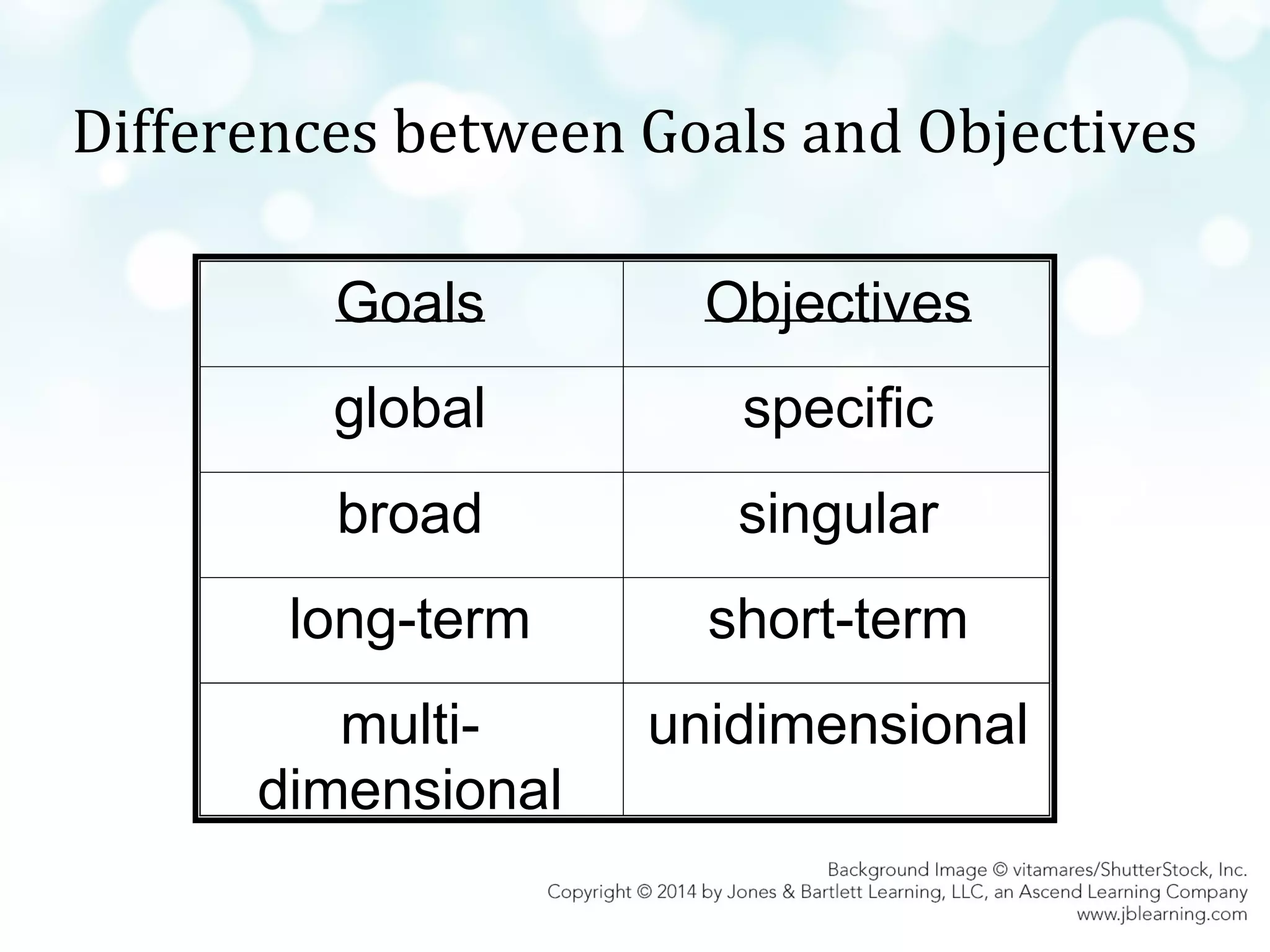
Differences between Goals and Objectives
Goals

Objectives

global

specific

broad

singular

long-term

short-term

multidimensional

unidimensional
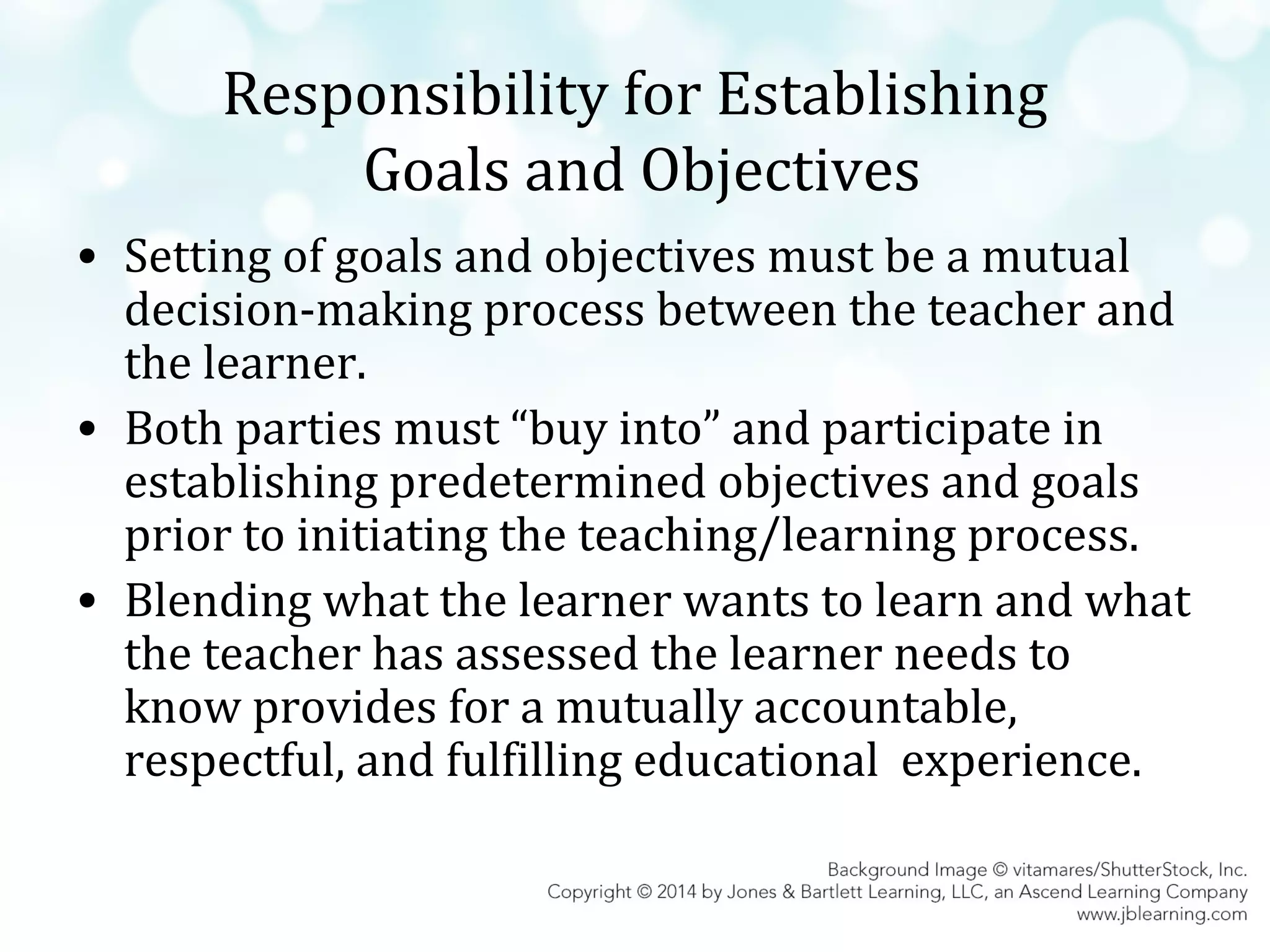
Responsibility for Establishing
Goals and Objectives
• Setting of goals and objectives must be a mutual
decision-making process between the teacher and
the learner.
• Both parties must “buy into” and participate in
establishing predetermined objectives and goals
prior to initiating the teaching/learning process.
• Blending what the learner wants to learn and what
the teacher has assessed the learner needs to
know provides for a mutually accountable,
respectful, and fulfilling educational experience.
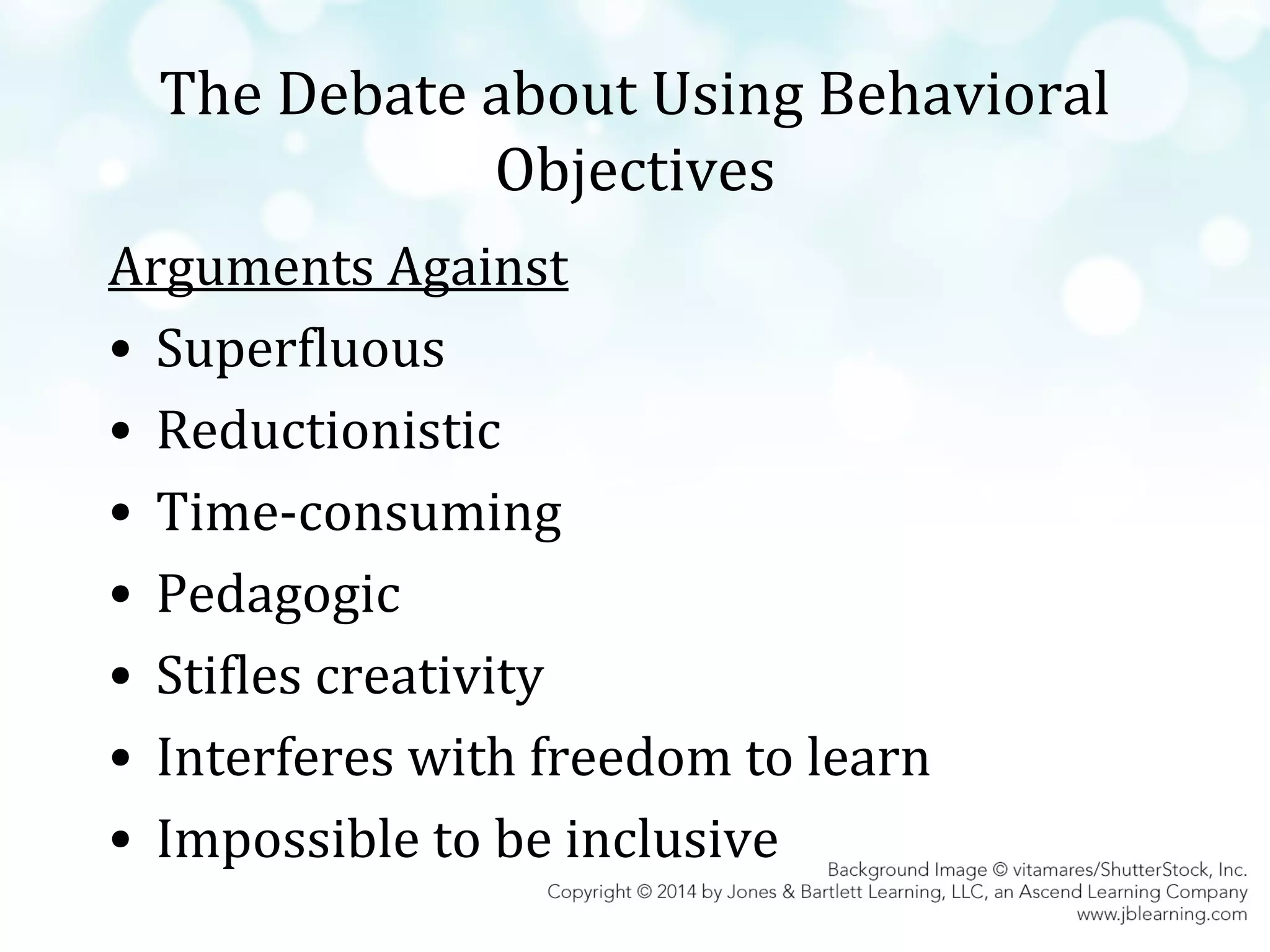
The Debate about Using Behavioral
Objectives
Arguments Against
• Superfluous
• Reductionistic
• Time-consuming
• Pedagogic
• Stifles creativity
• Interferes with freedom to learn
• Impossible to be inclusive
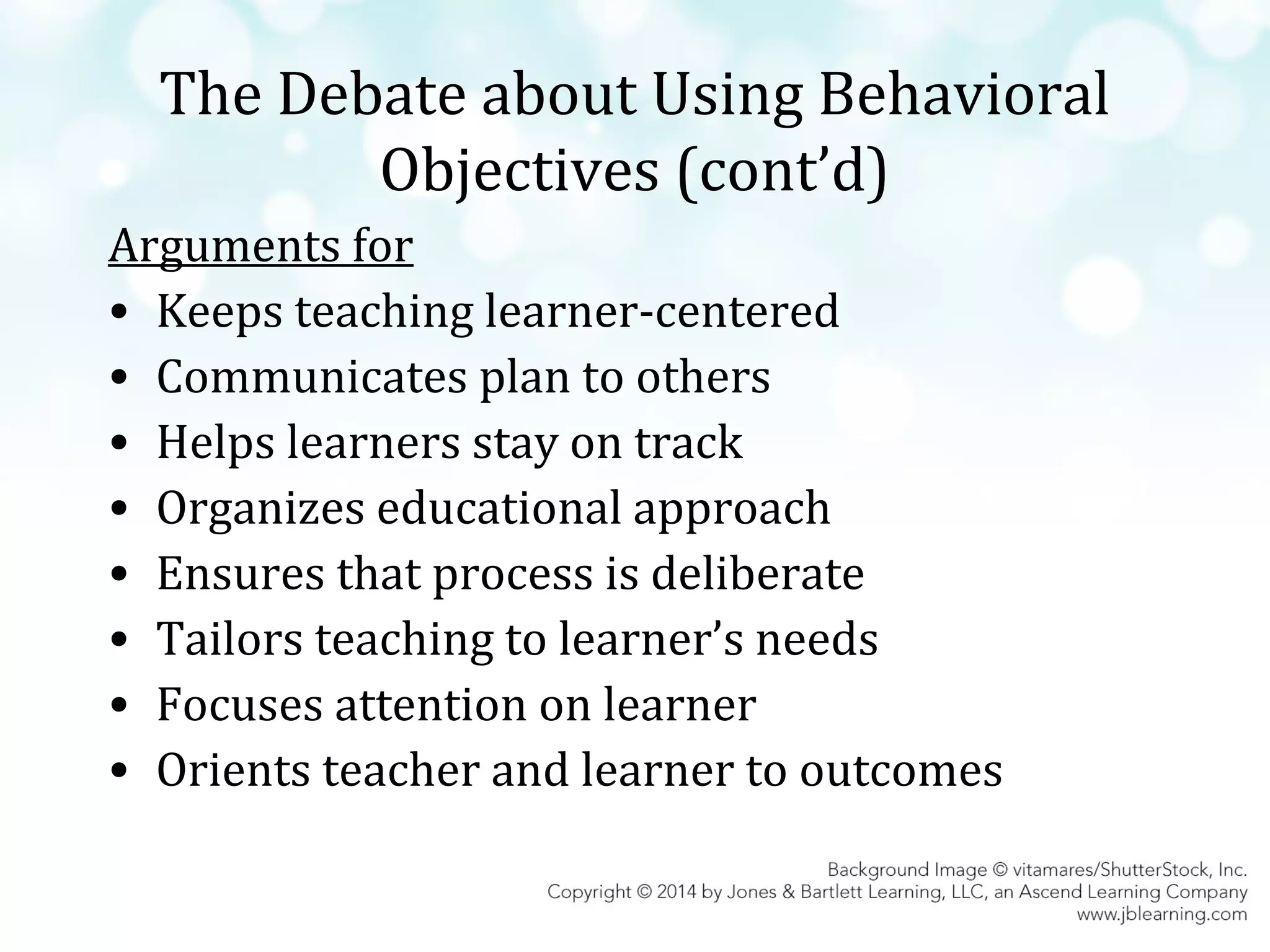
The Debate about Using Behavioral
Objectives (cont’d)
Arguments for
• Keeps teaching learner-centered
• Communicates plan to others
• Helps learners stay on track
• Organizes educational approach
• Ensures that process is deliberate
• Tailors teaching to learner’s needs
• Focuses attention on learner
• Orients teacher and learner to outcomes
Three Major Advantages
to Writing Objectives
• Provides basis for selection and design of
instructional content, methods, and
materials
• Provides learner with means to organize
efforts toward accomplishing objectives
• Allows for determination as to the extent
that objectives have been accomplished
Writing Behavioral Objectives
Three important characteristics:
1. Performance—describes what the
learner is expected to be able to do
2. Condition—describes the situation
under which behavior will be observed
3. Criterion—describes how well or with
what accuracy the learner must be able to
perform
The Four Step Approach
To link a behavioral objective together, the
following three steps are recommended:
1. Identify the testing situation (condition).
2. Identify who will perform (learner).
3. State what the learner will demonstrate
(performance).
4. State how well the learner will perform
(criterion).
The ABCD Rule
• A—Audience (who)
• B—Behavior (what)
• C—Condition (under what
circumstances)
• D—Degree (how much, to what extent)
Common Mistakes
When Writing Objectives
• Describing what the instructor will do rather
than what the learner will do
• Including more than one behavior in a single
objective
• Forgetting to include all three characteristics
• Using performance terms subject to many
interpretations and that are not actionoriented
Common Mistakes (cont’d)
• Writing an unattainable, unrealistic
objective
• Writing objectives unrelated to stated goal
• Cluttering an objective with unnecessary
information
• Making an objective too general so that the
outcome is not clear
Taxonomy of Objectives
Behavior is defined according to type
(domain category) and level of
complexity (simple to complex).
Three Types of Learning Domains
1. Cognitive—the “thinking” domain
2. Affective—the “feeling” domain
3. Psychomotor—the “skills” domain
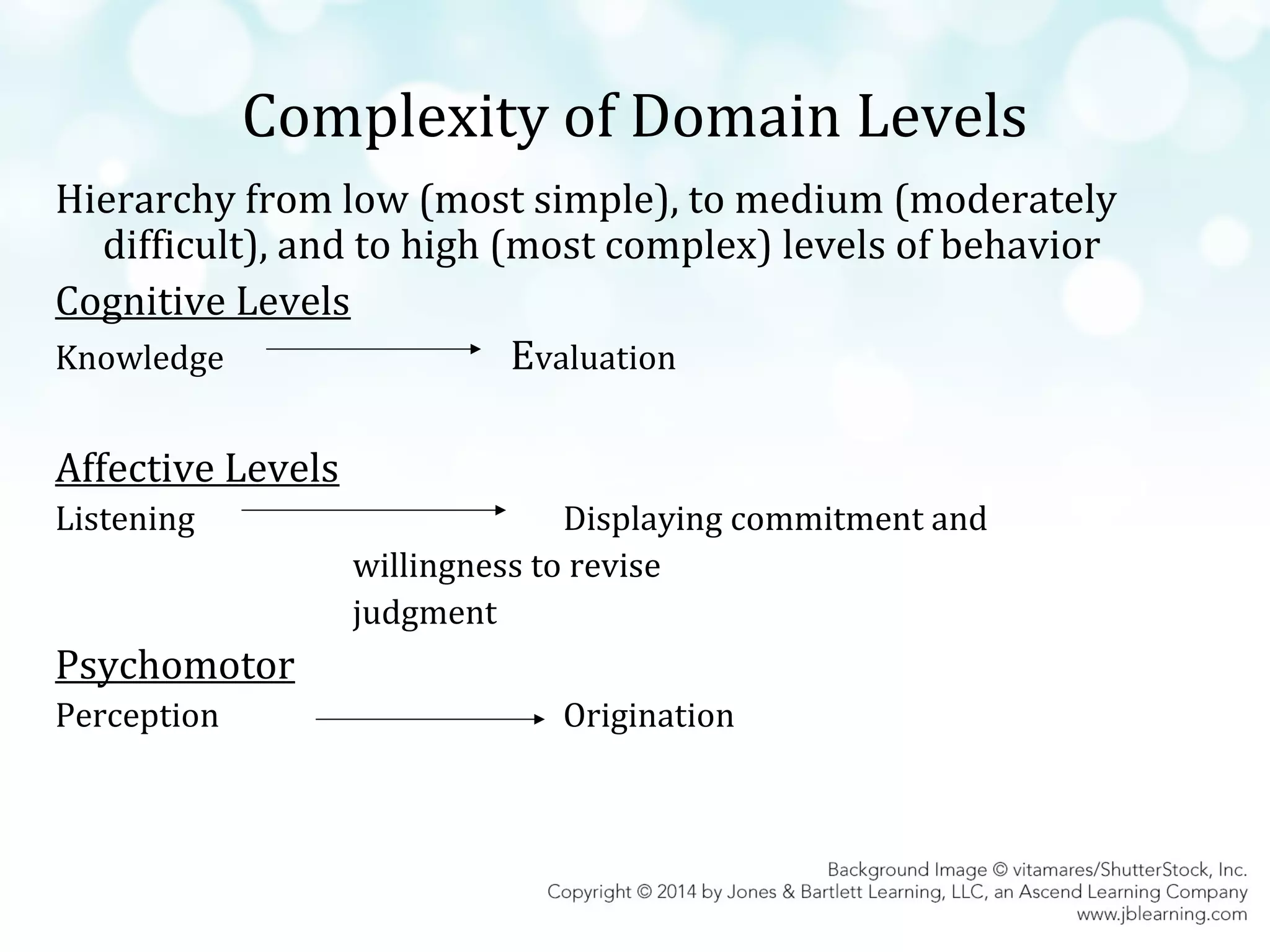
Complexity of Domain Levels
Hierarchy from low (most simple), to medium (moderately
difficult), and to high (most complex) levels of behavior
Cognitive Levels
Knowledge
Evaluation
Affective Levels
Listening

Displaying commitment and
willingness to revise
judgment

Psychomotor
Perception

Origination
Teaching in the Cognitive Domain
Learning in this domain involves acquisition of
information based on the learner’s intellectual
abilities and thinking processes.
• Methods most often used to stimulate learning in
the cognitive domain include:
- Lecture
- One-to-one instruction
- Computer-assisted instruction
Teaching in the Cognitive Domain
(cont’d)
• Cognitive-domain learning is the
traditional focus of most teaching.
• Cognitive knowledge is an essential
prerequisite for learning affective and
psychomotor skills.
Teaching in the Affective Domain
Learning in this domain involves an
increasing internalization or commitment
to feelings; affective learning involves the
degree to which feelings or attitudes are
incorporated into one’s personality or
value system
• Methods most often used to stimulate learning
in the affective domain include:
- Group discussion
- Role-playing
Teaching in the Affective Domain
(cont’d)
- Role-modeling
- Simulation gaming
- Questioning

• Nurse educators are encouraged to attend to
the needs of the whole person by recognizing
that learning is subjective and values driven.
• More time in teaching needs to focus on
exploring and clarifying learner feelings,
emotions, and attitudes.
Teaching in the Psychomotor Domain
Learning in this domain involves acquiring fine
and gross motor abilities with increasing
complexity of neuromuscular coordination.
• Methods most often used to stimulate learning in the
psychomotor domain include:

- Demonstration
- Return demonstration
- Simulation
- Gaming
- Self-instruction
Teaching in the Psychomotor Domain
(cont’d)
• Psychomotor skill development is very egocentric
and requires learner concentration.
• Asking questions that demand a cognitive or
affective response during psychomotor learning
interferes with psychomotor performance.
• The ability to perform a skill is not equivalent to
learning a skill (performance is transitory; learning
is more permanent).
• “Practice makes perfect”—repetition leads to
perfection and reinforcement of behavior.
Factors Influencing Psychomotor Skill
Acquisition
The amount of practice required to learn a
new skill varies with the individual,
depending upon such things as:
- Readiness to learn
- Motivation to learn
- Past experience
- Health status
Factors Influencing Psychomotor Skill
Acquisition (cont’d)
- Environmental stimuli
- Anxiety level
- Developmental stage
- Practice session length
Development of Teaching Plans
• Predetermined goals and objectives serve
as a basis for developing a teaching plan.
• Mutually agreed upon goals and
objectives clarify what the learner is to
learn and what the teacher is to teach.
Reasons to Construct Teaching Plans
1. Ensures a logical approach to teaching and
keeps instruction on target.
2. Communicates in writing an action plan for
the learner, teacher, and other providers.
3. Serves as a legal document that indicates a
plan is in place and the extent of progress
toward implementation.
Basic Elements of a Teaching Plan
•
•
•
•
•
•
•
•

Purpose
Goal statement
Objectives (sub-objectives)
Content outline
Methods of teaching
Time allotment
Resources for instruction
Evaluation
The Major Criterion for Judging a
Teaching Plan
Internal consistency exists when you can
answer “yes” to the following questions:
- Does the plan facilitate a relationship
between its parts?
- Do all 8 elements of the plan “hang
together”?
The Major Criterion for Judging a
Teaching Plan (cont’d)
- Is the identified domain of learning in
each objective reflected in the purpose
and goal, as well as across the plan, all the
way through to the end process of
evaluation?
Use of Learning Contracts
Learning Contract: A written (formal) or verbal
(informal) agreement between the teacher
and the learner that delineates specific
teaching and learning activities that are to
occur within a certain time frame.
Purpose of a Learning Contract
• To encourage learner’s active participation
• To improve teacher–client communication
Use of Learning Contracts (cont’d)
Learning contracts:
• Are an increasingly popular approach to
teaching and learning.
• Serve as an alternative and innovative
technique that embodies the principles of
adult learning.
• Can be used with any audience of adult
learners.
Use of Learning Contracts (cont’d)
• Empower the learner by emphasizing
self-direction, mutual negotiation, and
mutual evaluation of competency.
• Stress shared accountability between the
teacher and the learner.
Components of the Learning Contract
Four major components
1.Content—specifies precise behavioral
objectives.
2.Performance expectations—specify
conditions by which learning will be
achieved.
Components of Learning Contract
(cont’d)
3. Evaluation—specifies criteria by which
competencies will be judged.
4. Time frame—specifies length of time
needed for successful achievement of
objectives.
The Concept of Learning Curve
Learning Curve: A graphic depiction of
changes in psychomotor performance at
different stages of practice during a
specified time period
• Six stages of the theoretical learning
curve
• The irregularity of individual learning
curves
State of the Evidence
• Educational literature has plenty of evidence
establishing the value and utility of behavioral
objectives.
• Taxonomic hierarchy for categorizing
behaviors has also been established.
• Body of evidence on teaching plans is available.
• Educational literature has new research on
learning contracts, psychomotor skill
acquisition, learning curve concept.
Summary
• Assessment of the learner is a
prerequisite to formulating objectives.
• Writing clear and concise behavioral
objectives is fundamental to the
education process.
• Goals and objectives serve as a guide to
planning, implementation, and evaluation
of teaching and learning.
Chapter 10

  • 1.
  • 2.
    Definition of Terms Goal:the final outcome of what is achieved at the end of the teaching–learning process Objective: a behavior describing the performance that learners should be able to exhibit to be considered competent
  • 3.
    Types of Objectives EducationalObjectives: identify intended outcomes of the education process in reference to an aspect of a program or a total program of study Instructional Objectives: describe teaching activities and resources used to facilitate effective learning
  • 4.
    Types of Objectives(cont’d) Behavioral/Learning Objectives: actionoriented, learner-centered outcomes of the teaching/learning process
  • 5.
    Differences between Goalsand Objectives Goals Objectives global specific broad singular long-term short-term multidimensional unidimensional
  • 6.
    Responsibility for Establishing Goalsand Objectives • Setting of goals and objectives must be a mutual decision-making process between the teacher and the learner. • Both parties must “buy into” and participate in establishing predetermined objectives and goals prior to initiating the teaching/learning process. • Blending what the learner wants to learn and what the teacher has assessed the learner needs to know provides for a mutually accountable, respectful, and fulfilling educational experience.
  • 7.
    The Debate aboutUsing Behavioral Objectives Arguments Against • Superfluous • Reductionistic • Time-consuming • Pedagogic • Stifles creativity • Interferes with freedom to learn • Impossible to be inclusive
  • 8.
    The Debate aboutUsing Behavioral Objectives (cont’d) Arguments for • Keeps teaching learner-centered • Communicates plan to others • Helps learners stay on track • Organizes educational approach • Ensures that process is deliberate • Tailors teaching to learner’s needs • Focuses attention on learner • Orients teacher and learner to outcomes
  • 9.
    Three Major Advantages toWriting Objectives • Provides basis for selection and design of instructional content, methods, and materials • Provides learner with means to organize efforts toward accomplishing objectives • Allows for determination as to the extent that objectives have been accomplished
  • 10.
    Writing Behavioral Objectives Threeimportant characteristics: 1. Performance—describes what the learner is expected to be able to do 2. Condition—describes the situation under which behavior will be observed 3. Criterion—describes how well or with what accuracy the learner must be able to perform
  • 11.
    The Four StepApproach To link a behavioral objective together, the following three steps are recommended: 1. Identify the testing situation (condition). 2. Identify who will perform (learner). 3. State what the learner will demonstrate (performance). 4. State how well the learner will perform (criterion).
  • 12.
    The ABCD Rule •A—Audience (who) • B—Behavior (what) • C—Condition (under what circumstances) • D—Degree (how much, to what extent)
  • 13.
    Common Mistakes When WritingObjectives • Describing what the instructor will do rather than what the learner will do • Including more than one behavior in a single objective • Forgetting to include all three characteristics • Using performance terms subject to many interpretations and that are not actionoriented
  • 14.
    Common Mistakes (cont’d) •Writing an unattainable, unrealistic objective • Writing objectives unrelated to stated goal • Cluttering an objective with unnecessary information • Making an objective too general so that the outcome is not clear
  • 15.
    Taxonomy of Objectives Behavioris defined according to type (domain category) and level of complexity (simple to complex). Three Types of Learning Domains 1. Cognitive—the “thinking” domain 2. Affective—the “feeling” domain 3. Psychomotor—the “skills” domain
  • 16.
    Complexity of DomainLevels Hierarchy from low (most simple), to medium (moderately difficult), and to high (most complex) levels of behavior Cognitive Levels Knowledge Evaluation Affective Levels Listening Displaying commitment and willingness to revise judgment Psychomotor Perception Origination
  • 17.
    Teaching in theCognitive Domain Learning in this domain involves acquisition of information based on the learner’s intellectual abilities and thinking processes. • Methods most often used to stimulate learning in the cognitive domain include: - Lecture - One-to-one instruction - Computer-assisted instruction
  • 18.
    Teaching in theCognitive Domain (cont’d) • Cognitive-domain learning is the traditional focus of most teaching. • Cognitive knowledge is an essential prerequisite for learning affective and psychomotor skills.
  • 19.
    Teaching in theAffective Domain Learning in this domain involves an increasing internalization or commitment to feelings; affective learning involves the degree to which feelings or attitudes are incorporated into one’s personality or value system • Methods most often used to stimulate learning in the affective domain include: - Group discussion - Role-playing
  • 20.
    Teaching in theAffective Domain (cont’d) - Role-modeling - Simulation gaming - Questioning • Nurse educators are encouraged to attend to the needs of the whole person by recognizing that learning is subjective and values driven. • More time in teaching needs to focus on exploring and clarifying learner feelings, emotions, and attitudes.
  • 21.
    Teaching in thePsychomotor Domain Learning in this domain involves acquiring fine and gross motor abilities with increasing complexity of neuromuscular coordination. • Methods most often used to stimulate learning in the psychomotor domain include: - Demonstration - Return demonstration - Simulation - Gaming - Self-instruction
  • 22.
    Teaching in thePsychomotor Domain (cont’d) • Psychomotor skill development is very egocentric and requires learner concentration. • Asking questions that demand a cognitive or affective response during psychomotor learning interferes with psychomotor performance. • The ability to perform a skill is not equivalent to learning a skill (performance is transitory; learning is more permanent). • “Practice makes perfect”—repetition leads to perfection and reinforcement of behavior.
  • 23.
    Factors Influencing PsychomotorSkill Acquisition The amount of practice required to learn a new skill varies with the individual, depending upon such things as: - Readiness to learn - Motivation to learn - Past experience - Health status
  • 24.
    Factors Influencing PsychomotorSkill Acquisition (cont’d) - Environmental stimuli - Anxiety level - Developmental stage - Practice session length
  • 25.
    Development of TeachingPlans • Predetermined goals and objectives serve as a basis for developing a teaching plan. • Mutually agreed upon goals and objectives clarify what the learner is to learn and what the teacher is to teach.
  • 26.
    Reasons to ConstructTeaching Plans 1. Ensures a logical approach to teaching and keeps instruction on target. 2. Communicates in writing an action plan for the learner, teacher, and other providers. 3. Serves as a legal document that indicates a plan is in place and the extent of progress toward implementation.
  • 27.
    Basic Elements ofa Teaching Plan • • • • • • • • Purpose Goal statement Objectives (sub-objectives) Content outline Methods of teaching Time allotment Resources for instruction Evaluation
  • 28.
    The Major Criterionfor Judging a Teaching Plan Internal consistency exists when you can answer “yes” to the following questions: - Does the plan facilitate a relationship between its parts? - Do all 8 elements of the plan “hang together”?
  • 29.
    The Major Criterionfor Judging a Teaching Plan (cont’d) - Is the identified domain of learning in each objective reflected in the purpose and goal, as well as across the plan, all the way through to the end process of evaluation?
  • 30.
    Use of LearningContracts Learning Contract: A written (formal) or verbal (informal) agreement between the teacher and the learner that delineates specific teaching and learning activities that are to occur within a certain time frame. Purpose of a Learning Contract • To encourage learner’s active participation • To improve teacher–client communication
  • 31.
    Use of LearningContracts (cont’d) Learning contracts: • Are an increasingly popular approach to teaching and learning. • Serve as an alternative and innovative technique that embodies the principles of adult learning. • Can be used with any audience of adult learners.
  • 32.
    Use of LearningContracts (cont’d) • Empower the learner by emphasizing self-direction, mutual negotiation, and mutual evaluation of competency. • Stress shared accountability between the teacher and the learner.
  • 33.
    Components of theLearning Contract Four major components 1.Content—specifies precise behavioral objectives. 2.Performance expectations—specify conditions by which learning will be achieved.
  • 34.
    Components of LearningContract (cont’d) 3. Evaluation—specifies criteria by which competencies will be judged. 4. Time frame—specifies length of time needed for successful achievement of objectives.
  • 35.
    The Concept ofLearning Curve Learning Curve: A graphic depiction of changes in psychomotor performance at different stages of practice during a specified time period • Six stages of the theoretical learning curve • The irregularity of individual learning curves
  • 36.
    State of theEvidence • Educational literature has plenty of evidence establishing the value and utility of behavioral objectives. • Taxonomic hierarchy for categorizing behaviors has also been established. • Body of evidence on teaching plans is available. • Educational literature has new research on learning contracts, psychomotor skill acquisition, learning curve concept.
  • 37.
    Summary • Assessment ofthe learner is a prerequisite to formulating objectives. • Writing clear and concise behavioral objectives is fundamental to the education process. • Goals and objectives serve as a guide to planning, implementation, and evaluation of teaching and learning.