Standards B
Philippine Standard on Auditing 530 (Redrafted)
AUDIT SAMPLING
Auditing and Assurance Standards Council
PSA 530 (Redrafted)
1
PHILIPPINE STANDARD ON AUDITING 530∗∗∗∗
(REDRAFTED)
AUDIT SAMPLING
(Effective for audits of financial statements for periods beginning on or after December 15, 2009)
CONTENTS
Paragraph
Introduction
Scope of this PSA.................................................................................................... 1-2
Effective Date......................................................................................................... 3
Objective................................................................................................................ 4
Definitions............................................................................................................. 5
Requirements
Sample Design, Size and Selection of Items for Testing....................................... 6-8
Performing Audit Procedures................................................................................ 9-11
Nature and Cause of Deviations and Misstatements.............................................. 12-13
Projecting Misstatements....................................................................................... 14
Evaluating Results of Audit Sampling.................................................................. 15
Application and Other Explanatory Material
Definitions............................................................................................................. A1-A3
Sample Design, Size and Selection of Items for Testing...................................... A4-A13
Performing Audit Procedures............................................................................... A14-A16
Nature and Cause of Deviations and Misstatements............................................ A17
Projecting Misstatements..................................................................................... A18-A20
Evaluating Results of Audit Sampling................................................................. A21-A23
Acknowledgment
∗
[References in this PSA to other PSAs that have not yet been finalized reflect the working titles of those
PSAs. The references are indicated in brackets and will be updated when those PSAs are finalized.]
PSA 530 (Redrafted)
2
Appendix 1: Stratification and Value-Weighted Selection
Appendix 2: Examples of Factors Influencing Sample Size for Tests of Controls
Appendix 3: Examples of Factors Influencing Sample Size for Tests of Details
Appendix 4: Sample Selection Methods
Philippine Standard on Auditing (PSA) 530 (Redrafted), “Audit Sampling” should be
read in conjunction with PSA 200 (Revised and Redrafted), “Overall Objectives of the
Independent Auditor and the Conduct of an Audit in Accordance with Philippine
Standards on Auditing.”
PSA 530 (Redrafted)
3
Introduction
Scope of this PSA
1. This Philippine Standard on Auditing (PSA) applies when the auditor has decided
to use audit sampling in performing audit procedures. It deals with the auditor’s
use of statistical and non-statistical sampling when designing and selecting the
audit sample, performing tests of controls and tests of details, and evaluating the
results from the sample.
2. This PSA complements PSA 500 (Redrafted),1
which deals with the auditor’s
responsibility to design and perform audit procedures to obtain sufficient
appropriate audit evidence to be able to draw reasonable conclusions on which to
base the audit opinion. PSA 500 (Redrafted) provides guidance on the means
available to the auditor for selecting items for testing, of which audit sampling is
one means.
Effective Date
3. This PSA is effective for audits of financial statements for periods beginning on or
after December 15, 2009.
Objective
4. The objective of the auditor when using audit sampling is to provide a reasonable
basis for the auditor to draw conclusions about the population from which the
sample is selected.
Definitions
5. For purposes of the PSAs, the following terms have the meanings attributed
below:
(a) Audit sampling (sampling) – The application of audit procedures to less than
100% of items within a population of audit relevance such that all sampling
units have a chance of selection in order to provide the auditor with a
reasonable basis on which to draw conclusions about the entire population.
(b) Population – The entire set of data from which a sample is selected and
about which the auditor wishes to draw conclusions.
(c) Sampling risk – The risk that the auditor’s conclusion based on a sample
may be different from the conclusion if the entire population were subjected
to the same audit procedure. Sampling risk can lead to two types of
erroneous conclusions:
1
[PSA 500 (Redrafted), “Audit Evidence.”]
PSA 530 (Redrafted)
4
(i) In the case of a test of controls, that controls are more effective than
they actually are, or in the case of a test of details, that a material
misstatement does not exist when in fact it does. The auditor is
primarily concerned with this type of erroneous conclusion because it
affects audit effectiveness and is more likely to lead to an inappropriate
audit opinion.
(ii) In the case of a test of controls, that controls are less effective than
they actually are, or in the case of a test of details, that a material
misstatement exists when in fact it does not. This type of erroneous
conclusion affects audit efficiency as it would usually lead to
additional work to establish that initial conclusions were incorrect.
(d) Non-sampling risk – The risk that the auditor reaches an erroneous
conclusion for any reason not related to sampling risk. (Ref: Para A1)
(e) Anomaly – A misstatement or deviation that is demonstrably not
representative of misstatements or deviations in a population.
(f) Sampling unit – The individual items constituting a population. (Ref: Para A2)
(g) Statistical sampling – An approach to sampling that has the following
characteristics:
(i) Random selection of the sample items; and
(ii) The use of probability theory to evaluate sample results, including
measurement of sampling risk.
A sampling approach that does not have characteristics (i) and (ii) is
considered non-statistical sampling.
(h) Stratification – The process of dividing a population into sub-populations,
each of which is a group of sampling units which have similar characteristics
(often monetary value).
(i) Tolerable misstatement – A monetary amount set by the auditor in respect of
which the auditor seeks to obtain an appropriate level of assurance that the
monetary amount set by the auditor is not exceeded by the actual
misstatement in the population. (Ref: Para A3)
(j) Tolerable rate of deviation – A rate of deviation from prescribed internal
control procedures set by the auditor in respect of which the auditor seeks to
obtain an appropriate level of assurance that the rate of deviation set by the
auditor is not exceeded by the actual rate of deviation in the population.
PSA 530 (Redrafted)
5
Requirements
Sample Design, Size and Selection of Items for Testing
6. When designing an audit sample, the auditor shall consider the purpose of the
audit procedure and the characteristics of the population from which the sample
will be drawn. (Ref: Para. A4-A9)
7. The auditor shall determine a sample size sufficient to reduce sampling risk to an
acceptably low level. (Ref: Para. A10-A11)
8. The auditor shall select items for the sample in such a way that each sampling unit
in the population has a chance of selection. (Ref: Para. A12-A13)
Performing Audit Procedures
9. The auditor shall perform audit procedures, appropriate to the purpose, on each
item selected.
10. If the audit procedure is not applicable to the selected item, the auditor shall
perform the procedure on a replacement item. (Ref: Para. A14)
11. If the auditor is unable to apply the designed audit procedures, or suitable
alternative procedures, to a selected item, the auditor shall treat that item as a
deviation from the prescribed control, in the case of tests of controls, or a
misstatement, in the case of tests of details. (Ref: Para. A15-A16)
Nature and Cause of Deviations and Misstatements
12. The auditor shall investigate the nature and cause of any deviations or
misstatements identified, and evaluate their possible effect on the purpose of the
audit procedure and on other areas of the audit. (Ref: Para. A17)
13. In the extremely rare circumstances when the auditor considers a misstatement or
deviation discovered in a sample to be an anomaly, the auditor shall obtain a high
degree of certainty that such misstatement or deviation is not representative of the
population. The auditor shall obtain this degree of certainty by performing
additional audit procedures to obtain sufficient appropriate audit evidence that the
misstatement or deviation does not affect the remainder of the population.
Projecting Misstatements
14. For tests of details, the auditor shall project misstatements found in the sample to
the population. (Ref: Para. A18-A20)
PSA 530 (Redrafted)
6
Evaluating Results of Audit Sampling
15. The auditor shall evaluate:
(a) The results of the sample; and (Ref: Para. A21-A22)
(b) Whether the use of audit sampling has provided a reasonable basis for
conclusions about the population that has been tested. (Ref: Para. A23)
***
Application and Other Explanatory Material
Definitions
Non-Sampling Risk (Ref: Para. 5(d))
A1. Examples of non-sampling risk include use of inappropriate audit procedures, or
misinterpretation of audit evidence and failure to recognize a misstatement or
deviation.
Sampling Unit (Ref: Para. 5(f))
A2. The sampling units might be physical items (for example, checks listed on deposit
slips, credit entries on bank statements, sales invoices or debtors’ balances) or
monetary units.
Tolerable Misstatement (Ref: Para. 5(i))
A3. When designing a sample, the auditor determines tolerable misstatement in order
to address the risk that the aggregate of individually immaterial misstatements
may cause the financial statements to be materially misstated and provide a
margin for possible undetected misstatements. Tolerable misstatement is the
application of performance materiality, as defined in PSA 320 (Revised and
Redrafted),2
to a particular sampling procedure. Tolerable misstatement may be
the same amount or an amount lower than performance materiality.
Sample Design, Size and Selection of Items for Testing
Sample Design (Ref: Para. 6)
A4. Audit sampling enables the auditor to obtain and evaluate audit evidence about
some characteristic of the items selected in order to form or assist in forming a
conclusion concerning the population from which the sample is drawn. Audit
2
PSA 320 (Revised and Redrafted), “Materiality in Planning and Performing an Audit,” paragraph 9.
PSA 530 (Redrafted)
7
sampling can be applied using either non-statistical or statistical sampling
approaches.
A5. When designing an audit sample, the auditor’s consideration includes the specific
purpose to be achieved and the combination of audit procedures that is likely to
best achieve that purpose. Consideration of the nature of the audit evidence sought
and possible deviation or misstatement conditions or other characteristics relating
to that audit evidence will assist the auditor in defining what constitutes a
deviation or misstatement and what population to use for sampling. In fulfilling
the requirement of paragraph 8 of PSA 500 (Redrafted), when performing audit
sampling, the auditor performs audit procedures to obtain evidence that the
population from which the audit sample is drawn is complete.
A6. The auditor’s consideration of the purpose of the audit procedure, as required by
paragraph 6, includes a clear understanding of what constitutes a deviation or
misstatement so that all, and only, those conditions that are relevant to the purpose
of the audit procedure are included in the evaluation of deviations or projection of
misstatements. For example, in a test of details relating to the existence of
accounts receivable, such as confirmation, payments made by the customer before
the confirmation date but received shortly after that date by the client, are not
considered a misstatement. Also, a misposting between customer accounts does
not affect the total accounts receivable balance. Therefore, it may not be
appropriate to consider this a misstatement in evaluating the sample results of this
particular audit procedure, even though it may have an important effect on other
areas of the audit, such as the assessment of the risk of fraud or the adequacy of
the allowance for doubtful accounts.
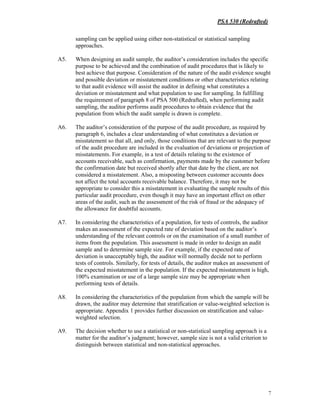
A7. In considering the characteristics of a population, for tests of controls, the auditor
makes an assessment of the expected rate of deviation based on the auditor’s
understanding of the relevant controls or on the examination of a small number of
items from the population. This assessment is made in order to design an audit
sample and to determine sample size. For example, if the expected rate of
deviation is unacceptably high, the auditor will normally decide not to perform
tests of controls. Similarly, for tests of details, the auditor makes an assessment of
the expected misstatement in the population. If the expected misstatement is high,
100% examination or use of a large sample size may be appropriate when
performing tests of details.
A8. In considering the characteristics of the population from which the sample will be
drawn, the auditor may determine that stratification or value-weighted selection is
appropriate. Appendix 1 provides further discussion on stratification and value-
weighted selection.
A9. The decision whether to use a statistical or non-statistical sampling approach is a
matter for the auditor’s judgment; however, sample size is not a valid criterion to
distinguish between statistical and non-statistical approaches.
PSA 530 (Redrafted)
8
Sample Size (Ref: Para. 7)
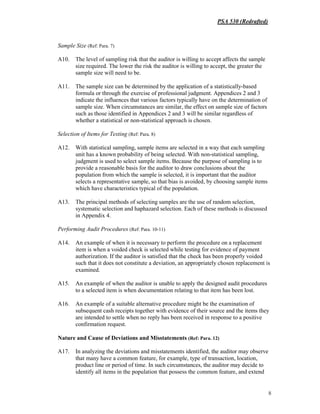
A10. The level of sampling risk that the auditor is willing to accept affects the sample
size required. The lower the risk the auditor is willing to accept, the greater the
sample size will need to be.
A11. The sample size can be determined by the application of a statistically-based
formula or through the exercise of professional judgment. Appendices 2 and 3
indicate the influences that various factors typically have on the determination of
sample size. When circumstances are similar, the effect on sample size of factors
such as those identified in Appendices 2 and 3 will be similar regardless of
whether a statistical or non-statistical approach is chosen.
Selection of Items for Testing (Ref: Para. 8)
A12. With statistical sampling, sample items are selected in a way that each sampling
unit has a known probability of being selected. With non-statistical sampling,
judgment is used to select sample items. Because the purpose of sampling is to
provide a reasonable basis for the auditor to draw conclusions about the
population from which the sample is selected, it is important that the auditor
selects a representative sample, so that bias is avoided, by choosing sample items
which have characteristics typical of the population.
A13. The principal methods of selecting samples are the use of random selection,
systematic selection and haphazard selection. Each of these methods is discussed
in Appendix 4.
Performing Audit Procedures (Ref: Para. 10-11)
A14. An example of when it is necessary to perform the procedure on a replacement
item is when a voided check is selected while testing for evidence of payment
authorization. If the auditor is satisfied that the check has been properly voided
such that it does not constitute a deviation, an appropriately chosen replacement is
examined.
A15. An example of when the auditor is unable to apply the designed audit procedures
to a selected item is when documentation relating to that item has been lost.
A16. An example of a suitable alternative procedure might be the examination of
subsequent cash receipts together with evidence of their source and the items they
are intended to settle when no reply has been received in response to a positive
confirmation request.
Nature and Cause of Deviations and Misstatements (Ref: Para. 12)
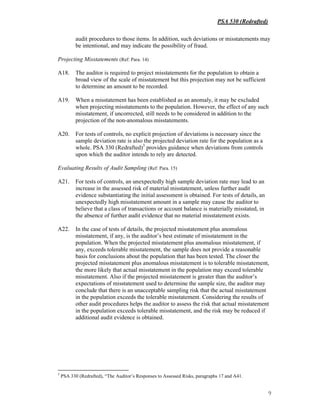
A17. In analyzing the deviations and misstatements identified, the auditor may observe
that many have a common feature, for example, type of transaction, location,
product line or period of time. In such circumstances, the auditor may decide to
identify all items in the population that possess the common feature, and extend
PSA 530 (Redrafted)
9
audit procedures to those items. In addition, such deviations or misstatements may
be intentional, and may indicate the possibility of fraud.
Projecting Misstatements (Ref: Para. 14)
A18. The auditor is required to project misstatements for the population to obtain a
broad view of the scale of misstatement but this projection may not be sufficient
to determine an amount to be recorded.
A19. When a misstatement has been established as an anomaly, it may be excluded
when projecting misstatements to the population. However, the effect of any such
misstatement, if uncorrected, still needs to be considered in addition to the
projection of the non-anomalous misstatements.
A20. For tests of controls, no explicit projection of deviations is necessary since the
sample deviation rate is also the projected deviation rate for the population as a
whole. PSA 330 (Redrafted)3
provides guidance when deviations from controls
upon which the auditor intends to rely are detected.
Evaluating Results of Audit Sampling (Ref: Para. 15)
A21. For tests of controls, an unexpectedly high sample deviation rate may lead to an
increase in the assessed risk of material misstatement, unless further audit
evidence substantiating the initial assessment is obtained. For tests of details, an
unexpectedly high misstatement amount in a sample may cause the auditor to
believe that a class of transactions or account balance is materially misstated, in
the absence of further audit evidence that no material misstatement exists.
A22. In the case of tests of details, the projected misstatement plus anomalous
misstatement, if any, is the auditor’s best estimate of misstatement in the
population. When the projected misstatement plus anomalous misstatement, if
any, exceeds tolerable misstatement, the sample does not provide a reasonable
basis for conclusions about the population that has been tested. The closer the
projected misstatement plus anomalous misstatement is to tolerable misstatement,
the more likely that actual misstatement in the population may exceed tolerable
misstatement. Also if the projected misstatement is greater than the auditor’s
expectations of misstatement used to determine the sample size, the auditor may
conclude that there is an unacceptable sampling risk that the actual misstatement
in the population exceeds the tolerable misstatement. Considering the results of
other audit procedures helps the auditor to assess the risk that actual misstatement
in the population exceeds tolerable misstatement, and the risk may be reduced if
additional audit evidence is obtained.
3
PSA 330 (Redrafted), “The Auditor’s Responses to Assessed Risks, paragraphs 17 and A41.
PSA 530 (Redrafted)
10
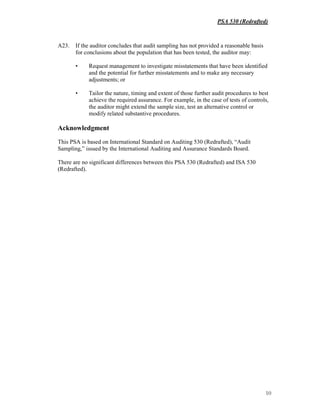
A23. If the auditor concludes that audit sampling has not provided a reasonable basis
for conclusions about the population that has been tested, the auditor may:
• Request management to investigate misstatements that have been identified
and the potential for further misstatements and to make any necessary
adjustments; or
• Tailor the nature, timing and extent of those further audit procedures to best
achieve the required assurance. For example, in the case of tests of controls,
the auditor might extend the sample size, test an alternative control or
modify related substantive procedures.
Acknowledgment
This PSA is based on International Standard on Auditing 530 (Redrafted), “Audit
Sampling,” issued by the International Auditing and Assurance Standards Board.
There are no significant differences between this PSA 530 (Redrafted) and ISA 530
(Redrafted).
PSA 530 (Redrafted)
11
Appendix 1
(Ref: Para. A8)
Stratification and Value-Weighted Selection
In considering the characteristics of the population from which the sample will be drawn,
the auditor may determine that stratification or value-weighted selection is appropriate.
This Appendix provides guidance to the auditor on the use of stratification and value-
weighted sampling techniques.
Stratification
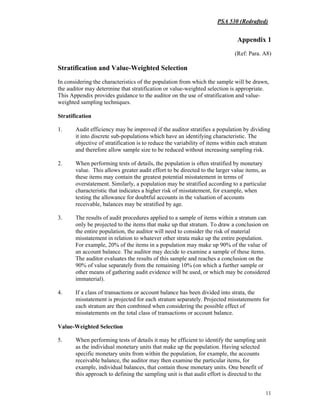
1. Audit efficiency may be improved if the auditor stratifies a population by dividing
it into discrete sub-populations which have an identifying characteristic. The
objective of stratification is to reduce the variability of items within each stratum
and therefore allow sample size to be reduced without increasing sampling risk.
2. When performing tests of details, the population is often stratified by monetary
value. This allows greater audit effort to be directed to the larger value items, as
these items may contain the greatest potential misstatement in terms of
overstatement. Similarly, a population may be stratified according to a particular
characteristic that indicates a higher risk of misstatement, for example, when
testing the allowance for doubtful accounts in the valuation of accounts
receivable, balances may be stratified by age.
3. The results of audit procedures applied to a sample of items within a stratum can
only be projected to the items that make up that stratum. To draw a conclusion on
the entire population, the auditor will need to consider the risk of material
misstatement in relation to whatever other strata make up the entire population.
For example, 20% of the items in a population may make up 90% of the value of
an account balance. The auditor may decide to examine a sample of these items.
The auditor evaluates the results of this sample and reaches a conclusion on the
90% of value separately from the remaining 10% (on which a further sample or
other means of gathering audit evidence will be used, or which may be considered
immaterial).
4. If a class of transactions or account balance has been divided into strata, the
misstatement is projected for each stratum separately. Projected misstatements for
each stratum are then combined when considering the possible effect of
misstatements on the total class of transactions or account balance.
Value-Weighted Selection
5. When performing tests of details it may be efficient to identify the sampling unit
as the individual monetary units that make up the population. Having selected
specific monetary units from within the population, for example, the accounts
receivable balance, the auditor may then examine the particular items, for
example, individual balances, that contain those monetary units. One benefit of
this approach to defining the sampling unit is that audit effort is directed to the
PSA 530 (Redrafted)
12
larger value items because they have a greater chance of selection, and can result
in smaller sample sizes. This approach may be used in conjunction with the
systematic method of sample selection (described in Appendix 4) and is most
efficient when selecting items using random selection.
PSA 530 (Redrafted)
13
Appendix 2
(Ref: Para. A11)
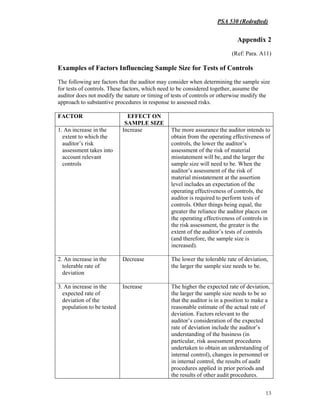
Examples of Factors Influencing Sample Size for Tests of Controls
The following are factors that the auditor may consider when determining the sample size
for tests of controls. These factors, which need to be considered together, assume the
auditor does not modify the nature or timing of tests of controls or otherwise modify the
approach to substantive procedures in response to assessed risks.
FACTOR EFFECT ON
SAMPLE SIZE
1. An increase in the
extent to which the
auditor’s risk
assessment takes into
account relevant
controls
Increase The more assurance the auditor intends to
obtain from the operating effectiveness of
controls, the lower the auditor’s
assessment of the risk of material
misstatement will be, and the larger the
sample size will need to be. When the
auditor’s assessment of the risk of
material misstatement at the assertion
level includes an expectation of the
operating effectiveness of controls, the
auditor is required to perform tests of
controls. Other things being equal, the
greater the reliance the auditor places on
the operating effectiveness of controls in
the risk assessment, the greater is the
extent of the auditor’s tests of controls
(and therefore, the sample size is
increased).
2. An increase in the
tolerable rate of
deviation
Decrease The lower the tolerable rate of deviation,
the larger the sample size needs to be.
3. An increase in the
expected rate of
deviation of the
population to be tested
Increase The higher the expected rate of deviation,
the larger the sample size needs to be so
that the auditor is in a position to make a
reasonable estimate of the actual rate of
deviation. Factors relevant to the
auditor’s consideration of the expected
rate of deviation include the auditor’s
understanding of the business (in
particular, risk assessment procedures
undertaken to obtain an understanding of
internal control), changes in personnel or
in internal control, the results of audit
procedures applied in prior periods and
the results of other audit procedures.
PSA 530 (Redrafted)
14
FACTOR EFFECT ON
SAMPLE SIZE
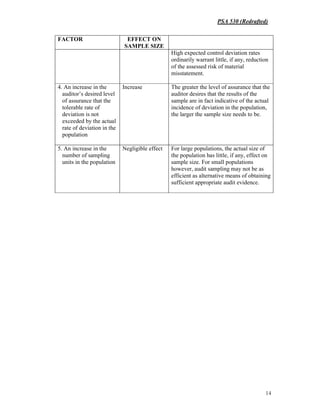
High expected control deviation rates
ordinarily warrant little, if any, reduction
of the assessed risk of material
misstatement.
4. An increase in the
auditor’s desired level
of assurance that the
tolerable rate of
deviation is not
exceeded by the actual
rate of deviation in the
population
Increase The greater the level of assurance that the
auditor desires that the results of the
sample are in fact indicative of the actual
incidence of deviation in the population,
the larger the sample size needs to be.
5. An increase in the
number of sampling
units in the population
Negligible effect For large populations, the actual size of
the population has little, if any, effect on
sample size. For small populations
however, audit sampling may not be as
efficient as alternative means of obtaining
sufficient appropriate audit evidence.
PSA 530 (Redrafted)
15
Appendix 3
(Ref: Para. A11)
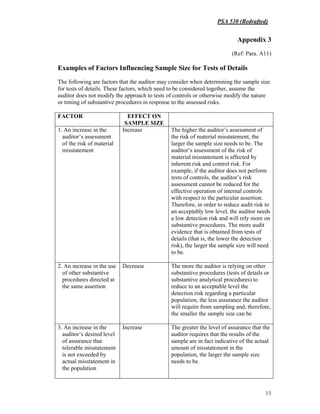
Examples of Factors Influencing Sample Size for Tests of Details
The following are factors that the auditor may consider when determining the sample size
for tests of details. These factors, which need to be considered together, assume the
auditor does not modify the approach to tests of controls or otherwise modify the nature
or timing of substantive procedures in response to the assessed risks.
FACTOR EFFECT ON
SAMPLE SIZE
1. An increase in the
auditor’s assessment
of the risk of material
misstatement
Increase The higher the auditor’s assessment of
the risk of material misstatement, the
larger the sample size needs to be. The
auditor’s assessment of the risk of
material misstatement is affected by
inherent risk and control risk. For
example, if the auditor does not perform
tests of controls, the auditor’s risk
assessment cannot be reduced for the
effective operation of internal controls
with respect to the particular assertion.
Therefore, in order to reduce audit risk to
an acceptably low level, the auditor needs
a low detection risk and will rely more on
substantive procedures. The more audit
evidence that is obtained from tests of
details (that is, the lower the detection
risk), the larger the sample size will need
to be.
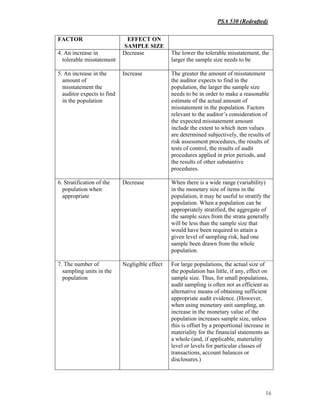
2. An increase in the use
of other substantive
procedures directed at
the same assertion
Decrease The more the auditor is relying on other
substantive procedures (tests of details or
substantive analytical procedures) to
reduce to an acceptable level the
detection risk regarding a particular
population, the less assurance the auditor
will require from sampling and, therefore,
the smaller the sample size can be
3. An increase in the
auditor’s desired level
of assurance that
tolerable misstatement
is not exceeded by
actual misstatement in
the population
Increase The greater the level of assurance that the
auditor requires that the results of the
sample are in fact indicative of the actual
amount of misstatement in the
population, the larger the sample size
needs to be.
PSA 530 (Redrafted)
16
FACTOR EFFECT ON
SAMPLE SIZE
4. An increase in
tolerable misstatement
Decrease The lower the tolerable misstatement, the
larger the sample size needs to be
5. An increase in the
amount of
misstatement the
auditor expects to find
in the population
Increase The greater the amount of misstatement
the auditor expects to find in the
population, the larger the sample size
needs to be in order to make a reasonable
estimate of the actual amount of
misstatement in the population. Factors
relevant to the auditor’s consideration of
the expected misstatement amount
include the extent to which item values
are determined subjectively, the results of
risk assessment procedures, the results of
tests of control, the results of audit
procedures applied in prior periods, and
the results of other substantive
procedures.
6. Stratification of the
population when
appropriate
Decrease When there is a wide range (variability)
in the monetary size of items in the
population, it may be useful to stratify the
population. When a population can be
appropriately stratified, the aggregate of
the sample sizes from the strata generally
will be less than the sample size that
would have been required to attain a
given level of sampling risk, had one
sample been drawn from the whole
population.
7. The number of
sampling units in the
population
Negligible effect For large populations, the actual size of
the population has little, if any, effect on
sample size. Thus, for small populations,
audit sampling is often not as efficient as
alternative means of obtaining sufficient
appropriate audit evidence. (However,
when using monetary unit sampling, an
increase in the monetary value of the
population increases sample size, unless
this is offset by a proportional increase in
materiality for the financial statements as
a whole (and, if applicable, materiality
level or levels for particular classes of
transactions, account balances or
disclosures.)
PSA 530 (Redrafted)
17
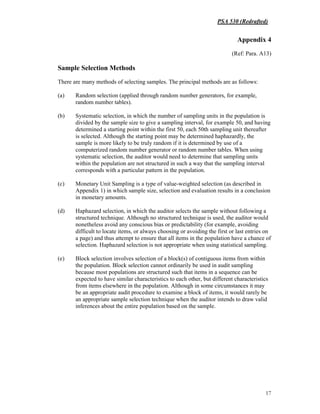
Appendix 4
(Ref: Para. A13)
Sample Selection Methods
There are many methods of selecting samples. The principal methods are as follows:
(a) Random selection (applied through random number generators, for example,
random number tables).
(b) Systematic selection, in which the number of sampling units in the population is
divided by the sample size to give a sampling interval, for example 50, and having
determined a starting point within the first 50, each 50th sampling unit thereafter
is selected. Although the starting point may be determined haphazardly, the
sample is more likely to be truly random if it is determined by use of a
computerized random number generator or random number tables. When using
systematic selection, the auditor would need to determine that sampling units
within the population are not structured in such a way that the sampling interval
corresponds with a particular pattern in the population.
(c) Monetary Unit Sampling is a type of value-weighted selection (as described in
Appendix 1) in which sample size, selection and evaluation results in a conclusion
in monetary amounts.
(d) Haphazard selection, in which the auditor selects the sample without following a
structured technique. Although no structured technique is used, the auditor would
nonetheless avoid any conscious bias or predictability (for example, avoiding
difficult to locate items, or always choosing or avoiding the first or last entries on
a page) and thus attempt to ensure that all items in the population have a chance of
selection. Haphazard selection is not appropriate when using statistical sampling.
(e) Block selection involves selection of a block(s) of contiguous items from within
the population. Block selection cannot ordinarily be used in audit sampling
because most populations are structured such that items in a sequence can be
expected to have similar characteristics to each other, but different characteristics
from items elsewhere in the population. Although in some circumstances it may
be an appropriate audit procedure to examine a block of items, it would rarely be
an appropriate sample selection technique when the auditor intends to draw valid
inferences about the entire population based on the sample.
PSA 530 (Redrafted)
18
This PSA 530 (Redrafted), “Audit Sampling,” was unanimously approved for adoption on
November 24, 2008 by the members of the Auditing and Assurance Standards Council.
Benjamin R. Punongbayan, Chairman
Felicidad A. Abad Antonio P. Acyatan
Erwin Vincent G. Alcala Froilan G. Ampil
David L. Balangue Ma. Gracia F. Casals-Diaz
Eliseo A. Fernandez Jaime P. Naranjo
Ma. Cecilia F. Ortiz Nestorio C. Roraldo
Joaquin P. Tolentino Editha O. Tuason
Jaime E. Ysmael

Psa 530-redrafted

  • 1.
    Standards B Philippine Standardon Auditing 530 (Redrafted) AUDIT SAMPLING Auditing and Assurance Standards Council
  • 2.
    PSA 530 (Redrafted) 1 PHILIPPINESTANDARD ON AUDITING 530∗∗∗∗ (REDRAFTED) AUDIT SAMPLING (Effective for audits of financial statements for periods beginning on or after December 15, 2009) CONTENTS Paragraph Introduction Scope of this PSA.................................................................................................... 1-2 Effective Date......................................................................................................... 3 Objective................................................................................................................ 4 Definitions............................................................................................................. 5 Requirements Sample Design, Size and Selection of Items for Testing....................................... 6-8 Performing Audit Procedures................................................................................ 9-11 Nature and Cause of Deviations and Misstatements.............................................. 12-13 Projecting Misstatements....................................................................................... 14 Evaluating Results of Audit Sampling.................................................................. 15 Application and Other Explanatory Material Definitions............................................................................................................. A1-A3 Sample Design, Size and Selection of Items for Testing...................................... A4-A13 Performing Audit Procedures............................................................................... A14-A16 Nature and Cause of Deviations and Misstatements............................................ A17 Projecting Misstatements..................................................................................... A18-A20 Evaluating Results of Audit Sampling................................................................. A21-A23 Acknowledgment ∗ [References in this PSA to other PSAs that have not yet been finalized reflect the working titles of those PSAs. The references are indicated in brackets and will be updated when those PSAs are finalized.]
  • 3.
    PSA 530 (Redrafted) 2 Appendix1: Stratification and Value-Weighted Selection Appendix 2: Examples of Factors Influencing Sample Size for Tests of Controls Appendix 3: Examples of Factors Influencing Sample Size for Tests of Details Appendix 4: Sample Selection Methods Philippine Standard on Auditing (PSA) 530 (Redrafted), “Audit Sampling” should be read in conjunction with PSA 200 (Revised and Redrafted), “Overall Objectives of the Independent Auditor and the Conduct of an Audit in Accordance with Philippine Standards on Auditing.”
  • 4.
    PSA 530 (Redrafted) 3 Introduction Scopeof this PSA 1. This Philippine Standard on Auditing (PSA) applies when the auditor has decided to use audit sampling in performing audit procedures. It deals with the auditor’s use of statistical and non-statistical sampling when designing and selecting the audit sample, performing tests of controls and tests of details, and evaluating the results from the sample. 2. This PSA complements PSA 500 (Redrafted),1 which deals with the auditor’s responsibility to design and perform audit procedures to obtain sufficient appropriate audit evidence to be able to draw reasonable conclusions on which to base the audit opinion. PSA 500 (Redrafted) provides guidance on the means available to the auditor for selecting items for testing, of which audit sampling is one means. Effective Date 3. This PSA is effective for audits of financial statements for periods beginning on or after December 15, 2009. Objective 4. The objective of the auditor when using audit sampling is to provide a reasonable basis for the auditor to draw conclusions about the population from which the sample is selected. Definitions 5. For purposes of the PSAs, the following terms have the meanings attributed below: (a) Audit sampling (sampling) – The application of audit procedures to less than 100% of items within a population of audit relevance such that all sampling units have a chance of selection in order to provide the auditor with a reasonable basis on which to draw conclusions about the entire population. (b) Population – The entire set of data from which a sample is selected and about which the auditor wishes to draw conclusions. (c) Sampling risk – The risk that the auditor’s conclusion based on a sample may be different from the conclusion if the entire population were subjected to the same audit procedure. Sampling risk can lead to two types of erroneous conclusions: 1 [PSA 500 (Redrafted), “Audit Evidence.”]
  • 5.
    PSA 530 (Redrafted) 4 (i)In the case of a test of controls, that controls are more effective than they actually are, or in the case of a test of details, that a material misstatement does not exist when in fact it does. The auditor is primarily concerned with this type of erroneous conclusion because it affects audit effectiveness and is more likely to lead to an inappropriate audit opinion. (ii) In the case of a test of controls, that controls are less effective than they actually are, or in the case of a test of details, that a material misstatement exists when in fact it does not. This type of erroneous conclusion affects audit efficiency as it would usually lead to additional work to establish that initial conclusions were incorrect. (d) Non-sampling risk – The risk that the auditor reaches an erroneous conclusion for any reason not related to sampling risk. (Ref: Para A1) (e) Anomaly – A misstatement or deviation that is demonstrably not representative of misstatements or deviations in a population. (f) Sampling unit – The individual items constituting a population. (Ref: Para A2) (g) Statistical sampling – An approach to sampling that has the following characteristics: (i) Random selection of the sample items; and (ii) The use of probability theory to evaluate sample results, including measurement of sampling risk. A sampling approach that does not have characteristics (i) and (ii) is considered non-statistical sampling. (h) Stratification – The process of dividing a population into sub-populations, each of which is a group of sampling units which have similar characteristics (often monetary value). (i) Tolerable misstatement – A monetary amount set by the auditor in respect of which the auditor seeks to obtain an appropriate level of assurance that the monetary amount set by the auditor is not exceeded by the actual misstatement in the population. (Ref: Para A3) (j) Tolerable rate of deviation – A rate of deviation from prescribed internal control procedures set by the auditor in respect of which the auditor seeks to obtain an appropriate level of assurance that the rate of deviation set by the auditor is not exceeded by the actual rate of deviation in the population.
  • 6.
    PSA 530 (Redrafted) 5 Requirements SampleDesign, Size and Selection of Items for Testing 6. When designing an audit sample, the auditor shall consider the purpose of the audit procedure and the characteristics of the population from which the sample will be drawn. (Ref: Para. A4-A9) 7. The auditor shall determine a sample size sufficient to reduce sampling risk to an acceptably low level. (Ref: Para. A10-A11) 8. The auditor shall select items for the sample in such a way that each sampling unit in the population has a chance of selection. (Ref: Para. A12-A13) Performing Audit Procedures 9. The auditor shall perform audit procedures, appropriate to the purpose, on each item selected. 10. If the audit procedure is not applicable to the selected item, the auditor shall perform the procedure on a replacement item. (Ref: Para. A14) 11. If the auditor is unable to apply the designed audit procedures, or suitable alternative procedures, to a selected item, the auditor shall treat that item as a deviation from the prescribed control, in the case of tests of controls, or a misstatement, in the case of tests of details. (Ref: Para. A15-A16) Nature and Cause of Deviations and Misstatements 12. The auditor shall investigate the nature and cause of any deviations or misstatements identified, and evaluate their possible effect on the purpose of the audit procedure and on other areas of the audit. (Ref: Para. A17) 13. In the extremely rare circumstances when the auditor considers a misstatement or deviation discovered in a sample to be an anomaly, the auditor shall obtain a high degree of certainty that such misstatement or deviation is not representative of the population. The auditor shall obtain this degree of certainty by performing additional audit procedures to obtain sufficient appropriate audit evidence that the misstatement or deviation does not affect the remainder of the population. Projecting Misstatements 14. For tests of details, the auditor shall project misstatements found in the sample to the population. (Ref: Para. A18-A20)
  • 7.
    PSA 530 (Redrafted) 6 EvaluatingResults of Audit Sampling 15. The auditor shall evaluate: (a) The results of the sample; and (Ref: Para. A21-A22) (b) Whether the use of audit sampling has provided a reasonable basis for conclusions about the population that has been tested. (Ref: Para. A23) *** Application and Other Explanatory Material Definitions Non-Sampling Risk (Ref: Para. 5(d)) A1. Examples of non-sampling risk include use of inappropriate audit procedures, or misinterpretation of audit evidence and failure to recognize a misstatement or deviation. Sampling Unit (Ref: Para. 5(f)) A2. The sampling units might be physical items (for example, checks listed on deposit slips, credit entries on bank statements, sales invoices or debtors’ balances) or monetary units. Tolerable Misstatement (Ref: Para. 5(i)) A3. When designing a sample, the auditor determines tolerable misstatement in order to address the risk that the aggregate of individually immaterial misstatements may cause the financial statements to be materially misstated and provide a margin for possible undetected misstatements. Tolerable misstatement is the application of performance materiality, as defined in PSA 320 (Revised and Redrafted),2 to a particular sampling procedure. Tolerable misstatement may be the same amount or an amount lower than performance materiality. Sample Design, Size and Selection of Items for Testing Sample Design (Ref: Para. 6) A4. Audit sampling enables the auditor to obtain and evaluate audit evidence about some characteristic of the items selected in order to form or assist in forming a conclusion concerning the population from which the sample is drawn. Audit 2 PSA 320 (Revised and Redrafted), “Materiality in Planning and Performing an Audit,” paragraph 9.
  • 8.
    PSA 530 (Redrafted) 7 samplingcan be applied using either non-statistical or statistical sampling approaches. A5. When designing an audit sample, the auditor’s consideration includes the specific purpose to be achieved and the combination of audit procedures that is likely to best achieve that purpose. Consideration of the nature of the audit evidence sought and possible deviation or misstatement conditions or other characteristics relating to that audit evidence will assist the auditor in defining what constitutes a deviation or misstatement and what population to use for sampling. In fulfilling the requirement of paragraph 8 of PSA 500 (Redrafted), when performing audit sampling, the auditor performs audit procedures to obtain evidence that the population from which the audit sample is drawn is complete. A6. The auditor’s consideration of the purpose of the audit procedure, as required by paragraph 6, includes a clear understanding of what constitutes a deviation or misstatement so that all, and only, those conditions that are relevant to the purpose of the audit procedure are included in the evaluation of deviations or projection of misstatements. For example, in a test of details relating to the existence of accounts receivable, such as confirmation, payments made by the customer before the confirmation date but received shortly after that date by the client, are not considered a misstatement. Also, a misposting between customer accounts does not affect the total accounts receivable balance. Therefore, it may not be appropriate to consider this a misstatement in evaluating the sample results of this particular audit procedure, even though it may have an important effect on other areas of the audit, such as the assessment of the risk of fraud or the adequacy of the allowance for doubtful accounts. A7. In considering the characteristics of a population, for tests of controls, the auditor makes an assessment of the expected rate of deviation based on the auditor’s understanding of the relevant controls or on the examination of a small number of items from the population. This assessment is made in order to design an audit sample and to determine sample size. For example, if the expected rate of deviation is unacceptably high, the auditor will normally decide not to perform tests of controls. Similarly, for tests of details, the auditor makes an assessment of the expected misstatement in the population. If the expected misstatement is high, 100% examination or use of a large sample size may be appropriate when performing tests of details. A8. In considering the characteristics of the population from which the sample will be drawn, the auditor may determine that stratification or value-weighted selection is appropriate. Appendix 1 provides further discussion on stratification and value- weighted selection. A9. The decision whether to use a statistical or non-statistical sampling approach is a matter for the auditor’s judgment; however, sample size is not a valid criterion to distinguish between statistical and non-statistical approaches.
  • 9.
    PSA 530 (Redrafted) 8 SampleSize (Ref: Para. 7) A10. The level of sampling risk that the auditor is willing to accept affects the sample size required. The lower the risk the auditor is willing to accept, the greater the sample size will need to be. A11. The sample size can be determined by the application of a statistically-based formula or through the exercise of professional judgment. Appendices 2 and 3 indicate the influences that various factors typically have on the determination of sample size. When circumstances are similar, the effect on sample size of factors such as those identified in Appendices 2 and 3 will be similar regardless of whether a statistical or non-statistical approach is chosen. Selection of Items for Testing (Ref: Para. 8) A12. With statistical sampling, sample items are selected in a way that each sampling unit has a known probability of being selected. With non-statistical sampling, judgment is used to select sample items. Because the purpose of sampling is to provide a reasonable basis for the auditor to draw conclusions about the population from which the sample is selected, it is important that the auditor selects a representative sample, so that bias is avoided, by choosing sample items which have characteristics typical of the population. A13. The principal methods of selecting samples are the use of random selection, systematic selection and haphazard selection. Each of these methods is discussed in Appendix 4. Performing Audit Procedures (Ref: Para. 10-11) A14. An example of when it is necessary to perform the procedure on a replacement item is when a voided check is selected while testing for evidence of payment authorization. If the auditor is satisfied that the check has been properly voided such that it does not constitute a deviation, an appropriately chosen replacement is examined. A15. An example of when the auditor is unable to apply the designed audit procedures to a selected item is when documentation relating to that item has been lost. A16. An example of a suitable alternative procedure might be the examination of subsequent cash receipts together with evidence of their source and the items they are intended to settle when no reply has been received in response to a positive confirmation request. Nature and Cause of Deviations and Misstatements (Ref: Para. 12) A17. In analyzing the deviations and misstatements identified, the auditor may observe that many have a common feature, for example, type of transaction, location, product line or period of time. In such circumstances, the auditor may decide to identify all items in the population that possess the common feature, and extend
  • 10.
    PSA 530 (Redrafted) 9 auditprocedures to those items. In addition, such deviations or misstatements may be intentional, and may indicate the possibility of fraud. Projecting Misstatements (Ref: Para. 14) A18. The auditor is required to project misstatements for the population to obtain a broad view of the scale of misstatement but this projection may not be sufficient to determine an amount to be recorded. A19. When a misstatement has been established as an anomaly, it may be excluded when projecting misstatements to the population. However, the effect of any such misstatement, if uncorrected, still needs to be considered in addition to the projection of the non-anomalous misstatements. A20. For tests of controls, no explicit projection of deviations is necessary since the sample deviation rate is also the projected deviation rate for the population as a whole. PSA 330 (Redrafted)3 provides guidance when deviations from controls upon which the auditor intends to rely are detected. Evaluating Results of Audit Sampling (Ref: Para. 15) A21. For tests of controls, an unexpectedly high sample deviation rate may lead to an increase in the assessed risk of material misstatement, unless further audit evidence substantiating the initial assessment is obtained. For tests of details, an unexpectedly high misstatement amount in a sample may cause the auditor to believe that a class of transactions or account balance is materially misstated, in the absence of further audit evidence that no material misstatement exists. A22. In the case of tests of details, the projected misstatement plus anomalous misstatement, if any, is the auditor’s best estimate of misstatement in the population. When the projected misstatement plus anomalous misstatement, if any, exceeds tolerable misstatement, the sample does not provide a reasonable basis for conclusions about the population that has been tested. The closer the projected misstatement plus anomalous misstatement is to tolerable misstatement, the more likely that actual misstatement in the population may exceed tolerable misstatement. Also if the projected misstatement is greater than the auditor’s expectations of misstatement used to determine the sample size, the auditor may conclude that there is an unacceptable sampling risk that the actual misstatement in the population exceeds the tolerable misstatement. Considering the results of other audit procedures helps the auditor to assess the risk that actual misstatement in the population exceeds tolerable misstatement, and the risk may be reduced if additional audit evidence is obtained. 3 PSA 330 (Redrafted), “The Auditor’s Responses to Assessed Risks, paragraphs 17 and A41.
  • 11.
    PSA 530 (Redrafted) 10 A23.If the auditor concludes that audit sampling has not provided a reasonable basis for conclusions about the population that has been tested, the auditor may: • Request management to investigate misstatements that have been identified and the potential for further misstatements and to make any necessary adjustments; or • Tailor the nature, timing and extent of those further audit procedures to best achieve the required assurance. For example, in the case of tests of controls, the auditor might extend the sample size, test an alternative control or modify related substantive procedures. Acknowledgment This PSA is based on International Standard on Auditing 530 (Redrafted), “Audit Sampling,” issued by the International Auditing and Assurance Standards Board. There are no significant differences between this PSA 530 (Redrafted) and ISA 530 (Redrafted).
  • 12.
    PSA 530 (Redrafted) 11 Appendix1 (Ref: Para. A8) Stratification and Value-Weighted Selection In considering the characteristics of the population from which the sample will be drawn, the auditor may determine that stratification or value-weighted selection is appropriate. This Appendix provides guidance to the auditor on the use of stratification and value- weighted sampling techniques. Stratification 1. Audit efficiency may be improved if the auditor stratifies a population by dividing it into discrete sub-populations which have an identifying characteristic. The objective of stratification is to reduce the variability of items within each stratum and therefore allow sample size to be reduced without increasing sampling risk. 2. When performing tests of details, the population is often stratified by monetary value. This allows greater audit effort to be directed to the larger value items, as these items may contain the greatest potential misstatement in terms of overstatement. Similarly, a population may be stratified according to a particular characteristic that indicates a higher risk of misstatement, for example, when testing the allowance for doubtful accounts in the valuation of accounts receivable, balances may be stratified by age. 3. The results of audit procedures applied to a sample of items within a stratum can only be projected to the items that make up that stratum. To draw a conclusion on the entire population, the auditor will need to consider the risk of material misstatement in relation to whatever other strata make up the entire population. For example, 20% of the items in a population may make up 90% of the value of an account balance. The auditor may decide to examine a sample of these items. The auditor evaluates the results of this sample and reaches a conclusion on the 90% of value separately from the remaining 10% (on which a further sample or other means of gathering audit evidence will be used, or which may be considered immaterial). 4. If a class of transactions or account balance has been divided into strata, the misstatement is projected for each stratum separately. Projected misstatements for each stratum are then combined when considering the possible effect of misstatements on the total class of transactions or account balance. Value-Weighted Selection 5. When performing tests of details it may be efficient to identify the sampling unit as the individual monetary units that make up the population. Having selected specific monetary units from within the population, for example, the accounts receivable balance, the auditor may then examine the particular items, for example, individual balances, that contain those monetary units. One benefit of this approach to defining the sampling unit is that audit effort is directed to the
  • 13.
    PSA 530 (Redrafted) 12 largervalue items because they have a greater chance of selection, and can result in smaller sample sizes. This approach may be used in conjunction with the systematic method of sample selection (described in Appendix 4) and is most efficient when selecting items using random selection.
  • 14.
    PSA 530 (Redrafted) 13 Appendix2 (Ref: Para. A11) Examples of Factors Influencing Sample Size for Tests of Controls The following are factors that the auditor may consider when determining the sample size for tests of controls. These factors, which need to be considered together, assume the auditor does not modify the nature or timing of tests of controls or otherwise modify the approach to substantive procedures in response to assessed risks. FACTOR EFFECT ON SAMPLE SIZE 1. An increase in the extent to which the auditor’s risk assessment takes into account relevant controls Increase The more assurance the auditor intends to obtain from the operating effectiveness of controls, the lower the auditor’s assessment of the risk of material misstatement will be, and the larger the sample size will need to be. When the auditor’s assessment of the risk of material misstatement at the assertion level includes an expectation of the operating effectiveness of controls, the auditor is required to perform tests of controls. Other things being equal, the greater the reliance the auditor places on the operating effectiveness of controls in the risk assessment, the greater is the extent of the auditor’s tests of controls (and therefore, the sample size is increased). 2. An increase in the tolerable rate of deviation Decrease The lower the tolerable rate of deviation, the larger the sample size needs to be. 3. An increase in the expected rate of deviation of the population to be tested Increase The higher the expected rate of deviation, the larger the sample size needs to be so that the auditor is in a position to make a reasonable estimate of the actual rate of deviation. Factors relevant to the auditor’s consideration of the expected rate of deviation include the auditor’s understanding of the business (in particular, risk assessment procedures undertaken to obtain an understanding of internal control), changes in personnel or in internal control, the results of audit procedures applied in prior periods and the results of other audit procedures.
  • 15.
    PSA 530 (Redrafted) 14 FACTOREFFECT ON SAMPLE SIZE High expected control deviation rates ordinarily warrant little, if any, reduction of the assessed risk of material misstatement. 4. An increase in the auditor’s desired level of assurance that the tolerable rate of deviation is not exceeded by the actual rate of deviation in the population Increase The greater the level of assurance that the auditor desires that the results of the sample are in fact indicative of the actual incidence of deviation in the population, the larger the sample size needs to be. 5. An increase in the number of sampling units in the population Negligible effect For large populations, the actual size of the population has little, if any, effect on sample size. For small populations however, audit sampling may not be as efficient as alternative means of obtaining sufficient appropriate audit evidence.
  • 16.
    PSA 530 (Redrafted) 15 Appendix3 (Ref: Para. A11) Examples of Factors Influencing Sample Size for Tests of Details The following are factors that the auditor may consider when determining the sample size for tests of details. These factors, which need to be considered together, assume the auditor does not modify the approach to tests of controls or otherwise modify the nature or timing of substantive procedures in response to the assessed risks. FACTOR EFFECT ON SAMPLE SIZE 1. An increase in the auditor’s assessment of the risk of material misstatement Increase The higher the auditor’s assessment of the risk of material misstatement, the larger the sample size needs to be. The auditor’s assessment of the risk of material misstatement is affected by inherent risk and control risk. For example, if the auditor does not perform tests of controls, the auditor’s risk assessment cannot be reduced for the effective operation of internal controls with respect to the particular assertion. Therefore, in order to reduce audit risk to an acceptably low level, the auditor needs a low detection risk and will rely more on substantive procedures. The more audit evidence that is obtained from tests of details (that is, the lower the detection risk), the larger the sample size will need to be. 2. An increase in the use of other substantive procedures directed at the same assertion Decrease The more the auditor is relying on other substantive procedures (tests of details or substantive analytical procedures) to reduce to an acceptable level the detection risk regarding a particular population, the less assurance the auditor will require from sampling and, therefore, the smaller the sample size can be 3. An increase in the auditor’s desired level of assurance that tolerable misstatement is not exceeded by actual misstatement in the population Increase The greater the level of assurance that the auditor requires that the results of the sample are in fact indicative of the actual amount of misstatement in the population, the larger the sample size needs to be.
  • 17.
    PSA 530 (Redrafted) 16 FACTOREFFECT ON SAMPLE SIZE 4. An increase in tolerable misstatement Decrease The lower the tolerable misstatement, the larger the sample size needs to be 5. An increase in the amount of misstatement the auditor expects to find in the population Increase The greater the amount of misstatement the auditor expects to find in the population, the larger the sample size needs to be in order to make a reasonable estimate of the actual amount of misstatement in the population. Factors relevant to the auditor’s consideration of the expected misstatement amount include the extent to which item values are determined subjectively, the results of risk assessment procedures, the results of tests of control, the results of audit procedures applied in prior periods, and the results of other substantive procedures. 6. Stratification of the population when appropriate Decrease When there is a wide range (variability) in the monetary size of items in the population, it may be useful to stratify the population. When a population can be appropriately stratified, the aggregate of the sample sizes from the strata generally will be less than the sample size that would have been required to attain a given level of sampling risk, had one sample been drawn from the whole population. 7. The number of sampling units in the population Negligible effect For large populations, the actual size of the population has little, if any, effect on sample size. Thus, for small populations, audit sampling is often not as efficient as alternative means of obtaining sufficient appropriate audit evidence. (However, when using monetary unit sampling, an increase in the monetary value of the population increases sample size, unless this is offset by a proportional increase in materiality for the financial statements as a whole (and, if applicable, materiality level or levels for particular classes of transactions, account balances or disclosures.)
  • 18.
    PSA 530 (Redrafted) 17 Appendix4 (Ref: Para. A13) Sample Selection Methods There are many methods of selecting samples. The principal methods are as follows: (a) Random selection (applied through random number generators, for example, random number tables). (b) Systematic selection, in which the number of sampling units in the population is divided by the sample size to give a sampling interval, for example 50, and having determined a starting point within the first 50, each 50th sampling unit thereafter is selected. Although the starting point may be determined haphazardly, the sample is more likely to be truly random if it is determined by use of a computerized random number generator or random number tables. When using systematic selection, the auditor would need to determine that sampling units within the population are not structured in such a way that the sampling interval corresponds with a particular pattern in the population. (c) Monetary Unit Sampling is a type of value-weighted selection (as described in Appendix 1) in which sample size, selection and evaluation results in a conclusion in monetary amounts. (d) Haphazard selection, in which the auditor selects the sample without following a structured technique. Although no structured technique is used, the auditor would nonetheless avoid any conscious bias or predictability (for example, avoiding difficult to locate items, or always choosing or avoiding the first or last entries on a page) and thus attempt to ensure that all items in the population have a chance of selection. Haphazard selection is not appropriate when using statistical sampling. (e) Block selection involves selection of a block(s) of contiguous items from within the population. Block selection cannot ordinarily be used in audit sampling because most populations are structured such that items in a sequence can be expected to have similar characteristics to each other, but different characteristics from items elsewhere in the population. Although in some circumstances it may be an appropriate audit procedure to examine a block of items, it would rarely be an appropriate sample selection technique when the auditor intends to draw valid inferences about the entire population based on the sample.
  • 19.
    PSA 530 (Redrafted) 18 ThisPSA 530 (Redrafted), “Audit Sampling,” was unanimously approved for adoption on November 24, 2008 by the members of the Auditing and Assurance Standards Council. Benjamin R. Punongbayan, Chairman Felicidad A. Abad Antonio P. Acyatan Erwin Vincent G. Alcala Froilan G. Ampil David L. Balangue Ma. Gracia F. Casals-Diaz Eliseo A. Fernandez Jaime P. Naranjo Ma. Cecilia F. Ortiz Nestorio C. Roraldo Joaquin P. Tolentino Editha O. Tuason Jaime E. Ysmael