inheritence
in
Javascript
Aditya Gaur
Mentor: Apurba Nath, Satya Prakash
Why inheritence ?
 Creating a hierarchy
 Code reuse
Classical inheritance
Objects are instances of classes
A Class inherits from other class
Prototypal inheritance
A prototypal language is a class less object
oriented language.
 OOP without classes – now that’s weird
Here Objects inherit from objects
 What could be more object oriented than this!
 Code reuse done via cloning
How do we do this?
prototype
A prototype is an object used to implement
structure, state, and behaviour inheritance in
ECMAScript.
So, what kind of
objects contain the
prototype object?
Each and every object
(Except the Object.prototype)
What !But when I do { }.prototype, I get null
:-/
So what is prototype actually?
The true prototype of an object is held by the
internal [[Prototype]] property.
This is represented as __proto__ in some of
the browsers like firefox.
__proto__
oldObjectnewObject
Accessing the prototype
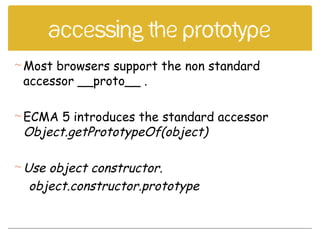
Most browsers support the non standard
accessor __proto__ .
ECMA 5 introduces the standard accessor
Object.getPrototypeOf(object)
Use object constructor.
object.constructor.prototype
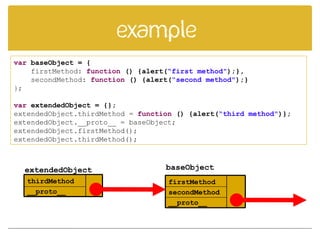
Example
var baseObject = {
firstMethod: function () {alert(“first method");},
secondMethod: function () {alert(“second method");}
};
var extendedObject = {};
extendedObject.thirdMethod = function () {alert(“third method")};
extendedObject.__proto__ = baseObject;
extendedObject.firstMethod();
extendedObject.thirdMethod();
firstMethod
secondMethod
__proto__
thirdMethod
__proto__
baseObjectextendedObject
Prototype chaining
When an object is asked to evaluate property foo,
JavaScript walks the prototype chain (starting with
object a itself), checking each link in the chain for the
presence of property foo.
If and when foo is found it is returned, otherwise
undefined is returned.
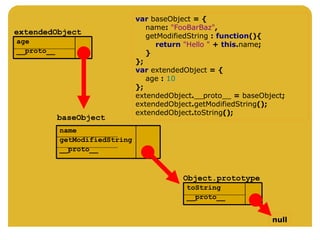
var baseObject = {
name: "FooBarBaz",
getModifiedString : function(){
return "Hello " + this.name;
}
};
var extendedObject = {
age : 10
};
extendedObject.__proto__ = baseObject;
extendedObject.getModifiedString();
extendedObject.toString();
name
getModifiedString
__proto__
age
__proto__
baseObject
extendedObject
toString
__proto__
Object.prototype
null
OK, So what was the prototype we were
talking about in the last session?
Prototype property in functions
var newClass = function (){
var privateVal = 10;
this.publicVal = 20;
}
newClass.prototype.sharedVal = 30;
what's this?
 The functions in JavaScript are objects and they
contain methods and properties.
 One of property of the function objects is prototype.
 A function’s prototype property is the object that will
be assigned as the prototype ([[Prototype]] ) to all
instances created when this function is used as a
constructor.
examples
//function will never be a constructor but it has a prototype
property anyway
Math.max.prototype; //[object Object]
//function intended to be a constructor has a prototype too
var A = function(name) {
this.name = name;
}
A.prototype; //[object Object]
//Math is not a function so no prototype property
Math.prototype; //null
 Every function has a prototype property, and the
objects which are not function don’t have the prototype
property.
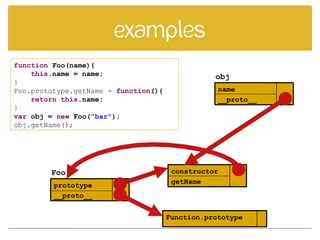
examples
function Foo(name){
this.name = name;
}
Foo.prototype.getName = function(){
return this.name;
}
var obj = new Foo("bar");
obj.getName();
Foo
prototype
__proto__
constructor
getName
obj
name
__proto__
Function.prototype
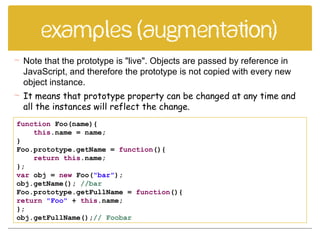
Examples (augmentation)
function Foo(name){
this.name = name;
}
Foo.prototype.getName = function(){
return this.name;
};
var obj = new Foo("bar");
obj.getName(); //bar
Foo.prototype.getFullName = function(){
return "Foo" + this.name;
};
obj.getFullName();// Foobar
 Note that the prototype is "live". Objects are passed by reference in
JavaScript, and therefore the prototype is not copied with every new
object instance.
 It means that prototype property can be changed at any time and
all the instances will reflect the change.
A catch
function Foo(name){
this.name = name;
}
Foo.prototype.getName = function(){
return this.name;
};
var obj = new Foo("bar");
obj.getName(); //bar
Foo.prototype = {
getFullName : function (){
return "FOO" + this.name;
}
};
obj.getFullName();// ERROR
obj.getName(); //bar
var obj2 = new Foo("baz");
obj2.getFullName(); //FOObaz
 If the prototype property is completely replaced the object still
points to the original prototype ([[Prototype]] )
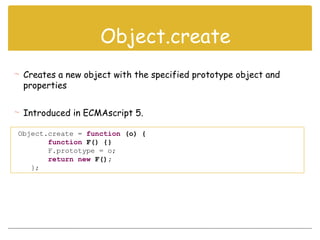
Object.create = function (o) {
function F() {}
F.prototype = o;
return new F();
};
 Creates a new object with the specified prototype object and
properties
 Introduced in ECMAscript 5.
Object.create
var func = function(){
alert(this);
this.aVar =10;
}
var aVar = func();
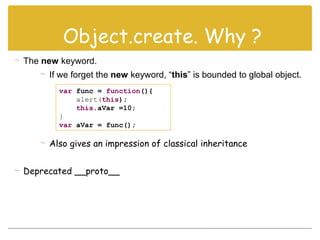
 The new keyword.
 If we forget the new keyword, “this” is bounded to global object.
 Also gives an impression of classical inheritance
 Deprecated __proto__
Object.create. Why ?
 Douglas Crockford’s video lecture on Advanced
javascript
 Mozilla developer network
References
Thank you

Prototype 120102020133-phpapp02

  • 1.
  • 2.
  • 3.
     Creating ahierarchy  Code reuse
  • 4.
    Classical inheritance Objects areinstances of classes A Class inherits from other class
  • 5.
    Prototypal inheritance A prototypallanguage is a class less object oriented language.  OOP without classes – now that’s weird Here Objects inherit from objects  What could be more object oriented than this!  Code reuse done via cloning
  • 6.
    How do wedo this?
  • 7.
    prototype A prototype isan object used to implement structure, state, and behaviour inheritance in ECMAScript.
  • 8.
    So, what kindof objects contain the prototype object?
  • 9.
    Each and everyobject (Except the Object.prototype)
  • 10.
    What !But whenI do { }.prototype, I get null :-/
  • 11.
    So what isprototype actually? The true prototype of an object is held by the internal [[Prototype]] property. This is represented as __proto__ in some of the browsers like firefox. __proto__ oldObjectnewObject
  • 12.
    Accessing the prototype Mostbrowsers support the non standard accessor __proto__ . ECMA 5 introduces the standard accessor Object.getPrototypeOf(object) Use object constructor. object.constructor.prototype
  • 13.
    Example var baseObject ={ firstMethod: function () {alert(“first method");}, secondMethod: function () {alert(“second method");} }; var extendedObject = {}; extendedObject.thirdMethod = function () {alert(“third method")}; extendedObject.__proto__ = baseObject; extendedObject.firstMethod(); extendedObject.thirdMethod(); firstMethod secondMethod __proto__ thirdMethod __proto__ baseObjectextendedObject
  • 14.
    Prototype chaining When anobject is asked to evaluate property foo, JavaScript walks the prototype chain (starting with object a itself), checking each link in the chain for the presence of property foo. If and when foo is found it is returned, otherwise undefined is returned.
  • 15.
    var baseObject ={ name: "FooBarBaz", getModifiedString : function(){ return "Hello " + this.name; } }; var extendedObject = { age : 10 }; extendedObject.__proto__ = baseObject; extendedObject.getModifiedString(); extendedObject.toString(); name getModifiedString __proto__ age __proto__ baseObject extendedObject toString __proto__ Object.prototype null
  • 16.
    OK, So whatwas the prototype we were talking about in the last session?
  • 17.
    Prototype property infunctions var newClass = function (){ var privateVal = 10; this.publicVal = 20; } newClass.prototype.sharedVal = 30; what's this?  The functions in JavaScript are objects and they contain methods and properties.  One of property of the function objects is prototype.  A function’s prototype property is the object that will be assigned as the prototype ([[Prototype]] ) to all instances created when this function is used as a constructor.
  • 18.
    examples //function will neverbe a constructor but it has a prototype property anyway Math.max.prototype; //[object Object] //function intended to be a constructor has a prototype too var A = function(name) { this.name = name; } A.prototype; //[object Object] //Math is not a function so no prototype property Math.prototype; //null  Every function has a prototype property, and the objects which are not function don’t have the prototype property.
  • 19.
    examples function Foo(name){ this.name =name; } Foo.prototype.getName = function(){ return this.name; } var obj = new Foo("bar"); obj.getName(); Foo prototype __proto__ constructor getName obj name __proto__ Function.prototype
  • 20.
    Examples (augmentation) function Foo(name){ this.name= name; } Foo.prototype.getName = function(){ return this.name; }; var obj = new Foo("bar"); obj.getName(); //bar Foo.prototype.getFullName = function(){ return "Foo" + this.name; }; obj.getFullName();// Foobar  Note that the prototype is "live". Objects are passed by reference in JavaScript, and therefore the prototype is not copied with every new object instance.  It means that prototype property can be changed at any time and all the instances will reflect the change.
  • 21.
    A catch function Foo(name){ this.name= name; } Foo.prototype.getName = function(){ return this.name; }; var obj = new Foo("bar"); obj.getName(); //bar Foo.prototype = { getFullName : function (){ return "FOO" + this.name; } }; obj.getFullName();// ERROR obj.getName(); //bar var obj2 = new Foo("baz"); obj2.getFullName(); //FOObaz  If the prototype property is completely replaced the object still points to the original prototype ([[Prototype]] )
  • 22.
    Object.create = function(o) { function F() {} F.prototype = o; return new F(); };  Creates a new object with the specified prototype object and properties  Introduced in ECMAscript 5. Object.create
  • 23.
    var func =function(){ alert(this); this.aVar =10; } var aVar = func();  The new keyword.  If we forget the new keyword, “this” is bounded to global object.  Also gives an impression of classical inheritance  Deprecated __proto__ Object.create. Why ?
  • 24.
     Douglas Crockford’svideo lecture on Advanced javascript  Mozilla developer network References
  • 25.