© 2016 Protiviti Member Firm Middle East Limited
M&A Pro
February 2017
GCC Investment banking outlook: 2017
Protiviti GCC M&A Newsletter
$0
$200
$400
$600
$800
$1,000
$1,200
$1,400
$1,600
20002001200220032004200520062007200820092010201120122013201420152016
Source: Deal Intelligence, Full Year 2016,
Thomson Reuters (Middle Eastern IB Analysis)
1
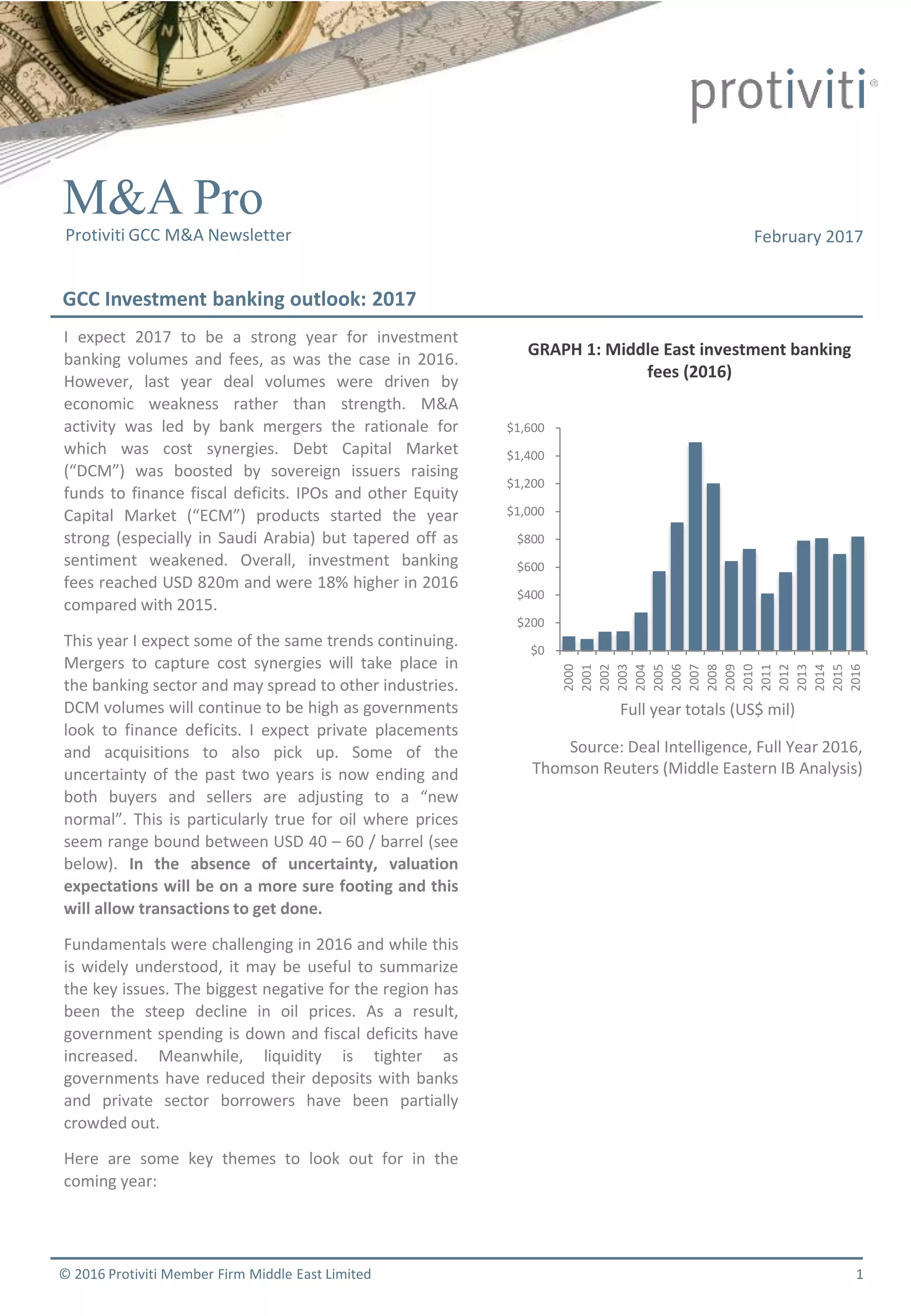
I expect 2017 to be a strong year for investment
banking volumes and fees, as was the case in 2016.
However, last year deal volumes were driven by
economic weakness rather than strength. M&A
activity was led by bank mergers the rationale for
which was cost synergies. Debt Capital Market
(“DCM”) was boosted by sovereign issuers raising
funds to finance fiscal deficits. IPOs and other Equity
Capital Market (“ECM”) products started the year
strong (especially in Saudi Arabia) but tapered off as
sentiment weakened. Overall, investment banking
fees reached USD 820m and were 18% higher in 2016
compared with 2015.
This year I expect some of the same trends continuing.
Mergers to capture cost synergies will take place in
the banking sector and may spread to other industries.
DCM volumes will continue to be high as governments
look to finance deficits. I expect private placements
and acquisitions to also pick up. Some of the
uncertainty of the past two years is now ending and
both buyers and sellers are adjusting to a “new
normal”. This is particularly true for oil where prices
seem range bound between USD 40 – 60 / barrel (see
below). In the absence of uncertainty, valuation
expectations will be on a more sure footing and this
will allow transactions to get done.
Fundamentals were challenging in 2016 and while this
is widely understood, it may be useful to summarize
the key issues. The biggest negative for the region has
been the steep decline in oil prices. As a result,
government spending is down and fiscal deficits have
increased. Meanwhile, liquidity is tighter as
governments have reduced their deposits with banks
and private sector borrowers have been partially
crowded out.
Here are some key themes to look out for in the
coming year:
GRAPH 1: Middle East investment banking
fees (2016)
Full year totals (US$ mil)
2000
2001
2002
2003
2004
2005
2006
2007
2008
2009
2010
2011
2012
2013
2014
2015
2016
© 2016 Protiviti Member Firm Middle East Limited
M&A Pro
February 2017
GCC Investment banking outlook: 2017
Protiviti GCC M&A Newsletter
2
0
10
20
30
40
50
60
Jan-16
Feb-16
Mar-16
Apr-16
May-16
Jun-16
Jul-16
Aug-16
Sep-16
Oct-16
Nov-16
Dec-16
Oil Prices
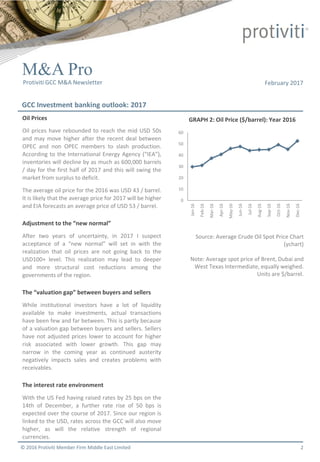
Oil prices have rebounded to reach the mid USD 50s
and may move higher after the recent deal between
OPEC and non OPEC members to slash production.
According to the International Energy Agency (“IEA”),
inventories will decline by as much as 600,000 barrels
/ day for the first half of 2017 and this will swing the
market from surplus to deficit.
The average oil price for the 2016 was USD 43 / barrel.
It is likely that the average price for 2017 will be higher
and EIA forecasts an average price of USD 53 / barrel.
Adjustment to the “new normal”
After two years of uncertainty, in 2017 I suspect
acceptance of a “new normal” will set in with the
realization that oil prices are not going back to the
USD100+ level. This realization may lead to deeper
and more structural cost reductions among the
governments of the region.
The “valuation gap” between buyers and sellers
While institutional investors have a lot of liquidity
available to make investments, actual transactions
have been few and far between. This is partly because
of a valuation gap between buyers and sellers. Sellers
have not adjusted prices lower to account for higher
risk associated with lower growth. This gap may
narrow in the coming year as continued austerity
negatively impacts sales and creates problems with
receivables.
The interest rate environment
With the US Fed having raised rates by 25 bps on the
14th of December, a further rate rise of 50 bps is
expected over the course of 2017. Since our region is
linked to the USD, rates across the GCC will also move
higher, as will the relative strength of regional
currencies.
GRAPH 2: Oil Price ($/barrel): Year 2016
Source: Average Crude Oil Spot Price Chart
(ychart)
Note: Average spot price of Brent, Dubai and
West Texas Intermediate, equally weighed.
Units are $/barrel.
© 2016 Protiviti Member Firm Middle East Limited
February 2017
Investment banking outlook: by product
M&A Pro
Protiviti GCC M&A Newsletter
Mergers and Acquisitions (“M&A”)
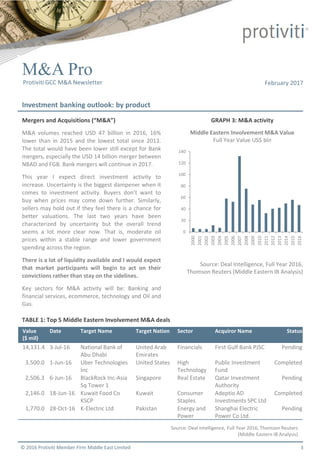
M&A volumes reached USD 47 billion in 2016, 16%
lower than in 2015 and the lowest total since 2013.
The total would have been lower still except for Bank
mergers, especially the USD 14 billion merger between
NBAD and FGB. Bank mergers will continue in 2017.
This year I expect direct investment activity to
increase. Uncertainty is the biggest dampener when it
comes to investment activity. Buyers don’t want to
buy when prices may come down further. Similarly,
sellers may hold out if they feel there is a chance for
better valuations. The last two years have been
characterized by uncertainty but the overall trend
seems a lot more clear now. That is, moderate oil
prices within a stable range and lower government
spending across the region.
There is a lot of liquidity available and I would expect
that market participants will begin to act on their
convictions rather than stay on the sidelines.
Key sectors for M&A activity will be: Banking and
financial services, ecommerce, technology and Oil and
Gas.
GRAPH 3: M&A activity
Source: Deal Intelligence, Full Year 2016,
Thomson Reuters (Middle Eastern IB Analysis)
Source: Deal Intelligence, Full Year 2016, Thomson Reuters
(Middle Eastern IB Analysis)
3
0
20
40
60
80
100
120
140
20002001200220032004200520062007200820092010201120122013201420152016
Value
($ mil)
Date Target Name Target Nation Sector Acquiror Name Status
14,131.4 3-Jul-16 National Bank of
Abu Dhabi
United Arab
Emirates
Financials First Gulf Bank PJSC Pending
3.500.0 1-Jun-16 Uber Technologies
Inc
United States High
Technology
Public Investment
Fund
Completed
2,506.3 6-Jun-16 BlackRock Inc-Asia
Sq Tower 1
Singapore Real Estate Qatar Investment
Authority
Pending
2,146.0 18-Jun-16 Kuwait Food Co
KSCP
Kuwait Consumer
Staples
Adeptio AD
Investments SPC Ltd
Completed
1,770.0 28-Oct-16 K-Electric Ltd Pakistan Energy and
Power
Shanghai Electric
Power Co Ltd.
Pending
TABLE 1: Top 5 Middle Eastern Involvement M&A deals
Middle Eastern Involvement M&A Value
Full Year Value US$ bln
2000
2001
2002
2003
2004
2005
2006
2007
2008
2009
2010
2011
2012
2013
2014
2015
2016
© 2016 Protiviti Member Firm Middle East Limited
February 2017
Investment banking outlook: by product
M&A Pro
Protiviti GCC M&A Newsletter
0
10
20
30
40
50
60
70
80
90
2000 2002 2004 2006 2008 2010 2012 2014 2016
Debt Capital Markets (“DCM”)
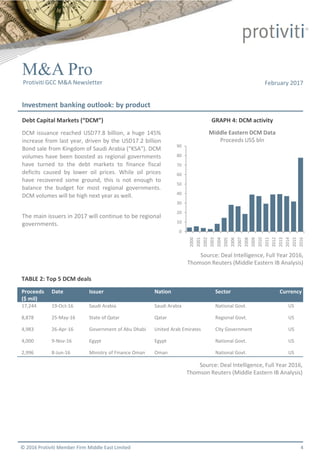
DCM issuance reached USD77.8 billion, a huge 145%
increase from last year, driven by the USD17.2 billion
Bond sale from Kingdom of Saudi Arabia (“KSA”). DCM
volumes have been boosted as regional governments
have turned to the debt markets to finance fiscal
deficits caused by lower oil prices. While oil prices
have recovered some ground, this is not enough to
balance the budget for most regional governments.
DCM volumes will be high next year as well.
The main issuers in 2017 will continue to be regional
governments.
GRAPH 4: DCM activity
Source: Deal Intelligence, Full Year 2016,
Thomson Reuters (Middle Eastern IB Analysis)
4
Source: Deal Intelligence, Full Year 2016,
Thomson Reuters (Middle Eastern IB Analysis)
Middle Eastern DCM Data
Proceeds US$ bln
TABLE 2: Top 5 DCM deals
Proceeds
($ mil)
Date Issuer Nation Sector Currency
17,244 19-Oct-16 Saudi Arabia Saudi Arabia National Govt. US
8,878 25-May-16 State of Qatar Qatar Regional Govt. US
4,983 26-Apr-16 Government of Abu Dhabi United Arab Emirates City Government US
4,000 9-Nov-16 Egypt Egypt National Govt. US
2,996 8-Jun-16 Ministry of Finance Oman Oman National Govt. US
2000
2001
2002
2003
2004
2005
2006
2007
2008
2009
2010
2011
2012
2013
2014
2015
2016
© 2016 Protiviti Member Firm Middle East Limited
February 2017
Investment banking outlook: by product
M&A Pro
Protiviti GCC M&A Newsletter
Proceeds
($ mil)
Date Issuer Nation Sector Issue
Type
Exchange
471.3 09-Mar-16 Middle East Heathcare Co Saudi Arabia Healthcare IPO Saudi Exch
456.9 25-May-16 Dubai Parks and Resorts PJSC United Arab
Emirates
Media and
Entertainment
FO Dubai Exch
408.4 28-Dec-16 Emirates Islamic Bank PJSC United Arab
Emirates
Financials FO Dubai Exch
320.2 14-Dec-16 NMC Health PLC United Arab
Emirates
Healthcare FO London
183.8 12-Jun-16 Ajman Bank PJSC United Arab
Emirates
Financials FO Dubai Exch
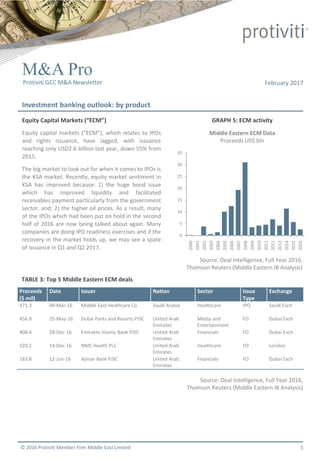
Equity Capital Markets (“ECM”)
Equity capital markets (“ECM”), which relates to IPOs
and rights issuance, have lagged, with issuance
reaching only USD2.6 billion last year, down 55% from
2015.
The big market to look out for when it comes to IPOs is
the KSA market. Recently, equity market sentiment in
KSA has improved because: 1) the huge bond issue
which has improved liquidity and facilitated
receivables payment particularly from the government
sector, and; 2) the higher oil prices. As a result, many
of the IPOs which had been put on hold in the second
half of 2016 are now being talked about again. Many
companies are doing IPO readiness exercises and if the
recovery in the market holds up, we may see a spate
of issuance in Q1 and Q2 2017.
GRAPH 5: ECM activity
Source: Deal Intelligence, Full Year 2016,
Thomson Reuters (Middle Eastern IB Analysis)
5
Source: Deal Intelligence, Full Year 2016,
Thomson Reuters (Middle Eastern IB Analysis)
Middle Eastern ECM Data
Proceeds US$ bln
0
5
10
15
20
25
30
35
2000 2002 2004 2006 2008 2010 2012 2014 2016
2000
2001
2002
2003
2004
2005
2006
2007
2008
2009
2010
2011
2012
2013
2014
2015
2016
TABLE 3: Top 5 Middle Eastern ECM deals
© 2016 Protiviti Member Firm Middle East Limited
February 2017
Investment banking outlook: by product
M&A Pro
Protiviti GCC M&A Newsletter
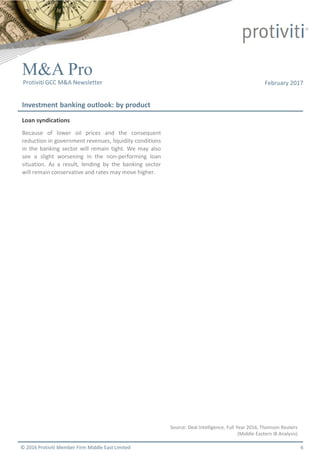
Loan syndications
Because of lower oil prices and the consequent
reduction in government revenues, liquidity conditions
in the banking sector will remain tight. We may also
see a slight worsening in the non-performing loan
situation. As a result, lending by the banking sector
will remain conservative and rates may move higher.
Source: Deal Intelligence, Full Year 2016, Thomson Reuters
(Middle Eastern IB Analysis)
6
© 2016 Protiviti Member Firm Middle East Limited
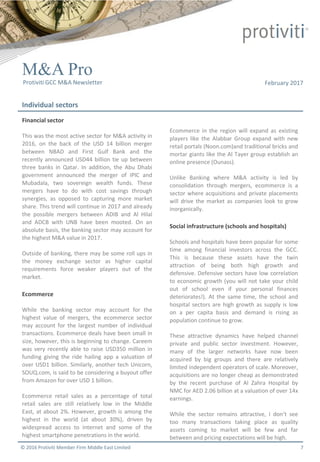
Individual sectors
M&A Pro
Protiviti GCC M&A Newsletter February 2017
Financial sector
This was the most active sector for M&A activity in
2016, on the back of the USD 14 billion merger
between NBAD and First Gulf Bank and the
recently announced USD44 billion tie up between
three banks in Qatar. In addition, the Abu Dhabi
government announced the merger of IPIC and
Mubadala, two sovereign wealth funds. These
mergers have to do with cost savings through
synergies, as opposed to capturing more market
share. This trend will continue in 2017 and already
the possible mergers between ADIB and Al Hilal
and ADCB with UNB have been mooted. On an
absolute basis, the banking sector may account for
the highest M&A value in 2017.
Outside of banking, there may be some roll ups in
the money exchange sector as higher capital
requirements force weaker players out of the
market.
Ecommerce
While the banking sector may account for the
highest value of mergers, the ecommerce sector
may account for the largest number of individual
transactions. Ecommerce deals have been small in
size, however, this is beginning to change. Careem
was very recently able to raise USD350 million in
funding giving the ride hailing app a valuation of
over USD1 billion. Similarly, another tech Unicorn,
SOUQ.com, is said to be considering a buyout offer
from Amazon for over USD 1 billion.
Ecommerce retail sales as a percentage of total
retail sales are still relatively low in the Middle
East, at about 2%. However, growth is among the
highest in the world (at about 30%), driven by
widespread access to internet and some of the
highest smartphone penetrations in the world.
Ecommerce in the region will expand as existing
players like the Alabbar Group expand with new
retail portals (Noon.com)and traditional bricks and
mortar giants like the Al Tayer group establish an
online presence (Ounass).
Unlike Banking where M&A activity is led by
consolidation through mergers, ecommerce is a
sector where acquisitions and private placements
will drive the market as companies look to grow
inorganically.
Social infrastructure (schools and hospitals)
Schools and hospitals have been popular for some
time among financial investors across the GCC.
This is because these assets have the twin
attraction of being both high growth and
defensive. Defensive sectors have low correlation
to economic growth (you will not take your child
out of school even if your personal finances
deteriorates!). At the same time, the school and
hospital sectors are high growth as supply is low
on a per capita basis and demand is rising as
population continue to grow.
These attractive dynamics have helped channel
private and public sector investment. However,
many of the larger networks have now been
acquired by big groups and there are relatively
limited independent operators of scale. Moreover,
acquisitions are no longer cheap as demonstrated
by the recent purchase of Al Zahra Hospital by
NMC for AED 2.06 billion at a valuation of over 14x
earnings.
While the sector remains attractive, I don’t see
too many transactions taking place as quality
assets coming to market will be few and far
between and pricing expectations will be high.
7
© 2016 Protiviti Member Firm Middle East Limited
Individual sectors
M&A Pro
Protiviti GCC M&A Newsletter February 2017
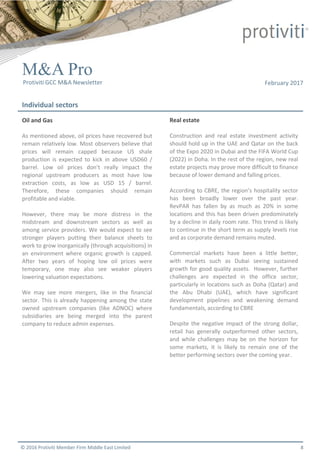
Oil and Gas
As mentioned above, oil prices have recovered but
remain relatively low. Most observers believe that
prices will remain capped because US shale
production is expected to kick in above USD60 /
barrel. Low oil prices don’t really impact the
regional upstream producers as most have low
extraction costs, as low as USD 15 / barrel.
Therefore, these companies should remain
profitable and viable.
However, there may be more distress in the
midstream and downstream sectors as well as
among service providers. We would expect to see
stronger players putting their balance sheets to
work to grow inorganically (through acquisitions) in
an environment where organic growth is capped.
After two years of hoping low oil prices were
temporary, one may also see weaker players
lowering valuation expectations.
We may see more mergers, like in the financial
sector. This is already happening among the state
owned upstream companies (like ADNOC) where
subsidiaries are being merged into the parent
company to reduce admin expenses.
Real estate
Construction and real estate investment activity
should hold up in the UAE and Qatar on the back
of the Expo 2020 in Dubai and the FIFA World Cup
(2022) in Doha. In the rest of the region, new real
estate projects may prove more difficult to finance
because of lower demand and falling prices.
According to CBRE, the region’s hospitality sector
has been broadly lower over the past year.
RevPAR has fallen by as much as 20% in some
locations and this has been driven predominately
by a decline in daily room rate. This trend is likely
to continue in the short term as supply levels rise
and as corporate demand remains muted.
Commercial markets have been a little better,
with markets such as Dubai seeing sustained
growth for good quality assets. However, further
challenges are expected in the office sector,
particularly in locations such as Doha (Qatar) and
the Abu Dhabi (UAE), which have significant
development pipelines and weakening demand
fundamentals, according to CBRE
Despite the negative impact of the strong dollar,
retail has generally outperformed other sectors,
and while challenges may be on the horizon for
some markets, it is likely to remain one of the
better performing sectors over the coming year.
8
© 2016 Protiviti Member Firm Middle East Limited
This publication has been prepared by Mr. Ehsun Khan, Managing Director of Protiviti’s member firm for the Middle East using information from public
sources. Views and opinions expressed in this publication are that of the writer and not of Protiviti, Inc. or its affiliates and member firms. You should not act
or refrain from acting, based upon the information contained in this publication, without obtaining specific professional advice. Protiviti, its subsidiaries,
affiliates, member firms, partners, directors, employees and agents do not accept or assume any liability or responsibility for any loss incurred as a result of
acting on information in this publication, or for any decision based on it.
About Protiviti
Protiviti delivers deep expertise, objective insights, a tailored approach and unparalleled collaboration to help leaders face the future with confidence. Our
consulting solutions span critical business problems in technology, business process, analytics, risk, compliance, transactions and internal audit. We are
committed to attracting and developing a diverse workforce of professionals that share the common value of collaboration. As an organization, we believe
that by teaming together, with each other, and our clients, we can see beyond the surface of changes and problems organizations face in this fast changing
world to discover opportunities others might miss and face the future with greater confidence.
Our more than 4,500 people serve clients through the network of Protiviti and independently owned Member Firms in more than 70 offices in over 20
countries. We have served over 60% of FORTUNE 1000® companies and 35% of FORTUNE Global 500® companies. Our people and organization have
consistently been recognized by FORTUNE and Consulting Magazine as a best company to work for. In the Middle East Region, Protiviti’s member firm is a
leading provider of business consulting, internal audit, risk management, technology, forensic and fraud investigation, human capital and transaction
services. Protiviti member firms are separate and independent legal entities, are not agents of other firms in the Protiviti network, and have no authority to
obligate or bind other firms in the Protiviti network.
About Our Transaction Services
Protiviti has a broad and varied range of experience in assisting clients in both pre and post-acquisition situations. Our transaction services cover deal
identification/origination, valuation, financial and operational due diligence, merger and acquisition advise, IPO readiness, equity and debt funding,
restructuring, preparing information memorandum/prospectus and deal structuring. Other services we provide include business consulting, technology
consulting, risk consulting, human capital consulting, fraud investigation and forensic, tax and regulatory compliance, corporate governance and internal
audit.
For more information about Protiviti in the Middle East, please contact:
Abu Dhabi
Al Ghaith Holding Tower,
9th Floor, Airport Road
P.O. Box: 32468, Abu Dhabi
United Arab Emirates
Tel: +971 2658 4640
Fax: +971 2658 4641
Email: abudhabi@protivitiglobal.me
Bahrain
Platinum Tower, 17th Floor
Bldg. 190, Rd 2803, Blk 428, Seef P.O.
Box: 10231, Diplomatic Area
Manama, Kingdom of Bahrain
Tel: +973 1710 0050
Fax: +973 1710 0051
Email: bahrain@protivitiglobal.me
Dubai
Office 2104, 21st Floor
U-Bora Tower 2, Business Bay
P.O. Box: 78475, Dubai
United Arab Emirates
Tel: +971 4438 0660
Fax:+971 4438 0655
Email: dubai@protivitiglobal.me
Kuwait
Al Shaheed Tower, 4th Floor
Khaled Ben Al Waleed Street,
Sharq
P.O. Box: 1773, Safat 13018
State of Kuwait
Tel: +965 2242 6444
Fax: +965 2240 1555
Email: kuwait@protivitiglobal.me
Oman
Al Ufuq Building, 2nd Floor,
Office No. 26, Shatti Al Qurum
P.O. Box: 1130, PC 112, Ruwi
Sultanate of Oman
Tel: +968 2469 9403
Fax: +968 2469 6356
Email: oman@protivitiglobal.me
Qatar
Palm Tower B, 19th Floor
P.O. Box: 13374
West Bay, Doha, Qatar
Tel: +974 4421 5300
Fax: +974 4421 5288
Email: qatar@protivitiglobal.me
Saudi Arabia
Global Towers (Middle Tower),
4th Floor, King Saud Street
P.O. Box: 9524 Riyadh 11423
Kingdom of Saudi Arabia
Tel: +966 11 2930021
Fax: +966 11 4615810
Email:
saudiarabia@protivitiglobal.me
For more information about this publication and our services, please contact:
Ehsun Khan
Managing Director
U-Bora Tower 2, 21st Floor
Business Bay, Dubai
P.O. Box: 78475, United Arab Emirates
Direct : +971 4 438 6909
Fax: +971 4 438 0655
Mobile:+971 55 7727 9862
Email: ehsun.khan@protivitiglobal.me
Web: www.protiviti.com
9

Protiviti M&A Pro - GCC 2017 outlook

  • 1.
    © 2016 ProtivitiMember Firm Middle East Limited M&A Pro February 2017 GCC Investment banking outlook: 2017 Protiviti GCC M&A Newsletter $0 $200 $400 $600 $800 $1,000 $1,200 $1,400 $1,600 20002001200220032004200520062007200820092010201120122013201420152016 Source: Deal Intelligence, Full Year 2016, Thomson Reuters (Middle Eastern IB Analysis) 1 I expect 2017 to be a strong year for investment banking volumes and fees, as was the case in 2016. However, last year deal volumes were driven by economic weakness rather than strength. M&A activity was led by bank mergers the rationale for which was cost synergies. Debt Capital Market (“DCM”) was boosted by sovereign issuers raising funds to finance fiscal deficits. IPOs and other Equity Capital Market (“ECM”) products started the year strong (especially in Saudi Arabia) but tapered off as sentiment weakened. Overall, investment banking fees reached USD 820m and were 18% higher in 2016 compared with 2015. This year I expect some of the same trends continuing. Mergers to capture cost synergies will take place in the banking sector and may spread to other industries. DCM volumes will continue to be high as governments look to finance deficits. I expect private placements and acquisitions to also pick up. Some of the uncertainty of the past two years is now ending and both buyers and sellers are adjusting to a “new normal”. This is particularly true for oil where prices seem range bound between USD 40 – 60 / barrel (see below). In the absence of uncertainty, valuation expectations will be on a more sure footing and this will allow transactions to get done. Fundamentals were challenging in 2016 and while this is widely understood, it may be useful to summarize the key issues. The biggest negative for the region has been the steep decline in oil prices. As a result, government spending is down and fiscal deficits have increased. Meanwhile, liquidity is tighter as governments have reduced their deposits with banks and private sector borrowers have been partially crowded out. Here are some key themes to look out for in the coming year: GRAPH 1: Middle East investment banking fees (2016) Full year totals (US$ mil) 2000 2001 2002 2003 2004 2005 2006 2007 2008 2009 2010 2011 2012 2013 2014 2015 2016
  • 2.
    © 2016 ProtivitiMember Firm Middle East Limited M&A Pro February 2017 GCC Investment banking outlook: 2017 Protiviti GCC M&A Newsletter 2 0 10 20 30 40 50 60 Jan-16 Feb-16 Mar-16 Apr-16 May-16 Jun-16 Jul-16 Aug-16 Sep-16 Oct-16 Nov-16 Dec-16 Oil Prices Oil prices have rebounded to reach the mid USD 50s and may move higher after the recent deal between OPEC and non OPEC members to slash production. According to the International Energy Agency (“IEA”), inventories will decline by as much as 600,000 barrels / day for the first half of 2017 and this will swing the market from surplus to deficit. The average oil price for the 2016 was USD 43 / barrel. It is likely that the average price for 2017 will be higher and EIA forecasts an average price of USD 53 / barrel. Adjustment to the “new normal” After two years of uncertainty, in 2017 I suspect acceptance of a “new normal” will set in with the realization that oil prices are not going back to the USD100+ level. This realization may lead to deeper and more structural cost reductions among the governments of the region. The “valuation gap” between buyers and sellers While institutional investors have a lot of liquidity available to make investments, actual transactions have been few and far between. This is partly because of a valuation gap between buyers and sellers. Sellers have not adjusted prices lower to account for higher risk associated with lower growth. This gap may narrow in the coming year as continued austerity negatively impacts sales and creates problems with receivables. The interest rate environment With the US Fed having raised rates by 25 bps on the 14th of December, a further rate rise of 50 bps is expected over the course of 2017. Since our region is linked to the USD, rates across the GCC will also move higher, as will the relative strength of regional currencies. GRAPH 2: Oil Price ($/barrel): Year 2016 Source: Average Crude Oil Spot Price Chart (ychart) Note: Average spot price of Brent, Dubai and West Texas Intermediate, equally weighed. Units are $/barrel.
  • 3.
    © 2016 ProtivitiMember Firm Middle East Limited February 2017 Investment banking outlook: by product M&A Pro Protiviti GCC M&A Newsletter Mergers and Acquisitions (“M&A”) M&A volumes reached USD 47 billion in 2016, 16% lower than in 2015 and the lowest total since 2013. The total would have been lower still except for Bank mergers, especially the USD 14 billion merger between NBAD and FGB. Bank mergers will continue in 2017. This year I expect direct investment activity to increase. Uncertainty is the biggest dampener when it comes to investment activity. Buyers don’t want to buy when prices may come down further. Similarly, sellers may hold out if they feel there is a chance for better valuations. The last two years have been characterized by uncertainty but the overall trend seems a lot more clear now. That is, moderate oil prices within a stable range and lower government spending across the region. There is a lot of liquidity available and I would expect that market participants will begin to act on their convictions rather than stay on the sidelines. Key sectors for M&A activity will be: Banking and financial services, ecommerce, technology and Oil and Gas. GRAPH 3: M&A activity Source: Deal Intelligence, Full Year 2016, Thomson Reuters (Middle Eastern IB Analysis) Source: Deal Intelligence, Full Year 2016, Thomson Reuters (Middle Eastern IB Analysis) 3 0 20 40 60 80 100 120 140 20002001200220032004200520062007200820092010201120122013201420152016 Value ($ mil) Date Target Name Target Nation Sector Acquiror Name Status 14,131.4 3-Jul-16 National Bank of Abu Dhabi United Arab Emirates Financials First Gulf Bank PJSC Pending 3.500.0 1-Jun-16 Uber Technologies Inc United States High Technology Public Investment Fund Completed 2,506.3 6-Jun-16 BlackRock Inc-Asia Sq Tower 1 Singapore Real Estate Qatar Investment Authority Pending 2,146.0 18-Jun-16 Kuwait Food Co KSCP Kuwait Consumer Staples Adeptio AD Investments SPC Ltd Completed 1,770.0 28-Oct-16 K-Electric Ltd Pakistan Energy and Power Shanghai Electric Power Co Ltd. Pending TABLE 1: Top 5 Middle Eastern Involvement M&A deals Middle Eastern Involvement M&A Value Full Year Value US$ bln 2000 2001 2002 2003 2004 2005 2006 2007 2008 2009 2010 2011 2012 2013 2014 2015 2016
  • 4.
    © 2016 ProtivitiMember Firm Middle East Limited February 2017 Investment banking outlook: by product M&A Pro Protiviti GCC M&A Newsletter 0 10 20 30 40 50 60 70 80 90 2000 2002 2004 2006 2008 2010 2012 2014 2016 Debt Capital Markets (“DCM”) DCM issuance reached USD77.8 billion, a huge 145% increase from last year, driven by the USD17.2 billion Bond sale from Kingdom of Saudi Arabia (“KSA”). DCM volumes have been boosted as regional governments have turned to the debt markets to finance fiscal deficits caused by lower oil prices. While oil prices have recovered some ground, this is not enough to balance the budget for most regional governments. DCM volumes will be high next year as well. The main issuers in 2017 will continue to be regional governments. GRAPH 4: DCM activity Source: Deal Intelligence, Full Year 2016, Thomson Reuters (Middle Eastern IB Analysis) 4 Source: Deal Intelligence, Full Year 2016, Thomson Reuters (Middle Eastern IB Analysis) Middle Eastern DCM Data Proceeds US$ bln TABLE 2: Top 5 DCM deals Proceeds ($ mil) Date Issuer Nation Sector Currency 17,244 19-Oct-16 Saudi Arabia Saudi Arabia National Govt. US 8,878 25-May-16 State of Qatar Qatar Regional Govt. US 4,983 26-Apr-16 Government of Abu Dhabi United Arab Emirates City Government US 4,000 9-Nov-16 Egypt Egypt National Govt. US 2,996 8-Jun-16 Ministry of Finance Oman Oman National Govt. US 2000 2001 2002 2003 2004 2005 2006 2007 2008 2009 2010 2011 2012 2013 2014 2015 2016
  • 5.
    © 2016 ProtivitiMember Firm Middle East Limited February 2017 Investment banking outlook: by product M&A Pro Protiviti GCC M&A Newsletter Proceeds ($ mil) Date Issuer Nation Sector Issue Type Exchange 471.3 09-Mar-16 Middle East Heathcare Co Saudi Arabia Healthcare IPO Saudi Exch 456.9 25-May-16 Dubai Parks and Resorts PJSC United Arab Emirates Media and Entertainment FO Dubai Exch 408.4 28-Dec-16 Emirates Islamic Bank PJSC United Arab Emirates Financials FO Dubai Exch 320.2 14-Dec-16 NMC Health PLC United Arab Emirates Healthcare FO London 183.8 12-Jun-16 Ajman Bank PJSC United Arab Emirates Financials FO Dubai Exch Equity Capital Markets (“ECM”) Equity capital markets (“ECM”), which relates to IPOs and rights issuance, have lagged, with issuance reaching only USD2.6 billion last year, down 55% from 2015. The big market to look out for when it comes to IPOs is the KSA market. Recently, equity market sentiment in KSA has improved because: 1) the huge bond issue which has improved liquidity and facilitated receivables payment particularly from the government sector, and; 2) the higher oil prices. As a result, many of the IPOs which had been put on hold in the second half of 2016 are now being talked about again. Many companies are doing IPO readiness exercises and if the recovery in the market holds up, we may see a spate of issuance in Q1 and Q2 2017. GRAPH 5: ECM activity Source: Deal Intelligence, Full Year 2016, Thomson Reuters (Middle Eastern IB Analysis) 5 Source: Deal Intelligence, Full Year 2016, Thomson Reuters (Middle Eastern IB Analysis) Middle Eastern ECM Data Proceeds US$ bln 0 5 10 15 20 25 30 35 2000 2002 2004 2006 2008 2010 2012 2014 2016 2000 2001 2002 2003 2004 2005 2006 2007 2008 2009 2010 2011 2012 2013 2014 2015 2016 TABLE 3: Top 5 Middle Eastern ECM deals
  • 6.
    © 2016 ProtivitiMember Firm Middle East Limited February 2017 Investment banking outlook: by product M&A Pro Protiviti GCC M&A Newsletter Loan syndications Because of lower oil prices and the consequent reduction in government revenues, liquidity conditions in the banking sector will remain tight. We may also see a slight worsening in the non-performing loan situation. As a result, lending by the banking sector will remain conservative and rates may move higher. Source: Deal Intelligence, Full Year 2016, Thomson Reuters (Middle Eastern IB Analysis) 6
  • 7.
    © 2016 ProtivitiMember Firm Middle East Limited Individual sectors M&A Pro Protiviti GCC M&A Newsletter February 2017 Financial sector This was the most active sector for M&A activity in 2016, on the back of the USD 14 billion merger between NBAD and First Gulf Bank and the recently announced USD44 billion tie up between three banks in Qatar. In addition, the Abu Dhabi government announced the merger of IPIC and Mubadala, two sovereign wealth funds. These mergers have to do with cost savings through synergies, as opposed to capturing more market share. This trend will continue in 2017 and already the possible mergers between ADIB and Al Hilal and ADCB with UNB have been mooted. On an absolute basis, the banking sector may account for the highest M&A value in 2017. Outside of banking, there may be some roll ups in the money exchange sector as higher capital requirements force weaker players out of the market. Ecommerce While the banking sector may account for the highest value of mergers, the ecommerce sector may account for the largest number of individual transactions. Ecommerce deals have been small in size, however, this is beginning to change. Careem was very recently able to raise USD350 million in funding giving the ride hailing app a valuation of over USD1 billion. Similarly, another tech Unicorn, SOUQ.com, is said to be considering a buyout offer from Amazon for over USD 1 billion. Ecommerce retail sales as a percentage of total retail sales are still relatively low in the Middle East, at about 2%. However, growth is among the highest in the world (at about 30%), driven by widespread access to internet and some of the highest smartphone penetrations in the world. Ecommerce in the region will expand as existing players like the Alabbar Group expand with new retail portals (Noon.com)and traditional bricks and mortar giants like the Al Tayer group establish an online presence (Ounass). Unlike Banking where M&A activity is led by consolidation through mergers, ecommerce is a sector where acquisitions and private placements will drive the market as companies look to grow inorganically. Social infrastructure (schools and hospitals) Schools and hospitals have been popular for some time among financial investors across the GCC. This is because these assets have the twin attraction of being both high growth and defensive. Defensive sectors have low correlation to economic growth (you will not take your child out of school even if your personal finances deteriorates!). At the same time, the school and hospital sectors are high growth as supply is low on a per capita basis and demand is rising as population continue to grow. These attractive dynamics have helped channel private and public sector investment. However, many of the larger networks have now been acquired by big groups and there are relatively limited independent operators of scale. Moreover, acquisitions are no longer cheap as demonstrated by the recent purchase of Al Zahra Hospital by NMC for AED 2.06 billion at a valuation of over 14x earnings. While the sector remains attractive, I don’t see too many transactions taking place as quality assets coming to market will be few and far between and pricing expectations will be high. 7
  • 8.
    © 2016 ProtivitiMember Firm Middle East Limited Individual sectors M&A Pro Protiviti GCC M&A Newsletter February 2017 Oil and Gas As mentioned above, oil prices have recovered but remain relatively low. Most observers believe that prices will remain capped because US shale production is expected to kick in above USD60 / barrel. Low oil prices don’t really impact the regional upstream producers as most have low extraction costs, as low as USD 15 / barrel. Therefore, these companies should remain profitable and viable. However, there may be more distress in the midstream and downstream sectors as well as among service providers. We would expect to see stronger players putting their balance sheets to work to grow inorganically (through acquisitions) in an environment where organic growth is capped. After two years of hoping low oil prices were temporary, one may also see weaker players lowering valuation expectations. We may see more mergers, like in the financial sector. This is already happening among the state owned upstream companies (like ADNOC) where subsidiaries are being merged into the parent company to reduce admin expenses. Real estate Construction and real estate investment activity should hold up in the UAE and Qatar on the back of the Expo 2020 in Dubai and the FIFA World Cup (2022) in Doha. In the rest of the region, new real estate projects may prove more difficult to finance because of lower demand and falling prices. According to CBRE, the region’s hospitality sector has been broadly lower over the past year. RevPAR has fallen by as much as 20% in some locations and this has been driven predominately by a decline in daily room rate. This trend is likely to continue in the short term as supply levels rise and as corporate demand remains muted. Commercial markets have been a little better, with markets such as Dubai seeing sustained growth for good quality assets. However, further challenges are expected in the office sector, particularly in locations such as Doha (Qatar) and the Abu Dhabi (UAE), which have significant development pipelines and weakening demand fundamentals, according to CBRE Despite the negative impact of the strong dollar, retail has generally outperformed other sectors, and while challenges may be on the horizon for some markets, it is likely to remain one of the better performing sectors over the coming year. 8
  • 9.
    © 2016 ProtivitiMember Firm Middle East Limited This publication has been prepared by Mr. Ehsun Khan, Managing Director of Protiviti’s member firm for the Middle East using information from public sources. Views and opinions expressed in this publication are that of the writer and not of Protiviti, Inc. or its affiliates and member firms. You should not act or refrain from acting, based upon the information contained in this publication, without obtaining specific professional advice. Protiviti, its subsidiaries, affiliates, member firms, partners, directors, employees and agents do not accept or assume any liability or responsibility for any loss incurred as a result of acting on information in this publication, or for any decision based on it. About Protiviti Protiviti delivers deep expertise, objective insights, a tailored approach and unparalleled collaboration to help leaders face the future with confidence. Our consulting solutions span critical business problems in technology, business process, analytics, risk, compliance, transactions and internal audit. We are committed to attracting and developing a diverse workforce of professionals that share the common value of collaboration. As an organization, we believe that by teaming together, with each other, and our clients, we can see beyond the surface of changes and problems organizations face in this fast changing world to discover opportunities others might miss and face the future with greater confidence. Our more than 4,500 people serve clients through the network of Protiviti and independently owned Member Firms in more than 70 offices in over 20 countries. We have served over 60% of FORTUNE 1000® companies and 35% of FORTUNE Global 500® companies. Our people and organization have consistently been recognized by FORTUNE and Consulting Magazine as a best company to work for. In the Middle East Region, Protiviti’s member firm is a leading provider of business consulting, internal audit, risk management, technology, forensic and fraud investigation, human capital and transaction services. Protiviti member firms are separate and independent legal entities, are not agents of other firms in the Protiviti network, and have no authority to obligate or bind other firms in the Protiviti network. About Our Transaction Services Protiviti has a broad and varied range of experience in assisting clients in both pre and post-acquisition situations. Our transaction services cover deal identification/origination, valuation, financial and operational due diligence, merger and acquisition advise, IPO readiness, equity and debt funding, restructuring, preparing information memorandum/prospectus and deal structuring. Other services we provide include business consulting, technology consulting, risk consulting, human capital consulting, fraud investigation and forensic, tax and regulatory compliance, corporate governance and internal audit. For more information about Protiviti in the Middle East, please contact: Abu Dhabi Al Ghaith Holding Tower, 9th Floor, Airport Road P.O. Box: 32468, Abu Dhabi United Arab Emirates Tel: +971 2658 4640 Fax: +971 2658 4641 Email: abudhabi@protivitiglobal.me Bahrain Platinum Tower, 17th Floor Bldg. 190, Rd 2803, Blk 428, Seef P.O. Box: 10231, Diplomatic Area Manama, Kingdom of Bahrain Tel: +973 1710 0050 Fax: +973 1710 0051 Email: bahrain@protivitiglobal.me Dubai Office 2104, 21st Floor U-Bora Tower 2, Business Bay P.O. Box: 78475, Dubai United Arab Emirates Tel: +971 4438 0660 Fax:+971 4438 0655 Email: dubai@protivitiglobal.me Kuwait Al Shaheed Tower, 4th Floor Khaled Ben Al Waleed Street, Sharq P.O. Box: 1773, Safat 13018 State of Kuwait Tel: +965 2242 6444 Fax: +965 2240 1555 Email: kuwait@protivitiglobal.me Oman Al Ufuq Building, 2nd Floor, Office No. 26, Shatti Al Qurum P.O. Box: 1130, PC 112, Ruwi Sultanate of Oman Tel: +968 2469 9403 Fax: +968 2469 6356 Email: oman@protivitiglobal.me Qatar Palm Tower B, 19th Floor P.O. Box: 13374 West Bay, Doha, Qatar Tel: +974 4421 5300 Fax: +974 4421 5288 Email: qatar@protivitiglobal.me Saudi Arabia Global Towers (Middle Tower), 4th Floor, King Saud Street P.O. Box: 9524 Riyadh 11423 Kingdom of Saudi Arabia Tel: +966 11 2930021 Fax: +966 11 4615810 Email: saudiarabia@protivitiglobal.me For more information about this publication and our services, please contact: Ehsun Khan Managing Director U-Bora Tower 2, 21st Floor Business Bay, Dubai P.O. Box: 78475, United Arab Emirates Direct : +971 4 438 6909 Fax: +971 4 438 0655 Mobile:+971 55 7727 9862 Email: ehsun.khan@protivitiglobal.me Web: www.protiviti.com 9