Quest for Cost Effective Carbon and Nitrogen Sources for
Protease Production from A. niger
NITINJAY SINGH
ID-17BTBIOCE011
SUB -ENZYME TECHNOLOGY
PROJECT TITLE
CONTENT
• What are proteases ?
• Why proteases is important ?
• How Protease are produce ?
• Why Aspergillus Niger is important in protease production ?
• Cost effective carbon and nitrogen source
What are proteases ?
• Proteases occur naturally in all organisms.
• Hydrolyzed peptide bonds.
• 60 % of total enzyme market.
CLASSIFICATION OF PROTEASES
• On the basis of site of action on protein
Proteases are broadly classified as endo- or exo-enzymes
• Based on the pH
They are referred to as acidic, neutral, or alkaline proteases.
• Further categorized as serine proteases, aspartic proteases, threonine proteases cysteine
proteases
Source of Protease
• Sources
• Animal Proteases: pancreatic trypsin, chymotrypsin, pepsin and rennin.
• Plant Proteases: Papain, keratinases, and ficin
• Microbial proteases: Fungal or Bacterial
Why Aspergillus Niger for Protease production ?
The fungi possess diverse habitat, grow ubiquitously and produce various
proteins/enzymes their survival.
Fungal proteases offer a distinct advantage over bacterial enzymes in terms of ease of
downstream processing
Fungal enzymes are commonly used in industries due to various technical reasons,
including the feasibility of obtaining enzymes at high concentration in the
fermentation medium .
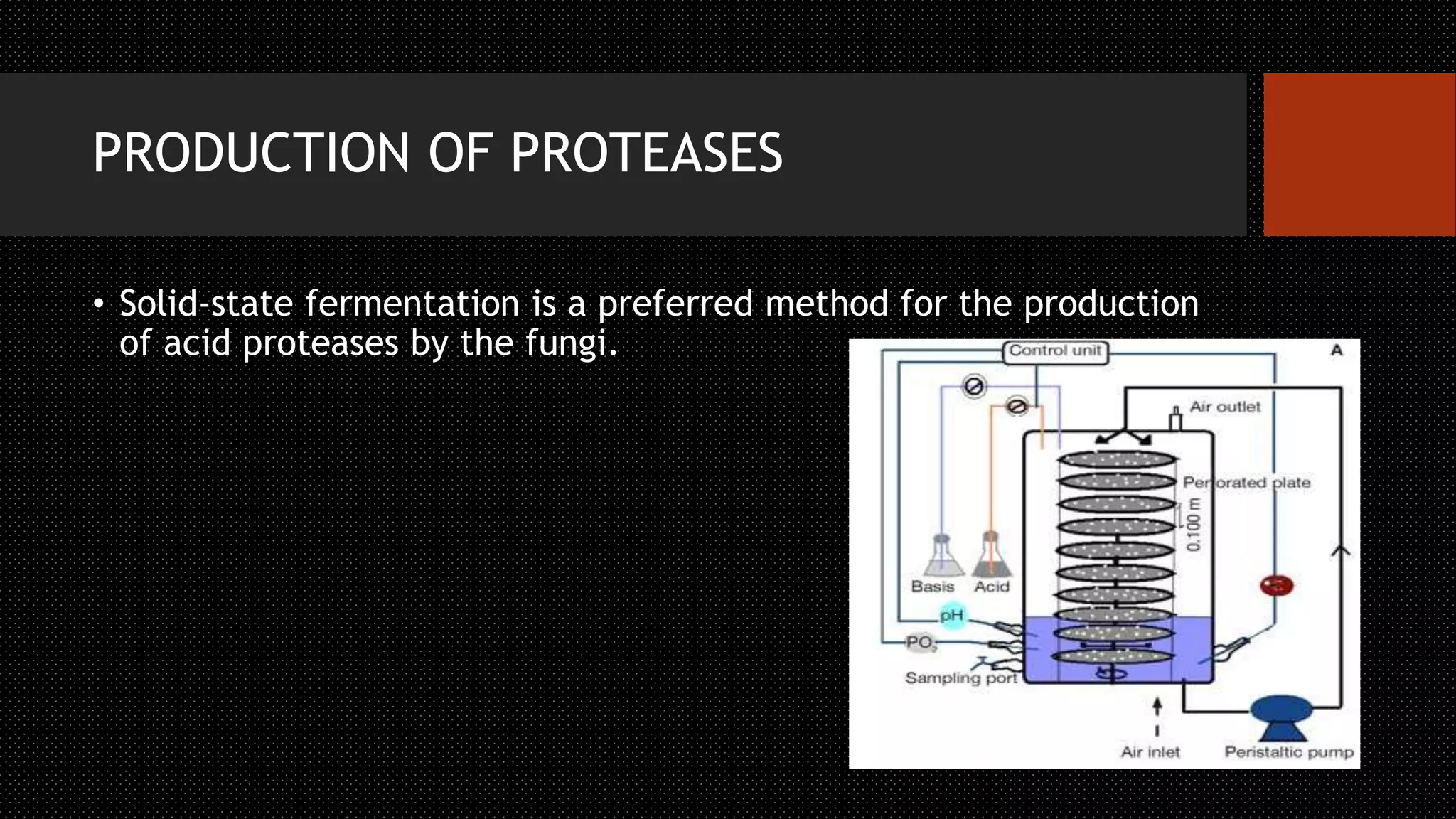
PRODUCTION OF PROTEASES
• Solid-state fermentation is a preferred method for the production
of acid proteases by the fungi.
COST EFFECTIVE CARBON AND NITROGEN SOURCE
• Effect of different carbon sources
Rice bran or wheat bran is used for economic basis
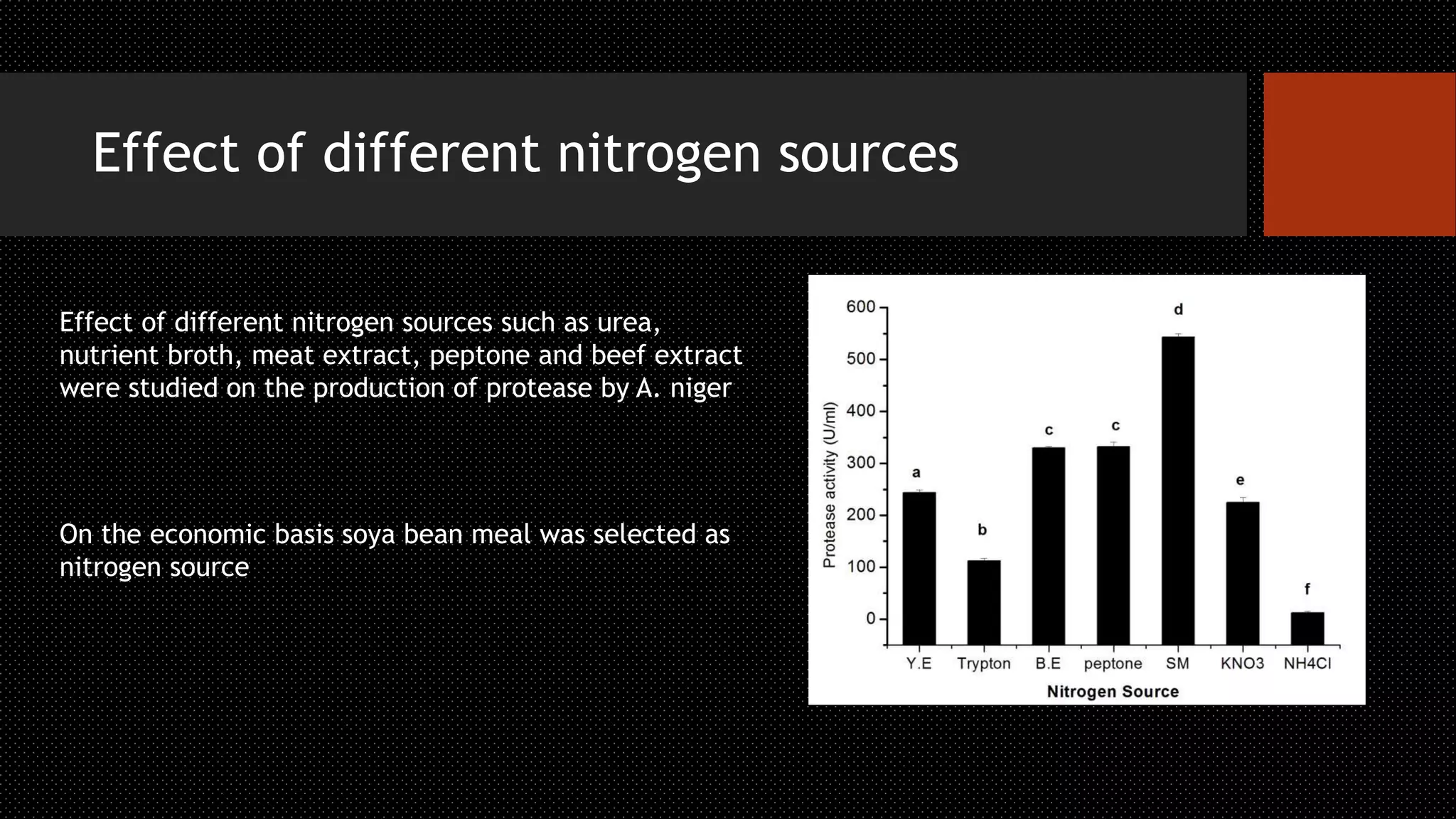
Effect of different nitrogen sources
Effect of different nitrogen sources such as urea,
nutrient broth, meat extract, peptone and beef extract
were studied on the production of protease by A. niger
On the economic basis soya bean meal was selected as
nitrogen source
Why proteases are important ?
THANK YOU

Protease production

  • 1.
    Quest for CostEffective Carbon and Nitrogen Sources for Protease Production from A. niger NITINJAY SINGH ID-17BTBIOCE011 SUB -ENZYME TECHNOLOGY PROJECT TITLE
  • 2.
    CONTENT • What areproteases ? • Why proteases is important ? • How Protease are produce ? • Why Aspergillus Niger is important in protease production ? • Cost effective carbon and nitrogen source
  • 3.
    What are proteases? • Proteases occur naturally in all organisms. • Hydrolyzed peptide bonds. • 60 % of total enzyme market.
  • 4.
    CLASSIFICATION OF PROTEASES •On the basis of site of action on protein Proteases are broadly classified as endo- or exo-enzymes • Based on the pH They are referred to as acidic, neutral, or alkaline proteases. • Further categorized as serine proteases, aspartic proteases, threonine proteases cysteine proteases
  • 5.
    Source of Protease •Sources • Animal Proteases: pancreatic trypsin, chymotrypsin, pepsin and rennin. • Plant Proteases: Papain, keratinases, and ficin • Microbial proteases: Fungal or Bacterial
  • 6.
    Why Aspergillus Nigerfor Protease production ? The fungi possess diverse habitat, grow ubiquitously and produce various proteins/enzymes their survival. Fungal proteases offer a distinct advantage over bacterial enzymes in terms of ease of downstream processing Fungal enzymes are commonly used in industries due to various technical reasons, including the feasibility of obtaining enzymes at high concentration in the fermentation medium .
  • 7.
    PRODUCTION OF PROTEASES •Solid-state fermentation is a preferred method for the production of acid proteases by the fungi.
  • 8.
    COST EFFECTIVE CARBONAND NITROGEN SOURCE • Effect of different carbon sources Rice bran or wheat bran is used for economic basis
  • 9.
    Effect of differentnitrogen sources Effect of different nitrogen sources such as urea, nutrient broth, meat extract, peptone and beef extract were studied on the production of protease by A. niger On the economic basis soya bean meal was selected as nitrogen source
  • 10.
    Why proteases areimportant ?
  • 11.