1
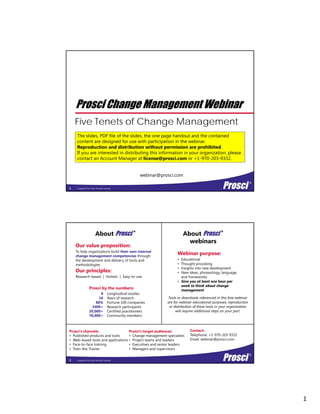
Prosci Change Management Webinar
Five Tenets of Change Management
The slides, PDF file of the slides, the one page handout and the contained
content are designed for use with participation in the webinar.
Copyright Prosci 2014. All rights reserved.1
webinar@prosci.com
Reproduction and distribution without permission are prohibited.
If you are interested in distributing this information in your organization, please
contact an Account Manager at license@prosci.com or +1-970-203-9332.
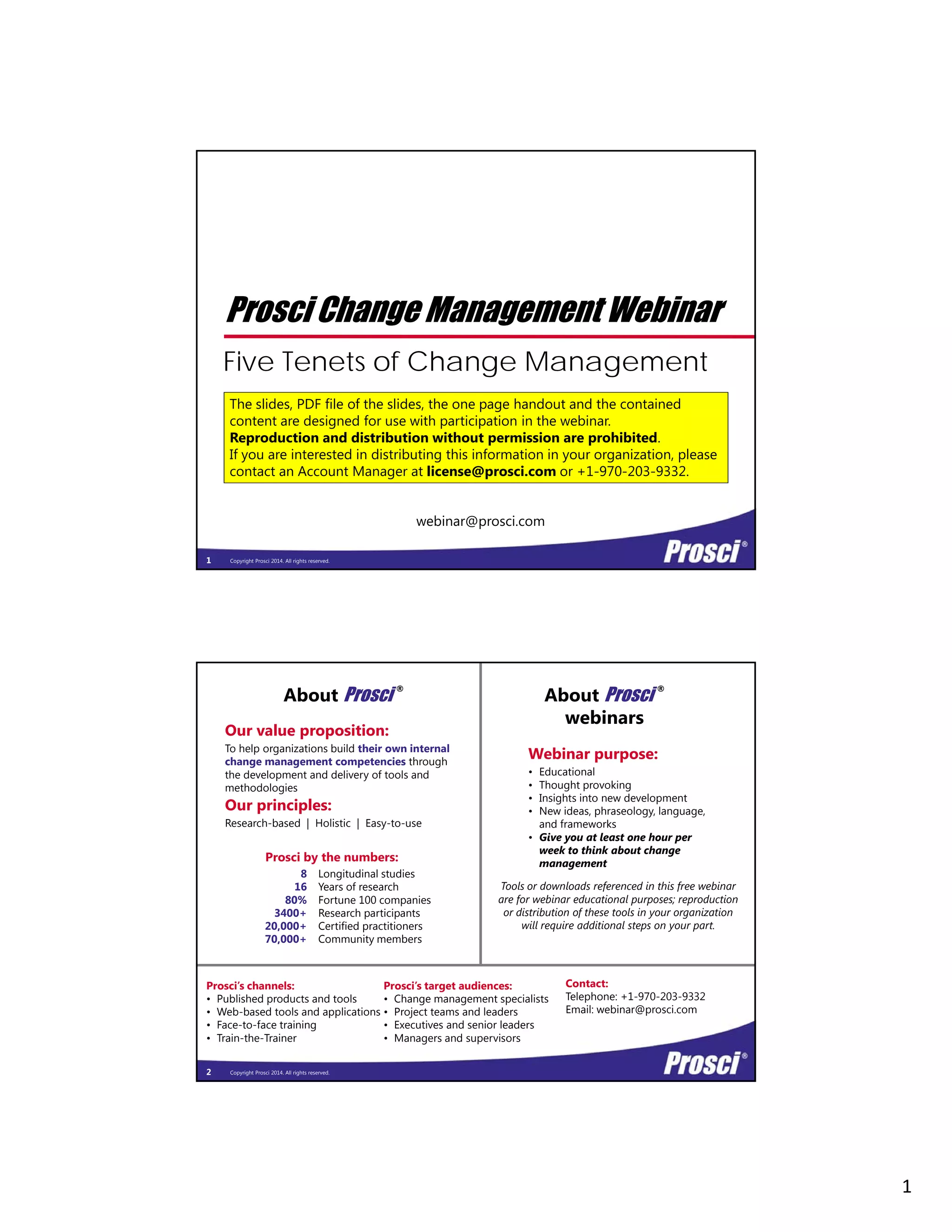
Our value proposition:
To help organizations build their own internal
change management competencies through
the development and delivery of tools and
methodologies
O i i l
About Prosci
®
Webinar purpose:
• Educational
• Thought provoking
• Insights into new development
About Prosci
®
webinars
Our principles:
Research-based | Holistic | Easy-to-use
Prosci by the numbers:
8
16
80%
3400+
20,000+
70,000+
Longitudinal studies
Years of research
Fortune 100 companies
Research participants
Certified practitioners
Community members
s g ts to e de e op e t
• New ideas, phraseology, language,
and frameworks
• Give you at least one hour per
week to think about change
management
Tools or downloads referenced in this free webinar
are for webinar educational purposes; reproduction
or distribution of these tools in your organization
will require additional steps on your part.
Copyright Prosci 2014. All rights reserved.
Prosci’s target audiences:
• Change management specialists
• Project teams and leaders
• Executives and senior leaders
• Managers and supervisors
Prosci’s channels:
• Published products and tools
• Web-based tools and applications
• Face-to-face training
• Train-the-Trainer
70,000+ Community members
Contact:
Telephone: +1-970-203-9332
Email: webinar@prosci.com
2
2
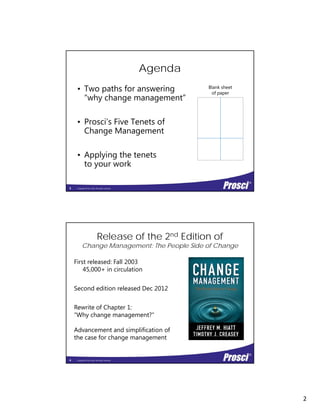
Agenda
• Two paths for answering
“why change management”
Blank sheet
of paper
why change management
• Prosci’s Five Tenets of
Change Management
Copyright Prosci 2014. All rights reserved.
• Applying the tenets
to your work
3
Release of the 2nd Edition of
Change Management: The People Side of Change
First released: Fall 2003
45 000+ in circulation45,000+ in circulation
Second edition released Dec 2012
Rewrite of Chapter 1:
“Why change management?”
Copyright Prosci 2014. All rights reserved.
Why change management?
Advancement and simplification of
the case for change management
4
3
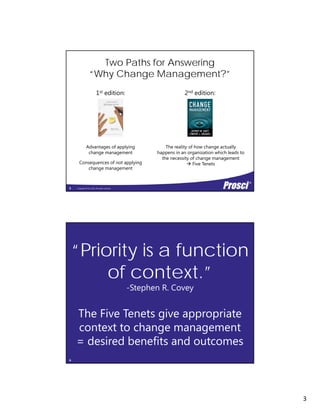
Two Paths for Answering
“Why Change Management?”
1st edition: 2nd edition:
Copyright Prosci 2014. All rights reserved.
Consequences of not applying
change management
Advantages of applying
change management
The reality of how change actually
happens in an organization which leads to
the necessity of change management
 Five Tenets
5
“Priority is a function
of context ”of context.”
-Stephen R. Covey
The Five Tenets give appropriate
Copyright Prosci 2014. All rights reserved.
The Five Tenets give appropriate
context to change management
= desired benefits and outcomes
6
4
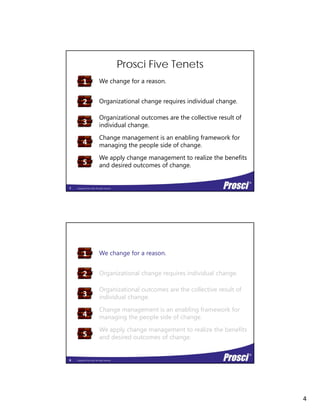
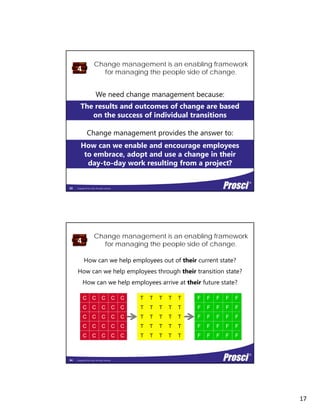
We change for a reason.
Prosci Five Tenets
1
Organizational change requires individual change.
Organizational outcomes are the collective result of
individual change.
Change management is an enabling framework for
managing the people side of change
2
3
4
Copyright Prosci 2014. All rights reserved.
managing the people side of change.
We apply change management to realize the benefits
and desired outcomes of change.5
7
We change for a reason.1
Organizational change requires individual change.
Organizational outcomes are the collective result of
individual change.
Change management is an enabling framework for
managing the people side of change
2
3
4
Copyright Prosci 2014. All rights reserved.
managing the people side of change.
We apply change management to realize the benefits
and desired outcomes of change.5
8
5
We change for a reason.1
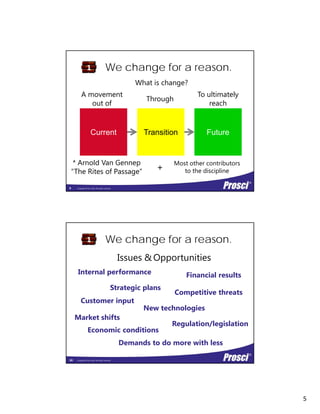
What is change?
A movement
Th h
To ultimately
Current Transition Future
out of
Through
y
reach
Copyright Prosci 2014. All rights reserved.
* Arnold Van Gennep
“The Rites of Passage” +
Most other contributors
to the discipline
9
We change for a reason.1
Issues & Opportunities
I l fInternal performance Financial results
Customer input
Competitive threats
Market shifts
New technologies
Strategic plans
Copyright Prosci 2014. All rights reserved.
Market shifts
Regulation/legislation
Demands to do more with less
Economic conditions
10
6
We change for a reason.1
FutureCurrent FutureCurrent
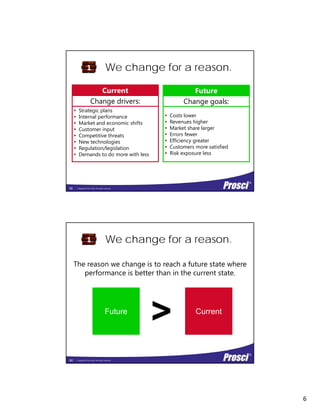
Change goals:Change drivers: Change goals:
• Costs lower
• Revenues higher
• Market share larger
• Errors fewer
• Efficiency greater
Change drivers:
• Strategic plans
• Internal performance
• Market and economic shifts
• Customer input
• Competitive threats
• New technologies
Copyright Prosci 2014. All rights reserved.
• Customers more satisfied
• Risk exposure less
g
• Regulation/legislation
• Demands to do more with less
11
We change for a reason.1
The reason we change is to reach a future state where
CurrentFuture
performance is better than in the current state.
>
Copyright Prosci 2014. All rights reserved.
>
12
7
3
2
1
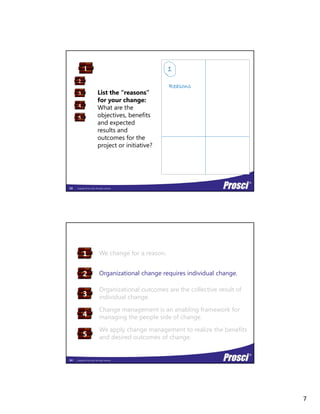
List the “reasons”
f
1
Reasons
5
4
for your change:
What are the
objectives, benefits
and expected
results and
outcomes for the
project or initiative?
Copyright Prosci 2014. All rights reserved.
project or initiative?
13
We change for a reason.1
Organizational change requires individual change.
Organizational outcomes are the collective result of
individual change.
Change management is an enabling framework for
managing the people side of change
2
3
4
Copyright Prosci 2014. All rights reserved.
managing the people side of change.
We apply change management to realize the benefits
and desired outcomes of change.5
14
8
Organizational change requires
individual change.
2
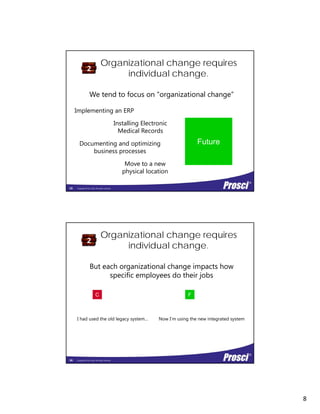
We tend to focus on “organizational change”g g
Future
Implementing an ERP
Installing Electronic
Medical Records
Documenting and optimizing
Copyright Prosci 2014. All rights reserved.
Documenting and optimizing
business processes
Move to a new
physical location
15
Organizational change requires
individual change.
2
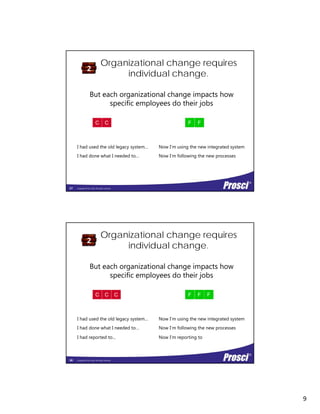
But each organizational change impacts how
FC
g g p
specific employees do their jobs
Copyright Prosci 2014. All rights reserved.
I had used the old legacy system… Now I’m using the new integrated system
16
9
Organizational change requires
individual change.
2
But each organizational change impacts how
FFC C
g g p
specific employees do their jobs
Copyright Prosci 2014. All rights reserved.
I had used the old legacy system… Now I’m using the new integrated system
I had done what I needed to… Now I’m following the new processes
17
Organizational change requires
individual change.
2
But each organizational change impacts how
F FFC C C
g g p
specific employees do their jobs
Copyright Prosci 2014. All rights reserved.
I had used the old legacy system… Now I’m using the new integrated system
I had done what I needed to… Now I’m following the new processes
I had reported to… Now I’m reporting to
18
10
Organizational change requires
individual change.
2
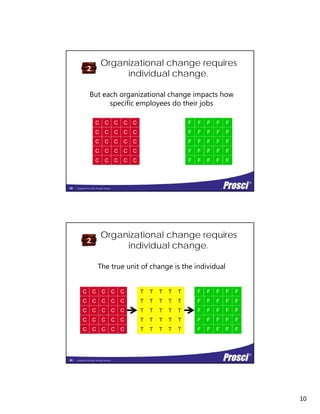
But each organizational change impacts how
F F F
F F F F
F F F F
F
F
F
FC C C C C
C C C C C
C C C C C
g g p
specific employees do their jobs
Copyright Prosci 2014. All rights reserved.
F F F
F F F
F
F
F
F
C C C C C
C C C C C
19
Organizational change requires
individual change.
2
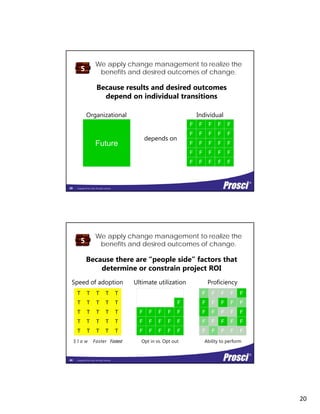
The true unit of change is the individual
Transition
g
Current Future
C C C C C
C C C C C
C C C C C
T T T T
T T T T T
T T T T T
F F F
F F F F
F F F F
T F
F
F
F
Copyright Prosci 2014. All rights reserved.
TC C C C C
C C C C C
T T T
T T T T
F F F
F F F
T
T
F
F
F
F
20
11
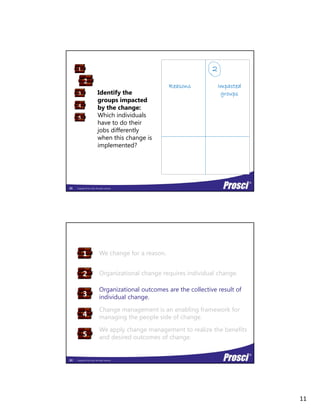
Identify the3
2
1 2
Impacted
groups
Reasons
groups impacted
by the change:
Which individuals
have to do their
jobs differently
when this change is
implemented?
5
4
Copyright Prosci 2014. All rights reserved.
implemented?
21
We change for a reason.1
Organizational change requires individual change.
Organizational outcomes are the collective result of
individual change.
Change management is an enabling framework for
managing the people side of change
2
3
4
Copyright Prosci 2014. All rights reserved.
managing the people side of change.
We apply change management to realize the benefits
and desired outcomes of change.5
22
12
Organizational outcomes are the
collective result of individual change.
3
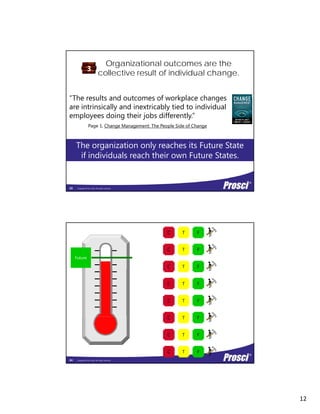
“The results and outcomes of workplace changesThe results and outcomes of workplace changes
are intrinsically and inextricably tied to individual
employees doing their jobs differently.”
Page 1, Change Management: The People Side of Change
The organization only reaches its Future State
Copyright Prosci 2014. All rights reserved.
The organization only reaches its Future State
if individuals reach their own Future States.
23
C T F
C T F
C T F
FutureFuture
C T F
C T F
C T F
Copyright Prosci 2014. All rights reserved.
C T F
C T F
C T F
24
13
Organizational outcomes are the
collective result of individual change.
3
Speed of adoption: How quickly employees
move through their transition statemove through their transition state
T T T T
T T T T T
T T T T T
TT T T T
T T T T T
T T T T T
T T T T T
T T T T T
T T T T T
T
S l o w Faster Fastest
Copyright Prosci 2014. All rights reserved.
TT T T
T T T T
T
T
TT T T
T T T T
T
T
TT T T
T T T T
T
T
25
Organizational outcomes are the
collective result of individual change.
3
Ultimate utilization: How many
l h th i f t t temployees reach their future state
Future
F F F
F F F F
F F F
F F F F
F
F
F
F
F
F
Future
F F F
F F F F
F F F
F F F F
F
F
F
F
F
F
Copyright Prosci 2014. All rights reserved.
FF F
F F F
F
F
F
F
FF F
F F F
F
F
F
F
26
14
Organizational outcomes are the
collective result of individual change.
3
Proficiency: How successfully employees
f i th i f t t t
Future
F F F
F F F F
F F F
F F F F
F
F
F
F
F
F
Future
perform in their future state
F F F
F F F F
F F F
F F F F
F
F
F
F
F
F
F F F
F F F
F F F
F F F F
F
F
F
F
F
F
Copyright Prosci 2014. All rights reserved.
FF F
F F F
F
F
F
F
FF F
F F F
F
F
F
F
FF F
F F F
F
F
F
F
27
Organizational outcomes are the
collective result of individual change.
3
Especially with today’s changes,
l t hi hi /h f t t t
F
Future
F F
F F F F
F F F F
F
F
F
FF
Future
F F
F F F F
F F F F
F
F
F
F
one employee not reaching his/her future state
can prevent the project from delivering results
Copyright Prosci 2014. All rights reserved.
F F F
F F F
F
F
F
F
F F F
F F F
F
F
F
F
e.g. Enterprise Resource Planning end-to-end solution
28
15
Organizational outcomes are the
collective result of individual change.
3
Project ROI, successful
depend
j
results and
outcomes
F t
F F F
F F F F
F F F F
F
F
F
F
F t
individual
transitions
depend
on
Copyright Prosci 2014. All rights reserved.
Future
F F F
F F F
F F F F
F
F
F
F
F
29
Future
Organizational outcomes are the
collective result of individual change.
3
F
F F
F
Future
F
F F
F
F
F F
F
F
F F
F
Project
objectives:
Objective #1
Objective #2
Impacted
groups
Copyright Prosci 2014. All rights reserved.
F
F F
F
F
F F
F
F
F F
F
Objective #3
Objective #4
30
16
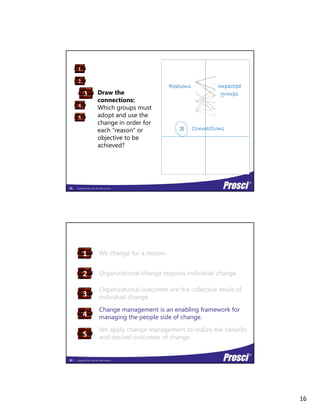
Draw the
Impacted
groups
Reasons
3
2
1
connections:
Which groups must
adopt and use the
change in order for
each “reason” or
objective to be
achieved?
3
5
4
Connections
Copyright Prosci 2014. All rights reserved.
achieved?
31
We change for a reason.1
Organizational change requires individual change.
Organizational outcomes are the collective result of
individual change.
Change management is an enabling framework for
managing the people side of change
2
3
4
Copyright Prosci 2014. All rights reserved.
managing the people side of change.
We apply change management to realize the benefits
and desired outcomes of change.5
32
17
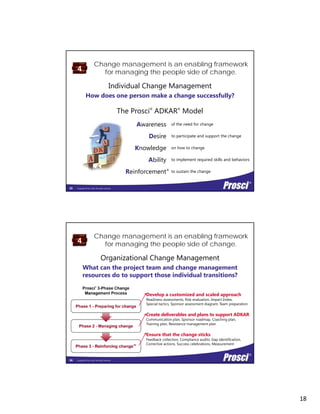
Change management is an enabling framework
for managing the people side of change.
We need change management because:
4
g g
How can we enable and encourage employees
Change management provides the answer to:
The results and outcomes of change are based
on the success of individual transitions
Copyright Prosci 2014. All rights reserved.
How can we enable and encourage employees
to embrace, adopt and use a change in their
day-to-day work resulting from a project?
33
Change management is an enabling framework
for managing the people side of change.4
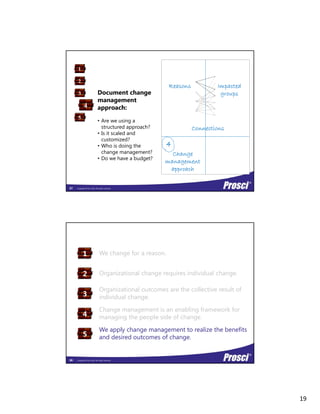
H h l l th h th i t iti t t ?
How can we help employees out of their current state?
How can we help employees arrive at their future state?
C C C C C
C C C C C
C C C C C
T T T T T
T T T T T
T T T T T
F F F F
F F F F
F F F F
F
F
F
How can we help employees through their transition state?
Copyright Prosci 2014. All rights reserved.
C C C C C
C C C C C
C C C C C
TT T T
T T T T
T T T T T
T
T
F F F
F F F
F F F F
F
F
F
F
F
34
18
Change management is an enabling framework
for managing the people side of change.4
Individual Change Management
How does one person make a change successfully?How does one person make a change successfully?
Awareness of the need for change
Desire to participate and support the change
The Prosci®
ADKAR®
Model
Copyright Prosci 2014. All rights reserved.35
Knowledge on how to change
Ability to implement required skills and behaviors
Reinforcement to sustain the change®
Change management is an enabling framework
for managing the people side of change.4
Organizational Change Management
What can the project team and change managementWhat can the project team and change management
resources do to support those individual transitions?
Develop a customized and scaled approach
Readiness assessments, Risk evaluation, Impact Index,
Special tactics, Sponsor assessment diagram, Team preparation
Create deliverables and plans to support ADKAR
Copyright Prosci 2014. All rights reserved.36
p pp
Communication plan, Sponsor roadmap, Coaching plan,
Training plan, Resistance management plan
Ensure that the change sticks
Feedback collection, Compliance audits, Gap identification,
Corrective actions, Success celebrations, Measurement
19
Document change
Impacted
groups
Reasons
3
2
1
management
approach:
• Are we using a
structured approach?
• Is it scaled and
customized?
Wh i d i th 4
5
4
Connections
Copyright Prosci 2014. All rights reserved.
• Who is doing the
change management?
• Do we have a budget?
4
Change
management
approach
37
We change for a reason.1
Organizational change requires individual change.
Organizational outcomes are the collective result of
individual change.
Change management is an enabling framework for
managing the people side of change
2
3
4
Copyright Prosci 2014. All rights reserved.
managing the people side of change.
We apply change management to realize the benefits
and desired outcomes of change.5
38
20
We apply change management to realize the
benefits and desired outcomes of change.5
Because results and desired outcomes
depend on individual transitionsdepend on individual transitions
Future
F F F F
F F F F
F F F F
F
F
F
Organizational Individual
depends on
Copyright Prosci 2014. All rights reserved.
Future
F F F
F F F
F F F F
F
F
F
F
F
39
We apply change management to realize the
benefits and desired outcomes of change.5
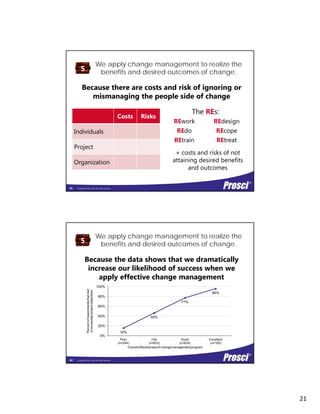
Because there are “people side” factors that
determine or constrain project ROIdetermine or constrain project ROI
T T T T
T T T T T
T T T T T
T
Speed of adoption Ultimate utilization Proficiency
FutureF F F F
F
F Future
F F F
F F F F
F F F F
F
F
F
F F F F
F F F
F F F F
F
F
F
F
Copyright Prosci 2014. All rights reserved.
TT T T
T T T T
T
T
S l o w Faster Fastest
FF F
F F F
F
F
F
F
FF F
F F F
F
F
F
F
FF F
F F F
F
F
F
F
Opt in vs. Opt out Ability to perform
40
21
We apply change management to realize the
benefits and desired outcomes of change.5
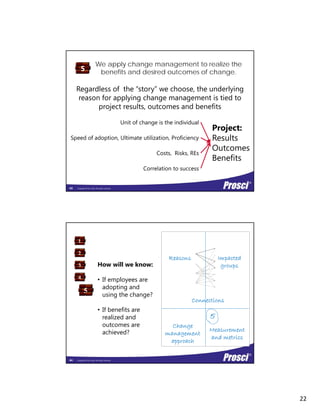
Because there are costs and risk of ignoring or
mismanaging the people side of changemismanaging the people side of change
Costs Risks
Individuals
j
The REs:
REwork REdesign
REdo REcope
REtrain REtreat
Copyright Prosci 2014. All rights reserved.
Project
Organization
+ costs and risks of not
attaining desired benefits
and outcomes
41
We apply change management to realize the
benefits and desired outcomes of change.5
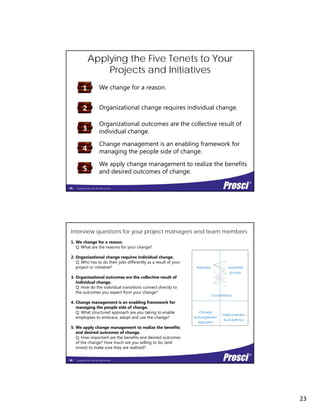
Because the data shows that we dramatically
increase our likelihood of success when we
46%
77%
96%
40%
60%
80%
100%
espondentsthatmet
dprojectobjectives
increase our likelihood of success when we
apply effective change management
Copyright Prosci 2014. All rights reserved.
16%
46%
0%
20%
40%
Poor
(n=244)
Fair
(n=653)
Good
(n=834)
Excellent
(n=165)
Percentofre
orexceeded
Overalleffectivenessof changemanagementprogram
42
22
We apply change management to realize the
benefits and desired outcomes of change.5
Regardless of the “story” we choose, the underlying
reason for applying change management is tied toreason for applying change management is tied to
project results, outcomes and benefits
Project:
Results
Unit of change is the individual
Speed of adoption, Ultimate utilization, Proficiency
Copyright Prosci 2014. All rights reserved.
Outcomes
Benefits
Costs, Risks, REs
Correlation to success
43
How will we know:
Impacted
groups
Reasons
3
2
1
• If employees are
adopting and
using the change?
• If benefits are
realized and 5
Connections
5
4
Copyright Prosci 2014. All rights reserved.
realized and
outcomes are
achieved?
5
Measurement
and metrics
Change
management
approach
44
23
We change for a reason.
Applying the Five Tenets to Your
Projects and Initiatives
1
Organizational change requires individual change.
Organizational outcomes are the collective result of
individual change.
Change management is an enabling framework for
2
3
Copyright Prosci 2014. All rights reserved.
Change management is an enabling framework for
managing the people side of change.
We apply change management to realize the benefits
and desired outcomes of change.5
4
45
ImpactedReasons
1. We change for a reason.
Q: What are the reasons for your change?
2. Organizational change requires individual change.
Q: Who has to do their jobs differently as a result of your
project or initiative?
Interview questions for your project managers and team members:
p
groups
Connections
Measurement
Change
a age e t
p j
3. Organizational outcomes are the collective result of
individual change.
Q: How do the individual transitions connect directly to
the outcomes you expect from your change?
4. Change management is an enabling framework for
managing the people side of change.
Q: What structured approach are you taking to enable
l t b d t d th h ?
Copyright Prosci 2014. All rights reserved.
and metrics
management
approach
employees to embrace, adopt and use the change?
5. We apply change management to realize the benefits
and desired outcomes of change.
Q: How important are the benefits and desired outcomes
of the change? How much are you willing to do (and
invest) to make sure they are realized?
46
24
We change for a reason.1
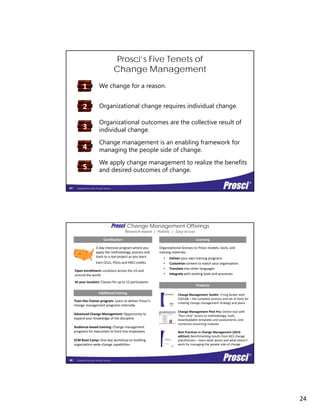
Prosci’s Five Tenets of
Change Management
Organizational change requires individual change.
Organizational outcomes are the collective result of
individual change.
Change management is an enabling framework for
2
3
4
Copyright Prosci 2014. All rights reserved.
g g g
managing the people side of change.
We apply change management to realize the benefits
and desired outcomes of change.5
4
47
Prosci Change Management Offerings
Research‐based  |  Holistic  |  Easy‐to‐use
3‐day intensive program where you 
apply the methodology, process and 
tools to a real project as you learn
Earn CEUs, PDUs and HRCI credits
ll h d
Organizational licenses to Prosci models, tools, and 
training materials:
Certification Licensing
• Deliver your own training programs
• Customize content to match your organization
• Translate into other languages
Open enrollment: Locations across the US and 
around the world 
Change Management Toolkit: 3‐ring binder with 
CD/USB – the complete process and set of tools for 
creating change management strategy and plans
Change Management Pilot Pro: Online tool with 
“four‐click” access to methodology, tools,
Train‐the‐Trainer program: Learn to deliver Prosci’s 
change management programs internally
Additional training
Products
Translate into other languages
• Integrate with existing tools and processes
Advanced Change Management: Opportunity to 
At your location: Classes for up to 12 participants
Copyright Prosci 2014. All rights reserved.
Best Practices in Change Management (2014 
edition): Benchmarking results from 822 change 
practitioners – learn what works and what doesn’t 
work for managing the people side of change
four click  access to methodology, tools, 
downloadable templates and assessments, and 
numerous eLearning modules
expand your knowledge of the discipline
Audience‐based training: Change management 
programs for executives to front line employees
ECM Boot Camp: One‐day workshop on building 
organization‐wide change capabilities
48

Prosci-Webinar-Five-Tenets-Slides

  • 1.
    1 Prosci Change ManagementWebinar Five Tenets of Change Management The slides, PDF file of the slides, the one page handout and the contained content are designed for use with participation in the webinar. Copyright Prosci 2014. All rights reserved.1 webinar@prosci.com Reproduction and distribution without permission are prohibited. If you are interested in distributing this information in your organization, please contact an Account Manager at license@prosci.com or +1-970-203-9332. Our value proposition: To help organizations build their own internal change management competencies through the development and delivery of tools and methodologies O i i l About Prosci ® Webinar purpose: • Educational • Thought provoking • Insights into new development About Prosci ® webinars Our principles: Research-based | Holistic | Easy-to-use Prosci by the numbers: 8 16 80% 3400+ 20,000+ 70,000+ Longitudinal studies Years of research Fortune 100 companies Research participants Certified practitioners Community members s g ts to e de e op e t • New ideas, phraseology, language, and frameworks • Give you at least one hour per week to think about change management Tools or downloads referenced in this free webinar are for webinar educational purposes; reproduction or distribution of these tools in your organization will require additional steps on your part. Copyright Prosci 2014. All rights reserved. Prosci’s target audiences: • Change management specialists • Project teams and leaders • Executives and senior leaders • Managers and supervisors Prosci’s channels: • Published products and tools • Web-based tools and applications • Face-to-face training • Train-the-Trainer 70,000+ Community members Contact: Telephone: +1-970-203-9332 Email: webinar@prosci.com 2
  • 2.
    2 Agenda • Two pathsfor answering “why change management” Blank sheet of paper why change management • Prosci’s Five Tenets of Change Management Copyright Prosci 2014. All rights reserved. • Applying the tenets to your work 3 Release of the 2nd Edition of Change Management: The People Side of Change First released: Fall 2003 45 000+ in circulation45,000+ in circulation Second edition released Dec 2012 Rewrite of Chapter 1: “Why change management?” Copyright Prosci 2014. All rights reserved. Why change management? Advancement and simplification of the case for change management 4
  • 3.
    3 Two Paths forAnswering “Why Change Management?” 1st edition: 2nd edition: Copyright Prosci 2014. All rights reserved. Consequences of not applying change management Advantages of applying change management The reality of how change actually happens in an organization which leads to the necessity of change management  Five Tenets 5 “Priority is a function of context ”of context.” -Stephen R. Covey The Five Tenets give appropriate Copyright Prosci 2014. All rights reserved. The Five Tenets give appropriate context to change management = desired benefits and outcomes 6
  • 4.
    4 We change fora reason. Prosci Five Tenets 1 Organizational change requires individual change. Organizational outcomes are the collective result of individual change. Change management is an enabling framework for managing the people side of change 2 3 4 Copyright Prosci 2014. All rights reserved. managing the people side of change. We apply change management to realize the benefits and desired outcomes of change.5 7 We change for a reason.1 Organizational change requires individual change. Organizational outcomes are the collective result of individual change. Change management is an enabling framework for managing the people side of change 2 3 4 Copyright Prosci 2014. All rights reserved. managing the people side of change. We apply change management to realize the benefits and desired outcomes of change.5 8
  • 5.
    5 We change fora reason.1 What is change? A movement Th h To ultimately Current Transition Future out of Through y reach Copyright Prosci 2014. All rights reserved. * Arnold Van Gennep “The Rites of Passage” + Most other contributors to the discipline 9 We change for a reason.1 Issues & Opportunities I l fInternal performance Financial results Customer input Competitive threats Market shifts New technologies Strategic plans Copyright Prosci 2014. All rights reserved. Market shifts Regulation/legislation Demands to do more with less Economic conditions 10
  • 6.
    6 We change fora reason.1 FutureCurrent FutureCurrent Change goals:Change drivers: Change goals: • Costs lower • Revenues higher • Market share larger • Errors fewer • Efficiency greater Change drivers: • Strategic plans • Internal performance • Market and economic shifts • Customer input • Competitive threats • New technologies Copyright Prosci 2014. All rights reserved. • Customers more satisfied • Risk exposure less g • Regulation/legislation • Demands to do more with less 11 We change for a reason.1 The reason we change is to reach a future state where CurrentFuture performance is better than in the current state. > Copyright Prosci 2014. All rights reserved. > 12
  • 7.
    7 3 2 1 List the “reasons” f 1 Reasons 5 4 foryour change: What are the objectives, benefits and expected results and outcomes for the project or initiative? Copyright Prosci 2014. All rights reserved. project or initiative? 13 We change for a reason.1 Organizational change requires individual change. Organizational outcomes are the collective result of individual change. Change management is an enabling framework for managing the people side of change 2 3 4 Copyright Prosci 2014. All rights reserved. managing the people side of change. We apply change management to realize the benefits and desired outcomes of change.5 14
  • 8.
    8 Organizational change requires individualchange. 2 We tend to focus on “organizational change”g g Future Implementing an ERP Installing Electronic Medical Records Documenting and optimizing Copyright Prosci 2014. All rights reserved. Documenting and optimizing business processes Move to a new physical location 15 Organizational change requires individual change. 2 But each organizational change impacts how FC g g p specific employees do their jobs Copyright Prosci 2014. All rights reserved. I had used the old legacy system… Now I’m using the new integrated system 16
  • 9.
    9 Organizational change requires individualchange. 2 But each organizational change impacts how FFC C g g p specific employees do their jobs Copyright Prosci 2014. All rights reserved. I had used the old legacy system… Now I’m using the new integrated system I had done what I needed to… Now I’m following the new processes 17 Organizational change requires individual change. 2 But each organizational change impacts how F FFC C C g g p specific employees do their jobs Copyright Prosci 2014. All rights reserved. I had used the old legacy system… Now I’m using the new integrated system I had done what I needed to… Now I’m following the new processes I had reported to… Now I’m reporting to 18
  • 10.
    10 Organizational change requires individualchange. 2 But each organizational change impacts how F F F F F F F F F F F F F F FC C C C C C C C C C C C C C C g g p specific employees do their jobs Copyright Prosci 2014. All rights reserved. F F F F F F F F F F C C C C C C C C C C 19 Organizational change requires individual change. 2 The true unit of change is the individual Transition g Current Future C C C C C C C C C C C C C C C T T T T T T T T T T T T T T F F F F F F F F F F F T F F F F Copyright Prosci 2014. All rights reserved. TC C C C C C C C C C T T T T T T T F F F F F F T T F F F F 20
  • 11.
    11 Identify the3 2 1 2 Impacted groups Reasons groupsimpacted by the change: Which individuals have to do their jobs differently when this change is implemented? 5 4 Copyright Prosci 2014. All rights reserved. implemented? 21 We change for a reason.1 Organizational change requires individual change. Organizational outcomes are the collective result of individual change. Change management is an enabling framework for managing the people side of change 2 3 4 Copyright Prosci 2014. All rights reserved. managing the people side of change. We apply change management to realize the benefits and desired outcomes of change.5 22
  • 12.
    12 Organizational outcomes arethe collective result of individual change. 3 “The results and outcomes of workplace changesThe results and outcomes of workplace changes are intrinsically and inextricably tied to individual employees doing their jobs differently.” Page 1, Change Management: The People Side of Change The organization only reaches its Future State Copyright Prosci 2014. All rights reserved. The organization only reaches its Future State if individuals reach their own Future States. 23 C T F C T F C T F FutureFuture C T F C T F C T F Copyright Prosci 2014. All rights reserved. C T F C T F C T F 24
  • 13.
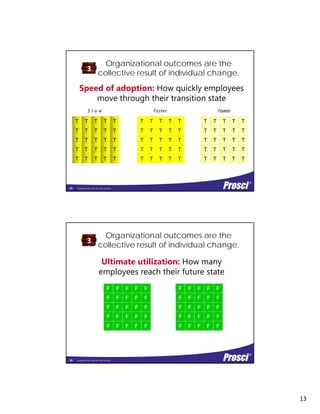
    13 Organizational outcomes arethe collective result of individual change. 3 Speed of adoption: How quickly employees move through their transition statemove through their transition state T T T T T T T T T T T T T T TT T T T T T T T T T T T T T T T T T T T T T T T T T T T T T S l o w Faster Fastest Copyright Prosci 2014. All rights reserved. TT T T T T T T T T TT T T T T T T T T TT T T T T T T T T 25 Organizational outcomes are the collective result of individual change. 3 Ultimate utilization: How many l h th i f t t temployees reach their future state Future F F F F F F F F F F F F F F F F F F F F Future F F F F F F F F F F F F F F F F F F F F Copyright Prosci 2014. All rights reserved. FF F F F F F F F F FF F F F F F F F F 26
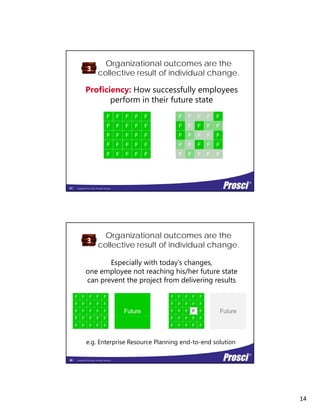
  • 14.
    14 Organizational outcomes arethe collective result of individual change. 3 Proficiency: How successfully employees f i th i f t t t Future F F F F F F F F F F F F F F F F F F F F Future perform in their future state F F F F F F F F F F F F F F F F F F F F F F F F F F F F F F F F F F F F F F F Copyright Prosci 2014. All rights reserved. FF F F F F F F F F FF F F F F F F F F FF F F F F F F F F 27 Organizational outcomes are the collective result of individual change. 3 Especially with today’s changes, l t hi hi /h f t t t F Future F F F F F F F F F F F F F FF Future F F F F F F F F F F F F F F one employee not reaching his/her future state can prevent the project from delivering results Copyright Prosci 2014. All rights reserved. F F F F F F F F F F F F F F F F F F F F e.g. Enterprise Resource Planning end-to-end solution 28
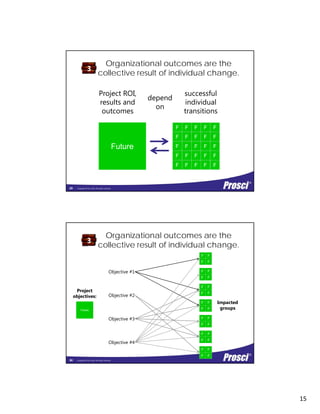
  • 15.
    15 Organizational outcomes arethe collective result of individual change. 3 Project ROI, successful depend j results and outcomes F t F F F F F F F F F F F F F F F F t individual transitions depend on Copyright Prosci 2014. All rights reserved. Future F F F F F F F F F F F F F F F 29 Future Organizational outcomes are the collective result of individual change. 3 F F F F Future F F F F F F F F F F F F Project objectives: Objective #1 Objective #2 Impacted groups Copyright Prosci 2014. All rights reserved. F F F F F F F F F F F F Objective #3 Objective #4 30
  • 16.
    16 Draw the Impacted groups Reasons 3 2 1 connections: Which groupsmust adopt and use the change in order for each “reason” or objective to be achieved? 3 5 4 Connections Copyright Prosci 2014. All rights reserved. achieved? 31 We change for a reason.1 Organizational change requires individual change. Organizational outcomes are the collective result of individual change. Change management is an enabling framework for managing the people side of change 2 3 4 Copyright Prosci 2014. All rights reserved. managing the people side of change. We apply change management to realize the benefits and desired outcomes of change.5 32
  • 17.
    17 Change management isan enabling framework for managing the people side of change. We need change management because: 4 g g How can we enable and encourage employees Change management provides the answer to: The results and outcomes of change are based on the success of individual transitions Copyright Prosci 2014. All rights reserved. How can we enable and encourage employees to embrace, adopt and use a change in their day-to-day work resulting from a project? 33 Change management is an enabling framework for managing the people side of change.4 H h l l th h th i t iti t t ? How can we help employees out of their current state? How can we help employees arrive at their future state? C C C C C C C C C C C C C C C T T T T T T T T T T T T T T T F F F F F F F F F F F F F F F How can we help employees through their transition state? Copyright Prosci 2014. All rights reserved. C C C C C C C C C C C C C C C TT T T T T T T T T T T T T T F F F F F F F F F F F F F F F 34
  • 18.
    18 Change management isan enabling framework for managing the people side of change.4 Individual Change Management How does one person make a change successfully?How does one person make a change successfully? Awareness of the need for change Desire to participate and support the change The Prosci® ADKAR® Model Copyright Prosci 2014. All rights reserved.35 Knowledge on how to change Ability to implement required skills and behaviors Reinforcement to sustain the change® Change management is an enabling framework for managing the people side of change.4 Organizational Change Management What can the project team and change managementWhat can the project team and change management resources do to support those individual transitions? Develop a customized and scaled approach Readiness assessments, Risk evaluation, Impact Index, Special tactics, Sponsor assessment diagram, Team preparation Create deliverables and plans to support ADKAR Copyright Prosci 2014. All rights reserved.36 p pp Communication plan, Sponsor roadmap, Coaching plan, Training plan, Resistance management plan Ensure that the change sticks Feedback collection, Compliance audits, Gap identification, Corrective actions, Success celebrations, Measurement
  • 19.
    19 Document change Impacted groups Reasons 3 2 1 management approach: • Arewe using a structured approach? • Is it scaled and customized? Wh i d i th 4 5 4 Connections Copyright Prosci 2014. All rights reserved. • Who is doing the change management? • Do we have a budget? 4 Change management approach 37 We change for a reason.1 Organizational change requires individual change. Organizational outcomes are the collective result of individual change. Change management is an enabling framework for managing the people side of change 2 3 4 Copyright Prosci 2014. All rights reserved. managing the people side of change. We apply change management to realize the benefits and desired outcomes of change.5 38
  • 20.
    20 We apply changemanagement to realize the benefits and desired outcomes of change.5 Because results and desired outcomes depend on individual transitionsdepend on individual transitions Future F F F F F F F F F F F F F F F Organizational Individual depends on Copyright Prosci 2014. All rights reserved. Future F F F F F F F F F F F F F F F 39 We apply change management to realize the benefits and desired outcomes of change.5 Because there are “people side” factors that determine or constrain project ROIdetermine or constrain project ROI T T T T T T T T T T T T T T T Speed of adoption Ultimate utilization Proficiency FutureF F F F F F Future F F F F F F F F F F F F F F F F F F F F F F F F F F F F F Copyright Prosci 2014. All rights reserved. TT T T T T T T T T S l o w Faster Fastest FF F F F F F F F F FF F F F F F F F F FF F F F F F F F F Opt in vs. Opt out Ability to perform 40
  • 21.
    21 We apply changemanagement to realize the benefits and desired outcomes of change.5 Because there are costs and risk of ignoring or mismanaging the people side of changemismanaging the people side of change Costs Risks Individuals j The REs: REwork REdesign REdo REcope REtrain REtreat Copyright Prosci 2014. All rights reserved. Project Organization + costs and risks of not attaining desired benefits and outcomes 41 We apply change management to realize the benefits and desired outcomes of change.5 Because the data shows that we dramatically increase our likelihood of success when we 46% 77% 96% 40% 60% 80% 100% espondentsthatmet dprojectobjectives increase our likelihood of success when we apply effective change management Copyright Prosci 2014. All rights reserved. 16% 46% 0% 20% 40% Poor (n=244) Fair (n=653) Good (n=834) Excellent (n=165) Percentofre orexceeded Overalleffectivenessof changemanagementprogram 42
  • 22.
    22 We apply changemanagement to realize the benefits and desired outcomes of change.5 Regardless of the “story” we choose, the underlying reason for applying change management is tied toreason for applying change management is tied to project results, outcomes and benefits Project: Results Unit of change is the individual Speed of adoption, Ultimate utilization, Proficiency Copyright Prosci 2014. All rights reserved. Outcomes Benefits Costs, Risks, REs Correlation to success 43 How will we know: Impacted groups Reasons 3 2 1 • If employees are adopting and using the change? • If benefits are realized and 5 Connections 5 4 Copyright Prosci 2014. All rights reserved. realized and outcomes are achieved? 5 Measurement and metrics Change management approach 44
  • 23.
    23 We change fora reason. Applying the Five Tenets to Your Projects and Initiatives 1 Organizational change requires individual change. Organizational outcomes are the collective result of individual change. Change management is an enabling framework for 2 3 Copyright Prosci 2014. All rights reserved. Change management is an enabling framework for managing the people side of change. We apply change management to realize the benefits and desired outcomes of change.5 4 45 ImpactedReasons 1. We change for a reason. Q: What are the reasons for your change? 2. Organizational change requires individual change. Q: Who has to do their jobs differently as a result of your project or initiative? Interview questions for your project managers and team members: p groups Connections Measurement Change a age e t p j 3. Organizational outcomes are the collective result of individual change. Q: How do the individual transitions connect directly to the outcomes you expect from your change? 4. Change management is an enabling framework for managing the people side of change. Q: What structured approach are you taking to enable l t b d t d th h ? Copyright Prosci 2014. All rights reserved. and metrics management approach employees to embrace, adopt and use the change? 5. We apply change management to realize the benefits and desired outcomes of change. Q: How important are the benefits and desired outcomes of the change? How much are you willing to do (and invest) to make sure they are realized? 46
  • 24.
    24 We change fora reason.1 Prosci’s Five Tenets of Change Management Organizational change requires individual change. Organizational outcomes are the collective result of individual change. Change management is an enabling framework for 2 3 4 Copyright Prosci 2014. All rights reserved. g g g managing the people side of change. We apply change management to realize the benefits and desired outcomes of change.5 4 47 Prosci Change Management Offerings Research‐based  |  Holistic  |  Easy‐to‐use 3‐day intensive program where you  apply the methodology, process and  tools to a real project as you learn Earn CEUs, PDUs and HRCI credits ll h d Organizational licenses to Prosci models, tools, and  training materials: Certification Licensing • Deliver your own training programs • Customize content to match your organization • Translate into other languages Open enrollment: Locations across the US and  around the world  Change Management Toolkit: 3‐ring binder with  CD/USB – the complete process and set of tools for  creating change management strategy and plans Change Management Pilot Pro: Online tool with  “four‐click” access to methodology, tools, Train‐the‐Trainer program: Learn to deliver Prosci’s  change management programs internally Additional training Products Translate into other languages • Integrate with existing tools and processes Advanced Change Management: Opportunity to  At your location: Classes for up to 12 participants Copyright Prosci 2014. All rights reserved. Best Practices in Change Management (2014  edition): Benchmarking results from 822 change  practitioners – learn what works and what doesn’t  work for managing the people side of change four click  access to methodology, tools,  downloadable templates and assessments, and  numerous eLearning modules expand your knowledge of the discipline Audience‐based training: Change management  programs for executives to front line employees ECM Boot Camp: One‐day workshop on building  organization‐wide change capabilities 48