1
Affiliated to Pokhara University
POKHARA ENGINEERING COLLEGE
Phirke, Pokhara-08
A
Project Proposal on
Online Attendance System
Submitted by:
NIKIT PANDEY (21070562)
RANJAN PAUDEL (21070565)
SHIVA KUMAR BHANDARI (21070575)
SUMAN SHARMA (21070579)
Submitted to:
Research Management Cell
Pokhara Engineering College
2024
2
Chapter 1: Introduction
In the realm of educational institutions, effective attendance management plays a
pivotal role in ensuring the smooth operation of daily activities and the overall academic
progress of students. However, traditional methods of attendance tracking often prove
to be cumbersome, error-prone, and inefficient. In light of these challenges, we propose
the development of a comprehensive web-based solution: an Attendance System
tailored for educational institutions. This system will not only simplify the process of
recording student attendance but also provide valuable statistical insights for
administrators and teachers alike.
1.1 Background
Our project is all about adapting to changes in education by helping schools manage
attendance better, no matter where they are or who they serve. We're creating an Online
Attendance System to make it easier for schools of all types to keep track of attendance,
which will help bridge gaps between different communities, save money on paperwork,
and ensure that every student gets the support they need to succeed. Our goal is to make
attendance tracking fairer, more efficient, and accessible to all schools, regardless of
their location or budget.
1.2 Statement of Problem
Many schools still rely on old-fashioned methods like paper-based systems or outdated
software to track attendance, which are slow, error-prone, and don't suit the needs of
diverse student populations. This leads to disparities in attendance recording, extra
work for administrators, and challenges in ensuring every student receives the support
they need. There's a pressing need for a modern attendance management solution that's
user-friendly, adaptable, and accessible for all schools, regardless of their socio-
economic background or geographical location.
3
1.3 Objectives
Our project aims to address the shortcomings of traditional attendance management
systems by introducing an Online Attendance System tailored for educational
institutions.
• Create an easy-to-use attendance system for students, teachers, and admins.
• Advanced analytics for actionable insights on attendance trends.
• Timely reminders to encourage improved attendance and engagement.
1.4 Scope of Project
This project could expand to include advanced features like biometric or RFID-based
attendance tracking, predictive analytics for attendance forecasting, and integration
with other educational platforms. We may also explore emerging technologies like AI
and ML to make attendance management even more efficient.
1.5 Limitations
While the Online Attendance System aims to revolutionize attendance tracking in
educational settings, it might have certain limitations:
• The system may initially lack certain advanced features and could face challenges in
scaling the platform to accommodate future growth.
• There could be potential compatibility issues with specific devices or web browsers,
affecting user accessibility and experience.
• Limited resources for marketing and user acquisition efforts may pose challenges in
promoting and expanding the adoption of the system within educational institutions.
4
Chapter 2: Literature Review
The literature review section offers insights into existing research and projects relevant
to the development of Online Attendance System. It outlines preliminary study
conducted for this project and similar platform available.
Preliminary Study:
The preliminary investigation of the project looked at whether it would be possible to
develop an online attendance system for educational institutions. This involved
examining existing attendance tracking methods, identifying challenges faced by
teachers. Additionally, the study considered factors such as user requirements, data
security, and system scalability. The insights gained from the study will help make
informed decisions and plan the project effectively.
Similar Tasks:
Several relevant projects and existing online attendance systems were reviewed during
the literature review phase. These serve as valuable references for understanding the
scope and possibilities within this domain. Notable tasks examined include:
• AttendEasy: An online attendance system designed for educational institutions,
offering features such as real-time tracking and customizable reporting.
• ClassTrack: An attendance management system that integrates with available
school systems, providing features like attendance recording and analysis.
• AttendancePro: A cloud-based attendance tracking solution tailored for schools and
universities, offering features such as biometric authentication and predictive
analytics.
The literature review phase has provided valuable understanding of the existing
research and projects in this field of online attendance systems. This knowledge serves
as a foundation for developing this project, ensuring that it meets the needs of
educational institutions and enhances attendance management processes.
5
Chapter 3: Methodology
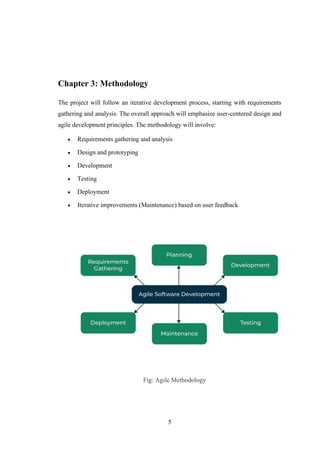
The project will follow an iterative development process, starting with requirements
gathering and analysis. The overall approach will emphasize user-centered design and
agile development principles. The methodology will involve:
• Requirements gathering and analysis
• Design and prototyping
• Development
• Testing
• Deployment
• Iterative improvements (Maintenance) based on user feedback
Fig: Agile Methodology
6
Chapter 4: System Modelling
4.1 E-R Diagram
Fig: E-R Diagram
7
4.2 Class Diagram
Fig: Class Diagram
8
4.3 Sequence Diagram
Fig: Sequence Diagram
9
Chapter 5: Project Schedule
Phases May
10-15
May
16- 20
May
21- 30
March
1-8
March
9-15
Project planning
and preparation
Design and
Prototyping
Development
Phase I
Development
phase II
Testing and
Debugging
Finalization and
Deployment
The proposed work has duration of about 4 and half week approx. which is divided
into multiple phases as above. Different phase has been assigned working days
according to its need.
10
Chapter 6: Expected Outcomes
Upon completion, the Online Attendance System is expected to achieve the following
outcomes:
• Efficient attendance management through a user-friendly online platform.
• Improved communication and transparency among students, teachers, and
administrators.
• Scalability and flexibility to accommodate future growth and feature
enhancements.
11
Reference:
1) Stack Overflow: https://stackoverflow.com/
2) PHP Documentation: https://devdocs.io/php/
3) JavaScript Documentation: https://developer.mozilla.org/en-
US/docs/Web/JavaScript

Proposalsecondyearprojectproposaleng.pdf

  • 1.
    1 Affiliated to PokharaUniversity POKHARA ENGINEERING COLLEGE Phirke, Pokhara-08 A Project Proposal on Online Attendance System Submitted by: NIKIT PANDEY (21070562) RANJAN PAUDEL (21070565) SHIVA KUMAR BHANDARI (21070575) SUMAN SHARMA (21070579) Submitted to: Research Management Cell Pokhara Engineering College 2024
  • 2.
    2 Chapter 1: Introduction Inthe realm of educational institutions, effective attendance management plays a pivotal role in ensuring the smooth operation of daily activities and the overall academic progress of students. However, traditional methods of attendance tracking often prove to be cumbersome, error-prone, and inefficient. In light of these challenges, we propose the development of a comprehensive web-based solution: an Attendance System tailored for educational institutions. This system will not only simplify the process of recording student attendance but also provide valuable statistical insights for administrators and teachers alike. 1.1 Background Our project is all about adapting to changes in education by helping schools manage attendance better, no matter where they are or who they serve. We're creating an Online Attendance System to make it easier for schools of all types to keep track of attendance, which will help bridge gaps between different communities, save money on paperwork, and ensure that every student gets the support they need to succeed. Our goal is to make attendance tracking fairer, more efficient, and accessible to all schools, regardless of their location or budget. 1.2 Statement of Problem Many schools still rely on old-fashioned methods like paper-based systems or outdated software to track attendance, which are slow, error-prone, and don't suit the needs of diverse student populations. This leads to disparities in attendance recording, extra work for administrators, and challenges in ensuring every student receives the support they need. There's a pressing need for a modern attendance management solution that's user-friendly, adaptable, and accessible for all schools, regardless of their socio- economic background or geographical location.
  • 3.
    3 1.3 Objectives Our projectaims to address the shortcomings of traditional attendance management systems by introducing an Online Attendance System tailored for educational institutions. • Create an easy-to-use attendance system for students, teachers, and admins. • Advanced analytics for actionable insights on attendance trends. • Timely reminders to encourage improved attendance and engagement. 1.4 Scope of Project This project could expand to include advanced features like biometric or RFID-based attendance tracking, predictive analytics for attendance forecasting, and integration with other educational platforms. We may also explore emerging technologies like AI and ML to make attendance management even more efficient. 1.5 Limitations While the Online Attendance System aims to revolutionize attendance tracking in educational settings, it might have certain limitations: • The system may initially lack certain advanced features and could face challenges in scaling the platform to accommodate future growth. • There could be potential compatibility issues with specific devices or web browsers, affecting user accessibility and experience. • Limited resources for marketing and user acquisition efforts may pose challenges in promoting and expanding the adoption of the system within educational institutions.
  • 4.
    4 Chapter 2: LiteratureReview The literature review section offers insights into existing research and projects relevant to the development of Online Attendance System. It outlines preliminary study conducted for this project and similar platform available. Preliminary Study: The preliminary investigation of the project looked at whether it would be possible to develop an online attendance system for educational institutions. This involved examining existing attendance tracking methods, identifying challenges faced by teachers. Additionally, the study considered factors such as user requirements, data security, and system scalability. The insights gained from the study will help make informed decisions and plan the project effectively. Similar Tasks: Several relevant projects and existing online attendance systems were reviewed during the literature review phase. These serve as valuable references for understanding the scope and possibilities within this domain. Notable tasks examined include: • AttendEasy: An online attendance system designed for educational institutions, offering features such as real-time tracking and customizable reporting. • ClassTrack: An attendance management system that integrates with available school systems, providing features like attendance recording and analysis. • AttendancePro: A cloud-based attendance tracking solution tailored for schools and universities, offering features such as biometric authentication and predictive analytics. The literature review phase has provided valuable understanding of the existing research and projects in this field of online attendance systems. This knowledge serves as a foundation for developing this project, ensuring that it meets the needs of educational institutions and enhances attendance management processes.
  • 5.
    5 Chapter 3: Methodology Theproject will follow an iterative development process, starting with requirements gathering and analysis. The overall approach will emphasize user-centered design and agile development principles. The methodology will involve: • Requirements gathering and analysis • Design and prototyping • Development • Testing • Deployment • Iterative improvements (Maintenance) based on user feedback Fig: Agile Methodology
  • 6.
    6 Chapter 4: SystemModelling 4.1 E-R Diagram Fig: E-R Diagram
  • 7.
  • 8.
  • 9.
    9 Chapter 5: ProjectSchedule Phases May 10-15 May 16- 20 May 21- 30 March 1-8 March 9-15 Project planning and preparation Design and Prototyping Development Phase I Development phase II Testing and Debugging Finalization and Deployment The proposed work has duration of about 4 and half week approx. which is divided into multiple phases as above. Different phase has been assigned working days according to its need.
  • 10.
    10 Chapter 6: ExpectedOutcomes Upon completion, the Online Attendance System is expected to achieve the following outcomes: • Efficient attendance management through a user-friendly online platform. • Improved communication and transparency among students, teachers, and administrators. • Scalability and flexibility to accommodate future growth and feature enhancements.
  • 11.
    11 Reference: 1) Stack Overflow:https://stackoverflow.com/ 2) PHP Documentation: https://devdocs.io/php/ 3) JavaScript Documentation: https://developer.mozilla.org/en- US/docs/Web/JavaScript