Proportion and the Human Face
 
 
Mona Lisa   by Leonardo Da Vinci
Correct proportions
Draw an egg shape - not an oval
Draw a vertical line through the center
Draw a horizontal line through the center
Divide bottom half into thirds
Drawing the eyes
Draw 2 curves on the middle horizontal line
Create eyes on the curves
Add eyebrows above the eyes
Draw the bottom of the nose on the line below the eyes
Add a curve for the bridge of the nose
Draw a mouth above the bottom horizontal line
Draw the ears from the eyes to bottom of nose
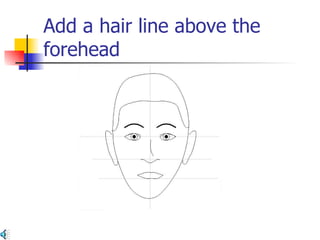
Add a hair line above the forehead
Draw a neck starting under the ears and curving down
Adding shoulders
Erase guidelines, add details
Credits: Face Proportions http://www. alifetimeofcolor .com/main. taf ?p=2,1,1,5   How to Draw Accurate Face Proportions http://www. ehow .com/how_2215833_draw-accurate-face-proportions.html   Standard Facial Proportions http:// drawinglab . evansville . edu /face.html   Clown Images  www.bing.com   The Golden Ratio http://www.geom.uiuc.edu/~demo5337/s97b/art. htm Clipart Hair http://www.fundraw.com/clipart/categories/!Photo_Decorations/Hair/00000171

Proportion and the human face

Editor's Notes

  • #2 Today we’re going to learn about facial proportions. Proportion is a part of one thing as it relates to the whole. When proportions are not correct, the image will look odd.
  • #3 For example, does a clown’s feet look like they are in proportion with the rest of the body?
  • #4 Of course not! That’s one of the things that makes a clown look so funny. The feet are out of proportion.
  • #5 This is a famous painting by Leonardo Da Vinci, called The Mona Lisa This image has the ideal proportions, which Leonardo called “Divine Proportion”
  • #6 We are going to learn how to draw a face with the correct proportions.
  • #7 First, let’s draw an egg-shape. Notice that this shape is different than an oval. An egg shape is larger at one end and smaller at the other end.
  • #8 Using a vertical line, let’s divide our shape into two equal sections. Draw the guideline lightly, so you can erase them later.
  • #9 Next, draw another guideline horizontally through the center to divide the shape into 4 equal parts
  • #10 Use 2 more horizontal lines to divide the bottom half of the shape into three equal parts
  • #11 Now its time to draw the eyes. Most students will draw the eyes in the center of the 2 top halves. However, in reality the eyes are in the center of the head.
  • #12 Draw the top of each eye on the 1 st horizontal line. As a rule, you should be able to fit 5 eye lengths across the line.
  • #13 Draw the eyes and eyelids.
  • #14 Add the eyebrows. These should be drawn directly above the eyes
  • #15 The bottom of the nose should be drawn at the next horizontal line
  • #16 Adding a curve will help define the bridge of the nose. You could even draw a curve for each side of the nose. That’s up to you.
  • #17 The mouth should be drawn directly above the last horizontal line. The corners of a relaxed mouth should line up with the center of the eyes.
  • #18 Next are the ears. As a rule, the length of the ears are about the same length as the distance between the eyes and the bottom of the nose.
  • #19 Adding a hairline will help you as you draw the hair. Make sure you leave enough room for a forehead.
  • #20 The top of the neck actually starts directly under the ears. Curve inwards slightly, but not so much as to make the neck too narrow.
  • #21 If you have room, add shoulders. Make sure you make them wide enough. Your shoulders should be able to fit an extra head on each one.
  • #22 Once you have the correct proportions, erase your guidelines. Then you can begin adding all the details that will make your drawing unique. Begin with the hair, then add details like eyelashes, earrings, hats…whatever you think will give your face personality. Here’s where you can really get creative. And above all, have fun!