• Nanomaterials usuallydefined as materials composed of a set of substances where at least one dimension is
less than approximately 100 nm providing unique physical and chemical properties that exist at the
nanoscale.
• Because of the unique nanoscale (1–100 nm) size, nanomaterials are different from microscopic atoms
molecules and macro-objects in terms of their physical, chemical, electrical, and magnetic properties.
• The properties of macroscopic material abruptly change to some exceptional properties because of the size
reduction.
Introduction
3.
• Size andshape of nanomaterials
As per size and dimension, nanomaterials can be classified into four categories:
(1) zero dimensional (0D) clusters and particles
(2) one-dimensional (1D) nanotubes and nanowires
(3) two-dimensional (2D) nanoplates and layer
(4) three-dimensional (3D) bundles of nanowires and nanotubes as well as multinanolayers.
They can exist in single, fused, aggregated, or agglomerated forms with spherical, tubular, ellipsoidal, and
irregular shapes.
1. Physical Properties
4.
• Surface effects
Nanomaterialspossess a large fraction of surface atom per unit volume. This dramatic increase
in the ratio of the surface atom to interior atom in nanomaterials is responsible for great change in physical
and other properties of the materials. When the size of the object is reduced to a nanometric range the
proportion of surface atom increased leading to substantially more reactive surface sites. Thus
nanomaterials possess high surface area over volume ratio, which leads them to interact with the
environment more effectively compared to bulk materials.
• Quantum confinement effects
The quantum confinement effects describe electrons in terms of energy levels, potential wells, valence
bands, conduction bands, and electron energy band gaps. Quantum size effects are related to the
“dimensionality” of a system in the nanometer range because quantum confinement effect is only observed
when the size of the particle is too small to be comparable to the wavelength of the electron.
5.
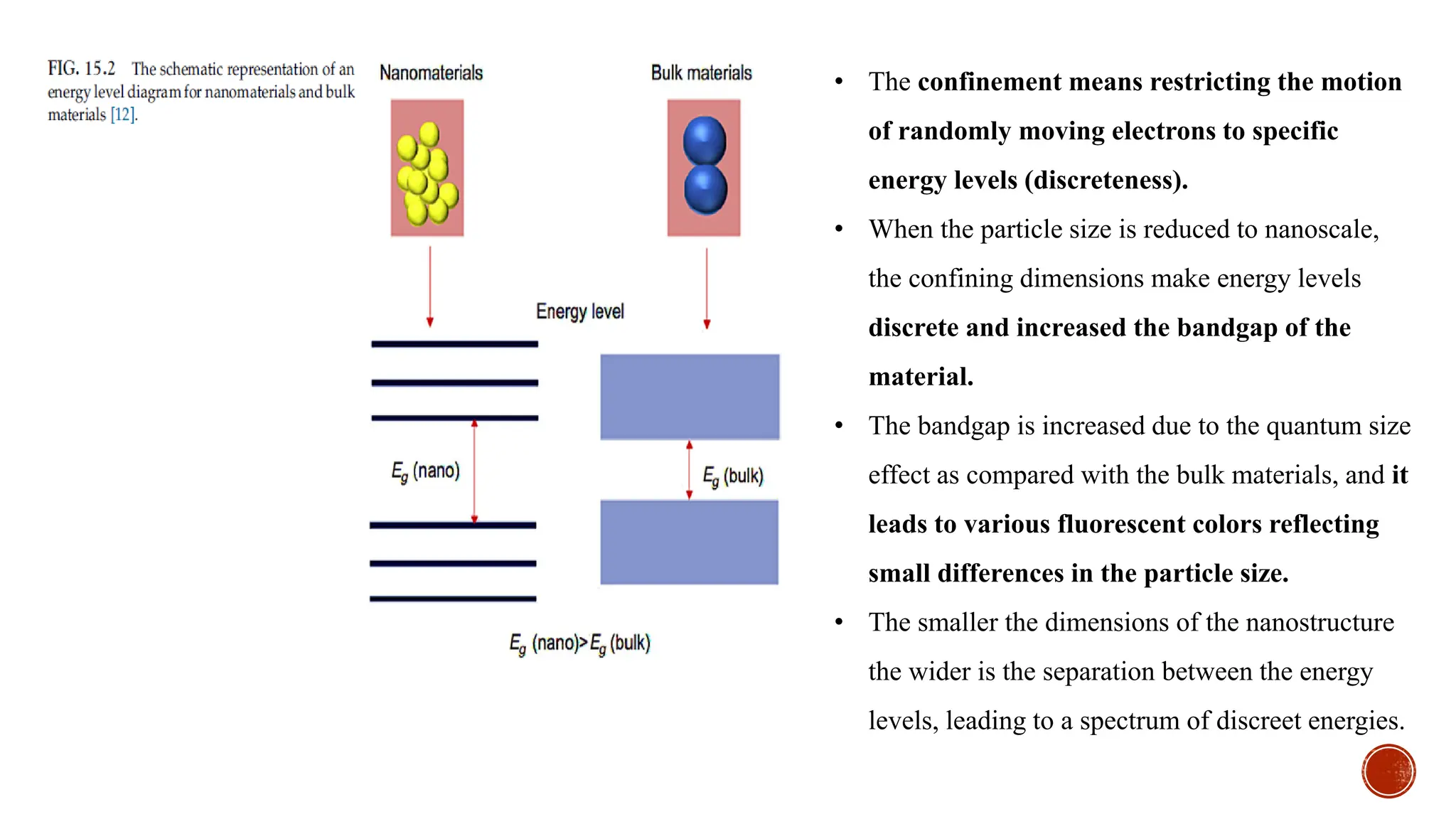
• The confinementmeans restricting the motion
of randomly moving electrons to specific
energy levels (discreteness).
• When the particle size is reduced to nanoscale,
the confining dimensions make energy levels
discrete and increased the bandgap of the
material.
• The bandgap is increased due to the quantum size
effect as compared with the bulk materials, and it
leads to various fluorescent colors reflecting
small differences in the particle size.
• The smaller the dimensions of the nanostructure
the wider is the separation between the energy
levels, leading to a spectrum of discreet energies.
6.
• Surface chargeand stability
➢ Surface charge plays an important role to describe the properties and functionalities of nanomaterials.
The nature and magnitude of the force of the surface charge are the significant factors that define the
stability, aggregation, and affinity of nanomaterials towards the environment and functional groups.
The surface charge is also a major determinant of colloidal behavior that specifically influences the
organism response upon exposure to nanomaterials by changing their shape and size through the
aggregate or agglomerate formation.
➢ Surface charge is commonly measured in terms of zeta potential. The magnitude of the zeta potential
indicates the degree of electrostatic repulsion between adjacent and similarly charged particles in
dispersion. The higher the magnitude the greater the colloidal stability and lesser aggregation. The value
of zeta potential depends on the particle size, composition, and pH of the medium. To maintain stability
and avoid aggregation of particles, high values of zeta potential, either positive or negative, should be
achieved.
7.
2. Chemical Properties
•Surface and internal structures of nanomaterials are commonly composed of multilayers and/or
multiphases containing multicomponent that plays a vital role to provide the desired functions.
• Depending on external conditions such as temperature or pressure, atoms can arrange themselves in
various ways in lattice structures leading to different crystal structures for some materials with the
same proportions of contained elements.
• Thus based on the external condition, one nanomaterial can possess different crystal structures
with different physiochemical properties such as reactivity or photocatalytic activity.
2.1 Chemical structure and composition of nanomaterials
8.
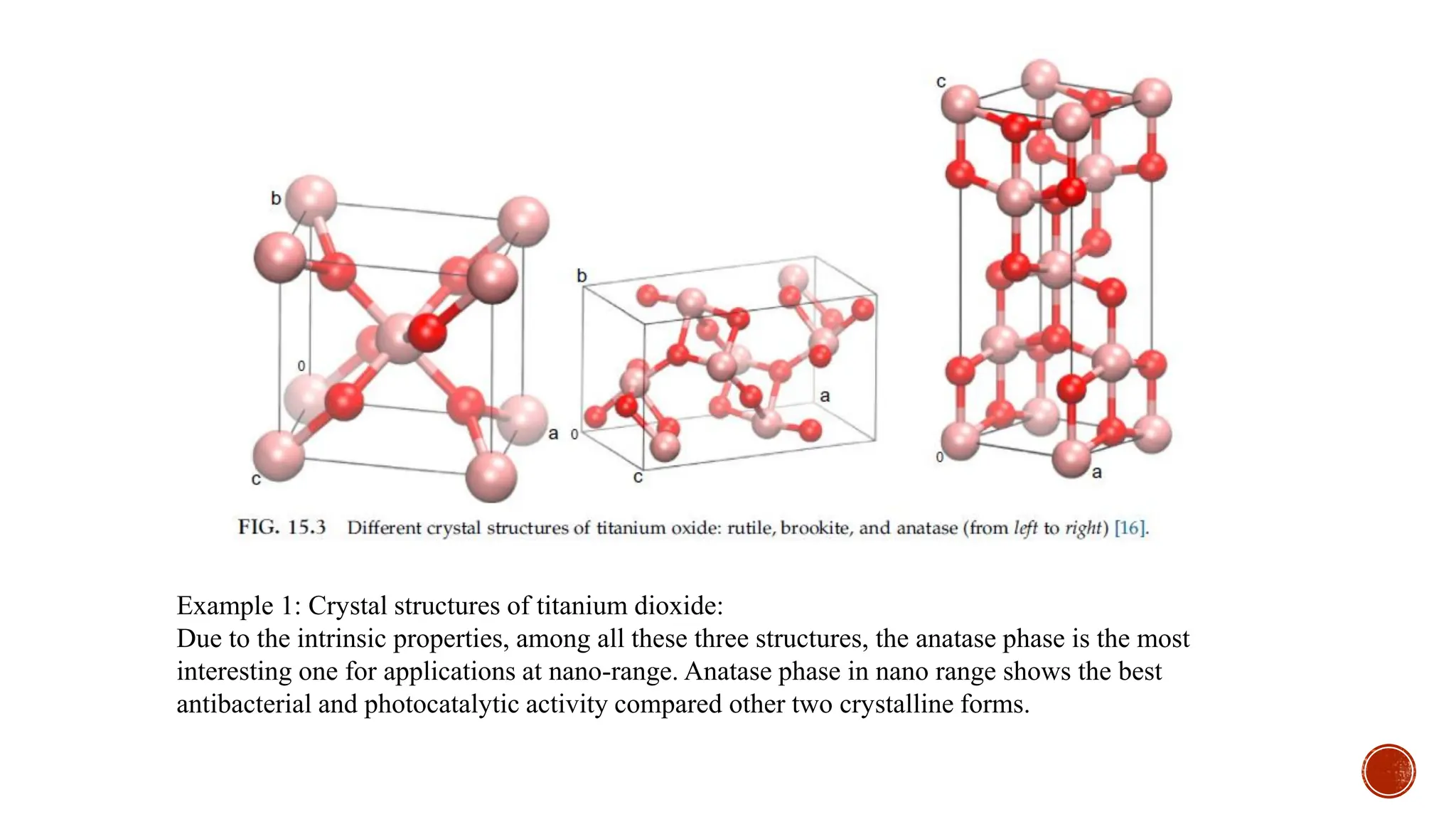
Example 1: Crystalstructures of titanium dioxide:
Due to the intrinsic properties, among all these three structures, the anatase phase is the most
interesting one for applications at nano-range. Anatase phase in nano range shows the best
antibacterial and photocatalytic activity compared other two crystalline forms.
9.
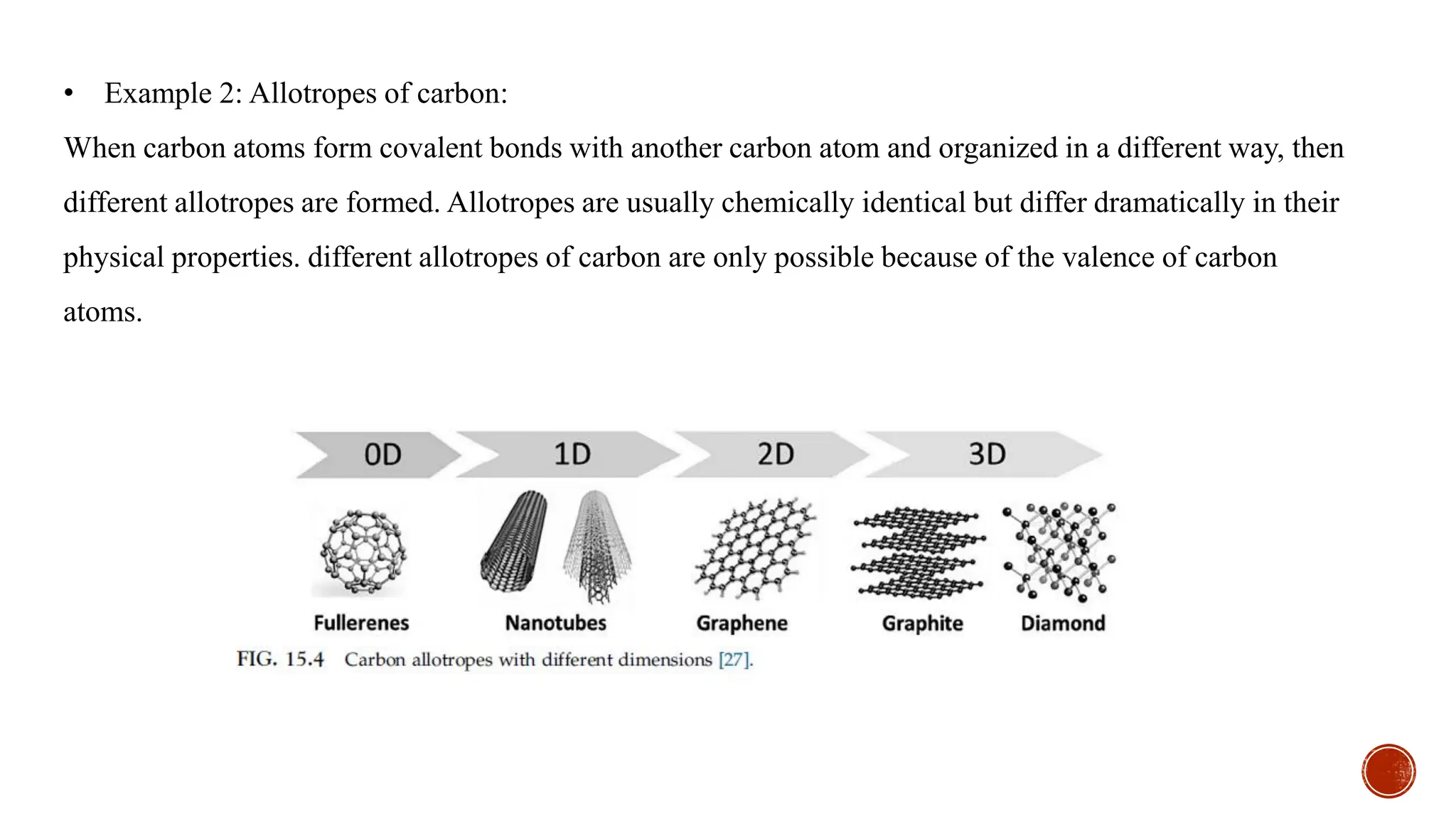
• Example 2:Allotropes of carbon:
When carbon atoms form covalent bonds with another carbon atom and organized in a different way, then
different allotropes are formed. Allotropes are usually chemically identical but differ dramatically in their
physical properties. different allotropes of carbon are only possible because of the valence of carbon
atoms.
10.
2.2 Catalytic reactivity
•The electronic structure of nanomaterial and the number of surface atom are significantly different from
bulk materials, which are mainly responsible for the high reactivity of nanomaterials. Nanomaterials
have long been considered as promising heterogeneous catalysts, because of their high surface to volume
ratio and the possibility of maximizing active facets by manipulating the morphology of the nanocrystals.
• Nanomaterials with high surface energy usually exhibit high reactivity, because it will try to reduce its
energy by interacting with suitable substances from the outside environment.Thus, they can be easily
degraded or oxidized with environment exposure.
• These distinctive phenomena at the nanoscale are conducive to chemical transformation in kinetics and
allow many chemical transformations to occur under the mild condition, which is not possible for
bulk materials.
11.
2.3 Optical Properties
•The optical properties such as reflection, transmission, absorption, and light emission of the
nanomaterials are completely dependent on their electronic structure that significantly differs for various
morphologies since electronic structure of the nanomaterials are very much dependent on surface atoms.
• Two factors, namely, increased energy level spacing (quantum effect) and surface plasmon resonance,
profoundly contribute to the size-dependent optical properties of nanomaterials.
• At nanoscale level, nanoparticles are so small that electrons in them are not as much as free to move as in
case of bulk material. Due to this quantum confinement of electrons, nanoparticles react differently with
light compared to the bulk material.
• Optical properties such as emission and adsorption occur when electron transition occurs between
valence and conduction band. This optical bandgap increases with the decrease in particle size, especially
for the semiconductor nanomaterials.
12.
• When anelectron drops from higher energy state to lower energy state a quantum of light (photon)
will be emitted. with wavelength λ=hc/ΔE where h, c, ΔE are Plank’s constant, speed of light, and
energy difference between allowed electron energy levels, respectively. The larger the ΔE the shorter
the wavelength (blue shifted).
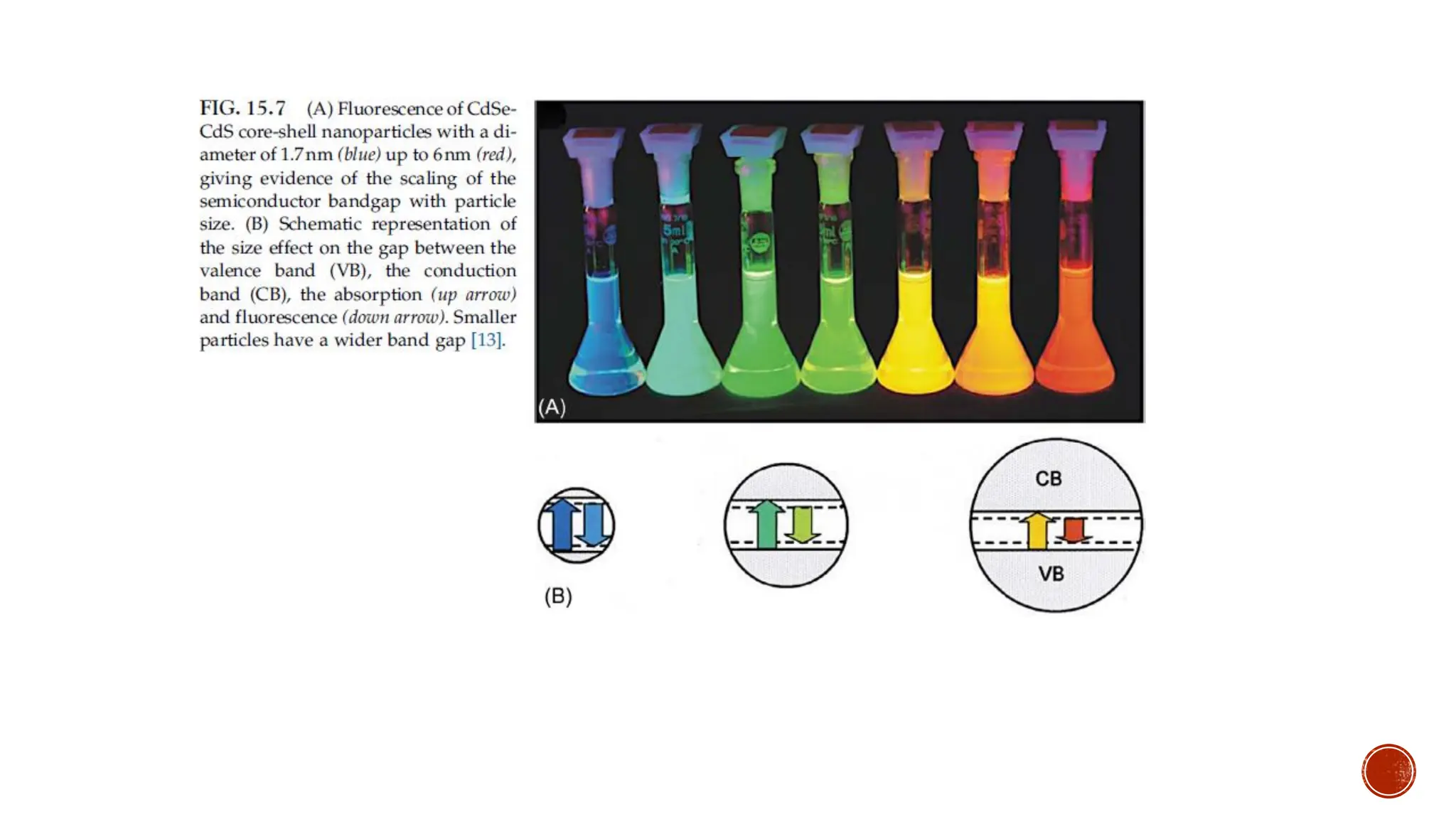
• By changing the size and composition of the nanomaterials, their emission wavelengths can be tuned
from the UV through the visible to the near-infrared regions of the spectrum. For example, by tuning
the size of colloidal CdSe-CdS core-shell nanoparticles from 2 to 6 nm in diameter, the emission
wavelength can be shifted across the visible spectrum, with the smaller particles emitting in the
blue and the larger particles emitting red light.
14.
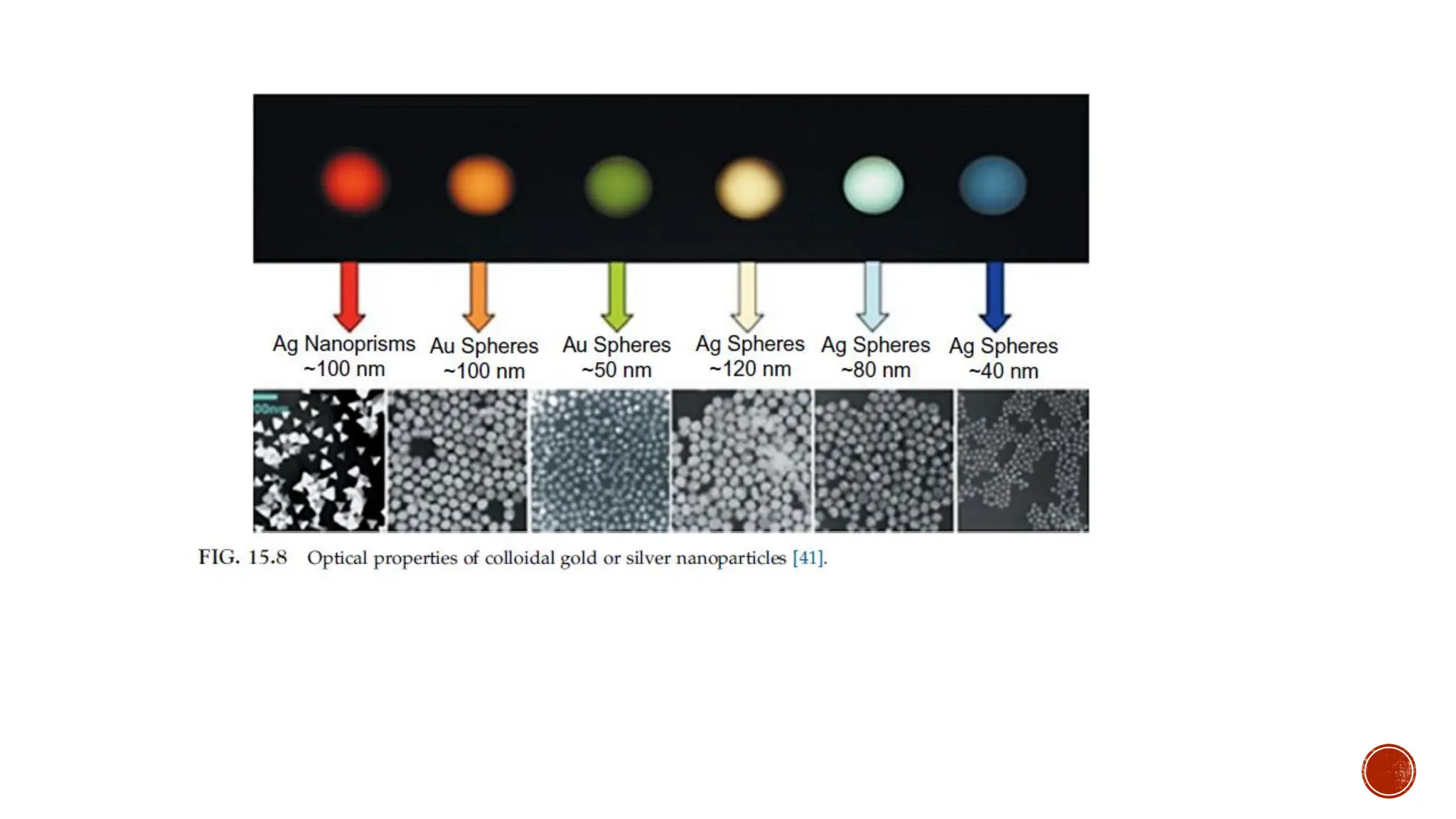
• When theparticle size becomes less than the wavelength of the incident radiation, surface plasmon
resonance phenomenon becomes dominant to control the optical properties of nanomaterials. Surface
plasmon resonance is the results of coherent excitation of the free electrons of the
nanomaterials, which are present in the conduction band and their in-phase resonance oscillations
with the applied light energy. Thus nanomaterials can produce surface plasmon resonance, unlike the
bulk materials.
• The intensity of such surface plasmon resonance is directly proportional to the number of such
excited electrons and the dielectric constant of the medium used.
• Metals such as gold, silver, and aluminum can support surface plasmon modes where the free
electrons in the material naturally resonate at a frequency that depends on the composition, size, and
shape of the particle.
16.
2.3 Magnetic Properties
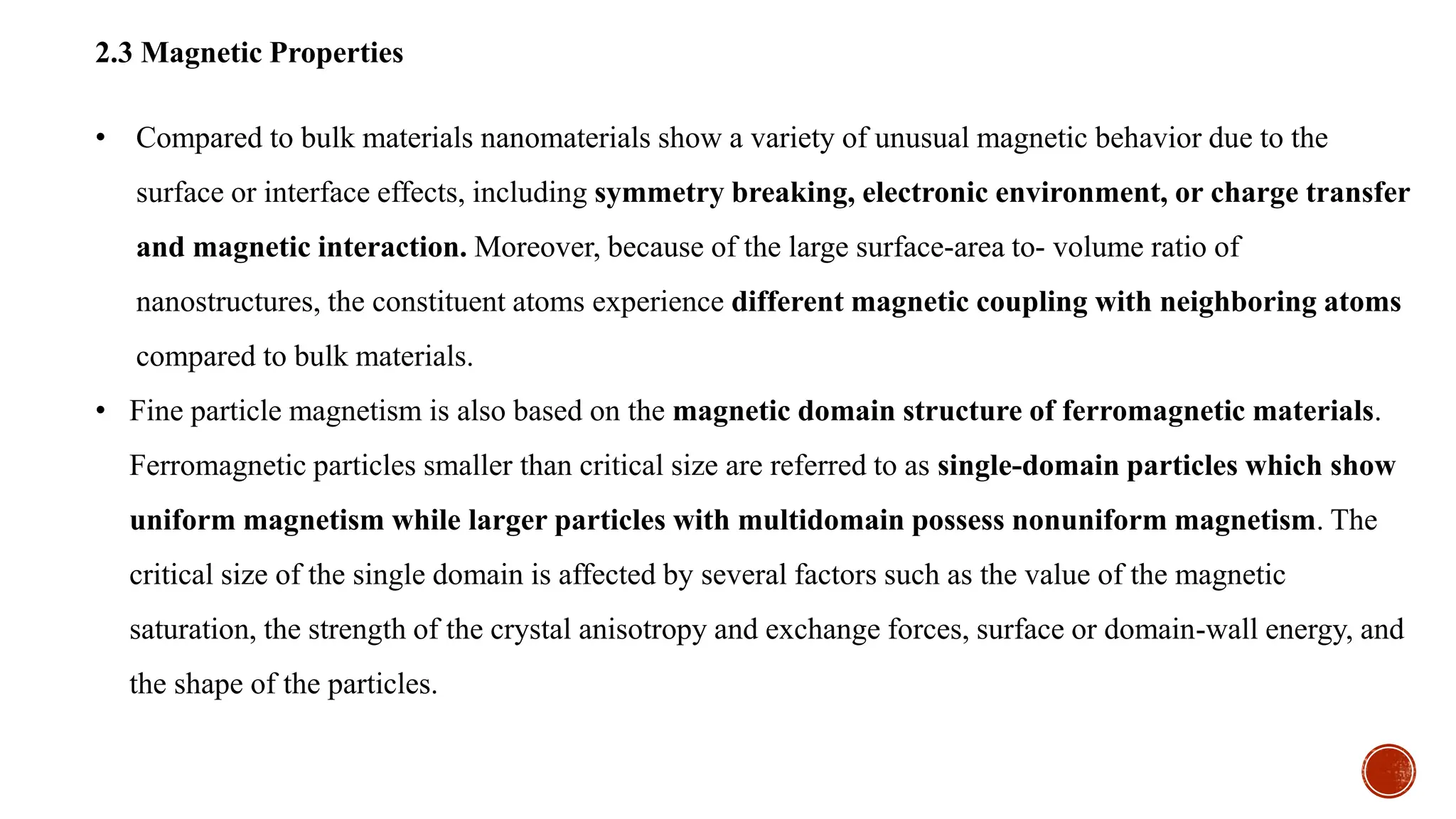
•Compared to bulk materials nanomaterials show a variety of unusual magnetic behavior due to the
surface or interface effects, including symmetry breaking, electronic environment, or charge transfer
and magnetic interaction. Moreover, because of the large surface-area to- volume ratio of
nanostructures, the constituent atoms experience different magnetic coupling with neighboring atoms
compared to bulk materials.
• Fine particle magnetism is also based on the magnetic domain structure of ferromagnetic materials.
Ferromagnetic particles smaller than critical size are referred to as single-domain particles which show
uniform magnetism while larger particles with multidomain possess nonuniform magnetism. The
critical size of the single domain is affected by several factors such as the value of the magnetic
saturation, the strength of the crystal anisotropy and exchange forces, surface or domain-wall energy, and
the shape of the particles.
17.
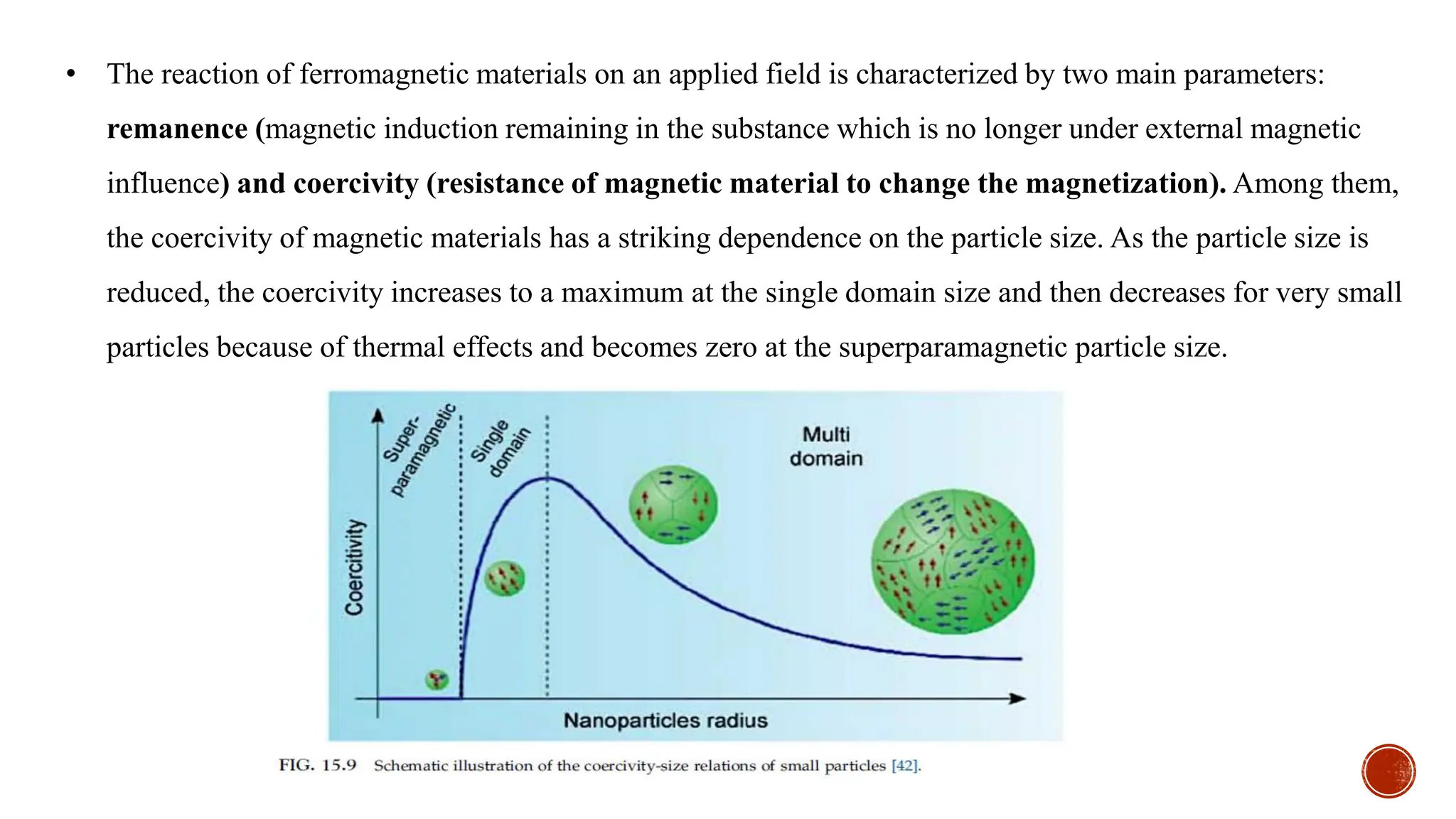
• The reactionof ferromagnetic materials on an applied field is characterized by two main parameters:
remanence (magnetic induction remaining in the substance which is no longer under external magnetic
influence) and coercivity (resistance of magnetic material to change the magnetization). Among them,
the coercivity of magnetic materials has a striking dependence on the particle size. As the particle size is
reduced, the coercivity increases to a maximum at the single domain size and then decreases for very small
particles because of thermal effects and becomes zero at the superparamagnetic particle size.
18.
• Thus thenanomaterials may become superparamagnetic, even though their corresponding bulk materials are
not magnetic. For example, Fe3O4 nanoparticles showed superparamagnetic-like behavior, even though
bulk iron oxide (Fe3O4) is ferromagnetic. Exceptional surface energy and the flipped orientation of the spin
electrons of the Fe3O4 nanoparticles are responsible for this phenomenon.
• Superparamagnetic nanoparticles are not magnetic when located in a zero magnetic field, but they quickly
become magnetized after an external magnetic field is applied. When they are below the superparamagnetic
diameter, the nanoparticles can revert quickly to a non magnetized state after an external magnet is removed.
There are various crystalline materials that exhibit ferromagnetism, such as Fe, Co, or Ni. Among them, ferrite
oxide-magnetite (Fe3O4) is the most widely used in the form of superparamagnetic nanoparticles for all sorts
of biological applications
19.
Electrical properties
• Theproperties such as conductivity or resistivity are considered under the category of electrical
properties. Similar to optical or magnetic properties, these properties are also observed to change at the
nanoscale level. The electrical properties of nanomaterials mainly concern the mobility of the charge
carriers. When the dimensions of a material are reduced to the nanometer range, the quantum-size effect
and quantum confinement effect are bound to occur.
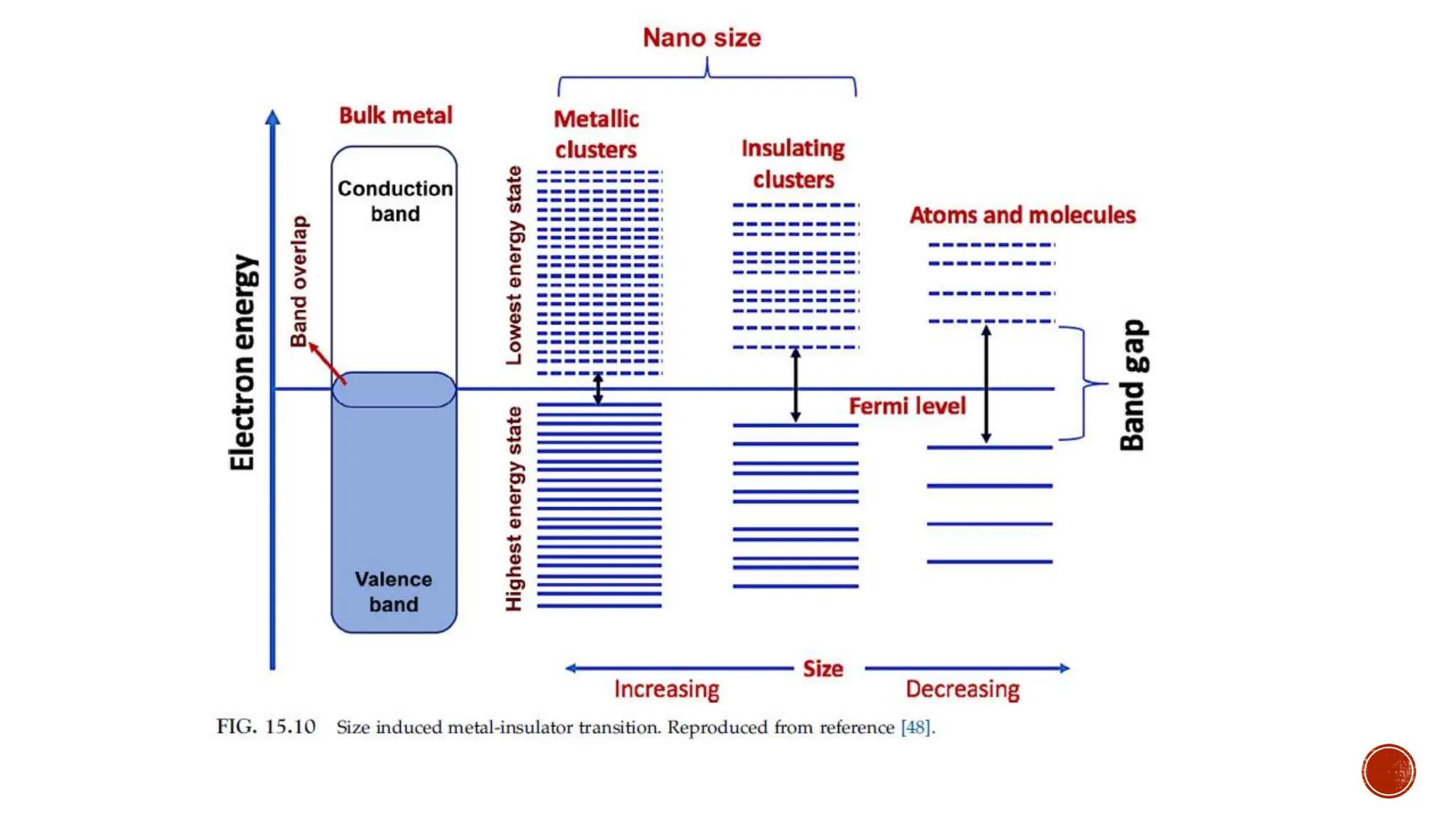
• The electrical conductivity of nanomaterials is generally lower than the bulk materials due to the
increase of the band gap energy with a decrease in particle size of the nanomaterials, especially for
semiconductor nanomaterials. For example, as the energy bands cease to overlap at 2–3 nm range, in spite
of being metallic, gold nanoparticles cease to be conductive and turn into insulators.
21.
References
• Mekuye, B.,& Abera, B. (2023). Nanomaterials: An overview of synthesis, classification, characterization,
and applications. Nano Select, 4(8), 486-501. https://doi.org/10.1002/nano.202300038
• Asha, A. B., & Narain, R. (2020). Nanomaterials properties. In Polymer science and nanotechnology (pp.
343-359). Elsevier. https://doi.org/10.1016/B978-0-12-816806-6.00015-7