Modern Pharmaceutical Analytical Techniques (MPA 101T) Presentation
Topic – Paper Chromatography
Presented To –
Dr. Priyanka & Dr. Mansi
Department Of Pharmaceutical
Sciences,
Babasaheb Bhimrao Ambedkar
University, Lucknow
Presented By –
Vasudev Dwivedi
M. Pharm. 1st
Semester
(Pharmaceutical Analysis)
Department Of Pharmaceutical
Sciences,
BBAU, Lucknow
PAPER
CHROMATOGRAPHY
TABLE OF CONTENT
1. Introduction
2. History
3. Principle
4. Apparatus
5. Mechanism of Separation
6. Types of Chromatography
7. Factors Affecting the Resolution in Paper
Chromatography
8. Application of paper chromatography
INTRODUCTION
 Paper chromatography is an analytical technique used to separate and identify
components of a mixture by allowing them to move at different rates along a strip of
paper under the influence of a solvent (mobile phase). The paper acts as the stationary
phase, and the separation occurs based on differences in the solubility and adsorption
of the substances on the paper.
 Paper chromatography is a planar form of chromatography just like thin layer
chromatography (TLC) and employs A flat relatively thin layer of paper as the
stationary support.
 The spot where the sample is applied is called the origin and several samples may be
applied in a horizontal line in this way.
History
 Archer Martin and Richard Synge in 1943 introduced paper chromatography a
separation technique where the mixture to be separated is dissolved in suitable
solvent and applied to a thick piece of paper using a very fine glass capillary
as a dropper.
 They had previously developed partition chromatography and later adapted
the technique using paper as the stationary phase and a solvent as the mobile
phase.
 The method quickly became popular because it was cheap, simple, and
effective for separating and identifying small molecules like amino acids,
sugars, and pigments.
PRINCIPLE
 Since surface tension is the driving force for capillary movements in cellulose,
the technique involves partition as the main mechanism of separation.
 Paper chromatography works on the principle of partition between two phases
- the stationary phase (water molecules held in the interstices of the filter paper
matrix by hydrogen bonding) and the mobile phase (a solvent that moves over
the paper).
 In paper chromatography the interaction between solutes & the cellulose may
also be involved, and then adsorption & hydrogen bonding as well may also
play an important role in separation.
Continued…….
When a mixture is applied to the paper and the solvent moves up by capillary
action, each component of the mixture distributes itself differently between the
stationary and mobile phases based on its solubility in the solvent and affinity for
the paper.
• Substances more soluble in the solvent travel farther.
• Substances with greater affinity for the paper move more slowly.
This difference in movement causes the components to separate along the paper.
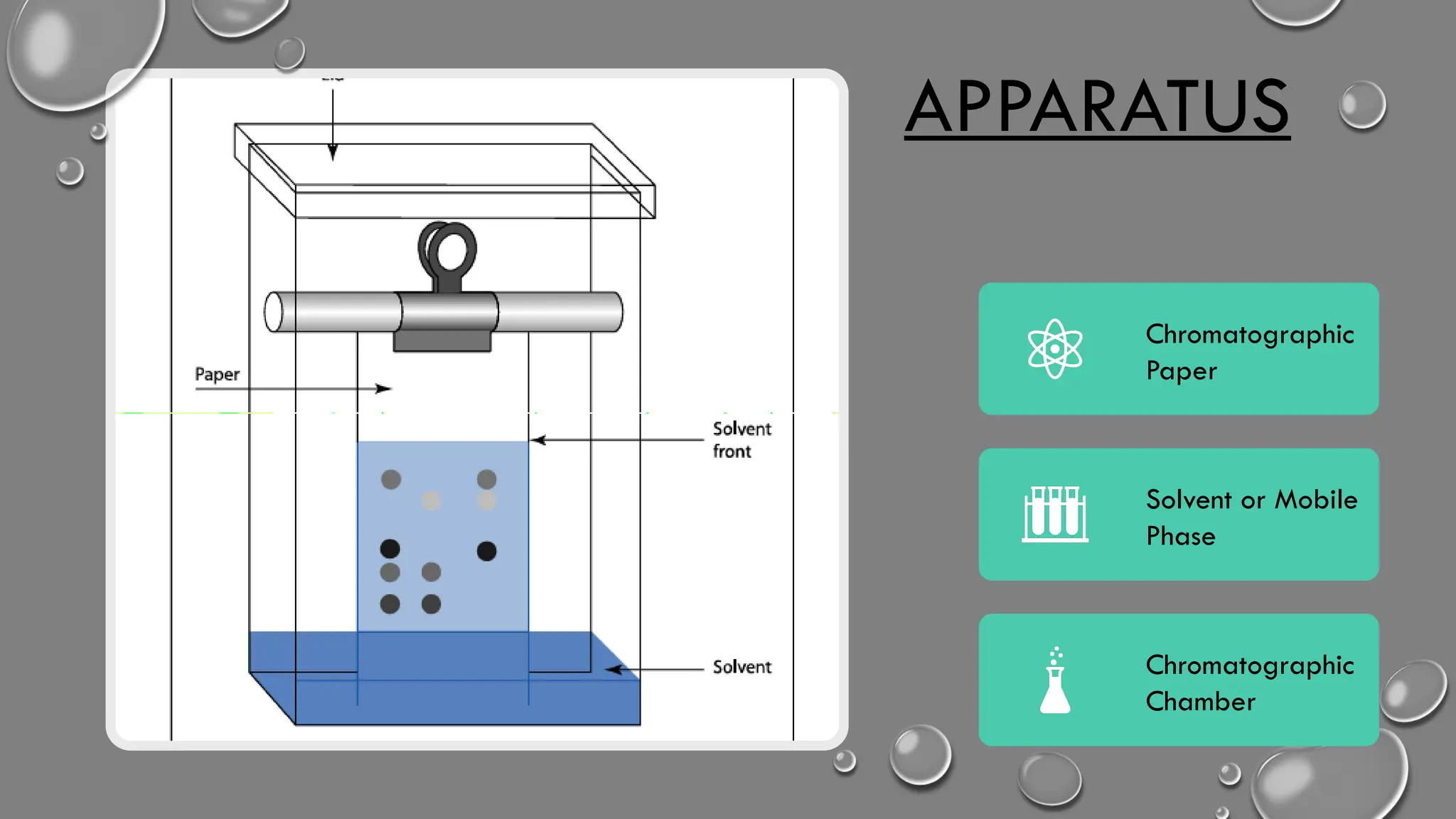
APPARATUS
Chromatographic
Paper
Solvent or Mobile
Phase
Chromatographic
Chamber
APPARATUS FOR PAPER CHROMATOGRAPHY
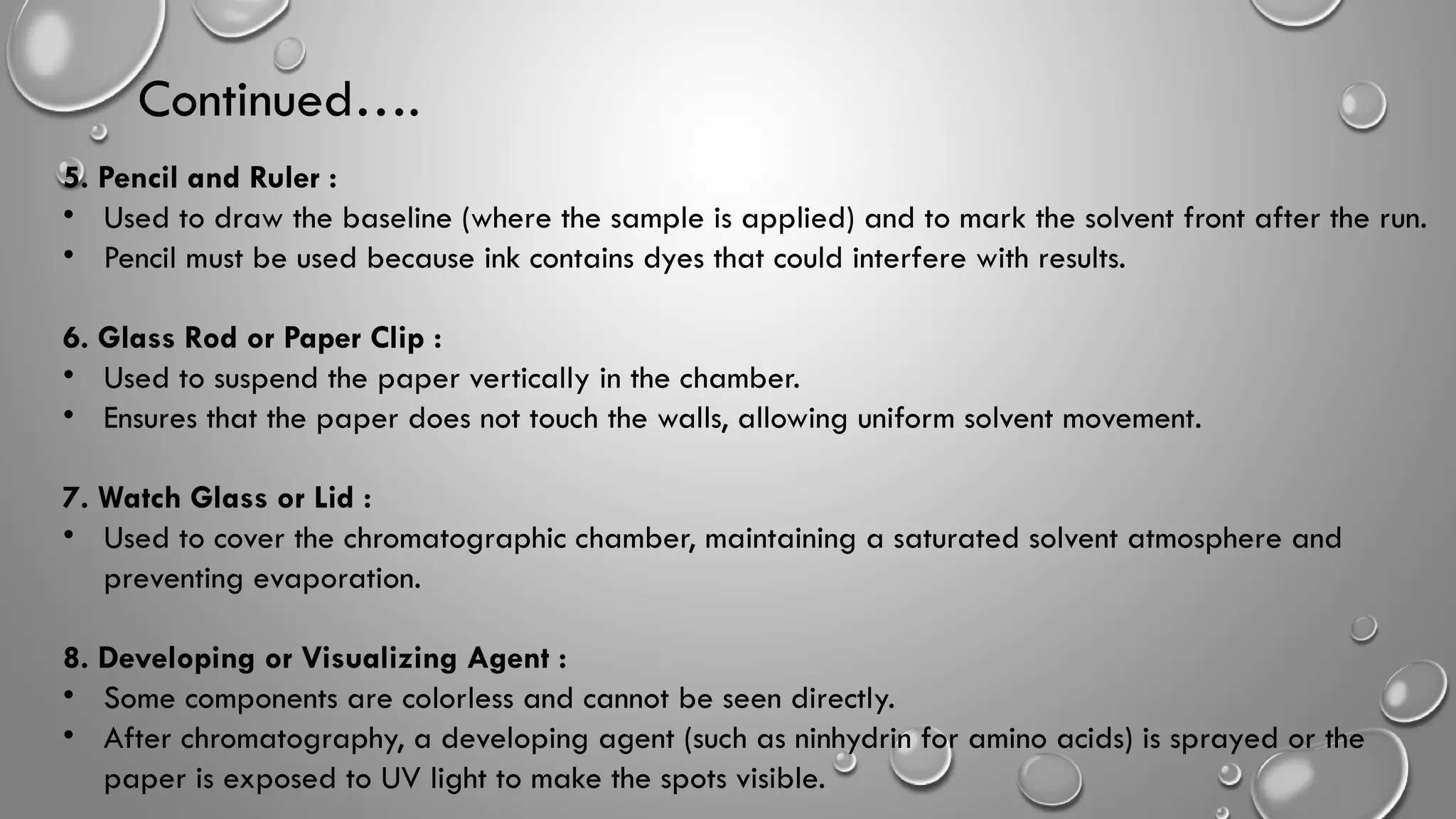
1. Chromatographic paper :
• The most essential component of the setup.
• Usually made of high-quality filter paper (like Whatman No. 1).
• It acts as the stationary phase, holding a thin layer of water molecules in its fibers.
• The paper allows capillary action to draw the solvent upward (or downward, depending on the
setup).
• The type and quality of paper affect the resolution and separation of components.
2. Solvent or Mobile Phase :
• The solvent (or a mixture of solvents) carries the sample along the paper.
• It serves as the mobile phase, determining how well substances move and separate.
• Common solvents include water, ethanol, butanol, acetone, or mixtures like butanol-acetic acid-
water.
• The choice of solvent depends on the nature of the sample - polar or nonpolar.
3. Beaker or Chromatographic Chamber :
• A closed container that holds the solvent and provides a saturated atmosphere with solvent vapor.
• Prevents evaporation of the mobile phase and ensures consistent solvent movement.
• Usually covered with a watch glass or lid during the process.
• Some chambers are lined with filter paper soaked in solvent to maintain uniform humidity.
4. Capillary Tube or Micropipette :
• Used to apply a small, concentrated spot of the sample on the chromatography paper.
• Ensures that the spot is precise and controlled - too large a spot may cause poor separation.
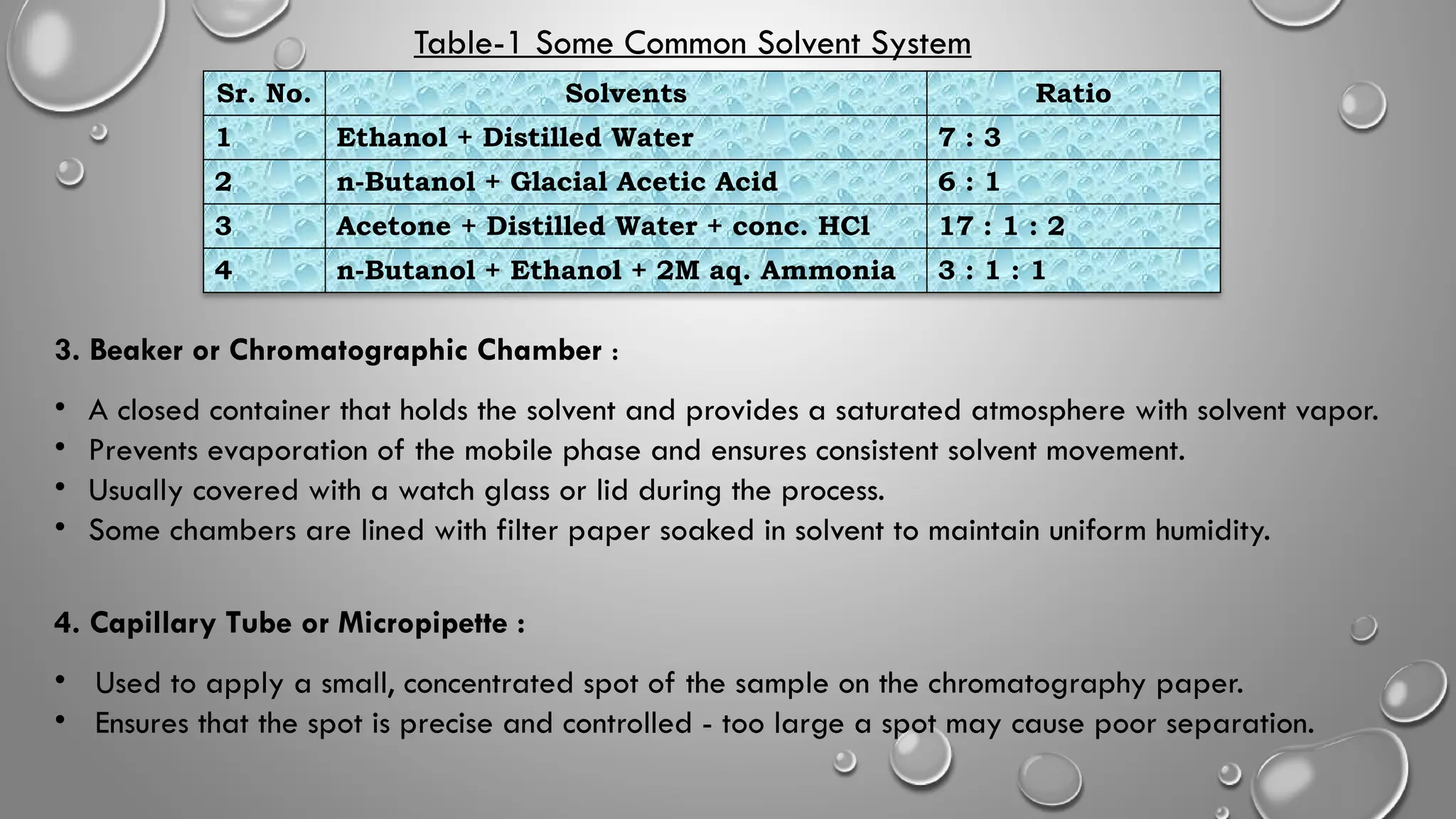
Sr. No. Solvents Ratio
1 Ethanol + Distilled Water 7 : 3
2 n-Butanol + Glacial Acetic Acid 6 : 1
3 Acetone + Distilled Water + conc. HCl 17 : 1 : 2
4 n-Butanol + Ethanol + 2M aq. Ammonia 3 : 1 : 1
Table-1 Some Common Solvent System
5. Pencil and Ruler :
• Used to draw the baseline (where the sample is applied) and to mark the solvent front after the run.
• Pencil must be used because ink contains dyes that could interfere with results.
6. Glass Rod or Paper Clip :
• Used to suspend the paper vertically in the chamber.
• Ensures that the paper does not touch the walls, allowing uniform solvent movement.
7. Watch Glass or Lid :
• Used to cover the chromatographic chamber, maintaining a saturated solvent atmosphere and
preventing evaporation.
8. Developing or Visualizing Agent :
• Some components are colorless and cannot be seen directly.
• After chromatography, a developing agent (such as ninhydrin for amino acids) is sprayed or the
paper is exposed to UV light to make the spots visible.
Continued….
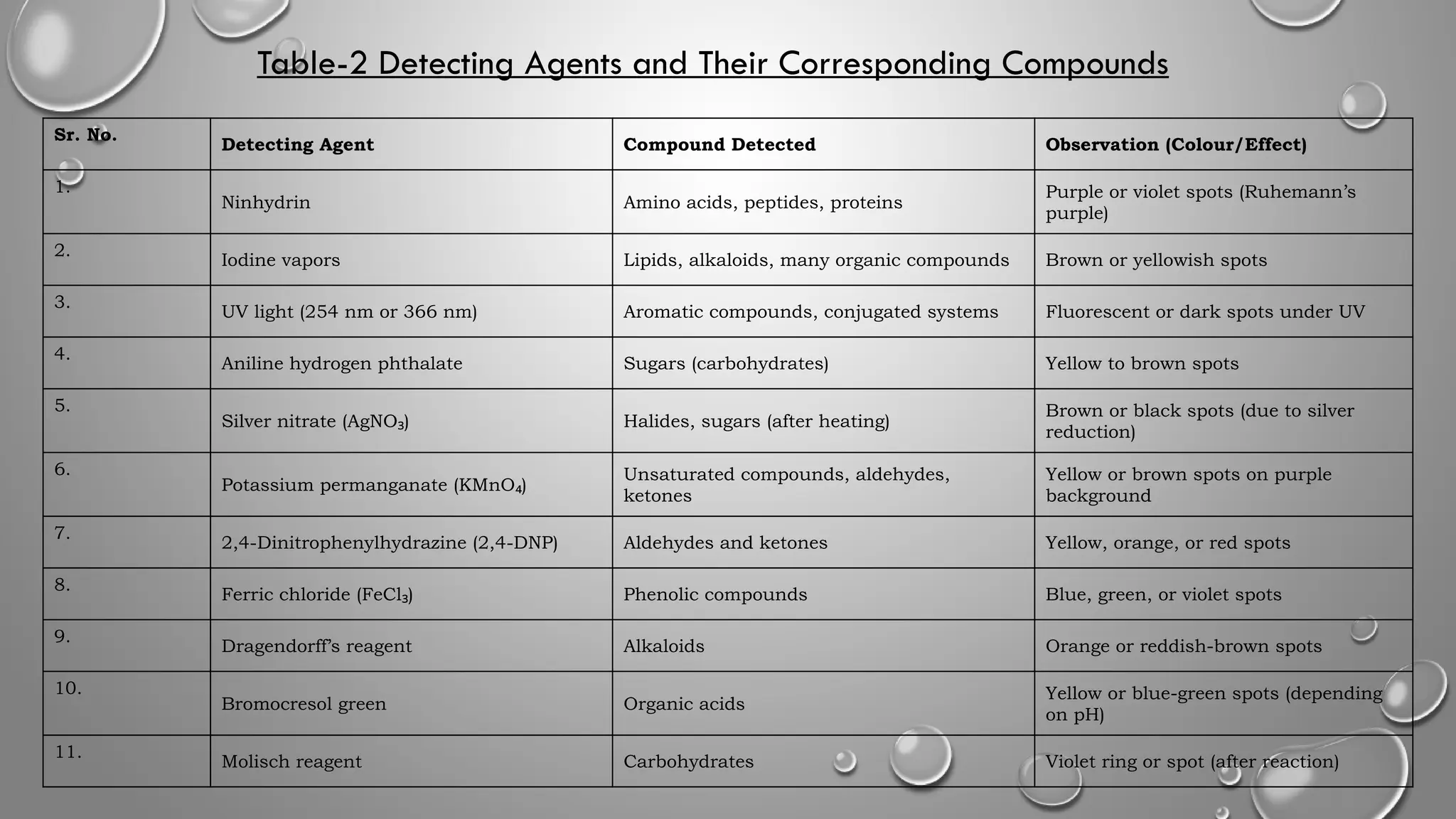
Sr. No.
Detecting Agent Compound Detected Observation (Colour/Effect)
1.
Ninhydrin Amino acids, peptides, proteins
Purple or violet spots (Ruhemann’s
purple)
2.
Iodine vapors Lipids, alkaloids, many organic compounds Brown or yellowish spots
3.
UV light (254 nm or 366 nm) Aromatic compounds, conjugated systems Fluorescent or dark spots under UV
4.
Aniline hydrogen phthalate Sugars (carbohydrates) Yellow to brown spots
5.
Silver nitrate (AgNO )
₃ Halides, sugars (after heating)
Brown or black spots (due to silver
reduction)
6.
Potassium permanganate (KMnO )
₄
Unsaturated compounds, aldehydes,
ketones
Yellow or brown spots on purple
background
7.
2,4-Dinitrophenylhydrazine (2,4-DNP) Aldehydes and ketones Yellow, orange, or red spots
8.
Ferric chloride (FeCl )
₃ Phenolic compounds Blue, green, or violet spots
9.
Dragendorff’s reagent Alkaloids Orange or reddish-brown spots
10.
Bromocresol green Organic acids
Yellow or blue-green spots (depending
on pH)
11.
Molisch reagent Carbohydrates Violet ring or spot (after reaction)
Table-2 Detecting Agents and Their Corresponding Compounds
MECHANISM OF SEPARATION
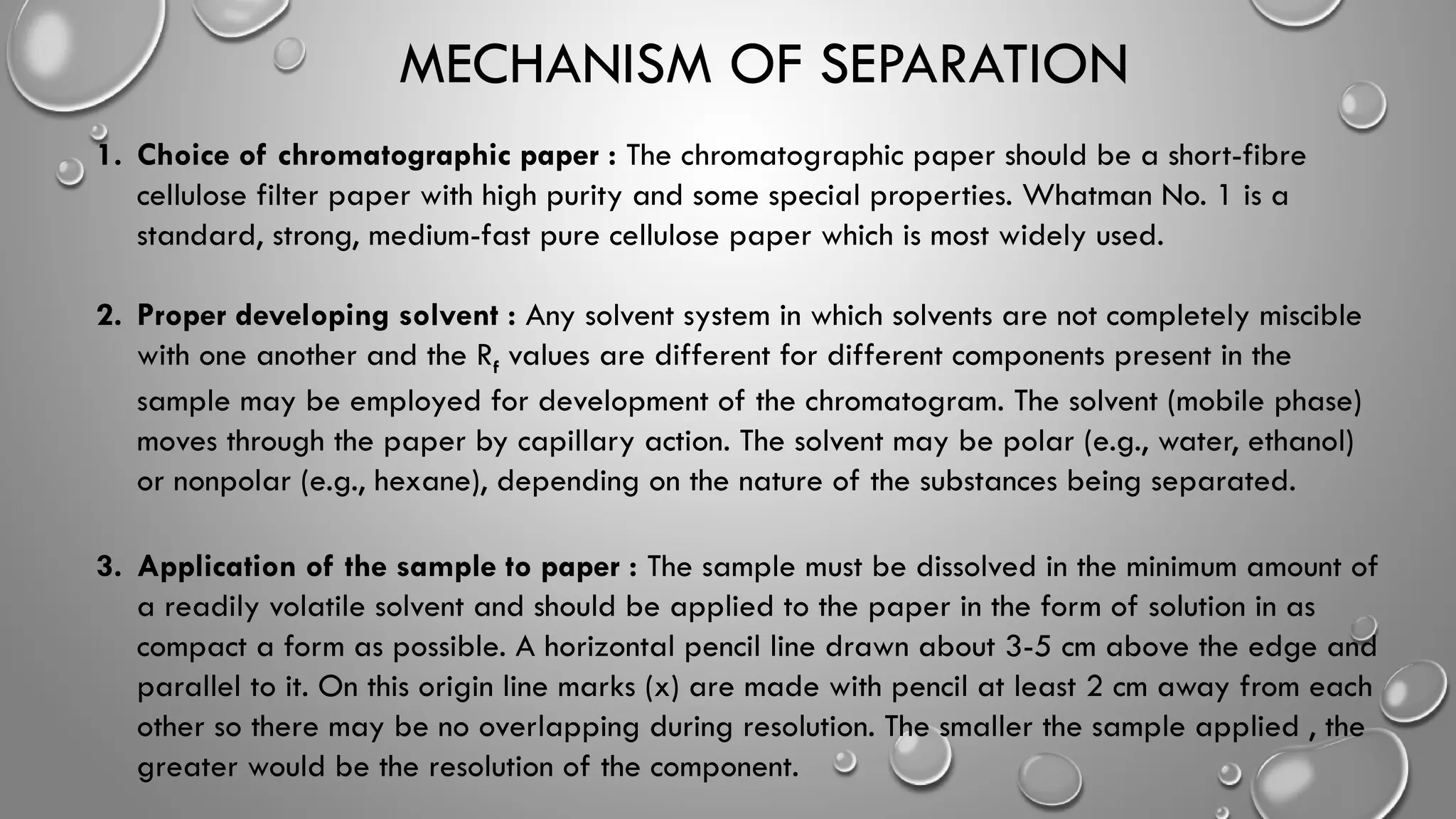
1. Choice of chromatographic paper : The chromatographic paper should be a short-fibre
cellulose filter paper with high purity and some special properties. Whatman No. 1 is a
standard, strong, medium-fast pure cellulose paper which is most widely used.
2. Proper developing solvent : Any solvent system in which solvents are not completely miscible
with one another and the Rf values are different for different components present in the
sample may be employed for development of the chromatogram. The solvent (mobile phase)
moves through the paper by capillary action. The solvent may be polar (e.g., water, ethanol)
or nonpolar (e.g., hexane), depending on the nature of the substances being separated.
3. Application of the sample to paper : The sample must be dissolved in the minimum amount of
a readily volatile solvent and should be applied to the paper in the form of solution in as
compact a form as possible. A horizontal pencil line drawn about 3-5 cm above the edge and
parallel to it. On this origin line marks (x) are made with pencil at least 2 cm away from each
other so there may be no overlapping during resolution. The smaller the sample applied , the
greater would be the resolution of the component.
Continued….
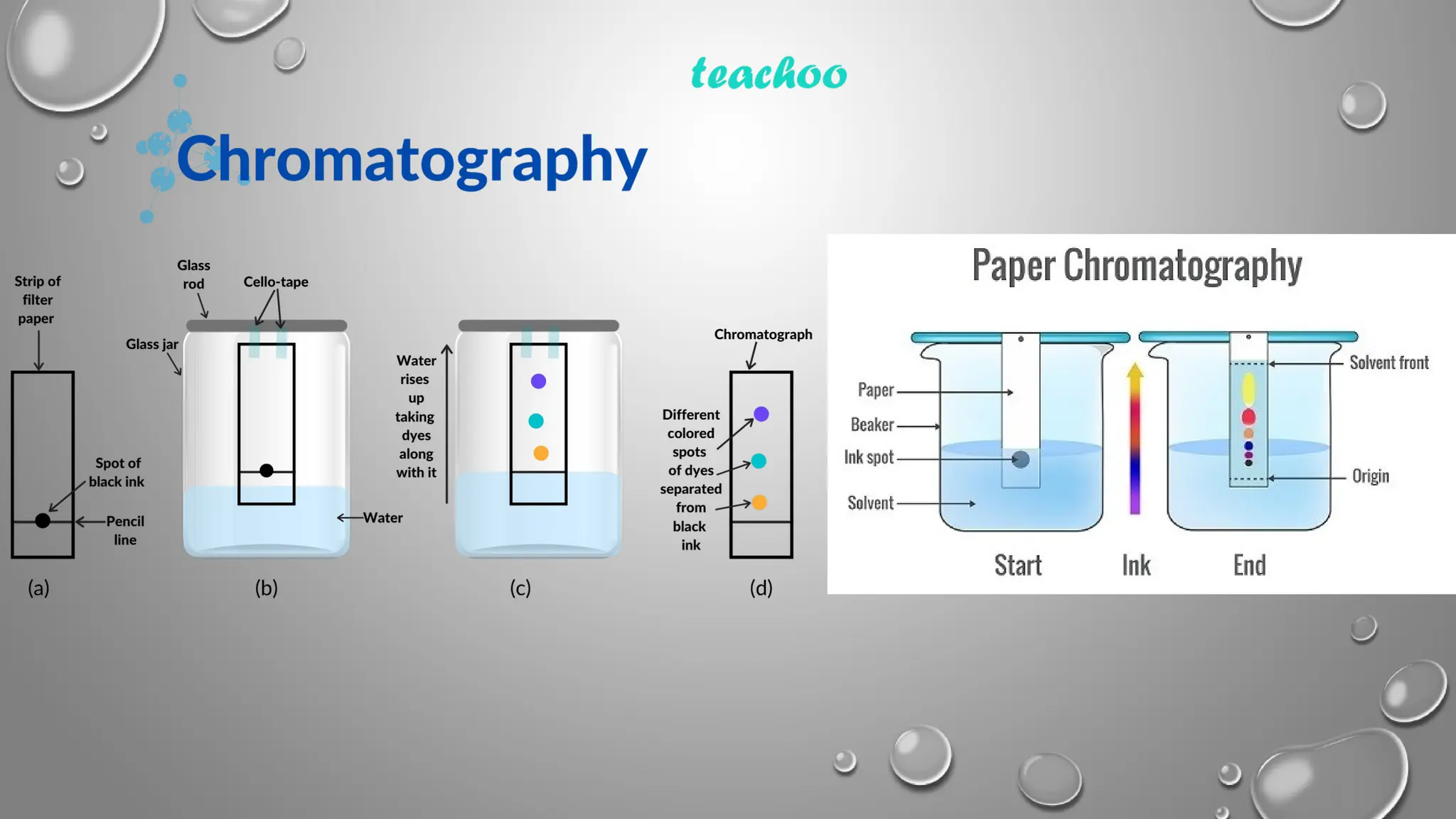
4. Development of the chromatogram : The paper is now fixed vertically in the glass jar with a
clip attached to the inner side of the cover of jar. The paper is dipped in to the developing solvent
such that covered properly. When the solvent has moved a considerable distance 3/4th
of the
paper length, the paper is removed from the jar and the position of the solvent front is marked
with a lead pencil. Allow it to dry at room temperature. The dried paper is called a
chromatogram.
5. Drying of the chromatogram : If the solvent is volatile, the paper can be dried by simply
suspending it in air by means of a clip in a fume cup-board. In case of less volatile solvents, warm
air blower or a drying oven may be used for drying.
6. Visualisation of separated spots : This can be done –
a) Either by chemical means (detecting agent), or
b) By using UV radiation
Usually the spots are located by spraying the reagent from an atomizer and later on it is dried as
before.
Continued….
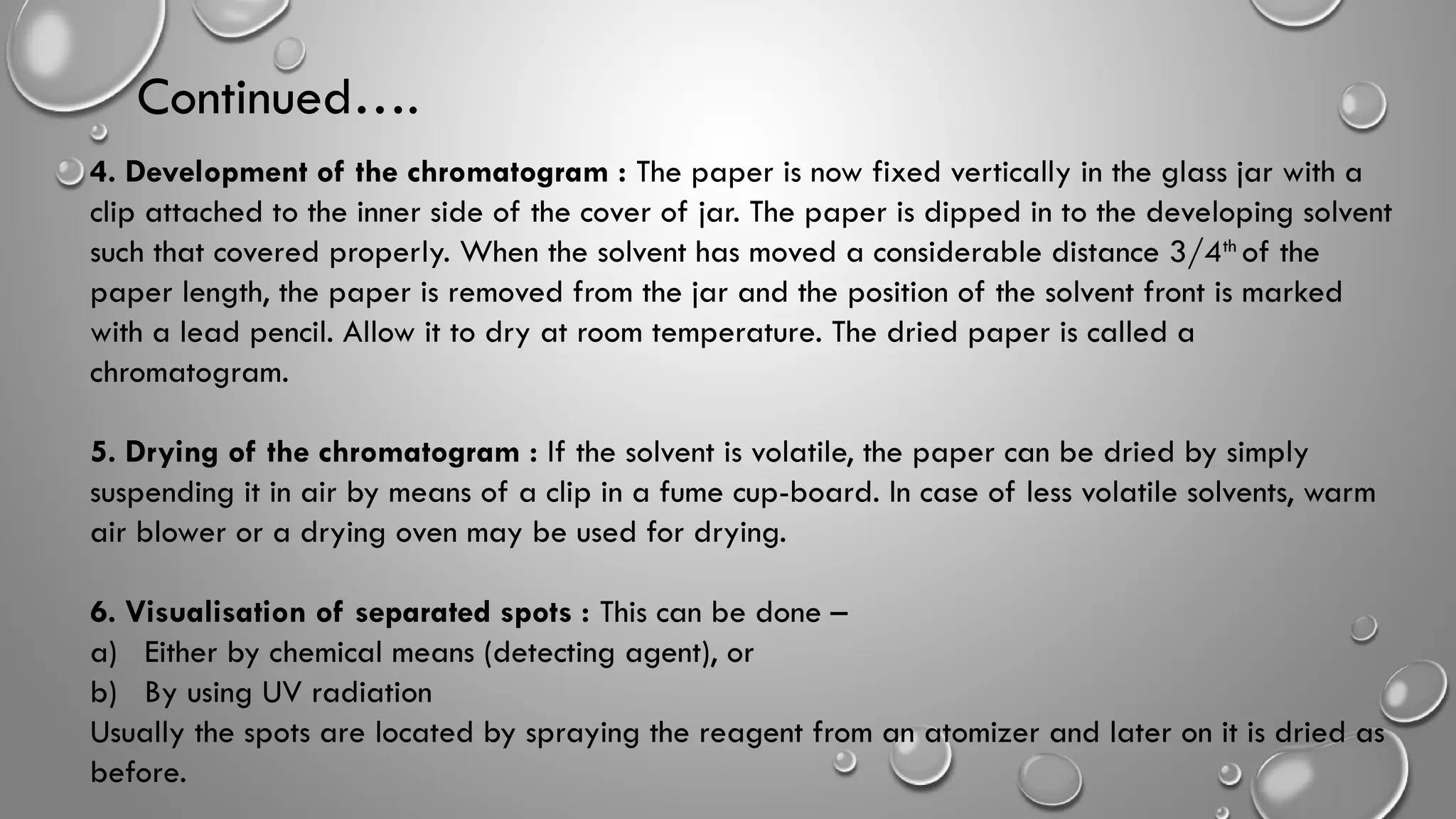
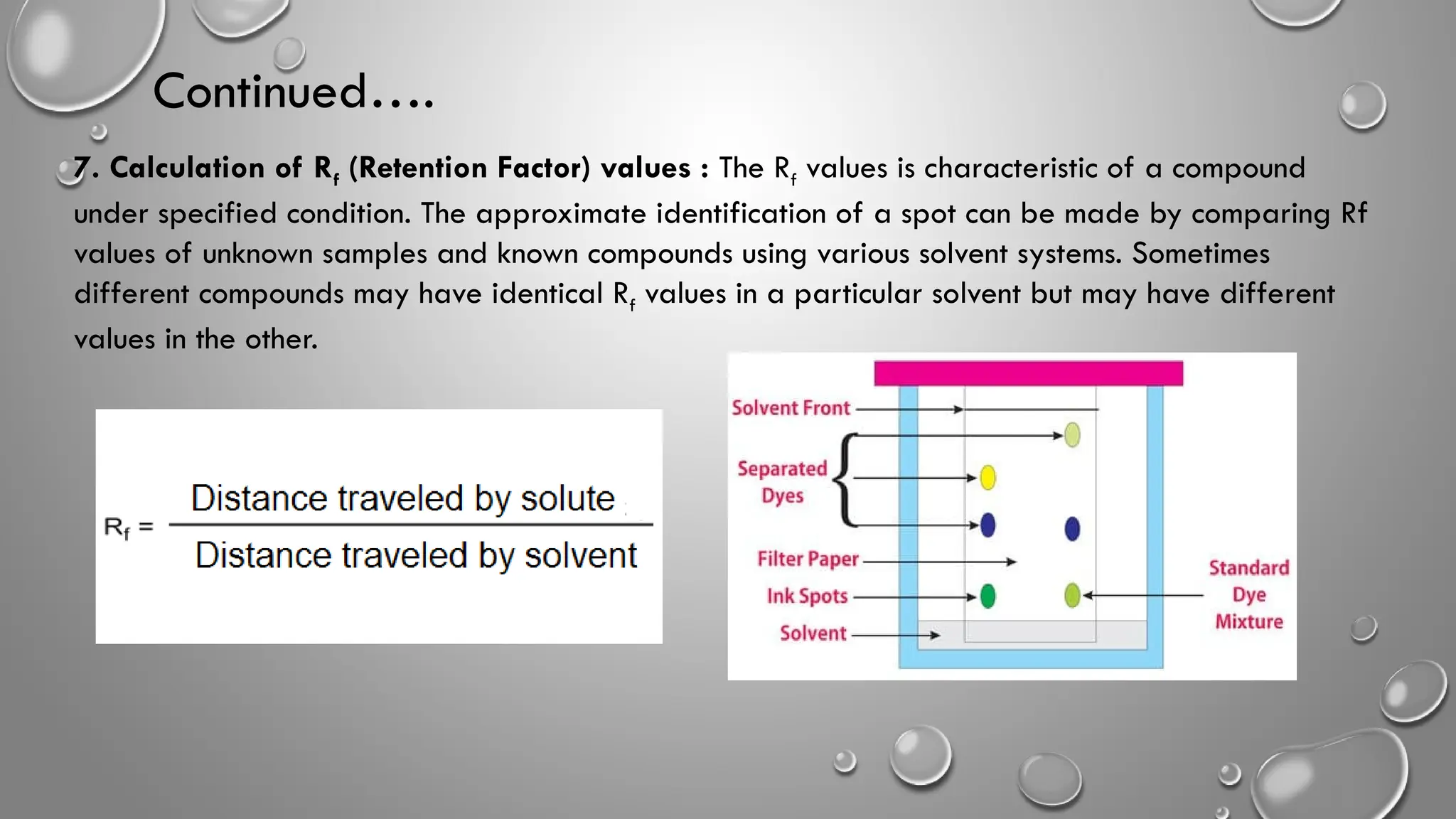
7. Calculation of Rf (Retention Factor) values : The Rf values is characteristic of a compound
under specified condition. The approximate identification of a spot can be made by comparing Rf
values of unknown samples and known compounds using various solvent systems. Sometimes
different compounds may have identical Rf values in a particular solvent but may have different
values in the other.
TYPES OF PAPER CHROMATOGRAPHY
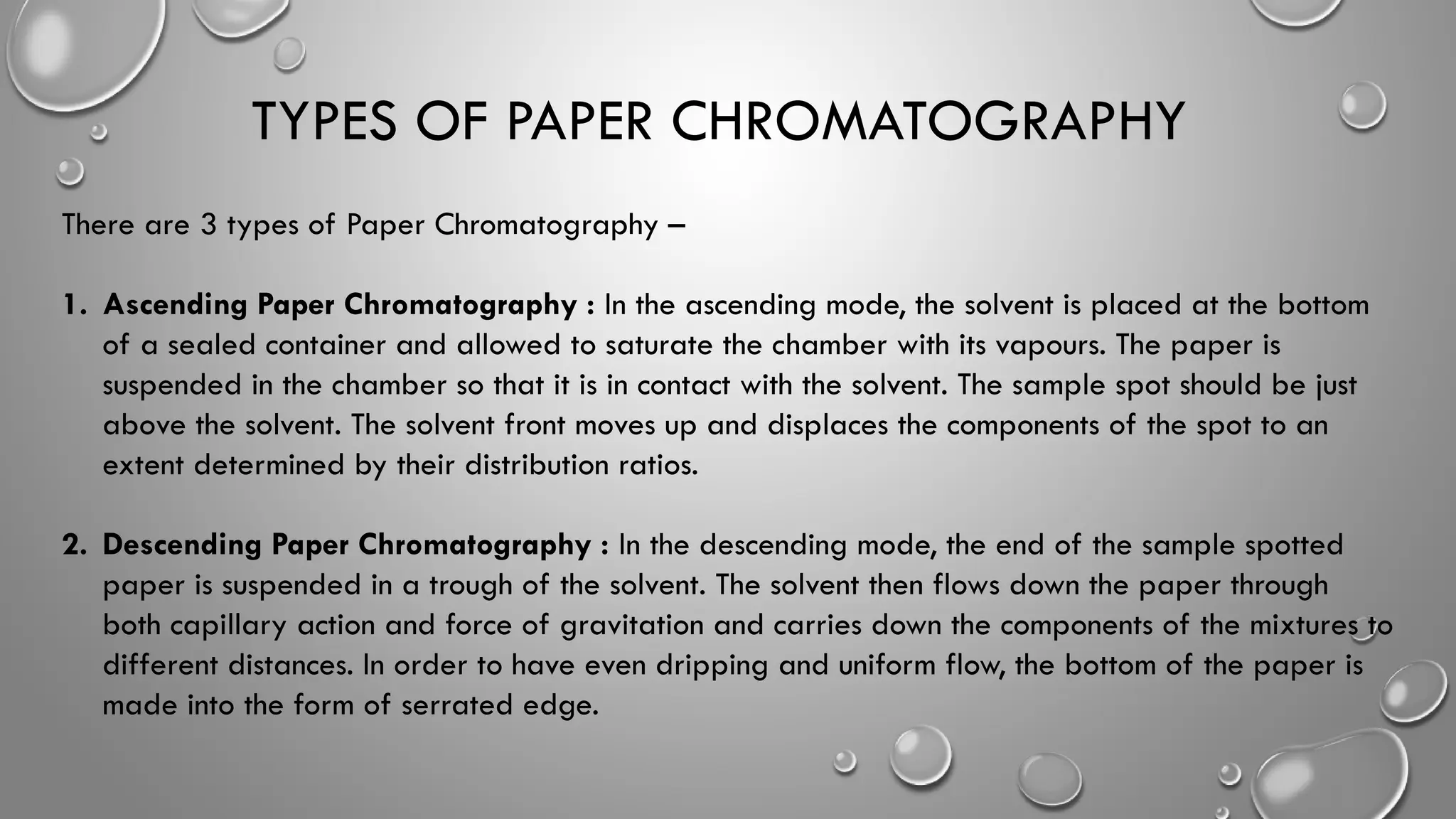
There are 3 types of Paper Chromatography –
1. Ascending Paper Chromatography : In the ascending mode, the solvent is placed at the bottom
of a sealed container and allowed to saturate the chamber with its vapours. The paper is
suspended in the chamber so that it is in contact with the solvent. The sample spot should be just
above the solvent. The solvent front moves up and displaces the components of the spot to an
extent determined by their distribution ratios.
2. Descending Paper Chromatography : In the descending mode, the end of the sample spotted
paper is suspended in a trough of the solvent. The solvent then flows down the paper through
both capillary action and force of gravitation and carries down the components of the mixtures to
different distances. In order to have even dripping and uniform flow, the bottom of the paper is
made into the form of serrated edge.
Continued….
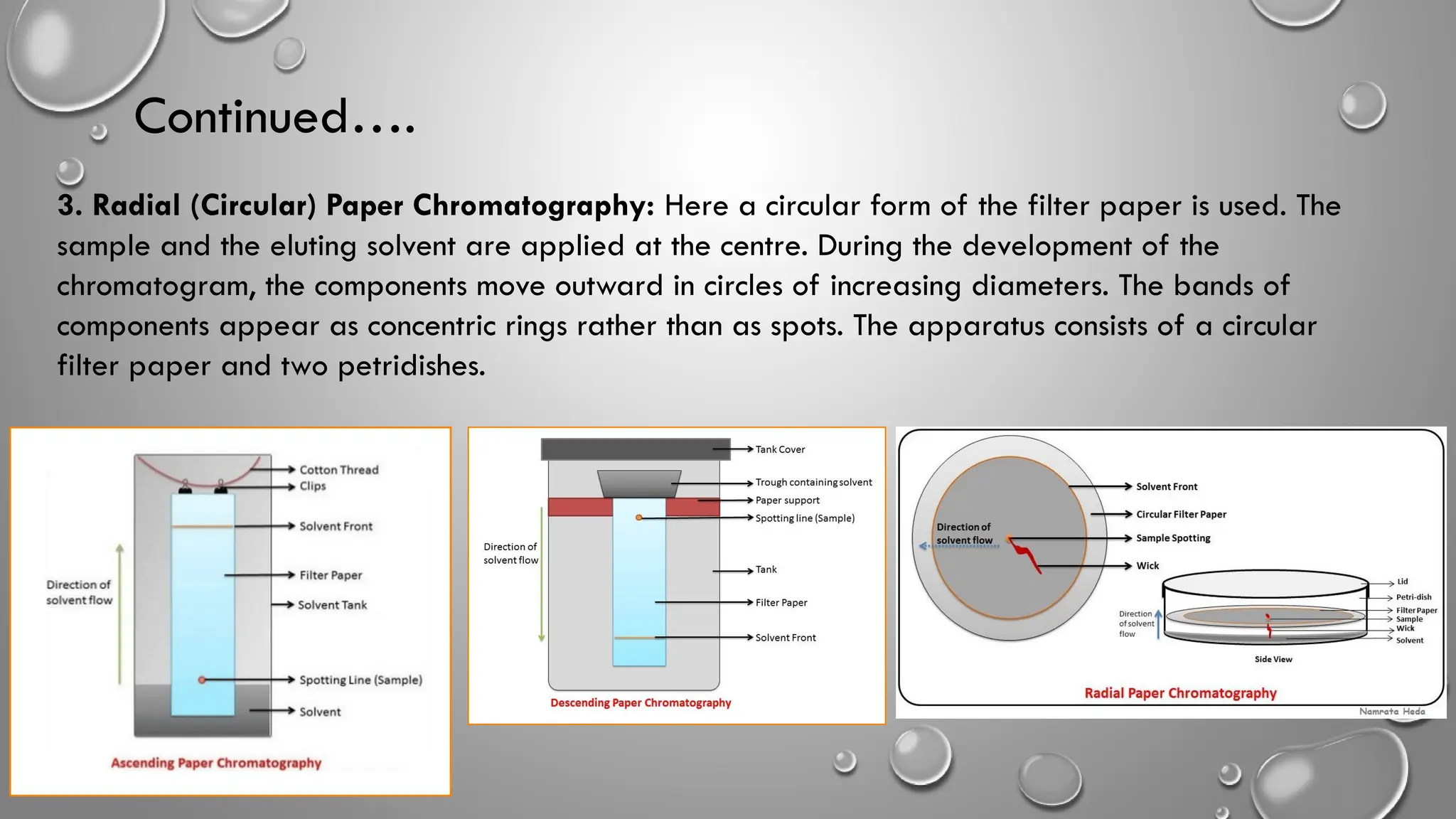
3. Radial (Circular) Paper Chromatography: Here a circular form of the filter paper is used. The
sample and the eluting solvent are applied at the centre. During the development of the
chromatogram, the components move outward in circles of increasing diameters. The bands of
components appear as concentric rings rather than as spots. The apparatus consists of a circular
filter paper and two petridishes.
FACTORS AFFECTING THE RESOLUTION IN PAPER
CHROMATOGRAPHY
1. Interaction Between Solute, Solvent and Paper
o The chemical nature of the solutes (polarity, hydrogen bonding, molecular size) affects how
strongly they interact with the paper or the solvent.
o Balanced interactions between phases yield the best resolution.
2. Time and Distance of Development
o If the paper runs for too short a distance, separation may be incomplete.
o If it runs too long, spots may diffuse.
o Proper optimization gives distinct and separated spots.
3. Chamber Saturation (Humidity)
o A saturated atmosphere in the chromatography chamber prevents solvent evaporation and
ensures uniform flow.
o If the chamber is not saturated, uneven solvent movement may occur, leading to distorted or
unclear spots.
Continued….
4. Sample Size and Concentration
o Applying too large or concentrated a sample leads to overlapping spots.
o Small, concentrated spots give sharper and clearer separations.
5. Temperature
o Increasing temperature increases solvent flow rate and solubility of solutes, but excessive heat
can cause diffusion and poor resolution.
o Maintaining a constant moderate temperature gives more consistent results.
6. pH of the Solvent
o For ionizable compounds, pH can influence their charge and solubility.
o Adjusting the pH of the solvent system can improve separation of acids, bases, or amino acids.
APPLICATION OF PAPER CHROMATOGRAPHY
1. Identification of amino acids by chromatography : Separation, isolation and identification of amino
acids released in the hydrolysis of proteins is conveniently done by using Paper chromatography.
2. Separation of a mixture of sugars by paper chromatography : The mixture of sugars is dissolved in
a mixture of isopropyl alcohol and water (1:9) and applied at a spot marked with the help of a
melting point capillary.
3. Separation of mixture of dyes by paper chromatography : The separation of the given dyes (like
alizarin red, methyl orange and methyl red) in ethyl alcohol and by means of melting point
capillaries.
4. Pharmaceutical Applications : Used to analyze and identify drugs, alkaloids, and other active
compounds in medicinal plants and formulations.
5. Purity Testing : Used in laboratories to check the purity of compounds - impurities appear as
additional spots.
REFERENCES
1. Pharmaceutical Analysis-II Instrumental Methods – P.C. Kamboj Vallabh Publications.
2. Vogel‘s textbook of quantitative chemical analysis - Jeffery J Bassett, J. Mendham, R. C.
Denney, 5th edition, ELBS, 1991.
3. Practical Pharmaceutical Chemistry – Beckett and Stenlake, Vol II, 4th edition, CBS
Publishers, New Delhi, 1997.
THANK YOU

Paper chromatography separation technique.pptx

  • 1.
    Modern Pharmaceutical AnalyticalTechniques (MPA 101T) Presentation Topic – Paper Chromatography Presented To – Dr. Priyanka & Dr. Mansi Department Of Pharmaceutical Sciences, Babasaheb Bhimrao Ambedkar University, Lucknow Presented By – Vasudev Dwivedi M. Pharm. 1st Semester (Pharmaceutical Analysis) Department Of Pharmaceutical Sciences, BBAU, Lucknow
  • 2.
  • 3.
    TABLE OF CONTENT 1.Introduction 2. History 3. Principle 4. Apparatus 5. Mechanism of Separation 6. Types of Chromatography 7. Factors Affecting the Resolution in Paper Chromatography 8. Application of paper chromatography
  • 4.
    INTRODUCTION  Paper chromatographyis an analytical technique used to separate and identify components of a mixture by allowing them to move at different rates along a strip of paper under the influence of a solvent (mobile phase). The paper acts as the stationary phase, and the separation occurs based on differences in the solubility and adsorption of the substances on the paper.  Paper chromatography is a planar form of chromatography just like thin layer chromatography (TLC) and employs A flat relatively thin layer of paper as the stationary support.  The spot where the sample is applied is called the origin and several samples may be applied in a horizontal line in this way.
  • 5.
    History  Archer Martinand Richard Synge in 1943 introduced paper chromatography a separation technique where the mixture to be separated is dissolved in suitable solvent and applied to a thick piece of paper using a very fine glass capillary as a dropper.  They had previously developed partition chromatography and later adapted the technique using paper as the stationary phase and a solvent as the mobile phase.  The method quickly became popular because it was cheap, simple, and effective for separating and identifying small molecules like amino acids, sugars, and pigments.
  • 6.
    PRINCIPLE  Since surfacetension is the driving force for capillary movements in cellulose, the technique involves partition as the main mechanism of separation.  Paper chromatography works on the principle of partition between two phases - the stationary phase (water molecules held in the interstices of the filter paper matrix by hydrogen bonding) and the mobile phase (a solvent that moves over the paper).  In paper chromatography the interaction between solutes & the cellulose may also be involved, and then adsorption & hydrogen bonding as well may also play an important role in separation.
  • 7.
    Continued……. When a mixtureis applied to the paper and the solvent moves up by capillary action, each component of the mixture distributes itself differently between the stationary and mobile phases based on its solubility in the solvent and affinity for the paper. • Substances more soluble in the solvent travel farther. • Substances with greater affinity for the paper move more slowly. This difference in movement causes the components to separate along the paper.
  • 8.
  • 9.
    APPARATUS FOR PAPERCHROMATOGRAPHY 1. Chromatographic paper : • The most essential component of the setup. • Usually made of high-quality filter paper (like Whatman No. 1). • It acts as the stationary phase, holding a thin layer of water molecules in its fibers. • The paper allows capillary action to draw the solvent upward (or downward, depending on the setup). • The type and quality of paper affect the resolution and separation of components. 2. Solvent or Mobile Phase : • The solvent (or a mixture of solvents) carries the sample along the paper. • It serves as the mobile phase, determining how well substances move and separate. • Common solvents include water, ethanol, butanol, acetone, or mixtures like butanol-acetic acid- water. • The choice of solvent depends on the nature of the sample - polar or nonpolar.
  • 10.
    3. Beaker orChromatographic Chamber : • A closed container that holds the solvent and provides a saturated atmosphere with solvent vapor. • Prevents evaporation of the mobile phase and ensures consistent solvent movement. • Usually covered with a watch glass or lid during the process. • Some chambers are lined with filter paper soaked in solvent to maintain uniform humidity. 4. Capillary Tube or Micropipette : • Used to apply a small, concentrated spot of the sample on the chromatography paper. • Ensures that the spot is precise and controlled - too large a spot may cause poor separation. Sr. No. Solvents Ratio 1 Ethanol + Distilled Water 7 : 3 2 n-Butanol + Glacial Acetic Acid 6 : 1 3 Acetone + Distilled Water + conc. HCl 17 : 1 : 2 4 n-Butanol + Ethanol + 2M aq. Ammonia 3 : 1 : 1 Table-1 Some Common Solvent System
  • 11.
    5. Pencil andRuler : • Used to draw the baseline (where the sample is applied) and to mark the solvent front after the run. • Pencil must be used because ink contains dyes that could interfere with results. 6. Glass Rod or Paper Clip : • Used to suspend the paper vertically in the chamber. • Ensures that the paper does not touch the walls, allowing uniform solvent movement. 7. Watch Glass or Lid : • Used to cover the chromatographic chamber, maintaining a saturated solvent atmosphere and preventing evaporation. 8. Developing or Visualizing Agent : • Some components are colorless and cannot be seen directly. • After chromatography, a developing agent (such as ninhydrin for amino acids) is sprayed or the paper is exposed to UV light to make the spots visible. Continued….
  • 12.
    Sr. No. Detecting AgentCompound Detected Observation (Colour/Effect) 1. Ninhydrin Amino acids, peptides, proteins Purple or violet spots (Ruhemann’s purple) 2. Iodine vapors Lipids, alkaloids, many organic compounds Brown or yellowish spots 3. UV light (254 nm or 366 nm) Aromatic compounds, conjugated systems Fluorescent or dark spots under UV 4. Aniline hydrogen phthalate Sugars (carbohydrates) Yellow to brown spots 5. Silver nitrate (AgNO ) ₃ Halides, sugars (after heating) Brown or black spots (due to silver reduction) 6. Potassium permanganate (KMnO ) ₄ Unsaturated compounds, aldehydes, ketones Yellow or brown spots on purple background 7. 2,4-Dinitrophenylhydrazine (2,4-DNP) Aldehydes and ketones Yellow, orange, or red spots 8. Ferric chloride (FeCl ) ₃ Phenolic compounds Blue, green, or violet spots 9. Dragendorff’s reagent Alkaloids Orange or reddish-brown spots 10. Bromocresol green Organic acids Yellow or blue-green spots (depending on pH) 11. Molisch reagent Carbohydrates Violet ring or spot (after reaction) Table-2 Detecting Agents and Their Corresponding Compounds
  • 13.
    MECHANISM OF SEPARATION 1.Choice of chromatographic paper : The chromatographic paper should be a short-fibre cellulose filter paper with high purity and some special properties. Whatman No. 1 is a standard, strong, medium-fast pure cellulose paper which is most widely used. 2. Proper developing solvent : Any solvent system in which solvents are not completely miscible with one another and the Rf values are different for different components present in the sample may be employed for development of the chromatogram. The solvent (mobile phase) moves through the paper by capillary action. The solvent may be polar (e.g., water, ethanol) or nonpolar (e.g., hexane), depending on the nature of the substances being separated. 3. Application of the sample to paper : The sample must be dissolved in the minimum amount of a readily volatile solvent and should be applied to the paper in the form of solution in as compact a form as possible. A horizontal pencil line drawn about 3-5 cm above the edge and parallel to it. On this origin line marks (x) are made with pencil at least 2 cm away from each other so there may be no overlapping during resolution. The smaller the sample applied , the greater would be the resolution of the component.
  • 15.
    Continued…. 4. Development ofthe chromatogram : The paper is now fixed vertically in the glass jar with a clip attached to the inner side of the cover of jar. The paper is dipped in to the developing solvent such that covered properly. When the solvent has moved a considerable distance 3/4th of the paper length, the paper is removed from the jar and the position of the solvent front is marked with a lead pencil. Allow it to dry at room temperature. The dried paper is called a chromatogram. 5. Drying of the chromatogram : If the solvent is volatile, the paper can be dried by simply suspending it in air by means of a clip in a fume cup-board. In case of less volatile solvents, warm air blower or a drying oven may be used for drying. 6. Visualisation of separated spots : This can be done – a) Either by chemical means (detecting agent), or b) By using UV radiation Usually the spots are located by spraying the reagent from an atomizer and later on it is dried as before.
  • 16.
    Continued…. 7. Calculation ofRf (Retention Factor) values : The Rf values is characteristic of a compound under specified condition. The approximate identification of a spot can be made by comparing Rf values of unknown samples and known compounds using various solvent systems. Sometimes different compounds may have identical Rf values in a particular solvent but may have different values in the other.
  • 17.
    TYPES OF PAPERCHROMATOGRAPHY There are 3 types of Paper Chromatography – 1. Ascending Paper Chromatography : In the ascending mode, the solvent is placed at the bottom of a sealed container and allowed to saturate the chamber with its vapours. The paper is suspended in the chamber so that it is in contact with the solvent. The sample spot should be just above the solvent. The solvent front moves up and displaces the components of the spot to an extent determined by their distribution ratios. 2. Descending Paper Chromatography : In the descending mode, the end of the sample spotted paper is suspended in a trough of the solvent. The solvent then flows down the paper through both capillary action and force of gravitation and carries down the components of the mixtures to different distances. In order to have even dripping and uniform flow, the bottom of the paper is made into the form of serrated edge.
  • 18.
    Continued…. 3. Radial (Circular)Paper Chromatography: Here a circular form of the filter paper is used. The sample and the eluting solvent are applied at the centre. During the development of the chromatogram, the components move outward in circles of increasing diameters. The bands of components appear as concentric rings rather than as spots. The apparatus consists of a circular filter paper and two petridishes.
  • 19.
    FACTORS AFFECTING THERESOLUTION IN PAPER CHROMATOGRAPHY 1. Interaction Between Solute, Solvent and Paper o The chemical nature of the solutes (polarity, hydrogen bonding, molecular size) affects how strongly they interact with the paper or the solvent. o Balanced interactions between phases yield the best resolution. 2. Time and Distance of Development o If the paper runs for too short a distance, separation may be incomplete. o If it runs too long, spots may diffuse. o Proper optimization gives distinct and separated spots. 3. Chamber Saturation (Humidity) o A saturated atmosphere in the chromatography chamber prevents solvent evaporation and ensures uniform flow. o If the chamber is not saturated, uneven solvent movement may occur, leading to distorted or unclear spots.
  • 20.
    Continued…. 4. Sample Sizeand Concentration o Applying too large or concentrated a sample leads to overlapping spots. o Small, concentrated spots give sharper and clearer separations. 5. Temperature o Increasing temperature increases solvent flow rate and solubility of solutes, but excessive heat can cause diffusion and poor resolution. o Maintaining a constant moderate temperature gives more consistent results. 6. pH of the Solvent o For ionizable compounds, pH can influence their charge and solubility. o Adjusting the pH of the solvent system can improve separation of acids, bases, or amino acids.
  • 21.
    APPLICATION OF PAPERCHROMATOGRAPHY 1. Identification of amino acids by chromatography : Separation, isolation and identification of amino acids released in the hydrolysis of proteins is conveniently done by using Paper chromatography. 2. Separation of a mixture of sugars by paper chromatography : The mixture of sugars is dissolved in a mixture of isopropyl alcohol and water (1:9) and applied at a spot marked with the help of a melting point capillary. 3. Separation of mixture of dyes by paper chromatography : The separation of the given dyes (like alizarin red, methyl orange and methyl red) in ethyl alcohol and by means of melting point capillaries. 4. Pharmaceutical Applications : Used to analyze and identify drugs, alkaloids, and other active compounds in medicinal plants and formulations. 5. Purity Testing : Used in laboratories to check the purity of compounds - impurities appear as additional spots.
  • 22.
    REFERENCES 1. Pharmaceutical Analysis-IIInstrumental Methods – P.C. Kamboj Vallabh Publications. 2. Vogel‘s textbook of quantitative chemical analysis - Jeffery J Bassett, J. Mendham, R. C. Denney, 5th edition, ELBS, 1991. 3. Practical Pharmaceutical Chemistry – Beckett and Stenlake, Vol II, 4th edition, CBS Publishers, New Delhi, 1997.
  • 23.