PRONOUNS
By: Santiago Bolivar, Valentina Mora, Bryan Cardozo
WHAT IS A PRONOUN?
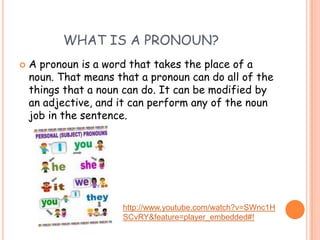
 A pronoun is a word that takes the place of a
noun. That means that a pronoun can do all of the
things that a noun can do. It can be modified by
an adjective, and it can perform any of the noun
job in the sentence.
http://www.youtube.com/watch?v=SWnc1H
SCvRY&feature=player_embedded#!
WHAT TYPES OF PRONOUNS ARE?
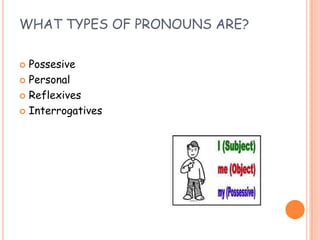
 Possesive
 Personal
 Reflexives
 Interrogatives
WHAT IS A PERSONAL PRONOUN?
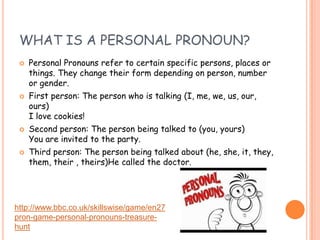
 Personal Pronouns refer to certain specific persons, places or
things. They change their form depending on person, number
or gender.
 First person: The person who is talking (I, me, we, us, our,
ours)
I love cookies!
 Second person: The person being talked to (you, yours)
You are invited to the party.
 Third person: The person being talked about (he, she, it, they,
them, their , theirs)He called the doctor.
http://www.bbc.co.uk/skillswise/game/en27
pron-game-personal-pronouns-treasure-
hunt
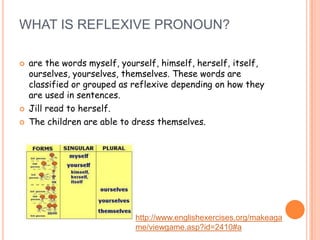
WHAT IS REFLEXIVE PRONOUN?
 are the words myself, yourself, himself, herself, itself,
ourselves, yourselves, themselves. These words are
classified or grouped as reflexive depending on how they
are used in sentences.
 Jill read to herself.
 The children are able to dress themselves.
http://www.englishexercises.org/makeaga
me/viewgame.asp?id=2410#a

Pronouns

  • 1.
    PRONOUNS By: Santiago Bolivar,Valentina Mora, Bryan Cardozo
  • 2.
    WHAT IS APRONOUN?  A pronoun is a word that takes the place of a noun. That means that a pronoun can do all of the things that a noun can do. It can be modified by an adjective, and it can perform any of the noun job in the sentence. http://www.youtube.com/watch?v=SWnc1H SCvRY&feature=player_embedded#!
  • 3.
    WHAT TYPES OFPRONOUNS ARE?  Possesive  Personal  Reflexives  Interrogatives
  • 4.
    WHAT IS APERSONAL PRONOUN?  Personal Pronouns refer to certain specific persons, places or things. They change their form depending on person, number or gender.  First person: The person who is talking (I, me, we, us, our, ours) I love cookies!  Second person: The person being talked to (you, yours) You are invited to the party.  Third person: The person being talked about (he, she, it, they, them, their , theirs)He called the doctor. http://www.bbc.co.uk/skillswise/game/en27 pron-game-personal-pronouns-treasure- hunt
  • 5.
    WHAT IS REFLEXIVEPRONOUN?  are the words myself, yourself, himself, herself, itself, ourselves, yourselves, themselves. These words are classified or grouped as reflexive depending on how they are used in sentences.  Jill read to herself.  The children are able to dress themselves. http://www.englishexercises.org/makeaga me/viewgame.asp?id=2410#a