
Wealth Management
Why it’s becoming quintessential and exigent today
Project Report - 5 January 2015
Submitted by: Shubham Mehta
Bsc(H) Statistics
Ramjas College

WEALTH MANAGEMENT 1
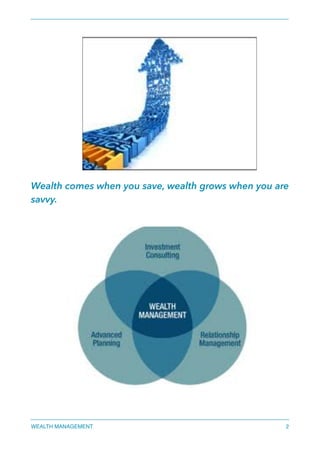
Wealth comes when you save, wealth grows when you are
savvy.
WEALTH MANAGEMENT 2
Certificate
This	
  is	
  to	
  certify	
  that	
  Shubham	
  Mehta	
  has	
  prepared	
  the	
  
project	
   report	
   entitled:	
   “Wealth	
   Management-­‐why	
   it’s	
  
becoming	
  quintessential	
  and	
  exigent	
  today?”	
  
This	
  project	
  is	
  a	
  part	
  of	
  the	
  winter	
  internship	
  and	
  has	
  no	
  
commercial	
  implications.	
  The	
  report	
  being	
  submitted	
  is	
  
original	
  and	
  does	
  not	
  indulge	
  in	
  plagiarism	
  of	
  any	
  sort.	
  
Mr.	
  Chirag	
  Jain	
  
Wealth	
  Manager,	
  Wealth	
  Management	
  
Aditya	
  Birla	
  Money	
  Mart	
  Limited	


WEALTH MANAGEMENT 3
Acknowledgements	
  
The internship opportunity I had with Aditya Birla Money Mart (ABMM)
was a great chance for learning and professional development. Therefore, I
consider myself as a very lucky individual as I was provided with an
opportunity to be a part of it.
At ABMM, I was fortunate to have the opportunity to interact with our
outstanding mentors and colleagues who made the learning a pleasure and
challenge. This is how the present project has evolved.
In acknowledging the help I have received from others in the work presented
here, I must begin by recording my greatest debt to Chirag Jain Sir, who
inspired us to work in this area. He is also a marvellous mentor and his ideas
continued to influence me throughout the internship. During the period of
evolution of this work, I was fortunate to receive comments, suggestions,
questions and dismissals and encouragement from myriad number of
people, especially Shailendra Talwar Sir, who was motivating at every point
during this internship.
It is impossible for me to express adequately my gratitude to the benefit I
had received from him not only as a mentor but as a friend in general
throughout the work. I will be failing in my duty if I miss out to articulate
our earnest thanks to Rajesh Soni Sir, for if he won’t have provided me with
this staggering chance, this project won’t have been successful. Lastly, the
harmonious climate at office proved efficacious for preparing the project.
I perceive this opportunity as a big milestone in my career development. I
will strive to capitalise the gained skills and knowledge in the best possible
manner, and I will continue to work for their improvement.
Sincerely,
Shubham Mehta
WEALTH MANAGEMENT 4
Contents	
  
• Introduction	
  
• Sources	
  of	
  Wealth	
  
• Concept	
  of	
  Wealth	
  Management	
  
• Objectives	
  
• Research	
  Methodology	
  
• State	
  of	
  Wealth	
  Management	
  Industry	
  in	
  India	
  
• Opportunity	
  for	
  Local	
  and	
  Foreign	
  Players	
  
• Instruments	
  of	
  Wealth	
  Management	
  
• Bank	
  Deposits	
  v/s	
  Equity	
  v/s	
  Mutual	
  Funds	
  
• Merits	
  and	
  Demerits	
  of	
  investing	
  in	
  Mutual	
  funds	
  
• The	
  role	
  of	
  Finance	
  Department	
  in	
  a	
  company	
  
• Conclusion	
  
• Bibliography	
  
WEALTH MANAGEMENT 5
Introduction	
  
Wealth	
  usually	
  refers	
  to	
  money	
  and	
  property	
  or	
  something	
  which	
  has	
  economic	
  	
  value	
  
attached	
   to	
   it.	
   It	
   is	
   the	
   abundance	
   of	
   objects	
   of	
   value	
   and	
   also	
   the	
   state	
   of	
   having	
  
accumulated	
  these	
  objects.	
  The	
  use	
  of	
  the	
  word	
  itself	
  assumes	
  some	
  socially-­‐accepted	
  
means	
  of	
  identifying	
  objects,	
  land,	
  or	
  money	
  as	
  belonging	
  to	
  someone,	
  i.e.	
  a	
  broadly	
  
accepted	
  notion	
  of	
  property	
  and	
  a	
  means	
  of	
  protection	
  of	
  that	
  property	
  that	
  can	
  be	
  
invoked	
  with	
  minimal	
  (or,	
  ideally,	
  no)	
  effort	
  and	
  expense	
  on	
  the	
  part	
  of	
  the	
  owner.	
  
Concepts	
  of	
  wealth	
  vary	
  among	
  societies.	
  Anthropology	
  characterises	
  societies,	
  in	
  part,	
  
based	
  on	
  a	
  society's	
  concept	
  of	
  wealth,	
  and	
  the	
  institutional	
  structures	
  and	
  power	
  used	
  
to	
   protect	
   this	
   wealth.	
   Several	
   types	
   are	
   deXined	
   below.	
   They	
   can	
   be	
   viewed	
   as	
   an	
  
evolutionary	
  progression.	
  Industrialisation	
  emphasised	
  the	
  role	
  of	
  technology.	
  Many	
  
jobs	
  were	
  automated.	
  Machines	
  replaced	
  some	
  workers	
  while	
  other	
  workers	
  became	
  
more	
  specialised.	
  Labour	
  specialisation	
  became	
  critical	
  to	
  economic	
  success	
  However,	
  
physical	
  capital,	
  as	
  it	
  came	
  to	
  be	
  known,	
  consisting	
  of	
  both	
  the	
  natural	
  capital	
  (raw	
  
materials	
  from	
  nature)	
  and	
  the	
  infrastructural	
  capital	
  (facilitating	
  technology),	
  became	
  
the	
  focus	
  of	
  the	
  analysis	
  of	
  wealth.	
  
SOURCES	
  OF	
  WEALTH	
  
• Wealth	
  is	
  created	
  through	
  several	
  means.	
  
• Natural	
  resources	
  can	
  be	
  harvested	
  and	
  sold	
  to	
  those	
  who	
  want	
  them.	
  
• Material	
  can	
  be	
  changed	
  into	
  something	
  more	
  valuable	
  through	
  proper	
  application	
  
of	
  labour	
  and	
  equipment.	
  
• Better	
  methods	
  also	
  create	
  wealth	
  by	
  allowing	
  faster	
  creation	
  of	
  wealth.	
  
• Ideas	
  create	
  wealth	
  by	
  allowing	
  it	
  to	
  be	
  created	
  faster	
  or	
  with	
  new	
  methods.	
  
THE	
  CONCEPT	
  OF	
  WEALTH	
  MANAGEMENT	
  
The	
  concept	
  of	
  wealth	
  management	
  refers	
  to	
  management	
  of	
  both	
  the	
  sources	
  and	
  the	
  
facets	
  of	
  various	
  forms	
  of	
  both	
  tangible	
  and	
  non-­‐tangible	
  wealth.	
  India	
  has	
  become	
  a	
  
highly	
   potential	
   market	
   for	
   wealth	
   management	
   because	
   wealth	
   managers,	
   both	
  
domestic	
  and	
  international,	
  are	
  able	
  to	
  establish	
  the	
  beginnings	
  of	
  a	
  market	
  with	
  few	
  
obstacles,	
   relative	
   to	
   the	
   other	
   emerging	
   markets.	
   Where	
   there	
   are	
   regulatory	
  
restrictions,	
  these	
  are	
  less	
  problematic	
  than	
  those	
  in	
  China	
  or	
  the	
  Middle	
  East.	
  
WEALTH MANAGEMENT 6
OBJECTIVES	
  OF	
  THIS	
  REPORT	
  
• To	
  analyse	
  the	
  evolution	
  and	
  growth	
  of	
  wealth	
  management	
  market	
  in	
  India.	
  
• To	
   analyse	
   whether	
   Indian	
   economic	
   development	
   is	
   creating	
   a	
   broad	
   and	
  
competitive	
  wealth	
  management	
  market	
  in	
  India.	
  
• To	
  discuss	
  the	
  factors	
  that	
  have	
  acted	
  as	
  facilitators	
  and	
  obstructions	
  for	
  the	
  growth	
  
of	
  wealth	
  management	
  market	
  in	
  India.	
  
• From	
  the	
  above	
  three	
  objectives,	
  to	
  derive	
  the	
  potentiality	
  and	
  the	
  future	
  prospect	
  of	
  
the	
  wealth	
  management	
  industry	
  in	
  India.	
  
• This	
   project	
   report	
   also	
   analyses	
   both	
   the	
   onshore	
   and	
   offshore	
   aspects	
   of	
   liquid	
  
wealth	
   in	
   India	
   and	
   sizes	
   the	
   mass	
   afXluent	
   and	
   high	
   net	
   worth	
   customers	
   by	
  
onshore	
  wealth.	
  
RESEARCH	
  METHODOLOGY	
  
The	
  present	
  study	
  is	
  purely	
  an	
  exploratory	
  study,	
  dependent	
  on	
  both	
  the	
  primary	
  and	
  
the	
  secondary	
  sources	
  of	
  data.	
  The	
  primary	
  sources	
  of	
  data	
  constitutes	
  the	
  interaction	
  
(both	
   formal	
   and	
   informal)	
   of	
   the	
   researcher	
   with	
   the	
   managers	
   and	
   other	
   ofXicials	
  
who	
   are	
   directly	
   associated	
   with	
   the	
   wealth	
   management	
   industry	
   in	
   India.	
   The	
  
ofXicials	
  were	
  selected	
  on	
  the	
  method	
  of	
  simple	
  random	
  sampling.	
  The	
  Annual	
  Reports	
  
of	
  the	
  concerned	
  agencies	
  and	
  the	
  relevant	
  literature	
  and	
  facts	
  and	
  Xigures	
  available	
  on	
  
the	
   problem	
   of	
   the	
   study	
   in	
   various	
   books,	
   journals	
   and	
   magazines	
   constitutes	
   the	
  
secondary	
  sources	
  of	
  data.	
  
• Macroeconomic	
   and	
   savings	
   and	
   investment	
   data	
   collected	
   directly	
   from	
  
governmental	
  sources	
  such	
  as	
  the	
  Reserve	
  Bank	
  of	
  India.	
  
• Insight	
  into	
  the	
  Indian	
  Xinancial	
  services	
  market	
  
SIGNIFICANCE	
  OF	
  THE	
  STUDY:	
  
• Allows	
  wealth	
  managers	
  to	
  monitor	
  threats	
  and	
  opportunities	
  posed	
  by	
  their	
  main	
  
competition.	
  
• Helps	
  plan	
  products	
  and	
  services	
  by	
  giving	
  key	
  information	
  on	
  customers	
  Xinancial	
  
services	
  preferences.	
  
• Looks	
  at	
  the	
  onshore	
  liquid	
  wealth	
  of	
  mass	
  afXluent	
  and	
  high	
  net	
  worth	
  individuals	
  
in	
  India	
  and	
  in	
  India's	
  largest	
  and	
  most	
  afXluent	
  states.	
  
• Offers	
  access	
  to	
  key	
  statistics	
  providing	
  a	
  clear	
  picture	
  of	
  the	
  scale,	
  composition	
  and	
  
direction	
  of	
  the	
  developing	
  landscape	
  on	
  a	
  regional	
  basis.	
  
• Find	
  out	
  why	
  India	
  is	
  an	
  attractive	
  market	
  and	
  its	
  advantages	
  over	
  other	
  emerging	
  
economies.	
  
WEALTH MANAGEMENT 7
STATE	
  OF	
  WEALTH	
  MANAGEMENT	
  
INDUSTRY	
  IN	
  INDIA	
  
Wealth	
  management	
  is	
  just	
  emerging	
  in	
  India.	
  The	
  growth	
  of	
  the	
  economy	
  has	
  already	
  
been	
   widely	
   showcased.	
   Wealth	
   management	
   services	
   have	
   been	
   getting	
   more	
  
attention	
   over	
   the	
   last	
   two	
   years.	
   A	
   booming	
   economy,	
   rising	
   stock	
   prices	
   and	
   an	
  
increase	
  in	
  salaries	
  and	
  spending	
  power	
  have	
  turned	
  the	
  spotlight	
  on	
  this	
  sector.	
  The	
  
wealth	
   management	
   space	
   was	
   earlier	
   the	
   preserve	
   of	
   some	
   foreign	
   banks	
   which	
  
offered	
   these	
   "exclusive	
   services"	
   to	
   a	
   select	
   few.	
   This	
   was	
   not	
   a	
   service	
   you	
   could	
  
apply	
  for.	
  The	
  unsaid	
  tagline	
  was	
  "Don't	
  call	
  us.	
  We'll	
  call	
  you	
  (if	
  you	
  are	
  that	
  wealthy)!"	
  
Today,	
   a	
   number	
   of	
   private	
   banks	
   and	
   wealth	
   management	
   companies	
   offer	
   this	
  
service,	
  though	
  they	
  can	
  be	
  choosy	
  in	
  terms	
  of	
  their	
  clients	
  as	
  per	
  company’s	
  policy.	
  
Also	
   entering	
   this	
   arena	
   and	
   carving	
   a	
   niche	
   for	
   themselves	
   are	
   standalone	
   entities	
  
that	
   offer	
   the	
   full	
   range	
   of	
   services	
   —	
   investment	
   advice,	
   portfolio	
   management,	
  
taxation	
  advice	
  etc.	
  
A	
   report	
   published	
   by	
   independent	
   market	
   analyst,	
   Datamonitor	
   reveals	
   the	
   Indian	
  
wealth	
  market	
  is	
  offering	
  competitors	
  enormous	
  opportunities.	
  In	
  the	
  last	
  few	
  years,	
  
afXluent	
  wealth	
  in	
  India	
  has	
  grown	
  at	
  a	
  rate	
  of	
  17.6%	
  with	
  afXluent	
  individuals	
  totalling	
  
618,000	
  at	
  the	
  end	
  of	
  2007.	
  Competitors	
  are	
  realising	
  this	
  fact	
  and	
  are	
  beginning	
  to	
  
bring	
   their	
   propositions	
   to	
   the	
   table.	
   Going	
   forward,	
   this	
   is	
   a	
   trend	
   that	
   is	
   likely	
   to	
  
continue.	
  The	
  number	
  of	
  mass	
  afXluent	
  individuals	
  in	
  India	
  has	
  more	
  than	
  quadrupled	
  
since	
   1998.	
   India	
   is	
   becoming	
   an	
   increasingly	
   attractive	
   market	
   in	
   many	
   industries,	
  
and	
   wealth	
   management	
   is	
   no	
   exception.	
   India	
   is	
   attracting	
   both	
   foreign	
   wealth	
  
managers	
  and	
  domestic	
  banks	
  to	
  set	
  up	
  wealth	
  management	
  businesses.	
  Driving	
  the	
  
attractiveness	
  of	
  the	
  market	
  has	
  been	
  the	
  country’s	
  exceptional	
  economic	
  performance	
  
over	
  the	
  last	
  decade.	
  The	
  economy	
  has	
  grown	
  at	
  an	
  average	
  of	
  7.6%	
  since	
  1994,	
  due	
  to	
  
the	
   continued	
   development	
   of	
   the	
   service	
   industry	
   and	
   strong	
   growth	
   in	
   the	
  
technology	
  sector.	
  The	
  opportunities	
  that	
  have	
  been	
  created	
  by	
  a	
  booming	
  economy	
  
have	
   in	
   turn	
   driven	
   individual	
   wealth	
   growth.	
   The	
   wealth	
   of	
   India’s	
   residents	
   has	
  
grown	
   from	
   US$	
   79	
   billions	
   in	
   1998	
   to	
   US$	
   177	
   billions	
   at	
   the	
   end	
   of	
   2008.	
   This	
  
amounts	
  to	
  an	
  increase	
  of	
  123%	
  in	
  just	
  Xive	
  years.	
  This	
  wealth	
  is	
  usually	
  concentrated	
  
with	
   a	
   few	
   individuals	
   of	
   the	
   country	
   as	
   well	
   as	
   NRI’s.	
   Another	
   important	
   fact	
  
delineates	
  that	
  the	
  gross	
  wealth	
  concentrated	
  with	
  NRI’s,	
  NRO’s	
  and	
  citizens	
  of	
  Indian	
  
origin	
  exceeds	
  the	
  wealth	
  with	
  local	
  HNI’s.	
  	
  
WEALTH MANAGEMENT 8
OPPORTUNITIES	
  FOR	
  LOCAL	
  AND	
  FOREIGN	
  
PLAYERS	
  
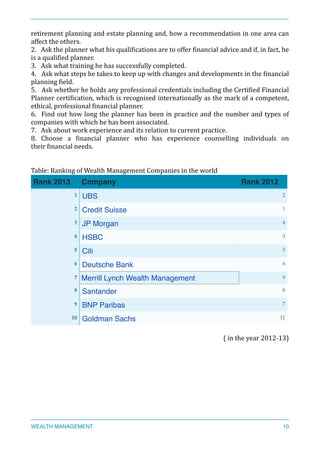
The	
  fact	
  that	
  afXluent	
  wealth	
  is	
  growing	
  at	
  a	
  rate	
  of	
  17.6%	
  compounded	
  annually	
  is	
  
attracting	
  both	
  foreign	
  wealth	
  managers	
  to	
  set	
  up	
  business	
  and	
  domestic	
  banks	
  to	
  set	
  
up	
  wealth	
  management	
  businesses.	
  There	
  are	
  certainly	
  opportunities	
  to	
  be	
  had	
  in	
  the	
  
Indian	
   wealth	
   market.	
   Whilst	
   on	
   the	
   world	
   stage,	
   the	
   Indian	
   wealth	
   market	
   is	
  
underdeveloped	
   and	
   dormant,	
   there	
   are	
   still	
   a	
   large	
   number	
   of	
   afXluent	
   individuals	
  
who	
  are	
  not	
  being	
  served	
  by	
  the	
  current	
  competitors	
  and	
  the	
  pool	
  of	
  potential	
  clients	
  
created	
   each	
   year	
   is	
   huge.	
   Datamonitor	
   forecasts	
   that	
   afXluent	
   wealth	
   in	
   India	
   will	
  
grow	
  rapidly	
  .	


India	
  is	
  still	
  at	
  a	
  stage	
  where	
  the	
  wealth	
  manager	
  is	
  not	
  necessarily	
  a	
  certiXied	
  entity	
  
and	
   the	
   term	
   itself	
   is	
   used	
   rather	
   loosely.	
   With	
   banks	
   and	
   distribution	
   houses,	
  
insurance	
  agents,	
  mutual	
  fund	
  distributors	
  and	
  chartered	
  accountants	
  liberally	
  calling	
  
themselves	
  'wealth	
  managers',	
  there	
  is	
  a	
  mind	
  boggling	
  array	
  of	
  people	
  to	
  choose	
  from.	
  
So,	
  it	
  becomes	
  imperative	
  to	
  Xirst	
  identify	
  the	
  type	
  of	
  people	
  you	
  can	
  sign	
  on	
  as	
  your	
  
wealth	
  managers.	
  There	
  are	
  wealth	
  managers	
  in	
  banks	
  and	
  wealth	
  management	
  Xirms	
  
who	
   will	
   eagerly	
   do	
   your	
   	
   Xinancial	
   planning	
   if	
   you	
   fall	
   in	
   the	
   HNI	
   (high	
   net	
   worth	
  
individual)	
   block.	
   These	
   Xirms	
   assign	
   a	
   relationship	
   manager	
   (RM)	
   to	
   you,	
   who	
   is	
  
expected	
  to	
  manage	
  the	
  relationship	
  with	
  you	
  by	
  proactively	
  using	
  his	
  knowledge	
  to	
  
tailor	
  unique	
  and	
  innovative	
  Xinancial	
  solutions	
  that	
  will	
  create	
  value.	
  However,	
  he	
  is	
  
restricted	
  by	
  the	
  number	
  of	
  distribution	
  tie-­‐ups	
  he	
  has	
  -­‐	
  not	
  all	
  of	
  them	
  can	
  sell	
  all	
  
products.	
  Besides,	
  as	
  banks	
  and	
  distribution	
  houses	
  increasingly	
  compete	
  with	
  each	
  
other	
  with	
  a	
  similar	
  set	
  of	
  products,	
  an	
  RM	
  may	
  end	
  up	
  just	
  pushing	
  his	
  own	
  brands	
  
instead	
   of	
   delivering	
   long-­‐term	
   advice.	
   The	
   high	
   churn	
   among	
   RM’s	
   often	
   leads	
   to	
  
sudden	
  breaks	
  in	
  relationship	
  building	
  and	
  a	
  whole	
  lot	
  of	
  miscommunication	
  between	
  
the	
  customer	
  and	
  the	
  Xinancial	
  services	
  Xirm	
  ensues.	
  
Then	
  there	
  is	
  everyone	
  else	
  keen	
  on	
  getting	
  a	
  slice	
  of	
  your	
  pie	
  with	
  assurances	
  to	
  make	
  
you	
  richer	
  than	
  you	
  are	
  today.	
  Your	
  friendly	
  neighbours	
  who	
  sell	
  insurance	
  and	
  mutual	
  
funds	
   may	
   not	
   always	
   be	
   the	
   right	
   source.	
   After	
   all,	
   their	
   interests	
   in	
   selling	
   you	
   a	
  
particular	
   product	
   is	
   the	
   commission	
   that	
   they	
   earn	
   through	
   selling	
   you	
   a	
   Xinancial	
  
product.	
  Besides,	
  your	
  accountant	
  or	
  stockbroker	
  may	
  not	
  adopt	
  a	
  holistic	
  approach	
  to	
  
all	
   your	
   Xinancial	
   planning	
   needs.	
   If	
   you	
   strictly	
   go	
   by	
   the	
   book	
   and	
   look	
   	
   for	
   a	
  
qualiXication	
  that	
  beXits	
  a	
  wealth	
  manager,	
  then	
  you	
  should	
  go	
  to	
  the	
  150-­‐odd	
  certiXied	
  
Xinancial	
  planners	
  (CFPs)	
  who	
  have	
  been	
  certiXied	
  by	
  the	
  Financial	
  Planning	
  Standards	
  
Board	
  (FPSB),	
  India.	
  Remember	
  that	
  a	
  true	
  wealth	
  manager	
  uses	
  the	
  Xinancial	
  planning	
  
process	
   to	
   help	
   you	
   Xigure	
   out	
   how	
   to	
   meet	
   your	
   life	
   goals	
   through	
   the	
   proper	
  
management	
  of	
  your	
  Xinancial	
  resources.	
  Once	
  you	
  have	
  identiXied	
  the	
  category	
  of	
  your	
  
wealth	
  manager,	
  it	
  boils	
  down	
  to	
  choosing	
  one.	
  Here	
  are	
  eight	
  questions	
  to	
  ask	
  before	
  
you	
  hand	
  over	
  that	
  cheque	
  and	
  remember	
  to	
  keep	
  asking	
  as	
  you	
  go	
  along.	
  
1.	
   Wealth	
   management	
   requires	
   hands-­‐on	
   experience	
   and	
   a	
   strong	
   technical	
  
understanding	
   of	
   topics	
   such	
   as	
   personal	
   tax	
   planning,	
   insurance,	
   investments,	
  
WEALTH MANAGEMENT 9
retirement	
  planning	
  and	
  estate	
  planning	
  and,	
  how	
  a	
  recommendation	
  in	
  one	
  area	
  can	
  
affect	
  the	
  others.	
  	
  
2.	
  	
  	
  Ask	
  the	
  planner	
  what	
  his	
  qualiXications	
  are	
  to	
  offer	
  Xinancial	
  advice	
  and	
  if,	
  in	
  fact,	
  he	
  
is	
  a	
  qualiXied	
  planner.	
  	
  
3.	
  	
  	
  Ask	
  what	
  training	
  he	
  has	
  successfully	
  completed.	
  	
  
4.	
  	
  	
  Ask	
  what	
  steps	
  he	
  takes	
  to	
  keep	
  up	
  with	
  changes	
  and	
  developments	
  in	
  the	
  Xinancial	
  
planning	
  Xield.	
  	
  
5.	
  	
  	
  Ask	
  whether	
  he	
  holds	
  any	
  professional	
  credentials	
  including	
  the	
  CertiXied	
  Financial	


Planner	
  certiXication,	
  which	
  is	
  recognised	
  internationally	
  as	
  the	
  mark	
  of	
  a	
  competent,	
  
ethical,	
  professional	
  Xinancial	
  planner.	
  	
  
6.	
   	
  Find	
  out	
  how	
  long	
  the	
  planner	
  has	
  been	
  in	
  practice	
  and	
  the	
  number	
  and	
  types	
  of	
  
companies	
  with	
  which	
  he	
  has	
  been	
  associated.	
  	
  
7.	
  	
  	
  Ask	
  about	
  work	
  experience	
  and	
  its	
  relation	
  to	
  current	
  practice.	
  	
  
8.	
   Choose	
   a	
   Xinancial	
   planner	
   who	
   has	
   experience	
   counselling	
   individuals	
   on	
  
their	
  Xinancial	
  needs.	
  	
  
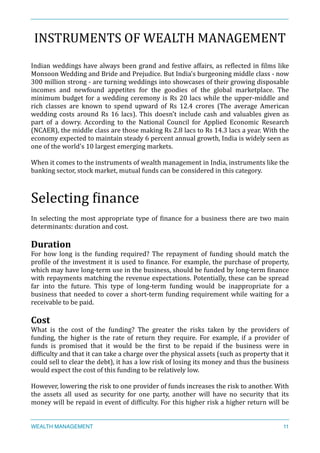
Table:	
  Ranking	
  of	
  Wealth	
  Management	
  Companies	
  in	
  the	
  world	
  
(	
  in	
  the	
  year	
  2012-­‐13)	
  
Rank 2013 Company Rank 2012
1 UBS 2
2 Credit Suisse 1
3 JP Morgan 4
4 HSBC 3
5 Citi 5
6 Deutsche Bank 6
7 Merrill Lynch Wealth Management 9
8 Santander 8
9 BNP Paribas 7
10 Goldman Sachs 11
WEALTH MANAGEMENT 10
INSTRUMENTS	
  OF	
  WEALTH	
  MANAGEMENT	
  
Indian	
  weddings	
  have	
  always	
  been	
  grand	
  and	
  festive	
  affairs,	
  as	
  reXlected	
  in	
  Xilms	
  like	
  
Monsoon	
  Wedding	
  and	
  Bride	
  and	
  Prejudice.	
  But	
  India's	
  burgeoning	
  middle	
  class	
  -­‐	
  now	
  
300	
  million	
  strong	
  -­‐	
  are	
  turning	
  weddings	
  into	
  showcases	
  of	
  their	
  growing	
  disposable	
  
incomes	
   and	
   newfound	
   appetites	
   for	
   the	
   goodies	
   of	
   the	
   global	
   marketplace.	
   The	
  
minimum	
  budget	
  for	
  a	
  wedding	
  ceremony	
  is	
  Rs	
  20	
  lacs	
  while	
  the	
  upper-­‐middle	
  and	
  
rich	
   classes	
   are	
   known	
   to	
   spend	
   upward	
   of	
   Rs	
   12.4	
   crores	
   (The	
   average	
   American	
  
wedding	
  costs	
  around	
  Rs	
  16	
  lacs).	
  This	
  doesn't	
  include	
  cash	
  and	
  valuables	
  given	
  as	
  
part	
   of	
   a	
   dowry.	
   According	
   to	
   the	
   National	
   Council	
   for	
   Applied	
   Economic	
   Research	
  
(NCAER),	
  the	
  middle	
  class	
  are	
  those	
  making	
  Rs	
  2.8	
  lacs	
  to	
  Rs	
  14.3	
  lacs	
  a	
  year.	
  With	
  the	
  
economy	
  expected	
  to	
  maintain	
  steady	
  6	
  percent	
  annual	
  growth,	
  India	
  is	
  widely	
  seen	
  as	
  
one	
  of	
  the	
  world's	
  10	
  largest	
  emerging	
  markets.	
  
When	
  it	
  comes	
  to	
  the	
  instruments	
  of	
  wealth	
  management	
  in	
  India,	
  instruments	
  like	
  the	
  
banking	
  sector,	
  stock	
  market,	
  mutual	
  funds	
  can	
  be	
  considered	
  in	
  this	
  category.	
  
Selecting	
  Xinance	
  
In	
  selecting	
  the	
  most	
  appropriate	
  type	
  of	
  Xinance	
  for	
  a	
  business	
  there	
  are	
  two	
  main	
  
determinants:	
  duration	
  and	
  cost.	
  
Duration	
  
For	
   how	
   long	
   is	
   the	
   funding	
   required?	
   The	
   repayment	
   of	
   funding	
   should	
   match	
   the	
  
proXile	
  of	
  the	
  investment	
  it	
  is	
  used	
  to	
  Xinance.	
  For	
  example,	
  the	
  purchase	
  of	
  property,	
  
which	
  may	
  have	
  long-­‐term	
  use	
  in	
  the	
  business,	
  should	
  be	
  funded	
  by	
  long-­‐term	
  Xinance	
  
with	
  repayments	
  matching	
  the	
  revenue	
  expectations.	
  Potentially,	
  these	
  can	
  be	
  spread	
  
far	
   into	
   the	
   future.	
   This	
   type	
   of	
   long-­‐term	
   funding	
   would	
   be	
   inappropriate	
   for	
   a	
  
business	
  that	
  needed	
  to	
  cover	
  a	
  short-­‐term	
  funding	
  requirement	
  while	
  waiting	
  for	
  a	
  
receivable	
  to	
  be	
  paid.	
  
Cost	
  
What	
   is	
   the	
   cost	
   of	
   the	
   funding?	
   The	
   greater	
   the	
   risks	
   taken	
   by	
   the	
   providers	
   of	
  
funding,	
   the	
   higher	
   is	
   the	
   rate	
   of	
   return	
   they	
   require.	
   For	
   example,	
   if	
   a	
   provider	
   of	
  
funds	
   is	
   promised	
   that	
   it	
   would	
   be	
   the	
   Xirst	
   to	
   be	
   repaid	
   if	
   the	
   business	
   were	
   in	
  
difXiculty	
  and	
  that	
  it	
  can	
  take	
  a	
  charge	
  over	
  the	
  physical	
  assets	
  (such	
  as	
  property	
  that	
  it	
  
could	
  sell	
  to	
  clear	
  the	
  debt),	
  it	
  has	
  a	
  low	
  risk	
  of	
  losing	
  its	
  money	
  and	
  thus	
  the	
  business	
  
would	
  expect	
  the	
  cost	
  of	
  this	
  funding	
  to	
  be	
  relatively	
  low.	
  
However,	
  lowering	
  the	
  risk	
  to	
  one	
  provider	
  of	
  funds	
  increases	
  the	
  risk	
  to	
  another.	
  With	
  
the	
   assets	
   all	
   used	
   as	
   security	
   for	
   one	
   party,	
   another	
   will	
   have	
   no	
   security	
   that	
   its	
  
money	
  will	
  be	
  repaid	
  in	
  event	
  of	
  difXiculty.	
  For	
  this	
  higher	
  risk	
  a	
  higher	
  return	
  will	
  be	
  
WEALTH MANAGEMENT 11
required.	
  The	
  cost	
  of	
  funding	
  is	
  therefore	
  determined	
  by	
  the	
  level	
  of	
  risk	
  to	
  each	
  type	
  
of	
  funding.	
  
Types	
  of	
  funding	
  
There	
  are	
  three	
  main	
  types	
  of	
  funding:	
  
Equity:	
  This	
  is	
  capital	
  put	
  in	
  by	
  investors	
  –	
  the	
  owners	
  of	
  business.	
  They	
  are	
  the	
  last	
  to	
  
be	
  repaid	
  if	
  the	
  business	
  is	
  in	
  trouble	
  and	
  have	
  to	
  accept	
  the	
  risk	
  that	
  they	
  may	
  lose	
  all	
  
the	
   money	
   they	
   put	
   into	
   the	
   business	
   (but	
   no	
   more	
   than	
   that).	
   In	
   return	
   they	
   are	
  
entitled	
  to	
  the	
  proXits	
  generated	
  by	
  the	
  business,	
  and	
  to	
  a	
  potentially	
  limitless	
  return.	
  
Debt	
   instruments:	
   These	
   long-­‐term	
   borrowings	
   are	
   typically	
   used	
   to	
   fund	
  
investments	
   such	
   as	
   the	
   purchase	
   of	
   property.	
   The	
   lenders	
   will	
   have	
   priority	
   if	
   the	
  
business	
  runs	
  into	
  trouble	
  and	
  may	
  even	
  have	
  some	
  protection	
  by	
  taking	
  security	
  on	
  
the	
  asset	
  funded.	
  Their	
  reward	
  will	
  be	
  a	
  predetermined	
  rate	
  of	
  interest	
  that	
  is	
  either	
  
Xixed	
  or	
  linked	
  to	
  a	
  central	
  bank	
  index.	


Bank	
   borrowing:	
   This	
   typically	
   short-­‐term	
   funding	
   is	
   used	
   to	
   cover	
   temporary	
  
shortfalls	
  and	
  timing	
  differences.	
  The	
  borrowing	
  may	
  be	
  unsecured	
  and	
  consequently	
  
carry	
   an	
   interest	
   rate	
   above	
   that	
   of	
   a	
   debt	
   instrument.	
   A	
   business	
   may	
   organise	
   a	
  
borrowing	
  facility	
  with	
  a	
  bank	
  to	
  enable	
  it	
  to	
  draw	
  on	
  this	
  type	
  of	
  funding	
  at	
  short	
  
notice	
  without	
  the	
  need	
  for	
  further	
  discussion	
  with	
  the	
  bank.	
  
BANK	
  DEPOSITS	
  
Independent	
  research	
  shows	
  that	
  customers	
  prefer	
  to	
  deal	
  with	
  a	
  local	
  operator	
  for	
  	
  
management	
  of	
  his	
  assets.	
  The	
  wealth	
  management	
  industry	
  has	
  begun	
  to	
  follow	
  the	
  
trend	
  set	
  by	
  the	
  likes	
  of	
  shoe	
  brand	
  Nike	
  and	
  fashion	
  retailer	
  Gap	
  in	
  moving	
  parts	
  of	
  	
  
its	
  operations	
  to	
  cheaper	
  environments.	
  As	
  ever,	
  the	
  back	
  and	
  middle	
  ofXices	
  are	
  the	
  
bits	
  that	
  wealth	
  managers	
  want	
  to	
  ofXload.	
  In	
  India,	
  it	
  is	
  both	
  the	
  public	
  sector	
  and	
  the	
  
private	
   sector	
   banks	
   who	
   have	
   demonstrated	
   themselves	
   in	
   the	
   assets	
   management	
  
market	
  to	
  tap	
  the	
  growing	
  potentiality	
  of	
  this	
  sector.	
  State	
  Bank	
  of	
  India,	
  the	
  nation’s	
  
largest	
  lender,	
  plans	
  to	
  offer	
  wealth	
  management	
  services	
  to	
  afXluent	
  clients,	
  seeking	
  a	
  
share	
   of	
   a	
   fast-­‐growing	
   market	
   that	
   is	
   now	
   worth	
   $10	
   billion,	
   and	
   that	
   may	
   double	
  
every	
  two	
  years.	
  	
  
Wealth	
   management	
   has	
   tremendous	
   growth	
   potential.	
   Foreign	
   banks	
   with	
   Indian	
  
collaborations	
  are	
  not	
  also	
  far	
  from	
  others.	
  For	
   	
  example,	
  Fidelity	
  and	
  Citibank	
  have	
  
some	
  operations	
  in	
  India,	
  including	
  call	
  centres,	
  processing	
  and	
  systems	
  development.	
  
Citigroup,	
  ABN	
  AMRO	
  Holding,	
  Standard	
  Chartered,	
  Aditya	
  Birla	
  Money	
  and	
  ICICI	
  Bank	
  
to	
  name	
  a	
  few	
  already	
  offer	
  wealth	
  management	
  services	
  in	
  the	
  nation.	
  DSP	
  Merrill	
  
Lynch	
  estimates	
  that	
  wealth	
  under	
  	
  management	
  in	
  India	
  totals	
  about	
  $30	
  billion.	
  Now	
  
WEALTH MANAGEMENT 12
government-­‐controlled	
  banks,	
  including	
  State	
  Bank,	
  are	
  seeking	
  wealth	
  management	
  
business	
  as	
  economic	
  growth,	
  forecast	
  by	
  the	
  government	
  at	
  an	
  annual	
  average	
  pace	
  of	
  
7	
  percent,	
  raises	
  incomes	
  and	
  as	
  Indians	
  seek	
  more	
  ways	
  to	
  earn	
  higher	
  returns	
  on	
  
their	
  wealth.	
  In	
  the	
  current	
  interest	
  rate,	
  taxation	
  and	
  macroeconomic	
  environment,	
  
with	
  a	
  positive	
  corporate	
  performance	
  and	
  GDP	
  growth,	
  more	
  and	
  more	
  individuals	
  
are	
  seeking	
  professional	
  management	
  of	
  their	
  Xinances.	
  Canara	
  Bank,	
  the	
  third-­‐biggest	
  
lender	
   in	
   India,	
   who	
   planed	
   to	
   open	
   branches	
   catering	
   speciXically	
   to	
   afXluent	
  
individuals,	
  initially	
  offered	
  Xinancial	
  advice,	
  mutual	
  funds	
  and	
  insurance	
  products.	
  	
  
Among	
  several	
  others	
  to	
  join	
  this	
  tempting	
  rat	
  race	
  are	
  Bank	
  of	
  India,	
  Union	
  Bank	
  of	
  
India,	
   ICICI	
   has	
   500	
   Xinancial	
   advisers	
   for	
   its	
   clients,	
   having	
   expanded	
   the	
  
number	
   fourfold	
   in	
   the	
   past	
   three	
   years.	
   Citibank	
   has	
   a	
   well-­‐organised	
   system	
   of	
  
Wealth	
  Management	
  services	
  in	
  India	
  that	
  give	
  you	
  unparalleled	
  advantage	
  and	
  opens	
  
up	
   the	
   opportunity	
   to	
   maximise	
   wealth.	
   For	
   example,	
   Citigold	
   Wealth	
   Management	
  
Scheme	
  which	
  offers	
  exclusive	
  privileges	
  to	
  its	
  customers	
  that	
  comprises	
  of:	
  
• Tax	
  and	
  estate	
  advisory	
  services	
  through	
  a	
  leading	
  tax	
  advisory	
  Xirm	
  in	
  India.	
  
• Free	
  for	
  life	
  Citibank	
  International	
  Gold	
  Credit	
  Card.	
  
• Updated	
  information	
  on	
  treasury,	
  currency	
  markets.	
  
• Invites	
  to	
  seminars	
  on	
  capital	
  markets,	
  mutual	
  funds,	
  budget	
  and	
  taxation.	
  
• Free	
   insurance	
   beneXits	
   -­‐	
   upto	
   Rs	
   30	
   lakh	
   personal	
   accident,	
   and	
   baggage	
   and	
  
householder	
  insurance.	
  
• Free	
  access	
  to	
  airport	
  lounges	
  at	
  Domestic	
  and	
  International	
  airports	
  in	
  India.	
  
DBS	
  Bank	
  offers	
  power	
  packed	
  Savings	
  Account	
  with	
  convenient	
  features	
  and	
  charge-­‐
free	
  banking	
  options.	
  So	
  now	
  you	
  can	
  bank	
  and	
  transact	
  without	
  the	
  stress	
  of	
   	
  fees	
  
levied	
   on	
   transactions.	
   No	
   frills	
   account	
   is	
   made	
   to	
   order,	
   working	
   to	
   provide	
   vital	
  
banking	
  services	
  with	
  nominal	
  average	
  quarterly	
  balance	
  requirements.	
  Saving	
  Power	
  
Plus	
  Account	
  is	
  tailored	
  especially	
  for	
  individuals	
  with	
  an	
  investible	
  surplus	
  of	
  	
  Rs.	
  5	
  to	
  
25	
   lacs.	
   In	
   other	
   words,	
   the	
   account	
   is	
   suited	
   for	
   individuals	
   who	
   are	
   looking	
   for	
  
exclusive	
  banking	
  services.	
  Saving	
  Power	
  Plus	
  operates	
  in	
  INR	
  currency	
  with	
  a	
  high	
  
balance	
   and	
   zero	
   charge	
   structure.	
   With	
   its	
   features	
   and	
   beneXits,	
   the	
   accounts	
   is	
   a	
  
unique	
   offering.	
   The	
   minimum	
   balance	
   per	
   month	
   is	
   Rs.	
   100,000.	
   Account	
   holders	
  
receive	
  free	
  monthly	
  and	
  quarterly	
  statements	
  as	
  well	
  as	
  personalised	
  cheque	
  books.	
  
Saving	
   Power	
   Plus	
   offers	
   all	
   Banking	
   Services	
   without	
   service	
   charges.	
   The	
   Deposit	
  
Plus	
  account	
  is	
  for	
  individuals	
  looking	
  for	
  a	
  medium	
  term	
  investment	
  option	
  with	
  an	
  
investible	
  surplus	
  of	
  15	
  lacs	
  or	
  more.	
  This	
  is	
  a	
  pure	
  deposit	
  relationship	
  and	
  is	
  offered	
  
in	
  INR	
  currency.	
  The	
  difference	
  with	
  this	
  account	
  is	
  the	
  bundle	
  of	
  banking	
  services	
  and	
  
competitive	
  interest	
  rates.	
  
Private	
  banking	
  is	
  emerging	
  as	
  an	
  important	
  segment	
  of	
  business	
  for	
  some	
  banks	
  and	
  
non-­‐banking	
   Xinancial	
   companies	
   (NBFCs)	
   in	
   India.	
   Banks	
   and	
   NBFCs	
   say	
   there	
   has	
  
been	
  an	
  increase	
  in	
  the	
  number	
  of	
  private	
  banking	
  or	
  wealth	
  management	
  clients	
  they	
  
are	
   dealing	
   with	
   today.	
   Foreign	
   banks,	
   which	
   mostly	
   cater	
   to	
   high	
   net	
   worth	
  
individuals,	
  with	
  Xinancial	
  surplus	
  or	
  investible	
  incomes	
  of	
  over	
  Rs	
  2	
  crore	
  per	
  year,	
  say	
  
that	
  this	
  segment	
  is	
  expected	
  to	
  grow	
  by	
  almost	
  20	
  per	
  cent	
  over	
  the	
  next	
  couple	
  of	
  
years.	
   Wealth	
   management	
   is	
   a	
   fast	
   evolving	
   domain	
   with	
   tremendous	
   growth	
  
WEALTH MANAGEMENT 13
opportunity	
   in	
   India.	
   In	
   the	
   current	
   interest	
   rate	
   and	
   taxation	
   environment,	
   more	
  
individuals	
   are	
   seeking	
   professional	
   management	
   of	
   their	
   Xinances	
   and	
   prefer	
  
outsourcing	
  in	
  order	
  to	
  manage	
  their	
  assets.	
  
ADVANTAGES:	
  
• Banks	
  offer	
  stability	
  for	
  the	
  money	
  put	
  on	
  investment.	
  	
  
• The	
   degree	
   of	
   vulnerability	
   and	
   risk	
   is	
   minimum	
   in	
   case	
   of	
   banks	
   than	
   in	
   other	
  
instruments	
  of	
  wealth	
  management.	
  
• Free	
  from	
  market	
  adversity.	
  
• Banks	
   in	
   India	
   have	
   a	
   wider	
   network	
   covering	
   the	
   rural	
   areas	
   also	
   which	
   has	
   a	
  
potential	
  for	
  wealth	
  augmentation.	
  
DRAWBACKS:	
  
• Interest	
   rate	
   offered	
   by	
   banks	
   is	
   less	
   in	
   comparison	
   to	
   other	
   asset	
   augmentation	
  
instruments.	
  
MUTUAL	
  FUNDS	
  
A	
  Mutual	
  Fund	
  is	
  the	
  most	
  suitable	
  investment	
  for	
  the	
  common	
  man	
  as	
  it	
  offers	
  an	
  
opportunity	
  to	
  invest	
  in	
  a	
  diversiXied,	
  professionally	
  managed	
  portfolio	
  at	
  a	
  relatively	
  
low	
  cost.	
  Anybody	
  with	
  any	
  surplus	
  money	
  that	
  can	
  be	
  invested,	
  even	
  as	
  little	
  as	
  a	
  few	
  
thousand	
  rupees	
  can	
  invest	
  in	
  Mutual	
  Funds.	
  Each	
  Mutual	
  Fund	
  scheme	
  has	
  a	
  deXined	
  
investment	
  objective	
  and	
  strategy.	
  The	
  team	
  undertakes	
  this	
  in	
  the	
  most	
  professional	
  
manner.	
  
Markets	
  for	
  equity	
  shares,	
  debentures,	
  bonds	
  and	
  other	
  Xixed	
  income	
  instruments;	
  real	
  
estate,	
   derivatives	
   and	
   other	
   assets	
   have	
   reached	
   their	
   maturity	
   and	
   are	
   driven	
   by	
  
latest	
  up-­‐to-­‐date	
  information.	
  A	
  mutual	
  fund	
  is	
  thus	
  the	
  ideal	
  investment	
  vehicle	
  for	
  
today’s	
   complex	
   and	
   modern	
   Xinancial	
   scenario.	
   Price	
   changes	
   in	
   these	
   assets	
   are	
  
driven	
  by	
  global	
  events	
  occurring	
  every	
  day,	
  in-­‐fact	
  every	
  minute	
  in	
  faraway	
  places.	
  It	
  
will	
  be	
  very	
  difXicult,	
  in-­‐fact	
  next	
  to	
  impossible	
  for	
  an	
  ordinary	
  individual	
  to	
  have	
  the	
  
knowledge,	
   skills,	
   inclination	
   and	
   time	
   to	
   keep	
   track	
   of	
   events,	
   understand	
   their	
  	
  
implications	
   and	
   act	
   speedily.	
   An	
   individual	
   also	
   Xinds	
   it	
   difXicult	
   to	
   keep	
   track	
   of	
  	
  
ownership	
   of	
   his	
   assets,	
   investments,	
   brokerage	
   dues	
   and	
   bank	
   transactions	
   etc.	
   A	
  
mutual	
  fund	
  is	
  the	
  answer	
  to	
  all	
  these	
  situations.	
  It	
  appoints	
  professionally	
  qualiXied	
  
and	
  experienced	
  staff	
  that	
  manages	
  each	
  of	
  these	
  functions	
  on	
  a	
  full	
  time	
  basis.	
  The	
  	
  
costs	
   of	
   hiring	
   these	
   professionals	
   per	
   investor	
   are	
   very	
   low,	
   as	
   the	
   pool	
   of	
   money	
  
invested	
  is	
  large.	
  In	
  effect,	
  the	
  mutual	
  fund	
  vehicle	
  exploits	
  economies	
  of	
  scale	
  in	
  all	
  
three	
  areas	
  -­‐	
  research,	
  investments	
  and	
  transaction	
  processing.	
  
WEALTH MANAGEMENT 14
DiversiXication	
  of	
  investments	
  in	
  mutual	
  funds	
  reduces	
  the	
  overall	
  investment	
  risks	
  by	
  
spreading	
   the	
   risks	
   across	
   different	
   assets.	
   The	
   investment	
   of	
   the	
   mutual	
   fund	
  
company	
  depends	
  on	
  the	
  objectives	
  the	
  company	
  peruses.	
  Some	
  mutual	
  funds	
  invest	
  
exclusively	
   in	
   a	
   particular	
   sector	
   while	
   others	
   might	
   target	
   growth	
   opportunities	
   in	
  
general.	
  Although	
  mutual	
  funds	
  have	
  been	
  around	
  for	
  a	
  long	
  time,	
  dating	
  back	
  to	
  the	
  
early	
  19th	
  century,	
  the	
  Xirst	
  modern	
  American	
  mutual	
  fund	
  opened	
  in	
  1924	
  and	
  it	
  was	
  
only	
   in	
   the	
   1990s	
   that	
   mutual	
   funds	
   became	
   a	
   part	
   of	
   the	
   mainstream	
   investment.	
  
Today	
   mutual	
   funds	
   collectively	
   manage	
   almost	
   as	
   such	
   as	
   or	
   more	
   money	
   as	
  
compared	
  to	
  banks.	
  The	
  advantages	
  of	
  mutual	
  funds	
  include;	
  high	
  liquidity,	
  choice	
  of	
  	
  
investment,	
  low	
  investment	
  minimums,	
  low	
  transaction	
  costs,	
  government	
  regulation,	
  
which	
  assures	
  safety	
  of	
  the	
  fund	
  and	
  professional	
  management	
  of	
  the	
  fund,	
  etc.	
  
Mutual	
  fund	
  investment	
  has	
  also	
  its	
  own	
  drawbacks	
  like	
  lack	
  of	
  insurance	
  of	
  the	
  fund	
  
against	
  losses,	
  dilution	
  of	
  investment	
  value	
  and	
  proXit	
  thereof,	
  high	
  management	
  and	
  
operating	
   fees	
   and	
   sales	
   commissions,	
   lack	
   of	
   control	
   of	
   the	
   investor	
   over	
   own	
  
investment	
   portfolio	
   and	
   inefXiciency	
   of	
   cash	
   reserves	
   which	
   reduces	
   the	
   investor’s	
  
potential	
  return.	
  The	
  types	
  of	
  mutual	
  funds	
  are	
  subject	
  to	
  large	
  scale	
  variation	
  subject	
  
to	
  investment	
  objective,	
  size	
  strategy	
  and	
  style.	
  
ADVANTAGES	
  AND	
  RISK	
  IN	
  MUTUAL	
  FUND	
  
INVESTMENT	
  
Mutual	
  fund	
  investment,	
  particularly	
  mid	
  cap	
  investment	
  in	
  India	
  is	
  very	
  volatile	
  in	
  
nature.	
  There	
  may	
  be	
  high	
  returns	
  and	
  high	
  risk.	
  
ADVANTAGES:	
  -­‐	
  
1.	
   Diversi<ication	
   of	
   Funds:	
   DiversiXication	
   of	
   Funds	
   can	
   reduce	
   the	
   overall	
  
investment	
  risks	
  by	
  spreading	
  the	
  risk	
  across	
  different	
  assets.	
  When	
  some	
  assets	
  are	
  
falling	
  in	
  price	
  others	
  are	
  likely	
  to	
  be	
  rising.	
  Thus,	
  diversiXication	
  of	
  funds	
  lowers	
  the	
  
risk	
  than	
  investment	
  in	
  just	
  one	
  or	
  two	
  funds.	
  
2.	
  Choice:	
  Mutual	
  funds	
  come	
  in	
  a	
  wide	
  variety	
  of	
  types.	
  Some	
  mutual	
  funds	
  invest	
  
exclusively	
   in	
   a	
   particular	
   sector,	
   while	
   others	
   might	
   target	
   growth	
   opportunities	
   in	
  
general.	
  There	
  are	
  thousands	
  of	
  funds,	
  and	
  each	
  has	
  its	
  own	
  objectives	
  and	
  focus.	
  The	
  
key	
   for	
   an	
   investor	
   is	
   to	
   Xind	
   the	
   mutual	
   funds	
   which	
   closely	
   match	
   his	
   investment	
  
objectives.	
  
3.	
  Liquidity:	
  This	
  refers	
  to	
  the	
  ease	
  at	
  which	
  one	
  can	
  convert	
  his	
  assets	
  into	
  cash.	
  In	
  
the	
  case	
  of	
  mutual	
  funds,	
  it	
  is	
  as	
  easy	
  to	
  sell	
  a	
  share	
  of	
  a	
  mutual	
  fund	
  as	
  it	
  is	
  to	
  sell	
  a	
  
share	
  of	
  stock.	
  
WEALTH MANAGEMENT 15
4.	
   Low	
   Investment	
   Minimums:	
   An	
   investor	
   need	
   not	
   be	
   very	
   wealthy	
   in	
   order	
   to	
  
invest	
  in	
  a	
  mutual	
  fund.	
  Most	
  mutual	
  funds	
  allows	
  an	
  investor	
  to	
  buy	
  into	
  the	
  fund	
  with	
  
as	
  little	
  as	
  $	
  1000	
  or	
  $	
  2000	
  or	
  even	
  allows	
  a	
  no	
  minimum	
  investment	
  but	
  on	
  the	
  terms	
  
of	
  payment	
  of	
  regular	
  monthly	
  contributions.	
  
5.	
   Convenience:	
   Purchasing	
   and	
   selling	
   of	
   mutual	
   fund	
   is	
   very	
   easy.	
   Secondly,	
   an	
  
investor	
  of	
  mutual	
  funds	
  need	
  not	
  to	
  worry	
  about	
  tracking	
  the	
  various	
  securities	
  in	
  
which	
  the	
  funds	
  invest	
  rather	
  all	
  he	
  needs	
  to	
  keep	
  track	
  of	
  the	
  funds	
  performance.	
  
6.	
   Low	
   Transaction	
   Costs:	
   Mutual	
   are	
   able	
   to	
   keep	
   the	
   transaction	
   costs	
   at	
   the	
  
minimum	
  because	
  they	
  beneXit	
  from	
  reduced	
  brokerage	
  commissions	
  for	
  buying	
  and	
  
selling	
  large	
  quantities	
  of	
  investments	
  at	
  a	
  single	
  time.	
  
7.	
  Regulation:	
  Mutual	
  funds	
  are	
  regulated	
  by	
  the	
  government	
  through	
  the	
  Securities	
  
and	
  Exchange	
  Board	
  of	
  India	
  (SEBI).	
  It	
  regulates	
  the	
  way	
  the	
  mutual	
  funds	
  approach	
  
the	
  investors	
  the	
  way	
  they	
  conduct	
  their	
  internal	
  operations.	
  This	
  provides	
  some	
  level	
  
of	
  safety	
  to	
  the	
  investors.	
  
8.	
   Professional	
   Management	
   and	
   other	
   additional	
   services	
   provided	
   by	
   the	
   mutual	
  
funds.	
  
9.	
   If	
   the	
   fund	
   house	
   has	
   very	
   strong	
   research	
   and	
   is	
   able	
   to	
   really	
   spot	
   strong	
  
opportunities	
   in	
   a	
   disciplined	
   manner,	
   the	
   fund	
   should	
   be	
   a	
   great	
   long-­‐term	
  
investment.	
  
10.	
   The	
   best	
   returns	
   are	
   always	
   derived	
   from	
   spotting	
   the	
   opportunity	
   early	
   and	
  
holding	
  on	
  for	
  7-­‐10	
  years	
  or	
  more.	
  These	
  funds	
  test	
  the	
  fund	
  manager’s	
  conviction.	
  
11.	
  The	
  fund	
  gives	
  an	
  opportunity	
  to	
  diversify	
  across	
  mid-­‐caps	
  as	
  well	
  as	
  use	
  some	
  
scientiXic	
  method	
  to	
  identify	
  mid-­‐cap	
  stories,	
  rather	
  than	
  the	
  next	
  hot	
  tip	
  from	
  your	
  
neighbour.	
   If	
   you	
   are	
   planning	
   to	
   pick	
   mid-­‐caps	
   anyway,	
   this	
   is	
   probably	
   the	
   safest	
  
avenue.	
  
RISKS:	
  -­‐	
  
1.	
  No	
  Insurance:	
  Mutual	
  funds,	
  although	
  regulated	
  by	
  the	
  government,	
  are	
  not	
  insured	
  
against	
   losses.	
   Mutual	
   fund	
   returns	
   are	
   subject	
   to	
   market	
   risks.	
   Despite	
   the	
   risk	
  
reducing	
  diversiXication	
  beneXits	
  provided	
  by	
  the	
  mutual	
  funds,	
  losses	
  can	
  occur,	
  and	
  it	
  
is	
  possible	
  that	
  one	
  may	
  even	
  lose	
  the	
  entire	
  investment.	
  
2.	
  Dilution:	
  Although	
  diversiXication	
  reduces	
  the	
  amount	
  of	
  risks	
  involved	
  in	
  investing	
  
in	
  mutual	
  funds,	
  it	
  may	
  lead	
  to	
  dilution	
  which	
  can	
  be	
  disadvantageous	
  to	
  the	
  investor.	
  
If	
  a	
  single	
  security	
  held	
  by	
  a	
  mutual	
  fund	
  doubles	
  in	
  value,	
  the	
  mutual	
  fund	
  itself	
  will	
  
not	
  double	
  in	
  value	
  because	
  that	
  security	
  is	
  only	
  one	
  small	
  part	
  of	
  the	
  fund’s	
  holdings.	
  
WEALTH MANAGEMENT 16
3.	
  Fees	
  and	
  Expenses:	
  Most	
  mutual	
  funds	
  charge	
  management	
  and	
  operating	
  fees	
  that	
  
pay	
  for	
  the	
  fund’s	
  management	
  expenses.	
  Some	
  mutual	
  funds	
  also	
  charge	
  high	
  sales	
  
commissions.	
  And	
  some	
  buy	
  and	
  trade	
  shares	
  so	
  often	
  that	
  the	
  transaction	
  costs	
  add	
  
up	
  signiXicantly.	
  Some	
  of	
  the	
  fees	
  and	
  expenses	
  are	
  also	
  recurring.	
  
4.	
  Poor	
  Performance:	
  Returns	
  on	
  a	
  mutual	
  fund	
  are	
  by	
  no	
  means	
  guaranteed.	
  On	
  an	
  
average,	
  around	
  75%	
  of	
  all	
  mutual	
  funds	
  fail	
  to	
  beat	
  the	
  major	
  market	
  indexes.	
  Critics	
  
have	
  also	
  questioned	
  whether	
  or	
  not	
  professional	
  money	
  managers	
  have	
  better	
  stock	
  
picking	
  capabilities	
  than	
  the	
  average	
  investor.	
  
5.	
  Loss	
  of	
  Control:	
  The	
  managers	
  of	
  mutual	
  funds	
  make	
  all	
  the	
  decisions	
  about	
  which	
  
securities	
  to	
  buy	
  and	
  sell	
  and	
  when	
  to	
  do	
  so.	
  This	
  makes	
  difXicult	
  on	
  the	
  part	
  of	
  the	
  
investor	
  in	
  managing	
  his	
  portfolio.	
  For	
  example,	
  the	
  tax	
  consequences	
  of	
  a	
  decision	
  by	
  
the	
   manager	
   to	
   buy	
   or	
   sell	
   an	
   asset	
   at	
   a	
   certain	
   time	
   might	
   not	
   be	
   optimal	
   for	
   the	
  
investor.	
  
6.	
   Trading	
   Limitations:	
   Although	
   mutual	
   funds	
   are	
   highly	
   liquid	
   in	
   general,	
   most	
  
mutual	
  funds	
  i.e.	
  open	
  ended	
  mutual	
  funds	
  cannot	
  be	
  bought	
  or	
  sold	
  in	
  the	
  middle	
  of	
  
the	
  trading	
  day.	
  One	
  can	
  only	
  buy	
  and	
  sell	
  them	
  at	
  the	
  end	
  of	
  the	
  day,	
  after	
  the	
  current	
  
value	
  of	
  their	
  holdings	
  have	
  been	
  calculated.	
  
7.	
  Size:	
  Some	
  mutual	
  funds	
  are	
  too	
  big	
  to	
  Xind	
  any	
  investment	
  i.e.	
  the	
  funds	
  that	
  focus	
  
on	
   small	
   companies	
   given	
   that	
   where	
   are	
   strict	
   rules	
   about	
   how	
   much	
   of	
   a	
   single	
  
company	
  a	
  fund	
  may	
  own.	
  As	
  a	
  result,	
  the	
  fund	
  might	
  be	
  forced	
  to	
  lower	
  its	
  standards	
  
when	
  selecting	
  companies	
  to	
  invest	
  in.	
  However,	
  mid	
  cap	
  investment	
  is	
  not	
  suffering	
  
from	
  this	
  type	
  of	
  problem.	
  
8.	
  Inef<iciency	
  of	
  Cash	
  Reserves:	
  Mutual	
  funds	
  usually	
  maintain	
  large	
  cash	
  reserves	
  
as	
   protection	
   against	
   a	
   large	
   number	
   of	
   simultaneous	
   withdrawals.	
   Although	
   this	
  
provides	
  investors	
  with	
  liquidity,	
  it	
  means	
  that	
  some	
  of	
  the	
  fund’s	
  money	
  is	
  invested	
  in	
  
cash	
  instead	
  of	
  assets,	
  which	
  tends	
  to	
  lower	
  the	
  investor’s	
  potential	
  return.	
  
WEALTH MANAGEMENT 17
The	
  role	
  of	
  the	
  Finance	
  
Department	
  in	
  Companies	
  
THE	
  DIRECTORS	
  OF	
  A	
  COMPANY	
  have	
  a	
  legal	
  responsibility	
  for	
  ensuring	
  that	
  
the	
   company	
   keeps	
   appropriate	
   accounting	
   records	
   which	
   enable	
   them	
   to	
  
report	
   the	
   Xinancial	
   position	
   of	
   the	
   business	
   to	
   investors,	
   regulators	
   and	
   tax	
  
authorities.	
  
What	
  managers	
  need	
  to	
  know	
  
In	
  an	
  organisation	
  Xinancial	
  acumen	
  is	
  a	
  skill	
  that	
  will	
  support	
  any	
  manager	
  in	
  
their	
   career.	
   The	
   skill	
   is	
   not	
   about	
   knowing	
   the	
   intricacies	
   of	
   transaction	
  
recording	
  or	
  the	
  details	
  of	
  Xinancial	
  reporting;	
  it	
  is	
  about	
  having	
  the	
  ability	
  to	
  do	
  
six	
  things:	
  
• Engage	
   with	
   the	
   business	
   strategy	
   –	
   know	
   the	
   organisation’s	
   mission,	
  
objectives,	
  strategy	
  and	
  tactics	
  at	
  a	
  macro	
  level	
  to	
  make	
  sure	
  that	
  all	
  actions	
  
that	
  are	
  taken	
  align	
  with	
  these	
  overarching	
  principles.	
  
• Understand	
  performance	
  indicators	
  –	
  know	
  the	
  portfolio	
  of	
  measures	
  that	
  are	
  
used	
  to	
  monitor	
  business	
  performance	
  at	
  a	
  company,	
  department	
  and	
  project	
  
level.	
  This	
  includes	
  knowing	
  how	
  the	
  indicators	
  are	
  calculated	
  to	
  make	
  sure	
  
that	
  actions	
  taken	
  can	
  be	
  translated	
  into	
  how	
  the	
  indicators	
  will	
  be	
  affected.	
  
• Read	
  and	
  interpret	
  Xinancial	
  reports	
  –	
  be	
  able	
  to	
  read	
  the	
  Xinancial	
  reports	
  
that	
  are	
  generated	
  within	
  the	
  business.	
  This	
  includes	
  company,	
  department,	
  
budget	
   area	
   and	
   projects.	
   The	
   skill	
   is	
   being	
   able	
   to	
   assess	
   strengths	
   and	
  
weaknesses	
  and	
  identify	
  appropriate	
  actions	
  that	
  will	
  improve	
  performance.	
  
• Contribute	
  to	
  the	
  budgetary	
  process	
  –	
  participate	
  in	
  the	
  budgetary	
  process,	
  
the	
   setting	
   of	
   budgets	
   and	
   the	
   monitoring	
   of	
   performance	
   through	
   the	
  
Xinancial	
   year.	
   At	
   a	
   detailed	
   level	
   this	
   includes	
   using	
   variance	
   analysis	
   to	
  
interpret	
   the	
   causes	
   of	
   deviation	
   from	
   budget	
   predictions	
   and	
   producing	
  
year-­‐end	
  forecasts	
  that	
  predict	
  the	
  likely	
  outturn	
  for	
  the	
  year.	
  
• Know	
   the	
   Xinancial	
   consequences	
   of	
   the	
   decisions	
   –	
   identify	
   the	
   Xinancial	
  
implication	
   of	
   decisions	
   through	
   the	
   creation	
   and	
   evaluation	
   of	
   a	
   business	
  
case	
  that	
  takes	
  into	
  account	
  the	
  likely	
  Xinancial	
  effects	
  of	
  the	
  changes	
  to	
  the	
  
business	
   that	
   will	
   take	
   place	
   as	
   a	
   result	
   of	
   any	
   decision.	
   This	
   involves	
  
WEALTH MANAGEMENT 18
venturing	
   beyond	
   Xinance	
   into	
   judgment,	
   but	
   the	
   judgment	
   is	
   made	
   on	
   the	
  
basis	
  of	
  experience	
  and	
  sound	
  evidence.	
  
• Seek	
  ways	
  to	
  add	
  value	
  not	
  cost	
  –	
  continually	
  improve	
  the	
  performance	
  of	
  the	
  
products	
  and	
  services	
  by	
  adding	
  customer	
  value	
  while	
  eliminating	
  cost	
  and	
  
waste	
  in	
  their	
  provision.	
  
• Although	
  strength	
  in	
  these	
  six	
  abilities	
  is	
  by	
  no	
  means	
  a	
  fast-­‐track	
  ticket	
  up	
  
through	
  an	
  organisation,	
  the	
  opposite	
  is	
  almost	
  certainly	
  true.	
  Weakness	
  in	
  
them	
  will	
  hold	
  back	
  even	
  the	
  most	
  ambitious	
  individual.	
  
Portfolio	
  Management	
  
Among	
   the	
   many	
   reasons	
   a	
   company	
   may	
   build	
   up	
   a	
   portfolio	
   of	
   businesses,	
  
products	
  or	
  services	
  are:	
  
• economies	
  of	
  scale	
  –	
  for	
  example,	
  having	
  a	
  single	
  head	
  ofXice	
  for	
  all	
  business	
  
units	
   to	
   avoid	
   overhead	
   duplication	
   and	
   to	
   derive	
   economies	
   of	
   scale	
   in	
  
funding	
  each	
  business	
  
• diversiXied	
  risk	
  –	
  selling	
  ice	
  cream	
  and	
  umbrellas	
  to	
  ensure	
  that	
  sales	
  are	
  less	
  
vulnerable	
  to	
  weather;	
  
• vertical	
  integration	
  –	
  owning	
  different	
  parts	
  of	
  the	
  supply	
  chain,	
  such	
  as	
  oil	
  
companies	
   owning	
   the	
   oilXields,	
   platforms,	
   pipelines,	
   reXineries	
   and	
   gas	
  
stations;	
  
• purchasing	
  power	
  –	
  the	
  ability	
  to	
  obtain	
  better	
  prices	
  from	
  suppliers	
  by	
  being	
  
able	
  to	
  offer	
  them	
  more	
  business;	
  
• life-­‐cycle	
   stages	
   –	
   for	
   example,	
   car	
   companies	
   will	
   typically	
   have	
   several	
  
models	
   that	
   they	
   relaunch	
   in	
   rotation.	
   The	
   cash	
   generated	
   from	
   the	
   new	
  
models	
   provides	
   the	
   resources	
   to	
   invest	
   in	
   development	
   to	
   replace	
   the	
   old	
  
models;	
  
• common	
  customers	
  –	
  a	
  strong	
  brand	
  to	
  which	
  customers	
  are	
  attracted	
  and	
  
loyal	
  can	
  be	
  exploited	
  by	
  expanding	
  into	
  different	
  product	
  or	
  service	
  areas.	
  
There	
   can	
   also	
   be	
   an	
   economy	
   of	
   scale	
   in	
   the	
   marketing	
   that	
   supports	
   the	
  
separate	
  businesses.	
  
Optimising	
   a	
   portfolio	
   can	
   involve	
   fundamental	
   changes	
   that	
   might	
   include	
  
deleting	
  products,	
  launching	
  new	
  products,	
  and	
  relocating	
  and	
  laying	
  off	
  staff.	
  
WEALTH MANAGEMENT 19
The	
  decisions	
  made	
  need	
  to	
  be	
  objective	
  and	
  based	
  on	
  long-­‐term	
  value	
  creation,	
  
not	
  on	
  sentimentality.	
  
The	
  management	
  of	
  a	
  portfolio	
  and	
  its	
  complexities	
  involves	
  consideration	
  of	
  
the	
  following:	
  
• Heritage	
   –	
   the	
   relevance	
   of	
   maintaining	
   the	
   accumulated	
   legacy	
   of	
   past	
  
acquisitions,	
   including	
   products,	
   services	
   and	
   operating	
   sites,	
   while	
  
respecting	
  crucial	
  cultural	
  factors.	
  
• Resources	
  –	
  whether	
  the	
  human	
  and	
  other	
  resources	
  such	
  as	
  equipment	
  and	
  
systems	
  currently	
  in	
  place	
  are	
  appropriate.	
  
• Product	
   life	
   cycle	
   –	
   changes	
   in	
   technology	
   or	
   customer	
   needs	
   that	
   create	
  
opportunities	
  as	
  well	
  as	
  close	
  them.	
  
• Market	
   dynamics	
   –	
   changes	
   in	
   the	
   operating	
   landscape	
   caused	
   by	
   new	
  
competitors,	
  dominance	
  of	
  suppliers	
  or	
  customers,	
  regulation	
  and	
  trends.	
  
To	
   manage	
   a	
   portfolio	
   effectively	
   requires	
   a	
   combination	
   of	
   strategic	
  
engineering	
  and	
  excellent	
  operational	
  effectiveness.	
  Decisions	
  need	
  to	
  be	
  made	
  
for	
   the	
   long-­‐term	
   beneXit	
   of	
   the	
   product,	
   service	
   and	
   business,	
   not	
   just	
   as	
   a	
  
response	
  to	
  short-­‐term	
  targets	
  and	
  pressures.	
  
Stock	
  market	
  and	
  investor	
  measures	
  
THE	
  STOCK	
  MARKET	
  is	
  where	
  investors	
  buy	
  and	
  sell	
  shares	
  and	
  make	
  and	
  lose	
  
money	
  –	
  in	
  some	
  cases	
  a	
  lot	
  of	
  money.	
  To	
  monitor	
  the	
  performance	
  of	
  stocks	
  
there	
   is	
   a	
   range	
   of	
   measures	
   that	
   are	
   regularly	
   quoted	
   in	
   Xinancial	
   media	
  
showing	
  absolute	
  and	
  relative	
  performance	
  of	
  shares.	
  This	
  chapter	
  explores	
  a	
  
number	
  of	
  these	
  measures.	
  
Why	
  are	
  companies	
  quoted	
  on	
  a	
  stock	
  market?	
  
A	
   private	
   company	
   is	
   one	
   where	
   shares	
   are	
   typically	
   bought	
   and	
   sold	
   by	
   the	
  
owner	
   managers	
   or	
   a	
   small	
   group	
   of	
   investors,	
   and	
   a	
   public	
   company	
   is	
   one	
  	
  
where	
   shares	
   are	
   bought	
   and	
   sold	
   on	
   the	
   stock	
   market.	
   There	
   are	
   many	
  
successful	
  private	
  companies	
  such	
  as	
  Cargill,	
  an	
  agricultural	
  commodities	
  and	
  
food	
  business,	
  and	
  Mars,	
  a	
  confectionery	
  and	
  pet-­‐food	
  business.	
  Both	
  would	
  be	
  
WEALTH MANAGEMENT 20
in	
  the	
  top	
  300	
  of	
  the	
  Fortune	
  500	
  biggest	
  global	
  corporations	
  if	
  they	
  were	
  listed	
  
on	
  a	
  stock	
  exchange.	
  
The	
  advantage	
  of	
  a	
  quotation	
  on	
  a	
  stock	
  market	
  is	
  the	
  ability	
  to	
  gain	
  access	
  to	
  
equity	
   investment	
   by	
   issuing	
   tradable	
   shares.	
   Balancing	
   the	
   mix	
   of	
   debt	
   and	
  
equity	
  is	
  a	
  fundamental	
  part	
  of	
  managing	
  leverage	
  (gearing)	
  levels	
  to	
  provide	
  
optimum	
  levels	
  of	
  WACC.	
  Shares	
  have	
  an	
  added	
  advantage	
  of	
  no	
  repayment	
  date	
  
and	
  no	
  interest	
  payments.	
  This	
  means	
  that	
  in	
  the	
  growth	
  phase	
  of	
  a	
  business	
  the	
  
cash	
   Xlow	
   can	
   be	
   directed	
   towards	
   the	
   operations	
   and	
   not	
   the	
   investors.	
   The	
  
growth	
  in	
  share	
  price	
  provides	
  the	
  investors	
  with	
  their	
  required	
  return.	
  
A	
  stock	
  exchange	
  
Shares	
  in	
  publicly	
  traded	
  companies	
  are	
  bought	
  and	
  sold	
  on	
  a	
  stock	
  market.	
  The	
  
New	
   York	
   Stock	
   Exchange	
   (NYSE)	
   and	
   the	
   Bombay	
   Stock	
   Exchange	
   (BSE)	
   are	
  
two	
  examples.	
  
The	
  exchanges	
  make	
  buying	
  and	
  selling	
  easy.	
  A	
  stockbroker	
  will	
  act	
  on	
  behalf	
  of	
  
its	
  clients	
  and	
  trade	
  on	
  the	
  market.	
  If	
  a	
  client	
  wants	
  to	
  buy	
  some	
  shares,	
  the	
  
broker	
  will	
  place	
  a	
  buy	
  order.	
  However,	
  it	
  is	
  not	
  like	
  a	
  supermarket	
  where	
  there	
  
are	
  products	
  on	
  shelves	
  waiting	
  to	
  be	
  purchased.	
  At	
  any	
  point	
  in	
  time	
  all	
  the	
  
shares	
  are	
  owned	
  by	
  somebody	
  (either	
  an	
  individual	
  or	
  an	
  organisation).	
  For	
  a	
  
purchase	
   to	
   take	
   place	
   there	
   must	
   be	
   someone	
   willing	
   to	
   sell.	
   If	
   there	
   are	
   no	
  
sellers	
  wanting	
  to	
  part	
  with	
  their	
  shares,	
  the	
  market	
  makers	
  will	
  raise	
  the	
  share	
  
price	
  to	
  entice	
  a	
  shareholder	
  to	
  sell	
  and	
  complete	
  the	
  trade.	
  
If	
  there	
  are	
  more	
  buyers	
  than	
  sellers	
  in	
  the	
  market,	
  the	
  price	
  of	
  a	
  share	
  will	
  rise	
  
and	
   vice	
   versa.	
   Brokers	
   will	
   not	
   take	
   more	
   than	
   a	
   few	
   shares	
   onto	
   their	
   own	
  
book	
  so	
  trades	
  have	
  to	
  be	
  matched.	
  Therefore	
  share	
  prices	
  rise	
  and	
  fall	
  as	
  trades	
  
take	
   place.	
   Sophisticated	
   investors	
   watch	
   this	
   movement	
   minute	
   by	
   minute	
  
when	
  the	
  markets	
  are	
  open	
  to	
  spot	
  opportunities	
  to	
  make	
  money	
  out	
  of	
  even	
  the	
  
smallest	
  changes	
  in	
  price.	
  
What	
  drives	
  a	
  share	
  price?	
  
Although	
  there	
  are	
  equal	
  numbers	
  of	
  buyers	
  and	
  sellers	
  at	
  any	
  share	
  price,	
  the	
  
views	
  of	
  the	
  shareholders	
  on	
  whether	
  the	
  share	
  price	
  is	
  rising	
  or	
  falling	
  will	
  be	
  
at	
  variance	
  with	
  each	
  other.	
  
The	
   main	
   factors	
   can	
   be	
   categorised	
   in	
   three	
   groups:	
   track	
   record,	
   external	
  
factors	
   and	
   future	
   expectations.	
   The	
   track	
   record,	
   comprising	
   facts	
   and	
  
WEALTH MANAGEMENT 21
attributes	
   of	
   past	
   performance,	
   is	
   the	
   most	
   tangible	
   of	
   these	
   groups,	
   but	
   it	
   is	
  
perhaps	
  the	
  poorest	
  at	
  predicting	
  the	
  future	
  potential	
  of	
  a	
  business.	
  
However,	
  much	
  management	
  credibility	
  is	
  created	
  by	
  the	
  delivery	
  of	
  a	
  strong	
  set	
  
of	
  Xinancial	
  results,	
  increased	
  earnings	
  and	
  in	
  particular	
  a	
  strong	
  cash	
  Xlow.	
  If	
  
management	
   has	
   a	
   proven	
   track	
   record	
   and	
   the	
   strength	
   to	
   exceed	
   investor	
  
expectations,	
  there	
  is	
  justiXication	
  for	
  trusting	
  them	
  to	
  continue	
  the	
  process	
  in	
  
the	
  future.	
  
The	
  uncontrollable	
  inXluence	
  is	
  the	
  combination	
  of	
  external	
  factors:	
  	
  
• A	
  change	
  of	
  government	
  will	
  create	
  uncertainty	
  in	
  the	
  market.	
  
• Changes	
  in	
  regulation,	
  policy	
  and	
  taxes	
  will	
  alter	
  the	
  market	
  conditions	
  for	
  
businesses.	
  
• Rises	
  in	
  interest	
  rates	
  and	
  commodity	
  prices	
  can	
  reduce	
  consumer	
  spending,	
  
which	
  in	
  turn	
  can	
  reduce	
  demand	
  across	
  the	
  economy.	
  
• 	
  Events	
  in	
  the	
  global	
  economy	
  will	
  affect	
  exchange	
  rates	
  and	
  prices	
  for	
  dealing	
  
with	
  foreign	
  suppliers	
  and	
  customers.	
  
Ultimately,	
   the	
   main	
   inXluence	
   on	
   a	
   share	
   price	
   is	
   the	
   expectation	
   of	
   future	
  
returns	
   for	
   the	
   investor.	
   This	
   is	
   a	
   combination	
   of	
   the	
   factors	
   from	
   all	
   three	
  
groups,	
  and	
  expectations	
  can	
  be	
  assimilated	
  and	
  then	
  projected	
  into	
  the	
  future	
  
to	
   determine	
   whether	
   the	
   current	
   share	
   price	
   offers	
   the	
   potential	
   for	
   gain	
   or	
  
loss.	
  
Indicators	
  of	
  future	
  growth	
  potential	
  
The	
  P/E	
  ratio	
  
An	
  important	
  measure	
  used	
  by	
  investors	
  to	
  compare	
  future	
  expectation	
  with	
  the	
  
current	
   share	
   price	
   is	
   a	
   price/earnings	
   (P/E)	
   ratio.	
   This	
   is	
   the	
   share	
   price	
  
divided	
  by	
  earnings	
  per	
  share	
  and	
  is	
  a	
  factor	
  or	
  multiple.	
  
The	
  share	
  price	
  is	
  the	
  current	
  value	
  from	
  the	
  market,	
  and	
  for	
  active	
  shares	
  this	
  
will	
  constantly	
  move	
  when	
  the	
  market	
  is	
  open.	
  
Earnings	
   is	
   the	
   proXit	
   generated	
   by	
   the	
   business	
   that	
   is	
   attributable	
   to	
   the	
  
shareholders	
  and	
  is	
  after	
  tax	
  and	
  interest.	
  If	
  the	
  total	
  earnings	
  are	
  divided	
  by	
  the	
  
number	
  of	
  shares	
  in	
  issue,	
  a	
  value	
  of	
  earnings	
  per	
  share	
  (EPS)	
  will	
  result.	
  The	
  
value	
  is	
  usually	
  small	
  and	
  therefore	
  expressed	
  in	
  rupees.	
  
WEALTH MANAGEMENT 22
Appendix	
  
(Edited	
  excepts	
  from	
  interviews	
  and	
  responses)	
  
Q.	
   Do	
   you	
   believe	
   that	
   Wealth	
   Management	
   has	
   increasingly	
   becoming	
   a	
   booming	
  
industry	
  in	
  India?	


YES	


   84%	
  
NO	


  14%	
  
NOT	
  SURE	


  2%	
  
Q.	
  What	
  is	
  the	
  state	
  of	
  the	
  Wealth	
  Management	
  Industry?	
  
A.	
  The	
  summary	
  of	
  the	
  response	
  was	
  that	
  wealth	
  and	
  disposable	
  income	
  are	
  growing	
  
substantially.	
  We	
  are	
  also	
  noticing	
  that	
  for	
  the	
  Xirst	
  time	
  the	
  ability	
  to	
  earn	
  and	
  save	
  are	
  
slightly	
  different.	
  Earlier	
  you	
  just	
  put	
  away	
  your	
  money	
  in	
  some	
  guaranteed	
  products.	
  
Today,	
   when	
   even	
   the	
   government	
   is	
   withdrawing	
   from	
   those	
   products	
   (it	
   recently	
  
stopped	
   the	
   maturity	
   bonus	
   on	
   post-­‐ofXice	
   savings),	
   investors,	
   whether	
   they	
   be	
  
doctors,	
  architects	
  or	
  anyone	
  else,	
  need	
  professional	
  help.	
  
Q.	
  Is	
  Wealth	
  Management	
  	
  only	
  for	
  wealthy?	
  
A. Only	
   10	
   percent	
   of	
   the	
   respondents	
   were	
   of	
   the	
   opinion	
   that	
   yes	
   wealth	
  
management	
   industry	
   is	
   only	
   for	
   those	
   who	
   are	
   having	
   enormous	
   wealth.	
   But	
   a	
  
massive	
   84	
   percent	
   felt	
   that	
   it	
   is	
   for	
   everybody.	
   The	
   person	
   who	
   is	
   earning	
   Rs	
  
30,000	
  per	
  month	
  also	
  needs	
  this	
  advice.	
  For	
  instance,	
  if	
  there	
  is	
  a	
  25-­‐year-­‐old	
  guy	
  
who	
  earns	
  this	
  sum,	
  his	
  Xirst	
  priority	
  is	
  to	
  buy	
  a	
  house	
  for,	
  say,	
  around	
  Rs	
  20	
  lakh.	
  
He	
   has	
   to	
   now	
   protect	
   this	
   property	
   from,	
   say,	
   Xlood,	
   cyclone	
   or	
   other	
   natural	
  
disasters.	
  You	
  have	
  building	
  insurance	
  that	
  doesn't	
  cost	
  more	
  than	
  Rs	
  800-­‐1,000.	
  
Only	
  5	
  percent	
  responded	
  in	
  terms	
  of	
  do	
  not	
  know/can’t	
  say.	
  
WEALTH MANAGEMENT 23
 
YES	


   10%	
  
NO	


  84%	
  
DON'T	
  KNOW	
  /	
  CAN'T	
  SAY	


  5%	
  
Q.	
  WHICH	
  IS	
  YOUR	
  MAIN	
  MARKET?	
  
A.	
  Stock	
  Options	
   	
   	
   62%	


  Expansion	
  of	
  Business	
   	
   33%	


  Not	
  Sure	


  3%	


62	
   percent	
   prefer	
   getting	
   stock	
   options.	
   33	
   percent	
   operate	
   on	
   the	
   expansion	
   of	
  	
  
business	
  and	
  entrepreneurial	
  capacity.	
  3	
  percent	
  responded	
  in	
  terms	
  of	
  do	
  not	
  know/
can’t	
  say.	
  
Q.	
  What	
  about	
  competition	
  from	
  foreign	
  and	
  Indian	
  banks?	


A.	
  The	
  response	
  was	
  that	
  basically,	
  the	
  service	
  the	
  foreign	
  banks	
  offer	
  is	
  transaction	
  
oriented.	
  Most	
  of	
  them	
  offer	
  some	
  mutual	
  funds	
  and	
  some	
  equity	
  advice.	
  But	
  someone	
  
who	
  has	
  between	
  Rs	
  2	
  crore	
  to	
  Rs	
  25	
  crore	
  don't	
  want	
  this.	
  Whereas	
  Indian	
  banks	
  have	
  
a	
   customer-­‐centric	
   model.	
   They	
   work	
   with	
   customers	
   and	
   offer	
   them	
   a	
   range	
   of	
  
services	
  —	
  investment	
  advisory	
  —	
  in	
  debt,	
  equity,	
  mutual	
  funds,	
  derivatives,	
  besides	
  
tax	
  advisory,	
  succession	
  planning,	
  insurance	
  advisory,	
  etc.	
  
Q.	
  What	
  are	
  the	
  emerging	
  trends	
  in	
  wealth	
  management	
  in	
  India?	
  
WEALTH MANAGEMENT 24
A.	
  Real	
  estate	
  and	
  private	
  equity	
  are	
  increasingly	
  becoming	
  important	
  asset	
  classes	
  for	
  	
  
high	
  net	
  worth	
  individuals	
  (HNIs).	
  The	
  demand	
  for	
  realty	
  is	
  on	
  a	
  high	
  growth	
  path	
  on	
  
account	
  of	
  the	
  burgeoning	
  economy.	
  While	
  a	
  few	
  realty	
  funds	
  have	
  been	
  launched,	
  the	
  
agencies	
  believe	
  that	
  retail	
  investors	
  have	
  been	
  left	
  out	
  as	
  only	
  HNIs	
  and	
  institutional	
  
players	
  have	
  the	
  capacity	
  to	
  participate	
  in	
  these.	
  However,	
  equity	
  participation	
  will	
  be	
  
ensured	
  by	
  the	
  introduction	
  of	
  real	
  estate	
  mutual	
  funds,	
  which	
  are	
  fairly	
  common	
  in	
  
developed	
  countries.	
  
Q.	
  How	
  is	
  the	
  private	
  equity	
  scenario	
  developing?	
  
A.	
   Alternative	
   investments	
   including	
   private	
   equity	
   allow	
   HNIs	
   to	
   broad	
   base	
   their	
  	
  
portfolios.	
  Though	
  at	
  a	
  nascent	
  stage,	
  private	
  equity	
  in	
  India	
  is	
  on	
  the	
  rise	
  because	
  of	
  	
  
maturing	
  Xinancial	
  sophistication.	
  Secondary	
  research	
  highlights	
  that	
  in	
  the	
  developed	
  
markets,	
  there	
  is	
  a	
  growing	
  conviction	
  among	
  HNIs	
  that	
  investments	
  in	
  fundamentally	
  
strong	
  businesses	
  are	
  a	
  very	
  dependable	
  wealth	
  management	
  strategy.	
  
Q.	
  Is	
  the	
  client	
  base	
  expanding?	
  Is	
  it	
  becoming	
  more	
  expensive	
  for	
  people	
  to	
  mandate	
  a	
  
private	
  wealth	
  manager?	
  
A.	
   India	
   is	
   becoming	
   an	
   increasingly	
   attractive	
   market	
   for	
   many	
   industries	
   -­‐	
   wealth	
  
management	
   is	
   no	
   exception.	
   There	
   is	
   a	
   promising	
   onshore	
   wealth	
   management	
  
services	
   sector	
   here.	
   Driving	
   the	
   development	
   has	
   been	
   the	
   country's	
   exceptional	
  
economic	
   performance	
   over	
   the	
   last	
   decade.	
   The	
   booming	
   economy	
   has	
   led	
   to	
  
innumerable	
   opportunities	
   and	
   pushed	
   individual	
   wealth	
   growth.	
   According	
   to	
   one	
  
estimate,	
  India	
  has	
  seen	
  about	
  19	
  per	
  cent	
  growth	
  in	
  HNI	
  population	
  in	
  2005	
  vis-­‐à-­‐vis	
  
the	
  world	
  growth	
  rate	
  of	
  6.5	
  per	
  cent.	
  The	
  fee	
  structure	
  here	
  is	
  yet	
  to	
  be	
  developed	
  and	
  
is	
  currently	
  accrued	
  from	
  brokerage	
  fees	
  and	
  commissions	
  on	
  the	
  services	
  rendered.	
  
Q.	
  How	
  can	
  a	
  wealth	
  manager	
  create	
  a	
  difference	
  in	
  prevailing	
  market	
  conditions?	
  
A.	
  Wealth	
  management	
  is	
  a	
  highly	
  specialised	
  service,	
  covering	
  all	
  asset	
  classes.	
  Asset	
  
allocation	
  helps	
  determine	
  an	
  optimal	
  mix	
  of	
  asset	
  classes,	
  ranging	
  from	
  equity,	
  debt	
  
and	
  real	
  estate	
  to	
  alternatives.	
  The	
  latter	
  may	
  include	
  investments	
  of	
  passion-­‐even	
  Xine	
  
art	
  and	
  collectables	
  -­‐	
  as	
  well	
  as	
  structured	
  products	
  and	
  hedge	
  funds.	
  Clients'	
  life	
  goals,	
  
time	
  horizon	
  and	
  risk	
  tolerance	
  are	
  three	
  vital	
  factors	
  on	
  this	
  front.	
  
Q.	
  What	
  value	
  added	
  services	
  do	
  a	
  Wealth	
  Management	
  Firm/Company	
  provides?	
  
A.	
  Financial	
  planning	
   	
   64%	


  Individual	
  requirements	
   29%	


  Don’t	
  Know/Can’t	
  say	


  7%	
  
WEALTH MANAGEMENT 25
 
64	
  percent	
  responded	
  that	
  their	
  managers	
  offer	
  complete	
  Xinancial	
  planning.	
  They	
  are	
  
able	
   to	
   give	
   the	
   customers	
   advice	
   on	
   equity	
   investment,	
   debt,	
   commodities,	
   art,	
  
insurance,	
  international	
  investment,	
  which	
  home	
  loans	
  to	
  take	
  and	
  why,	
  tax	
  planning,	
  
estate	
   planning,	
   Xiling	
   tax	
   returns,	
   superannuation,	
   real	
   estate,	
   and	
   do	
   a	
   cash-­‐Xlow	
  
analysis.	
   29	
   percent	
   responded	
   that	
   they	
   are	
   specialised	
   to	
   meet	
   the	
   individual	
  
requirements	
  of	
  the	
  customers	
  i.e.	
  in	
  portfolio	
  management.	
  
Q.	
  How	
  much	
  do	
  a	
  Wealth	
  Manager	
  charge	
  and	
  on	
  what	
  basis?	
  
A.	
   These	
   charges	
   are	
   over	
   and	
   above	
   any	
   other	
   charges	
   like	
   an	
   entry	
   and	
   exit	
   load	
  
charged	
  by	
  mutual	
  funds	
  when	
  the	
  customers	
  invest	
  in	
  them.	
  
Fees:	
  They	
  are	
  based	
  on	
  an	
  hourly	
  rate,	
  a	
  Xlat	
  rate,	
  or	
  on	
  a	
  percentage	
  of	
  your	
  assets	
  
and/or	
  income.	
  At	
  times,	
  it	
  is	
  on	
  the	
  nature	
  of	
  the	
  work	
  done.	
  
Commissions:	
  Though	
  commissions	
  are	
  not	
  paid	
  by	
  you,	
  but	
  by	
  a	
  third	
  party	
  (like	
  a	
  
mutual	
   fund	
   house	
   or	
   insurance	
   company),	
   it	
   does	
   come	
   out	
   of	
   your	
   pocket.	
   Fund	
  
houses	
   and	
   insurance	
   companies	
   use	
   their	
   entry	
   and	
   exit	
   loads	
   to	
   fund	
   these	
  
commissions	
  for	
  their	
  brokers	
  and	
  distributors.	
  
Combination	
  of	
  fees	
  and	
  commissions:	
  Here	
  you	
  are	
  charged	
  fees	
  for	
  the	
  amount	
  of	
  	
  
work	
   done	
   to	
   develop	
   the	
   Xinancial	
   plan	
   and	
   commissions	
   are	
   received	
   from	
   any	
  
products	
  sold.	
  
Q.	
  Should	
  the	
  allocation	
  change	
  be	
  based	
  on	
  economic	
  conditions	
  ?	
  
A.	
  Yes	


  50%	


  No	


  41%	


  Not	
  sure	


  9%	


WEALTH MANAGEMENT 26
Q.	
  With	
  interest	
  rates	
  low	
  and	
  the	
  stock	
  markets	
  perhaps	
  overvalued,	
  where	
  should	
  
one	
  invest	
  today?	
  
A.	
  Domestic	
  Market	
   71%	


  Foreign	
  Market	


  9%	


  Both	


  21%	


Q.	
  Why	
  should	
  one	
  choose	
  to	
  invest	
  in	
  a	
  mutual	
  fund?	
  
A.	
  For	
  a	
  retail	
  investor	
  who	
  does	
  not	
  have	
  the	
  time	
  and	
  expertise	
  to	
  analyse	
  and	
  invest	
  
in	
  stocks	
  and	
  bonds,	
  mutual	
  funds	
  offer	
  a	
  viable	
  investment	
  alternative.	
  This	
  is	
  because	
  
Mutual	
  Funds	
  provide	
  the	
  beneXit	
  of	
  cheap	
  access	
  to	
  expensive	
  stocks.	
  Mutual	
  funds	
  
diversify	
   the	
   risk	
   of	
   the	
   investor	
   by	
   investing	
   in	
   a	
   basket	
   of	
   assets.	
   A	
   team	
   of	
  
professional	
   fund	
   managers	
   manages	
   them	
   with	
   in-­‐depth	
   research	
   inputs	
   from	
  
investment	
   analysts.	
   Being	
   institutions	
   with	
   good	
   bargaining	
   power	
   in	
   markets,	
  
mutual	
  funds	
  have	
  access	
  to	
  crucial	
  corporate	
  information	
  which	
  individual	
  investors	
  
cannot	
  access.	
  
Q.	
  Can	
  mutual	
  funds	
  be	
  viewed	
  as	
  RISK-­‐FREE	
  INVESTMENTS?	
  
A.	
  Yes	
  	
   	
   12%	


  No	


  72%	


  Not	
  sure	
   	
   	
  16%	


WEALTH MANAGEMENT 27
Q.	
  How	
  do	
  one	
  invest	
  money	
  in	
  mutual	
  funds?	
  
A.	
  One	
  can	
  invest	
  by	
  approaching	
  a	
  registered	
  broker	
  of	
  Mutual	
  funds	
  or	
  the	
  respective	
  
ofXices	
  of	
  the	
  Mutual	
  funds	
  in	
  that	
  particular	
  town/city.	
  An	
  application	
  form	
  has	
  to	
  be	
  
Xilled	
   up	
   giving	
   all	
   the	
   particulars	
   along	
   with	
   the	
   cheque	
   or	
   Demand	
   Draft	
   for	
   the	
  
amount	
  to	
  be	
  invested.	
  
Q.	
  What	
  are	
  the	
  parameters	
  on	
  which	
  a	
  Mutual	
  Fund	
  scheme	
  should	
  be	
  evaluated?	
  
A.	
  Performance	
  indicators	
  like	
  total	
  returns	
  given	
  by	
  the	
  fund	
  on	
  different	
  schemes,	
  the	
  
returns	
  on	
  competing	
  funds,	
  the	
  objective	
  of	
  the	
  fund	
  and	
  the	
  promoters	
  image	
  are	
  
some	
   of	
   the	
   key	
   factors	
   to	
   be	
   considered	
   while	
   taking	
   an	
   investment	
   decision	
  
regarding	
  mutual	
  funds.	
  
Q.	
  What	
  are	
  the	
  different	
  types	
  of	
  plans	
  that	
  any	
  mutual	
  fund	
  scheme	
  offers?	
  
A.	
  The	
  summary	
  of	
  the	
  response	
  was	
  that	
  it	
  depends	
  on	
  the	
  strategy	
  of	
  the	
  concerned	
  
scheme.	
  But	
  generally	
  there	
  are	
  3	
  broad	
  categories.	
  A	
  dividend	
  plan	
  entails	
  a	
  regular	
  	
  
payment	
   of	
   dividend	
   to	
   the	
   investors.	
   A	
   reinvestment	
   plan	
   is	
   a	
   plan	
   where	
   these	
  
dividends	
  are	
  reinvested	
  in	
  the	
  scheme	
  itself.	
  A	
  growth	
  plan	
  is	
  one	
  where	
  no	
  dividends	
  
are	
  declared	
  and	
  the	
  investor	
  only	
  gains	
  through	
  capital	
  appreciation	
  in	
  the	
  NAV	
  of	
  the	
  
fund.The	
   plan	
   one	
   should	
   choose	
   depends	
   on	
   his	
   investment	
   object,	
   which	
   again	
  
depends	
   on	
   his	
   income,	
   age,	
   Xinancial	
   responsibilities,	
   risk	
   taking	
   capacity	
   and	
   tax	
  
status.	
  For	
  	
  example	
  a	
  retired	
  government	
  employee	
  is	
  most	
  likely	
  to	
  opt	
  for	
  monthly	
  
income	
  plan	
  while	
  a	
  high-­‐income	
  youngster	
  is	
  most	
  likely	
  to	
  opt	
  for	
  growth	
  plan.	
  
Q.	
  What	
  are	
  the	
  beneXits	
  of	
  SYSTEMATIC	
  INVESTMENT	
  PLAN?	
  
A.	
  A	
  systematic	
  investment	
  plan	
  (SIP)	
  offers	
  2	
  major	
  beneXits	
  to	
  an	
  investor:	
  
•	
  It	
  avoids	
  lump	
  sum	
  investment	
  at	
  one	
  point	
  of	
  time	
  
•	
  In	
  a	
  scenario	
  of	
  falling	
  prices,	
  it	
  reduces	
  your	
  overall	
  cost	
  of	
  acquisition	
  by	
  a	
  process	
  
of	
  rupee-­‐cost	
  averaging.	
  This	
  means	
  that	
  at	
  lower	
  prices	
  you	
  end	
  up	
  getting	
  more	
  units	
  
for	
  the	
  same	
  investment.	
  
Q.	
  What	
  proportion	
  of	
  one’s	
  investment	
  should	
  be	
  put	
  invested	
  in	
  mutual	
  funds?	
  
A.	
  Major	
  portion	


  19	
  %	


  Minor	
  portion	


  24%	


  Depends	
  on	
  the	
  economic	
  position	
  of	
  the	
  investor	
  	
   	
  57%	


WEALTH MANAGEMENT 28
Q.	
  What	
  are	
  the	
  types	
  of	
  bank	
  accounts	
  available	
  to	
  NRIs?	
  
A.	
   Non-­‐Resident	
   External	
   [NRE]	
   Rupee	
   savings	
   account:	
   Your	
   funds	
   in	
   NRE	
   savings	
  
accounts	
   are	
   held	
   in	
   convertible	
   rupees	
   -­‐	
   principle	
   and	
   interest	
   are	
   fully	
   reparable.	
  
Interest	
  income	
  is	
  fully	
  exempt	
  from	
  tax	
  in	
  India.	
  The	
  savings	
  account	
  can	
  be	
  opened	
  
jointly	
  with	
  a	
  Non-­‐Resident	
  individual.	
  	
  
Non-­‐Resident	
   External	
   [NRE]	
   Rupee	
   Xixed	
   deposit:	
   Fixed	
   deposit	
   in	
   Indian	
   rupees	
  
where	
   the	
   principle	
   and	
   interest	
   are	
   fully	
   repatriable.	
   All	
   interest	
   earned	
   is	
   fully	
  
exempt	
  from	
  tax	
  in	
  India.	
  The	
  account	
  can	
  also	
  be	
  opened	
  jointly	
  with	
  a	
  non-­‐resident.	
  
Non-­‐Resident	
   Ordinary	
   [NRO]	
   Rupee	
   savings	
   account:	
   	
   Your	
   funds	
   in	
   Non	
   Resident	
  
Ordinary	
  (NRO)	
  savings	
  account	
  are	
  held	
  in	
  India,	
  in	
  Indian	
  rupees.	
  The	
  NRO	
  account	
  
can	
  be	
  funded	
  through	
  NRI	
  income	
  in	
  India.	
  Only	
  the	
  interest	
  in	
  an	
  NRO	
  account	
  is	
  
repatriable.	
   Interest	
   income	
   on	
   this	
   account	
   is	
   liable	
   for	
   Indian	
   Income	
   Taxes.	
   Non	
  
Resident	
  Ordinary	
  [NRO]	
  Rupee	
  Xixed	
  account	
  .	
  Fixed	
  deposit	
  in	
  Indian	
  rupees	
  where	
  
the	
  earnings	
  in	
  India	
  can	
  be	
  deposited.	
  The	
  interest	
  is	
  repatriable	
  [after	
  payment	
  of	
  
tax].	
  
Foreign	
  current	
  Non-­‐residents	
  [FCNR]	
  deposit:	
  The	
  FCNR	
  Deposit	
  is	
  a	
  fully	
  repatriable	
  
foreign	
   currency	
   deposit	
   available	
   in	
   major	
   currencies:	
   US	
   Dollars,	
   Pound	
   Sterling,	
  
Euros,	
  Australian	
  dollars	
  and	
  Canadian	
  dollars.	
  
Q.	
  Can	
  an	
  NRI	
  invest	
  in	
  mutual	
  funds?	
  
A.	
  Yes	


  81%	


  No	


  19%	


WEALTH MANAGEMENT 29
Conclusions	
  
Wealth	
   managers	
   are	
   beginning	
   to	
   investigate	
   innovative	
   segmentation	
   methods	
   to	
  
manage	
  the	
  changing	
  client	
  proXile.	
  Over	
  the	
  next	
  20	
  years,	
  wealth	
  managers	
  will	
  hone	
  
their	
  segmentation	
  methods.	
  Wealth	
  managers	
  will	
  develop	
  segmentation	
  as	
  a	
  service	
  
efXiciency	
   initiative.	
   Segmentation	
   models	
   will	
   apply	
   holistic	
   criteria	
   to	
   wealth	
  
management.	
  The	
  most	
  important	
  segments	
  globally	
  will	
  be	
  entrepreneurs	
  and	
  SMES/
CEOs	
   apart	
   from	
   Doctors	
   and	
   Industrialists.	
   Financial	
   advisers	
   will	
   become	
   an	
  
important	
   separate	
   client	
   segment	
   for	
   wealth	
   managers	
   The	
   organisation	
   of	
   direct	
  
client	
   ownership	
   will	
   also	
   change	
   availability	
   and	
   Xlexibility	
   will	
   become	
   vital	
  
components	
  of	
  the	
  business	
  model.	
  Internal	
  restructuring	
  will	
  aim	
  to	
  integrate	
  client	
  
services.	
  The	
  rise	
  of	
  the	
  mass	
  afXluent	
  represents	
  an	
  opportunity	
  for	
  wealth	
  managers	
  
in	
   the	
   medium	
   term.	
   Wealth	
   managers	
   will	
   capture	
   the	
   higher	
   value	
   mass	
   afXluent	
  
market	
   by	
   offering	
   a	
   scaled	
   down	
   wealth	
   management	
   service.	
   The	
   mass	
   afXluent	
  
proposition	
   will	
   run	
   along	
   the	
   lines	
   of	
   the	
   current	
   wealth	
   management	
   service.	
  
Liability	
  management	
  is	
  currently	
  not	
  part	
  of	
  the	
  wealth	
  management	
  agenda	
  but	
  has	
  
proven	
   potential.	
   Clients	
   in	
   developed	
   markets	
   are	
   seeking	
   more	
   holistic	
   wealth	
  
management	
  services	
  Liability	
  management	
  is	
  clearly	
  a	
  proXitable	
  area	
  with	
  a	
  proven	
  
existing	
  client	
  base.	
  The	
  incorporation	
  of	
  lending	
  into	
  wealth	
  management	
  will	
  shift	
  
the	
   focus	
   of	
   the	
   service.	
   Specialist	
   forms	
   of	
   lending	
   will	
   also	
   become	
   common	
  
additions	
  to	
  the	
  offerings	
  of	
  many	
  wealth	
  managers.	
  Some	
  will	
  fail	
  due	
  to	
  a	
  persistence	
  
of	
  the	
  asset	
  focused	
  service	
  model	
  and	
  a	
  lack	
  of	
   	
  commitment.	
  There	
  are	
  signiXicant	
  
beneXits	
  in	
  the	
  area	
  of	
  liability	
  management	
  for	
  the	
  wealthy,	
  and	
  that	
  the	
  importance	
  of	
  
liability	
  management	
  as	
  part	
  of	
  wealth	
  management	
  will	
  inevitably	
  grow	
  over	
  the	
  next	
  
20	
  years,	
  until	
  it	
  becomes	
  a	
  key	
  service	
  area.	
  Rising	
  income	
  and	
  wealth	
  inequalities,	
  if	
  
not	
  matched	
  by	
  a	
  corresponding	
  rise	
  of	
  incomes	
  across	
  the	
  nation,	
  can	
  lead	
  to	
  social	
  
unrest.	
  An	
  area	
  of	
  great	
  concern	
  is	
  the	
  level	
  of	
  ostentatious	
  expenditure	
  on	
  weddings	
  
and	
  other	
  family	
  events.	
  Such	
  vulgarity	
  insults	
  the	
  poverty	
  of	
  the	
  less	
  privileged,	
  it	
  is	
  
socially	
  wasteful	
  and	
  it	
  plants	
  the	
  seeds	
  of	
  resentment	
  in	
  the	
  minds	
  of	
  the	
  have-­‐nots.	
  
WEALTH MANAGEMENT 30
Bibliography	
  
❖ Guide	
  to	
  Financial	
  Management	
  by	
  John	
  Tennent	
  (The	
  Economist)	
  
❖ Economic	
  &	
  Political	
  Weekly	
  -­‐	
  July-­‐August,	
  2007	
  
❖ Finance	
  India,	
  July-­‐2006	
  
❖ How	
  Mutual	
  Funds	
  Work	
  -­‐	
  Fredman	
  and	
  Wiles	
  
❖ Mutual	
  Funds	
  in	
  India	
  -­‐	
  H.	
  Sadhak	
  	
  
❖ Marketing	
  Management	
  by	
  Philip	
  Kotler	
  
❖ Marketing	
  Research	
  –	
  Naresh	
  Malhotra	
  
❖ Marketing	
  Management-­‐	
  Kotler	
  	
  
❖ Various	
  Reports	
  on	
  Indian	
  Insurance	
  Industry	
  
❖ Personal	
  Financial	
  Planning	
  by	
  Aitken	
  and	
  Goodmen	
  
❖ Journal	
  of	
  the	
  ICFAI	
  on	
  investments,	
  2007	
  
❖ www.investopedia.com	
  
❖ www.wikipedia.com	
  
WEALTH MANAGEMENT 31

Project Report

  • 1.
    Wealth Management Why it’sbecoming quintessential and exigent today Project Report - 5 January 2015 Submitted by: Shubham Mehta Bsc(H) Statistics Ramjas College
 WEALTH MANAGEMENT 1
  • 2.
    Wealth comes whenyou save, wealth grows when you are savvy. WEALTH MANAGEMENT 2
  • 3.
    Certificate This  is  to  certify  that  Shubham  Mehta  has  prepared  the   project   report   entitled:   “Wealth   Management-­‐why   it’s   becoming  quintessential  and  exigent  today?”   This  project  is  a  part  of  the  winter  internship  and  has  no   commercial  implications.  The  report  being  submitted  is   original  and  does  not  indulge  in  plagiarism  of  any  sort.   Mr.  Chirag  Jain   Wealth  Manager,  Wealth  Management   Aditya  Birla  Money  Mart  Limited       WEALTH MANAGEMENT 3
  • 4.
    Acknowledgements   The internshipopportunity I had with Aditya Birla Money Mart (ABMM) was a great chance for learning and professional development. Therefore, I consider myself as a very lucky individual as I was provided with an opportunity to be a part of it. At ABMM, I was fortunate to have the opportunity to interact with our outstanding mentors and colleagues who made the learning a pleasure and challenge. This is how the present project has evolved. In acknowledging the help I have received from others in the work presented here, I must begin by recording my greatest debt to Chirag Jain Sir, who inspired us to work in this area. He is also a marvellous mentor and his ideas continued to influence me throughout the internship. During the period of evolution of this work, I was fortunate to receive comments, suggestions, questions and dismissals and encouragement from myriad number of people, especially Shailendra Talwar Sir, who was motivating at every point during this internship. It is impossible for me to express adequately my gratitude to the benefit I had received from him not only as a mentor but as a friend in general throughout the work. I will be failing in my duty if I miss out to articulate our earnest thanks to Rajesh Soni Sir, for if he won’t have provided me with this staggering chance, this project won’t have been successful. Lastly, the harmonious climate at office proved efficacious for preparing the project. I perceive this opportunity as a big milestone in my career development. I will strive to capitalise the gained skills and knowledge in the best possible manner, and I will continue to work for their improvement. Sincerely, Shubham Mehta WEALTH MANAGEMENT 4
  • 5.
    Contents   • Introduction   • Sources  of  Wealth   • Concept  of  Wealth  Management   • Objectives   • Research  Methodology   • State  of  Wealth  Management  Industry  in  India   • Opportunity  for  Local  and  Foreign  Players   • Instruments  of  Wealth  Management   • Bank  Deposits  v/s  Equity  v/s  Mutual  Funds   • Merits  and  Demerits  of  investing  in  Mutual  funds   • The  role  of  Finance  Department  in  a  company   • Conclusion   • Bibliography   WEALTH MANAGEMENT 5
  • 6.
    Introduction   Wealth  usually  refers  to  money  and  property  or  something  which  has  economic    value   attached   to   it.   It   is   the   abundance   of   objects   of   value   and   also   the   state   of   having   accumulated  these  objects.  The  use  of  the  word  itself  assumes  some  socially-­‐accepted   means  of  identifying  objects,  land,  or  money  as  belonging  to  someone,  i.e.  a  broadly   accepted  notion  of  property  and  a  means  of  protection  of  that  property  that  can  be   invoked  with  minimal  (or,  ideally,  no)  effort  and  expense  on  the  part  of  the  owner.   Concepts  of  wealth  vary  among  societies.  Anthropology  characterises  societies,  in  part,   based  on  a  society's  concept  of  wealth,  and  the  institutional  structures  and  power  used   to   protect   this   wealth.   Several   types   are   deXined   below.   They   can   be   viewed   as   an   evolutionary  progression.  Industrialisation  emphasised  the  role  of  technology.  Many   jobs  were  automated.  Machines  replaced  some  workers  while  other  workers  became   more  specialised.  Labour  specialisation  became  critical  to  economic  success  However,   physical  capital,  as  it  came  to  be  known,  consisting  of  both  the  natural  capital  (raw   materials  from  nature)  and  the  infrastructural  capital  (facilitating  technology),  became   the  focus  of  the  analysis  of  wealth.   SOURCES  OF  WEALTH   • Wealth  is  created  through  several  means.   • Natural  resources  can  be  harvested  and  sold  to  those  who  want  them.   • Material  can  be  changed  into  something  more  valuable  through  proper  application   of  labour  and  equipment.   • Better  methods  also  create  wealth  by  allowing  faster  creation  of  wealth.   • Ideas  create  wealth  by  allowing  it  to  be  created  faster  or  with  new  methods.   THE  CONCEPT  OF  WEALTH  MANAGEMENT   The  concept  of  wealth  management  refers  to  management  of  both  the  sources  and  the   facets  of  various  forms  of  both  tangible  and  non-­‐tangible  wealth.  India  has  become  a   highly   potential   market   for   wealth   management   because   wealth   managers,   both   domestic  and  international,  are  able  to  establish  the  beginnings  of  a  market  with  few   obstacles,   relative   to   the   other   emerging   markets.   Where   there   are   regulatory   restrictions,  these  are  less  problematic  than  those  in  China  or  the  Middle  East.   WEALTH MANAGEMENT 6
  • 7.
    OBJECTIVES  OF  THIS  REPORT   • To  analyse  the  evolution  and  growth  of  wealth  management  market  in  India.   • To   analyse   whether   Indian   economic   development   is   creating   a   broad   and   competitive  wealth  management  market  in  India.   • To  discuss  the  factors  that  have  acted  as  facilitators  and  obstructions  for  the  growth   of  wealth  management  market  in  India.   • From  the  above  three  objectives,  to  derive  the  potentiality  and  the  future  prospect  of   the  wealth  management  industry  in  India.   • This   project   report   also   analyses   both   the   onshore   and   offshore   aspects   of   liquid   wealth   in   India   and   sizes   the   mass   afXluent   and   high   net   worth   customers   by   onshore  wealth.   RESEARCH  METHODOLOGY   The  present  study  is  purely  an  exploratory  study,  dependent  on  both  the  primary  and   the  secondary  sources  of  data.  The  primary  sources  of  data  constitutes  the  interaction   (both   formal   and   informal)   of   the   researcher   with   the   managers   and   other   ofXicials   who   are   directly   associated   with   the   wealth   management   industry   in   India.   The   ofXicials  were  selected  on  the  method  of  simple  random  sampling.  The  Annual  Reports   of  the  concerned  agencies  and  the  relevant  literature  and  facts  and  Xigures  available  on   the   problem   of   the   study   in   various   books,   journals   and   magazines   constitutes   the   secondary  sources  of  data.   • Macroeconomic   and   savings   and   investment   data   collected   directly   from   governmental  sources  such  as  the  Reserve  Bank  of  India.   • Insight  into  the  Indian  Xinancial  services  market   SIGNIFICANCE  OF  THE  STUDY:   • Allows  wealth  managers  to  monitor  threats  and  opportunities  posed  by  their  main   competition.   • Helps  plan  products  and  services  by  giving  key  information  on  customers  Xinancial   services  preferences.   • Looks  at  the  onshore  liquid  wealth  of  mass  afXluent  and  high  net  worth  individuals   in  India  and  in  India's  largest  and  most  afXluent  states.   • Offers  access  to  key  statistics  providing  a  clear  picture  of  the  scale,  composition  and   direction  of  the  developing  landscape  on  a  regional  basis.   • Find  out  why  India  is  an  attractive  market  and  its  advantages  over  other  emerging   economies.   WEALTH MANAGEMENT 7
  • 8.
    STATE  OF  WEALTH  MANAGEMENT   INDUSTRY  IN  INDIA   Wealth  management  is  just  emerging  in  India.  The  growth  of  the  economy  has  already   been   widely   showcased.   Wealth   management   services   have   been   getting   more   attention   over   the   last   two   years.   A   booming   economy,   rising   stock   prices   and   an   increase  in  salaries  and  spending  power  have  turned  the  spotlight  on  this  sector.  The   wealth   management   space   was   earlier   the   preserve   of   some   foreign   banks   which   offered   these   "exclusive   services"   to   a   select   few.   This   was   not   a   service   you   could   apply  for.  The  unsaid  tagline  was  "Don't  call  us.  We'll  call  you  (if  you  are  that  wealthy)!"   Today,   a   number   of   private   banks   and   wealth   management   companies   offer   this   service,  though  they  can  be  choosy  in  terms  of  their  clients  as  per  company’s  policy.   Also   entering   this   arena   and   carving   a   niche   for   themselves   are   standalone   entities   that   offer   the   full   range   of   services   —   investment   advice,   portfolio   management,   taxation  advice  etc.   A   report   published   by   independent   market   analyst,   Datamonitor   reveals   the   Indian   wealth  market  is  offering  competitors  enormous  opportunities.  In  the  last  few  years,   afXluent  wealth  in  India  has  grown  at  a  rate  of  17.6%  with  afXluent  individuals  totalling   618,000  at  the  end  of  2007.  Competitors  are  realising  this  fact  and  are  beginning  to   bring   their   propositions   to   the   table.   Going   forward,   this   is   a   trend   that   is   likely   to   continue.  The  number  of  mass  afXluent  individuals  in  India  has  more  than  quadrupled   since   1998.   India   is   becoming   an   increasingly   attractive   market   in   many   industries,   and   wealth   management   is   no   exception.   India   is   attracting   both   foreign   wealth   managers  and  domestic  banks  to  set  up  wealth  management  businesses.  Driving  the   attractiveness  of  the  market  has  been  the  country’s  exceptional  economic  performance   over  the  last  decade.  The  economy  has  grown  at  an  average  of  7.6%  since  1994,  due  to   the   continued   development   of   the   service   industry   and   strong   growth   in   the   technology  sector.  The  opportunities  that  have  been  created  by  a  booming  economy   have   in   turn   driven   individual   wealth   growth.   The   wealth   of   India’s   residents   has   grown   from   US$   79   billions   in   1998   to   US$   177   billions   at   the   end   of   2008.   This   amounts  to  an  increase  of  123%  in  just  Xive  years.  This  wealth  is  usually  concentrated   with   a   few   individuals   of   the   country   as   well   as   NRI’s.   Another   important   fact   delineates  that  the  gross  wealth  concentrated  with  NRI’s,  NRO’s  and  citizens  of  Indian   origin  exceeds  the  wealth  with  local  HNI’s.     WEALTH MANAGEMENT 8
  • 9.
    OPPORTUNITIES  FOR  LOCAL  AND  FOREIGN   PLAYERS   The  fact  that  afXluent  wealth  is  growing  at  a  rate  of  17.6%  compounded  annually  is   attracting  both  foreign  wealth  managers  to  set  up  business  and  domestic  banks  to  set   up  wealth  management  businesses.  There  are  certainly  opportunities  to  be  had  in  the   Indian   wealth   market.   Whilst   on   the   world   stage,   the   Indian   wealth   market   is   underdeveloped   and   dormant,   there   are   still   a   large   number   of   afXluent   individuals   who  are  not  being  served  by  the  current  competitors  and  the  pool  of  potential  clients   created   each   year   is   huge.   Datamonitor   forecasts   that   afXluent   wealth   in   India   will   grow  rapidly  .       India  is  still  at  a  stage  where  the  wealth  manager  is  not  necessarily  a  certiXied  entity   and   the   term   itself   is   used   rather   loosely.   With   banks   and   distribution   houses,   insurance  agents,  mutual  fund  distributors  and  chartered  accountants  liberally  calling   themselves  'wealth  managers',  there  is  a  mind  boggling  array  of  people  to  choose  from.   So,  it  becomes  imperative  to  Xirst  identify  the  type  of  people  you  can  sign  on  as  your   wealth  managers.  There  are  wealth  managers  in  banks  and  wealth  management  Xirms   who   will   eagerly   do   your     Xinancial   planning   if   you   fall   in   the   HNI   (high   net   worth   individual)   block.   These   Xirms   assign   a   relationship   manager   (RM)   to   you,   who   is   expected  to  manage  the  relationship  with  you  by  proactively  using  his  knowledge  to   tailor  unique  and  innovative  Xinancial  solutions  that  will  create  value.  However,  he  is   restricted  by  the  number  of  distribution  tie-­‐ups  he  has  -­‐  not  all  of  them  can  sell  all   products.  Besides,  as  banks  and  distribution  houses  increasingly  compete  with  each   other  with  a  similar  set  of  products,  an  RM  may  end  up  just  pushing  his  own  brands   instead   of   delivering   long-­‐term   advice.   The   high   churn   among   RM’s   often   leads   to   sudden  breaks  in  relationship  building  and  a  whole  lot  of  miscommunication  between   the  customer  and  the  Xinancial  services  Xirm  ensues.   Then  there  is  everyone  else  keen  on  getting  a  slice  of  your  pie  with  assurances  to  make   you  richer  than  you  are  today.  Your  friendly  neighbours  who  sell  insurance  and  mutual   funds   may   not   always   be   the   right   source.   After   all,   their   interests   in   selling   you   a   particular   product   is   the   commission   that   they   earn   through   selling   you   a   Xinancial   product.  Besides,  your  accountant  or  stockbroker  may  not  adopt  a  holistic  approach  to   all   your   Xinancial   planning   needs.   If   you   strictly   go   by   the   book   and   look     for   a   qualiXication  that  beXits  a  wealth  manager,  then  you  should  go  to  the  150-­‐odd  certiXied   Xinancial  planners  (CFPs)  who  have  been  certiXied  by  the  Financial  Planning  Standards   Board  (FPSB),  India.  Remember  that  a  true  wealth  manager  uses  the  Xinancial  planning   process   to   help   you   Xigure   out   how   to   meet   your   life   goals   through   the   proper   management  of  your  Xinancial  resources.  Once  you  have  identiXied  the  category  of  your   wealth  manager,  it  boils  down  to  choosing  one.  Here  are  eight  questions  to  ask  before   you  hand  over  that  cheque  and  remember  to  keep  asking  as  you  go  along.   1.   Wealth   management   requires   hands-­‐on   experience   and   a   strong   technical   understanding   of   topics   such   as   personal   tax   planning,   insurance,   investments,   WEALTH MANAGEMENT 9
  • 10.
    retirement  planning  and  estate  planning  and,  how  a  recommendation  in  one  area  can   affect  the  others.     2.      Ask  the  planner  what  his  qualiXications  are  to  offer  Xinancial  advice  and  if,  in  fact,  he   is  a  qualiXied  planner.     3.      Ask  what  training  he  has  successfully  completed.     4.      Ask  what  steps  he  takes  to  keep  up  with  changes  and  developments  in  the  Xinancial   planning  Xield.     5.      Ask  whether  he  holds  any  professional  credentials  including  the  CertiXied  Financial       Planner  certiXication,  which  is  recognised  internationally  as  the  mark  of  a  competent,   ethical,  professional  Xinancial  planner.     6.    Find  out  how  long  the  planner  has  been  in  practice  and  the  number  and  types  of   companies  with  which  he  has  been  associated.     7.      Ask  about  work  experience  and  its  relation  to  current  practice.     8.   Choose   a   Xinancial   planner   who   has   experience   counselling   individuals   on   their  Xinancial  needs.     Table:  Ranking  of  Wealth  Management  Companies  in  the  world   (  in  the  year  2012-­‐13)   Rank 2013 Company Rank 2012 1 UBS 2 2 Credit Suisse 1 3 JP Morgan 4 4 HSBC 3 5 Citi 5 6 Deutsche Bank 6 7 Merrill Lynch Wealth Management 9 8 Santander 8 9 BNP Paribas 7 10 Goldman Sachs 11 WEALTH MANAGEMENT 10
  • 11.
    INSTRUMENTS  OF  WEALTH  MANAGEMENT   Indian  weddings  have  always  been  grand  and  festive  affairs,  as  reXlected  in  Xilms  like   Monsoon  Wedding  and  Bride  and  Prejudice.  But  India's  burgeoning  middle  class  -­‐  now   300  million  strong  -­‐  are  turning  weddings  into  showcases  of  their  growing  disposable   incomes   and   newfound   appetites   for   the   goodies   of   the   global   marketplace.   The   minimum  budget  for  a  wedding  ceremony  is  Rs  20  lacs  while  the  upper-­‐middle  and   rich   classes   are   known   to   spend   upward   of   Rs   12.4   crores   (The   average   American   wedding  costs  around  Rs  16  lacs).  This  doesn't  include  cash  and  valuables  given  as   part   of   a   dowry.   According   to   the   National   Council   for   Applied   Economic   Research   (NCAER),  the  middle  class  are  those  making  Rs  2.8  lacs  to  Rs  14.3  lacs  a  year.  With  the   economy  expected  to  maintain  steady  6  percent  annual  growth,  India  is  widely  seen  as   one  of  the  world's  10  largest  emerging  markets.   When  it  comes  to  the  instruments  of  wealth  management  in  India,  instruments  like  the   banking  sector,  stock  market,  mutual  funds  can  be  considered  in  this  category.   Selecting  Xinance   In  selecting  the  most  appropriate  type  of  Xinance  for  a  business  there  are  two  main   determinants:  duration  and  cost.   Duration   For   how   long   is   the   funding   required?   The   repayment   of   funding   should   match   the   proXile  of  the  investment  it  is  used  to  Xinance.  For  example,  the  purchase  of  property,   which  may  have  long-­‐term  use  in  the  business,  should  be  funded  by  long-­‐term  Xinance   with  repayments  matching  the  revenue  expectations.  Potentially,  these  can  be  spread   far   into   the   future.   This   type   of   long-­‐term   funding   would   be   inappropriate   for   a   business  that  needed  to  cover  a  short-­‐term  funding  requirement  while  waiting  for  a   receivable  to  be  paid.   Cost   What   is   the   cost   of   the   funding?   The   greater   the   risks   taken   by   the   providers   of   funding,   the   higher   is   the   rate   of   return   they   require.   For   example,   if   a   provider   of   funds   is   promised   that   it   would   be   the   Xirst   to   be   repaid   if   the   business   were   in   difXiculty  and  that  it  can  take  a  charge  over  the  physical  assets  (such  as  property  that  it   could  sell  to  clear  the  debt),  it  has  a  low  risk  of  losing  its  money  and  thus  the  business   would  expect  the  cost  of  this  funding  to  be  relatively  low.   However,  lowering  the  risk  to  one  provider  of  funds  increases  the  risk  to  another.  With   the   assets   all   used   as   security   for   one   party,   another   will   have   no   security   that   its   money  will  be  repaid  in  event  of  difXiculty.  For  this  higher  risk  a  higher  return  will  be   WEALTH MANAGEMENT 11
  • 12.
    required.  The  cost  of  funding  is  therefore  determined  by  the  level  of  risk  to  each  type   of  funding.   Types  of  funding   There  are  three  main  types  of  funding:   Equity:  This  is  capital  put  in  by  investors  –  the  owners  of  business.  They  are  the  last  to   be  repaid  if  the  business  is  in  trouble  and  have  to  accept  the  risk  that  they  may  lose  all   the   money   they   put   into   the   business   (but   no   more   than   that).   In   return   they   are   entitled  to  the  proXits  generated  by  the  business,  and  to  a  potentially  limitless  return.   Debt   instruments:   These   long-­‐term   borrowings   are   typically   used   to   fund   investments   such   as   the   purchase   of   property.   The   lenders   will   have   priority   if   the   business  runs  into  trouble  and  may  even  have  some  protection  by  taking  security  on   the  asset  funded.  Their  reward  will  be  a  predetermined  rate  of  interest  that  is  either   Xixed  or  linked  to  a  central  bank  index.       Bank   borrowing:   This   typically   short-­‐term   funding   is   used   to   cover   temporary   shortfalls  and  timing  differences.  The  borrowing  may  be  unsecured  and  consequently   carry   an   interest   rate   above   that   of   a   debt   instrument.   A   business   may   organise   a   borrowing  facility  with  a  bank  to  enable  it  to  draw  on  this  type  of  funding  at  short   notice  without  the  need  for  further  discussion  with  the  bank.   BANK  DEPOSITS   Independent  research  shows  that  customers  prefer  to  deal  with  a  local  operator  for     management  of  his  assets.  The  wealth  management  industry  has  begun  to  follow  the   trend  set  by  the  likes  of  shoe  brand  Nike  and  fashion  retailer  Gap  in  moving  parts  of     its  operations  to  cheaper  environments.  As  ever,  the  back  and  middle  ofXices  are  the   bits  that  wealth  managers  want  to  ofXload.  In  India,  it  is  both  the  public  sector  and  the   private   sector   banks   who   have   demonstrated   themselves   in   the   assets   management   market  to  tap  the  growing  potentiality  of  this  sector.  State  Bank  of  India,  the  nation’s   largest  lender,  plans  to  offer  wealth  management  services  to  afXluent  clients,  seeking  a   share   of   a   fast-­‐growing   market   that   is   now   worth   $10   billion,   and   that   may   double   every  two  years.     Wealth   management   has   tremendous   growth   potential.   Foreign   banks   with   Indian   collaborations  are  not  also  far  from  others.  For    example,  Fidelity  and  Citibank  have   some  operations  in  India,  including  call  centres,  processing  and  systems  development.   Citigroup,  ABN  AMRO  Holding,  Standard  Chartered,  Aditya  Birla  Money  and  ICICI  Bank   to  name  a  few  already  offer  wealth  management  services  in  the  nation.  DSP  Merrill   Lynch  estimates  that  wealth  under    management  in  India  totals  about  $30  billion.  Now   WEALTH MANAGEMENT 12
  • 13.
    government-­‐controlled  banks,  including  State  Bank,  are  seeking  wealth  management   business  as  economic  growth,  forecast  by  the  government  at  an  annual  average  pace  of   7  percent,  raises  incomes  and  as  Indians  seek  more  ways  to  earn  higher  returns  on   their  wealth.  In  the  current  interest  rate,  taxation  and  macroeconomic  environment,   with  a  positive  corporate  performance  and  GDP  growth,  more  and  more  individuals   are  seeking  professional  management  of  their  Xinances.  Canara  Bank,  the  third-­‐biggest   lender   in   India,   who   planed   to   open   branches   catering   speciXically   to   afXluent   individuals,  initially  offered  Xinancial  advice,  mutual  funds  and  insurance  products.     Among  several  others  to  join  this  tempting  rat  race  are  Bank  of  India,  Union  Bank  of   India,   ICICI   has   500   Xinancial   advisers   for   its   clients,   having   expanded   the   number   fourfold   in   the   past   three   years.   Citibank   has   a   well-­‐organised   system   of   Wealth  Management  services  in  India  that  give  you  unparalleled  advantage  and  opens   up   the   opportunity   to   maximise   wealth.   For   example,   Citigold   Wealth   Management   Scheme  which  offers  exclusive  privileges  to  its  customers  that  comprises  of:   • Tax  and  estate  advisory  services  through  a  leading  tax  advisory  Xirm  in  India.   • Free  for  life  Citibank  International  Gold  Credit  Card.   • Updated  information  on  treasury,  currency  markets.   • Invites  to  seminars  on  capital  markets,  mutual  funds,  budget  and  taxation.   • Free   insurance   beneXits   -­‐   upto   Rs   30   lakh   personal   accident,   and   baggage   and   householder  insurance.   • Free  access  to  airport  lounges  at  Domestic  and  International  airports  in  India.   DBS  Bank  offers  power  packed  Savings  Account  with  convenient  features  and  charge-­‐ free  banking  options.  So  now  you  can  bank  and  transact  without  the  stress  of    fees   levied   on   transactions.   No   frills   account   is   made   to   order,   working   to   provide   vital   banking  services  with  nominal  average  quarterly  balance  requirements.  Saving  Power   Plus  Account  is  tailored  especially  for  individuals  with  an  investible  surplus  of    Rs.  5  to   25   lacs.   In   other   words,   the   account   is   suited   for   individuals   who   are   looking   for   exclusive  banking  services.  Saving  Power  Plus  operates  in  INR  currency  with  a  high   balance   and   zero   charge   structure.   With   its   features   and   beneXits,   the   accounts   is   a   unique   offering.   The   minimum   balance   per   month   is   Rs.   100,000.   Account   holders   receive  free  monthly  and  quarterly  statements  as  well  as  personalised  cheque  books.   Saving   Power   Plus   offers   all   Banking   Services   without   service   charges.   The   Deposit   Plus  account  is  for  individuals  looking  for  a  medium  term  investment  option  with  an   investible  surplus  of  15  lacs  or  more.  This  is  a  pure  deposit  relationship  and  is  offered   in  INR  currency.  The  difference  with  this  account  is  the  bundle  of  banking  services  and   competitive  interest  rates.   Private  banking  is  emerging  as  an  important  segment  of  business  for  some  banks  and   non-­‐banking   Xinancial   companies   (NBFCs)   in   India.   Banks   and   NBFCs   say   there   has   been  an  increase  in  the  number  of  private  banking  or  wealth  management  clients  they   are   dealing   with   today.   Foreign   banks,   which   mostly   cater   to   high   net   worth   individuals,  with  Xinancial  surplus  or  investible  incomes  of  over  Rs  2  crore  per  year,  say   that  this  segment  is  expected  to  grow  by  almost  20  per  cent  over  the  next  couple  of   years.   Wealth   management   is   a   fast   evolving   domain   with   tremendous   growth   WEALTH MANAGEMENT 13
  • 14.
    opportunity   in   India.   In   the   current   interest   rate   and   taxation   environment,   more   individuals   are   seeking   professional   management   of   their   Xinances   and   prefer   outsourcing  in  order  to  manage  their  assets.   ADVANTAGES:   • Banks  offer  stability  for  the  money  put  on  investment.     • The   degree   of   vulnerability   and   risk   is   minimum   in   case   of   banks   than   in   other   instruments  of  wealth  management.   • Free  from  market  adversity.   • Banks   in   India   have   a   wider   network   covering   the   rural   areas   also   which   has   a   potential  for  wealth  augmentation.   DRAWBACKS:   • Interest   rate   offered   by   banks   is   less   in   comparison   to   other   asset   augmentation   instruments.   MUTUAL  FUNDS   A  Mutual  Fund  is  the  most  suitable  investment  for  the  common  man  as  it  offers  an   opportunity  to  invest  in  a  diversiXied,  professionally  managed  portfolio  at  a  relatively   low  cost.  Anybody  with  any  surplus  money  that  can  be  invested,  even  as  little  as  a  few   thousand  rupees  can  invest  in  Mutual  Funds.  Each  Mutual  Fund  scheme  has  a  deXined   investment  objective  and  strategy.  The  team  undertakes  this  in  the  most  professional   manner.   Markets  for  equity  shares,  debentures,  bonds  and  other  Xixed  income  instruments;  real   estate,   derivatives   and   other   assets   have   reached   their   maturity   and   are   driven   by   latest  up-­‐to-­‐date  information.  A  mutual  fund  is  thus  the  ideal  investment  vehicle  for   today’s   complex   and   modern   Xinancial   scenario.   Price   changes   in   these   assets   are   driven  by  global  events  occurring  every  day,  in-­‐fact  every  minute  in  faraway  places.  It   will  be  very  difXicult,  in-­‐fact  next  to  impossible  for  an  ordinary  individual  to  have  the   knowledge,   skills,   inclination   and   time   to   keep   track   of   events,   understand   their     implications   and   act   speedily.   An   individual   also   Xinds   it   difXicult   to   keep   track   of     ownership   of   his   assets,   investments,   brokerage   dues   and   bank   transactions   etc.   A   mutual  fund  is  the  answer  to  all  these  situations.  It  appoints  professionally  qualiXied   and  experienced  staff  that  manages  each  of  these  functions  on  a  full  time  basis.  The     costs   of   hiring   these   professionals   per   investor   are   very   low,   as   the   pool   of   money   invested  is  large.  In  effect,  the  mutual  fund  vehicle  exploits  economies  of  scale  in  all   three  areas  -­‐  research,  investments  and  transaction  processing.   WEALTH MANAGEMENT 14
  • 15.
    DiversiXication  of  investments  in  mutual  funds  reduces  the  overall  investment  risks  by   spreading   the   risks   across   different   assets.   The   investment   of   the   mutual   fund   company  depends  on  the  objectives  the  company  peruses.  Some  mutual  funds  invest   exclusively   in   a   particular   sector   while   others   might   target   growth   opportunities   in   general.  Although  mutual  funds  have  been  around  for  a  long  time,  dating  back  to  the   early  19th  century,  the  Xirst  modern  American  mutual  fund  opened  in  1924  and  it  was   only   in   the   1990s   that   mutual   funds   became   a   part   of   the   mainstream   investment.   Today   mutual   funds   collectively   manage   almost   as   such   as   or   more   money   as   compared  to  banks.  The  advantages  of  mutual  funds  include;  high  liquidity,  choice  of     investment,  low  investment  minimums,  low  transaction  costs,  government  regulation,   which  assures  safety  of  the  fund  and  professional  management  of  the  fund,  etc.   Mutual  fund  investment  has  also  its  own  drawbacks  like  lack  of  insurance  of  the  fund   against  losses,  dilution  of  investment  value  and  proXit  thereof,  high  management  and   operating   fees   and   sales   commissions,   lack   of   control   of   the   investor   over   own   investment   portfolio   and   inefXiciency   of   cash   reserves   which   reduces   the   investor’s   potential  return.  The  types  of  mutual  funds  are  subject  to  large  scale  variation  subject   to  investment  objective,  size  strategy  and  style.   ADVANTAGES  AND  RISK  IN  MUTUAL  FUND   INVESTMENT   Mutual  fund  investment,  particularly  mid  cap  investment  in  India  is  very  volatile  in   nature.  There  may  be  high  returns  and  high  risk.   ADVANTAGES:  -­‐   1.   Diversi<ication   of   Funds:   DiversiXication   of   Funds   can   reduce   the   overall   investment  risks  by  spreading  the  risk  across  different  assets.  When  some  assets  are   falling  in  price  others  are  likely  to  be  rising.  Thus,  diversiXication  of  funds  lowers  the   risk  than  investment  in  just  one  or  two  funds.   2.  Choice:  Mutual  funds  come  in  a  wide  variety  of  types.  Some  mutual  funds  invest   exclusively   in   a   particular   sector,   while   others   might   target   growth   opportunities   in   general.  There  are  thousands  of  funds,  and  each  has  its  own  objectives  and  focus.  The   key   for   an   investor   is   to   Xind   the   mutual   funds   which   closely   match   his   investment   objectives.   3.  Liquidity:  This  refers  to  the  ease  at  which  one  can  convert  his  assets  into  cash.  In   the  case  of  mutual  funds,  it  is  as  easy  to  sell  a  share  of  a  mutual  fund  as  it  is  to  sell  a   share  of  stock.   WEALTH MANAGEMENT 15
  • 16.
    4.   Low   Investment   Minimums:   An   investor   need   not   be   very   wealthy   in   order   to   invest  in  a  mutual  fund.  Most  mutual  funds  allows  an  investor  to  buy  into  the  fund  with   as  little  as  $  1000  or  $  2000  or  even  allows  a  no  minimum  investment  but  on  the  terms   of  payment  of  regular  monthly  contributions.   5.   Convenience:   Purchasing   and   selling   of   mutual   fund   is   very   easy.   Secondly,   an   investor  of  mutual  funds  need  not  to  worry  about  tracking  the  various  securities  in   which  the  funds  invest  rather  all  he  needs  to  keep  track  of  the  funds  performance.   6.   Low   Transaction   Costs:   Mutual   are   able   to   keep   the   transaction   costs   at   the   minimum  because  they  beneXit  from  reduced  brokerage  commissions  for  buying  and   selling  large  quantities  of  investments  at  a  single  time.   7.  Regulation:  Mutual  funds  are  regulated  by  the  government  through  the  Securities   and  Exchange  Board  of  India  (SEBI).  It  regulates  the  way  the  mutual  funds  approach   the  investors  the  way  they  conduct  their  internal  operations.  This  provides  some  level   of  safety  to  the  investors.   8.   Professional   Management   and   other   additional   services   provided   by   the   mutual   funds.   9.   If   the   fund   house   has   very   strong   research   and   is   able   to   really   spot   strong   opportunities   in   a   disciplined   manner,   the   fund   should   be   a   great   long-­‐term   investment.   10.   The   best   returns   are   always   derived   from   spotting   the   opportunity   early   and   holding  on  for  7-­‐10  years  or  more.  These  funds  test  the  fund  manager’s  conviction.   11.  The  fund  gives  an  opportunity  to  diversify  across  mid-­‐caps  as  well  as  use  some   scientiXic  method  to  identify  mid-­‐cap  stories,  rather  than  the  next  hot  tip  from  your   neighbour.   If   you   are   planning   to   pick   mid-­‐caps   anyway,   this   is   probably   the   safest   avenue.   RISKS:  -­‐   1.  No  Insurance:  Mutual  funds,  although  regulated  by  the  government,  are  not  insured   against   losses.   Mutual   fund   returns   are   subject   to   market   risks.   Despite   the   risk   reducing  diversiXication  beneXits  provided  by  the  mutual  funds,  losses  can  occur,  and  it   is  possible  that  one  may  even  lose  the  entire  investment.   2.  Dilution:  Although  diversiXication  reduces  the  amount  of  risks  involved  in  investing   in  mutual  funds,  it  may  lead  to  dilution  which  can  be  disadvantageous  to  the  investor.   If  a  single  security  held  by  a  mutual  fund  doubles  in  value,  the  mutual  fund  itself  will   not  double  in  value  because  that  security  is  only  one  small  part  of  the  fund’s  holdings.   WEALTH MANAGEMENT 16
  • 17.
    3.  Fees  and  Expenses:  Most  mutual  funds  charge  management  and  operating  fees  that   pay  for  the  fund’s  management  expenses.  Some  mutual  funds  also  charge  high  sales   commissions.  And  some  buy  and  trade  shares  so  often  that  the  transaction  costs  add   up  signiXicantly.  Some  of  the  fees  and  expenses  are  also  recurring.   4.  Poor  Performance:  Returns  on  a  mutual  fund  are  by  no  means  guaranteed.  On  an   average,  around  75%  of  all  mutual  funds  fail  to  beat  the  major  market  indexes.  Critics   have  also  questioned  whether  or  not  professional  money  managers  have  better  stock   picking  capabilities  than  the  average  investor.   5.  Loss  of  Control:  The  managers  of  mutual  funds  make  all  the  decisions  about  which   securities  to  buy  and  sell  and  when  to  do  so.  This  makes  difXicult  on  the  part  of  the   investor  in  managing  his  portfolio.  For  example,  the  tax  consequences  of  a  decision  by   the   manager   to   buy   or   sell   an   asset   at   a   certain   time   might   not   be   optimal   for   the   investor.   6.   Trading   Limitations:   Although   mutual   funds   are   highly   liquid   in   general,   most   mutual  funds  i.e.  open  ended  mutual  funds  cannot  be  bought  or  sold  in  the  middle  of   the  trading  day.  One  can  only  buy  and  sell  them  at  the  end  of  the  day,  after  the  current   value  of  their  holdings  have  been  calculated.   7.  Size:  Some  mutual  funds  are  too  big  to  Xind  any  investment  i.e.  the  funds  that  focus   on   small   companies   given   that   where   are   strict   rules   about   how   much   of   a   single   company  a  fund  may  own.  As  a  result,  the  fund  might  be  forced  to  lower  its  standards   when  selecting  companies  to  invest  in.  However,  mid  cap  investment  is  not  suffering   from  this  type  of  problem.   8.  Inef<iciency  of  Cash  Reserves:  Mutual  funds  usually  maintain  large  cash  reserves   as   protection   against   a   large   number   of   simultaneous   withdrawals.   Although   this   provides  investors  with  liquidity,  it  means  that  some  of  the  fund’s  money  is  invested  in   cash  instead  of  assets,  which  tends  to  lower  the  investor’s  potential  return.   WEALTH MANAGEMENT 17
  • 18.
    The  role  of  the  Finance   Department  in  Companies   THE  DIRECTORS  OF  A  COMPANY  have  a  legal  responsibility  for  ensuring  that   the   company   keeps   appropriate   accounting   records   which   enable   them   to   report   the   Xinancial   position   of   the   business   to   investors,   regulators   and   tax   authorities.   What  managers  need  to  know   In  an  organisation  Xinancial  acumen  is  a  skill  that  will  support  any  manager  in   their   career.   The   skill   is   not   about   knowing   the   intricacies   of   transaction   recording  or  the  details  of  Xinancial  reporting;  it  is  about  having  the  ability  to  do   six  things:   • Engage   with   the   business   strategy   –   know   the   organisation’s   mission,   objectives,  strategy  and  tactics  at  a  macro  level  to  make  sure  that  all  actions   that  are  taken  align  with  these  overarching  principles.   • Understand  performance  indicators  –  know  the  portfolio  of  measures  that  are   used  to  monitor  business  performance  at  a  company,  department  and  project   level.  This  includes  knowing  how  the  indicators  are  calculated  to  make  sure   that  actions  taken  can  be  translated  into  how  the  indicators  will  be  affected.   • Read  and  interpret  Xinancial  reports  –  be  able  to  read  the  Xinancial  reports   that  are  generated  within  the  business.  This  includes  company,  department,   budget   area   and   projects.   The   skill   is   being   able   to   assess   strengths   and   weaknesses  and  identify  appropriate  actions  that  will  improve  performance.   • Contribute  to  the  budgetary  process  –  participate  in  the  budgetary  process,   the   setting   of   budgets   and   the   monitoring   of   performance   through   the   Xinancial   year.   At   a   detailed   level   this   includes   using   variance   analysis   to   interpret   the   causes   of   deviation   from   budget   predictions   and   producing   year-­‐end  forecasts  that  predict  the  likely  outturn  for  the  year.   • Know   the   Xinancial   consequences   of   the   decisions   –   identify   the   Xinancial   implication   of   decisions   through   the   creation   and   evaluation   of   a   business   case  that  takes  into  account  the  likely  Xinancial  effects  of  the  changes  to  the   business   that   will   take   place   as   a   result   of   any   decision.   This   involves   WEALTH MANAGEMENT 18
  • 19.
    venturing   beyond   Xinance   into   judgment,   but   the   judgment   is   made   on   the   basis  of  experience  and  sound  evidence.   • Seek  ways  to  add  value  not  cost  –  continually  improve  the  performance  of  the   products  and  services  by  adding  customer  value  while  eliminating  cost  and   waste  in  their  provision.   • Although  strength  in  these  six  abilities  is  by  no  means  a  fast-­‐track  ticket  up   through  an  organisation,  the  opposite  is  almost  certainly  true.  Weakness  in   them  will  hold  back  even  the  most  ambitious  individual.   Portfolio  Management   Among   the   many   reasons   a   company   may   build   up   a   portfolio   of   businesses,   products  or  services  are:   • economies  of  scale  –  for  example,  having  a  single  head  ofXice  for  all  business   units   to   avoid   overhead   duplication   and   to   derive   economies   of   scale   in   funding  each  business   • diversiXied  risk  –  selling  ice  cream  and  umbrellas  to  ensure  that  sales  are  less   vulnerable  to  weather;   • vertical  integration  –  owning  different  parts  of  the  supply  chain,  such  as  oil   companies   owning   the   oilXields,   platforms,   pipelines,   reXineries   and   gas   stations;   • purchasing  power  –  the  ability  to  obtain  better  prices  from  suppliers  by  being   able  to  offer  them  more  business;   • life-­‐cycle   stages   –   for   example,   car   companies   will   typically   have   several   models   that   they   relaunch   in   rotation.   The   cash   generated   from   the   new   models   provides   the   resources   to   invest   in   development   to   replace   the   old   models;   • common  customers  –  a  strong  brand  to  which  customers  are  attracted  and   loyal  can  be  exploited  by  expanding  into  different  product  or  service  areas.   There   can   also   be   an   economy   of   scale   in   the   marketing   that   supports   the   separate  businesses.   Optimising   a   portfolio   can   involve   fundamental   changes   that   might   include   deleting  products,  launching  new  products,  and  relocating  and  laying  off  staff.   WEALTH MANAGEMENT 19
  • 20.
    The  decisions  made  need  to  be  objective  and  based  on  long-­‐term  value  creation,   not  on  sentimentality.   The  management  of  a  portfolio  and  its  complexities  involves  consideration  of   the  following:   • Heritage   –   the   relevance   of   maintaining   the   accumulated   legacy   of   past   acquisitions,   including   products,   services   and   operating   sites,   while   respecting  crucial  cultural  factors.   • Resources  –  whether  the  human  and  other  resources  such  as  equipment  and   systems  currently  in  place  are  appropriate.   • Product   life   cycle   –   changes   in   technology   or   customer   needs   that   create   opportunities  as  well  as  close  them.   • Market   dynamics   –   changes   in   the   operating   landscape   caused   by   new   competitors,  dominance  of  suppliers  or  customers,  regulation  and  trends.   To   manage   a   portfolio   effectively   requires   a   combination   of   strategic   engineering  and  excellent  operational  effectiveness.  Decisions  need  to  be  made   for   the   long-­‐term   beneXit   of   the   product,   service   and   business,   not   just   as   a   response  to  short-­‐term  targets  and  pressures.   Stock  market  and  investor  measures   THE  STOCK  MARKET  is  where  investors  buy  and  sell  shares  and  make  and  lose   money  –  in  some  cases  a  lot  of  money.  To  monitor  the  performance  of  stocks   there   is   a   range   of   measures   that   are   regularly   quoted   in   Xinancial   media   showing  absolute  and  relative  performance  of  shares.  This  chapter  explores  a   number  of  these  measures.   Why  are  companies  quoted  on  a  stock  market?   A   private   company   is   one   where   shares   are   typically   bought   and   sold   by   the   owner   managers   or   a   small   group   of   investors,   and   a   public   company   is   one     where   shares   are   bought   and   sold   on   the   stock   market.   There   are   many   successful  private  companies  such  as  Cargill,  an  agricultural  commodities  and   food  business,  and  Mars,  a  confectionery  and  pet-­‐food  business.  Both  would  be   WEALTH MANAGEMENT 20
  • 21.
    in  the  top  300  of  the  Fortune  500  biggest  global  corporations  if  they  were  listed   on  a  stock  exchange.   The  advantage  of  a  quotation  on  a  stock  market  is  the  ability  to  gain  access  to   equity   investment   by   issuing   tradable   shares.   Balancing   the   mix   of   debt   and   equity  is  a  fundamental  part  of  managing  leverage  (gearing)  levels  to  provide   optimum  levels  of  WACC.  Shares  have  an  added  advantage  of  no  repayment  date   and  no  interest  payments.  This  means  that  in  the  growth  phase  of  a  business  the   cash   Xlow   can   be   directed   towards   the   operations   and   not   the   investors.   The   growth  in  share  price  provides  the  investors  with  their  required  return.   A  stock  exchange   Shares  in  publicly  traded  companies  are  bought  and  sold  on  a  stock  market.  The   New   York   Stock   Exchange   (NYSE)   and   the   Bombay   Stock   Exchange   (BSE)   are   two  examples.   The  exchanges  make  buying  and  selling  easy.  A  stockbroker  will  act  on  behalf  of   its  clients  and  trade  on  the  market.  If  a  client  wants  to  buy  some  shares,  the   broker  will  place  a  buy  order.  However,  it  is  not  like  a  supermarket  where  there   are  products  on  shelves  waiting  to  be  purchased.  At  any  point  in  time  all  the   shares  are  owned  by  somebody  (either  an  individual  or  an  organisation).  For  a   purchase   to   take   place   there   must   be   someone   willing   to   sell.   If   there   are   no   sellers  wanting  to  part  with  their  shares,  the  market  makers  will  raise  the  share   price  to  entice  a  shareholder  to  sell  and  complete  the  trade.   If  there  are  more  buyers  than  sellers  in  the  market,  the  price  of  a  share  will  rise   and   vice   versa.   Brokers   will   not   take   more   than   a   few   shares   onto   their   own   book  so  trades  have  to  be  matched.  Therefore  share  prices  rise  and  fall  as  trades   take   place.   Sophisticated   investors   watch   this   movement   minute   by   minute   when  the  markets  are  open  to  spot  opportunities  to  make  money  out  of  even  the   smallest  changes  in  price.   What  drives  a  share  price?   Although  there  are  equal  numbers  of  buyers  and  sellers  at  any  share  price,  the   views  of  the  shareholders  on  whether  the  share  price  is  rising  or  falling  will  be   at  variance  with  each  other.   The   main   factors   can   be   categorised   in   three   groups:   track   record,   external   factors   and   future   expectations.   The   track   record,   comprising   facts   and   WEALTH MANAGEMENT 21
  • 22.
    attributes   of   past   performance,   is   the   most   tangible   of   these   groups,   but   it   is   perhaps  the  poorest  at  predicting  the  future  potential  of  a  business.   However,  much  management  credibility  is  created  by  the  delivery  of  a  strong  set   of  Xinancial  results,  increased  earnings  and  in  particular  a  strong  cash  Xlow.  If   management   has   a   proven   track   record   and   the   strength   to   exceed   investor   expectations,  there  is  justiXication  for  trusting  them  to  continue  the  process  in   the  future.   The  uncontrollable  inXluence  is  the  combination  of  external  factors:     • A  change  of  government  will  create  uncertainty  in  the  market.   • Changes  in  regulation,  policy  and  taxes  will  alter  the  market  conditions  for   businesses.   • Rises  in  interest  rates  and  commodity  prices  can  reduce  consumer  spending,   which  in  turn  can  reduce  demand  across  the  economy.   •  Events  in  the  global  economy  will  affect  exchange  rates  and  prices  for  dealing   with  foreign  suppliers  and  customers.   Ultimately,   the   main   inXluence   on   a   share   price   is   the   expectation   of   future   returns   for   the   investor.   This   is   a   combination   of   the   factors   from   all   three   groups,  and  expectations  can  be  assimilated  and  then  projected  into  the  future   to   determine   whether   the   current   share   price   offers   the   potential   for   gain   or   loss.   Indicators  of  future  growth  potential   The  P/E  ratio   An  important  measure  used  by  investors  to  compare  future  expectation  with  the   current   share   price   is   a   price/earnings   (P/E)   ratio.   This   is   the   share   price   divided  by  earnings  per  share  and  is  a  factor  or  multiple.   The  share  price  is  the  current  value  from  the  market,  and  for  active  shares  this   will  constantly  move  when  the  market  is  open.   Earnings   is   the   proXit   generated   by   the   business   that   is   attributable   to   the   shareholders  and  is  after  tax  and  interest.  If  the  total  earnings  are  divided  by  the   number  of  shares  in  issue,  a  value  of  earnings  per  share  (EPS)  will  result.  The   value  is  usually  small  and  therefore  expressed  in  rupees.   WEALTH MANAGEMENT 22
  • 23.
    Appendix   (Edited  excepts  from  interviews  and  responses)   Q.   Do   you   believe   that   Wealth   Management   has   increasingly   becoming   a   booming   industry  in  India?     YES         84%   NO                                      14%   NOT  SURE              2%   Q.  What  is  the  state  of  the  Wealth  Management  Industry?   A.  The  summary  of  the  response  was  that  wealth  and  disposable  income  are  growing   substantially.  We  are  also  noticing  that  for  the  Xirst  time  the  ability  to  earn  and  save  are   slightly  different.  Earlier  you  just  put  away  your  money  in  some  guaranteed  products.   Today,   when   even   the   government   is   withdrawing   from   those   products   (it   recently   stopped   the   maturity   bonus   on   post-­‐ofXice   savings),   investors,   whether   they   be   doctors,  architects  or  anyone  else,  need  professional  help.   Q.  Is  Wealth  Management    only  for  wealthy?   A. Only   10   percent   of   the   respondents   were   of   the   opinion   that   yes   wealth   management   industry   is   only   for   those   who   are   having   enormous   wealth.   But   a   massive   84   percent   felt   that   it   is   for   everybody.   The   person   who   is   earning   Rs   30,000  per  month  also  needs  this  advice.  For  instance,  if  there  is  a  25-­‐year-­‐old  guy   who  earns  this  sum,  his  Xirst  priority  is  to  buy  a  house  for,  say,  around  Rs  20  lakh.   He   has   to   now   protect   this   property   from,   say,   Xlood,   cyclone   or   other   natural   disasters.  You  have  building  insurance  that  doesn't  cost  more  than  Rs  800-­‐1,000.   Only  5  percent  responded  in  terms  of  do  not  know/can’t  say.   WEALTH MANAGEMENT 23
  • 24.
      YES                 10%   NO              84%   DON'T  KNOW  /  CAN'T  SAY                            5%   Q.  WHICH  IS  YOUR  MAIN  MARKET?   A.  Stock  Options       62%            Expansion  of  Business     33%            Not  Sure          3%     62   percent   prefer   getting   stock   options.   33   percent   operate   on   the   expansion   of     business  and  entrepreneurial  capacity.  3  percent  responded  in  terms  of  do  not  know/ can’t  say.   Q.  What  about  competition  from  foreign  and  Indian  banks?       A.  The  response  was  that  basically,  the  service  the  foreign  banks  offer  is  transaction   oriented.  Most  of  them  offer  some  mutual  funds  and  some  equity  advice.  But  someone   who  has  between  Rs  2  crore  to  Rs  25  crore  don't  want  this.  Whereas  Indian  banks  have   a   customer-­‐centric   model.   They   work   with   customers   and   offer   them   a   range   of   services  —  investment  advisory  —  in  debt,  equity,  mutual  funds,  derivatives,  besides   tax  advisory,  succession  planning,  insurance  advisory,  etc.   Q.  What  are  the  emerging  trends  in  wealth  management  in  India?   WEALTH MANAGEMENT 24
  • 25.
    A.  Real  estate  and  private  equity  are  increasingly  becoming  important  asset  classes  for     high  net  worth  individuals  (HNIs).  The  demand  for  realty  is  on  a  high  growth  path  on   account  of  the  burgeoning  economy.  While  a  few  realty  funds  have  been  launched,  the   agencies  believe  that  retail  investors  have  been  left  out  as  only  HNIs  and  institutional   players  have  the  capacity  to  participate  in  these.  However,  equity  participation  will  be   ensured  by  the  introduction  of  real  estate  mutual  funds,  which  are  fairly  common  in   developed  countries.   Q.  How  is  the  private  equity  scenario  developing?   A.   Alternative   investments   including   private   equity   allow   HNIs   to   broad   base   their     portfolios.  Though  at  a  nascent  stage,  private  equity  in  India  is  on  the  rise  because  of     maturing  Xinancial  sophistication.  Secondary  research  highlights  that  in  the  developed   markets,  there  is  a  growing  conviction  among  HNIs  that  investments  in  fundamentally   strong  businesses  are  a  very  dependable  wealth  management  strategy.   Q.  Is  the  client  base  expanding?  Is  it  becoming  more  expensive  for  people  to  mandate  a   private  wealth  manager?   A.   India   is   becoming   an   increasingly   attractive   market   for   many   industries   -­‐   wealth   management   is   no   exception.   There   is   a   promising   onshore   wealth   management   services   sector   here.   Driving   the   development   has   been   the   country's   exceptional   economic   performance   over   the   last   decade.   The   booming   economy   has   led   to   innumerable   opportunities   and   pushed   individual   wealth   growth.   According   to   one   estimate,  India  has  seen  about  19  per  cent  growth  in  HNI  population  in  2005  vis-­‐à-­‐vis   the  world  growth  rate  of  6.5  per  cent.  The  fee  structure  here  is  yet  to  be  developed  and   is  currently  accrued  from  brokerage  fees  and  commissions  on  the  services  rendered.   Q.  How  can  a  wealth  manager  create  a  difference  in  prevailing  market  conditions?   A.  Wealth  management  is  a  highly  specialised  service,  covering  all  asset  classes.  Asset   allocation  helps  determine  an  optimal  mix  of  asset  classes,  ranging  from  equity,  debt   and  real  estate  to  alternatives.  The  latter  may  include  investments  of  passion-­‐even  Xine   art  and  collectables  -­‐  as  well  as  structured  products  and  hedge  funds.  Clients'  life  goals,   time  horizon  and  risk  tolerance  are  three  vital  factors  on  this  front.   Q.  What  value  added  services  do  a  Wealth  Management  Firm/Company  provides?   A.  Financial  planning     64%            Individual  requirements   29%            Don’t  Know/Can’t  say        7%   WEALTH MANAGEMENT 25
  • 26.
      64  percent  responded  that  their  managers  offer  complete  Xinancial  planning.  They  are   able   to   give   the   customers   advice   on   equity   investment,   debt,   commodities,   art,   insurance,  international  investment,  which  home  loans  to  take  and  why,  tax  planning,   estate   planning,   Xiling   tax   returns,   superannuation,   real   estate,   and   do   a   cash-­‐Xlow   analysis.   29   percent   responded   that   they   are   specialised   to   meet   the   individual   requirements  of  the  customers  i.e.  in  portfolio  management.   Q.  How  much  do  a  Wealth  Manager  charge  and  on  what  basis?   A.   These   charges   are   over   and   above   any   other   charges   like   an   entry   and   exit   load   charged  by  mutual  funds  when  the  customers  invest  in  them.   Fees:  They  are  based  on  an  hourly  rate,  a  Xlat  rate,  or  on  a  percentage  of  your  assets   and/or  income.  At  times,  it  is  on  the  nature  of  the  work  done.   Commissions:  Though  commissions  are  not  paid  by  you,  but  by  a  third  party  (like  a   mutual   fund   house   or   insurance   company),   it   does   come   out   of   your   pocket.   Fund   houses   and   insurance   companies   use   their   entry   and   exit   loads   to   fund   these   commissions  for  their  brokers  and  distributors.   Combination  of  fees  and  commissions:  Here  you  are  charged  fees  for  the  amount  of     work   done   to   develop   the   Xinancial   plan   and   commissions   are   received   from   any   products  sold.   Q.  Should  the  allocation  change  be  based  on  economic  conditions  ?   A.  Yes          50%            No          41%            Not  sure              9%     WEALTH MANAGEMENT 26
  • 27.
    Q.  With  interest  rates  low  and  the  stock  markets  perhaps  overvalued,  where  should   one  invest  today?   A.  Domestic  Market   71%            Foreign  Market        9%            Both          21%     Q.  Why  should  one  choose  to  invest  in  a  mutual  fund?   A.  For  a  retail  investor  who  does  not  have  the  time  and  expertise  to  analyse  and  invest   in  stocks  and  bonds,  mutual  funds  offer  a  viable  investment  alternative.  This  is  because   Mutual  Funds  provide  the  beneXit  of  cheap  access  to  expensive  stocks.  Mutual  funds   diversify   the   risk   of   the   investor   by   investing   in   a   basket   of   assets.   A   team   of   professional   fund   managers   manages   them   with   in-­‐depth   research   inputs   from   investment   analysts.   Being   institutions   with   good   bargaining   power   in   markets,   mutual  funds  have  access  to  crucial  corporate  information  which  individual  investors   cannot  access.   Q.  Can  mutual  funds  be  viewed  as  RISK-­‐FREE  INVESTMENTS?   A.  Yes       12%            No        72%            Not  sure      16%     WEALTH MANAGEMENT 27
  • 28.
    Q.  How  do  one  invest  money  in  mutual  funds?   A.  One  can  invest  by  approaching  a  registered  broker  of  Mutual  funds  or  the  respective   ofXices  of  the  Mutual  funds  in  that  particular  town/city.  An  application  form  has  to  be   Xilled   up   giving   all   the   particulars   along   with   the   cheque   or   Demand   Draft   for   the   amount  to  be  invested.   Q.  What  are  the  parameters  on  which  a  Mutual  Fund  scheme  should  be  evaluated?   A.  Performance  indicators  like  total  returns  given  by  the  fund  on  different  schemes,  the   returns  on  competing  funds,  the  objective  of  the  fund  and  the  promoters  image  are   some   of   the   key   factors   to   be   considered   while   taking   an   investment   decision   regarding  mutual  funds.   Q.  What  are  the  different  types  of  plans  that  any  mutual  fund  scheme  offers?   A.  The  summary  of  the  response  was  that  it  depends  on  the  strategy  of  the  concerned   scheme.  But  generally  there  are  3  broad  categories.  A  dividend  plan  entails  a  regular     payment   of   dividend   to   the   investors.   A   reinvestment   plan   is   a   plan   where   these   dividends  are  reinvested  in  the  scheme  itself.  A  growth  plan  is  one  where  no  dividends   are  declared  and  the  investor  only  gains  through  capital  appreciation  in  the  NAV  of  the   fund.The   plan   one   should   choose   depends   on   his   investment   object,   which   again   depends   on   his   income,   age,   Xinancial   responsibilities,   risk   taking   capacity   and   tax   status.  For    example  a  retired  government  employee  is  most  likely  to  opt  for  monthly   income  plan  while  a  high-­‐income  youngster  is  most  likely  to  opt  for  growth  plan.   Q.  What  are  the  beneXits  of  SYSTEMATIC  INVESTMENT  PLAN?   A.  A  systematic  investment  plan  (SIP)  offers  2  major  beneXits  to  an  investor:   •  It  avoids  lump  sum  investment  at  one  point  of  time   •  In  a  scenario  of  falling  prices,  it  reduces  your  overall  cost  of  acquisition  by  a  process   of  rupee-­‐cost  averaging.  This  means  that  at  lower  prices  you  end  up  getting  more  units   for  the  same  investment.   Q.  What  proportion  of  one’s  investment  should  be  put  invested  in  mutual  funds?   A.  Major  portion                  19  %            Minor  portion                  24%            Depends  on  the  economic  position  of  the  investor      57%     WEALTH MANAGEMENT 28
  • 29.
    Q.  What  are  the  types  of  bank  accounts  available  to  NRIs?   A.   Non-­‐Resident   External   [NRE]   Rupee   savings   account:   Your   funds   in   NRE   savings   accounts   are   held   in   convertible   rupees   -­‐   principle   and   interest   are   fully   reparable.   Interest  income  is  fully  exempt  from  tax  in  India.  The  savings  account  can  be  opened   jointly  with  a  Non-­‐Resident  individual.     Non-­‐Resident   External   [NRE]   Rupee   Xixed   deposit:   Fixed   deposit   in   Indian   rupees   where   the   principle   and   interest   are   fully   repatriable.   All   interest   earned   is   fully   exempt  from  tax  in  India.  The  account  can  also  be  opened  jointly  with  a  non-­‐resident.   Non-­‐Resident   Ordinary   [NRO]   Rupee   savings   account:     Your   funds   in   Non   Resident   Ordinary  (NRO)  savings  account  are  held  in  India,  in  Indian  rupees.  The  NRO  account   can  be  funded  through  NRI  income  in  India.  Only  the  interest  in  an  NRO  account  is   repatriable.   Interest   income   on   this   account   is   liable   for   Indian   Income   Taxes.   Non   Resident  Ordinary  [NRO]  Rupee  Xixed  account  .  Fixed  deposit  in  Indian  rupees  where   the  earnings  in  India  can  be  deposited.  The  interest  is  repatriable  [after  payment  of   tax].   Foreign  current  Non-­‐residents  [FCNR]  deposit:  The  FCNR  Deposit  is  a  fully  repatriable   foreign   currency   deposit   available   in   major   currencies:   US   Dollars,   Pound   Sterling,   Euros,  Australian  dollars  and  Canadian  dollars.   Q.  Can  an  NRI  invest  in  mutual  funds?   A.  Yes        81%            No        19%           WEALTH MANAGEMENT 29
  • 30.
    Conclusions   Wealth  managers   are   beginning   to   investigate   innovative   segmentation   methods   to   manage  the  changing  client  proXile.  Over  the  next  20  years,  wealth  managers  will  hone   their  segmentation  methods.  Wealth  managers  will  develop  segmentation  as  a  service   efXiciency   initiative.   Segmentation   models   will   apply   holistic   criteria   to   wealth   management.  The  most  important  segments  globally  will  be  entrepreneurs  and  SMES/ CEOs   apart   from   Doctors   and   Industrialists.   Financial   advisers   will   become   an   important   separate   client   segment   for   wealth   managers   The   organisation   of   direct   client   ownership   will   also   change   availability   and   Xlexibility   will   become   vital   components  of  the  business  model.  Internal  restructuring  will  aim  to  integrate  client   services.  The  rise  of  the  mass  afXluent  represents  an  opportunity  for  wealth  managers   in   the   medium   term.   Wealth   managers   will   capture   the   higher   value   mass   afXluent   market   by   offering   a   scaled   down   wealth   management   service.   The   mass   afXluent   proposition   will   run   along   the   lines   of   the   current   wealth   management   service.   Liability  management  is  currently  not  part  of  the  wealth  management  agenda  but  has   proven   potential.   Clients   in   developed   markets   are   seeking   more   holistic   wealth   management  services  Liability  management  is  clearly  a  proXitable  area  with  a  proven   existing  client  base.  The  incorporation  of  lending  into  wealth  management  will  shift   the   focus   of   the   service.   Specialist   forms   of   lending   will   also   become   common   additions  to  the  offerings  of  many  wealth  managers.  Some  will  fail  due  to  a  persistence   of  the  asset  focused  service  model  and  a  lack  of    commitment.  There  are  signiXicant   beneXits  in  the  area  of  liability  management  for  the  wealthy,  and  that  the  importance  of   liability  management  as  part  of  wealth  management  will  inevitably  grow  over  the  next   20  years,  until  it  becomes  a  key  service  area.  Rising  income  and  wealth  inequalities,  if   not  matched  by  a  corresponding  rise  of  incomes  across  the  nation,  can  lead  to  social   unrest.  An  area  of  great  concern  is  the  level  of  ostentatious  expenditure  on  weddings   and  other  family  events.  Such  vulgarity  insults  the  poverty  of  the  less  privileged,  it  is   socially  wasteful  and  it  plants  the  seeds  of  resentment  in  the  minds  of  the  have-­‐nots.   WEALTH MANAGEMENT 30
  • 31.
    Bibliography   ❖ Guide  to  Financial  Management  by  John  Tennent  (The  Economist)   ❖ Economic  &  Political  Weekly  -­‐  July-­‐August,  2007   ❖ Finance  India,  July-­‐2006   ❖ How  Mutual  Funds  Work  -­‐  Fredman  and  Wiles   ❖ Mutual  Funds  in  India  -­‐  H.  Sadhak     ❖ Marketing  Management  by  Philip  Kotler   ❖ Marketing  Research  –  Naresh  Malhotra   ❖ Marketing  Management-­‐  Kotler     ❖ Various  Reports  on  Indian  Insurance  Industry   ❖ Personal  Financial  Planning  by  Aitken  and  Goodmen   ❖ Journal  of  the  ICFAI  on  investments,  2007   ❖ www.investopedia.com   ❖ www.wikipedia.com   WEALTH MANAGEMENT 31