Contacts:
ILO Geneva
Patrick Taran, Senior Migration Specialist
Tel.: +41 22 799 80 91
E-mail: taran@ilo.org
ILO Regional Project Office Kyrgyzstan
Svetlana Rakhimova, Chief Technical
Advisor/Regional Coordinator
101/1 Manas Avenue Office 407
Tel.: +996 312 69 40 82
Tel./Fax: +996 312 69 40 78
E-mail: rakhimova@ilo.org
Kylychbek Isa, National Project Coordinator in
Kyrgyzstan
Tel.: +996 312 69 41 92
Tel./Fax: +996 312 69 40 78
E-mail: isa@ilo.org
ILO Project Office in Kazakhstan
Svetlana Bekmambetova, National Project
Coordinator in Kazakhstan
38 Abay Street, office 112, Astana, 010000,
Kazakhstan Tel.:/Fax: + 7 7172 216317
E-mail: bekmambetova@ilo.org
ILO Project Office in Tajikistan
Khudodod Khudododov, National Project
Coordinator in Tajikistan, 100 Rudaki Avenue
Office 23 Dushanbe
Tel./Fax: +992 37 224 10 53
E-mail: khudododov@ilo.org
International Training Centre of the ILO
Miriam Boudraa, Social Protection Programme,
E-mail: m.boudraa@itcilo.org
http://www.itcilo.org
European Commission
Marlene Vermorken, EuropeAid Co-operation
Office
E-mail: Marlene.Vermorken@ec.europa.eu
Background
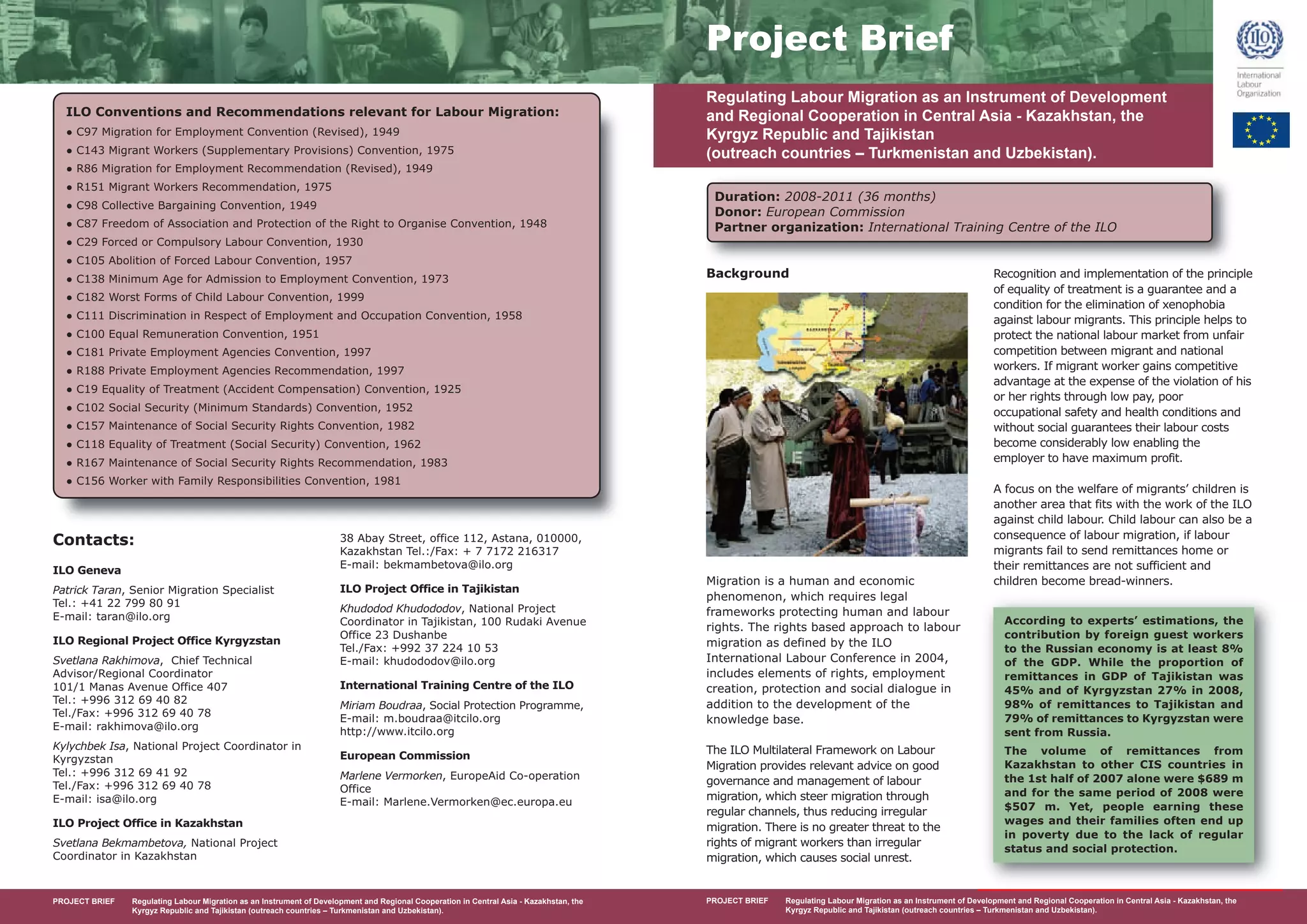
Migration is a human and economic
phenomenon, which requires legal
frameworks protecting human and labour
rights. The rights based approach to labour
migration as defined by the ILO
International Labour Conference in 2004,
includes elements of rights, employment
creation, protection and social dialogue in
addition to the development of the
knowledge base.
The ILO Multilateral Framework on Labour
Migration provides relevant advice on good
governance and management of labour
migration, which steer migration through
regular channels, thus reducing irregular
migration. There is no greater threat to the
rights of migrant workers than irregular
migration, which causes social unrest.
Recognition and implementation of the principle
of equality of treatment is a guarantee and a
condition for the elimination of xenophobia
against labour migrants. This principle helps to
protect the national labour market from unfair
competition between migrant and national
workers. If migrant worker gains competitive
advantage at the expense of the violation of his
or her rights through low pay, poor
occupational safety and health conditions and
without social guarantees their labour costs
become considerably low enabling the
employer to have maximum profit.
A focus on the welfare of migrants’ children is
another area that fits with the work of the ILO
against child labour. Child labour can also be a
consequence of labour migration, if labour
migrants fail to send remittances home or
their remittances are not sufficient and
children become bread-winners.
Project Brief
Regulating Labour Migration as an Instrument of Development
and Regional Cooperation in Central Asia - Kazakhstan, the
Kyrgyz Republic and Tajikistan
(outreach countries – Turkmenistan and Uzbekistan).
According to experts’ estimations, the
contribution by foreign guest workers
to the Russian economy is at least 8%
of the GDP. While the proportion of
remittances in GDP of Tajikistan was
45% and of Kyrgyzstan 27% in 2008,
98% of remittances to Tajikistan and
79% of remittances to Kyrgyzstan were
sent from Russia.
The volume of remittances from
Kazakhstan to other CIS countries in
the 1st half of 2007 alone were $689 m
and for the same period of 2008 were
$507 m. Yet, people earning these
wages and their families often end up
in poverty due to the lack of regular
status and social protection.
PROJECT BRIEF Regulating Labour Migration as an Instrument of Development and Regional Cooperation in Central Asia - Kazakhstan, the
Kyrgyz Republic and Tajikistan (outreach countries – Turkmenistan and Uzbekistan).
PROJECT BRIEF Regulating Labour Migration as an Instrument of Development and Regional Cooperation in Central Asia - Kazakhstan, the
Kyrgyz Republic and Tajikistan (outreach countries – Turkmenistan and Uzbekistan).
ILO Conventions and Recommendations relevant for Labour Migration:
● C97 Migration for Employment Convention (Revised), 1949
● C143 Migrant Workers (Supplementary Provisions) Convention, 1975
● R86 Migration for Employment Recommendation (Revised), 1949
● R151 Migrant Workers Recommendation, 1975
● C98 Collective Bargaining Convention, 1949
● C87 Freedom of Association and Protection of the Right to Organise Convention, 1948
● C29 Forced or Compulsory Labour Convention, 1930
● C105 Abolition of Forced Labour Convention, 1957
● C138 Minimum Age for Admission to Employment Convention, 1973
● C182 Worst Forms of Child Labour Convention, 1999
● C111 Discrimination in Respect of Employment and Occupation Convention, 1958
● C100 Equal Remuneration Convention, 1951
● C181 Private Employment Agencies Convention, 1997
● R188 Private Employment Agencies Recommendation, 1997
● C19 Equality of Treatment (Accident Compensation) Convention, 1925
● C102 Social Security (Minimum Standards) Convention, 1952
● C157 Maintenance of Social Security Rights Convention, 1982
● C118 Equality of Treatment (Social Security) Convention, 1962
● R167 Maintenance of Social Security Rights Recommendation, 1983
● C156 Worker with Family Responsibilities Convention, 1981
Duration: 2008-2011 (36 months)
Donor: European Commission
Partner organization: International Training Centre of the ILO
Thus, equality of treatment, provision of
regular migration channels, social
protection of migrant workers, and
elimination of irregular migration flows
should be priority areas for sending and
receiving countries in the sphere of
effective governance and regulation of
labour migration.
The overall objective of the project is to
elaborate and promote adoption of a
comprehensive strategy for labour migration
and more effective regulation of migration
flows in Central Asian countries, focusing on
Kazakhstan, the Kyrgyz Republic and
Tajikistan.
Activities and Expected
Results
1. Targeted training, advisory services
and practical support will ensure that
government structures and mechanisms
have the necessary competencies and
capacities to formulate, implement and
monitor labour migration policies.
2. Promoting the harmonisation of labour
migration policies and practices in the
Central Asian countries through
institutional capacity development and
advisory services to legislative processes.
Through comparative assessments of
national labour migration legislation,
structures and mechanisms, the project
will facilitate regional co-ordination and
regulation of labour migration, including
dialogue with the Russian Federation. It is
expected that improved regulation and
regular migration channels will discourage
and reduce irregular movements.
3. Supporting and strengthening social
dialogue through involvement of ILO
constituents as well as civil society and
migrant associations to promote rights
protection, welfare and decent work for
migrant workers at both national and
regional levels.
4. Revitalizing policy dialogue and consultation
among key stakeholders across the concerned
Central Asian countries will help realise and
maximise benefits for development
frointernational labour migration.
5. Enhancing regional exchange and policy
application of statistics and data
collection. Efforts will be focused on
integrating data on Central Asia into the
global International Labour Migration
database, making it accessible elsewhere
and facilitating Central Asian interaction
with other concerned origin, transit and
destination countries.
The ILO Approach
The logic of the project follows the ILO
approach and methodology summarized in
the Multilateral Framework for Labour
Migration Policy published by ILO in 2006
and responding to widespread demands by
ILO’s constituents for practical guidance and
actions towards maximisation of the benefits
of labour migration.
Project Partners: National governments,
trade unions, employers’ organizations
Final beneficiaries: Women and men
migrant workers, in particular the youth;
unskilled and vulnerable workers; migrant
associations; migrant communities in
countries of origin and destination.
Target groups in Kazakhstan:
● Parliament of RK
● Ministry of Labour and Social Protection
of the population of the RK including the
department of the social protection and
social insurance
● Migration Committee under the MoLSP of
the RK
● Agency for Statistics of the RK
● Ministry of Foreign Affairs of the RK
● Ministry of Finance of RK including Tax
Committee
● Ministry of Trade and Industry of the RK
● Association of Pension Funds
● Department of Migration Police, Ministry
of Internal Affairs of RK
● Ministry of Health of RK
● Confederation of Employers of
Kazakhstan
● Federation of Trade Unions of
Kazakhstan
● Private Employment Agency network
● Research, support and advocacy NGOs
Associations and initiative groups of migrants
Target groups in the Kyrgyz
Republic:
● Parliament of KR
● Ministry of Labour, Employment, and
Migration of KR
● Ministry of Foreign Affairs of KR
● Ministry of Internal Affairs of KR
● State Statistics Service of KR
● State Taxation Service of KR
● Social Security Agency of КR
● Border Control Service of KR
● Non-government Pension Fund of
Kyrgyzstan
● Federation of Trade Unions of KR
● Confederation of Employers of KR
● Private Employment Agency network
● Associations of Migrants and their
Families of KR
● Research, support and advocacy
organizations
Target groups in Tajikistan:
● Parliament of RT
● Department of employment and social
protection of the Executive Office of
the President of the RT
● Ministry of Labour and Social
Protection of RT
● Migration Service of the Ministry of
Interior of RT
● State Statistics Committee
● Ministry of Foreign Affairs of RT
● Ministry of Finance of RT
● Ministry of Economic Development and
Trade of RT
● Tax Committee under the Government of RT
● Border Control Committee of RT
● State Agency on insurance and pension
● Union of Employers of RT
● Federation of Independent Trade Unions
● Private Employment Agency networks
● Research, support and advocacy NGOs
PROJECT BRIEF Regulating Labour Migration as an Instrument of Development and Regional Cooperation in Central Asia - Kazakhstan, the
Kyrgyz Republic and Tajikistan (outreach countries – Turkmenistan and Uzbekistan).
PROJECT BRIEF Regulating Labour Migration as an Instrument of Development and Regional Cooperation in Central Asia - Kazakhstan, the
Kyrgyz Republic and Tajikistan (outreach countries – Turkmenistan and Uzbekistan).
Key ILO publications:
● Towards a fair deal for migrant workers in the global economy, Report submitted to the 92nd
Session (June 2004) of the International Labour Conference, Geneva, 2004
● ILO Multilateral Framework on Labour Migration/ Non-binding principles and guidelines for a rights-
based approach to labour migration, Geneva, 2006
● Handbook on Establishing Effective Labour Migration Policies in Countries of Origin and Destination,
OSCE, IOM, ILO, 2006
Photo: ILO
Photo: ILO

Project Brief

  • 1.
    Contacts: ILO Geneva Patrick Taran,Senior Migration Specialist Tel.: +41 22 799 80 91 E-mail: taran@ilo.org ILO Regional Project Office Kyrgyzstan Svetlana Rakhimova, Chief Technical Advisor/Regional Coordinator 101/1 Manas Avenue Office 407 Tel.: +996 312 69 40 82 Tel./Fax: +996 312 69 40 78 E-mail: rakhimova@ilo.org Kylychbek Isa, National Project Coordinator in Kyrgyzstan Tel.: +996 312 69 41 92 Tel./Fax: +996 312 69 40 78 E-mail: isa@ilo.org ILO Project Office in Kazakhstan Svetlana Bekmambetova, National Project Coordinator in Kazakhstan 38 Abay Street, office 112, Astana, 010000, Kazakhstan Tel.:/Fax: + 7 7172 216317 E-mail: bekmambetova@ilo.org ILO Project Office in Tajikistan Khudodod Khudododov, National Project Coordinator in Tajikistan, 100 Rudaki Avenue Office 23 Dushanbe Tel./Fax: +992 37 224 10 53 E-mail: khudododov@ilo.org International Training Centre of the ILO Miriam Boudraa, Social Protection Programme, E-mail: m.boudraa@itcilo.org http://www.itcilo.org European Commission Marlene Vermorken, EuropeAid Co-operation Office E-mail: Marlene.Vermorken@ec.europa.eu Background Migration is a human and economic phenomenon, which requires legal frameworks protecting human and labour rights. The rights based approach to labour migration as defined by the ILO International Labour Conference in 2004, includes elements of rights, employment creation, protection and social dialogue in addition to the development of the knowledge base. The ILO Multilateral Framework on Labour Migration provides relevant advice on good governance and management of labour migration, which steer migration through regular channels, thus reducing irregular migration. There is no greater threat to the rights of migrant workers than irregular migration, which causes social unrest. Recognition and implementation of the principle of equality of treatment is a guarantee and a condition for the elimination of xenophobia against labour migrants. This principle helps to protect the national labour market from unfair competition between migrant and national workers. If migrant worker gains competitive advantage at the expense of the violation of his or her rights through low pay, poor occupational safety and health conditions and without social guarantees their labour costs become considerably low enabling the employer to have maximum profit. A focus on the welfare of migrants’ children is another area that fits with the work of the ILO against child labour. Child labour can also be a consequence of labour migration, if labour migrants fail to send remittances home or their remittances are not sufficient and children become bread-winners. Project Brief Regulating Labour Migration as an Instrument of Development and Regional Cooperation in Central Asia - Kazakhstan, the Kyrgyz Republic and Tajikistan (outreach countries – Turkmenistan and Uzbekistan). According to experts’ estimations, the contribution by foreign guest workers to the Russian economy is at least 8% of the GDP. While the proportion of remittances in GDP of Tajikistan was 45% and of Kyrgyzstan 27% in 2008, 98% of remittances to Tajikistan and 79% of remittances to Kyrgyzstan were sent from Russia. The volume of remittances from Kazakhstan to other CIS countries in the 1st half of 2007 alone were $689 m and for the same period of 2008 were $507 m. Yet, people earning these wages and their families often end up in poverty due to the lack of regular status and social protection. PROJECT BRIEF Regulating Labour Migration as an Instrument of Development and Regional Cooperation in Central Asia - Kazakhstan, the Kyrgyz Republic and Tajikistan (outreach countries – Turkmenistan and Uzbekistan). PROJECT BRIEF Regulating Labour Migration as an Instrument of Development and Regional Cooperation in Central Asia - Kazakhstan, the Kyrgyz Republic and Tajikistan (outreach countries – Turkmenistan and Uzbekistan). ILO Conventions and Recommendations relevant for Labour Migration: ● C97 Migration for Employment Convention (Revised), 1949 ● C143 Migrant Workers (Supplementary Provisions) Convention, 1975 ● R86 Migration for Employment Recommendation (Revised), 1949 ● R151 Migrant Workers Recommendation, 1975 ● C98 Collective Bargaining Convention, 1949 ● C87 Freedom of Association and Protection of the Right to Organise Convention, 1948 ● C29 Forced or Compulsory Labour Convention, 1930 ● C105 Abolition of Forced Labour Convention, 1957 ● C138 Minimum Age for Admission to Employment Convention, 1973 ● C182 Worst Forms of Child Labour Convention, 1999 ● C111 Discrimination in Respect of Employment and Occupation Convention, 1958 ● C100 Equal Remuneration Convention, 1951 ● C181 Private Employment Agencies Convention, 1997 ● R188 Private Employment Agencies Recommendation, 1997 ● C19 Equality of Treatment (Accident Compensation) Convention, 1925 ● C102 Social Security (Minimum Standards) Convention, 1952 ● C157 Maintenance of Social Security Rights Convention, 1982 ● C118 Equality of Treatment (Social Security) Convention, 1962 ● R167 Maintenance of Social Security Rights Recommendation, 1983 ● C156 Worker with Family Responsibilities Convention, 1981 Duration: 2008-2011 (36 months) Donor: European Commission Partner organization: International Training Centre of the ILO
  • 2.
    Thus, equality oftreatment, provision of regular migration channels, social protection of migrant workers, and elimination of irregular migration flows should be priority areas for sending and receiving countries in the sphere of effective governance and regulation of labour migration. The overall objective of the project is to elaborate and promote adoption of a comprehensive strategy for labour migration and more effective regulation of migration flows in Central Asian countries, focusing on Kazakhstan, the Kyrgyz Republic and Tajikistan. Activities and Expected Results 1. Targeted training, advisory services and practical support will ensure that government structures and mechanisms have the necessary competencies and capacities to formulate, implement and monitor labour migration policies. 2. Promoting the harmonisation of labour migration policies and practices in the Central Asian countries through institutional capacity development and advisory services to legislative processes. Through comparative assessments of national labour migration legislation, structures and mechanisms, the project will facilitate regional co-ordination and regulation of labour migration, including dialogue with the Russian Federation. It is expected that improved regulation and regular migration channels will discourage and reduce irregular movements. 3. Supporting and strengthening social dialogue through involvement of ILO constituents as well as civil society and migrant associations to promote rights protection, welfare and decent work for migrant workers at both national and regional levels. 4. Revitalizing policy dialogue and consultation among key stakeholders across the concerned Central Asian countries will help realise and maximise benefits for development frointernational labour migration. 5. Enhancing regional exchange and policy application of statistics and data collection. Efforts will be focused on integrating data on Central Asia into the global International Labour Migration database, making it accessible elsewhere and facilitating Central Asian interaction with other concerned origin, transit and destination countries. The ILO Approach The logic of the project follows the ILO approach and methodology summarized in the Multilateral Framework for Labour Migration Policy published by ILO in 2006 and responding to widespread demands by ILO’s constituents for practical guidance and actions towards maximisation of the benefits of labour migration. Project Partners: National governments, trade unions, employers’ organizations Final beneficiaries: Women and men migrant workers, in particular the youth; unskilled and vulnerable workers; migrant associations; migrant communities in countries of origin and destination. Target groups in Kazakhstan: ● Parliament of RK ● Ministry of Labour and Social Protection of the population of the RK including the department of the social protection and social insurance ● Migration Committee under the MoLSP of the RK ● Agency for Statistics of the RK ● Ministry of Foreign Affairs of the RK ● Ministry of Finance of RK including Tax Committee ● Ministry of Trade and Industry of the RK ● Association of Pension Funds ● Department of Migration Police, Ministry of Internal Affairs of RK ● Ministry of Health of RK ● Confederation of Employers of Kazakhstan ● Federation of Trade Unions of Kazakhstan ● Private Employment Agency network ● Research, support and advocacy NGOs Associations and initiative groups of migrants Target groups in the Kyrgyz Republic: ● Parliament of KR ● Ministry of Labour, Employment, and Migration of KR ● Ministry of Foreign Affairs of KR ● Ministry of Internal Affairs of KR ● State Statistics Service of KR ● State Taxation Service of KR ● Social Security Agency of КR ● Border Control Service of KR ● Non-government Pension Fund of Kyrgyzstan ● Federation of Trade Unions of KR ● Confederation of Employers of KR ● Private Employment Agency network ● Associations of Migrants and their Families of KR ● Research, support and advocacy organizations Target groups in Tajikistan: ● Parliament of RT ● Department of employment and social protection of the Executive Office of the President of the RT ● Ministry of Labour and Social Protection of RT ● Migration Service of the Ministry of Interior of RT ● State Statistics Committee ● Ministry of Foreign Affairs of RT ● Ministry of Finance of RT ● Ministry of Economic Development and Trade of RT ● Tax Committee under the Government of RT ● Border Control Committee of RT ● State Agency on insurance and pension ● Union of Employers of RT ● Federation of Independent Trade Unions ● Private Employment Agency networks ● Research, support and advocacy NGOs PROJECT BRIEF Regulating Labour Migration as an Instrument of Development and Regional Cooperation in Central Asia - Kazakhstan, the Kyrgyz Republic and Tajikistan (outreach countries – Turkmenistan and Uzbekistan). PROJECT BRIEF Regulating Labour Migration as an Instrument of Development and Regional Cooperation in Central Asia - Kazakhstan, the Kyrgyz Republic and Tajikistan (outreach countries – Turkmenistan and Uzbekistan). Key ILO publications: ● Towards a fair deal for migrant workers in the global economy, Report submitted to the 92nd Session (June 2004) of the International Labour Conference, Geneva, 2004 ● ILO Multilateral Framework on Labour Migration/ Non-binding principles and guidelines for a rights- based approach to labour migration, Geneva, 2006 ● Handbook on Establishing Effective Labour Migration Policies in Countries of Origin and Destination, OSCE, IOM, ILO, 2006 Photo: ILO Photo: ILO