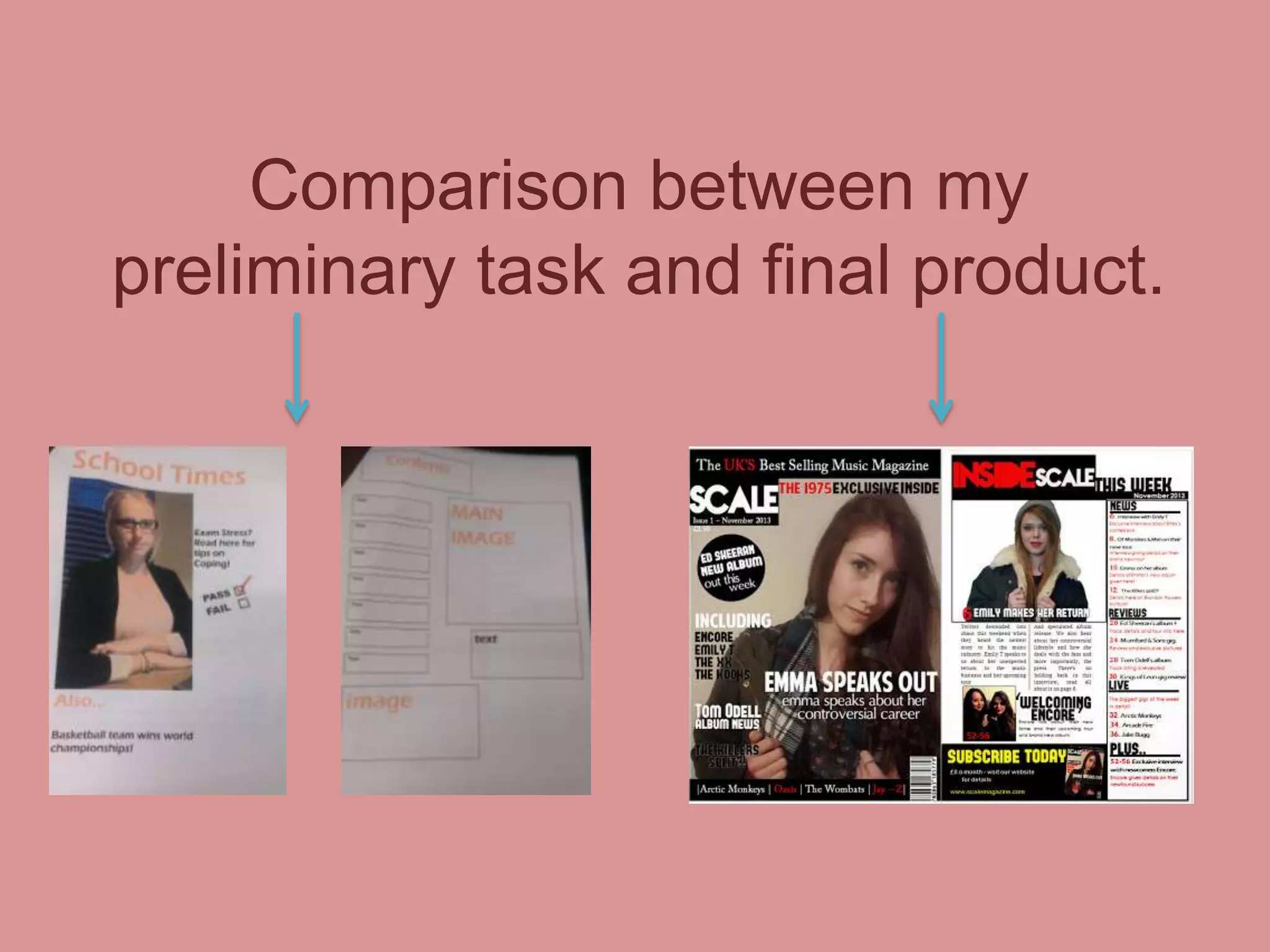
Comparison between my
preliminary task and final product.
Front Cover - conventions
The image I have used on my final product is more
conventional than the one I used on the preliminary
task. This is as it is more appealing to the audience
and is more specific to the genre. I have also used a
more conventional shot type to show their body
language and made it link to the genre which my
magazine is aimed at. The colours I used on my
preliminary task were plain and wouldn’t appeal to the
audience.
I have tried to make my front cover more conventional
from my research. This is as I had learnt about
features which I should use to make it more
conventional, whereas with my preliminary task I did
not use these features.
I have used more conventional features on my
magazine cover such as the use of the route of the
eye. I have also used a conventional colour scheme
and used a house style. The fonts I used on my final
product are sans serif, which is also more conventional
to the audience and stand out better than the ones
which I used on my preliminary task front cover.
Front cover - layout
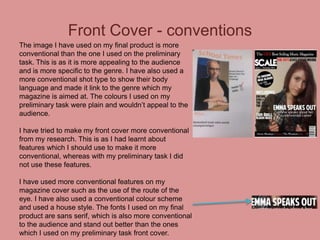
The layout I used on my preliminary task was
simple and was not conventional to the target
audience. This was as I didn’t follow a layout and
did not know what layout would appeal to a target
audience of this genre. From my research the
layout compared from my preliminary task and my
final product has improved. My layout on my final
product was more organized and clear than the
preliminary task.
I also used features such as the left third and
route of the eye to appeal to the audience. I
placed the important information here as this is
conventional and is where the attention is first
placed on a magazine cover. I have learnt to use
a main image in the center of the page to attract
attention toward it and to make it obvious what the
magazine includes. I have also learnt to place the
masthead in a conventional place so it stands out
and follows the route of the eye.

Left third.
Contents page - conventions
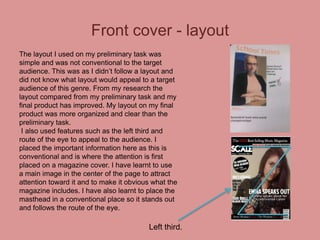
I have used a conventional layout on my final product
whereas on my preliminary task the layout was simple and
unconventional. The layout of my final product is more
conventional as I have followed the route of the eye to
ensure the more important information is seen first and
stands out the most. I have also made it clearer to appeal
to the audience.
I have used more conventional colours, such as reds and
blacks, on my final product compared to my preliminary
task to appeal to the target audience. These are more
conventional than the orange colours I used on my
preliminary task. These colours on my final product stand
out on the white background, so would appeal to the
audience as they are easily noticed. I have used
conventional fonts on my final product, which I found out
from my research.
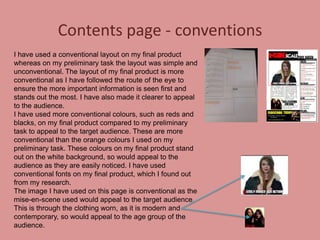
The image I have used on this page is conventional as the
mise-en-scene used would appeal to the target audience.
This is through the clothing worn, as it is modern and
contemporary, so would appeal to the age group of the
audience.
Contents page – layout
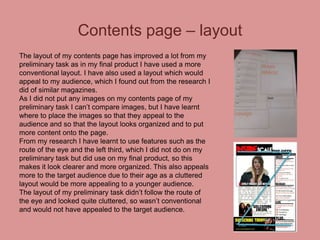
The layout of my contents page has improved a lot from my
preliminary task as in my final product I have used a more
conventional layout. I have also used a layout which would
appeal to my audience, which I found out from the research I
did of similar magazines.
As I did not put any images on my contents page of my
preliminary task I can’t compare images, but I have learnt
where to place the images so that they appeal to the
audience and so that the layout looks organized and to put
more content onto the page.
From my research I have learnt to use features such as the
route of the eye and the left third, which I did not do on my
preliminary task but did use on my final product, so this
makes it look clearer and more organized. This also appeals
more to the target audience due to their age as a cluttered
layout would be more appealing to a younger audience.
The layout of my preliminary task didn’t follow the route of
the eye and looked quite cluttered, so wasn’t conventional
and would not have appealed to the target audience.
Contents page – fonts and colours.
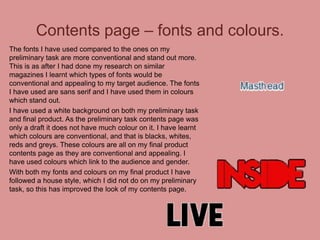
The fonts I have used compared to the ones on my
preliminary task are more conventional and stand out more.
This is as after I had done my research on similar
magazines I learnt which types of fonts would be
conventional and appealing to my target audience. The fonts
I have used are sans serif and I have used them in colours
which stand out.
I have used a white background on both my preliminary task
and final product. As the preliminary task contents page was
only a draft it does not have much colour on it. I have learnt
which colours are conventional, and that is blacks, whites,
reds and greys. These colours are all on my final product
contents page as they are conventional and appealing. I
have used colours which link to the audience and gender.
With both my fonts and colours on my final product I have
followed a house style, which I did not do on my preliminary
task, so this has improved the look of my contents page.

Progression

  • 1.
    Comparison between my preliminarytask and final product.
  • 2.
    Front Cover -conventions The image I have used on my final product is more conventional than the one I used on the preliminary task. This is as it is more appealing to the audience and is more specific to the genre. I have also used a more conventional shot type to show their body language and made it link to the genre which my magazine is aimed at. The colours I used on my preliminary task were plain and wouldn’t appeal to the audience. I have tried to make my front cover more conventional from my research. This is as I had learnt about features which I should use to make it more conventional, whereas with my preliminary task I did not use these features. I have used more conventional features on my magazine cover such as the use of the route of the eye. I have also used a conventional colour scheme and used a house style. The fonts I used on my final product are sans serif, which is also more conventional to the audience and stand out better than the ones which I used on my preliminary task front cover.
  • 3.
    Front cover -layout The layout I used on my preliminary task was simple and was not conventional to the target audience. This was as I didn’t follow a layout and did not know what layout would appeal to a target audience of this genre. From my research the layout compared from my preliminary task and my final product has improved. My layout on my final product was more organized and clear than the preliminary task. I also used features such as the left third and route of the eye to appeal to the audience. I placed the important information here as this is conventional and is where the attention is first placed on a magazine cover. I have learnt to use a main image in the center of the page to attract attention toward it and to make it obvious what the magazine includes. I have also learnt to place the masthead in a conventional place so it stands out and follows the route of the eye. Left third.
  • 4.
    Contents page -conventions I have used a conventional layout on my final product whereas on my preliminary task the layout was simple and unconventional. The layout of my final product is more conventional as I have followed the route of the eye to ensure the more important information is seen first and stands out the most. I have also made it clearer to appeal to the audience. I have used more conventional colours, such as reds and blacks, on my final product compared to my preliminary task to appeal to the target audience. These are more conventional than the orange colours I used on my preliminary task. These colours on my final product stand out on the white background, so would appeal to the audience as they are easily noticed. I have used conventional fonts on my final product, which I found out from my research. The image I have used on this page is conventional as the mise-en-scene used would appeal to the target audience. This is through the clothing worn, as it is modern and contemporary, so would appeal to the age group of the audience.
  • 5.
    Contents page –layout The layout of my contents page has improved a lot from my preliminary task as in my final product I have used a more conventional layout. I have also used a layout which would appeal to my audience, which I found out from the research I did of similar magazines. As I did not put any images on my contents page of my preliminary task I can’t compare images, but I have learnt where to place the images so that they appeal to the audience and so that the layout looks organized and to put more content onto the page. From my research I have learnt to use features such as the route of the eye and the left third, which I did not do on my preliminary task but did use on my final product, so this makes it look clearer and more organized. This also appeals more to the target audience due to their age as a cluttered layout would be more appealing to a younger audience. The layout of my preliminary task didn’t follow the route of the eye and looked quite cluttered, so wasn’t conventional and would not have appealed to the target audience.
  • 6.
    Contents page –fonts and colours. The fonts I have used compared to the ones on my preliminary task are more conventional and stand out more. This is as after I had done my research on similar magazines I learnt which types of fonts would be conventional and appealing to my target audience. The fonts I have used are sans serif and I have used them in colours which stand out. I have used a white background on both my preliminary task and final product. As the preliminary task contents page was only a draft it does not have much colour on it. I have learnt which colours are conventional, and that is blacks, whites, reds and greys. These colours are all on my final product contents page as they are conventional and appealing. I have used colours which link to the audience and gender. With both my fonts and colours on my final product I have followed a house style, which I did not do on my preliminary task, so this has improved the look of my contents page.