Project EvaluationBilaal Saghir
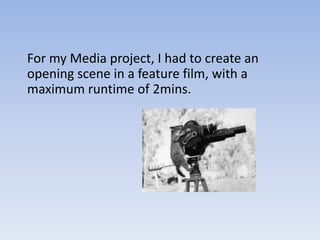
For my Media project, I had to create an opening scene in a feature film, with a maximum runtime of 2mins.
Q.1. In what ways does your media product use, develop or challenge forms and conventions of real media products?A film opening sequence can be challenged to induce the audience, it can something be successful in doing so, or it can be a confusing disaster. However, the key elements for an opening sequence is (as quoted from Nick Lacey) “The same but different”Our opening sequence follows the conventions of a thriller. Film noir genre, but executed in a different manner. We initially twisted the general concept of an opening sequence into what you would call the start of the end, something the audience will see later on, revealing the reason behind the actions in the opening sequence. Crime mainly revolves around a thriller, where the protagonist will have an exploitable weakness, which the antagonist will take advantage of.  Enigmas follow throughout a thriller which evidently is resolved at the end of the film. To show and compare…..
Conventions of the Thriller GenreUsually, the narrative will centre around crimeOrdinary situations where extraordinary things occur.The antagonist will normally have the upper hand on the protagonist, which usuallyleads to the protagonist to feel helpless, until the climax of the film where he/she exploitsthe antagonists’ weakness. Thrillers normally introduce an enigma (or more than one) The enigma can essentially be the mystery in the plot, for e.g. The killer’s identity in Psycho (1960)These points are the driven fundamental in a thriller genre film.
American Gangster (2007)Shades of Grey (2011)Both studios are notoriously known for providing crime/thriller films over the years, such as Pulp Fiction (1994, Miramax), Scarface (1983, Universal). We (the group) felt is was relevant to create a  thriller/film-noir, because it’s a popular genre with the audience, it’s been popular ever since the 70s, it’s grown and expanded into sub-genres and it’s very suitable, whether it’s a popcorn flick or an Oscar winning film.
American Gangster (2007)Shades of Grey (2011)Both stills show the audience elements of crime and what both characters could be linked in the story.Generally, the low-key lighting is always either altered to give it’s sophisticated, sinister look according to the film story etc., but there’s always an element of a dark shade, resulting in the creepy, hollow and maybe a disturbing effect. The subtitle in the first screenshot is evident to what genre we’re discussing and the next screenshot, is what appears a stereotypically FBI Agent, Police, Undercover, Gangster perhaps too.Both characters appear to be either hurt or on the verge, as oil is being poured, which again, goes back to the crime element. This shown in the very first minute  creates instant enigma, self questioningto why such a body is on the floor, why the person is tied back on a chair. The enigma is a key element in aThriller genre, especially in the opening sequence, as this immediately grabs the audiences attention.
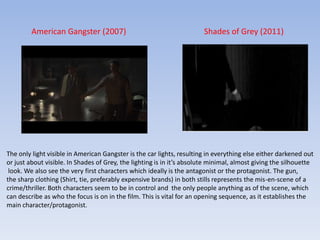
American Gangster (2007)Shades of Grey (2011)The only light visible in American Gangster is the car lights, resulting in everything else either darkened outor just about visible. In Shades of Grey, the lighting is in it’s absolute minimal, almost giving the silhouette look.We also see the very first characters which ideally is the antagonist or the protagonist. The gun, the sharp clothing (Shirt, tie, preferably expensive brands) in both stills represents the mis-en-scene of a crime/thriller. Both characters seem to be in control and  the only people anything as of the scene, which can describe as who the focus is on in the film. This is vital for an opening sequence, as it establishes the main character/protagonist.
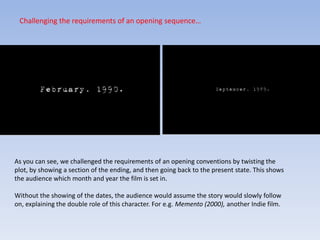
Challenging the requirements of an opening sequence…As you can see, we challenged the requirements of an opening conventions by twisting the plot, by showing a section of the ending, and then going back to the present state. This shows the audience which month and year the film is set in. Without the showing of the dates, the audience would assume the story would slowly followon, explaining the double role of this character. For e.g. Memento (2000), another Indie film.
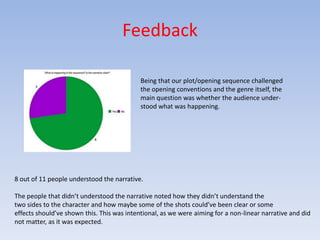
FeedbackBeing that our plot/opening sequence challengedthe opening conventions and the genre itself, the main question was whether the audience under-stood what was happening. 8 out of 11 people understood the narrative.The people that didn’t understood the narrative noted how they didn’t understand the two sides to the character and how maybe some of the shots could’ve been clear or some effects should’ve shown this. This was intentional, as we were aiming for a non-linear narrative and didnot matter, as it was expected.
Q.2. How does your media product represent particular social groups?Our media product represents middle aged men, criminalsand maybe even people who even suffer from the sameIllness preferably  in their late 20s, early 30s, policemen, andFBI Officers.The gun, the killing, the secluded area, the dark lighting and the char-actor himself all aim at men, the common group, from the ages of 18-35It challenges the stereotype of a working class officerwho instead of being the good, loyal, family man cop, is a psychopath. This is based on characteristics and not needs.
Officers are stereotyped as: Strict
No sense of Humour
Loyal Working
Fan of Doughnuts
Masculine Characteristics, including a lean body.
Tie & Shirt, maybe a blazer.
Usually in a Police Station or work office.In our product, the character who appears to be dressed as a an officer of some sort, turns out to be the violent, psychopath one, which is challengingthe ideology we see in a grown man wearing a black tie, white shirt, black blazer.
Q.3. What kind of media institution might distribute your media product and why?Using both Major and Indie distributors, such as Universal to Revolver, our film could  be a potential “Indiewood” film. Given Universal and Miramax’s respect and reputationfor Thriller/Film-Noir films, they will be the appropriate distributors for a wider recognition outside the UK.Revolver Entertainment is known for it’s Indie films, from British Films and even French and I believe this company is suitable and well known to push a thriller genre in the market.I believe these companies will financially back me up as they haveproduced many thriller/film-noir films before and they have been criticallyand financially successful.
For example….Kidulthood (2006), distributed by Revolver Entertainment.Critically acclaimed and a ‘street hit’ which led onto the box-office hit sequel Adulthood (2008)Pulp Fiction(1994), distributed by Miramax Films. The film is known for its rich, eclectic dialogue, ironic mix of humour and violence, nonlinear storyline, and host of cinematic allusions and pop culture referenceScarface(1983), distributed by Universal Picture is an American epic crime drama movie. The film has since gathered a cult following and has become an important cultural icon.
Q.4. Who would be the audience for your media product?Using different theories for targeting the right audience, we sent out questionnaires to find out who our target audience will be. Because this was a crime related film, we had an idea that our central audience would be male, teenage boys and men upto the ages of 35.In terms of the two Demographic and Psychographic profiling techniques, on the Socio-Economic scale, our product aims at the B, out of the 6 groups.Group B’s description is “Intermediate managerial, administrative or professional e.g. Teachers, solicitors. This does not mean only the product will only appeal to that group,but the representation in the film, hits the B group.When it comes to Psychographic Profiling, Young and Rubicam’s Cross-cultural ConsumerCharacteristics will have our product aiming for Indie’s. People who look at films through a form of art perspective and not just to sit in the cinema expecting a popcorn flick.
G.R.A.S.S.G-ender		Men.R-ace		All racesA-ge		18-35S-ocioeconomicS-tatusA class which you belong, dependingon your job/occupation. I’ve classedthis film to appeal to: B to D.Group B – Middle Class – Middle ManagementGroup C1-Lower Middle Class – Trades and supervisory jobsC2 – Skilled working class – Blue collar workersD – Lower working class – Manual WorkersI believe the film has the potential to appealto these chosen groups and does not reflect to anIndividuals taste.
We felt this target audience would be a good one because not only have we got a wide range of ages and people with different backgrounds, our film has big potential. We could’ve also added a comedy element in, as films such as “Bad Boys”(1995) and “Lethal Weapon” have been successful in providing a crime/comedy films. Hybridity is very important in a film, if we wanted to execute the plot, sub-plots and characters, so each individual who watches the film can either relate to a character and enjoy it, most importantly. This can also bring in a secondary target audience. Films such as Slumdog Millionaire was a co production British/US film, but the stars, the setting and part of the language gave it the Bollywood edge, which brought in another range of audience.When an audience wants to re-watch a scene or a film, it only proves the film was intriguing and they wanna watch it again, to maybe get a better understanding, which is what one or two of our test audience did.
Q.5. How did you attract/address your audience?I think, the key USP (Unique Selling Point) for our product was that the narrative was not as straightforward. The Mise-En-Scene, such as the dark location, the messy background as the character walks in, the actor himself all brings attraction for male and female viewers. The male audience are attracted to see the violence where the women are looking to see the good looking, lean and mean antagonist hero to kick some ass.
carrying on….Narrative: The use of a non-linear narrative is appealing to audiences and I believe an audience likes to see both filming aspects being used. As much as people like to see a brainless, popcorn flick, they also would like to see originality and to get themselves involved in the story themselves, from favouring a character or to even suspecting a killer on the loose. I think when the audience engage with the film, it entertains and pleases the people, both commercially and critically. Past films, such as Pulp Fiction (1994) and Memento (2000) are cult examples.Genre: In use of the non-linear narrative, the right genre to fit in with this is crucial. You have to understand, if you’re going to keep the audience on their feet, sussing out what’s happening and why, more importantly, to keeping them entertained, the genre needs to be an entertaining one, where the plot needs to have a constant flow, to make sense. Again, prime example Pulp Fiction does this perfectly.  In our film, I believe it would’ve been inspired by Tarantino’s classic.
and finally…Lighting – Lighting conveys emotion. If the viewer could only see bright lights, the ideology behind bright colours are mostly positive ones. When filming a film-noir/psychological crime film, the low-key, side-light plays a crucial part for the characters part. In our sequence, we decided to keep the footage all in black and white. We chose this, because it conveys the characters lifestyle, the bold choices he makes and goes through and more importantly, the double role he has. The audiences can almost relate to this, they can enjoy this by investigating what one person may go through.Editing – Coincidental with the cinematography. Editing can always add the gloss over a good shoots of footage. The B&W effect is considered “old” and is rarely used in 2011. I think it adds perfectly onto the film’s narrative and plot and I believe it adds the extra attention it may well get as the “black and white film”
not long to go till the next question…Sound – As you have heard the score used in the opening sequence, the score/soundtrack is a very important factor when watching almost everything. If I was to just listen to the sound and watch nothing, I should be able to presume what is happening. With our opening sequence, the diegetic sounds of the gunshot, the door opening, the throwing away of the gun are all perfect for one to just have an idea of what genre it is, what particularly is happening in the scene and what emotions to feel.Cinematography – I believe this is an element in film which is taken very lightly by the audiences, assuming they don’t know what cinematography is. However, what the audience sees on screen is absolutely important to telling the story and what is happening on screen or what even the viewers should be thinking and feeling. Also, I think to maybe not give so much away in a single shot/frame can work well, as it may frustrate some viewers, it may well work very nicely in the next shot, as something a viewer might have been trying to work out before, has now found out what and why whatever is happening, is happening. So, in terms of the opening sequence, especially giving it’s non-linear approach, a simple cinematography work is relevant, as everything else plays a bigger and crucial part in revealing the plot/storyline.
Q.6. What have you learnt about technologies from the process of constructing this product?In the process of creating  our project, modern technology was used pretty much throughout. I learnt to develop new skills I hoped to have learnt and I think the end result could’ve been better, but I think it was a well done job.

Production Evaluation

  • 1.
  • 2.
    For my Mediaproject, I had to create an opening scene in a feature film, with a maximum runtime of 2mins.
  • 3.
    Q.1. In whatways does your media product use, develop or challenge forms and conventions of real media products?A film opening sequence can be challenged to induce the audience, it can something be successful in doing so, or it can be a confusing disaster. However, the key elements for an opening sequence is (as quoted from Nick Lacey) “The same but different”Our opening sequence follows the conventions of a thriller. Film noir genre, but executed in a different manner. We initially twisted the general concept of an opening sequence into what you would call the start of the end, something the audience will see later on, revealing the reason behind the actions in the opening sequence. Crime mainly revolves around a thriller, where the protagonist will have an exploitable weakness, which the antagonist will take advantage of. Enigmas follow throughout a thriller which evidently is resolved at the end of the film. To show and compare…..
  • 4.
    Conventions of theThriller GenreUsually, the narrative will centre around crimeOrdinary situations where extraordinary things occur.The antagonist will normally have the upper hand on the protagonist, which usuallyleads to the protagonist to feel helpless, until the climax of the film where he/she exploitsthe antagonists’ weakness. Thrillers normally introduce an enigma (or more than one) The enigma can essentially be the mystery in the plot, for e.g. The killer’s identity in Psycho (1960)These points are the driven fundamental in a thriller genre film.
  • 5.
    American Gangster (2007)Shadesof Grey (2011)Both studios are notoriously known for providing crime/thriller films over the years, such as Pulp Fiction (1994, Miramax), Scarface (1983, Universal). We (the group) felt is was relevant to create a thriller/film-noir, because it’s a popular genre with the audience, it’s been popular ever since the 70s, it’s grown and expanded into sub-genres and it’s very suitable, whether it’s a popcorn flick or an Oscar winning film.
  • 6.
    American Gangster (2007)Shadesof Grey (2011)Both stills show the audience elements of crime and what both characters could be linked in the story.Generally, the low-key lighting is always either altered to give it’s sophisticated, sinister look according to the film story etc., but there’s always an element of a dark shade, resulting in the creepy, hollow and maybe a disturbing effect. The subtitle in the first screenshot is evident to what genre we’re discussing and the next screenshot, is what appears a stereotypically FBI Agent, Police, Undercover, Gangster perhaps too.Both characters appear to be either hurt or on the verge, as oil is being poured, which again, goes back to the crime element. This shown in the very first minute creates instant enigma, self questioningto why such a body is on the floor, why the person is tied back on a chair. The enigma is a key element in aThriller genre, especially in the opening sequence, as this immediately grabs the audiences attention.
  • 7.
    American Gangster (2007)Shadesof Grey (2011)The only light visible in American Gangster is the car lights, resulting in everything else either darkened outor just about visible. In Shades of Grey, the lighting is in it’s absolute minimal, almost giving the silhouette look.We also see the very first characters which ideally is the antagonist or the protagonist. The gun, the sharp clothing (Shirt, tie, preferably expensive brands) in both stills represents the mis-en-scene of a crime/thriller. Both characters seem to be in control and the only people anything as of the scene, which can describe as who the focus is on in the film. This is vital for an opening sequence, as it establishes the main character/protagonist.
  • 8.
    Challenging the requirementsof an opening sequence…As you can see, we challenged the requirements of an opening conventions by twisting the plot, by showing a section of the ending, and then going back to the present state. This shows the audience which month and year the film is set in. Without the showing of the dates, the audience would assume the story would slowly followon, explaining the double role of this character. For e.g. Memento (2000), another Indie film.
  • 9.
    FeedbackBeing that ourplot/opening sequence challengedthe opening conventions and the genre itself, the main question was whether the audience under-stood what was happening. 8 out of 11 people understood the narrative.The people that didn’t understood the narrative noted how they didn’t understand the two sides to the character and how maybe some of the shots could’ve been clear or some effects should’ve shown this. This was intentional, as we were aiming for a non-linear narrative and didnot matter, as it was expected.
  • 10.
    Q.2. How doesyour media product represent particular social groups?Our media product represents middle aged men, criminalsand maybe even people who even suffer from the sameIllness preferably in their late 20s, early 30s, policemen, andFBI Officers.The gun, the killing, the secluded area, the dark lighting and the char-actor himself all aim at men, the common group, from the ages of 18-35It challenges the stereotype of a working class officerwho instead of being the good, loyal, family man cop, is a psychopath. This is based on characteristics and not needs.
  • 11.
  • 12.
  • 13.
  • 14.
  • 15.
  • 16.
    Tie & Shirt,maybe a blazer.
  • 17.
    Usually in aPolice Station or work office.In our product, the character who appears to be dressed as a an officer of some sort, turns out to be the violent, psychopath one, which is challengingthe ideology we see in a grown man wearing a black tie, white shirt, black blazer.
  • 18.
    Q.3. What kindof media institution might distribute your media product and why?Using both Major and Indie distributors, such as Universal to Revolver, our film could be a potential “Indiewood” film. Given Universal and Miramax’s respect and reputationfor Thriller/Film-Noir films, they will be the appropriate distributors for a wider recognition outside the UK.Revolver Entertainment is known for it’s Indie films, from British Films and even French and I believe this company is suitable and well known to push a thriller genre in the market.I believe these companies will financially back me up as they haveproduced many thriller/film-noir films before and they have been criticallyand financially successful.
  • 19.
    For example….Kidulthood (2006),distributed by Revolver Entertainment.Critically acclaimed and a ‘street hit’ which led onto the box-office hit sequel Adulthood (2008)Pulp Fiction(1994), distributed by Miramax Films. The film is known for its rich, eclectic dialogue, ironic mix of humour and violence, nonlinear storyline, and host of cinematic allusions and pop culture referenceScarface(1983), distributed by Universal Picture is an American epic crime drama movie. The film has since gathered a cult following and has become an important cultural icon.
  • 20.
    Q.4. Who wouldbe the audience for your media product?Using different theories for targeting the right audience, we sent out questionnaires to find out who our target audience will be. Because this was a crime related film, we had an idea that our central audience would be male, teenage boys and men upto the ages of 35.In terms of the two Demographic and Psychographic profiling techniques, on the Socio-Economic scale, our product aims at the B, out of the 6 groups.Group B’s description is “Intermediate managerial, administrative or professional e.g. Teachers, solicitors. This does not mean only the product will only appeal to that group,but the representation in the film, hits the B group.When it comes to Psychographic Profiling, Young and Rubicam’s Cross-cultural ConsumerCharacteristics will have our product aiming for Indie’s. People who look at films through a form of art perspective and not just to sit in the cinema expecting a popcorn flick.
  • 21.
    G.R.A.S.S.G-ender Men.R-ace All racesA-ge 18-35S-ocioeconomicS-tatusA classwhich you belong, dependingon your job/occupation. I’ve classedthis film to appeal to: B to D.Group B – Middle Class – Middle ManagementGroup C1-Lower Middle Class – Trades and supervisory jobsC2 – Skilled working class – Blue collar workersD – Lower working class – Manual WorkersI believe the film has the potential to appealto these chosen groups and does not reflect to anIndividuals taste.
  • 22.
    We felt thistarget audience would be a good one because not only have we got a wide range of ages and people with different backgrounds, our film has big potential. We could’ve also added a comedy element in, as films such as “Bad Boys”(1995) and “Lethal Weapon” have been successful in providing a crime/comedy films. Hybridity is very important in a film, if we wanted to execute the plot, sub-plots and characters, so each individual who watches the film can either relate to a character and enjoy it, most importantly. This can also bring in a secondary target audience. Films such as Slumdog Millionaire was a co production British/US film, but the stars, the setting and part of the language gave it the Bollywood edge, which brought in another range of audience.When an audience wants to re-watch a scene or a film, it only proves the film was intriguing and they wanna watch it again, to maybe get a better understanding, which is what one or two of our test audience did.
  • 23.
    Q.5. How didyou attract/address your audience?I think, the key USP (Unique Selling Point) for our product was that the narrative was not as straightforward. The Mise-En-Scene, such as the dark location, the messy background as the character walks in, the actor himself all brings attraction for male and female viewers. The male audience are attracted to see the violence where the women are looking to see the good looking, lean and mean antagonist hero to kick some ass.
  • 24.
    carrying on….Narrative: Theuse of a non-linear narrative is appealing to audiences and I believe an audience likes to see both filming aspects being used. As much as people like to see a brainless, popcorn flick, they also would like to see originality and to get themselves involved in the story themselves, from favouring a character or to even suspecting a killer on the loose. I think when the audience engage with the film, it entertains and pleases the people, both commercially and critically. Past films, such as Pulp Fiction (1994) and Memento (2000) are cult examples.Genre: In use of the non-linear narrative, the right genre to fit in with this is crucial. You have to understand, if you’re going to keep the audience on their feet, sussing out what’s happening and why, more importantly, to keeping them entertained, the genre needs to be an entertaining one, where the plot needs to have a constant flow, to make sense. Again, prime example Pulp Fiction does this perfectly. In our film, I believe it would’ve been inspired by Tarantino’s classic.
  • 25.
    and finally…Lighting –Lighting conveys emotion. If the viewer could only see bright lights, the ideology behind bright colours are mostly positive ones. When filming a film-noir/psychological crime film, the low-key, side-light plays a crucial part for the characters part. In our sequence, we decided to keep the footage all in black and white. We chose this, because it conveys the characters lifestyle, the bold choices he makes and goes through and more importantly, the double role he has. The audiences can almost relate to this, they can enjoy this by investigating what one person may go through.Editing – Coincidental with the cinematography. Editing can always add the gloss over a good shoots of footage. The B&W effect is considered “old” and is rarely used in 2011. I think it adds perfectly onto the film’s narrative and plot and I believe it adds the extra attention it may well get as the “black and white film”
  • 26.
    not long togo till the next question…Sound – As you have heard the score used in the opening sequence, the score/soundtrack is a very important factor when watching almost everything. If I was to just listen to the sound and watch nothing, I should be able to presume what is happening. With our opening sequence, the diegetic sounds of the gunshot, the door opening, the throwing away of the gun are all perfect for one to just have an idea of what genre it is, what particularly is happening in the scene and what emotions to feel.Cinematography – I believe this is an element in film which is taken very lightly by the audiences, assuming they don’t know what cinematography is. However, what the audience sees on screen is absolutely important to telling the story and what is happening on screen or what even the viewers should be thinking and feeling. Also, I think to maybe not give so much away in a single shot/frame can work well, as it may frustrate some viewers, it may well work very nicely in the next shot, as something a viewer might have been trying to work out before, has now found out what and why whatever is happening, is happening. So, in terms of the opening sequence, especially giving it’s non-linear approach, a simple cinematography work is relevant, as everything else plays a bigger and crucial part in revealing the plot/storyline.
  • 27.
    Q.6. What haveyou learnt about technologies from the process of constructing this product?In the process of creating our project, modern technology was used pretty much throughout. I learnt to develop new skills I hoped to have learnt and I think the end result could’ve been better, but I think it was a well done job.