PRODUCT CATEGORIES & THE RULES
1. Functional products in daily use.
2. Impulse products.
3. Products of conspicuous consumption.
4. High ticket items.
5. Services.
Key options in Market & Product Planning
 What markets should be served?
 What form should the product take?
 What should the product do for the user?
 For whom is the product most important?
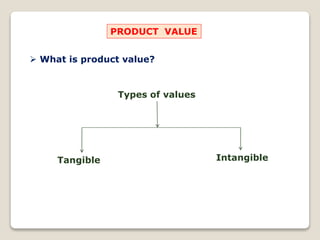
PRODUCT VALUE
 What is product value?
Types of values
Tangible Intangible
TANGIBLE VALUES:
1. Functional value.
2. Sensory value.
3. Economic value.
4. Hygiene value.
5. Convenience value.
6. Aesthetic value.
7. Futuristic value.
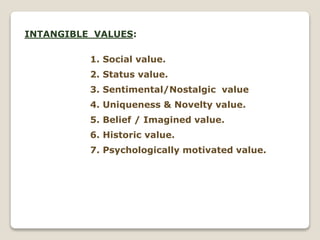
INTANGIBLE VALUES:
1. Social value.
2. Status value.
3. Sentimental/Nostalgic value
4. Uniqueness & Novelty value.
5. Belief / Imagined value.
6. Historic value.
7. Psychologically motivated value.
ACHIEVING PRODUCT PREFERENCE
But How?
By superior product…….!
What is superior product then …??
Then what is not a superior product…??
Why many companies fail to provide superior
Products?
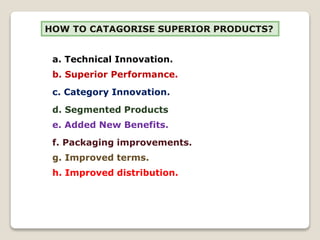
HOW TO CATAGORISE SUPERIOR PRODUCTS?
a. Technical Innovation.
b. Superior Performance.
c. Category Innovation.
d. Segmented Products
e. Added New Benefits.
f. Packaging improvements.
g. Improved terms.
h. Improved distribution.
HOW SHOULD YOU SET ABOUT LOOKING FOR
PRODUCT IMPROVEMENT?
1. Speed:
Can the product do its job more quickly?
2. Efficiency:
. Can the product be made to do its job more
more effectively?
. Can it deal with a greater volume than
competitors products?
3. Convenience:
. Can the product be made easier to use?
4. Longer Lasting:
. Can the product’s effect be made to last longer
than competitors products?
e. Aesthetics:
. Can it be made to look nicer or to be less
embarrassing?
f. Value:
. Can you offer more at the same price?
g. Usage Extension:
. Can it be made so that target groups previously
not catered, could now use it?
. Can it be made so that it could be used more
frequently?

Product management - Categories and Value

  • 1.
    PRODUCT CATEGORIES &THE RULES 1. Functional products in daily use. 2. Impulse products. 3. Products of conspicuous consumption. 4. High ticket items. 5. Services.
  • 2.
    Key options inMarket & Product Planning  What markets should be served?  What form should the product take?  What should the product do for the user?  For whom is the product most important?
  • 3.
    PRODUCT VALUE  Whatis product value? Types of values Tangible Intangible
  • 4.
    TANGIBLE VALUES: 1. Functionalvalue. 2. Sensory value. 3. Economic value. 4. Hygiene value. 5. Convenience value. 6. Aesthetic value. 7. Futuristic value.
  • 5.
    INTANGIBLE VALUES: 1. Socialvalue. 2. Status value. 3. Sentimental/Nostalgic value 4. Uniqueness & Novelty value. 5. Belief / Imagined value. 6. Historic value. 7. Psychologically motivated value.
  • 6.
    ACHIEVING PRODUCT PREFERENCE ButHow? By superior product…….! What is superior product then …?? Then what is not a superior product…?? Why many companies fail to provide superior Products?
  • 7.
    HOW TO CATAGORISESUPERIOR PRODUCTS? a. Technical Innovation. b. Superior Performance. c. Category Innovation. d. Segmented Products e. Added New Benefits. f. Packaging improvements. g. Improved terms. h. Improved distribution.
  • 8.
    HOW SHOULD YOUSET ABOUT LOOKING FOR PRODUCT IMPROVEMENT? 1. Speed: Can the product do its job more quickly? 2. Efficiency: . Can the product be made to do its job more more effectively? . Can it deal with a greater volume than competitors products? 3. Convenience: . Can the product be made easier to use? 4. Longer Lasting: . Can the product’s effect be made to last longer than competitors products?
  • 9.
    e. Aesthetics: . Canit be made to look nicer or to be less embarrassing? f. Value: . Can you offer more at the same price? g. Usage Extension: . Can it be made so that target groups previously not catered, could now use it? . Can it be made so that it could be used more frequently?