International Journal of Trend in Scientific Research and Development (IJTSRD)
Volume: 3 | Issue: 4 | May-Jun 2019 Available Online: www.ijtsrd.com e-ISSN: 2456 - 6470
@ IJTSRD | Unique Paper ID – IJTSRD24011 | Volume – 3 | Issue – 4 | May-Jun 2019 Page: 961
Printed Antenna Design and Simulation for 5G using HFSS
Mahvish1, Tanika2
1M.Tech Scholar, 2Assistant Professor
1Department of Electronics and Communication Engineering,
1,2Swami Vivekananda Institute of Engineering and Technology, Ramnagar, Banur, Punjab, India
How to cite this paper: Mahvish |
Tanika "Printed Antenna Design and
Simulationfor5GusingHFSS"Published
in International Journal of Trend in
Scientific Research and Development
(ijtsrd), ISSN: 2456-
6470, Volume-3 |
Issue-4, June 2019,
pp.961-965, URL:
https://www.ijtsrd.c
om/papers/ijtsrd24
011.pdf
Copyright © 2019 by author(s) and
International Journal of Trend in
Scientific Research and Development
Journal. This is an Open Access article
distributed under
the terms of the
Creative Commons
Attribution License (CC BY 4.0)
(http://creativecommons.org/licenses/
by/4.0)
ABSTRACT
With expanding number of users, the demand for better technology also
increases. The fifth Generation 5G technology would be one of the best
technologies to meet the need of increased capacity demand, massive
connectivity better speed by using the large amount of spectrum in the
millimeter wave band, with 5G it is expected toget80-100 Mbpsspeed.Theneed
for 5G technology, methodology designing of antenna and varioussimulationsis
offered. The micro strip patch antenna is used here in 5G technologyisrelatively
inexpensive to manufacture and design because of its simple physicalgeometry.
Micro strip Patch Antenna shows multi-band characteristics and has a compact
structure and hence has emerged as a promising candidate forhandheld devices
the proposed idea is implemented by using HFSS software which is used for
antenna designing.
Keywords: 4G, 5G, UHD, IP, GSM
I. Introduction
The early communication systems supported onlyanalogy voiceandnowprovide
wide range of different applications to large number of users. First origination
mobile system supported voice only. Within previous minor years, we have seen
continuous development of mobile telecommunications by the birth of2Gbands,
3G and 4G bands wireless networks respectively. Digital networking procedures
as if modulation techniques, Frequency reuse,Packetswitchingand physicallayer
simulation etc. have appeared in this change. With the
expanding appeal of smart devices, nowadays IP based
networks has grown into an essential Resultant, new
multimedia applications for mobile users. Open Market is
overwhelm with these applications and has opened up new
deals for mobile userand serviceproviders.Theforthcoming
of mobile communications is likely to be very distinct tothat
which we are used to today. While interest for portable
broadband will drastically increase day by day, largely
consumed by UHD video and better screens, we are already
seeing the developing impact of the human capabilities of
technology as the stuff around us become ever more linked.
The approaching 5th generation networkiscertain tooutput
a constant Gbps data speed experience across a wide range
of user scenarios. 5G is more just a new wireless
transmission technology called radio technology. It is a gate
opener to new communication capabilities and used cases,
many of that are still unknown to us. For the bandwidth
aspects, here millimeter wave mobile communications
approach is developed and a micro-strip receiver has
implemented for the 5G cellularnetwork/device. Respecting
the 4G and 5G network bands, its focus is approaching
smooth combination of cellular networks such as GSM and
3G, WLAN and Bluetooth. Micro-strip patch receiver(MPAs)
has beautiful and boundless features due to its low profile,
small size, and lightweight, low cost as well as to the fact
these are very simple to construct, suited to planer and non-
laner surfaces. However, their future use in definite systems
is finite of their almost narrow bandwidth. For generating
the excessive-frequency mm-wave electricsignals,theusage
of traditional electronics turns into less financially
appealing; consequently, there is an excessive concern to at
once generate mm-wave alerts within the optical domain.
For that reason in these paintings, the photonic technology,
variation and circulation of 60 GHz thickness band signals to
be applied in 5G that have been recommended and
established already. Basically, a photonics founded totally
mm-wave is a laser beam together with two or extra
coherent longitudinalmodeswith frequencyspacingsameto
the wanted mm-wave. As the longitudinal method beat with
each dissimilar in the photodiode,thedefiniteelectricalmm-
wave can be achieved.
II. Problem Definition
The fundamental intention of this thesis is to style a micro-
strip patch antenna for milli meter wave mobile
communication at 38GHz frequency by exploitation the
fundamental micro-strip conductor methodology and line
calculation analyze from HFSS computer code. In projected
style excited in its basic mode contains a most radial
asymmetry within the direction perpendicular to the patch
(broadside) and is 8.4316 db. during this style, input
reflection coefficients or the S11 parameter for the antenna
is -42 decibel at resonant frequency a pair of.8 GHz. the
height Gain 8.211 decibel and therefore the most -10dB
information measure of 0.0565GHz are achieved in
simulation of S11 parameter for center frequency a pair of.8
GHz. Another vital parameter of AN antenna is that the
IJTSRD24011
International Journal of Trend in Scientific Research and Development (IJTSRD) @ www.ijtsrd.com eISSN: 2456-6470
@ IJTSRD | Unique Paper ID – IJTSRD24011 | Volume – 3 | Issue – 4 | May-Jun 2019 Page: 962
information measure it covers. Most of the time solely
resistance or come loss information measure is given.
However, it's vital to comprehend that many different
definitions of information measure exist: radial asymmetry
Bandwidth, polarization information measure and potency
bandwidth. radial asymmetry and potency are usually
combined to achieve information measure
III. Methodology
The methodology involves theuseof theoreticalanalysisand
the system simulation. For the simulation approach, the
event simulator HFSS package tool needs to be used to
investigate the number of parameters. The HFSS software
package is used to design a Micro-strip Patch Antenna and
the parameters investigated are Return Loss, Radiation
Pattern, The Gain, VSWR, Impedance, Directivity etc.
IV. Results
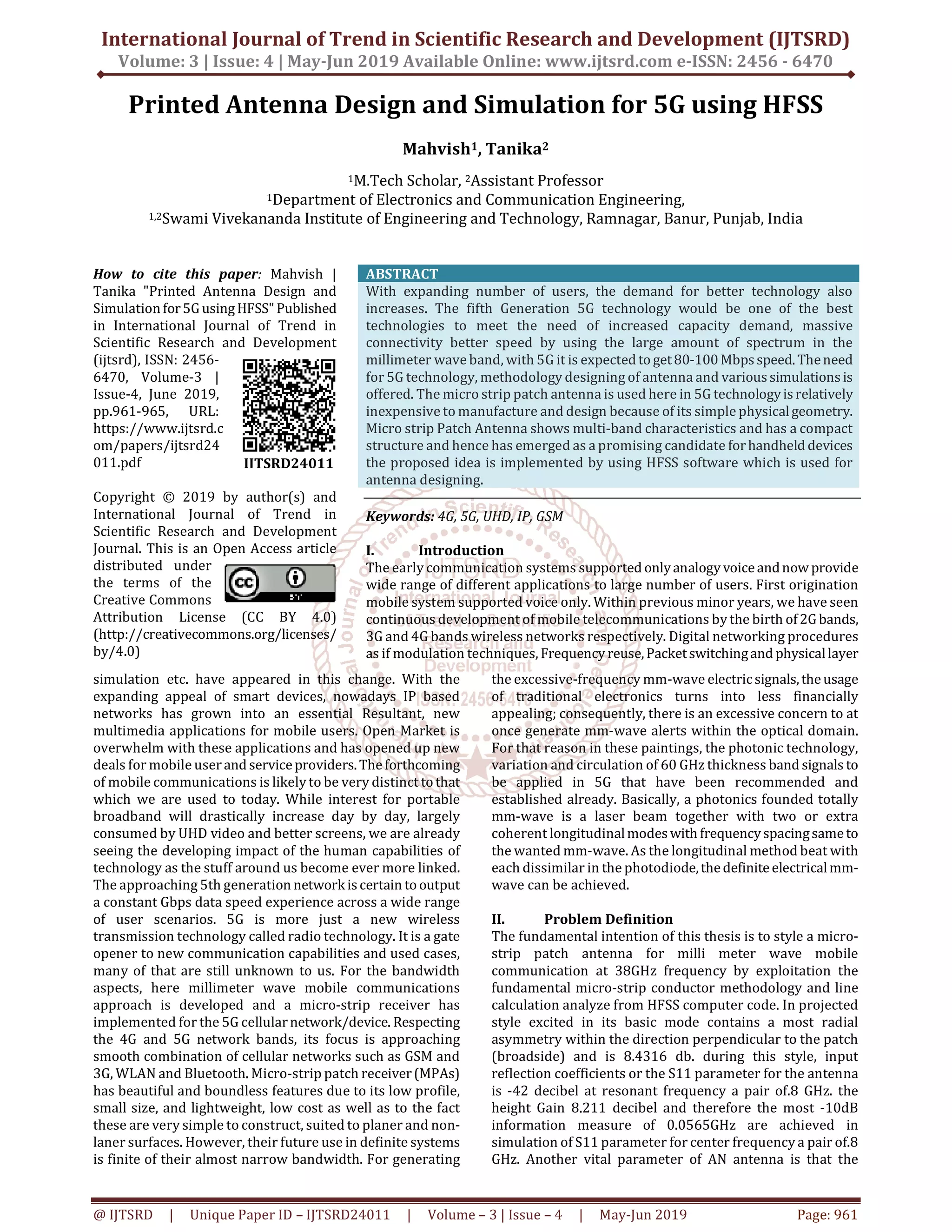
The results obtained after using the HFSS software. The HFSS is an efficient platform for designing micro strip Patch Antenna.
Designed micro strip Patch Antenna using HFSS.
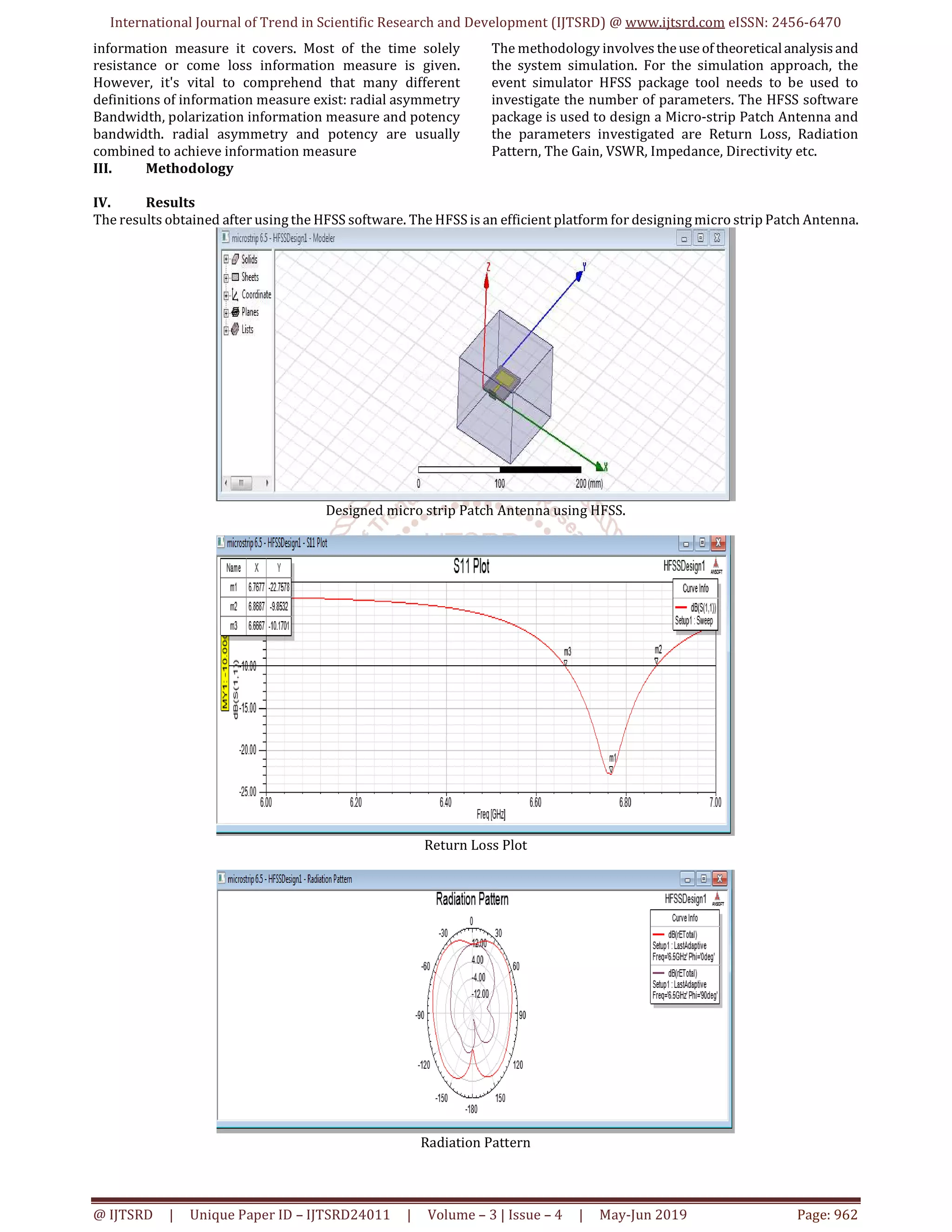
Return Loss Plot
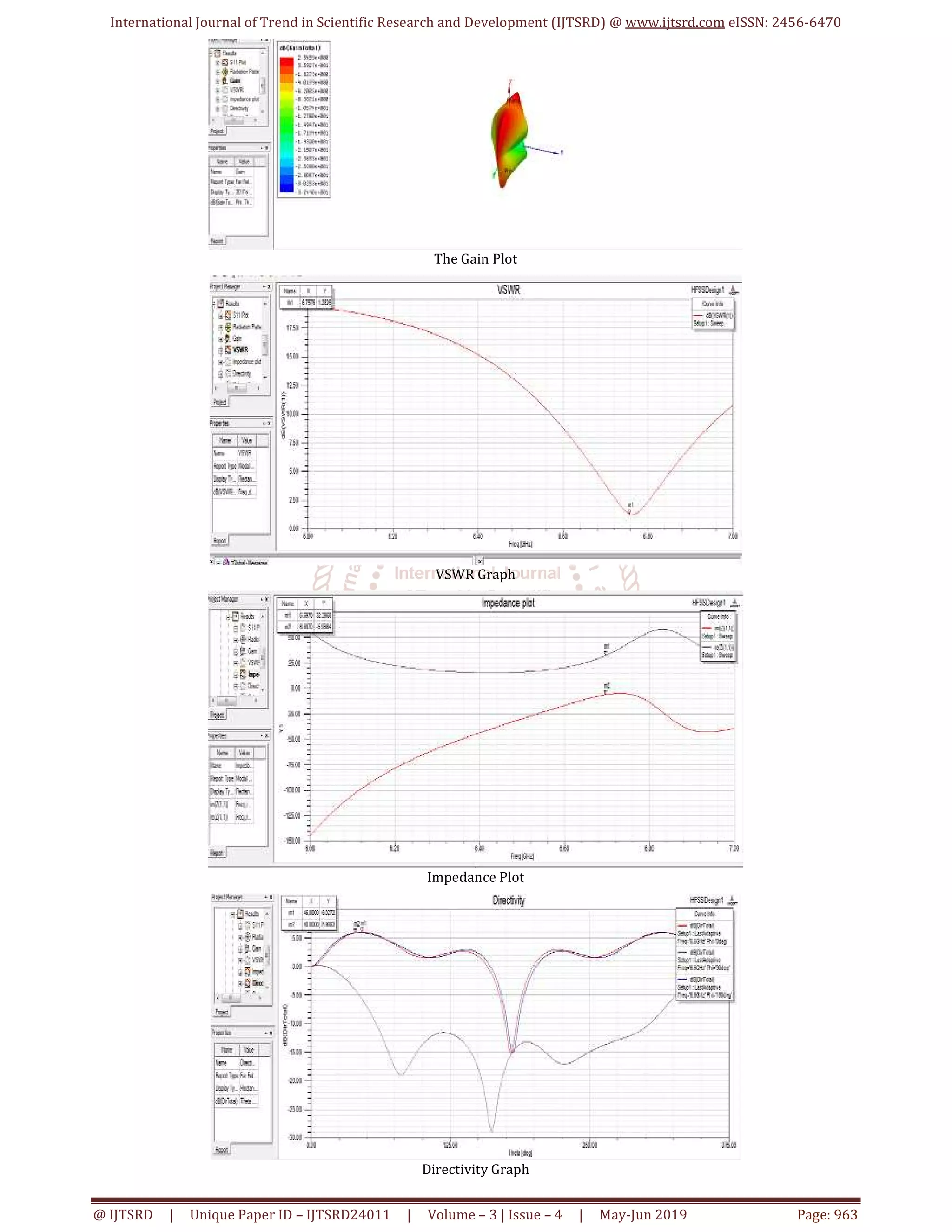
Radiation Pattern
International Journal of Trend in Scientific Research and Development (IJTSRD) @ www.ijtsrd.com eISSN: 2456-6470
@ IJTSRD | Unique Paper ID – IJTSRD24011 | Volume – 3 | Issue – 4 | May-Jun 2019 Page: 963
The Gain Plot
VSWR Graph
Impedance Plot
Directivity Graph
International Journal of Trend in Scientific Research and Development (IJTSRD) @ www.ijtsrd.com eISSN: 2456-6470
@ IJTSRD | Unique Paper ID – IJTSRD24011 | Volume – 3 | Issue – 4 | May-Jun 2019 Page: 964
Gain vs. Frequency Graph
Results
PARAMETERS VALUES
Return Loss -23 db
Resonance Frequency 6.76GHz
Bandwidth 200 MHz
Highest Radiation Intensity 2.63 db
Directivity 5.87 db
VSWR 1.28 db
Comparison between my base paper and my work
PARAMETERS Reported design at F=2.8 GHz Proposed design at F=6.5 GHz
Return Loss -42dB -23 db
Resonance Frequency 2.76 GHz 6.76GHz
Bandwidth 0.0565 GHz 200 MHz
Highest Radiation Intensity 2.63 db 2.63 db
Directivity 8.48dB 5.87 db
VSWR Not obtained 1.28 db
V. Conclusion:
The paper explains the micro-strip patch antenna
fundamentals and HFSS software. The paper explains in
details the steps needed to develop a complete simulation of
micro-strip patch antenna using the popular HFSS software.
The results are given with parameter values and the
comparison between parameters of bases paper and our
proposed work.
References
[1]. BrajlataChauhan, Sandip Vijay, S. C. Gupta,“Millimetre-
Wave Mobile Communications Micro strip Antennafor
5G - A Future Antenna”, International Journal of
Computer Applications Volume 99– No.19, August
2014.
[2]. Theodore S. Rappaport, Shu Sun, RimmaMayzus, Hang
Zhao, YanivAzar, “Millimetre Wave Mobile
Communications for 5G Cellular”, IEEE Access. Vol. 1,
2013.
[3]. M. Samimi, K. Wang, Y. Azar, G. N. Wong, R. Mayzus, H.
Zhao, J. K. Schulz, S. Sun, F. Gutierrez, and T.S. Rapp
port, “28 GHz angle of arrival and angle of departure
analysis for outdoor cellular communications using
steerable-beam antennas in New York City” , in Proc.
IEEE Veh. Technol. Conf., Jun. 2013.
[4]. M. Cudak, A. Ghosh, T. Kovarik, R. Ratasuk, T. Thomas,
F. Vook, and P. Moorut, ``Moving towards mmwave-
based beyond-4G (B-4G) Technology'', in Proc. IEEE
Veh. Technol. Soc. Conf., 2013.
[5]. Singh, Sapana, Pratap Singh, "Key Concepts and
Network Architecture for 5G Mobile Technology.",
International Journal of Scientific Research
Engineering & Technology,1.5,2012.
[6]. H. Zhao, R. Mayzus, S. Sun, M. Samimi, J. K. Schulz, Y.
Azar, K. Wang, G. N. Wong, F. Gutierrez, Jr., and S. T.
Rapp port, ``28 GHz millimetre wave cellular
communication measurements for reflection and
penetration loss in and around buildings in New York
City'', in Proc. IEEE Int. Conf. Comm., Jun. 2013.
[7]. N. Murdock, E. Ben-Dor, Y. Qiao, J. I. Tamir, and T. S.
Rapp port „„A 38 GHz cellular outage study for an
urban campus environment‟‟, in Proc. IEEE Wireless
Commun. Netw. Conf., Apr. 2012.
[8]. S. Rajagopal, S. Abu-Surra, Z. Pi, and F. Khan, ``Antenna
array design formulti-Gbpsmmwavemobilebroadband
communication'', in Proc. IEEE Global Telecommun.
Conf., Dec. 2011.
[9]. G. Nair, “Single-feed Dual-frequency Dual-polarized
Slotted Square micro strip Antenna”, Microw. Opt.
Technol. Lett., 25, pp. 395-397, June 20, 2000.
[10]. W.F. Richards, Y.T. Lo, and D.D. Harrison,“An Improved
Theory Formicro strip Antennas and Applications”,
IEEETrans. antennas Propagat.29, pp. 38-46, Jan.1981.
International Journal of Trend in Scientific Research and Development (IJTSRD) @ www.ijtsrd.com eISSN: 2456-6470
@ IJTSRD | Unique Paper ID – IJTSRD24011 | Volume – 3 | Issue – 4 | May-Jun 2019 Page: 965
[11]. W.F. William F. Richards, “micro strip Antennas”, in
Antenna Handbook, Y. T. Lo and S.W. Lee, Eds.
NewYork: Van Nostrand Reinhold, 1993.
[12]. L. Alatan, M. I. Aksun, K. Leblebicioglu, and M. T.
Birand,“Useof Computationally Efficient Method of
Moments in the Optimization of Printed Antennas”,
IEEE Trans. Antennas Propagate., 47, pp. 725-732, Apr.
1999.
[13]. D. H. Shaubert, F. G. Garrar, A. Sindoris, and S. T. Hayes,
“microstripantennas with Frequency Agility and
Polarization Diversity”, IEEE Trans. Antennas
Propagate.,29, pp. 118-123, Jan. 1981.
[14]. W. F. Richards and Y. T. Lo, “Theoretical and
Experimental Investigation of a micro strip Radiator
with MultipleLumpedLinearLoads”,Electromagn,3(3-
4), pp. 371-385,July-Dec. 1983.
[15]. S. C. Pan and K.L. Wand, “Dual Frequency Triangular
micro strip Antenna with Shorting Pin”, IEEE Trans.
Antennas Propagate, 45, pp. 1889-1891, Dec. 1997.
[16]. Ms. Varsharani Mokal1, Prof S. R.Gagare2, Dr. R. P.
Labade “Analysis of Micro strip patch Antenna Using
Coaxial feed and Micro strip line feed for Wireless
Application” ,IOSR Journal of Electronics and
Communication Engineering (IOSR-JECE) Volume 12,
Issue 3, Ver. III (May - June 2017), PP 36-41
www.iosrjournals.org
[17]. Deal W., N. Kaneda, J. Sor, Y. Qian, and T. Itoh, “A New
Quasiyagi Antenna for Planar Active Antenna Arrays”,
IEEE.

Printed Antenna Design and Simulation for 5G using HFSS

  • 1.
    International Journal ofTrend in Scientific Research and Development (IJTSRD) Volume: 3 | Issue: 4 | May-Jun 2019 Available Online: www.ijtsrd.com e-ISSN: 2456 - 6470 @ IJTSRD | Unique Paper ID – IJTSRD24011 | Volume – 3 | Issue – 4 | May-Jun 2019 Page: 961 Printed Antenna Design and Simulation for 5G using HFSS Mahvish1, Tanika2 1M.Tech Scholar, 2Assistant Professor 1Department of Electronics and Communication Engineering, 1,2Swami Vivekananda Institute of Engineering and Technology, Ramnagar, Banur, Punjab, India How to cite this paper: Mahvish | Tanika "Printed Antenna Design and Simulationfor5GusingHFSS"Published in International Journal of Trend in Scientific Research and Development (ijtsrd), ISSN: 2456- 6470, Volume-3 | Issue-4, June 2019, pp.961-965, URL: https://www.ijtsrd.c om/papers/ijtsrd24 011.pdf Copyright © 2019 by author(s) and International Journal of Trend in Scientific Research and Development Journal. This is an Open Access article distributed under the terms of the Creative Commons Attribution License (CC BY 4.0) (http://creativecommons.org/licenses/ by/4.0) ABSTRACT With expanding number of users, the demand for better technology also increases. The fifth Generation 5G technology would be one of the best technologies to meet the need of increased capacity demand, massive connectivity better speed by using the large amount of spectrum in the millimeter wave band, with 5G it is expected toget80-100 Mbpsspeed.Theneed for 5G technology, methodology designing of antenna and varioussimulationsis offered. The micro strip patch antenna is used here in 5G technologyisrelatively inexpensive to manufacture and design because of its simple physicalgeometry. Micro strip Patch Antenna shows multi-band characteristics and has a compact structure and hence has emerged as a promising candidate forhandheld devices the proposed idea is implemented by using HFSS software which is used for antenna designing. Keywords: 4G, 5G, UHD, IP, GSM I. Introduction The early communication systems supported onlyanalogy voiceandnowprovide wide range of different applications to large number of users. First origination mobile system supported voice only. Within previous minor years, we have seen continuous development of mobile telecommunications by the birth of2Gbands, 3G and 4G bands wireless networks respectively. Digital networking procedures as if modulation techniques, Frequency reuse,Packetswitchingand physicallayer simulation etc. have appeared in this change. With the expanding appeal of smart devices, nowadays IP based networks has grown into an essential Resultant, new multimedia applications for mobile users. Open Market is overwhelm with these applications and has opened up new deals for mobile userand serviceproviders.Theforthcoming of mobile communications is likely to be very distinct tothat which we are used to today. While interest for portable broadband will drastically increase day by day, largely consumed by UHD video and better screens, we are already seeing the developing impact of the human capabilities of technology as the stuff around us become ever more linked. The approaching 5th generation networkiscertain tooutput a constant Gbps data speed experience across a wide range of user scenarios. 5G is more just a new wireless transmission technology called radio technology. It is a gate opener to new communication capabilities and used cases, many of that are still unknown to us. For the bandwidth aspects, here millimeter wave mobile communications approach is developed and a micro-strip receiver has implemented for the 5G cellularnetwork/device. Respecting the 4G and 5G network bands, its focus is approaching smooth combination of cellular networks such as GSM and 3G, WLAN and Bluetooth. Micro-strip patch receiver(MPAs) has beautiful and boundless features due to its low profile, small size, and lightweight, low cost as well as to the fact these are very simple to construct, suited to planer and non- laner surfaces. However, their future use in definite systems is finite of their almost narrow bandwidth. For generating the excessive-frequency mm-wave electricsignals,theusage of traditional electronics turns into less financially appealing; consequently, there is an excessive concern to at once generate mm-wave alerts within the optical domain. For that reason in these paintings, the photonic technology, variation and circulation of 60 GHz thickness band signals to be applied in 5G that have been recommended and established already. Basically, a photonics founded totally mm-wave is a laser beam together with two or extra coherent longitudinalmodeswith frequencyspacingsameto the wanted mm-wave. As the longitudinal method beat with each dissimilar in the photodiode,thedefiniteelectricalmm- wave can be achieved. II. Problem Definition The fundamental intention of this thesis is to style a micro- strip patch antenna for milli meter wave mobile communication at 38GHz frequency by exploitation the fundamental micro-strip conductor methodology and line calculation analyze from HFSS computer code. In projected style excited in its basic mode contains a most radial asymmetry within the direction perpendicular to the patch (broadside) and is 8.4316 db. during this style, input reflection coefficients or the S11 parameter for the antenna is -42 decibel at resonant frequency a pair of.8 GHz. the height Gain 8.211 decibel and therefore the most -10dB information measure of 0.0565GHz are achieved in simulation of S11 parameter for center frequency a pair of.8 GHz. Another vital parameter of AN antenna is that the IJTSRD24011
  • 2.
    International Journal ofTrend in Scientific Research and Development (IJTSRD) @ www.ijtsrd.com eISSN: 2456-6470 @ IJTSRD | Unique Paper ID – IJTSRD24011 | Volume – 3 | Issue – 4 | May-Jun 2019 Page: 962 information measure it covers. Most of the time solely resistance or come loss information measure is given. However, it's vital to comprehend that many different definitions of information measure exist: radial asymmetry Bandwidth, polarization information measure and potency bandwidth. radial asymmetry and potency are usually combined to achieve information measure III. Methodology The methodology involves theuseof theoreticalanalysisand the system simulation. For the simulation approach, the event simulator HFSS package tool needs to be used to investigate the number of parameters. The HFSS software package is used to design a Micro-strip Patch Antenna and the parameters investigated are Return Loss, Radiation Pattern, The Gain, VSWR, Impedance, Directivity etc. IV. Results The results obtained after using the HFSS software. The HFSS is an efficient platform for designing micro strip Patch Antenna. Designed micro strip Patch Antenna using HFSS. Return Loss Plot Radiation Pattern
  • 3.
    International Journal ofTrend in Scientific Research and Development (IJTSRD) @ www.ijtsrd.com eISSN: 2456-6470 @ IJTSRD | Unique Paper ID – IJTSRD24011 | Volume – 3 | Issue – 4 | May-Jun 2019 Page: 963 The Gain Plot VSWR Graph Impedance Plot Directivity Graph
  • 4.
    International Journal ofTrend in Scientific Research and Development (IJTSRD) @ www.ijtsrd.com eISSN: 2456-6470 @ IJTSRD | Unique Paper ID – IJTSRD24011 | Volume – 3 | Issue – 4 | May-Jun 2019 Page: 964 Gain vs. Frequency Graph Results PARAMETERS VALUES Return Loss -23 db Resonance Frequency 6.76GHz Bandwidth 200 MHz Highest Radiation Intensity 2.63 db Directivity 5.87 db VSWR 1.28 db Comparison between my base paper and my work PARAMETERS Reported design at F=2.8 GHz Proposed design at F=6.5 GHz Return Loss -42dB -23 db Resonance Frequency 2.76 GHz 6.76GHz Bandwidth 0.0565 GHz 200 MHz Highest Radiation Intensity 2.63 db 2.63 db Directivity 8.48dB 5.87 db VSWR Not obtained 1.28 db V. Conclusion: The paper explains the micro-strip patch antenna fundamentals and HFSS software. The paper explains in details the steps needed to develop a complete simulation of micro-strip patch antenna using the popular HFSS software. The results are given with parameter values and the comparison between parameters of bases paper and our proposed work. References [1]. BrajlataChauhan, Sandip Vijay, S. C. Gupta,“Millimetre- Wave Mobile Communications Micro strip Antennafor 5G - A Future Antenna”, International Journal of Computer Applications Volume 99– No.19, August 2014. [2]. Theodore S. Rappaport, Shu Sun, RimmaMayzus, Hang Zhao, YanivAzar, “Millimetre Wave Mobile Communications for 5G Cellular”, IEEE Access. Vol. 1, 2013. [3]. M. Samimi, K. Wang, Y. Azar, G. N. Wong, R. Mayzus, H. Zhao, J. K. Schulz, S. Sun, F. Gutierrez, and T.S. Rapp port, “28 GHz angle of arrival and angle of departure analysis for outdoor cellular communications using steerable-beam antennas in New York City” , in Proc. IEEE Veh. Technol. Conf., Jun. 2013. [4]. M. Cudak, A. Ghosh, T. Kovarik, R. Ratasuk, T. Thomas, F. Vook, and P. Moorut, ``Moving towards mmwave- based beyond-4G (B-4G) Technology'', in Proc. IEEE Veh. Technol. Soc. Conf., 2013. [5]. Singh, Sapana, Pratap Singh, "Key Concepts and Network Architecture for 5G Mobile Technology.", International Journal of Scientific Research Engineering & Technology,1.5,2012. [6]. H. Zhao, R. Mayzus, S. Sun, M. Samimi, J. K. Schulz, Y. Azar, K. Wang, G. N. Wong, F. Gutierrez, Jr., and S. T. Rapp port, ``28 GHz millimetre wave cellular communication measurements for reflection and penetration loss in and around buildings in New York City'', in Proc. IEEE Int. Conf. Comm., Jun. 2013. [7]. N. Murdock, E. Ben-Dor, Y. Qiao, J. I. Tamir, and T. S. Rapp port „„A 38 GHz cellular outage study for an urban campus environment‟‟, in Proc. IEEE Wireless Commun. Netw. Conf., Apr. 2012. [8]. S. Rajagopal, S. Abu-Surra, Z. Pi, and F. Khan, ``Antenna array design formulti-Gbpsmmwavemobilebroadband communication'', in Proc. IEEE Global Telecommun. Conf., Dec. 2011. [9]. G. Nair, “Single-feed Dual-frequency Dual-polarized Slotted Square micro strip Antenna”, Microw. Opt. Technol. Lett., 25, pp. 395-397, June 20, 2000. [10]. W.F. Richards, Y.T. Lo, and D.D. Harrison,“An Improved Theory Formicro strip Antennas and Applications”, IEEETrans. antennas Propagat.29, pp. 38-46, Jan.1981.
  • 5.
    International Journal ofTrend in Scientific Research and Development (IJTSRD) @ www.ijtsrd.com eISSN: 2456-6470 @ IJTSRD | Unique Paper ID – IJTSRD24011 | Volume – 3 | Issue – 4 | May-Jun 2019 Page: 965 [11]. W.F. William F. Richards, “micro strip Antennas”, in Antenna Handbook, Y. T. Lo and S.W. Lee, Eds. NewYork: Van Nostrand Reinhold, 1993. [12]. L. Alatan, M. I. Aksun, K. Leblebicioglu, and M. T. Birand,“Useof Computationally Efficient Method of Moments in the Optimization of Printed Antennas”, IEEE Trans. Antennas Propagate., 47, pp. 725-732, Apr. 1999. [13]. D. H. Shaubert, F. G. Garrar, A. Sindoris, and S. T. Hayes, “microstripantennas with Frequency Agility and Polarization Diversity”, IEEE Trans. Antennas Propagate.,29, pp. 118-123, Jan. 1981. [14]. W. F. Richards and Y. T. Lo, “Theoretical and Experimental Investigation of a micro strip Radiator with MultipleLumpedLinearLoads”,Electromagn,3(3- 4), pp. 371-385,July-Dec. 1983. [15]. S. C. Pan and K.L. Wand, “Dual Frequency Triangular micro strip Antenna with Shorting Pin”, IEEE Trans. Antennas Propagate, 45, pp. 1889-1891, Dec. 1997. [16]. Ms. Varsharani Mokal1, Prof S. R.Gagare2, Dr. R. P. Labade “Analysis of Micro strip patch Antenna Using Coaxial feed and Micro strip line feed for Wireless Application” ,IOSR Journal of Electronics and Communication Engineering (IOSR-JECE) Volume 12, Issue 3, Ver. III (May - June 2017), PP 36-41 www.iosrjournals.org [17]. Deal W., N. Kaneda, J. Sor, Y. Qian, and T. Itoh, “A New Quasiyagi Antenna for Planar Active Antenna Arrays”, IEEE.