Millimeter Waves
(mmWaves)
By: Belal Essam
7 August 2016
Agenda
• mmWave In Brief
• Motivation
• mmWave Characteristics
• Existing Solutions
• Applications of mmWave Communications
• Key Player in mmWave Comm. Research
• Conclusion
• References
7 August 2016
mmWave In Brief
• Millimeter-wave frequencies often refer to the frequency range
from 30GHz to 300GHz.
• Such frequencies are designated as Extremely high frequency (EHF)
band.
• The wavelength of which is between 10mm to 1mm.
7 August 2016
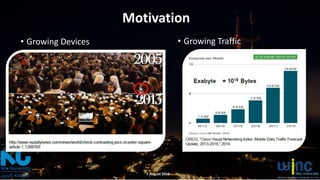
Motivation
• Growing Devices • Growing Traffic
7 August 2016
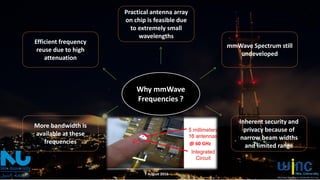
Why mmWave
Frequencies ?
mmWave Spectrum still
undeveloped
More bandwidth is
available at these
frequencies
Efficient frequency
reuse due to high
attenuation
Inherent security and
privacy because of
narrow beam widths
and limited range
Practical antenna array
on chip is feasible due
to extremely small
wavelengths
@ 60 GHz
7 August 2016
mmWave Characteristics
• mmWave characterization should be considered in the design of
network architectures and protocols to fully exploit its potential.
1. mmWave communications suffer from huge propagation loss, due
to the high carrier frequency.
7 August 2016
mmWave Characteristics
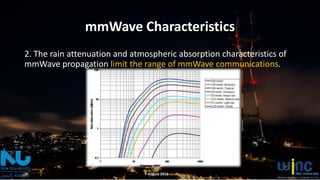
2. The rain attenuation and atmospheric absorption characteristics of
mmWave propagation limit the range of mmWave communications.
7 August 2016
mmWave Characteristics
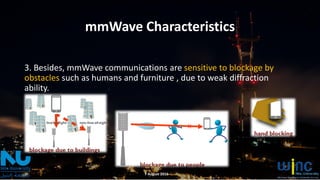
3. Besides, mmWave communications are sensitive to blockage by
obstacles such as humans and furniture , due to weak diffraction
ability.
7 August 2016
mmWave Characteristics
• Researchers in [1] conducted propagation measurements in a realistic
indoor environment in the presence of human activity, and the results
show that the channel is blocked for about 1% or 2% of the time for
one to five persons.
• Taking human mobility into consideration, mmWave links are
intermittent.
• [1] S. Collonge, G. Zaharia, and G. E. Zein, “Influence of human activity on wide-band
characteristics of the 60GHz indoor radio channel,” IEEE Trans. Wirel. Commun., vol. 3, no. 6, pp.
2369–2406, 2004.
7 August 2016
Existing Solutions
• To combat severe propagation loss, beamforming (BF) has been
adopted as an essential technique where with a small wavelength,
electronically steerable antenna arrays can be realized on chip.
• With smaller cell sizes , the rain attenuation and atmospheric
absorption do not create significant additional path loss for cell sizes
on the order of 200 m.
7 August 2016
Existing Solutions
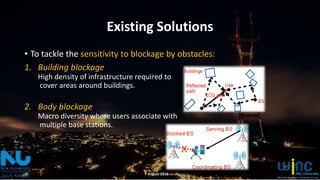
• To tackle the sensitivity to blockage by obstacles:
1. Building blockage
High density of infrastructure required to
cover areas around buildings.
2. Body blockage
Macro diversity where users associate with
multiple base stations.
7 August 2016
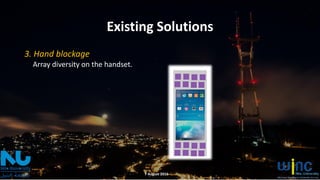
Existing Solutions
3. Hand blockage
Array diversity on the handset.
7 August 2016
Applications of mmWave Communications
• Small Cell Access
With huge bandwidth, mmWave small cells are able to provide the multi-gigabit
rates.
• Cellular Access
It is shown that mmWave for 5G cellular access have the potential for high
coverage and capacity as long as the infrastructure is densely deployed.
7 August 2016
Applications of mmWave Communications
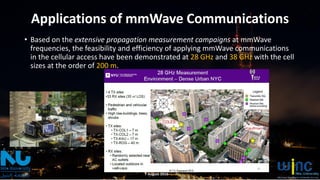
• Based on the extensive propagation measurement campaigns at mmWave
frequencies, the feasibility and efficiency of applying mmWave communications
in the cellular access have been demonstrated at 28 GHz and 38 GHz with the cell
sizes at the order of 200 m.
7 August 2016
Applications of mmWave Communications
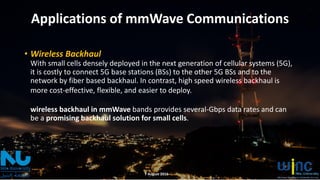
• Wireless Backhaul
With small cells densely deployed in the next generation of cellular systems (5G),
it is costly to connect 5G base stations (BSs) to the other 5G BSs and to the
network by fiber based backhaul. In contrast, high speed wireless backhaul is
more cost-effective, flexible, and easier to deploy.
wireless backhaul in mmWave bands provides several-Gbps data rates and can
be a promising backhaul solution for small cells.
7 August 2016
Applications of mmWave Communications
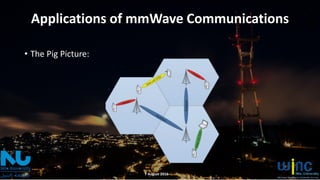
• The Pig Picture:
7 August 2016
Key Player in mmWave Comm. Research
7 August 2016
Conclusion
• With the potential to offer orders of magnitude greater capacity over
current communication systems, mmWave communications become
a promising candidate for the 5G mobile networks.
• The characteristics of mmWave communications promote the
redesign of architectures and protocols to address the challenges,
including integrated circuits and system design, interference
management and spatial reuse, anti-blockage, etc.
7 August 2016
References
• Niu, Yong, et al. "A survey of millimeter wave communications (mmWave) for 5G:
opportunities and challenges." Wireless Networks 21.8 (2015): 2657-2676.
• Theodore (Ted) S. Rappaport. “Millimeter Wave Wireless Communications: The
Renaissance of Computing and Communications.” International Conference on
Communications, Keynote presentation Sydney, Australia, 2014.
• Robert W. Heath. “Millimeter wave as the future of 5G.” Wireless Networking and
Communications Group, Department of Electrical and Computer Engineering, The
University of Texas at Austin, 2015.
• Yu, Yikun, Baltus, Peter G.M., van Roermund, Arthur H.M. “Integrated 60GHz RF
Beamforming in CMOS.” Springer, 2011.
7 August 2016
7 August 2016

Millimeter Waves (mmWaves)

  • 1.
  • 2.
    Agenda • mmWave InBrief • Motivation • mmWave Characteristics • Existing Solutions • Applications of mmWave Communications • Key Player in mmWave Comm. Research • Conclusion • References 7 August 2016
  • 3.
    mmWave In Brief •Millimeter-wave frequencies often refer to the frequency range from 30GHz to 300GHz. • Such frequencies are designated as Extremely high frequency (EHF) band. • The wavelength of which is between 10mm to 1mm. 7 August 2016
  • 4.
    Motivation • Growing Devices• Growing Traffic 7 August 2016
  • 5.
    Why mmWave Frequencies ? mmWaveSpectrum still undeveloped More bandwidth is available at these frequencies Efficient frequency reuse due to high attenuation Inherent security and privacy because of narrow beam widths and limited range Practical antenna array on chip is feasible due to extremely small wavelengths @ 60 GHz 7 August 2016
  • 6.
    mmWave Characteristics • mmWavecharacterization should be considered in the design of network architectures and protocols to fully exploit its potential. 1. mmWave communications suffer from huge propagation loss, due to the high carrier frequency. 7 August 2016
  • 7.
    mmWave Characteristics 2. Therain attenuation and atmospheric absorption characteristics of mmWave propagation limit the range of mmWave communications. 7 August 2016
  • 8.
    mmWave Characteristics 3. Besides,mmWave communications are sensitive to blockage by obstacles such as humans and furniture , due to weak diffraction ability. 7 August 2016
  • 9.
    mmWave Characteristics • Researchersin [1] conducted propagation measurements in a realistic indoor environment in the presence of human activity, and the results show that the channel is blocked for about 1% or 2% of the time for one to five persons. • Taking human mobility into consideration, mmWave links are intermittent. • [1] S. Collonge, G. Zaharia, and G. E. Zein, “Influence of human activity on wide-band characteristics of the 60GHz indoor radio channel,” IEEE Trans. Wirel. Commun., vol. 3, no. 6, pp. 2369–2406, 2004. 7 August 2016
  • 10.
    Existing Solutions • Tocombat severe propagation loss, beamforming (BF) has been adopted as an essential technique where with a small wavelength, electronically steerable antenna arrays can be realized on chip. • With smaller cell sizes , the rain attenuation and atmospheric absorption do not create significant additional path loss for cell sizes on the order of 200 m. 7 August 2016
  • 11.
    Existing Solutions • Totackle the sensitivity to blockage by obstacles: 1. Building blockage High density of infrastructure required to cover areas around buildings. 2. Body blockage Macro diversity where users associate with multiple base stations. 7 August 2016
  • 12.
    Existing Solutions 3. Handblockage Array diversity on the handset. 7 August 2016
  • 13.
    Applications of mmWaveCommunications • Small Cell Access With huge bandwidth, mmWave small cells are able to provide the multi-gigabit rates. • Cellular Access It is shown that mmWave for 5G cellular access have the potential for high coverage and capacity as long as the infrastructure is densely deployed. 7 August 2016
  • 14.
    Applications of mmWaveCommunications • Based on the extensive propagation measurement campaigns at mmWave frequencies, the feasibility and efficiency of applying mmWave communications in the cellular access have been demonstrated at 28 GHz and 38 GHz with the cell sizes at the order of 200 m. 7 August 2016
  • 15.
    Applications of mmWaveCommunications • Wireless Backhaul With small cells densely deployed in the next generation of cellular systems (5G), it is costly to connect 5G base stations (BSs) to the other 5G BSs and to the network by fiber based backhaul. In contrast, high speed wireless backhaul is more cost-effective, flexible, and easier to deploy. wireless backhaul in mmWave bands provides several-Gbps data rates and can be a promising backhaul solution for small cells. 7 August 2016
  • 16.
    Applications of mmWaveCommunications • The Pig Picture: 7 August 2016
  • 17.
    Key Player inmmWave Comm. Research 7 August 2016
  • 18.
    Conclusion • With thepotential to offer orders of magnitude greater capacity over current communication systems, mmWave communications become a promising candidate for the 5G mobile networks. • The characteristics of mmWave communications promote the redesign of architectures and protocols to address the challenges, including integrated circuits and system design, interference management and spatial reuse, anti-blockage, etc. 7 August 2016
  • 19.
    References • Niu, Yong,et al. "A survey of millimeter wave communications (mmWave) for 5G: opportunities and challenges." Wireless Networks 21.8 (2015): 2657-2676. • Theodore (Ted) S. Rappaport. “Millimeter Wave Wireless Communications: The Renaissance of Computing and Communications.” International Conference on Communications, Keynote presentation Sydney, Australia, 2014. • Robert W. Heath. “Millimeter wave as the future of 5G.” Wireless Networking and Communications Group, Department of Electrical and Computer Engineering, The University of Texas at Austin, 2015. • Yu, Yikun, Baltus, Peter G.M., van Roermund, Arthur H.M. “Integrated 60GHz RF Beamforming in CMOS.” Springer, 2011. 7 August 2016
  • 20.