Principles & Practicesof
Principles & Practices of
Banking
Banking
Module A
Module A
Indian Financial System
Indian Financial System
K Chockalingam
K Chockalingam
IIBF
IIBF
2.
Financial System
Financial System
An institutional framework existing in a
An institutional framework existing in a
country to enable financial transactions
country to enable financial transactions
Three main parts
Three main parts
Financial assets (loans, deposits, bonds, equities, etc.)
Financial assets (loans, deposits, bonds, equities, etc.)
Financial institutions (banks, mutual funds, insurance
Financial institutions (banks, mutual funds, insurance
companies, etc.)
companies, etc.)
Financial markets (money market, capital market, forex
Financial markets (money market, capital market, forex
market, etc.)
market, etc.)
Regulation is another aspect of the financial
Regulation is another aspect of the financial
system (RBI, SEBI, IRDA, FMC)
system (RBI, SEBI, IRDA, FMC)
3.
Financial assets/instruments
Financial assets/instruments
Enable channelising funds from surplus units to
Enable channelising funds from surplus units to
deficit units
deficit units
There are instruments for savers such as deposits,
There are instruments for savers such as deposits,
equities, mutual fund units, etc.
equities, mutual fund units, etc.
There are instruments for borrowers such as loans,
There are instruments for borrowers such as loans,
overdrafts, etc.
overdrafts, etc.
Like businesses, governments too raise funds
Like businesses, governments too raise funds
through issue of bonds, Treasury bills, etc.
through issue of bonds, Treasury bills, etc.
Instruments like PPF, KVP, etc. are available to
Instruments like PPF, KVP, etc. are available to
savers who wish to lend money to the government
savers who wish to lend money to the government
4.
Money Market Instruments
MoneyMarket Instruments
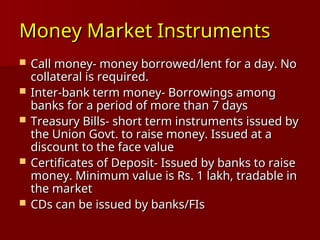
Call money- money borrowed/lent for a day. No
Call money- money borrowed/lent for a day. No
collateral is required.
collateral is required.
Inter-bank term money- Borrowings among
Inter-bank term money- Borrowings among
banks for a period of more than 7 days
banks for a period of more than 7 days
Treasury Bills- short term instruments issued by
Treasury Bills- short term instruments issued by
the Union Govt. to raise money. Issued at a
the Union Govt. to raise money. Issued at a
discount to the face value
discount to the face value
Certificates of Deposit- Issued by banks to raise
Certificates of Deposit- Issued by banks to raise
money. Minimum value is Rs. 1 lakh, tradable in
money. Minimum value is Rs. 1 lakh, tradable in
the market
the market
CDs can be issued by banks/FIs
CDs can be issued by banks/FIs
5.
Money Market Instruments(2)
Money Market Instruments (2)
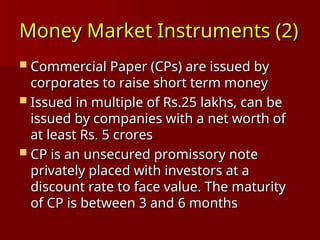
Commercial Paper (CPs) are issued by
Commercial Paper (CPs) are issued by
corporates to raise short term money
corporates to raise short term money
Issued in multiple of Rs.25 lakhs, can be
Issued in multiple of Rs.25 lakhs, can be
issued by companies with a net worth of
issued by companies with a net worth of
at least Rs. 5 crores
at least Rs. 5 crores
CP is an unsecured promissory note
CP is an unsecured promissory note
privately placed with investors at a
privately placed with investors at a
discount rate to face value. The maturity
discount rate to face value. The maturity
of CP is between 3 and 6 months
of CP is between 3 and 6 months
6.
Financial Institutions
Financial Institutions
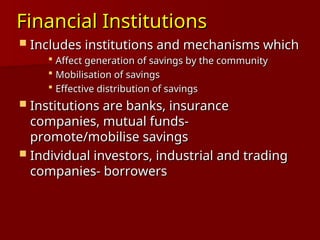
Includes institutions and mechanisms which
Includes institutions and mechanisms which
Affect generation of savings by the community
Affect generation of savings by the community
Mobilisation of savings
Mobilisation of savings
Effective distribution of savings
Effective distribution of savings
Institutions are banks, insurance
Institutions are banks, insurance
companies, mutual funds-
companies, mutual funds-
promote/mobilise savings
promote/mobilise savings
Individual investors, industrial and trading
Individual investors, industrial and trading
companies- borrowers
companies- borrowers
7.
Financial Markets
Financial Markets
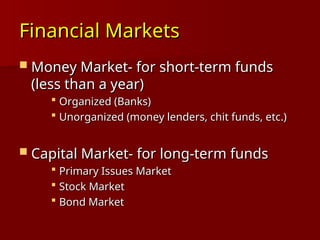
Money Market- for short-term funds
Money Market- for short-term funds
(less than a year)
(less than a year)
Organized (Banks)
Organized (Banks)
Unorganized (money lenders, chit funds, etc.)
Unorganized (money lenders, chit funds, etc.)
Capital Market- for long-term funds
Capital Market- for long-term funds
Primary Issues Market
Primary Issues Market
Stock Market
Stock Market
Bond Market
Bond Market
8.
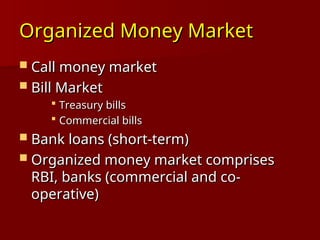
Organized Money Market
OrganizedMoney Market
Call money market
Call money market
Bill Market
Bill Market
Treasury bills
Treasury bills
Commercial bills
Commercial bills
Bank loans (short-term)
Bank loans (short-term)
Organized money market comprises
Organized money market comprises
RBI, banks (commercial and co-
RBI, banks (commercial and co-
operative)
operative)
9.
Call money market(1)
Call money market (1)
It deals with one-day loans (overnight, to be
It deals with one-day loans (overnight, to be
precise) called call loans or call money
precise) called call loans or call money
Participants are mostly banks. Also called inter-
Participants are mostly banks. Also called inter-
bank call money market.
bank call money market.
The borrowing is exclusively limited to banks,
The borrowing is exclusively limited to banks,
who are temporarily short of funds.
who are temporarily short of funds.
On the lending side, besides banks with excess
On the lending side, besides banks with excess
cash and as special cases few FIs like LIC, UTI
cash and as special cases few FIs like LIC, UTI
All others have to keep their funds in term
All others have to keep their funds in term
deposits with banks to earn interest
deposits with banks to earn interest
10.
Call money market(2)
Call money market (2)
Call loans are generally made on a clean basis- i.e.
Call loans are generally made on a clean basis- i.e.
no collateral is required
no collateral is required
The main function of the call money market is to
The main function of the call money market is to
redistribute the pool of day-to-day surplus funds
redistribute the pool of day-to-day surplus funds
of banks among other banks in temporary deficit
of banks among other banks in temporary deficit
of funds
of funds
The call market helps banks earn interest and yet
The call market helps banks earn interest and yet
improve their liquidity
improve their liquidity
It is a highly competitive and sensitive market
It is a highly competitive and sensitive market
It acts as a good indicator of the liquidity position
It acts as a good indicator of the liquidity position
11.
Bill Market
Bill Market
Treasury Bill market- Also called the T-Bill market
Treasury Bill market- Also called the T-Bill market
– These bills are short-term liabilities (91-day, 182-day,
These bills are short-term liabilities (91-day, 182-day,
364-day) of the Government of India
364-day) of the Government of India
– It is an IOU of the government, a promise to pay the
It is an IOU of the government, a promise to pay the
stated amount after expiry of the stated period from
stated amount after expiry of the stated period from
the date of issue
the date of issue
– They are issued at discount to the face value and at
They are issued at discount to the face value and at
the end of maturity, the face value is paid
the end of maturity, the face value is paid
– The rate of discount and the corresponding issue
The rate of discount and the corresponding issue
price are determined at each auction
price are determined at each auction
Commercial Bill market- Not as developed in
Commercial Bill market- Not as developed in
India as the T-Bill market
India as the T-Bill market
12.
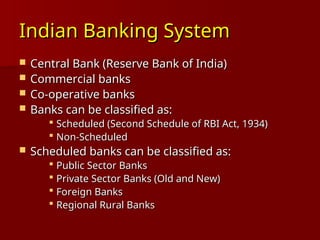
Indian Banking System
IndianBanking System
Central Bank (Reserve Bank of India)
Central Bank (Reserve Bank of India)
Commercial banks
Commercial banks
Co-operative banks
Co-operative banks
Banks can be classified as:
Banks can be classified as:
Scheduled (Second Schedule of RBI Act, 1934)
Scheduled (Second Schedule of RBI Act, 1934)
Non-Scheduled
Non-Scheduled
Scheduled banks can be classified as:
Scheduled banks can be classified as:
Public Sector Banks
Public Sector Banks
Private Sector Banks (Old and New)
Private Sector Banks (Old and New)
Foreign Banks
Foreign Banks
Regional Rural Banks
Regional Rural Banks
13.
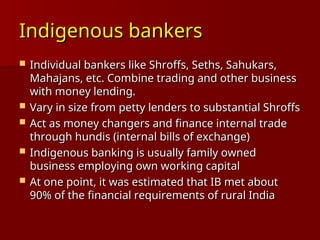
Indigenous bankers
Indigenous bankers
Individual bankers like Shroffs, Seths, Sahukars,
Individual bankers like Shroffs, Seths, Sahukars,
Mahajans, etc. Combine trading and other business
Mahajans, etc. Combine trading and other business
with money lending.
with money lending.
Vary in size from petty lenders to substantial Shroffs
Vary in size from petty lenders to substantial Shroffs
Act as money changers and finance internal trade
Act as money changers and finance internal trade
through hundis (internal bills of exchange)
through hundis (internal bills of exchange)
Indigenous banking is usually family owned
Indigenous banking is usually family owned
business employing own working capital
business employing own working capital
At one point, it was estimated that IB met about
At one point, it was estimated that IB met about
90% of the financial requirements of rural India
90% of the financial requirements of rural India
14.
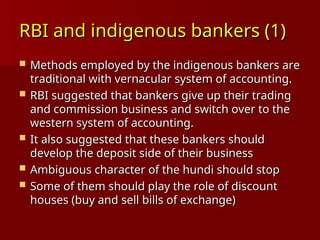
RBI and indigenousbankers (1)
RBI and indigenous bankers (1)
Methods employed by the indigenous bankers are
Methods employed by the indigenous bankers are
traditional with vernacular system of accounting.
traditional with vernacular system of accounting.
RBI suggested that bankers give up their trading
RBI suggested that bankers give up their trading
and commission business and switch over to the
and commission business and switch over to the
western system of accounting.
western system of accounting.
It also suggested that these bankers should
It also suggested that these bankers should
develop the deposit side of their business
develop the deposit side of their business
Ambiguous character of the hundi should stop
Ambiguous character of the hundi should stop
Some of them should play the role of discount
Some of them should play the role of discount
houses (buy and sell bills of exchange)
houses (buy and sell bills of exchange)
15.
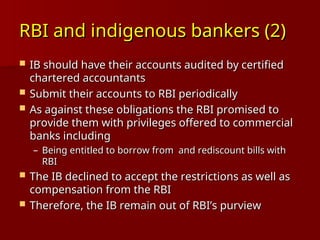
RBI and indigenousbankers (2)
RBI and indigenous bankers (2)
IB should have their accounts audited by certified
IB should have their accounts audited by certified
chartered accountants
chartered accountants
Submit their accounts to RBI periodically
Submit their accounts to RBI periodically
As against these obligations the RBI promised to
As against these obligations the RBI promised to
provide them with privileges offered to commercial
provide them with privileges offered to commercial
banks including
banks including
– Being entitled to borrow from and rediscount bills with
Being entitled to borrow from and rediscount bills with
RBI
RBI
The IB declined to accept the restrictions as well as
The IB declined to accept the restrictions as well as
compensation from the RBI
compensation from the RBI
Therefore, the IB remain out of RBI’s purview
Therefore, the IB remain out of RBI’s purview
16.
Development Oriented
Development Oriented
Banking
Banking
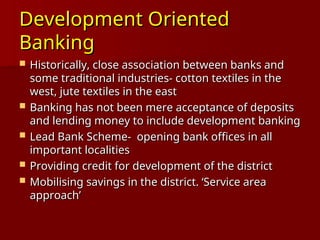
Historically, close association between banks and
Historically, close association between banks and
some traditional industries- cotton textiles in the
some traditional industries- cotton textiles in the
west, jute textiles in the east
west, jute textiles in the east
Banking has not been mere acceptance of deposits
Banking has not been mere acceptance of deposits
and lending money to include development banking
and lending money to include development banking
Lead Bank Scheme- opening bank offices in all
Lead Bank Scheme- opening bank offices in all
important localities
important localities
Providing credit for development of the district
Providing credit for development of the district
Mobilising savings in the district. ‘Service area
Mobilising savings in the district. ‘Service area
approach’
approach’
17.
Progress of bankingin India (1)
Progress of banking in India (1)
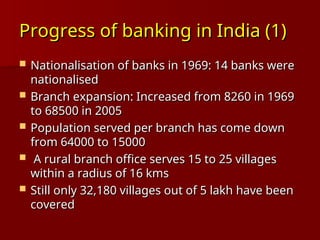
Nationalisation of banks in 1969: 14 banks were
Nationalisation of banks in 1969: 14 banks were
nationalised
nationalised
Branch expansion: Increased from 8260 in 1969
Branch expansion: Increased from 8260 in 1969
to 68500 in 2005
to 68500 in 2005
Population served per branch has come down
Population served per branch has come down
from 64000 to 15000
from 64000 to 15000
A rural branch office serves 15 to 25 villages
A rural branch office serves 15 to 25 villages
within a radius of 16 kms
within a radius of 16 kms
Still only 32,180 villages out of 5 lakh have been
Still only 32,180 villages out of 5 lakh have been
covered
covered
18.
Progress of bankingin India
Progress of banking in India (2)
(2)
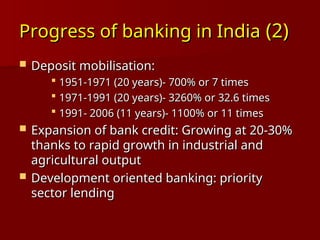
Deposit mobilisation:
Deposit mobilisation:
1951-1971 (20 years)- 700% or 7 times
1951-1971 (20 years)- 700% or 7 times
1971-1991 (20 years)- 3260% or 32.6 times
1971-1991 (20 years)- 3260% or 32.6 times
1991- 2006 (11 years)- 1100% or 11 times
1991- 2006 (11 years)- 1100% or 11 times
Expansion of bank credit: Growing at 20-30%
Expansion of bank credit: Growing at 20-30%
thanks to rapid growth in industrial and
thanks to rapid growth in industrial and
agricultural output
agricultural output
Development oriented banking: priority
Development oriented banking: priority
sector lending
sector lending
19.
Progress of bankingin India (3)
Progress of banking in India (3)
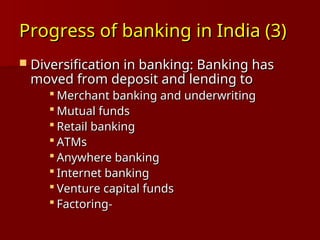
Diversification in banking: Banking has
Diversification in banking: Banking has
moved from deposit and lending to
moved from deposit and lending to
Merchant banking and underwriting
Merchant banking and underwriting
Mutual funds
Mutual funds
Retail banking
Retail banking
ATMs
ATMs
Anywhere banking
Anywhere banking
Internet banking
Internet banking
Venture capital funds
Venture capital funds
Factoring-
Factoring-
20.
Profitability of
Profitability ofBanks(1)
Banks(1)
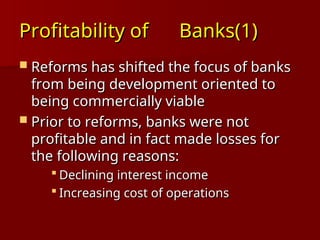
Reforms has shifted the focus of banks
Reforms has shifted the focus of banks
from being development oriented to
from being development oriented to
being commercially viable
being commercially viable
Prior to reforms, banks were not
Prior to reforms, banks were not
profitable and in fact made losses for
profitable and in fact made losses for
the following reasons:
the following reasons:
Declining interest income
Declining interest income
Increasing cost of operations
Increasing cost of operations
21.
Profitability of banks(2)
Profitability of banks (2)
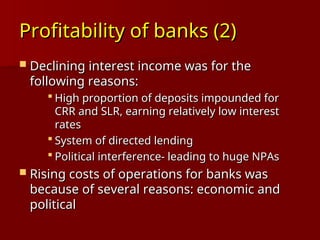
Declining interest income was for the
Declining interest income was for the
following reasons:
following reasons:
High proportion of deposits impounded for
High proportion of deposits impounded for
CRR and SLR, earning relatively low interest
CRR and SLR, earning relatively low interest
rates
rates
System of directed lending
System of directed lending
Political interference- leading to huge NPAs
Political interference- leading to huge NPAs
Rising costs of operations for banks was
Rising costs of operations for banks was
because of several reasons: economic and
because of several reasons: economic and
political
political
22.
Profitability of Banks(3)
Profitability of Banks (3)
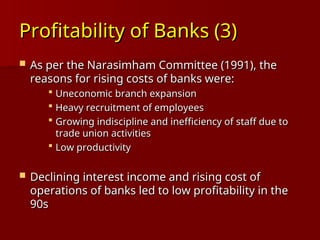
As per the Narasimham Committee (1991), the
As per the Narasimham Committee (1991), the
reasons for rising costs of banks were:
reasons for rising costs of banks were:
Uneconomic branch expansion
Uneconomic branch expansion
Heavy recruitment of employees
Heavy recruitment of employees
Growing indiscipline and inefficiency of staff due to
Growing indiscipline and inefficiency of staff due to
trade union activities
trade union activities
Low productivity
Low productivity
Declining interest income and rising cost of
Declining interest income and rising cost of
operations of banks led to low profitability in the
operations of banks led to low profitability in the
90s
90s
23.
Bank profitability: Suggestions
Bankprofitability: Suggestions
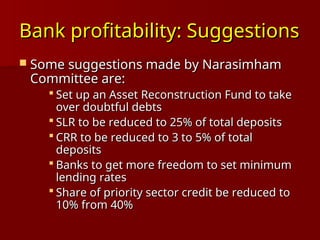
Some suggestions made by Narasimham
Some suggestions made by Narasimham
Committee are:
Committee are:
Set up an Asset Reconstruction Fund to take
Set up an Asset Reconstruction Fund to take
over doubtful debts
over doubtful debts
SLR to be reduced to 25% of total deposits
SLR to be reduced to 25% of total deposits
CRR to be reduced to 3 to 5% of total
CRR to be reduced to 3 to 5% of total
deposits
deposits
Banks to get more freedom to set minimum
Banks to get more freedom to set minimum
lending rates
lending rates
Share of priority sector credit be reduced to
Share of priority sector credit be reduced to
10% from 40%
10% from 40%
24.
Suggestions (cont’d)
Suggestions (cont’d)
All concessional rates of interest should be
All concessional rates of interest should be
removed
removed
Banks should go for new sources of funds such as
Banks should go for new sources of funds such as
Certificates of Deposits
Certificates of Deposits
Branch expansion should be carried out strictly
Branch expansion should be carried out strictly
on commercial principles
on commercial principles
Diversification of banking activities
Diversification of banking activities
Almost all suggestions of the Narasimham
Almost all suggestions of the Narasimham
Committee have been accepted and implemented
Committee have been accepted and implemented
in a phased manner since the onset of Reforms
in a phased manner since the onset of Reforms
25.
NPA Management
NPA Management
The Narasimham Committee
The Narasimham Committee
recommendations were made, among
recommendations were made, among
other things, to reduce the Non-
other things, to reduce the Non-
Performing Assets (NPAs) of banks
Performing Assets (NPAs) of banks
To tackle this, the government enacted
To tackle this, the government enacted
the Securitization and Reconstruction of
the Securitization and Reconstruction of
Financial Assets and Enforcement of
Financial Assets and Enforcement of
Security Act (SARFAESI) Act, 2002
Security Act (SARFAESI) Act, 2002
Enabled banks to realise their dues
Enabled banks to realise their dues
without intervention of courts
without intervention of courts
26.
SARFAESI Act
SARFAESI Act
Enables setting up of Asset Management Companies to
Enables setting up of Asset Management Companies to
acquire NPAs of any bank or FI (SASF, ARCIL are
acquire NPAs of any bank or FI (SASF, ARCIL are
examples)
examples)
NPAs are acquired by issuing debentures, bonds or any
NPAs are acquired by issuing debentures, bonds or any
other security
other security
As a second creditor can serve notice to the defaulting
As a second creditor can serve notice to the defaulting
borrower to discharge his/her liabilities in 60 days
borrower to discharge his/her liabilities in 60 days
Failing which the company can take possession of
Failing which the company can take possession of
assets, takeover the management of assets and
assets, takeover the management of assets and
appoint any person to manage the secured assets
appoint any person to manage the secured assets
Borrowers have the right to appeal to the Debts
Borrowers have the right to appeal to the Debts
Tribunal after depositing 50% of the amount claimed
Tribunal after depositing 50% of the amount claimed
by the second creditor
by the second creditor
27.
The Indian CapitalMarket (1)
The Indian Capital Market (1)
Market for long-term capital. Demand
Market for long-term capital. Demand
comes from the industrial, service sector
comes from the industrial, service sector
and government
and government
Supply comes from individuals, corporates,
Supply comes from individuals, corporates,
banks, financial institutions, etc.
banks, financial institutions, etc.
Can be classified into:
Can be classified into:
Gilt-edged market
Gilt-edged market
Industrial securities market (new issues and
Industrial securities market (new issues and
stock market)
stock market)
28.
The Indian CapitalMarket (2)
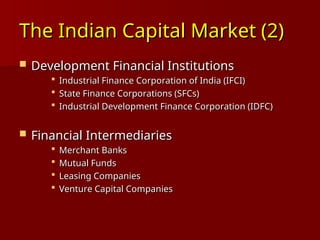
The Indian Capital Market (2)
Development Financial Institutions
Development Financial Institutions
Industrial Finance Corporation of India (IFCI)
Industrial Finance Corporation of India (IFCI)
State Finance Corporations (SFCs)
State Finance Corporations (SFCs)
Industrial Development Finance Corporation (IDFC)
Industrial Development Finance Corporation (IDFC)
Financial Intermediaries
Financial Intermediaries
Merchant Banks
Merchant Banks
Mutual Funds
Mutual Funds
Leasing Companies
Leasing Companies
Venture Capital Companies
Venture Capital Companies
29.
Industrial Securities Market
IndustrialSecurities Market
Refers to the market for shares and
Refers to the market for shares and
debentures of old and new companies
debentures of old and new companies
New Issues Market- also known as the
New Issues Market- also known as the
primary market- refers to raising of new
primary market- refers to raising of new
capital in the form of shares and
capital in the form of shares and
debentures
debentures
Stock Market- also known as the secondary
Stock Market- also known as the secondary
market. Deals with securities already issued
market. Deals with securities already issued
by companies
by companies
30.
Financial Intermediaries (1)
FinancialIntermediaries (1)
Mutual Funds- Promote savings and mobilise
Mutual Funds- Promote savings and mobilise
funds which are invested in the stock market
funds which are invested in the stock market
and bond market
and bond market
Indirect source of finance to companies
Indirect source of finance to companies
Pool funds of savers and invest in the stock
Pool funds of savers and invest in the stock
market/bond market
market/bond market
Their instruments at saver’s end are called units
Their instruments at saver’s end are called units
Offer many types of schemes: growth fund,
Offer many types of schemes: growth fund,
income fund, balanced fund
income fund, balanced fund
Regulated by SEBI
Regulated by SEBI
31.
Financial Intermediaries (2)
FinancialIntermediaries (2)
Merchant banking- manage and underwrite new
Merchant banking- manage and underwrite new
issues, undertake syndication of credit, advise
issues, undertake syndication of credit, advise
corporate clients on fund raising
corporate clients on fund raising
Subject to regulation by SEBI and RBI
Subject to regulation by SEBI and RBI
SEBI regulates them on issue activity and
SEBI regulates them on issue activity and
portfolio management of their business.
portfolio management of their business.
RBI supervises those merchant banks which are
RBI supervises those merchant banks which are
subsidiaries or affiliates of commercial banks
subsidiaries or affiliates of commercial banks
Have to adopt stipulated capital adequacy norms
Have to adopt stipulated capital adequacy norms
and abide by a code of conduct
and abide by a code of conduct
32.
Conclusion
Conclusion
There areother financial intermediaries such
There are other financial intermediaries such
as NBFCs, Venture Capital Funds, Hire and
as NBFCs, Venture Capital Funds, Hire and
Leasing Companies, etc.
Leasing Companies, etc.
India’s financial system is quite huge and
India’s financial system is quite huge and
caters to every kind of demand for funds
caters to every kind of demand for funds
Banks are at the core of our financial system
Banks are at the core of our financial system
and therefore, there is greater expectation
and therefore, there is greater expectation
from them in terms of reaching out to the
from them in terms of reaching out to the
vast populace as well as being competitive.
vast populace as well as being competitive.
33.
hank ou
hank ou
KChockalingam
K Chockalingam
TEL : 9322295394
TEL : 9322295394
e.mail: chockalingam_2000@yahoo.com
e.mail: chockalingam_2000@yahoo.com
chockalingam@iibf.org.in
chockalingam@iibf.org.in




![Indian financial system[1]](https://cdn.slidesharecdn.com/ss_thumbnails/indianfinancialsystem1-130511123055-phpapp01-thumbnail.jpg?width=640&height=640&fit=bounds)


![Eco presentation1[2]](https://cdn.slidesharecdn.com/ss_thumbnails/ecopresentation12-120927080734-phpapp02-thumbnail.jpg?width=640&height=640&fit=bounds)


