Principles of Marketing
Kotler and Armstrong
Chapter 1:
Marketing
Creating Customer Value
and Engagement
Insert
Textbook
Cover
Image
Copyright © 2016 Pearson Education, Inc. 1-1
• Objective 1: Define marketing and outline the steps in the
marketing process.
• Objective 2: Explain the importance of understanding the
marketplace and customers and identify the five core
marketplace concepts.
Learning Objectives
Marketing: Creating Customer Value and Engagement
1-2
Copyright © 2016 Pearson Education, Inc.
• Objective 3: Identify the key elements of a customer-driven
marketing strategy and discuss the marketing management
orientations that guide marketing strategy.
Learning Objectives
Marketing: Creating Customer Value and Engagement
1-3
Copyright © 2016 Pearson Education, Inc.
Learning Objectives
Marketing: Creating Customer Value and Engagement
• Objective 4: Discuss customer relationship management and
identify strategies for creating value for customers and
capturing value from customers in return.
• Objective 5: Describe the major trends and forces that are
changing the marketing landscape in this age of relationships.
Copyright © 2016 Pearson Education, Inc. 1-4
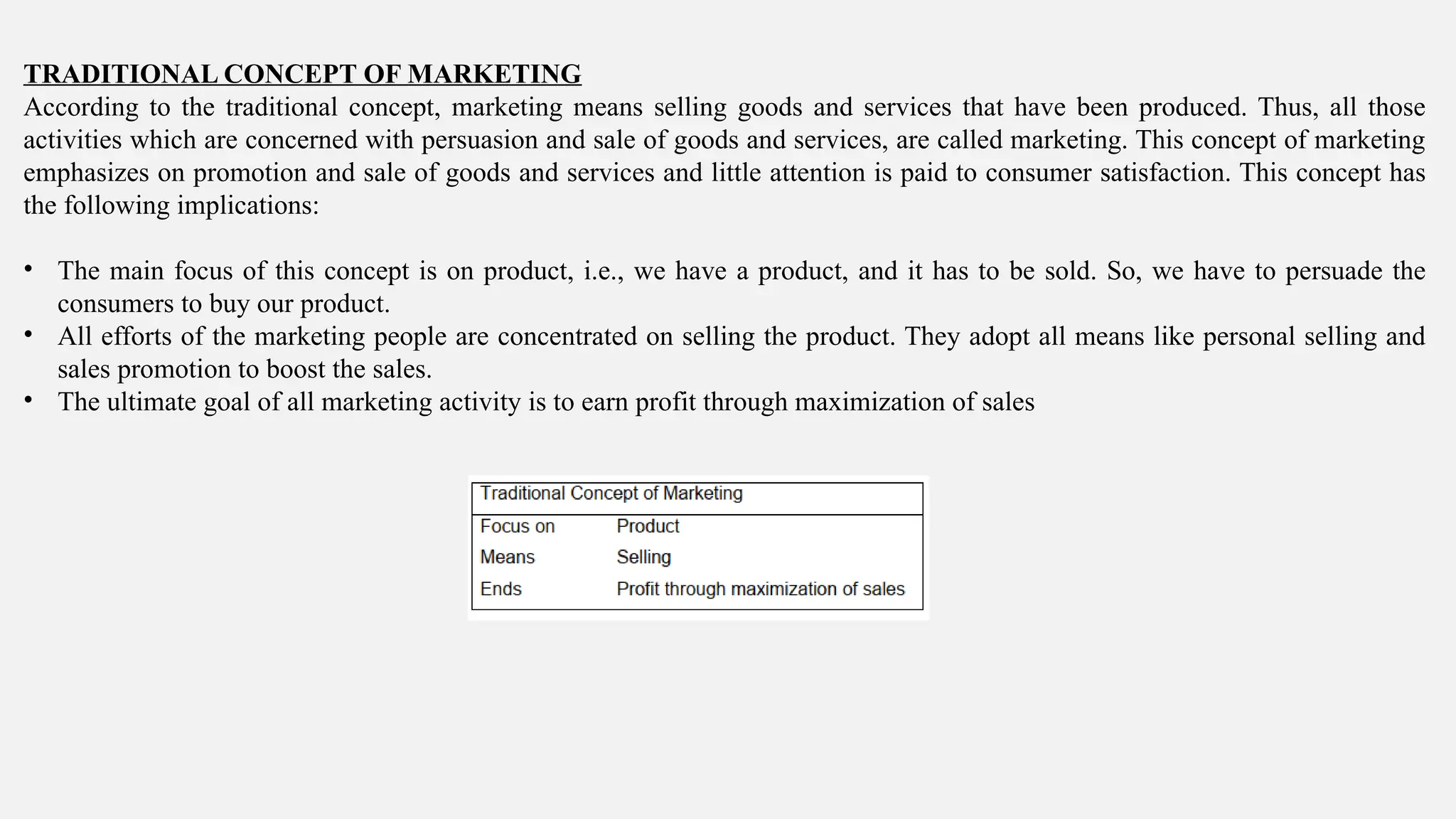
TRADITIONAL CONCEPT OF MARKETING
According to the traditional concept, marketing means selling goods and services that have been produced. Thus, all those
activities which are concerned with persuasion and sale of goods and services, are called marketing. This concept of marketing
emphasizes on promotion and sale of goods and services and little attention is paid to consumer satisfaction. This concept has
the following implications:
• The main focus of this concept is on product, i.e., we have a product, and it has to be sold. So, we have to persuade the
consumers to buy our product.
• All efforts of the marketing people are concentrated on selling the product. They adopt all means like personal selling and
sales promotion to boost the sales.
• The ultimate goal of all marketing activity is to earn profit through maximization of sales
Marketing: Creating Customer Value and Engagement
Learning Objective 1
• Define marketing and outline the steps in the marketing
process.
What Is Marketing?
Copyright © 2016 Pearson Education, Inc. 1-6
TRADITIONAL CONCEPT OF MARKETING
According to the traditional concept, marketing means selling goods and services that have been produced. Thus, all those
activities which are concerned with persuasion and sale of goods and services, are called marketing. This concept of marketing
emphasizes on promotion and sale of goods and services and little attention is paid to consumer satisfaction. This concept has
the following implications:
• The main focus of this concept is on product, i.e., we have a product, and it has to be sold. So, we have to persuade the
consumers to buy our product.
• All efforts of the marketing people are concentrated on selling the product. They adopt all means like personal selling and
sales promotion to boost the sales.
• The ultimate goal of all marketing activity is to earn profit through maximization of sales
MODERN CONCEPT OF MARKETING
The modern concept of marketing considers the consumers’ wants and needs as the guiding spirit and focuses on the delivery
of such goods and services that can satisfy those needs most effectively. Thus, marketing starts with identifying consumer
needs, then plan the production of goods and services accordingly to provide him the maximum satisfaction. In other words,
the products and services are planned according to the needs of the customers rather than according to the availability of
materials and machinery. Not only that, all activities (manufacturing, research and development, quality control, distribution,
selling etc.) are directed to satisfy the consumers.
Peter Drucker, a leading management theorist, says that “the aim of marketing is to make selling superfluous. The aim of
marketing is to know and understand the customer so well that the product or service fits him and sells itself.
DIFFERENCE BETWEEN SELLING AND MARKETING
The old sense of making a sale is telling and selling, but in new sense it is satisfying customer needs. Selling
occurs only after a product is produced. By contrast, marketing starts long before a company has a product.
 What is marketing? Many people think of marketing as only selling and advertising. We are
bombarded every day with TV commercials
 However, selling and advertising are only the tip of the marketing iceberg.
 Today, marketing must be understood not in the old sense of making a sale—“telling and selling”—
but in the new sense of satisfying customer needs.
 If the marketer engages consumers effectively, understands their needs, develops products that
provide superior customer value, and prices, distributes, and promotes them well, these products
will sell easily
Peter Drucker, a leading management theorist, says that “the aim of marketing is to make selling
superfluous. The aim of marketing is to know and understand the customer so well that the product or
service fits him and sells itself.
Marketing Defined
 Marketing, more than any other business function, deals with customers.
 Although we will soon explore more-detailed definitions of marketing, perhaps the simplest
definition is this one: Marketing is engaging customers and managing profitable customer
relationships. The twofold goal of marketing is to attract new customers by promising superior
value and to keep and grow current customers by delivering value and satisfaction.
Marketing Defined
What Is Marketing?
Marketing Defined
Marketing is a process by which companies create value for
customers and build strong customer relationships in order
to capture value from customers in return.
Copyright © 2016 Pearson Education, Inc. 1-13
What Is Marketing?
The Marketing Process
Copyright © 2016 Pearson Education, Inc. 1-14
Marketing: Creating Customer Value and Engagement
Learning Objective 1
• Define marketing and outline the steps in the marketing
process.
What Is Marketing?
- creating value for customers
- capturing value from customers
Copyright © 2016 Pearson Education, Inc. 1-15
Marketing: Creating Customer Value and Engagement
Learning Objective 2
• Explain the importance of understanding the marketplace and
customers and identify the five core marketplace concepts.
Understanding the Marketplace and Customer Needs
Copyright © 2016 Pearson Education, Inc. 1-16
Understanding the Marketplace and Customer Needs
Customer Needs, Wants, and Demands
• States of deprivation
Needs
• Form that needs take
Wants
• Wants backed by
buying power
Deman
ds
Copyright © 2016 Pearson Education, Inc. 1-18
Understanding the Marketplace and Customer Needs
Market Offerings – Products, Services, and Experiences
• Market offerings are some combination of products, services, information, or
experiences offered to a market to satisfy a need or want.
• Marketing myopia is focusing only on existing wants and losing sight of
underlying consumer needs.
Copyright © 2016 Pearson Education, Inc. 1-19
Understanding the Marketplace and Customer Needs
Customer Value and Satisfaction
Customers
• Value and
satisfaction
Marketers
• Set the right
level of
expectations
1-13
Copyright © 2016 Pearson Education, Inc.
Understanding the Marketplace and Customer Needs
Exchanges and Relationships
Exchange is the act of obtaining a desired object from someone
by offering something in return.
Marketing actions try to create, maintain, and grow desirable
exchange relationships.
Copyright © 2016 Pearson Education, Inc. 1-21
Understanding the Marketplace and Customer Needs
Markets
Copyright © 2016 Pearson Education, Inc.
1-22
Marketing: Creating Customer Value and Engagement
Learning Objective 2
Explain the importance of understanding the marketplace and
customers and identify the five core marketplace concepts.
• Customer Needs, Wants, and Demands
• Market Offerings – Products, Services, and Experiences
• Customer Value and Satisfaction
• Exchanges and Relationships
• Markets
Copyright © 2016 Pearson Education, Inc. 1-23
Marketing: Creating Customer Value and Engagement
Learning Objective 3
• Identify the key elements of a customer-driven marketing
strategy and discuss the marketing management orientations
that guide marketing strategy.
Designing a Customer Value-Driven Marketing Strategy
Preparing an Integrated Marketing Plan and Program
Copyright © 2016 Pearson Education, Inc. 1-24
Designing a Customer Value-Driven Marketing Strategy
Selecting Customers to Serve
Marketing management is the art and science of choosing
target markets and building profitable relationships with them.
• What customers will we serve?
• How can we best serve these customers?
Copyright © 2016 Pearson Education, Inc. 1-18
Designing a Customer Value-Driven Marketing Strategy
Selecting Customers to Serve
Market segmentation refers to dividing the markets into
segments of customers.
Target marketing refers to which segments to go after.
Copyright © 2016 Pearson Education, Inc. 1-19
Designing a Customer Value-Driven Marketing Strategy
Choosing a Value Proposition
A brand’s value
proposition is the
set of benefits or
values it promises
to deliver to
customers to
satisfy their needs. Twitter, Inc.
Copyright © 2016 Pearson Education, Inc. 1-27
The customer-driven marketing strategy outlines which
customers the company will serve (the target market) and
how it will serve them (the value proposition). Now, the
company develops marketing plans and programs—a
marketing mix—that will actually deliver the intended
customer value.
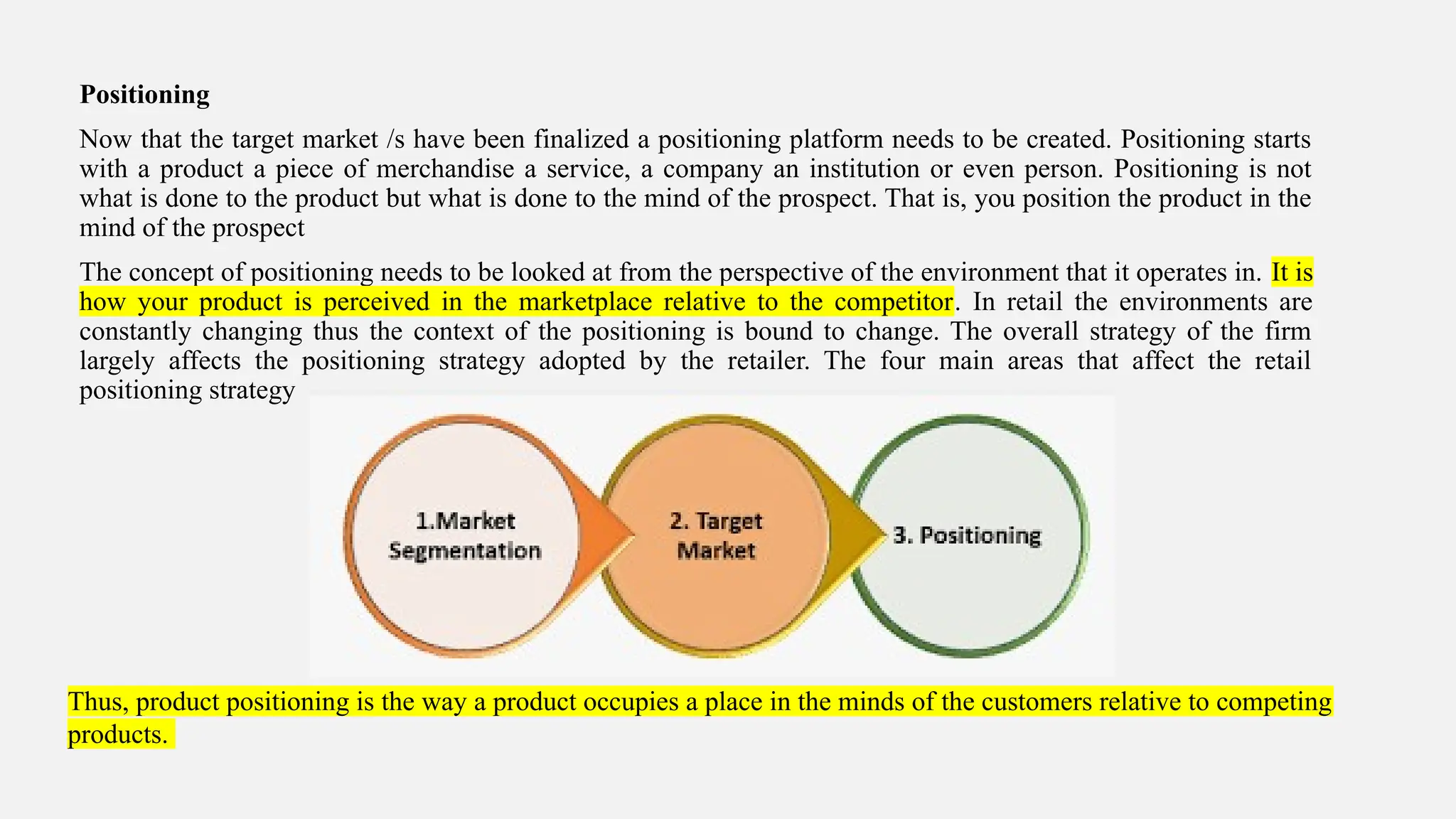
Positioning
Now that the target market /s have been finalized a positioning platform needs to be created. Positioning starts
with a product a piece of merchandise a service, a company an institution or even person. Positioning is not
what is done to the product but what is done to the mind of the prospect. That is, you position the product in the
mind of the prospect
The concept of positioning needs to be looked at from the perspective of the environment that it operates in. It is
how your product is perceived in the marketplace relative to the competitor. In retail the environments are
constantly changing thus the context of the positioning is bound to change. The overall strategy of the firm
largely affects the positioning strategy adopted by the retailer. The four main areas that affect the retail
positioning strategy
Thus, product positioning is the way a product occupies a place in the minds of the customers relative to competing
products.
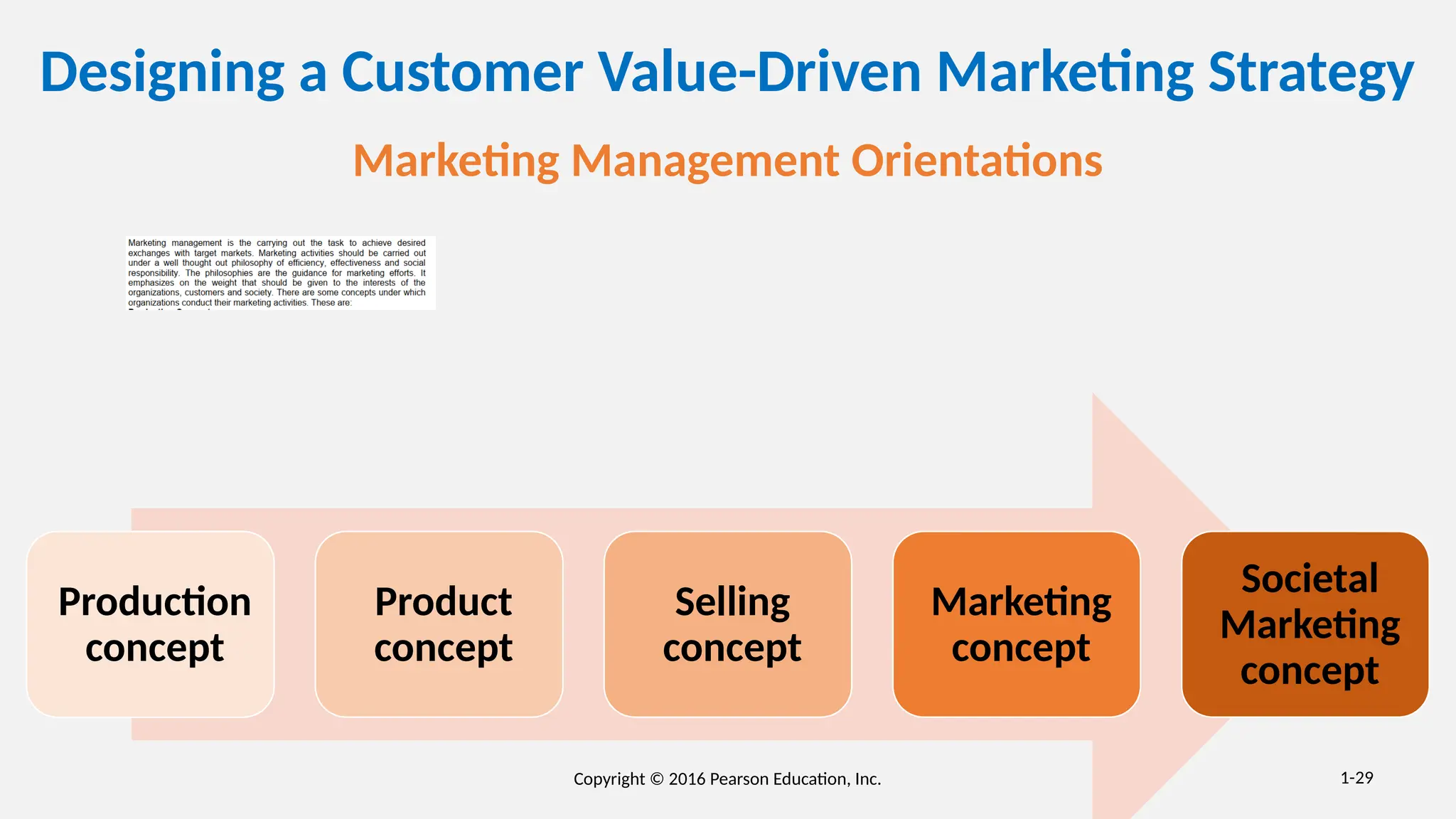
Designing a Customer Value-Driven Marketing Strategy
Marketing Management Orientations
Production
concept
Product
concept
Selling
concept
Marketing
concept
Societal
Marketing
concept
Copyright © 2016 Pearson Education, Inc. 1-29
Designing a Customer Value-Driven Marketing Strategy
Marketing Management Orientations
Production concept:
Consumers will favor products that are available and highly
affordable.
Copyright © 2016 Pearson Education, Inc.
1-30
Designing a Customer Value-Driven Marketing Strategy
Marketing Management Orientations
Product concept:
Consumers favor products that offer the most quality,
performance, and features.
The focus is on continuous product improvements.
Copyright © 2016 Pearson Education, Inc. 1-31
Designing a Customer Value-Driven Marketing Strategy
Marketing Management Orientations
Selling concept:
Consumers will not buy enough of the firm’s products unless the
firm undertakes a large-scale selling and promotion effort.
Copyright © 2016 Pearson Education, Inc. 1-32
Designing a Customer Value-Driven Marketing Strategy
Marketing Management Orientations
Marketing concept:
Know the needs and wants of the target markets and deliver the
desired satisfactions better than competitors.
Copyright © 2016 Pearson Education, Inc. 1-33
Designing a Customer Value-Driven Marketing Strategy
Marketing Management Orientations
Societal marketing:
The company’s marketing decisions should consider consumers’
wants, the company’s requirements, consumers’ long-run
interests, and society’s long-run interests.
Copyright © 2016 Pearson Education, Inc. 1-34
Designing a Customer Value-Driven Marketing Strategy
Marketing Management Orientations
Copyright © 2016 Pearson Education, Inc. 1-35
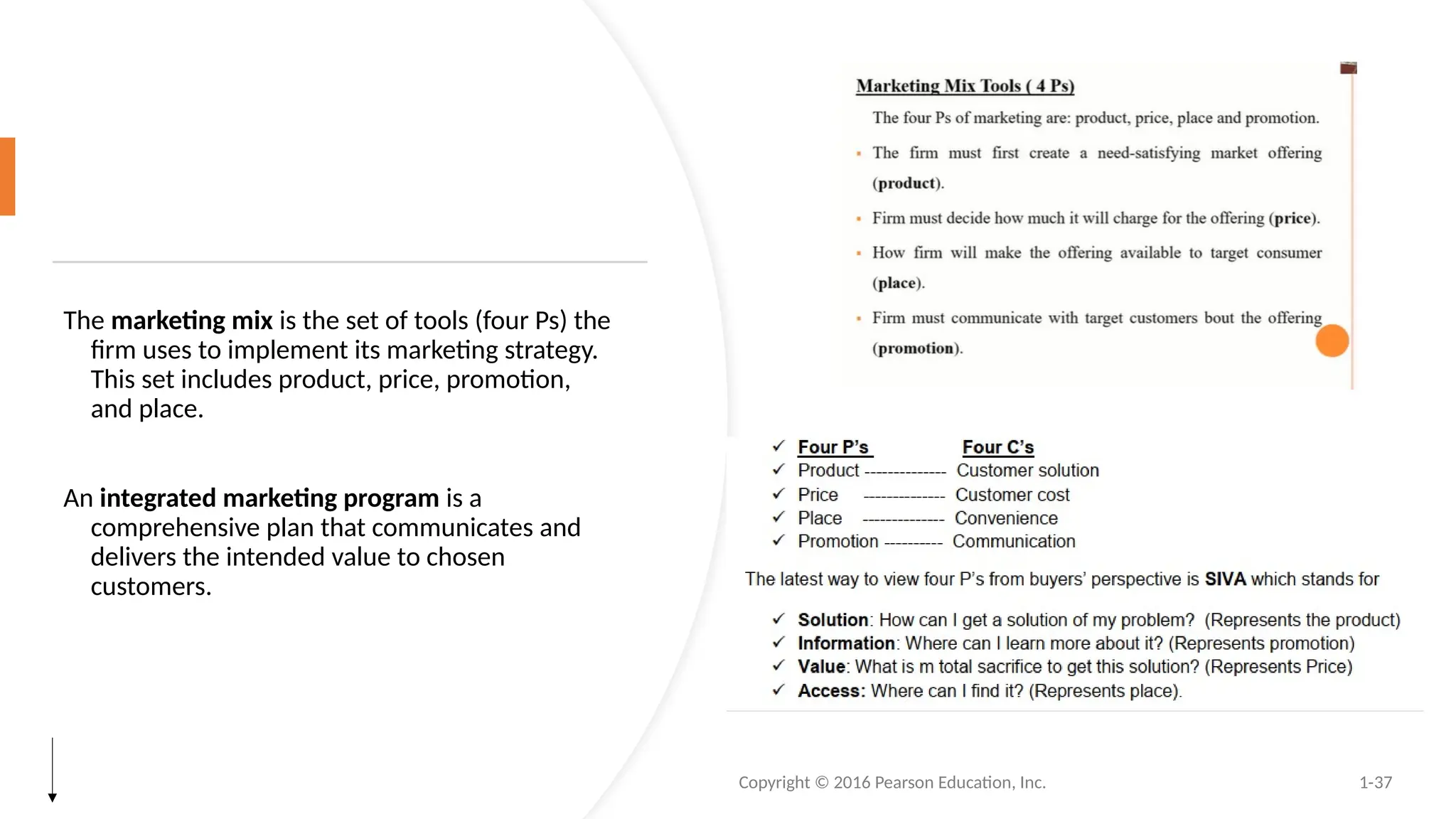
The marketing mix is the set of tools (four Ps) the
firm uses to implement its marketing strategy.
This set includes product, price, promotion,
and place.
An integrated marketing program is a
comprehensive plan that communicates and
delivers the intended value to chosen
customers.
Copyright © 2016 Pearson Education, Inc. 1-37
Marketing: Creating Customer Value and Engagement
Learning Objective 3
• Identify the key elements of a customer-driven marketing
strategy and discuss the marketing management orientations
that guide marketing strategy.
Designing a Customer Value-Driven Marketing Strategy
- Selecting Customers
- Choosing a Value Proposition
- Marketing Management Orientations
Preparing an Integrated Marketing Plan and Program
Copyright © 2016 Pearson Education, Inc. 1-38
Marketing: Creating Customer Value and Engagement
Learning Objective 4
• Discuss customer relationship management and identify strategies for
creating value for customers and capturing value from customers in
return.
Building Customer Relationships
Capturing Value from Customers
Copyright © 2016 Pearson Education, Inc. 1-39
Building Customer Relationships
Customer Relationship Management
Customer relationship management is the overall process of
building and maintaining profitable customer relationships by
delivering superior customer value and satisfaction.
Copyright © 2016 Pearson Education, Inc.
1-40
Building Customer Relationships
Customer Relationship Management
Relationship Building Blocks
Customer-
perceived value
• The difference
between total
customer
perceived
benefits and
customer cost
Customer
satisfaction
• The extent to
which perceived
performance
matches a
buyer’s
expectations
Copyright © 2016 Pearson Education, Inc. 1-41
Building Customer Relationships
Customer Relationship Management
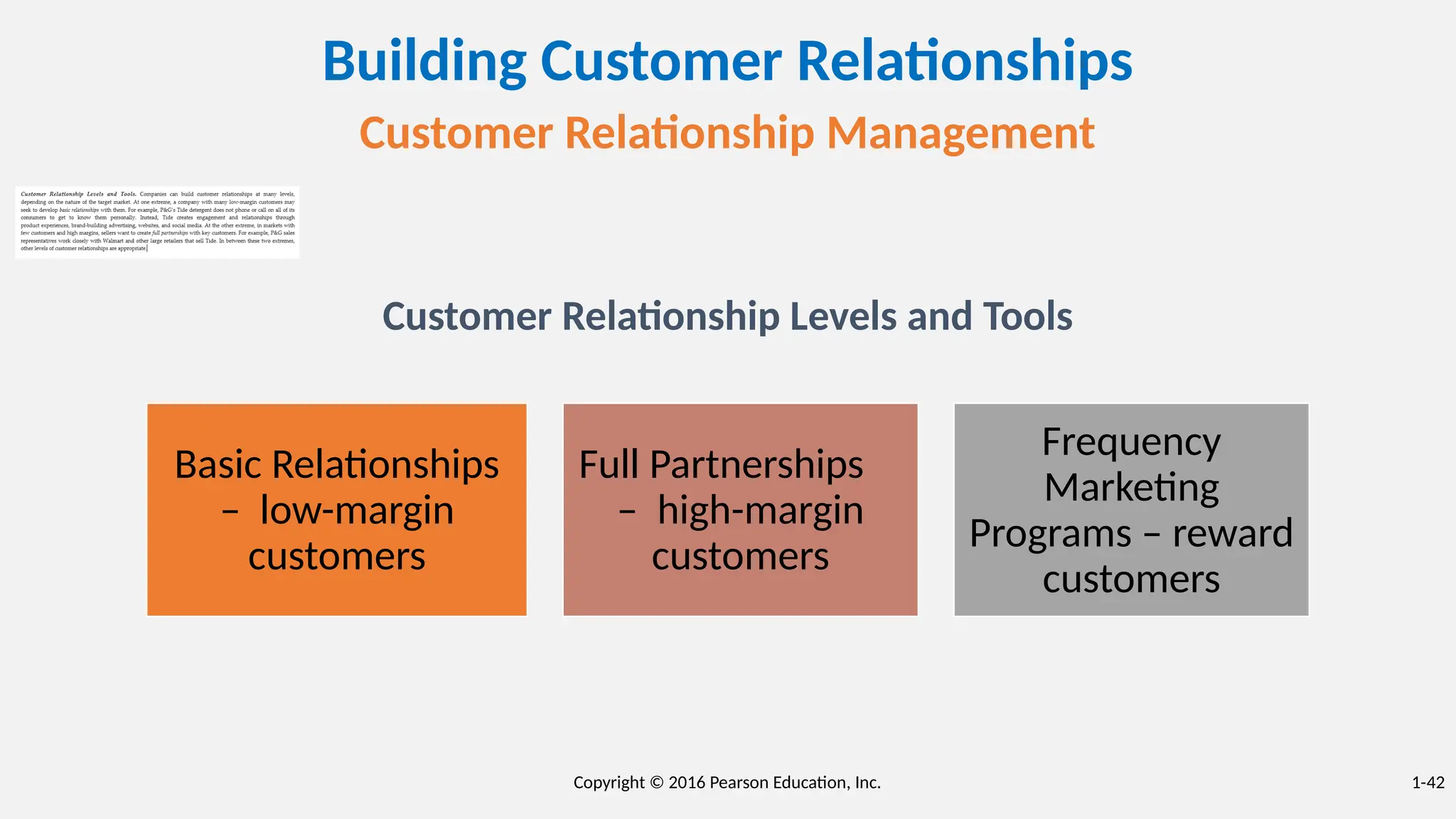
Customer Relationship Levels and Tools
Basic Relationships
– low-margin
customers
Full Partnerships
– high-margin
customers
Frequency
Marketing
Programs – reward
customers
Copyright © 2016 Pearson Education, Inc. 1-42
Building Customer Relationships
Engaging Customers
Customer-Engagement and Today’s Digital and Social Media
Customer-Engagement Marketing makes the brand a meaningful part of
consumers’ conversations and lives
by fostering direct and continuous customer involvement in shaping brand
conversations, experiences, and community.
Copyright © 2016 Pearson Education, Inc. 1-43
Building Customer Relationships
Engaging Customers
Customer Engagement and Today’s Digital and Social Media
Customer engagement
and the social media:
“Share It Up” social
media campaign
Hertz System, Inc.
Copyright © 2016 Pearson Education, Inc. 1-4
Building Customer Relationships
Engaging Customers
Consumer-Generated Marketing
Brand exchanges created by consumers themselves—
both invited and uninvited—by which consumers are
playing an increasing role in shaping their own brand
experiences and those of other consumers.
Copyright © 2016 Pearson Education, Inc. 1-4
Building Customer Relationships
Engaging Customers
Engaging customers: Life is
good starts with a deeply
felt, engagement-worthy
sense of purpose: spreading
the power of optimism.
The Life is good Company
Copyright © 2016 Pearson Education, Inc.
1-46
Building Customer Relationships
Partner Relationship Management
Partner relationship management involves working closely with
partners in other company departments and outside the
company to jointly bring greater value to customers.
1-47
Copyright © 2016 Pearson Education, Inc.
Capturing Value from Customers
Creating Customer Loyalty and Retention
Customer lifetime value is the
value of the entire stream of
purchases that the customer
would make over a lifetime of
patronage.
1-48
Keeping customers loyal makes good economic sense. Loyal customers
spend more and stay around longer. Research also shows that it’s five
times cheaper to keep an old customer than acquire a new one.
Conversely, customer defections can be costly. Losing a customer
means losing more than a single sale. It means losing the entire stream
of purchases that the customer would make over a lifetime of
patronage.
Capturing Value from Customers
Growing Share of Customer
Share of customer is the portion of the customer’s purchasing
that a company gets in its product categories.
Copyright © 2016 Pearson Education, Inc. 1-49
To increase share of customer, firms can offer greater variety to current customers or they can create
programs to cross-sell and up-sell to market more products and services to existing customers.
Capturing Value from Customers
Building Customer Equity
Customer equity is
the total combined
customer lifetime
values of all of the
company’s customers.
Copyright © 2016 Pearson Education, Inc.
1-50
Capturing Value from Customers
Building Customer Equity
Building the Right Relationships with the Right Customers
FIGURE 1.5
Customer
Relationship
Groups
Copyright © 2016 Pearson Education, Inc. 1-51
Marketing: Creating Customer Value and Engagement
Learning Objective 4
• Discuss customer relationship management and identify
strategies for creating value for customers and capturing value
from customers in return.
Building Customer Relationships
- Customer Relationship Management
- Engaging Customers
- Partner Relationship Management
Copyright © 2016 Pearson Education, Inc. 1-52
Marketing: Creating Customer Value and Engagement
Learning Objective 4
• Discuss customer relationship management and identify
strategies for creating value for customers and capturing value
from customers in return.
Capturing Value from Customers
- Creating Customer Value Loyalty & Retention
- Growing Share of Customer
- Building Customer Equity
Copyright © 2016 Pearson Education, Inc. 1-53
Marketing: Creating Customer Value and Engagement
Learning Objective 5
• Describe the major trends and forces that are changing the
marketing landscape in this age of relationships.
The Changing Marketing Landscape
Copyright © 2016 Pearson Education, Inc. 1-54
The Changing Marketing Landscape
The Digital Age: Online, Mobile, and Social Media Marketing
Digital and social media marketing involves using digital
marketing tools such as web sites, social media, mobile ads and
apps, online videos, e-mail, and blogs that engage consumers
anywhere, at any time, via their digital devices.
Copyright © 2016 Pearson Education, Inc.
1-55
The Changing Marketing Landscape
The Digital Age: Online, Mobile, and Social Media Marketing
Copyright © 2016 Pearson Education, Inc. 1-56
The Changing Marketing Landscape
• Not-for-
profit
marketing
growth
• Rapid
globalization
• Sustainable
marketing
Copyright © 2016 Pearson Education, Inc. 1-57
Marketing: Creating Customer Value and Engagement
Learning Objective 5
• Describe the major trends and forces that are changing the
marketing landscape in this age of relationships.
The Changing Marketing Landscape
- The Digital Age
- Not-for-Profit
- Rapid Globalization
- Sustainable Marketing
Copyright © 2016 Pearson Education, Inc. 1-58
So, What Is Marketing? Pulling It All Together
Copyright © 2016 Pearson Education, Inc. 1-59
Principles of Marketing
PowerPoint Copyright Page
Copyright © 2016 Pearson Education, Inc. 1-52

Principles of Marketing. ppt, chapter 1

  • 1.
    Principles of Marketing Kotlerand Armstrong Chapter 1: Marketing Creating Customer Value and Engagement Insert Textbook Cover Image Copyright © 2016 Pearson Education, Inc. 1-1
  • 2.
    • Objective 1:Define marketing and outline the steps in the marketing process. • Objective 2: Explain the importance of understanding the marketplace and customers and identify the five core marketplace concepts. Learning Objectives Marketing: Creating Customer Value and Engagement 1-2 Copyright © 2016 Pearson Education, Inc.
  • 3.
    • Objective 3:Identify the key elements of a customer-driven marketing strategy and discuss the marketing management orientations that guide marketing strategy. Learning Objectives Marketing: Creating Customer Value and Engagement 1-3 Copyright © 2016 Pearson Education, Inc.
  • 4.
    Learning Objectives Marketing: CreatingCustomer Value and Engagement • Objective 4: Discuss customer relationship management and identify strategies for creating value for customers and capturing value from customers in return. • Objective 5: Describe the major trends and forces that are changing the marketing landscape in this age of relationships. Copyright © 2016 Pearson Education, Inc. 1-4
  • 5.
    TRADITIONAL CONCEPT OFMARKETING According to the traditional concept, marketing means selling goods and services that have been produced. Thus, all those activities which are concerned with persuasion and sale of goods and services, are called marketing. This concept of marketing emphasizes on promotion and sale of goods and services and little attention is paid to consumer satisfaction. This concept has the following implications: • The main focus of this concept is on product, i.e., we have a product, and it has to be sold. So, we have to persuade the consumers to buy our product. • All efforts of the marketing people are concentrated on selling the product. They adopt all means like personal selling and sales promotion to boost the sales. • The ultimate goal of all marketing activity is to earn profit through maximization of sales
  • 6.
    Marketing: Creating CustomerValue and Engagement Learning Objective 1 • Define marketing and outline the steps in the marketing process. What Is Marketing? Copyright © 2016 Pearson Education, Inc. 1-6
  • 7.
    TRADITIONAL CONCEPT OFMARKETING According to the traditional concept, marketing means selling goods and services that have been produced. Thus, all those activities which are concerned with persuasion and sale of goods and services, are called marketing. This concept of marketing emphasizes on promotion and sale of goods and services and little attention is paid to consumer satisfaction. This concept has the following implications: • The main focus of this concept is on product, i.e., we have a product, and it has to be sold. So, we have to persuade the consumers to buy our product. • All efforts of the marketing people are concentrated on selling the product. They adopt all means like personal selling and sales promotion to boost the sales. • The ultimate goal of all marketing activity is to earn profit through maximization of sales
  • 8.
    MODERN CONCEPT OFMARKETING The modern concept of marketing considers the consumers’ wants and needs as the guiding spirit and focuses on the delivery of such goods and services that can satisfy those needs most effectively. Thus, marketing starts with identifying consumer needs, then plan the production of goods and services accordingly to provide him the maximum satisfaction. In other words, the products and services are planned according to the needs of the customers rather than according to the availability of materials and machinery. Not only that, all activities (manufacturing, research and development, quality control, distribution, selling etc.) are directed to satisfy the consumers. Peter Drucker, a leading management theorist, says that “the aim of marketing is to make selling superfluous. The aim of marketing is to know and understand the customer so well that the product or service fits him and sells itself.
  • 9.
    DIFFERENCE BETWEEN SELLINGAND MARKETING The old sense of making a sale is telling and selling, but in new sense it is satisfying customer needs. Selling occurs only after a product is produced. By contrast, marketing starts long before a company has a product.
  • 11.
     What ismarketing? Many people think of marketing as only selling and advertising. We are bombarded every day with TV commercials  However, selling and advertising are only the tip of the marketing iceberg.  Today, marketing must be understood not in the old sense of making a sale—“telling and selling”— but in the new sense of satisfying customer needs.  If the marketer engages consumers effectively, understands their needs, develops products that provide superior customer value, and prices, distributes, and promotes them well, these products will sell easily Peter Drucker, a leading management theorist, says that “the aim of marketing is to make selling superfluous. The aim of marketing is to know and understand the customer so well that the product or service fits him and sells itself. Marketing Defined
  • 12.
     Marketing, morethan any other business function, deals with customers.  Although we will soon explore more-detailed definitions of marketing, perhaps the simplest definition is this one: Marketing is engaging customers and managing profitable customer relationships. The twofold goal of marketing is to attract new customers by promising superior value and to keep and grow current customers by delivering value and satisfaction. Marketing Defined
  • 13.
    What Is Marketing? MarketingDefined Marketing is a process by which companies create value for customers and build strong customer relationships in order to capture value from customers in return. Copyright © 2016 Pearson Education, Inc. 1-13
  • 14.
    What Is Marketing? TheMarketing Process Copyright © 2016 Pearson Education, Inc. 1-14
  • 15.
    Marketing: Creating CustomerValue and Engagement Learning Objective 1 • Define marketing and outline the steps in the marketing process. What Is Marketing? - creating value for customers - capturing value from customers Copyright © 2016 Pearson Education, Inc. 1-15
  • 16.
    Marketing: Creating CustomerValue and Engagement Learning Objective 2 • Explain the importance of understanding the marketplace and customers and identify the five core marketplace concepts. Understanding the Marketplace and Customer Needs Copyright © 2016 Pearson Education, Inc. 1-16
  • 18.
    Understanding the Marketplaceand Customer Needs Customer Needs, Wants, and Demands • States of deprivation Needs • Form that needs take Wants • Wants backed by buying power Deman ds Copyright © 2016 Pearson Education, Inc. 1-18
  • 19.
    Understanding the Marketplaceand Customer Needs Market Offerings – Products, Services, and Experiences • Market offerings are some combination of products, services, information, or experiences offered to a market to satisfy a need or want. • Marketing myopia is focusing only on existing wants and losing sight of underlying consumer needs. Copyright © 2016 Pearson Education, Inc. 1-19
  • 20.
    Understanding the Marketplaceand Customer Needs Customer Value and Satisfaction Customers • Value and satisfaction Marketers • Set the right level of expectations 1-13 Copyright © 2016 Pearson Education, Inc.
  • 21.
    Understanding the Marketplaceand Customer Needs Exchanges and Relationships Exchange is the act of obtaining a desired object from someone by offering something in return. Marketing actions try to create, maintain, and grow desirable exchange relationships. Copyright © 2016 Pearson Education, Inc. 1-21
  • 22.
    Understanding the Marketplaceand Customer Needs Markets Copyright © 2016 Pearson Education, Inc. 1-22
  • 23.
    Marketing: Creating CustomerValue and Engagement Learning Objective 2 Explain the importance of understanding the marketplace and customers and identify the five core marketplace concepts. • Customer Needs, Wants, and Demands • Market Offerings – Products, Services, and Experiences • Customer Value and Satisfaction • Exchanges and Relationships • Markets Copyright © 2016 Pearson Education, Inc. 1-23
  • 24.
    Marketing: Creating CustomerValue and Engagement Learning Objective 3 • Identify the key elements of a customer-driven marketing strategy and discuss the marketing management orientations that guide marketing strategy. Designing a Customer Value-Driven Marketing Strategy Preparing an Integrated Marketing Plan and Program Copyright © 2016 Pearson Education, Inc. 1-24
  • 25.
    Designing a CustomerValue-Driven Marketing Strategy Selecting Customers to Serve Marketing management is the art and science of choosing target markets and building profitable relationships with them. • What customers will we serve? • How can we best serve these customers? Copyright © 2016 Pearson Education, Inc. 1-18
  • 26.
    Designing a CustomerValue-Driven Marketing Strategy Selecting Customers to Serve Market segmentation refers to dividing the markets into segments of customers. Target marketing refers to which segments to go after. Copyright © 2016 Pearson Education, Inc. 1-19
  • 27.
    Designing a CustomerValue-Driven Marketing Strategy Choosing a Value Proposition A brand’s value proposition is the set of benefits or values it promises to deliver to customers to satisfy their needs. Twitter, Inc. Copyright © 2016 Pearson Education, Inc. 1-27 The customer-driven marketing strategy outlines which customers the company will serve (the target market) and how it will serve them (the value proposition). Now, the company develops marketing plans and programs—a marketing mix—that will actually deliver the intended customer value.
  • 28.
    Positioning Now that thetarget market /s have been finalized a positioning platform needs to be created. Positioning starts with a product a piece of merchandise a service, a company an institution or even person. Positioning is not what is done to the product but what is done to the mind of the prospect. That is, you position the product in the mind of the prospect The concept of positioning needs to be looked at from the perspective of the environment that it operates in. It is how your product is perceived in the marketplace relative to the competitor. In retail the environments are constantly changing thus the context of the positioning is bound to change. The overall strategy of the firm largely affects the positioning strategy adopted by the retailer. The four main areas that affect the retail positioning strategy Thus, product positioning is the way a product occupies a place in the minds of the customers relative to competing products.
  • 29.
    Designing a CustomerValue-Driven Marketing Strategy Marketing Management Orientations Production concept Product concept Selling concept Marketing concept Societal Marketing concept Copyright © 2016 Pearson Education, Inc. 1-29
  • 30.
    Designing a CustomerValue-Driven Marketing Strategy Marketing Management Orientations Production concept: Consumers will favor products that are available and highly affordable. Copyright © 2016 Pearson Education, Inc. 1-30
  • 31.
    Designing a CustomerValue-Driven Marketing Strategy Marketing Management Orientations Product concept: Consumers favor products that offer the most quality, performance, and features. The focus is on continuous product improvements. Copyright © 2016 Pearson Education, Inc. 1-31
  • 32.
    Designing a CustomerValue-Driven Marketing Strategy Marketing Management Orientations Selling concept: Consumers will not buy enough of the firm’s products unless the firm undertakes a large-scale selling and promotion effort. Copyright © 2016 Pearson Education, Inc. 1-32
  • 33.
    Designing a CustomerValue-Driven Marketing Strategy Marketing Management Orientations Marketing concept: Know the needs and wants of the target markets and deliver the desired satisfactions better than competitors. Copyright © 2016 Pearson Education, Inc. 1-33
  • 34.
    Designing a CustomerValue-Driven Marketing Strategy Marketing Management Orientations Societal marketing: The company’s marketing decisions should consider consumers’ wants, the company’s requirements, consumers’ long-run interests, and society’s long-run interests. Copyright © 2016 Pearson Education, Inc. 1-34
  • 35.
    Designing a CustomerValue-Driven Marketing Strategy Marketing Management Orientations Copyright © 2016 Pearson Education, Inc. 1-35
  • 37.
    The marketing mixis the set of tools (four Ps) the firm uses to implement its marketing strategy. This set includes product, price, promotion, and place. An integrated marketing program is a comprehensive plan that communicates and delivers the intended value to chosen customers. Copyright © 2016 Pearson Education, Inc. 1-37
  • 38.
    Marketing: Creating CustomerValue and Engagement Learning Objective 3 • Identify the key elements of a customer-driven marketing strategy and discuss the marketing management orientations that guide marketing strategy. Designing a Customer Value-Driven Marketing Strategy - Selecting Customers - Choosing a Value Proposition - Marketing Management Orientations Preparing an Integrated Marketing Plan and Program Copyright © 2016 Pearson Education, Inc. 1-38
  • 39.
    Marketing: Creating CustomerValue and Engagement Learning Objective 4 • Discuss customer relationship management and identify strategies for creating value for customers and capturing value from customers in return. Building Customer Relationships Capturing Value from Customers Copyright © 2016 Pearson Education, Inc. 1-39
  • 40.
    Building Customer Relationships CustomerRelationship Management Customer relationship management is the overall process of building and maintaining profitable customer relationships by delivering superior customer value and satisfaction. Copyright © 2016 Pearson Education, Inc. 1-40
  • 41.
    Building Customer Relationships CustomerRelationship Management Relationship Building Blocks Customer- perceived value • The difference between total customer perceived benefits and customer cost Customer satisfaction • The extent to which perceived performance matches a buyer’s expectations Copyright © 2016 Pearson Education, Inc. 1-41
  • 42.
    Building Customer Relationships CustomerRelationship Management Customer Relationship Levels and Tools Basic Relationships – low-margin customers Full Partnerships – high-margin customers Frequency Marketing Programs – reward customers Copyright © 2016 Pearson Education, Inc. 1-42
  • 43.
    Building Customer Relationships EngagingCustomers Customer-Engagement and Today’s Digital and Social Media Customer-Engagement Marketing makes the brand a meaningful part of consumers’ conversations and lives by fostering direct and continuous customer involvement in shaping brand conversations, experiences, and community. Copyright © 2016 Pearson Education, Inc. 1-43
  • 44.
    Building Customer Relationships EngagingCustomers Customer Engagement and Today’s Digital and Social Media Customer engagement and the social media: “Share It Up” social media campaign Hertz System, Inc. Copyright © 2016 Pearson Education, Inc. 1-4
  • 45.
    Building Customer Relationships EngagingCustomers Consumer-Generated Marketing Brand exchanges created by consumers themselves— both invited and uninvited—by which consumers are playing an increasing role in shaping their own brand experiences and those of other consumers. Copyright © 2016 Pearson Education, Inc. 1-4
  • 46.
    Building Customer Relationships EngagingCustomers Engaging customers: Life is good starts with a deeply felt, engagement-worthy sense of purpose: spreading the power of optimism. The Life is good Company Copyright © 2016 Pearson Education, Inc. 1-46
  • 47.
    Building Customer Relationships PartnerRelationship Management Partner relationship management involves working closely with partners in other company departments and outside the company to jointly bring greater value to customers. 1-47 Copyright © 2016 Pearson Education, Inc.
  • 48.
    Capturing Value fromCustomers Creating Customer Loyalty and Retention Customer lifetime value is the value of the entire stream of purchases that the customer would make over a lifetime of patronage. 1-48 Keeping customers loyal makes good economic sense. Loyal customers spend more and stay around longer. Research also shows that it’s five times cheaper to keep an old customer than acquire a new one. Conversely, customer defections can be costly. Losing a customer means losing more than a single sale. It means losing the entire stream of purchases that the customer would make over a lifetime of patronage.
  • 49.
    Capturing Value fromCustomers Growing Share of Customer Share of customer is the portion of the customer’s purchasing that a company gets in its product categories. Copyright © 2016 Pearson Education, Inc. 1-49 To increase share of customer, firms can offer greater variety to current customers or they can create programs to cross-sell and up-sell to market more products and services to existing customers.
  • 50.
    Capturing Value fromCustomers Building Customer Equity Customer equity is the total combined customer lifetime values of all of the company’s customers. Copyright © 2016 Pearson Education, Inc. 1-50
  • 51.
    Capturing Value fromCustomers Building Customer Equity Building the Right Relationships with the Right Customers FIGURE 1.5 Customer Relationship Groups Copyright © 2016 Pearson Education, Inc. 1-51
  • 52.
    Marketing: Creating CustomerValue and Engagement Learning Objective 4 • Discuss customer relationship management and identify strategies for creating value for customers and capturing value from customers in return. Building Customer Relationships - Customer Relationship Management - Engaging Customers - Partner Relationship Management Copyright © 2016 Pearson Education, Inc. 1-52
  • 53.
    Marketing: Creating CustomerValue and Engagement Learning Objective 4 • Discuss customer relationship management and identify strategies for creating value for customers and capturing value from customers in return. Capturing Value from Customers - Creating Customer Value Loyalty & Retention - Growing Share of Customer - Building Customer Equity Copyright © 2016 Pearson Education, Inc. 1-53
  • 54.
    Marketing: Creating CustomerValue and Engagement Learning Objective 5 • Describe the major trends and forces that are changing the marketing landscape in this age of relationships. The Changing Marketing Landscape Copyright © 2016 Pearson Education, Inc. 1-54
  • 55.
    The Changing MarketingLandscape The Digital Age: Online, Mobile, and Social Media Marketing Digital and social media marketing involves using digital marketing tools such as web sites, social media, mobile ads and apps, online videos, e-mail, and blogs that engage consumers anywhere, at any time, via their digital devices. Copyright © 2016 Pearson Education, Inc. 1-55
  • 56.
    The Changing MarketingLandscape The Digital Age: Online, Mobile, and Social Media Marketing Copyright © 2016 Pearson Education, Inc. 1-56
  • 57.
    The Changing MarketingLandscape • Not-for- profit marketing growth • Rapid globalization • Sustainable marketing Copyright © 2016 Pearson Education, Inc. 1-57
  • 58.
    Marketing: Creating CustomerValue and Engagement Learning Objective 5 • Describe the major trends and forces that are changing the marketing landscape in this age of relationships. The Changing Marketing Landscape - The Digital Age - Not-for-Profit - Rapid Globalization - Sustainable Marketing Copyright © 2016 Pearson Education, Inc. 1-58
  • 59.
    So, What IsMarketing? Pulling It All Together Copyright © 2016 Pearson Education, Inc. 1-59
  • 60.
    Principles of Marketing PowerPointCopyright Page Copyright © 2016 Pearson Education, Inc. 1-52

Editor's Notes

  • #2 Objective 1 Define marketing and outline the steps in the marketing process. Objective 2 Explain the importance of understanding the marketplace and customers and identify the five core marketplace concepts. Objective 3 Identify the key elements of a customer-driven marketing strategy and discuss the marketing management orientations that guide marketing strategy. Objective 4 Discuss customer relationship management and identify strategies for creating value for customers and capturing value from customers in return. Objective 5 Describe the major trends and forces that are changing the marketing landscape in this age of relationships.
  • #3 Objective 1 Define marketing and outline the steps in the marketing process. Objective 2 Explain the importance of understanding the marketplace and customers and identify the five core marketplace concepts. Objective 3 Identify the key elements of a customer-driven marketing strategy and discuss the marketing management orientations that guide marketing strategy. Objective 4 Discuss customer relationship management and identify strategies for creating value for customers and capturing value from customers in return. Objective 5 Describe the major trends and forces that are changing the marketing landscape in this age of relationships.
  • #4 Objective 1 Define marketing and outline the steps in the marketing process. Objective 2 Explain the importance of understanding the marketplace and customers and identify the five core marketplace concepts. Objective 3 Identify the key elements of a customer-driven marketing strategy and discuss the marketing management orientations that guide marketing strategy. Objective 4 Discuss customer relationship management and identify strategies for creating value for customers and capturing value from customers in return. Objective 5 Describe the major trends and forces that are changing the marketing landscape in this age of relationships.
  • #13 Discussion Question Ask students for examples of either national or local companies that are excellent at marketing and ask how they reflect the definition given in this slide. Perhaps the simplest definition of marketing is engaging customers and managing profitable customer relationships. The twofold goal of marketing is to: attract new customers by promising superior value grow current customers by delivering satisfaction Sound marketing is critical to the success of every organization: large for-profit firms not-for-profit organizations You already know a lot about marketing—it’s all around you: products at your nearby shopping mall ads that fill your TV screen and magazines, or stuff your mailbox imaginative web sites and mobile phone apps blogs, online videos, and social media Today’s marketers reach you directly, personally, and interactively. They want to become a part of your life and enrich your experiences with their brands—to help you live their brands.
  • #14 Figure 1.1 presents a simple, five-step model of the marketing process for creating and capturing value. In the first four steps, companies work to understand consumers, create customer value, and build strong customer relationships. In the final step, companies reap the rewards of creating superior customer value. By creating value for consumers, they in turn capture value from consumers in the form of sales, profits, and long-term customer equity.
  • #15 Discussion Question What are the five steps in the marketing process? Learning Objective 1 Summary Marketing is the process by which companies create value for customers and build strong customer relationships in order to capture value from customers in return. The marketing process involves five steps. The first four steps create value for customers. First, marketers need to understand the marketplace and customer needs and wants. Next, marketers design a customer-driven marketing strategy with the goal of getting, keeping, and growing target customers. In the third step, marketers construct a marketing program that actually delivers superior value. All of these steps form the basis for the fourth step, building profitable customer relationships and creating customer delight. In the final step, the company reaps the rewards of strong customer relationships by capturing value from customers.
  • #18 Marketing is all about creating value for customers. So, as the first step in the marketing process, the company must fully understand consumers and the marketplace in which it operates. Discussion Question Ask the students to 1) Give an example of a product (good or service) they purchased recently 2) Tell how that product satisfied a need, want or demand. Human needs include basic physical needs for food, clothing, warmth, and safety; social needs for belonging and affection; and individual needs for knowledge and self-expression. Wants are the form human needs take as they are shaped by one’s society and are described in terms of objects that will satisfy those needs. When backed by buying power, wants become demands. Outstanding marketing companies go to great lengths to learn about and understand their customers’ needs, wants, and demands.
  • #19 Marketing experiences: More than just a mobile game app, Angry Birds is “a digital immersion in addictively cheerful destruction.” Creator Rovio plans to expand the Angry Birds experience through animated videos, licensed products, and even Angry Birds-branded playgrounds and activity parks. Market offerings include other entities, such as persons, places, organizations, information, and ideas. Many sellers suffer from marketing myopia, the mistake of paying more attention to the specific products they offer than to the benefits and experiences produced by these products. Smart marketers orchestrate several services and products, thereby creating brand experiences for consumers.
  • #20 Discussion Question Ask students what online retailers deliver exceptional value and satisfaction. Consumers usually face a broad array of products and services that might satisfy a given need. How do they choose among these many market offerings? Customers form expectations about the value and satisfaction that various market offerings will deliver and buy accordingly. Satisfied customers buy again and tell others about their good experiences. Dissatisfied customers often switch to competitors and disparage the product to others. Marketers must be careful to set the right level of expectations. If they set expectations too low, they may satisfy those who buy but fail to attract enough buyers. If they set expectations too high, buyers will be disappointed. Customer value and customer satisfaction are key building blocks for developing and managing customer relationships.
  • #21 Marketing occurs when people decide to satisfy their needs and wants through exchange relationships. In the broadest sense, the marketer tries to bring about a response to some market offering. The response may be more than simply buying or trading products and services. A political candidate, for instance, wants votes; a church wants membership; an orchestra wants an audience; and a social action group wants idea acceptance. Companies want to build strong relationships by consistently delivering superior customer value.
  • #22 A market is the set of actual and potential buyers of a product or service. These buyers share a particular need or want that can be satisfied through exchange relationships. Figure 1.2 shows the main elements in a marketing system. Each party in the system adds value for the next level and is affected by major environmental forces (demographic, economic, natural, technological, political, and social/cultural). Marketing means managing markets to bring about profitable customer relationships. Activities such as consumer research, product development, communication, distribution, pricing, and service are core marketing activities. Buyers also carry out marketing, thus, in addition to customer relationship management, today’s marketers must also deal effectively with customer-managed relationships. Marketers are no longer asking only “How can we influence our customers?” but also “How can our customers influence us?” and even “How can our customers influence each other?”
  • #23 Discussion Question Explain the importance of understanding the marketplace and customers and identify the five core marketplace concepts. Learning Objective 2 Summary Outstanding marketing companies go to great lengths to learn about and understand their customers’ needs, wants, and demands. This understanding helps them to design want-satisfying market offerings and build value-laden customer relationships by which they can capture customer lifetime value and greater share of customer. The result is increased long-term customer equity for the firm. The core marketplace concepts are needs, wants, and demands; market offerings (products, services, and experiences); value and satisfaction; exchange and relationships; and markets. Wants are the form taken by human needs when shaped by culture and individual personality. When backed by buying power, wants become demands. Companies address needs by putting forth a value proposition, a set of benefits that they promise to consumers to satisfy their needs. The value proposition is fulfilled through a market offering, which delivers customer value and satisfaction, resulting in long-term exchange relationships with customers.
  • #25 Discussion Question Ask students to describe a market segment they are a part of for a specific product such as, athletic or fitness equipment or clothing. Now that the company fully understands its consumers and the marketplace, it must decide which customers it will serve and how it will bring them value.
  • #26 The marketing manager’s aim is to find, attract, keep, and grow target customers by creating, delivering, and communicating superior customer value. To design a winning marketing strategy, the marketing manager must answer two important questions: What customers will we serve (what’s our target market)? How can we serve these customers best (what’s our value proposition)?
  • #27  BMW promises “the ultimate driving machine” Facebook helps you “connect and share with the people in your life” YouTube “provides a place for people to connect, inform, and inspire others across the globe.” The company must decide how it will serve targeted customers—how it will differentiate and position itself in the marketplace. A brand’s value proposition is the set of benefits or values it promises to deliver to consumers to satisfy their needs. Value propositions differentiate one brand from another. They answer the customer’s question, “Why should I buy your brand rather than a competitor’s?” Companies must design strong value propositions that give them the greatest advantage in their target markets.
  • #29 There are five alternative concepts under which organizations design and carry out their marketing strategies: the production, product, selling, marketing, and societal marketing concepts. Marketing management wants to design strategies that will build profitable relationships with target consumers. But what philosophy should guide these marketing strategies? What weight should be given to the interests of customers, the organization, and society? Very often, these interests conflict.
  • #30 With the production concept, management focuses on improving production and distribution efficiency. This concept is one of the oldest orientations that guides sellers. The production concept is still a useful philosophy in some situations. For example in the highly competitive, price-sensitive Chinese market, both personal computer maker Lenovo and home appliance maker Haier dominate through low labor costs, high production efficiency, and mass distribution. However, although useful in some situations, the production concept can lead to marketing myopia and losing sight of the real objective—satisfying customer needs and building customer relationships.
  • #31 Product quality and improvement are important parts of most marketing strategies. However, focusing only on the company’s products can also lead to marketing myopia. For example, some manufacturers believe that if they can “build a better mousetrap, the world will beat a path to their doors.” But they are often rudely shocked. Buyers may be looking for a better solution to a mouse problem but not necessarily for a better mousetrap. The better solution might be a chemical spray, a house cat, or something else that suits their needs even better than a mousetrap. Furthermore, a better mousetrap will not sell unless the manufacturer designs, packages, and prices it attractively; places it in convenient distribution channels; brings it to the attention of people who need it; and convinces buyers that it is a better product.
  • #32 The selling concept is typically practiced with unsought goods—those that buyers do not normally think of buying, such as life insurance or blood donations. These industries must be good at tracking down prospects and selling them on a product’s benefits. Such aggressive selling, however, carries high risks. It focuses on creating sales transactions rather than on building long-term, profitable customer relationships. The aim often is to sell what the company makes rather than making what the market wants. It assumes that customers who are coaxed into buying the product will like it. Or, if they don’t like it, they will possibly forget their disappointment and buy it again later. These are usually poor assumptions.
  • #33 Under the marketing concept, customer focus and value are the paths to sales and profits. Instead of a product-centered make-and-sell philosophy, the marketing concept is a customer-centered sense-and-respond philosophy. The job is not to find the right customers for your product but to find the right products for your customers.
  • #34 Discussion Questions What companies can you identify with social marketing? What do these companies do that ties to the societal marketing concept? Students might be familiar with many different companies that practice societal marketing through their corporate social responsibility (CSR) initiatives. Students might be familiar with local retailers who are also involved in societal marketing. They will note that these companies donate, contribute, or offer services to charities and not-for-profit organizations. The societal marketing concept questions whether the pure marketing concept overlooks possible conflicts between consumer short-run wants and consumer long-run welfare. Is a firm that satisfies the immediate needs and wants of target markets always doing what’s best for its consumers in the long run? The societal marketing concept holds that marketing strategy should deliver value to customers in a way that maintains or improves both the consumer’s and society’s well-being. It calls for sustainable marketing, socially and environmentally responsible marketing that meets the present needs of consumers and businesses while also preserving or enhancing the ability of future generations to meet their needs. Even more broadly, many leading business and marketing thinkers are now preaching the concept of shared value, which recognizes that societal needs, not just economic needs, define markets.
  • #35 Figure 1.3 contrasts the selling concept and the marketing concept. The selling concept takes an inside-out perspective. It starts with the factory, focuses on the company’s existing products, and calls for heavy selling and promotion to obtain profitable sales. It focuses primarily on customer conquest—getting short-term sales with little concern about who buys or why. In contrast, the marketing concept takes an outside-in perspective. As Herb Kelleher, the colorful founder of Southwest Airlines, once put it, “We don’t have a marketing department; we have a customer department.” The marketing concept starts with a well-defined market, focuses on customer needs, and integrates all the marketing activities that affect customers. In turn, it yields profits by creating relationships with the right customers based on customer value and satisfaction.
  • #37 The company’s marketing strategy outlines which customers (Target marketing ) it will serve and how it will create value (value proposition ) for these customers. Next, the marketer develops an integrated marketing program that will actually deliver the intended value to target customers. The marketing program builds customer relationships by transforming the marketing strategy into action. It consists of the firm’s marketing mix, the set of marketing tools the firm uses to implement its marketing strategy. The major marketing mix tools are classified into four broad groups called the four Ps of marketing: product, price, place, and promotion. To deliver on its value proposition, the firm must first create a need-satisfying market offering (product). It must then decide how much it will charge for the offering (price) and how it will make the offering available to target consumers (place). Finally, it must engage target consumers, communicate about the offering, and persuade consumers of the offer’s merits (promotion). The firm must blend each marketing mix tool into a comprehensive integrated marketing program that communicates and delivers the intended value to chosen customers.
  • #38 Discussion Question Describe the key elements of a customer-driven marketing strategy and discuss the marketing management orientations that guide marketing strategy. Learning Objective 3 Summary To design a winning marketing strategy, the company must first decide whom it will serve. It does this by dividing the market into segments of customers (market segmentation) and selecting which segments it will cultivate (target marketing). Next, the company must decide how it will serve targeted customers (how it will differentiate and position itself in the marketplace). Marketing management can adopt one of five competing market orientations. The production concept holds that management’s task is to improve production efficiency and bring down prices. The product concept holds that consumers favor products that offer the most in quality, performance, and innovative features; thus, little promotional effort is required. The selling concept holds that consumers will not buy enough of an organization’s products unless it undertakes a large-scale selling and promotion effort. The marketing concept holds that achieving organizational goals depends on determining the needs and wants of target markets and delivering the desired satisfactions more effectively and efficiently than competitors do. The societal marketing concept holds that generating customer satisfaction and long-run societal well-being through sustainable marketing strategies is key to both achieving the company’s goals and fulfilling its responsibilities.
  • #40 The first three steps in the marketing process—understanding the marketplace and customer needs, designing a customer value-driven marketing strategy, and constructing a marketing program—all lead up to the fourth and most important step: building and managing profitable customer relationships. We first discuss the basics of customer relationship management. Then, we examine how companies go about engaging customers on a deeper level in this age of digital and social marketing. Customer relationship management is perhaps the most important concept of modern marketing. Some marketers define it narrowly as a customer data management activity (a practice called CRM). By this definition, it involves managing detailed information about individual customers and carefully managing customer touchpoints to maximize customer loyalty. In the broader sense, customer relationship management is the overall process of building and maintaining profitable customer relationships by delivering superior customer value and satisfaction. It deals with all aspects of acquiring, engaging, and growing customers.
  • #41 The key to building lasting customer relationships is to create superior customer value and satisfaction. Satisfied customers are more likely to be loyal customers and give the company a larger share of their business. A customer buys from the firm that offers the highest customer-perceived value—the customer’s evaluation of the difference between all the benefits and all the costs of a market offering relative to those of competing offers. Customer satisfaction depends on the product’s perceived performance relative to a buyer’s expectations. If the product’s performance falls short of expectations, the customer is dissatisfied. If performance matches expectations, the customer is satisfied. If performance exceeds expectations, the customer is highly satisfied or delighted. Outstanding marketing companies go out of their way to keep important customers satisfied. Most studies show that higher levels of customer satisfaction lead to greater customer loyalty, which in turn results in better company performance. Smart companies aim to delight customers by promising only what they can deliver and then delivering more than they promise. Delighted customers not only make repeat purchases but also become willing marketing partners and “customer evangelists” who spread the word about their good experiences to others.
  • #42  Companies can build customer relationships at many levels, depending on the nature of the target market. At one extreme, a company with many low-margin customers may seek to develop basic relationships with them. Companies creates engagement and relationships through brand-building advertising, websites, and social media presence. In markets with few customers and high margins, sellers want to create full partnerships with key customers. In between these two extremes, other levels of customer relationships are appropriate. Beyond offering consistently high value and satisfaction, marketers can use specific marketing tools like frequency marketing programs that reward customers who buy frequently or in large quantities.
  • #43 The digital age has spawned a dazzling set of new customer relationship-building tools, from web sites, online ads and videos, mobile ads and apps, and blogs to online communities and the major social media, such as Twitter, Facebook, YouTube, Instagram, and Pinterest. Today’s companies are using online, mobile, and social media to refine their targeting and to engage customers more deeply and interactively. The new marketing is customer-engagement marketing. Customer-engagement marketing goes beyond just selling a brand to consumers. Its goal is to make the brand a meaningful part of consumers’ conversations and lives. The burgeoning Internet and social media have given a huge boost to customer-engagement marketing. Today’s consumers are better informed, more connected, and more empowered than ever before. Marketers are now embracing not only customer relationship management, but also customer-managed relationships, in which customers connect with companies and with each other to help forge their own brand experiences. .
  • #44  Rental car company Hertz uses a broad range of digital and social media to engage its customers and boost sales. A recent Hertz study found that consumers who engage in social conversations about the brand are 30 percent more likely to make a purchase than those who don’t. And customers who engage in Hertz-related social activity in early stages of the rental process are four times more likely to visit Hertz’s web site. So, Hertz now incorporates social media in almost all of its marketing,
  • #45 A growing form of customer-engagement marketing is consumer-generated marketing. This might happen through uninvited consumer-to-consumer exchanges in blogs, video-sharing sites, social media, and other digital forums. But increasingly, companies themselves are inviting consumers to play a more active role in shaping products and brand content. Some companies ask consumers for new product and service ideas. For example, at its My Starbucks Idea site, Starbucks collects ideas from customers on new products, store changes, and just about anything else that might make their Starbucks experience better.
  • #46 As consumers become more connected and empowered, and as the boom in digital and social media technologies continues, consumer brand engagement—whether invited by marketers or not—will be an increasingly important marketing force. Through a profusion of consumer-generated videos, shared reviews, blogs, mobile apps, and web sites, consumers are playing a growing role in shaping their own and other consumers’ brand experiences. Engaged consumers are now having a say in everything from product design, usage, and packaging to brand messaging, pricing, and distribution. Brands must embrace this new consumer empowerment and master the new digital and social media relationship tools or risk being left behind.
  • #47 In addition to being good at customer relationship management, marketers must also be good at partner relationship management—working closely with others inside and outside the company to jointly engage and bring more value to customers. Traditionally, marketers have been charged with understanding customers and representing customer needs to different company departments. However, in today’s more connected world, every functional area in the organization can interact with customers. Marketers must also partner with suppliers, channel partners, and others outside the company.
  • #48 At Stew Leonard’s profitable four-store supermarket, the lifetime revenue of a customer is $50,000. Because his average customer spends about $100 a week, shops 50 weeks a year, and remains in the area for about 10 years, losing one customer can be a significant loss. Discussion Question Ask students if they know of other retailers that build this kind of customer loyalty and retention. Good customer relationship management creates customer satisfaction. In turn, satisfied customers remain loyal and talk favorably to others about the company and its products. Studies show big differences in the loyalty of customers who are less satisfied, somewhat satisfied, and completely satisfied. Keeping customers loyal makes good economic sense. Loyal customers spend more and stay around longer. Research also shows that it’s five times cheaper to keep an old customer than acquire a new one. Conversely, customer defections can be costly. Losing a customer means losing more than a single sale. It means losing the entire stream of purchases that the customer would make over a lifetime of patronage.
  • #49 Beyond simply retaining good customers to capture customer lifetime value, good customer relationship management can help marketers increase their share of customer—the share they get of the customer’s purchasing in their product categories. Thus, banks want to increase “share of wallet.” Supermarkets and restaurants want to get more “share of stomach.” Car companies want to increase “share of garage,” and airlines want greater “share of travel.” To increase share of customer, firms can offer greater variety to current customers or they can create programs to cross-sell and up-sell to market more products and services to existing customers. For example, Amazon is highly skilled at leveraging relationships with its 237 million customers to increase its share of each customer’s spending budget.
  • #50 The ultimate aim of customer relationship management is to produce high customer equity. Customer equity is the total combined customer lifetime values of all of the company’s current and potential customers. As such, it’s a measure of the future value of the company’s customer base. Clearly, the more loyal the firm’s profitable customers, the higher its customer equity. Customer equity may be a better measure of a firm’s performance than current sales or market share. Whereas sales and market share reflect the past, customer equity suggests the future. Marketers should care not just about current sales and market share. Customer lifetime value and customer equity are the name of the game.
  • #51 Figure 1.5 classifies customers into one of four relationship groups, according to their profitability and projected loyalty. Each group requires a different relationship management strategy. Strangers show low potential profitability and little projected loyalty. Butterflies are potentially profitable but not loyal. True friends are both profitable and loyal. Barnacles are highly loyal but not very profitable. The point here is an important one: Different types of customers require different engagement and relationship management strategies. The goal is to build the right relationships with the right customers.
  • #52 Discussion Question: What is customer-engagement marketing? Describe an example of a brand that engages customers well. Learning Objective 4 Summary Broadly defined, customer relationship management is the process of building and maintaining profitable customer relationships by delivering superior customer value and satisfaction. Customer engagement marketing aims to make a brand a meaningful part of consumers’ conversations and lives through direct and continuous customer involvement in shaping brand conversations, experiences, and community. The marketer’s aim is to build the right relationships with the right customers. In return for creating value for targeted customers, the company captures value from customers in the form of profits and customer equity. In building customer relationships, good marketers realize that they cannot go it alone. They must work closely with marketing partners inside and outside the company. In addition to being good at customer relationship management, they must also be good at partner relationship management.
  • #53 The aim of customer relationship management and customer engagement is to produce high customer equity, the total combined customer lifetime values of all of the company’s customers. The key to building lasting relationships is the creation of superior customer value and satisfaction. Companies want to not only acquire profitable customers but also build relationships that will keep them and grow “share of customer.” Different types of customers require different customer relationship management strategies.
  • #55 The explosive growth in digital technology has fundamentally changed the way we live—how we communicate, share information, access entertainment, and shop. An estimated 3 billion people—40 percent of the world’s population—are now online. Nearly half of all American adults now own smartphones; 50 percent of those adults use their smartphones and other mobile devices to access social media sites. These numbers will only grow as digital technology rockets into the future.
  • #56 Digital and social media marketing involves using digital marketing tools such as web sites, social media, mobile ads and apps, online videos, e-mail, blogs, and other digital platforms that engage consumers anywhere, anytime via their computers, smartphones, tablets, Internet-ready TVs, and other digital devices. These days, it seems that every company is reaching out to customers with multiple web sites, newsy Tweets and Facebook pages, viral ads and videos posted on YouTube, rich-media e-mails, and mobile apps that solve consumer problems and help them shop. Social media provide exciting opportunities to extend customer engagement and get people talking about a brand. Mobile marketing is perhaps the fastest-growing digital marketing platform.
  • #57 In recent years, marketing has also become a major part of the strategies of many not-for-profit organizations, such as colleges, hospitals, museums, zoos, symphony orchestras, foundations, and even churches. The nation’s not-for-profits face stiff competition for support and membership. Sound marketing can help them attract members, funds, and support. For example, Alex’s Lemonade Stand Foundation is a not-for-profit organization with a special mission: “Fighting childhood cancer, one cup at a time.” As they are redefining their customer relationships, marketers are also taking a fresh look at the ways in which they relate with the broader world around them. Today, almost every company, large or small, is touched in some way by global competition. Marketers are reexamining their relationships with social values and responsibilities and with the very Earth that sustains us. As the worldwide consumerism and environmentalism movements mature, today’s marketers are being called on to develop sustainable marketing practices.
  • #58 Discussion Question When implementing customer relationship management, why might a business desire fewer customers over more customers? Shouldn’t the focus of marketing be to acquire as many customers as possible? Learning Objective 5 Summary Dramatic changes are occurring in the marketing arena. The digital age has created exciting new ways to learn about and relate to individual customers. As a result, advances in digital and social media have taken the marketing world by storm. Online, mobile, and social media marketing offer exciting new opportunities to target customers more selectively and engage them more deeply. Although the new digital and social media offer huge potential, most marketers are still learning how to use them effectively. The key is to blend the new digital approaches with traditional marketing to create a smoothly integrated marketing strategy and mix. In recent years, marketing has become a major part of the strategies for many not-for-profit organizations, such as colleges, hospitals, museums, zoos, symphony orchestras, foundations, and even churches. Also, in an increasingly smaller world, many marketers are now connected globally with their customers and marketing partners. Today, almost every company, large or small, is touched in some way by global competition. Finally, today’s marketers are also reexamining their ethical and societal responsibilities. Marketers are being called on to take greater responsibility for the social and environmental impacts of their actions.
  • #59 At the start of this chapter, Figure 1.1 presented a simple model of the marketing process. Now that we’ve discussed all the steps in the process, Figure 1.6 presents an expanded model that will help you pull it all together.