1
Chapter 5: Staffing
Learning Objectives
At the end of the chapter, you are all expected to understand
the following:
 Definition of Staffing
 Nature of Staffing
 Recruitment
 Selection
 Training
 Identifying Training Needs
 Types of Training
 Human Asset Accounting
 Movements of Personnel
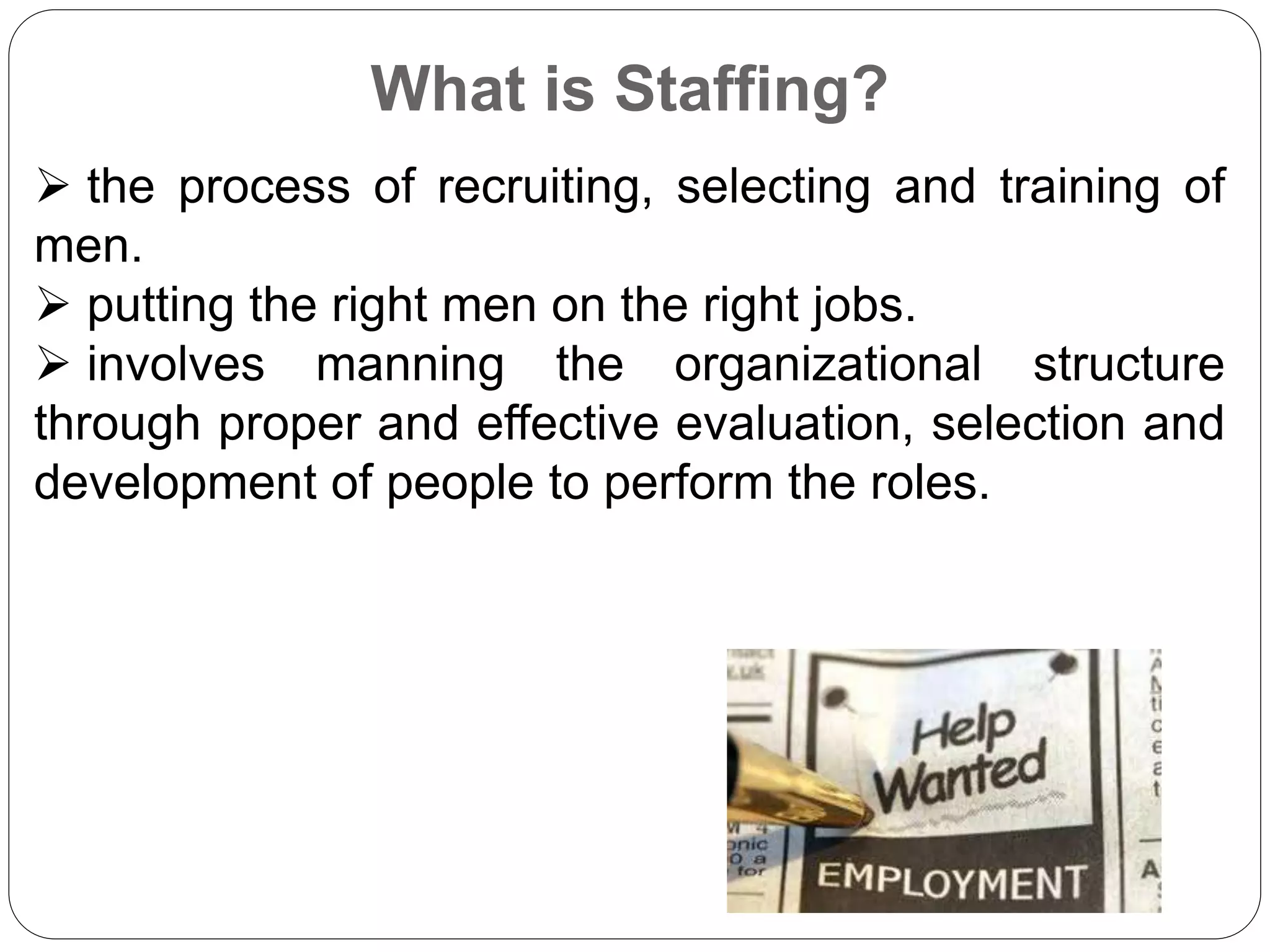
What is Staffing?
 the process of recruiting, selecting and training of
men.
 putting the right men on the right jobs.
 involves manning the organizational structure
through proper and effective evaluation, selection and
development of people to perform the roles.
Nature of Staffing
 All business organizations should focus their
attention and be concerned about the
effectiveness and efficiency of their employees
especially their managers.
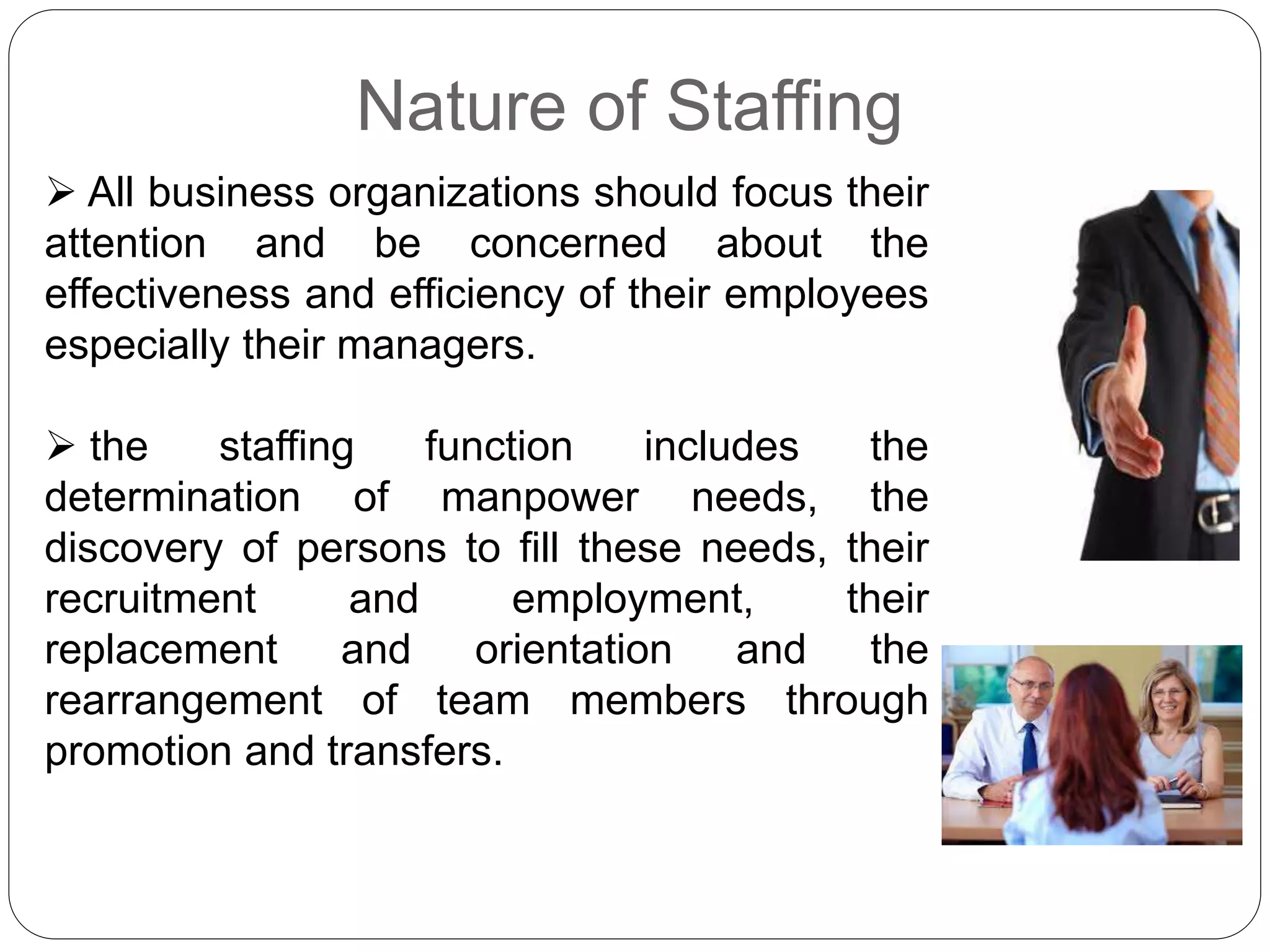
 the staffing function includes the
determination of manpower needs, the
discovery of persons to fill these needs, their
recruitment and employment, their
replacement and orientation and the
rearrangement of team members through
promotion and transfers.
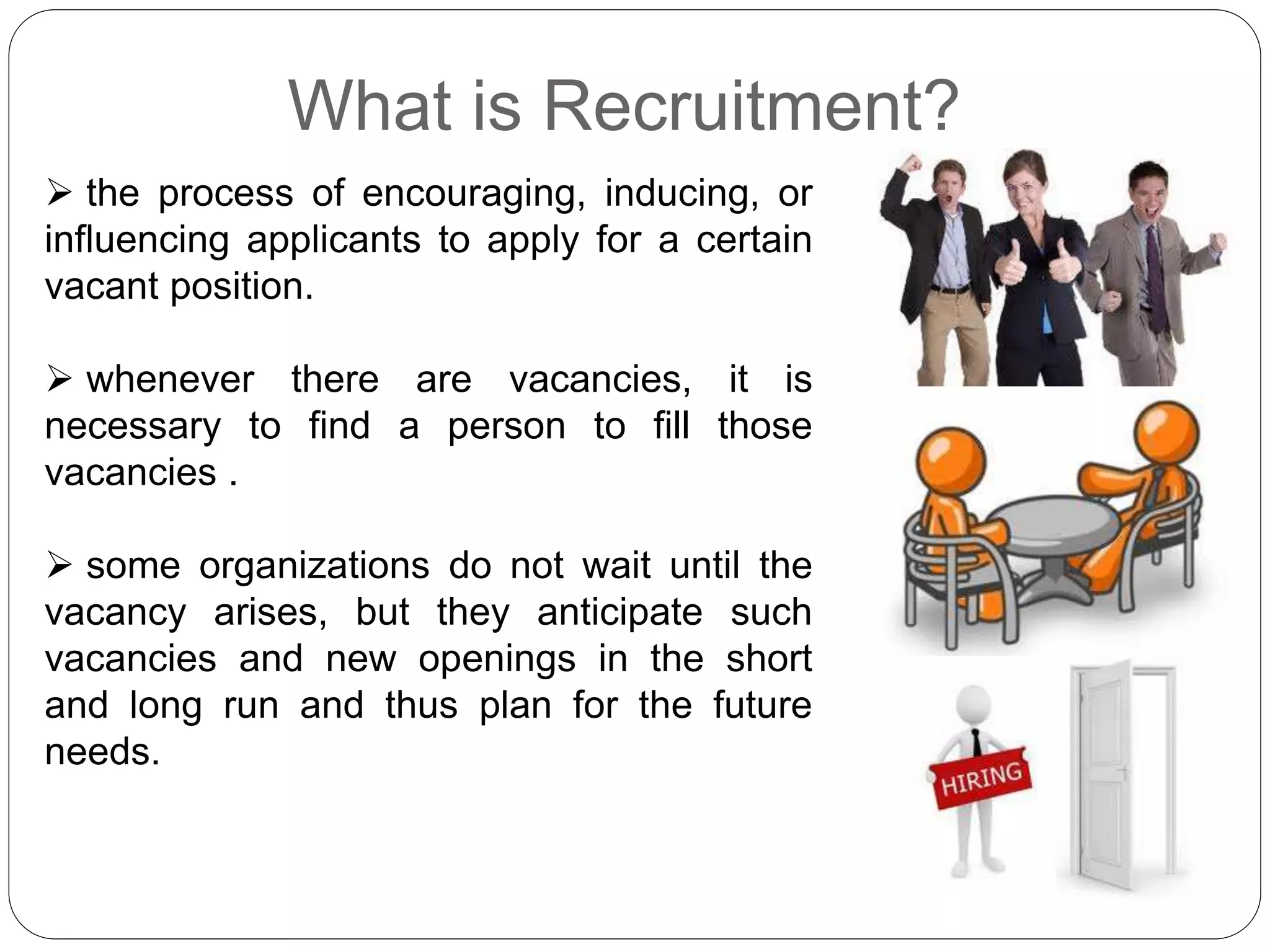
What is Recruitment?
 the process of encouraging, inducing, or
influencing applicants to apply for a certain
vacant position.
 whenever there are vacancies, it is
necessary to find a person to fill those
vacancies .
 some organizations do not wait until the
vacancy arises, but they anticipate such
vacancies and new openings in the short
and long run and thus plan for the future
needs.
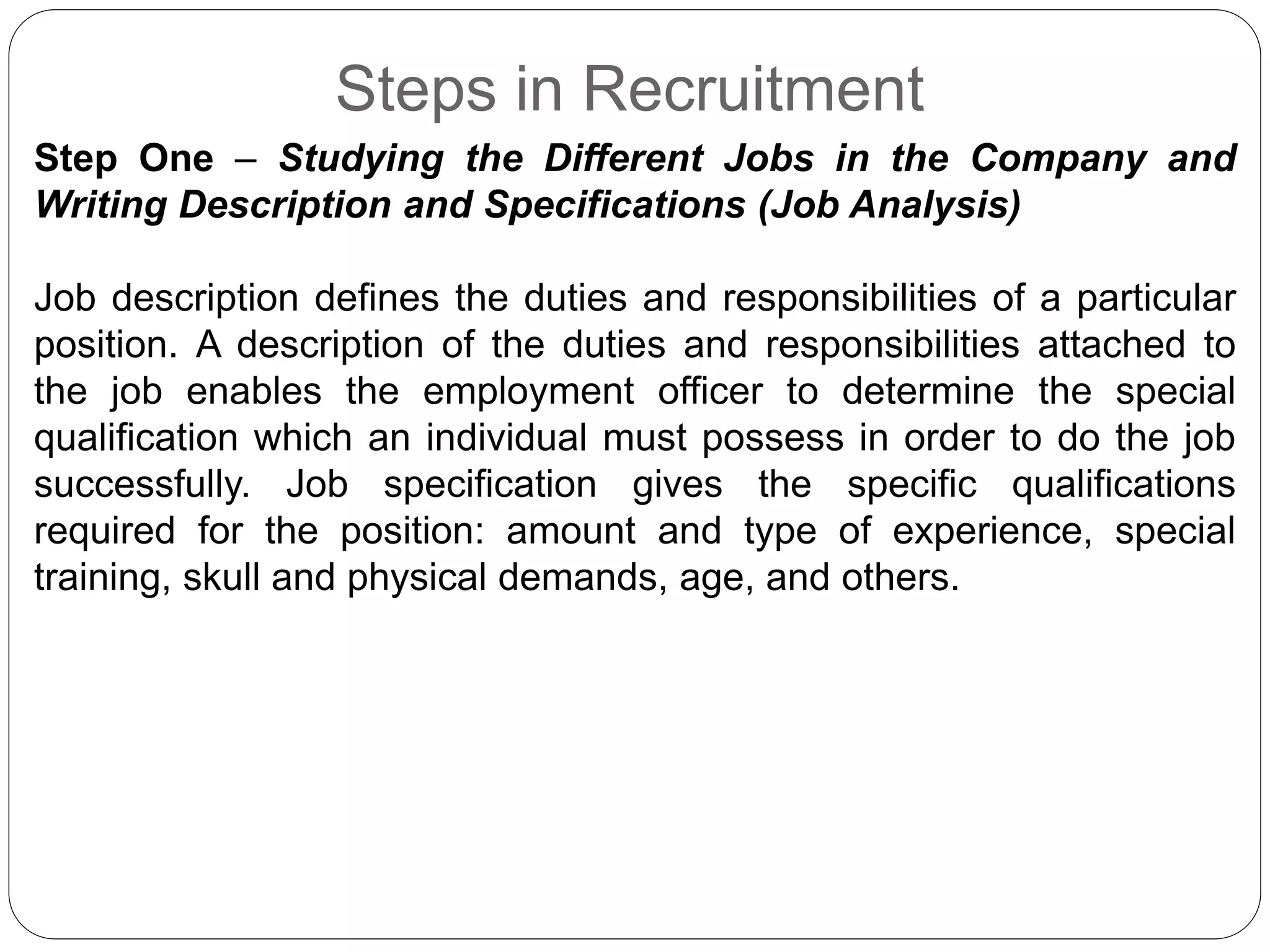
Steps in Recruitment
Step One – Studying the Different Jobs in the Company and
Writing Description and Specifications (Job Analysis)
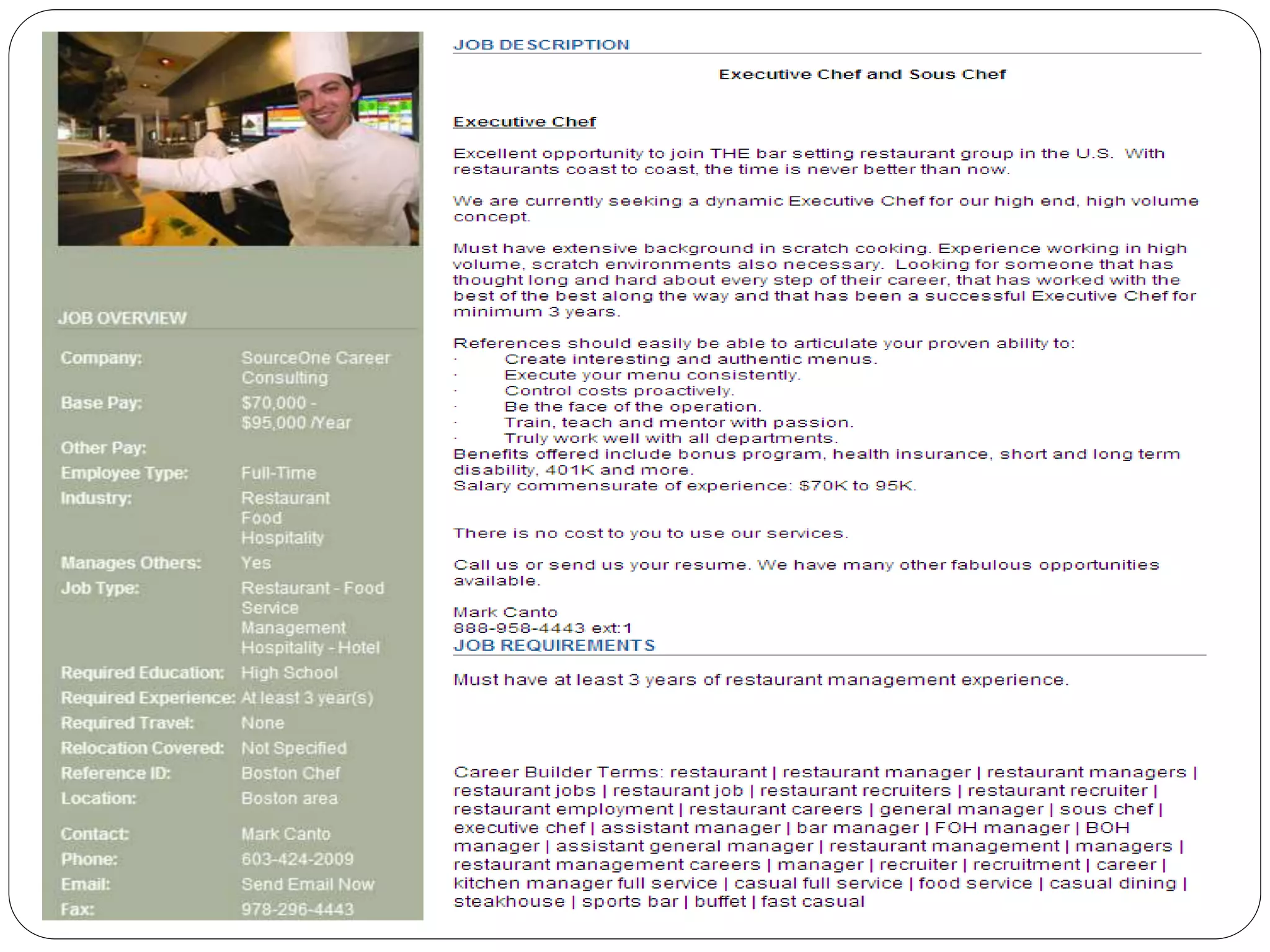
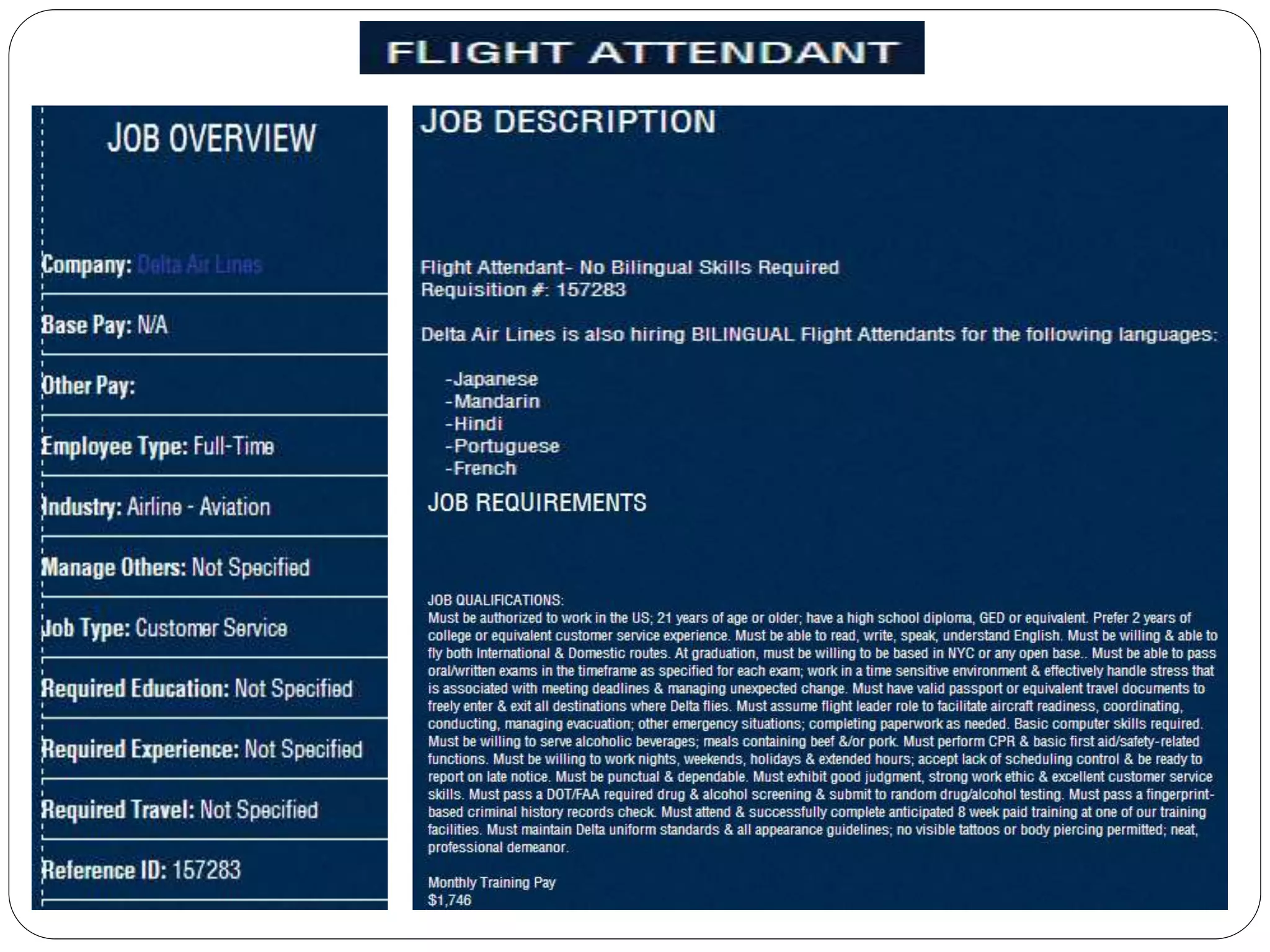
Job description defines the duties and responsibilities of a particular
position. A description of the duties and responsibilities attached to
the job enables the employment officer to determine the special
qualification which an individual must possess in order to do the job
successfully. Job specification gives the specific qualifications
required for the position: amount and type of experience, special
training, skull and physical demands, age, and others.
Steps in Recruitment
Step Two – Requisition of New Employee
 To inform the personnel department, the line supervisor or the department head
concerned should accomplish a formal requisition form, indicating the position to be
filled, the date when the new employee will be needed, the pay rate, the required
qualifications, job description, approval by the responsible official of the company and
others.
Step Three – Actual Recruitment of Applicants
 Process by which prospective applicants are induced to apply in the company in
order that their qualifications for present and anticipated vacancies can be evaluated
through sound screening and selection procedures.
Sources of Labor/Applicants:
a. Internal – employees recruited within the company.
b. External – applicants recruited through schools, references, advertisements,
placements agencies, etc.
Selection
 the process of getting the most qualified applicant among different job
seekers.
Step 1 – Reception of Applicants – Preliminary screening or sight
screening to eliminate undesirable applicants. Applicants are being
interviewed to be considered or not for further interviews or examination.
Step 2 – Preliminary Interview – Purposes: 1. how qualified the applicant,
2. to provide information of the job, 3. to create goodwill to the company.
Interviewer uses the applicant’s resume, employment tests and background
investigation.
Step 3 – Application Form – Used for the following:
1. As a guide when interviewing the applicant
2. Basis for eliminating applicants with unfavorable personal data
3. Matching the qualifications of the applicant
4. For checking applicant’s records
5. As part of employee’s permanent record
Selection
Step 4 – Employment Test – Testing the applicant’s abilities
Step 5 – Final Selection by Immediate Supervisor or Department Head
1. Management’s Decision – Applicant’s best fit for the job.
2. Applicant’s Decision – If the job is really for him.
3. Supervisor Decision – If the applicant can work for him and the team.
Step 6 – Physical and Medical Examination – Must pass the medical and
physical exam to prevent contamination of contagious disease and hiring of
liability employees.
Step 7 – Hiring – After steps 1 – 6, applicant to the HR dept for the
completion of the hiring process.
Step 8 – Orientation/Induction/Indoctrination – New employees are
oriented on company policies, rules and regulations, etc.
Training
 According to Labor Code of the Philippines, it is the
systematic development of the attitude, knowledge, behavior
patterns for adequate performance of a given job or task.
 It is a day to day, year-round task.
 All employees on a new job undergo a learning process
whether or not formal training exists.
Identifying Training Needs
 Training must be aimed at the accomplishment of some organizational goals, such as more efficient
production methods, improved quality product/services, or reduced operating costs.
Common Types of Training
1. On-the-Job Training and Job Rotation – Normally given by a senior employee or supervisor. Trainee
is shown how to perform the job and allowed to do it under the trainer’s supervision. Job-rotation or
cross-training allows flexibility in the department.
2. Vestibule Training – Procedure and equipment similar to those used in the actual job are set up in a
special working area. Trainee is taught how to perform the job at a comfortable pace without the
pressure of production schedule.
3. Apprenticeship Training – Generally lasts from one month to a year. During this time, the trainee
works under the guidance of a skilled worker.
4. Classroom Training – Use of classroom for teaching actual material, concepts, principles and theories.
5. Programming Instructions – Training is facilitated through computers in text form and/or computer
video displays.
6. Management Development Program – a systematic process of training and growth by which
individuals gain and apply knowledge, skills, insights and attitude to manage work organizations
effectively. Popular methods: Understudy assignment, Coaching, Experience, Job Rotation, Special
Projects, Lectures, Case Studies, Role Playing, In-Basket Techniques, Business Management Games
and University and Professional Association Seminars.
Human Asset Accounting
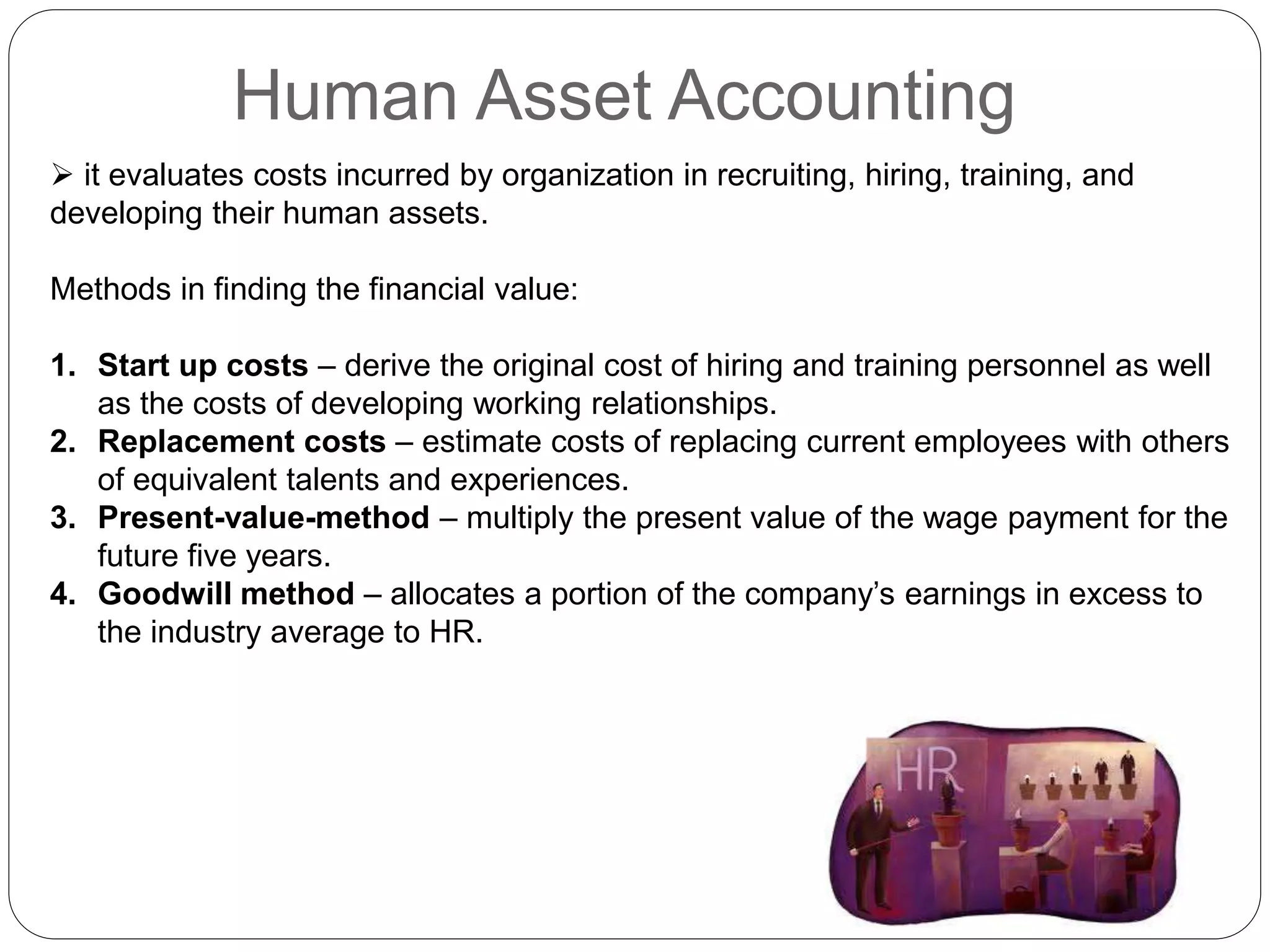
 it evaluates costs incurred by organization in recruiting, hiring, training, and
developing their human assets.
Methods in finding the financial value:
1. Start up costs – derive the original cost of hiring and training personnel as well
as the costs of developing working relationships.
2. Replacement costs – estimate costs of replacing current employees with others
of equivalent talents and experiences.
3. Present-value-method – multiply the present value of the wage payment for the
future five years.
4. Goodwill method – allocates a portion of the company’s earnings in excess to
the industry average to HR.
Movement of Personnel
Transfer – refers to shifting of an employee from one position to
another without increasing his duties, responsibilities, or pay.
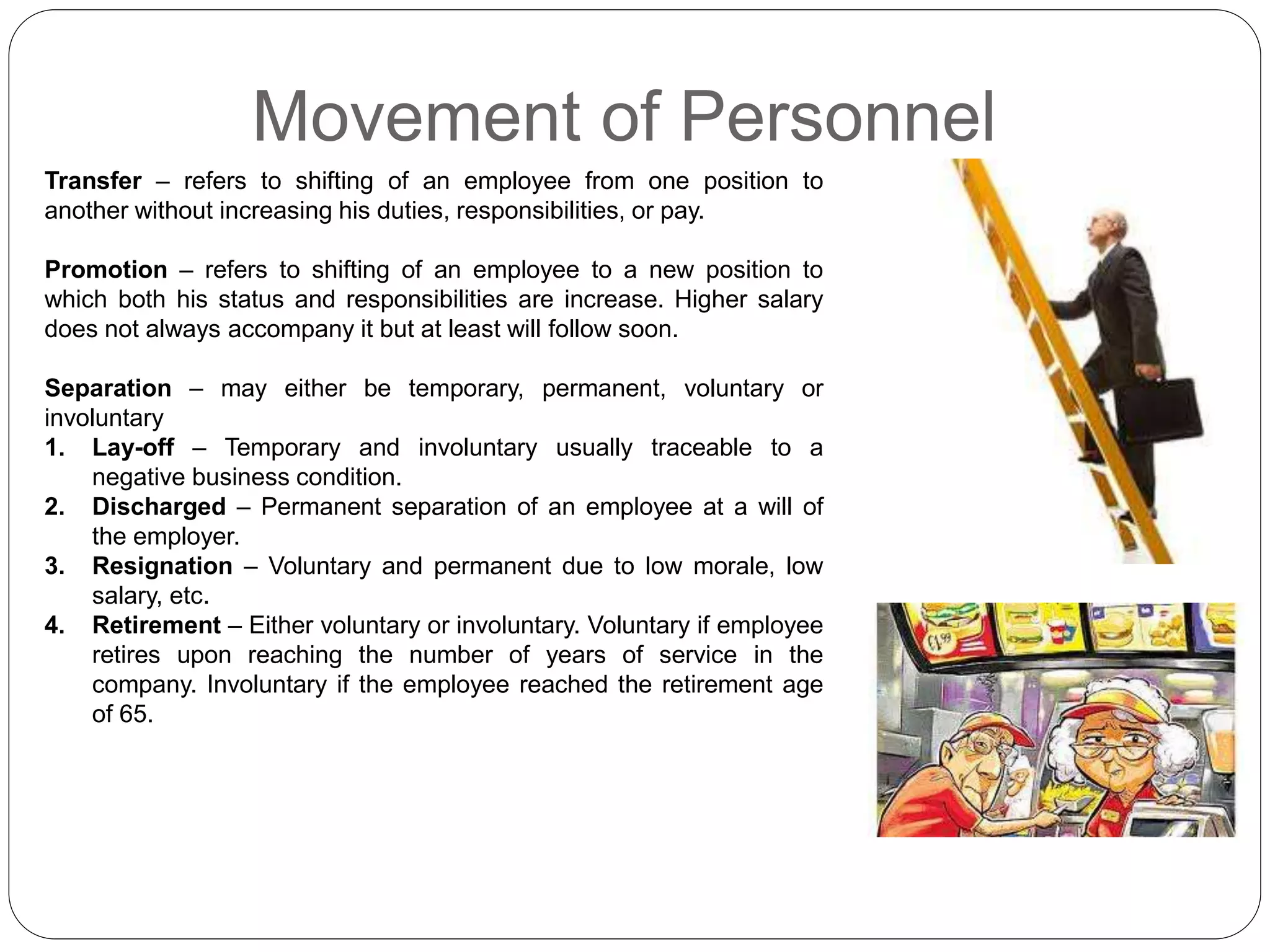
Promotion – refers to shifting of an employee to a new position to
which both his status and responsibilities are increase. Higher salary
does not always accompany it but at least will follow soon.
Separation – may either be temporary, permanent, voluntary or
involuntary
1. Lay-off – Temporary and involuntary usually traceable to a
negative business condition.
2. Discharged – Permanent separation of an employee at a will of
the employer.
3. Resignation – Voluntary and permanent due to low morale, low
salary, etc.
4. Retirement – Either voluntary or involuntary. Voluntary if employee
retires upon reaching the number of years of service in the
company. Involuntary if the employee reached the retirement age
of 65.

Principles of Management Chapter 5 Staffing

  • 1.
  • 2.
    Learning Objectives At theend of the chapter, you are all expected to understand the following:  Definition of Staffing  Nature of Staffing  Recruitment  Selection  Training  Identifying Training Needs  Types of Training  Human Asset Accounting  Movements of Personnel
  • 3.
    What is Staffing? the process of recruiting, selecting and training of men.  putting the right men on the right jobs.  involves manning the organizational structure through proper and effective evaluation, selection and development of people to perform the roles.
  • 4.
    Nature of Staffing All business organizations should focus their attention and be concerned about the effectiveness and efficiency of their employees especially their managers.  the staffing function includes the determination of manpower needs, the discovery of persons to fill these needs, their recruitment and employment, their replacement and orientation and the rearrangement of team members through promotion and transfers.
  • 5.
    What is Recruitment? the process of encouraging, inducing, or influencing applicants to apply for a certain vacant position.  whenever there are vacancies, it is necessary to find a person to fill those vacancies .  some organizations do not wait until the vacancy arises, but they anticipate such vacancies and new openings in the short and long run and thus plan for the future needs.
  • 6.
    Steps in Recruitment StepOne – Studying the Different Jobs in the Company and Writing Description and Specifications (Job Analysis) Job description defines the duties and responsibilities of a particular position. A description of the duties and responsibilities attached to the job enables the employment officer to determine the special qualification which an individual must possess in order to do the job successfully. Job specification gives the specific qualifications required for the position: amount and type of experience, special training, skull and physical demands, age, and others.
  • 9.
    Steps in Recruitment StepTwo – Requisition of New Employee  To inform the personnel department, the line supervisor or the department head concerned should accomplish a formal requisition form, indicating the position to be filled, the date when the new employee will be needed, the pay rate, the required qualifications, job description, approval by the responsible official of the company and others. Step Three – Actual Recruitment of Applicants  Process by which prospective applicants are induced to apply in the company in order that their qualifications for present and anticipated vacancies can be evaluated through sound screening and selection procedures. Sources of Labor/Applicants: a. Internal – employees recruited within the company. b. External – applicants recruited through schools, references, advertisements, placements agencies, etc.
  • 10.
    Selection  the processof getting the most qualified applicant among different job seekers. Step 1 – Reception of Applicants – Preliminary screening or sight screening to eliminate undesirable applicants. Applicants are being interviewed to be considered or not for further interviews or examination. Step 2 – Preliminary Interview – Purposes: 1. how qualified the applicant, 2. to provide information of the job, 3. to create goodwill to the company. Interviewer uses the applicant’s resume, employment tests and background investigation. Step 3 – Application Form – Used for the following: 1. As a guide when interviewing the applicant 2. Basis for eliminating applicants with unfavorable personal data 3. Matching the qualifications of the applicant 4. For checking applicant’s records 5. As part of employee’s permanent record
  • 11.
    Selection Step 4 –Employment Test – Testing the applicant’s abilities Step 5 – Final Selection by Immediate Supervisor or Department Head 1. Management’s Decision – Applicant’s best fit for the job. 2. Applicant’s Decision – If the job is really for him. 3. Supervisor Decision – If the applicant can work for him and the team. Step 6 – Physical and Medical Examination – Must pass the medical and physical exam to prevent contamination of contagious disease and hiring of liability employees. Step 7 – Hiring – After steps 1 – 6, applicant to the HR dept for the completion of the hiring process. Step 8 – Orientation/Induction/Indoctrination – New employees are oriented on company policies, rules and regulations, etc.
  • 12.
    Training  According toLabor Code of the Philippines, it is the systematic development of the attitude, knowledge, behavior patterns for adequate performance of a given job or task.  It is a day to day, year-round task.  All employees on a new job undergo a learning process whether or not formal training exists.
  • 13.
    Identifying Training Needs Training must be aimed at the accomplishment of some organizational goals, such as more efficient production methods, improved quality product/services, or reduced operating costs. Common Types of Training 1. On-the-Job Training and Job Rotation – Normally given by a senior employee or supervisor. Trainee is shown how to perform the job and allowed to do it under the trainer’s supervision. Job-rotation or cross-training allows flexibility in the department. 2. Vestibule Training – Procedure and equipment similar to those used in the actual job are set up in a special working area. Trainee is taught how to perform the job at a comfortable pace without the pressure of production schedule. 3. Apprenticeship Training – Generally lasts from one month to a year. During this time, the trainee works under the guidance of a skilled worker. 4. Classroom Training – Use of classroom for teaching actual material, concepts, principles and theories. 5. Programming Instructions – Training is facilitated through computers in text form and/or computer video displays. 6. Management Development Program – a systematic process of training and growth by which individuals gain and apply knowledge, skills, insights and attitude to manage work organizations effectively. Popular methods: Understudy assignment, Coaching, Experience, Job Rotation, Special Projects, Lectures, Case Studies, Role Playing, In-Basket Techniques, Business Management Games and University and Professional Association Seminars.
  • 14.
    Human Asset Accounting it evaluates costs incurred by organization in recruiting, hiring, training, and developing their human assets. Methods in finding the financial value: 1. Start up costs – derive the original cost of hiring and training personnel as well as the costs of developing working relationships. 2. Replacement costs – estimate costs of replacing current employees with others of equivalent talents and experiences. 3. Present-value-method – multiply the present value of the wage payment for the future five years. 4. Goodwill method – allocates a portion of the company’s earnings in excess to the industry average to HR.
  • 15.
    Movement of Personnel Transfer– refers to shifting of an employee from one position to another without increasing his duties, responsibilities, or pay. Promotion – refers to shifting of an employee to a new position to which both his status and responsibilities are increase. Higher salary does not always accompany it but at least will follow soon. Separation – may either be temporary, permanent, voluntary or involuntary 1. Lay-off – Temporary and involuntary usually traceable to a negative business condition. 2. Discharged – Permanent separation of an employee at a will of the employer. 3. Resignation – Voluntary and permanent due to low morale, low salary, etc. 4. Retirement – Either voluntary or involuntary. Voluntary if employee retires upon reaching the number of years of service in the company. Involuntary if the employee reached the retirement age of 65.