Draft Primary National
      Curriculum
   What would change?
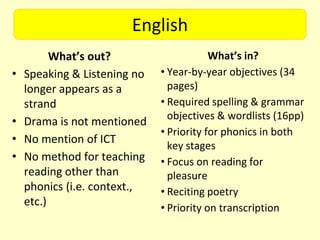
English
          What’s out?                     What’s in?
•   Speaking & Listening no   • Year-by-year objectives (34
    longer appears as a         pages)
    strand                    • Required spelling & grammar
                                objectives & wordlists (16pp)
•   Drama is not mentioned
                              • Priority for phonics in both
•   No mention of ICT
                                key stages
•   No method for teaching    • Focus on reading for
    reading other than          pleasure
    phonics (i.e. context.,   • Reciting poetry
    etc.)                     • Priority on transcription
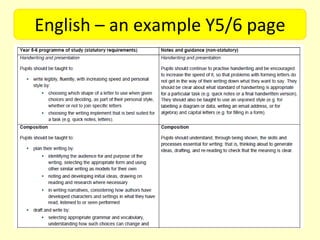
English – an example Y5/6 page
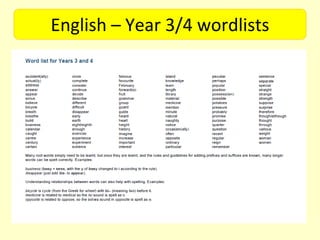
English – Year 3/4 wordlists
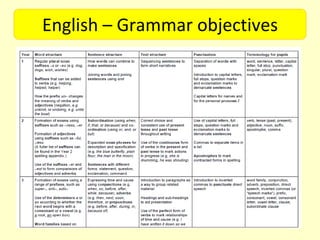
English – Grammar objectives
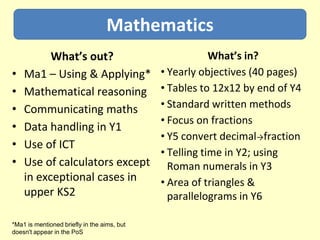
Mathematics
          What’s out?                                    What’s in?
•   Ma1 – Using & Applying*                  • Yearly objectives (40 pages)
•   Mathematical reasoning                   • Tables to 12x12 by end of Y4
•   Communicating maths                      • Standard written methods
                                             • Focus on fractions
•   Data handling in Y1
                                             • Y5 convert decimal→fraction
•   Use of ICT
                                             • Telling time in Y2; using
•   Use of calculators except                  Roman numerals in Y3
    in exceptional cases in                  • Area of triangles &
    upper KS2                                  parallelograms in Y6

*Ma1 is mentioned briefly in the aims, but
doesn't appear in the PoS
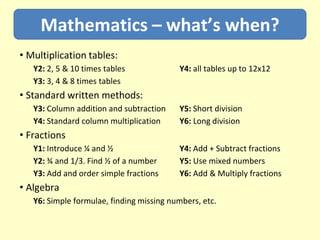
Mathematics – what’s when?
• Multiplication tables:
   Y2: 2, 5 & 10 times tables             Y4: all tables up to 12x12
   Y3: 3, 4 & 8 times tables
• Standard written methods:
   Y3: Column addition and subtraction    Y5: Short division
   Y4: Standard column multiplication     Y6: Long division
• Fractions
   Y1: Introduce ¼ and ½                  Y4: Add + Subtract fractions
   Y2: ¾ and 1/3. Find ½ of a number      Y5: Use mixed numbers
   Y3: Add and order simple fractions     Y6: Add & Multiply fractions
• Algebra
   Y6: Simple formulae, finding missing numbers, etc.
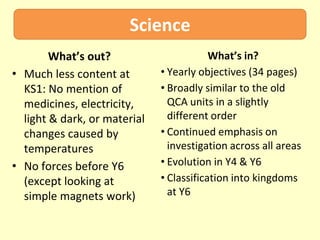
Science
        What’s out?                       What’s in?
• Much less content at        • Yearly objectives (34 pages)
  KS1: No mention of          • Broadly similar to the old
  medicines, electricity,       QCA units in a slightly
  light & dark, or material     different order
  changes caused by           • Continued emphasis on
  temperatures                  investigation across all areas
• No forces before Y6         • Evolution in Y4 & Y6
  (except looking at          • Classification into kingdoms
  simple magnets work)          at Y6
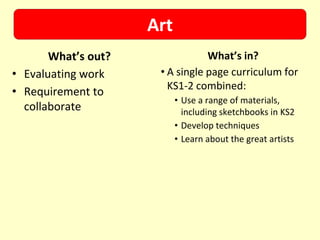
Art
       What’s out?               What’s in?
• Evaluating work     • A single page curriculum for
                        KS1-2 combined:
• Requirement to
                           • Use a range of materials,
  collaborate                including sketchbooks in KS2
                           • Develop techniques
                           • Learn about the great artists
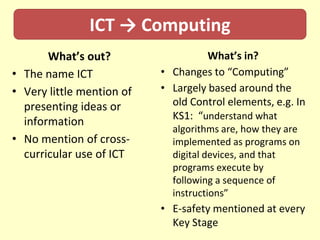
ICT → Computing
       What’s out?                   What’s in?
• The name ICT             • Changes to “Computing”
• Very little mention of   • Largely based around the
  presenting ideas or        old Control elements, e.g. In
                             KS1: “understand what
  information
                             algorithms are, how they are
• No mention of cross-       implemented as programs on
  curricular use of ICT      digital devices, and that
                             programs execute by
                             following a sequence of
                             instructions”
                           • E-safety mentioned at every
                             Key Stage
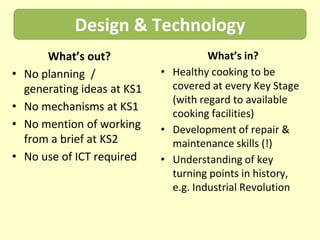
Design & Technology
        What’s out?                     What’s in?
•   No planning /             • Healthy cooking to be
    generating ideas at KS1     covered at every Key Stage
                                (with regard to available
•   No mechanisms at KS1
                                cooking facilities)
•   No mention of working     • Development of repair &
    from a brief at KS2         maintenance skills (!)
•   No use of ICT required    • Understanding of key
                                turning points in history,
                                e.g. Industrial Revolution
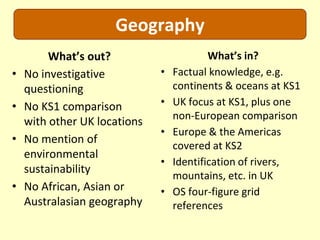
Geography
         What’s out?                      What’s in?
•   No investigative          •   Factual knowledge, e.g.
    questioning                   continents & oceans at KS1
•   No KS1 comparison         •   UK focus at KS1, plus one
                                  non-European comparison
    with other UK locations
                              •   Europe & the Americas
•   No mention of
                                  covered at KS2
    environmental
                              •   Identification of rivers,
    sustainability
                                  mountains, etc. in UK
•   No African, Asian or      •   OS four-figure grid
    Australasian geography        references
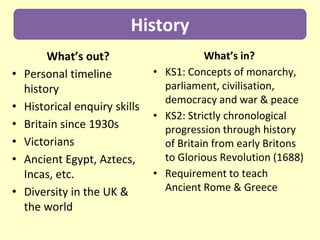
History
         What’s out?                       What’s in?
•   Personal timeline           • KS1: Concepts of monarchy,
    history                       parliament, civilisation,
                                  democracy and war & peace
•   Historical enquiry skills
                                • KS2: Strictly chronological
•   Britain since 1930s           progression through history
•   Victorians                    of Britain from early Britons
•   Ancient Egypt, Aztecs,        to Glorious Revolution (1688)
    Incas, etc.                 • Requirement to teach
•   Diversity in the UK &         Ancient Rome & Greece
    the world
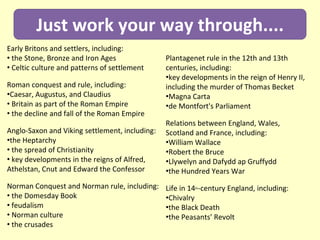
Just work your way through....
Early Britons and settlers, including:
• the Stone, Bronze and Iron Ages               Plantagenet rule in the 12th and 13th
• Celtic culture and patterns of settlement     centuries, including:
                                                •key developments in the reign of Henry II,
Roman conquest and rule, including:             including the murder of Thomas Becket
•Caesar, Augustus, and Claudius                 •Magna Carta
• Britain as part of the Roman Empire           •de Montfort's Parliament
• the decline and fall of the Roman Empire
                                                Relations between England, Wales,
Anglo-Saxon and Viking settlement, including:   Scotland and France, including:
•the Heptarchy                                  •William Wallace
• the spread of Christianity                    •Robert the Bruce
• key developments in the reigns of Alfred,     •Llywelyn and Dafydd ap Gruffydd
Athelstan, Cnut and Edward the Confessor        •the Hundred Years War
Norman Conquest and Norman rule, including:     Life in 14th-century England, including:
• the Domesday Book                             •Chivalry
• feudalism                                     •the Black Death
• Norman culture                                •the Peasants’ Revolt
• the crusades
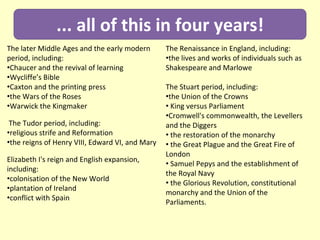
... all of this in four years!
The later Middle Ages and the early modern       The Renaissance in England, including:
period, including:                               •the lives and works of individuals such as
•Chaucer and the revival of learning             Shakespeare and Marlowe
•Wycliffe’s Bible
•Caxton and the printing press                   The Stuart period, including:
•the Wars of the Roses                           •the Union of the Crowns
•Warwick the Kingmaker                           • King versus Parliament
                                                 •Cromwell's commonwealth, the Levellers
 The Tudor period, including:                    and the Diggers
•religious strife and Reformation                • the restoration of the monarchy
•the reigns of Henry VIII, Edward VI, and Mary   • the Great Plague and the Great Fire of
                                                 London
Elizabeth I's reign and English expansion,
                                                 • Samuel Pepys and the establishment of
including:
                                                 the Royal Navy
•colonisation of the New World
                                                 • the Glorious Revolution, constitutional
•plantation of Ireland
                                                 monarchy and the Union of the
•conflict with Spain
                                                 Parliaments.
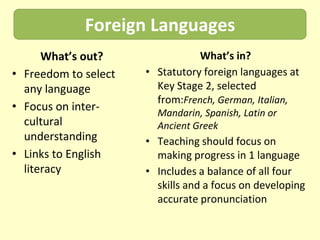
Foreign Languages
      What’s out?                What’s in?
• Freedom to select   • Statutory foreign languages at
  any language          Key Stage 2, selected
                        from:French, German, Italian,
• Focus on inter-       Mandarin, Spanish, Latin or
  cultural              Ancient Greek
  understanding       • Teaching should focus on
• Links to English      making progress in 1 language
  literacy            • Includes a balance of all four
                        skills and a focus on developing
                        accurate pronunciation
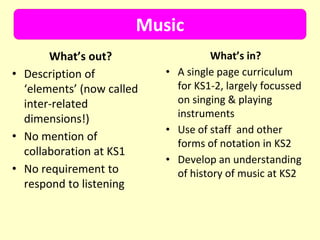
Music
       What’s out?                   What’s in?
• Description of           • A single page curriculum
  ‘elements’ (now called     for KS1-2, largely focussed
  inter-related              on singing & playing
  dimensions!)               instruments
                           • Use of staff and other
• No mention of
                             forms of notation in KS2
  collaboration at KS1
                           • Develop an understanding
• No requirement to          of history of music at KS2
  respond to listening
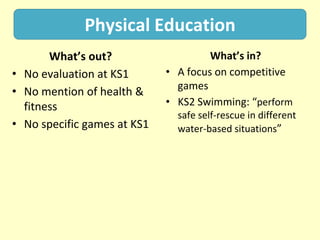
Physical Education
       What’s out?                    What’s in?
• No evaluation at KS1       • A focus on competitive
                               games
• No mention of health &
  fitness                    • KS2 Swimming: “perform
                               safe self-rescue in different
• No specific games at KS1     water-based situations”
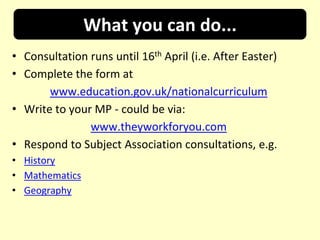
What you can do...
• Consultation runs until 16th April (i.e. After Easter)
• Complete the form at
       www.education.gov.uk/nationalcurriculum
• Write to your MP - could be via:
               www.theyworkforyou.com
• Respond to Subject Association consultations, e.g.
• History
• Mathematics
• Geography

Primary nc what's changed (1)

  • 1.
    Draft Primary National Curriculum What would change?
  • 2.
    English What’s out? What’s in? • Speaking & Listening no • Year-by-year objectives (34 longer appears as a pages) strand • Required spelling & grammar objectives & wordlists (16pp) • Drama is not mentioned • Priority for phonics in both • No mention of ICT key stages • No method for teaching • Focus on reading for reading other than pleasure phonics (i.e. context., • Reciting poetry etc.) • Priority on transcription
  • 3.
    English – anexample Y5/6 page
  • 4.
    English – Year3/4 wordlists
  • 5.
  • 6.
    Mathematics What’s out? What’s in? • Ma1 – Using & Applying* • Yearly objectives (40 pages) • Mathematical reasoning • Tables to 12x12 by end of Y4 • Communicating maths • Standard written methods • Focus on fractions • Data handling in Y1 • Y5 convert decimal→fraction • Use of ICT • Telling time in Y2; using • Use of calculators except Roman numerals in Y3 in exceptional cases in • Area of triangles & upper KS2 parallelograms in Y6 *Ma1 is mentioned briefly in the aims, but doesn't appear in the PoS
  • 7.
    Mathematics – what’swhen? • Multiplication tables: Y2: 2, 5 & 10 times tables Y4: all tables up to 12x12 Y3: 3, 4 & 8 times tables • Standard written methods: Y3: Column addition and subtraction Y5: Short division Y4: Standard column multiplication Y6: Long division • Fractions Y1: Introduce ¼ and ½ Y4: Add + Subtract fractions Y2: ¾ and 1/3. Find ½ of a number Y5: Use mixed numbers Y3: Add and order simple fractions Y6: Add & Multiply fractions • Algebra Y6: Simple formulae, finding missing numbers, etc.
  • 8.
    Science What’s out? What’s in? • Much less content at • Yearly objectives (34 pages) KS1: No mention of • Broadly similar to the old medicines, electricity, QCA units in a slightly light & dark, or material different order changes caused by • Continued emphasis on temperatures investigation across all areas • No forces before Y6 • Evolution in Y4 & Y6 (except looking at • Classification into kingdoms simple magnets work) at Y6
  • 9.
    Art What’s out? What’s in? • Evaluating work • A single page curriculum for KS1-2 combined: • Requirement to • Use a range of materials, collaborate including sketchbooks in KS2 • Develop techniques • Learn about the great artists
  • 10.
    ICT → Computing What’s out? What’s in? • The name ICT • Changes to “Computing” • Very little mention of • Largely based around the presenting ideas or old Control elements, e.g. In KS1: “understand what information algorithms are, how they are • No mention of cross- implemented as programs on curricular use of ICT digital devices, and that programs execute by following a sequence of instructions” • E-safety mentioned at every Key Stage
  • 11.
    Design & Technology What’s out? What’s in? • No planning / • Healthy cooking to be generating ideas at KS1 covered at every Key Stage (with regard to available • No mechanisms at KS1 cooking facilities) • No mention of working • Development of repair & from a brief at KS2 maintenance skills (!) • No use of ICT required • Understanding of key turning points in history, e.g. Industrial Revolution
  • 12.
    Geography What’s out? What’s in? • No investigative • Factual knowledge, e.g. questioning continents & oceans at KS1 • No KS1 comparison • UK focus at KS1, plus one non-European comparison with other UK locations • Europe & the Americas • No mention of covered at KS2 environmental • Identification of rivers, sustainability mountains, etc. in UK • No African, Asian or • OS four-figure grid Australasian geography references
  • 13.
    History What’s out? What’s in? • Personal timeline • KS1: Concepts of monarchy, history parliament, civilisation, democracy and war & peace • Historical enquiry skills • KS2: Strictly chronological • Britain since 1930s progression through history • Victorians of Britain from early Britons • Ancient Egypt, Aztecs, to Glorious Revolution (1688) Incas, etc. • Requirement to teach • Diversity in the UK & Ancient Rome & Greece the world
  • 14.
    Just work yourway through.... Early Britons and settlers, including: • the Stone, Bronze and Iron Ages Plantagenet rule in the 12th and 13th • Celtic culture and patterns of settlement centuries, including: •key developments in the reign of Henry II, Roman conquest and rule, including: including the murder of Thomas Becket •Caesar, Augustus, and Claudius •Magna Carta • Britain as part of the Roman Empire •de Montfort's Parliament • the decline and fall of the Roman Empire Relations between England, Wales, Anglo-Saxon and Viking settlement, including: Scotland and France, including: •the Heptarchy •William Wallace • the spread of Christianity •Robert the Bruce • key developments in the reigns of Alfred, •Llywelyn and Dafydd ap Gruffydd Athelstan, Cnut and Edward the Confessor •the Hundred Years War Norman Conquest and Norman rule, including: Life in 14th-century England, including: • the Domesday Book •Chivalry • feudalism •the Black Death • Norman culture •the Peasants’ Revolt • the crusades
  • 15.
    ... all ofthis in four years! The later Middle Ages and the early modern The Renaissance in England, including: period, including: •the lives and works of individuals such as •Chaucer and the revival of learning Shakespeare and Marlowe •Wycliffe’s Bible •Caxton and the printing press The Stuart period, including: •the Wars of the Roses •the Union of the Crowns •Warwick the Kingmaker • King versus Parliament •Cromwell's commonwealth, the Levellers The Tudor period, including: and the Diggers •religious strife and Reformation • the restoration of the monarchy •the reigns of Henry VIII, Edward VI, and Mary • the Great Plague and the Great Fire of London Elizabeth I's reign and English expansion, • Samuel Pepys and the establishment of including: the Royal Navy •colonisation of the New World • the Glorious Revolution, constitutional •plantation of Ireland monarchy and the Union of the •conflict with Spain Parliaments.
  • 16.
    Foreign Languages What’s out? What’s in? • Freedom to select • Statutory foreign languages at any language Key Stage 2, selected from:French, German, Italian, • Focus on inter- Mandarin, Spanish, Latin or cultural Ancient Greek understanding • Teaching should focus on • Links to English making progress in 1 language literacy • Includes a balance of all four skills and a focus on developing accurate pronunciation
  • 17.
    Music What’s out? What’s in? • Description of • A single page curriculum ‘elements’ (now called for KS1-2, largely focussed inter-related on singing & playing dimensions!) instruments • Use of staff and other • No mention of forms of notation in KS2 collaboration at KS1 • Develop an understanding • No requirement to of history of music at KS2 respond to listening
  • 18.
    Physical Education What’s out? What’s in? • No evaluation at KS1 • A focus on competitive games • No mention of health & fitness • KS2 Swimming: “perform safe self-rescue in different • No specific games at KS1 water-based situations”
  • 19.
    What you cando... • Consultation runs until 16th April (i.e. After Easter) • Complete the form at www.education.gov.uk/nationalcurriculum • Write to your MP - could be via: www.theyworkforyou.com • Respond to Subject Association consultations, e.g. • History • Mathematics • Geography