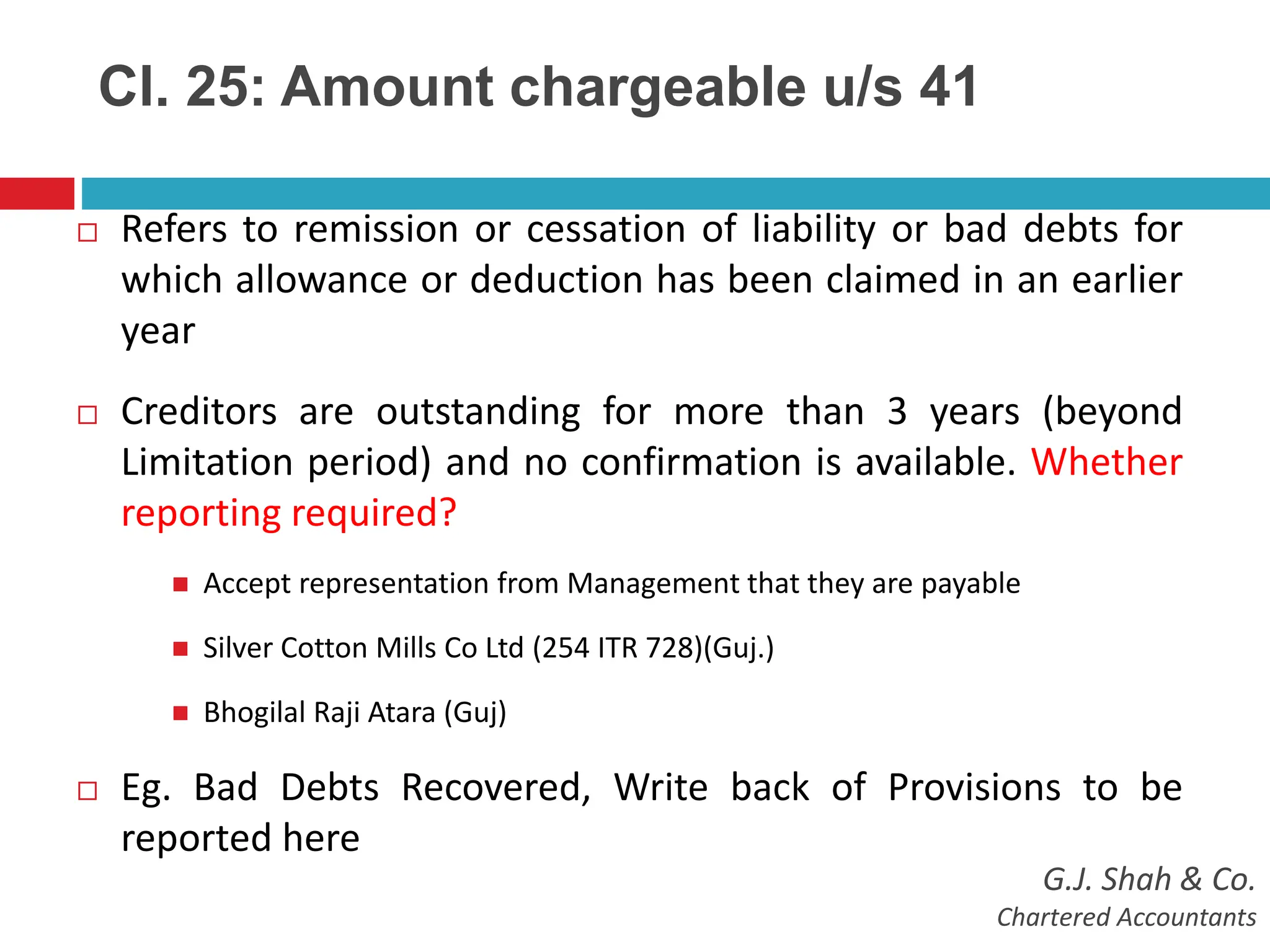
Tax Audit – a
national duty of
Chartered
Accountants
Jabalpur Branch of CIRC of ICAI
Presented By: CA. Pankaj Shah
To start with
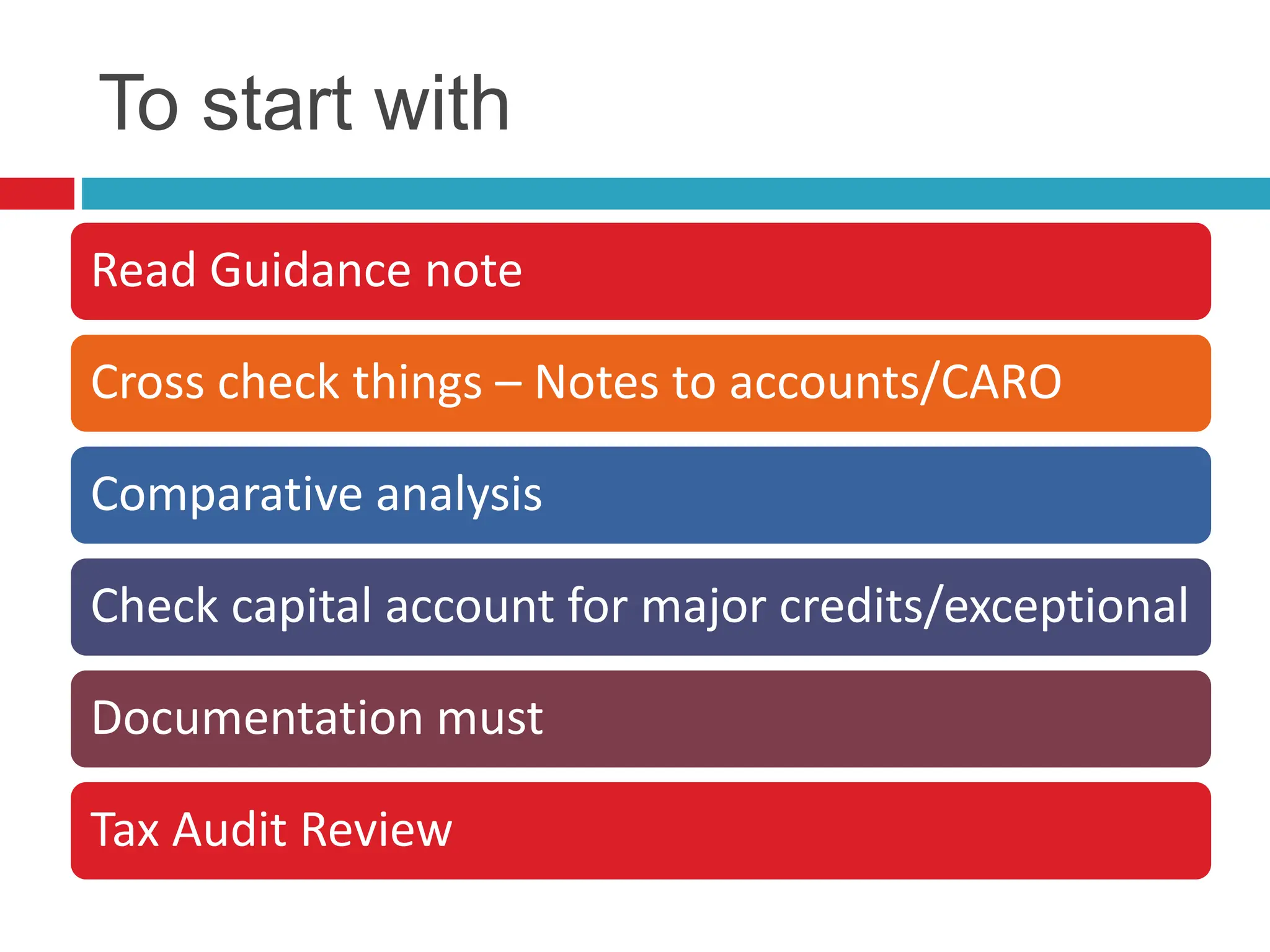
Read Guidance note
Cross check things – Notes to accounts/CARO
Comparative analysis
Check capital account for major credits/exceptional
Documentation must
Tax Audit Review
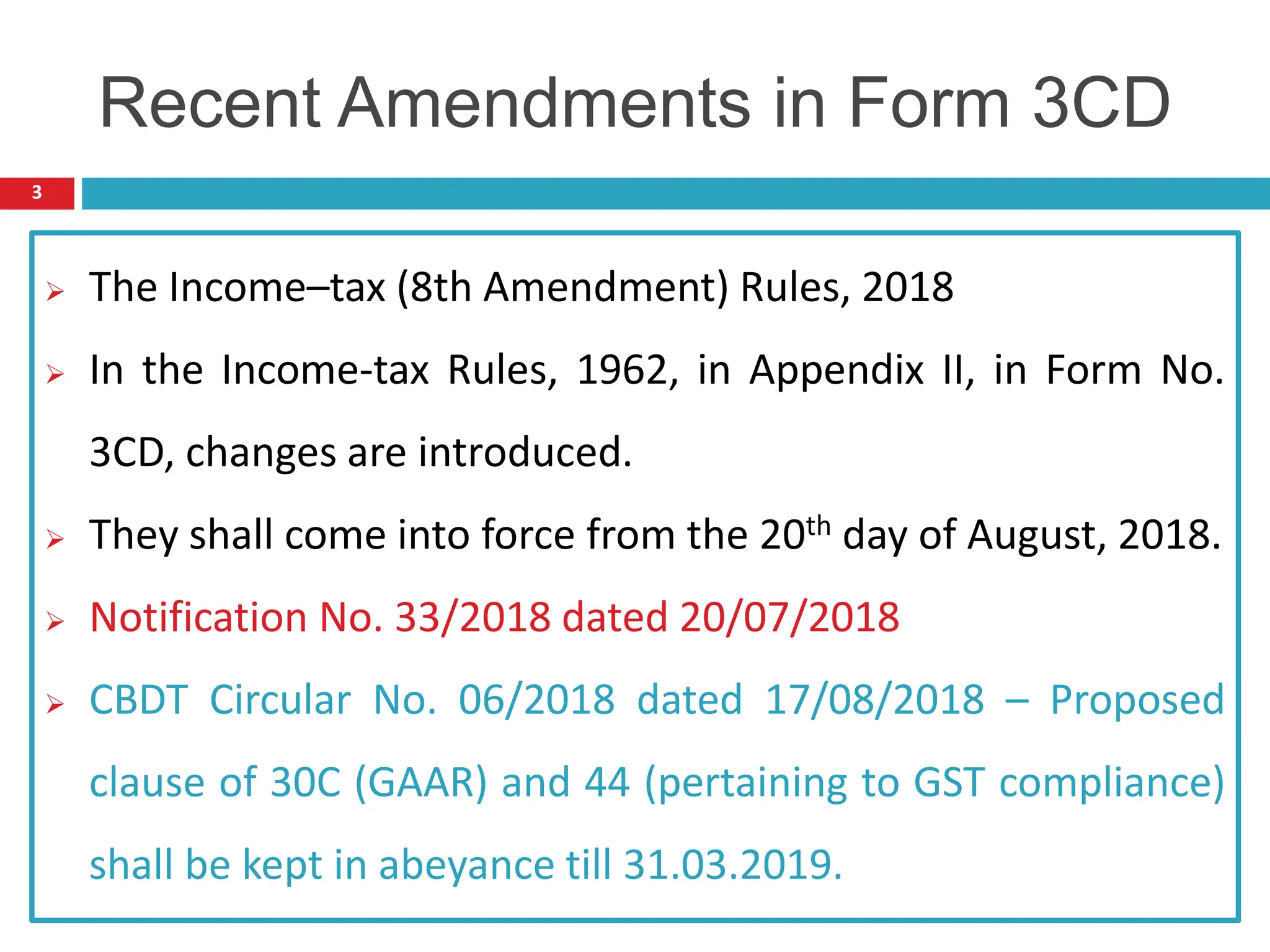
 The Income–tax (8th Amendment) Rules, 2018
 In the Income-tax Rules, 1962, in Appendix II, in Form No.
3CD, changes are introduced.
 They shall come into force from the 20th day of August, 2018.
 Notification No. 33/2018 dated 20/07/2018
 CBDT Circular No. 06/2018 dated 17/08/2018 – Proposed
clause of 30C (GAAR) and 44 (pertaining to GST compliance)
shall be kept in abeyance till 31.03.2019.
3
Recent Amendments in Form 3CD
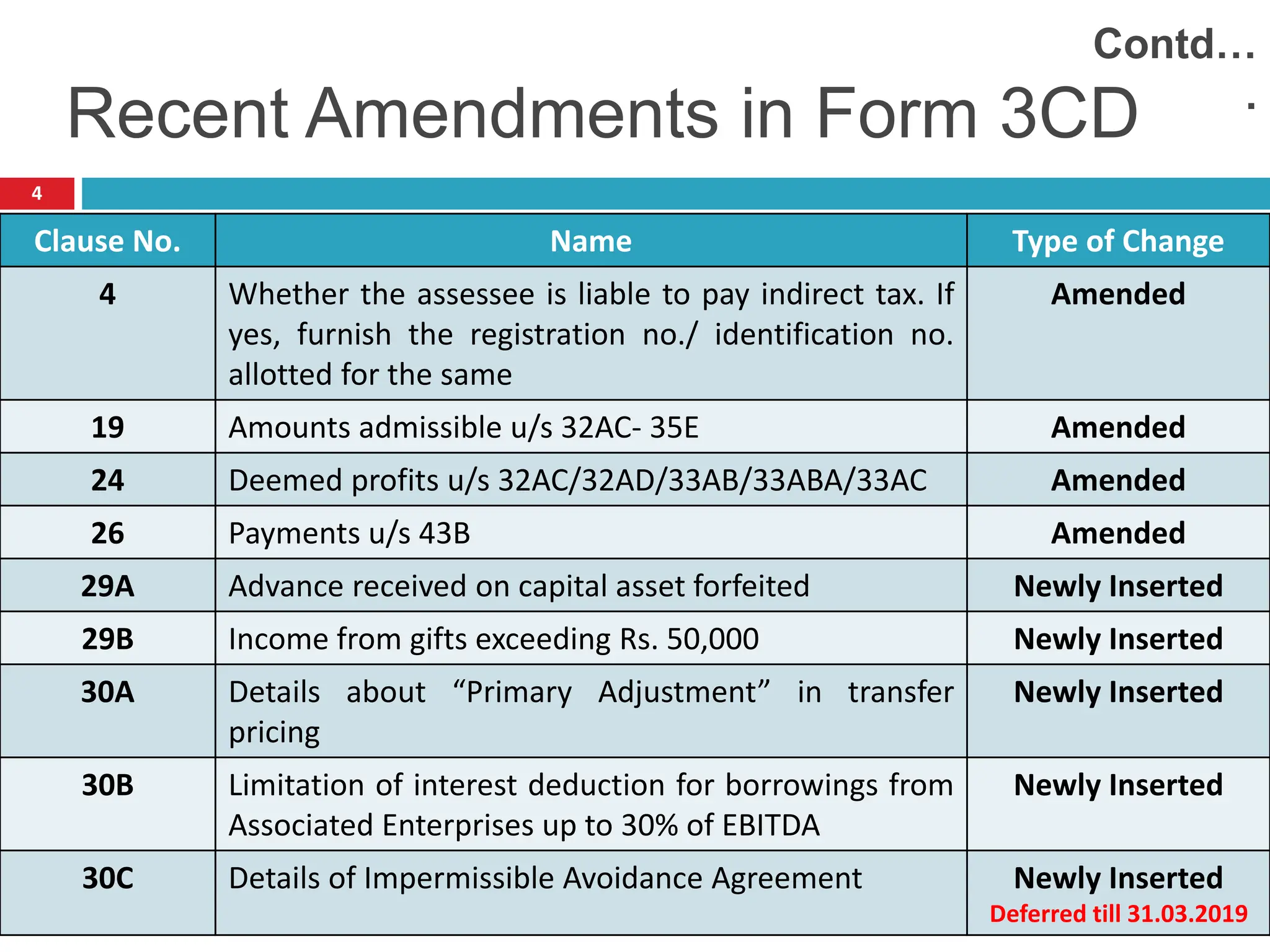
Clause No. Name Type of Change
4 Whether the assessee is liable to pay indirect tax. If
yes, furnish the registration no./ identification no.
allotted for the same
Amended
19 Amounts admissible u/s 32AC- 35E Amended
24 Deemed profits u/s 32AC/32AD/33AB/33ABA/33AC Amended
26 Payments u/s 43B Amended
29A Advance received on capital asset forfeited Newly Inserted
29B Income from gifts exceeding Rs. 50,000 Newly Inserted
30A Details about “Primary Adjustment” in transfer
pricing
Newly Inserted
30B Limitation of interest deduction for borrowings from
Associated Enterprises up to 30% of EBITDA
Newly Inserted
30C Details of Impermissible Avoidance Agreement Newly Inserted
Deferred till 31.03.2019
4
Recent Amendments in Form 3CD
Contd…
.
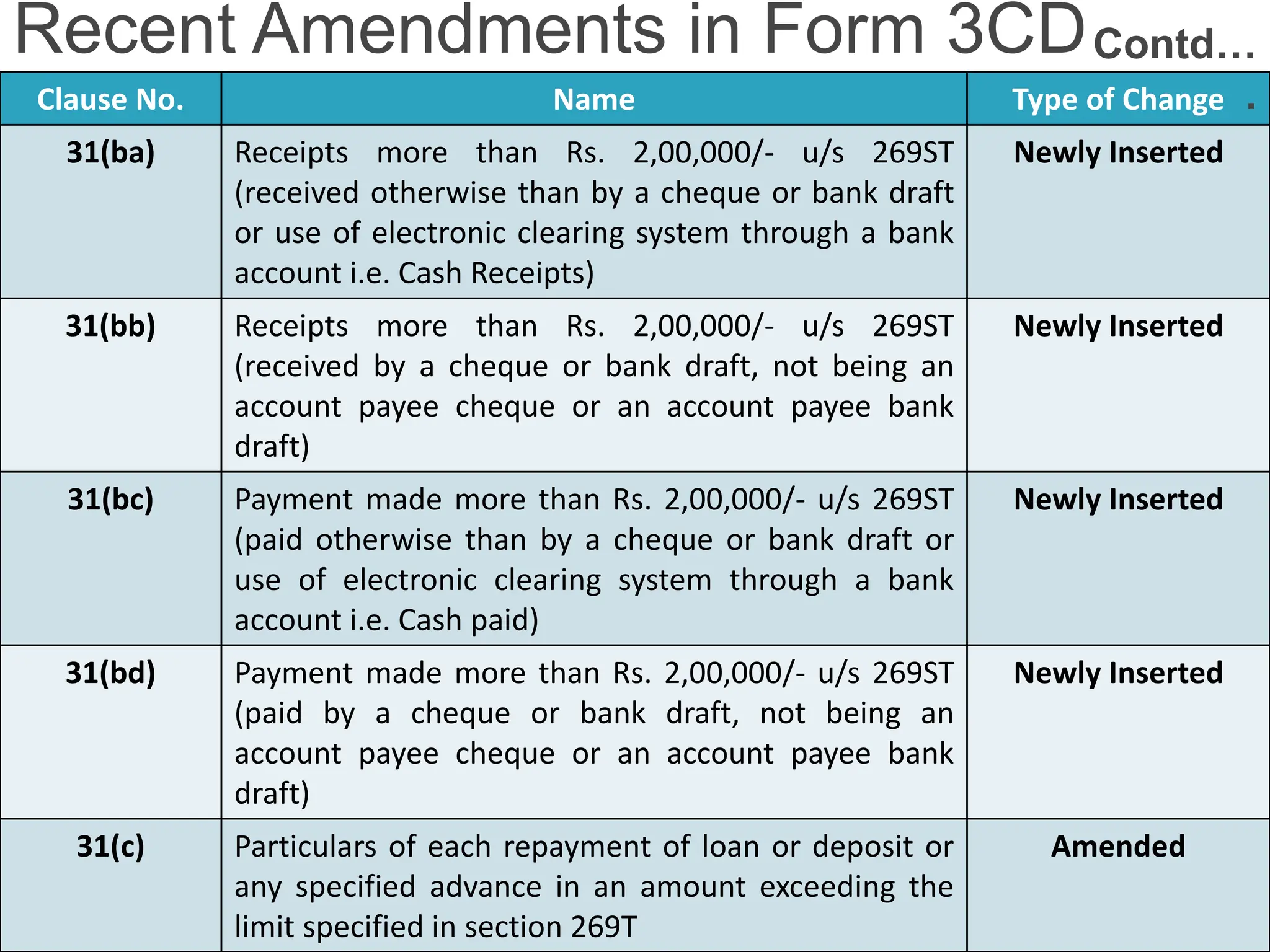
Clause No. Name Type of Change
31(ba) Receipts more than Rs. 2,00,000/- u/s 269ST
(received otherwise than by a cheque or bank draft
or use of electronic clearing system through a bank
account i.e. Cash Receipts)
Newly Inserted
31(bb) Receipts more than Rs. 2,00,000/- u/s 269ST
(received by a cheque or bank draft, not being an
account payee cheque or an account payee bank
draft)
Newly Inserted
31(bc) Payment made more than Rs. 2,00,000/- u/s 269ST
(paid otherwise than by a cheque or bank draft or
use of electronic clearing system through a bank
account i.e. Cash paid)
Newly Inserted
31(bd) Payment made more than Rs. 2,00,000/- u/s 269ST
(paid by a cheque or bank draft, not being an
account payee cheque or an account payee bank
draft)
Newly Inserted
31(c) Particulars of each repayment of loan or deposit or
any specified advance in an amount exceeding the
limit specified in section 269T
Amended
Recent Amendments in Form 3CDContd…
.
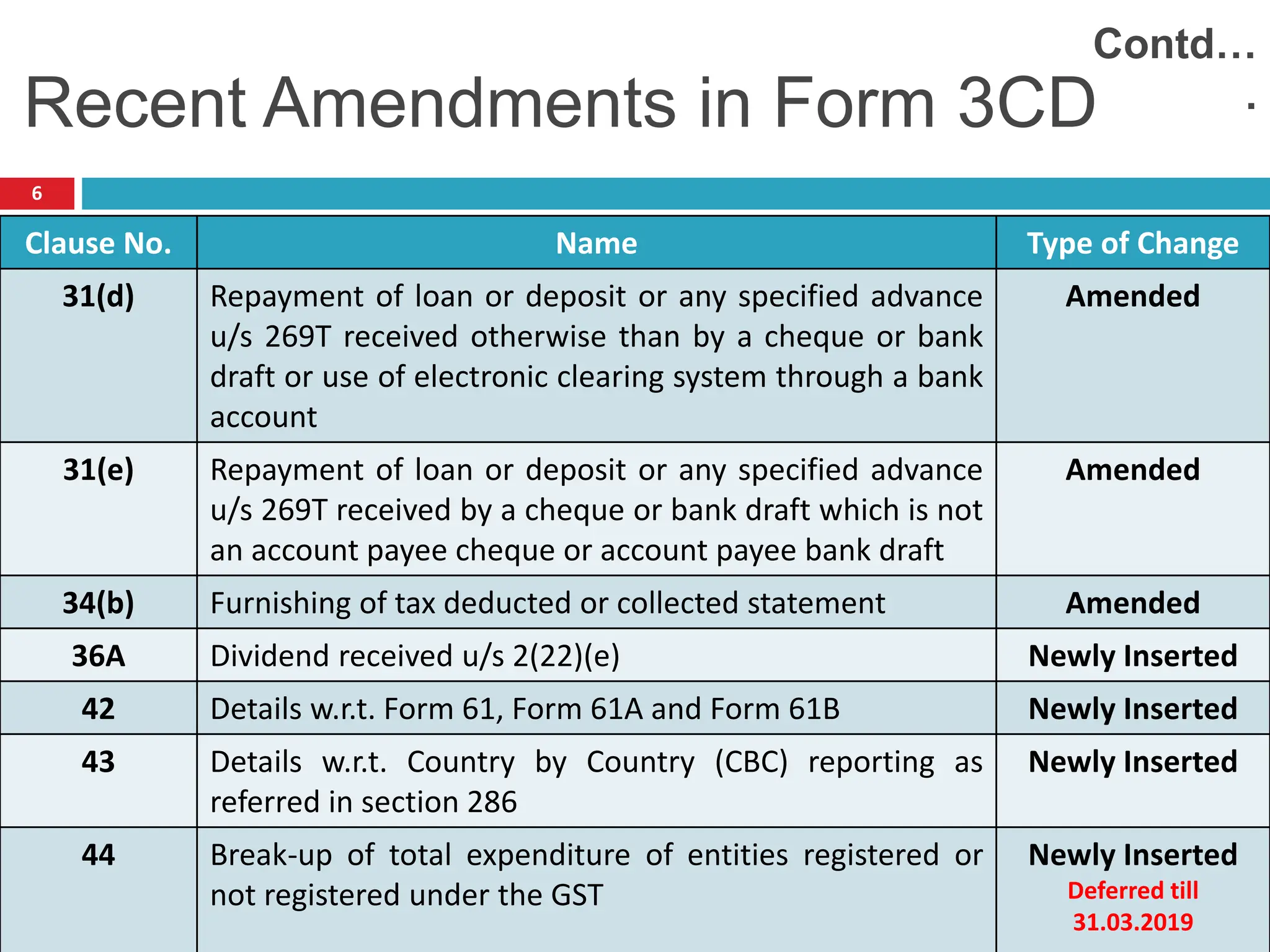
Clause No. Name Type of Change
31(d) Repayment of loan or deposit or any specified advance
u/s 269T received otherwise than by a cheque or bank
draft or use of electronic clearing system through a bank
account
Amended
31(e) Repayment of loan or deposit or any specified advance
u/s 269T received by a cheque or bank draft which is not
an account payee cheque or account payee bank draft
Amended
34(b) Furnishing of tax deducted or collected statement Amended
36A Dividend received u/s 2(22)(e) Newly Inserted
42 Details w.r.t. Form 61, Form 61A and Form 61B Newly Inserted
43 Details w.r.t. Country by Country (CBC) reporting as
referred in section 286
Newly Inserted
44 Break-up of total expenditure of entities registered or
not registered under the GST
Newly Inserted
Deferred till
31.03.2019
Recent Amendments in Form 3CD
Contd…
.
6
General Changes due
to Amendment in
Income Tax Act
7
Old Clause:
‘Whether the assessee is liable to pay indirect tax like excise duty, service
tax, sales tax, customs duty, etc. If yes, please furnish the registration
number or any other identification number allotted for the same.’
Amendment by Income tax (18th Amendment) Rules, 2018
‘Whether the assessee is liable to pay indirect tax like excise duty, service
tax, sales tax, goods and services tax, customs duty, etc. If yes, please
furnish the registration number or GST number or any other
identification number allotted for the same.’
Brief: Applicability of GST and if yes, then GSTIN have to mentioned.
8
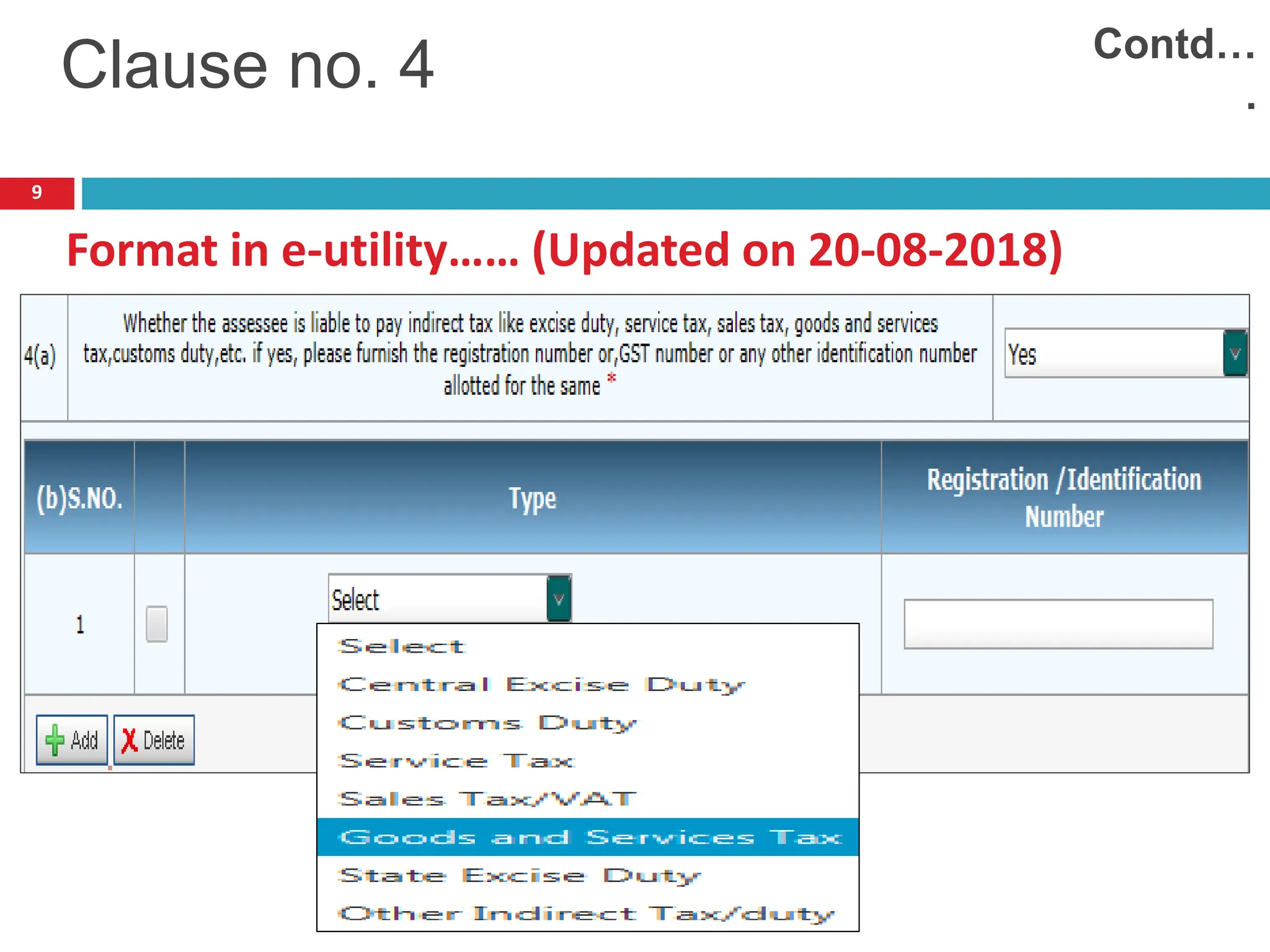
Clause no. 4
[Amended]
9
Format in e-utility…… (Updated on 20-08-2018)
Clause no. 4 Contd…
.
10
Clause 19 (Amended) - in the table, after the row with entry
“32AC”, the row with entry “32AD” shall be inserted;
i.e. Allowance under Section 32AD* is to be reported which
should be 15% of actual cost of new asset.
*Section 32AD - investment in new plant or machinery in
notified backward areas in certain States
Clause no. 19 [Amended]
11
Clause no. 19 [Amended]
Format in e-utility
Contd…
.
12
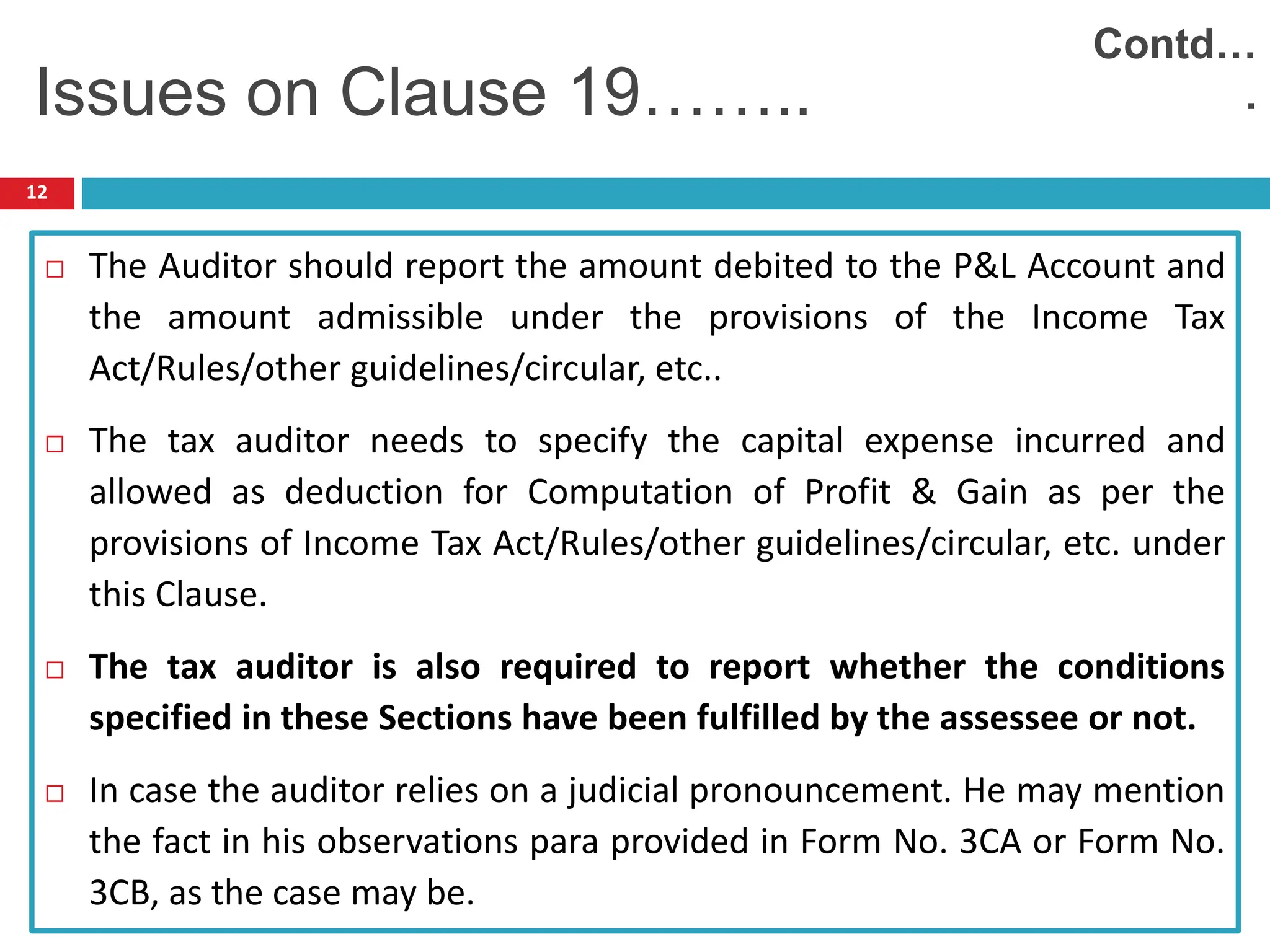
 The Auditor should report the amount debited to the P&L Account and
the amount admissible under the provisions of the Income Tax
Act/Rules/other guidelines/circular, etc..
 The tax auditor needs to specify the capital expense incurred and
allowed as deduction for Computation of Profit & Gain as per the
provisions of Income Tax Act/Rules/other guidelines/circular, etc. under
this Clause.
 The tax auditor is also required to report whether the conditions
specified in these Sections have been fulfilled by the assessee or not.
 In case the auditor relies on a judicial pronouncement. He may mention
the fact in his observations para provided in Form No. 3CA or Form No.
3CB, as the case may be.
Issues on Clause 19……..
Contd…
.
13
Clause 24 (Amended) - after the words “32AC or”, the words
“32AD or” shall be inserted.
i.e. Deemed gains under Section 32AD* to be reported if the
new asset in respect of which the amount of deduction is
availed under this section, is sold before the expiry of 5 years.
*Section 32AD - investment in new plant or machinery in
notified backward areas in certain States
Clause no. 24 [Amended]
14
Format in e-utility…..
Contd….
Clause no. 24 [Amended]
15
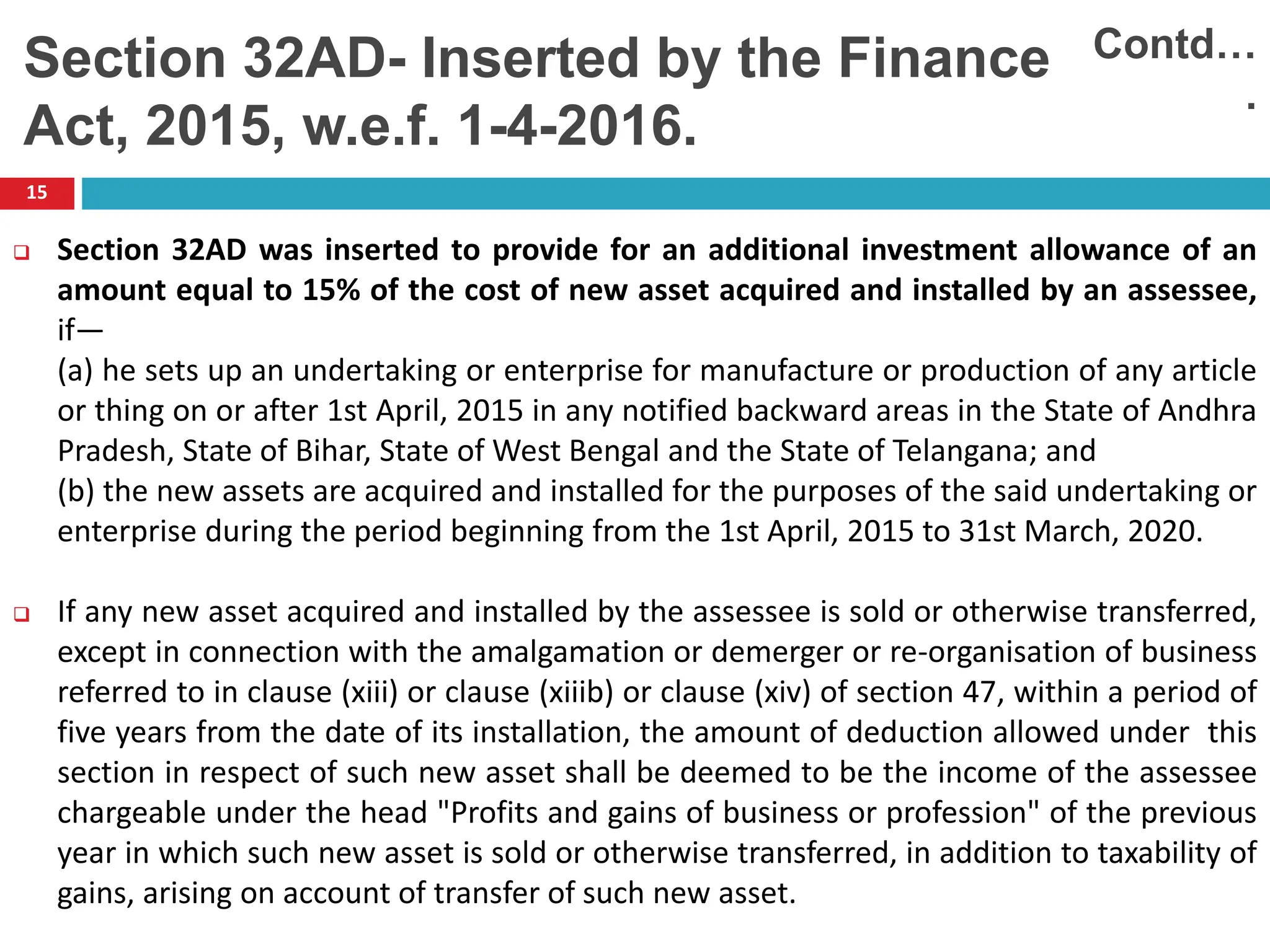
 Section 32AD was inserted to provide for an additional investment allowance of an
amount equal to 15% of the cost of new asset acquired and installed by an assessee,
if—
(a) he sets up an undertaking or enterprise for manufacture or production of any article
or thing on or after 1st April, 2015 in any notified backward areas in the State of Andhra
Pradesh, State of Bihar, State of West Bengal and the State of Telangana; and
(b) the new assets are acquired and installed for the purposes of the said undertaking or
enterprise during the period beginning from the 1st April, 2015 to 31st March, 2020.
 If any new asset acquired and installed by the assessee is sold or otherwise transferred,
except in connection with the amalgamation or demerger or re-organisation of business
referred to in clause (xiii) or clause (xiiib) or clause (xiv) of section 47, within a period of
five years from the date of its installation, the amount of deduction allowed under this
section in respect of such new asset shall be deemed to be the income of the assessee
chargeable under the head "Profits and gains of business or profession" of the previous
year in which such new asset is sold or otherwise transferred, in addition to taxability of
gains, arising on account of transfer of such new asset.
Section 32AD- Inserted by the Finance
Act, 2015, w.e.f. 1-4-2016.
Contd…
.
16
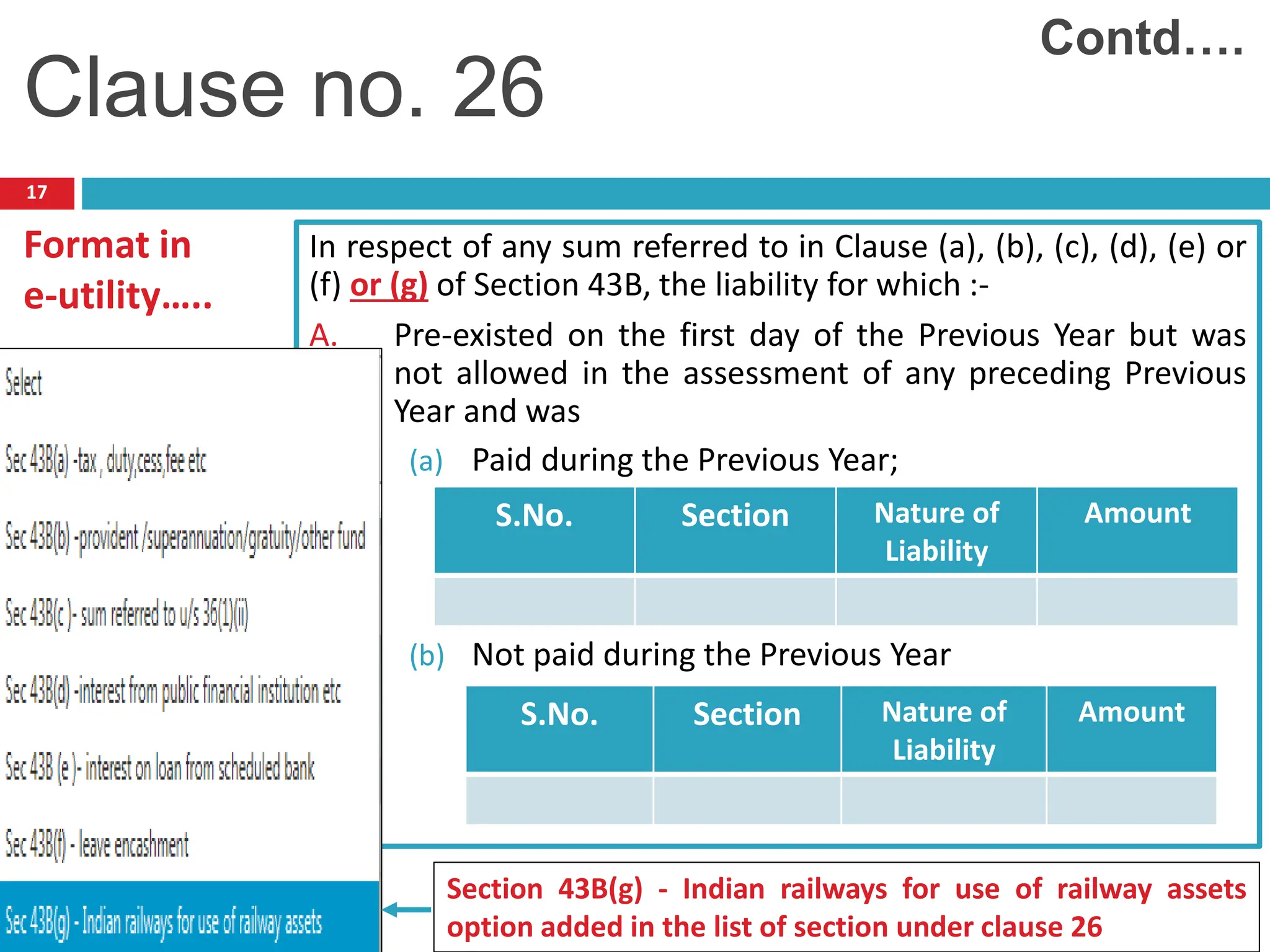
Clause 26 (Amended) - Inclusion of clause (g) of section 43B
i.e. the amount payable to the Indian Railways for use of its assets,
is to be reported.
 An amendment by the Finance Act, 2016 (w.e.f. 01.04.2017) in sec
43B(Certain deductions to be only on actual payment) includes the
following:
“any sum payable by the assessee to the Indian Railways for
the use of railway assets”
 And, thus change is also made in line with above amendment for
reporting purpose as well.
Clause no. 26 [Amended]
17
In respect of any sum referred to in Clause (a), (b), (c), (d), (e) or
(f) or (g) of Section 43B, the liability for which :-
A. Pre-existed on the first day of the Previous Year but was
not allowed in the assessment of any preceding Previous
Year and was
(a) Paid during the Previous Year;
(b) Not paid during the Previous Year
S.No. Section Nature of
Liability
Amount
S.No. Section Nature of
Liability
Amount
Clause no. 26
Contd….
Format in
e-utility…..
Section 43B(g) - Indian railways for use of railway assets
option added in the list of section under clause 26
18
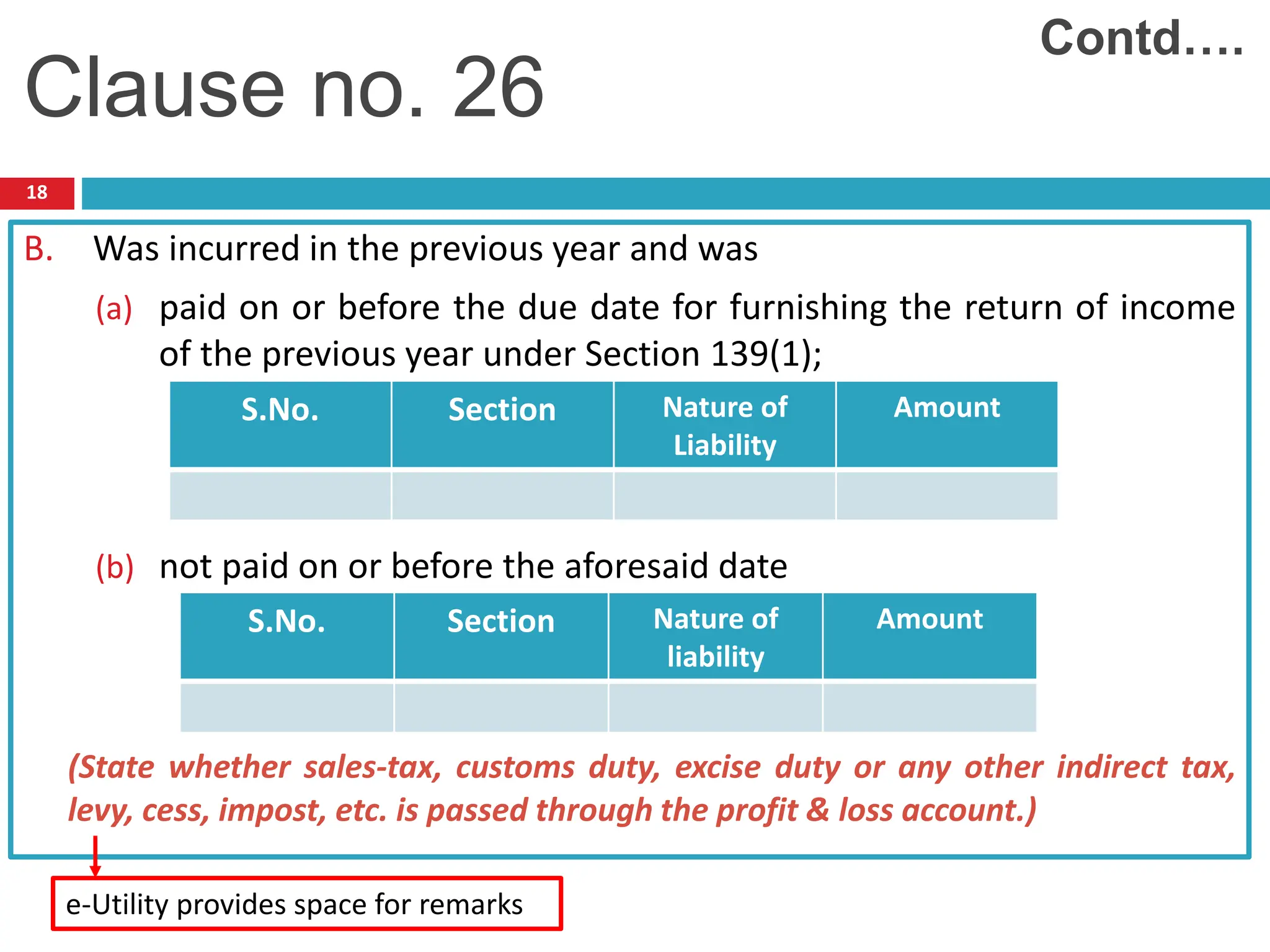
B. Was incurred in the previous year and was
(a) paid on or before the due date for furnishing the return of income
of the previous year under Section 139(1);
(b) not paid on or before the aforesaid date
(State whether sales-tax, customs duty, excise duty or any other indirect tax,
levy, cess, impost, etc. is passed through the profit & loss account.)
S.No. Section Nature of
Liability
Amount
S.No. Section Nature of
liability
Amount
Contd….
Clause no. 26
e-Utility provides space for remarks
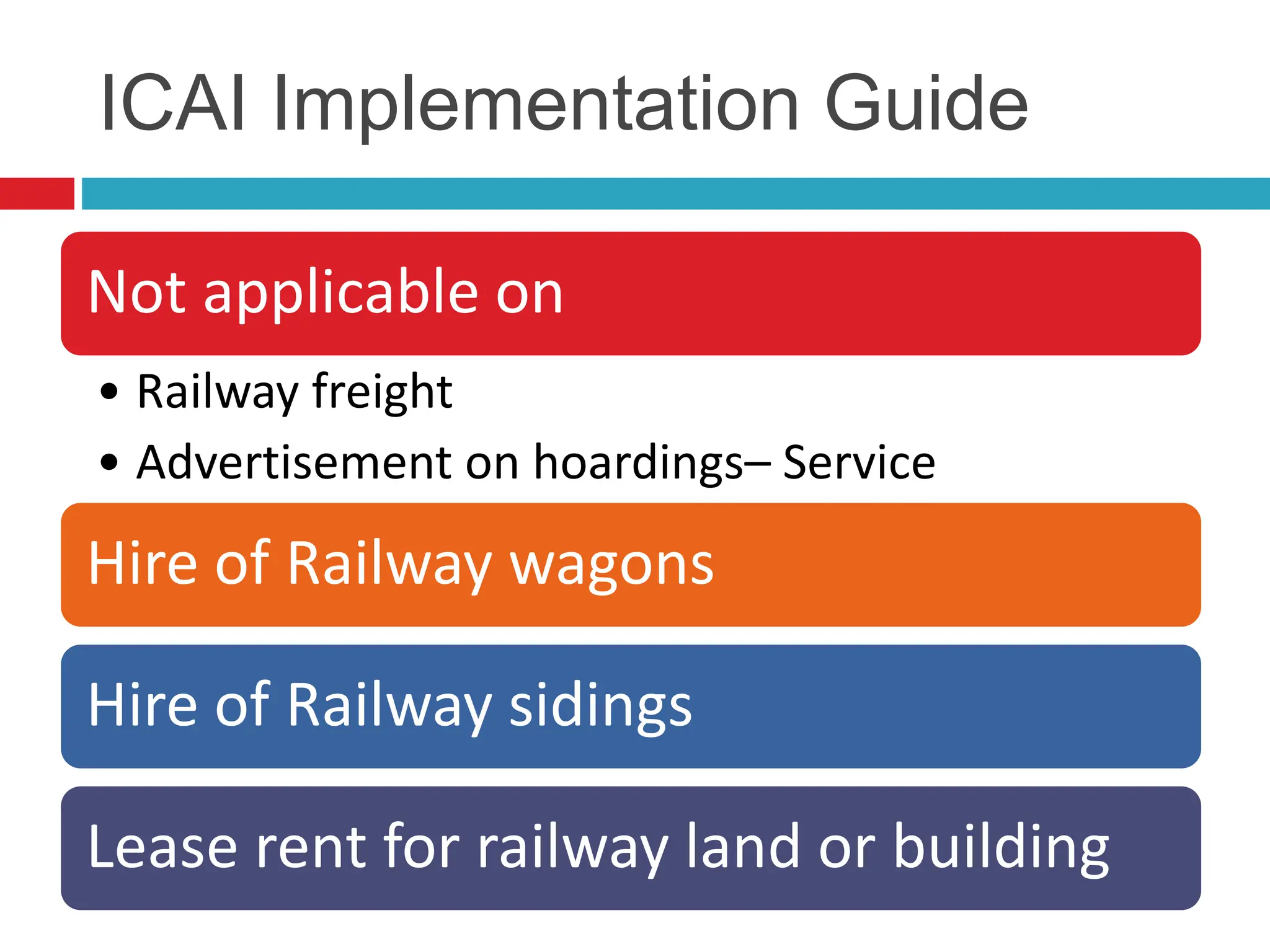
ICAI Implementation Guide
Not applicable on
• Railway freight
• Advertisement on hoardings– Service
Hire of Railway wagons
Hire of Railway sidings
Lease rent for railway land or building
20
a) Whether any amount is to be included as income chargeable
under the head income from other sources as referred to in
clause (ix) of sub-section (2) of section 56? (Yes/No)
b) If yes, please furnish the following details:
i. Nature of income
ii. Amount thereof
Clause no. 29A [Newly
Inserted]
Brief: Advance received on capital asset forfeited to be reported under this
clause.
*Whether an amount is forfeited or not cannot be detected with ordinary auditing
techniques. The only indication of a forfeiture can be a long-standing credit not being paid.
However, the indication is available not in the year of forfeiture. Detection of forfeiture in the
very year of forfeiture is a subject matter of investigation that one who is empowered to
summon other documents and enforce attendance of parties can do. This casts an onerous
duty on the tax auditor.
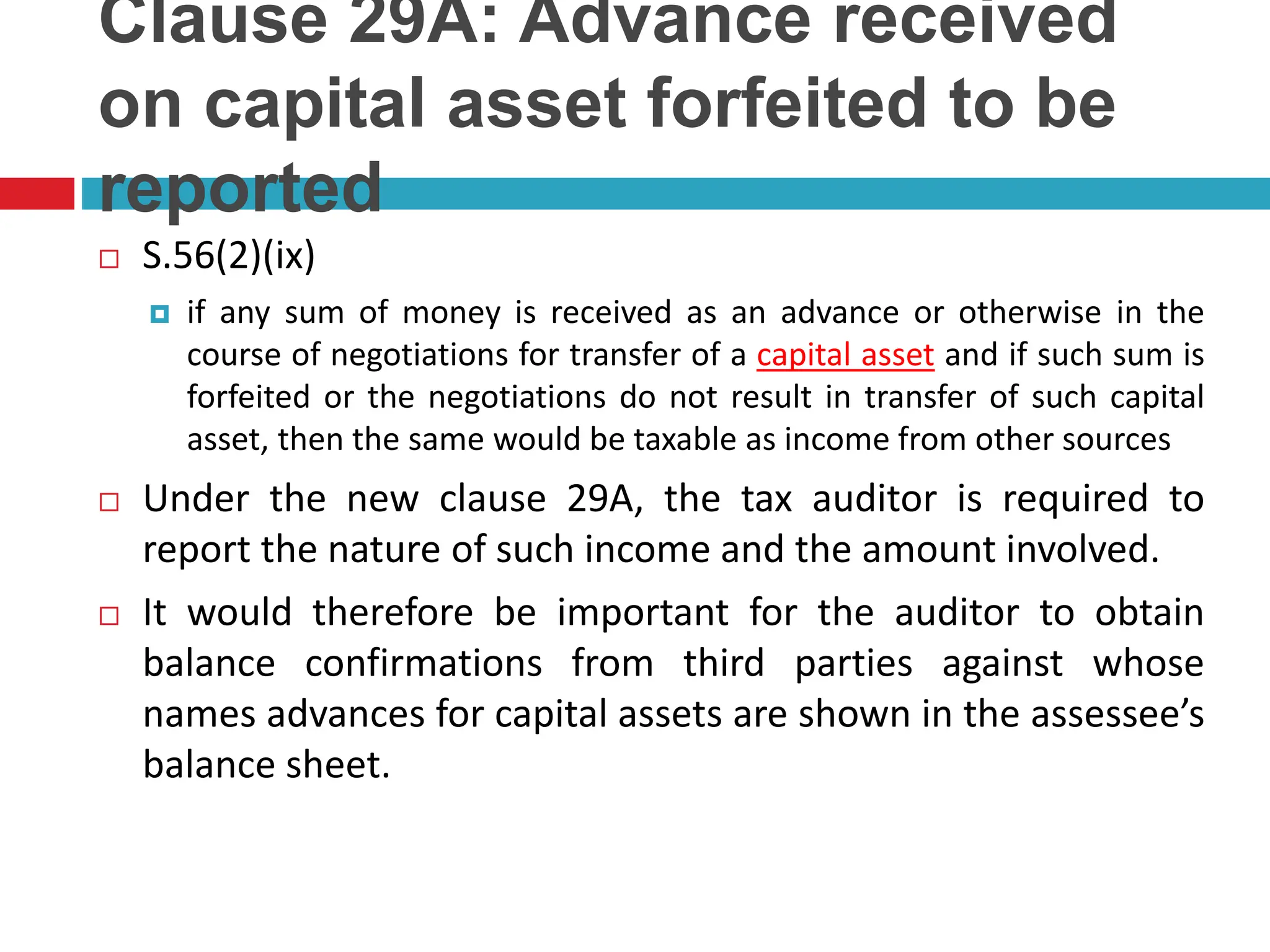
Clause 29A: Advance received
on capital asset forfeited to be
reported
 S.56(2)(ix)
 if any sum of money is received as an advance or otherwise in the
course of negotiations for transfer of a capital asset and if such sum is
forfeited or the negotiations do not result in transfer of such capital
asset, then the same would be taxable as income from other sources
 Under the new clause 29A, the tax auditor is required to
report the nature of such income and the amount involved.
 It would therefore be important for the auditor to obtain
balance confirmations from third parties against whose
names advances for capital assets are shown in the assessee’s
balance sheet.
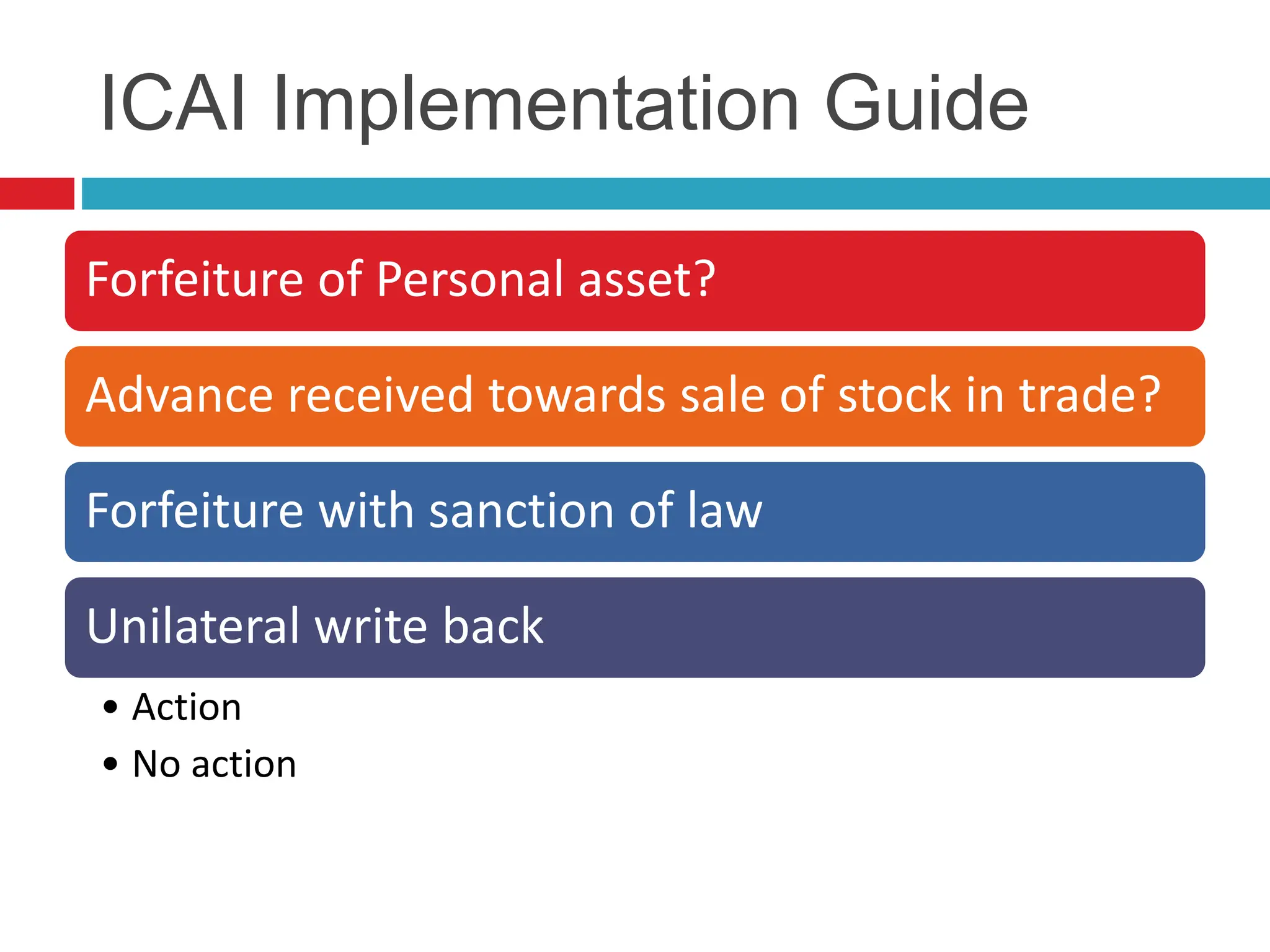
ICAI Implementation Guide
Forfeiture of Personal asset?
Advance received towards sale of stock in trade?
Forfeiture with sanction of law
Unilateral write back
• Action
• No action
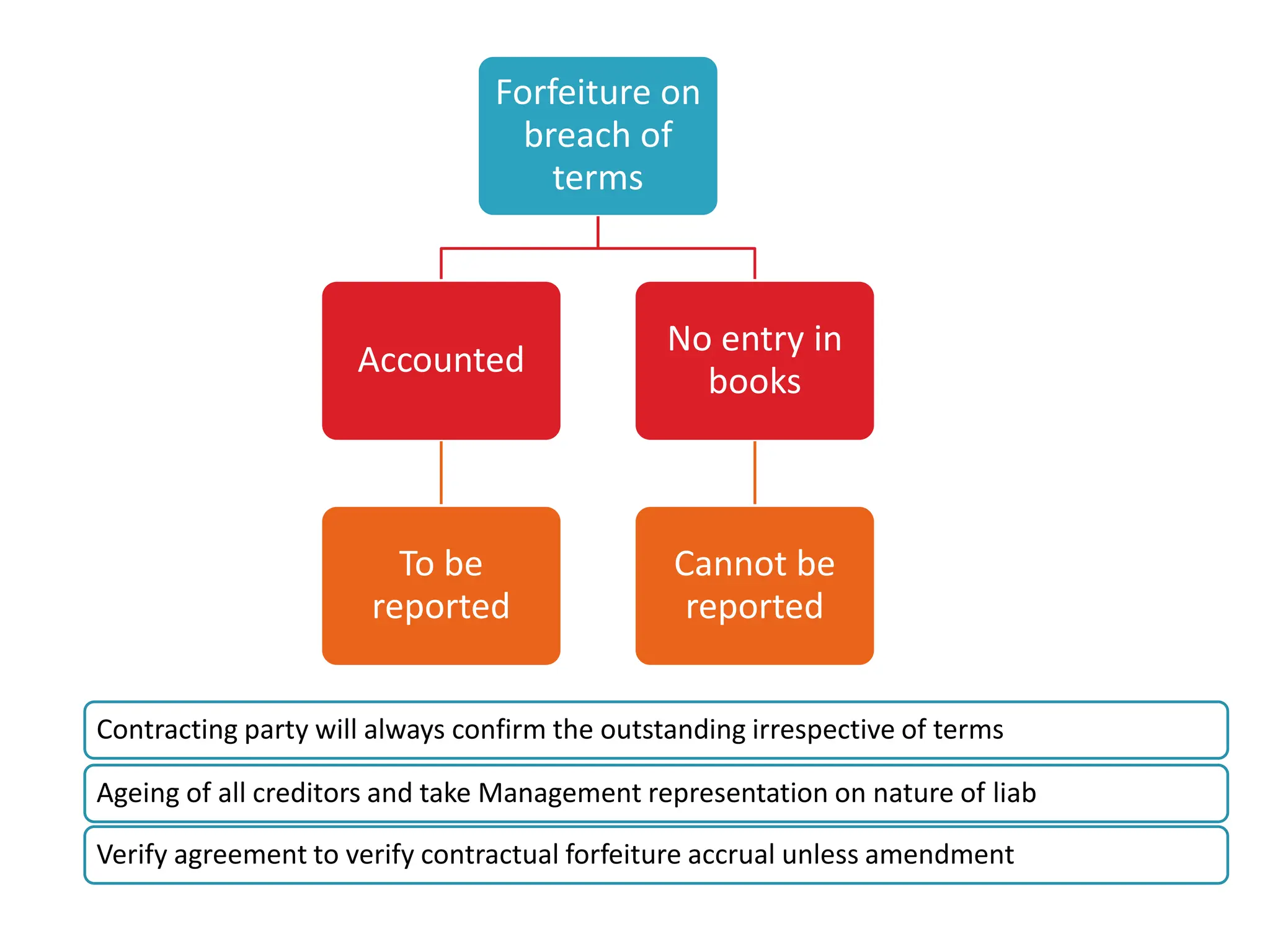
Forfeiture on
breach of
terms
Accounted
To be
reported
No entry in
books
Cannot be
reported
Contracting party will always confirm the outstanding irrespective of terms
Ageing of all creditors and take Management representation on nature of liab
Verify agreement to verify contractual forfeiture accrual unless amendment
24
Clause no. 29A
Section 56 (2): In particular, and without prejudice to the generality of
the provisions of sub-section (1), the following incomes, shall be
chargeable to income-tax under the head "Income from other
sources", namely:
…………………………..
(ix) any sum of money received as an advance or otherwise in the
course of negotiations for transfer of a capital asset, if,—
(a) such sum is forfeited; and
(b) the negotiations do not result in transfer of such capital asset;
[inserted by Finance (No. 2) Act, 2014, w.e.f. 01-04-2015]
Contd….
25
Format in e-utility…..
Contd….
Clause no. 29A [Newly
Inserted]
26
a) Whether any amount is to be included as income chargeable under
the head income from other sources as referred to in clause (x) of
sub-section (2) of section 56? (Yes/No)
b) If yes, please furnish the following details:
i. Nature of income
ii. Amount (in Rs.) thereof
Clause no. 29B [Newly
Inserted]
Brief: Income of gifts exceeding Rs. 50,000 is to be reported under
this clause
27
Format in e-utility…..
Contd….
Clause no. 29B [Newly
Inserted]
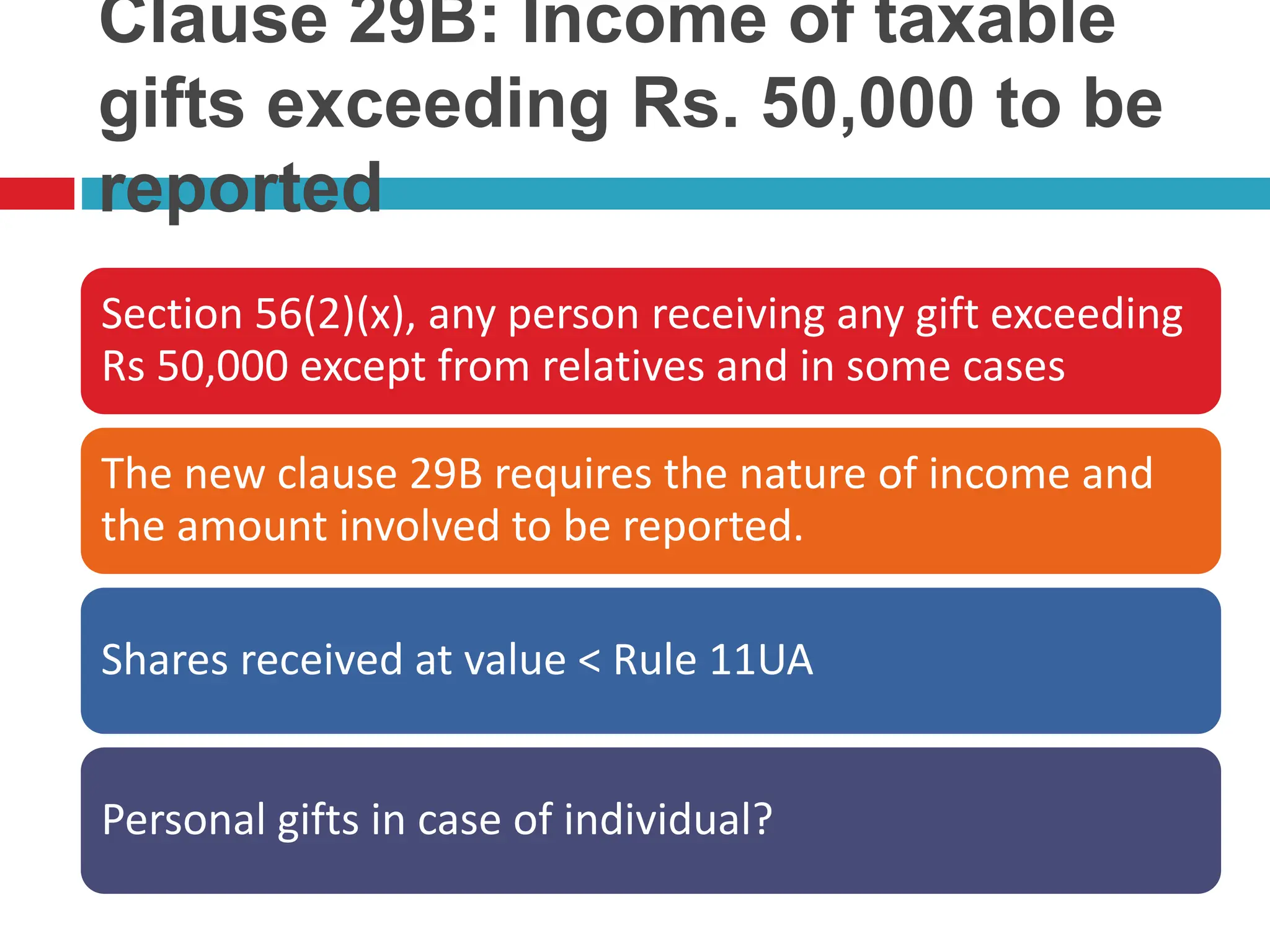
Clause 29B: Income of taxable
gifts exceeding Rs. 50,000 to be
reported
Section 56(2)(x), any person receiving any gift exceeding
Rs 50,000 except from relatives and in some cases
The new clause 29B requires the nature of income and
the amount involved to be reported.
Shares received at value < Rule 11UA
Personal gifts in case of individual?
Immovable property
Only on Land or building
Not applicable on Rights in land or building
• Leasehold rights – CIT vs. Greenfield Hotels and
• Estates P Ltd [2016] 389 ITR 68 (Bombay)
• Tenancy rights – Fleurette Marine Novelle Hatam vs.
ITO [2015] 70 SOT 203 (Mumbai - Trib.)
• FSI and TDR – ITO vs. Shri Prem Rattan Gupta
• (ITA No.5803/Mum/2009)
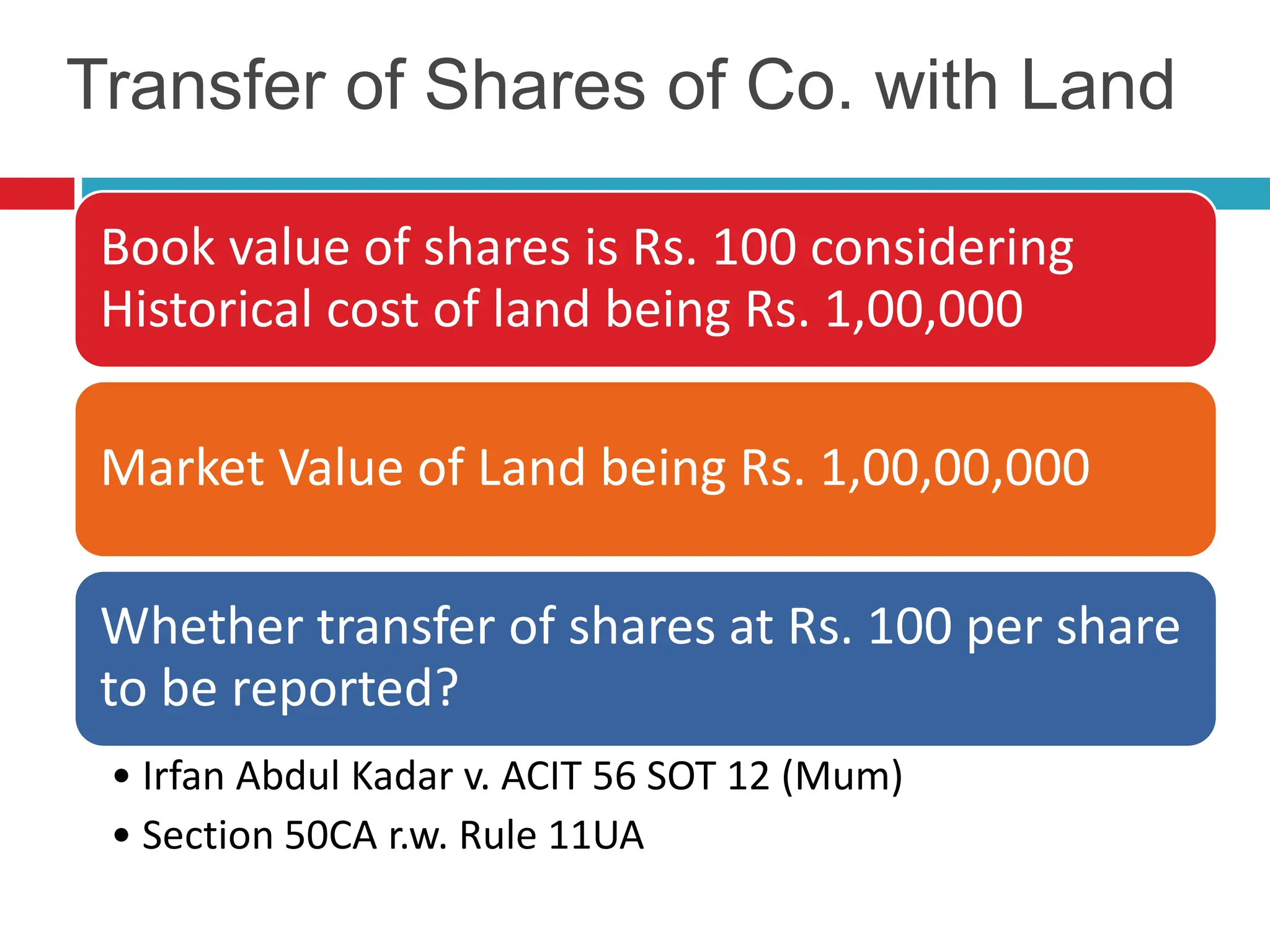
Transfer of Shares of Co. with Land
Book value of shares is Rs. 100 considering
Historical cost of land being Rs. 1,00,000
Market Value of Land being Rs. 1,00,00,000
Whether transfer of shares at Rs. 100 per share
to be reported?
• Irfan Abdul Kadar v. ACIT 56 SOT 12 (Mum)
• Section 50CA r.w. Rule 11UA
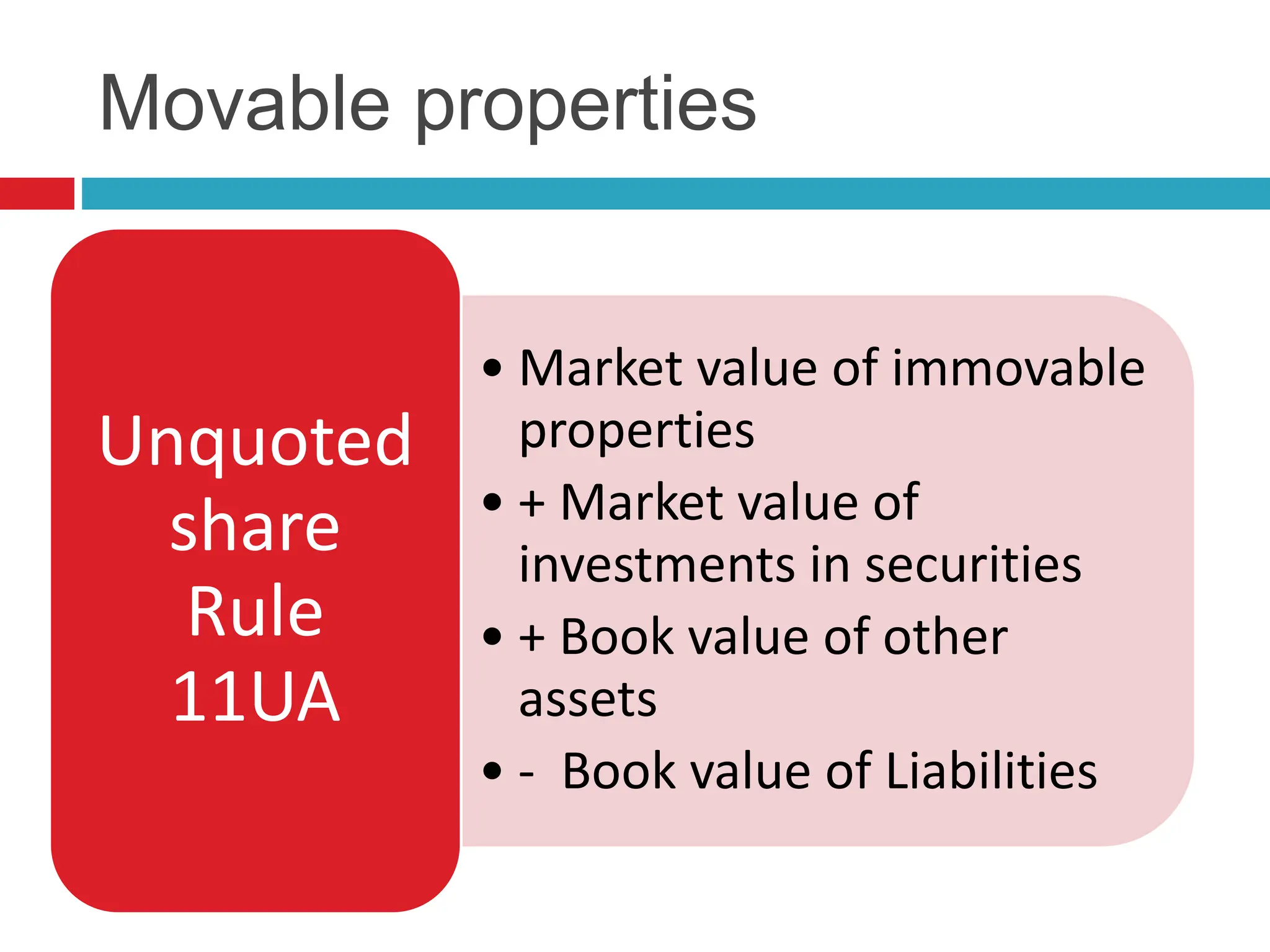
Movable properties
• Market value of immovable
properties
• + Market value of
investments in securities
• + Book value of other
assets
• - Book value of Liabilities
Unquoted
share
Rule
11UA
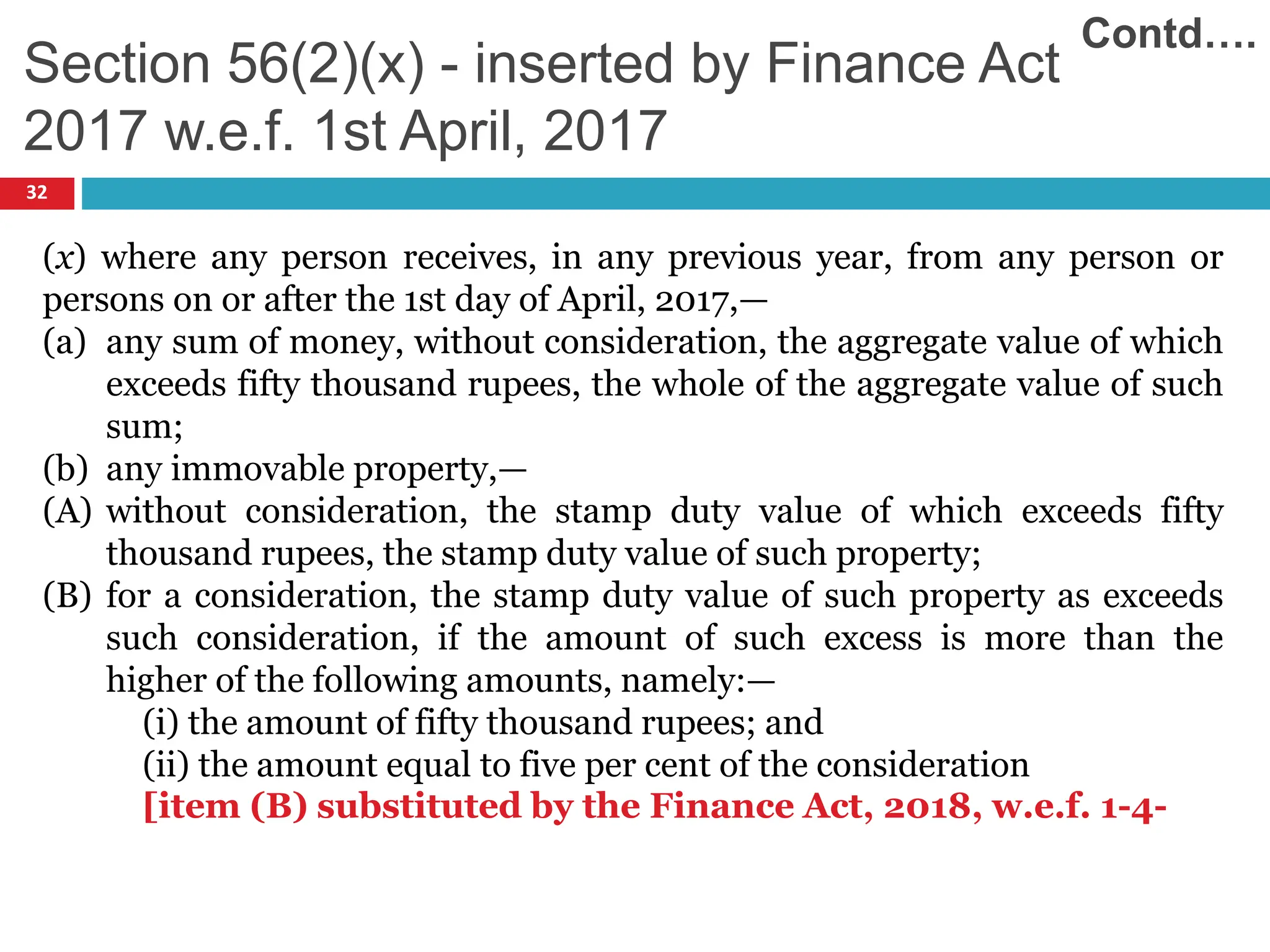
(x) where any person receives, in any previous year, from any person or
persons on or after the 1st day of April, 2017,—
(a) any sum of money, without consideration, the aggregate value of which
exceeds fifty thousand rupees, the whole of the aggregate value of such
sum;
(b) any immovable property,—
(A) without consideration, the stamp duty value of which exceeds fifty
thousand rupees, the stamp duty value of such property;
(B) for a consideration, the stamp duty value of such property as exceeds
such consideration, if the amount of such excess is more than the
higher of the following amounts, namely:—
(i) the amount of fifty thousand rupees; and
(ii) the amount equal to five per cent of the consideration
[item (B) substituted by the Finance Act, 2018, w.e.f. 1-4-
32
Section 56(2)(x) - inserted by Finance Act
2017 w.e.f. 1st April, 2017
Contd….
33
33
33
33
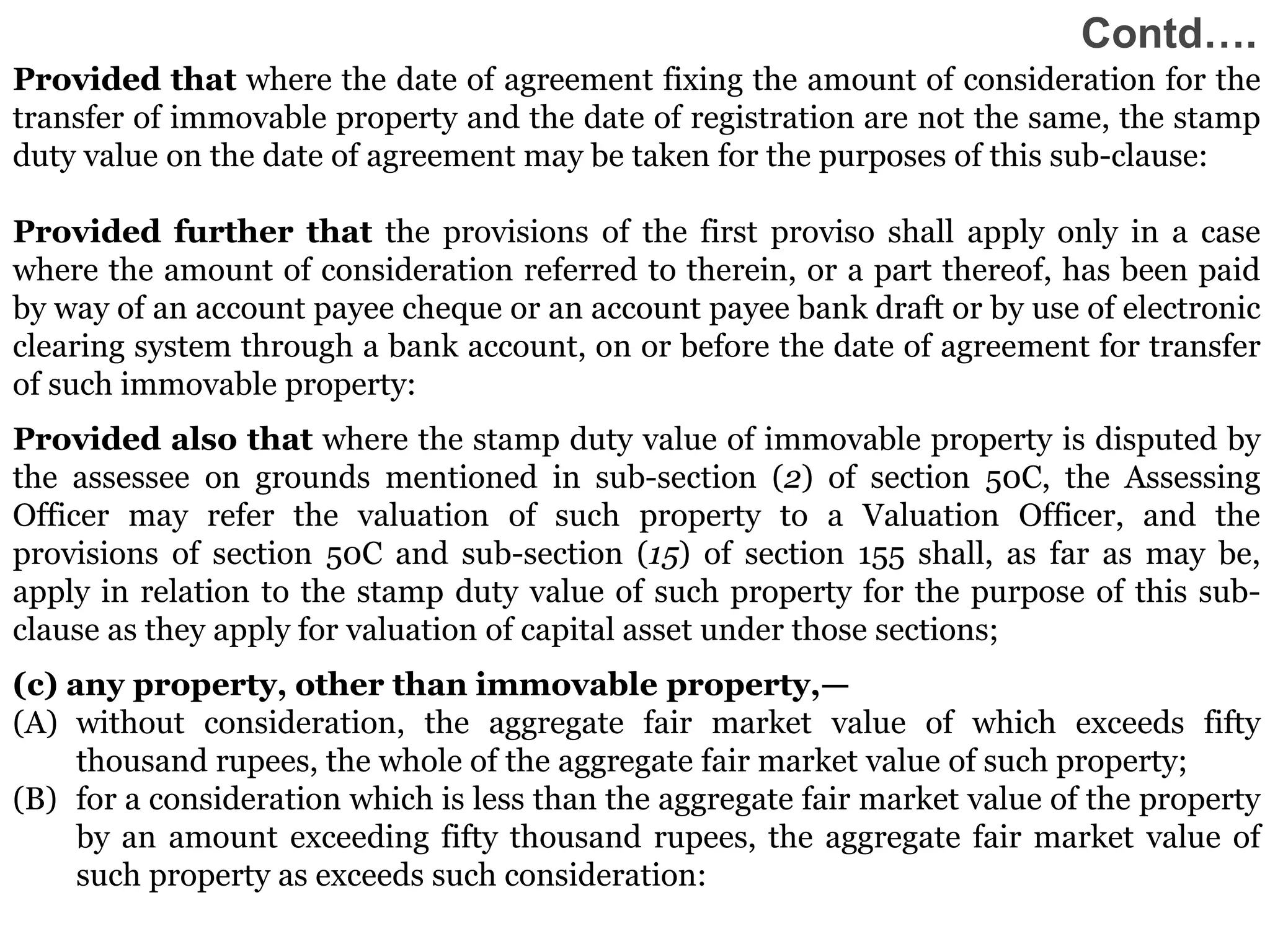
Provided that where the date of agreement fixing the amount of consideration for the
transfer of immovable property and the date of registration are not the same, the stamp
duty value on the date of agreement may be taken for the purposes of this sub-clause:
Provided further that the provisions of the first proviso shall apply only in a case
where the amount of consideration referred to therein, or a part thereof, has been paid
by way of an account payee cheque or an account payee bank draft or by use of electronic
clearing system through a bank account, on or before the date of agreement for transfer
of such immovable property:
Provided also that where the stamp duty value of immovable property is disputed by
the assessee on grounds mentioned in sub-section (2) of section 50C, the Assessing
Officer may refer the valuation of such property to a Valuation Officer, and the
provisions of section 50C and sub-section (15) of section 155 shall, as far as may be,
apply in relation to the stamp duty value of such property for the purpose of this sub-
clause as they apply for valuation of capital asset under those sections;
(c) any property, other than immovable property,—
(A) without consideration, the aggregate fair market value of which exceeds fifty
thousand rupees, the whole of the aggregate fair market value of such property;
(B) for a consideration which is less than the aggregate fair market value of the property
by an amount exceeding fifty thousand rupees, the aggregate fair market value of
such property as exceeds such consideration:
33
Contd….
34
34
34
34
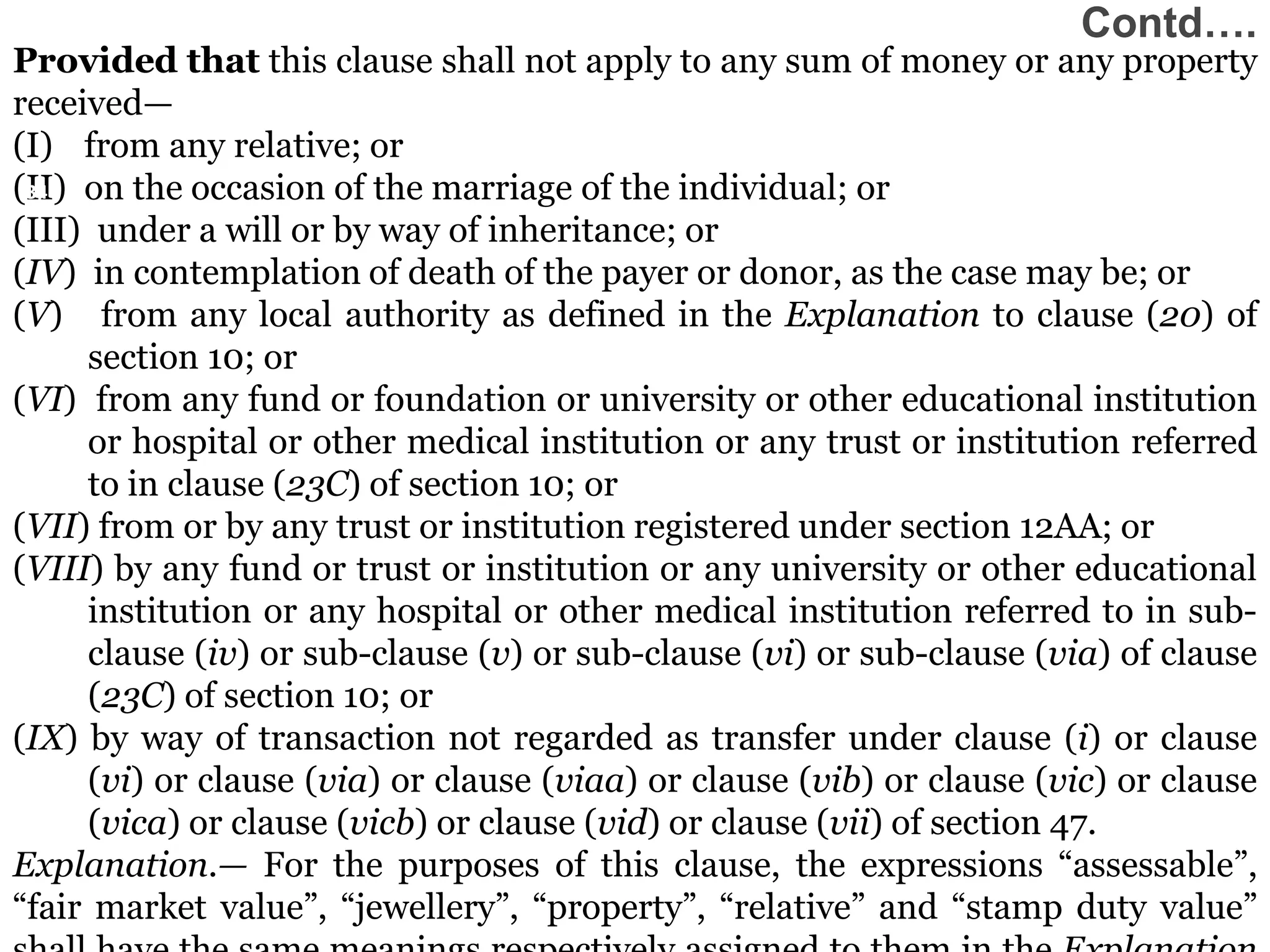
Provided that this clause shall not apply to any sum of money or any property
received—
(I) from any relative; or
(II) on the occasion of the marriage of the individual; or
(III) under a will or by way of inheritance; or
(IV) in contemplation of death of the payer or donor, as the case may be; or
(V) from any local authority as defined in the Explanation to clause (20) of
section 10; or
(VI) from any fund or foundation or university or other educational institution
or hospital or other medical institution or any trust or institution referred
to in clause (23C) of section 10; or
(VII) from or by any trust or institution registered under section 12AA; or
(VIII) by any fund or trust or institution or any university or other educational
institution or any hospital or other medical institution referred to in sub-
clause (iv) or sub-clause (v) or sub-clause (vi) or sub-clause (via) of clause
(23C) of section 10; or
(IX) by way of transaction not regarded as transfer under clause (i) or clause
(vi) or clause (via) or clause (viaa) or clause (vib) or clause (vic) or clause
(vica) or clause (vicb) or clause (vid) or clause (vii) of section 47.
Explanation.— For the purposes of this clause, the expressions “assessable”,
“fair market value”, “jewellery”, “property”, “relative” and “stamp duty value”
34
Contd….
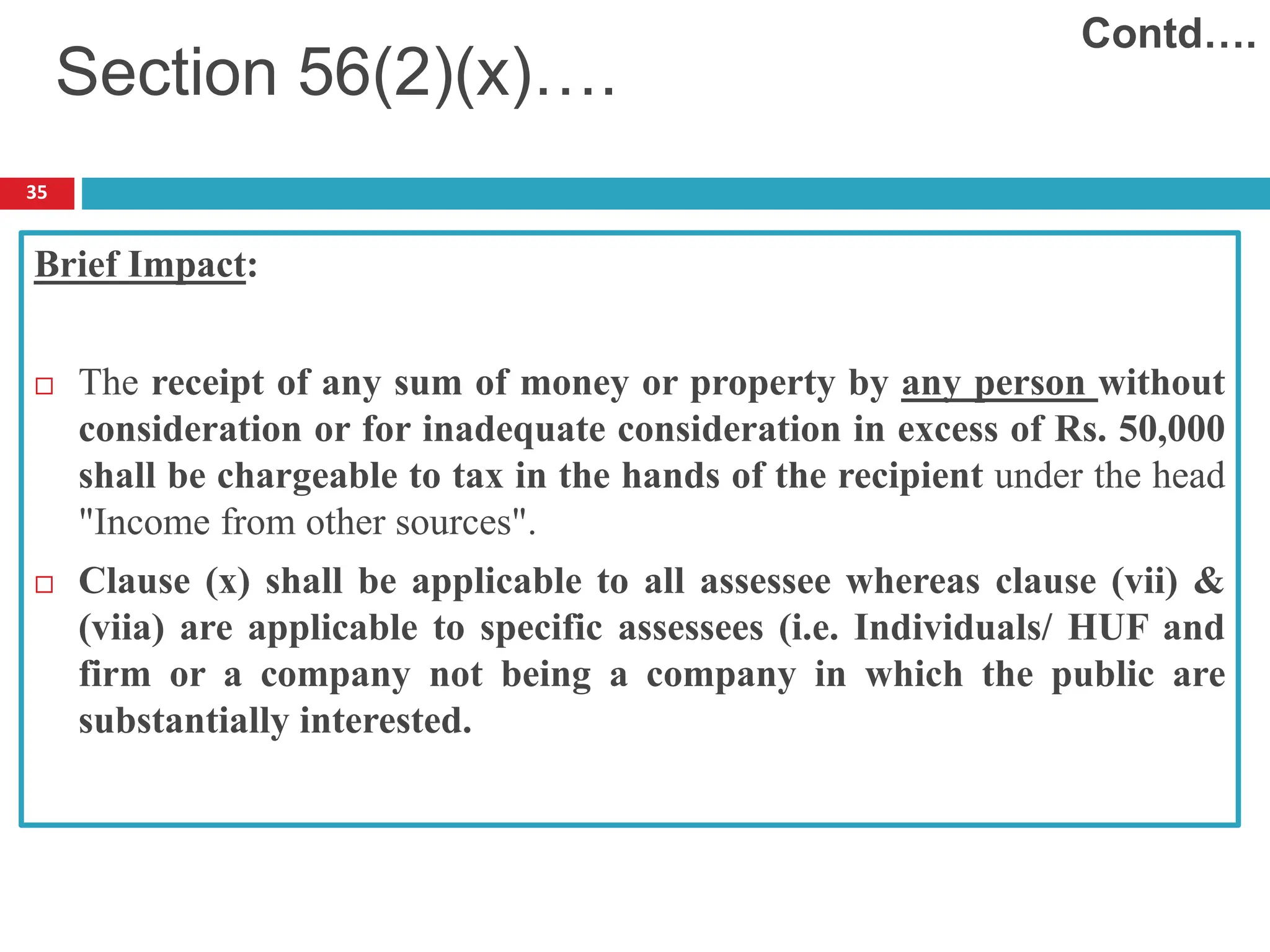
35
Brief Impact:
 The receipt of any sum of money or property by any person without
consideration or for inadequate consideration in excess of Rs. 50,000
shall be chargeable to tax in the hands of the recipient under the head
"Income from other sources".
 Clause (x) shall be applicable to all assessee whereas clause (vii) &
(viia) are applicable to specific assessees (i.e. Individuals/ HUF and
firm or a company not being a company in which the public are
substantially interested.
Section 56(2)(x)….
Contd….
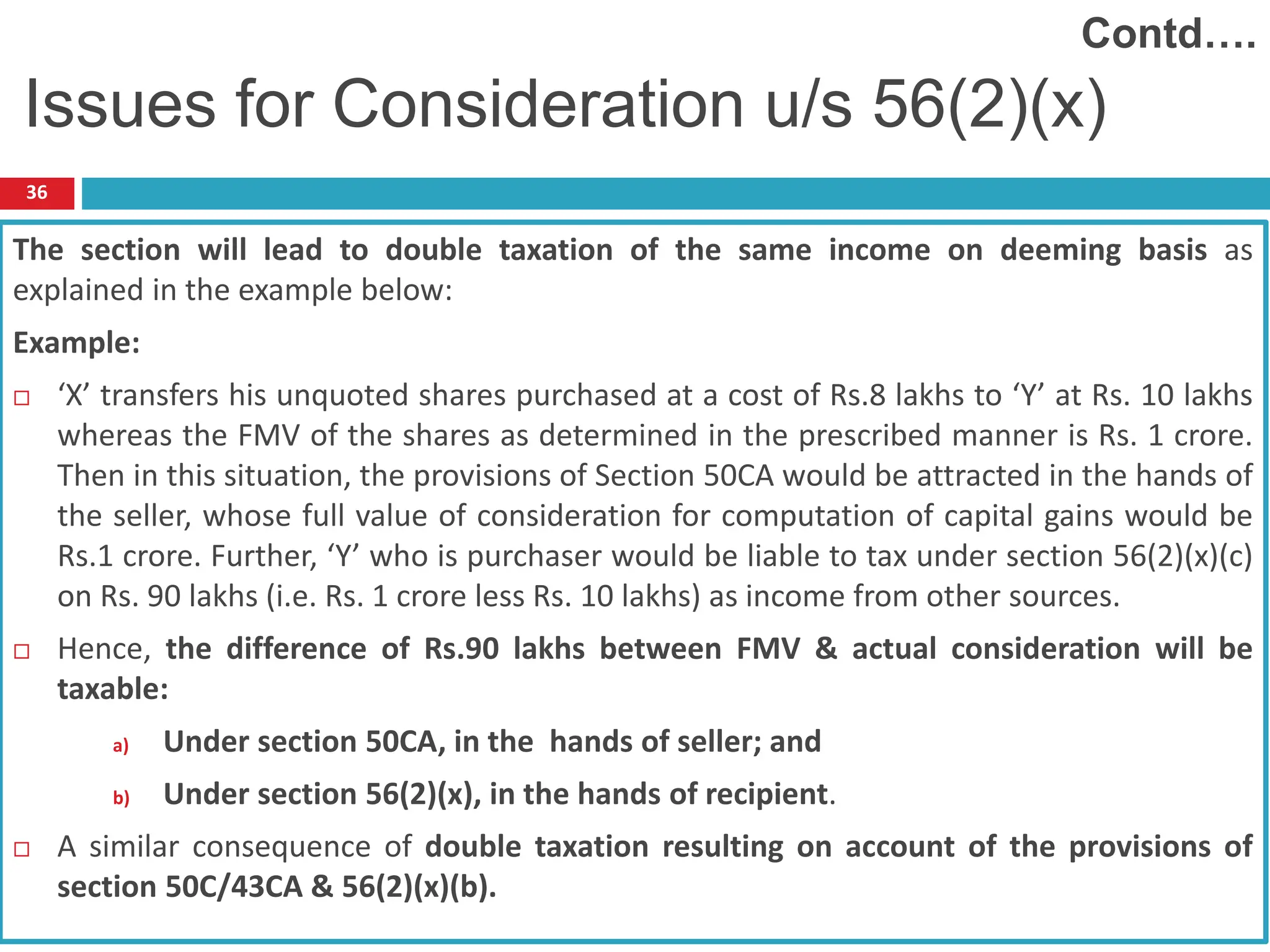
36
The section will lead to double taxation of the same income on deeming basis as
explained in the example below:
Example:
 ‘X’ transfers his unquoted shares purchased at a cost of Rs.8 lakhs to ‘Y’ at Rs. 10 lakhs
whereas the FMV of the shares as determined in the prescribed manner is Rs. 1 crore.
Then in this situation, the provisions of Section 50CA would be attracted in the hands of
the seller, whose full value of consideration for computation of capital gains would be
Rs.1 crore. Further, ‘Y’ who is purchaser would be liable to tax under section 56(2)(x)(c)
on Rs. 90 lakhs (i.e. Rs. 1 crore less Rs. 10 lakhs) as income from other sources.
 Hence, the difference of Rs.90 lakhs between FMV & actual consideration will be
taxable:
a) Under section 50CA, in the hands of seller; and
b) Under section 56(2)(x), in the hands of recipient.
 A similar consequence of double taxation resulting on account of the provisions of
section 50C/43CA & 56(2)(x)(b).
Issues for Consideration u/s 56(2)(x)
Contd….
37
 The Auditor would have to apply professional judgement as to what
would fall under these provisions or not, would require to evaluated
on facts & circumstances of transactions.
 It may be difficult to locate all transactions and it may also involve a
time consuming effort. It may not be possible to verify the list of all
persons covered by this section and therefore, the information
supplied by the assessee can be relied upon. Where the tax auditor
relies upon the information in this regard furnished to him by the
assessee it would be advisable to make an appropriate disclosure.
 In case tax auditor is involved in proprietary concern audit but not
the individual account audit, then proper disclaimer should be
given in the observation para in Form 3CA or Form 3CB, as the case
may be.
Issues in respect of Clause 29A & 29B
Contd….
38
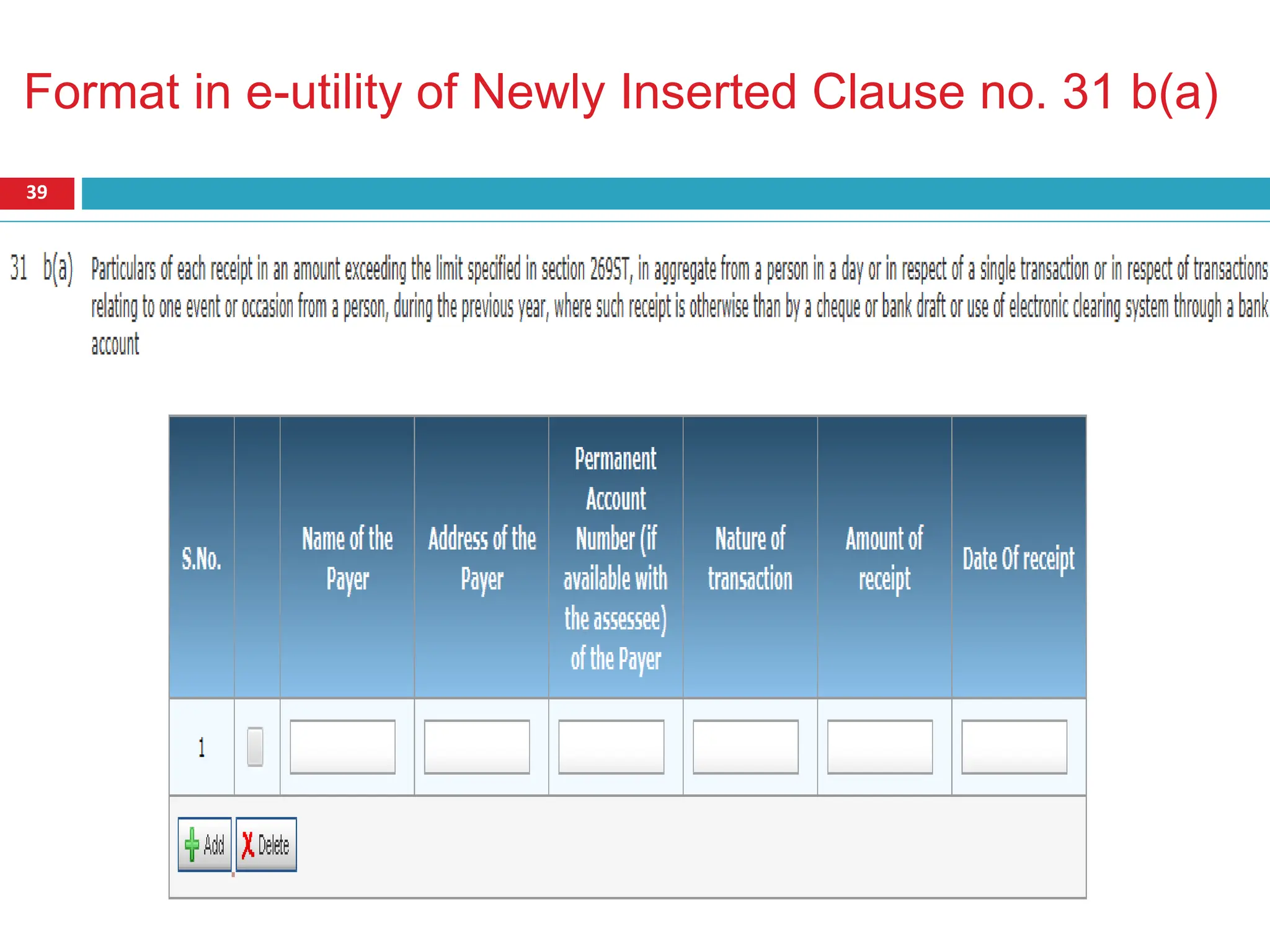
Clause b(a) Newly Inserted
Particulars of each receipt in an amount exceeding the limit specified in
section 269ST, in aggregate from a person in a day or in respect of a
single transaction or in respect of transactions relating to one event or
occasion from a person, during the previous year, where such receipt is
otherwise than by a cheque or bank draft or use of electronic clearing
system through a bank account:-
i. Name, address and Permanent Account Number (if available with
the assessee) of the payer;
ii. Nature of transaction;
iii. Amount of receipt (in Rs.);
iv. Date of receipt
Clause no. 31
[Amended]
Format in e-utility of Newly Inserted Clause no. 31 b(a)
39
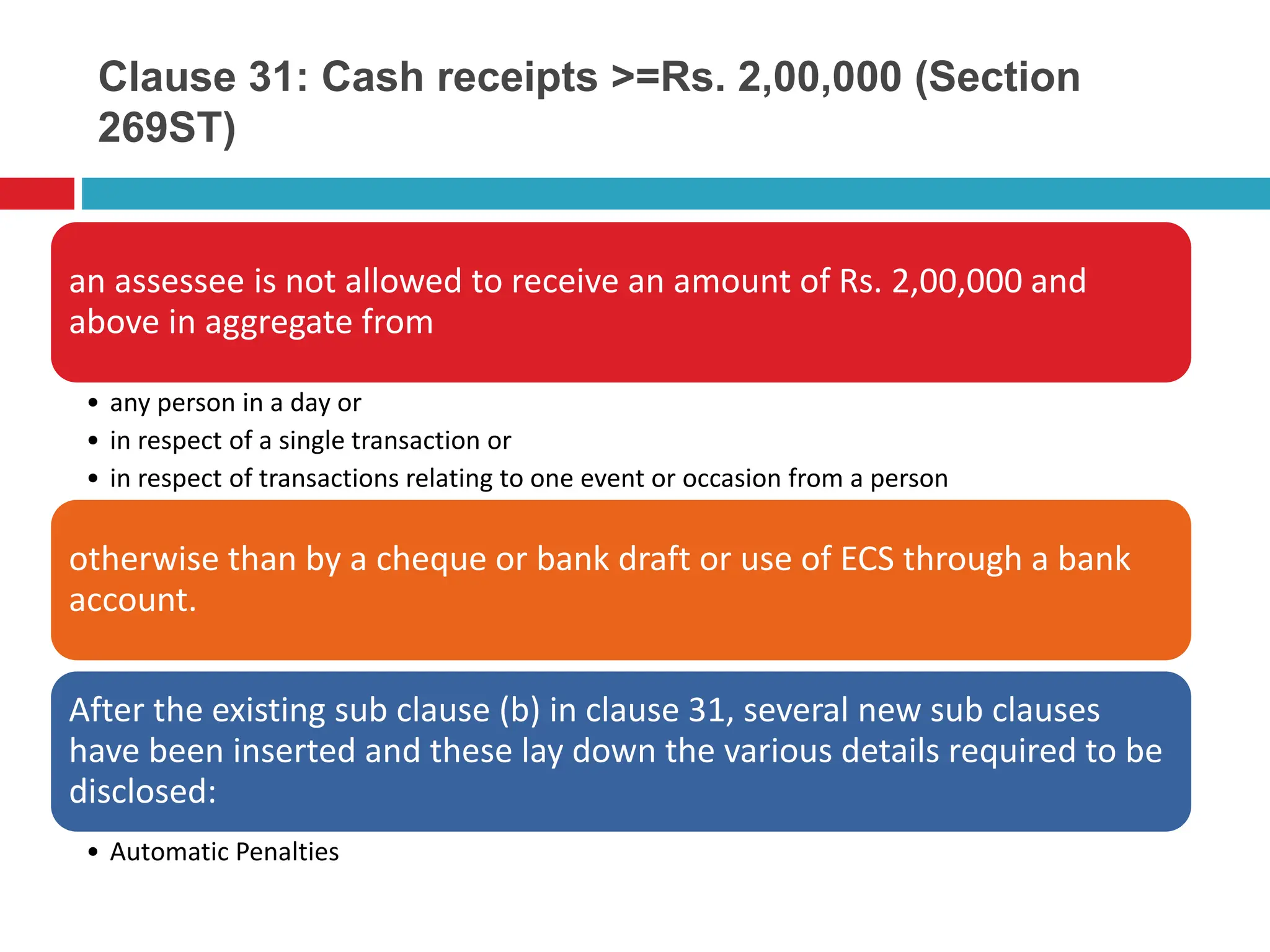
Clause 31: Cash receipts >=Rs. 2,00,000 (Section
269ST)
an assessee is not allowed to receive an amount of Rs. 2,00,000 and
above in aggregate from
• any person in a day or
• in respect of a single transaction or
• in respect of transactions relating to one event or occasion from a person
otherwise than by a cheque or bank draft or use of ECS through a bank
account.
After the existing sub clause (b) in clause 31, several new sub clauses
have been inserted and these lay down the various details required to be
disclosed:
• Automatic Penalties
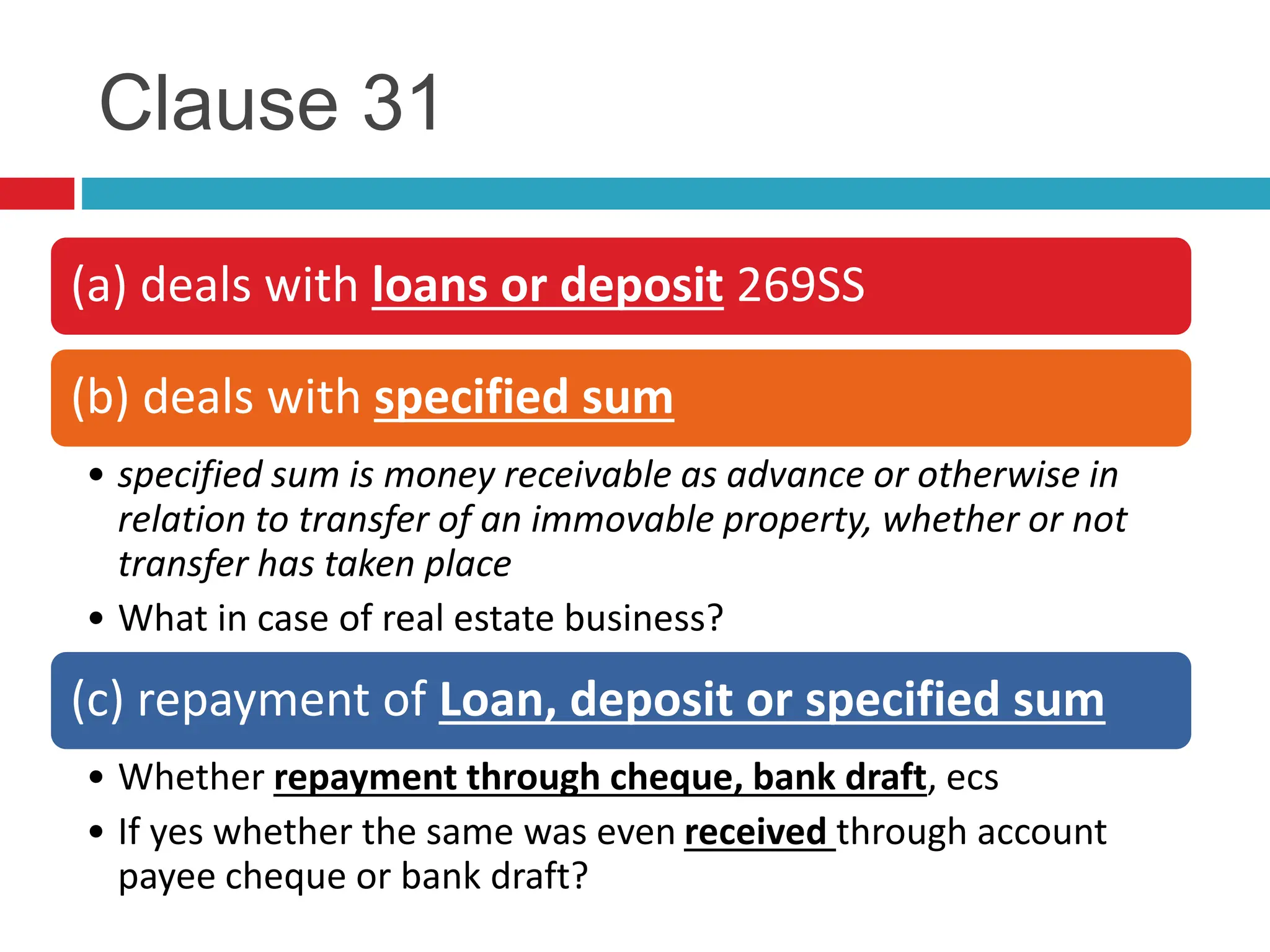
Clause 31
(a) deals with loans or deposit 269SS
(b) deals with specified sum
• specified sum is money receivable as advance or otherwise in
relation to transfer of an immovable property, whether or not
transfer has taken place
• What in case of real estate business?
(c) repayment of Loan, deposit or specified sum
• Whether repayment through cheque, bank draft, ecs
• If yes whether the same was even received through account
payee cheque or bank draft?
42
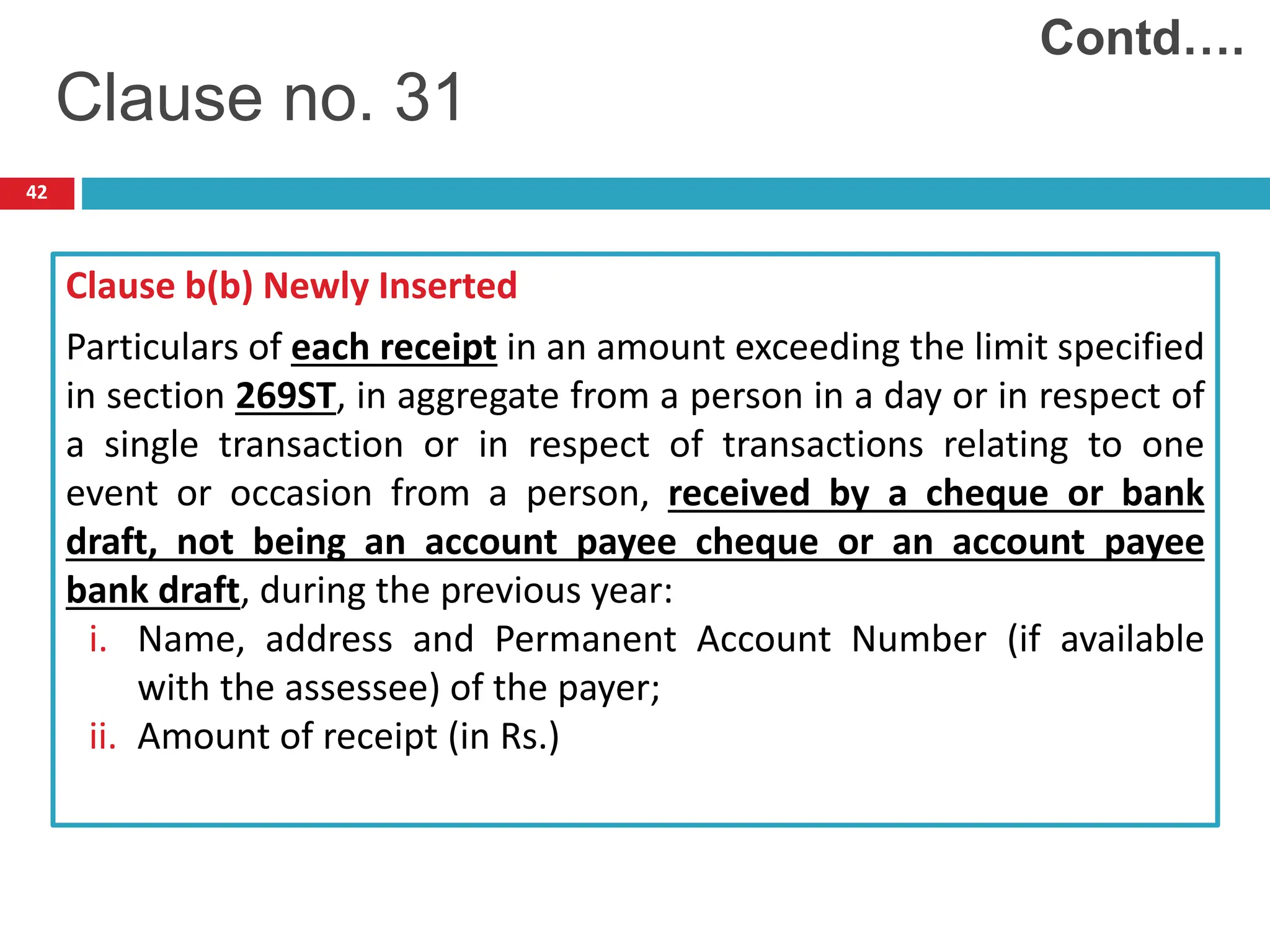
Clause b(b) Newly Inserted
Particulars of each receipt in an amount exceeding the limit specified
in section 269ST, in aggregate from a person in a day or in respect of
a single transaction or in respect of transactions relating to one
event or occasion from a person, received by a cheque or bank
draft, not being an account payee cheque or an account payee
bank draft, during the previous year:
i. Name, address and Permanent Account Number (if available
with the assessee) of the payer;
ii. Amount of receipt (in Rs.)
Clause no. 31
Contd….
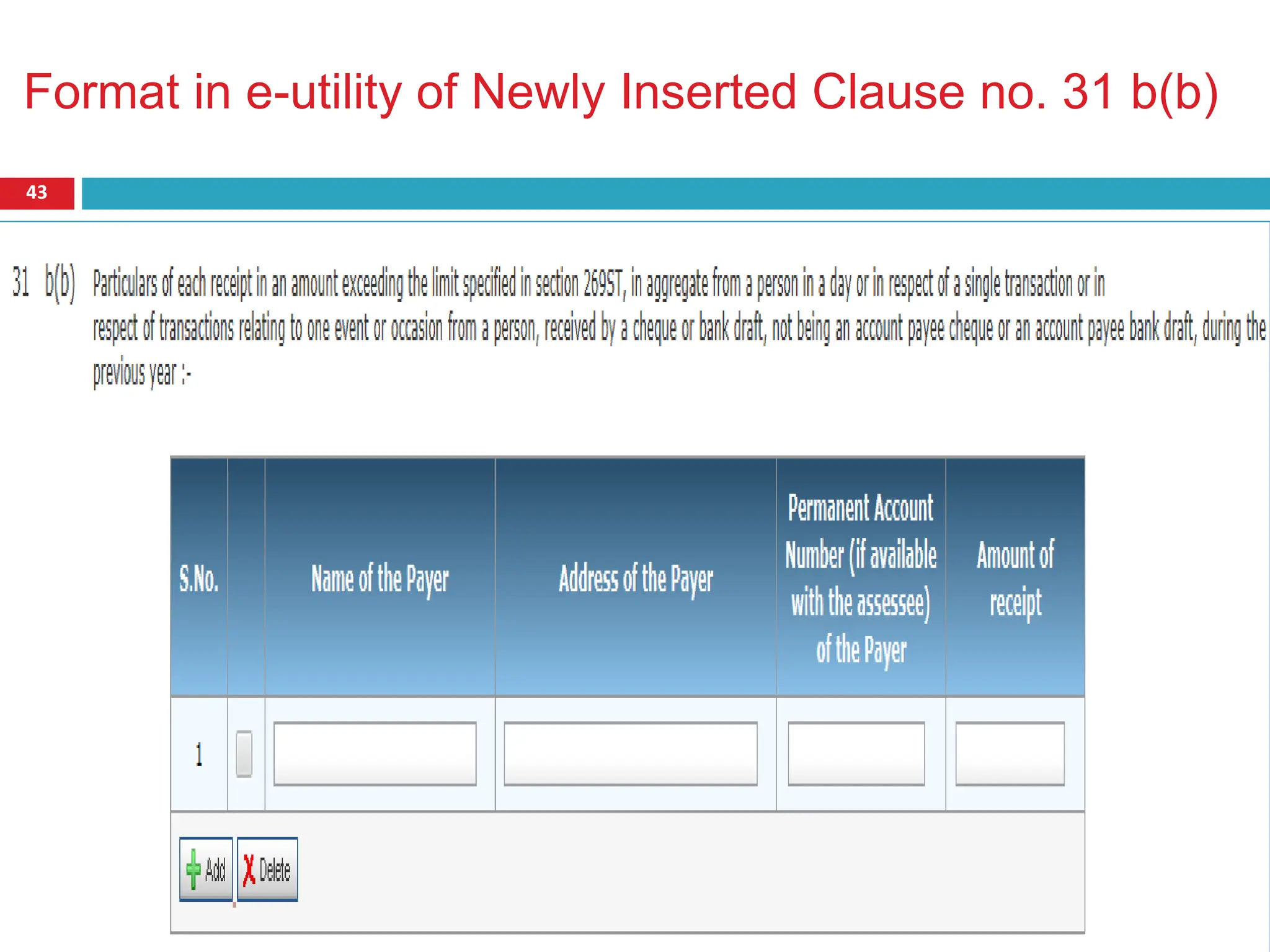
Format in e-utility of Newly Inserted Clause no. 31 b(b)
43
44
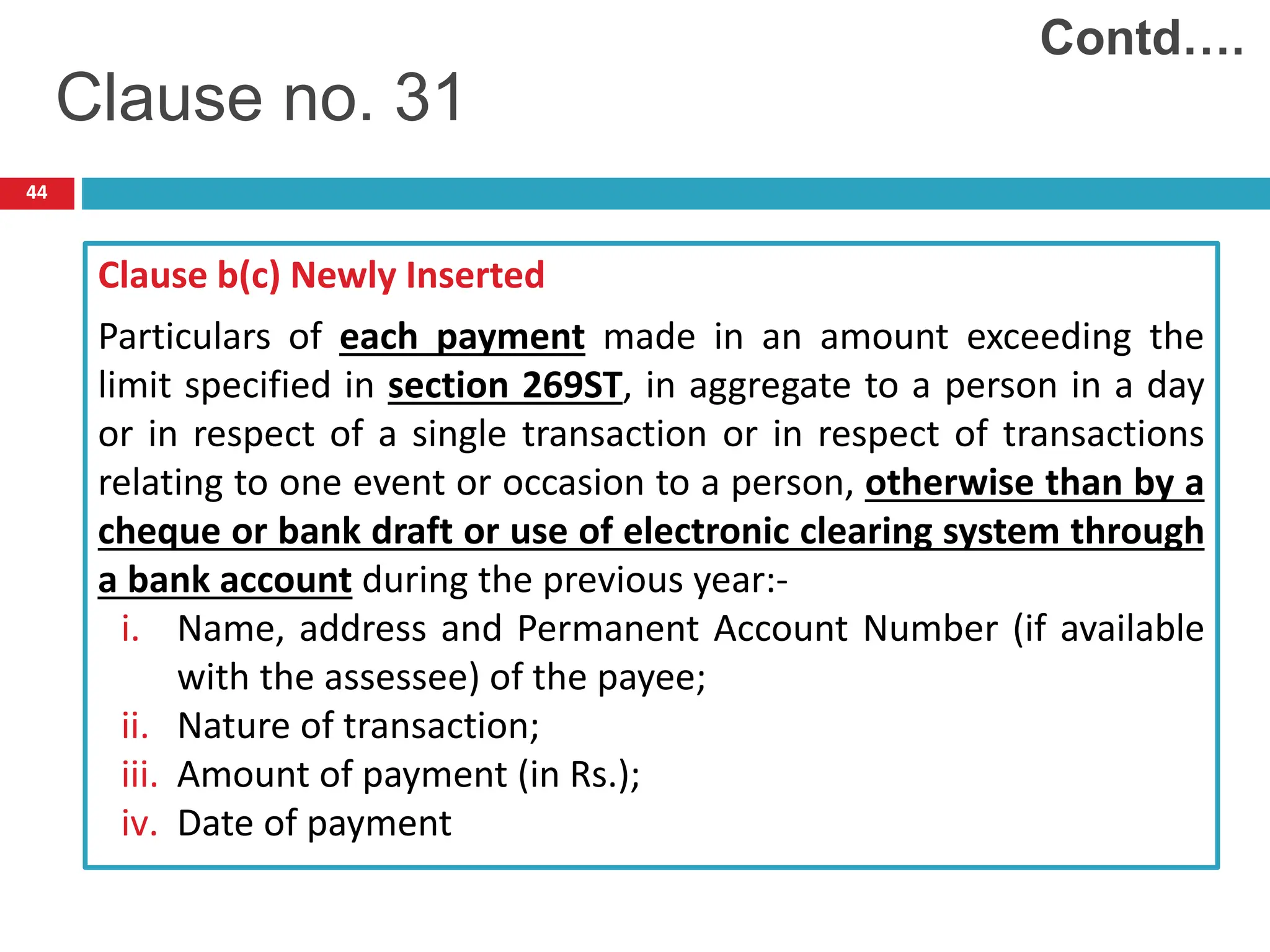
Clause b(c) Newly Inserted
Particulars of each payment made in an amount exceeding the
limit specified in section 269ST, in aggregate to a person in a day
or in respect of a single transaction or in respect of transactions
relating to one event or occasion to a person, otherwise than by a
cheque or bank draft or use of electronic clearing system through
a bank account during the previous year:-
i. Name, address and Permanent Account Number (if available
with the assessee) of the payee;
ii. Nature of transaction;
iii. Amount of payment (in Rs.);
iv. Date of payment
Clause no. 31
Contd….
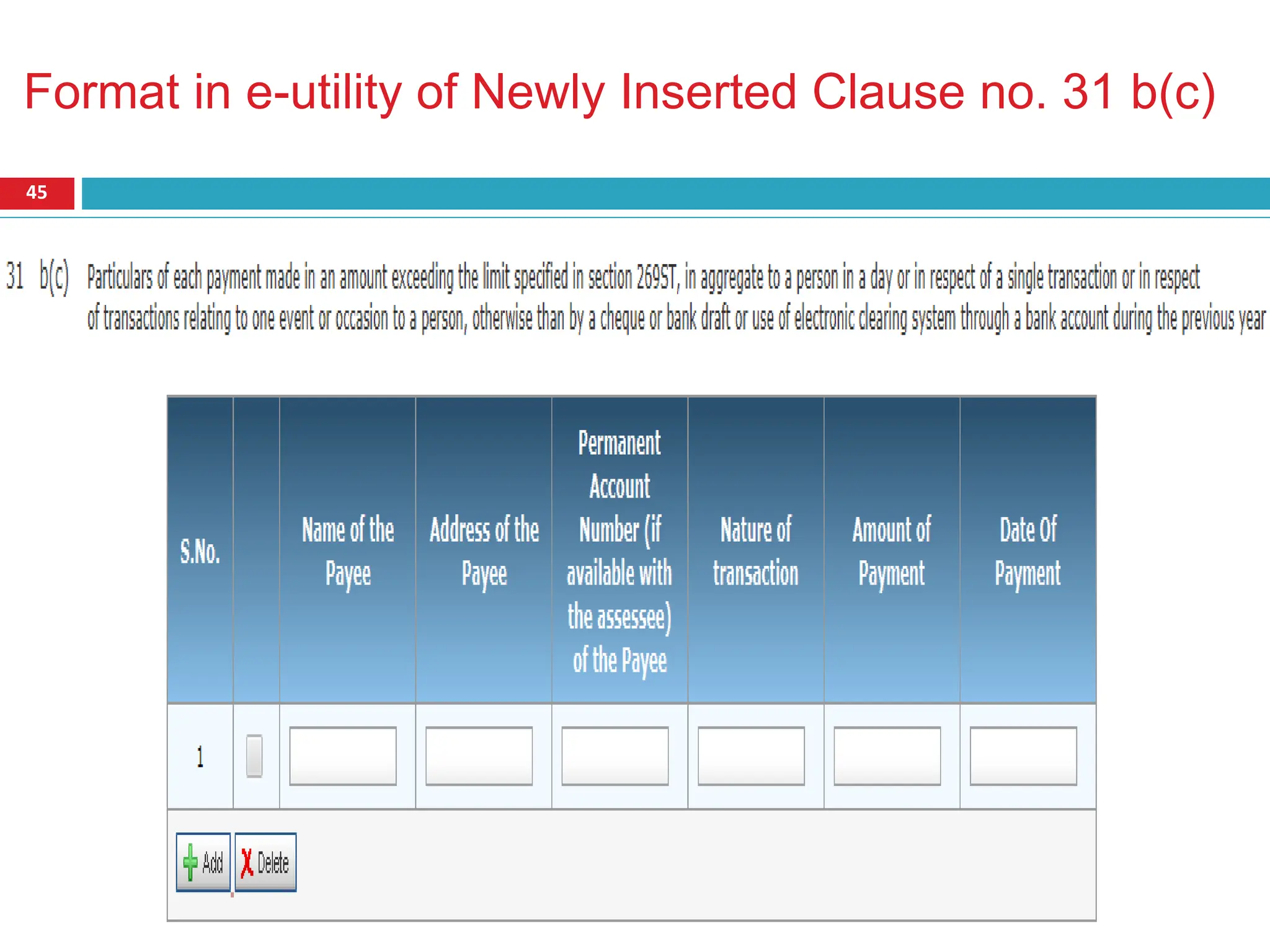
Format in e-utility of Newly Inserted Clause no. 31 b(c)
45
46
Clause b(d) Newly Inserted
Particulars of each payment in an amount exceeding the limit
specified in section 269ST, in aggregate to a person in a day or in
respect of a single transaction or in respect of transactions relating
to one event or occasion to a person, made by a cheque or bank
draft, not being an account payee cheque or an account payee
bank draft, during the previous year:
i. Name, address and Permanent Account Number (if available
with the assessee) of the payee;
ii. Amount of payment (in Rs.);
Clause no. 31
Contd….
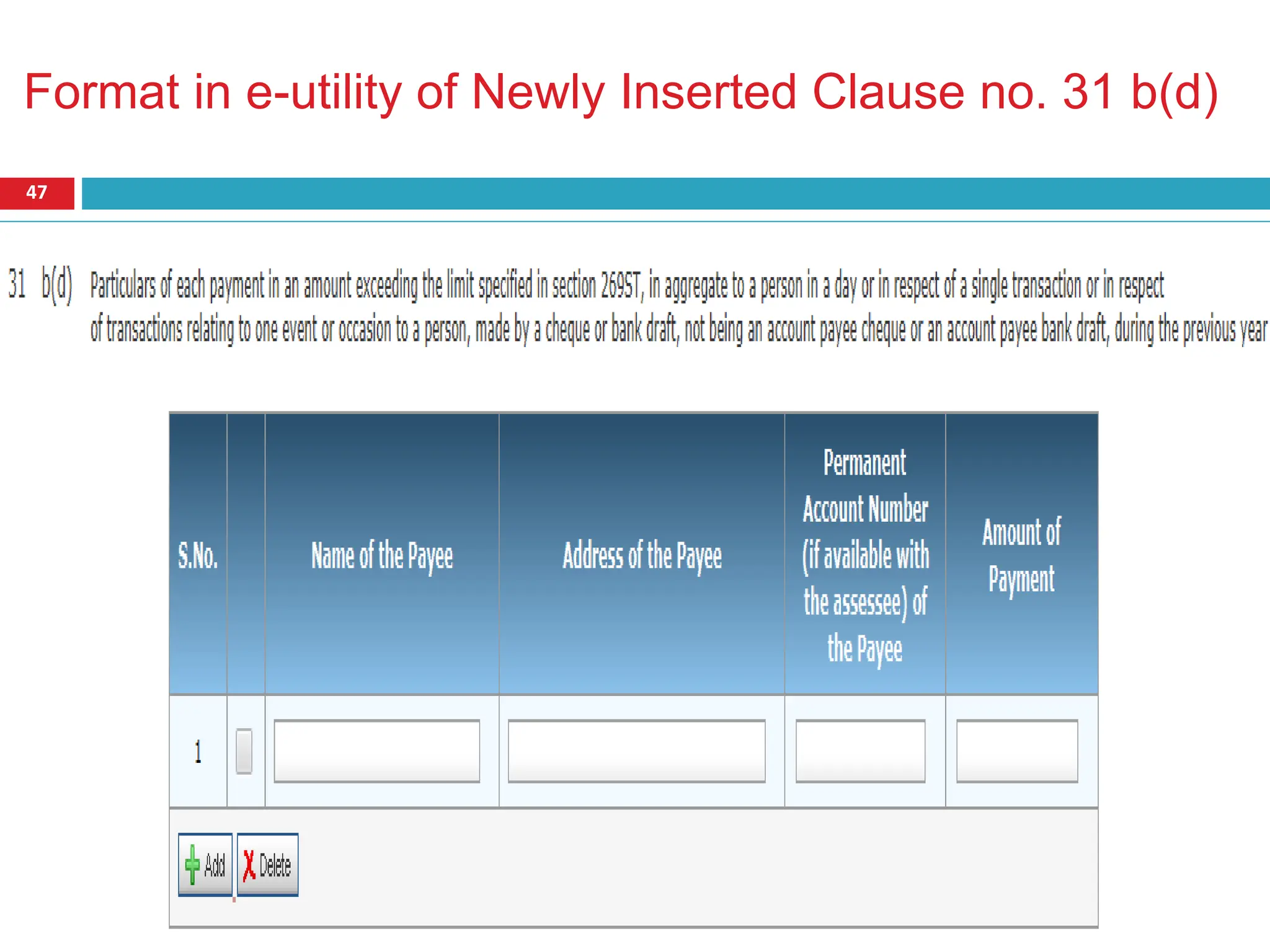
Format in e-utility of Newly Inserted Clause no. 31 b(d)
47
48
Particulars at (ba), (bb), (bc) and (bd) need not be given in the case of
receipt by or payment to a Government company, a banking Company,
a post office savings bank, a cooperative bank or in the case of
transactions referred to in section 269SS or in the case of persons
referred to in Notification No. S.O. 2065(E) dated 3rd July, 2017
Clause no. 31
Contd….
49
 The transactions reported under Form 61A for SFT must be included under clause
31b(a) & 31b(b) according to respective mode of transaction and reporting
requirements.
 It may be possible that the transactions reported u/s 269SS & 269T would require
to report again u/s 269ST (i.e. transactions more than Rs. 2,00,000/-), as section
269ST covers reporting of all the transactions of Rs.2,00,000/- or more, whether
trade or non-trade.
 There may be practical difficulties in verifying whether the transactions are done
by account payee cheque or account payee bank draft. In such cases, the tax
auditor should verify the transactions with reference to such evidence which may
be available. In the absence of satisfactory evidence, the guidance given by ICAI
to the tax auditor has been given to make a suitable comment in his report as
suggested:
“It is not possible for me/us to verify whether loans or deposits have been taken
or accepted otherwise than by an account payee cheque or account payee bank
draft, as the necessary evidence is not in the possession of the assessee”
Issues on clause 31 b(a), b(b), b(c) &
b(d)
Contd….
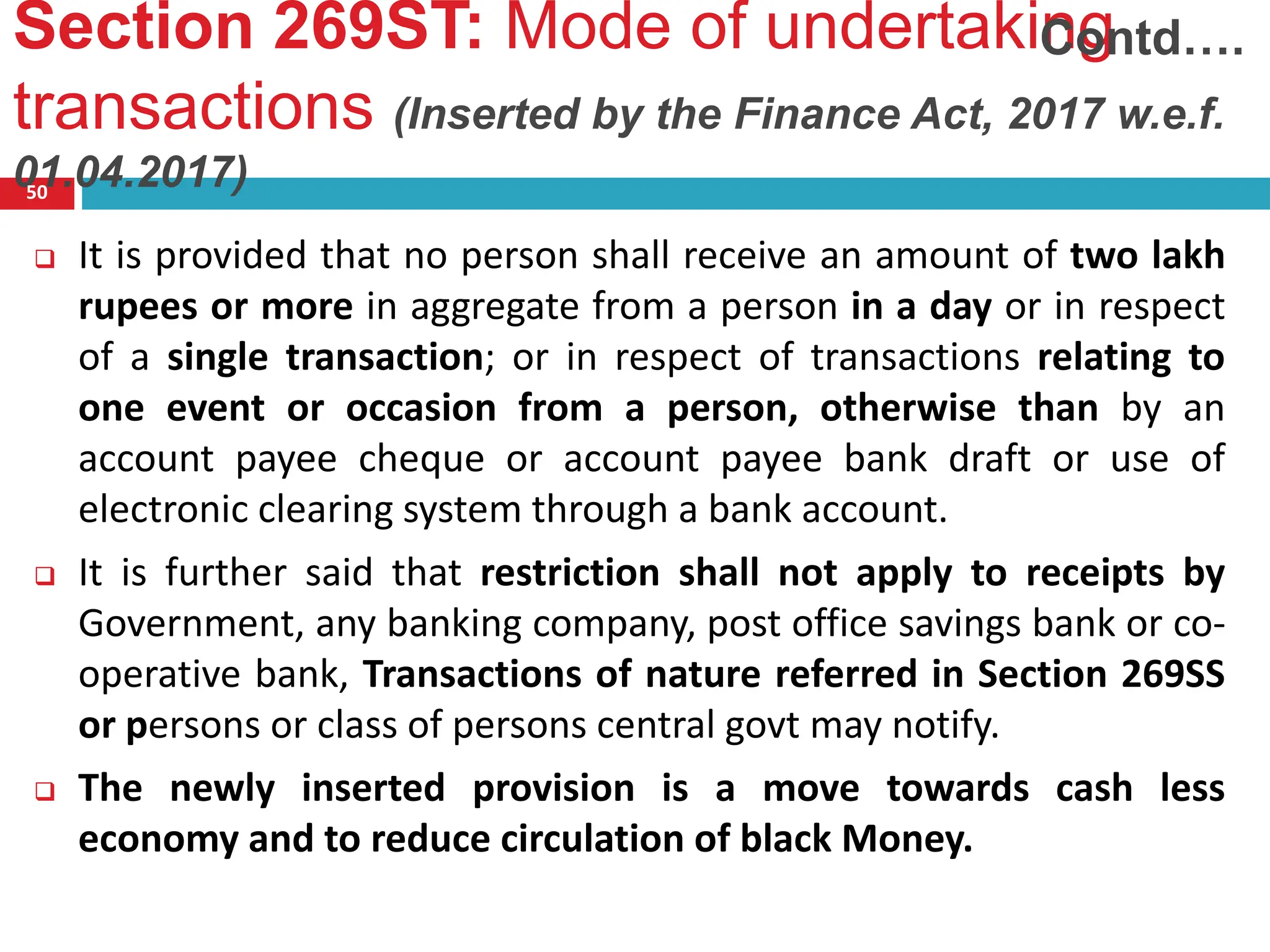
Section 269ST: Mode of undertaking
transactions (Inserted by the Finance Act, 2017 w.e.f.
01.04.2017)
50
 It is provided that no person shall receive an amount of two lakh
rupees or more in aggregate from a person in a day or in respect
of a single transaction; or in respect of transactions relating to
one event or occasion from a person, otherwise than by an
account payee cheque or account payee bank draft or use of
electronic clearing system through a bank account.
 It is further said that restriction shall not apply to receipts by
Government, any banking company, post office savings bank or co-
operative bank, Transactions of nature referred in Section 269SS
or persons or class of persons central govt may notify.
 The newly inserted provision is a move towards cash less
economy and to reduce circulation of black Money.
Contd….
Circulars or Notification issued in
respect of section 269ST
51
 It is clarified that in respect of receipt in the nature of repayment
of loan by non-banking financial companies (NBFCs) and housing
finance companies (HFCs), the receipt of one instalment of loan
repayment in respect of a loan shall constitute a ‘single
transaction’ as specified in clause (b) of section 269ST of the Act
and all the instalments paid for a loan shall not be aggregated for
the purposes of determining applicability of the provisions
section 269ST. [Circular No. 22 of 2017 dated 03/07/2017]
 It is clarified that cash sale of the agricultural produce by its
cultivator to the trader for an amount of Rs 2 Lakh or more is
prohibited under section 269ST of the Act in the case of the
cultivator. [Circular No. 27 of 2017 dated 03/11/2017]
Circulars or Notification
issued in respect of section
269ST
52
The Receipts/ Entities which are Exempt from Provisions u/s 269ST of the Income Tax Act,
1961 [Notification No. 57 /2017, dated 03/07/2017 w.e.f. 01/04/2017]
 The provision of section 269ST shall not apply to the following, namely:-
(a) receipt by a business correspondent on behalf of a banking company or co-operative
bank, in accordance with the guidelines issued by the Reserve Bank of India;
(b) receipt by a white label automated teller machine operator from retail outlet sources
on behalf of a banking company or co-operative bank, in accordance with the
authorisation issued by the Reserve Bank of India under the Payment and Settlement
Systems Act, 2007 (51 of 2007);
(c) receipt from an agent by an issuer of pre-paid payment instruments, in accordance
with the authorisation issued by the Reserve Bank of India under the Payment and
Settlement Systems Act, 2007 (51 of 2007);
(d) receipt by a company or institution issuing credit cards against bills raised in respect of
one or more credit cards;
(e) receipt which is not includible in the total income under clause (17A) of section 10 of
the Income-tax Act, 1961.
Contd….
53
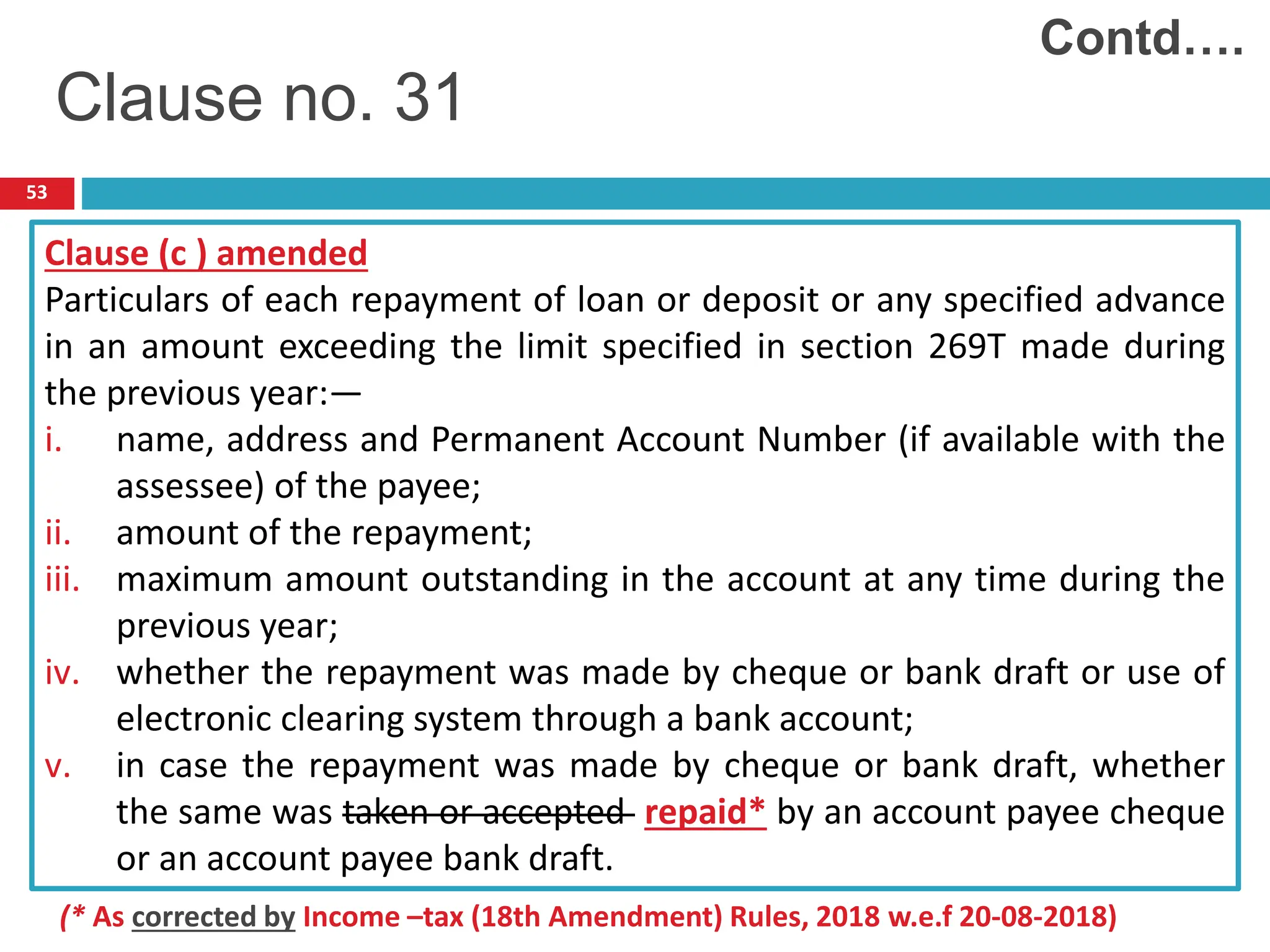
Clause (c ) amended
Particulars of each repayment of loan or deposit or any specified advance
in an amount exceeding the limit specified in section 269T made during
the previous year:—
i. name, address and Permanent Account Number (if available with the
assessee) of the payee;
ii. amount of the repayment;
iii. maximum amount outstanding in the account at any time during the
previous year;
iv. whether the repayment was made by cheque or bank draft or use of
electronic clearing system through a bank account;
v. in case the repayment was made by cheque or bank draft, whether
the same was taken or accepted repaid* by an account payee cheque
or an account payee bank draft.
Contd….
Clause no. 31
(* As corrected by Income –tax (18th Amendment) Rules, 2018 w.e.f 20-08-2018)
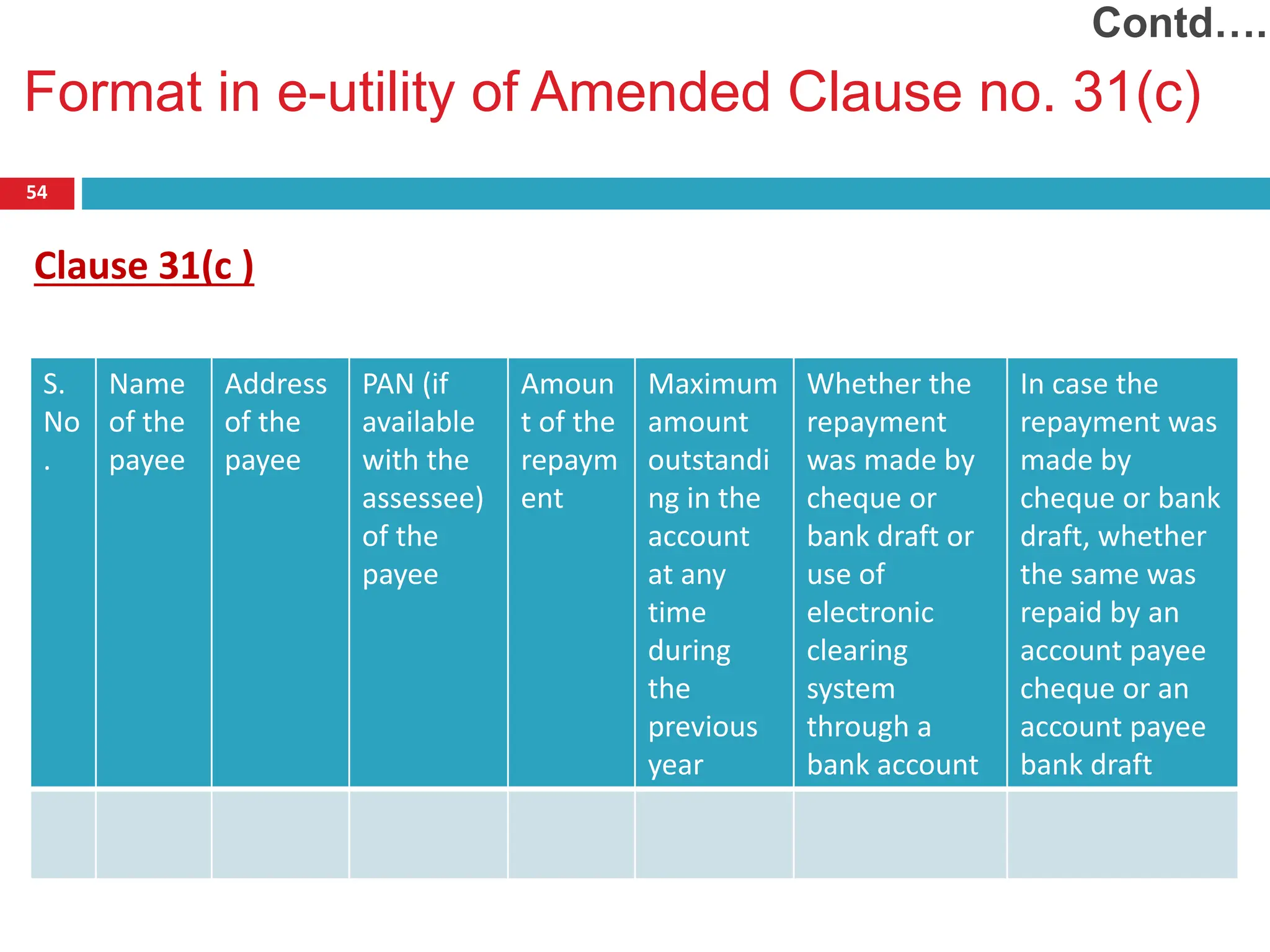
Format in e-utility of Amended Clause no. 31(c)
54
Clause 31(c )
Contd….
S.
No
.
Name
of the
payee
Address
of the
payee
PAN (if
available
with the
assessee)
of the
payee
Amoun
t of the
repaym
ent
Maximum
amount
outstandi
ng in the
account
at any
time
during
the
previous
year
Whether the
repayment
was made by
cheque or
bank draft or
use of
electronic
clearing
system
through a
bank account
In case the
repayment was
made by
cheque or bank
draft, whether
the same was
repaid by an
account payee
cheque or an
account payee
bank draft
55
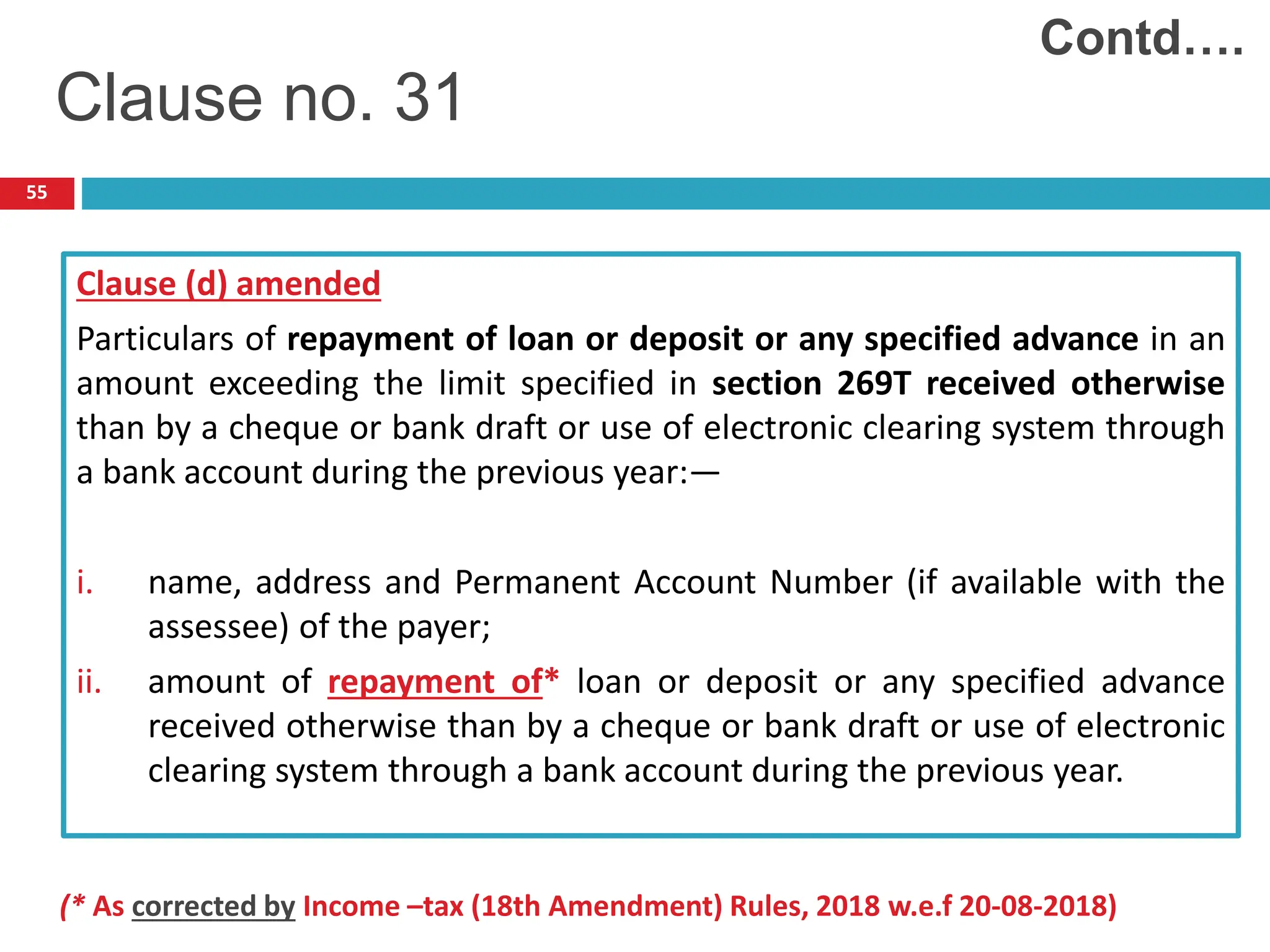
Clause (d) amended
Particulars of repayment of loan or deposit or any specified advance in an
amount exceeding the limit specified in section 269T received otherwise
than by a cheque or bank draft or use of electronic clearing system through
a bank account during the previous year:—
i. name, address and Permanent Account Number (if available with the
assessee) of the payer;
ii. amount of repayment of* loan or deposit or any specified advance
received otherwise than by a cheque or bank draft or use of electronic
clearing system through a bank account during the previous year.
Contd….
Clause no. 31
(* As corrected by Income –tax (18th Amendment) Rules, 2018 w.e.f 20-08-2018)
56
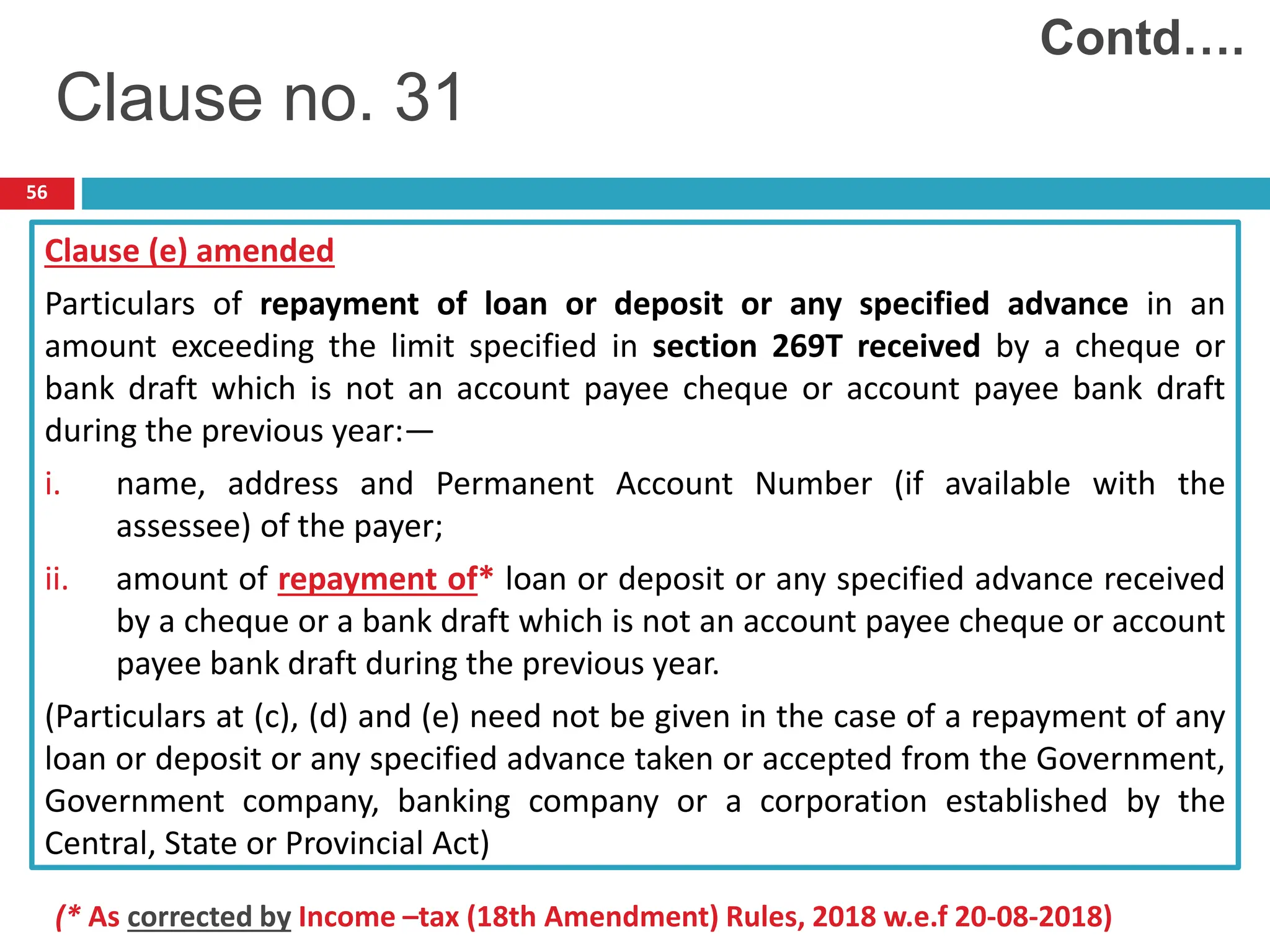
Clause (e) amended
Particulars of repayment of loan or deposit or any specified advance in an
amount exceeding the limit specified in section 269T received by a cheque or
bank draft which is not an account payee cheque or account payee bank draft
during the previous year:—
i. name, address and Permanent Account Number (if available with the
assessee) of the payer;
ii. amount of repayment of* loan or deposit or any specified advance received
by a cheque or a bank draft which is not an account payee cheque or account
payee bank draft during the previous year.
(Particulars at (c), (d) and (e) need not be given in the case of a repayment of any
loan or deposit or any specified advance taken or accepted from the Government,
Government company, banking company or a corporation established by the
Central, State or Provincial Act)
Contd….
Clause no. 31
(* As corrected by Income –tax (18th Amendment) Rules, 2018 w.e.f 20-08-2018)
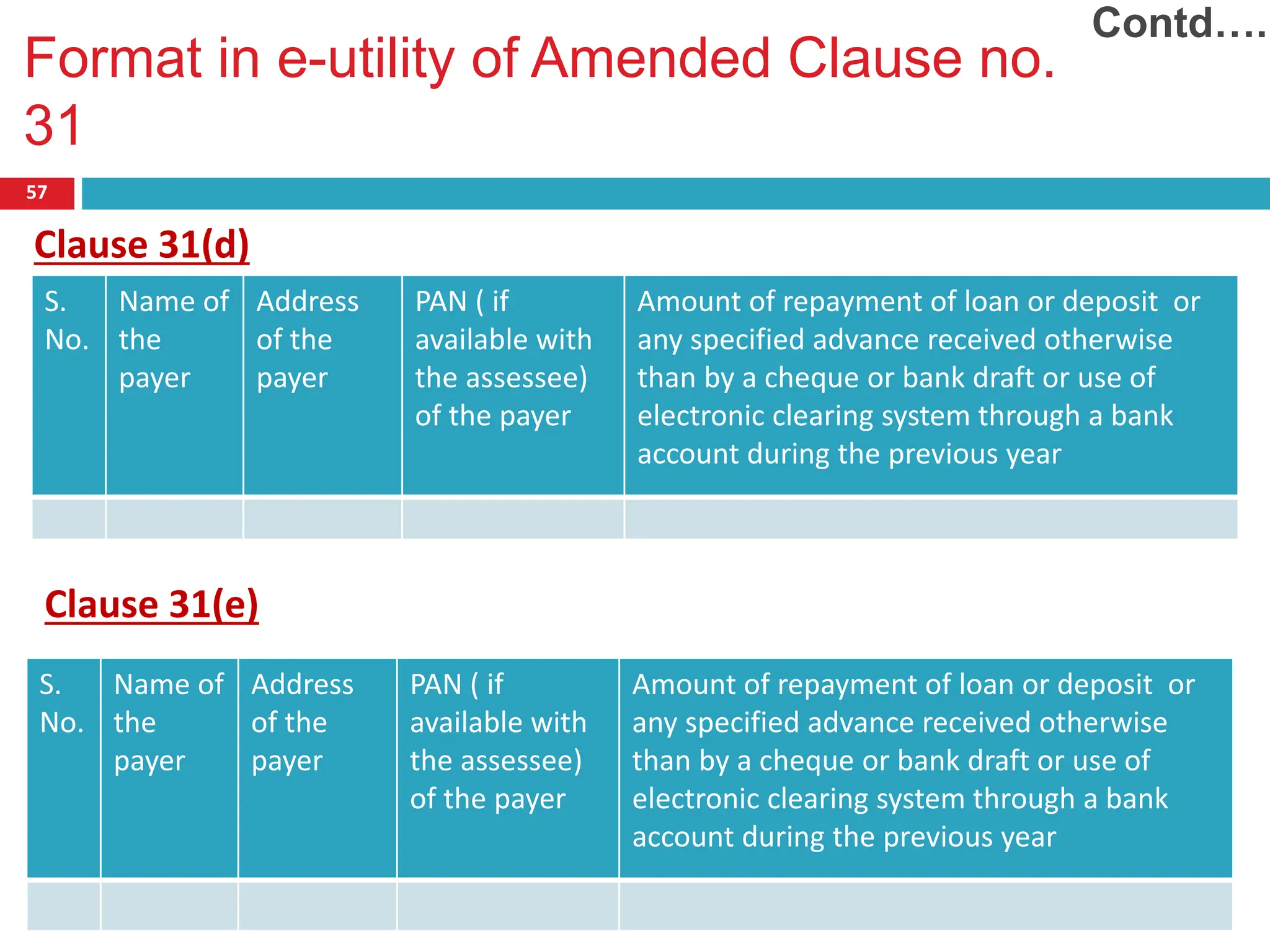
Format in e-utility of Amended Clause no.
31
57
Clause 31(d)
Contd….
S.
No.
Name of
the
payer
Address
of the
payer
PAN ( if
available with
the assessee)
of the payer
Amount of repayment of loan or deposit or
any specified advance received otherwise
than by a cheque or bank draft or use of
electronic clearing system through a bank
account during the previous year
S.
No.
Name of
the
payer
Address
of the
payer
PAN ( if
available with
the assessee)
of the payer
Amount of repayment of loan or deposit or
any specified advance received otherwise
than by a cheque or bank draft or use of
electronic clearing system through a bank
account during the previous year
Clause 31(e)
58
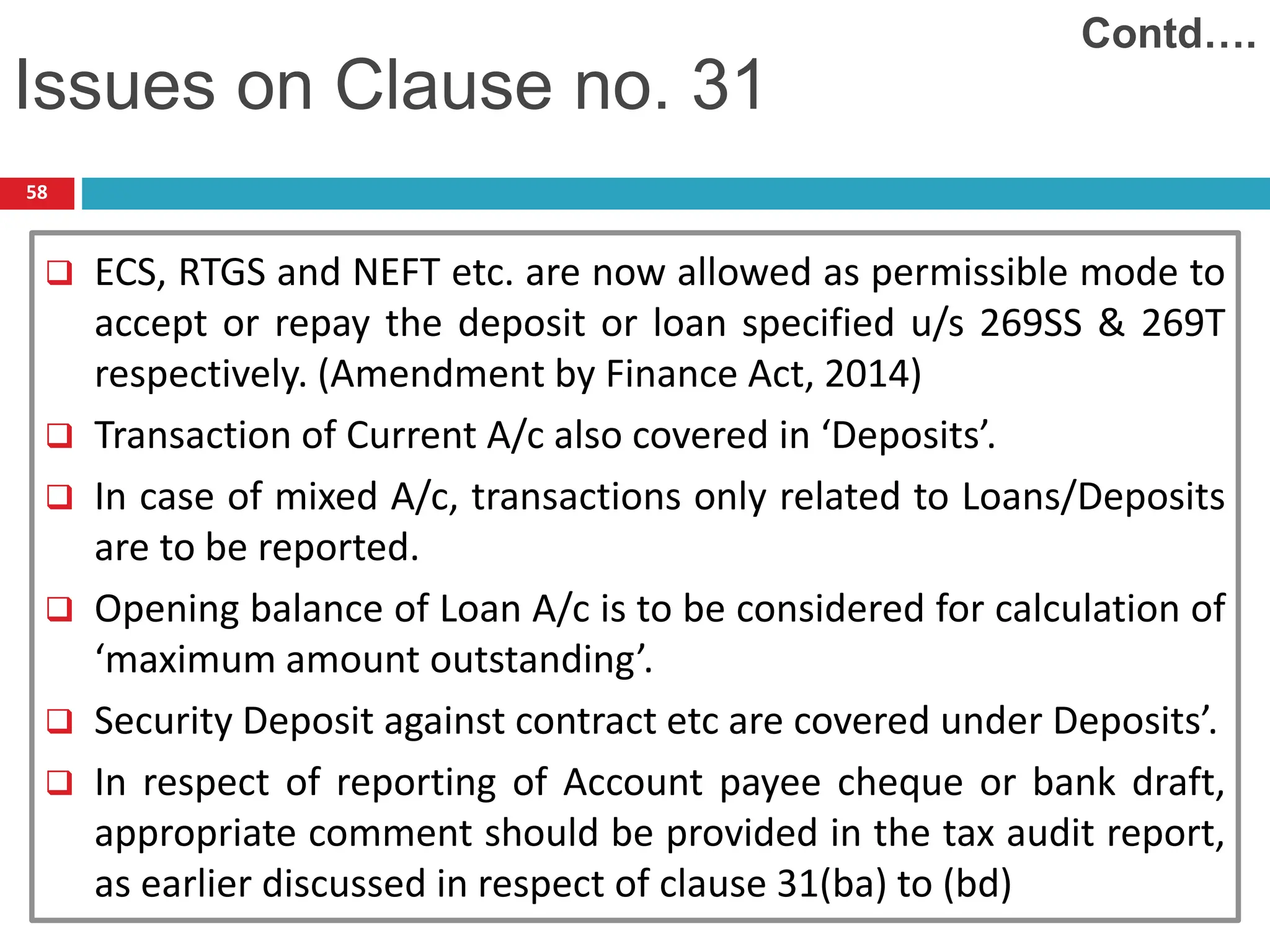
 ECS, RTGS and NEFT etc. are now allowed as permissible mode to
accept or repay the deposit or loan specified u/s 269SS & 269T
respectively. (Amendment by Finance Act, 2014)
 Transaction of Current A/c also covered in ‘Deposits’.
 In case of mixed A/c, transactions only related to Loans/Deposits
are to be reported.
 Opening balance of Loan A/c is to be considered for calculation of
‘maximum amount outstanding’.
 Security Deposit against contract etc are covered under Deposits’.
 In respect of reporting of Account payee cheque or bank draft,
appropriate comment should be provided in the tax audit report,
as earlier discussed in respect of clause 31(ba) to (bd)
Issues on Clause no. 31
Contd….
59
Accepting/ Repaying Loans/ Advances via Journal Entries:
 The provisions of Section 269SS of the Act does not get attracted merely for
transfer of amount to a loan account in the form of book entry. CIT Vs.
Worldwide Township Projects Ltd., [2014] 367 ITR 433 (Delhi)
 Contrary view has been taken by High Court of Bombay in CIT vs Triumph
International Finance (I) Ltd. [2012] 345 ITR 270 (Bombay) wherein held that
repayment of loan/deposit by merely debiting account through journal entries
contravenes provisions of Section 269T.
 Further, held by ITAT- Bombay in Lodha Builders Pvt Ltd vs. ACIT, [2014] 34
ITR(T) 157, that penalty cannot be levied u/s 271D and 271E if the transactions
are bona fide & genuine even where accepting/ repaying loans/ advances via
journal entries contravenes s. 269SS & 269T.
Contd….
Issues on Clause no. 31
60
 Where the transaction is by an A/c Payee Cheque and no payment was
made in Cash. Provisions of Sec 269SS shall not be attracted. CIT Vs Noida
Toll Bridge Co. Ltd 262 ITR 260 (Del)
 If the cheque or bank draft through which loan is received is ‘crossed’ but
words ‘account payee’ is not written in the crossing but the transaction is
otherwise genuine and the bank confirms that these amounts have been
deposited in assessee’s account and are as per the banking norms and
there was no flaw in the transaction, penalty under Section 271D is not
imposable for such a trivial violation. CIT v. Makhija Construction Co.
[2002] 123 Taxman 1003 (MP)
Contd….
Issues on Clause no. 31
Issue on clause 31 – Applicability of 269SS on
Share Application money
 Share application money partakes the character of a deposit even if it cannot be
considered as a loan within the meaning of section 269SS. Since it is payable in
specie on refusal to allot shares and was repayable if recalled by the applicant,
before allotment of shares and the conclusion of the contract. Therefore, acceptance
of share application money in cash amounting to Rs. 20,000 or more would violate
provisions of section 269SS. Balotia Engineering Works (P) Ltd. Vs. CIT (2005) 275
ITR 0399 (Jhar.).
 However, in DIT (Exemption) v. Acme Educational Society [2010] 326 ITR 146, it
was held that a loan grants temporary use of money, or temporary accommodation,
and that the essence of a deposit is that there must be a liability to return it to the
party by whom or on whose behalf it has been made, on fulfilment of certain
conditions. If these tests are applied to the receipt of share application money, it may
be seen that the receipt of share application monies from other companies for
allotment of shares cannot be treated as receipt of loan or deposit. Also see CIT Vs
I.P. India (P.) Ltd. [2012] 343 ITR 353 (Delhi)
 Where the assessee was under bonafide belief that share application money was
neither loans or deposits, penalty u/s 271D could not be levied CIT Vs Object
Frontier Software (P.) Ltd. [2017] 244 Taxman 292 (Madras)
61
62
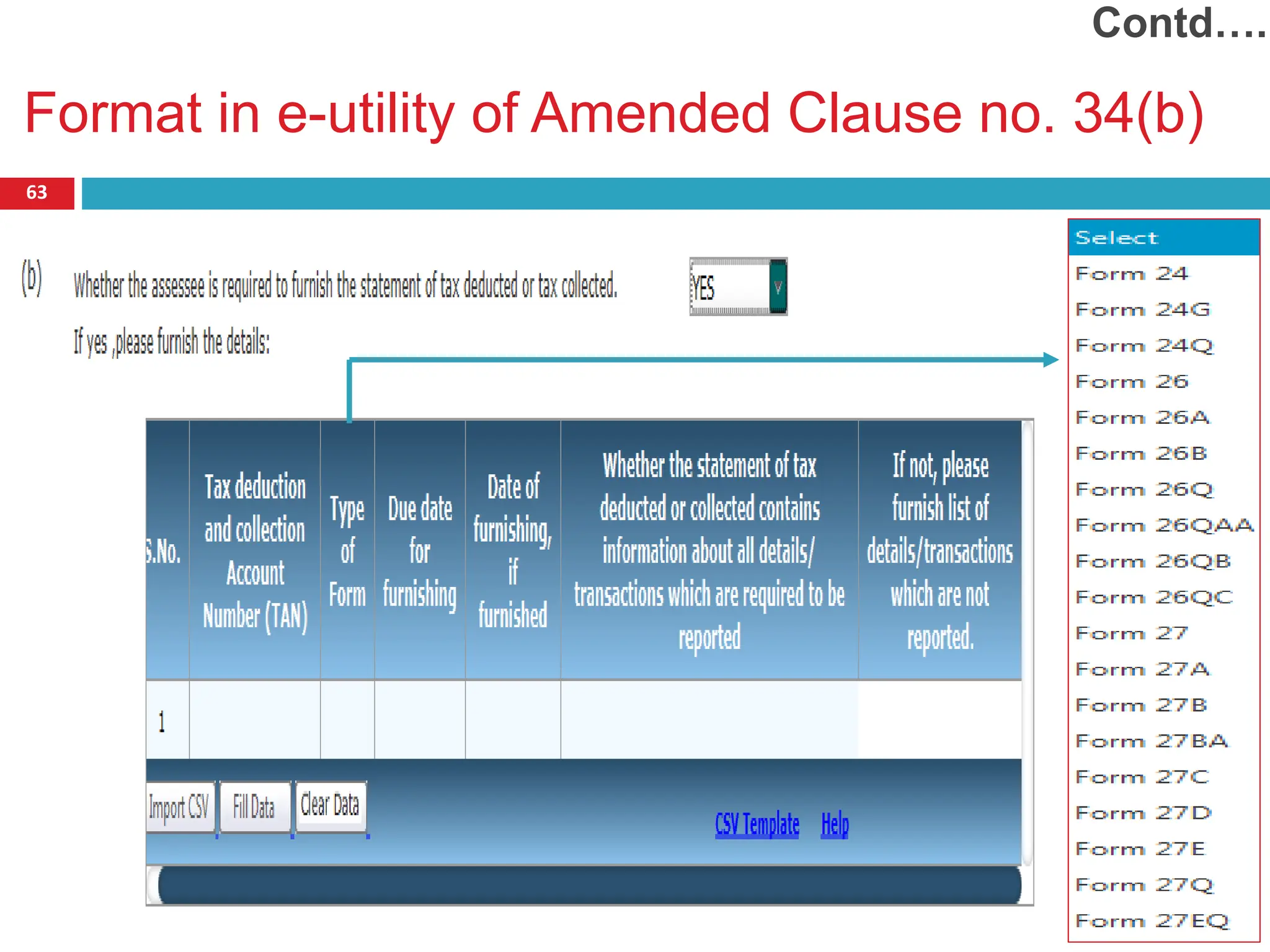
Clause (b) substituted
 whether the assessee is required to furnish the statement of tax
deducted or tax collected. If yes, please furnish the details:
Clause no. 34 [Amended]
Tax
deduction
and
collection
Account
Number
(TAN)
Type of
Form
Due date
for
furnishing
Date of
furnishing
, if
furnished
Whether the statement of tax
deducted or collected contains
information about all details/
transactions which are required to
be reported. If not, please furnish
list of details/ transactions which
are not reported.;
Brief: Clause 34(b) has been substituted i.e. Details with respect to transactions
not disclosed in TDS Return/ TCS Return is to be mentioned.
Format in e-utility of Amended Clause no. 34(b)
63
Contd….
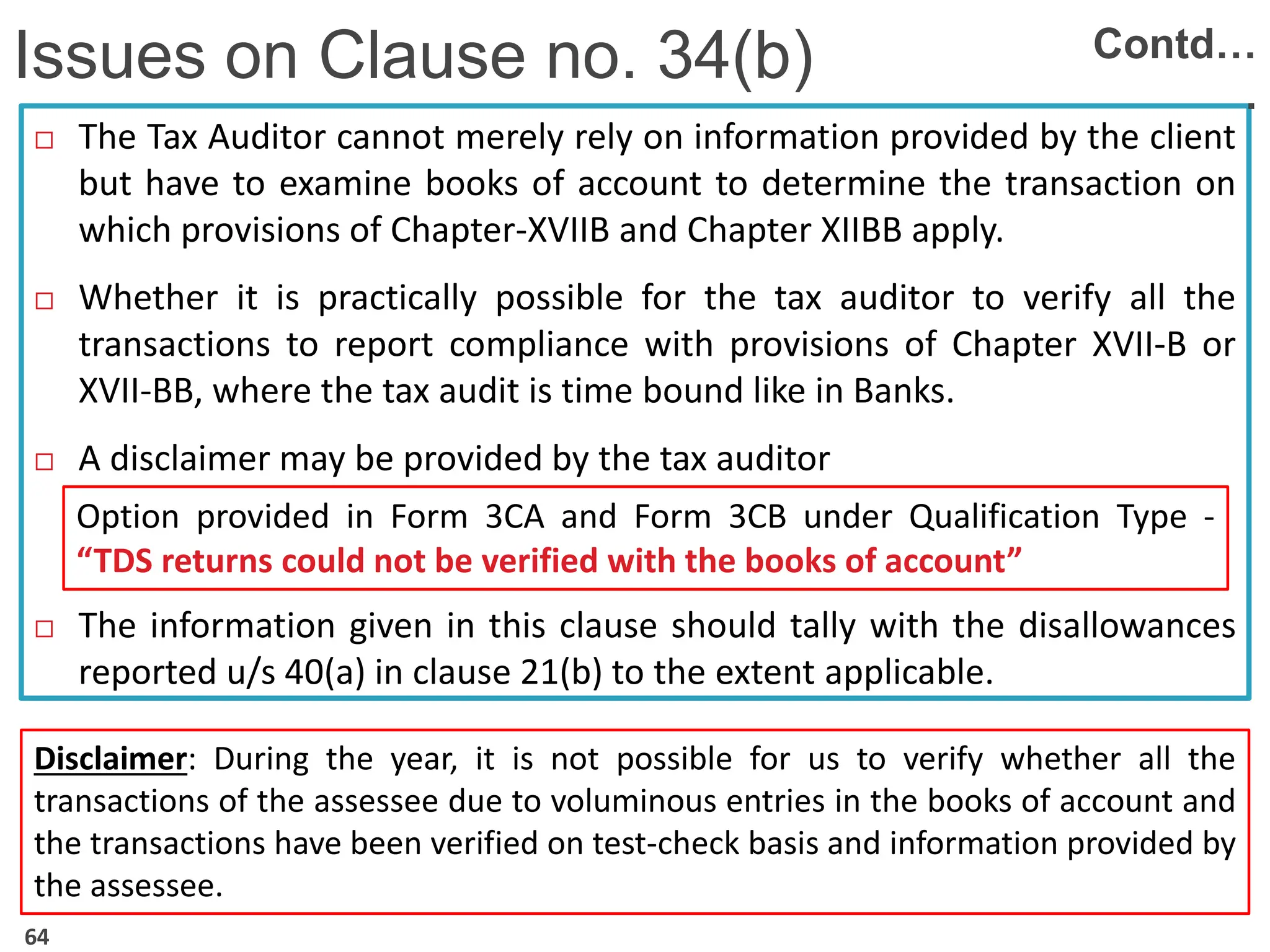
 The Tax Auditor cannot merely rely on information provided by the client
but have to examine books of account to determine the transaction on
which provisions of Chapter-XVIIB and Chapter XIIBB apply.
 Whether it is practically possible for the tax auditor to verify all the
transactions to report compliance with provisions of Chapter XVII-B or
XVII-BB, where the tax audit is time bound like in Banks.
 A disclaimer may be provided by the tax auditor
 The information given in this clause should tally with the disallowances
reported u/s 40(a) in clause 21(b) to the extent applicable.
Issues on Clause no. 34(b) Contd…
.
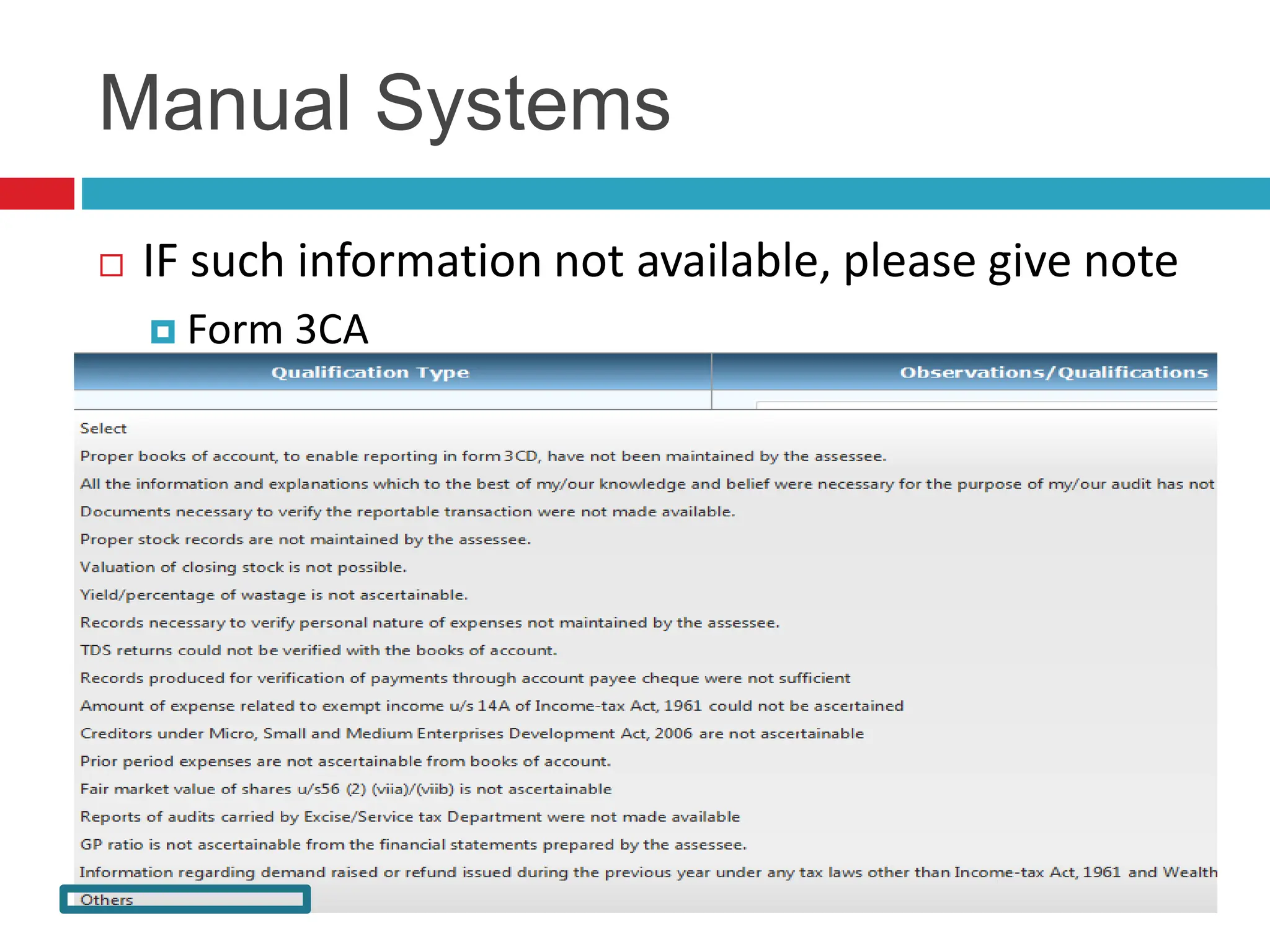
Option provided in Form 3CA and Form 3CB under Qualification Type -
“TDS returns could not be verified with the books of account”
Disclaimer: During the year, it is not possible for us to verify whether all the
transactions of the assessee due to voluminous entries in the books of account and
the transactions have been verified on test-check basis and information provided by
the assessee.
64
65
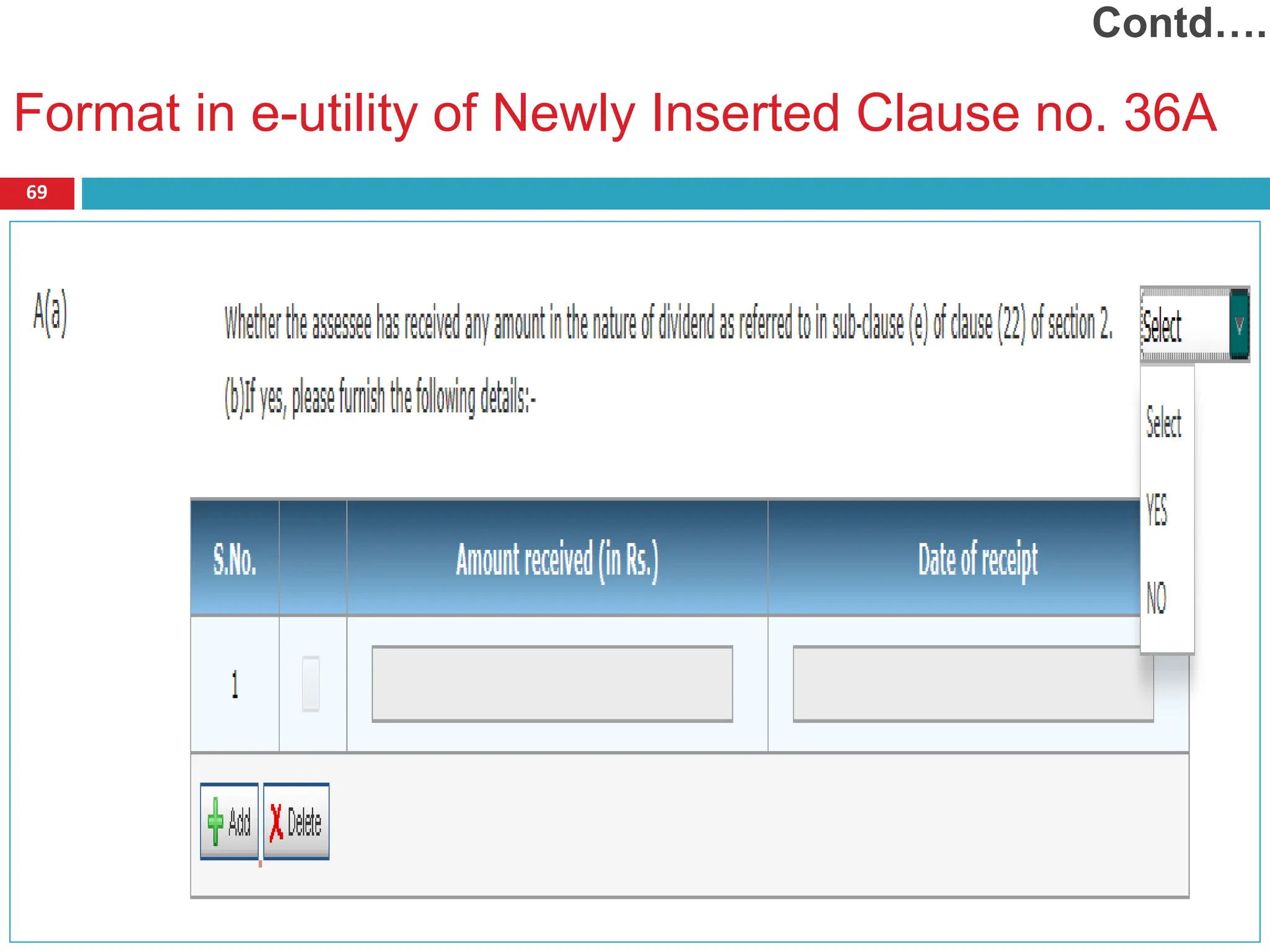
a) Whether the assessee has received any amount in the nature
of dividend as referred to in sub-clause (e) of clause (22) of
section 2? (Yes/No)
b) If yes, please furnish the following details:-
i. Amount received (in Rs.)
ii. Date of receipt
Clause no. 36A [Newly
Inserted]
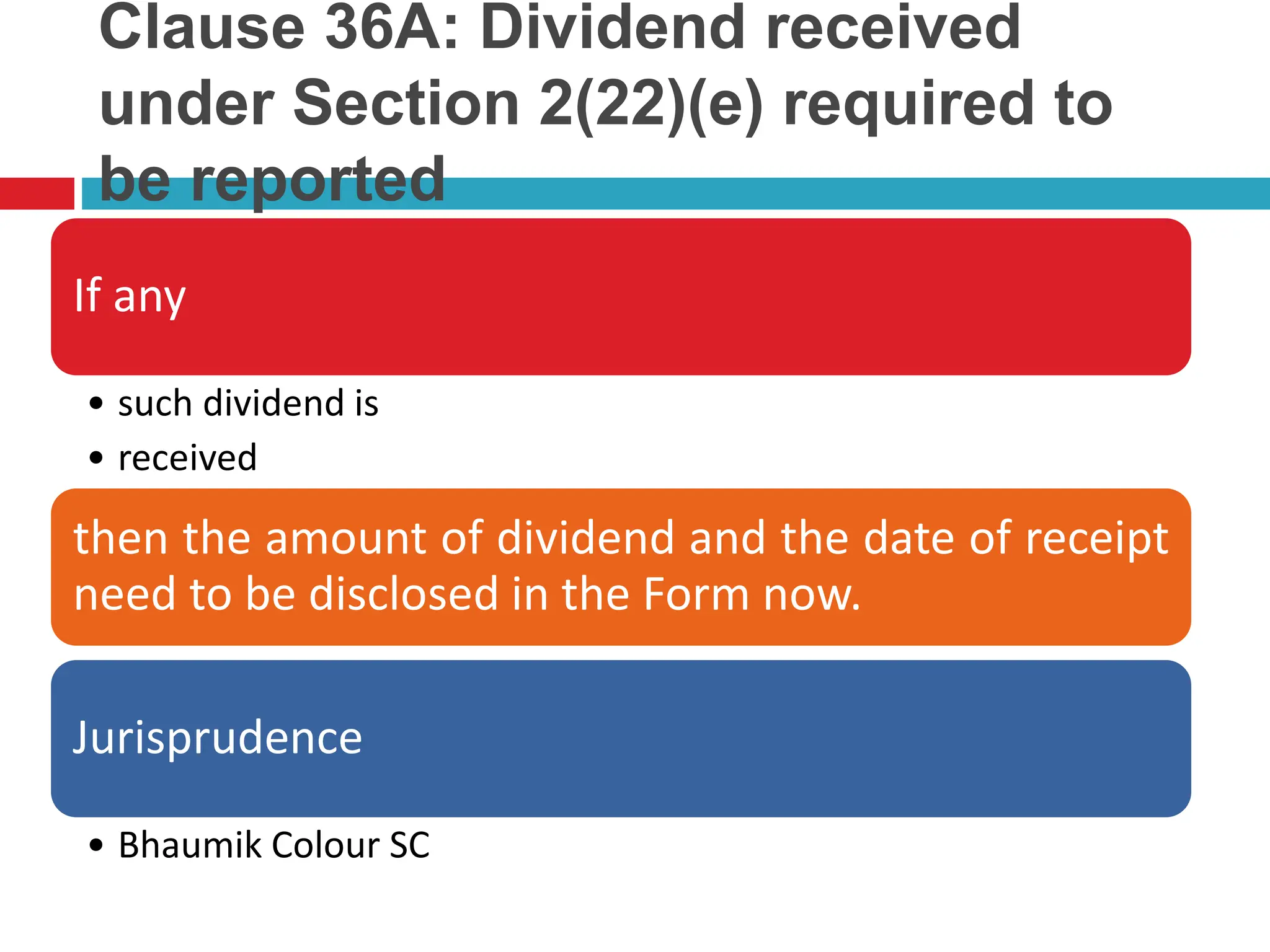
Brief: Dividend received u/s 2(22)(e) is required to be reported under
this clause
Clause 36A: Dividend received
under Section 2(22)(e) required to
be reported
If any
• such dividend is
• received
then the amount of dividend and the date of receipt
need to be disclosed in the Form now.
Jurisprudence
• Bhaumik Colour SC
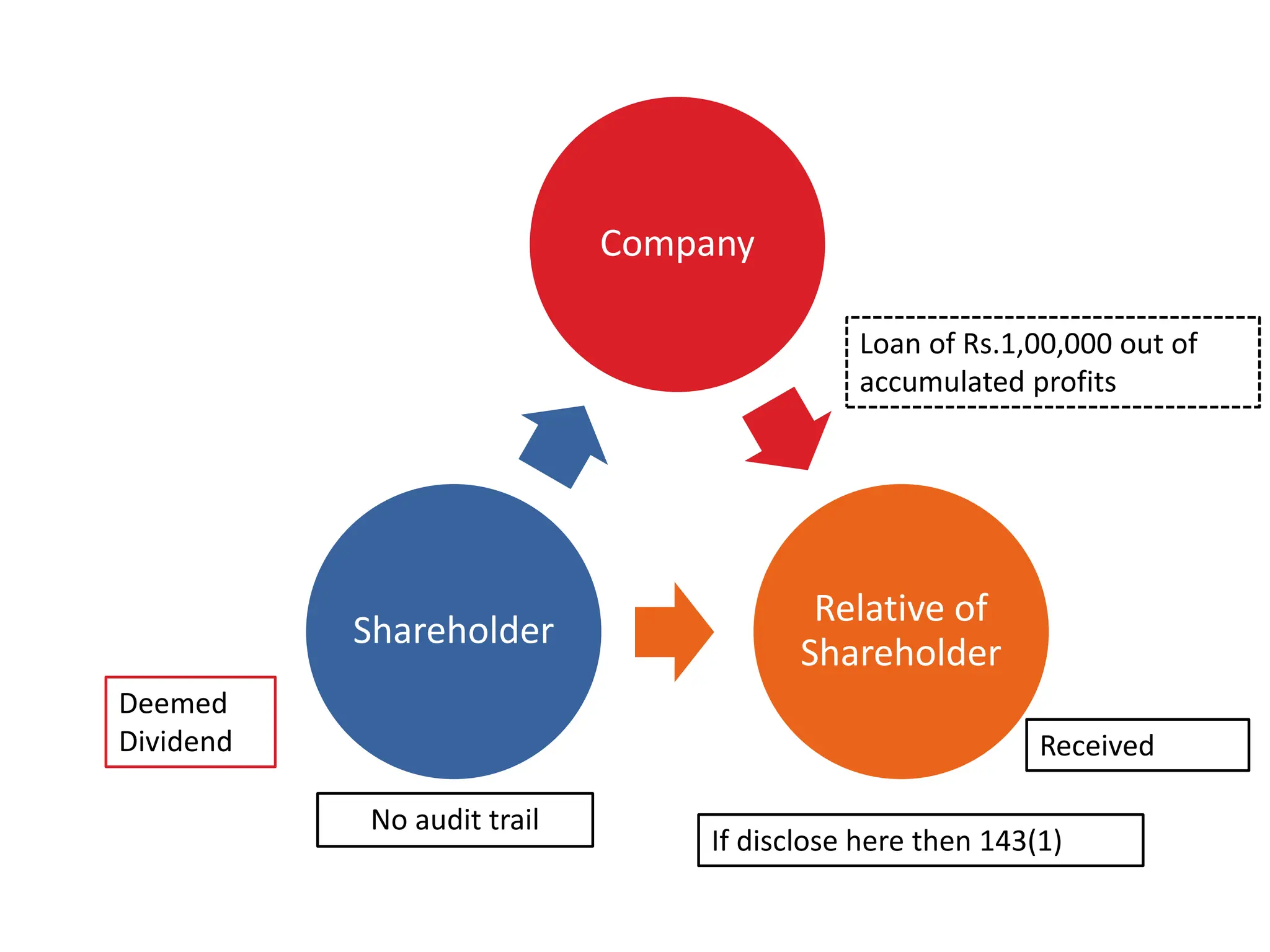
Company
Relative of
Shareholder
Shareholder
Loan of Rs.1,00,000 out of
accumulated profits
Deemed
Dividend Received
If disclose here then 143(1)
No audit trail
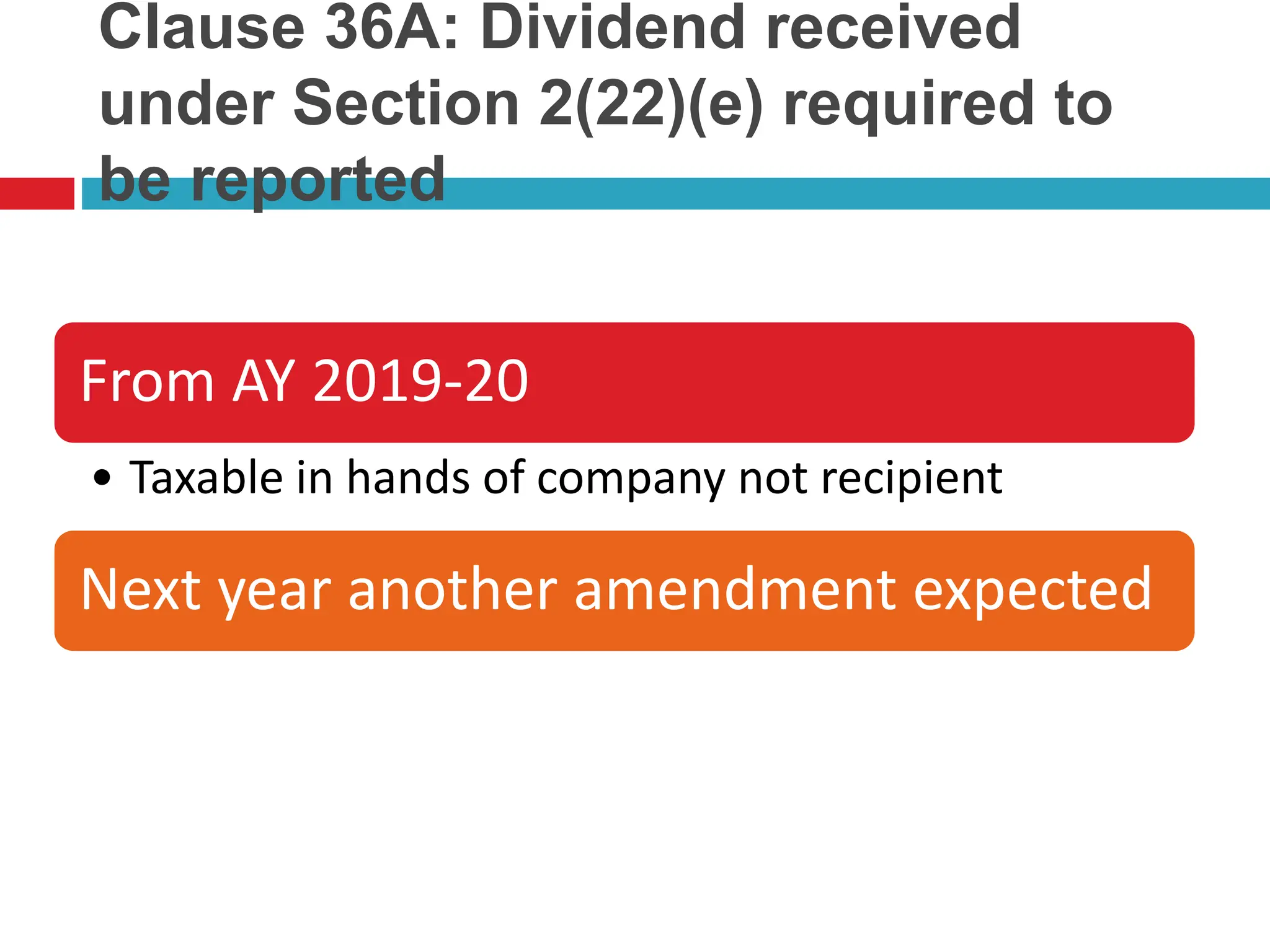
Clause 36A: Dividend received
under Section 2(22)(e) required to
be reported
From AY 2019-20
• Taxable in hands of company not recipient
Next year another amendment expected
Format in e-utility of Newly Inserted Clause no. 36A
69
Contd….
A Shareholder
 in which such shareholder
is a member or a partner
 and in which he has a
substantial interest
 being the beneficial
owner of shares
 holding not less than
10% of voting power
 on behalf, or for the
individual benefit of any
such shareholder
Any Concern Any Person
or
to the extent to which the company possesses Accumulated profits.
or
Provisions of Deemed Dividend u/s Section 2(22)(e) of
the Income Tax Act, 1961……
Meaning of “Substantial Interest”:
Person shall be deemed to have a substantial interest in a concern, other than a company, if
he is, during the previous year, beneficially entitled to not less than 20% of the income of
such concern.
In the case of Company-a person should beneficially hold at least 20% Equity Share capital of
the company.
71
 The Auditor would have to apply professional judgement as to what would fall
under this provisions or not, would require to evaluated on facts & circumstances
of transactions.
 The tax auditor would have to check all the investment in shares held by the
assessee in the closely held companies during the year and also have to check
whether assessee was also beneficial shareholder of that with 10% voting power
in that company at any time during the concerned year. If Yes, then the tax
auditor also have to verify whether any amount received from those companies
covered under the applicable provisions or not.
 If the tax auditor is being placed reliance on any judicial pronouncement in
respect of this section, then it should be reported in his audit report and proper
working paper should be maintained in this regard.
 The management representation obtained in respect of this should be
maintained properly for further reference.
 A disclaimer may be provided by the tax auditor in his audit report under Form
3CA or Form 3CB as the case may be.
Contd….
Issues on Clause 36A……..
72
 Whether it is practically possible for the tax auditor to verify all the transactions
to report compliance with provisions. As in those cases where payment is made
to concern or persons, on behalf of assessee, which may taxed under the
provisions of section 2(22)(e) of the Act in the hands of the assessee, would not
be possible on the part of the tax auditor to verify. Hence, the auditor would
have to place reliance of the information provided by the assessee in this regard
and proper disclosure should be made for this.
 Whether an amount is deemed to be dividend under section 2(22)(e) of the Act
or not, in many cases depends upon whether the payer company had
“accumulated profits” or not. This cannot be known from the records of the
recipient of the tainted amount since it is only the accounts of the payer that one
can know whether he had ‘accumulated profits’. It is not known how the auditor,
in the course of audit of the person who received the tainted amount, can know
whether the other party had accumulated profits or not. This information is
confidential and even the person in receipt of the amount cannot provide this
information.
Contd….
Issues on Clause 36A……..
73
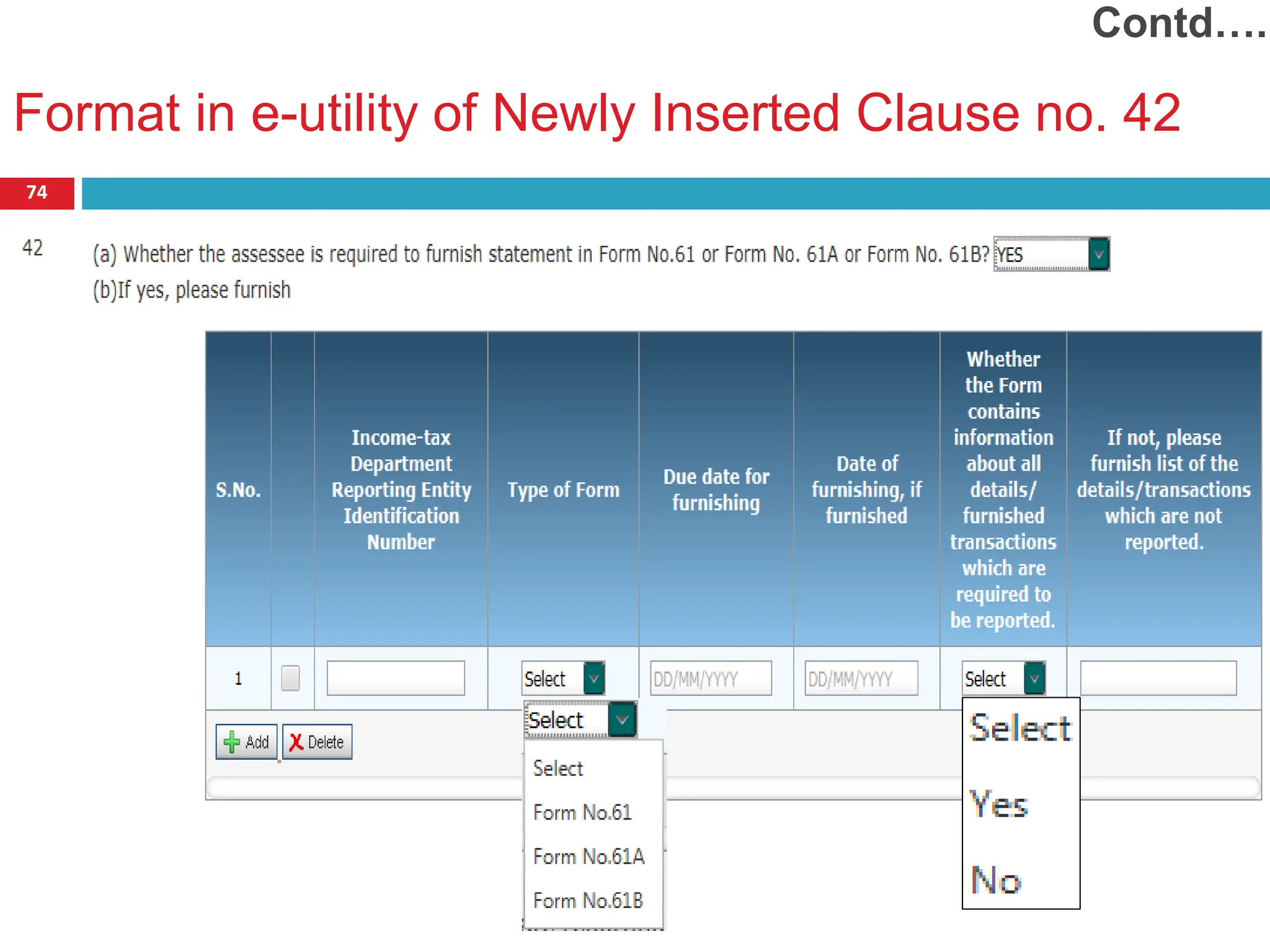
a) Whether the assessee is required to furnish statement in Form
No.61 or Form No. 61A or Form No. 61B? (Yes/No)
b) If yes, please furnish:
Income-tax
Department
Reporting Entity
Identification
Number
Type of
Form
Due date for
furnishing
Date of
furnishing, if
furnished
Whether the Form contains
information about all details/
transactions which are required to
be reported. If not, please furnish
list of the details/transactions
which are not reported.
Clause no. 42 [Newly
Inserted]
Brief: Details w.r.t. Form 61 (details of No PAN/ Form 60 received), Form 61A
(statement of Specified Financial Transactions), Form 61B (Statement of
Reportable Account), is to be reported here.
Format in e-utility of Newly Inserted Clause no. 42
74
Contd….
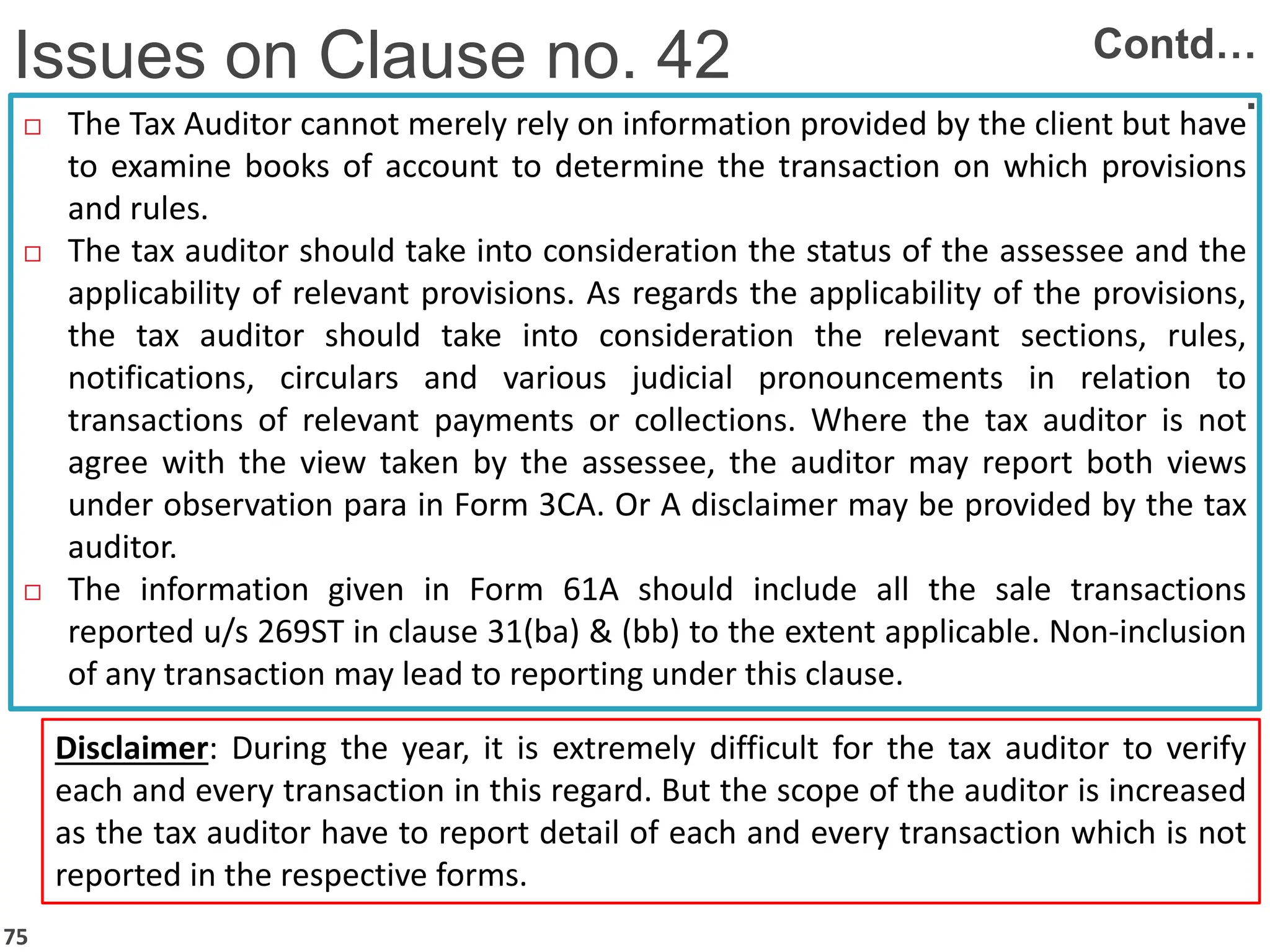
 The Tax Auditor cannot merely rely on information provided by the client but have
to examine books of account to determine the transaction on which provisions
and rules.
 The tax auditor should take into consideration the status of the assessee and the
applicability of relevant provisions. As regards the applicability of the provisions,
the tax auditor should take into consideration the relevant sections, rules,
notifications, circulars and various judicial pronouncements in relation to
transactions of relevant payments or collections. Where the tax auditor is not
agree with the view taken by the assessee, the auditor may report both views
under observation para in Form 3CA. Or A disclaimer may be provided by the tax
auditor.
 The information given in Form 61A should include all the sale transactions
reported u/s 269ST in clause 31(ba) & (bb) to the extent applicable. Non-inclusion
of any transaction may lead to reporting under this clause.
Issues on Clause no. 42 Contd…
.
Disclaimer: During the year, it is extremely difficult for the tax auditor to verify
each and every transaction in this regard. But the scope of the auditor is increased
as the tax auditor have to report detail of each and every transaction which is not
reported in the respective forms.
75
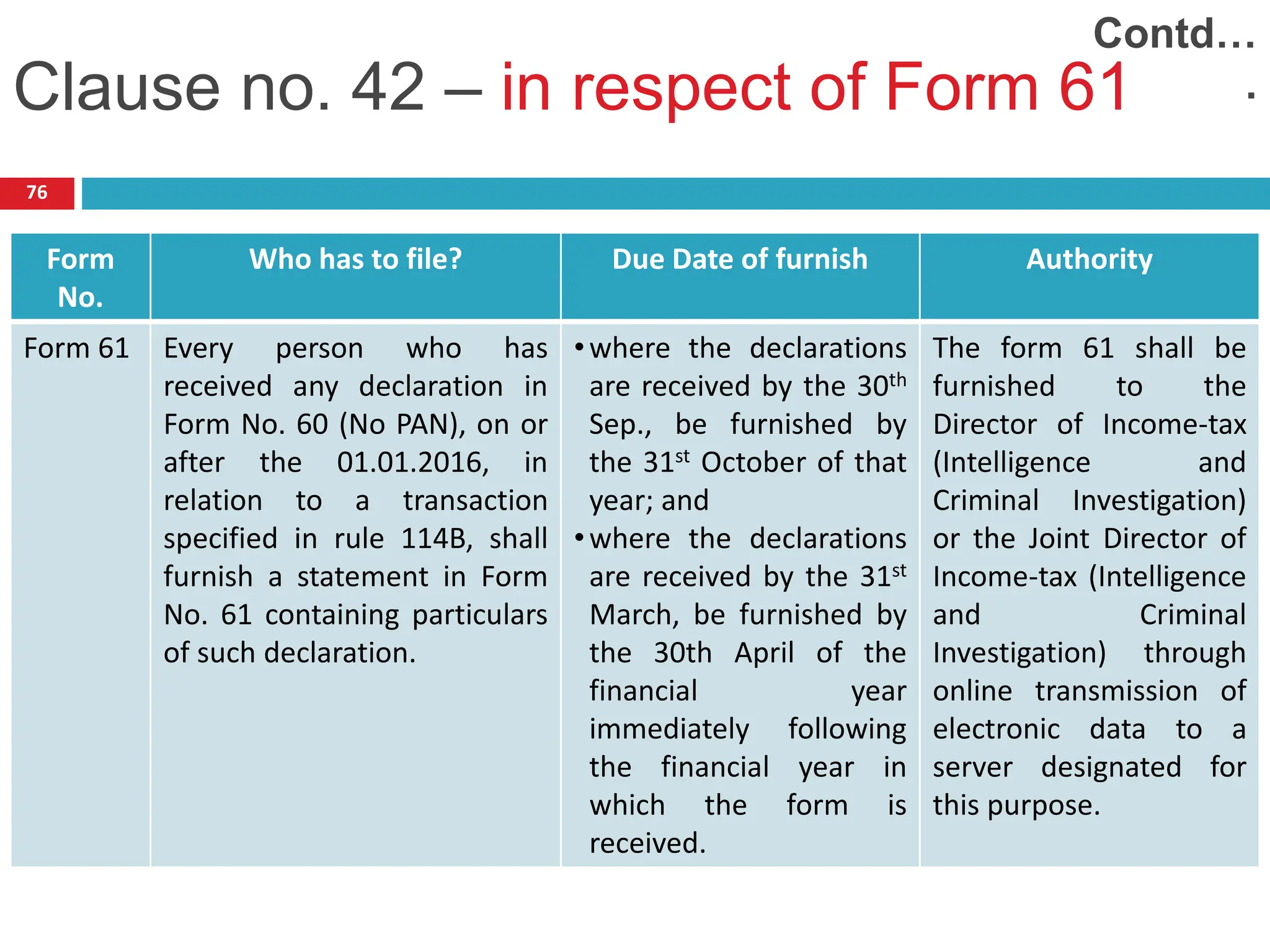
76
Form
No.
Who has to file? Due Date of furnish Authority
Form 61 Every person who has
received any declaration in
Form No. 60 (No PAN), on or
after the 01.01.2016, in
relation to a transaction
specified in rule 114B, shall
furnish a statement in Form
No. 61 containing particulars
of such declaration.
•where the declarations
are received by the 30th
Sep., be furnished by
the 31st October of that
year; and
•where the declarations
are received by the 31st
March, be furnished by
the 30th April of the
financial year
immediately following
the financial year in
which the form is
received.
The form 61 shall be
furnished to the
Director of Income-tax
(Intelligence and
Criminal Investigation)
or the Joint Director of
Income-tax (Intelligence
and Criminal
Investigation) through
online transmission of
electronic data to a
server designated for
this purpose.
Clause no. 42 – in respect of Form 61
Contd…
.
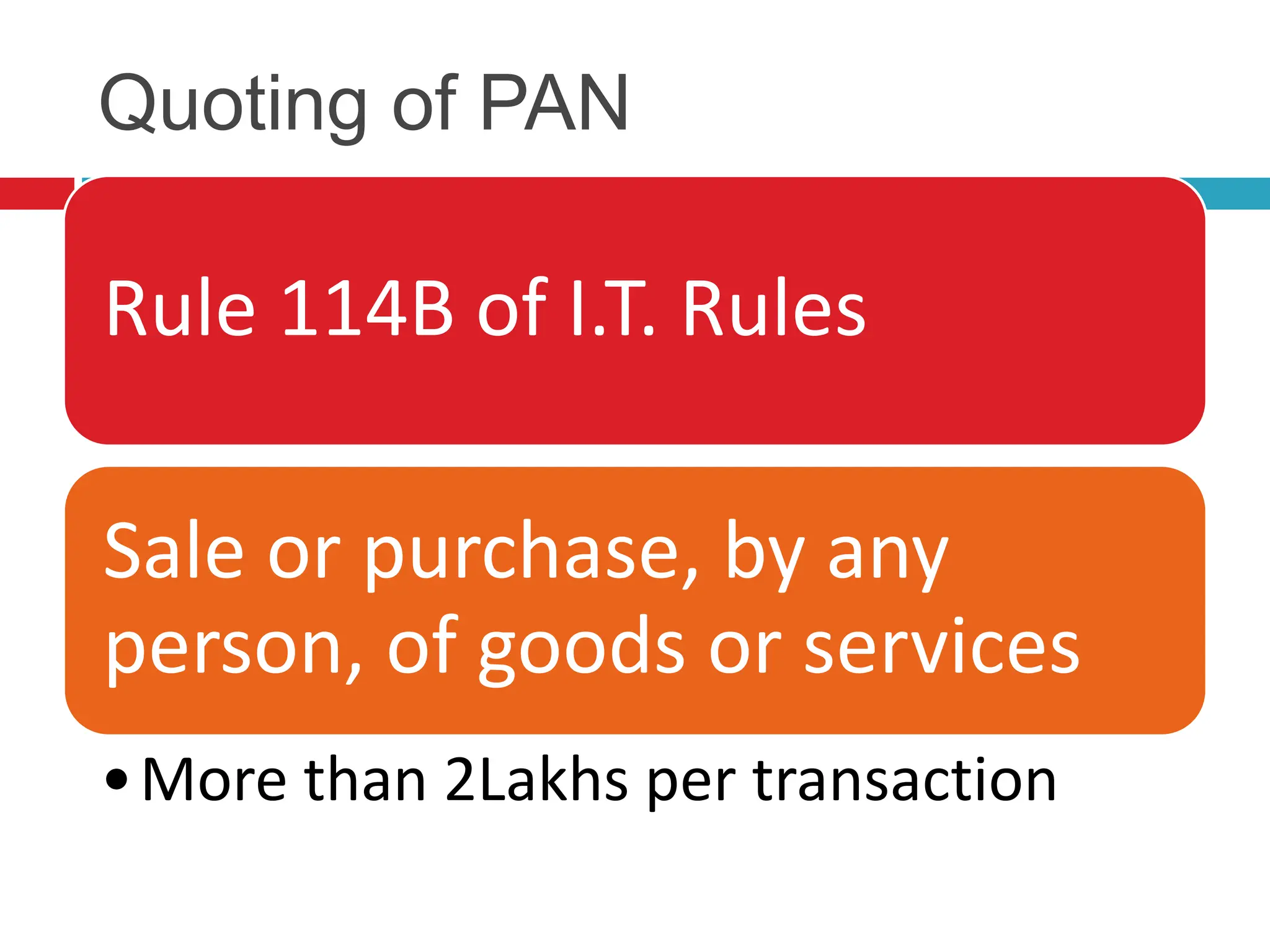
Transactions for which Form 61 comes into picture?
[Rule – 114B] i.e. Transactions in relation to which
permanent account number is to be quoted in all
documents
77
S.
No.
Nature of transaction Value of transaction
1 Sale or purchase of a motor vehicle or vehicle, as defined in
clause (28) of section 2 of the Motor Vehicles Act, 1988 which
requires registration by a registering authority under Chapter IV
of that Act, other than two wheeled vehicles.
All such transactions.
2 Opening an account [other than a time-deposit referred to at
Sl. No.12 and a Basic Savings Bank Deposit Account] with a
banking company or a co-operative bank to which the Banking
Regulation Act, 1949 applies (including any bank or banking
institution referred to in section 51 of that Act).
All such transactions.
3 Making an application to any banking company or a co-
operative bank to which the Banking Regulation Act, 1949
applies (including any bank or banking institution referred to in
section 51 of that Act) or to any other company or institution,
for issue of a credit or debit card.
All such transactions.
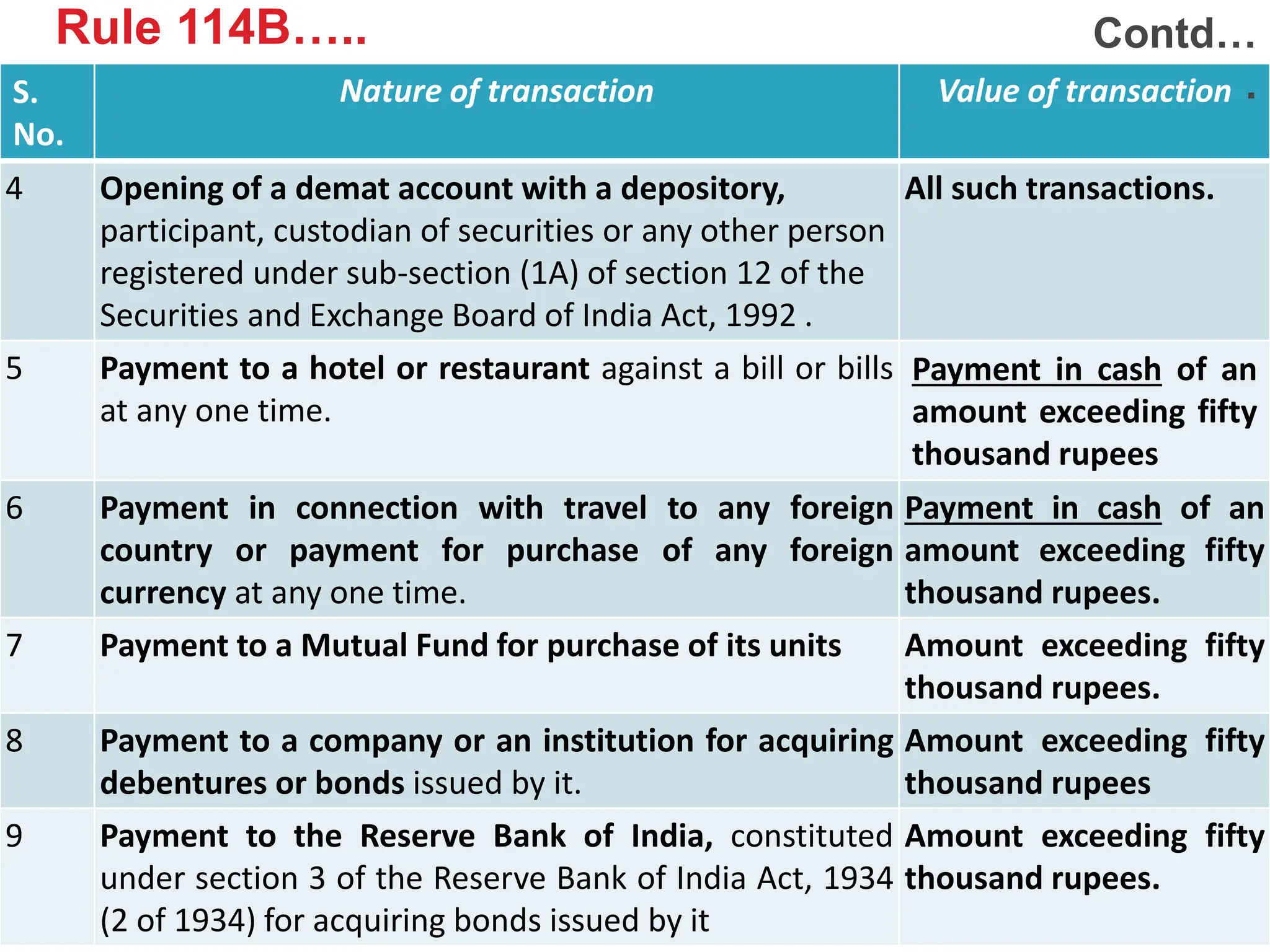
78
S.
No.
Nature of transaction Value of transaction
4 Opening of a demat account with a depository,
participant, custodian of securities or any other person
registered under sub-section (1A) of section 12 of the
Securities and Exchange Board of India Act, 1992 .
All such transactions.
5 Payment to a hotel or restaurant against a bill or bills
at any one time.
Payment in cash of an
amount exceeding fifty
thousand rupees
6 Payment in connection with travel to any foreign
country or payment for purchase of any foreign
currency at any one time.
Payment in cash of an
amount exceeding fifty
thousand rupees.
7 Payment to a Mutual Fund for purchase of its units Amount exceeding fifty
thousand rupees.
8 Payment to a company or an institution for acquiring
debentures or bonds issued by it.
Amount exceeding fifty
thousand rupees
9 Payment to the Reserve Bank of India, constituted
under section 3 of the Reserve Bank of India Act, 1934
(2 of 1934) for acquiring bonds issued by it
Amount exceeding fifty
thousand rupees.
Contd…
.
Rule 114B…..
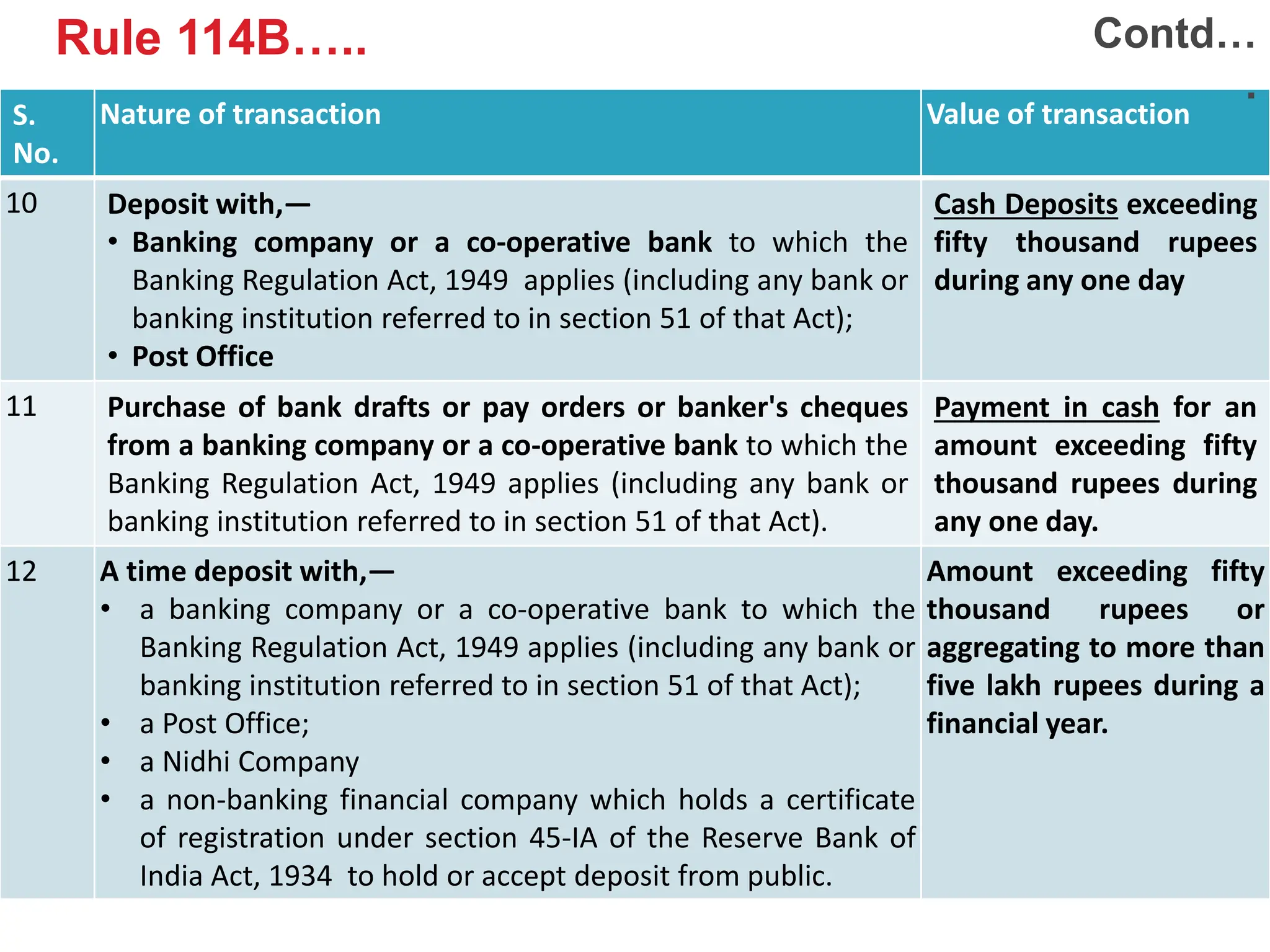
79
S.
No.
Nature of transaction Value of transaction
10 Deposit with,—
• Banking company or a co-operative bank to which the
Banking Regulation Act, 1949 applies (including any bank or
banking institution referred to in section 51 of that Act);
• Post Office
Cash Deposits exceeding
fifty thousand rupees
during any one day
11 Purchase of bank drafts or pay orders or banker's cheques
from a banking company or a co-operative bank to which the
Banking Regulation Act, 1949 applies (including any bank or
banking institution referred to in section 51 of that Act).
Payment in cash for an
amount exceeding fifty
thousand rupees during
any one day.
12 A time deposit with,—
• a banking company or a co-operative bank to which the
Banking Regulation Act, 1949 applies (including any bank or
banking institution referred to in section 51 of that Act);
• a Post Office;
• a Nidhi Company
• a non-banking financial company which holds a certificate
of registration under section 45-IA of the Reserve Bank of
India Act, 1934 to hold or accept deposit from public.
Amount exceeding fifty
thousand rupees or
aggregating to more than
five lakh rupees during a
financial year.
Contd…
.
Rule 114B…..
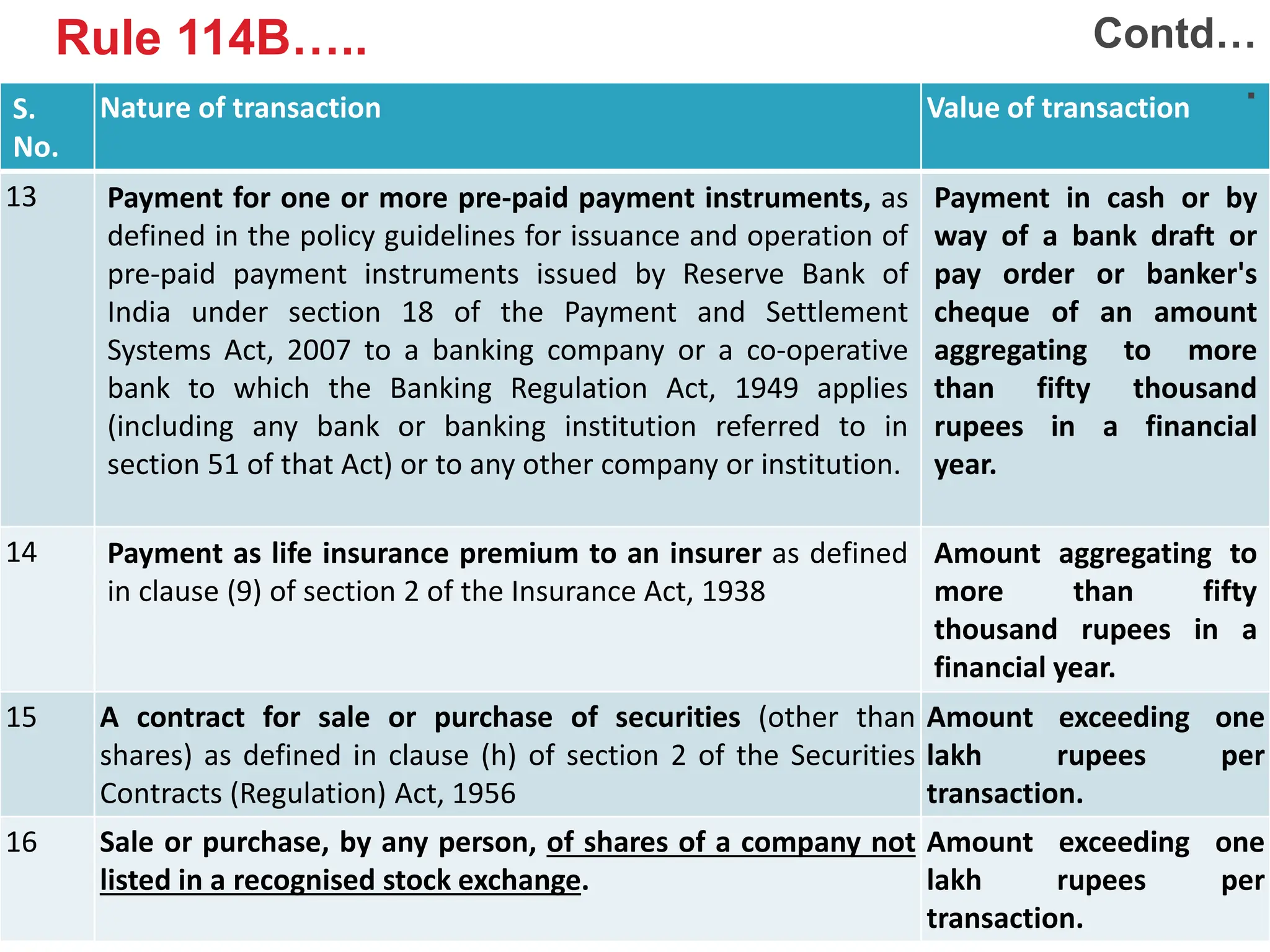
80
S.
No.
Nature of transaction Value of transaction
13 Payment for one or more pre-paid payment instruments, as
defined in the policy guidelines for issuance and operation of
pre-paid payment instruments issued by Reserve Bank of
India under section 18 of the Payment and Settlement
Systems Act, 2007 to a banking company or a co-operative
bank to which the Banking Regulation Act, 1949 applies
(including any bank or banking institution referred to in
section 51 of that Act) or to any other company or institution.
Payment in cash or by
way of a bank draft or
pay order or banker's
cheque of an amount
aggregating to more
than fifty thousand
rupees in a financial
year.
14 Payment as life insurance premium to an insurer as defined
in clause (9) of section 2 of the Insurance Act, 1938
Amount aggregating to
more than fifty
thousand rupees in a
financial year.
15 A contract for sale or purchase of securities (other than
shares) as defined in clause (h) of section 2 of the Securities
Contracts (Regulation) Act, 1956
Amount exceeding one
lakh rupees per
transaction.
16 Sale or purchase, by any person, of shares of a company not
listed in a recognised stock exchange.
Amount exceeding one
lakh rupees per
transaction.
Contd…
.
Rule 114B…..
81
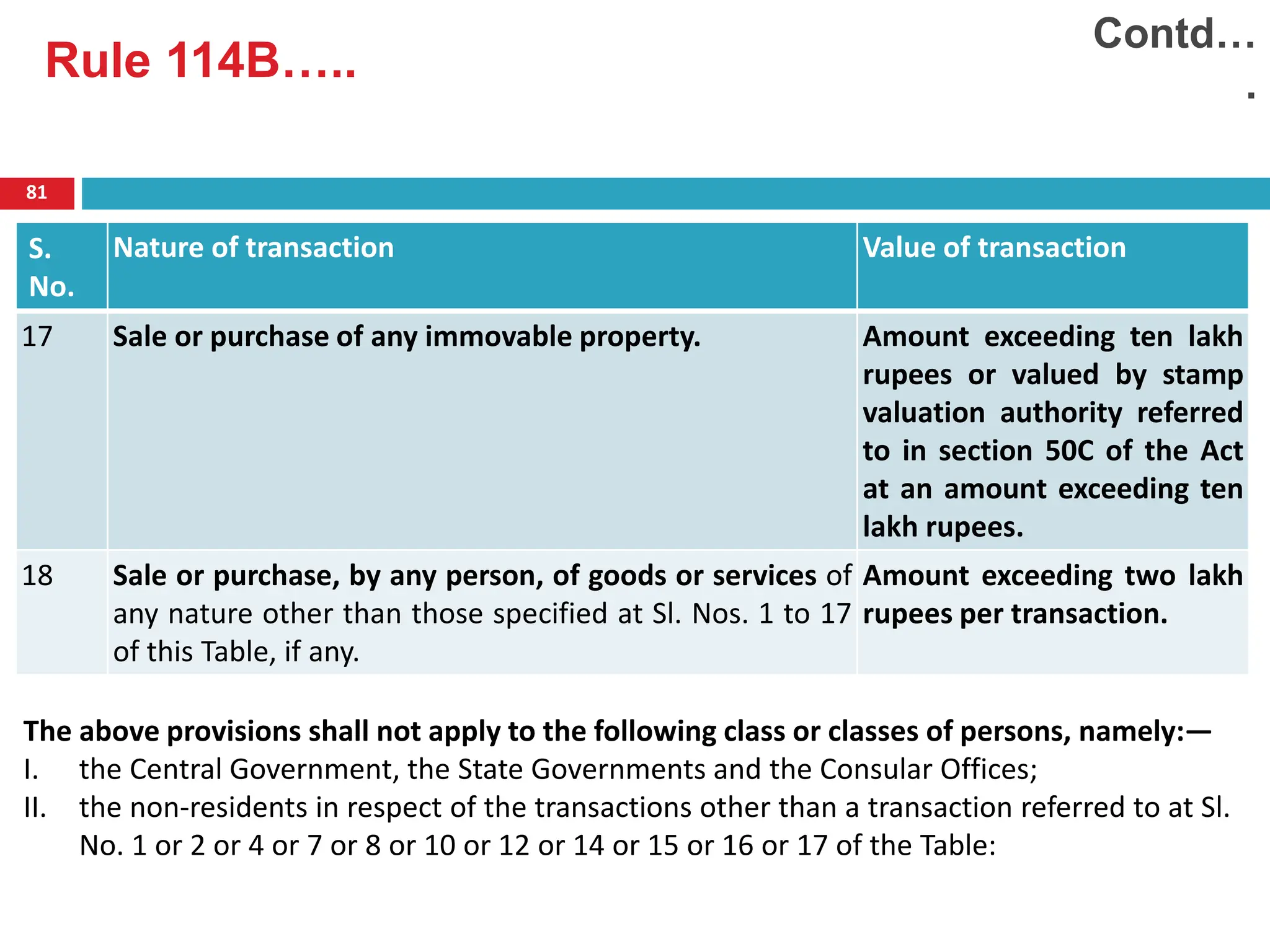
S.
No.
Nature of transaction Value of transaction
17 Sale or purchase of any immovable property. Amount exceeding ten lakh
rupees or valued by stamp
valuation authority referred
to in section 50C of the Act
at an amount exceeding ten
lakh rupees.
18 Sale or purchase, by any person, of goods or services of
any nature other than those specified at Sl. Nos. 1 to 17
of this Table, if any.
Amount exceeding two lakh
rupees per transaction.
Contd…
.
The above provisions shall not apply to the following class or classes of persons, namely:—
I. the Central Government, the State Governments and the Consular Offices;
II. the non-residents in respect of the transactions other than a transaction referred to at Sl.
No. 1 or 2 or 4 or 7 or 8 or 10 or 12 or 14 or 15 or 16 or 17 of the Table:
Rule 114B…..
Person who are liable to file Form
61?
[Rule – 114C]
82
 Any person being,—
 a registering officer or an Inspector-General appointed under the Registration
Act, 1908;
 a person who sells the immovable property or motor vehicle;
 a manager or officer of a banking company or co-operative bank, as the case
may be, referred to at Sl. No. 2 or 3 or 10 or 11 or 12 or 13 of rule 114B;
 post master;
 stock broker, sub-broker, share transfer agent, banker to an issue, trustee of a
trust deed, registrar to issue, merchant banker, underwriter, portfolio
manager, investment adviser and such other intermediaries registered under
the Securities and Exchange Board of India Act, 1992
 a depository, participant, custodian of securities or any other person
registered under the Securities and Exchange Board of India Act, 1992
referred to at Sl. No. 4 of rule 114B;
 the principal officer of a company referred to at Sl. No. 3 or 4 or 8 or 12 or 13
or 15 or 16 of rule 114B;
83
 the principal officer of an institution referred to at Sl. No. 2 or 3 or 8 or 10 or 11 or
12 or 13 of rule 114B;
 any trustee or any other person duly authorised by the trustee of a Mutual Fund
referred to at Sl. No. 7 of rule 114B;
 an officer of the Reserve Bank of India, constituted u/s 3 of the RBI Act, 1934 or of
any agency bank authorised by the RBI;
 a manager or officer of an insurer referred to at Sl. No. 14 of rule 114B,
 Any person, being a person raising bills referred to at Sl. No. 5 or 6 or 18 of rule
114B And, who is required to get his accounts audited under section 44AB of the
Act.
who, in relation to a transaction specified in the said Sl. No., has issued any
document shall ensure after verification that permanent account number has been
correctly furnished and the same shall be mentioned in such document, or as the
case may be, a declaration in Form 60 has been duly furnished with complete
particulars. Contd…
Person who are liable to file Form
61?
[Rule – 114C]
84
Brief Impact:
A. Every person who has received Form 60 for the transactions mentioned in
Rule 114B [Excluding transactions at SR No. 5, 6 and 18 of the table given in
Rule 114B i.e. hotels/foreign travel and cash transactions > 2 Lakh],
B. Every person who has received Form 60 for the transactions mentioned in
SR No. 5, 6 and 18 (i.e. hotels/foreign travel and cash transactions > 2 Lakh)
of the table given in Rule 114B AND who is required to get its accounts
audited under Section 44AB of the act.
Contd…
Person who are liable to file Form
61?
85
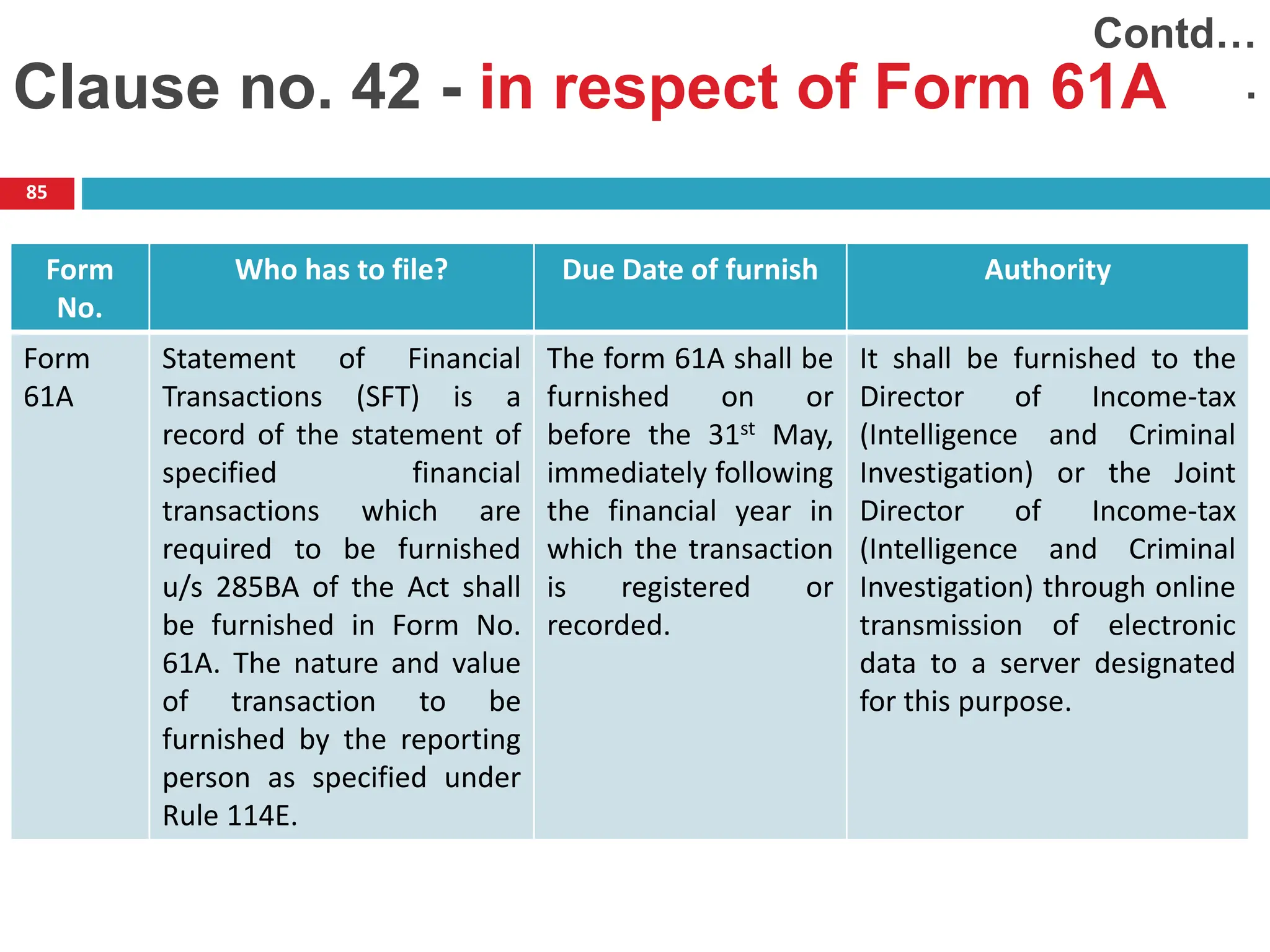
Form
No.
Who has to file? Due Date of furnish Authority
Form
61A
Statement of Financial
Transactions (SFT) is a
record of the statement of
specified financial
transactions which are
required to be furnished
u/s 285BA of the Act shall
be furnished in Form No.
61A. The nature and value
of transaction to be
furnished by the reporting
person as specified under
Rule 114E.
The form 61A shall be
furnished on or
before the 31st May,
immediately following
the financial year in
which the transaction
is registered or
recorded.
It shall be furnished to the
Director of Income-tax
(Intelligence and Criminal
Investigation) or the Joint
Director of Income-tax
(Intelligence and Criminal
Investigation) through online
transmission of electronic
data to a server designated
for this purpose.
Clause no. 42 - in respect of Form 61A
Contd…
.
For what and by whom Form 61A is
filed?
[Rule - 114 E ]
86
S.
No
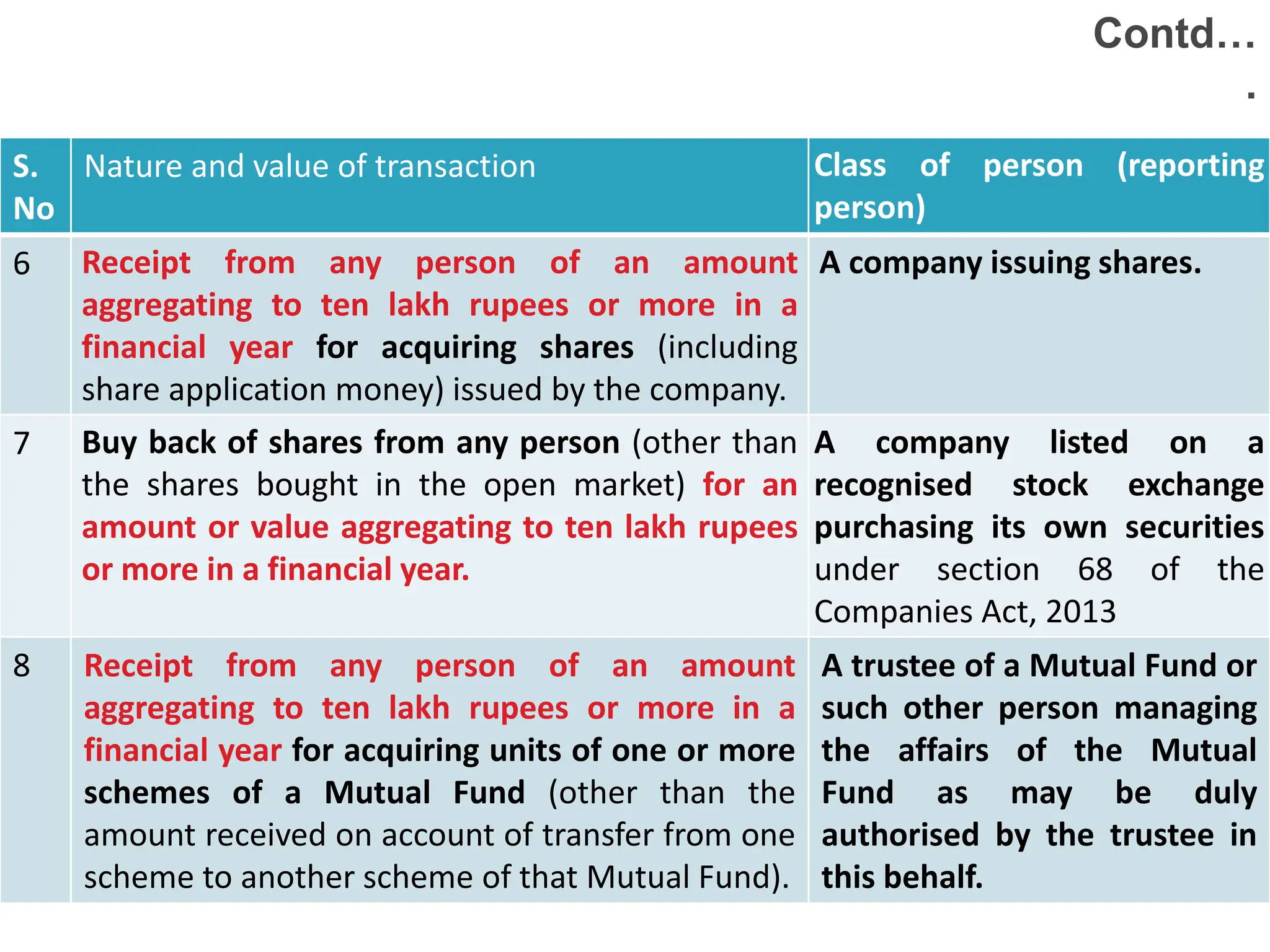
Nature and value of transaction Class of person (reporting person)
1 a) Payment made in cash for purchase of bank
drafts or pay orders or banker's cheque of an
amount aggregating to ten lakh rupees or more
in a financial year.
b) Payments made in cash aggregating to ten lakh
rupees or more during the financial year for
purchase of pre-paid instruments issued by RBI.
c) Cash deposits or cash withdrawals (including
through bearer's cheque) aggregating to fifty
lakh rupees or more in a financial year, in or
from one or more current account of a person.
A banking company or a co-
operative bank to which the
Banking Regulation Act applies
(including any bank or banking
institution referred to in section 51
of that Act).
2 Cash deposits aggregating to ten lakh rupees or
more in a financial year, in one or more accounts
(other than a current account and time deposit) of
a person.
• Same as above and,
• Post Master General as referred
to in clause (j) of section 2 of the
Indian Post Office Act, 1898.
87
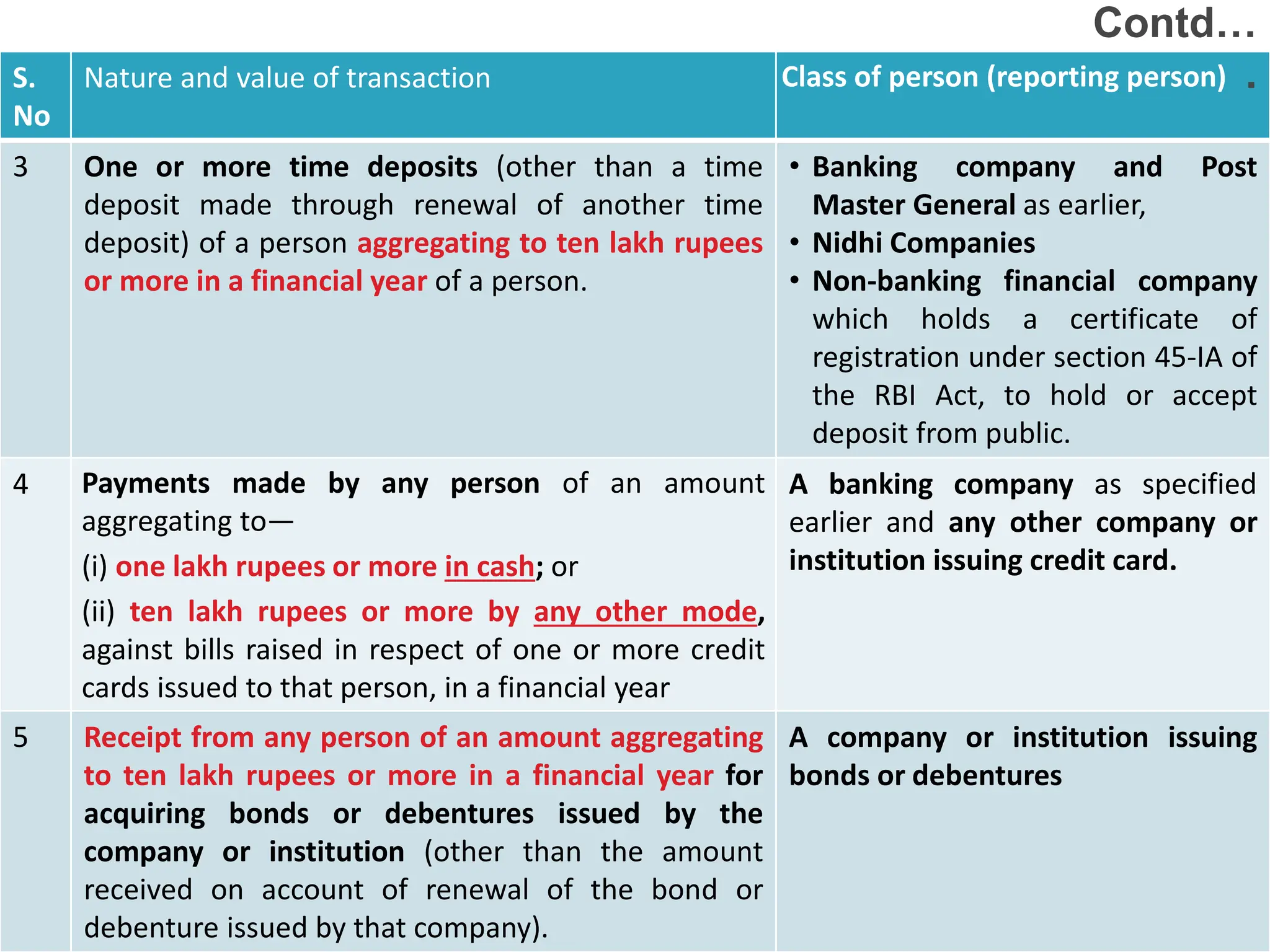
S.
No
Nature and value of transaction Class of person (reporting person)
3 One or more time deposits (other than a time
deposit made through renewal of another time
deposit) of a person aggregating to ten lakh rupees
or more in a financial year of a person.
• Banking company and Post
Master General as earlier,
• Nidhi Companies
• Non-banking financial company
which holds a certificate of
registration under section 45-IA of
the RBI Act, to hold or accept
deposit from public.
4 Payments made by any person of an amount
aggregating to—
(i) one lakh rupees or more in cash; or
(ii) ten lakh rupees or more by any other mode,
against bills raised in respect of one or more credit
cards issued to that person, in a financial year
A banking company as specified
earlier and any other company or
institution issuing credit card.
5 Receipt from any person of an amount aggregating
to ten lakh rupees or more in a financial year for
acquiring bonds or debentures issued by the
company or institution (other than the amount
received on account of renewal of the bond or
debenture issued by that company).
A company or institution issuing
bonds or debentures
Contd…
.
88
S.
No
Nature and value of transaction Class of person (reporting
person)
6 Receipt from any person of an amount
aggregating to ten lakh rupees or more in a
financial year for acquiring shares (including
share application money) issued by the company.
A company issuing shares.
7 Buy back of shares from any person (other than
the shares bought in the open market) for an
amount or value aggregating to ten lakh rupees
or more in a financial year.
A company listed on a
recognised stock exchange
purchasing its own securities
under section 68 of the
Companies Act, 2013
8 Receipt from any person of an amount
aggregating to ten lakh rupees or more in a
financial year for acquiring units of one or more
schemes of a Mutual Fund (other than the
amount received on account of transfer from one
scheme to another scheme of that Mutual Fund).
A trustee of a Mutual Fund or
such other person managing
the affairs of the Mutual
Fund as may be duly
authorised by the trustee in
this behalf.
Contd…
.
89
S.
No
Nature and value of transaction Class of person (reporting
person)
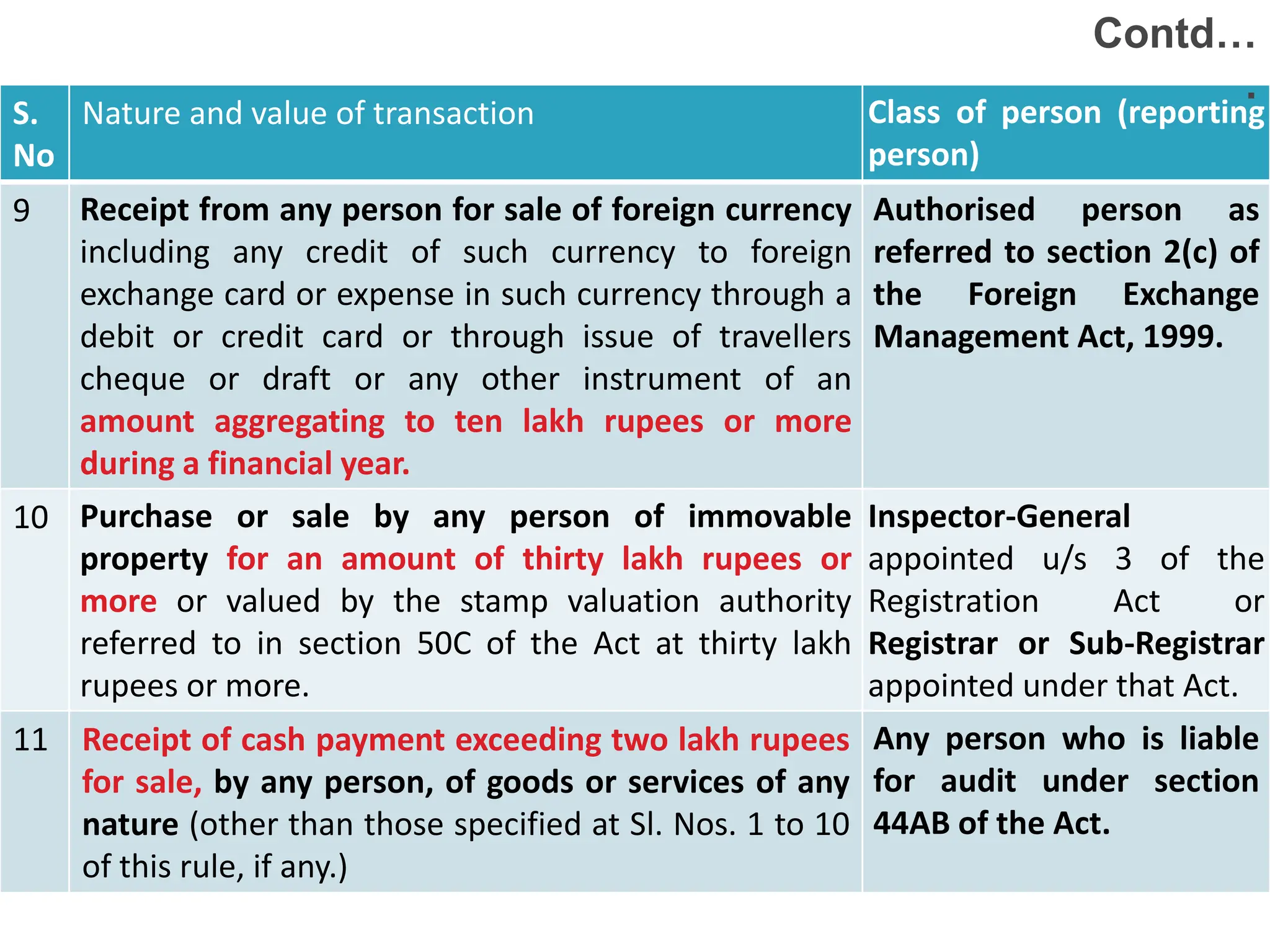
9 Receipt from any person for sale of foreign currency
including any credit of such currency to foreign
exchange card or expense in such currency through a
debit or credit card or through issue of travellers
cheque or draft or any other instrument of an
amount aggregating to ten lakh rupees or more
during a financial year.
Authorised person as
referred to section 2(c) of
the Foreign Exchange
Management Act, 1999.
10 Purchase or sale by any person of immovable
property for an amount of thirty lakh rupees or
more or valued by the stamp valuation authority
referred to in section 50C of the Act at thirty lakh
rupees or more.
Inspector-General
appointed u/s 3 of the
Registration Act or
Registrar or Sub-Registrar
appointed under that Act.
11 Receipt of cash payment exceeding two lakh rupees
for sale, by any person, of goods or services of any
nature (other than those specified at Sl. Nos. 1 to 10
of this rule, if any.)
Any person who is liable
for audit under section
44AB of the Act.
Contd…
.
90
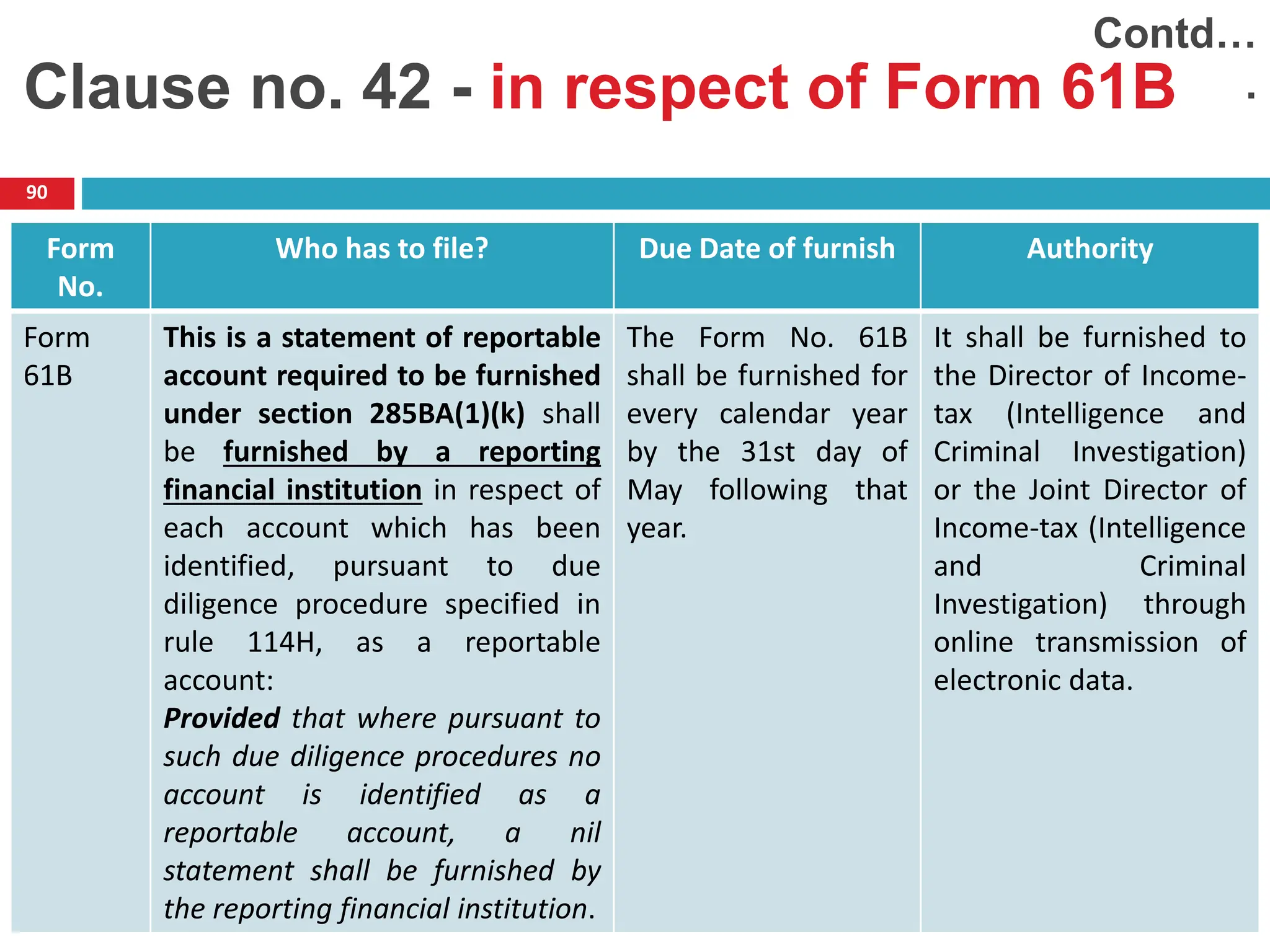
Form
No.
Who has to file? Due Date of furnish Authority
Form
61B
This is a statement of reportable
account required to be furnished
under section 285BA(1)(k) shall
be furnished by a reporting
financial institution in respect of
each account which has been
identified, pursuant to due
diligence procedure specified in
rule 114H, as a reportable
account:
Provided that where pursuant to
such due diligence procedures no
account is identified as a
reportable account, a nil
statement shall be furnished by
the reporting financial institution.
The Form No. 61B
shall be furnished for
every calendar year
by the 31st day of
May following that
year.
It shall be furnished to
the Director of Income-
tax (Intelligence and
Criminal Investigation)
or the Joint Director of
Income-tax (Intelligence
and Criminal
Investigation) through
online transmission of
electronic data.
Contd…
.
Clause no. 42 - in respect of Form 61B
Reportable Account [Rule –
114F(6)]
91
A Reportable Account means an account, which has been identified
pursuant to the due diligence procedure, as held by:
1) A reportable person; or
2) An entity, not based in United States of America, with one or
more controlling persons that is a specified U.S. person; or
3) A passive non-financial entity with one or more controlling
persons that is a person described in sub-clause (b) of clause (8)
of the rule 114F.
Reporting Financial Institution (i.e.
RFI) [Rule – 114F(7)]
92
“Reporting financial institution" means,-
a) a financial institution (other than a non-reporting financial
institution) which is resident in India, but excludes any branch of
such institution, that is located outside India; and
b) any branch, of a financial institution (other than a non-reporting
financial institution) which is not resident in India, if that branch is
located in India;
Reportable person [Rule –
114F(8)]
93
Reportable person" means,-
a) one or more specified U.S. persons; or
b) one or more persons other than,-
i. a corporation, the stock of which is regularly traded on one or more
established securities markets;
ii. any corporation that is a related entity of a corporation mentioned in
item (i);
iii. a Governmental entity;
iv. an International organisation;
v. a Central bank; or
vi. a financial institution,
c) that is a resident of any country or territory outside India (except the
United States of America) under the tax laws of such country or territory
or an estate of a decedent who was a resident of any country or territory
outside India (except the United States of America) under the tax laws of
such country or territory;
U.S. Person [Rule – 114F(10)]
94
"U.S. person" means,-
a) an individual, being a citizen or resident of the United States of America ;
b) a partnership or corporation organized in the United States of America or
under the laws of the United States of America or any State thereof;
c) a trust if,-
i. (i) a court within the United States of America would have authority
under applicable law to render orders or judgments concerning
substantially all issues regarding administration of the trust; and
ii. (ii) one or more U.S. persons have the authority to control all substantial
decisions of the trust; or
d) an estate of a decedent who was a citizen or resident of the United States of
America;
Information to be maintained and
reported [Rule – 114G]
95
After the RFI has identified the reportable accounts, RFI needs to report specific
information in respect of each reportable account. As per Rule 114G(1), RFI needs
to maintain and report the following information in case of each Reportable
Account:
a) The name, address, taxpayer identification number (assigned to the account
holder by the country or territory of his residence for tax purposes) and date
and place of birth (in the case of an individual) of each reportable person, that
is an account holder of the account;
b) In the case of any entity which is an account holder and which, after
application of due diligence procedures prescribed in rule 114H, is identified as
having one or more controlling persons that is a reportable person,-
 The name and address of the entity, taxpayer identification number
assigned to the entity by the country or territory of its residence; and
 The name, address, date and place of birth of each such controlling person
and taxpayer identification number assigned to such controlling person by
the country or territory of his residence;
96
c) The account number (or functional equivalent in the absence of an account
number);
d) The account balance or value (including, in the case of a cash value insurance
contract or annuity contract, the cash value or surrender value) at the end of
relevant calendar year or, if the account was closed during such year,
immediately before closure;
e) in the case of any custodial account,-
 the total gross amount of interest, the total gross amount of dividends, and
the total gross amount of other income generated with respect to the
assets held in the account, in each case paid or credited to the account (or
with respect to the account) during the calendar year; and
 the total gross proceeds from the sale or redemption of financial assets
paid or credited to the account during the calendar year with respect to
which the reporting financial institution acted as a custodian, broker,
nominee, or otherwise as an agent for the account holder;
Contd…
.
Information to be maintained and
reported [Rule – 114G]
97
f) in the case of any depository account, the total gross amount of
interest paid or credited to the account during the relevant calendar
year;
g) in the case of any account other than that referred to in clause (e) or
(f), the total gross amount paid or credited to the account holder with
respect to the account during the relevant calendar year with respect
to which the reporting financial institution is the obligor or debtor,
including the aggregate amount of any redemption payments made to
the account holder during the relevant calendar year; and
h) in the case of any account held by a non-participating financial
institution, for calendar year 2015 and 2016, the name of each non-
participating financial institution to which payments have been made
and the aggregate amount of such payments:
Contd…
.
Information to be maintained and
reported [Rule – 114G]
Changes due to
Transfer Pricing
Provisions
98
99
a) Whether primary adjustment to transfer price, as referred to in sub-section
(1) of section 92CE, has been made during the previous year? (Yes/No)
b) If yes, please furnish the following details:-
i. Under which clause of sub-section (1) of section 92CE primary
adjustment is made?
ii. Amount (in Rs.) of primary adjustment:
iii. Whether the excess money available with the associated enterprise is
required to be repatriated to India as per the provisions of sub-section
(2) of section 92CE? (Yes/No)
iv. If yes, whether the excess money has been repatriated within the
prescribed time (Yes/No)
v. If no, the amount (in Rs.) of imputed interest income on such excess
money which has not been repatriated within the prescribed time:
Clause no. 30A [Newly
Inserted]
Brief: Details about “Primary Adjustment” in transfer pricing to be reported as
per section 92CE
Summary
100
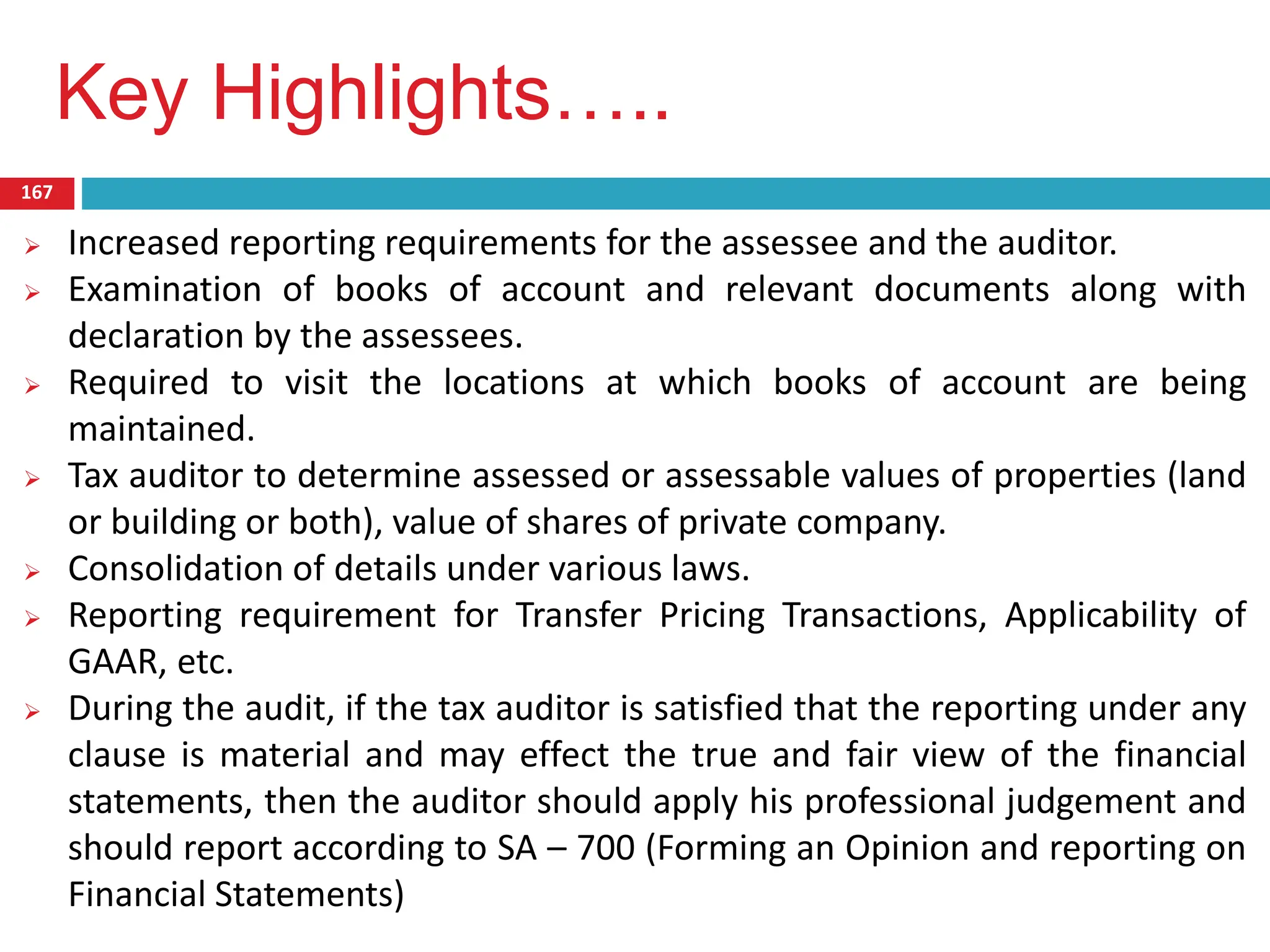
Key Highlights…..
101
 Increased reporting requirements for the assessee and the auditor.
 Examination of books of account and relevant documents along with
declaration by the assessees.
 Required to visit the locations at which books of account are being
maintained.
 Tax auditor to determine assessed or assessable values of properties (land
or building or both), value of shares of private company.
 Consolidation of details under various laws.
 Reporting requirement for Transfer Pricing Transactions, Applicability of
GAAR, etc.
 During the audit, if the tax auditor is satisfied that the reporting under any
clause is material and may effect the true and fair view of the financial
statements, then the auditor should apply his professional judgement and
should report according to SA – 700 (Forming an Opinion and reporting on
Financial Statements)
a) Tax Auditor can rely upon the judicial pronouncements while
taking any particular view about inclusion or exclusion of any
items in the particulars to be furnished under any of the
clauses specified in Form No.3CD.
b) If there is a conflict of judicial opinion on any particular issue,
Auditor may refer to the view which has been followed while
giving the particulars under any specified clause.
c) The AS, Guidance Notes, SA issued by the Institute from time
to time should be followed.
102
General principles to be kept in mind while
preparing the statement of particulars for Form
3CD:
 The information in Form No.3CD should be based on the books of account, records, documents,
information and explanations made available to the tax auditor for his examination.
 If a particular item of income/ expenditure is covered in more than one of the specified clauses
in the statement of particulars, a suitable cross reference to such items at the appropriate places.
 If there is any difference in the opinion of the tax auditor and that of the assessee in respect of
any information furnished in Form No. 3CD, the tax auditor should state both the view points and
also the relevant information in order to enable the tax authority to take a decision in the matter.
 If any particular clause in Form No.3CD is not applicable, he should state that the same is not
applicable.
 In computing the allowance/ disallowance, the law applicable in the relevant year should keep in
view, even though the form of audit report may not have been amended to bring it in conformity
with the amended law.
 In case the auditor relies on a judicial pronouncement, mention the fact as his observations in
clause (3) of Form No.3CA or clause (5) provided in Form No.3CB, as the case may be
 The tax auditor may qualify his report on matters in respect of which information is not furnished
to him and state in his report that the relevant information has not been furnished by the
assessee.
103
Important points to be considered by the tax
auditor while furnishing the particulars in Form
No.3CD….
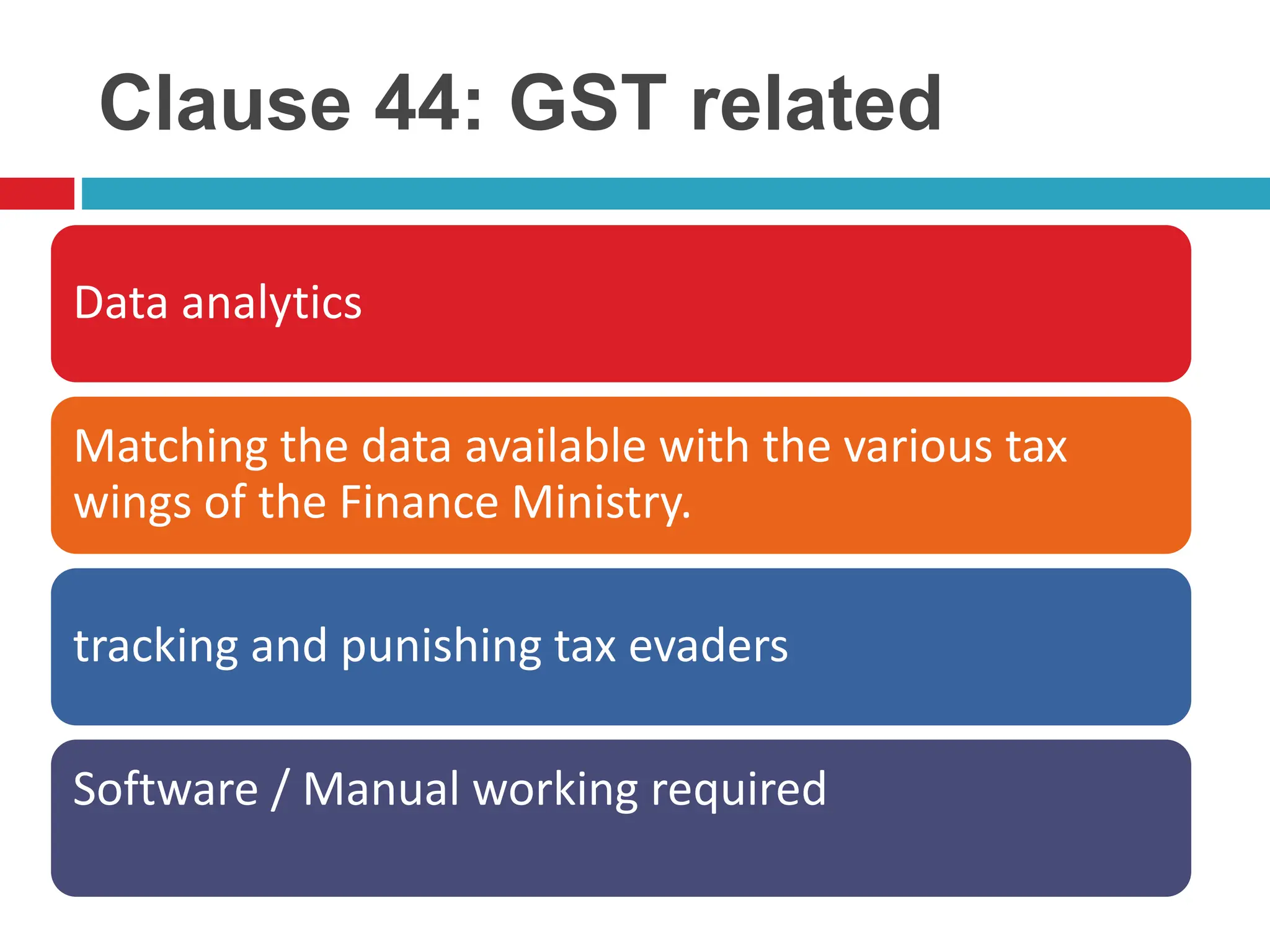
Clause 44: GST related
Data analytics
Matching the data available with the various tax
wings of the Finance Ministry.
tracking and punishing tax evaders
Software / Manual working required
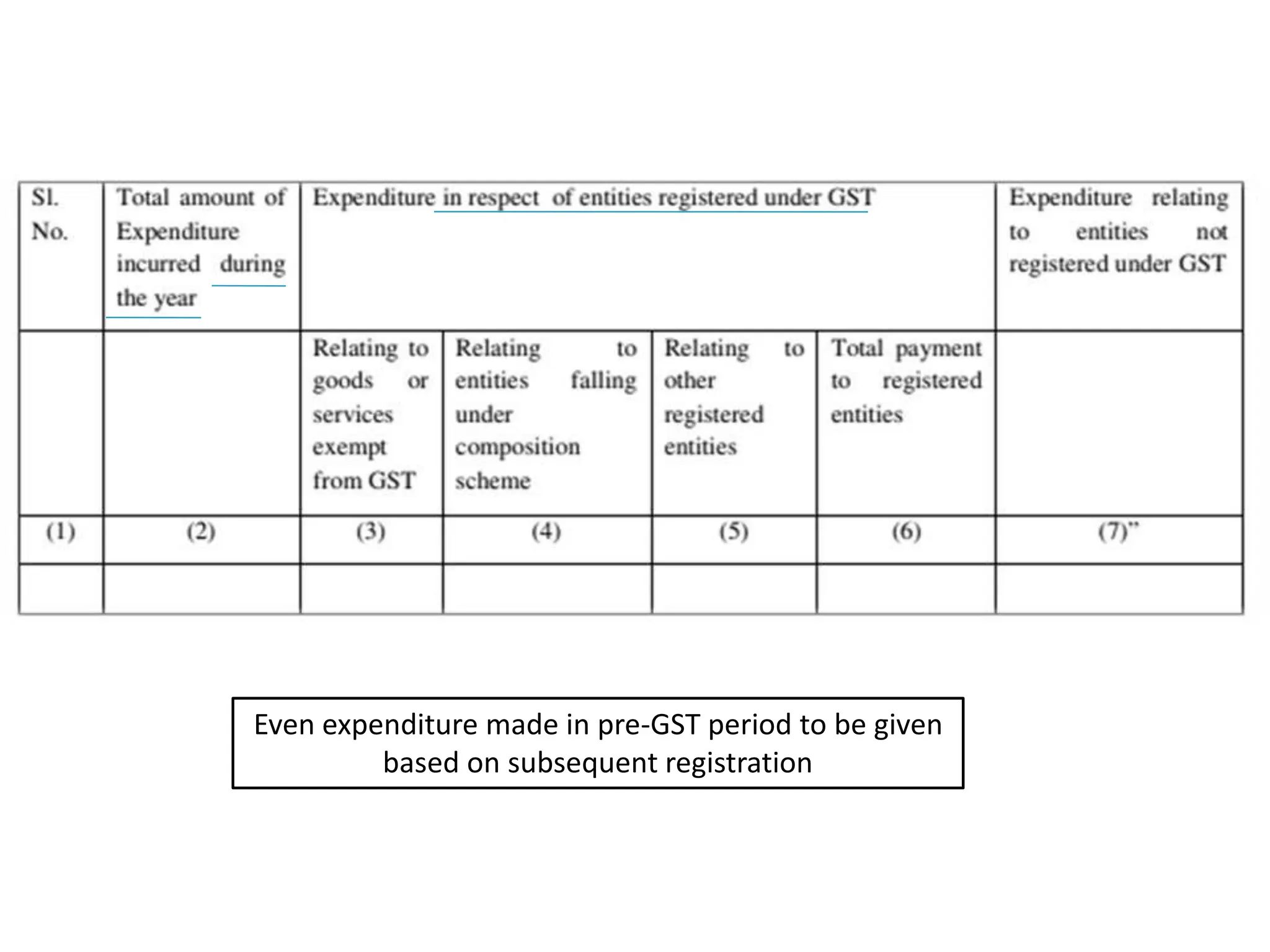
Even expenditure made in pre-GST period to be given
based on subsequent registration
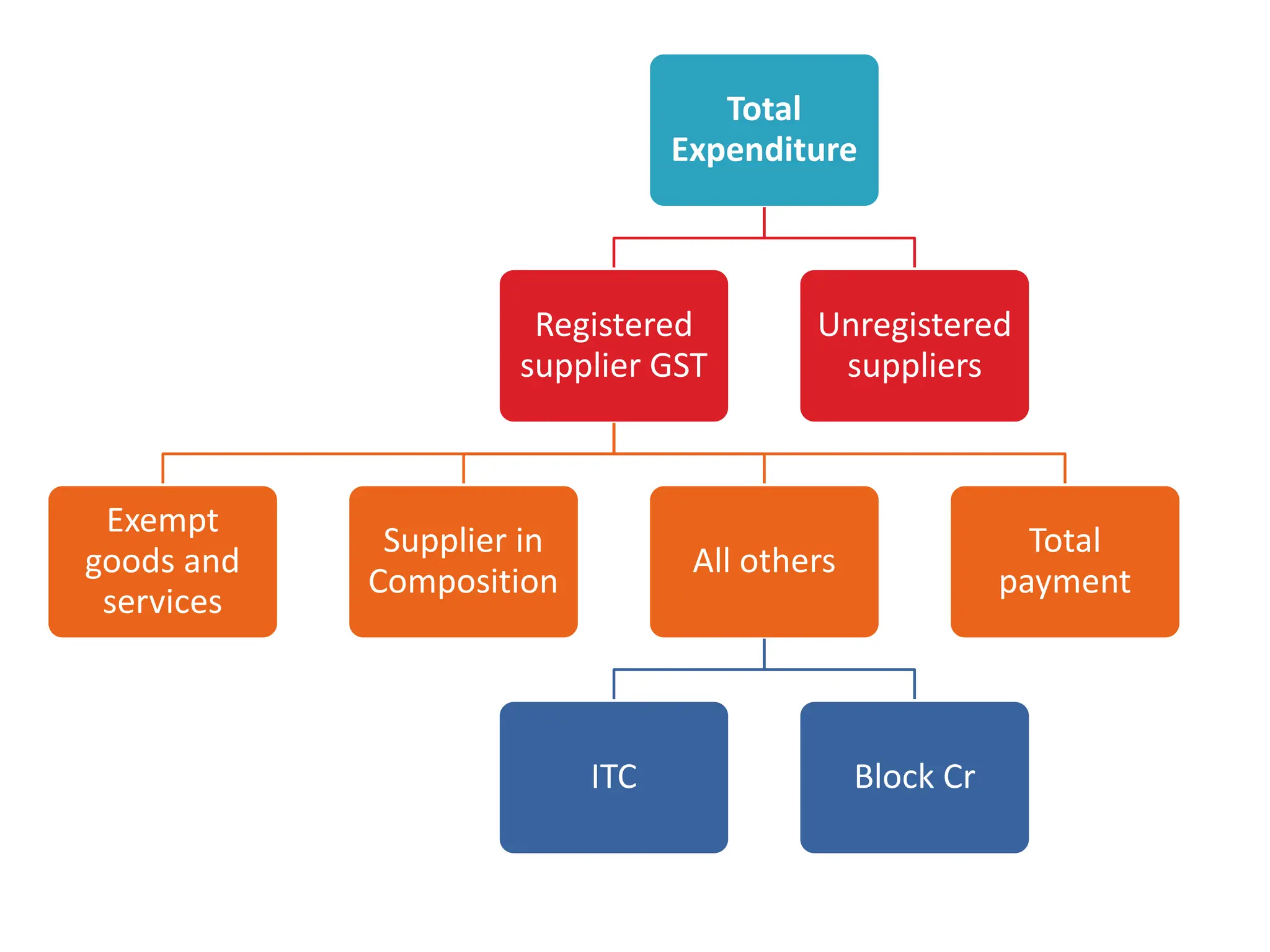
Total
Expenditure
Registered
supplier GST
Exempt
goods and
services
Supplier in
Composition
All others
ITC Block Cr
Total
payment
Unregistered
suppliers
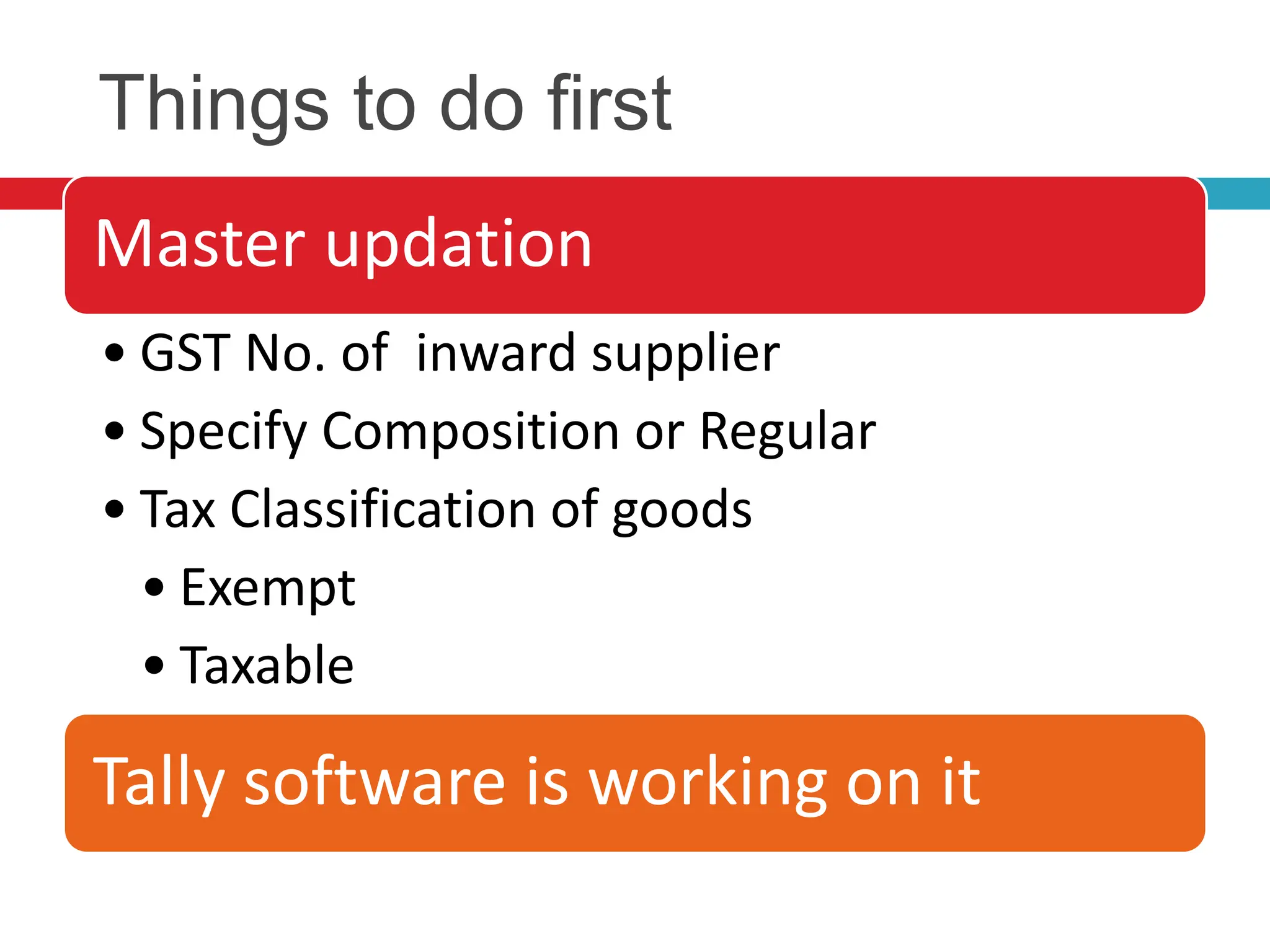
Things to do first
Master updation
• GST No. of inward supplier
• Specify Composition or Regular
• Tax Classification of goods
• Exempt
• Taxable
Tally software is working on it
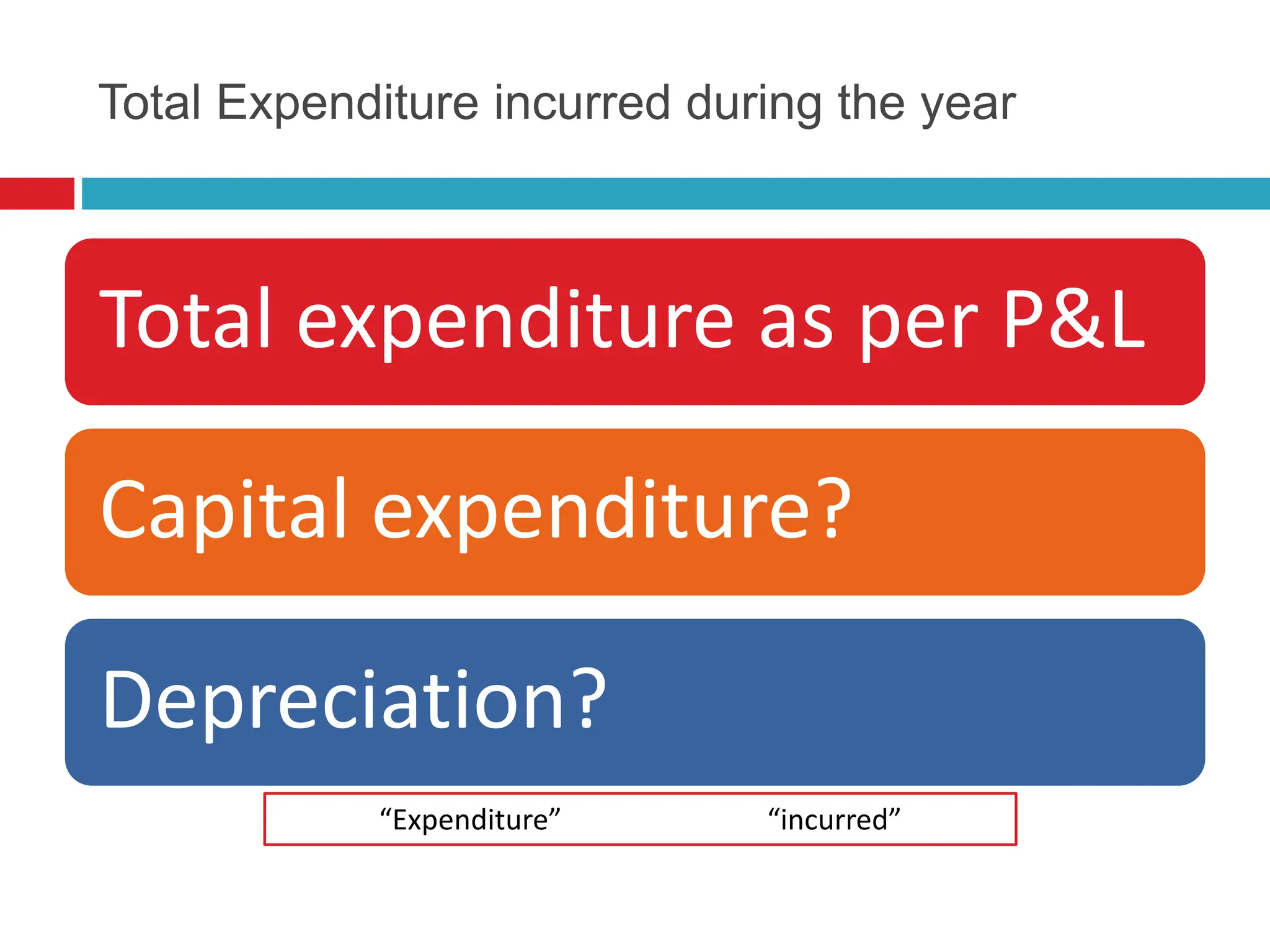
Total Expenditure incurred during the year
Total expenditure as per P&L
Capital expenditure?
Depreciation?
“Expenditure” “incurred”
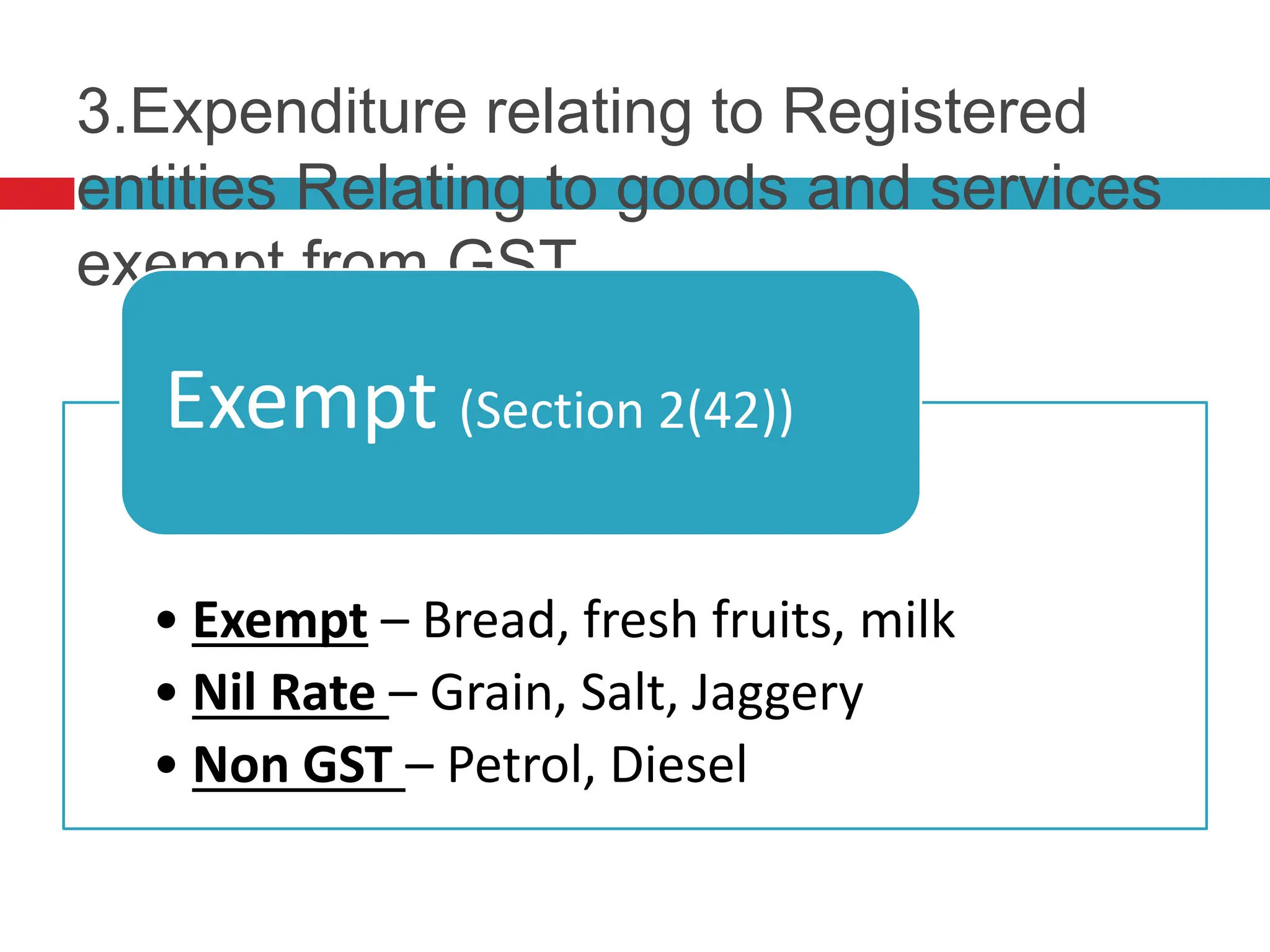
3.Expenditure relating to Registered
entities Relating to goods and services
exempt from GST
• Exempt – Bread, fresh fruits, milk
• Nil Rate – Grain, Salt, Jaggery
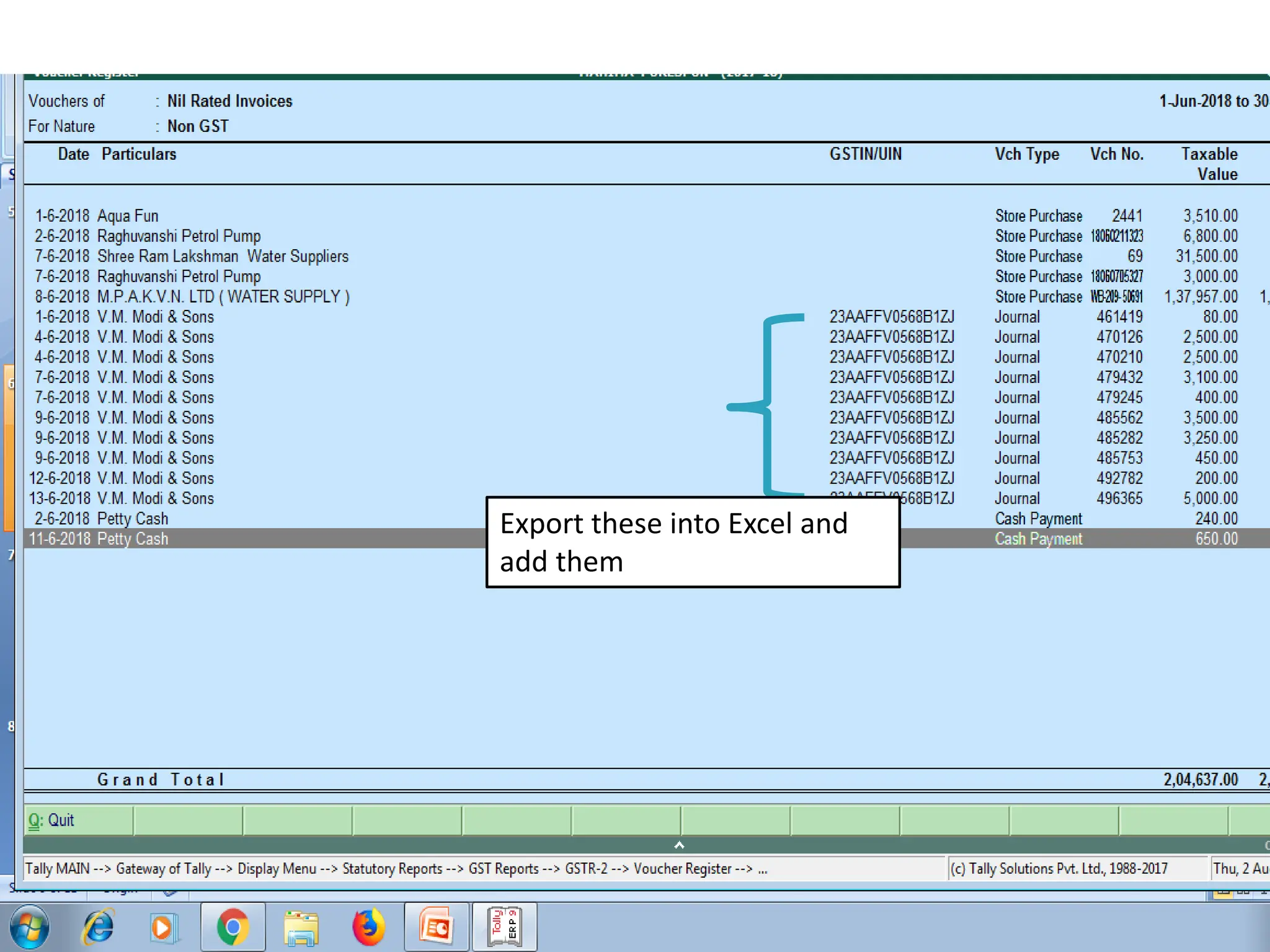
• Non GST – Petrol, Diesel
Exempt (Section 2(42))
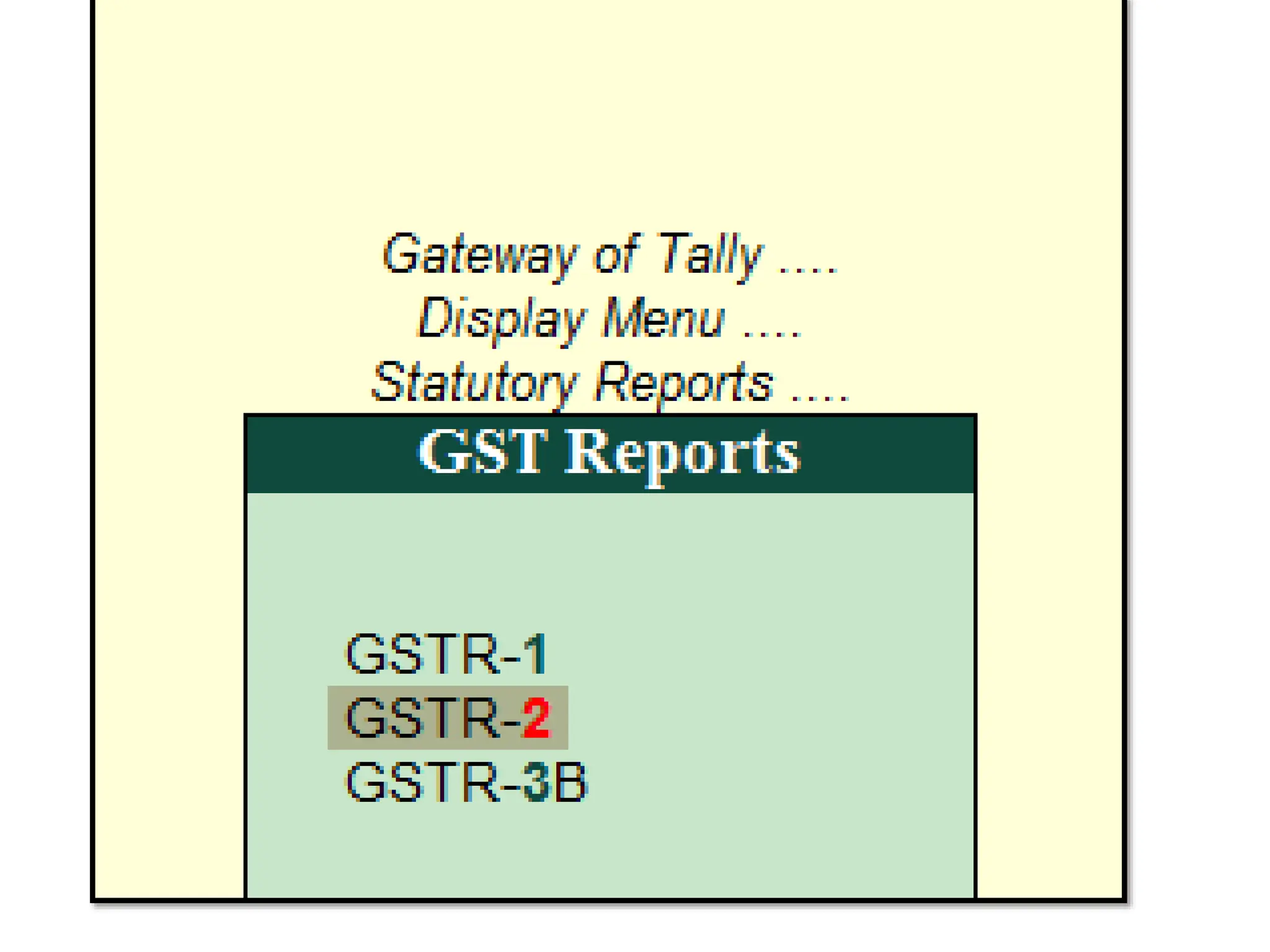
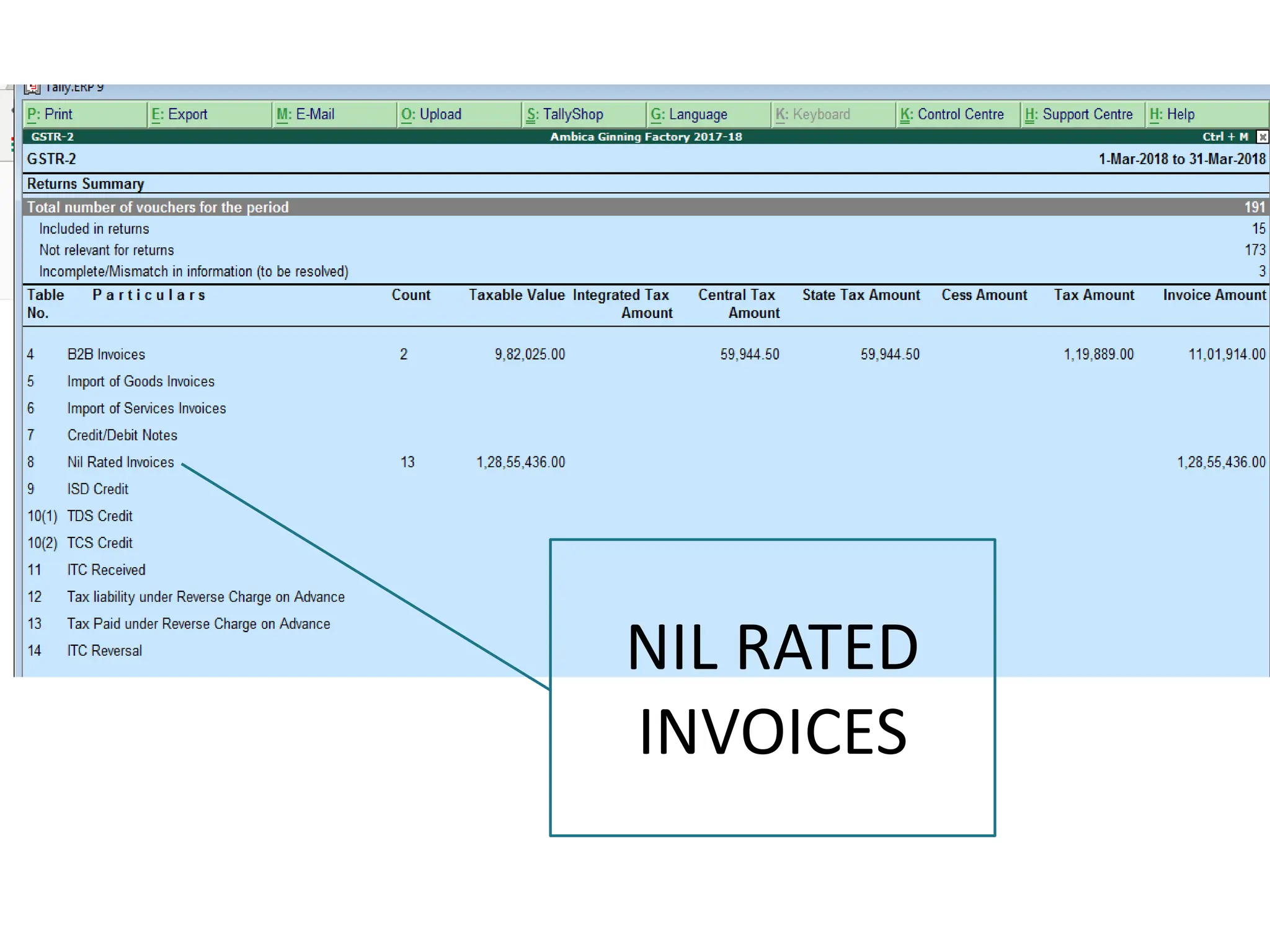
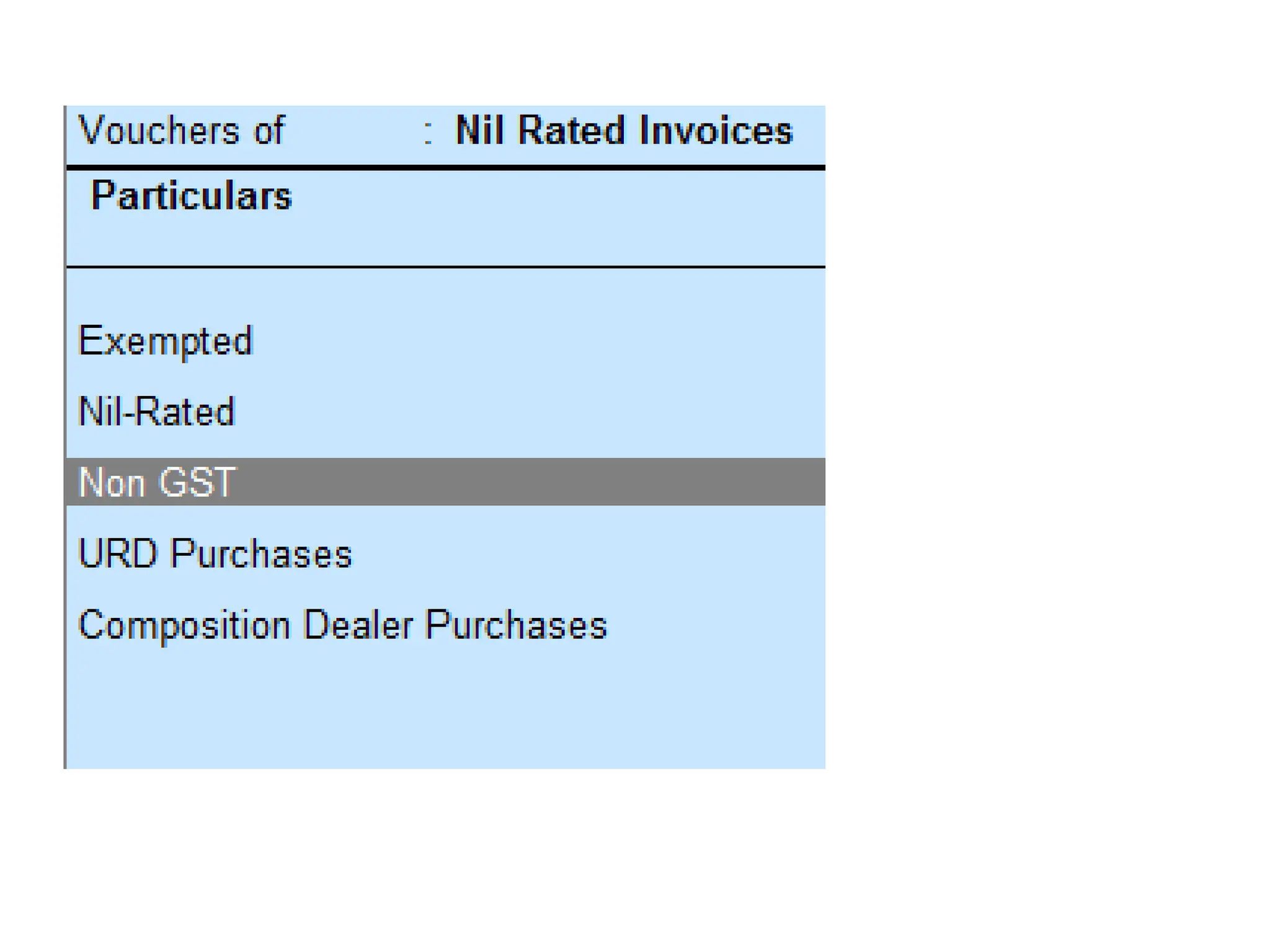
GSTR-2 – Inward supplies
NIL RATED
INVOICES
Export these into Excel and
add them
Expenditure relating to Registered
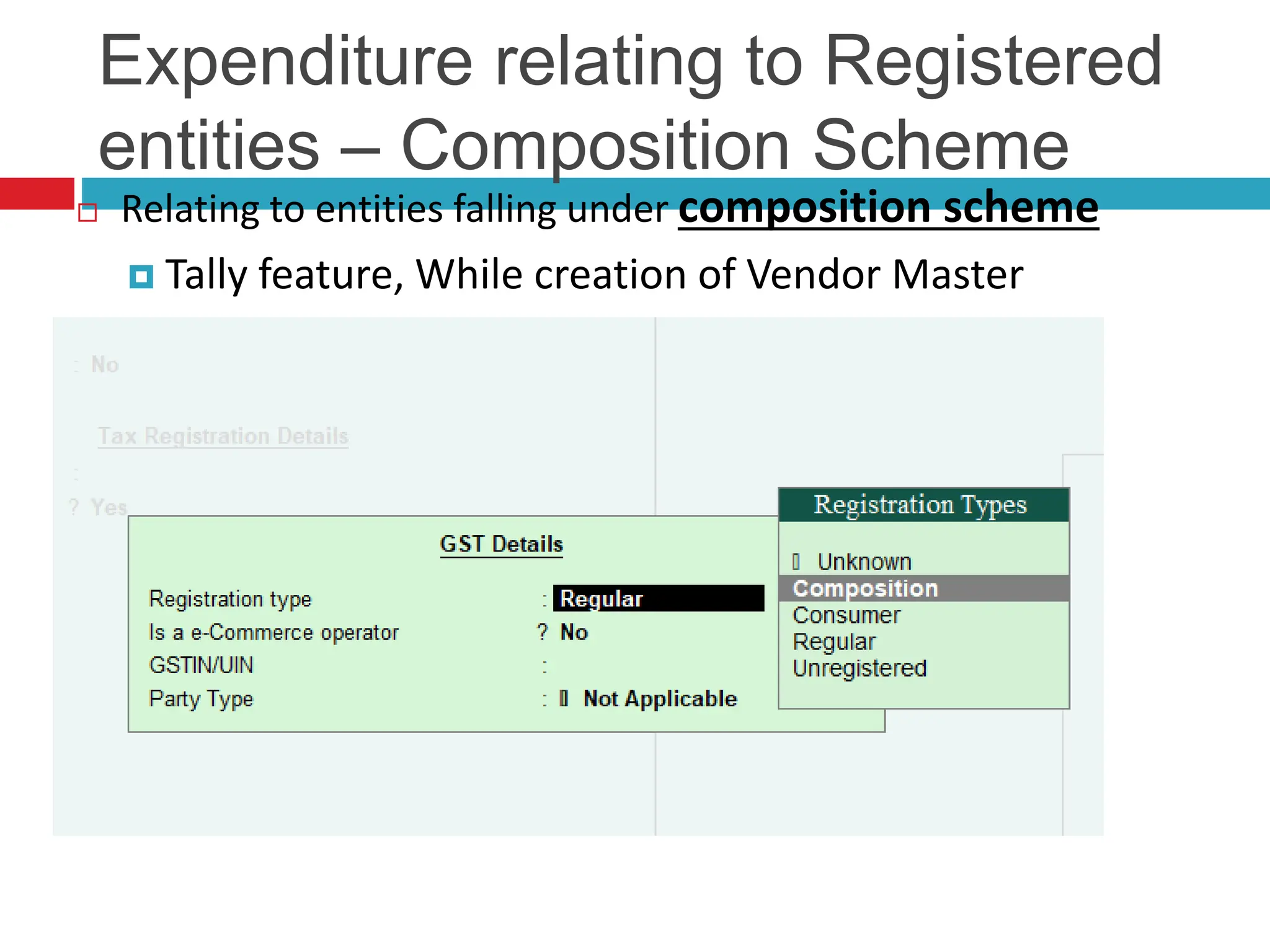
entities – Composition Scheme
 Relating to entities falling under composition scheme
 Tally feature, While creation of Vendor Master
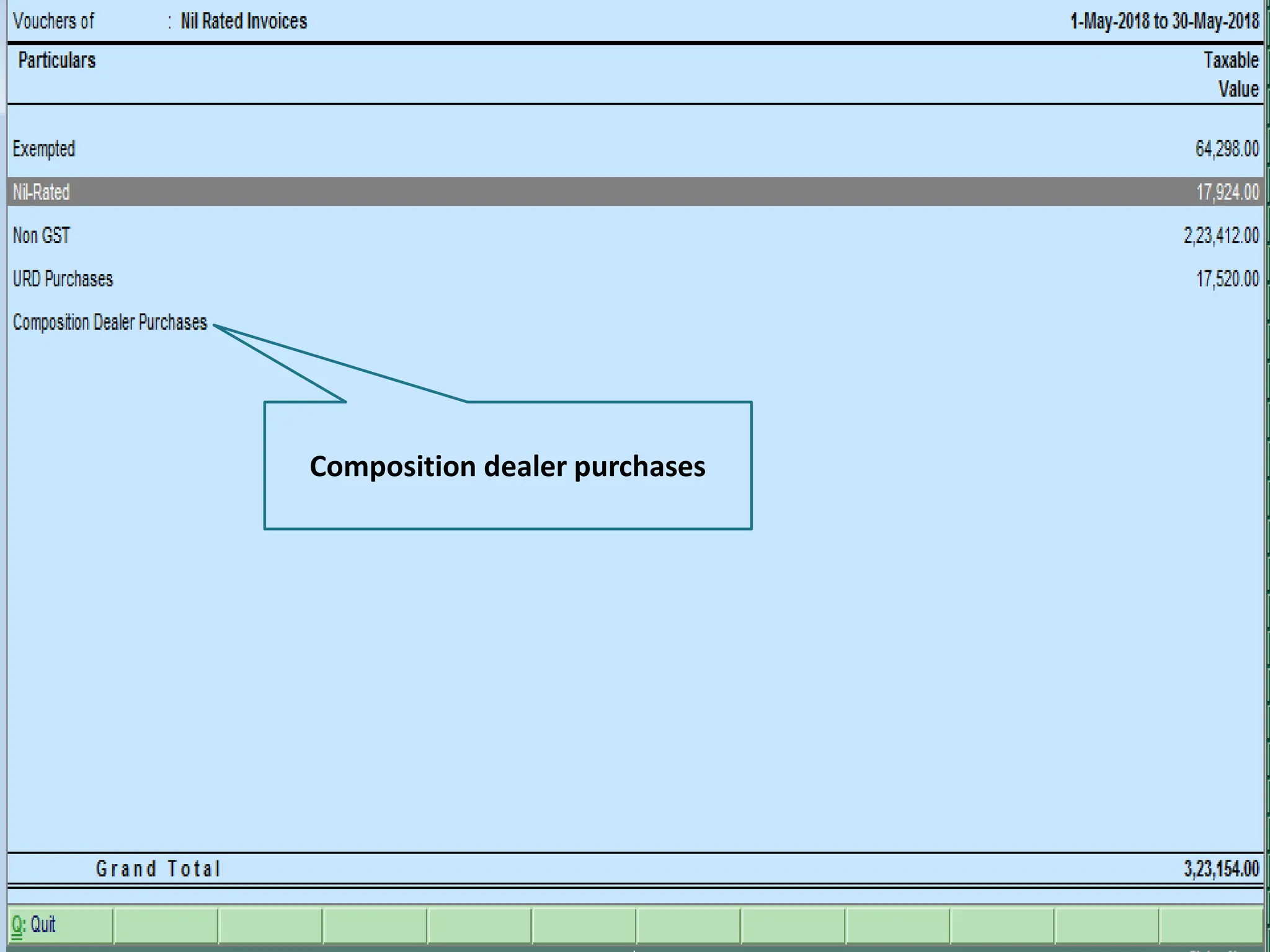
Composition dealer purchases
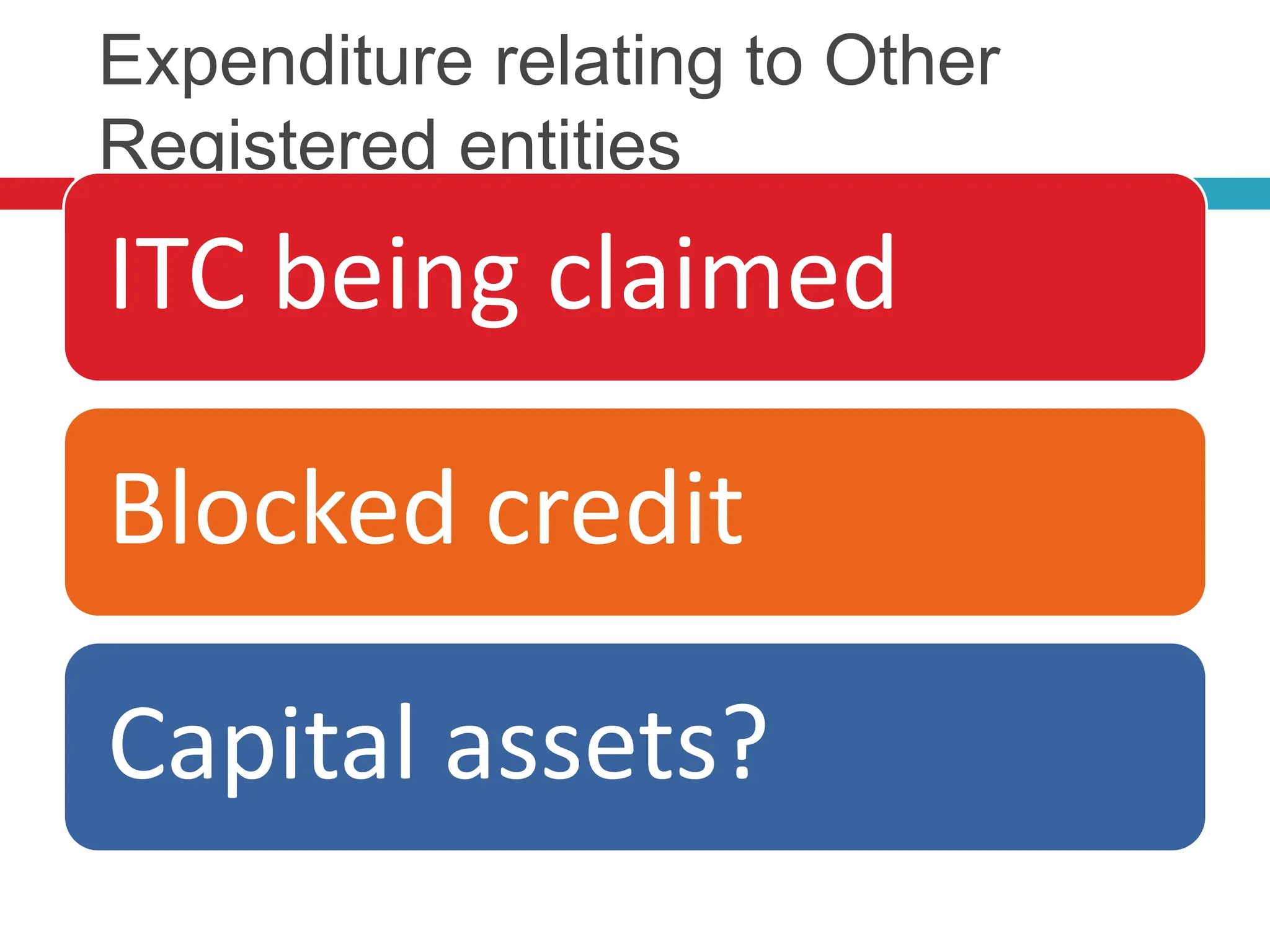
Expenditure relating to Other
Registered entities
ITC being claimed
Blocked credit
Capital assets?
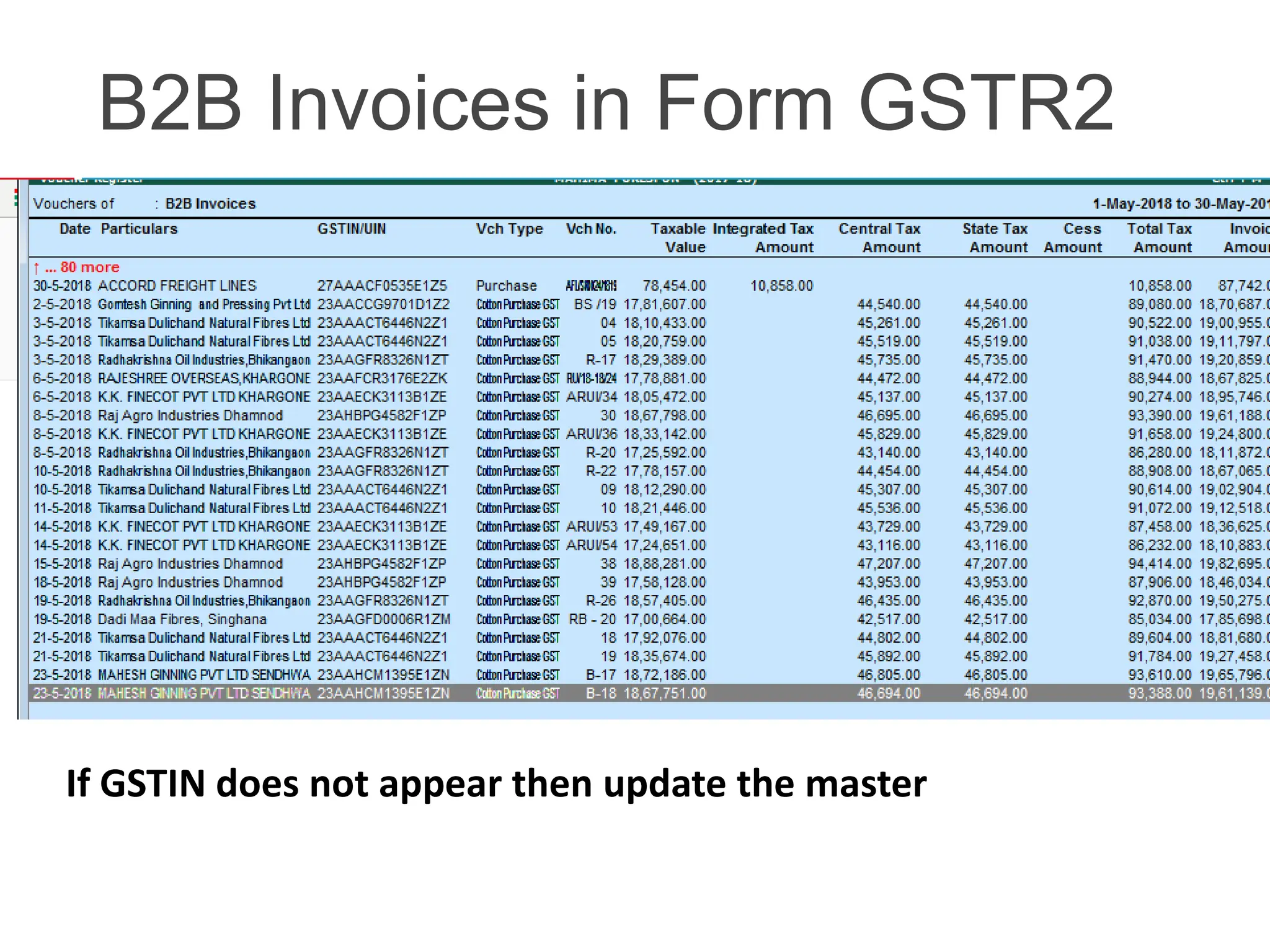
If GSTIN does not appear then update the master
B2B Invoices in Form GSTR2
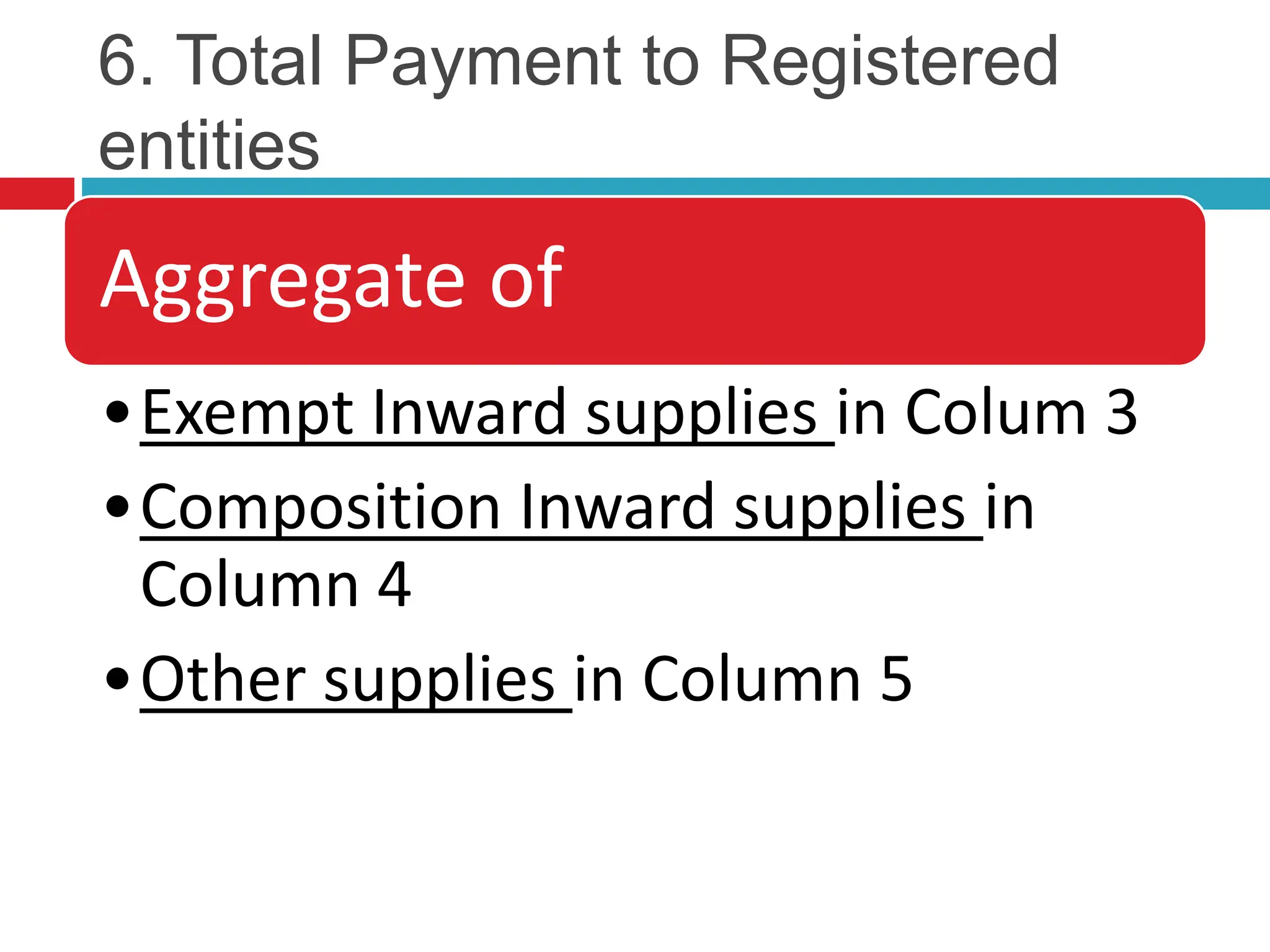
6. Total Payment to Registered
entities
Aggregate of
•Exempt Inward supplies in Colum 3
•Composition Inward supplies in
Column 4
•Other supplies in Column 5
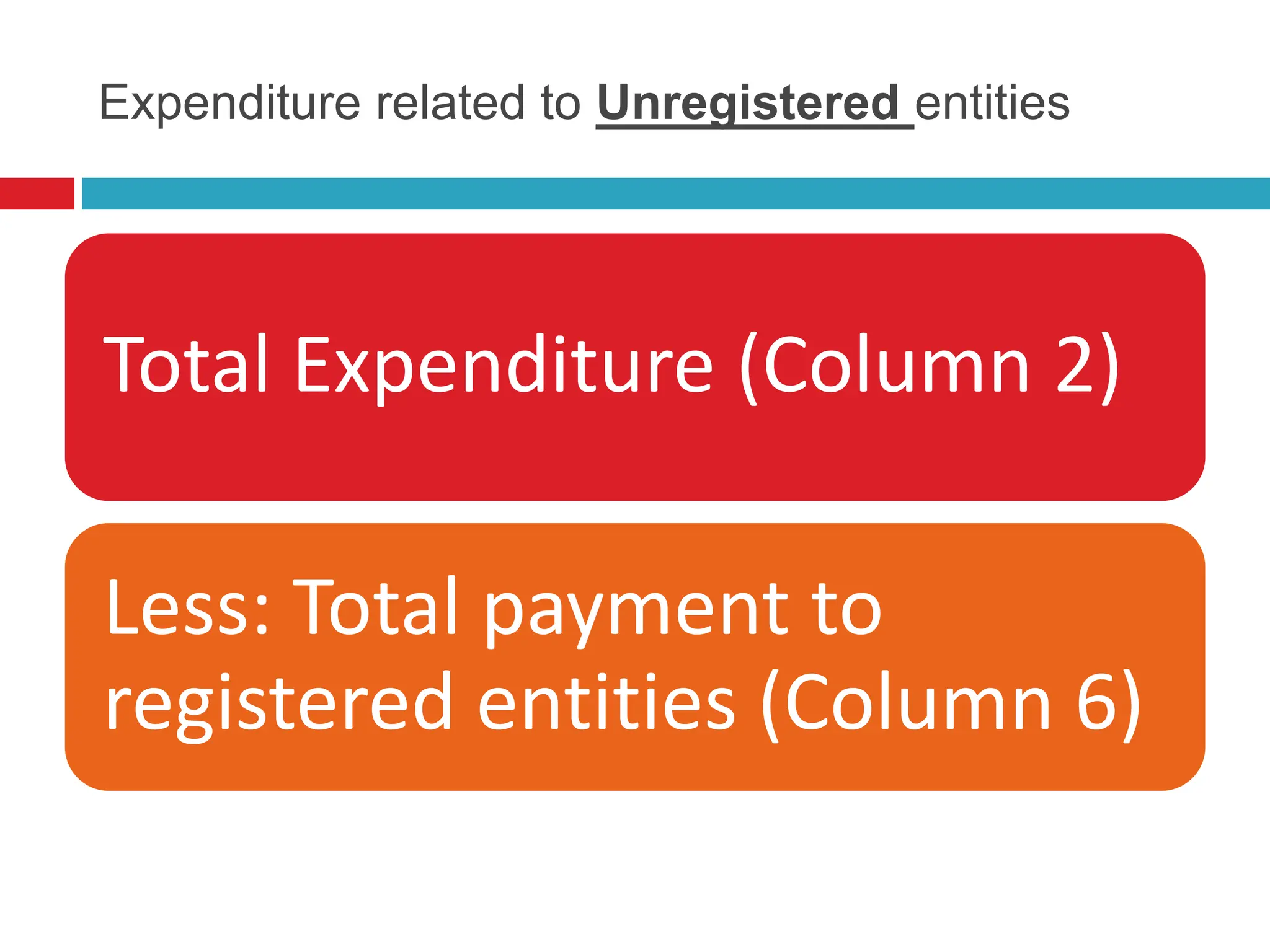
Expenditure related to Unregistered entities
Total Expenditure (Column 2)
Less: Total payment to
registered entities (Column 6)
Manual Systems
 IF such information not available, please give note
 Form 3CA
 Form 3CB – Clause 5
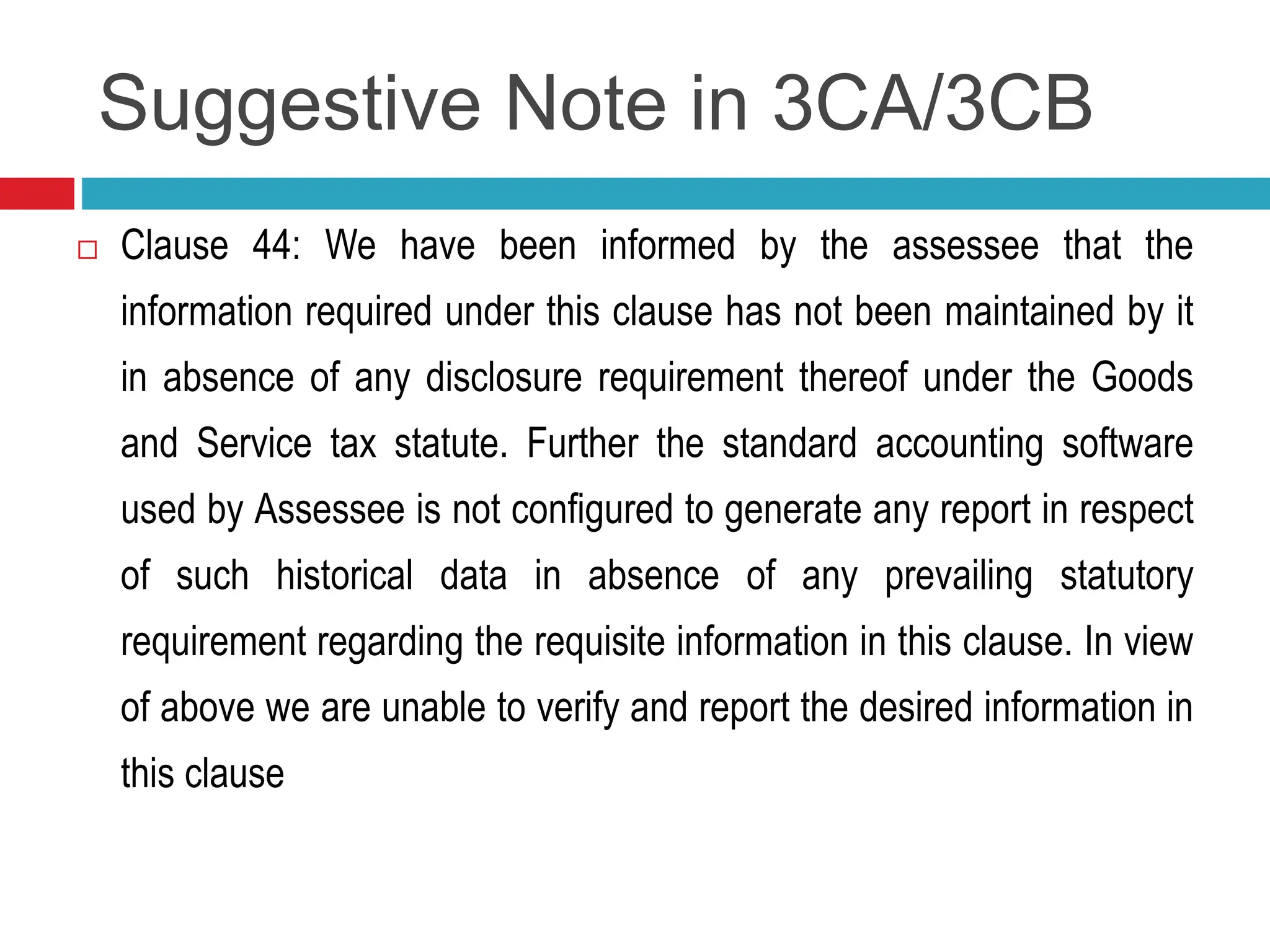
Suggestive Note in 3CA/3CB
 Clause 44: We have been informed by the assessee that the
information required under this clause has not been maintained by it
in absence of any disclosure requirement thereof under the Goods
and Service tax statute. Further the standard accounting software
used by Assessee is not configured to generate any report in respect
of such historical data in absence of any prevailing statutory
requirement regarding the requisite information in this clause. In view
of above we are unable to verify and report the desired information in
this clause
Clause 18
Depreciation cap at 40%
Effect of section 40A(3)
•Addition of assets purchase in
cash > Rs.10,000
•Difference in book
Old clauses
Clause 9 : Partnership
Verify Deed of Partnership for the names of the partners
and their profit sharing ratios. Disclose change/s in the
ratio. Ratio for sharing losses, if different from the profit
sharing ratio, should be disclosed.
• Check remuneration mentioned in Deed
Cross verify the names of the partners and their profit
sharing ratios with that in the accounts of the current year
and that of the previous year to ascertain any change.
• [Firms includes Limited Liability Partnership (LLP) also]
Cl 11: Books of accounts
Location of Books of accounts
If books of accounts are kept are more than one location, then
furnish the addresses of all the locations along with the details
of the books of accounts maintained at all such locations.
Avoid address of residence
Cl 12 : Presumptive
Commission and brokerage
not covered
If for any business tax audit
is not done then disclose
Some Important ICDS
MTM/Expected losses
will not be allowed
•FAQ MTM profits also not
to be taxed
Mark to Market Concept
TREATMENT
OF MTM
Allowable/Taxable Monetary Items
Cash
Receivables
Payables
Not
Allowable/Taxable
Non monetary
items
Fixed Assets
Forex derivatives Currency Futures
Mark to Market
Particulars Enter rate Year end rate
31.3.18
MTM Gain/(Loss)
Foreign
Currency
Creditors
50000$ @
Rs.60
=30,00,000
50000@ 65
=3250000
(Rs.2,50,000)
USD Future
June contract
1 lot of 10000$
@ Rs.62
1 lot of 10000$
@ Rs.68
(Rs.60000)
Foreign
Currency
Balance in NRO
Account
10000$ @
Rs.60
=6,00,000
10000@ 65
=6,50, 000
Rs.50,000
UK Pound
Future July
contract
2 lot of 5000
UKP @ Rs.80
2 lot of 5000
UKP @ Rs.85
Rs.50,000
Allowable
Not
Allowable
Taxable
Not
Taxable
Change
in
an
accounting
policy
Material Impact Disclose
Year of change
Year in which such change
has first material impact
No Material Impact No disclosure required
Inventory has been
accepted as certified
by the Management
Approach
Inventory is material item of Balance sheet
Inventory list as on year end date
Shortage and Excess list on verification by Client
Obtain Purchase and Sales for April to June
Physical verification (SA)
• Existence and condition of Inventory
Expenses Qty Amount Income Qty Amount
Op. Stock 100 kg 10000Sales 600kg 120000
Purchases 1000kg 100000
Profit
Closing Stock 500kg 50,000
600kg 60000
Trading Account
Purpose of Inventory valuation is to set off the cost of unsold value from
purchase debited to ascertain correct profit
Inventory Valuation cannot result in profit
Other Issues (Revised)
Standard costing method of inventory
valuation permitted if standard cost
approximates actual cost
Weighted Average and FIFO accepted
• LIFO not acceptable
Cost Formulae – FIFO, WEIGHTED
AVG.
Specific Identification method
 First-in First-out and Weighted Average Cost Formula
 16. Cost of inventories, other than the inventory dealt
with in paragraph 13……………..
PARA 13
“13. The Cost of inventories of items
(i) that are not ordinarily interchangeable; and
(ii) goods or services produced and segregated for
specific projects shall be assigned by specific identification
of their individual costs.
14. 'Specific identification of cost' means specific costs are
attributed to identified items of inventory.”
Retail Method
Retail Method
In respect of retail method of measuring
inventory, cost is determined by reducing
appropriate percentage of gross margin from
the sales value.
ICDS now requires that an average
percentage for each retail department under
retail method is to be mandatorily used
WIP for Service Providers
AS
• Excludes WIP of Service Providers
ICDS 
• The cost of services in case of a service provider shall consist of labour and other cost
of personnel…………….
Definition of Inventory (all tangible)
• (i) held for sale in the ordinary course of business;
• (ii) in the process of production for such sale;
• (iii) in the form of materials or supplies to be consumed in the production process or in
the rendering of services.
Revenue Recognition
• Percentage Completion method
• Short period Services taking <90 days
Disclosures
 General Disclosure
 Raw materials, work-in-progress, finished goods,
goods for trade and stores, spares, etc. are valued at
cost or net realisable value, whichever is lower.
 Goods in transit are valued at cost to date.
 ‘Cost’ comprises all costs of purchase, costs of
conversion and other costs incurred in bringing the
inventory to the present location and condition.
 The cost formulae used is either ‘first in first out’, or
‘specific identification’, or the ‘average cost’, as
applicable.
Specific Disclosure
 Carrying cost of inventory as on Balance Sheet date
is as follows:
 Finished goods………..,
 Traded goods…………….,
 Work in progress………………,
 Raw materials……………
Government Grants
Grant
Received
Depreciable
Asset
Specific
Specific
Reduction
Non Specific
Reduction
from All assets
Non
Depreciable
P&L
Clause 17: Issue 4
• Land held in personal capacity sold for below 50C value
• Whether Reporting required?
Proprietor maintains books only for business
Reporting In case of Firm/Companies, etc.?
Cl. 18 - Depreciation
 Maximum Rate of depreciation now
40%
Clause 18: Depreciation on
Intangibles
Item Citation
Goodwill SMIFS SECURITIES Ltd.
(Supreme Court)
Skill and Knowhow of Labour BOSCH LTD v. CIT
(2009-TIOL-736-ITAT-BANG)
Brand Name Raveendran Pillai
332 ITR 549 (Kerala HC)
Non Compete Medicorp Tech. 21 DTR 69
Marketing and Commercial Rights Skyline Caterers (20 SOT 266)
Depreciation
 Car Registered in Partner’s name – Reflected in Firm’s
Balance Sheet – What about Depreciation
 CIT Vs. Aravali Finlease Ltd. 341 ITR 282 (Guj)
 Edwise Consultants P. Ltd. Vs. DCIT 44 ITR 236 /45 CCH 392
(Mum.Trib.)
 Depreciation on Individual assets which are not used but
forming part of block of asset
 CIT Vs. G. R. Shipping Ltd. – ITA No. 598 of 2009 (Bom HC)
 CIT Vs. Sonic Hiochem Extraction P. Ltd. 94CCH 99 (Bom.)
 Depreciation on vehicles for personal use
 Microsoft Corporation India P. Ltd. Vs. Addl CIT 37 ITR 290 (Del.
Trib.)
 No Personal use in the case of companies
New AS 10- Property, plant and equipment
Machinery spares to be capitalised on
consumption as per New AS-10
ICDS V requires it to be charged to
P&L as per Old AS-10
Deferred tax liability
Clause 20(b) Details of Employee’s
Contribution to Funds
Serial
number
Nature of
fund
Sum
received
from
employees
Due date
for
payment
The
actual
amount
paid
The actual date of
payment to the
concerned
authorities
Amount paid up to due date of filing the return,
held to be allowable in following cases:-
• CIT vs. AIMIL Ltd. and others 321 ITR 508.(Del HC)
• DCIT v. D&H Secheron (ITA No. 172/Ind/2011)
• Som Distilleries v. DIT (ITA Nos.296 & 297/Ind/2009)
Cl. 21(a): Personal expense debited to P&L
 Scrutinise following Expense Accounts :
1. Membership and Subscription,
2. Staff Welfare Expenses,
3. General Expenses,
4. Gifts and Presentation,
5. Travelling Expenses,,
6. Entertainment Expenses, etc
 General Note that “payments made as per contractual obligations not considered
for this clause”
 Refer Auditors Report (CARO) for any comments on personal expenses
 If no appeal filed in earlier years for certain disallowances for expenses towards
personal motor car expenses, telephone, etc, the same should be mentioned in
report.
 Scrutinise Credit card payments
Clause 21(a): Expenses on fine, penalty, etc
Materiality to be considered while reporting
No view to be expressed on allowability.
Penalty and fine are to be distinguished from contractual obligations -even if such
payments are labeled as “penalty” in a contract.
Compensatory vs. penal payments (SC decisions)
• Prakash Cotton Mills 201 ITR 684
• Ahmedabad Cotton Mfg Co Ltd 205 ITR 163
• Malwa Vanaspati & Chemical Co 225 ITR 383
Interest on Late Deposit of TDS
• Bharat Commerce (1998) 230 ITR 733 (SC)
Cl.21 Capital v. Revenue
Expenses
15
4
Benefit of enduring nature – Empire Jute (SC)
Expenses incurred on leased/rental premises are revenue in
nature –
• Malabar Mills 288 ITR 815
• Modi Spg. & Wvg. Mills v. CIT 200 ITR 544
• Amway India v. DCIT 27 SOT 344 (DELHI)
Supreme Court in CIT V. Ramaraju Mills (294 ITR 328) held that
• if the production capacity remaining constant even after the replacement of
the asset it is allowable as a revenue exp.
Following expenses have been
held as revenue
15
5
Nature of Expense Decision
Cost of water proofing of Roof Area (322 ITR 590)
Renovation expenses including
replacement of tiles, painting, false
ceiling, portions etc.
(306 ITR 182) (Del.)
Replacement of a part of the
machinery
163 Taxman 201 (SC)
Reconstruction of Road (100 Taxman 247)(Ahd)
Repairs to Boundary Wall (2010-TIOL-648-HC-DEL-IT)
Internal furnishings, painting and
polishing work, dismantling of old
false ceiling, fees for interior
designing, lift maintenance, etc.
121 ITR 165 (Punj. & Har.).
(104 ITD 427) (Del)
Clause 21(b)(i):TDS Disallowances
Reporting Disallowance for
• Non deduction of TDS
• Non deposit of TDS deducted
Second Proviso to Section 40(a)(ia)
• If the Payee has offered the same to tax
• Certificate of CA in form 26A
• No disallowance
• Conservative view to be adopted from Audit point of
view
Clause 21(d): 40A(3)
New Limit Rs.10000
Disallowance/deemed income under section 40A(3)
Electricity Payment to MPEB Companies
• Padigela Rajeshwar Ginning Industries ITA 1137/Hyd/2011,
• Trivedi Corporation (ITA 2844/Ahd/2006)
• M.R. Soap (P.) Ltd. 32 TTJ 505 (DELHI)
S.No. Date of payment
Nature of
payment
Amount
Name and Permanent
Account Number of the
payee, if available
CROSSED CHEQUE vs. A/C PAYEE CHEQUE
 There is clear distinction between a crossed cheque
and an account payee cheque as in account payee
cheque banks are directed to credit amount of an
account payee cheque only in account of payee and no
other person while crossed cheques are endorsed in
favour of a person other than drawee making it
difficult to trace constituent of money and thus,
crossed cheque is violative of section
40A(3) - Rajmoti Industries v. Asstt. CIT [2014] 45
taxmann.com 72/223 Taxman 428 (Guj.)
Clause 21(b)(i):TDS Disallowances
Reporting Disallowance for
• Non deduction of TDS
• Non deposit of TDS deducted
Second Proviso to Section 40(a)(ia)
• If the Payee has offered the same to tax
• Certificate of CA in form 26A
• No disallowance
• Conservative view to be adopted from Audit point of
view
Cl 21(i) – Disallowance u/s
36(1)(iii)
Borrowed as well as Own funds
Interest paid on borrowed funds
Interest free Loan given to sister Concerns
Whether disallowance is warranted u/s 36(1)(iii)
• Reliance Utilities (Bom)
• S.A. Builders 288 ITR 1 (SC)
Clause 23 : Related Party
Statutory audit v. TAR (MR)
Domestic Transfer Pricing repealed in non tax arbitrage
Steep Salary increase to Directors / related party
• To reduce DDT and 2(22)(e) liability
Interest @ 18%
• Pr CIT v Cama Hotels Ltd - [2016] 68 taxmann.com 153 (Gujarat)
• Balkishan Jagannath Goyal (Indore ITAT)
Refer Notes to Accounts for Related party disclosure
Cl. 25: Amount chargeable u/s 41
 Refers to remission or cessation of liability or bad debts for
which allowance or deduction has been claimed in an earlier
year
 Creditors are outstanding for more than 3 years (beyond
Limitation period) and no confirmation is available. Whether
reporting required?
 Accept representation from Management that they are payable
 Silver Cotton Mills Co Ltd (254 ITR 728)(Guj.)
 Bhogilal Raji Atara (Guj)
 Eg. Bad Debts Recovered, Write back of Provisions to be
reported here
G.J. Shah & Co.
Chartered Accountants
Clause 29: Section 56(2)(viib)
Assessee Company has issued shares to Resident
Public are not substantially interested in such Company
Issue price is higher than FMV
Report Excess from FMV received after following checks:
• Insist for DCF Valuation Report from a CA
• Obtain Management Representation
S.No. Name of the person from
whom consideration
received for issue of
shares
PAN of the
person, if
available
No. of
Shares
issued
Amount of
consideration
received
Fair Market
value of the
shares
Quoting of PAN
Rule 114B of I.T. Rules
Sale or purchase, by any
person, of goods or services
•More than 2Lakhs per transaction
Key Highlights…..
167
 Increased reporting requirements for the assessee and the auditor.
 Examination of books of account and relevant documents along with
declaration by the assessees.
 Required to visit the locations at which books of account are being
maintained.
 Tax auditor to determine assessed or assessable values of properties (land
or building or both), value of shares of private company.
 Consolidation of details under various laws.
 Reporting requirement for Transfer Pricing Transactions, Applicability of
GAAR, etc.
 During the audit, if the tax auditor is satisfied that the reporting under any
clause is material and may effect the true and fair view of the financial
statements, then the auditor should apply his professional judgement and
should report according to SA – 700 (Forming an Opinion and reporting on
Financial Statements)
a) Tax Auditor can rely upon the judicial pronouncements while
taking any particular view about inclusion or exclusion of any
items in the particulars to be furnished under any of the
clauses specified in Form No.3CD.
b) If there is a conflict of judicial opinion on any particular issue,
Auditor may refer to the view which has been followed while
giving the particulars under any specified clause.
c) The AS, Guidance Notes, SA issued by the Institute from time
to time should be followed.
168
General principles to be kept in mind while
preparing the statement of particulars for Form
3CD:
 The information in Form No.3CD should be based on the books of account, records, documents,
information and explanations made available to the tax auditor for his examination.
 If a particular item of income/ expenditure is covered in more than one of the specified clauses
in the statement of particulars, a suitable cross reference to such items at the appropriate places.
 If there is any difference in the opinion of the tax auditor and that of the assessee in respect of
any information furnished in Form No. 3CD, the tax auditor should state both the view points and
also the relevant information in order to enable the tax authority to take a decision in the matter.
 If any particular clause in Form No.3CD is not applicable, he should state that the same is not
applicable.
 In computing the allowance/ disallowance, the law applicable in the relevant year should keep in
view, even though the form of audit report may not have been amended to bring it in conformity
with the amended law.
 In case the auditor relies on a judicial pronouncement, mention the fact as his observations in
clause (3) of Form No.3CA or clause (5) provided in Form No.3CB, as the case may be
 The tax auditor may qualify his report on matters in respect of which information is not furnished
to him and state in his report that the relevant information has not been furnished by the
assessee.
169
Important points to be considered by the tax
auditor while furnishing the particulars in Form
No.3CD….
Thank You!…
Email ID: pankajgshah@gmail.com
Presented By: CA. Pankaj G. Shah

Presentation on Tax Audit and relevant clauses

  • 1.
    Tax Audit –a national duty of Chartered Accountants Jabalpur Branch of CIRC of ICAI Presented By: CA. Pankaj Shah
  • 2.
    To start with ReadGuidance note Cross check things – Notes to accounts/CARO Comparative analysis Check capital account for major credits/exceptional Documentation must Tax Audit Review
  • 3.
     The Income–tax(8th Amendment) Rules, 2018  In the Income-tax Rules, 1962, in Appendix II, in Form No. 3CD, changes are introduced.  They shall come into force from the 20th day of August, 2018.  Notification No. 33/2018 dated 20/07/2018  CBDT Circular No. 06/2018 dated 17/08/2018 – Proposed clause of 30C (GAAR) and 44 (pertaining to GST compliance) shall be kept in abeyance till 31.03.2019. 3 Recent Amendments in Form 3CD
  • 4.
    Clause No. NameType of Change 4 Whether the assessee is liable to pay indirect tax. If yes, furnish the registration no./ identification no. allotted for the same Amended 19 Amounts admissible u/s 32AC- 35E Amended 24 Deemed profits u/s 32AC/32AD/33AB/33ABA/33AC Amended 26 Payments u/s 43B Amended 29A Advance received on capital asset forfeited Newly Inserted 29B Income from gifts exceeding Rs. 50,000 Newly Inserted 30A Details about “Primary Adjustment” in transfer pricing Newly Inserted 30B Limitation of interest deduction for borrowings from Associated Enterprises up to 30% of EBITDA Newly Inserted 30C Details of Impermissible Avoidance Agreement Newly Inserted Deferred till 31.03.2019 4 Recent Amendments in Form 3CD Contd… .
  • 5.
    Clause No. NameType of Change 31(ba) Receipts more than Rs. 2,00,000/- u/s 269ST (received otherwise than by a cheque or bank draft or use of electronic clearing system through a bank account i.e. Cash Receipts) Newly Inserted 31(bb) Receipts more than Rs. 2,00,000/- u/s 269ST (received by a cheque or bank draft, not being an account payee cheque or an account payee bank draft) Newly Inserted 31(bc) Payment made more than Rs. 2,00,000/- u/s 269ST (paid otherwise than by a cheque or bank draft or use of electronic clearing system through a bank account i.e. Cash paid) Newly Inserted 31(bd) Payment made more than Rs. 2,00,000/- u/s 269ST (paid by a cheque or bank draft, not being an account payee cheque or an account payee bank draft) Newly Inserted 31(c) Particulars of each repayment of loan or deposit or any specified advance in an amount exceeding the limit specified in section 269T Amended Recent Amendments in Form 3CDContd… .
  • 6.
    Clause No. NameType of Change 31(d) Repayment of loan or deposit or any specified advance u/s 269T received otherwise than by a cheque or bank draft or use of electronic clearing system through a bank account Amended 31(e) Repayment of loan or deposit or any specified advance u/s 269T received by a cheque or bank draft which is not an account payee cheque or account payee bank draft Amended 34(b) Furnishing of tax deducted or collected statement Amended 36A Dividend received u/s 2(22)(e) Newly Inserted 42 Details w.r.t. Form 61, Form 61A and Form 61B Newly Inserted 43 Details w.r.t. Country by Country (CBC) reporting as referred in section 286 Newly Inserted 44 Break-up of total expenditure of entities registered or not registered under the GST Newly Inserted Deferred till 31.03.2019 Recent Amendments in Form 3CD Contd… . 6
  • 7.
    General Changes due toAmendment in Income Tax Act 7
  • 8.
    Old Clause: ‘Whether theassessee is liable to pay indirect tax like excise duty, service tax, sales tax, customs duty, etc. If yes, please furnish the registration number or any other identification number allotted for the same.’ Amendment by Income tax (18th Amendment) Rules, 2018 ‘Whether the assessee is liable to pay indirect tax like excise duty, service tax, sales tax, goods and services tax, customs duty, etc. If yes, please furnish the registration number or GST number or any other identification number allotted for the same.’ Brief: Applicability of GST and if yes, then GSTIN have to mentioned. 8 Clause no. 4 [Amended]
  • 9.
    9 Format in e-utility……(Updated on 20-08-2018) Clause no. 4 Contd… .
  • 10.
    10 Clause 19 (Amended)- in the table, after the row with entry “32AC”, the row with entry “32AD” shall be inserted; i.e. Allowance under Section 32AD* is to be reported which should be 15% of actual cost of new asset. *Section 32AD - investment in new plant or machinery in notified backward areas in certain States Clause no. 19 [Amended]
  • 11.
    11 Clause no. 19[Amended] Format in e-utility Contd… .
  • 12.
    12  The Auditorshould report the amount debited to the P&L Account and the amount admissible under the provisions of the Income Tax Act/Rules/other guidelines/circular, etc..  The tax auditor needs to specify the capital expense incurred and allowed as deduction for Computation of Profit & Gain as per the provisions of Income Tax Act/Rules/other guidelines/circular, etc. under this Clause.  The tax auditor is also required to report whether the conditions specified in these Sections have been fulfilled by the assessee or not.  In case the auditor relies on a judicial pronouncement. He may mention the fact in his observations para provided in Form No. 3CA or Form No. 3CB, as the case may be. Issues on Clause 19…….. Contd… .
  • 13.
    13 Clause 24 (Amended)- after the words “32AC or”, the words “32AD or” shall be inserted. i.e. Deemed gains under Section 32AD* to be reported if the new asset in respect of which the amount of deduction is availed under this section, is sold before the expiry of 5 years. *Section 32AD - investment in new plant or machinery in notified backward areas in certain States Clause no. 24 [Amended]
  • 14.
  • 15.
    15  Section 32ADwas inserted to provide for an additional investment allowance of an amount equal to 15% of the cost of new asset acquired and installed by an assessee, if— (a) he sets up an undertaking or enterprise for manufacture or production of any article or thing on or after 1st April, 2015 in any notified backward areas in the State of Andhra Pradesh, State of Bihar, State of West Bengal and the State of Telangana; and (b) the new assets are acquired and installed for the purposes of the said undertaking or enterprise during the period beginning from the 1st April, 2015 to 31st March, 2020.  If any new asset acquired and installed by the assessee is sold or otherwise transferred, except in connection with the amalgamation or demerger or re-organisation of business referred to in clause (xiii) or clause (xiiib) or clause (xiv) of section 47, within a period of five years from the date of its installation, the amount of deduction allowed under this section in respect of such new asset shall be deemed to be the income of the assessee chargeable under the head "Profits and gains of business or profession" of the previous year in which such new asset is sold or otherwise transferred, in addition to taxability of gains, arising on account of transfer of such new asset. Section 32AD- Inserted by the Finance Act, 2015, w.e.f. 1-4-2016. Contd… .
  • 16.
    16 Clause 26 (Amended)- Inclusion of clause (g) of section 43B i.e. the amount payable to the Indian Railways for use of its assets, is to be reported.  An amendment by the Finance Act, 2016 (w.e.f. 01.04.2017) in sec 43B(Certain deductions to be only on actual payment) includes the following: “any sum payable by the assessee to the Indian Railways for the use of railway assets”  And, thus change is also made in line with above amendment for reporting purpose as well. Clause no. 26 [Amended]
  • 17.
    17 In respect ofany sum referred to in Clause (a), (b), (c), (d), (e) or (f) or (g) of Section 43B, the liability for which :- A. Pre-existed on the first day of the Previous Year but was not allowed in the assessment of any preceding Previous Year and was (a) Paid during the Previous Year; (b) Not paid during the Previous Year S.No. Section Nature of Liability Amount S.No. Section Nature of Liability Amount Clause no. 26 Contd…. Format in e-utility….. Section 43B(g) - Indian railways for use of railway assets option added in the list of section under clause 26
  • 18.
    18 B. Was incurredin the previous year and was (a) paid on or before the due date for furnishing the return of income of the previous year under Section 139(1); (b) not paid on or before the aforesaid date (State whether sales-tax, customs duty, excise duty or any other indirect tax, levy, cess, impost, etc. is passed through the profit & loss account.) S.No. Section Nature of Liability Amount S.No. Section Nature of liability Amount Contd…. Clause no. 26 e-Utility provides space for remarks
  • 19.
    ICAI Implementation Guide Notapplicable on • Railway freight • Advertisement on hoardings– Service Hire of Railway wagons Hire of Railway sidings Lease rent for railway land or building
  • 20.
    20 a) Whether anyamount is to be included as income chargeable under the head income from other sources as referred to in clause (ix) of sub-section (2) of section 56? (Yes/No) b) If yes, please furnish the following details: i. Nature of income ii. Amount thereof Clause no. 29A [Newly Inserted] Brief: Advance received on capital asset forfeited to be reported under this clause. *Whether an amount is forfeited or not cannot be detected with ordinary auditing techniques. The only indication of a forfeiture can be a long-standing credit not being paid. However, the indication is available not in the year of forfeiture. Detection of forfeiture in the very year of forfeiture is a subject matter of investigation that one who is empowered to summon other documents and enforce attendance of parties can do. This casts an onerous duty on the tax auditor.
  • 21.
    Clause 29A: Advancereceived on capital asset forfeited to be reported  S.56(2)(ix)  if any sum of money is received as an advance or otherwise in the course of negotiations for transfer of a capital asset and if such sum is forfeited or the negotiations do not result in transfer of such capital asset, then the same would be taxable as income from other sources  Under the new clause 29A, the tax auditor is required to report the nature of such income and the amount involved.  It would therefore be important for the auditor to obtain balance confirmations from third parties against whose names advances for capital assets are shown in the assessee’s balance sheet.
  • 22.
    ICAI Implementation Guide Forfeitureof Personal asset? Advance received towards sale of stock in trade? Forfeiture with sanction of law Unilateral write back • Action • No action
  • 23.
    Forfeiture on breach of terms Accounted Tobe reported No entry in books Cannot be reported Contracting party will always confirm the outstanding irrespective of terms Ageing of all creditors and take Management representation on nature of liab Verify agreement to verify contractual forfeiture accrual unless amendment
  • 24.
    24 Clause no. 29A Section56 (2): In particular, and without prejudice to the generality of the provisions of sub-section (1), the following incomes, shall be chargeable to income-tax under the head "Income from other sources", namely: ………………………….. (ix) any sum of money received as an advance or otherwise in the course of negotiations for transfer of a capital asset, if,— (a) such sum is forfeited; and (b) the negotiations do not result in transfer of such capital asset; [inserted by Finance (No. 2) Act, 2014, w.e.f. 01-04-2015] Contd….
  • 25.
  • 26.
    26 a) Whether anyamount is to be included as income chargeable under the head income from other sources as referred to in clause (x) of sub-section (2) of section 56? (Yes/No) b) If yes, please furnish the following details: i. Nature of income ii. Amount (in Rs.) thereof Clause no. 29B [Newly Inserted] Brief: Income of gifts exceeding Rs. 50,000 is to be reported under this clause
  • 27.
  • 28.
    Clause 29B: Incomeof taxable gifts exceeding Rs. 50,000 to be reported Section 56(2)(x), any person receiving any gift exceeding Rs 50,000 except from relatives and in some cases The new clause 29B requires the nature of income and the amount involved to be reported. Shares received at value < Rule 11UA Personal gifts in case of individual?
  • 29.
    Immovable property Only onLand or building Not applicable on Rights in land or building • Leasehold rights – CIT vs. Greenfield Hotels and • Estates P Ltd [2016] 389 ITR 68 (Bombay) • Tenancy rights – Fleurette Marine Novelle Hatam vs. ITO [2015] 70 SOT 203 (Mumbai - Trib.) • FSI and TDR – ITO vs. Shri Prem Rattan Gupta • (ITA No.5803/Mum/2009)
  • 30.
    Transfer of Sharesof Co. with Land Book value of shares is Rs. 100 considering Historical cost of land being Rs. 1,00,000 Market Value of Land being Rs. 1,00,00,000 Whether transfer of shares at Rs. 100 per share to be reported? • Irfan Abdul Kadar v. ACIT 56 SOT 12 (Mum) • Section 50CA r.w. Rule 11UA
  • 31.
    Movable properties • Marketvalue of immovable properties • + Market value of investments in securities • + Book value of other assets • - Book value of Liabilities Unquoted share Rule 11UA
  • 32.
    (x) where anyperson receives, in any previous year, from any person or persons on or after the 1st day of April, 2017,— (a) any sum of money, without consideration, the aggregate value of which exceeds fifty thousand rupees, the whole of the aggregate value of such sum; (b) any immovable property,— (A) without consideration, the stamp duty value of which exceeds fifty thousand rupees, the stamp duty value of such property; (B) for a consideration, the stamp duty value of such property as exceeds such consideration, if the amount of such excess is more than the higher of the following amounts, namely:— (i) the amount of fifty thousand rupees; and (ii) the amount equal to five per cent of the consideration [item (B) substituted by the Finance Act, 2018, w.e.f. 1-4- 32 Section 56(2)(x) - inserted by Finance Act 2017 w.e.f. 1st April, 2017 Contd….
  • 33.
    33 33 33 33 Provided that wherethe date of agreement fixing the amount of consideration for the transfer of immovable property and the date of registration are not the same, the stamp duty value on the date of agreement may be taken for the purposes of this sub-clause: Provided further that the provisions of the first proviso shall apply only in a case where the amount of consideration referred to therein, or a part thereof, has been paid by way of an account payee cheque or an account payee bank draft or by use of electronic clearing system through a bank account, on or before the date of agreement for transfer of such immovable property: Provided also that where the stamp duty value of immovable property is disputed by the assessee on grounds mentioned in sub-section (2) of section 50C, the Assessing Officer may refer the valuation of such property to a Valuation Officer, and the provisions of section 50C and sub-section (15) of section 155 shall, as far as may be, apply in relation to the stamp duty value of such property for the purpose of this sub- clause as they apply for valuation of capital asset under those sections; (c) any property, other than immovable property,— (A) without consideration, the aggregate fair market value of which exceeds fifty thousand rupees, the whole of the aggregate fair market value of such property; (B) for a consideration which is less than the aggregate fair market value of the property by an amount exceeding fifty thousand rupees, the aggregate fair market value of such property as exceeds such consideration: 33 Contd….
  • 34.
    34 34 34 34 Provided that thisclause shall not apply to any sum of money or any property received— (I) from any relative; or (II) on the occasion of the marriage of the individual; or (III) under a will or by way of inheritance; or (IV) in contemplation of death of the payer or donor, as the case may be; or (V) from any local authority as defined in the Explanation to clause (20) of section 10; or (VI) from any fund or foundation or university or other educational institution or hospital or other medical institution or any trust or institution referred to in clause (23C) of section 10; or (VII) from or by any trust or institution registered under section 12AA; or (VIII) by any fund or trust or institution or any university or other educational institution or any hospital or other medical institution referred to in sub- clause (iv) or sub-clause (v) or sub-clause (vi) or sub-clause (via) of clause (23C) of section 10; or (IX) by way of transaction not regarded as transfer under clause (i) or clause (vi) or clause (via) or clause (viaa) or clause (vib) or clause (vic) or clause (vica) or clause (vicb) or clause (vid) or clause (vii) of section 47. Explanation.— For the purposes of this clause, the expressions “assessable”, “fair market value”, “jewellery”, “property”, “relative” and “stamp duty value” 34 Contd….
  • 35.
    35 Brief Impact:  Thereceipt of any sum of money or property by any person without consideration or for inadequate consideration in excess of Rs. 50,000 shall be chargeable to tax in the hands of the recipient under the head "Income from other sources".  Clause (x) shall be applicable to all assessee whereas clause (vii) & (viia) are applicable to specific assessees (i.e. Individuals/ HUF and firm or a company not being a company in which the public are substantially interested. Section 56(2)(x)…. Contd….
  • 36.
    36 The section willlead to double taxation of the same income on deeming basis as explained in the example below: Example:  ‘X’ transfers his unquoted shares purchased at a cost of Rs.8 lakhs to ‘Y’ at Rs. 10 lakhs whereas the FMV of the shares as determined in the prescribed manner is Rs. 1 crore. Then in this situation, the provisions of Section 50CA would be attracted in the hands of the seller, whose full value of consideration for computation of capital gains would be Rs.1 crore. Further, ‘Y’ who is purchaser would be liable to tax under section 56(2)(x)(c) on Rs. 90 lakhs (i.e. Rs. 1 crore less Rs. 10 lakhs) as income from other sources.  Hence, the difference of Rs.90 lakhs between FMV & actual consideration will be taxable: a) Under section 50CA, in the hands of seller; and b) Under section 56(2)(x), in the hands of recipient.  A similar consequence of double taxation resulting on account of the provisions of section 50C/43CA & 56(2)(x)(b). Issues for Consideration u/s 56(2)(x) Contd….
  • 37.
    37  The Auditorwould have to apply professional judgement as to what would fall under these provisions or not, would require to evaluated on facts & circumstances of transactions.  It may be difficult to locate all transactions and it may also involve a time consuming effort. It may not be possible to verify the list of all persons covered by this section and therefore, the information supplied by the assessee can be relied upon. Where the tax auditor relies upon the information in this regard furnished to him by the assessee it would be advisable to make an appropriate disclosure.  In case tax auditor is involved in proprietary concern audit but not the individual account audit, then proper disclaimer should be given in the observation para in Form 3CA or Form 3CB, as the case may be. Issues in respect of Clause 29A & 29B Contd….
  • 38.
    38 Clause b(a) NewlyInserted Particulars of each receipt in an amount exceeding the limit specified in section 269ST, in aggregate from a person in a day or in respect of a single transaction or in respect of transactions relating to one event or occasion from a person, during the previous year, where such receipt is otherwise than by a cheque or bank draft or use of electronic clearing system through a bank account:- i. Name, address and Permanent Account Number (if available with the assessee) of the payer; ii. Nature of transaction; iii. Amount of receipt (in Rs.); iv. Date of receipt Clause no. 31 [Amended]
  • 39.
    Format in e-utilityof Newly Inserted Clause no. 31 b(a) 39
  • 40.
    Clause 31: Cashreceipts >=Rs. 2,00,000 (Section 269ST) an assessee is not allowed to receive an amount of Rs. 2,00,000 and above in aggregate from • any person in a day or • in respect of a single transaction or • in respect of transactions relating to one event or occasion from a person otherwise than by a cheque or bank draft or use of ECS through a bank account. After the existing sub clause (b) in clause 31, several new sub clauses have been inserted and these lay down the various details required to be disclosed: • Automatic Penalties
  • 41.
    Clause 31 (a) dealswith loans or deposit 269SS (b) deals with specified sum • specified sum is money receivable as advance or otherwise in relation to transfer of an immovable property, whether or not transfer has taken place • What in case of real estate business? (c) repayment of Loan, deposit or specified sum • Whether repayment through cheque, bank draft, ecs • If yes whether the same was even received through account payee cheque or bank draft?
  • 42.
    42 Clause b(b) NewlyInserted Particulars of each receipt in an amount exceeding the limit specified in section 269ST, in aggregate from a person in a day or in respect of a single transaction or in respect of transactions relating to one event or occasion from a person, received by a cheque or bank draft, not being an account payee cheque or an account payee bank draft, during the previous year: i. Name, address and Permanent Account Number (if available with the assessee) of the payer; ii. Amount of receipt (in Rs.) Clause no. 31 Contd….
  • 43.
    Format in e-utilityof Newly Inserted Clause no. 31 b(b) 43
  • 44.
    44 Clause b(c) NewlyInserted Particulars of each payment made in an amount exceeding the limit specified in section 269ST, in aggregate to a person in a day or in respect of a single transaction or in respect of transactions relating to one event or occasion to a person, otherwise than by a cheque or bank draft or use of electronic clearing system through a bank account during the previous year:- i. Name, address and Permanent Account Number (if available with the assessee) of the payee; ii. Nature of transaction; iii. Amount of payment (in Rs.); iv. Date of payment Clause no. 31 Contd….
  • 45.
    Format in e-utilityof Newly Inserted Clause no. 31 b(c) 45
  • 46.
    46 Clause b(d) NewlyInserted Particulars of each payment in an amount exceeding the limit specified in section 269ST, in aggregate to a person in a day or in respect of a single transaction or in respect of transactions relating to one event or occasion to a person, made by a cheque or bank draft, not being an account payee cheque or an account payee bank draft, during the previous year: i. Name, address and Permanent Account Number (if available with the assessee) of the payee; ii. Amount of payment (in Rs.); Clause no. 31 Contd….
  • 47.
    Format in e-utilityof Newly Inserted Clause no. 31 b(d) 47
  • 48.
    48 Particulars at (ba),(bb), (bc) and (bd) need not be given in the case of receipt by or payment to a Government company, a banking Company, a post office savings bank, a cooperative bank or in the case of transactions referred to in section 269SS or in the case of persons referred to in Notification No. S.O. 2065(E) dated 3rd July, 2017 Clause no. 31 Contd….
  • 49.
    49  The transactionsreported under Form 61A for SFT must be included under clause 31b(a) & 31b(b) according to respective mode of transaction and reporting requirements.  It may be possible that the transactions reported u/s 269SS & 269T would require to report again u/s 269ST (i.e. transactions more than Rs. 2,00,000/-), as section 269ST covers reporting of all the transactions of Rs.2,00,000/- or more, whether trade or non-trade.  There may be practical difficulties in verifying whether the transactions are done by account payee cheque or account payee bank draft. In such cases, the tax auditor should verify the transactions with reference to such evidence which may be available. In the absence of satisfactory evidence, the guidance given by ICAI to the tax auditor has been given to make a suitable comment in his report as suggested: “It is not possible for me/us to verify whether loans or deposits have been taken or accepted otherwise than by an account payee cheque or account payee bank draft, as the necessary evidence is not in the possession of the assessee” Issues on clause 31 b(a), b(b), b(c) & b(d) Contd….
  • 50.
    Section 269ST: Modeof undertaking transactions (Inserted by the Finance Act, 2017 w.e.f. 01.04.2017) 50  It is provided that no person shall receive an amount of two lakh rupees or more in aggregate from a person in a day or in respect of a single transaction; or in respect of transactions relating to one event or occasion from a person, otherwise than by an account payee cheque or account payee bank draft or use of electronic clearing system through a bank account.  It is further said that restriction shall not apply to receipts by Government, any banking company, post office savings bank or co- operative bank, Transactions of nature referred in Section 269SS or persons or class of persons central govt may notify.  The newly inserted provision is a move towards cash less economy and to reduce circulation of black Money. Contd….
  • 51.
    Circulars or Notificationissued in respect of section 269ST 51  It is clarified that in respect of receipt in the nature of repayment of loan by non-banking financial companies (NBFCs) and housing finance companies (HFCs), the receipt of one instalment of loan repayment in respect of a loan shall constitute a ‘single transaction’ as specified in clause (b) of section 269ST of the Act and all the instalments paid for a loan shall not be aggregated for the purposes of determining applicability of the provisions section 269ST. [Circular No. 22 of 2017 dated 03/07/2017]  It is clarified that cash sale of the agricultural produce by its cultivator to the trader for an amount of Rs 2 Lakh or more is prohibited under section 269ST of the Act in the case of the cultivator. [Circular No. 27 of 2017 dated 03/11/2017]
  • 52.
    Circulars or Notification issuedin respect of section 269ST 52 The Receipts/ Entities which are Exempt from Provisions u/s 269ST of the Income Tax Act, 1961 [Notification No. 57 /2017, dated 03/07/2017 w.e.f. 01/04/2017]  The provision of section 269ST shall not apply to the following, namely:- (a) receipt by a business correspondent on behalf of a banking company or co-operative bank, in accordance with the guidelines issued by the Reserve Bank of India; (b) receipt by a white label automated teller machine operator from retail outlet sources on behalf of a banking company or co-operative bank, in accordance with the authorisation issued by the Reserve Bank of India under the Payment and Settlement Systems Act, 2007 (51 of 2007); (c) receipt from an agent by an issuer of pre-paid payment instruments, in accordance with the authorisation issued by the Reserve Bank of India under the Payment and Settlement Systems Act, 2007 (51 of 2007); (d) receipt by a company or institution issuing credit cards against bills raised in respect of one or more credit cards; (e) receipt which is not includible in the total income under clause (17A) of section 10 of the Income-tax Act, 1961. Contd….
  • 53.
    53 Clause (c )amended Particulars of each repayment of loan or deposit or any specified advance in an amount exceeding the limit specified in section 269T made during the previous year:— i. name, address and Permanent Account Number (if available with the assessee) of the payee; ii. amount of the repayment; iii. maximum amount outstanding in the account at any time during the previous year; iv. whether the repayment was made by cheque or bank draft or use of electronic clearing system through a bank account; v. in case the repayment was made by cheque or bank draft, whether the same was taken or accepted repaid* by an account payee cheque or an account payee bank draft. Contd…. Clause no. 31 (* As corrected by Income –tax (18th Amendment) Rules, 2018 w.e.f 20-08-2018)
  • 54.
    Format in e-utilityof Amended Clause no. 31(c) 54 Clause 31(c ) Contd…. S. No . Name of the payee Address of the payee PAN (if available with the assessee) of the payee Amoun t of the repaym ent Maximum amount outstandi ng in the account at any time during the previous year Whether the repayment was made by cheque or bank draft or use of electronic clearing system through a bank account In case the repayment was made by cheque or bank draft, whether the same was repaid by an account payee cheque or an account payee bank draft
  • 55.
    55 Clause (d) amended Particularsof repayment of loan or deposit or any specified advance in an amount exceeding the limit specified in section 269T received otherwise than by a cheque or bank draft or use of electronic clearing system through a bank account during the previous year:— i. name, address and Permanent Account Number (if available with the assessee) of the payer; ii. amount of repayment of* loan or deposit or any specified advance received otherwise than by a cheque or bank draft or use of electronic clearing system through a bank account during the previous year. Contd…. Clause no. 31 (* As corrected by Income –tax (18th Amendment) Rules, 2018 w.e.f 20-08-2018)
  • 56.
    56 Clause (e) amended Particularsof repayment of loan or deposit or any specified advance in an amount exceeding the limit specified in section 269T received by a cheque or bank draft which is not an account payee cheque or account payee bank draft during the previous year:— i. name, address and Permanent Account Number (if available with the assessee) of the payer; ii. amount of repayment of* loan or deposit or any specified advance received by a cheque or a bank draft which is not an account payee cheque or account payee bank draft during the previous year. (Particulars at (c), (d) and (e) need not be given in the case of a repayment of any loan or deposit or any specified advance taken or accepted from the Government, Government company, banking company or a corporation established by the Central, State or Provincial Act) Contd…. Clause no. 31 (* As corrected by Income –tax (18th Amendment) Rules, 2018 w.e.f 20-08-2018)
  • 57.
    Format in e-utilityof Amended Clause no. 31 57 Clause 31(d) Contd…. S. No. Name of the payer Address of the payer PAN ( if available with the assessee) of the payer Amount of repayment of loan or deposit or any specified advance received otherwise than by a cheque or bank draft or use of electronic clearing system through a bank account during the previous year S. No. Name of the payer Address of the payer PAN ( if available with the assessee) of the payer Amount of repayment of loan or deposit or any specified advance received otherwise than by a cheque or bank draft or use of electronic clearing system through a bank account during the previous year Clause 31(e)
  • 58.
    58  ECS, RTGSand NEFT etc. are now allowed as permissible mode to accept or repay the deposit or loan specified u/s 269SS & 269T respectively. (Amendment by Finance Act, 2014)  Transaction of Current A/c also covered in ‘Deposits’.  In case of mixed A/c, transactions only related to Loans/Deposits are to be reported.  Opening balance of Loan A/c is to be considered for calculation of ‘maximum amount outstanding’.  Security Deposit against contract etc are covered under Deposits’.  In respect of reporting of Account payee cheque or bank draft, appropriate comment should be provided in the tax audit report, as earlier discussed in respect of clause 31(ba) to (bd) Issues on Clause no. 31 Contd….
  • 59.
    59 Accepting/ Repaying Loans/Advances via Journal Entries:  The provisions of Section 269SS of the Act does not get attracted merely for transfer of amount to a loan account in the form of book entry. CIT Vs. Worldwide Township Projects Ltd., [2014] 367 ITR 433 (Delhi)  Contrary view has been taken by High Court of Bombay in CIT vs Triumph International Finance (I) Ltd. [2012] 345 ITR 270 (Bombay) wherein held that repayment of loan/deposit by merely debiting account through journal entries contravenes provisions of Section 269T.  Further, held by ITAT- Bombay in Lodha Builders Pvt Ltd vs. ACIT, [2014] 34 ITR(T) 157, that penalty cannot be levied u/s 271D and 271E if the transactions are bona fide & genuine even where accepting/ repaying loans/ advances via journal entries contravenes s. 269SS & 269T. Contd…. Issues on Clause no. 31
  • 60.
    60  Where thetransaction is by an A/c Payee Cheque and no payment was made in Cash. Provisions of Sec 269SS shall not be attracted. CIT Vs Noida Toll Bridge Co. Ltd 262 ITR 260 (Del)  If the cheque or bank draft through which loan is received is ‘crossed’ but words ‘account payee’ is not written in the crossing but the transaction is otherwise genuine and the bank confirms that these amounts have been deposited in assessee’s account and are as per the banking norms and there was no flaw in the transaction, penalty under Section 271D is not imposable for such a trivial violation. CIT v. Makhija Construction Co. [2002] 123 Taxman 1003 (MP) Contd…. Issues on Clause no. 31
  • 61.
    Issue on clause31 – Applicability of 269SS on Share Application money  Share application money partakes the character of a deposit even if it cannot be considered as a loan within the meaning of section 269SS. Since it is payable in specie on refusal to allot shares and was repayable if recalled by the applicant, before allotment of shares and the conclusion of the contract. Therefore, acceptance of share application money in cash amounting to Rs. 20,000 or more would violate provisions of section 269SS. Balotia Engineering Works (P) Ltd. Vs. CIT (2005) 275 ITR 0399 (Jhar.).  However, in DIT (Exemption) v. Acme Educational Society [2010] 326 ITR 146, it was held that a loan grants temporary use of money, or temporary accommodation, and that the essence of a deposit is that there must be a liability to return it to the party by whom or on whose behalf it has been made, on fulfilment of certain conditions. If these tests are applied to the receipt of share application money, it may be seen that the receipt of share application monies from other companies for allotment of shares cannot be treated as receipt of loan or deposit. Also see CIT Vs I.P. India (P.) Ltd. [2012] 343 ITR 353 (Delhi)  Where the assessee was under bonafide belief that share application money was neither loans or deposits, penalty u/s 271D could not be levied CIT Vs Object Frontier Software (P.) Ltd. [2017] 244 Taxman 292 (Madras) 61
  • 62.
    62 Clause (b) substituted whether the assessee is required to furnish the statement of tax deducted or tax collected. If yes, please furnish the details: Clause no. 34 [Amended] Tax deduction and collection Account Number (TAN) Type of Form Due date for furnishing Date of furnishing , if furnished Whether the statement of tax deducted or collected contains information about all details/ transactions which are required to be reported. If not, please furnish list of details/ transactions which are not reported.; Brief: Clause 34(b) has been substituted i.e. Details with respect to transactions not disclosed in TDS Return/ TCS Return is to be mentioned.
  • 63.
    Format in e-utilityof Amended Clause no. 34(b) 63 Contd….
  • 64.
     The TaxAuditor cannot merely rely on information provided by the client but have to examine books of account to determine the transaction on which provisions of Chapter-XVIIB and Chapter XIIBB apply.  Whether it is practically possible for the tax auditor to verify all the transactions to report compliance with provisions of Chapter XVII-B or XVII-BB, where the tax audit is time bound like in Banks.  A disclaimer may be provided by the tax auditor  The information given in this clause should tally with the disallowances reported u/s 40(a) in clause 21(b) to the extent applicable. Issues on Clause no. 34(b) Contd… . Option provided in Form 3CA and Form 3CB under Qualification Type - “TDS returns could not be verified with the books of account” Disclaimer: During the year, it is not possible for us to verify whether all the transactions of the assessee due to voluminous entries in the books of account and the transactions have been verified on test-check basis and information provided by the assessee. 64
  • 65.
    65 a) Whether theassessee has received any amount in the nature of dividend as referred to in sub-clause (e) of clause (22) of section 2? (Yes/No) b) If yes, please furnish the following details:- i. Amount received (in Rs.) ii. Date of receipt Clause no. 36A [Newly Inserted] Brief: Dividend received u/s 2(22)(e) is required to be reported under this clause
  • 66.
    Clause 36A: Dividendreceived under Section 2(22)(e) required to be reported If any • such dividend is • received then the amount of dividend and the date of receipt need to be disclosed in the Form now. Jurisprudence • Bhaumik Colour SC
  • 67.
    Company Relative of Shareholder Shareholder Loan ofRs.1,00,000 out of accumulated profits Deemed Dividend Received If disclose here then 143(1) No audit trail
  • 68.
    Clause 36A: Dividendreceived under Section 2(22)(e) required to be reported From AY 2019-20 • Taxable in hands of company not recipient Next year another amendment expected
  • 69.
    Format in e-utilityof Newly Inserted Clause no. 36A 69 Contd….
  • 70.
    A Shareholder  inwhich such shareholder is a member or a partner  and in which he has a substantial interest  being the beneficial owner of shares  holding not less than 10% of voting power  on behalf, or for the individual benefit of any such shareholder Any Concern Any Person or to the extent to which the company possesses Accumulated profits. or Provisions of Deemed Dividend u/s Section 2(22)(e) of the Income Tax Act, 1961…… Meaning of “Substantial Interest”: Person shall be deemed to have a substantial interest in a concern, other than a company, if he is, during the previous year, beneficially entitled to not less than 20% of the income of such concern. In the case of Company-a person should beneficially hold at least 20% Equity Share capital of the company.
  • 71.
    71  The Auditorwould have to apply professional judgement as to what would fall under this provisions or not, would require to evaluated on facts & circumstances of transactions.  The tax auditor would have to check all the investment in shares held by the assessee in the closely held companies during the year and also have to check whether assessee was also beneficial shareholder of that with 10% voting power in that company at any time during the concerned year. If Yes, then the tax auditor also have to verify whether any amount received from those companies covered under the applicable provisions or not.  If the tax auditor is being placed reliance on any judicial pronouncement in respect of this section, then it should be reported in his audit report and proper working paper should be maintained in this regard.  The management representation obtained in respect of this should be maintained properly for further reference.  A disclaimer may be provided by the tax auditor in his audit report under Form 3CA or Form 3CB as the case may be. Contd…. Issues on Clause 36A……..
  • 72.
    72  Whether itis practically possible for the tax auditor to verify all the transactions to report compliance with provisions. As in those cases where payment is made to concern or persons, on behalf of assessee, which may taxed under the provisions of section 2(22)(e) of the Act in the hands of the assessee, would not be possible on the part of the tax auditor to verify. Hence, the auditor would have to place reliance of the information provided by the assessee in this regard and proper disclosure should be made for this.  Whether an amount is deemed to be dividend under section 2(22)(e) of the Act or not, in many cases depends upon whether the payer company had “accumulated profits” or not. This cannot be known from the records of the recipient of the tainted amount since it is only the accounts of the payer that one can know whether he had ‘accumulated profits’. It is not known how the auditor, in the course of audit of the person who received the tainted amount, can know whether the other party had accumulated profits or not. This information is confidential and even the person in receipt of the amount cannot provide this information. Contd…. Issues on Clause 36A……..
  • 73.
    73 a) Whether theassessee is required to furnish statement in Form No.61 or Form No. 61A or Form No. 61B? (Yes/No) b) If yes, please furnish: Income-tax Department Reporting Entity Identification Number Type of Form Due date for furnishing Date of furnishing, if furnished Whether the Form contains information about all details/ transactions which are required to be reported. If not, please furnish list of the details/transactions which are not reported. Clause no. 42 [Newly Inserted] Brief: Details w.r.t. Form 61 (details of No PAN/ Form 60 received), Form 61A (statement of Specified Financial Transactions), Form 61B (Statement of Reportable Account), is to be reported here.
  • 74.
    Format in e-utilityof Newly Inserted Clause no. 42 74 Contd….
  • 75.
     The TaxAuditor cannot merely rely on information provided by the client but have to examine books of account to determine the transaction on which provisions and rules.  The tax auditor should take into consideration the status of the assessee and the applicability of relevant provisions. As regards the applicability of the provisions, the tax auditor should take into consideration the relevant sections, rules, notifications, circulars and various judicial pronouncements in relation to transactions of relevant payments or collections. Where the tax auditor is not agree with the view taken by the assessee, the auditor may report both views under observation para in Form 3CA. Or A disclaimer may be provided by the tax auditor.  The information given in Form 61A should include all the sale transactions reported u/s 269ST in clause 31(ba) & (bb) to the extent applicable. Non-inclusion of any transaction may lead to reporting under this clause. Issues on Clause no. 42 Contd… . Disclaimer: During the year, it is extremely difficult for the tax auditor to verify each and every transaction in this regard. But the scope of the auditor is increased as the tax auditor have to report detail of each and every transaction which is not reported in the respective forms. 75
  • 76.
    76 Form No. Who has tofile? Due Date of furnish Authority Form 61 Every person who has received any declaration in Form No. 60 (No PAN), on or after the 01.01.2016, in relation to a transaction specified in rule 114B, shall furnish a statement in Form No. 61 containing particulars of such declaration. •where the declarations are received by the 30th Sep., be furnished by the 31st October of that year; and •where the declarations are received by the 31st March, be furnished by the 30th April of the financial year immediately following the financial year in which the form is received. The form 61 shall be furnished to the Director of Income-tax (Intelligence and Criminal Investigation) or the Joint Director of Income-tax (Intelligence and Criminal Investigation) through online transmission of electronic data to a server designated for this purpose. Clause no. 42 – in respect of Form 61 Contd… .
  • 77.
    Transactions for whichForm 61 comes into picture? [Rule – 114B] i.e. Transactions in relation to which permanent account number is to be quoted in all documents 77 S. No. Nature of transaction Value of transaction 1 Sale or purchase of a motor vehicle or vehicle, as defined in clause (28) of section 2 of the Motor Vehicles Act, 1988 which requires registration by a registering authority under Chapter IV of that Act, other than two wheeled vehicles. All such transactions. 2 Opening an account [other than a time-deposit referred to at Sl. No.12 and a Basic Savings Bank Deposit Account] with a banking company or a co-operative bank to which the Banking Regulation Act, 1949 applies (including any bank or banking institution referred to in section 51 of that Act). All such transactions. 3 Making an application to any banking company or a co- operative bank to which the Banking Regulation Act, 1949 applies (including any bank or banking institution referred to in section 51 of that Act) or to any other company or institution, for issue of a credit or debit card. All such transactions.
  • 78.
    78 S. No. Nature of transactionValue of transaction 4 Opening of a demat account with a depository, participant, custodian of securities or any other person registered under sub-section (1A) of section 12 of the Securities and Exchange Board of India Act, 1992 . All such transactions. 5 Payment to a hotel or restaurant against a bill or bills at any one time. Payment in cash of an amount exceeding fifty thousand rupees 6 Payment in connection with travel to any foreign country or payment for purchase of any foreign currency at any one time. Payment in cash of an amount exceeding fifty thousand rupees. 7 Payment to a Mutual Fund for purchase of its units Amount exceeding fifty thousand rupees. 8 Payment to a company or an institution for acquiring debentures or bonds issued by it. Amount exceeding fifty thousand rupees 9 Payment to the Reserve Bank of India, constituted under section 3 of the Reserve Bank of India Act, 1934 (2 of 1934) for acquiring bonds issued by it Amount exceeding fifty thousand rupees. Contd… . Rule 114B…..
  • 79.
    79 S. No. Nature of transactionValue of transaction 10 Deposit with,— • Banking company or a co-operative bank to which the Banking Regulation Act, 1949 applies (including any bank or banking institution referred to in section 51 of that Act); • Post Office Cash Deposits exceeding fifty thousand rupees during any one day 11 Purchase of bank drafts or pay orders or banker's cheques from a banking company or a co-operative bank to which the Banking Regulation Act, 1949 applies (including any bank or banking institution referred to in section 51 of that Act). Payment in cash for an amount exceeding fifty thousand rupees during any one day. 12 A time deposit with,— • a banking company or a co-operative bank to which the Banking Regulation Act, 1949 applies (including any bank or banking institution referred to in section 51 of that Act); • a Post Office; • a Nidhi Company • a non-banking financial company which holds a certificate of registration under section 45-IA of the Reserve Bank of India Act, 1934 to hold or accept deposit from public. Amount exceeding fifty thousand rupees or aggregating to more than five lakh rupees during a financial year. Contd… . Rule 114B…..
  • 80.
    80 S. No. Nature of transactionValue of transaction 13 Payment for one or more pre-paid payment instruments, as defined in the policy guidelines for issuance and operation of pre-paid payment instruments issued by Reserve Bank of India under section 18 of the Payment and Settlement Systems Act, 2007 to a banking company or a co-operative bank to which the Banking Regulation Act, 1949 applies (including any bank or banking institution referred to in section 51 of that Act) or to any other company or institution. Payment in cash or by way of a bank draft or pay order or banker's cheque of an amount aggregating to more than fifty thousand rupees in a financial year. 14 Payment as life insurance premium to an insurer as defined in clause (9) of section 2 of the Insurance Act, 1938 Amount aggregating to more than fifty thousand rupees in a financial year. 15 A contract for sale or purchase of securities (other than shares) as defined in clause (h) of section 2 of the Securities Contracts (Regulation) Act, 1956 Amount exceeding one lakh rupees per transaction. 16 Sale or purchase, by any person, of shares of a company not listed in a recognised stock exchange. Amount exceeding one lakh rupees per transaction. Contd… . Rule 114B…..
  • 81.
    81 S. No. Nature of transactionValue of transaction 17 Sale or purchase of any immovable property. Amount exceeding ten lakh rupees or valued by stamp valuation authority referred to in section 50C of the Act at an amount exceeding ten lakh rupees. 18 Sale or purchase, by any person, of goods or services of any nature other than those specified at Sl. Nos. 1 to 17 of this Table, if any. Amount exceeding two lakh rupees per transaction. Contd… . The above provisions shall not apply to the following class or classes of persons, namely:— I. the Central Government, the State Governments and the Consular Offices; II. the non-residents in respect of the transactions other than a transaction referred to at Sl. No. 1 or 2 or 4 or 7 or 8 or 10 or 12 or 14 or 15 or 16 or 17 of the Table: Rule 114B…..
  • 82.
    Person who areliable to file Form 61? [Rule – 114C] 82  Any person being,—  a registering officer or an Inspector-General appointed under the Registration Act, 1908;  a person who sells the immovable property or motor vehicle;  a manager or officer of a banking company or co-operative bank, as the case may be, referred to at Sl. No. 2 or 3 or 10 or 11 or 12 or 13 of rule 114B;  post master;  stock broker, sub-broker, share transfer agent, banker to an issue, trustee of a trust deed, registrar to issue, merchant banker, underwriter, portfolio manager, investment adviser and such other intermediaries registered under the Securities and Exchange Board of India Act, 1992  a depository, participant, custodian of securities or any other person registered under the Securities and Exchange Board of India Act, 1992 referred to at Sl. No. 4 of rule 114B;  the principal officer of a company referred to at Sl. No. 3 or 4 or 8 or 12 or 13 or 15 or 16 of rule 114B;
  • 83.
    83  the principalofficer of an institution referred to at Sl. No. 2 or 3 or 8 or 10 or 11 or 12 or 13 of rule 114B;  any trustee or any other person duly authorised by the trustee of a Mutual Fund referred to at Sl. No. 7 of rule 114B;  an officer of the Reserve Bank of India, constituted u/s 3 of the RBI Act, 1934 or of any agency bank authorised by the RBI;  a manager or officer of an insurer referred to at Sl. No. 14 of rule 114B,  Any person, being a person raising bills referred to at Sl. No. 5 or 6 or 18 of rule 114B And, who is required to get his accounts audited under section 44AB of the Act. who, in relation to a transaction specified in the said Sl. No., has issued any document shall ensure after verification that permanent account number has been correctly furnished and the same shall be mentioned in such document, or as the case may be, a declaration in Form 60 has been duly furnished with complete particulars. Contd… Person who are liable to file Form 61? [Rule – 114C]
  • 84.
    84 Brief Impact: A. Everyperson who has received Form 60 for the transactions mentioned in Rule 114B [Excluding transactions at SR No. 5, 6 and 18 of the table given in Rule 114B i.e. hotels/foreign travel and cash transactions > 2 Lakh], B. Every person who has received Form 60 for the transactions mentioned in SR No. 5, 6 and 18 (i.e. hotels/foreign travel and cash transactions > 2 Lakh) of the table given in Rule 114B AND who is required to get its accounts audited under Section 44AB of the act. Contd… Person who are liable to file Form 61?
  • 85.
    85 Form No. Who has tofile? Due Date of furnish Authority Form 61A Statement of Financial Transactions (SFT) is a record of the statement of specified financial transactions which are required to be furnished u/s 285BA of the Act shall be furnished in Form No. 61A. The nature and value of transaction to be furnished by the reporting person as specified under Rule 114E. The form 61A shall be furnished on or before the 31st May, immediately following the financial year in which the transaction is registered or recorded. It shall be furnished to the Director of Income-tax (Intelligence and Criminal Investigation) or the Joint Director of Income-tax (Intelligence and Criminal Investigation) through online transmission of electronic data to a server designated for this purpose. Clause no. 42 - in respect of Form 61A Contd… .
  • 86.
    For what andby whom Form 61A is filed? [Rule - 114 E ] 86 S. No Nature and value of transaction Class of person (reporting person) 1 a) Payment made in cash for purchase of bank drafts or pay orders or banker's cheque of an amount aggregating to ten lakh rupees or more in a financial year. b) Payments made in cash aggregating to ten lakh rupees or more during the financial year for purchase of pre-paid instruments issued by RBI. c) Cash deposits or cash withdrawals (including through bearer's cheque) aggregating to fifty lakh rupees or more in a financial year, in or from one or more current account of a person. A banking company or a co- operative bank to which the Banking Regulation Act applies (including any bank or banking institution referred to in section 51 of that Act). 2 Cash deposits aggregating to ten lakh rupees or more in a financial year, in one or more accounts (other than a current account and time deposit) of a person. • Same as above and, • Post Master General as referred to in clause (j) of section 2 of the Indian Post Office Act, 1898.
  • 87.
    87 S. No Nature and valueof transaction Class of person (reporting person) 3 One or more time deposits (other than a time deposit made through renewal of another time deposit) of a person aggregating to ten lakh rupees or more in a financial year of a person. • Banking company and Post Master General as earlier, • Nidhi Companies • Non-banking financial company which holds a certificate of registration under section 45-IA of the RBI Act, to hold or accept deposit from public. 4 Payments made by any person of an amount aggregating to— (i) one lakh rupees or more in cash; or (ii) ten lakh rupees or more by any other mode, against bills raised in respect of one or more credit cards issued to that person, in a financial year A banking company as specified earlier and any other company or institution issuing credit card. 5 Receipt from any person of an amount aggregating to ten lakh rupees or more in a financial year for acquiring bonds or debentures issued by the company or institution (other than the amount received on account of renewal of the bond or debenture issued by that company). A company or institution issuing bonds or debentures Contd… .
  • 88.
    88 S. No Nature and valueof transaction Class of person (reporting person) 6 Receipt from any person of an amount aggregating to ten lakh rupees or more in a financial year for acquiring shares (including share application money) issued by the company. A company issuing shares. 7 Buy back of shares from any person (other than the shares bought in the open market) for an amount or value aggregating to ten lakh rupees or more in a financial year. A company listed on a recognised stock exchange purchasing its own securities under section 68 of the Companies Act, 2013 8 Receipt from any person of an amount aggregating to ten lakh rupees or more in a financial year for acquiring units of one or more schemes of a Mutual Fund (other than the amount received on account of transfer from one scheme to another scheme of that Mutual Fund). A trustee of a Mutual Fund or such other person managing the affairs of the Mutual Fund as may be duly authorised by the trustee in this behalf. Contd… .
  • 89.
    89 S. No Nature and valueof transaction Class of person (reporting person) 9 Receipt from any person for sale of foreign currency including any credit of such currency to foreign exchange card or expense in such currency through a debit or credit card or through issue of travellers cheque or draft or any other instrument of an amount aggregating to ten lakh rupees or more during a financial year. Authorised person as referred to section 2(c) of the Foreign Exchange Management Act, 1999. 10 Purchase or sale by any person of immovable property for an amount of thirty lakh rupees or more or valued by the stamp valuation authority referred to in section 50C of the Act at thirty lakh rupees or more. Inspector-General appointed u/s 3 of the Registration Act or Registrar or Sub-Registrar appointed under that Act. 11 Receipt of cash payment exceeding two lakh rupees for sale, by any person, of goods or services of any nature (other than those specified at Sl. Nos. 1 to 10 of this rule, if any.) Any person who is liable for audit under section 44AB of the Act. Contd… .
  • 90.
    90 Form No. Who has tofile? Due Date of furnish Authority Form 61B This is a statement of reportable account required to be furnished under section 285BA(1)(k) shall be furnished by a reporting financial institution in respect of each account which has been identified, pursuant to due diligence procedure specified in rule 114H, as a reportable account: Provided that where pursuant to such due diligence procedures no account is identified as a reportable account, a nil statement shall be furnished by the reporting financial institution. The Form No. 61B shall be furnished for every calendar year by the 31st day of May following that year. It shall be furnished to the Director of Income- tax (Intelligence and Criminal Investigation) or the Joint Director of Income-tax (Intelligence and Criminal Investigation) through online transmission of electronic data. Contd… . Clause no. 42 - in respect of Form 61B
  • 91.
    Reportable Account [Rule– 114F(6)] 91 A Reportable Account means an account, which has been identified pursuant to the due diligence procedure, as held by: 1) A reportable person; or 2) An entity, not based in United States of America, with one or more controlling persons that is a specified U.S. person; or 3) A passive non-financial entity with one or more controlling persons that is a person described in sub-clause (b) of clause (8) of the rule 114F.
  • 92.
    Reporting Financial Institution(i.e. RFI) [Rule – 114F(7)] 92 “Reporting financial institution" means,- a) a financial institution (other than a non-reporting financial institution) which is resident in India, but excludes any branch of such institution, that is located outside India; and b) any branch, of a financial institution (other than a non-reporting financial institution) which is not resident in India, if that branch is located in India;
  • 93.
    Reportable person [Rule– 114F(8)] 93 Reportable person" means,- a) one or more specified U.S. persons; or b) one or more persons other than,- i. a corporation, the stock of which is regularly traded on one or more established securities markets; ii. any corporation that is a related entity of a corporation mentioned in item (i); iii. a Governmental entity; iv. an International organisation; v. a Central bank; or vi. a financial institution, c) that is a resident of any country or territory outside India (except the United States of America) under the tax laws of such country or territory or an estate of a decedent who was a resident of any country or territory outside India (except the United States of America) under the tax laws of such country or territory;
  • 94.
    U.S. Person [Rule– 114F(10)] 94 "U.S. person" means,- a) an individual, being a citizen or resident of the United States of America ; b) a partnership or corporation organized in the United States of America or under the laws of the United States of America or any State thereof; c) a trust if,- i. (i) a court within the United States of America would have authority under applicable law to render orders or judgments concerning substantially all issues regarding administration of the trust; and ii. (ii) one or more U.S. persons have the authority to control all substantial decisions of the trust; or d) an estate of a decedent who was a citizen or resident of the United States of America;
  • 95.
    Information to bemaintained and reported [Rule – 114G] 95 After the RFI has identified the reportable accounts, RFI needs to report specific information in respect of each reportable account. As per Rule 114G(1), RFI needs to maintain and report the following information in case of each Reportable Account: a) The name, address, taxpayer identification number (assigned to the account holder by the country or territory of his residence for tax purposes) and date and place of birth (in the case of an individual) of each reportable person, that is an account holder of the account; b) In the case of any entity which is an account holder and which, after application of due diligence procedures prescribed in rule 114H, is identified as having one or more controlling persons that is a reportable person,-  The name and address of the entity, taxpayer identification number assigned to the entity by the country or territory of its residence; and  The name, address, date and place of birth of each such controlling person and taxpayer identification number assigned to such controlling person by the country or territory of his residence;
  • 96.
    96 c) The accountnumber (or functional equivalent in the absence of an account number); d) The account balance or value (including, in the case of a cash value insurance contract or annuity contract, the cash value or surrender value) at the end of relevant calendar year or, if the account was closed during such year, immediately before closure; e) in the case of any custodial account,-  the total gross amount of interest, the total gross amount of dividends, and the total gross amount of other income generated with respect to the assets held in the account, in each case paid or credited to the account (or with respect to the account) during the calendar year; and  the total gross proceeds from the sale or redemption of financial assets paid or credited to the account during the calendar year with respect to which the reporting financial institution acted as a custodian, broker, nominee, or otherwise as an agent for the account holder; Contd… . Information to be maintained and reported [Rule – 114G]
  • 97.
    97 f) in thecase of any depository account, the total gross amount of interest paid or credited to the account during the relevant calendar year; g) in the case of any account other than that referred to in clause (e) or (f), the total gross amount paid or credited to the account holder with respect to the account during the relevant calendar year with respect to which the reporting financial institution is the obligor or debtor, including the aggregate amount of any redemption payments made to the account holder during the relevant calendar year; and h) in the case of any account held by a non-participating financial institution, for calendar year 2015 and 2016, the name of each non- participating financial institution to which payments have been made and the aggregate amount of such payments: Contd… . Information to be maintained and reported [Rule – 114G]
  • 98.
    Changes due to TransferPricing Provisions 98
  • 99.
    99 a) Whether primaryadjustment to transfer price, as referred to in sub-section (1) of section 92CE, has been made during the previous year? (Yes/No) b) If yes, please furnish the following details:- i. Under which clause of sub-section (1) of section 92CE primary adjustment is made? ii. Amount (in Rs.) of primary adjustment: iii. Whether the excess money available with the associated enterprise is required to be repatriated to India as per the provisions of sub-section (2) of section 92CE? (Yes/No) iv. If yes, whether the excess money has been repatriated within the prescribed time (Yes/No) v. If no, the amount (in Rs.) of imputed interest income on such excess money which has not been repatriated within the prescribed time: Clause no. 30A [Newly Inserted] Brief: Details about “Primary Adjustment” in transfer pricing to be reported as per section 92CE
  • 100.
  • 101.
    Key Highlights….. 101  Increasedreporting requirements for the assessee and the auditor.  Examination of books of account and relevant documents along with declaration by the assessees.  Required to visit the locations at which books of account are being maintained.  Tax auditor to determine assessed or assessable values of properties (land or building or both), value of shares of private company.  Consolidation of details under various laws.  Reporting requirement for Transfer Pricing Transactions, Applicability of GAAR, etc.  During the audit, if the tax auditor is satisfied that the reporting under any clause is material and may effect the true and fair view of the financial statements, then the auditor should apply his professional judgement and should report according to SA – 700 (Forming an Opinion and reporting on Financial Statements)
  • 102.
    a) Tax Auditorcan rely upon the judicial pronouncements while taking any particular view about inclusion or exclusion of any items in the particulars to be furnished under any of the clauses specified in Form No.3CD. b) If there is a conflict of judicial opinion on any particular issue, Auditor may refer to the view which has been followed while giving the particulars under any specified clause. c) The AS, Guidance Notes, SA issued by the Institute from time to time should be followed. 102 General principles to be kept in mind while preparing the statement of particulars for Form 3CD:
  • 103.
     The informationin Form No.3CD should be based on the books of account, records, documents, information and explanations made available to the tax auditor for his examination.  If a particular item of income/ expenditure is covered in more than one of the specified clauses in the statement of particulars, a suitable cross reference to such items at the appropriate places.  If there is any difference in the opinion of the tax auditor and that of the assessee in respect of any information furnished in Form No. 3CD, the tax auditor should state both the view points and also the relevant information in order to enable the tax authority to take a decision in the matter.  If any particular clause in Form No.3CD is not applicable, he should state that the same is not applicable.  In computing the allowance/ disallowance, the law applicable in the relevant year should keep in view, even though the form of audit report may not have been amended to bring it in conformity with the amended law.  In case the auditor relies on a judicial pronouncement, mention the fact as his observations in clause (3) of Form No.3CA or clause (5) provided in Form No.3CB, as the case may be  The tax auditor may qualify his report on matters in respect of which information is not furnished to him and state in his report that the relevant information has not been furnished by the assessee. 103 Important points to be considered by the tax auditor while furnishing the particulars in Form No.3CD….
  • 104.
    Clause 44: GSTrelated Data analytics Matching the data available with the various tax wings of the Finance Ministry. tracking and punishing tax evaders Software / Manual working required
  • 105.
    Even expenditure madein pre-GST period to be given based on subsequent registration
  • 106.
    Total Expenditure Registered supplier GST Exempt goods and services Supplierin Composition All others ITC Block Cr Total payment Unregistered suppliers
  • 107.
    Things to dofirst Master updation • GST No. of inward supplier • Specify Composition or Regular • Tax Classification of goods • Exempt • Taxable Tally software is working on it
  • 108.
    Total Expenditure incurredduring the year Total expenditure as per P&L Capital expenditure? Depreciation? “Expenditure” “incurred”
  • 109.
    3.Expenditure relating toRegistered entities Relating to goods and services exempt from GST • Exempt – Bread, fresh fruits, milk • Nil Rate – Grain, Salt, Jaggery • Non GST – Petrol, Diesel Exempt (Section 2(42))
  • 111.
    GSTR-2 – Inwardsupplies NIL RATED INVOICES
  • 113.
    Export these intoExcel and add them
  • 114.
    Expenditure relating toRegistered entities – Composition Scheme  Relating to entities falling under composition scheme  Tally feature, While creation of Vendor Master
  • 115.
  • 116.
    Expenditure relating toOther Registered entities ITC being claimed Blocked credit Capital assets?
  • 117.
    If GSTIN doesnot appear then update the master B2B Invoices in Form GSTR2
  • 118.
    6. Total Paymentto Registered entities Aggregate of •Exempt Inward supplies in Colum 3 •Composition Inward supplies in Column 4 •Other supplies in Column 5
  • 119.
    Expenditure related toUnregistered entities Total Expenditure (Column 2) Less: Total payment to registered entities (Column 6)
  • 120.
    Manual Systems  IFsuch information not available, please give note  Form 3CA  Form 3CB – Clause 5
  • 121.
    Suggestive Note in3CA/3CB  Clause 44: We have been informed by the assessee that the information required under this clause has not been maintained by it in absence of any disclosure requirement thereof under the Goods and Service tax statute. Further the standard accounting software used by Assessee is not configured to generate any report in respect of such historical data in absence of any prevailing statutory requirement regarding the requisite information in this clause. In view of above we are unable to verify and report the desired information in this clause
  • 122.
    Clause 18 Depreciation capat 40% Effect of section 40A(3) •Addition of assets purchase in cash > Rs.10,000 •Difference in book
  • 123.
  • 124.
    Clause 9 :Partnership Verify Deed of Partnership for the names of the partners and their profit sharing ratios. Disclose change/s in the ratio. Ratio for sharing losses, if different from the profit sharing ratio, should be disclosed. • Check remuneration mentioned in Deed Cross verify the names of the partners and their profit sharing ratios with that in the accounts of the current year and that of the previous year to ascertain any change. • [Firms includes Limited Liability Partnership (LLP) also]
  • 126.
    Cl 11: Booksof accounts Location of Books of accounts If books of accounts are kept are more than one location, then furnish the addresses of all the locations along with the details of the books of accounts maintained at all such locations. Avoid address of residence
  • 127.
    Cl 12 :Presumptive Commission and brokerage not covered If for any business tax audit is not done then disclose
  • 128.
  • 129.
    MTM/Expected losses will notbe allowed •FAQ MTM profits also not to be taxed Mark to Market Concept
  • 130.
    TREATMENT OF MTM Allowable/Taxable MonetaryItems Cash Receivables Payables Not Allowable/Taxable Non monetary items Fixed Assets Forex derivatives Currency Futures
  • 131.
    Mark to Market ParticularsEnter rate Year end rate 31.3.18 MTM Gain/(Loss) Foreign Currency Creditors 50000$ @ Rs.60 =30,00,000 50000@ 65 =3250000 (Rs.2,50,000) USD Future June contract 1 lot of 10000$ @ Rs.62 1 lot of 10000$ @ Rs.68 (Rs.60000) Foreign Currency Balance in NRO Account 10000$ @ Rs.60 =6,00,000 10000@ 65 =6,50, 000 Rs.50,000 UK Pound Future July contract 2 lot of 5000 UKP @ Rs.80 2 lot of 5000 UKP @ Rs.85 Rs.50,000 Allowable Not Allowable Taxable Not Taxable
  • 132.
    Change in an accounting policy Material Impact Disclose Yearof change Year in which such change has first material impact No Material Impact No disclosure required
  • 133.
    Inventory has been acceptedas certified by the Management
  • 134.
    Approach Inventory is materialitem of Balance sheet Inventory list as on year end date Shortage and Excess list on verification by Client Obtain Purchase and Sales for April to June Physical verification (SA) • Existence and condition of Inventory
  • 135.
    Expenses Qty AmountIncome Qty Amount Op. Stock 100 kg 10000Sales 600kg 120000 Purchases 1000kg 100000 Profit Closing Stock 500kg 50,000 600kg 60000 Trading Account Purpose of Inventory valuation is to set off the cost of unsold value from purchase debited to ascertain correct profit Inventory Valuation cannot result in profit
  • 136.
    Other Issues (Revised) Standardcosting method of inventory valuation permitted if standard cost approximates actual cost Weighted Average and FIFO accepted • LIFO not acceptable
  • 137.
    Cost Formulae –FIFO, WEIGHTED AVG.
  • 138.
  • 139.
     First-in First-outand Weighted Average Cost Formula  16. Cost of inventories, other than the inventory dealt with in paragraph 13…………….. PARA 13 “13. The Cost of inventories of items (i) that are not ordinarily interchangeable; and (ii) goods or services produced and segregated for specific projects shall be assigned by specific identification of their individual costs. 14. 'Specific identification of cost' means specific costs are attributed to identified items of inventory.”
  • 140.
  • 141.
    Retail Method In respectof retail method of measuring inventory, cost is determined by reducing appropriate percentage of gross margin from the sales value. ICDS now requires that an average percentage for each retail department under retail method is to be mandatorily used
  • 142.
    WIP for ServiceProviders AS • Excludes WIP of Service Providers ICDS  • The cost of services in case of a service provider shall consist of labour and other cost of personnel……………. Definition of Inventory (all tangible) • (i) held for sale in the ordinary course of business; • (ii) in the process of production for such sale; • (iii) in the form of materials or supplies to be consumed in the production process or in the rendering of services. Revenue Recognition • Percentage Completion method • Short period Services taking <90 days
  • 143.
    Disclosures  General Disclosure Raw materials, work-in-progress, finished goods, goods for trade and stores, spares, etc. are valued at cost or net realisable value, whichever is lower.  Goods in transit are valued at cost to date.  ‘Cost’ comprises all costs of purchase, costs of conversion and other costs incurred in bringing the inventory to the present location and condition.  The cost formulae used is either ‘first in first out’, or ‘specific identification’, or the ‘average cost’, as applicable.
  • 144.
    Specific Disclosure  Carryingcost of inventory as on Balance Sheet date is as follows:  Finished goods………..,  Traded goods…………….,  Work in progress………………,  Raw materials……………
  • 145.
  • 146.
    Clause 17: Issue4 • Land held in personal capacity sold for below 50C value • Whether Reporting required? Proprietor maintains books only for business Reporting In case of Firm/Companies, etc.?
  • 147.
    Cl. 18 -Depreciation  Maximum Rate of depreciation now 40%
  • 148.
    Clause 18: Depreciationon Intangibles Item Citation Goodwill SMIFS SECURITIES Ltd. (Supreme Court) Skill and Knowhow of Labour BOSCH LTD v. CIT (2009-TIOL-736-ITAT-BANG) Brand Name Raveendran Pillai 332 ITR 549 (Kerala HC) Non Compete Medicorp Tech. 21 DTR 69 Marketing and Commercial Rights Skyline Caterers (20 SOT 266)
  • 149.
    Depreciation  Car Registeredin Partner’s name – Reflected in Firm’s Balance Sheet – What about Depreciation  CIT Vs. Aravali Finlease Ltd. 341 ITR 282 (Guj)  Edwise Consultants P. Ltd. Vs. DCIT 44 ITR 236 /45 CCH 392 (Mum.Trib.)  Depreciation on Individual assets which are not used but forming part of block of asset  CIT Vs. G. R. Shipping Ltd. – ITA No. 598 of 2009 (Bom HC)  CIT Vs. Sonic Hiochem Extraction P. Ltd. 94CCH 99 (Bom.)  Depreciation on vehicles for personal use  Microsoft Corporation India P. Ltd. Vs. Addl CIT 37 ITR 290 (Del. Trib.)  No Personal use in the case of companies
  • 150.
    New AS 10-Property, plant and equipment Machinery spares to be capitalised on consumption as per New AS-10 ICDS V requires it to be charged to P&L as per Old AS-10 Deferred tax liability
  • 151.
    Clause 20(b) Detailsof Employee’s Contribution to Funds Serial number Nature of fund Sum received from employees Due date for payment The actual amount paid The actual date of payment to the concerned authorities Amount paid up to due date of filing the return, held to be allowable in following cases:- • CIT vs. AIMIL Ltd. and others 321 ITR 508.(Del HC) • DCIT v. D&H Secheron (ITA No. 172/Ind/2011) • Som Distilleries v. DIT (ITA Nos.296 & 297/Ind/2009)
  • 152.
    Cl. 21(a): Personalexpense debited to P&L  Scrutinise following Expense Accounts : 1. Membership and Subscription, 2. Staff Welfare Expenses, 3. General Expenses, 4. Gifts and Presentation, 5. Travelling Expenses,, 6. Entertainment Expenses, etc  General Note that “payments made as per contractual obligations not considered for this clause”  Refer Auditors Report (CARO) for any comments on personal expenses  If no appeal filed in earlier years for certain disallowances for expenses towards personal motor car expenses, telephone, etc, the same should be mentioned in report.  Scrutinise Credit card payments
  • 153.
    Clause 21(a): Expenseson fine, penalty, etc Materiality to be considered while reporting No view to be expressed on allowability. Penalty and fine are to be distinguished from contractual obligations -even if such payments are labeled as “penalty” in a contract. Compensatory vs. penal payments (SC decisions) • Prakash Cotton Mills 201 ITR 684 • Ahmedabad Cotton Mfg Co Ltd 205 ITR 163 • Malwa Vanaspati & Chemical Co 225 ITR 383 Interest on Late Deposit of TDS • Bharat Commerce (1998) 230 ITR 733 (SC)
  • 154.
    Cl.21 Capital v.Revenue Expenses 15 4 Benefit of enduring nature – Empire Jute (SC) Expenses incurred on leased/rental premises are revenue in nature – • Malabar Mills 288 ITR 815 • Modi Spg. & Wvg. Mills v. CIT 200 ITR 544 • Amway India v. DCIT 27 SOT 344 (DELHI) Supreme Court in CIT V. Ramaraju Mills (294 ITR 328) held that • if the production capacity remaining constant even after the replacement of the asset it is allowable as a revenue exp.
  • 155.
    Following expenses havebeen held as revenue 15 5 Nature of Expense Decision Cost of water proofing of Roof Area (322 ITR 590) Renovation expenses including replacement of tiles, painting, false ceiling, portions etc. (306 ITR 182) (Del.) Replacement of a part of the machinery 163 Taxman 201 (SC) Reconstruction of Road (100 Taxman 247)(Ahd) Repairs to Boundary Wall (2010-TIOL-648-HC-DEL-IT) Internal furnishings, painting and polishing work, dismantling of old false ceiling, fees for interior designing, lift maintenance, etc. 121 ITR 165 (Punj. & Har.). (104 ITD 427) (Del)
  • 156.
    Clause 21(b)(i):TDS Disallowances ReportingDisallowance for • Non deduction of TDS • Non deposit of TDS deducted Second Proviso to Section 40(a)(ia) • If the Payee has offered the same to tax • Certificate of CA in form 26A • No disallowance • Conservative view to be adopted from Audit point of view
  • 158.
    Clause 21(d): 40A(3) NewLimit Rs.10000 Disallowance/deemed income under section 40A(3) Electricity Payment to MPEB Companies • Padigela Rajeshwar Ginning Industries ITA 1137/Hyd/2011, • Trivedi Corporation (ITA 2844/Ahd/2006) • M.R. Soap (P.) Ltd. 32 TTJ 505 (DELHI) S.No. Date of payment Nature of payment Amount Name and Permanent Account Number of the payee, if available
  • 160.
    CROSSED CHEQUE vs.A/C PAYEE CHEQUE  There is clear distinction between a crossed cheque and an account payee cheque as in account payee cheque banks are directed to credit amount of an account payee cheque only in account of payee and no other person while crossed cheques are endorsed in favour of a person other than drawee making it difficult to trace constituent of money and thus, crossed cheque is violative of section 40A(3) - Rajmoti Industries v. Asstt. CIT [2014] 45 taxmann.com 72/223 Taxman 428 (Guj.)
  • 161.
    Clause 21(b)(i):TDS Disallowances ReportingDisallowance for • Non deduction of TDS • Non deposit of TDS deducted Second Proviso to Section 40(a)(ia) • If the Payee has offered the same to tax • Certificate of CA in form 26A • No disallowance • Conservative view to be adopted from Audit point of view
  • 162.
    Cl 21(i) –Disallowance u/s 36(1)(iii) Borrowed as well as Own funds Interest paid on borrowed funds Interest free Loan given to sister Concerns Whether disallowance is warranted u/s 36(1)(iii) • Reliance Utilities (Bom) • S.A. Builders 288 ITR 1 (SC)
  • 163.
    Clause 23 :Related Party Statutory audit v. TAR (MR) Domestic Transfer Pricing repealed in non tax arbitrage Steep Salary increase to Directors / related party • To reduce DDT and 2(22)(e) liability Interest @ 18% • Pr CIT v Cama Hotels Ltd - [2016] 68 taxmann.com 153 (Gujarat) • Balkishan Jagannath Goyal (Indore ITAT) Refer Notes to Accounts for Related party disclosure
  • 164.
    Cl. 25: Amountchargeable u/s 41  Refers to remission or cessation of liability or bad debts for which allowance or deduction has been claimed in an earlier year  Creditors are outstanding for more than 3 years (beyond Limitation period) and no confirmation is available. Whether reporting required?  Accept representation from Management that they are payable  Silver Cotton Mills Co Ltd (254 ITR 728)(Guj.)  Bhogilal Raji Atara (Guj)  Eg. Bad Debts Recovered, Write back of Provisions to be reported here G.J. Shah & Co. Chartered Accountants
  • 165.
    Clause 29: Section56(2)(viib) Assessee Company has issued shares to Resident Public are not substantially interested in such Company Issue price is higher than FMV Report Excess from FMV received after following checks: • Insist for DCF Valuation Report from a CA • Obtain Management Representation S.No. Name of the person from whom consideration received for issue of shares PAN of the person, if available No. of Shares issued Amount of consideration received Fair Market value of the shares
  • 166.
    Quoting of PAN Rule114B of I.T. Rules Sale or purchase, by any person, of goods or services •More than 2Lakhs per transaction
  • 167.
    Key Highlights….. 167  Increasedreporting requirements for the assessee and the auditor.  Examination of books of account and relevant documents along with declaration by the assessees.  Required to visit the locations at which books of account are being maintained.  Tax auditor to determine assessed or assessable values of properties (land or building or both), value of shares of private company.  Consolidation of details under various laws.  Reporting requirement for Transfer Pricing Transactions, Applicability of GAAR, etc.  During the audit, if the tax auditor is satisfied that the reporting under any clause is material and may effect the true and fair view of the financial statements, then the auditor should apply his professional judgement and should report according to SA – 700 (Forming an Opinion and reporting on Financial Statements)
  • 168.
    a) Tax Auditorcan rely upon the judicial pronouncements while taking any particular view about inclusion or exclusion of any items in the particulars to be furnished under any of the clauses specified in Form No.3CD. b) If there is a conflict of judicial opinion on any particular issue, Auditor may refer to the view which has been followed while giving the particulars under any specified clause. c) The AS, Guidance Notes, SA issued by the Institute from time to time should be followed. 168 General principles to be kept in mind while preparing the statement of particulars for Form 3CD:
  • 169.
     The informationin Form No.3CD should be based on the books of account, records, documents, information and explanations made available to the tax auditor for his examination.  If a particular item of income/ expenditure is covered in more than one of the specified clauses in the statement of particulars, a suitable cross reference to such items at the appropriate places.  If there is any difference in the opinion of the tax auditor and that of the assessee in respect of any information furnished in Form No. 3CD, the tax auditor should state both the view points and also the relevant information in order to enable the tax authority to take a decision in the matter.  If any particular clause in Form No.3CD is not applicable, he should state that the same is not applicable.  In computing the allowance/ disallowance, the law applicable in the relevant year should keep in view, even though the form of audit report may not have been amended to bring it in conformity with the amended law.  In case the auditor relies on a judicial pronouncement, mention the fact as his observations in clause (3) of Form No.3CA or clause (5) provided in Form No.3CB, as the case may be  The tax auditor may qualify his report on matters in respect of which information is not furnished to him and state in his report that the relevant information has not been furnished by the assessee. 169 Important points to be considered by the tax auditor while furnishing the particulars in Form No.3CD….
  • 170.
    Thank You!… Email ID:pankajgshah@gmail.com Presented By: CA. Pankaj G. Shah