MODERN CONSTRUCTION
MATERIALS
 FROM :-AXAY SHARMA
ROLL NO:-16BCL008
(CIVIL 16 BATCH)
PDPU,GANDHINAGAR
TRANSLUCENT CONCRETE
INTRODUCTION:-
 Translucent concrete(also known as light-transmitting concrete) is a concrete based building material with light-transmissive
properties due to embedded light optical elements –usually optical fibres.
 Light is conducted through the stone from one end to the other. Therefore, the fibre have to go through the whole object.
 This results in a certain light pattern on the other surface, depending on the fibre structure.
MATERIALS USED FOR MAKING TRANSLUCENT CONCRETE:-
The 2 basic materials used for making translucent(transparent) concrete are:-
1)Fine concrete 2)Optical fibres
FINE CONCRETE:-consists of cement & fine aggregates such as sand.
OPTICAL FIBRE:-there are 3 kinds:-
1)Multimode graded-index fibre .
2)Multimode step index fibre .
3)Single-mode step-index fibres .
MANUFACTURING PROCESS:-
 The manufacturing process of translucent concrete is almost same as regular concrete.
 Small layers of the concrete are poured into the mould and on top of each layer, a layer of fibres is fused.
 Fabrics and concrete are alternatively inserted into moulds at intervals of approximately 2mm to 5mm.
 Light-transmitting concrete is produced by adding 4-5 percentage optical fibres by volume into the concrete mixture.
 The concrete mixture is made from fine materials and doesnot contain coarse aggregate.
 Thousands of strands of optical fibres are cast into concrete to transmit light.
 Smaller or thinner layers allow an increased amount of light to pass through the concrete.
ADVANTAGES/BENEFITS OF TRANSLUCENT CONCRETE:-
 The main advantage of transparent concrete is that it can transmit light. There it can be used to make green buildings.
 Since it can transmit light from natural as well as artificial sources ,the building can have fewer lights to meet its demand for lighting ,thus saving huge energy cost.
 This concrete can also be used in cold countries to transmit heat with sunlight,since it uses sunlight as source of light.
DISADVANTAGES/DRAWBACKS OF TRANSLUCENT CONCRETE:-
 The concrete is very costly because of optical fibres.
 Casting of transparent concrete block is difficult for the labour, so special skilled person is required.
APPLICATIONS OF TRANSLUCENT CONCRETE:-
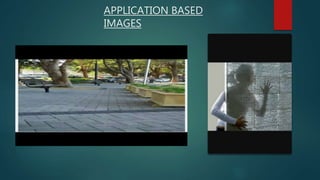
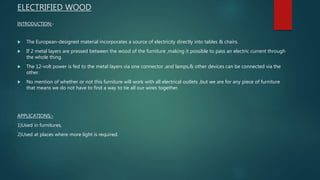
 Transparent concrete blocks can be used as building material for external and internal wall.
 For increasing visibility in dark subway stations.
 The concrete can be used for ceilings of large administrative center building which reduce the lighting costs during dayhours.
 Illumunating speedbumps on roadways at night,also used in light sidewalks at night.
 Also used in partition walls.
APPLICATION BASED
IMAGES
ELECTRIFIED WOOD
INTRODUCTION:-
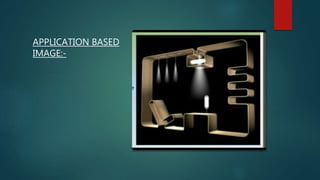
 The European-designed material incorporates a source of electricity directly into tables & chairs.
 If 2 metal layers are pressed between the wood of the furniture ,making it possible to pass an electric current through
the whole thing.
 The 12-volt power is fed to the metal layers via one connector ,and lamps,& other devices can be connected via the
other.
 No mention of whether or not this furniture will work with all electrical outlets ,but we are for any piece of furniture
that means we do not have to find a way to tie all our wires together.
APPLICATIONS:-
1)Used in furnitures,
2)Used at places where more light is required.
APPLICATION BASED
IMAGE:-
RICHLITE
INTRODUCTION:-
• Richlite is an extremely versatile,incredibly durable ,and highly sustainable material made from resin-infused paper.
• It is composed of approximately 65% recycled paper content and 35% phenolic resin, richlite colour comes from a combination of
the paper and the amber tone of the resin.
• Handmade from many layers of high quality custom craft paper,richlite`s surface texture comes from the natural variation in the way
fibres lay within the paper.
MATERIALS USED FOR MAKING RICHLITE:-
• It is made from:-
1)recycled paper 2)phenolic resin.
PROCESS OF MAKING RICHLITE:-
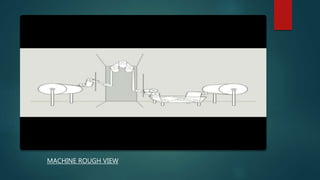
• Rolls of paper are saturated with a thermosetting resin before being cut to length & laid up by hand.
• Each sheet is carefully stacked, and the direction of the paper alternated,creating the ultimate balance and stability.
• The stacks are then pressed under even heat and pressure,which bonds the layers of paper together and cures the resin.
• Slowly cooled ,the cured panels produce a solid ,stable sheet of material .
• Richlite can be produced in many various sizes and thickness,from ¼”(6mm) to 3”(75mm) thick and sheet sizes up to
5`*12”(3660*1525mm).
MACHINE ROUGH VIEW
ADVANTAGES OF RICHLITE:-
• Unlike stone or a solid surface ,richlite works similar to a dense hardwood and can be easily milled,sanded,routed,and joined.
• It is water-resistant,heat and fire resistant.
• It is extraordinarily dense & durable,and has a natural appeal due to its paper construction.
DISADVANTAGES OF RICHLITE:-
• It is hard to glue.
• Under force can be scratched or gouged.
• Richlite countertops shouldnot be used as a cutting surface because richlite is a solid colour throughout, when scratches do occur,they can
be easily be buffed or sanded out.
APPLICATIONS:-
• A signature mottled appearance and warmth complement richlite`s range of interior & exterior applications like:-
1)furniture 2)retail displays 3)restaurant tables 4)worktops.
• Dense and durable ,yet easily tooled ,pleasing to the eye ,and with its smooth, natural aesthetic, richlite has become a choice material for a
wide range of architects, designers & industrial manufacturers.
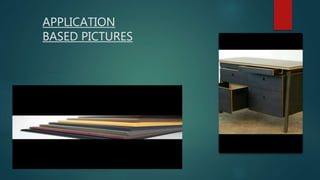
APPLICATION
BASED PICTURES
FLEXICOMB:-
INTRODUCTION:-
• The material is made from thousands of closely packed polypropylene tube that will bend in the convex direction while remaining
rigid in the concave one.
• It is a very versatile due to some of its properties.
• It is a flexible honeycomb matrix ,which can be used to build lighting fixtures & sculptural installations.
PROPERTIES OF FLEXICOMB:-
• It is slinky & beehive.
• It is flexible & bouncy.
• This porous, translucent material transmits light effectively.
• It can be bent, sprung & compressed.
MANUFACTURING PROCESS:-
• Flexicomb is made by fusing thousands of closely packed polypropylene tubes on one end to form a flexible honeycomb
• The production of flexicomb begins with a set of tightly compressed cylinders.
• When the end of closely packed tubes are heated , they fuse into a matrix of hexagons.
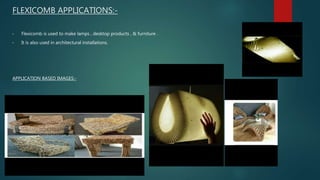
FLEXICOMB APPLICATIONS:-
• Flexicomb is used to make lamps , desktop products , & furniture .
• It is also used in architectural installations.
APPLICATION BASED IMAGES:-
SELF-REPAIRING CEMENT:-
INTRODUCTION:-
• It may seem that most of the materials have been designed to replace concrete , but cement is itself still evolving .
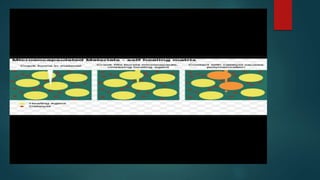
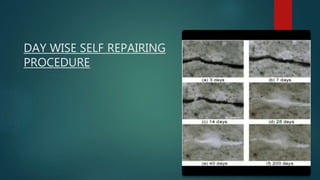
• A new self-healing cement is currently being developed which has the ability to repair its own cracks.
• This cement is mixed with microcapsules that release a glue-like epoxy resin that will automatically repair any cracks that form in
the sidewalk or roadway.
• In addition this cement will have the ability to regulate heat. Phase-change materials that can absorb or release large amounts of
heat have also been included in the ingridients.
WORKING PROCEDURE:-
• Exposure to hydrocarbons initiates the self-healing response when & where it is needed.
• The self-healing matrix reacts to create a complete hydraulic seal across the annulus.
• The cement matrix remains active after the cement has set-for as long as there is cement in the annulus.
ADVANTAGES:-
• With the material used in it , buildings can control their own temperature and hence energy is saved.
• Money on repair work is also saved.
• Formation of crack will be healed in the initial stage itself thereby increasing the service life of the structure than expected life.
• Self-healing agents helps in repairing the places where humans find it difficult to reach for the maintenance of the structures .
Hence it reduces risking of human life in dangerous areas and also increases the durability of the structure.
DISADVANTAGES:-
• If the volume of self healing agents mixed becomes greater than 20%,the strength is reduced.
• Ingridients are much more costly then that used in conventional cement(almost of double cost).
APPLICATIONS:-
• In buildings where human reach is not safe.
• In buildings where one time investment is possible.
DAY WISE SELF REPAIRING
PROCEDURE
CARBON FIBRE:-
INTRODUCTION:-
• They are the fibres about 5-10 micrometers in dimeter and composed mostly of carbon atoms.
• It`s five times as strong as steel ,two times as strong as stiff,yet weighs about two-third less.
• Carbon fiber is made up of carbon strands that are thinner than human hair. The strands can be woven together , like cloth, and
then can be molded to any shape you might want.
• Carbon fibre is frequently supplied in the form of a continuous tow wound onto a reel. The tow is a bundle of thousands of
continuous individual carbon filaments held together & protected by an organic coating, or size, such as polyethylene oxide(PEO) or
polyvinyl alcohol(PVA).
PROCESS OF MAKING CARBON FIBRE:-
• To produce a carbon fibre , the carbon atoms are bounded together in crystals that are more or less aligned parallel to the long axis
of the fibre as a crystal alignment gives the fibre high strength-to-vo;ume ratio(making it strong for its size).
• Several thousand carbon fibres are bundled together to form a tow, which may be used by itself or woven into a fabric.
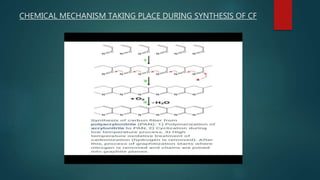
CHEMICAL MECHANISM TAKING PLACE DURING SYNTHESIS OF CF
• ADVANTAGES OF CF:-
1) High stiffness
2) High tensile strength
3)Low weight
4)High chemical resistance
5)High temperature tolerance
6)low thermal expansion.
DISADVANTAGE OF CARBON FIBRE:-
• They are relatively expensive when compared with similar fibres , such as glass fibres or plastic fibres.
APPLICATIONS OF CF:-
• Bridges are covered with the sheets of carbon fibre as a measure to increase resistance against
earthquakes.
• Several structural engineering applications utilize carbon fiber reinforced polymer because of its potential
construction benefits .
• They are also used in military and aerospace.
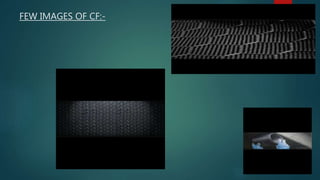
FEW IMAGES OF CF:-
BENDABLE CONCRETE:-
INTRODUCTION:-
• Traditional concrete is a very brittle material; any bucking or bending will cause it to a crack.
• A new type of fiber-reinforced bendable concrete bendable concrete might just be putting an end to that issue.
• This new concrete is around 500 times more resistant to cracking than regular concrete thanks to the tiny fibres , which
account for 2% of its make up.
• The fibers slide within the concrete when bending occurs , providing it with enough strength to prevent breakage.
WORKING MECHANISM:-
• Whenever the load increases beyond its limiting value the strong molecular bond formed between PVA fibres(polyvinyl
alcohol-fibres) are concrete during hydration prevents it from cracking.
• Different ingridients of ECC(engineered cementitious composite/bendable concrete) , work together , to share the applied
load.
ADVANTAGES:-
• It is more stronger ,more durable, and lasts longer than conventional concrete.
• It is more resistant to cracking.
• It does not emit that much amount of harmful gases as compared to conventional concrete.
• It reduces the cost of the project.
DISADVANTAGES:-
• It requires skilled labour for its construction.
• It needs special type of materials which can be difficult to find in some areas.
• Its quality depend upon the material used and the condition under which it is made.
APPLICATIONS:-
• It is used in the construction of the jointless bridges.
• In earthquake resistant structures.
• ECC overlays can be used over cracked concrete surfaces.
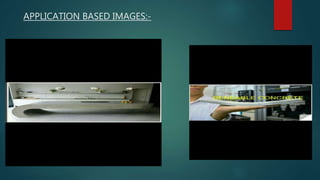
APPLICATION BASED IMAGES:-
TRANSPARENT ALUMINUM:-
INTRODUCTION:-
• Transparent aluminum , also known as aluminum oxynitride , is a transparent polycrystalline ceramic with a cubic spinel
crystal structure made of nitrogen , oxygen & aluminum.
• It is optically transparent in the near-ultraviolet, visible and infrared regions.
• It is 4 times harder than fused silica glass , 85% harder than sapphire & 15% harder than magnesium aliminate spinel.
PRODUCTION METHOD:-
• The fabricated ceramic material is subjected to heat treatment at elevated temperatures followed by the process of grinding.
• The material is then polished to obtain transparency.
• It losses transparency at around 2100 degree celcius.
• The processes of grinding & polishing mainly enhance the impact resistance and the resulting material is harder than
sapphire by 85% and magnesium aluminate spinel by 15%.
ADVANTAGES:-
• It has outstanding hardness & high strength.
• Available in wide variety of sizes , shape, & thicknesses.
• Total absence of birefringence.
DISADVANTAGES:-
• Not suitable in large panels, only suitable for small windows.
• Economically suitable only for longer run.
APPLICATIONS:-
• They are used in windows for laser communications and IR domes with different shapes that include
hemispherical and hyper-hemispherical domes.
• Translucent ceramics.
• Thermally conductive filler.
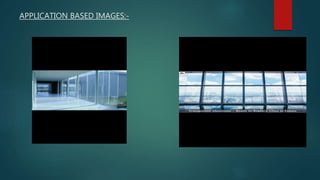
APPLICATION BASED IMAGES:-
LIQUID GRANITE:-
INTRODUCTION:-
• The material is made up of between 30-70% recycled material , mainly base products are from industry.
• Liquid granite consists of chips made from natural stone.
• It gives lovely & unique appearance ,and also offers UV Protection against fading and dulling .
• It has the ability to completely replace cement in concrete.
• Unlike concrete does not explode in high temperature.
ADVANTAGES:-
• It is light weight and has the same load bearing capacity as that of cement.
• Is made from recycled materials.
• It is fire resistant & can withstand temperatures of up to-1,100 degrees celcius.
• It is chemical resistant & scratch resistant.
DISADVANTAGES:-
• Is it costly.
• As unique colours are used in work , they cannot be replaced easily.
APPLICATIONS:-
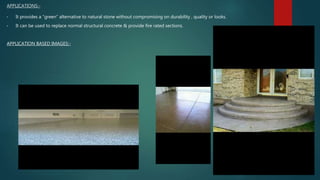
• It provides a “green” alternative to natural stone without compromising on durability , quality or looks.
• It can be used to replace normal structural concrete & provide fire rated sections.
APPLICATION BASED IMAGES:-
SOLAR PANEL ROOFING TILES:-
INTRODUCTION:-
• The system consists of rigid solar panels attached to a roof mounted rack, spaced at least 100mm of the roof,
this makes them to stick.
• It transforms the sun`s energy into useable electricity to power the house.
• With all integrated powerwall battery , energy collected during the day is stored and made available at any time.
ADVANTAGES:-
• Works well in long run.
• Reduces electricity bill.
• Are durable.
DISADVANTAGES:-
• Cannot be used in places where there is not much time difference between sunrise & sunset.
• Cannot be used where there is high rainfall annually.
APPLICTIONS:-
• Used in areas having low rainfall & sunny weather.
• Used in working places where high electricity demand is present.
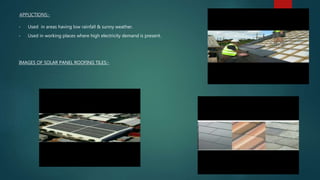
IMAGES OF SOLAR PANEL ROOFING TILES:-
Presentation on Modern construction materials

Presentation on Modern construction materials

  • 1.
    MODERN CONSTRUCTION MATERIALS  FROM:-AXAY SHARMA ROLL NO:-16BCL008 (CIVIL 16 BATCH) PDPU,GANDHINAGAR
  • 2.
    TRANSLUCENT CONCRETE INTRODUCTION:-  Translucentconcrete(also known as light-transmitting concrete) is a concrete based building material with light-transmissive properties due to embedded light optical elements –usually optical fibres.  Light is conducted through the stone from one end to the other. Therefore, the fibre have to go through the whole object.  This results in a certain light pattern on the other surface, depending on the fibre structure. MATERIALS USED FOR MAKING TRANSLUCENT CONCRETE:- The 2 basic materials used for making translucent(transparent) concrete are:- 1)Fine concrete 2)Optical fibres FINE CONCRETE:-consists of cement & fine aggregates such as sand. OPTICAL FIBRE:-there are 3 kinds:- 1)Multimode graded-index fibre . 2)Multimode step index fibre . 3)Single-mode step-index fibres . MANUFACTURING PROCESS:-  The manufacturing process of translucent concrete is almost same as regular concrete.  Small layers of the concrete are poured into the mould and on top of each layer, a layer of fibres is fused.  Fabrics and concrete are alternatively inserted into moulds at intervals of approximately 2mm to 5mm.
  • 3.
     Light-transmitting concreteis produced by adding 4-5 percentage optical fibres by volume into the concrete mixture.  The concrete mixture is made from fine materials and doesnot contain coarse aggregate.  Thousands of strands of optical fibres are cast into concrete to transmit light.  Smaller or thinner layers allow an increased amount of light to pass through the concrete. ADVANTAGES/BENEFITS OF TRANSLUCENT CONCRETE:-  The main advantage of transparent concrete is that it can transmit light. There it can be used to make green buildings.  Since it can transmit light from natural as well as artificial sources ,the building can have fewer lights to meet its demand for lighting ,thus saving huge energy cost.  This concrete can also be used in cold countries to transmit heat with sunlight,since it uses sunlight as source of light. DISADVANTAGES/DRAWBACKS OF TRANSLUCENT CONCRETE:-  The concrete is very costly because of optical fibres.  Casting of transparent concrete block is difficult for the labour, so special skilled person is required. APPLICATIONS OF TRANSLUCENT CONCRETE:-  Transparent concrete blocks can be used as building material for external and internal wall.  For increasing visibility in dark subway stations.  The concrete can be used for ceilings of large administrative center building which reduce the lighting costs during dayhours.  Illumunating speedbumps on roadways at night,also used in light sidewalks at night.  Also used in partition walls.
  • 4.
  • 5.
    ELECTRIFIED WOOD INTRODUCTION:-  TheEuropean-designed material incorporates a source of electricity directly into tables & chairs.  If 2 metal layers are pressed between the wood of the furniture ,making it possible to pass an electric current through the whole thing.  The 12-volt power is fed to the metal layers via one connector ,and lamps,& other devices can be connected via the other.  No mention of whether or not this furniture will work with all electrical outlets ,but we are for any piece of furniture that means we do not have to find a way to tie all our wires together. APPLICATIONS:- 1)Used in furnitures, 2)Used at places where more light is required.
  • 6.
  • 7.
    RICHLITE INTRODUCTION:- • Richlite isan extremely versatile,incredibly durable ,and highly sustainable material made from resin-infused paper. • It is composed of approximately 65% recycled paper content and 35% phenolic resin, richlite colour comes from a combination of the paper and the amber tone of the resin. • Handmade from many layers of high quality custom craft paper,richlite`s surface texture comes from the natural variation in the way fibres lay within the paper. MATERIALS USED FOR MAKING RICHLITE:- • It is made from:- 1)recycled paper 2)phenolic resin. PROCESS OF MAKING RICHLITE:- • Rolls of paper are saturated with a thermosetting resin before being cut to length & laid up by hand. • Each sheet is carefully stacked, and the direction of the paper alternated,creating the ultimate balance and stability. • The stacks are then pressed under even heat and pressure,which bonds the layers of paper together and cures the resin. • Slowly cooled ,the cured panels produce a solid ,stable sheet of material . • Richlite can be produced in many various sizes and thickness,from ¼”(6mm) to 3”(75mm) thick and sheet sizes up to 5`*12”(3660*1525mm).
  • 8.
  • 9.
    ADVANTAGES OF RICHLITE:- •Unlike stone or a solid surface ,richlite works similar to a dense hardwood and can be easily milled,sanded,routed,and joined. • It is water-resistant,heat and fire resistant. • It is extraordinarily dense & durable,and has a natural appeal due to its paper construction. DISADVANTAGES OF RICHLITE:- • It is hard to glue. • Under force can be scratched or gouged. • Richlite countertops shouldnot be used as a cutting surface because richlite is a solid colour throughout, when scratches do occur,they can be easily be buffed or sanded out. APPLICATIONS:- • A signature mottled appearance and warmth complement richlite`s range of interior & exterior applications like:- 1)furniture 2)retail displays 3)restaurant tables 4)worktops. • Dense and durable ,yet easily tooled ,pleasing to the eye ,and with its smooth, natural aesthetic, richlite has become a choice material for a wide range of architects, designers & industrial manufacturers.
  • 10.
  • 11.
    FLEXICOMB:- INTRODUCTION:- • The materialis made from thousands of closely packed polypropylene tube that will bend in the convex direction while remaining rigid in the concave one. • It is a very versatile due to some of its properties. • It is a flexible honeycomb matrix ,which can be used to build lighting fixtures & sculptural installations. PROPERTIES OF FLEXICOMB:- • It is slinky & beehive. • It is flexible & bouncy. • This porous, translucent material transmits light effectively. • It can be bent, sprung & compressed. MANUFACTURING PROCESS:- • Flexicomb is made by fusing thousands of closely packed polypropylene tubes on one end to form a flexible honeycomb • The production of flexicomb begins with a set of tightly compressed cylinders. • When the end of closely packed tubes are heated , they fuse into a matrix of hexagons.
  • 12.
    FLEXICOMB APPLICATIONS:- • Flexicombis used to make lamps , desktop products , & furniture . • It is also used in architectural installations. APPLICATION BASED IMAGES:-
  • 13.
    SELF-REPAIRING CEMENT:- INTRODUCTION:- • Itmay seem that most of the materials have been designed to replace concrete , but cement is itself still evolving . • A new self-healing cement is currently being developed which has the ability to repair its own cracks. • This cement is mixed with microcapsules that release a glue-like epoxy resin that will automatically repair any cracks that form in the sidewalk or roadway. • In addition this cement will have the ability to regulate heat. Phase-change materials that can absorb or release large amounts of heat have also been included in the ingridients. WORKING PROCEDURE:- • Exposure to hydrocarbons initiates the self-healing response when & where it is needed. • The self-healing matrix reacts to create a complete hydraulic seal across the annulus. • The cement matrix remains active after the cement has set-for as long as there is cement in the annulus.
  • 15.
    ADVANTAGES:- • With thematerial used in it , buildings can control their own temperature and hence energy is saved. • Money on repair work is also saved. • Formation of crack will be healed in the initial stage itself thereby increasing the service life of the structure than expected life. • Self-healing agents helps in repairing the places where humans find it difficult to reach for the maintenance of the structures . Hence it reduces risking of human life in dangerous areas and also increases the durability of the structure. DISADVANTAGES:- • If the volume of self healing agents mixed becomes greater than 20%,the strength is reduced. • Ingridients are much more costly then that used in conventional cement(almost of double cost). APPLICATIONS:- • In buildings where human reach is not safe. • In buildings where one time investment is possible.
  • 16.
    DAY WISE SELFREPAIRING PROCEDURE
  • 17.
    CARBON FIBRE:- INTRODUCTION:- • Theyare the fibres about 5-10 micrometers in dimeter and composed mostly of carbon atoms. • It`s five times as strong as steel ,two times as strong as stiff,yet weighs about two-third less. • Carbon fiber is made up of carbon strands that are thinner than human hair. The strands can be woven together , like cloth, and then can be molded to any shape you might want. • Carbon fibre is frequently supplied in the form of a continuous tow wound onto a reel. The tow is a bundle of thousands of continuous individual carbon filaments held together & protected by an organic coating, or size, such as polyethylene oxide(PEO) or polyvinyl alcohol(PVA). PROCESS OF MAKING CARBON FIBRE:- • To produce a carbon fibre , the carbon atoms are bounded together in crystals that are more or less aligned parallel to the long axis of the fibre as a crystal alignment gives the fibre high strength-to-vo;ume ratio(making it strong for its size). • Several thousand carbon fibres are bundled together to form a tow, which may be used by itself or woven into a fabric.
  • 18.
    CHEMICAL MECHANISM TAKINGPLACE DURING SYNTHESIS OF CF
  • 19.
    • ADVANTAGES OFCF:- 1) High stiffness 2) High tensile strength 3)Low weight 4)High chemical resistance 5)High temperature tolerance 6)low thermal expansion. DISADVANTAGE OF CARBON FIBRE:- • They are relatively expensive when compared with similar fibres , such as glass fibres or plastic fibres. APPLICATIONS OF CF:- • Bridges are covered with the sheets of carbon fibre as a measure to increase resistance against earthquakes. • Several structural engineering applications utilize carbon fiber reinforced polymer because of its potential construction benefits . • They are also used in military and aerospace.
  • 20.
  • 21.
    BENDABLE CONCRETE:- INTRODUCTION:- • Traditionalconcrete is a very brittle material; any bucking or bending will cause it to a crack. • A new type of fiber-reinforced bendable concrete bendable concrete might just be putting an end to that issue. • This new concrete is around 500 times more resistant to cracking than regular concrete thanks to the tiny fibres , which account for 2% of its make up. • The fibers slide within the concrete when bending occurs , providing it with enough strength to prevent breakage. WORKING MECHANISM:- • Whenever the load increases beyond its limiting value the strong molecular bond formed between PVA fibres(polyvinyl alcohol-fibres) are concrete during hydration prevents it from cracking. • Different ingridients of ECC(engineered cementitious composite/bendable concrete) , work together , to share the applied load. ADVANTAGES:- • It is more stronger ,more durable, and lasts longer than conventional concrete. • It is more resistant to cracking. • It does not emit that much amount of harmful gases as compared to conventional concrete. • It reduces the cost of the project.
  • 22.
    DISADVANTAGES:- • It requiresskilled labour for its construction. • It needs special type of materials which can be difficult to find in some areas. • Its quality depend upon the material used and the condition under which it is made. APPLICATIONS:- • It is used in the construction of the jointless bridges. • In earthquake resistant structures. • ECC overlays can be used over cracked concrete surfaces.
  • 23.
  • 24.
    TRANSPARENT ALUMINUM:- INTRODUCTION:- • Transparentaluminum , also known as aluminum oxynitride , is a transparent polycrystalline ceramic with a cubic spinel crystal structure made of nitrogen , oxygen & aluminum. • It is optically transparent in the near-ultraviolet, visible and infrared regions. • It is 4 times harder than fused silica glass , 85% harder than sapphire & 15% harder than magnesium aliminate spinel. PRODUCTION METHOD:- • The fabricated ceramic material is subjected to heat treatment at elevated temperatures followed by the process of grinding. • The material is then polished to obtain transparency. • It losses transparency at around 2100 degree celcius. • The processes of grinding & polishing mainly enhance the impact resistance and the resulting material is harder than sapphire by 85% and magnesium aluminate spinel by 15%.
  • 25.
    ADVANTAGES:- • It hasoutstanding hardness & high strength. • Available in wide variety of sizes , shape, & thicknesses. • Total absence of birefringence. DISADVANTAGES:- • Not suitable in large panels, only suitable for small windows. • Economically suitable only for longer run. APPLICATIONS:- • They are used in windows for laser communications and IR domes with different shapes that include hemispherical and hyper-hemispherical domes. • Translucent ceramics. • Thermally conductive filler.
  • 26.
  • 27.
    LIQUID GRANITE:- INTRODUCTION:- • Thematerial is made up of between 30-70% recycled material , mainly base products are from industry. • Liquid granite consists of chips made from natural stone. • It gives lovely & unique appearance ,and also offers UV Protection against fading and dulling . • It has the ability to completely replace cement in concrete. • Unlike concrete does not explode in high temperature. ADVANTAGES:- • It is light weight and has the same load bearing capacity as that of cement. • Is made from recycled materials. • It is fire resistant & can withstand temperatures of up to-1,100 degrees celcius. • It is chemical resistant & scratch resistant. DISADVANTAGES:- • Is it costly. • As unique colours are used in work , they cannot be replaced easily.
  • 28.
    APPLICATIONS:- • It providesa “green” alternative to natural stone without compromising on durability , quality or looks. • It can be used to replace normal structural concrete & provide fire rated sections. APPLICATION BASED IMAGES:-
  • 29.
    SOLAR PANEL ROOFINGTILES:- INTRODUCTION:- • The system consists of rigid solar panels attached to a roof mounted rack, spaced at least 100mm of the roof, this makes them to stick. • It transforms the sun`s energy into useable electricity to power the house. • With all integrated powerwall battery , energy collected during the day is stored and made available at any time. ADVANTAGES:- • Works well in long run. • Reduces electricity bill. • Are durable. DISADVANTAGES:- • Cannot be used in places where there is not much time difference between sunrise & sunset. • Cannot be used where there is high rainfall annually.
  • 30.
    APPLICTIONS:- • Used inareas having low rainfall & sunny weather. • Used in working places where high electricity demand is present. IMAGES OF SOLAR PANEL ROOFING TILES:-