CONCRETE TECHNOLOGY
RMC
Prepared by
K.BALAMURALI
18TPCV006
1
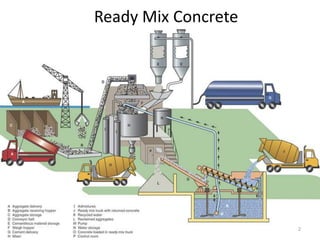
Ready Mix Concrete
2
Ready Mix Concrete
 Ready-mix concrete (RMC) is a ready-to-use
material, with predetermined mixture of Cement,
sand, aggregates and water.
 “Ready mix concrete is concrete whose
components are proportioned away from the
construction site for delivery to the construction site
by the truck in a ready-to-use-condition.”
3
IS 4926
Transport of Concrete
• The purchaser should plan his arrangements so as to
enable a full load of concrete to be discharged within
30 min of arrival on site
Time in Transport
• The general requirement is that concrete shall be
discharged from the truck-mixer within 2 h of the time
loading.
• The time of loading shall start from adding the mixing
water to the dry mix of cement and aggregate or of
adding the cement to the wet aggregate whichever is
applicable
4
IS 4926
• SAMPLING AND TESTING OF READY-MIXED CONCRETE
• INFORMATION TO BE SUPPLIED BY THE PURCHASER
• INFORMATION TO BE SUPPLIED BY THE PRODUCER
• PRODUCTION AND DELIVERY
• QUALITY CONTROL
• ORDER PROCESSING
• TRAINING
• MATERIALS TESTING REQUIREMENTS
• CALIBRATION AND WEIGHING EQUIPMENT ACCURACY
• ROUTINE MAINTENANCE CHECKS FOR PLANT AND
EQUIPMENT
• DELIVERY TICKET INFORMATION
5
Need for Ready Mix concrete
• Requirement for higher grades of concrete
• Correct accountability ingredients
• Rapid development of infrastructure industry
• Increased demand of concrete
• Possibility of manufacture of desired grades
• Mega project demands higher output
• Timely supply of reliable concrete
• Better quality concrete is produced.
• Elimination of storage space for basic materials at site.
• Elimination of Procurement / Hiring of plant and
machinery.
• Wastage of basic materials is avoided.
6
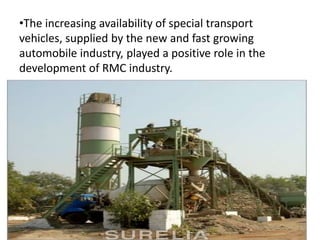
•The increasing availability of special transport
vehicles, supplied by the new and fast growing
automobile industry, played a positive role in the
development of RMC industry.
7
Ready Mix Concrete
• Raw Materials are:-
• 1. Water
• 2. Additives/Admixtures
• 3. Cement
• 4. Aggregates
• 5. Air
8
Ready Mix Concrete
ADMIXTUREs:
• Air-entraining admixtures (mainly used in concrete
exposed to freezing)
• Water-reducing admixtures, plasticizers (reduce the
dosage of water while maintaining the workability)
• Retarding admixtures (mainly used in hot weather to
retard the reaction of hydration)
• Accelerating admixtures (mainly used in cold weather to
accelerate the reaction of hydration)
• Super plasticizer or high range water-reducer
(significantly reduce the dosage of water while maintaining
the workability)
• Miscellaneous admixtures such as corrosion inhibiting,
shrinkage reducing, coloring, pumping etc.
9
Ready Mix Concrete
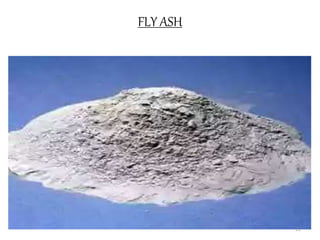
FLY ASH:
Fly ash is a by-product from coal-fired electricity
generating power plants.
The fly ash is generally used in the concrete in the
following ways.
• As partial replace for cement.
• As partial replacement for sand.
• As simultaneous replacement for both cement
and sand.
10
FLY ASH
11
Ready Mix Concrete
WATER :
The pH value of water should be in between
6.0 and 8.0 according to IS 456-2000.
12
Ready Mix Concrete
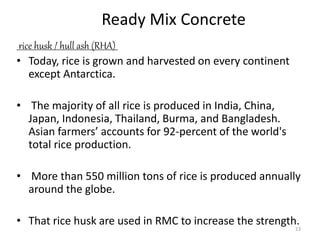
rice husk / hull ash (RHA)
• Today, rice is grown and harvested on every continent
except Antarctica.
• The majority of all rice is produced in India, China,
Japan, Indonesia, Thailand, Burma, and Bangladesh.
Asian farmers’ accounts for 92-percent of the world's
total rice production.
• More than 550 million tons of rice is produced annually
around the globe.
• That rice husk are used in RMC to increase the strength.
13
Ready Mix Concrete
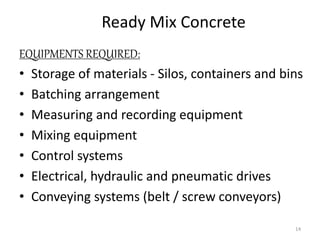
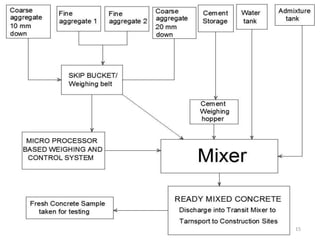
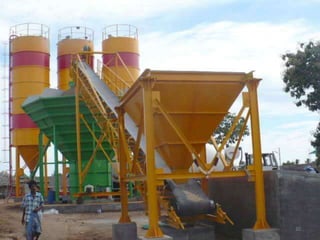
EQUIPMENTS REQUIRED:
• Storage of materials - Silos, containers and bins
• Batching arrangement
• Measuring and recording equipment
• Mixing equipment
• Control systems
• Electrical, hydraulic and pneumatic drives
• Conveying systems (belt / screw conveyors)
14
15
Ready Mix Concrete - BATCHING
Batching plants are classified as
• 1. Manual
• 2. Semiautomatic
• 3. Fully automatic
16
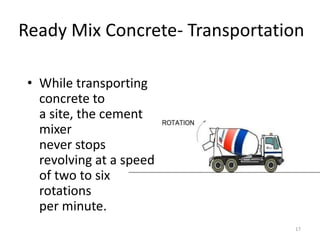
Ready Mix Concrete- Transportation
• While transporting
concrete to
a site, the cement
mixer
never stops
revolving at a speed
of two to six
rotations
per minute.
17
18
RMC Manufacturing
• After producing ready mix concrete, utmost care must be given
to the quality of concrete during transportation to the site.
• The following factors for transportation should be kept in mind:
• Travel distance: Since the concrete setting time is very much
related to the time, so time distance between loading and
pouring is very much important. Large travel time may hamper
the quality of concrete
• Transit mixers: These are the vehicles which carry ready mix
concrete from batching plant to site. So every transit mixers
should be in good condition and tested before carrying.
• Weather condition: As a tropical country weather is a
considerable factor for transportation of ready mix concrete.
Mainly in summer season ready mix concrete should be
transported with caution.
19
20
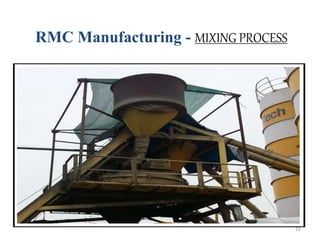
RMC Manufacturing - MIXING PROCESS:
 Thorough mixing of the materials is essential
for the production of uniform concrete.
 The mixing should ensure that the mass
becomes homogeneous, uniform in colour and
consistency.
• Following are the three types of mixing process
of RMC
• 1. Transit Mixed (or "truck-mixed") Concrete
• 2. Shrink Mixed Concrete
• 3. Central Mixed Concrete 21
RMC Manufacturing - MIXING PROCESS
22
RMC Manufacturing - TRANSITMIXED(OR "TRUCK-
MIXED") CONCRETE:-
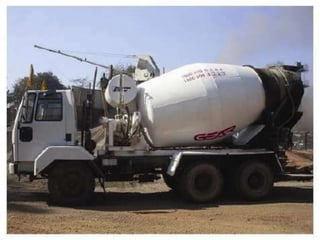
RMC can be delivered to the point of placement to the
construction site in truck-mounted, rotating drum
mixers.
Truck mixers have a revolving drum with the axis
inclined to the horizontal.
Inside the shell of the mixer drum are a pair of blades or
fins that wrap in a helical (spiral) configuration from the
head to the opening of the drum.
The concrete is loaded and mixed, it is normally hauled
to the job site with the drum turning at a speed of less
than 2 rpm.
23
NEEDS TO BE SPECIFIED BY CONSUMER FOR RMC
• Characteristic strength or grade (N/mm2)
• Target workability or slump in mm required at
site
• Exposure conditions for durability requirements
Maximum water to cement ratio
 Minimum cement content
 Maximum aggregate size
 Type of cement
 Mineral admixture and its proportion (Kg/m3)
24
CHECKS BY CONSUMER BEFORE ORDERING THE RMC
• Calibrations of all measuring devices and their
accuracy.
• Mode of operation of plant should preferably
be fully automatic and not manual.
• Quality of materials proposed to be used.
• Adequacy of quantity of materials used.
25
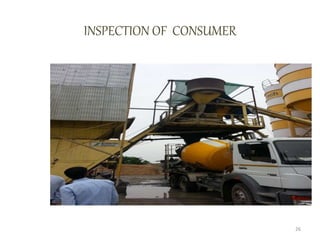
INSPECTION OF CONSUMER
26
MERITS OF R.M.C.
1. Better quality concrete is produced.
2. Elimination of storage space for basic materials at site.
3. Elimination of Hiring plant and machinery
4. Wastage of basic materials is avoided.
5. Labour associated with production of concrete is
eliminated.
6. Time required is greatly reduced
7. Noise and dust pollution at site is reduced.
8 .No wastage at site
9. Environment friendly 27
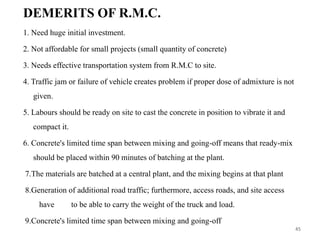
DEMERITS OF R.M.C.
1. Need huge initial investment.
2. Not affordable for small projects (small quantity of concrete)
3. Needs effective transportation system from R.M.C to site.
4. Traffic jam or failure of vehicle creates problem if proper dose of admixture is not
given.
5. Labours should be ready on site to cast the concrete in position to vibrate it and
compact it.
6. Concrete's limited time span between mixing and going-off means that ready-mix
should be placed within 90 minutes of batching at the plant.
7.The materials are batched at a central plant, and the mixing begins at that plant
8.Generation of additional road traffic; furthermore, access roads, and site access
have to be able to carry the weight of the truck and load.
9.Concrete's limited time span between mixing and going-off
45
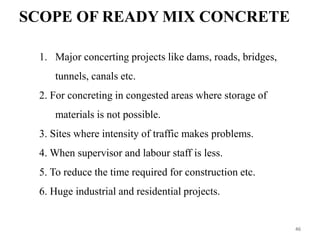
SCOPE OF READY MIX CONCRETE
1. Major concerting projects like dams, roads, bridges,
tunnels, canals etc.
2. For concreting in congested areas where storage of
materials is not possible.
3. Sites where intensity of traffic makes problems.
4. When supervisor and labour staff is less.
5. To reduce the time required for construction etc.
6. Huge industrial and residential projects.
46
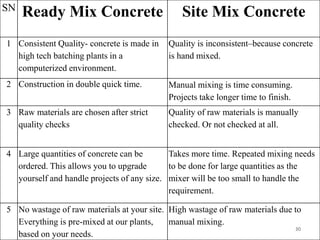
SN
Ready Mix Concrete Site Mix Concrete
1 Consistent Quality- concrete is made in
high tech batching plants in a
computerized environment.
Quality is inconsistent–because concrete
is hand mixed.
2 Construction in double quick time. Manual mixing is time consuming.
Projects take longer time to finish.
3 Raw materials are chosen after strict
quality checks
Quality of raw materials is manually
checked. Or not checked at all.
4 Large quantities of concrete can be
ordered. This allows you to upgrade
yourself and handle projects of any size.
Takes more time. Repeated mixing needs
to be done for large quantities as the
mixer will be too small to handle the
requirement.
5 No wastage of raw materials at your site.
Everything is pre-mixed at our plants,
based on your needs.
High wastage of raw materials due to
manual mixing.
30
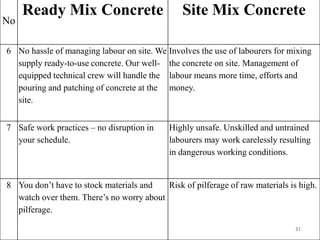
No
Ready Mix Concrete Site Mix Concrete
6 No hassle of managing labour on site. We
supply ready-to-use concrete. Our well-
equipped technical crew will handle the
pouring and patching of concrete at the
site.
Involves the use of labourers for mixing
the concrete on site. Management of
labour means more time, efforts and
money.
7 Safe work practices – no disruption in
your schedule.
Highly unsafe. Unskilled and untrained
labourers may work carelessly resulting
in dangerous working conditions.
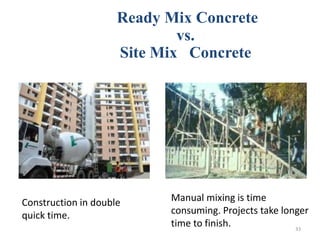
8 You don’t have to stock materials and
watch over them. There’s no worry about
pilferage.
Risk of pilferage of raw materials is high.
31
Ready Mix Concrete
vs.
Site Mix Concrete
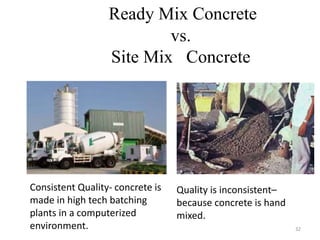
Consistent Quality- concrete is
made in high tech batching
plants in a computerized
environment.
Quality is inconsistent–
because concrete is hand
mixed.
32
Construction in double
quick time.
Manual mixing is time
consuming. Projects take longer
time to finish.
Ready Mix Concrete
vs.
Site Mix Concrete
33
Ready Mix Concrete
vs.
Site Mix Concrete
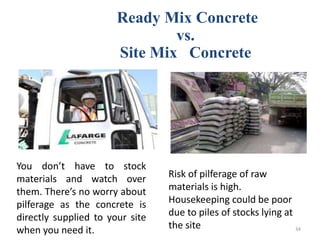
You don’t have to stock
materials and watch over
them. There’s no worry about
pilferage as the concrete is
directly supplied to your site
when you need it.
Risk of pilferage of raw
materials is high.
Housekeeping could be poor
due to piles of stocks lying at
the site 34
Ready Mix Concrete
vs.
Site Mix Concrete
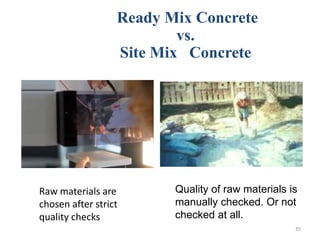
Raw materials are
chosen after strict
quality checks
Quality of raw materials is
manually checked. Or not
checked at all.
35
Ready Mix Concrete
vs.
Site Mix Concrete
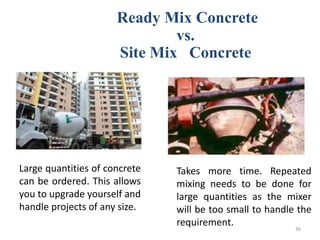
Large quantities of concrete
can be ordered. This allows
you to upgrade yourself and
handle projects of any size.
Takes more time. Repeated
mixing needs to be done for
large quantities as the mixer
will be too small to handle the
requirement. 36
Ready Mix Concrete
vs.
Site Mix Concrete
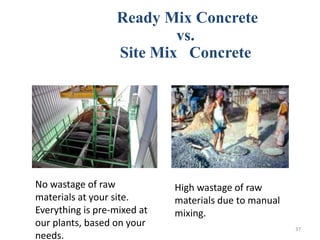
No wastage of raw
materials at your site.
Everything is pre-mixed at
our plants, based on your
needs.
High wastage of raw
materials due to manual
mixing.
37
Ready Mix Concrete
vs.
Site Mix Concrete
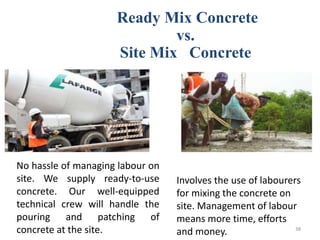
No hassle of managing labour on
site. We supply ready-to-use
concrete. Our well-equipped
technical crew will handle the
pouring and patching of
concrete at the site.
Involves the use of labourers
for mixing the concrete on
site. Management of labour
means more time, efforts
and money. 38
Ready Mix Concrete
vs.
Site Mix Concrete
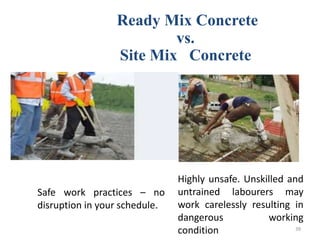
Safe work practices – no
disruption in your schedule.
Highly unsafe. Unskilled and
untrained labourers may
work carelessly resulting in
dangerous working
condition 39
Advantages Of Ready Mix Concrete
• Quality assurance
• Elimination of manual errors
• Mass production of concrete possible
• Water cement ratio maintained
• Reduced material wastage
• Labour cost saved
• Design mix as per IS standards resulting in standard
deviation and improved characteristics.
40
Disadvantages Of Ready Mix
Concrete
• The materials are batched at a central plant, and
the mixing begins at that plant
• Generation of additional road traffic; furthermore,
access roads, and site access have to be able to
carry the weight of the truck and load.
• Concrete's limited time span between mixing and
going-off
41
Thank you
42

Ready mix concrete

  • 1.
  • 2.
  • 3.
    Ready Mix Concrete Ready-mix concrete (RMC) is a ready-to-use material, with predetermined mixture of Cement, sand, aggregates and water.  “Ready mix concrete is concrete whose components are proportioned away from the construction site for delivery to the construction site by the truck in a ready-to-use-condition.” 3
  • 4.
    IS 4926 Transport ofConcrete • The purchaser should plan his arrangements so as to enable a full load of concrete to be discharged within 30 min of arrival on site Time in Transport • The general requirement is that concrete shall be discharged from the truck-mixer within 2 h of the time loading. • The time of loading shall start from adding the mixing water to the dry mix of cement and aggregate or of adding the cement to the wet aggregate whichever is applicable 4
  • 5.
    IS 4926 • SAMPLINGAND TESTING OF READY-MIXED CONCRETE • INFORMATION TO BE SUPPLIED BY THE PURCHASER • INFORMATION TO BE SUPPLIED BY THE PRODUCER • PRODUCTION AND DELIVERY • QUALITY CONTROL • ORDER PROCESSING • TRAINING • MATERIALS TESTING REQUIREMENTS • CALIBRATION AND WEIGHING EQUIPMENT ACCURACY • ROUTINE MAINTENANCE CHECKS FOR PLANT AND EQUIPMENT • DELIVERY TICKET INFORMATION 5
  • 6.
    Need for ReadyMix concrete • Requirement for higher grades of concrete • Correct accountability ingredients • Rapid development of infrastructure industry • Increased demand of concrete • Possibility of manufacture of desired grades • Mega project demands higher output • Timely supply of reliable concrete • Better quality concrete is produced. • Elimination of storage space for basic materials at site. • Elimination of Procurement / Hiring of plant and machinery. • Wastage of basic materials is avoided. 6
  • 7.
    •The increasing availabilityof special transport vehicles, supplied by the new and fast growing automobile industry, played a positive role in the development of RMC industry. 7
  • 8.
    Ready Mix Concrete •Raw Materials are:- • 1. Water • 2. Additives/Admixtures • 3. Cement • 4. Aggregates • 5. Air 8
  • 9.
    Ready Mix Concrete ADMIXTUREs: •Air-entraining admixtures (mainly used in concrete exposed to freezing) • Water-reducing admixtures, plasticizers (reduce the dosage of water while maintaining the workability) • Retarding admixtures (mainly used in hot weather to retard the reaction of hydration) • Accelerating admixtures (mainly used in cold weather to accelerate the reaction of hydration) • Super plasticizer or high range water-reducer (significantly reduce the dosage of water while maintaining the workability) • Miscellaneous admixtures such as corrosion inhibiting, shrinkage reducing, coloring, pumping etc. 9
  • 10.
    Ready Mix Concrete FLYASH: Fly ash is a by-product from coal-fired electricity generating power plants. The fly ash is generally used in the concrete in the following ways. • As partial replace for cement. • As partial replacement for sand. • As simultaneous replacement for both cement and sand. 10
  • 11.
  • 12.
    Ready Mix Concrete WATER: The pH value of water should be in between 6.0 and 8.0 according to IS 456-2000. 12
  • 13.
    Ready Mix Concrete ricehusk / hull ash (RHA) • Today, rice is grown and harvested on every continent except Antarctica. • The majority of all rice is produced in India, China, Japan, Indonesia, Thailand, Burma, and Bangladesh. Asian farmers’ accounts for 92-percent of the world's total rice production. • More than 550 million tons of rice is produced annually around the globe. • That rice husk are used in RMC to increase the strength. 13
  • 14.
    Ready Mix Concrete EQUIPMENTSREQUIRED: • Storage of materials - Silos, containers and bins • Batching arrangement • Measuring and recording equipment • Mixing equipment • Control systems • Electrical, hydraulic and pneumatic drives • Conveying systems (belt / screw conveyors) 14
  • 15.
  • 16.
    Ready Mix Concrete- BATCHING Batching plants are classified as • 1. Manual • 2. Semiautomatic • 3. Fully automatic 16
  • 17.
    Ready Mix Concrete-Transportation • While transporting concrete to a site, the cement mixer never stops revolving at a speed of two to six rotations per minute. 17
  • 18.
  • 19.
    RMC Manufacturing • Afterproducing ready mix concrete, utmost care must be given to the quality of concrete during transportation to the site. • The following factors for transportation should be kept in mind: • Travel distance: Since the concrete setting time is very much related to the time, so time distance between loading and pouring is very much important. Large travel time may hamper the quality of concrete • Transit mixers: These are the vehicles which carry ready mix concrete from batching plant to site. So every transit mixers should be in good condition and tested before carrying. • Weather condition: As a tropical country weather is a considerable factor for transportation of ready mix concrete. Mainly in summer season ready mix concrete should be transported with caution. 19
  • 20.
  • 21.
    RMC Manufacturing -MIXING PROCESS:  Thorough mixing of the materials is essential for the production of uniform concrete.  The mixing should ensure that the mass becomes homogeneous, uniform in colour and consistency. • Following are the three types of mixing process of RMC • 1. Transit Mixed (or "truck-mixed") Concrete • 2. Shrink Mixed Concrete • 3. Central Mixed Concrete 21
  • 22.
    RMC Manufacturing -MIXING PROCESS 22
  • 23.
    RMC Manufacturing -TRANSITMIXED(OR "TRUCK- MIXED") CONCRETE:- RMC can be delivered to the point of placement to the construction site in truck-mounted, rotating drum mixers. Truck mixers have a revolving drum with the axis inclined to the horizontal. Inside the shell of the mixer drum are a pair of blades or fins that wrap in a helical (spiral) configuration from the head to the opening of the drum. The concrete is loaded and mixed, it is normally hauled to the job site with the drum turning at a speed of less than 2 rpm. 23
  • 24.
    NEEDS TO BESPECIFIED BY CONSUMER FOR RMC • Characteristic strength or grade (N/mm2) • Target workability or slump in mm required at site • Exposure conditions for durability requirements Maximum water to cement ratio  Minimum cement content  Maximum aggregate size  Type of cement  Mineral admixture and its proportion (Kg/m3) 24
  • 25.
    CHECKS BY CONSUMERBEFORE ORDERING THE RMC • Calibrations of all measuring devices and their accuracy. • Mode of operation of plant should preferably be fully automatic and not manual. • Quality of materials proposed to be used. • Adequacy of quantity of materials used. 25
  • 26.
  • 27.
    MERITS OF R.M.C. 1.Better quality concrete is produced. 2. Elimination of storage space for basic materials at site. 3. Elimination of Hiring plant and machinery 4. Wastage of basic materials is avoided. 5. Labour associated with production of concrete is eliminated. 6. Time required is greatly reduced 7. Noise and dust pollution at site is reduced. 8 .No wastage at site 9. Environment friendly 27
  • 28.
    DEMERITS OF R.M.C. 1.Need huge initial investment. 2. Not affordable for small projects (small quantity of concrete) 3. Needs effective transportation system from R.M.C to site. 4. Traffic jam or failure of vehicle creates problem if proper dose of admixture is not given. 5. Labours should be ready on site to cast the concrete in position to vibrate it and compact it. 6. Concrete's limited time span between mixing and going-off means that ready-mix should be placed within 90 minutes of batching at the plant. 7.The materials are batched at a central plant, and the mixing begins at that plant 8.Generation of additional road traffic; furthermore, access roads, and site access have to be able to carry the weight of the truck and load. 9.Concrete's limited time span between mixing and going-off 45
  • 29.
    SCOPE OF READYMIX CONCRETE 1. Major concerting projects like dams, roads, bridges, tunnels, canals etc. 2. For concreting in congested areas where storage of materials is not possible. 3. Sites where intensity of traffic makes problems. 4. When supervisor and labour staff is less. 5. To reduce the time required for construction etc. 6. Huge industrial and residential projects. 46
  • 30.
    SN Ready Mix ConcreteSite Mix Concrete 1 Consistent Quality- concrete is made in high tech batching plants in a computerized environment. Quality is inconsistent–because concrete is hand mixed. 2 Construction in double quick time. Manual mixing is time consuming. Projects take longer time to finish. 3 Raw materials are chosen after strict quality checks Quality of raw materials is manually checked. Or not checked at all. 4 Large quantities of concrete can be ordered. This allows you to upgrade yourself and handle projects of any size. Takes more time. Repeated mixing needs to be done for large quantities as the mixer will be too small to handle the requirement. 5 No wastage of raw materials at your site. Everything is pre-mixed at our plants, based on your needs. High wastage of raw materials due to manual mixing. 30
  • 31.
    No Ready Mix ConcreteSite Mix Concrete 6 No hassle of managing labour on site. We supply ready-to-use concrete. Our well- equipped technical crew will handle the pouring and patching of concrete at the site. Involves the use of labourers for mixing the concrete on site. Management of labour means more time, efforts and money. 7 Safe work practices – no disruption in your schedule. Highly unsafe. Unskilled and untrained labourers may work carelessly resulting in dangerous working conditions. 8 You don’t have to stock materials and watch over them. There’s no worry about pilferage. Risk of pilferage of raw materials is high. 31
  • 32.
    Ready Mix Concrete vs. SiteMix Concrete Consistent Quality- concrete is made in high tech batching plants in a computerized environment. Quality is inconsistent– because concrete is hand mixed. 32
  • 33.
    Construction in double quicktime. Manual mixing is time consuming. Projects take longer time to finish. Ready Mix Concrete vs. Site Mix Concrete 33
  • 34.
    Ready Mix Concrete vs. SiteMix Concrete You don’t have to stock materials and watch over them. There’s no worry about pilferage as the concrete is directly supplied to your site when you need it. Risk of pilferage of raw materials is high. Housekeeping could be poor due to piles of stocks lying at the site 34
  • 35.
    Ready Mix Concrete vs. SiteMix Concrete Raw materials are chosen after strict quality checks Quality of raw materials is manually checked. Or not checked at all. 35
  • 36.
    Ready Mix Concrete vs. SiteMix Concrete Large quantities of concrete can be ordered. This allows you to upgrade yourself and handle projects of any size. Takes more time. Repeated mixing needs to be done for large quantities as the mixer will be too small to handle the requirement. 36
  • 37.
    Ready Mix Concrete vs. SiteMix Concrete No wastage of raw materials at your site. Everything is pre-mixed at our plants, based on your needs. High wastage of raw materials due to manual mixing. 37
  • 38.
    Ready Mix Concrete vs. SiteMix Concrete No hassle of managing labour on site. We supply ready-to-use concrete. Our well-equipped technical crew will handle the pouring and patching of concrete at the site. Involves the use of labourers for mixing the concrete on site. Management of labour means more time, efforts and money. 38
  • 39.
    Ready Mix Concrete vs. SiteMix Concrete Safe work practices – no disruption in your schedule. Highly unsafe. Unskilled and untrained labourers may work carelessly resulting in dangerous working condition 39
  • 40.
    Advantages Of ReadyMix Concrete • Quality assurance • Elimination of manual errors • Mass production of concrete possible • Water cement ratio maintained • Reduced material wastage • Labour cost saved • Design mix as per IS standards resulting in standard deviation and improved characteristics. 40
  • 41.
    Disadvantages Of ReadyMix Concrete • The materials are batched at a central plant, and the mixing begins at that plant • Generation of additional road traffic; furthermore, access roads, and site access have to be able to carry the weight of the truck and load. • Concrete's limited time span between mixing and going-off 41
  • 42.