Rio de Janeiro, Brazil, 5-8 November 2011


IMPLEMENTING SEMANTIC QUERIES IN
     ONLINE SOCIAL NETWORKS

         Jair Abú Bechir Láscar Alarcón
                jairabu@gmail.com
              Otávio Calaça Xavier
               otaviocx@gmail.com
             Cedric Luiz de Carvalho
                cedric@inf.ufg.br
Summary

Introduction


Foundations


Airetama


Implementing Semantic Queries


Conclusions
Introduction

The Web is a great technological achievement


Access, extraction, interpretation and maintenance
information is done manually

Web Systems are often isolated applications.
They are designed for human beings and are not suitable
to be automatically accessed by software tools


There is a need for software agents that help users in
finding, processing and organizing this information


                                                         1/10
Introduction

This article presents the implementation
of semantic queries in online social networks


For this implementation we created a framework that
uses Semantic Web to make relationships in such networks

The experiment used in this article was to create a ranking
of affinity between users based on common interests


This work was done because of the clear need for more
sophisticated queries, which would enable the computer
to interpret these relationships semantically

                                                         2/10
Foundations


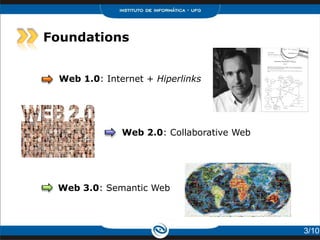
  Web 1.0: Internet + Hiperlinks


               Web 2.0: Collaborative Web


 Web 3.0: Semantic Web


                                            3/10
Foundations


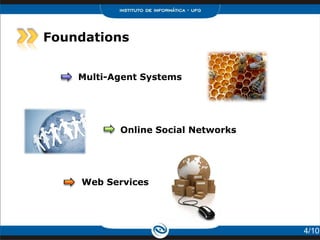
    Multi-Agent Systems


           Online Social Networks


    Web Services


                                    4/10
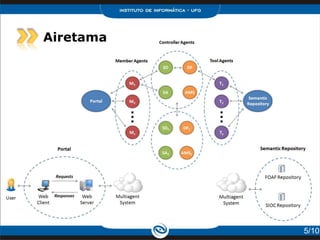
Airetama


           5/10
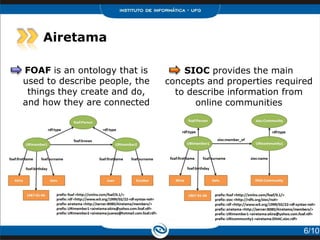
Airetama

FOAF is an ontology that is        SIOC provides the main
used to describe people, the   concepts and properties required
 things they create and do,      to describe information from
and how they are connected            online communities


                                                             6/10
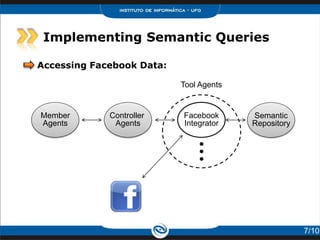
Implementing Semantic Queries

Accessing Facebook Data:

                           Tool Agents


Member       Controller    Facebook      Semantic
Agents        Agents       Integrator    Repository


                                                      7/10
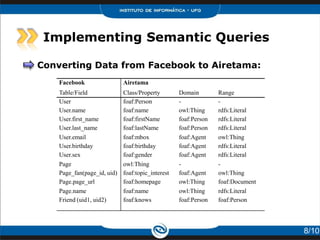
Implementing Semantic Queries

Converting Data from Facebook to Airetama:
    Facebook                 Airetama
    Table/Field              Class/Property        Domain        Range
    User                     foaf:Person           -             -
    User.name                foaf:name             owl:Thing     rdfs:Literal
    User.first_name          foaf:firstName        foaf:Person   rdfs:Literal
    User.last_name           foaf:lastName         foaf:Person   rdfs:Literal
    User.email               foaf:mbox             foaf:Agent    owl:Thing
    User.birthday            foaf:birthday         foaf:Agent    rdfs:Literal
    User.sex                 foaf:gender           foaf:Agent    rdfs:Literal
    Page                     owl:Thing             -             -
    Page_fan(page_id, uid)   foaf:topic_interest   foaf:Agent    owl:Thing
    Page.page_url            foaf:homepage         owl:Thing     foaf:Document
    Page.name                foaf:name             owl:Thing     rdfs:Literal
    Friend (uid1, uid2)      foaf:knows            foaf:Person   foaf:Person


                                                                                 8/10
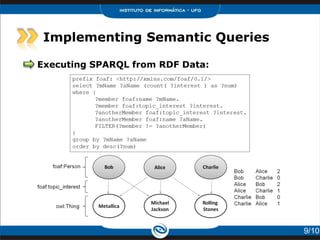
Implementing Semantic Queries

Executing SPARQL from RDF Data:


                                  9/10
Conclusions
The biggest advantage found in this work is the ability to
perform semantic queries on the pre-existing data from
social network users

Another contribution was the conversion of data from
Facebook users to triples in RDF

It was also relevant to show that it is possible to create
semantic-based social applications
Can be done an approach of potential relationships
among strangers and not just a search for people you know
in real life, as is done in most social networks online today
The inclusion of semantic in the current Web aims at
allowing agents software to use their pages more
intelligently, thus offering better services
                                                             10/10
Questions?


             THANKS!

Implementing Semantic Queries in Online Social Networks

  • 1.
    Rio de Janeiro,Brazil, 5-8 November 2011 IMPLEMENTING SEMANTIC QUERIES IN ONLINE SOCIAL NETWORKS Jair Abú Bechir Láscar Alarcón jairabu@gmail.com Otávio Calaça Xavier otaviocx@gmail.com Cedric Luiz de Carvalho cedric@inf.ufg.br
  • 2.
  • 3.
    Introduction The Web isa great technological achievement Access, extraction, interpretation and maintenance information is done manually Web Systems are often isolated applications. They are designed for human beings and are not suitable to be automatically accessed by software tools There is a need for software agents that help users in finding, processing and organizing this information 1/10
  • 4.
    Introduction This article presentsthe implementation of semantic queries in online social networks For this implementation we created a framework that uses Semantic Web to make relationships in such networks The experiment used in this article was to create a ranking of affinity between users based on common interests This work was done because of the clear need for more sophisticated queries, which would enable the computer to interpret these relationships semantically 2/10
  • 5.
    Foundations Web1.0: Internet + Hiperlinks Web 2.0: Collaborative Web Web 3.0: Semantic Web 3/10
  • 6.
    Foundations Multi-Agent Systems Online Social Networks Web Services 4/10
  • 7.
  • 8.
    Airetama FOAF is anontology that is SIOC provides the main used to describe people, the concepts and properties required things they create and do, to describe information from and how they are connected online communities 6/10
  • 9.
    Implementing Semantic Queries AccessingFacebook Data: Tool Agents Member Controller Facebook Semantic Agents Agents Integrator Repository 7/10
  • 10.
    Implementing Semantic Queries ConvertingData from Facebook to Airetama: Facebook Airetama Table/Field Class/Property Domain Range User foaf:Person - - User.name foaf:name owl:Thing rdfs:Literal User.first_name foaf:firstName foaf:Person rdfs:Literal User.last_name foaf:lastName foaf:Person rdfs:Literal User.email foaf:mbox foaf:Agent owl:Thing User.birthday foaf:birthday foaf:Agent rdfs:Literal User.sex foaf:gender foaf:Agent rdfs:Literal Page owl:Thing - - Page_fan(page_id, uid) foaf:topic_interest foaf:Agent owl:Thing Page.page_url foaf:homepage owl:Thing foaf:Document Page.name foaf:name owl:Thing rdfs:Literal Friend (uid1, uid2) foaf:knows foaf:Person foaf:Person 8/10
  • 11.
    Implementing Semantic Queries ExecutingSPARQL from RDF Data: 9/10
  • 12.
    Conclusions The biggest advantagefound in this work is the ability to perform semantic queries on the pre-existing data from social network users Another contribution was the conversion of data from Facebook users to triples in RDF It was also relevant to show that it is possible to create semantic-based social applications Can be done an approach of potential relationships among strangers and not just a search for people you know in real life, as is done in most social networks online today The inclusion of semantic in the current Web aims at allowing agents software to use their pages more intelligently, thus offering better services 10/10
  • 13.
    Questions? THANKS!