INTEGRATING DIGITAL
TRACES INTO A SEMANTIC-
ENRICHED DATA CLOUD
FOR INFORMAL LEARNING


Vania Dimitrova, Dhaval Thakker, Lydia Lau
Outline
   Motivation and bigger picture
   Aggregating Digital traces into Semantic-
    enriched data cloud
   Semantic Data Browser
   Exploratory Evaluation
   Conclusions
Motivation
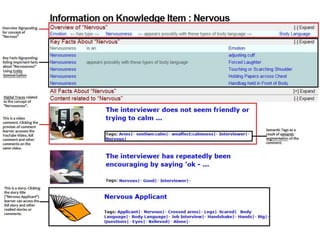
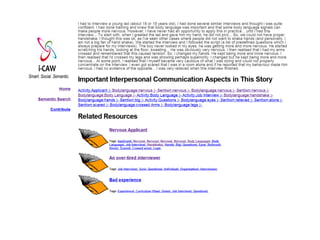
   Modern learning models require linking
    experience in training environments with
    experience in the real-world.
   Real-world experiences are hard to collect
   Social media brings new opportunities to
    tackle this challenge, supplying digital traces
   Exploiting social content as a source for
    experiential learning is being investigated in
    Immersive Reflective Experience based
    Adaptive Learning (ImREAL)

                         http://imreal-project.eu/
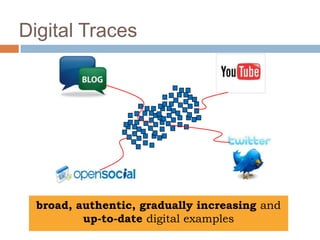
Digital Traces


  broad, authentic, gradually increasing and
          up-to-date digital examples
Ill-Defined domains
   Hard to specify and often require multiple
    interpretations and viewpoints.
   Soft skills –
    communicating, planning, managing, advising,
    negotiating.
   Highly demanded
   Modern informal learning environments for
    soft skills can exploit digital traces to provide
    learning situations linked to real world
    experience by peers (other learners) or tutors.
Role of Semantic Web
Technologies
   To realise this vision, novel architectures are
    needed which use: robust and cost-effective
    ways to
    retrieve, create, aggregate, organise, and
    exploit Digital Traces in learning situations; in
    other words, to tame Digital Traces for
    informal learning.
   By combining major advancements in
    semantic web : semantic
    augmentation, semantic
    query, relatedness, similarity, summarisatio
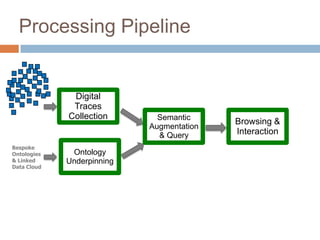
Processing Pipeline


              Digital
              Traces
             Collection       Semantic
                                           Browsing &
                            Augmentation
                              & Query      Interaction
Bespoke
Ontologies    Ontology
& Linked     Underpinning
Data Cloud
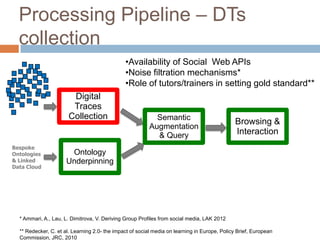
Processing Pipeline – DTs
  collection
                                               •Availability of Social Web APIs
                                               •Noise filtration mechanisms*
                                               •Role of tutors/trainers in setting gold standard**
                        Digital
                        Traces
                       Collection                          Semantic
                                                                                              Browsing &
                                                         Augmentation
                                                           & Query                            Interaction
Bespoke
Ontologies             Ontology
& Linked              Underpinning
Data Cloud


  * Ammari, A., Lau, L. Dimitrova, V. Deriving Group Profiles from social media, LAK 2012

  ** Redecker, C. et al. Learning 2.0- the impact of social media on learning in Europe, Policy Brief, European
  Commission, JRC, 2010
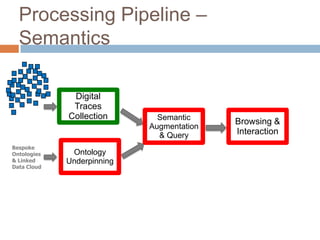
Processing Pipeline –
  Semantics

              Digital
              Traces
             Collection       Semantic
                                           Browsing &
                            Augmentation
                              & Query      Interaction
Bespoke
Ontologies    Ontology
& Linked     Underpinning
Data Cloud
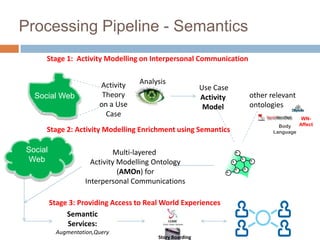
Processing Pipeline - Semantics
     Stage 1: Activity Modelling on Interpersonal Communication


                         Activity   Analysis
                                                          Use Case
  Social Web              Theory                          Activity     other relevant
                         on a Use                          Model       ontologies
                           Case                                                              WN-
                                                                                   Body     Affect
     Stage 2: Activity Modelling Enrichment using Semantics                      Language


Social                        Multi-layered
 Web                  Activity Modelling Ontology
                               (AMOn) for
                    Interpersonal Communications              Logical Encoding

         Stage 3: Providing Access to Real World Experiences
              Semantic
              Services:
           Augmentation,Query
                                         Story Boarding
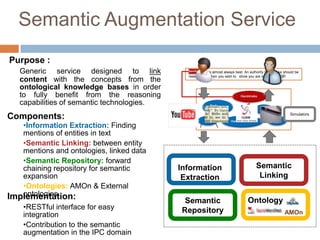
Semantic Augmentation Service
Purpose :
   Generic service designed to link                        is almost always best. An authority handshake should be
                                              reserved for when you wish to show you are in charge.
   content with the concepts from the
   ontological knowledge bases in order
   to fully benefit from the reasoning
   capabilities of semantic technologies.
Components:                                                                                                 Simulators


   •Information Extraction: Finding
   mentions of entities in text
   •Semantic Linking: between entity
   mentions and ontologies, linked data
   •Semantic Repository: forward
   chaining repository for semantic         Information                                Semantic
   expansion                                 Extraction                                 Linking
   •Ontologies: AMOn & External
   ontologies
Implementation:                              Semantic                             Ontology
    •RESTful interface for easy             Repository
    integration                                                                                          AMOn

    •Contribution to the semantic
    augmentation in the IPC domain
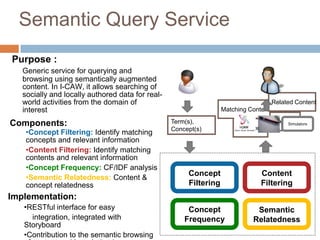
Semantic Query Service
Purpose :
   Generic service for querying and
   browsing using semantically augmented
   content. In I-CAW, it allows searching of
   socially and locally authored data for real-
   world activities from the domain of                                                Related Content
   interest                                                        Matching Content

Components:                                       Term(s),                         Browsing
                                                                                         Simulators
                                                  Concept(s)           Tag Cloud
    •Concept Filtering: Identify matching
    concepts and relevant information
    •Content Filtering: Identify matching
    contents and relevant information
    •Concept Frequency: CF/IDF analysis
                                                       Concept                  Content
    •Semantic Relatedness: Content &
    concept relatedness                                Filtering                Filtering
Implementation:
   •RESTful interface for easy                         Concept                Semantic
     integration, integrated with                     Frequency              Relatedness
   Storyboard
   •Contribution to the semantic browsing
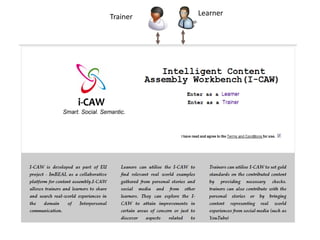
Trainer   Learner
Exploratory Study
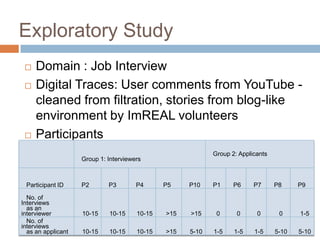
    Domain : Job Interview
    Digital Traces: User comments from YouTube -
     cleaned from filtration, stories from blog-like
     environment by ImREAL volunteers
    Participants
                                                            Group 2: Applicants
                    Group 1: Interviewers


 Participant ID     P2       P3        P4      P5    P10    P1     P6     P7      P8     P9

  No. of
Interviews
  as an
interviewer         10-15    10-15     10-15   >15   >15     0      0      0       0     1-5
  No. of
interviews
  as an applicant   10-15    10-15     10-15   >15   5-10   1-5    1-5    1-5     5-10   5-10
Exploratory Study: Good things about
DTs
   Participants particularly liked the authenticity
    of the content:
“Examples are the beauty of system – I will learn from examples [p10]”
“Anything that facilitates the preparation of training material and provides real
   world examples to backup training is very helpful [p5]”
   Which probed them to:
     Further  reflect on their experiences, and in some
      cases help articulate what they had been doing
      intuitively
     Provide their viewpoints (due to culture,
      environment, tacit knowledge) – acted as stimuli
     Sense the diversity or consensus on the selected
      topic
Exploratory Study: Issues with
DTs
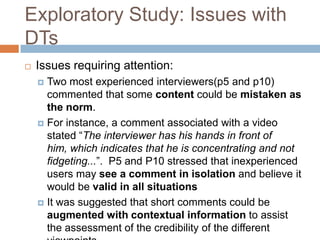
   Issues requiring attention:
     Two most experienced interviewers(p5 and p10)
      commented that some content could be mistaken as
      the norm.
     For instance, a comment associated with a video
      stated “The interviewer has his hands in front of
      him, which indicates that he is concentrating and not
      fidgeting...”. P5 and P10 stressed that inexperienced
      users may see a comment in isolation and believe it
      would be valid in all situations
     It was suggested that short comments could be
      augmented with contextual information to assist
      the assessment of the credibility of the different
Conclusions
   Social spaces bring new opportunities , i.e. as
    a source of diverse range of real-world
    experiences.
           signs are encouraging – digital traces as a
     Initial
     source of authentic examples and stimuli
     Further work is needed to capitalise on new
     opportunities brought by social content
   Semantics technologies provide apparatus for
    taming digital traces
     Further  work is needed to turn semantic browsing
      into informal learning.
Thank You!

D.Thakker@leeds.ac.uk
http://www.imreal-project.eu/

Integrating digital traces into a semantic enriched data

  • 1.
    INTEGRATING DIGITAL TRACES INTOA SEMANTIC- ENRICHED DATA CLOUD FOR INFORMAL LEARNING Vania Dimitrova, Dhaval Thakker, Lydia Lau
  • 2.
    Outline  Motivation and bigger picture  Aggregating Digital traces into Semantic- enriched data cloud  Semantic Data Browser  Exploratory Evaluation  Conclusions
  • 3.
    Motivation  Modern learning models require linking experience in training environments with experience in the real-world.  Real-world experiences are hard to collect  Social media brings new opportunities to tackle this challenge, supplying digital traces  Exploiting social content as a source for experiential learning is being investigated in Immersive Reflective Experience based Adaptive Learning (ImREAL) http://imreal-project.eu/
  • 4.
    Digital Traces broad, authentic, gradually increasing and up-to-date digital examples
  • 5.
    Ill-Defined domains  Hard to specify and often require multiple interpretations and viewpoints.  Soft skills – communicating, planning, managing, advising, negotiating.  Highly demanded  Modern informal learning environments for soft skills can exploit digital traces to provide learning situations linked to real world experience by peers (other learners) or tutors.
  • 6.
    Role of SemanticWeb Technologies  To realise this vision, novel architectures are needed which use: robust and cost-effective ways to retrieve, create, aggregate, organise, and exploit Digital Traces in learning situations; in other words, to tame Digital Traces for informal learning.  By combining major advancements in semantic web : semantic augmentation, semantic query, relatedness, similarity, summarisatio
  • 7.
    Processing Pipeline Digital Traces Collection Semantic Browsing & Augmentation & Query Interaction Bespoke Ontologies Ontology & Linked Underpinning Data Cloud
  • 8.
    Processing Pipeline –DTs collection •Availability of Social Web APIs •Noise filtration mechanisms* •Role of tutors/trainers in setting gold standard** Digital Traces Collection Semantic Browsing & Augmentation & Query Interaction Bespoke Ontologies Ontology & Linked Underpinning Data Cloud * Ammari, A., Lau, L. Dimitrova, V. Deriving Group Profiles from social media, LAK 2012 ** Redecker, C. et al. Learning 2.0- the impact of social media on learning in Europe, Policy Brief, European Commission, JRC, 2010
  • 9.
    Processing Pipeline – Semantics Digital Traces Collection Semantic Browsing & Augmentation & Query Interaction Bespoke Ontologies Ontology & Linked Underpinning Data Cloud
  • 10.
    Processing Pipeline -Semantics Stage 1: Activity Modelling on Interpersonal Communication Activity Analysis Use Case Social Web Theory Activity other relevant on a Use Model ontologies Case WN- Body Affect Stage 2: Activity Modelling Enrichment using Semantics Language Social Multi-layered Web Activity Modelling Ontology (AMOn) for Interpersonal Communications Logical Encoding Stage 3: Providing Access to Real World Experiences Semantic Services: Augmentation,Query Story Boarding
  • 11.
    Semantic Augmentation Service Purpose: Generic service designed to link is almost always best. An authority handshake should be reserved for when you wish to show you are in charge. content with the concepts from the ontological knowledge bases in order to fully benefit from the reasoning capabilities of semantic technologies. Components: Simulators •Information Extraction: Finding mentions of entities in text •Semantic Linking: between entity mentions and ontologies, linked data •Semantic Repository: forward chaining repository for semantic Information Semantic expansion Extraction Linking •Ontologies: AMOn & External ontologies Implementation: Semantic Ontology •RESTful interface for easy Repository integration AMOn •Contribution to the semantic augmentation in the IPC domain
  • 12.
    Semantic Query Service Purpose: Generic service for querying and browsing using semantically augmented content. In I-CAW, it allows searching of socially and locally authored data for real- world activities from the domain of Related Content interest Matching Content Components: Term(s), Browsing Simulators Concept(s) Tag Cloud •Concept Filtering: Identify matching concepts and relevant information •Content Filtering: Identify matching contents and relevant information •Concept Frequency: CF/IDF analysis Concept Content •Semantic Relatedness: Content & concept relatedness Filtering Filtering Implementation: •RESTful interface for easy Concept Semantic integration, integrated with Frequency Relatedness Storyboard •Contribution to the semantic browsing
  • 13.
    Trainer Learner
  • 16.
    Exploratory Study  Domain : Job Interview  Digital Traces: User comments from YouTube - cleaned from filtration, stories from blog-like environment by ImREAL volunteers  Participants Group 2: Applicants Group 1: Interviewers Participant ID P2 P3 P4 P5 P10 P1 P6 P7 P8 P9 No. of Interviews as an interviewer 10-15 10-15 10-15 >15 >15 0 0 0 0 1-5 No. of interviews as an applicant 10-15 10-15 10-15 >15 5-10 1-5 1-5 1-5 5-10 5-10
  • 17.
    Exploratory Study: Goodthings about DTs  Participants particularly liked the authenticity of the content: “Examples are the beauty of system – I will learn from examples [p10]” “Anything that facilitates the preparation of training material and provides real world examples to backup training is very helpful [p5]”  Which probed them to:  Further reflect on their experiences, and in some cases help articulate what they had been doing intuitively  Provide their viewpoints (due to culture, environment, tacit knowledge) – acted as stimuli  Sense the diversity or consensus on the selected topic
  • 18.
    Exploratory Study: Issueswith DTs  Issues requiring attention:  Two most experienced interviewers(p5 and p10) commented that some content could be mistaken as the norm.  For instance, a comment associated with a video stated “The interviewer has his hands in front of him, which indicates that he is concentrating and not fidgeting...”. P5 and P10 stressed that inexperienced users may see a comment in isolation and believe it would be valid in all situations  It was suggested that short comments could be augmented with contextual information to assist the assessment of the credibility of the different
  • 19.
    Conclusions  Social spaces bring new opportunities , i.e. as a source of diverse range of real-world experiences. signs are encouraging – digital traces as a  Initial source of authentic examples and stimuli  Further work is needed to capitalise on new opportunities brought by social content  Semantics technologies provide apparatus for taming digital traces  Further work is needed to turn semantic browsing into informal learning.
  • 20.

Editor's Notes