Tseliou Styliani, Andreadis Ioannis
Aristotle University of Thessaloniki
DATIS Conference
24th -25th August 2025
Aristotle University of Thessaloniki
A Study of Political and
Demographic Influences on
Attitudes Toward
Immigrants
Outline
 DATIS & ISSP 2023
 Theoretical Framework
 National Identity issues
 Greece – Contextual Factors
 Research Hypothesis
 Data analysis
 Results
 Conclusion
 Next Steps
2
DATIS and ISSP 2023
 Data for Inclusive Societies (DATIS)
 Exploring Enemies and Supporters of Inclusive
Societies: Theoretical and Empirical Insights
 The International Social Survey Programme (ISSP)
 Since 1985 (if a topic is still the most relevant, it is
repeated every 10 years)
 ISSP 2023 items used to study attitudes toward
immigrants.
3
Theoretical Framework
• One of the greatest challenges that modern nations face is
preserving their national identity in a world dominated by
globalization (Norris & Inglehart, 2009).
• This Rising globalization produces a “globalization cleavage”
(Kriesi et al., 2008; Azmanova, 2011).
• Divides citizens into:
• Those favoring national closure & immigration
restrictions.
• Those favoring transnational integration & openness.
• National identity is multidimensional, encompassing both
affective attachment (nationalism and patriotism) and
definitional boundaries of the national community (Raijman &
Hochman, 2011).
4
Greece – Contextual Factors
• Historical Shift:
• 1990s: Emigration → Immigration country
• Migration Flows:
• Balkans, Asia, Africa → Rising immigrant population
(Kotzamanis & Karkanis, 2018)
• Key Event:
• 2015 Migration Crisis + Economic Crisis
• Current Challenges:
• Social cohesion
• Inclusion of immigrants (Carastathis et al., 2018)
5
Research Hypothesis
 Individuals’ attitudes toward immigrants, are influenced
by both demographic characteristics (age, gender,
education, residence) and social-political orientations
(religiosity, political self-placement on the left–right
spectrum), with social-political orientations expected to
have a stronger and more consistent effect.
6
● Mixed method: Web Survey & Phone Interviews
● Online questionnaire (LimeSurvey)
● Invitations via Text Messages
● Method similar to Random Digit Dialing (RDD)
(Andreadis, 2020,2022)
The survey
7
Creating the Immigrant Attitudes
Index
• Factor Analysis: Examined survey items to
identify underlying factors.
• Item Combination: Merged positively and
negatively worded items into a single
composite index.
• Method: Principal Axis Factoring with Varimax
rotation.
• Reliability Check: Cronbach’s alpha tested for
internal consistency.
• Purpose: Capture respondents’ overall
attitudes toward immigrants.
8
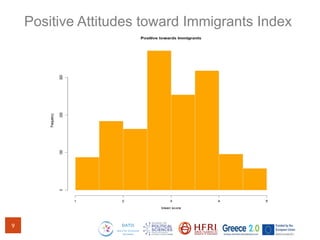
Positive Attitudes toward Immigrants Index
9
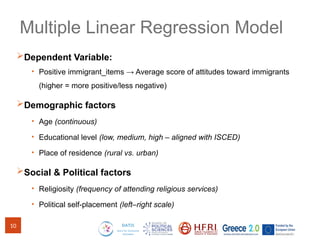
Multiple Linear Regression Model
Dependent Variable:
• Positive immigrant_items → Average score of attitudes toward immigrants
(higher = more positive/less negative)
Demographic factors
• Age (continuous)
• Educational level (low, medium, high – aligned with ISCED)
• Place of residence (rural vs. urban)
Social & Political factors
• Religiosity (frequency of attending religious services)
• Political self-placement (left–right scale)
10
11
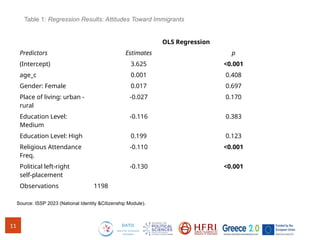
OLS Regression
Predictors Estimates p
(Intercept) 3.625 <0.001
age_c 0.001 0.408
Gender: Female 0.017 0.697
Place of living: urban -
rural
-0.027 0.170
Education Level:
Medium
-0.116 0.383
Education Level: High 0.199 0.123
Religious Attendance
Freq.
-0.110 <0.001
Political left-right
self-placement
-0.130 <0.001
Observations 1198
Table 1: Regression Results: Attitudes Toward Immigrants
Source: ISSP 2023 (National Identity &Citizenship Module).
12
Results
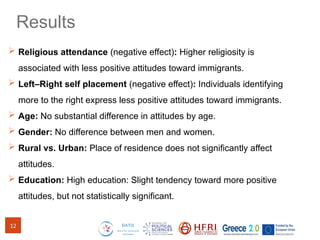
 Religious attendance (negative effect): Higher religiosity is
associated with less positive attitudes toward immigrants.
 Left–Right self placement (negative effect): Individuals identifying
more to the right express less positive attitudes toward immigrants.
 Age: No substantial difference in attitudes by age.
 Gender: No difference between men and women.
 Rural vs. Urban: Place of residence does not significantly affect
attitudes.
 Education: High education: Slight tendency toward more positive
attitudes, but not statistically significant.
Conclusions
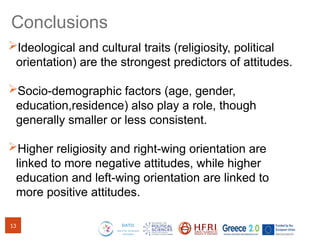
Ideological and cultural traits (religiosity, political
orientation) are the strongest predictors of attitudes.
Socio-demographic factors (age, gender,
education,residence) also play a role, though
generally smaller or less consistent.
Higher religiosity and right-wing orientation are
linked to more negative attitudes, while higher
education and left-wing orientation are linked to
more positive attitudes.
13
Future Research Directions
14
 Explore additional determinants that affect
immigration perceptions.
 Use ISSP data from multiple countries to
capture variation in immigration attitudes
across contexts.
 Combine ISSP waves to trace how national
identity and citizenship attitudes evolve over
time.
Bibliography
• Andreadis, I. (2020). Text Message (SMS) Pre-notifications, Invitations and Reminders for Web
Surveys. Survey Methods: Insights from the Field (SMIF). https://doi.org/10.13094/SMIF-2020-00019
• Andreadis, I. (2022). Proceedings of the DataPopEU Conference (2022): Populism and
Euroscepticism in Perspective. In Survey Data Collection and Data Quality.
• Azmanova, A. (2011). After the left–right (dis) continuum: globalization and the remaking of Europe's
ideological geography. International Political Sociology, 5(4), 384-407.
• Carastathis, A., Spathopoulou, A., & Tsilimpounidi, M. (2018). Crisis, What Crisis? Immigrants,
Refugees, and Invisible Struggles. Refuge: Canada’s Journal on Refugees / Refuge : Revue
Canadienne Sur Les Réfugiés, 34(1).
• Norris, P., & Inglehart, R. (2009). Cosmopolitan Communications: Cultural Diversity in a Globalized
World. Cambridge University Press.
• Kriesi, H., Grande, E., Lachat, R., Dolezal, M., Bornschier, S., & Frey, T. (2008). West European
politics in the age of globalization (Vol. 10). Cambridge: Cambridge University Press.
• Raijman, R., & Hochman, O. (2011). National attachments, economic competition, and social
exclusion of non-ethnic migrants in Israel: A mixed-methods approach. Quality & Quantity, 45(6),
1151-1174.
Thank you! Questions? Comments?
Twitter/X: @Datis_project
Datis Project: https://datis.gr/
Facebook/ Instagram: DATIS
DATIS project is carried out within the framework of the
National Recovery and Resilience Plan Greece 2.0, funded by
the European Union – NextGenerationEU (Implementation
body: HFRI).
16

Presentation DATIS 2025-Andreadis,Tseliou.pptx

  • 1.
    Tseliou Styliani, AndreadisIoannis Aristotle University of Thessaloniki DATIS Conference 24th -25th August 2025 Aristotle University of Thessaloniki A Study of Political and Demographic Influences on Attitudes Toward Immigrants
  • 2.
    Outline  DATIS &ISSP 2023  Theoretical Framework  National Identity issues  Greece – Contextual Factors  Research Hypothesis  Data analysis  Results  Conclusion  Next Steps 2
  • 3.
    DATIS and ISSP2023  Data for Inclusive Societies (DATIS)  Exploring Enemies and Supporters of Inclusive Societies: Theoretical and Empirical Insights  The International Social Survey Programme (ISSP)  Since 1985 (if a topic is still the most relevant, it is repeated every 10 years)  ISSP 2023 items used to study attitudes toward immigrants. 3
  • 4.
    Theoretical Framework • Oneof the greatest challenges that modern nations face is preserving their national identity in a world dominated by globalization (Norris & Inglehart, 2009). • This Rising globalization produces a “globalization cleavage” (Kriesi et al., 2008; Azmanova, 2011). • Divides citizens into: • Those favoring national closure & immigration restrictions. • Those favoring transnational integration & openness. • National identity is multidimensional, encompassing both affective attachment (nationalism and patriotism) and definitional boundaries of the national community (Raijman & Hochman, 2011). 4
  • 5.
    Greece – ContextualFactors • Historical Shift: • 1990s: Emigration → Immigration country • Migration Flows: • Balkans, Asia, Africa → Rising immigrant population (Kotzamanis & Karkanis, 2018) • Key Event: • 2015 Migration Crisis + Economic Crisis • Current Challenges: • Social cohesion • Inclusion of immigrants (Carastathis et al., 2018) 5
  • 6.
    Research Hypothesis  Individuals’attitudes toward immigrants, are influenced by both demographic characteristics (age, gender, education, residence) and social-political orientations (religiosity, political self-placement on the left–right spectrum), with social-political orientations expected to have a stronger and more consistent effect. 6
  • 7.
    ● Mixed method:Web Survey & Phone Interviews ● Online questionnaire (LimeSurvey) ● Invitations via Text Messages ● Method similar to Random Digit Dialing (RDD) (Andreadis, 2020,2022) The survey 7
  • 8.
    Creating the ImmigrantAttitudes Index • Factor Analysis: Examined survey items to identify underlying factors. • Item Combination: Merged positively and negatively worded items into a single composite index. • Method: Principal Axis Factoring with Varimax rotation. • Reliability Check: Cronbach’s alpha tested for internal consistency. • Purpose: Capture respondents’ overall attitudes toward immigrants. 8
  • 9.
    Positive Attitudes towardImmigrants Index 9
  • 10.
    Multiple Linear RegressionModel Dependent Variable: • Positive immigrant_items → Average score of attitudes toward immigrants (higher = more positive/less negative) Demographic factors • Age (continuous) • Educational level (low, medium, high – aligned with ISCED) • Place of residence (rural vs. urban) Social & Political factors • Religiosity (frequency of attending religious services) • Political self-placement (left–right scale) 10
  • 11.
    11 OLS Regression Predictors Estimatesp (Intercept) 3.625 <0.001 age_c 0.001 0.408 Gender: Female 0.017 0.697 Place of living: urban - rural -0.027 0.170 Education Level: Medium -0.116 0.383 Education Level: High 0.199 0.123 Religious Attendance Freq. -0.110 <0.001 Political left-right self-placement -0.130 <0.001 Observations 1198 Table 1: Regression Results: Attitudes Toward Immigrants Source: ISSP 2023 (National Identity &Citizenship Module).
  • 12.
    12 Results  Religious attendance(negative effect): Higher religiosity is associated with less positive attitudes toward immigrants.  Left–Right self placement (negative effect): Individuals identifying more to the right express less positive attitudes toward immigrants.  Age: No substantial difference in attitudes by age.  Gender: No difference between men and women.  Rural vs. Urban: Place of residence does not significantly affect attitudes.  Education: High education: Slight tendency toward more positive attitudes, but not statistically significant.
  • 13.
    Conclusions Ideological and culturaltraits (religiosity, political orientation) are the strongest predictors of attitudes. Socio-demographic factors (age, gender, education,residence) also play a role, though generally smaller or less consistent. Higher religiosity and right-wing orientation are linked to more negative attitudes, while higher education and left-wing orientation are linked to more positive attitudes. 13
  • 14.
    Future Research Directions 14 Explore additional determinants that affect immigration perceptions.  Use ISSP data from multiple countries to capture variation in immigration attitudes across contexts.  Combine ISSP waves to trace how national identity and citizenship attitudes evolve over time.
  • 15.
    Bibliography • Andreadis, I.(2020). Text Message (SMS) Pre-notifications, Invitations and Reminders for Web Surveys. Survey Methods: Insights from the Field (SMIF). https://doi.org/10.13094/SMIF-2020-00019 • Andreadis, I. (2022). Proceedings of the DataPopEU Conference (2022): Populism and Euroscepticism in Perspective. In Survey Data Collection and Data Quality. • Azmanova, A. (2011). After the left–right (dis) continuum: globalization and the remaking of Europe's ideological geography. International Political Sociology, 5(4), 384-407. • Carastathis, A., Spathopoulou, A., & Tsilimpounidi, M. (2018). Crisis, What Crisis? Immigrants, Refugees, and Invisible Struggles. Refuge: Canada’s Journal on Refugees / Refuge : Revue Canadienne Sur Les Réfugiés, 34(1). • Norris, P., & Inglehart, R. (2009). Cosmopolitan Communications: Cultural Diversity in a Globalized World. Cambridge University Press. • Kriesi, H., Grande, E., Lachat, R., Dolezal, M., Bornschier, S., & Frey, T. (2008). West European politics in the age of globalization (Vol. 10). Cambridge: Cambridge University Press. • Raijman, R., & Hochman, O. (2011). National attachments, economic competition, and social exclusion of non-ethnic migrants in Israel: A mixed-methods approach. Quality & Quantity, 45(6), 1151-1174.
  • 16.
    Thank you! Questions?Comments? Twitter/X: @Datis_project Datis Project: https://datis.gr/ Facebook/ Instagram: DATIS DATIS project is carried out within the framework of the National Recovery and Resilience Plan Greece 2.0, funded by the European Union – NextGenerationEU (Implementation body: HFRI). 16