GROUPS :
 HAZIYAH BINTI ABDUL GHANI
      AMINAH BINTI OMAR
     AZIRAH BINTI TAWANG
    UMMI AMIRA BINTI ALIAS
SITI NUR HALINI BINTI MANSOR
  NUR AIDA BINTI MOHD NIN
       NADIA BINTI MUSLY
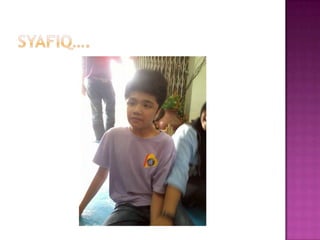
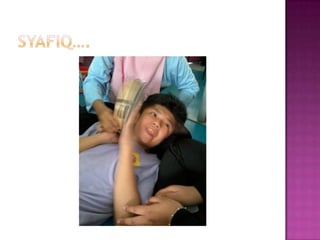
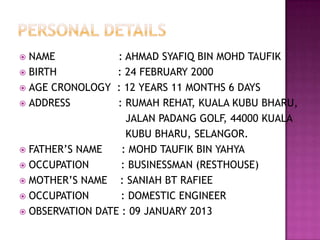
 NAME            : AHMAD SYAFIQ BIN MOHD TAUFIK
 BIRTH           : 24 FEBRUARY 2000
 AGE CRONOLOGY   : 12 YEARS 11 MONTHS 6 DAYS
 ADDRESS         : RUMAH REHAT, KUALA KUBU BHARU,
                    JALAN PADANG GOLF, 44000 KUALA
                    KUBU BHARU, SELANGOR.
 FATHER‟S NAME    : MOHD TAUFIK BIN YAHYA
 OCCUPATION       : BUSINESSMAN (RESTHOUSE)
 MOTHER‟S NAME    : SANIAH BT RAFIEE
 OCCUPATION       : DOMESTIC ENGINEER
 OBSERVATION DATE : 09 JANUARY 2013
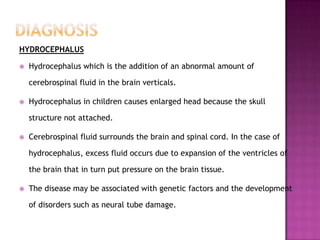
HYDROCEPHALUS

   Hydrocephalus which is the addition of an abnormal amount of

    cerebrospinal fluid in the brain verticals.

   Hydrocephalus in children causes enlarged head because the skull

    structure not attached.

   Cerebrospinal fluid surrounds the brain and spinal cord. In the case of

    hydrocephalus, excess fluid occurs due to expansion of the ventricles of

    the brain that in turn put pressure on the brain tissue.

   The disease may be associated with genetic factors and the development

    of disorders such as neural tube damage.
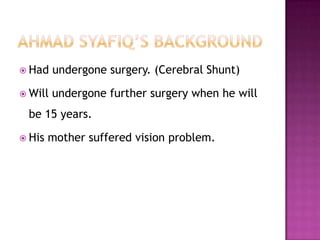
 Had    undergone surgery. (Cerebral Shunt)

 Will   undergone further surgery when he will
 be 15 years.

 His   mother suffered vision problem.
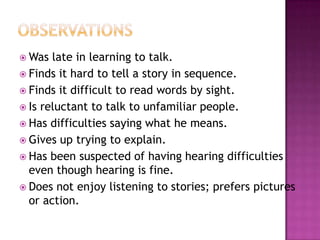
 Was  late in learning to talk.
 Finds it hard to tell a story in sequence.
 Finds it difficult to read words by sight.
 Is reluctant to talk to unfamiliar people.
 Has difficulties saying what he means.
 Gives up trying to explain.
 Has been suspected of having hearing difficulties
  even though hearing is fine.
 Does not enjoy listening to stories; prefers pictures
  or action.
 Seems   to be in a world of his own a lot of the
  time.
 Often does the wrong thing when instruction
  are given.
 Gets tired and „tunes out‟ if listening for a
  long time.
 Does not use facial expression or eye contact
  appropriately.
 Gets frustrated and upset when cannot make
  self understood.
 When upset or in trouble, cannot explain
  what is wrong.
 Is easily distracted by noises.
 Able
     to walk slowly. (his feets close like a
 mermaid tail)
 Able   creasing tissue or paper.
 Able   to play music.
 Able   to arrange wooden blocks.
 Ableto listen a simple order and only in
 English. Eg : “Give Me Five!” , “Clap Your
 Hand!”.
 Has   needed speech therapy.

 Create   variety types of activity.

 Plan   activities involving music.

 Duration   for an activity is short.

 Extra   monitoring should be given.

 Eg: Toilet Trained.
Presentation checklist

Presentation checklist

  • 1.
    GROUPS : HAZIYAHBINTI ABDUL GHANI AMINAH BINTI OMAR AZIRAH BINTI TAWANG UMMI AMIRA BINTI ALIAS SITI NUR HALINI BINTI MANSOR NUR AIDA BINTI MOHD NIN NADIA BINTI MUSLY
  • 4.
     NAME : AHMAD SYAFIQ BIN MOHD TAUFIK  BIRTH : 24 FEBRUARY 2000  AGE CRONOLOGY : 12 YEARS 11 MONTHS 6 DAYS  ADDRESS : RUMAH REHAT, KUALA KUBU BHARU, JALAN PADANG GOLF, 44000 KUALA KUBU BHARU, SELANGOR.  FATHER‟S NAME : MOHD TAUFIK BIN YAHYA  OCCUPATION : BUSINESSMAN (RESTHOUSE)  MOTHER‟S NAME : SANIAH BT RAFIEE  OCCUPATION : DOMESTIC ENGINEER  OBSERVATION DATE : 09 JANUARY 2013
  • 5.
    HYDROCEPHALUS  Hydrocephalus which is the addition of an abnormal amount of cerebrospinal fluid in the brain verticals.  Hydrocephalus in children causes enlarged head because the skull structure not attached.  Cerebrospinal fluid surrounds the brain and spinal cord. In the case of hydrocephalus, excess fluid occurs due to expansion of the ventricles of the brain that in turn put pressure on the brain tissue.  The disease may be associated with genetic factors and the development of disorders such as neural tube damage.
  • 6.
     Had undergone surgery. (Cerebral Shunt)  Will undergone further surgery when he will be 15 years.  His mother suffered vision problem.
  • 7.
     Was late in learning to talk.  Finds it hard to tell a story in sequence.  Finds it difficult to read words by sight.  Is reluctant to talk to unfamiliar people.  Has difficulties saying what he means.  Gives up trying to explain.  Has been suspected of having hearing difficulties even though hearing is fine.  Does not enjoy listening to stories; prefers pictures or action.
  • 8.
     Seems to be in a world of his own a lot of the time.  Often does the wrong thing when instruction are given.  Gets tired and „tunes out‟ if listening for a long time.  Does not use facial expression or eye contact appropriately.  Gets frustrated and upset when cannot make self understood.  When upset or in trouble, cannot explain what is wrong.  Is easily distracted by noises.
  • 9.
     Able to walk slowly. (his feets close like a mermaid tail)  Able creasing tissue or paper.  Able to play music.  Able to arrange wooden blocks.  Ableto listen a simple order and only in English. Eg : “Give Me Five!” , “Clap Your Hand!”.
  • 10.
     Has needed speech therapy.  Create variety types of activity.  Plan activities involving music.  Duration for an activity is short.  Extra monitoring should be given. Eg: Toilet Trained.