ITS not magic, just
some data,
calculations and math
: )
Prepared and presented by : Khansa baig
and Siraj ud-din
3.
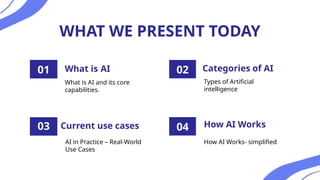
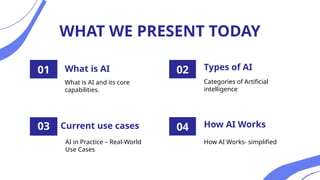
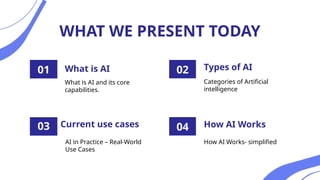
WHAT WE PRESENTTODAY
What is AI and its core
capabilities.
What is AI
01
Categories of Artificial
intelligence
Types of AI
02
How AI Works- simplified
How AI Works
04
AI in Practice – Real-World
Use Cases
Current use cases
03
4.
What is AI?
AI is not replacing humans, but redefining
what it means to be human in the workplace
01
5.
Artificial Intelligence (AI)is the branch of computer science focused on building
systems capable of performing tasks that typically require . These
tasks include reasoning, learning from experience, understanding language,
recognizing patterns, making decisions, and adapting to new information.
Its Core Capabilities are:
• Learning from data
• Pattern recognition
• Language processing and decision making
In short, AI enables machines to perceive, reason, learn, and act.
What is AI ?
Human
intelligence
6.
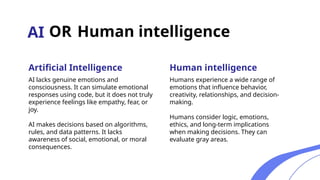
AI lacks genuineemotions and
consciousness. It can simulate emotional
responses using code, but it does not truly
experience feelings like empathy, fear, or
joy.
AI makes decisions based on algorithms,
rules, and data patterns. It lacks
awareness of social, emotional, or moral
consequences.
Humans experience a wide range of
emotions that influence behavior,
creativity, relationships, and decision-
making.
Humans consider logic, emotions,
ethics, and long-term implications
when making decisions. They can
evaluate gray areas.
Artificial Intelligence Human intelligence
Human intelligence
OR
AI
7.
WHAT WE PRESENTTODAY
What is AI and its core
capabilities.
What is
01
Types of Artificial
intelligence
Categories of AI
02
How AI Works- simplified
How AI Works
04
AI in Practice – Real-World
Use Cases
Current use cases
03
AI
8.
Categories of AI
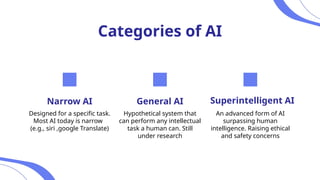
Designedfor a specific task.
Most AI today is narrow
(e.g., siri ,google Translate)
Hypothetical system that
can perform any intellectual
task a human can. Still
under research
Narrow AI General AI
An advanced form of AI
surpassing human
intelligence. Raising ethical
and safety concerns
Superintelligent AI
9.
Narrow AI
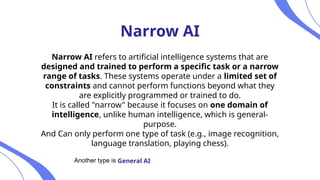
Narrow AIrefers to artificial intelligence systems that are
designed and trained to perform a specific task or a narrow
range of tasks. These systems operate under a limited set of
constraints and cannot perform functions beyond what they
are explicitly programmed or trained to do.
It is called "narrow" because it focuses on one domain of
intelligence, unlike human intelligence, which is general-
purpose.
And Can only perform one type of task (e.g., image recognition,
language translation, playing chess).
Another type is General AI
10.
General AI
General AIrefers to an advanced form of artificial intelligence that can
perform any intellectual task that a human can do. Unlike Narrow AI,
which is limited to specific tasks, General AI has the ability to learn,
understand, and reason across a wide range of domains, just like a
human being.
General AI is still theoretical — it does not exist yet, but it is a major goal of
AI research.
Capable of logical reasoning, abstract thinking, moral judgment, and ethical
decisions.
May be able to understand and respond to human emotions appropriately
(though not truly experience them).
Last but no the least is Superintelligent AI
11.
Superintelligent AI refersto a hypothetical
future AI that surpasses the intelligence,
problem-solving ability, creativity, and decision-
making skills of the most capable human minds
in virtually every field.
It would outperform humans in:
•Scientific reasoning
•Emotional intelligence
•Strategic thinking
•Creativity and innovation
•Social skills and manipulation
Superintelligence is not yet real — it is a concept
explored in AI research, ethics, and philosophy
as a potential future stage of AI development and
most powerful in .
Superintelligent AI
Types of AI
12.
WHAT WE PRESENTTODAY
What is AI and its core
capabilities.
What is AI
01
Categories of Artificial
intelligence
02
How AI Works- simplified
How AI Works
04
AI in Practice – Real-World
Use Cases
Current use cases
03
Types of AI
13.
Current use cases
AI
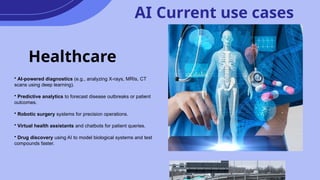
Healthcare
•AI-powered diagnostics (e.g., analyzing X-rays, MRIs, CT
scans using deep learning).
• Predictive analytics to forecast disease outbreaks or patient
outcomes.
• Robotic surgery systems for precision operations.
• Virtual health assistants and chatbots for patient queries.
• Drug discovery using AI to model biological systems and test
compounds faster.
14.
Transportation
and Automotive
• Self-drivingvehicles (autonomous navigation,
lane detection, object recognition)
• Traffic prediction and route optimization using
AI (Google Maps, Waze)
• Fleet management systems in logistics
companies
15.
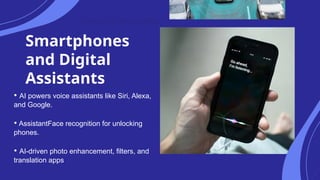
Smartphones
and Digital
Assistants
• AIpowers voice assistants like Siri, Alexa,
and Google.
• AssistantFace recognition for unlocking
phones.
• AI-driven photo enhancement, filters, and
translation apps
Current use cases
16.
WHAT WE PRESENTTODAY
What is AI and its core
capabilities.
What is AI
01
Categories of Artificial
intelligence
02
How AI Works- simplified
How AI Works
04
AI in Practice – Real-World
Use Cases
03
Types of AI
Current use cases
17.
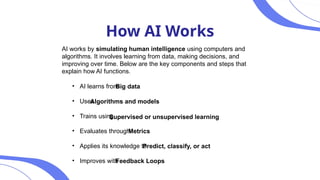
How AI Works
•AI learns from
• Uses
• Trains using
• Evaluates through
• Applies its knowledge to
• Improves with
AI works by simulating human intelligence using computers and
algorithms. It involves learning from data, making decisions, and
improving over time. Below are the key components and steps that
explain how AI functions.
Big data
Algorithms and models
Metrics
Predict, classify, or act
Feedback Loops
Supervised or unsupervised learning
18.
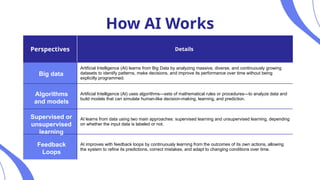
How AI Works
PerspectivesDetails
Artificial Intelligence (AI) learns from Big Data by analyzing massive, diverse, and continuously growing
datasets to identify patterns, make decisions, and improve its performance over time without being
explicitly programmed.
Artificial Intelligence (AI) uses algorithms—sets of mathematical rules or procedures—to analyze data and
build models that can simulate human-like decision-making, learning, and prediction.
AI learns from data using two main approaches: supervised learning and unsupervised learning, depending
on whether the input data is labeled or not.
AI improves with feedback loops by continuously learning from the outcomes of its own actions, allowing
the system to refine its predictions, correct mistakes, and adapt to changing conditions over time.
Big data
Algorithms
and models
Supervised or
unsupervised
learning
Feedback
Loops
19.
CREDITS: This presentationtemplate was created by Slidesgo, and
includes icons by Flaticon, and infographics & images by Freepik
Thanks!
Do you have any questions?
Feel free to Ask…
For your time : )
That’s all what we have to elaborate
about Artificial intelligence AI




![Basic concept about the AI [Artificial intelligence]](https://cdn.slidesharecdn.com/ss_thumbnails/aibasics-251211105831-a82be355-thumbnail.jpg?width=640&height=640&fit=bounds)


