DANS is een instituut van KNAW en NWO
Data Archiving and Networked ServicesData Archiving and Networked Services
Datamanagement( )plannen
Marjan Grootveld
Essentials 4 Data Support, 10 april 2014
DANS is een instituut van KNAW en NWO
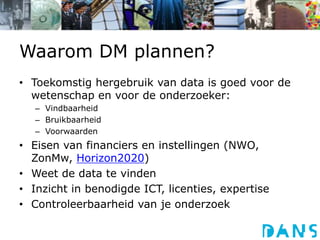
Waarom DM plannen?
• Toekomstig hergebruik van data is goed voor de
wetenschap en voor de onderzoeker:
– Vindbaarheid
– Bruikbaarheid
– Voorwaarden
• Eisen van financiers en instellingen (NWO,
ZonMw, Horizon2020)
• Weet de data te vinden
• Inzicht in benodigde ICT, licenties, expertise
• Controleerbaarheid van je onderzoek
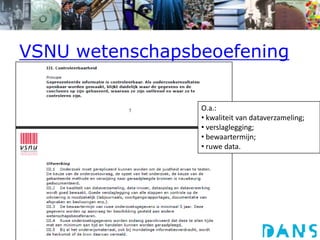
VSNU wetenschapsbeoefening
O.a.:
• kwaliteit van dataverzameling;
• verslaglegging;
• bewaartermijn;
• ruwe data.
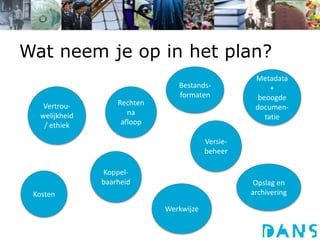
Wat neem je op in het plan?
Kosten
Rechten
na
afloop
Versie-
beheer
Koppel-
baarheid
Vertrou-
welijkheid
/ ethiek
Metadata
+
beoogde
documen-
tatie
Werkwijze
Opslag en
archivering
Bestands-
formaten
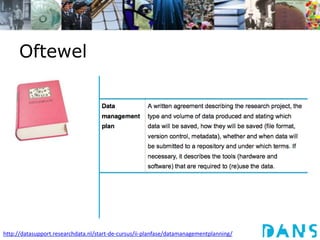
Oftewel
http://datasupport.researchdata.nl/start-de-cursus/ii-planfase/datamanagementplanning/
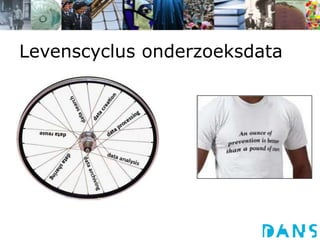
Levenscyclus onderzoeksdata
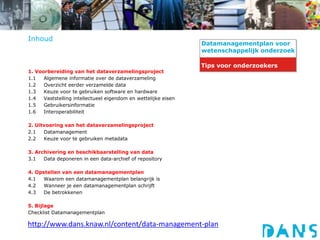
CARDS-datamanagementplan
http://www.dans.knaw.nl/content/data-management-plan
Inhoud
1. Voorbereiding van het dataverzamelingsproject
1.1 Algemene informatie over de dataverzameling
1.2 Overzicht eerder verzamelde data
1.3 Keuze voor te gebruiken software en hardware
1.4 Vaststelling intellectueel eigendom en wettelijke eisen
1.5 Gebruikersinformatie
1.6 Interoperabiliteit
2. Uitvoering van het dataverzamelingsproject
2.1 Datamanagement
2.2 Keuze voor te gebruiken metadata
3. Archivering en beschikbaarstelling van data
3.1 Data deponeren in een data-archief of repository
4. Opstellen van een datamanagementplan
4.1 Waarom een datamanagementplan belangrijk is
4.2 Wanneer je een datamanagementplan schrijft
4.3 De betrokkenen
5. Bijlage
Checklist Datamanagementplan
Datamanagementplan voor
wetenschappelijk onderzoek
Tips voor onderzoekers
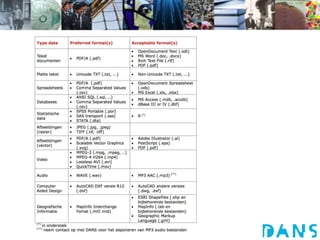
Preferred formats
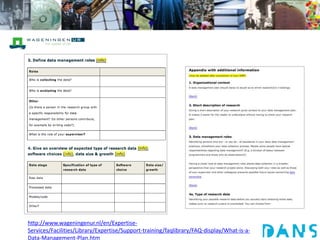
Wageningen UR
http://www.wageningenur.nl/en/Expertise-
Services/Facilities/Library/Expertise/Support-training/faqlibrary/FAQ-display/What-is-a-
Data-Management-Plan.htm
for example naming conventions, version control and folder structures. Explain how the
consistency and quality of data collection will be controlled and documented. This may
include processes such as calibration, repeat samples or measurements, standardised
data capture or recording, data entry validation, peer review of data or representation
with controlled vocabularies.
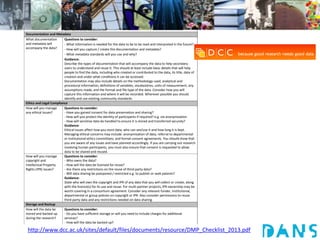
Documentation and Metadata
What documentation
and metadata will
accompany the data?
Questions to consider:
- What information is needed for the data to be to be read and interpreted in the future?
- How will you capture / create this documentation and metadata?
- What metadata standards will you use and why?
Guidance:
Describe the types of documentation that will accompany the data to help secondary
users to understand and reuse it. This should at least include basic details that will help
people to find the data, including who created or contributed to the data, its title, date of
creation and under what conditions it can be accessed.
Documentation may also include details on the methodology used, analytical and
procedural information, definitions of variables, vocabularies, units of measurement, any
assumptions made, and the format and file type of the data. Consider how you will
capture this information and where it will be recorded. Wherever possible you should
identify and use existing community standards.
Ethics and Legal Compliance
How will you manage
any ethical issues?
Questions to consider:
- Have you gained consent for data preservation and sharing?
- How will you protect the identity of participants if required? e.g. via anonymisation
- How will sensitive data be handled to ensure it is stored and transferred securely?
Guidance:
Ethical issues affect how you store data, who can see/use it and how long it is kept.
Managing ethical concerns may include: anonymisation of data; referral to departmental
or institutional ethics committees; and formal consent agreements. You should show that
you are aware of any issues and have planned accordingly. If you are carrying out research
involving human participants, you must also ensure that consent is requested to allow
data to be shared and reused.
How will you manage
copyright and
Intellectual Property
Rights (IPR) issues?
Questions to consider:
- Who owns the data?
- How will the data be licensed for reuse?
- Are there any restrictions on the reuse of third-party data?
- Will data sharing be postponed / restricted e.g. to publish or seek patents?
Guidance:
State who will own the copyright and IPR of any data that you will collect or create, along
with the licence(s) for its use and reuse. For multi-partner projects, IPR ownership may be
worth covering in a consortium agreement. Consider any relevant funder, institutional,
departmental or group policies on copyright or IPR. Also consider permissions to reuse
third-party data and any restrictions needed on data sharing.
Storage and Backup
How will the data be
stored and backed up
during the research?
Questions to consider:
- Do you have sufficient storage or will you need to include charges for additional
services?
- How will the data be backed up?
- Who will be responsible for backup and recovery?
- How will the data be recovered in the event of an incident?
Guidance:
http://www.dcc.ac.uk/sites/default/files/documents/resource/DMP_Checklist_2013.pdf
Deze sheet alleen gebruiken voor bijvoorbeeld een
screenshot van een applicatie. Door het ontbreken
van stijlkenmerken kan de screenshot zo groot
mogelijk. Voor alle andere informatie altijd een
sheet met stijlkenmerken gebruiken!
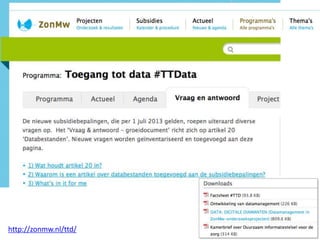
http://zonmw.nl/ttd/
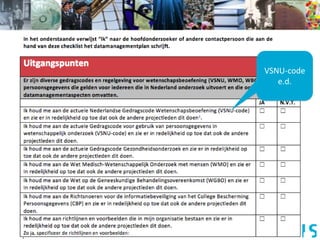
Uitgangspunten
VSNU-code
e.d.
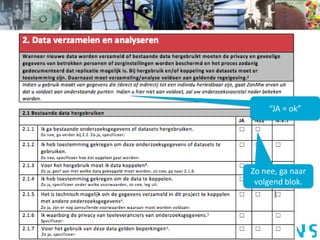
Data verzamelen en analyseren 1
“JA = ok”
Zo nee, ga naar
volgend blok.
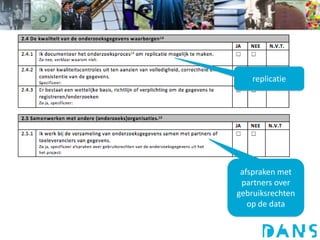
Data verzamelen en analyseren 3
replicatie
afspraken met
partners over
gebruiksrechten
op de data
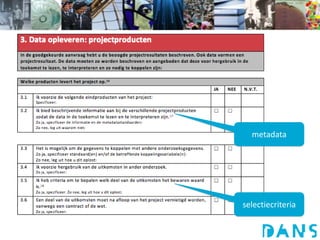
Data opleveren3
metadata
selectiecriteria
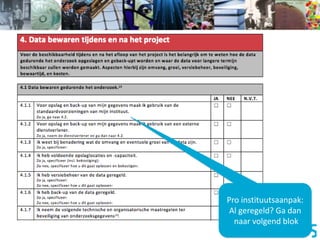
Data bewaren – tijdens…
Pro instituutsaanpak:
Al geregeld? Ga dan
naar volgend blok
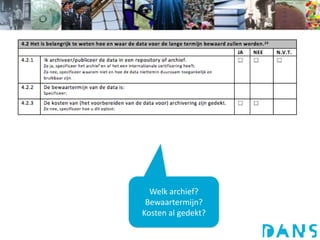
Data bewaren – lange termijn
Welk archief?
Bewaartermijn?
Kosten al gedekt?
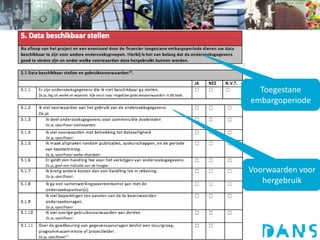
Data beschikbaar stellen - 1
Voorwaarden voor
hergebruik
Toegestane
embargoperiode
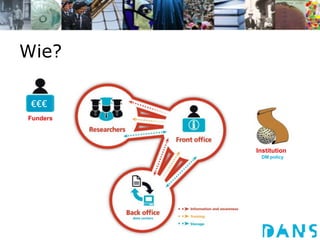
Wie?
Institution
DM policy
€€€
Funders
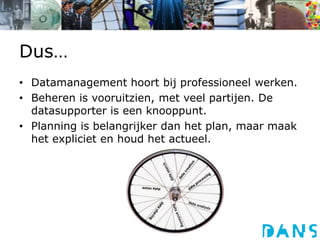
Dus…
• Datamanagement hoort bij professioneel werken.
• Beheren is vooruitzien, met veel partijen. De
datasupporter is een knooppunt.
• Planning is belangrijker dan het plan, maar maak
het expliciet en houd het actueel.
Data Archiving and Networked Services (DANS)
Anna van Saksenlaan 51 | 2593 HW Den Haag
Postbus 93067 | 2509 AB Den Haag
070 349 44 50 | info@dans.knaw.nl | www.dans.knaw.nl
KVK 54667089 | DANS is een instituut van KNAW en NWO
Vragen?
Zie http://datasupport.researchdata.nl
of neem contact op met
Marjan.Grootveld@dans.knaw.nl

Presentatie Marjan Grootveld E4DS (Data management)

  • 1.
    DANS is eeninstituut van KNAW en NWO Data Archiving and Networked ServicesData Archiving and Networked Services Datamanagement( )plannen Marjan Grootveld Essentials 4 Data Support, 10 april 2014 DANS is een instituut van KNAW en NWO
  • 2.
    Waarom DM plannen? •Toekomstig hergebruik van data is goed voor de wetenschap en voor de onderzoeker: – Vindbaarheid – Bruikbaarheid – Voorwaarden • Eisen van financiers en instellingen (NWO, ZonMw, Horizon2020) • Weet de data te vinden • Inzicht in benodigde ICT, licenties, expertise • Controleerbaarheid van je onderzoek
  • 3.
    VSNU wetenschapsbeoefening O.a.: • kwaliteitvan dataverzameling; • verslaglegging; • bewaartermijn; • ruwe data.
  • 4.
    Wat neem jeop in het plan? Kosten Rechten na afloop Versie- beheer Koppel- baarheid Vertrou- welijkheid / ethiek Metadata + beoogde documen- tatie Werkwijze Opslag en archivering Bestands- formaten
  • 5.
  • 6.
  • 7.
    CARDS-datamanagementplan http://www.dans.knaw.nl/content/data-management-plan Inhoud 1. Voorbereiding vanhet dataverzamelingsproject 1.1 Algemene informatie over de dataverzameling 1.2 Overzicht eerder verzamelde data 1.3 Keuze voor te gebruiken software en hardware 1.4 Vaststelling intellectueel eigendom en wettelijke eisen 1.5 Gebruikersinformatie 1.6 Interoperabiliteit 2. Uitvoering van het dataverzamelingsproject 2.1 Datamanagement 2.2 Keuze voor te gebruiken metadata 3. Archivering en beschikbaarstelling van data 3.1 Data deponeren in een data-archief of repository 4. Opstellen van een datamanagementplan 4.1 Waarom een datamanagementplan belangrijk is 4.2 Wanneer je een datamanagementplan schrijft 4.3 De betrokkenen 5. Bijlage Checklist Datamanagementplan Datamanagementplan voor wetenschappelijk onderzoek Tips voor onderzoekers
  • 8.
  • 9.
  • 10.
    for example namingconventions, version control and folder structures. Explain how the consistency and quality of data collection will be controlled and documented. This may include processes such as calibration, repeat samples or measurements, standardised data capture or recording, data entry validation, peer review of data or representation with controlled vocabularies. Documentation and Metadata What documentation and metadata will accompany the data? Questions to consider: - What information is needed for the data to be to be read and interpreted in the future? - How will you capture / create this documentation and metadata? - What metadata standards will you use and why? Guidance: Describe the types of documentation that will accompany the data to help secondary users to understand and reuse it. This should at least include basic details that will help people to find the data, including who created or contributed to the data, its title, date of creation and under what conditions it can be accessed. Documentation may also include details on the methodology used, analytical and procedural information, definitions of variables, vocabularies, units of measurement, any assumptions made, and the format and file type of the data. Consider how you will capture this information and where it will be recorded. Wherever possible you should identify and use existing community standards. Ethics and Legal Compliance How will you manage any ethical issues? Questions to consider: - Have you gained consent for data preservation and sharing? - How will you protect the identity of participants if required? e.g. via anonymisation - How will sensitive data be handled to ensure it is stored and transferred securely? Guidance: Ethical issues affect how you store data, who can see/use it and how long it is kept. Managing ethical concerns may include: anonymisation of data; referral to departmental or institutional ethics committees; and formal consent agreements. You should show that you are aware of any issues and have planned accordingly. If you are carrying out research involving human participants, you must also ensure that consent is requested to allow data to be shared and reused. How will you manage copyright and Intellectual Property Rights (IPR) issues? Questions to consider: - Who owns the data? - How will the data be licensed for reuse? - Are there any restrictions on the reuse of third-party data? - Will data sharing be postponed / restricted e.g. to publish or seek patents? Guidance: State who will own the copyright and IPR of any data that you will collect or create, along with the licence(s) for its use and reuse. For multi-partner projects, IPR ownership may be worth covering in a consortium agreement. Consider any relevant funder, institutional, departmental or group policies on copyright or IPR. Also consider permissions to reuse third-party data and any restrictions needed on data sharing. Storage and Backup How will the data be stored and backed up during the research? Questions to consider: - Do you have sufficient storage or will you need to include charges for additional services? - How will the data be backed up? - Who will be responsible for backup and recovery? - How will the data be recovered in the event of an incident? Guidance: http://www.dcc.ac.uk/sites/default/files/documents/resource/DMP_Checklist_2013.pdf
  • 11.
    Deze sheet alleengebruiken voor bijvoorbeeld een screenshot van een applicatie. Door het ontbreken van stijlkenmerken kan de screenshot zo groot mogelijk. Voor alle andere informatie altijd een sheet met stijlkenmerken gebruiken! http://zonmw.nl/ttd/
  • 12.
  • 13.
    Data verzamelen enanalyseren 1 “JA = ok” Zo nee, ga naar volgend blok.
  • 14.
    Data verzamelen enanalyseren 3 replicatie afspraken met partners over gebruiksrechten op de data
  • 15.
  • 16.
    Data bewaren –tijdens… Pro instituutsaanpak: Al geregeld? Ga dan naar volgend blok
  • 17.
    Data bewaren –lange termijn Welk archief? Bewaartermijn? Kosten al gedekt?
  • 18.
    Data beschikbaar stellen- 1 Voorwaarden voor hergebruik Toegestane embargoperiode
  • 19.
  • 20.
    Dus… • Datamanagement hoortbij professioneel werken. • Beheren is vooruitzien, met veel partijen. De datasupporter is een knooppunt. • Planning is belangrijker dan het plan, maar maak het expliciet en houd het actueel.
  • 21.
    Data Archiving andNetworked Services (DANS) Anna van Saksenlaan 51 | 2593 HW Den Haag Postbus 93067 | 2509 AB Den Haag 070 349 44 50 | info@dans.knaw.nl | www.dans.knaw.nl KVK 54667089 | DANS is een instituut van KNAW en NWO Vragen? Zie http://datasupport.researchdata.nl of neem contact op met Marjan.Grootveld@dans.knaw.nl