API Trends
Juan Carlos Rejon Estrada
Eduardo Alanís Rodríguez
Adrián Alejandro Cruz Alanis
What’s
an API?
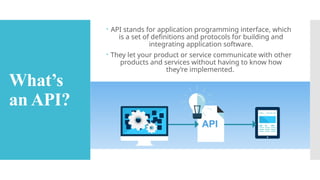
 API stands for application programming interface, which
is a set of definitions and protocols for building and
integrating application software.
 They let your product or service communicate with other
products and services without having to know how
they’re implemented.
Why are API’s
so
important?
There are three main reasons
about the impotance of APIs,
these are:
 Saves Devloper’s Time
 Help Automate App Testing
 Social Engagement
Why are
API’s so
important?
 Saves Developer’s time: APIs can save a considerable
amount of time. It eliminates the task of writing endless
lines of code, thus shorten the app development cycle and
reducing the coding errors.
Why are API’s so important?
 Help Automate App Testing: With a faster
application building process, the otherwise
manual testing process gets automated, ensuring
that one of the bugs remain undetected. Thus,
helping developers deliver an app that stands high
on both – quality and user expectations.
Why are
API’s so
important?
 Social Engagement: Social media are no longer a mode
of entertainment; they are now a modern way of living.
Connecting APIs of popular platforms like Facebook,
Twitter, etc. allows the users to share the content, post
comments, and leave reviews directly without having to
create a different username.
Trend 9
Complete API-driven infrastructure
proves efficient in handling multiple
cloud platforms
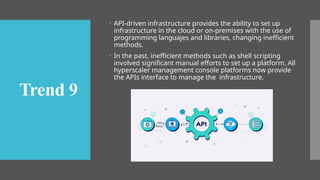
 API-driven infrastructure provides the ability to set up
infrastructure in the cloud or on-premises with the use of
programming languajes and libraries, changing inefficient
methods.
 In the past, inefficient methods such as shell scripting
involved significant manual efforts to set up a platform. All
hyperscaler management console platforms now provide
the APIs interface to manage the infrastructure.
Trend 9
Trend 9
 Many hyperscalers have come up with multicloud
management platforms, such as AWS Outpost, Azure Arc,
and Google Anthos.
 These platforms provide the APIs interface to manage,
provision and audit their hyperscaler infrastructure or on-
premise infrastructure
Trend 10
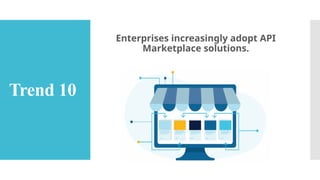
Enterprises increasingly adopt API
Marketplace solutions.
Trend 10
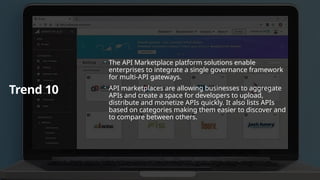
 The API Marketplace platform solutions enable
enterprises to integrate a single governance framework
for multi-API gateways.
 API marketplaces are allowing businesses to aggregate
APIs and create a space for developers to upload,
distribute and monetize APIs quickly. It also lists APIs
based on categories making them easier to discover and
to compare between others.
Trend 10
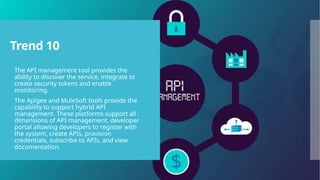
 The API management tool provides the
ability to discover the service, integrate to
create security tokens and enable
monitoring.
 The Apigee and MuleSoft tools provide the
capability to support hybrid API
management. These platforms support all
dimensions of API management, developer
portal allowing developers to register with
the system, create APIs, provision
credentials, subscribe to APIs, and view
documentation.

Presentaci[on sobre las API Trends en la programación

  • 1.
    API Trends Juan CarlosRejon Estrada Eduardo Alanís Rodríguez Adrián Alejandro Cruz Alanis
  • 2.
    What’s an API?  APIstands for application programming interface, which is a set of definitions and protocols for building and integrating application software.  They let your product or service communicate with other products and services without having to know how they’re implemented.
  • 3.
    Why are API’s so important? Thereare three main reasons about the impotance of APIs, these are:  Saves Devloper’s Time  Help Automate App Testing  Social Engagement
  • 4.
    Why are API’s so important? Saves Developer’s time: APIs can save a considerable amount of time. It eliminates the task of writing endless lines of code, thus shorten the app development cycle and reducing the coding errors.
  • 5.
    Why are API’sso important?  Help Automate App Testing: With a faster application building process, the otherwise manual testing process gets automated, ensuring that one of the bugs remain undetected. Thus, helping developers deliver an app that stands high on both – quality and user expectations.
  • 6.
    Why are API’s so important? Social Engagement: Social media are no longer a mode of entertainment; they are now a modern way of living. Connecting APIs of popular platforms like Facebook, Twitter, etc. allows the users to share the content, post comments, and leave reviews directly without having to create a different username.
  • 7.
    Trend 9 Complete API-driveninfrastructure proves efficient in handling multiple cloud platforms
  • 8.
     API-driven infrastructureprovides the ability to set up infrastructure in the cloud or on-premises with the use of programming languajes and libraries, changing inefficient methods.  In the past, inefficient methods such as shell scripting involved significant manual efforts to set up a platform. All hyperscaler management console platforms now provide the APIs interface to manage the infrastructure. Trend 9
  • 9.
    Trend 9  Manyhyperscalers have come up with multicloud management platforms, such as AWS Outpost, Azure Arc, and Google Anthos.  These platforms provide the APIs interface to manage, provision and audit their hyperscaler infrastructure or on- premise infrastructure
  • 10.
    Trend 10 Enterprises increasinglyadopt API Marketplace solutions.
  • 11.
    Trend 10  TheAPI Marketplace platform solutions enable enterprises to integrate a single governance framework for multi-API gateways.  API marketplaces are allowing businesses to aggregate APIs and create a space for developers to upload, distribute and monetize APIs quickly. It also lists APIs based on categories making them easier to discover and to compare between others.
  • 12.
    Trend 10  TheAPI management tool provides the ability to discover the service, integrate to create security tokens and enable monitoring.  The Apigee and MuleSoft tools provide the capability to support hybrid API management. These platforms support all dimensions of API management, developer portal allowing developers to register with the system, create APIs, provision credentials, subscribe to APIs, and view documentation.