GRAMMAR LESSON ONE
Present Simple Tense
By Dr Faraz Bughio
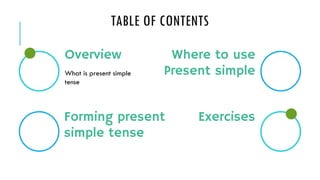
TABLE OF CONTENTS
Overview
Forming present
simple tense
Where to use
Present simple
Exercises
What is present simple
tense
01
02
03
04
INTRODUCTION
Present simple tense is used to describe actions or states that are
regular, habitual, or permanent.
It is used in situations for expressing habits, routines, general truths, or
things that happen regularly or repeatedly.
PRESENT SIMPLE EXAMPLES
1. I wake up at 6 am every day.
2. She drinks coffee every morning.
3. He works in a bank.
4. They live in New York.
5. We play tennis on Saturdays.
6. The sun rises in the east and sets in the west.
7. Cats meow when they are hungry.
8. The earth orbits around the sun.
9. The teacher explains the lesson to the students.
10.The train arrives at the station at 9 am every day.
STRUCTURE
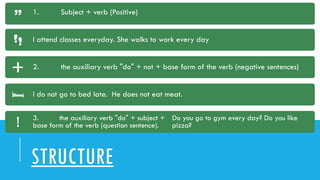
1. Subject + verb (Positive)
I attend classes everyday. She walks to work every day
2. the auxiliary verb "do" + not + base form of the verb (negative sentences)
I do not go to bed late. He does not eat meat.
3. the auxiliary verb "do" + subject +
base form of the verb (question sentence).
Do you go to gym every day? Do you like
pizza?
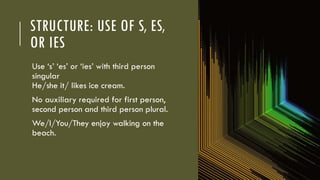
STRUCTURE: USE OF S, ES,
OR IES
Use ‘s’ ‘es’ or ‘ies’ with third person
singular
He/she it/ likes ice cream.
No auxiliary required for first person,
second person and third person plural.
We/I/You/They enjoy walking on the
beach.
HOW PRESENT SIMPLE IS
USED
Express regularly or habits.
I wake up at 6 am every day. She brushes
her teeth before bed every night.
Express preferences
I prefer coffee to tea. He likes to watch
movies on weekends.
Express generalizations or state facts.
The sun rises in the east. Water boils at
100 degrees Celsius.
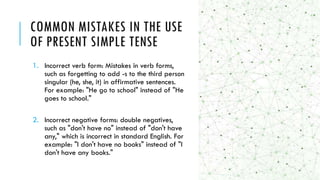
COMMON MISTAKES IN THE USE
OF PRESENT SIMPLE TENSE
1. Incorrect verb form: Mistakes in verb forms,
such as forgetting to add -s to the third person
singular (he, she, it) in affirmative sentences.
For example: "He go to school" instead of "He
goes to school."
2. Incorrect negative forms: double negatives,
such as "don't have no" instead of "don't have
any," which is incorrect in standard English. For
example: "I don't have no books" instead of "I
don't have any books."
COMMON MISTAKES IN THE USE OF
PRESENT SIMPLE TENSE
1. Misusing time expressions: such as using "yesterday,"
"last week," or "tomorrow," which are not appropriate
with the present simple tense. For example: "I go to the
movies yesterday" instead of "I went to the movies
yesterday."
2. Incorrect word order: Students may place words in
incorrect order within a sentence, resulting in
grammatically incorrect sentences. For example: "She
like pizza not" instead of "She does not like pizza."
EXERCISE 1
1. Describe your daily routine,
2. State your preferences for different
activities
3. Make a generalization about a topic.
4. State facts or truth.
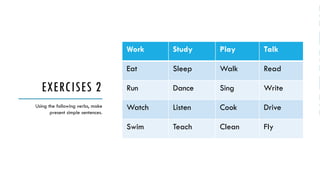
EXERCISES 2
Using the following verbs, make
present simple sentences.
Work Study Play Talk
Eat Sleep Walk Read
Run Dance Sing Write
Watch Listen Cook Drive
Swim Teach Clean Fly
THANKS!
Email Bughio.faraz79@gmail.com
https://www.facebook.com/faraz.bughio.378
https://www.facebook.com/DrFarazBughio
https://www.instagram.com/faraz_bughio/
https://www.linkedin.com/in/faraz-bughio-66ba6b39/
https://twitter.com/FarazBughio

Present Simple Tense.pptx

  • 1.
    GRAMMAR LESSON ONE PresentSimple Tense By Dr Faraz Bughio
  • 2.
    TABLE OF CONTENTS Overview Formingpresent simple tense Where to use Present simple Exercises What is present simple tense 01 02 03 04
  • 3.
    INTRODUCTION Present simple tenseis used to describe actions or states that are regular, habitual, or permanent. It is used in situations for expressing habits, routines, general truths, or things that happen regularly or repeatedly.
  • 4.
    PRESENT SIMPLE EXAMPLES 1.I wake up at 6 am every day. 2. She drinks coffee every morning. 3. He works in a bank. 4. They live in New York. 5. We play tennis on Saturdays. 6. The sun rises in the east and sets in the west. 7. Cats meow when they are hungry. 8. The earth orbits around the sun. 9. The teacher explains the lesson to the students. 10.The train arrives at the station at 9 am every day.
  • 5.
    STRUCTURE 1. Subject +verb (Positive) I attend classes everyday. She walks to work every day 2. the auxiliary verb "do" + not + base form of the verb (negative sentences) I do not go to bed late. He does not eat meat. 3. the auxiliary verb "do" + subject + base form of the verb (question sentence). Do you go to gym every day? Do you like pizza?
  • 6.
    STRUCTURE: USE OFS, ES, OR IES Use ‘s’ ‘es’ or ‘ies’ with third person singular He/she it/ likes ice cream. No auxiliary required for first person, second person and third person plural. We/I/You/They enjoy walking on the beach.
  • 7.
    HOW PRESENT SIMPLEIS USED Express regularly or habits. I wake up at 6 am every day. She brushes her teeth before bed every night. Express preferences I prefer coffee to tea. He likes to watch movies on weekends. Express generalizations or state facts. The sun rises in the east. Water boils at 100 degrees Celsius.
  • 8.
    COMMON MISTAKES INTHE USE OF PRESENT SIMPLE TENSE 1. Incorrect verb form: Mistakes in verb forms, such as forgetting to add -s to the third person singular (he, she, it) in affirmative sentences. For example: "He go to school" instead of "He goes to school." 2. Incorrect negative forms: double negatives, such as "don't have no" instead of "don't have any," which is incorrect in standard English. For example: "I don't have no books" instead of "I don't have any books."
  • 9.
    COMMON MISTAKES INTHE USE OF PRESENT SIMPLE TENSE 1. Misusing time expressions: such as using "yesterday," "last week," or "tomorrow," which are not appropriate with the present simple tense. For example: "I go to the movies yesterday" instead of "I went to the movies yesterday." 2. Incorrect word order: Students may place words in incorrect order within a sentence, resulting in grammatically incorrect sentences. For example: "She like pizza not" instead of "She does not like pizza."
  • 10.
    EXERCISE 1 1. Describeyour daily routine, 2. State your preferences for different activities 3. Make a generalization about a topic. 4. State facts or truth.
  • 11.
    EXERCISES 2 Using thefollowing verbs, make present simple sentences. Work Study Play Talk Eat Sleep Walk Read Run Dance Sing Write Watch Listen Cook Drive Swim Teach Clean Fly
  • 12.