Present Simple Tense
1
การใช้
การใช้ Present
Present
Simple Tense
Simple Tense
ใช้กล่าวถึงเหตุการณ์ที่เกิดขึ้น
ในปัจจุบัน
ในปัจจุบัน
2
หลักการใช้
หลักการใช้
A.
A. ใช้กับเหตุการณ์ที่เป็นความ
ใช้กับเหตุการณ์ที่เป็นความ
จริง สัจธรรม หรือปรากฏการณ์
ทางธรรมชาติ เช่น
ทางธรรมชาติ เช่น
-
- The sun rises in the
The sun rises in the
east and sets in
east and sets in
the west.
the west.
-
- A dog has four legs.
A dog has four legs.
3
 We use this tense for things that are
always true
true.
 Stones are hard.
e.g.
Present Simple Tense
4
 It very cold
in winter. (be)
is  Cats mice.
(catch)
catch
e.g.
5
Present Simple Tense
หลักการใช้
หลักการใช้
B.
B. ใช้กับเหตุการณ์ที่เกิดขึ้นจนเป็น
ใช้กับเหตุการณ์ที่เกิดขึ้นจนเป็น
นิสัยในปัจจุบัน
นิสัยในปัจจุบัน
และ
และ Adverb of Frequency (
Adverb of Frequency (กริ
กริ
ยาวิเศษณ์
ยาวิเศษณ์
บอกความถี่
บอกความถี่)
) เช่น
เช่น always,
always,
sometimes,
sometimes,
usually, etc.
usually, etc. อยู่ในประโยคด้วย
อยู่ในประโยคด้วย
เช่น
เช่น
Jane always wakes up
late.
late.
6
7
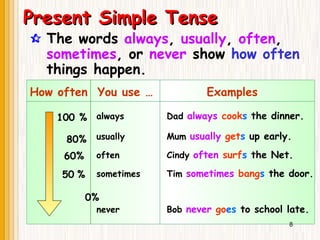
 The words always, usually, often,
sometimes, or never show how often
things happen.
How often You use … Examples
100 %
80%
often Cindy often surfs the Net.
always Dad always cooks the dinner.
usually Mum usually gets up early.
sometimes Tim sometimes bangs the door.
0%
never Bob never goes to school late.
50 %
8
Present Simple Tense
60%
 We use this tense to talk about
habits.
 Ben lifts weights every day.
SUN MON TUE WED THUR FRI SAT
 1  2  3  4  5 6
 7  8  9  10  11  12 13
 14  15  16  17  18  19 20
 21  22  23  24  25  26 27
 28  29  30
 May 
e.g.
Ben
9
 We use this tense to talk about things
that always
always, usually
usually, often
often,
sometimes
sometimes, or never
never happen.
e.g.
Tim
Sally
SUN MON TUE WED THUR FRI SAT
1 2 3 4 5 6
7 8 9 10 11 12 13
14 15 16 17 18 19 20
21 22 23 24 25 26 27
28 29 30
 July 
 Tim and Sally sometimes play cards.
10
Present Simple Tense
หลักการใช้
หลักการใช้
C:ใช้กับเหตุการณ์ที่เป็นกิจวัตรประจำวัน
และจะมี Adverb of time (กริยา
วิเศษณ์บอกเวลา) เช่น every day,
every week,
every ten minutes, etc. อยู่ใน
ประโยคด้วย เช่น
Moss’s father reads the
newspaper every day.
The bus leaves the terminal
every ten minutes. 11
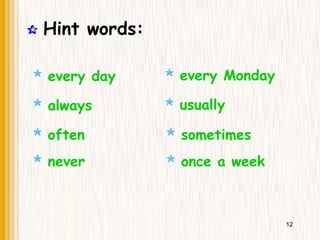
 Hint words:
 always  usually
 often  sometimes
 never
 every day  every Monday
 once a week
12
 Maggie works late on Mondays and
Thursdays.
Maggie works late every
Monday and Thursday.
SUN MON TUE WED THUR FRI SAT
 1 2 3 4 5 6
7  8 9 10  11 12 13
14  15 16 17  18 19 20
21  22 23 24  25 26 27
28  29 30
 November 
Maggie
e.g.
เหตุการณ์ที่เป็นกิจวัตรประจำวัน
13
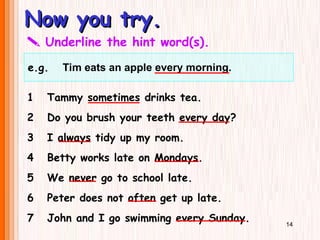
Now you try.
Now you try.
e.g. Tim eats an apple every morning.
 Underline the hint word(s).
1 Tammy sometimes drinks tea.
2 Do you brush your teeth every day?
3 I always tidy up my room.
4 Betty works late on Mondays.
5 We never go to school late.
6 Peter does not often get up late.
7 John and I go swimming every Sunday. 14
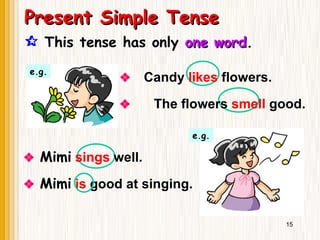
 This tense has only one word
one word.
 The flowers smell good.
e.g.
 Candy likes flowers.
 Mimi sings well.
e.g.
 Mimi is good at singing.
15
Present Simple Tense
 We add s
s or
or es
es to the verb when
to the verb when
the subject is
the subject is he
he,
, she
she or
or it
it.
I
I
You
You
We
We
They
They
like
like playing
playing
football.
football.
He
He
She
She
It
It
like
likes
s eating fish.
eating fish.
Subject Verb Things
16
Present Simple Tense
+ s  Mary feeds her dog. (feed)
 Peter enjoys the food. (enjoy)
 Tim always cooks the dinner. (cook)
+es  Tim watches TV every night. (watch)
 May usually dresses in pink. (dress)
 Bob never washes his car. (wash)
y  ies  The baby cries loudly. (cry)
 Peter carries a heavy bag. (carry)
 Tina dries the dishes every night. (dry)
17
Present Simple Tense
to be
I am
He
She
It
is
You are
We
You
They
are
do
does
to do
I
You
He
She
It
We
You
They
do
has
to have
I
You
have
He
She
It
We
You
They
have
18
Present Simple Tense
Now you try.
Now you try.
e.g.Tom orange juice every day. (drink)
drinks
1 Henry often chocolate eggs. (eat)
2 Lily always up early in the morning. (get)
3 Rabbits faster than tortoises. (run)
4 May and Joe sometimes to the radio. (listen)
5 Bob a bus at 9:15 a.m. every day. (catch)
6 It very hot and sunny in summer. (be)
7 Most flowers good. (smell)
8 Mary and Karen kind and helpful. (be)
eats
gets
are
smell
is
catches
listen
run
19
Questions
Questions
 We use do
do or
or does
does to make questions
to make questions.
 Don’t change the verb after do
do or
or
does
does.
What time do you go to school?
Does your dad like music?
20
Present Simple Tense
Practice
Practice
e.g. Where Mary ? (live)
does live
1 the children to school? (walk)
2 What Mr Wong ? (teach)
3 Tim and Bob good manners? (have)
4 What time Helen usually up? (get)
5 the students the Net every day? (surf)
6 How Peter and Paul here? (come)
7 What you for dinner, Mary? (have)
8 Sally listening to music? (enjoy)
Do walk
does teach
have
have
does get
Do surf
do come
do
Does enjoy
Do
21
 We add do not
do not or
or does not
does not to make
the sentences negative.
 Don’t change the verb after do
do or
or
does
does.
Mimi likes singing.
+ not
Mimi does not like singing.
Negative sentences
Negative sentences
22
Present Simple Tense
Practice
Practice
1 I like visiting friends. Tammy does not
visiting friends.
2 Do you get up early?
No, we up early.
3 Tigers run fast but elephants fast.
4 Henry is overweight but Tim and Sam not
overweight.
5 They like reading but Sally reading.
e.g. Cindy plays the piano. Ben
the piano.
does not play
like
don’t get
are
does not like
do not run
23
1 Tim and Bob sometimes eats cake.
2 Does you iron your clothes?
No, I do not irons my clothes.
3 I listens to music every day.
4 May do not makes the breakfast.
5 I likes cooking but Mary do not like cooking.
6 Does they cooks the dinner?
Proof-reading
Proof-reading
e.g. Peter always drink tea. drinks
eat
Do
iron
listen
does, make
like, does
Do, cook
24
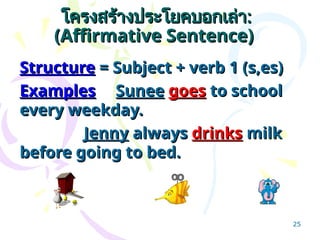
โครงสร้างประโยคบอกเล่า
โครงสร้างประโยคบอกเล่า:
:
(
(Affirmative Sentence)
Affirmative Sentence)
Structure
Structure = Subject + verb 1 (s,es)
= Subject + verb 1 (s,es)
Examples
Examples Sunee
Sunee goes
goes to school
to school
every weekday.
every weekday.
Jenny
Jenny always
always drinks
drinks milk
milk
before going to bed.
25
โครงสร้างประโยคปฏิเสธ
โครงสร้างประโยคปฏิเสธ:
:
(Negative Sentence)
(Negative Sentence)
Structure
Structure = Subject + does/do +
= Subject + does/do +
not + verb1
not + verb1
(doesn’t/ don’t)
(doesn’t/ don’t)
Examples
Examples Sunee
Sunee doesn’t go
doesn’t go to
to
school every
school every
weekday.
weekday.
Jenny
Jenny doesn’t
doesn’t drink
drink milk
milk
before
before
going to bed.
going to bed. 26
Tip
Tip
แต่ถ้าประโยคไหนที่มี
แต่ถ้าประโยคไหนที่มี Verb to be ( is, am,
Verb to be ( is, am,
are)
are) มาเป็นกริยามาในประโยค นักเรียนไม่
มาเป็นกริยามาในประโยค นักเรียนไม่
ต้องเอาเจ้า
ต้องเอาเจ้า Verb to do (do, does)
Verb to do (do, does) เข้ามา
เข้ามา
ช่วยนะขอรับ เดี๋ยวมันจะวางมวย เอ้ย
ช่วยนะขอรับ เดี๋ยวมันจะวางมวย เอ้ย...
...จะผิด
จะผิด
เอานะครับ ให้นักเรียนเพียงเติม
เอานะครับ ให้นักเรียนเพียงเติม not
not หลัง
หลัง
Verb to be (is, am, are)
Verb to be (is, am, are) เท่านั้น เช่น
เท่านั้น เช่น
Moss is a policeman.
Moss is a policeman. ถ้าจะทำเป็น
ถ้าจะทำเป็น
ประโยคปฏิเสธก็เพียงแค่เติม
ประโยคปฏิเสธก็เพียงแค่เติม not
not เข้าไปหลัง
เข้าไปหลัง
is
is ก็เป็น
ก็เป็น Moss
Moss is not
is not a policeman.
a policeman. แค่
แค่
นี้ก็เป็นอันเรียบร้อยโรงเรียนประถมสาธิต
27
โครงสร้างประโยคคำถาม
โครงสร้างประโยคคำถาม:
:
(
(Interrogative Sentence)
Interrogative Sentence)
Structure
Structure =
= Do / Does +
Do / Does +
Subject + Verb1?
Subject + Verb1?
Examples
Examples
Do you go to school
Do you go to school
everyday?
everyday?
Does
Does Sunee
Sunee go
go to school
to school
every weekday?
every weekday?

28
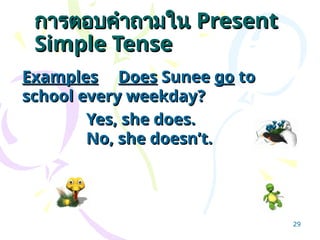
การตอบคำถามใน
การตอบคำถามใน Present
Present
Simple Tense
Simple Tense
Examples
Examples Does
Does Sunee
Sunee go
go to
to
school every weekday?
Yes, she does.
Yes, she does.
No, she doesn’t.
No, she doesn’t.
29
Tip
Tip
มีข้อสำคัญอีกประการหนึ่งที่นักเรียนควร
ใส่ใจในการเรียนรู้เรื่อง
ใส่ใจในการเรียนรู้เรื่อง Present
Present
Simple Tense
Simple Tense คือ การใช้กริยา
คือ การใช้กริยา
ให้สอดคล้องกับประธาน เพราะใน
Present Simple Tense
Present Simple Tense นั้นจะมีการ
นั้นจะมีการ
เติม
เติม s, es
s, es ที่กริยาของประโยค
ที่กริยาของประโยค
นั้น ๆ ซึ่งจะต้องขึ้นอยู่กับประธานของ
ประโยคด้วย
ประโยคด้วย
30
Tip
Tip
เขามีหลักการอยู่ว่า
เขามีหลักการอยู่ว่า “
“ ใน
ใน Present
Present
Simple Tense
Simple Tense
ถ้าประธานเป็นเอกพจน์
ถ้าประธานเป็นเอกพจน์ (
(Singular)
Singular)
บุรุษที่
บุรุษที่ 3
3
(Third Person)
(Third Person) กริยาต้องเติม
กริยาต้องเติม s
s หรือ
หรือ
es
es แฮ่ ๆๆๆ นักเรียนอาจจะเริ่มมีมี ง
แฮ่ ๆๆๆ นักเรียนอาจจะเริ่มมีมี ง.
. งู
งู
สองตัวซ้อน
สองตัวซ้อน (
( งง
งง )
) ในสมองกันแล้วล่ะ
ในสมองกันแล้วล่ะ
ซิ
ซิ....
....เอ
เอ...
...อะไรคือบุรุษที่
อะไรคือบุรุษที่ 3????
3???? เอา
เอา
ล่ะ
ล่ะ..
..มาลองอ่านคำอธิบายกันต่อสักนิด
มาลองอ่านคำอธิบายกันต่อสักนิด 31
Tip
Tip
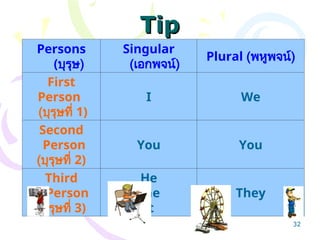
Persons
(บุรุษ)
Singular
(เอกพจน์)
Plural (พหูพจน์)
First
Person
(บุรุษที่ 1)
I We
Second
Person
(บุรุษที่ 2)
You You
Third
Person
(บุรุษที่ 3)
He
She
It
They
32
Tip
Tip
เมื่อดูจากตารางดังกล่าว นักเรียนจะ
เห็นว่า
เห็นว่า
เจ้าบุรุษที่
เจ้าบุรุษที่ 3
3 ที่ครูกล่าวถึงนั้นมีอยู่
ที่ครูกล่าวถึงนั้นมีอยู่ 4
4 ตัวด้วย
ตัวด้วย
กัน คือ
กัน คือ He, She, It
He, She, It และ
และ They
They แต่ตามหลัก
แต่ตามหลัก
ของการเติม
ของการเติม s, es
s, es ที่กริยามีอยู่ว่า
ที่กริยามีอยู่ว่า “
“ ถ้า
ถ้า
ประธานเป็น
ประธานเป็นเอกพจน์
เอกพจน์ บุรุษที่
บุรุษที่ 3
3 กริยาต้อง
กริยาต้อง
เติม
เติม s,
s, หรือ
หรือ es”
es” ดังนั้นเราจะเห็นว่า กฎเน้น
ดังนั้นเราจะเห็นว่า กฎเน้น
ที่ ประธานเอกพจน์ บุรุษที่
ที่ ประธานเอกพจน์ บุรุษที่ 3
3 เท่านั้น เราจึง
เท่านั้น เราจึง
เหลือตัวเลือกเพียง
เหลือตัวเลือกเพียง He, She, It
He, She, It เท่านั้น
เท่านั้น
คงจะเข้าใจบ้างแล้วนะครับ มาสรุปง่าย คือ
คงจะเข้าใจบ้างแล้วนะครับ มาสรุปง่าย คือ 33
Tip
Tip
I, We, You,
They
Verb 1
He, She, It
Verb 1 เติม s,
หรือ es
34
หลักในการเติม
หลักในการเติม s
s และ
และ es
es ที่
ที่
กริยา
กริยา
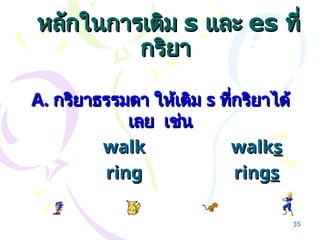
A.
A. กริยาธรรมดา ให้เติม
กริยาธรรมดา ให้เติม s
s ที่กริยาได้
ที่กริยาได้
เลย เช่น
เลย เช่น
walk
walk walk
walks
s
ring
ring ring
rings
s
35
หลักในการเติม
หลักในการเติม s
s และ
และ es
es ที่
ที่
กริยา
กริยา
B:
B: กริยาที่ลงท้ายด้วย
กริยาที่ลงท้ายด้วย s, ss, sh, ch, x, o
s, ss, sh, ch, x, o
ให้เติม
ให้เติม es
es ที่กริยา เช่น
ที่กริยา เช่น
pass
pass pass
passes
es
wash
wash wash
washes
es
watch
watch watch
watches
es
box
box box
boxes
es
go
go go
goes
es
36
หลักในการเติม
หลักในการเติม s
s และ
และ es
es ที่
ที่
กริยา
กริยา
C:
C: กริยาที่ลงท้ายด้วย
กริยาที่ลงท้ายด้วย y
y และหน้า
และหน้า y
y เป็น
เป็น
พยัญชนะให้เปลี่ยน
พยัญชนะให้เปลี่ยน y
y เป็น
เป็น i
i แล้วเติม
แล้วเติม es
es
เช่น
เช่น
cry
cry cr
cries
ies
try
try tr
tries
ies
fly
fly fl
flies
ies
37
หลักในการเติม
หลักในการเติม s
s และ
และ es
es ที่
ที่
กริยา
กริยา
D:
D: คำกริยาที่ลงท้ายด้วย
คำกริยาที่ลงท้ายด้วย y
y และหน้า
และหน้า y
y เป็น
เป็น
สระ
สระ (a, e, i, o, u)
(a, e, i, o, u) ให้เติม
ให้เติม s
s ที่ท้ายกริยาตัว
ที่ท้ายกริยาตัว
นั้นได้เลย เช่น
นั้นได้เลย เช่น
stay
stay stay
stays
s
play
play play
plays
s
lay
lay lay
lays
s
38
Adverb of Frequency (
Adverb of Frequency (กริยา
กริยา
วิเศษณ์บอกความถี่
วิเศษณ์บอกความถี่)
)
always
always เสมอ ๆ
เสมอ ๆ
usually
usually ตามปกติ
ตามปกติ
sometimes
sometimes บางครั้ง
บางครั้ง.
. บาง
บาง
เวลา
เวลา
often
often บ่อย ๆ
บ่อย ๆ
generally
generally โดยทั่วไป
โดยทั่วไป
seldom
seldom นาน ๆ ครั้ง
นาน ๆ ครั้ง,
,
ไม่ค่อยจะ
ไม่ค่อยจะ
never
never ไม่เคย
ไม่เคย
39
Adverb of Time
Adverb of Time กริยา
กริยา
วิเศษณ์บอกเวลา
วิเศษณ์บอกเวลา
every day (week, month, year)
every day (week, month, year) ทุก ๆ
ทุก ๆ
วัน
วัน
(
(สัปดาห์
สัปดาห์,
, เดือน
เดือน,
, ปี
ปี)
)
every hour
every hour ทุกชั่วโมง
ทุกชั่วโมง
once a day (week, month, year)
once a day (week, month, year) หนึ่ง
หนึ่ง
ครั้งต่อวัน
ครั้งต่อวัน
(
(สัปดาห์
สัปดาห์,
, เดือน
เดือน,
, ปี
ปี)
)
now and again
now and again ซ้ำแล้วซ้ำเล่า
ซ้ำแล้วซ้ำเล่า
40
PRETEST:
PRETEST: Present
Present
Simple Tense
Simple Tense
1. I sometimes __________ to school. (walk
, walked, walks)
2. My friend never __________ to school.
(come, comes, came)
3. They usually ____________ basketball. (play
, plays, played)
4. He often __________ tennis. (
play, played, plays)
5. Sue rarely _________ coffee. (
drink, drank, drinks)
6. My father and I always _______ my 41
POST TEST: Present
POST TEST: Present
Simple Tense
Simple Tense
1. I sometimes __________ to school.
1. I sometimes __________ to school. (
(walk,
,
walked,
, walks)
)
2. My friend never __________ to school.
2. My friend never __________ to school. (
(
come,
, comes,
, came)
)
3. They usually ____________ basketball.
3. They usually ____________ basketball. (
(play,
,
plays, played)
plays, played)
4. He often __________ tennis.
4. He often __________ tennis. (play, played,
(play, played,
plays)
plays)
5. Sue rarely _________ coffee.
5. Sue rarely _________ coffee. (drink,
(drink,
drank, drinks)
drank, drinks)
6. My father and I always _______ my
grandfather. (visit, visits, visited)
7. Jimmy doesn’t ________ guitar. (like, likes,
42
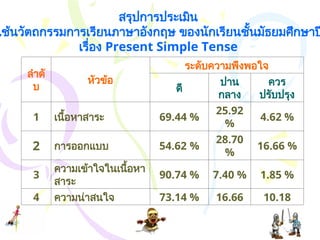
ลำดั
บ
หัวข้อ
ระดับความพึงพอใจ
ดี
ปาน
กลาง
ควร
ปรับปรุง
1 เนื้อหาสาระ 69.44 %
25.92
%
4.62 %
2 การออกแบบ 54.62 %
28.70
%
16.66 %
3
ความเข้าใจในเนื้อหา
สาระ
90.74 % 7.40 % 1.85 %
4 ความน่าสนใจ 73.14 % 16.66 10.18
สรุปการประเมิน
ใช้นวัตถกรรมการเรียนภาษาอังกฤษ ของนักเรียนชั้นมัธยมศึกษาป
เรื่อง Present Simple Tense
43
สรุปการประเมิน
ใช้นวัตถกรรมการเรียนภาษาอังกฤษ ของนักเรียนชั้นมัธยมศึกษาป
เรื่อง Present Simple Tense
ลำดั
บ
หัวข้อ
ระดับความพึงพอใจ
ดี
ปาน
กลาง
ควร
ปรับปรุง
1 เนื้อหาสาระ 75 28 5
2 การออกแบบ 59 31 18
3
ความเข้าใจในเนื้อหา
สาระ
98 8 2
4 ความน่าสนใจ 79 18 11
หมายเหตุ...จากจำนวนนักเรียน
108 คน
44

โครงสร้างประโยค และวิธีการใช้ present-simple-tense.ppt

  • 1.
  • 2.
    การใช้ การใช้ Present Present Simple Tense SimpleTense ใช้กล่าวถึงเหตุการณ์ที่เกิดขึ้น ใช้กล่าวถึงเหตุการณ์ที่เกิดขึ้น ในปัจจุบัน ในปัจจุบัน 2
  • 3.
    หลักการใช้ หลักการใช้ A. A. ใช้กับเหตุการณ์ที่เป็นความ ใช้กับเหตุการณ์ที่เป็นความ จริง สัจธรรมหรือปรากฏการณ์ จริง สัจธรรม หรือปรากฏการณ์ ทางธรรมชาติ เช่น ทางธรรมชาติ เช่น - - The sun rises in the The sun rises in the east and sets in east and sets in the west. the west. - - A dog has four legs. A dog has four legs. 3
  • 4.
     We usethis tense for things that are always true true.  Stones are hard. e.g. Present Simple Tense Present Simple Tense 4
  • 5.
     It verycold in winter. (be) is  Cats mice. (catch) catch e.g. 5 Present Simple Tense Present Simple Tense
  • 6.
    หลักการใช้ หลักการใช้ B. B. ใช้กับเหตุการณ์ที่เกิดขึ้นจนเป็น ใช้กับเหตุการณ์ที่เกิดขึ้นจนเป็น นิสัยในปัจจุบัน นิสัยในปัจจุบัน และ และ Adverbof Frequency ( Adverb of Frequency (กริ กริ ยาวิเศษณ์ ยาวิเศษณ์ บอกความถี่ บอกความถี่) ) เช่น เช่น always, always, sometimes, sometimes, usually, etc. usually, etc. อยู่ในประโยคด้วย อยู่ในประโยคด้วย เช่น เช่น Jane always wakes up Jane always wakes up late. late. 6
  • 7.
  • 8.
     The wordsalways, usually, often, sometimes, or never show how often things happen. How often You use … Examples 100 % 80% often Cindy often surfs the Net. always Dad always cooks the dinner. usually Mum usually gets up early. sometimes Tim sometimes bangs the door. 0% never Bob never goes to school late. 50 % 8 Present Simple Tense Present Simple Tense 60%
  • 9.
     We usethis tense to talk about habits.  Ben lifts weights every day. SUN MON TUE WED THUR FRI SAT  1  2  3  4  5 6  7  8  9  10  11  12 13  14  15  16  17  18  19 20  21  22  23  24  25  26 27  28  29  30  May  e.g. Ben 9
  • 10.
     We usethis tense to talk about things that always always, usually usually, often often, sometimes sometimes, or never never happen. e.g. Tim Sally SUN MON TUE WED THUR FRI SAT 1 2 3 4 5 6 7 8 9 10 11 12 13 14 15 16 17 18 19 20 21 22 23 24 25 26 27 28 29 30  July   Tim and Sally sometimes play cards. 10 Present Simple Tense Present Simple Tense
  • 11.
    หลักการใช้ หลักการใช้ C:ใช้กับเหตุการณ์ที่เป็นกิจวัตรประจำวัน และจะมี Adverb oftime (กริยา วิเศษณ์บอกเวลา) เช่น every day, every week, every ten minutes, etc. อยู่ใน ประโยคด้วย เช่น Moss’s father reads the newspaper every day. The bus leaves the terminal every ten minutes. 11
  • 12.
     Hint words: always  usually  often  sometimes  never  every day  every Monday  once a week 12
  • 13.
     Maggie workslate on Mondays and Thursdays. Maggie works late every Monday and Thursday. SUN MON TUE WED THUR FRI SAT  1 2 3 4 5 6 7  8 9 10  11 12 13 14  15 16 17  18 19 20 21  22 23 24  25 26 27 28  29 30  November  Maggie e.g. เหตุการณ์ที่เป็นกิจวัตรประจำวัน 13
  • 14.
    Now you try. Nowyou try. e.g. Tim eats an apple every morning.  Underline the hint word(s). 1 Tammy sometimes drinks tea. 2 Do you brush your teeth every day? 3 I always tidy up my room. 4 Betty works late on Mondays. 5 We never go to school late. 6 Peter does not often get up late. 7 John and I go swimming every Sunday. 14
  • 15.
     This tensehas only one word one word.  The flowers smell good. e.g.  Candy likes flowers.  Mimi sings well. e.g.  Mimi is good at singing. 15 Present Simple Tense Present Simple Tense
  • 16.
     We adds s or or es es to the verb when to the verb when the subject is the subject is he he, , she she or or it it. I I You You We We They They like like playing playing football. football. He He She She It It like likes s eating fish. eating fish. Subject Verb Things 16 Present Simple Tense Present Simple Tense
  • 17.
    + s Mary feeds her dog. (feed)  Peter enjoys the food. (enjoy)  Tim always cooks the dinner. (cook) +es  Tim watches TV every night. (watch)  May usually dresses in pink. (dress)  Bob never washes his car. (wash) y  ies  The baby cries loudly. (cry)  Peter carries a heavy bag. (carry)  Tina dries the dishes every night. (dry) 17 Present Simple Tense Present Simple Tense
  • 18.
    to be I am He She It is Youare We You They are do does to do I You He She It We You They do has to have I You have He She It We You They have 18 Present Simple Tense Present Simple Tense
  • 19.
    Now you try. Nowyou try. e.g.Tom orange juice every day. (drink) drinks 1 Henry often chocolate eggs. (eat) 2 Lily always up early in the morning. (get) 3 Rabbits faster than tortoises. (run) 4 May and Joe sometimes to the radio. (listen) 5 Bob a bus at 9:15 a.m. every day. (catch) 6 It very hot and sunny in summer. (be) 7 Most flowers good. (smell) 8 Mary and Karen kind and helpful. (be) eats gets are smell is catches listen run 19
  • 20.
    Questions Questions  We usedo do or or does does to make questions to make questions.  Don’t change the verb after do do or or does does. What time do you go to school? Does your dad like music? 20 Present Simple Tense Present Simple Tense
  • 21.
    Practice Practice e.g. Where Mary? (live) does live 1 the children to school? (walk) 2 What Mr Wong ? (teach) 3 Tim and Bob good manners? (have) 4 What time Helen usually up? (get) 5 the students the Net every day? (surf) 6 How Peter and Paul here? (come) 7 What you for dinner, Mary? (have) 8 Sally listening to music? (enjoy) Do walk does teach have have does get Do surf do come do Does enjoy Do 21
  • 22.
     We adddo not do not or or does not does not to make the sentences negative.  Don’t change the verb after do do or or does does. Mimi likes singing. + not Mimi does not like singing. Negative sentences Negative sentences 22 Present Simple Tense Present Simple Tense
  • 23.
    Practice Practice 1 I likevisiting friends. Tammy does not visiting friends. 2 Do you get up early? No, we up early. 3 Tigers run fast but elephants fast. 4 Henry is overweight but Tim and Sam not overweight. 5 They like reading but Sally reading. e.g. Cindy plays the piano. Ben the piano. does not play like don’t get are does not like do not run 23
  • 24.
    1 Tim andBob sometimes eats cake. 2 Does you iron your clothes? No, I do not irons my clothes. 3 I listens to music every day. 4 May do not makes the breakfast. 5 I likes cooking but Mary do not like cooking. 6 Does they cooks the dinner? Proof-reading Proof-reading e.g. Peter always drink tea. drinks eat Do iron listen does, make like, does Do, cook 24
  • 25.
    โครงสร้างประโยคบอกเล่า โครงสร้างประโยคบอกเล่า: : ( (Affirmative Sentence) Affirmative Sentence) Structure Structure= Subject + verb 1 (s,es) = Subject + verb 1 (s,es) Examples Examples Sunee Sunee goes goes to school to school every weekday. every weekday. Jenny Jenny always always drinks drinks milk milk before going to bed. before going to bed. 25
  • 26.
    โครงสร้างประโยคปฏิเสธ โครงสร้างประโยคปฏิเสธ: : (Negative Sentence) (Negative Sentence) Structure Structure= Subject + does/do + = Subject + does/do + not + verb1 not + verb1 (doesn’t/ don’t) (doesn’t/ don’t) Examples Examples Sunee Sunee doesn’t go doesn’t go to to school every school every weekday. weekday. Jenny Jenny doesn’t doesn’t drink drink milk milk before before going to bed. going to bed. 26
  • 27.
    Tip Tip แต่ถ้าประโยคไหนที่มี แต่ถ้าประโยคไหนที่มี Verb tobe ( is, am, Verb to be ( is, am, are) are) มาเป็นกริยามาในประโยค นักเรียนไม่ มาเป็นกริยามาในประโยค นักเรียนไม่ ต้องเอาเจ้า ต้องเอาเจ้า Verb to do (do, does) Verb to do (do, does) เข้ามา เข้ามา ช่วยนะขอรับ เดี๋ยวมันจะวางมวย เอ้ย ช่วยนะขอรับ เดี๋ยวมันจะวางมวย เอ้ย... ...จะผิด จะผิด เอานะครับ ให้นักเรียนเพียงเติม เอานะครับ ให้นักเรียนเพียงเติม not not หลัง หลัง Verb to be (is, am, are) Verb to be (is, am, are) เท่านั้น เช่น เท่านั้น เช่น Moss is a policeman. Moss is a policeman. ถ้าจะทำเป็น ถ้าจะทำเป็น ประโยคปฏิเสธก็เพียงแค่เติม ประโยคปฏิเสธก็เพียงแค่เติม not not เข้าไปหลัง เข้าไปหลัง is is ก็เป็น ก็เป็น Moss Moss is not is not a policeman. a policeman. แค่ แค่ นี้ก็เป็นอันเรียบร้อยโรงเรียนประถมสาธิต นี้ก็เป็นอันเรียบร้อยโรงเรียนประถมสาธิต 27
  • 28.
    โครงสร้างประโยคคำถาม โครงสร้างประโยคคำถาม: : ( (Interrogative Sentence) Interrogative Sentence) Structure Structure= = Do / Does + Do / Does + Subject + Verb1? Subject + Verb1? Examples Examples Do you go to school Do you go to school everyday? everyday? Does Does Sunee Sunee go go to school to school every weekday? every weekday?  28
  • 29.
    การตอบคำถามใน การตอบคำถามใน Present Present Simple Tense SimpleTense Examples Examples Does Does Sunee Sunee go go to to school every weekday? school every weekday? Yes, she does. Yes, she does. No, she doesn’t. No, she doesn’t. 29
  • 30.
    Tip Tip มีข้อสำคัญอีกประการหนึ่งที่นักเรียนควร มีข้อสำคัญอีกประการหนึ่งที่นักเรียนควร ใส่ใจในการเรียนรู้เรื่อง ใส่ใจในการเรียนรู้เรื่อง Present Present Simple Tense SimpleTense คือ การใช้กริยา คือ การใช้กริยา ให้สอดคล้องกับประธาน เพราะใน ให้สอดคล้องกับประธาน เพราะใน Present Simple Tense Present Simple Tense นั้นจะมีการ นั้นจะมีการ เติม เติม s, es s, es ที่กริยาของประโยค ที่กริยาของประโยค นั้น ๆ ซึ่งจะต้องขึ้นอยู่กับประธานของ นั้น ๆ ซึ่งจะต้องขึ้นอยู่กับประธานของ ประโยคด้วย ประโยคด้วย 30
  • 31.
    Tip Tip เขามีหลักการอยู่ว่า เขามีหลักการอยู่ว่า “ “ ใน ในPresent Present Simple Tense Simple Tense ถ้าประธานเป็นเอกพจน์ ถ้าประธานเป็นเอกพจน์ ( (Singular) Singular) บุรุษที่ บุรุษที่ 3 3 (Third Person) (Third Person) กริยาต้องเติม กริยาต้องเติม s s หรือ หรือ es es แฮ่ ๆๆๆ นักเรียนอาจจะเริ่มมีมี ง แฮ่ ๆๆๆ นักเรียนอาจจะเริ่มมีมี ง. . งู งู สองตัวซ้อน สองตัวซ้อน ( ( งง งง ) ) ในสมองกันแล้วล่ะ ในสมองกันแล้วล่ะ ซิ ซิ.... ....เอ เอ... ...อะไรคือบุรุษที่ อะไรคือบุรุษที่ 3???? 3???? เอา เอา ล่ะ ล่ะ.. ..มาลองอ่านคำอธิบายกันต่อสักนิด มาลองอ่านคำอธิบายกันต่อสักนิด 31
  • 32.
    Tip Tip Persons (บุรุษ) Singular (เอกพจน์) Plural (พหูพจน์) First Person (บุรุษที่ 1) IWe Second Person (บุรุษที่ 2) You You Third Person (บุรุษที่ 3) He She It They 32
  • 33.
    Tip Tip เมื่อดูจากตารางดังกล่าว นักเรียนจะ เมื่อดูจากตารางดังกล่าว นักเรียนจะ เห็นว่า เห็นว่า เจ้าบุรุษที่ เจ้าบุรุษที่3 3 ที่ครูกล่าวถึงนั้นมีอยู่ ที่ครูกล่าวถึงนั้นมีอยู่ 4 4 ตัวด้วย ตัวด้วย กัน คือ กัน คือ He, She, It He, She, It และ และ They They แต่ตามหลัก แต่ตามหลัก ของการเติม ของการเติม s, es s, es ที่กริยามีอยู่ว่า ที่กริยามีอยู่ว่า “ “ ถ้า ถ้า ประธานเป็น ประธานเป็นเอกพจน์ เอกพจน์ บุรุษที่ บุรุษที่ 3 3 กริยาต้อง กริยาต้อง เติม เติม s, s, หรือ หรือ es” es” ดังนั้นเราจะเห็นว่า กฎเน้น ดังนั้นเราจะเห็นว่า กฎเน้น ที่ ประธานเอกพจน์ บุรุษที่ ที่ ประธานเอกพจน์ บุรุษที่ 3 3 เท่านั้น เราจึง เท่านั้น เราจึง เหลือตัวเลือกเพียง เหลือตัวเลือกเพียง He, She, It He, She, It เท่านั้น เท่านั้น คงจะเข้าใจบ้างแล้วนะครับ มาสรุปง่าย คือ คงจะเข้าใจบ้างแล้วนะครับ มาสรุปง่าย คือ 33
  • 34.
    Tip Tip I, We, You, They Verb1 He, She, It Verb 1 เติม s, หรือ es 34
  • 35.
    หลักในการเติม หลักในการเติม s s และ และes es ที่ ที่ กริยา กริยา A. A. กริยาธรรมดา ให้เติม กริยาธรรมดา ให้เติม s s ที่กริยาได้ ที่กริยาได้ เลย เช่น เลย เช่น walk walk walk walks s ring ring ring rings s 35
  • 36.
    หลักในการเติม หลักในการเติม s s และ และes es ที่ ที่ กริยา กริยา B: B: กริยาที่ลงท้ายด้วย กริยาที่ลงท้ายด้วย s, ss, sh, ch, x, o s, ss, sh, ch, x, o ให้เติม ให้เติม es es ที่กริยา เช่น ที่กริยา เช่น pass pass pass passes es wash wash wash washes es watch watch watch watches es box box box boxes es go go go goes es 36
  • 37.
    หลักในการเติม หลักในการเติม s s และ และes es ที่ ที่ กริยา กริยา C: C: กริยาที่ลงท้ายด้วย กริยาที่ลงท้ายด้วย y y และหน้า และหน้า y y เป็น เป็น พยัญชนะให้เปลี่ยน พยัญชนะให้เปลี่ยน y y เป็น เป็น i i แล้วเติม แล้วเติม es es เช่น เช่น cry cry cr cries ies try try tr tries ies fly fly fl flies ies 37
  • 38.
    หลักในการเติม หลักในการเติม s s และ และes es ที่ ที่ กริยา กริยา D: D: คำกริยาที่ลงท้ายด้วย คำกริยาที่ลงท้ายด้วย y y และหน้า และหน้า y y เป็น เป็น สระ สระ (a, e, i, o, u) (a, e, i, o, u) ให้เติม ให้เติม s s ที่ท้ายกริยาตัว ที่ท้ายกริยาตัว นั้นได้เลย เช่น นั้นได้เลย เช่น stay stay stay stays s play play play plays s lay lay lay lays s 38
  • 39.
    Adverb of Frequency( Adverb of Frequency (กริยา กริยา วิเศษณ์บอกความถี่ วิเศษณ์บอกความถี่) ) always always เสมอ ๆ เสมอ ๆ usually usually ตามปกติ ตามปกติ sometimes sometimes บางครั้ง บางครั้ง. . บาง บาง เวลา เวลา often often บ่อย ๆ บ่อย ๆ generally generally โดยทั่วไป โดยทั่วไป seldom seldom นาน ๆ ครั้ง นาน ๆ ครั้ง, , ไม่ค่อยจะ ไม่ค่อยจะ never never ไม่เคย ไม่เคย 39
  • 40.
    Adverb of Time Adverbof Time กริยา กริยา วิเศษณ์บอกเวลา วิเศษณ์บอกเวลา every day (week, month, year) every day (week, month, year) ทุก ๆ ทุก ๆ วัน วัน ( (สัปดาห์ สัปดาห์, , เดือน เดือน, , ปี ปี) ) every hour every hour ทุกชั่วโมง ทุกชั่วโมง once a day (week, month, year) once a day (week, month, year) หนึ่ง หนึ่ง ครั้งต่อวัน ครั้งต่อวัน ( (สัปดาห์ สัปดาห์, , เดือน เดือน, , ปี ปี) ) now and again now and again ซ้ำแล้วซ้ำเล่า ซ้ำแล้วซ้ำเล่า 40
  • 41.
    PRETEST: PRETEST: Present Present Simple Tense SimpleTense 1. I sometimes __________ to school. (walk , walked, walks) 2. My friend never __________ to school. (come, comes, came) 3. They usually ____________ basketball. (play , plays, played) 4. He often __________ tennis. ( play, played, plays) 5. Sue rarely _________ coffee. ( drink, drank, drinks) 6. My father and I always _______ my 41
  • 42.
    POST TEST: Present POSTTEST: Present Simple Tense Simple Tense 1. I sometimes __________ to school. 1. I sometimes __________ to school. ( (walk, , walked, , walks) ) 2. My friend never __________ to school. 2. My friend never __________ to school. ( ( come, , comes, , came) ) 3. They usually ____________ basketball. 3. They usually ____________ basketball. ( (play, , plays, played) plays, played) 4. He often __________ tennis. 4. He often __________ tennis. (play, played, (play, played, plays) plays) 5. Sue rarely _________ coffee. 5. Sue rarely _________ coffee. (drink, (drink, drank, drinks) drank, drinks) 6. My father and I always _______ my 6. My father and I always _______ my grandfather. (visit, visits, visited) grandfather. (visit, visits, visited) 7. Jimmy doesn’t ________ guitar. (like, likes, 42
  • 43.
    ลำดั บ หัวข้อ ระดับความพึงพอใจ ดี ปาน กลาง ควร ปรับปรุง 1 เนื้อหาสาระ 69.44% 25.92 % 4.62 % 2 การออกแบบ 54.62 % 28.70 % 16.66 % 3 ความเข้าใจในเนื้อหา สาระ 90.74 % 7.40 % 1.85 % 4 ความน่าสนใจ 73.14 % 16.66 10.18 สรุปการประเมิน ใช้นวัตถกรรมการเรียนภาษาอังกฤษ ของนักเรียนชั้นมัธยมศึกษาป เรื่อง Present Simple Tense 43
  • 44.
    สรุปการประเมิน ใช้นวัตถกรรมการเรียนภาษาอังกฤษ ของนักเรียนชั้นมัธยมศึกษาป เรื่อง PresentSimple Tense ลำดั บ หัวข้อ ระดับความพึงพอใจ ดี ปาน กลาง ควร ปรับปรุง 1 เนื้อหาสาระ 75 28 5 2 การออกแบบ 59 31 18 3 ความเข้าใจในเนื้อหา สาระ 98 8 2 4 ความน่าสนใจ 79 18 11 หมายเหตุ...จากจำนวนนักเรียน 108 คน 44