Present simple
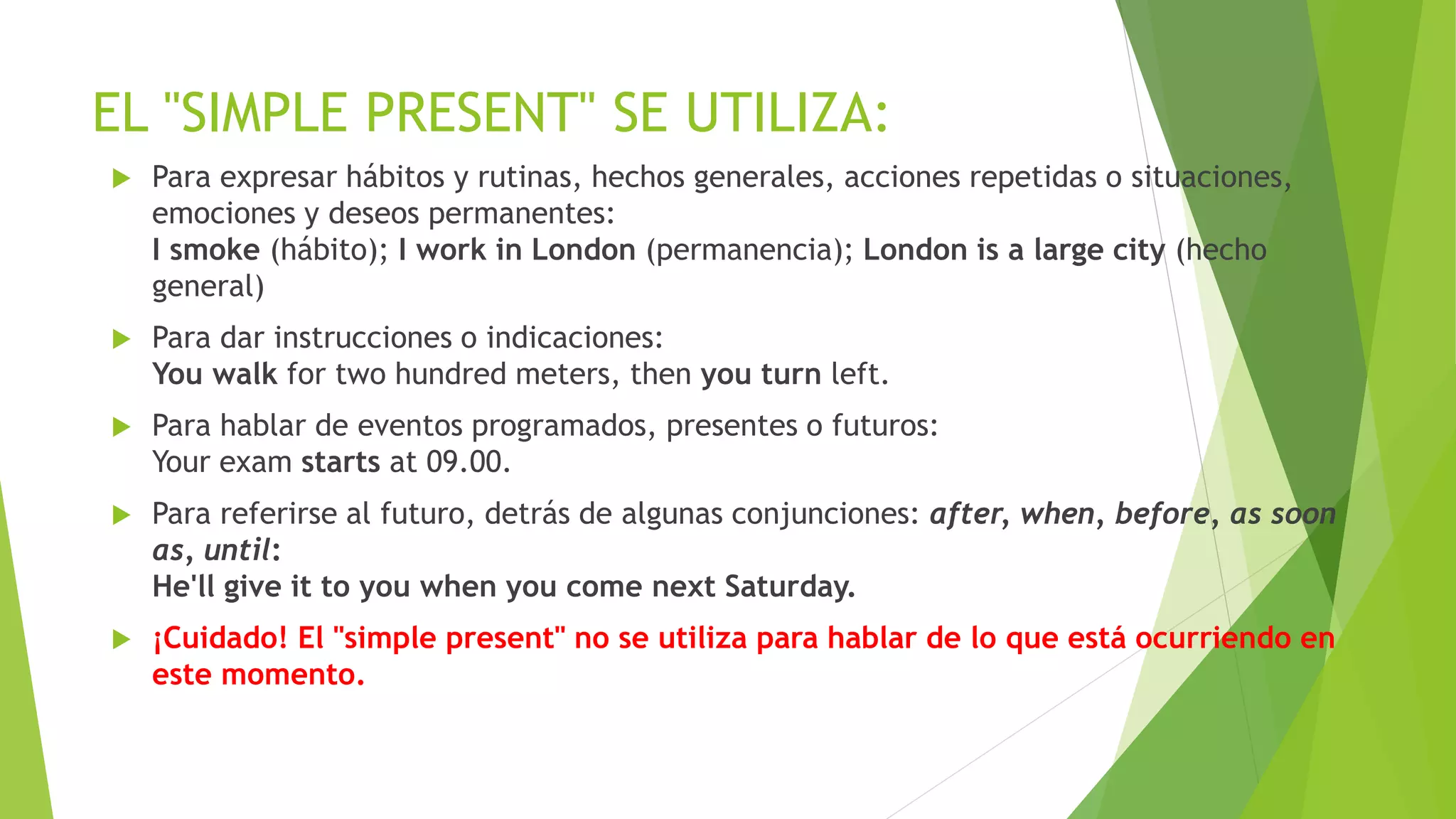
EL "SIMPLE PRESENT" SE UTILIZA:
 Para expresar hábitos y rutinas, hechos generales, acciones repetidas o situaciones,
emociones y deseos permanentes:
I smoke (hábito); I work in London (permanencia); London is a large city (hecho
general)
 Para dar instrucciones o indicaciones:
You walk for two hundred meters, then you turn left.
 Para hablar de eventos programados, presentes o futuros:
Your exam starts at 09.00.
 Para referirse al futuro, detrás de algunas conjunciones: after, when, before, as soon
as, until:
He'll give it to you when you come next Saturday.
 ¡Cuidado! El "simple present" no se utiliza para hablar de lo que está ocurriendo en
este momento.
EJEMPLOS
 Hábitos y rutinas
He drinks tea at breakfast.
She only eats fish.
They watch television regularly.
 Eventos y acciones repetidos
We catch the bus every morning.
It rains every afternoon in the hot season.
They drive to Monaco every summer.
 Hechos generales
Water freezes at zero degrees.
The Earth revolves around the Sun.
Her mother is Peruvian.
 Instrucciones o indicaciones
Open the packet and pour the contents into hot water.
You take the No.6 bus to Watney and then the No.10 to Bedford.
 Eventos programados
His mother arrives tomorrow.
Our holiday starts on the 26th March
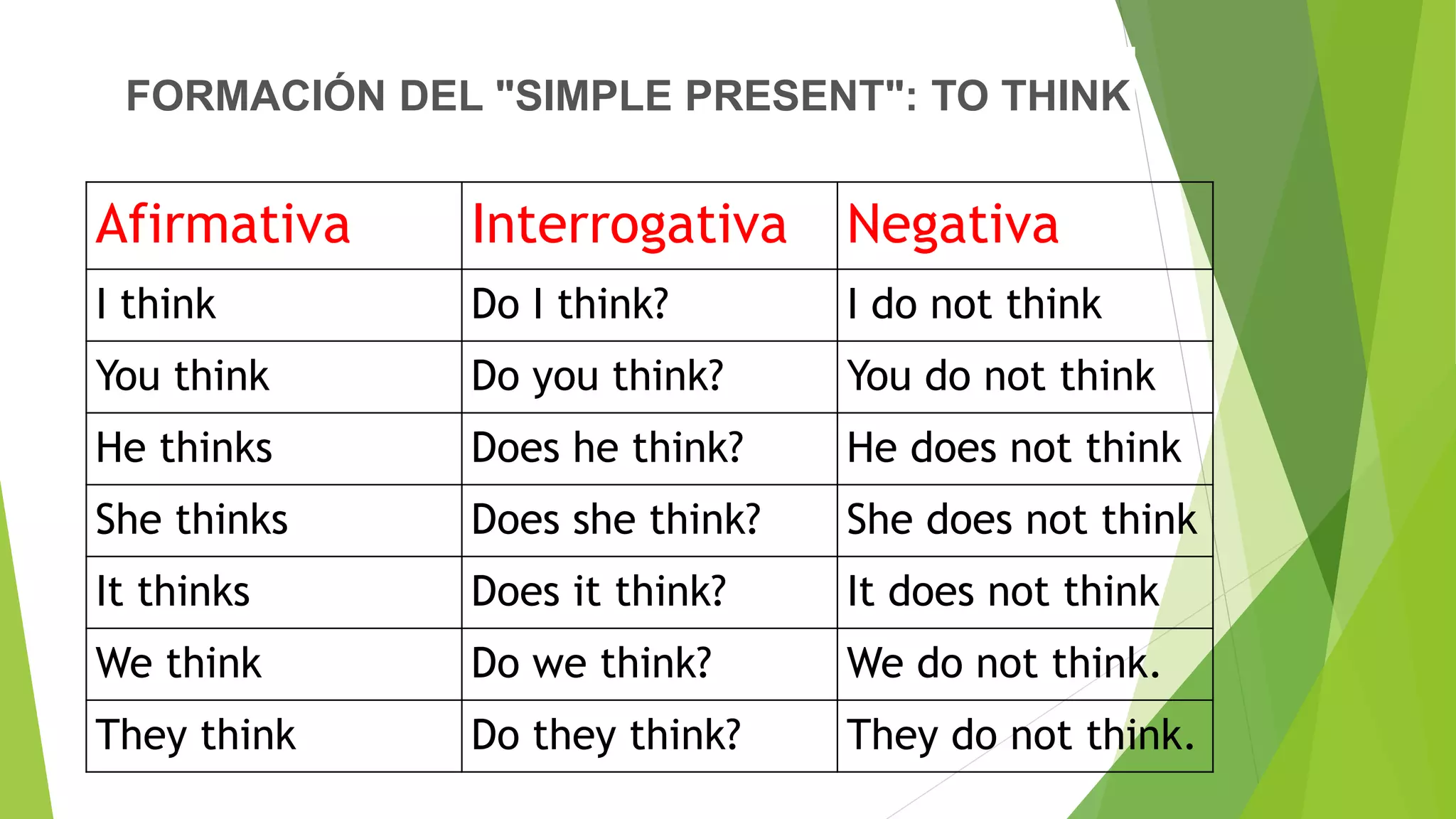
Afirmativa Interrogativa Negativa
I think Do I think? I do not think
You think Do you think? You do not think
He thinks Does he think? He does not think
She thinks Does she think? She does not think
It thinks Does it think? It does not think
We think Do we think? We do not think.
They think Do they think? They do not think.
FORMACIÓN DEL "SIMPLE PRESENT": TO THINK
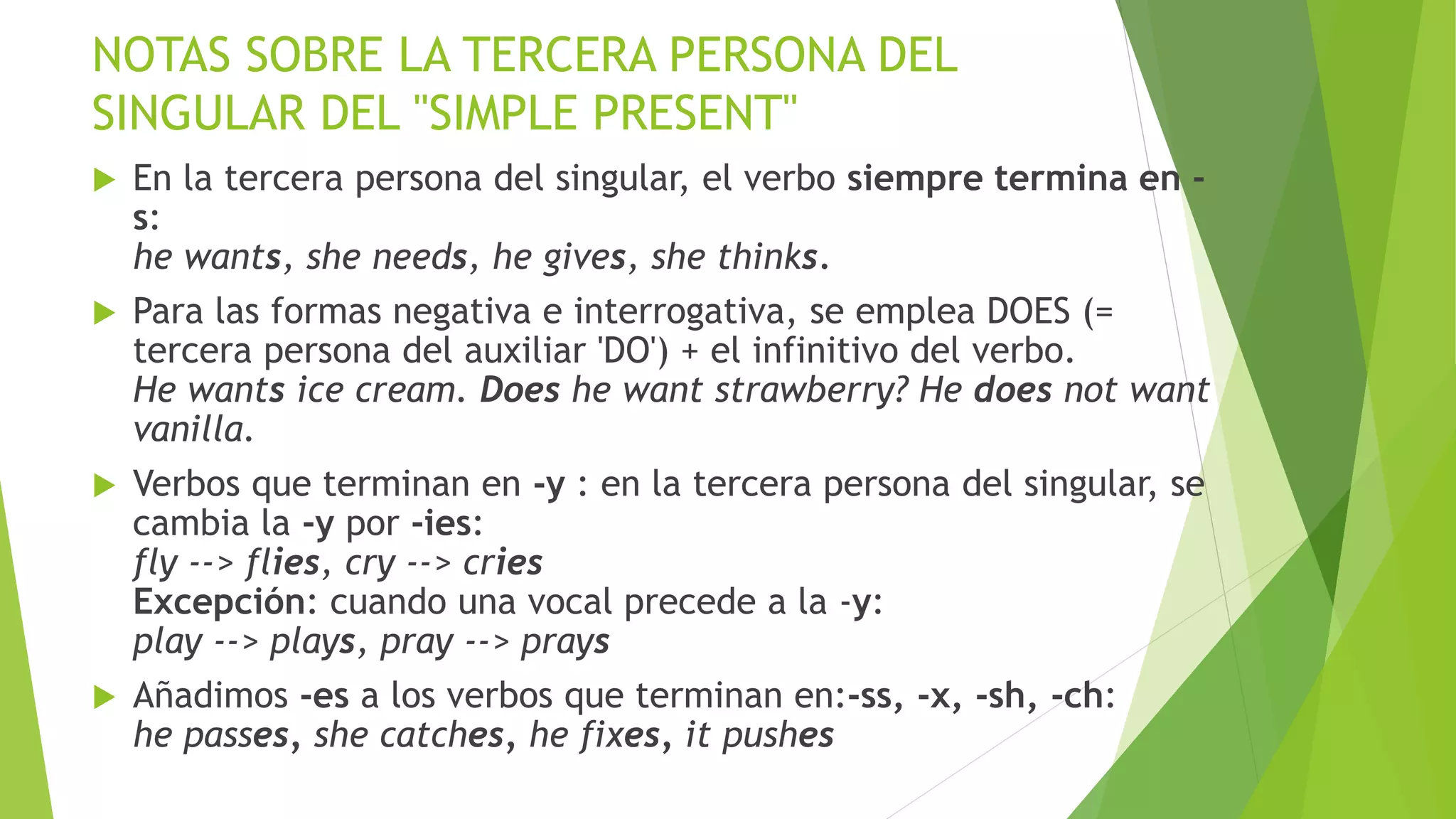
NOTAS SOBRE LA TERCERA PERSONA DEL
SINGULAR DEL "SIMPLE PRESENT"
 En la tercera persona del singular, el verbo siempre termina en -
s:
he wants, she needs, he gives, she thinks.
 Para las formas negativa e interrogativa, se emplea DOES (=
tercera persona del auxiliar 'DO') + el infinitivo del verbo.
He wants ice cream. Does he want strawberry? He does not want
vanilla.
 Verbos que terminan en -y : en la tercera persona del singular, se
cambia la -y por -ies:
fly --> flies, cry --> cries
Excepción: cuando una vocal precede a la -y:
play --> plays, pray --> prays
 Añadimos -es a los verbos que terminan en:-ss, -x, -sh, -ch:
he passes, she catches, he fixes, it pushes
EJEMPLOS
 He goes to school every morning.
 She understands English.
 It mixes the sand and the water.
 He tries very hard.
 She enjoys playing the piano.

Present simple

  • 1.
  • 2.
    EL "SIMPLE PRESENT"SE UTILIZA:  Para expresar hábitos y rutinas, hechos generales, acciones repetidas o situaciones, emociones y deseos permanentes: I smoke (hábito); I work in London (permanencia); London is a large city (hecho general)  Para dar instrucciones o indicaciones: You walk for two hundred meters, then you turn left.  Para hablar de eventos programados, presentes o futuros: Your exam starts at 09.00.  Para referirse al futuro, detrás de algunas conjunciones: after, when, before, as soon as, until: He'll give it to you when you come next Saturday.  ¡Cuidado! El "simple present" no se utiliza para hablar de lo que está ocurriendo en este momento.
  • 3.
    EJEMPLOS  Hábitos yrutinas He drinks tea at breakfast. She only eats fish. They watch television regularly.  Eventos y acciones repetidos We catch the bus every morning. It rains every afternoon in the hot season. They drive to Monaco every summer.  Hechos generales Water freezes at zero degrees. The Earth revolves around the Sun. Her mother is Peruvian.
  • 4.
     Instrucciones oindicaciones Open the packet and pour the contents into hot water. You take the No.6 bus to Watney and then the No.10 to Bedford.  Eventos programados His mother arrives tomorrow. Our holiday starts on the 26th March
  • 5.
    Afirmativa Interrogativa Negativa Ithink Do I think? I do not think You think Do you think? You do not think He thinks Does he think? He does not think She thinks Does she think? She does not think It thinks Does it think? It does not think We think Do we think? We do not think. They think Do they think? They do not think. FORMACIÓN DEL "SIMPLE PRESENT": TO THINK
  • 6.
    NOTAS SOBRE LATERCERA PERSONA DEL SINGULAR DEL "SIMPLE PRESENT"  En la tercera persona del singular, el verbo siempre termina en - s: he wants, she needs, he gives, she thinks.  Para las formas negativa e interrogativa, se emplea DOES (= tercera persona del auxiliar 'DO') + el infinitivo del verbo. He wants ice cream. Does he want strawberry? He does not want vanilla.  Verbos que terminan en -y : en la tercera persona del singular, se cambia la -y por -ies: fly --> flies, cry --> cries Excepción: cuando una vocal precede a la -y: play --> plays, pray --> prays  Añadimos -es a los verbos que terminan en:-ss, -x, -sh, -ch: he passes, she catches, he fixes, it pushes
  • 7.
    EJEMPLOS  He goesto school every morning.  She understands English.  It mixes the sand and the water.  He tries very hard.  She enjoys playing the piano.