48 Asia Pacific Metalworking Equipment News | OCTOBER 2022
INDUSTRY FOCUS
PREDICTIVE MAINTENANCE
IN OIL & GAS INDUSTRY: THE
COMPLETE GUIDE
Lenden Vaz, Vice President for Energy & Utilities at Birlasoft takes
APMEN through on ensuring smooth operations.
T
he oil and gas industry uses old machinery — at
least 15 years old for its upstream, midstream,
and downstream operations. So, periodic
inspection and maintenance activities are essential
to keep them operational. However, such reactive
maintenance doesn’t offer any guarantees against
unplanned downtime.
Using predictive maintenance, oil and gas companies
can rely on IIoT-enabled technology, such as sensor data,
and leverage predictive analytics for real-time equipment
inspection. This helps predict maintenance requirements,
which cuts maintenance costs and reduces unplanned
equipment failures.
Why is Predictive Maintenance so Important in
the Oil and Gas Industry?
An average oil and gas company goes through at least 27
days of unplanned downtime each year, costing US$38
million. Even if the downtime lasts for just 3.65 days, the
resulting losses can be as high as US$5 million.
That’s why predictive maintenance is so important.
Sophisticated predictive maintenance technologies
49
Asia Pacific Metalworking Equipment News | OCTOBER 2022
INDUSTRY FOCUS
Oil & Gas Vessel Maintenance &
Monitoring
Real-time data collection and aggregation helps
oil and gas companies boost overall vessel efficiency by
continuously monitoring operations, tracking KPIs, and
raising alarms whenever they drop. When paired with
advanced analytics, modern predictive maintenance
systems can simulate scenarios involving weather risks or
other environmental conditions and act as early warning
systems to minimise risks and equipment damage. As a
result, oil and gas companies can run safe, streamlined,
and efficient operations.
Virtual Rig Monitoring
According to McKinsey, a typical oil and gas
offshore platform runs at 77 percent of its
maximum capacity, causing a shortfall of 10 million
barrels a day or US$200 billion in annual revenue. That’s
because control room operations at oil rigs are complex,
involving analysis of copious amounts of data — 30,000
sensors — and other factors affecting production, such
as wave heights or humidity.
The systems that support the crew aren’t built for
real-time data capture and analysis and can run limited
simulations. Predictive maintenance systems powered
by IoT and AI can analyse real-time data from all 30,000
sensors to find patterns that can be used to develop
algorithms to track potential issues.
The data and reports from these systems can
be accessed virtually. So, rig operators can monitor
use artificial intelligence, machine learning, and advanced
analytics to spot issues and alert the relevant technicians,
preventing potential equipment failure and safety risks.
According to a McKinsey report, an offshore oil and gas
company used a predictive maintenance solution to
reduce downtime by 20 percent, leading to a production
increase of more than 500,000 oil barrels annually.
How Does Predictive Maintenance Work?
Predictive maintenance technologies aggregate vast
amounts of real-time operational data from sensors
regarding equipment thermography, lubrication, circuitry,
and more with data from other sources — ERP or MES —
to spot patterns. IoT and AI facilitate such real-time data
collection and monitoring automatically. Using machine
learning algorithms and analytics, the software tracks
the wear and tear of oil and gas equipment to predict
potential failures and recommends precise maintenance
tasks to fix anomalies, increase production, and prevent
costly breakdowns.
For instance, if a machine crosses its pressure and
temperature threshold, the system triggers an alarm.
More sophisticated systems analyse sensor data to
spot the signatures of known failure modes, according
to McKinsey.
Oil and Gas Predictive Maintenance Use Cases
Let’s look at some predictive maintenance use cases
in the oil and gas industry — from exploration and
production to storage and processing.
1. Oil & Gas Pump Condition Monitoring
2. Oil & Gas Vessel Maintenance & Monitoring
3. Virtual Rig Monitoring
4. Tank Pressure Monitoring
5. Machinery Condition Monitoring System and Asset
Protection
6. Plant Performance Monitoring
7. Pipeline Monitoring
8. Drill Corrosion Detection and Maintenance
Oil & Gas Pump Condition Monitoring
Predictive maintenance solutions track a gas
pump’s flow, power, vibration, and other key
variables in near real-time to look for issues such
as leakage. These solutions generate automated
reports on pump conditions and alert the relevant
technicians whenever the performance drops below
the benchmark.
Moreover, since the solution collects historical data
on the pump’s performance, oil and gas companies can
use them along with the real-time data to run simulations
of potential failure scenarios. This helps the companies
stay prepared for future maintenance activities and
perform process improvements that improve the pump’s
performance and efficiency.
50 Asia Pacific Metalworking Equipment News | OCTOBER 2022
INDUSTRY FOCUS
production remotely, spot bottlenecks, and initiate
predictive repairs to ensure smooth and uninterrupted
rig operation.
Tank Pressure Monitoring
Monitoring the tank pressure is essential to
protect workers, preserve the integrity of the
tank’s contents, and reduce emissions to comply with
increasingly tightening environmental regulations. In
addition, the liquid and temperature changes make it
necessary to monitor the tank pressure continuously.
Real-time monitoring using predictive maintenance
solutions and IoT tank sensors for ullage, pressure,
temperature, or discharging rate can tackle these
challenges and manage tank pressure changes effectively.
As a result, oil and gas companies can ensure rapid
response in performance fluctuations, higher emissions,
potential oxidation, or imminent equipment failure.
Machinery Condition Monitoring
System and Asset Protection
The machinery used in oil drilling operates at
different speeds and vibrations and consumes different
amounts of power. For instance, thrusters used in drilling
change their load and speed dynamically. Mud pumps have
a complex vibration signature, which must be spotted and
separated from the other equipment to track trends, assess
diagnostics, fire off alarms whenever there’s an issue.
Moreover, the machinery at the heart of the drilling
operation must be well-maintained, and any repairs
to parts must be done without warranting expensive
replacements or unscheduled downtime.
Ensuring optimal machinery condition in such a
dynamic environment requires real-time tracking and
monitoring all the equipment simultaneously, which are
the core strengths of predictive maintenance software.
Plant Performance Monitoring
IoT in oil and gas industry has fuelled predictive
maintenance and made plants more efficient and
boosted their availability. For instance, using sensors for
pressure, temperature, vibration, corrosion, and flow can
help track the performance of everything from pumps,
motors, and valves to generators and cooling towers.
Coupled with predictive analytics and data science,
predictive maintenance systems can track abnormalities
in the plant’s operations, investigate root causes of
production bottlenecks, and assess failure modes
automatically and in real-time.
IoT Pipeline Monitoring
Crude oil and natural gas pipelines span long
distances, bringing them under the scrutiny of
numerous regulations to ensure operational efficiency
and personnel safety. Flaws in these pipelines can lead
to accidents such as explosions or leakages and cause
significant environmental damage.
That’s where real-time pipeline monitoring can help.
With continuous monitoring and tracking of essential
KPIs, oil and gas companies can immediately respond to
potential issues and fix them as they occur, which reduces
the likelihood of unplanned shutdowns and subsequent
revenue losses.
Drill Corrosion Detection and
Maintenance
The global cost of corrosion is US$2.5 trillion,
and corrosion control techniques can save oil and
gas companies anywhere between $375-875 billion
annually. Corrosion occurs when metal is exposed
to electrochemical during drilling operations. While
corrosion inhibiting alloys in equipment help mitigate
the damage, it isn’t foolproof because of the challenges
presented by the oil wells. That’s why equipping drilling
equipment with corrosion detection sensors can
facilitate early detection and repairs.
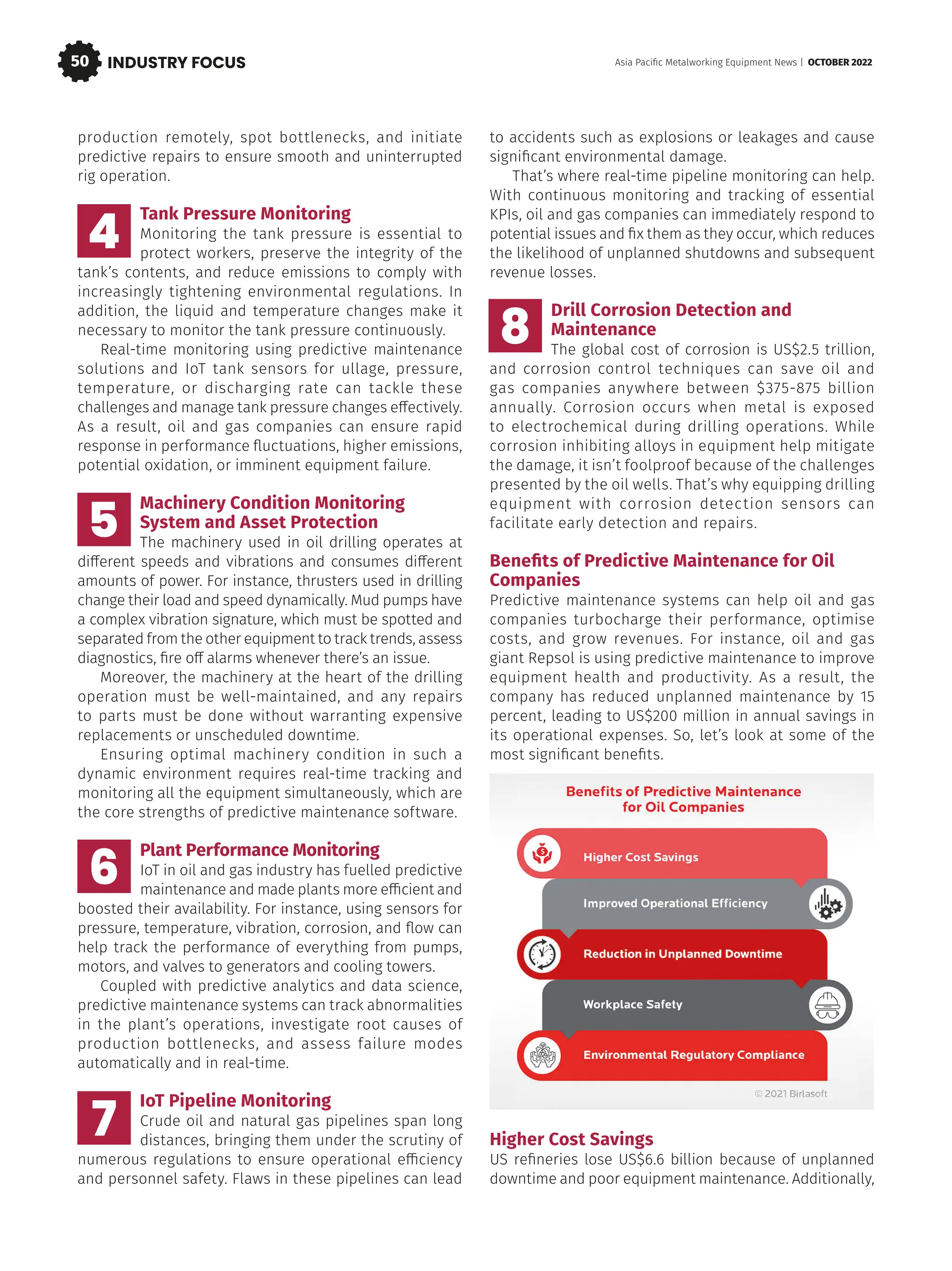
Benefits of Predictive Maintenance for Oil
Companies
Predictive maintenance systems can help oil and gas
companies turbocharge their performance, optimise
costs, and grow revenues. For instance, oil and gas
giant Repsol is using predictive maintenance to improve
equipment health and productivity. As a result, the
company has reduced unplanned maintenance by 15
percent, leading to US$200 million in annual savings in
its operational expenses. So, let’s look at some of the
most significant benefits.
Higher Cost Savings
US refineries lose US$6.6 billion because of unplanned
downtime and poor equipment maintenance. Additionally,
51
Asia Pacific Metalworking Equipment News | OCTOBER 2022
INDUSTRY FOCUS
unwarranted yet routine inspections, which are standard
in reactive maintenance, are also costly. That’s where
predictive maintenance can provide significant cost savings
since it operates on the premise that maintenance should
only be performed when the performance has decreased
or there’s a chance of impending equipment failure.
Improved Operational Efficiency
Predictive maintenance systems make maintenance
more efficient, as technicians can use a single,
centralised dashboard to track and monitor all the
performance of all assets in real-time, regardless of the
location. This boosts the overall operational efficiency
of oil and gas operations.
Reduction in Unplanned Downtime
As mentioned earlier, even four days of unplanned
downtime can cost millions. However, using predictive
maintenance, oil and gas companies can develop machine
learning algorithms that, for instance, predict failures
in gas compressor trains with over 70 percent accuracy,
making these systems more reliable and less prone to
unplanned downtime.
Workplace Safety
During extraction processes, workers can be affected by
toxic emissions. Additionally, since several oil and gas
operations occur in remote locations, sudden equipment
breakdown can jeopardise employee health and safety.
Oil and gas companies can reduce the risks of such
hazards and conduct safer operations using predictive
maintenance. Moreover, they can tap into predictive
analytics to identify potential natural gas sources with
greater accuracy.
Environmental Regulatory Compliance
The oil and gas industry faces increasing regulatory pressure
to reduce emissions, leakages, and other environmental
hazards. For instance, the US oil and gas companies
release 1 million tons of methane gas into the environment.
IIoT-powered technologies can help companies spot and
intervene before another pipeline leak occurs. They can
also map energy usage patterns to identify ways of making
the operations more energy efficient.
How to Build Your Predictive Maintenance
Strategy
Accurate predictions and forecasting warrant
high-quality, useful, and actionable data. That’s why
the success of any predictive maintenance strategy
relies on an organisation’s master data management
and governance frameworks. At the same time, oil
and gas companies must establish a robust analytics
infrastructure capable of processing and storing large
volumes of big data.
The next step is to get buy-in from the senior leadership
by demonstrating the value of predictive maintenance and
decision-making driven by analytics. That’s where tying the
outcomes of predictive maintenance initiatives with the
overall strategic initiatives comes in handy.
This should be followed by substantial investments
in hiring the right experts — data scientists and analysts
and the relevant predictive maintenance technologies to
build analytics models that generate real value.
The Future of Oil & Gas Industry
Predictive maintenance has the potential to generate
substantial cost savings for the oil and gas industry. For
example, IoT solutions can increase production by 25
percent. Additionally, they can reduce maintenance costs
by 30 percent and equipment downtime by 45 percent.
That’s why oil and gas giants such as Shell, ExxonMobil,
BP, Chevron are already tapping into technologies
powered by AI and IoT, such as predictive maintenance, to
cut costs and boost efficiency. However, while predictive
maintenance looks promising for the oil and gas industry,
it’s just one aspect on the path to complete digital
transformation in the oil and gas world.
MakeAn EnquiryAt:
equipment-news.com/
contact-us
EDITORIAL
GOT A QUESTION?
ABOUT THE AUTHOR
Lenden Vaz is presently working
as Vice President with Birlasoft
Limited and is looking after the
Energy and Utilities business
of the enterprise. Based in the
US, he has more than 25 years
of experience. Prior to joining
Birlasoft, he was associated
with SYSTIME Computer Systems India Ltd. as an
Engagement Manager. Vaz graduated with a Bachelor of
Engineering in Instrumentation Engineering from Bharti
Vidyapeeth in 1998.

predictive-maintenance-in-oil-gas-Industry.pdf

  • 1.
    48 Asia PacificMetalworking Equipment News | OCTOBER 2022 INDUSTRY FOCUS PREDICTIVE MAINTENANCE IN OIL & GAS INDUSTRY: THE COMPLETE GUIDE Lenden Vaz, Vice President for Energy & Utilities at Birlasoft takes APMEN through on ensuring smooth operations. T he oil and gas industry uses old machinery — at least 15 years old for its upstream, midstream, and downstream operations. So, periodic inspection and maintenance activities are essential to keep them operational. However, such reactive maintenance doesn’t offer any guarantees against unplanned downtime. Using predictive maintenance, oil and gas companies can rely on IIoT-enabled technology, such as sensor data, and leverage predictive analytics for real-time equipment inspection. This helps predict maintenance requirements, which cuts maintenance costs and reduces unplanned equipment failures. Why is Predictive Maintenance so Important in the Oil and Gas Industry? An average oil and gas company goes through at least 27 days of unplanned downtime each year, costing US$38 million. Even if the downtime lasts for just 3.65 days, the resulting losses can be as high as US$5 million. That’s why predictive maintenance is so important. Sophisticated predictive maintenance technologies
  • 2.
    49 Asia Pacific MetalworkingEquipment News | OCTOBER 2022 INDUSTRY FOCUS Oil & Gas Vessel Maintenance & Monitoring Real-time data collection and aggregation helps oil and gas companies boost overall vessel efficiency by continuously monitoring operations, tracking KPIs, and raising alarms whenever they drop. When paired with advanced analytics, modern predictive maintenance systems can simulate scenarios involving weather risks or other environmental conditions and act as early warning systems to minimise risks and equipment damage. As a result, oil and gas companies can run safe, streamlined, and efficient operations. Virtual Rig Monitoring According to McKinsey, a typical oil and gas offshore platform runs at 77 percent of its maximum capacity, causing a shortfall of 10 million barrels a day or US$200 billion in annual revenue. That’s because control room operations at oil rigs are complex, involving analysis of copious amounts of data — 30,000 sensors — and other factors affecting production, such as wave heights or humidity. The systems that support the crew aren’t built for real-time data capture and analysis and can run limited simulations. Predictive maintenance systems powered by IoT and AI can analyse real-time data from all 30,000 sensors to find patterns that can be used to develop algorithms to track potential issues. The data and reports from these systems can be accessed virtually. So, rig operators can monitor use artificial intelligence, machine learning, and advanced analytics to spot issues and alert the relevant technicians, preventing potential equipment failure and safety risks. According to a McKinsey report, an offshore oil and gas company used a predictive maintenance solution to reduce downtime by 20 percent, leading to a production increase of more than 500,000 oil barrels annually. How Does Predictive Maintenance Work? Predictive maintenance technologies aggregate vast amounts of real-time operational data from sensors regarding equipment thermography, lubrication, circuitry, and more with data from other sources — ERP or MES — to spot patterns. IoT and AI facilitate such real-time data collection and monitoring automatically. Using machine learning algorithms and analytics, the software tracks the wear and tear of oil and gas equipment to predict potential failures and recommends precise maintenance tasks to fix anomalies, increase production, and prevent costly breakdowns. For instance, if a machine crosses its pressure and temperature threshold, the system triggers an alarm. More sophisticated systems analyse sensor data to spot the signatures of known failure modes, according to McKinsey. Oil and Gas Predictive Maintenance Use Cases Let’s look at some predictive maintenance use cases in the oil and gas industry — from exploration and production to storage and processing. 1. Oil & Gas Pump Condition Monitoring 2. Oil & Gas Vessel Maintenance & Monitoring 3. Virtual Rig Monitoring 4. Tank Pressure Monitoring 5. Machinery Condition Monitoring System and Asset Protection 6. Plant Performance Monitoring 7. Pipeline Monitoring 8. Drill Corrosion Detection and Maintenance Oil & Gas Pump Condition Monitoring Predictive maintenance solutions track a gas pump’s flow, power, vibration, and other key variables in near real-time to look for issues such as leakage. These solutions generate automated reports on pump conditions and alert the relevant technicians whenever the performance drops below the benchmark. Moreover, since the solution collects historical data on the pump’s performance, oil and gas companies can use them along with the real-time data to run simulations of potential failure scenarios. This helps the companies stay prepared for future maintenance activities and perform process improvements that improve the pump’s performance and efficiency.
  • 3.
    50 Asia PacificMetalworking Equipment News | OCTOBER 2022 INDUSTRY FOCUS production remotely, spot bottlenecks, and initiate predictive repairs to ensure smooth and uninterrupted rig operation. Tank Pressure Monitoring Monitoring the tank pressure is essential to protect workers, preserve the integrity of the tank’s contents, and reduce emissions to comply with increasingly tightening environmental regulations. In addition, the liquid and temperature changes make it necessary to monitor the tank pressure continuously. Real-time monitoring using predictive maintenance solutions and IoT tank sensors for ullage, pressure, temperature, or discharging rate can tackle these challenges and manage tank pressure changes effectively. As a result, oil and gas companies can ensure rapid response in performance fluctuations, higher emissions, potential oxidation, or imminent equipment failure. Machinery Condition Monitoring System and Asset Protection The machinery used in oil drilling operates at different speeds and vibrations and consumes different amounts of power. For instance, thrusters used in drilling change their load and speed dynamically. Mud pumps have a complex vibration signature, which must be spotted and separated from the other equipment to track trends, assess diagnostics, fire off alarms whenever there’s an issue. Moreover, the machinery at the heart of the drilling operation must be well-maintained, and any repairs to parts must be done without warranting expensive replacements or unscheduled downtime. Ensuring optimal machinery condition in such a dynamic environment requires real-time tracking and monitoring all the equipment simultaneously, which are the core strengths of predictive maintenance software. Plant Performance Monitoring IoT in oil and gas industry has fuelled predictive maintenance and made plants more efficient and boosted their availability. For instance, using sensors for pressure, temperature, vibration, corrosion, and flow can help track the performance of everything from pumps, motors, and valves to generators and cooling towers. Coupled with predictive analytics and data science, predictive maintenance systems can track abnormalities in the plant’s operations, investigate root causes of production bottlenecks, and assess failure modes automatically and in real-time. IoT Pipeline Monitoring Crude oil and natural gas pipelines span long distances, bringing them under the scrutiny of numerous regulations to ensure operational efficiency and personnel safety. Flaws in these pipelines can lead to accidents such as explosions or leakages and cause significant environmental damage. That’s where real-time pipeline monitoring can help. With continuous monitoring and tracking of essential KPIs, oil and gas companies can immediately respond to potential issues and fix them as they occur, which reduces the likelihood of unplanned shutdowns and subsequent revenue losses. Drill Corrosion Detection and Maintenance The global cost of corrosion is US$2.5 trillion, and corrosion control techniques can save oil and gas companies anywhere between $375-875 billion annually. Corrosion occurs when metal is exposed to electrochemical during drilling operations. While corrosion inhibiting alloys in equipment help mitigate the damage, it isn’t foolproof because of the challenges presented by the oil wells. That’s why equipping drilling equipment with corrosion detection sensors can facilitate early detection and repairs. Benefits of Predictive Maintenance for Oil Companies Predictive maintenance systems can help oil and gas companies turbocharge their performance, optimise costs, and grow revenues. For instance, oil and gas giant Repsol is using predictive maintenance to improve equipment health and productivity. As a result, the company has reduced unplanned maintenance by 15 percent, leading to US$200 million in annual savings in its operational expenses. So, let’s look at some of the most significant benefits. Higher Cost Savings US refineries lose US$6.6 billion because of unplanned downtime and poor equipment maintenance. Additionally,
  • 4.
    51 Asia Pacific MetalworkingEquipment News | OCTOBER 2022 INDUSTRY FOCUS unwarranted yet routine inspections, which are standard in reactive maintenance, are also costly. That’s where predictive maintenance can provide significant cost savings since it operates on the premise that maintenance should only be performed when the performance has decreased or there’s a chance of impending equipment failure. Improved Operational Efficiency Predictive maintenance systems make maintenance more efficient, as technicians can use a single, centralised dashboard to track and monitor all the performance of all assets in real-time, regardless of the location. This boosts the overall operational efficiency of oil and gas operations. Reduction in Unplanned Downtime As mentioned earlier, even four days of unplanned downtime can cost millions. However, using predictive maintenance, oil and gas companies can develop machine learning algorithms that, for instance, predict failures in gas compressor trains with over 70 percent accuracy, making these systems more reliable and less prone to unplanned downtime. Workplace Safety During extraction processes, workers can be affected by toxic emissions. Additionally, since several oil and gas operations occur in remote locations, sudden equipment breakdown can jeopardise employee health and safety. Oil and gas companies can reduce the risks of such hazards and conduct safer operations using predictive maintenance. Moreover, they can tap into predictive analytics to identify potential natural gas sources with greater accuracy. Environmental Regulatory Compliance The oil and gas industry faces increasing regulatory pressure to reduce emissions, leakages, and other environmental hazards. For instance, the US oil and gas companies release 1 million tons of methane gas into the environment. IIoT-powered technologies can help companies spot and intervene before another pipeline leak occurs. They can also map energy usage patterns to identify ways of making the operations more energy efficient. How to Build Your Predictive Maintenance Strategy Accurate predictions and forecasting warrant high-quality, useful, and actionable data. That’s why the success of any predictive maintenance strategy relies on an organisation’s master data management and governance frameworks. At the same time, oil and gas companies must establish a robust analytics infrastructure capable of processing and storing large volumes of big data. The next step is to get buy-in from the senior leadership by demonstrating the value of predictive maintenance and decision-making driven by analytics. That’s where tying the outcomes of predictive maintenance initiatives with the overall strategic initiatives comes in handy. This should be followed by substantial investments in hiring the right experts — data scientists and analysts and the relevant predictive maintenance technologies to build analytics models that generate real value. The Future of Oil & Gas Industry Predictive maintenance has the potential to generate substantial cost savings for the oil and gas industry. For example, IoT solutions can increase production by 25 percent. Additionally, they can reduce maintenance costs by 30 percent and equipment downtime by 45 percent. That’s why oil and gas giants such as Shell, ExxonMobil, BP, Chevron are already tapping into technologies powered by AI and IoT, such as predictive maintenance, to cut costs and boost efficiency. However, while predictive maintenance looks promising for the oil and gas industry, it’s just one aspect on the path to complete digital transformation in the oil and gas world. MakeAn EnquiryAt: equipment-news.com/ contact-us EDITORIAL GOT A QUESTION? ABOUT THE AUTHOR Lenden Vaz is presently working as Vice President with Birlasoft Limited and is looking after the Energy and Utilities business of the enterprise. Based in the US, he has more than 25 years of experience. Prior to joining Birlasoft, he was associated with SYSTIME Computer Systems India Ltd. as an Engagement Manager. Vaz graduated with a Bachelor of Engineering in Instrumentation Engineering from Bharti Vidyapeeth in 1998.