THE “GOOD LIFE” PART 2:
HEDONIC WELL-BEING
Pre class lecture
WHY IS UNDERSTANDING HEDONIC
WELL-BEING IMPORTANT?
• Aristotle thought the good life was a life of “virtue in action” –that pleasure, when not part of a thoughtfully
chosen virtuous action, was often a distraction (Thus, big proponent of the ‘meaning’ leg of the three legged stool
of well being –and of course, we saw that a meaning orientation contributes to life satisfaction more than a
pleasure orientation)
• BUT – the pleasure we derive from subjective experiences remains important – and most of us both value and
pursue feelings of happiness. Hedonic well-being also ripples outward –impacting physical health, cognitive
creativity, and social engagement.
• Today’s mini-lecture:
• Positive emotions function; adaptation across time; differences in importance across cultures
• In class lecture: positive emotions and health; why studying them is hard; but why boosting them is easy
• Aaaand, positive emotion boosting exercises!
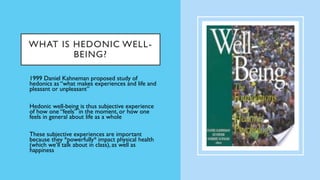
WHAT IS HEDONIC WELL-
BEING?
• 1999 Daniel Kahneman proposed study of
hedonics as “what makes experiences and life and
pleasant or unpleasant”
• Hedonic well-being is thus subjective experience
of how one “feels” in the moment, or how one
feels in general about life as a whole
• These subjective experiences are important
because they *powerfully* impact physical health
(which we’ll talk about in class), as well as
happiness
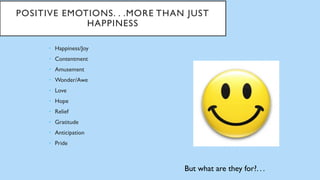
POSITIVE EMOTIONS. . .MORE THAN JUST
HAPPINESS
• Happiness/Joy
• Contentment
• Amusement
• Wonder/Awe
• Love
• Hope
• Relief
• Gratitude
• Anticipation
• Pride
But what are they for?. . .
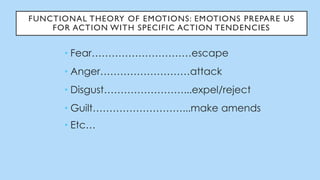
FUNCTIONAL THEORY OF EMOTIONS: EMOTIONS PREPARE US
FOR ACTION WITH SPECIFIC ACTION TENDENCIES
• Fear…………………………escape
• Anger………………………attack
• Disgust……………………...expel/reject
• Guilt………………………...make amends
• Etc…
IT is going to eat
me…
FEAR.
Freeze/Vigilant
attention to find
escape route
IT is going to eat
my child…
ANGER.
Body prepares to
fight off the attack
Tiger I’ve raised
from a baby cub
trusts me enough
to snuggle purring
in my lap. . .
??????
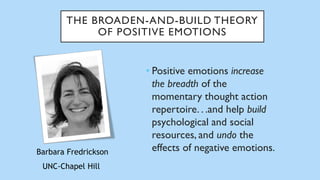
THE BROADEN-AND-BUILD THEORY
OF POSITIVE EMOTIONS
• Positive emotions increase
the breadth of the
momentary thought action
repertoire. . .and help build
psychological and social
resources, and undo the
effects of negative emotions.
Barbara Fredrickson
UNC-Chapel Hill
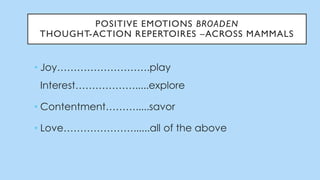
POSITIVE EMOTIONS BROADEN
THOUGHT-ACTION REPERTOIRES –ACROSS MAMMALS
• Joy……………………….play
Interest……………….....explore
• Contentment……….....savor
• Love…………………......all of the above
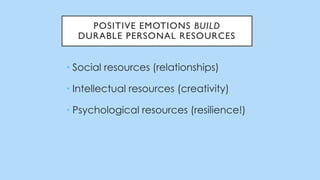
POSITIVE EMOTIONS BUILD
DURABLE PERSONAL RESOURCES
• Social resources (relationships)
• Intellectual resources (creativity)
• Psychological resources (resilience!)
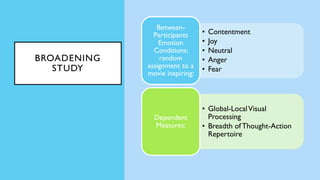
• Contentment
• Joy
• Neutral
• Anger
• Fear
Between-
Participants
Emotion
Conditions:
random
assignment to a
movie inspiring:
• Global-LocalVisual
Processing
• Breadth ofThought-Action
Repertoire
Dependent
Measures:
BROADENING
STUDY
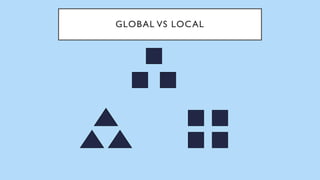
GLOBAL VS LOCAL
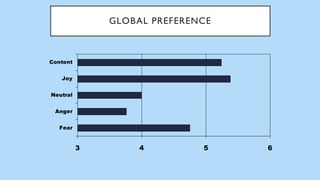
GLOBAL PREFERENCE
3 4 5 6
Fear
Anger
Neutral
Joy
Content
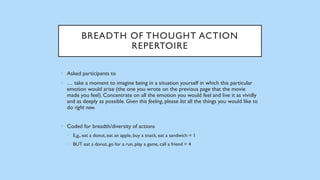
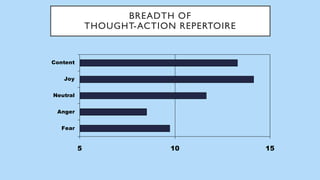
BREADTH OF THOUGHT ACTION
REPERTOIRE
• Asked participants to
• … take a moment to imagine being in a situation yourself in which this particular
emotion would arise (the one you wrote on the previous page that the movie
made you feel). Concentrate on all the emotion you would feel and live it as vividly
and as deeply as possible. Given this feeling, please list all the things you would like to
do right now.
• Coded for breadth/diversity of actions
• E,g,, eat a donut, eat an apple, buy a snack, eat a sandwich = 1
• BUT eat a donut, go for a run, play a game, call a friend = 4
BREADTH OF
THOUGHT-ACTION REPERTOIRE
5 10 15
Fear
Anger
Neutral
Joy
Content
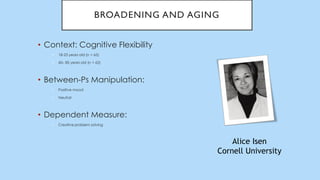
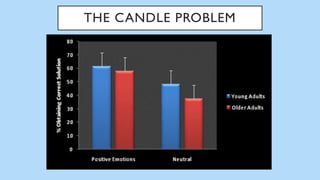
• Context: Cognitive Flexibility
• 18-25 years old (n = 65)
• 60– 85 years old (n = 62)
• Between-Ps Manipulation:
• Positive mood
• Neutral
• Dependent Measure:
• Creative problem solving
Alice Isen
Cornell University
BROADENING AND AGING
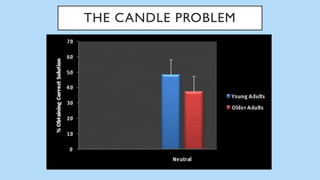
THE CANDLE PROBLEM
Using only the objects shown in the
picture, mount the candle on the wall.
THE CANDLE PROBLEM
THE CANDLE PROBLEM
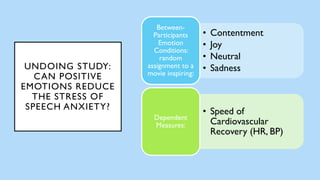
UNDOING STUDY:
CAN POSITIVE
EMOTIONS REDUCE
THE STRESS OF
SPEECH ANXIETY?
• Contentment
• Joy
• Neutral
• Sadness
Between-
Participants
Emotion
Conditions:
random
assignment to a
movie inspiring:
• Speed of
Cardiovascular
Recovery (HR, BP)
Dependent
Measures:
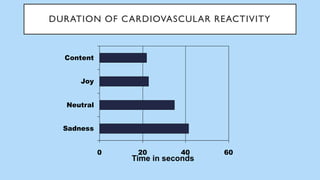
0 20 40 60
Sadness
Neutral
Joy
Content
Time in seconds
DURATION OF CARDIOVASCULAR REACTIVITY
COULD HELP EXPLAIN WHY
POS EMO IS GOOD FOR
HEALTH
• Find out in class! And find out what nuns
have to do with our knowledge base on
this question ☺
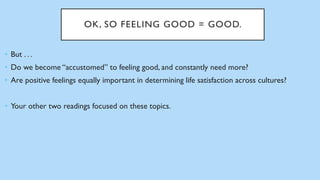
OK, SO FEELING GOOD = GOOD.
• But . . .
• Do we become “accustomed” to feeling good, and constantly need more?
• Are positive feelings equally important in determining life satisfaction across cultures?
• Your other two readings focused on these topics.
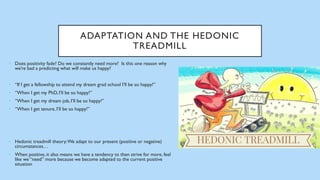
ADAPTATION AND THE HEDONIC
TREADMILL
• Does positivity fade? Do we constantly need more? Is this one reason why
we’re bad a predicting what will make us happy?
• “If I get a fellowship to attend my dream grad school I’ll be so happy!”
• “When I get my PhD, I’ll be so happy!”
• “When I get my dream job, I’ll be so happy!”
• “When I get tenure, I’ll be so happy!”
• Hedonic treadmill theory:We adapt to our present (positive or negative)
circumstances…
• When positive, it also means we have a tendency to then strive for more, feel
like we “need” more because we become adapted to the current positive
situation
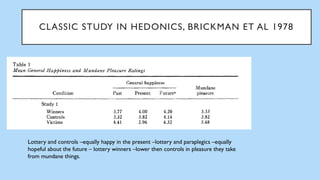
CLASSIC STUDY IN HEDONICS, BRICKMAN ET AL 1978
Lottery and controls –equally happy in the present –lottery and paraplegics –equally
hopeful about the future – lottery winners –lower then controls in pleasure they take
from mundane things.
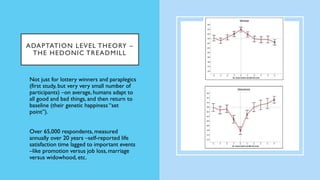
ADAPTATION LEVEL THEORY –
THE HEDONIC TREADMILL
• Not just for lottery winners and paraplegics
(first study, but very very small number of
participants) –on average, humans adapt to
all good and bad things, and then return to
baseline (their genetic happiness “set
point”).
• Over 65,000 respondents, measured
annually over 20 years –self-reported life
satisfaction time lagged to important events
–like promotion versus job loss, marriage
versus widowhood, etc.
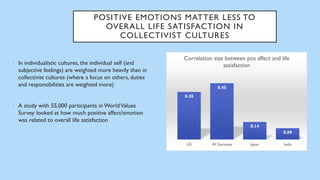
POSITIVE EMOTIONS MATTER LESS TO
OVERALL LIFE SATISFACTION IN
COLLECTIVIST CULTURES
• In individualistic cultures, the individual self (and
subjective feelings) are weighted more heavily than in
collectivist cultures (where a focus on others, duties
and responsibilities are weighted more)
• A study with 55,000 participants in WorldValues
Survey looked at how much positive affect/emotion
was related to overall life satisfaction
0.38
0.45
0.14
0.09
US W Germany Japan India
Correlation size between pos affect and life
satisfaction
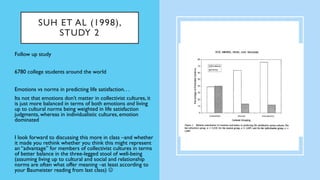
SUH ET AL (1998),
STUDY 2
• Follow up study
• 6780 college students around the world
• Emotions vs norms in predicting life satisfaction. . .
• Its not that emotions don’t matter in collectivist cultures, it
is just more balanced in terms of both emotions and living
up to cultural norms being weighted in life satisfaction
judgments, whereas in individualistic cultures, emotion
dominated
• I look forward to discussing this more in class –and whether
it made you rethink whether you think this might represent
an “advantage” for members of collectivist cultures in terms
of better balance in the three-legged stool of well-being
(assuming living up to cultural and social and relationship
norms are often what offer meaning –at least according to
your Baumeister reading from last class) ☺
HEDONIC EXPERIENCE: IMPORTANT,
BUT HARD TO MEASURE
• Massively important for wellbeing –including even how long we live (we’ll talk about the positive emotion –mortality
association in class)
• Massively important to study – but challenging --not only because adaptation (hedonic treadmill) means people are bad at
forecasting what will make us happy….but also because of memory tricks that mean we can’t even remember what made us
happy in the past! (we’ll talk more about this in class too!)
• See you soon! ☺

Preclass lecture on Hedonics - Positive Psychology

  • 1.
    THE “GOOD LIFE”PART 2: HEDONIC WELL-BEING Pre class lecture
  • 2.
    WHY IS UNDERSTANDINGHEDONIC WELL-BEING IMPORTANT? • Aristotle thought the good life was a life of “virtue in action” –that pleasure, when not part of a thoughtfully chosen virtuous action, was often a distraction (Thus, big proponent of the ‘meaning’ leg of the three legged stool of well being –and of course, we saw that a meaning orientation contributes to life satisfaction more than a pleasure orientation) • BUT – the pleasure we derive from subjective experiences remains important – and most of us both value and pursue feelings of happiness. Hedonic well-being also ripples outward –impacting physical health, cognitive creativity, and social engagement. • Today’s mini-lecture: • Positive emotions function; adaptation across time; differences in importance across cultures • In class lecture: positive emotions and health; why studying them is hard; but why boosting them is easy • Aaaand, positive emotion boosting exercises!
  • 3.
    WHAT IS HEDONICWELL- BEING? • 1999 Daniel Kahneman proposed study of hedonics as “what makes experiences and life and pleasant or unpleasant” • Hedonic well-being is thus subjective experience of how one “feels” in the moment, or how one feels in general about life as a whole • These subjective experiences are important because they *powerfully* impact physical health (which we’ll talk about in class), as well as happiness
  • 4.
    POSITIVE EMOTIONS. ..MORE THAN JUST HAPPINESS • Happiness/Joy • Contentment • Amusement • Wonder/Awe • Love • Hope • Relief • Gratitude • Anticipation • Pride But what are they for?. . .
  • 5.
    FUNCTIONAL THEORY OFEMOTIONS: EMOTIONS PREPARE US FOR ACTION WITH SPECIFIC ACTION TENDENCIES • Fear…………………………escape • Anger………………………attack • Disgust……………………...expel/reject • Guilt………………………...make amends • Etc…
  • 6.
    IT is goingto eat me… FEAR. Freeze/Vigilant attention to find escape route IT is going to eat my child… ANGER. Body prepares to fight off the attack
  • 7.
    Tiger I’ve raised froma baby cub trusts me enough to snuggle purring in my lap. . . ??????
  • 8.
    THE BROADEN-AND-BUILD THEORY OFPOSITIVE EMOTIONS • Positive emotions increase the breadth of the momentary thought action repertoire. . .and help build psychological and social resources, and undo the effects of negative emotions. Barbara Fredrickson UNC-Chapel Hill
  • 9.
    POSITIVE EMOTIONS BROADEN THOUGHT-ACTIONREPERTOIRES –ACROSS MAMMALS • Joy……………………….play Interest……………….....explore • Contentment……….....savor • Love…………………......all of the above
  • 10.
    POSITIVE EMOTIONS BUILD DURABLEPERSONAL RESOURCES • Social resources (relationships) • Intellectual resources (creativity) • Psychological resources (resilience!)
  • 11.
    • Contentment • Joy •Neutral • Anger • Fear Between- Participants Emotion Conditions: random assignment to a movie inspiring: • Global-LocalVisual Processing • Breadth ofThought-Action Repertoire Dependent Measures: BROADENING STUDY
  • 12.
  • 13.
    GLOBAL PREFERENCE 3 45 6 Fear Anger Neutral Joy Content
  • 14.
    BREADTH OF THOUGHTACTION REPERTOIRE • Asked participants to • … take a moment to imagine being in a situation yourself in which this particular emotion would arise (the one you wrote on the previous page that the movie made you feel). Concentrate on all the emotion you would feel and live it as vividly and as deeply as possible. Given this feeling, please list all the things you would like to do right now. • Coded for breadth/diversity of actions • E,g,, eat a donut, eat an apple, buy a snack, eat a sandwich = 1 • BUT eat a donut, go for a run, play a game, call a friend = 4
  • 15.
    BREADTH OF THOUGHT-ACTION REPERTOIRE 510 15 Fear Anger Neutral Joy Content
  • 16.
    • Context: CognitiveFlexibility • 18-25 years old (n = 65) • 60– 85 years old (n = 62) • Between-Ps Manipulation: • Positive mood • Neutral • Dependent Measure: • Creative problem solving Alice Isen Cornell University BROADENING AND AGING
  • 17.
    THE CANDLE PROBLEM Usingonly the objects shown in the picture, mount the candle on the wall.
  • 18.
  • 19.
  • 20.
    UNDOING STUDY: CAN POSITIVE EMOTIONSREDUCE THE STRESS OF SPEECH ANXIETY? • Contentment • Joy • Neutral • Sadness Between- Participants Emotion Conditions: random assignment to a movie inspiring: • Speed of Cardiovascular Recovery (HR, BP) Dependent Measures:
  • 21.
    0 20 4060 Sadness Neutral Joy Content Time in seconds DURATION OF CARDIOVASCULAR REACTIVITY
  • 22.
    COULD HELP EXPLAINWHY POS EMO IS GOOD FOR HEALTH • Find out in class! And find out what nuns have to do with our knowledge base on this question ☺
  • 23.
    OK, SO FEELINGGOOD = GOOD. • But . . . • Do we become “accustomed” to feeling good, and constantly need more? • Are positive feelings equally important in determining life satisfaction across cultures? • Your other two readings focused on these topics.
  • 24.
    ADAPTATION AND THEHEDONIC TREADMILL • Does positivity fade? Do we constantly need more? Is this one reason why we’re bad a predicting what will make us happy? • “If I get a fellowship to attend my dream grad school I’ll be so happy!” • “When I get my PhD, I’ll be so happy!” • “When I get my dream job, I’ll be so happy!” • “When I get tenure, I’ll be so happy!” • Hedonic treadmill theory:We adapt to our present (positive or negative) circumstances… • When positive, it also means we have a tendency to then strive for more, feel like we “need” more because we become adapted to the current positive situation
  • 25.
    CLASSIC STUDY INHEDONICS, BRICKMAN ET AL 1978 Lottery and controls –equally happy in the present –lottery and paraplegics –equally hopeful about the future – lottery winners –lower then controls in pleasure they take from mundane things.
  • 26.
    ADAPTATION LEVEL THEORY– THE HEDONIC TREADMILL • Not just for lottery winners and paraplegics (first study, but very very small number of participants) –on average, humans adapt to all good and bad things, and then return to baseline (their genetic happiness “set point”). • Over 65,000 respondents, measured annually over 20 years –self-reported life satisfaction time lagged to important events –like promotion versus job loss, marriage versus widowhood, etc.
  • 27.
    POSITIVE EMOTIONS MATTERLESS TO OVERALL LIFE SATISFACTION IN COLLECTIVIST CULTURES • In individualistic cultures, the individual self (and subjective feelings) are weighted more heavily than in collectivist cultures (where a focus on others, duties and responsibilities are weighted more) • A study with 55,000 participants in WorldValues Survey looked at how much positive affect/emotion was related to overall life satisfaction 0.38 0.45 0.14 0.09 US W Germany Japan India Correlation size between pos affect and life satisfaction
  • 28.
    SUH ET AL(1998), STUDY 2 • Follow up study • 6780 college students around the world • Emotions vs norms in predicting life satisfaction. . . • Its not that emotions don’t matter in collectivist cultures, it is just more balanced in terms of both emotions and living up to cultural norms being weighted in life satisfaction judgments, whereas in individualistic cultures, emotion dominated • I look forward to discussing this more in class –and whether it made you rethink whether you think this might represent an “advantage” for members of collectivist cultures in terms of better balance in the three-legged stool of well-being (assuming living up to cultural and social and relationship norms are often what offer meaning –at least according to your Baumeister reading from last class) ☺
  • 29.
    HEDONIC EXPERIENCE: IMPORTANT, BUTHARD TO MEASURE • Massively important for wellbeing –including even how long we live (we’ll talk about the positive emotion –mortality association in class) • Massively important to study – but challenging --not only because adaptation (hedonic treadmill) means people are bad at forecasting what will make us happy….but also because of memory tricks that mean we can’t even remember what made us happy in the past! (we’ll talk more about this in class too!) • See you soon! ☺