Pragmatic	
  Plone	
  Projects	
  

     Plone	
  Conference	
  2012	
  
               Arnhem	
  

               Andreas	
  Jung	
  	
  
                ZOPYX	
  Ltd.	
  
     www.zopyx.com,	
  info@zopyx.com	
  
Speaker	
  
•  long-­‐time	
  Python,	
  Zope,	
  	
  
   Plone	
  developer	
  	
  and	
  contributor	
  
•  Lead	
  developer	
  and	
  principal	
  consultant	
  of	
  	
  
   ZOPYX	
  Limited	
  
    –  Zope,	
  Python,	
  Pyramid,	
  Plone	
  projects	
  
    –  large	
  portals,	
  intranet,	
  internet,	
  extranet	
  
    –  Electronic	
  Publishing	
  
    –  complex	
  domain-­‐specific	
  applications	
  	
  
This	
  talk	
  is	
  about	
  
•  practical	
  hints	
  surviving	
  your	
  next	
  	
  
   Plone	
  project	
  
•  best	
  practices	
  
•  lessons	
  learned	
  from	
  our	
  last	
  	
  
   larger	
  Plone	
  project	
  
•  stuff	
  perhaps	
  covered	
  already	
  by	
  the	
  	
  
   Plone	
  trainings	
  
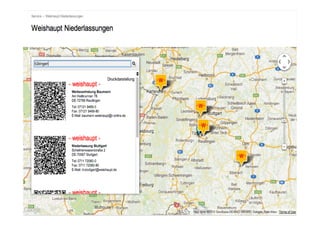
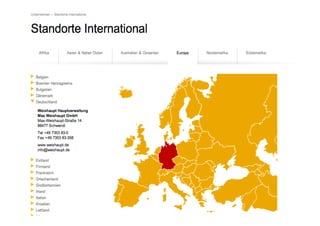
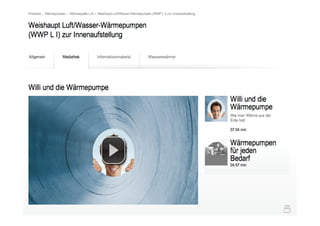
Relaunch	
  weishaupt.de	
  
•  Weishaupt:	
  	
  
    –  major	
  vendor	
  of	
  heating	
  systems	
  
    –  480	
  M€	
  revenue	
  
•  Large	
  company	
  portal	
  on	
  top	
  of	
  Plone	
  4.2	
  
•  Phase	
  1:	
  
    –  implementation	
  and	
  DE	
  content	
  
    –  4	
  months	
  
•  Phase	
  2:	
  
    –  20	
  subsidaries 	
  	
  
    –  more	
  than	
  30	
  languages	
  
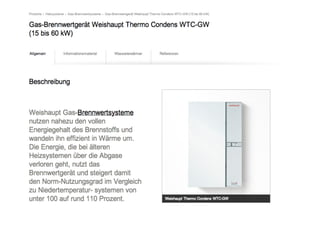
weishaupt.de	
  
weishaupt.de	
  
weishaupt.de	
  
weishaupt.de	
  
weishaupt.de	
  
Project	
  constraints	
  (1/3)	
  

There	
  is	
  no	
  real-­‐world	
  project	
  with	
  

•  unlimited	
  budget	
  

•  unlimited	
  human	
  resources	
  

•  unlimited	
  time	
  
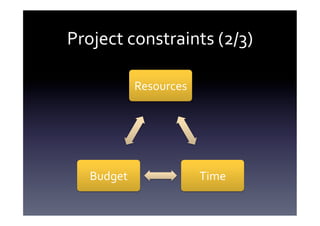
Project	
  constraints	
  (2/3)	
  

                 Resources	


    Budget	
                     Time	
  
Project	
  constraints	
  (3/3)	


Conclusions	
  

•  usually	
  impossible	
  finding	
  the	
  	
  
   „perfect“	
  solution	
  

•  the	
  	
  „perfect“	
  solution	
  is	
  	
  „mission	
  impossible“	
  
Getting	
  things	
  done	
  
•  within	
  a	
  reasonable	
  time-­‐frame	
  

•  on	
  budget	
  

•  with	
  the	
  available	
  human	
  resources	
  
Common	
  customizations	
  
•  Bugs	
  in	
  Plone	
  and	
  3rd-­‐party	
  packages	
  
   are	
  all	
  around	
  you	
  
•  Particular	
  behavior	
  of	
  Plone	
  or	
  3rd-­‐party	
  
   packages	
  is	
  a	
  common	
  project	
  requirement	
  
•  What	
  must	
  be	
  usually	
  customized:	
  
    –  Python	
  code	
  (browser	
  views,	
  skin	
  scripts)	
  
    –  Resources	
  (browser	
  view	
  templates,	
  JS,	
  CSS)	
  
Where	
  to	
  fix	
  things?	
  
•  Package	
  maintainer	
  (Plone	
  and	
  3rd-­‐party)	
  love	
  
      –  bug	
  reports	
  
      –  bug	
  fixes	
  
      –  contributions	
  
•  Stuff	
  on	
  Github:	
  Fork	
  &	
  Pull	
  request	
  
•  SVN	
  repositories:	
  svn	
  branch	
  &	
  svn	
  merge	
  
      –  check	
  if	
  the	
  package	
  is	
  maintained	
  
      –  ask	
  the	
  maintainer	
  for	
  merging	
  your	
  changes	
  or	
  merge	
  yourself	
  
      –  move	
  packages	
  to	
  Github	
  if	
  appropriate	
  
Where	
  and	
  how	
  to	
  	
  
                     customize	
  things?	
  
•  Is	
  your	
  required	
  change	
  of	
  interest	
  for	
  the	
  public?	
  
    –  fork	
  on	
  Github	
  
    –  branch	
  in	
  SVN	
  
    –  speak	
  with	
  the	
  package	
  maintainers	
  

•  Your	
  change	
  satisfies	
  an	
  absurd	
  customer	
  
   request?	
  
    –  keep	
  it	
  for	
  yourself.	
  
(Monkey)	
  Patching	
  Python	
  code	
  
 •  Monkey	
  patching:	
  	
  
    „dynamic	
  modifications	
  of	
  a	
  class	
  or	
  module	
  at	
  runtime“	
  
    (Source:	
  Wikipedia)	
  

 •  MP	
  in	
  general	
  should	
  be	
  considered	
  evil	
  and	
  bad-­‐style	
  
 •  MP	
  may	
  have	
  side-­‐effects	
  
 •  Use	
  MP	
  carefully	
  (and	
  only	
  when	
  you	
  know	
  what	
  you	
  are	
  
    doing)	
  
Monkey	
  patching	
  in	
  Python	
  
      Original	
  (foo.py)	
             Patched	
  version	
  (my_foo.py)	
  
class Foo:!                      def my_bar(self):!
!                                    return 43!
    def bar(self):!              !
           return 42!            from foo import Foo!
                                 Foo.bar = my_bar!
                                 !
                                 # or (needed in some situations)!
                                 !
                                 Foo.bar.func_code = my_bar.func_code!
Monkey	
  patching	
  Plone	
  
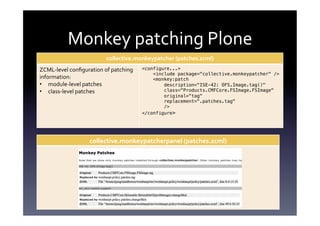
                                   collective.monkeypatcher	
  (patches.zcml)	
  
ZCML-­‐level	
  configuration	
  of	
  patching	
     <configure...>!
                                                         <include package="collective.monkeypatcher" />!
information:	
                                           <monkey:patch!
•  module-­‐level	
  patches	
                               description="ISE-42: OFS.Image.tag()"!
•  class-­‐level	
  patches	
                                class="Products.CMFCore.FSImage.FSImage"!
                                                             original="tag"!
                                                             replacement=".patches.tag"!
                                                             />!
                                                     </configure>!


                          collective.monkeypatcherpanel	
  (patches.zcml)	


Patching	
  resources	
  (1/2)	
  –	
  
                     overrides.zcml	
  
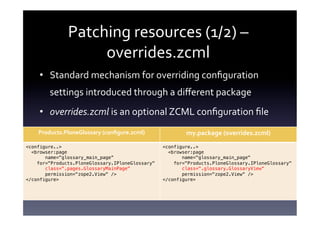
     •  Standard	
  mechanism	
  for	
  overriding	
  configuration	
  
        settings	
  introduced	
  through	
  a	
  different	
  package	
  
     •  overrides.zcml	
  is	
  an	
  optional	
  ZCML	
  configuration	
  file	
  
    Products.PloneGlossary	
  (configure.zcml)	
             my.package	
  (overrides.zcml)	
  
<configure..> !                                     <configure..> !
  <browser:page!                                      <browser:page!
       name="glossary_main_page“         !                 name="glossary_main_page"!
    for="Products.PloneGlossary.IPloneGlossary"!        for="Products.PloneGlossary.IPloneGlossary"!
       class=".pages.GlossaryMainPage"!                    class=".glossary.GlossaryView“!
       permission="zope2.View“ />!                         permission="zope2.View“ />!
</configure>!                                       </configure>!
                                                    !
Patching	
  resources	
  (2/2)	
  –	
  z3c.jbot	
  

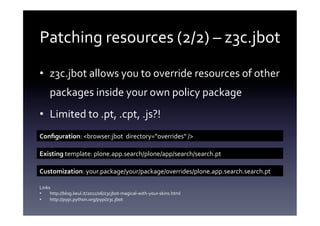
•  z3c.jbot	
  allows	
  you	
  to	
  override	
  resources	
  of	
  other	
  
     packages	
  inside	
  your	
  own	
  policy	
  package	
  
•  Limited	
  to	
  .pt,	
  .cpt,	
  .js?!	
  
Configuration:	
  <browser:jbot	
  	
  directory=“overrides“	
  />	
  

Existing	
  template:	
  plone.app.search/plone/app/search/search.pt	
  

Customization:	
  your.package/your/package/overrides/plone.app.search.search.pt	
  

Links	
  
•    http://blog.keul.it/2011/06/z3cjbot-­‐magical-­‐with-­‐your-­‐skins.html	
  
•    http://pypi.python.org/pypi/z3c.jbot	
  
Unconfigure	
  	
  
                resource	
  configurations	
  
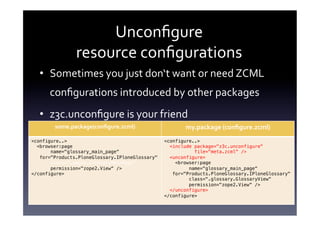
   •  Sometimes	
  you	
  just	
  don‘t	
  want	
  or	
  need	
  ZCML	
  
      configurations	
  introduced	
  by	
  other	
  packages	
  
   •  z3c.unconfigure	
  is	
  your	
  friend	
  
        some.package(configure.zcml)	
                    my.package	
  (configure.zcml)	
  
<configure..> !                                   <configure..> !
  <browser:page!                                    <include package="z3c.unconfigure"     !
       name="glossary_main_page“          !                  file="meta.zcml" />!
   for="Products.PloneGlossary.IPloneGlossary"!     <unconfigure>!
       class=".pages.GlossaryMainPage"!               <browser:page!
       permission="zope2.View“ />!                         name="glossary_main_page“   !
</configure>!                                        for="Products.PloneGlossary.IPloneGlossary"!
                                                           class=".glossary.GlossaryView“!
                                                           permission="zope2.View“ />!
                                                    </unconfigure>!
                                                  </configure>!
                                                  	
  
Extending	
  schemas	
  
Plone	
  comes	
  with	
  two	
  content-­‐type	
  systems	
  
•  Archetypes	
  (old-­‐style)	
  
     –  use	
  archetypes.schemaextender	
  
     –  modify	
  any	
  AT-­‐based	
  content-­‐type	
  
         (modifying	
  fields,	
  adding	
  fields)	
  
     –  SchemaExtender,	
  SchemaModifier	
  
•  Dexterity	
  (new-­‐style)	
  
     –  Dexterity	
  introduces	
  „behaviors“	
  
     –  „A	
  behavior	
  is	
  a	
  re-­‐usable	
  aspect	
  of	
  an	
  object	
  that	
  can	
  be	
  enabled	
  or	
  
         disabled	
  without	
  changing	
  the	
  component	
  registry“	
  	
  
         (Source:	
  Dexterity	
  developer	
  manual)	
  
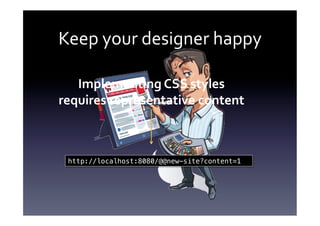
Keep	
  your	
  designer	
  happy	
  

   Implementing	
  CSS	
  styles	
  	
  
requires	
  representative	
  content	


  http://localhost:8080/@@new-site?content=1!
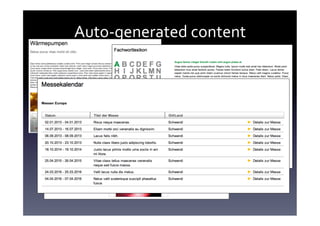
Auto-­‐generated	
  content	
  
Predefined	
  sample	
  content	
  
•  Write	
  a	
  browser	
  view	
  
    –  creating	
  a	
  Plone	
  site	
  with	
  policy	
  package	
  +	
  add-­‐ons	
  
    –  installing	
  the	
  basic	
  site-­‐structure	
  
    –  creating	
  example	
  content	
  for	
  each	
  content-­‐type,	
  content-­‐
       listing	
  etc	
  

•  use	
  http://lorempixel.com/600/400	
  ...	
  
•  look	
  at	
  loremipsum,	
  collective.loremipsum	
  or	
  
   zopyx.ipsumplone	
  
Predefined	
  sample	
  content	
  
•  Throw	
  your	
  sandbox/Plone	
  working	
  site	
  away	
  	
  
   as	
  often	
  as	
  possible	
  
•  sometimes	
  I	
  created	
  30-­‐40	
  new	
  Plone	
  sites	
  per	
  day	
  
•  Pragmatic	
  side-­‐effect	
  
    –  the	
  content	
  fixture	
  code	
  can	
  be	
  used	
  as	
  unit	
  test	
  where	
  all	
  
        your	
  content-­‐types	
  and	
  site-­‐infrastructure	
  is	
  created	
  and	
  
        tested	
  in	
  one	
  run	
  
    –  not	
  the	
  best	
  solution	
  but	
  it	
  works	
  reasonably	
  well	
  
Some	
  good	
  hints	
  
•  Never	
  ever	
  perform	
  customizations	
  in-­‐place	
  in	
  
   existing	
  3rd-­‐party	
  packages.	
  NEVER!!!	
  	
  
•  Customizations	
  always	
  belong	
  into	
  your	
  own	
  
   policy	
  package.	
  
•  Local	
  customizations	
  of	
  3rd-­‐party	
  package	
  will	
  
   be	
  lost	
  with	
  the	
  next	
  version	
  of	
  customized	
  
   package.	
  
Questions?	
  

Pragmatic plone projects

  • 1.
    Pragmatic  Plone  Projects   Plone  Conference  2012   Arnhem   Andreas  Jung     ZOPYX  Ltd.   www.zopyx.com,  info@zopyx.com  
  • 2.
    Speaker   •  long-­‐time  Python,  Zope,     Plone  developer    and  contributor   •  Lead  developer  and  principal  consultant  of     ZOPYX  Limited   –  Zope,  Python,  Pyramid,  Plone  projects   –  large  portals,  intranet,  internet,  extranet   –  Electronic  Publishing   –  complex  domain-­‐specific  applications    
  • 3.
    This  talk  is  about   •  practical  hints  surviving  your  next     Plone  project   •  best  practices   •  lessons  learned  from  our  last     larger  Plone  project   •  stuff  perhaps  covered  already  by  the     Plone  trainings  
  • 4.
    Relaunch  weishaupt.de   • Weishaupt:     –  major  vendor  of  heating  systems   –  480  M€  revenue   •  Large  company  portal  on  top  of  Plone  4.2   •  Phase  1:   –  implementation  and  DE  content   –  4  months   •  Phase  2:   –  20  subsidaries     –  more  than  30  languages  
  • 5.
  • 6.
  • 7.
  • 8.
  • 9.
  • 10.
    Project  constraints  (1/3)   There  is  no  real-­‐world  project  with   •  unlimited  budget   •  unlimited  human  resources   •  unlimited  time  
  • 11.
    Project  constraints  (2/3)   Resources   Budget   Time  
  • 12.
    Project  constraints  (3/3)   Conclusions   •  usually  impossible  finding  the     „perfect“  solution   •  the    „perfect“  solution  is    „mission  impossible“  
  • 13.
    Getting  things  done   •  within  a  reasonable  time-­‐frame   •  on  budget   •  with  the  available  human  resources  
  • 14.
    Common  customizations   • Bugs  in  Plone  and  3rd-­‐party  packages   are  all  around  you   •  Particular  behavior  of  Plone  or  3rd-­‐party   packages  is  a  common  project  requirement   •  What  must  be  usually  customized:   –  Python  code  (browser  views,  skin  scripts)   –  Resources  (browser  view  templates,  JS,  CSS)  
  • 15.
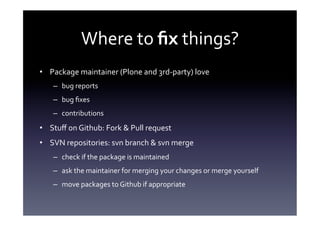
    Where  to  fix  things?   •  Package  maintainer  (Plone  and  3rd-­‐party)  love   –  bug  reports   –  bug  fixes   –  contributions   •  Stuff  on  Github:  Fork  &  Pull  request   •  SVN  repositories:  svn  branch  &  svn  merge   –  check  if  the  package  is  maintained   –  ask  the  maintainer  for  merging  your  changes  or  merge  yourself   –  move  packages  to  Github  if  appropriate  
  • 16.
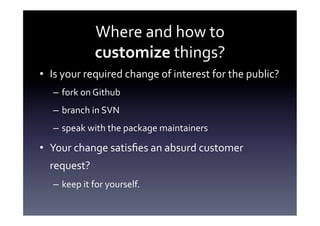
    Where  and  how  to     customize  things?   •  Is  your  required  change  of  interest  for  the  public?   –  fork  on  Github   –  branch  in  SVN   –  speak  with  the  package  maintainers   •  Your  change  satisfies  an  absurd  customer   request?   –  keep  it  for  yourself.  
  • 17.
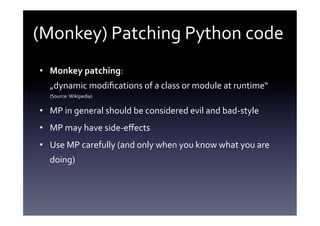
    (Monkey)  Patching  Python  code   •  Monkey  patching:     „dynamic  modifications  of  a  class  or  module  at  runtime“   (Source:  Wikipedia)   •  MP  in  general  should  be  considered  evil  and  bad-­‐style   •  MP  may  have  side-­‐effects   •  Use  MP  carefully  (and  only  when  you  know  what  you  are   doing)  
  • 18.
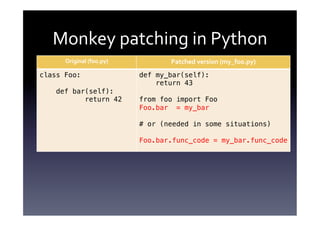
    Monkey  patching  in  Python   Original  (foo.py)   Patched  version  (my_foo.py)   class Foo:! def my_bar(self):! ! return 43! def bar(self):! ! return 42! from foo import Foo! Foo.bar = my_bar! ! # or (needed in some situations)! ! Foo.bar.func_code = my_bar.func_code!
  • 19.
    Monkey  patching  Plone   collective.monkeypatcher  (patches.zcml)   ZCML-­‐level  configuration  of  patching   <configure...>! <include package="collective.monkeypatcher" />! information:   <monkey:patch! •  module-­‐level  patches   description="ISE-42: OFS.Image.tag()"! •  class-­‐level  patches   class="Products.CMFCore.FSImage.FSImage"! original="tag"! replacement=".patches.tag"! />! </configure>! collective.monkeypatcherpanel  (patches.zcml)                
  • 20.
    Patching  resources  (1/2)  –   overrides.zcml   •  Standard  mechanism  for  overriding  configuration   settings  introduced  through  a  different  package   •  overrides.zcml  is  an  optional  ZCML  configuration  file   Products.PloneGlossary  (configure.zcml)   my.package  (overrides.zcml)   <configure..> ! <configure..> ! <browser:page! <browser:page! name="glossary_main_page“ ! name="glossary_main_page"! for="Products.PloneGlossary.IPloneGlossary"! for="Products.PloneGlossary.IPloneGlossary"! class=".pages.GlossaryMainPage"! class=".glossary.GlossaryView“! permission="zope2.View“ />! permission="zope2.View“ />! </configure>! </configure>! !
  • 21.
    Patching  resources  (2/2)  –  z3c.jbot   •  z3c.jbot  allows  you  to  override  resources  of  other   packages  inside  your  own  policy  package   •  Limited  to  .pt,  .cpt,  .js?!   Configuration:  <browser:jbot    directory=“overrides“  />   Existing  template:  plone.app.search/plone/app/search/search.pt   Customization:  your.package/your/package/overrides/plone.app.search.search.pt   Links   •  http://blog.keul.it/2011/06/z3cjbot-­‐magical-­‐with-­‐your-­‐skins.html   •  http://pypi.python.org/pypi/z3c.jbot  
  • 22.
    Unconfigure     resource  configurations   •  Sometimes  you  just  don‘t  want  or  need  ZCML   configurations  introduced  by  other  packages   •  z3c.unconfigure  is  your  friend   some.package(configure.zcml)   my.package  (configure.zcml)   <configure..> ! <configure..> ! <browser:page! <include package="z3c.unconfigure" ! name="glossary_main_page“ ! file="meta.zcml" />! for="Products.PloneGlossary.IPloneGlossary"! <unconfigure>! class=".pages.GlossaryMainPage"! <browser:page! permission="zope2.View“ />! name="glossary_main_page“ ! </configure>! for="Products.PloneGlossary.IPloneGlossary"! class=".glossary.GlossaryView“! permission="zope2.View“ />! </unconfigure>! </configure>!  
  • 23.
    Extending  schemas   Plone  comes  with  two  content-­‐type  systems   •  Archetypes  (old-­‐style)   –  use  archetypes.schemaextender   –  modify  any  AT-­‐based  content-­‐type   (modifying  fields,  adding  fields)   –  SchemaExtender,  SchemaModifier   •  Dexterity  (new-­‐style)   –  Dexterity  introduces  „behaviors“   –  „A  behavior  is  a  re-­‐usable  aspect  of  an  object  that  can  be  enabled  or   disabled  without  changing  the  component  registry“     (Source:  Dexterity  developer  manual)  
  • 24.
    Keep  your  designer  happy   Implementing  CSS  styles     requires  representative  content   http://localhost:8080/@@new-site?content=1!
  • 25.
  • 26.
    Predefined  sample  content   •  Write  a  browser  view   –  creating  a  Plone  site  with  policy  package  +  add-­‐ons   –  installing  the  basic  site-­‐structure   –  creating  example  content  for  each  content-­‐type,  content-­‐ listing  etc   •  use  http://lorempixel.com/600/400  ...   •  look  at  loremipsum,  collective.loremipsum  or   zopyx.ipsumplone  
  • 27.
    Predefined  sample  content   •  Throw  your  sandbox/Plone  working  site  away     as  often  as  possible   •  sometimes  I  created  30-­‐40  new  Plone  sites  per  day   •  Pragmatic  side-­‐effect   –  the  content  fixture  code  can  be  used  as  unit  test  where  all   your  content-­‐types  and  site-­‐infrastructure  is  created  and   tested  in  one  run   –  not  the  best  solution  but  it  works  reasonably  well  
  • 28.
    Some  good  hints   •  Never  ever  perform  customizations  in-­‐place  in   existing  3rd-­‐party  packages.  NEVER!!!     •  Customizations  always  belong  into  your  own   policy  package.   •  Local  customizations  of  3rd-­‐party  package  will   be  lost  with  the  next  version  of  customized   package.  
  • 29.