Andreas Jung • info@zopyx.com • www.zopyx.com • www.andreas-jung.com
zopyx-fastapi-auth
An opinionated security solution for FastAPI
Agenda
• Introduction to FastAPI
• Quick intro intro authentication and authorization
• Key concepts of fastapi-auth
• Integration and usage in FastAPI
• Pluggable user source architecture
• User management
• Demo time
• Q & A
Publishing developer & consultant
since mid-90s
https://www.zopyx.com
https://andreas-jung.com
✉ info@zopyx.com
Funder of print-css.rocks project
Independent PrintCSS consulting
- Software developer & software architect
- Requirements engineering
- Python developer & Python expert
- NGOs, EDU
- medical & pharmaceutical
- energy
- research & development quantum mechanics
- CMS Solutions
- Publishing Solutions
- Individual software solutions
About me
Introduction to FastAPI
What is FastAPI?
FastAPI is a modern, fast (high-performance), web framework
for building APIs with Python 3 based on standard Python type
hints and the data-validation framework Pydantic.
from fastapi import FastAPI
app = FastAPI()
@app.get("/")
def read_root():
return {"Hello": "World"}
@app.get("/items/{item_id}")
def read_item(item_id: int, q: str = None):
return {"item_id": item_id, "q": q}
if __name__ == "__main__":
import uvicorn
uvicorn.run(app, host="0.0.0.0", port=8000)
Reasons for using FastAPI
• Use of Pydantic
FastAPI uses Pydantic for data validation and serialization, ensuring robust input and output
handling.
• Full Async Support
FastAPI supports asynchronous programming, enabling high-performance and efficient request
handling.
• Automatic OpenAPI Generation
FastAPI automatically generates OpenAPI documentation, simplifying API development and testing.
• It is Fast
FastAPI is optimized for speed, making it one of the fastest web frameworks available.
• High Adoption Rate
FastAPI’s growing popularity and community support make it a reliable choice for modern web
development.
Authentication Authorization
What is authentication?
• Authentication verifies the identity of a user, device,
or entity.
• It uses credentials like username + passwords,
biometrics, or security tokens.
• This ensures only authorized access to
sensitive information or resources.
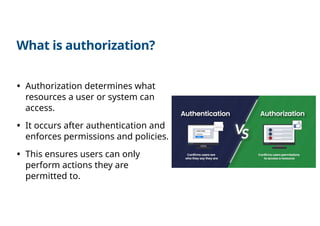
What is authorization?
• Authorization determines what
resources a user or system can
access.
• It occurs after authentication and
enforces permissions and policies.
• This ensures users can only
perform actions they are
permitted to.
zopyx-fastapi-auth
An opinionated authentication solution for FastAPI
Why zopyx-fastapi-auth
…when there are already many other solutions!?
• Usecase
Migration of a CMS Plone-based application from Plone
to FastAPI for the University of Saarbrücken.
• Problem
• None of the existing authentication frameworks for FastAPI has fit our needs
• No direct translation of security concepts of the legacy system
available for FastAPI
• Transparent authentication against three different
user sources (local, SAP, LDAP)
Concepts: Permissions
An access right that defines what actions a user or role can
perform, such as viewing, editing, or deleting resources
within an application.
Permissions are defined as code.
from fastapi_auth.permissions import Permission
VIEW_PERMISSION = Permission(name="view", description="View permission")
EDIT_PERMISSION = Permission(name="edit", description="Edit permission")
DELETE_PERMISSION = Permission(name="delete", description="Delete permission")
Concepts: Roles
A collection of permissions
wrapped together as a role.
Roles define a user’s access level
and responsibilities within an
application.
A user can have multiple roles,
each granting a different set of
permissions.
Roles are defined in code.
from fastapi_auth.permissions import Role
ADMIN_ROLE = Role(
name="Administrator",
description="Admin role",
permissions=[VIEW_PERMISSION, EDIT_PERMISSION, DELETE_PERMISSION],
)
USER_ROLE = Role(
name="User",
description="User role",
permissions=[VIEW_PERMISSION, EDIT_PERMISSION],
)
VIEWER_ROLE = Role(
name="Viewer",
description="Viewer role",
permissions=[VIEW_PERMISSION],
)
Concepts: Roles II
Roles must be registered with the (gobal) roles registry.
Interim solution…likely to go away soon.
from fastapi_auth.roles import ROLES_REGISTRY
ROLES_REGISTRY.register(ADMIN_ROLE)
ROLES_REGISTRY.register(USER_ROLE)
ROLES_REGISTRY.register(VIEWER_ROLE)
Concepts: Users
A user represents the currently user context accessing the system.
User types:
• Anonymous User
• Authenticated User
• (Superuser)
Users are stored in (external) user sources like a database, LDAP etc.
The User object in fastapi-auth
• The Protected() method is used to protect an endpoint
by permission, role or a custom checker
• Integration with FastAPI through dependency injection
• Successful authorization will return a User object
• Unsuccessful authorization ➡ HTTP 403/Forbidden
• User properties: name, description, roles, is_anonymous
@app.get(„/admin")
def admin(user: User = Depends(Protected(<protection_conditions)):
return {"user": user}
Concepts II
• A user can have multiple roles
• A role can multiple permissions
How to use fastapi-auth in your FastAPI app?
Endpoint protection by role(s)
# This is an endpoint that requires the user to be authenticated. In this case,
# the user must have the ADMIN_ROLE role. It is also possible to require a
# permission instead. Use the Protected dependency to require authentication.
# An unauthenticated request as ANONYMOUS_USER will be rejected.
@app.get(„/admin")
def admin(user: User = Depends(Protected(required_roles=[ADMIN_ROLE]))):
return {"user": user}
How to use fastapi-auth in your FastAPI app?
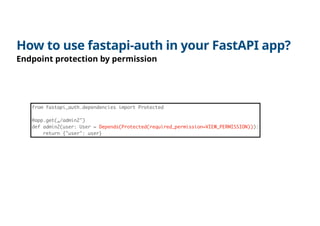
Endpoint protection by permission
from fastapi_auth.dependencies import Protected
@app.get(„/admin2")
def admin2(user: User = Depends(Protected(required_permission=VIEW_PERMISSION))):
return {"user": user}
How to use fastapi-auth in your FastAPI app?
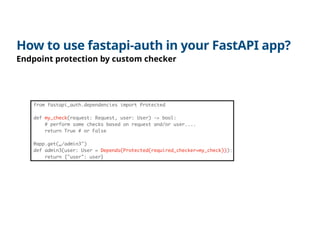
Endpoint protection by custom checker
from fastapi_auth.dependencies import Protected
def my_check(request: Request, user: User) -> bool:
# perform some checks based on request and/or user....
return True # or False
@app.get(„/admin3")
def admin3(user: User = Depends(Protected(required_checker=my_check))):
return {"user": user}
Concept of user sources
• A user source manages user accounts
• A user source can authenticate (or not) a user based on
the parameters of a login form
• …usually determined by validating the username and the
password against the data stored in a database
• Typical: RDBMS, LDAP etc.
Pluggable authenticators
from fastapi import Request
from fastapi.authenticator_registry import Authenticator, AUTHENTICATOR_REGISTRY
from fastapi.users import User
class MyAuthenticator(Authenticator):
async def authenticate(request: Request) -> User:
# extract credentials from request
username = request.form....
password = request.form....
# perform authentication against your own authentication system
user_data = my_backend.authenticate_user(username, password)
return User(name=user_data["name"], roles=[...])
AUTHENTICATOR_REGISTRY.add_authenticator(MyAuthenticator(), 0)
Build-in user management
• zopyx-fastapi-auth comes with a default user management
• with sqlite as database backend
• commandline utility fastapi-auth-user-admin
> fastapi-auth-user-admin add <username> <password> „Role1,Role2…“
> fastapi-auth-user-admin delete <username>
> fastapi-auth-user-admin lists-users
> fastapi-auth-user-admin set-password <username> <new-password>
Internals
• based on starlette.middleware.sessions
• authentication information stored and exchanged through
an encrypted cookie (symmetric encryption)
• client/browser can not decrypt the cookie
• lifetime of cookie: session or persistent
• ToDo:
• switching to secure cookies (starlette-securecookies)
• better control over lifetime of cookies, expiration, revocation!?
Demo time 🥳
• https://github.com/zopyx/fastapi-auth
• https://pypi.org/project/zopyx-fastapi-auth/
Resources
Questions & Answers
Thank you for listening
Andreas Jung • info@zopyx.com • www.zopyx.com • www.andreas-jung.com

zopyx-fastapi-auth - authentication and authorization for FastAPI

  • 1.
    Andreas Jung •info@zopyx.com • www.zopyx.com • www.andreas-jung.com zopyx-fastapi-auth An opinionated security solution for FastAPI
  • 2.
    Agenda • Introduction toFastAPI • Quick intro intro authentication and authorization • Key concepts of fastapi-auth • Integration and usage in FastAPI • Pluggable user source architecture • User management • Demo time • Q & A
  • 3.
    Publishing developer &consultant since mid-90s https://www.zopyx.com https://andreas-jung.com ✉ info@zopyx.com Funder of print-css.rocks project Independent PrintCSS consulting - Software developer & software architect - Requirements engineering - Python developer & Python expert - NGOs, EDU - medical & pharmaceutical - energy - research & development quantum mechanics - CMS Solutions - Publishing Solutions - Individual software solutions About me
  • 4.
  • 5.
    What is FastAPI? FastAPIis a modern, fast (high-performance), web framework for building APIs with Python 3 based on standard Python type hints and the data-validation framework Pydantic. from fastapi import FastAPI app = FastAPI() @app.get("/") def read_root(): return {"Hello": "World"} @app.get("/items/{item_id}") def read_item(item_id: int, q: str = None): return {"item_id": item_id, "q": q} if __name__ == "__main__": import uvicorn uvicorn.run(app, host="0.0.0.0", port=8000)
  • 6.
    Reasons for usingFastAPI • Use of Pydantic FastAPI uses Pydantic for data validation and serialization, ensuring robust input and output handling. • Full Async Support FastAPI supports asynchronous programming, enabling high-performance and efficient request handling. • Automatic OpenAPI Generation FastAPI automatically generates OpenAPI documentation, simplifying API development and testing. • It is Fast FastAPI is optimized for speed, making it one of the fastest web frameworks available. • High Adoption Rate FastAPI’s growing popularity and community support make it a reliable choice for modern web development.
  • 7.
  • 8.
    What is authentication? •Authentication verifies the identity of a user, device, or entity. • It uses credentials like username + passwords, biometrics, or security tokens. • This ensures only authorized access to sensitive information or resources.
  • 9.
    What is authorization? •Authorization determines what resources a user or system can access. • It occurs after authentication and enforces permissions and policies. • This ensures users can only perform actions they are permitted to.
  • 10.
  • 11.
    Why zopyx-fastapi-auth …when thereare already many other solutions!? • Usecase Migration of a CMS Plone-based application from Plone to FastAPI for the University of Saarbrücken. • Problem • None of the existing authentication frameworks for FastAPI has fit our needs • No direct translation of security concepts of the legacy system available for FastAPI • Transparent authentication against three different user sources (local, SAP, LDAP)
  • 12.
    Concepts: Permissions An accessright that defines what actions a user or role can perform, such as viewing, editing, or deleting resources within an application. Permissions are defined as code. from fastapi_auth.permissions import Permission VIEW_PERMISSION = Permission(name="view", description="View permission") EDIT_PERMISSION = Permission(name="edit", description="Edit permission") DELETE_PERMISSION = Permission(name="delete", description="Delete permission")
  • 13.
    Concepts: Roles A collectionof permissions wrapped together as a role. Roles define a user’s access level and responsibilities within an application. A user can have multiple roles, each granting a different set of permissions. Roles are defined in code. from fastapi_auth.permissions import Role ADMIN_ROLE = Role( name="Administrator", description="Admin role", permissions=[VIEW_PERMISSION, EDIT_PERMISSION, DELETE_PERMISSION], ) USER_ROLE = Role( name="User", description="User role", permissions=[VIEW_PERMISSION, EDIT_PERMISSION], ) VIEWER_ROLE = Role( name="Viewer", description="Viewer role", permissions=[VIEW_PERMISSION], )
  • 14.
    Concepts: Roles II Rolesmust be registered with the (gobal) roles registry. Interim solution…likely to go away soon. from fastapi_auth.roles import ROLES_REGISTRY ROLES_REGISTRY.register(ADMIN_ROLE) ROLES_REGISTRY.register(USER_ROLE) ROLES_REGISTRY.register(VIEWER_ROLE)
  • 15.
    Concepts: Users A userrepresents the currently user context accessing the system. User types: • Anonymous User • Authenticated User • (Superuser) Users are stored in (external) user sources like a database, LDAP etc.
  • 16.
    The User objectin fastapi-auth • The Protected() method is used to protect an endpoint by permission, role or a custom checker • Integration with FastAPI through dependency injection • Successful authorization will return a User object • Unsuccessful authorization ➡ HTTP 403/Forbidden • User properties: name, description, roles, is_anonymous @app.get(„/admin") def admin(user: User = Depends(Protected(<protection_conditions)): return {"user": user}
  • 17.
    Concepts II • Auser can have multiple roles • A role can multiple permissions
  • 18.
    How to usefastapi-auth in your FastAPI app? Endpoint protection by role(s) # This is an endpoint that requires the user to be authenticated. In this case, # the user must have the ADMIN_ROLE role. It is also possible to require a # permission instead. Use the Protected dependency to require authentication. # An unauthenticated request as ANONYMOUS_USER will be rejected. @app.get(„/admin") def admin(user: User = Depends(Protected(required_roles=[ADMIN_ROLE]))): return {"user": user}
  • 19.
    How to usefastapi-auth in your FastAPI app? Endpoint protection by permission from fastapi_auth.dependencies import Protected @app.get(„/admin2") def admin2(user: User = Depends(Protected(required_permission=VIEW_PERMISSION))): return {"user": user}
  • 20.
    How to usefastapi-auth in your FastAPI app? Endpoint protection by custom checker from fastapi_auth.dependencies import Protected def my_check(request: Request, user: User) -> bool: # perform some checks based on request and/or user.... return True # or False @app.get(„/admin3") def admin3(user: User = Depends(Protected(required_checker=my_check))): return {"user": user}
  • 21.
    Concept of usersources • A user source manages user accounts • A user source can authenticate (or not) a user based on the parameters of a login form • …usually determined by validating the username and the password against the data stored in a database • Typical: RDBMS, LDAP etc.
  • 22.
    Pluggable authenticators from fastapiimport Request from fastapi.authenticator_registry import Authenticator, AUTHENTICATOR_REGISTRY from fastapi.users import User class MyAuthenticator(Authenticator): async def authenticate(request: Request) -> User: # extract credentials from request username = request.form.... password = request.form.... # perform authentication against your own authentication system user_data = my_backend.authenticate_user(username, password) return User(name=user_data["name"], roles=[...]) AUTHENTICATOR_REGISTRY.add_authenticator(MyAuthenticator(), 0)
  • 23.
    Build-in user management •zopyx-fastapi-auth comes with a default user management • with sqlite as database backend • commandline utility fastapi-auth-user-admin > fastapi-auth-user-admin add <username> <password> „Role1,Role2…“ > fastapi-auth-user-admin delete <username> > fastapi-auth-user-admin lists-users > fastapi-auth-user-admin set-password <username> <new-password>
  • 24.
    Internals • based onstarlette.middleware.sessions • authentication information stored and exchanged through an encrypted cookie (symmetric encryption) • client/browser can not decrypt the cookie • lifetime of cookie: session or persistent • ToDo: • switching to secure cookies (starlette-securecookies) • better control over lifetime of cookies, expiration, revocation!?
  • 25.
  • 26.
  • 27.
  • 28.
    Thank you forlistening Andreas Jung • info@zopyx.com • www.zopyx.com • www.andreas-jung.com