are positively correlated (ellipse is pointed to the top right) or negatively correlated
(ellipse is pointed to the top left). The shading and width of the ellipse indicate the
strength of the association: thinner and darker ellipses correspond to stronger
relationships.
Figure 1-6. Correlation between ETF returns
Like the mean and standard deviation, the correlation coefficient is sensitive to outli‐
ers in the data. Software packages offer robust alternatives to the classical correlation
coefficient. For example, the R package robust uses the function covRob to compute a
robust estimate of correlation. The methods in the scikit-learn module
sklearn.covariance implement a variety of approaches.
Correlation | 33
Other Correlation Estimates
Statisticians long ago proposed other types of correlation coeffi‐
cients, such as Spearman’s rho or Kendall’s tau. These are correla‐
tion coefficients based on the rank of the data. Since they work
with ranks rather than values, these estimates are robust to outliers
and can handle certain types of nonlinearities. However, data scien‐
tists can generally stick to Pearson’s correlation coefficient, and its
robust alternatives, for exploratory analysis. The appeal of rank-
based estimates is mostly for smaller data sets and specific hypothe‐
sis tests.
Scatterplots
The standard way to visualize the relationship between two measured data variables is
with a scatterplot. The x-axis represents one variable and the y-axis another, and each
point on the graph is a record. See Figure 1-7 for a plot of the correlation between the
daily returns for ATT and Verizon. This is produced in R with the command:
plot(telecom$T, telecom$VZ, xlab='ATT (T)', ylab='Verizon (VZ)')
The same graph can be generated in Python using the pandas scatter method:
ax = telecom.plot.scatter(x='T', y='VZ', figsize=(4, 4), marker='$u25EF$')
ax.set_xlabel('ATT (T)')
ax.set_ylabel('Verizon (VZ)')
ax.axhline(0, color='grey', lw=1)
ax.axvline(0, color='grey', lw=1)
The returns have a positive relationship: while they cluster around zero, on most
days, the stocks go up or go down in tandem (upper-right and lower-left quadrants).
There are fewer days where one stock goes down significantly while the other stock
goes up, or vice versa (lower-right and upper-left quadrants).
While the plot Figure 1-7 displays only 754 data points, it’s already obvious how diffi‐
cult it is to identify details in the middle of the plot. We will see later how adding
transparency to the points, or using hexagonal binning and density plots, can help to
find additional structure in the data.
34 | Chapter 1: Exploratory Data Analysis
Figure 1-7. Scatterplot of correlation between returns for ATT and Verizon
Key Ideas
• The correlation coefficient measures the extent to which two paired variables
(e.g., height and weight for individuals) are associated with one another.
• When high values of v1 go with high values of v2, v1 and v2 are positively
associated.
• When high values of v1 go with low values of v2, v1 and v2 are negatively
associated.
• The correlation coefficient is a standardized metric, so that it always ranges from
–1 (perfect negative correlation) to +1 (perfect positive correlation).
• A correlation coefficient of zero indicates no correlation, but be aware that ran‐
dom arrangements of data will produce both positive and negative values for the
correlation coefficient just by chance.
Correlation | 35
Further Reading
Statistics, 4th ed., by David Freedman, Robert Pisani, and Roger Purves (W. W. Nor‐
ton, 2007) has an excellent discussion of correlation.
Exploring Two or More Variables
Familiar estimators like mean and variance look at variables one at a time (univariate
analysis). Correlation analysis (see “Correlation” on page 30) is an important method
that compares two variables (bivariate analysis). In this section we look at additional
estimates and plots, and at more than two variables (multivariate analysis).
Key Terms for Exploring Two or More Variables
Contingency table
A tally of counts between two or more categorical variables.
Hexagonal binning
A plot of two numeric variables with the records binned into hexagons.
Contour plot
A plot showing the density of two numeric variables like a topographical map.
Violin plot
Similar to a boxplot but showing the density estimate.
Like univariate analysis, bivariate analysis involves both computing summary statis‐
tics and producing visual displays. The appropriate type of bivariate or multivariate
analysis depends on the nature of the data: numeric versus categorical.
Hexagonal Binning and Contours
(Plotting Numeric Versus Numeric Data)
Scatterplots are fine when there is a relatively small number of data values. The plot
of stock returns in Figure 1-7 involves only about 750 points. For data sets with hun‐
dreds of thousands or millions of records, a scatterplot will be too dense, so we need a
different way to visualize the relationship. To illustrate, consider the data set kc_tax,
which contains the tax-assessed values for residential properties in King County,
Washington. In order to focus on the main part of the data, we strip out very expen‐
sive and very small or large residences using the subset function:
36 | Chapter 1: Exploratory Data Analysis
kc_tax0 <- subset(kc_tax, TaxAssessedValue < 750000 &
SqFtTotLiving > 100 &
SqFtTotLiving < 3500)
nrow(kc_tax0)
432693
In pandas, we filter the data set as follows:
kc_tax0 = kc_tax.loc[(kc_tax.TaxAssessedValue < 750000) &
(kc_tax.SqFtTotLiving > 100) &
(kc_tax.SqFtTotLiving < 3500), :]
kc_tax0.shape
(432693, 3)
Figure 1-8 is a hexagonal binning plot of the relationship between the finished square
feet and the tax-assessed value for homes in King County. Rather than plotting
points, which would appear as a monolithic dark cloud, we grouped the records into
hexagonal bins and plotted the hexagons with a color indicating the number of
records in that bin. In this chart, the positive relationship between square feet and
tax-assessed value is clear. An interesting feature is the hint of additional bands above
the main (darkest) band at the bottom, indicating homes that have the same square
footage as those in the main band but a higher tax-assessed value.
Figure 1-8 was generated by the powerful R package ggplot2, developed by Hadley
Wickham [ggplot2]. ggplot2 is one of several new software libraries for advanced
exploratory visual analysis of data; see “Visualizing Multiple Variables” on page 43:
ggplot(kc_tax0, (aes(x=SqFtTotLiving, y=TaxAssessedValue))) +
stat_binhex(color='white') +
theme_bw() +
scale_fill_gradient(low='white', high='black') +
labs(x='Finished Square Feet', y='Tax-Assessed Value')
In Python, hexagonal binning plots are readily available using the pandas data frame
method hexbin:
ax = kc_tax0.plot.hexbin(x='SqFtTotLiving', y='TaxAssessedValue',
gridsize=30, sharex=False, figsize=(5, 4))
ax.set_xlabel('Finished Square Feet')
ax.set_ylabel('Tax-Assessed Value')
Exploring Two or More Variables | 37
Figure 1-8. Hexagonal binning for tax-assessed value versus finished square feet
Figure 1-9 uses contours overlaid onto a scatterplot to visualize the relationship
between two numeric variables. The contours are essentially a topographical map to
two variables; each contour band represents a specific density of points, increasing as
one nears a “peak.” This plot shows a similar story as Figure 1-8: there is a secondary
peak “north” of the main peak. This chart was also created using ggplot2 with the
built-in geom_density2d function:
ggplot(kc_tax0, aes(SqFtTotLiving, TaxAssessedValue)) +
theme_bw() +
geom_point(alpha=0.1) +
geom_density2d(color='white') +
labs(x='Finished Square Feet', y='Tax-Assessed Value')
The seaborn kdeplot function in Python creates a contour plot:
ax = sns.kdeplot(kc_tax0.SqFtTotLiving, kc_tax0.TaxAssessedValue, ax=ax)
ax.set_xlabel('Finished Square Feet')
ax.set_ylabel('Tax-Assessed Value')
38 | Chapter 1: Exploratory Data Analysis
Figure 1-9. Contour plot for tax-assessed value versus finished square feet
Other types of charts are used to show the relationship between two numeric vari‐
ables, including heat maps. Heat maps, hexagonal binning, and contour plots all give
a visual representation of a two-dimensional density. In this way, they are natural
analogs to histograms and density plots.
Two Categorical Variables
A useful way to summarize two categorical variables is a contingency table—a table of
counts by category. Table 1-8 shows the contingency table between the grade of a per‐
sonal loan and the outcome of that loan. This is taken from data provided by Lending
Club, a leader in the peer-to-peer lending business. The grade goes from A (high) to
G (low). The outcome is either fully paid, current, late, or charged off (the balance of
the loan is not expected to be collected). This table shows the count and row percen‐
tages. High-grade loans have a very low late/charge-off percentage as compared with
lower-grade loans.
Exploring Two or More Variables | 39
Table 1-8. Contingency table of loan grade and status
Grade Charged off Current Fully paid Late Total
A 1562 50051 20408 469 72490
0.022 0.690 0.282 0.006 0.161
B 5302 93852 31160 2056 132370
0.040 0.709 0.235 0.016 0.294
C 6023 88928 23147 2777 120875
0.050 0.736 0.191 0.023 0.268
D 5007 53281 13681 2308 74277
0.067 0.717 0.184 0.031 0.165
E 2842 24639 5949 1374 34804
0.082 0.708 0.171 0.039 0.077
F 1526 8444 2328 606 12904
0.118 0.654 0.180 0.047 0.029
G 409 1990 643 199 3241
0.126 0.614 0.198 0.061 0.007
Total 22671 321185 97316 9789 450961
Contingency tables can look only at counts, or they can also include column and total
percentages. Pivot tables in Excel are perhaps the most common tool used to create
contingency tables. In R, the CrossTable function in the descr package produces
contingency tables, and the following code was used to create Table 1-8:
library(descr)
x_tab <- CrossTable(lc_loans$grade, lc_loans$status,
prop.c=FALSE, prop.chisq=FALSE, prop.t=FALSE)
The pivot_table method creates the pivot table in Python. The aggfunc argument
allows us to get the counts. Calculating the percentages is a bit more involved:
crosstab = lc_loans.pivot_table(index='grade', columns='status',
aggfunc=lambda x: len(x), margins=True)
df = crosstab.loc['A':'G',:].copy()
df.loc[:,'Charged Off':'Late'] = df.loc[:,'Charged Off':'Late'].div(df['All'],
axis=0)
df['All'] = df['All'] / sum(df['All'])
perc_crosstab = df
The margins keyword argument will add the column and row sums.
We create a copy of the pivot table, ignoring the column sums.
We divide the rows with the row sum.
40 | Chapter 1: Exploratory Data Analysis
We divide the 'All' column by its sum.
Categorical and Numeric Data
Boxplots (see “Percentiles and Boxplots” on page 20) are a simple way to visually
compare the distributions of a numeric variable grouped according to a categorical
variable. For example, we might want to compare how the percentage of flight delays
varies across airlines. Figure 1-10 shows the percentage of flights in a month that
were delayed where the delay was within the carrier’s control:
boxplot(pct_carrier_delay ~ airline, data=airline_stats, ylim=c(0, 50))
The pandas boxplot method takes the by argument that splits the data set into groups
and creates the individual boxplots:
ax = airline_stats.boxplot(by='airline', column='pct_carrier_delay')
ax.set_xlabel('')
ax.set_ylabel('Daily % of Delayed Flights')
plt.suptitle('')
Figure 1-10. Boxplot of percent of airline delays by carrier
Exploring Two or More Variables | 41
Alaska stands out as having the fewest delays, while American has the most delays:
the lower quartile for American is higher than the upper quartile for Alaska.
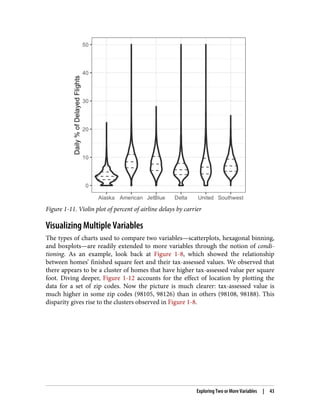
A violin plot, introduced by [Hintze-Nelson-1998], is an enhancement to the boxplot
and plots the density estimate with the density on the y-axis. The density is mirrored
and flipped over, and the resulting shape is filled in, creating an image resembling a
violin. The advantage of a violin plot is that it can show nuances in the distribution
that aren’t perceptible in a boxplot. On the other hand, the boxplot more clearly
shows the outliers in the data. In ggplot2, the function geom_violin can be used to
create a violin plot as follows:
ggplot(data=airline_stats, aes(airline, pct_carrier_delay)) +
ylim(0, 50) +
geom_violin() +
labs(x='', y='Daily % of Delayed Flights')
Violin plots are available with the violinplot method of the seaborn package:
ax = sns.violinplot(airline_stats.airline, airline_stats.pct_carrier_delay,
inner='quartile', color='white')
ax.set_xlabel('')
ax.set_ylabel('Daily % of Delayed Flights')
The corresponding plot is shown in Figure 1-11. The violin plot shows a concentra‐
tion in the distribution near zero for Alaska and, to a lesser extent, Delta. This phe‐
nomenon is not as obvious in the boxplot. You can combine a violin plot with a
boxplot by adding geom_boxplot to the plot (although this works best when colors
are used).
42 | Chapter 1: Exploratory Data Analysis
Figure 1-11. Violin plot of percent of airline delays by carrier
Visualizing Multiple Variables
The types of charts used to compare two variables—scatterplots, hexagonal binning,
and boxplots—are readily extended to more variables through the notion of condi‐
tioning. As an example, look back at Figure 1-8, which showed the relationship
between homes’ finished square feet and their tax-assessed values. We observed that
there appears to be a cluster of homes that have higher tax-assessed value per square
foot. Diving deeper, Figure 1-12 accounts for the effect of location by plotting the
data for a set of zip codes. Now the picture is much clearer: tax-assessed value is
much higher in some zip codes (98105, 98126) than in others (98108, 98188). This
disparity gives rise to the clusters observed in Figure 1-8.
Exploring Two or More Variables | 43
We created Figure 1-12 using ggplot2 and the idea of facets, or a conditioning vari‐
able (in this case, zip code):
ggplot(subset(kc_tax0, ZipCode %in% c(98188, 98105, 98108, 98126)),
aes(x=SqFtTotLiving, y=TaxAssessedValue)) +
stat_binhex(color='white') +
theme_bw() +
scale_fill_gradient(low='white', high='blue') +
labs(x='Finished Square Feet', y='Tax-Assessed Value') +
facet_wrap('ZipCode')
Use the ggplot functions facet_wrap and facet_grid to specify the condition‐
ing variable.
Figure 1-12. Tax-assessed value versus finished square feet by zip code
Most Python packages base their visualizations on Matplotlib. While it is in princi‐
ple possible to create faceted graphs using Matplotlib, the code can get complicated.
Fortunately, seaborn has a relatively straightforward way of creating these graphs:
44 | Chapter 1: Exploratory Data Analysis
zip_codes = [98188, 98105, 98108, 98126]
kc_tax_zip = kc_tax0.loc[kc_tax0.ZipCode.isin(zip_codes),:]
kc_tax_zip
def hexbin(x, y, color, **kwargs):
cmap = sns.light_palette(color, as_cmap=True)
plt.hexbin(x, y, gridsize=25, cmap=cmap, **kwargs)
g = sns.FacetGrid(kc_tax_zip, col='ZipCode', col_wrap=2)
g.map(hexbin, 'SqFtTotLiving', 'TaxAssessedValue',
extent=[0, 3500, 0, 700000])
g.set_axis_labels('Finished Square Feet', 'Tax-Assessed Value')
g.set_titles('Zip code {col_name:.0f}')
Use the arguments col and row to specify the conditioning variables. For a single
conditioning variable, use col together with col_wrap to wrap the faceted graphs
into multiple rows.
The map method calls the hexbin function with subsets of the original data set for
the different zip codes. extent defines the limits of the x- and y-axes.
The concept of conditioning variables in a graphics system was pioneered with Trellis
graphics, developed by Rick Becker, Bill Cleveland, and others at Bell Labs [Trellis-
Graphics]. This idea has propagated to various modern graphics systems, such as the
lattice [lattice] and ggplot2 packages in R and the seaborn [seaborn] and Bokeh
[bokeh] modules in Python. Conditioning variables are also integral to business intel‐
ligence platforms such as Tableau and Spotfire. With the advent of vast computing
power, modern visualization platforms have moved well beyond the humble begin‐
nings of exploratory data analysis. However, key concepts and tools developed a half
century ago (e.g., simple boxplots) still form a foundation for these systems.
Key Ideas
• Hexagonal binning and contour plots are useful tools that permit graphical
examination of two numeric variables at a time, without being overwhelmed by
huge amounts of data.
• Contingency tables are the standard tool for looking at the counts of two catego‐
rical variables.
• Boxplots and violin plots allow you to plot a numeric variable against a categori‐
cal variable.
Exploring Two or More Variables | 45
Further Reading
• Modern Data Science with R by Benjamin Baumer, Daniel Kaplan, and Nicholas
Horton (Chapman & Hall/CRC Press, 2017) has an excellent presentation of “a
grammar for graphics” (the “gg” in ggplot).
• ggplot2: Elegant Graphics for Data Analysis by Hadley Wickham (Springer, 2009)
is an excellent resource from the creator of ggplot2.
• Josef Fruehwald has a web-based tutorial on ggplot2.
Summary
Exploratory data analysis (EDA), pioneered by John Tukey, set a foundation for the
field of data science. The key idea of EDA is that the first and most important step in
any project based on data is to look at the data. By summarizing and visualizing the
data, you can gain valuable intuition and understanding of the project.
This chapter has reviewed concepts ranging from simple metrics, such as estimates of
location and variability, to rich visual displays that explore the relationships between
multiple variables, as in Figure 1-12. The diverse set of tools and techniques being
developed by the open source community, combined with the expressiveness of the R
and Python languages, has created a plethora of ways to explore and analyze data.
Exploratory analysis should be a cornerstone of any data science project.
46 | Chapter 1: Exploratory Data Analysis
CHAPTER 2
Data and Sampling Distributions
A popular misconception holds that the era of big data means the end of a need for
sampling. In fact, the proliferation of data of varying quality and relevance reinforces
the need for sampling as a tool to work efficiently with a variety of data and to mini‐
mize bias. Even in a big data project, predictive models are typically developed and
piloted with samples. Samples are also used in tests of various sorts (e.g., comparing
the effect of web page designs on clicks).
Figure 2-1 shows a schematic that underpins the concepts we will discuss in this
chapter—data and sampling distributions. The lefthand side represents a population
that, in statistics, is assumed to follow an underlying but unknown distribution. All
that is available is the sample data and its empirical distribution, shown on the right‐
hand side. To get from the lefthand side to the righthand side, a sampling procedure is
used (represented by an arrow). Traditional statistics focused very much on the left‐
hand side, using theory based on strong assumptions about the population. Modern
statistics has moved to the righthand side, where such assumptions are not needed.
In general, data scientists need not worry about the theoretical nature of the lefthand
side and instead should focus on the sampling procedures and the data at hand.
There are some notable exceptions. Sometimes data is generated from a physical pro‐
cess that can be modeled. The simplest example is flipping a coin: this follows a bino‐
mial distribution. Any real-life binomial situation (buy or don’t buy, fraud or no
fraud, click or don’t click) can be modeled effectively by a coin (with modified proba‐
bility of landing heads, of course). In these cases, we can gain additional insight by
using our understanding of the population.
47
Figure 2-1. Population versus sample
Random Sampling and Sample Bias
A sample is a subset of data from a larger data set; statisticians call this larger data set
the population. A population in statistics is not the same thing as in biology—it is a
large, defined (but sometimes theoretical or imaginary) set of data.
Random sampling is a process in which each available member of the population
being sampled has an equal chance of being chosen for the sample at each draw. The
sample that results is called a simple random sample. Sampling can be done with
replacement, in which observations are put back in the population after each draw for
possible future reselection. Or it can be done without replacement, in which case
observations, once selected, are unavailable for future draws.
Data quality often matters more than data quantity when making an estimate or a
model based on a sample. Data quality in data science involves completeness, consis‐
tency of format, cleanliness, and accuracy of individual data points. Statistics adds the
notion of representativeness.
48 | Chapter 2: Data and Sampling Distributions
Key Terms for Random Sampling
Sample
A subset from a larger data set.
Population
The larger data set or idea of a data set.
N (n)
The size of the population (sample).
Random sampling
Drawing elements into a sample at random.
Stratified sampling
Dividing the population into strata and randomly sampling from each strata.
Stratum (pl., strata)
A homogeneous subgroup of a population with common characteristics.
Simple random sample
The sample that results from random sampling without stratifying the
population.
Bias
Systematic error.
Sample bias
A sample that misrepresents the population.
The classic example is the Literary Digest poll of 1936 that predicted a victory of Alf
Landon over Franklin Roosevelt. The Literary Digest, a leading periodical of the day,
polled its entire subscriber base plus additional lists of individuals, a total of over 10
million people, and predicted a landslide victory for Landon. George Gallup, founder
of the Gallup Poll, conducted biweekly polls of just 2,000 people and accurately pre‐
dicted a Roosevelt victory. The difference lay in the selection of those polled.
The Literary Digest opted for quantity, paying little attention to the method of selec‐
tion. They ended up polling those with relatively high socioeconomic status (their
own subscribers, plus those who, by virtue of owning luxuries like telephones and
automobiles, appeared in marketers’ lists). The result was sample bias; that is, the
sample was different in some meaningful and nonrandom way from the larger popu‐
lation it was meant to represent. The term nonrandom is important—hardly any sam‐
ple, including random samples, will be exactly representative of the population.
Sample bias occurs when the difference is meaningful, and it can be expected to con‐
tinue for other samples drawn in the same way as the first.
Random Sampling and Sample Bias | 49
Self-Selection Sampling Bias
The reviews of restaurants, hotels, cafés, and so on that you read on
social media sites like Yelp are prone to bias because the people
submitting them are not randomly selected; rather, they themselves
have taken the initiative to write. This leads to self-selection bias—
the people motivated to write reviews may have had poor experien‐
ces, may have an association with the establishment, or may simply
be a different type of person from those who do not write reviews.
Note that while self-selection samples can be unreliable indicators
of the true state of affairs, they may be more reliable in simply com‐
paring one establishment to a similar one; the same self-selection
bias might apply to each.
Bias
Statistical bias refers to measurement or sampling errors that are systematic and pro‐
duced by the measurement or sampling process. An important distinction should be
made between errors due to random chance and errors due to bias. Consider the
physical process of a gun shooting at a target. It will not hit the absolute center of the
target every time, or even much at all. An unbiased process will produce error, but it
is random and does not tend strongly in any direction (see Figure 2-2). The results
shown in Figure 2-3 show a biased process—there is still random error in both the x
and y direction, but there is also a bias. Shots tend to fall in the upper-right quadrant.
Figure 2-2. Scatterplot of shots from a gun with true aim
50 | Chapter 2: Data and Sampling Distributions
Figure 2-3. Scatterplot of shots from a gun with biased aim
Bias comes in different forms, and may be observable or invisible. When a result does
suggest bias (e.g., by reference to a benchmark or actual values), it is often an indica‐
tor that a statistical or machine learning model has been misspecified, or an impor‐
tant variable left out.
Random Selection
To avoid the problem of sample bias that led the Literary Digest to predict Landon
over Roosevelt, George Gallup (shown in Figure 2-4) opted for more scientifically
chosen methods to achieve a sample that was representative of the US voting elector‐
ate. There are now a variety of methods to achieve representativeness, but at the heart
of all of them lies random sampling.
Figure 2-4. George Gallup, catapulted to fame by the Literary Digest’s “big data” failure
Random sampling is not always easy. Proper definition of an accessible population is
key. Suppose we want to generate a representative profile of customers and we need
to conduct a pilot customer survey. The survey needs to be representative but is labor
intensive.
Random Sampling and Sample Bias | 51
First, we need to define who a customer is. We might select all customer records
where purchase amount > 0. Do we include all past customers? Do we include
refunds? Internal test purchases? Resellers? Both billing agent and customer?
Next, we need to specify a sampling procedure. It might be “select 100 customers at
random.” Where a sampling from a flow is involved (e.g., real-time customer transac‐
tions or web visitors), timing considerations may be important (e.g., a web visitor at
10 a.m. on a weekday may be different from a web visitor at 10 p.m. on a weekend).
In stratified sampling, the population is divided up into strata, and random samples
are taken from each stratum. Political pollsters might seek to learn the electoral pref‐
erences of whites, blacks, and Hispanics. A simple random sample taken from the
population would yield too few blacks and Hispanics, so those strata could be over‐
weighted in stratified sampling to yield equivalent sample sizes.
Size Versus Quality: When Does Size Matter?
In the era of big data, it is sometimes surprising that smaller is better. Time and effort
spent on random sampling not only reduces bias but also allows greater attention to
data exploration and data quality. For example, missing data and outliers may contain
useful information. It might be prohibitively expensive to track down missing values
or evaluate outliers in millions of records, but doing so in a sample of several thou‐
sand records may be feasible. Data plotting and manual inspection bog down if there
is too much data.
So when are massive amounts of data needed?
The classic scenario for the value of big data is when the data is not only big but
sparse as well. Consider the search queries received by Google, where columns are
terms, rows are individual search queries, and cell values are either 0 or 1, depending
on whether a query contains a term. The goal is to determine the best predicted
search destination for a given query. There are over 150,000 words in the English lan‐
guage, and Google processes over one trillion queries per year. This yields a huge
matrix, the vast majority of whose entries are “0.”
This is a true big data problem—only when such enormous quantities of data are
accumulated can effective search results be returned for most queries. And the more
data accumulates, the better the results. For popular search terms this is not such a
problem—effective data can be found fairly quickly for the handful of extremely pop‐
ular topics trending at a particular time. The real value of modern search technology
lies in the ability to return detailed and useful results for a huge variety of search
queries, including those that occur with a frequency, say, of only one in a million.
Consider the search phrase “Ricky Ricardo and Little Red Riding Hood.” In the early
days of the internet, this query would probably have returned results on the band‐
leader Ricky Ricardo, the television show I Love Lucy in which that character
52 | Chapter 2: Data and Sampling Distributions
appeared, and the children’s story Little Red Riding Hood. Both of those individual
items would have had many searches to refer to, but the combination would have had
very few. Later, now that trillions of search queries have been accumulated, this search
query returns the exact I Love Lucy episode in which Ricky narrates, in dramatic fash‐
ion, the Little Red Riding Hood story to his infant son in a comic mix of English and
Spanish.
Keep in mind that the number of actual pertinent records—ones in which this exact
search query, or something very similar, appears (together with information on what
link people ultimately clicked on)—might need only be in the thousands to be effec‐
tive. However, many trillions of data points are needed to obtain these pertinent
records (and random sampling, of course, will not help). See also “Long-Tailed Dis‐
tributions” on page 73.
Sample Mean Versus Population Mean
The symbol x (pronounced “x-bar”) is used to represent the mean of a sample from a
population, whereas μ is used to represent the mean of a population. Why make the
distinction? Information about samples is observed, and information about large
populations is often inferred from smaller samples. Statisticians like to keep the two
things separate in the symbology.
Key Ideas
• Even in the era of big data, random sampling remains an important arrow in the
data scientist’s quiver.
• Bias occurs when measurements or observations are systematically in error
because they are not representative of the full population.
• Data quality is often more important than data quantity, and random sampling
can reduce bias and facilitate quality improvement that would otherwise be pro‐
hibitively expensive.
Further Reading
• A useful review of sampling procedures can be found in Ronald Fricker’s chapter
“Sampling Methods for Online Surveys” in The SAGE Handbook of Online
Research Methods, 2nd ed., edited by Nigel G. Fielding, Raymond M. Lee, and
Grant Blank (SAGE Publications, 2016). This chapter includes a review of the
modifications to random sampling that are often used for practical reasons of
cost or feasibility.
Random Sampling and Sample Bias | 53
• The story of the Literary Digest poll failure can be found on the Capital Century
website.
Selection Bias
To paraphrase Yogi Berra: if you don’t know what you’re looking for, look hard
enough and you’ll find it.
Selection bias refers to the practice of selectively choosing data—consciously or
unconsciously—in a way that leads to a conclusion that is misleading or ephemeral.
Key Terms for Selection Bias
Selection bias
Bias resulting from the way in which observations are selected.
Data snooping
Extensive hunting through data in search of something interesting.
Vast search effect
Bias or nonreproducibility resulting from repeated data modeling, or modeling
data with large numbers of predictor variables.
If you specify a hypothesis and conduct a well-designed experiment to test it, you can
have high confidence in the conclusion. This is frequently not what occurs, however.
Often, one looks at available data and tries to discern patterns. But are the patterns
real? Or are they just the product of data snooping—that is, extensive hunting
through the data until something interesting emerges? There is a saying among statis‐
ticians: “If you torture the data long enough, sooner or later it will confess.”
The difference between a phenomenon that you verify when you test a hypothesis
using an experiment and a phenomenon that you discover by perusing available data
can be illuminated with the following thought experiment.
Imagine that someone tells you they can flip a coin and have it land heads on the next
10 tosses. You challenge them (the equivalent of an experiment), and they proceed to
toss the coin 10 times, with all flips landing heads. Clearly you ascribe some special
talent to this person—the probability that 10 coin tosses will land heads just by
chance is 1 in 1,000.
Now imagine that the announcer at a sports stadium asks the 20,000 people in attend‐
ance each to toss a coin 10 times, and to report to an usher if they get 10 heads in a
row. The chance that somebody in the stadium will get 10 heads is extremely high
(more than 99%—it’s 1 minus the probability that nobody gets 10 heads). Clearly,
54 | Chapter 2: Data and Sampling Distributions
selecting after the fact the person (or persons) who gets 10 heads at the stadium does
not indicate they have any special talent—it’s most likely luck.
Since repeated review of large data sets is a key value proposition in data science,
selection bias is something to worry about. A form of selection bias of particular con‐
cern to data scientists is what John Elder (founder of Elder Research, a respected data
mining consultancy) calls the vast search effect. If you repeatedly run different models
and ask different questions with a large data set, you are bound to find something
interesting. But is the result you found truly something interesting, or is it the chance
outlier?
We can guard against this by using a holdout set, and sometimes more than one hold‐
out set, against which to validate performance. Elder also advocates the use of what
he calls target shuffling (a permutation test, in essence) to test the validity of predic‐
tive associations that a data mining model suggests.
Typical forms of selection bias in statistics, in addition to the vast search effect,
include nonrandom sampling (see “Random Sampling and Sample Bias” on page 48),
cherry-picking data, selection of time intervals that accentuate a particular statistical
effect, and stopping an experiment when the results look “interesting.”
Regression to the Mean
Regression to the mean refers to a phenomenon involving successive measurements
on a given variable: extreme observations tend to be followed by more central ones.
Attaching special focus and meaning to the extreme value can lead to a form of selec‐
tion bias.
Sports fans are familiar with the “rookie of the year, sophomore slump” phenomenon.
Among the athletes who begin their career in a given season (the rookie class), there
is always one who performs better than all the rest. Generally, this “rookie of the year”
does not do as well in his second year. Why not?
In nearly all major sports, at least those played with a ball or puck, there are two ele‐
ments that play a role in overall performance:
• Skill
• Luck
Regression to the mean is a consequence of a particular form of selection bias. When
we select the rookie with the best performance, skill and good luck are probably con‐
tributing. In his next season, the skill will still be there, but very often the luck will
not be, so his performance will decline—it will regress. The phenomenon was first
identified by Francis Galton in 1886 [Galton-1886], who wrote of it in connection
Selection Bias | 55
with genetic tendencies; for example, the children of extremely tall men tend not to
be as tall as their father (see Figure 2-5).
Figure 2-5. Galton’s study that identified the phenomenon of regression to the mean
Regression to the mean, meaning to “go back,” is distinct from the
statistical modeling method of linear regression, in which a linear
relationship is estimated between predictor variables and an out‐
come variable.
Key Ideas
• Specifying a hypothesis and then collecting data following randomization and
random sampling principles ensures against bias.
• All other forms of data analysis run the risk of bias resulting from the data collec‐
tion/analysis process (repeated running of models in data mining, data snooping
in research, and after-the-fact selection of interesting events).
56 | Chapter 2: Data and Sampling Distributions
Further Reading
• Christopher J. Pannucci and Edwin G. Wilkins’ article “Identifying and Avoiding
Bias in Research” in (surprisingly not a statistics journal) Plastic and Reconstruc‐
tive Surgery (August 2010) has an excellent review of various types of bias that
can enter into research, including selection bias.
• Michael Harris’s article “Fooled by Randomness Through Selection Bias” pro‐
vides an interesting review of selection bias considerations in stock market trad‐
ing schemes, from the perspective of traders.
Sampling Distribution of a Statistic
The term sampling distribution of a statistic refers to the distribution of some sample
statistic over many samples drawn from the same population. Much of classical statis‐
tics is concerned with making inferences from (small) samples to (very large) popula‐
tions.
Key Terms for Sampling Distribution
Sample statistic
A metric calculated for a sample of data drawn from a larger population.
Data distribution
The frequency distribution of individual values in a data set.
Sampling distribution
The frequency distribution of a sample statistic over many samples or resamples.
Central limit theorem
The tendency of the sampling distribution to take on a normal shape as sample
size rises.
Standard error
The variability (standard deviation) of a sample statistic over many samples (not
to be confused with standard deviation, which by itself, refers to variability of
individual data values).
Typically, a sample is drawn with the goal of measuring something (with a sample sta‐
tistic) or modeling something (with a statistical or machine learning model). Since
our estimate or model is based on a sample, it might be in error; it might be different
if we were to draw a different sample. We are therefore interested in how different it
might be—a key concern is sampling variability. If we had lots of data, we could draw
additional samples and observe the distribution of a sample statistic directly.
Sampling Distribution of a Statistic | 57
Typically, we will calculate our estimate or model using as much data as is easily avail‐
able, so the option of drawing additional samples from the population is not readily
available.
It is important to distinguish between the distribution of the indi‐
vidual data points, known as the data distribution, and the distribu‐
tion of a sample statistic, known as the sampling distribution.
The distribution of a sample statistic such as the mean is likely to be more regular and
bell-shaped than the distribution of the data itself. The larger the sample the statistic
is based on, the more this is true. Also, the larger the sample, the narrower the distri‐
bution of the sample statistic.
This is illustrated in an example using annual income for loan applicants to Lending‐
Club (see “A Small Example: Predicting Loan Default” on page 239 for a description
of the data). Take three samples from this data: a sample of 1,000 values, a sample of
1,000 means of 5 values, and a sample of 1,000 means of 20 values. Then plot a histo‐
gram of each sample to produce Figure 2-6.
Figure 2-6. Histogram of annual incomes of 1,000 loan applicants (top), then 1,000
means of n=5 applicants (middle), and finally 1,000 means of n=20 applicants (bottom)
58 | Chapter 2: Data and Sampling Distributions
The histogram of the individual data values is broadly spread out and skewed toward
higher values, as is to be expected with income data. The histograms of the means of
5 and 20 are increasingly compact and more bell-shaped. Here is the R code to gener‐
ate these histograms, using the visualization package ggplot2:
library(ggplot2)
# take a simple random sample
samp_data <- data.frame(income=sample(loans_income, 1000),
type='data_dist')
# take a sample of means of 5 values
samp_mean_05 <- data.frame(
income = tapply(sample(loans_income, 1000*5),
rep(1:1000, rep(5, 1000)), FUN=mean),
type = 'mean_of_5')
# take a sample of means of 20 values
samp_mean_20 <- data.frame(
income = tapply(sample(loans_income, 1000*20),
rep(1:1000, rep(20, 1000)), FUN=mean),
type = 'mean_of_20')
# bind the data.frames and convert type to a factor
income <- rbind(samp_data, samp_mean_05, samp_mean_20)
income$type = factor(income$type,
levels=c('data_dist', 'mean_of_5', 'mean_of_20'),
labels=c('Data', 'Mean of 5', 'Mean of 20'))
# plot the histograms
ggplot(income, aes(x=income)) +
geom_histogram(bins=40) +
facet_grid(type ~ .)
The Python code uses seaborn’s FacetGrid to show the three histograms:
import pandas as pd
import seaborn as sns
sample_data = pd.DataFrame({
'income': loans_income.sample(1000),
'type': 'Data',
})
sample_mean_05 = pd.DataFrame({
'income': [loans_income.sample(5).mean() for _ in range(1000)],
'type': 'Mean of 5',
})
sample_mean_20 = pd.DataFrame({
'income': [loans_income.sample(20).mean() for _ in range(1000)],
'type': 'Mean of 20',
})
results = pd.concat([sample_data, sample_mean_05, sample_mean_20])
g = sns.FacetGrid(results, col='type', col_wrap=1, height=2, aspect=2)
g.map(plt.hist, 'income', range=[0, 200000], bins=40)
Sampling Distribution of a Statistic | 59
g.set_axis_labels('Income', 'Count')
g.set_titles('{col_name}')
Central Limit Theorem
The phenomenon we’ve just described is termed the central limit theorem. It says that
the means drawn from multiple samples will resemble the familiar bell-shaped nor‐
mal curve (see “Normal Distribution” on page 69), even if the source population is
not normally distributed, provided that the sample size is large enough and the
departure of the data from normality is not too great. The central limit theorem
allows normal-approximation formulas like the t-distribution to be used in calculat‐
ing sampling distributions for inference—that is, confidence intervals and hypothesis
tests.
The central limit theorem receives a lot of attention in traditional statistics texts
because it underlies the machinery of hypothesis tests and confidence intervals,
which themselves consume half the space in such texts. Data scientists should be
aware of this role; however, since formal hypothesis tests and confidence intervals
play a small role in data science, and the bootstrap (see “The Bootstrap” on page 61) is
available in any case, the central limit theorem is not so central in the practice of data
science.
Standard Error
The standard error is a single metric that sums up the variability in the sampling dis‐
tribution for a statistic. The standard error can be estimated using a statistic based on
the standard deviation s of the sample values, and the sample size n:
Standard error = SE =
s
n
As the sample size increases, the standard error decreases, corresponding to what was
observed in Figure 2-6. The relationship between standard error and sample size is
sometimes referred to as the square root of n rule: to reduce the standard error by a
factor of 2, the sample size must be increased by a factor of 4.
The validity of the standard error formula arises from the central limit theorem. In
fact, you don’t need to rely on the central limit theorem to understand standard error.
Consider the following approach to measuring standard error:
1. Collect a number of brand-new samples from the population.
2. For each new sample, calculate the statistic (e.g., mean).
60 | Chapter 2: Data and Sampling Distributions
3. Calculate the standard deviation of the statistics computed in step 2; use this as
your estimate of standard error.
In practice, this approach of collecting new samples to estimate the standard error is
typically not feasible (and statistically very wasteful). Fortunately, it turns out that it is
not necessary to draw brand new samples; instead, you can use bootstrap resamples.
In modern statistics, the bootstrap has become the standard way to estimate standard
error. It can be used for virtually any statistic and does not rely on the central limit
theorem or other distributional assumptions.
Standard Deviation Versus Standard Error
Do not confuse standard deviation (which measures the variability
of individual data points) with standard error (which measures the
variability of a sample metric).
Key Ideas
• The frequency distribution of a sample statistic tells us how that metric would
turn out differently from sample to sample.
• This sampling distribution can be estimated via the bootstrap, or via formulas
that rely on the central limit theorem.
• A key metric that sums up the variability of a sample statistic is its standard error.
Further Reading
David Lane’s online multimedia resource in statistics has a useful simulation that
allows you to select a sample statistic, a sample size, and the number of iterations and
visualize a histogram of the resulting frequency distribution.
The Bootstrap
One easy and effective way to estimate the sampling distribution of a statistic, or of
model parameters, is to draw additional samples, with replacement, from the sample
itself and recalculate the statistic or model for each resample. This procedure is called
the bootstrap, and it does not necessarily involve any assumptions about the data or
the sample statistic being normally distributed.
The Bootstrap | 61
Key Terms for the Bootstrap
Bootstrap sample
A sample taken with replacement from an observed data set.
Resampling
The process of taking repeated samples from observed data; includes both boot‐
strap and permutation (shuffling) procedures.
Conceptually, you can imagine the bootstrap as replicating the original sample thou‐
sands or millions of times so that you have a hypothetical population that embodies
all the knowledge from your original sample (it’s just larger). You can then draw sam‐
ples from this hypothetical population for the purpose of estimating a sampling dis‐
tribution; see Figure 2-7.
Figure 2-7. The idea of the bootstrap
In practice, it is not necessary to actually replicate the sample a huge number of
times. We simply replace each observation after each draw; that is, we sample with
replacement. In this way we effectively create an infinite population in which the
probability of an element being drawn remains unchanged from draw to draw. The
algorithm for a bootstrap resampling of the mean, for a sample of size n, is as follows:
1. Draw a sample value, record it, and then replace it.
2. Repeat n times.
3. Record the mean of the n resampled values.
4. Repeat steps 1–3 R times.
5. Use the R results to:
62 | Chapter 2: Data and Sampling Distributions
a. Calculate their standard deviation (this estimates sample mean standard
error).
b. Produce a histogram or boxplot.
c. Find a confidence interval.
R, the number of iterations of the bootstrap, is set somewhat arbitrarily. The more
iterations you do, the more accurate the estimate of the standard error, or the confi‐
dence interval. The result from this procedure is a bootstrap set of sample statistics or
estimated model parameters, which you can then examine to see how variable they
are.
The R package boot combines these steps in one function. For example, the following
applies the bootstrap to the incomes of people taking out loans:
library(boot)
stat_fun <- function(x, idx) median(x[idx])
boot_obj <- boot(loans_income, R=1000, statistic=stat_fun)
The function stat_fun computes the median for a given sample specified by the
index idx. The result is as follows:
Bootstrap Statistics :
original bias std. error
t1* 62000 -70.5595 209.1515
The original estimate of the median is $62,000. The bootstrap distribution indicates
that the estimate has a bias of about –$70 and a standard error of $209. The results
will vary slightly between consecutive runs of the algorithm.
The major Python packages don’t provide implementations of the bootstrap
approach. It can be implemented using the scikit-learn method resample:
results = []
for nrepeat in range(1000):
sample = resample(loans_income)
results.append(sample.median())
results = pd.Series(results)
print('Bootstrap Statistics:')
print(f'original: {loans_income.median()}')
print(f'bias: {results.mean() - loans_income.median()}')
print(f'std. error: {results.std()}')
The bootstrap can be used with multivariate data, where the rows are sampled as
units (see Figure 2-8). A model might then be run on the bootstrapped data, for
example, to estimate the stability (variability) of model parameters, or to improve
predictive power. With classification and regression trees (also called decision trees),
running multiple trees on bootstrap samples and then averaging their predictions (or,
with classification, taking a majority vote) generally performs better than using a
The Bootstrap | 63
single tree. This process is called bagging (short for “bootstrap aggregating”; see “Bag‐
ging and the Random Forest” on page 259).
Figure 2-8. Multivariate bootstrap sampling
The repeated resampling of the bootstrap is conceptually simple, and Julian Simon,
an economist and demographer, published a compendium of resampling examples,
including the bootstrap, in his 1969 text Basic Research Methods in Social Science
(Random House). However, it is also computationally intensive and was not a feasible
option before the widespread availability of computing power. The technique gained
its name and took off with the publication of several journal articles and a book by
Stanford statistician Bradley Efron in the late 1970s and early 1980s. It was particu‐
larly popular among researchers who use statistics but are not statisticians, and for
use with metrics or models where mathematical approximations are not readily avail‐
able. The sampling distribution of the mean has been well established since 1908; the
sampling distribution of many other metrics has not. The bootstrap can be used for
sample size determination; experiment with different values for n to see how the sam‐
pling distribution is affected.
The bootstrap was met with considerable skepticism when it was first introduced; it
had the aura to many of spinning gold from straw. This skepticism stemmed from a
misunderstanding of the bootstrap’s purpose.
The bootstrap does not compensate for a small sample size; it does
not create new data, nor does it fill in holes in an existing data set.
It merely informs us about how lots of additional samples would
behave when drawn from a population like our original sample.
64 | Chapter 2: Data and Sampling Distributions
Resampling Versus Bootstrapping
Sometimes the term resampling is used synonymously with the term bootstrapping, as
just outlined. More often, the term resampling also includes permutation procedures
(see “Permutation Test” on page 97), where multiple samples are combined and the
sampling may be done without replacement. In any case, the term bootstrap always
implies sampling with replacement from an observed data set.
Key Ideas
• The bootstrap (sampling with replacement from a data set) is a powerful tool for
assessing the variability of a sample statistic.
• The bootstrap can be applied in similar fashion in a wide variety of circumstan‐
ces, without extensive study of mathematical approximations to sampling distri‐
butions.
• It also allows us to estimate sampling distributions for statistics where no mathe‐
matical approximation has been developed.
• When applied to predictive models, aggregating multiple bootstrap sample pre‐
dictions (bagging) outperforms the use of a single model.
Further Reading
• An Introduction to the Bootstrap by Bradley Efron and Robert Tibshirani (Chap‐
man & Hall, 1993) was the first book-length treatment of the bootstrap. It is still
widely read.
• The retrospective on the bootstrap in the May 2003 issue of Statistical Science
(vol. 18, no. 2), discusses (among other antecedents, in Peter Hall’s “A Short Pre‐
history of the Bootstrap”) Julian Simon’s initial publication of the bootstrap in
1969.
• See An Introduction to Statistical Learning by Gareth James, Daniela Witten, Tre‐
vor Hastie, and Robert Tibshirani (Springer, 2013) for sections on the bootstrap
and, in particular, bagging.
Confidence Intervals
Frequency tables, histograms, boxplots, and standard errors are all ways to under‐
stand the potential error in a sample estimate. Confidence intervals are another.
Confidence Intervals | 65
Key Terms for Confidence Intervals
Confidence level
The percentage of confidence intervals, constructed in the same way from the
same population, that are expected to contain the statistic of interest.
Interval endpoints
The top and bottom of the confidence interval.
There is a natural human aversion to uncertainty; people (especially experts) say “I
don’t know” far too rarely. Analysts and managers, while acknowledging uncertainty,
nonetheless place undue faith in an estimate when it is presented as a single number
(a point estimate). Presenting an estimate not as a single number but as a range is one
way to counteract this tendency. Confidence intervals do this in a manner grounded
in statistical sampling principles.
Confidence intervals always come with a coverage level, expressed as a (high) per‐
centage, say 90% or 95%. One way to think of a 90% confidence interval is as follows:
it is the interval that encloses the central 90% of the bootstrap sampling distribution
of a sample statistic (see “The Bootstrap” on page 61). More generally, an x% confi‐
dence interval around a sample estimate should, on average, contain similar sample
estimates x% of the time (when a similar sampling procedure is followed).
Given a sample of size n, and a sample statistic of interest, the algorithm for a boot‐
strap confidence interval is as follows:
1. Draw a random sample of size n with replacement from the data (a resample).
2. Record the statistic of interest for the resample.
3. Repeat steps 1–2 many (R) times.
4. For an x% confidence interval, trim [(100-x) / 2]% of the R resample results from
either end of the distribution.
5. The trim points are the endpoints of an x% bootstrap confidence interval.
Figure 2-9 shows a 90% confidence interval for the mean annual income of loan
applicants, based on a sample of 20 for which the mean was $62,231.
66 | Chapter 2: Data and Sampling Distributions
Figure 2-9. Bootstrap confidence interval for the annual income of loan applicants,
based on a sample of 20
The bootstrap is a general tool that can be used to generate confidence intervals for
most statistics, or model parameters. Statistical textbooks and software, with roots in
over a half century of computerless statistical analysis, will also reference confidence
intervals generated by formulas, especially the t-distribution (see “Student’s t-
Distribution” on page 75).
Of course, what we are really interested in when we have a sample
result is, “What is the probability that the true value lies within a
certain interval?” This is not really the question that a confidence
interval answers, but it ends up being how most people interpret
the answer.
The probability question associated with a confidence interval
starts out with the phrase “Given a sampling procedure and a pop‐
ulation, what is the probability that…” To go in the opposite direc‐
tion, “Given a sample result, what is the probability that
(something is true about the population)?” involves more complex
calculations and deeper imponderables.
Confidence Intervals | 67
The percentage associated with the confidence interval is termed the level of confi‐
dence. The higher the level of confidence, the wider the interval. Also, the smaller the
sample, the wider the interval (i.e., the greater the uncertainty). Both make sense: the
more confident you want to be, and the less data you have, the wider you must make
the confidence interval to be sufficiently assured of capturing the true value.
For a data scientist, a confidence interval is a tool that can be used
to get an idea of how variable a sample result might be. Data scien‐
tists would use this information not to publish a scholarly paper or
submit a result to a regulatory agency (as a researcher might) but
most likely to communicate the potential error in an estimate, and
perhaps to learn whether a larger sample is needed.
Key Ideas
• Confidence intervals are the typical way to present estimates as an interval range.
• The more data you have, the less variable a sample estimate will be.
• The lower the level of confidence you can tolerate, the narrower the confidence
interval will be.
• The bootstrap is an effective way to construct confidence intervals.
Further Reading
• For a bootstrap approach to confidence intervals, see Introductory Statistics and
Analytics: A Resampling Perspective by Peter Bruce (Wiley, 2014) or Statistics:
Unlocking the Power of Data, 2nd ed., by Robin Lock and four other Lock family
members (Wiley, 2016).
• Engineers, who have a need to understand the precision of their measurements,
use confidence intervals perhaps more than most disciplines, and Modern Engi‐
neering Statistics by Thomas Ryan (Wiley, 2007) discusses confidence intervals. It
also reviews a tool that is just as useful and gets less attention: prediction intervals
(intervals around a single value, as opposed to a mean or other summary
statistic).
68 | Chapter 2: Data and Sampling Distributions
1 The bell curve is iconic but perhaps overrated. George W. Cobb, the Mount Holyoke statistician noted for his
contribution to the philosophy of teaching introductory statistics, argued in a November 2015 editorial in the
American Statistician that the “standard introductory course, which puts the normal distribution at its center,
had outlived the usefulness of its centrality.”
Normal Distribution
The bell-shaped normal distribution is iconic in traditional statistics.1
The fact that
distributions of sample statistics are often normally shaped has made it a powerful
tool in the development of mathematical formulas that approximate those
distributions.
Key Terms for Normal Distribution
Error
The difference between a data point and a predicted or average value.
Standardize
Subtract the mean and divide by the standard deviation.
z-score
The result of standardizing an individual data point.
Standard normal
A normal distribution with mean = 0 and standard deviation = 1.
QQ-Plot
A plot to visualize how close a sample distribution is to a specified distribution,
e.g., the normal distribution.
In a normal distribution (Figure 2-10), 68% of the data lies within one standard devi‐
ation of the mean, and 95% lies within two standard deviations.
It is a common misconception that the normal distribution is
called that because most data follows a normal distribution—that
is, it is the normal thing. Most of the variables used in a typical data
science project—in fact, most raw data as a whole—are not nor‐
mally distributed: see “Long-Tailed Distributions” on page 73. The
utility of the normal distribution derives from the fact that many
statistics are normally distributed in their sampling distribution.
Even so, assumptions of normality are generally a last resort, used
when empirical probability distributions, or bootstrap distribu‐
tions, are not available.
Normal Distribution | 69
Figure 2-10. Normal curve
The normal distribution is also referred to as a Gaussian distribu‐
tion after Carl Friedrich Gauss, a prodigious German mathemati‐
cian from the late 18th and early 19th centuries. Another name
previously used for the normal distribution was the “error” distri‐
bution. Statistically speaking, an error is the difference between an
actual value and a statistical estimate like the sample mean. For
example, the standard deviation (see “Estimates of Variability” on
page 13) is based on the errors from the mean of the data. Gauss’s
development of the normal distribution came from his study of the
errors of astronomical measurements that were found to be nor‐
mally distributed.
70 | Chapter 2: Data and Sampling Distributions
Standard Normal and QQ-Plots
A standard normal distribution is one in which the units on the x-axis are expressed
in terms of standard deviations away from the mean. To compare data to a standard
normal distribution, you subtract the mean and then divide by the standard devia‐
tion; this is also called normalization or standardization (see “Standardization (Nor‐
malization, z-Scores)” on page 243). Note that “standardization” in this sense is
unrelated to database record standardization (conversion to a common format). The
transformed value is termed a z-score, and the normal distribution is sometimes
called the z-distribution.
A QQ-Plot is used to visually determine how close a sample is to a specified distribu‐
tion—in this case, the normal distribution. The QQ-Plot orders the z-scores from low
to high and plots each value’s z-score on the y-axis; the x-axis is the corresponding
quantile of a normal distribution for that value’s rank. Since the data is normalized,
the units correspond to the number of standard deviations away from the mean. If
the points roughly fall on the diagonal line, then the sample distribution can be con‐
sidered close to normal. Figure 2-11 shows a QQ-Plot for a sample of 100 values ran‐
domly generated from a normal distribution; as expected, the points closely follow
the line. This figure can be produced in R with the qqnorm function:
norm_samp <- rnorm(100)
qqnorm(norm_samp)
abline(a=0, b=1, col='grey')
In Python, use the method scipy.stats.probplot to create the QQ-Plot:
fig, ax = plt.subplots(figsize=(4, 4))
norm_sample = stats.norm.rvs(size=100)
stats.probplot(norm_sample, plot=ax)
Normal Distribution | 71
Figure 2-11. QQ-Plot of a sample of 100 values drawn from a standard normal
distribution
Converting data to z-scores (i.e., standardizing or normalizing the
data) does not make the data normally distributed. It just puts the
data on the same scale as the standard normal distribution, often
for comparison purposes.
Key Ideas
• The normal distribution was essential to the historical development of statistics,
as it permitted mathematical approximation of uncertainty and variability.
• While raw data is typically not normally distributed, errors often are, as are aver‐
ages and totals in large samples.
• To convert data to z-scores, you subtract the mean of the data and divide by the
standard deviation; you can then compare the data to a normal distribution.
72 | Chapter 2: Data and Sampling Distributions
Long-Tailed Distributions
Despite the importance of the normal distribution historically in statistics, and in
contrast to what the name would suggest, data is generally not normally distributed.
Key Terms for Long-Tailed Distributions
Tail
The long narrow portion of a frequency distribution, where relatively extreme
values occur at low frequency.
Skew
Where one tail of a distribution is longer than the other.
While the normal distribution is often appropriate and useful with respect to the dis‐
tribution of errors and sample statistics, it typically does not characterize the distribu‐
tion of raw data. Sometimes, the distribution is highly skewed (asymmetric), such as
with income data; or the distribution can be discrete, as with binomial data. Both
symmetric and asymmetric distributions may have long tails. The tails of a distribu‐
tion correspond to the extreme values (small and large). Long tails, and guarding
against them, are widely recognized in practical work. Nassim Taleb has proposed the
black swan theory, which predicts that anomalous events, such as a stock market
crash, are much more likely to occur than would be predicted by the normal
distribution.
A good example to illustrate the long-tailed nature of data is stock returns.
Figure 2-12 shows the QQ-Plot for the daily stock returns for Netflix (NFLX). This is
generated in R by:
nflx <- sp500_px[,'NFLX']
nflx <- diff(log(nflx[nflx>0]))
qqnorm(nflx)
abline(a=0, b=1, col='grey')
The corresponding Python code is:
nflx = sp500_px.NFLX
nflx = np.diff(np.log(nflx[nflx>0]))
fig, ax = plt.subplots(figsize=(4, 4))
stats.probplot(nflx, plot=ax)
Long-Tailed Distributions | 73
Figure 2-12. QQ-Plot of the returns for Netflix (NFLX)
In contrast to Figure 2-11, the points are far below the line for low values and far
above the line for high values, indicating the data are not normally distributed. This
means that we are much more likely to observe extreme values than would be
expected if the data had a normal distribution. Figure 2-12 shows another common
phenomenon: the points are close to the line for the data within one standard devia‐
tion of the mean. Tukey refers to this phenomenon as data being “normal in the mid‐
dle” but having much longer tails (see [Tukey-1987]).
74 | Chapter 2: Data and Sampling Distributions
There is much statistical literature about the task of fitting statisti‐
cal distributions to observed data. Beware an excessively data-
centric approach to this job, which is as much art as science. Data is
variable, and often consistent, on its face, with more than one
shape and type of distribution. It is typically the case that domain
and statistical knowledge must be brought to bear to determine
what type of distribution is appropriate to model a given situation.
For example, we might have data on the level of internet traffic on a
server over many consecutive five-second periods. It is useful to
know that the best distribution to model “events per time period” is
the Poisson (see “Poisson Distributions” on page 83).
Key Ideas
• Most data is not normally distributed.
• Assuming a normal distribution can lead to underestimation of extreme events
(“black swans”).
Further Reading
• The Black Swan, 2nd ed., by Nassim Nicholas Taleb (Random House, 2010)
• Handbook of Statistical Distributions with Applications, 2nd ed., by K. Krishna‐
moorthy (Chapman & Hall/CRC Press, 2016)
Student’s t-Distribution
The t-distribution is a normally shaped distribution, except that it is a bit thicker and
longer on the tails. It is used extensively in depicting distributions of sample statistics.
Distributions of sample means are typically shaped like a t-distribution, and there is a
family of t-distributions that differ depending on how large the sample is. The larger
the sample, the more normally shaped the t-distribution becomes.
Student’s t-Distribution | 75
Key Terms for Student’s t-Distribution
n
Sample size.
Degrees of freedom
A parameter that allows the t-distribution to adjust to different sample sizes, sta‐
tistics, and numbers of groups.
The t-distribution is often called Student’s t because it was published in 1908 in Bio‐
metrika by W. S. Gosset under the name “Student.” Gosset’s employer, the Guinness
brewery, did not want competitors to know that it was using statistical methods, so it
insisted that Gosset not use his name on the article.
Gosset wanted to answer the question “What is the sampling distribution of the mean
of a sample, drawn from a larger population?” He started out with a resampling
experiment—drawing random samples of 4 from a data set of 3,000 measurements of
criminals’ height and left-middle-finger length. (This being the era of eugenics, there
was much interest in data on criminals, and in discovering correlations between
criminal tendencies and physical or psychological attributes.) Gosset plotted the stan‐
dardized results (the z-scores) on the x-axis and the frequency on the y-axis. Sepa‐
rately, he had derived a function, now known as Student’s t, and he fit this function
over the sample results, plotting the comparison (see Figure 2-13).
Figure 2-13. Gosset’s resampling experiment results and fitted t-curve (from his 1908
Biometrika paper)
76 | Chapter 2: Data and Sampling Distributions
A number of different statistics can be compared, after standardization, to the t-
distribution, to estimate confidence intervals in light of sampling variation. Consider
a sample of size n for which the sample mean x has been calculated. If s is the sample
standard deviation, a 90% confidence interval around the sample mean is given by:
x ± tn − 1 0 . 05 ·
s
n
where tn − 1 . 05 is the value of the t-statistic, with (n – 1) degrees of freedom (see
“Degrees of Freedom” on page 116), that “chops off” 5% of the t-distribution at either
end. The t-distribution has been used as a reference for the distribution of a sample
mean, the difference between two sample means, regression parameters, and other
statistics.
Had computing power been widely available in 1908, statistics would no doubt have
relied much more heavily on computationally intensive resampling methods from the
start. Lacking computers, statisticians turned to mathematics and functions such as
the t-distribution to approximate sampling distributions. Computer power enabled
practical resampling experiments in the 1980s, but by then, use of the t-distribution
and similar distributions had become deeply embedded in textbooks and software.
The t-distribution’s accuracy in depicting the behavior of a sample statistic requires
that the distribution of that statistic for that sample be shaped like a normal distribu‐
tion. It turns out that sample statistics are often normally distributed, even when the
underlying population data is not (a fact which led to widespread application of the t-
distribution). This brings us back to the phenomenon known as the central limit theo‐
rem (see “Central Limit Theorem” on page 60).
What do data scientists need to know about the t-distribution and
the central limit theorem? Not a whole lot. The t-distribution is
used in classical statistical inference but is not as central to the pur‐
poses of data science. Understanding and quantifying uncertainty
and variation are important to data scientists, but empirical boot‐
strap sampling can answer most questions about sampling error.
However, data scientists will routinely encounter t-statistics in out‐
put from statistical software and statistical procedures in R—for
example, in A/B tests and regressions—so familiarity with its pur‐
pose is helpful.
Student’s t-Distribution | 77
Key Ideas
• The t-distribution is actually a family of distributions resembling the normal dis‐
tribution but with thicker tails.
• The t-distribution is widely used as a reference basis for the distribution of sam‐
ple means, differences between two sample means, regression parameters, and
more.
Further Reading
• The original W.S. Gosset paper as published in Biometrika in 1908 is available as
a PDF.
• A standard treatment of the t-distribution can be found in David Lane’s online
resource.
Binomial Distribution
Yes/no (binomial) outcomes lie at the heart of analytics since they are often the cul‐
mination of a decision or other process; buy/don’t buy, click/don’t click, survive/die,
and so on. Central to understanding the binomial distribution is the idea of a set of
trials, each trial having two possible outcomes with definite probabilities.
For example, flipping a coin 10 times is a binomial experiment with 10 trials, each
trial having two possible outcomes (heads or tails); see Figure 2-14. Such yes/no or
0/1 outcomes are termed binary outcomes, and they need not have 50/50 probabili‐
ties. Any probabilities that sum to 1.0 are possible. It is conventional in statistics to
term the “1” outcome the success outcome; it is also common practice to assign “1” to
the more rare outcome. Use of the term success does not imply that the outcome is
desirable or beneficial, but it does tend to indicate the outcome of interest. For exam‐
ple, loan defaults or fraudulent transactions are relatively uncommon events that we
may be interested in predicting, so they are termed “1s” or “successes.”
Figure 2-14. The tails side of a buffalo nickel
78 | Chapter 2: Data and Sampling Distributions
Key Terms for Binomial Distribution
Trial
An event with a discrete outcome (e.g., a coin flip).
Success
The outcome of interest for a trial.
Synonym
“1” (as opposed to “0”)
Binomial
Having two outcomes.
Synonyms
yes/no, 0/1, binary
Binomial trial
A trial with two outcomes.
Synonym
Bernoulli trial
Binomial distribution
Distribution of number of successes in x trials.
Synonym
Bernoulli distribution
The binomial distribution is the frequency distribution of the number of successes (x)
in a given number of trials (n) with specified probability (p) of success in each trial.
There is a family of binomial distributions, depending on the values of n and p. The
binomial distribution would answer a question like:
If the probability of a click converting to a sale is 0.02, what is the probability of
observing 0 sales in 200 clicks?
The R function dbinom calculates binomial probabilities. For example:
dbinom(x=2, size=5, p=0.1)
would return 0.0729, the probability of observing exactly x = 2 successes in size = 5
trials, where the probability of success for each trial is p = 0.1. For our example above,
we use x = 0, size = 200, and p = 0.02. With these arguments, dbinom returns a proba‐
bility of 0.0176.
Often we are interested in determining the probability of x or fewer successes in n
trials. In this case, we use the function pbinom:
Binomial Distribution | 79
pbinom(2, 5, 0.1)
This would return 0.9914, the probability of observing two or fewer successes in five
trials, where the probability of success for each trial is 0.1.
The scipy.stats module implements a large variety of statistical distributions. For
the binomial distribution, use the functions stats.binom.pmf and stats.binom.cdf:
stats.binom.pmf(2, n=5, p=0.1)
stats.binom.cdf(2, n=5, p=0.1)
The mean of a binomial distribution is n × p; you can also think of this as the
expected number of successes in n trials, for success probability = p.
The variance is n × p 1 − p . With a large enough number of trials (particularly when
p is close to 0.50), the binomial distribution is virtually indistinguishable from the
normal distribution. In fact, calculating binomial probabilities with large sample sizes
is computationally demanding, and most statistical procedures use the normal distri‐
bution, with mean and variance, as an approximation.
Key Ideas
• Binomial outcomes are important to model, since they represent, among other
things, fundamental decisions (buy or don’t buy, click or don’t click, survive or
die, etc.).
• A binomial trial is an experiment with two possible outcomes: one with probabil‐
ity p and the other with probability 1 – p.
• With large n, and provided p is not too close to 0 or 1, the binomial distribution
can be approximated by the normal distribution.
Further Reading
• Read about the “quincunx”, a pinball-like simulation device for illustrating the
binomial distribution.
• The binomial distribution is a staple of introductory statistics, and all introduc‐
tory statistics texts will have a chapter or two on it.
Chi-Square Distribution
An important idea in statistics is departure from expectation, especially with respect to
category counts. Expectation is defined loosely as “nothing unusual or of note in the
data” (e.g., no correlation between variables or predictable patterns). This is also
80 | Chapter 2: Data and Sampling Distributions
termed the “null hypothesis” or “null model” (see “The Null Hypothesis” on page 94).
For example, you might want to test whether one variable (say, a row variable repre‐
senting gender) is independent of another (say, a column variable representing “was
promoted in job”), and you have counts of the number in each of the cells of the data
table. The statistic that measures the extent to which results depart from the null
expectation of independence is the chi-square statistic. It is the difference between the
observed and expected values, divided by the square root of the expected value,
squared, then summed across all categories. This process standardizes the statistic so
it can be compared to a reference distribution. A more general way of putting this is
to note that the chi-square statistic is a measure of the extent to which a set of
observed values “fits” a specified distribution (a “goodness-of-fit” test). It is useful for
determining whether multiple treatments (an “A/B/C… test”) differ from one another
in their effects.
The chi-square distribution is the distribution of this statistic under repeated resam‐
pled draws from the null model—see “Chi-Square Test” on page 124 for a detailed
algorithm, and the chi-square formula for a data table. A low chi-square value for a
set of counts indicates that they closely follow the expected distribution. A high chi-
square indicates that they differ markedly from what is expected. There are a variety
of chi-square distributions associated with different degrees of freedom (e.g., number
of observations—see “Degrees of Freedom” on page 116).
Key Ideas
• The chi-square distribution is typically concerned with counts of subjects or
items falling into categories.
• The chi-square statistic measures the extent of departure from what you would
expect in a null model.
Further Reading
• The chi-square distribution owes its place in modern statistics to the great statis‐
tician Karl Pearson and the birth of hypothesis testing—read about this and more
in David Salsburg’s The Lady Tasting Tea: How Statistics Revolutionized Science in
the Twentieth Century (W. H. Freeman, 2001).
• For a more detailed exposition, see the section in this book on the chi-square test
(“Chi-Square Test” on page 124).
Chi-Square Distribution | 81
F-Distribution
A common procedure in scientific experimentation is to test multiple treatments
across groups—say, different fertilizers on different blocks of a field. This is similar to
the A/B/C test referred to in the chi-square distribution (see “Chi-Square Distribu‐
tion” on page 80), except we are dealing with measured continuous values rather than
counts. In this case we are interested in the extent to which differences among group
means are greater than we might expect under normal random variation. The F-
statistic measures this and is the ratio of the variability among the group means to the
variability within each group (also called residual variability). This comparison is
termed an analysis of variance (see “ANOVA” on page 118). The distribution of the F-
statistic is the frequency distribution of all the values that would be produced by ran‐
domly permuting data in which all the group means are equal (i.e., a null model).
There are a variety of F-distributions associated with different degrees of freedom
(e.g., numbers of groups—see “Degrees of Freedom” on page 116). The calculation of
F is illustrated in the section on ANOVA. The F-statistic is also used in linear regres‐
sion to compare the variation accounted for by the regression model to the overall
variation in the data. F-statistics are produced automatically by R and Python as part
of regression and ANOVA routines.
Key Ideas
• The F-distribution is used with experiments and linear models involving meas‐
ured data.
• The F-statistic compares variation due to factors of interest to overall variation.
Further Reading
George Cobb’s Introduction to Design and Analysis of Experiments (Wiley, 2008) con‐
tains an excellent exposition of the decomposition of variance components, which
helps in understanding ANOVA and the F-statistic.
Poisson and Related Distributions
Many processes produce events randomly at a given overall rate—visitors arriving at
a website, or cars arriving at a toll plaza (events spread over time); imperfections in a
square meter of fabric, or typos per 100 lines of code (events spread over space).
82 | Chapter 2: Data and Sampling Distributions

Practical Statistics for Data Scientists: 50+ Essential Concepts Using R and Python (Part 2)

  • 1.
    are positively correlated(ellipse is pointed to the top right) or negatively correlated (ellipse is pointed to the top left). The shading and width of the ellipse indicate the strength of the association: thinner and darker ellipses correspond to stronger relationships. Figure 1-6. Correlation between ETF returns Like the mean and standard deviation, the correlation coefficient is sensitive to outli‐ ers in the data. Software packages offer robust alternatives to the classical correlation coefficient. For example, the R package robust uses the function covRob to compute a robust estimate of correlation. The methods in the scikit-learn module sklearn.covariance implement a variety of approaches. Correlation | 33
  • 2.
    Other Correlation Estimates Statisticianslong ago proposed other types of correlation coeffi‐ cients, such as Spearman’s rho or Kendall’s tau. These are correla‐ tion coefficients based on the rank of the data. Since they work with ranks rather than values, these estimates are robust to outliers and can handle certain types of nonlinearities. However, data scien‐ tists can generally stick to Pearson’s correlation coefficient, and its robust alternatives, for exploratory analysis. The appeal of rank- based estimates is mostly for smaller data sets and specific hypothe‐ sis tests. Scatterplots The standard way to visualize the relationship between two measured data variables is with a scatterplot. The x-axis represents one variable and the y-axis another, and each point on the graph is a record. See Figure 1-7 for a plot of the correlation between the daily returns for ATT and Verizon. This is produced in R with the command: plot(telecom$T, telecom$VZ, xlab='ATT (T)', ylab='Verizon (VZ)') The same graph can be generated in Python using the pandas scatter method: ax = telecom.plot.scatter(x='T', y='VZ', figsize=(4, 4), marker='$u25EF$') ax.set_xlabel('ATT (T)') ax.set_ylabel('Verizon (VZ)') ax.axhline(0, color='grey', lw=1) ax.axvline(0, color='grey', lw=1) The returns have a positive relationship: while they cluster around zero, on most days, the stocks go up or go down in tandem (upper-right and lower-left quadrants). There are fewer days where one stock goes down significantly while the other stock goes up, or vice versa (lower-right and upper-left quadrants). While the plot Figure 1-7 displays only 754 data points, it’s already obvious how diffi‐ cult it is to identify details in the middle of the plot. We will see later how adding transparency to the points, or using hexagonal binning and density plots, can help to find additional structure in the data. 34 | Chapter 1: Exploratory Data Analysis
  • 3.
    Figure 1-7. Scatterplotof correlation between returns for ATT and Verizon Key Ideas • The correlation coefficient measures the extent to which two paired variables (e.g., height and weight for individuals) are associated with one another. • When high values of v1 go with high values of v2, v1 and v2 are positively associated. • When high values of v1 go with low values of v2, v1 and v2 are negatively associated. • The correlation coefficient is a standardized metric, so that it always ranges from –1 (perfect negative correlation) to +1 (perfect positive correlation). • A correlation coefficient of zero indicates no correlation, but be aware that ran‐ dom arrangements of data will produce both positive and negative values for the correlation coefficient just by chance. Correlation | 35
  • 4.
    Further Reading Statistics, 4thed., by David Freedman, Robert Pisani, and Roger Purves (W. W. Nor‐ ton, 2007) has an excellent discussion of correlation. Exploring Two or More Variables Familiar estimators like mean and variance look at variables one at a time (univariate analysis). Correlation analysis (see “Correlation” on page 30) is an important method that compares two variables (bivariate analysis). In this section we look at additional estimates and plots, and at more than two variables (multivariate analysis). Key Terms for Exploring Two or More Variables Contingency table A tally of counts between two or more categorical variables. Hexagonal binning A plot of two numeric variables with the records binned into hexagons. Contour plot A plot showing the density of two numeric variables like a topographical map. Violin plot Similar to a boxplot but showing the density estimate. Like univariate analysis, bivariate analysis involves both computing summary statis‐ tics and producing visual displays. The appropriate type of bivariate or multivariate analysis depends on the nature of the data: numeric versus categorical. Hexagonal Binning and Contours (Plotting Numeric Versus Numeric Data) Scatterplots are fine when there is a relatively small number of data values. The plot of stock returns in Figure 1-7 involves only about 750 points. For data sets with hun‐ dreds of thousands or millions of records, a scatterplot will be too dense, so we need a different way to visualize the relationship. To illustrate, consider the data set kc_tax, which contains the tax-assessed values for residential properties in King County, Washington. In order to focus on the main part of the data, we strip out very expen‐ sive and very small or large residences using the subset function: 36 | Chapter 1: Exploratory Data Analysis
  • 5.
    kc_tax0 <- subset(kc_tax,TaxAssessedValue < 750000 & SqFtTotLiving > 100 & SqFtTotLiving < 3500) nrow(kc_tax0) 432693 In pandas, we filter the data set as follows: kc_tax0 = kc_tax.loc[(kc_tax.TaxAssessedValue < 750000) & (kc_tax.SqFtTotLiving > 100) & (kc_tax.SqFtTotLiving < 3500), :] kc_tax0.shape (432693, 3) Figure 1-8 is a hexagonal binning plot of the relationship between the finished square feet and the tax-assessed value for homes in King County. Rather than plotting points, which would appear as a monolithic dark cloud, we grouped the records into hexagonal bins and plotted the hexagons with a color indicating the number of records in that bin. In this chart, the positive relationship between square feet and tax-assessed value is clear. An interesting feature is the hint of additional bands above the main (darkest) band at the bottom, indicating homes that have the same square footage as those in the main band but a higher tax-assessed value. Figure 1-8 was generated by the powerful R package ggplot2, developed by Hadley Wickham [ggplot2]. ggplot2 is one of several new software libraries for advanced exploratory visual analysis of data; see “Visualizing Multiple Variables” on page 43: ggplot(kc_tax0, (aes(x=SqFtTotLiving, y=TaxAssessedValue))) + stat_binhex(color='white') + theme_bw() + scale_fill_gradient(low='white', high='black') + labs(x='Finished Square Feet', y='Tax-Assessed Value') In Python, hexagonal binning plots are readily available using the pandas data frame method hexbin: ax = kc_tax0.plot.hexbin(x='SqFtTotLiving', y='TaxAssessedValue', gridsize=30, sharex=False, figsize=(5, 4)) ax.set_xlabel('Finished Square Feet') ax.set_ylabel('Tax-Assessed Value') Exploring Two or More Variables | 37
  • 6.
    Figure 1-8. Hexagonalbinning for tax-assessed value versus finished square feet Figure 1-9 uses contours overlaid onto a scatterplot to visualize the relationship between two numeric variables. The contours are essentially a topographical map to two variables; each contour band represents a specific density of points, increasing as one nears a “peak.” This plot shows a similar story as Figure 1-8: there is a secondary peak “north” of the main peak. This chart was also created using ggplot2 with the built-in geom_density2d function: ggplot(kc_tax0, aes(SqFtTotLiving, TaxAssessedValue)) + theme_bw() + geom_point(alpha=0.1) + geom_density2d(color='white') + labs(x='Finished Square Feet', y='Tax-Assessed Value') The seaborn kdeplot function in Python creates a contour plot: ax = sns.kdeplot(kc_tax0.SqFtTotLiving, kc_tax0.TaxAssessedValue, ax=ax) ax.set_xlabel('Finished Square Feet') ax.set_ylabel('Tax-Assessed Value') 38 | Chapter 1: Exploratory Data Analysis
  • 7.
    Figure 1-9. Contourplot for tax-assessed value versus finished square feet Other types of charts are used to show the relationship between two numeric vari‐ ables, including heat maps. Heat maps, hexagonal binning, and contour plots all give a visual representation of a two-dimensional density. In this way, they are natural analogs to histograms and density plots. Two Categorical Variables A useful way to summarize two categorical variables is a contingency table—a table of counts by category. Table 1-8 shows the contingency table between the grade of a per‐ sonal loan and the outcome of that loan. This is taken from data provided by Lending Club, a leader in the peer-to-peer lending business. The grade goes from A (high) to G (low). The outcome is either fully paid, current, late, or charged off (the balance of the loan is not expected to be collected). This table shows the count and row percen‐ tages. High-grade loans have a very low late/charge-off percentage as compared with lower-grade loans. Exploring Two or More Variables | 39
  • 8.
    Table 1-8. Contingencytable of loan grade and status Grade Charged off Current Fully paid Late Total A 1562 50051 20408 469 72490 0.022 0.690 0.282 0.006 0.161 B 5302 93852 31160 2056 132370 0.040 0.709 0.235 0.016 0.294 C 6023 88928 23147 2777 120875 0.050 0.736 0.191 0.023 0.268 D 5007 53281 13681 2308 74277 0.067 0.717 0.184 0.031 0.165 E 2842 24639 5949 1374 34804 0.082 0.708 0.171 0.039 0.077 F 1526 8444 2328 606 12904 0.118 0.654 0.180 0.047 0.029 G 409 1990 643 199 3241 0.126 0.614 0.198 0.061 0.007 Total 22671 321185 97316 9789 450961 Contingency tables can look only at counts, or they can also include column and total percentages. Pivot tables in Excel are perhaps the most common tool used to create contingency tables. In R, the CrossTable function in the descr package produces contingency tables, and the following code was used to create Table 1-8: library(descr) x_tab <- CrossTable(lc_loans$grade, lc_loans$status, prop.c=FALSE, prop.chisq=FALSE, prop.t=FALSE) The pivot_table method creates the pivot table in Python. The aggfunc argument allows us to get the counts. Calculating the percentages is a bit more involved: crosstab = lc_loans.pivot_table(index='grade', columns='status', aggfunc=lambda x: len(x), margins=True) df = crosstab.loc['A':'G',:].copy() df.loc[:,'Charged Off':'Late'] = df.loc[:,'Charged Off':'Late'].div(df['All'], axis=0) df['All'] = df['All'] / sum(df['All']) perc_crosstab = df The margins keyword argument will add the column and row sums. We create a copy of the pivot table, ignoring the column sums. We divide the rows with the row sum. 40 | Chapter 1: Exploratory Data Analysis
  • 9.
    We divide the'All' column by its sum. Categorical and Numeric Data Boxplots (see “Percentiles and Boxplots” on page 20) are a simple way to visually compare the distributions of a numeric variable grouped according to a categorical variable. For example, we might want to compare how the percentage of flight delays varies across airlines. Figure 1-10 shows the percentage of flights in a month that were delayed where the delay was within the carrier’s control: boxplot(pct_carrier_delay ~ airline, data=airline_stats, ylim=c(0, 50)) The pandas boxplot method takes the by argument that splits the data set into groups and creates the individual boxplots: ax = airline_stats.boxplot(by='airline', column='pct_carrier_delay') ax.set_xlabel('') ax.set_ylabel('Daily % of Delayed Flights') plt.suptitle('') Figure 1-10. Boxplot of percent of airline delays by carrier Exploring Two or More Variables | 41
  • 10.
    Alaska stands outas having the fewest delays, while American has the most delays: the lower quartile for American is higher than the upper quartile for Alaska. A violin plot, introduced by [Hintze-Nelson-1998], is an enhancement to the boxplot and plots the density estimate with the density on the y-axis. The density is mirrored and flipped over, and the resulting shape is filled in, creating an image resembling a violin. The advantage of a violin plot is that it can show nuances in the distribution that aren’t perceptible in a boxplot. On the other hand, the boxplot more clearly shows the outliers in the data. In ggplot2, the function geom_violin can be used to create a violin plot as follows: ggplot(data=airline_stats, aes(airline, pct_carrier_delay)) + ylim(0, 50) + geom_violin() + labs(x='', y='Daily % of Delayed Flights') Violin plots are available with the violinplot method of the seaborn package: ax = sns.violinplot(airline_stats.airline, airline_stats.pct_carrier_delay, inner='quartile', color='white') ax.set_xlabel('') ax.set_ylabel('Daily % of Delayed Flights') The corresponding plot is shown in Figure 1-11. The violin plot shows a concentra‐ tion in the distribution near zero for Alaska and, to a lesser extent, Delta. This phe‐ nomenon is not as obvious in the boxplot. You can combine a violin plot with a boxplot by adding geom_boxplot to the plot (although this works best when colors are used). 42 | Chapter 1: Exploratory Data Analysis
  • 11.
    Figure 1-11. Violinplot of percent of airline delays by carrier Visualizing Multiple Variables The types of charts used to compare two variables—scatterplots, hexagonal binning, and boxplots—are readily extended to more variables through the notion of condi‐ tioning. As an example, look back at Figure 1-8, which showed the relationship between homes’ finished square feet and their tax-assessed values. We observed that there appears to be a cluster of homes that have higher tax-assessed value per square foot. Diving deeper, Figure 1-12 accounts for the effect of location by plotting the data for a set of zip codes. Now the picture is much clearer: tax-assessed value is much higher in some zip codes (98105, 98126) than in others (98108, 98188). This disparity gives rise to the clusters observed in Figure 1-8. Exploring Two or More Variables | 43
  • 12.
    We created Figure1-12 using ggplot2 and the idea of facets, or a conditioning vari‐ able (in this case, zip code): ggplot(subset(kc_tax0, ZipCode %in% c(98188, 98105, 98108, 98126)), aes(x=SqFtTotLiving, y=TaxAssessedValue)) + stat_binhex(color='white') + theme_bw() + scale_fill_gradient(low='white', high='blue') + labs(x='Finished Square Feet', y='Tax-Assessed Value') + facet_wrap('ZipCode') Use the ggplot functions facet_wrap and facet_grid to specify the condition‐ ing variable. Figure 1-12. Tax-assessed value versus finished square feet by zip code Most Python packages base their visualizations on Matplotlib. While it is in princi‐ ple possible to create faceted graphs using Matplotlib, the code can get complicated. Fortunately, seaborn has a relatively straightforward way of creating these graphs: 44 | Chapter 1: Exploratory Data Analysis
  • 13.
    zip_codes = [98188,98105, 98108, 98126] kc_tax_zip = kc_tax0.loc[kc_tax0.ZipCode.isin(zip_codes),:] kc_tax_zip def hexbin(x, y, color, **kwargs): cmap = sns.light_palette(color, as_cmap=True) plt.hexbin(x, y, gridsize=25, cmap=cmap, **kwargs) g = sns.FacetGrid(kc_tax_zip, col='ZipCode', col_wrap=2) g.map(hexbin, 'SqFtTotLiving', 'TaxAssessedValue', extent=[0, 3500, 0, 700000]) g.set_axis_labels('Finished Square Feet', 'Tax-Assessed Value') g.set_titles('Zip code {col_name:.0f}') Use the arguments col and row to specify the conditioning variables. For a single conditioning variable, use col together with col_wrap to wrap the faceted graphs into multiple rows. The map method calls the hexbin function with subsets of the original data set for the different zip codes. extent defines the limits of the x- and y-axes. The concept of conditioning variables in a graphics system was pioneered with Trellis graphics, developed by Rick Becker, Bill Cleveland, and others at Bell Labs [Trellis- Graphics]. This idea has propagated to various modern graphics systems, such as the lattice [lattice] and ggplot2 packages in R and the seaborn [seaborn] and Bokeh [bokeh] modules in Python. Conditioning variables are also integral to business intel‐ ligence platforms such as Tableau and Spotfire. With the advent of vast computing power, modern visualization platforms have moved well beyond the humble begin‐ nings of exploratory data analysis. However, key concepts and tools developed a half century ago (e.g., simple boxplots) still form a foundation for these systems. Key Ideas • Hexagonal binning and contour plots are useful tools that permit graphical examination of two numeric variables at a time, without being overwhelmed by huge amounts of data. • Contingency tables are the standard tool for looking at the counts of two catego‐ rical variables. • Boxplots and violin plots allow you to plot a numeric variable against a categori‐ cal variable. Exploring Two or More Variables | 45
  • 14.
    Further Reading • ModernData Science with R by Benjamin Baumer, Daniel Kaplan, and Nicholas Horton (Chapman & Hall/CRC Press, 2017) has an excellent presentation of “a grammar for graphics” (the “gg” in ggplot). • ggplot2: Elegant Graphics for Data Analysis by Hadley Wickham (Springer, 2009) is an excellent resource from the creator of ggplot2. • Josef Fruehwald has a web-based tutorial on ggplot2. Summary Exploratory data analysis (EDA), pioneered by John Tukey, set a foundation for the field of data science. The key idea of EDA is that the first and most important step in any project based on data is to look at the data. By summarizing and visualizing the data, you can gain valuable intuition and understanding of the project. This chapter has reviewed concepts ranging from simple metrics, such as estimates of location and variability, to rich visual displays that explore the relationships between multiple variables, as in Figure 1-12. The diverse set of tools and techniques being developed by the open source community, combined with the expressiveness of the R and Python languages, has created a plethora of ways to explore and analyze data. Exploratory analysis should be a cornerstone of any data science project. 46 | Chapter 1: Exploratory Data Analysis
  • 15.
    CHAPTER 2 Data andSampling Distributions A popular misconception holds that the era of big data means the end of a need for sampling. In fact, the proliferation of data of varying quality and relevance reinforces the need for sampling as a tool to work efficiently with a variety of data and to mini‐ mize bias. Even in a big data project, predictive models are typically developed and piloted with samples. Samples are also used in tests of various sorts (e.g., comparing the effect of web page designs on clicks). Figure 2-1 shows a schematic that underpins the concepts we will discuss in this chapter—data and sampling distributions. The lefthand side represents a population that, in statistics, is assumed to follow an underlying but unknown distribution. All that is available is the sample data and its empirical distribution, shown on the right‐ hand side. To get from the lefthand side to the righthand side, a sampling procedure is used (represented by an arrow). Traditional statistics focused very much on the left‐ hand side, using theory based on strong assumptions about the population. Modern statistics has moved to the righthand side, where such assumptions are not needed. In general, data scientists need not worry about the theoretical nature of the lefthand side and instead should focus on the sampling procedures and the data at hand. There are some notable exceptions. Sometimes data is generated from a physical pro‐ cess that can be modeled. The simplest example is flipping a coin: this follows a bino‐ mial distribution. Any real-life binomial situation (buy or don’t buy, fraud or no fraud, click or don’t click) can be modeled effectively by a coin (with modified proba‐ bility of landing heads, of course). In these cases, we can gain additional insight by using our understanding of the population. 47
  • 16.
    Figure 2-1. Populationversus sample Random Sampling and Sample Bias A sample is a subset of data from a larger data set; statisticians call this larger data set the population. A population in statistics is not the same thing as in biology—it is a large, defined (but sometimes theoretical or imaginary) set of data. Random sampling is a process in which each available member of the population being sampled has an equal chance of being chosen for the sample at each draw. The sample that results is called a simple random sample. Sampling can be done with replacement, in which observations are put back in the population after each draw for possible future reselection. Or it can be done without replacement, in which case observations, once selected, are unavailable for future draws. Data quality often matters more than data quantity when making an estimate or a model based on a sample. Data quality in data science involves completeness, consis‐ tency of format, cleanliness, and accuracy of individual data points. Statistics adds the notion of representativeness. 48 | Chapter 2: Data and Sampling Distributions
  • 17.
    Key Terms forRandom Sampling Sample A subset from a larger data set. Population The larger data set or idea of a data set. N (n) The size of the population (sample). Random sampling Drawing elements into a sample at random. Stratified sampling Dividing the population into strata and randomly sampling from each strata. Stratum (pl., strata) A homogeneous subgroup of a population with common characteristics. Simple random sample The sample that results from random sampling without stratifying the population. Bias Systematic error. Sample bias A sample that misrepresents the population. The classic example is the Literary Digest poll of 1936 that predicted a victory of Alf Landon over Franklin Roosevelt. The Literary Digest, a leading periodical of the day, polled its entire subscriber base plus additional lists of individuals, a total of over 10 million people, and predicted a landslide victory for Landon. George Gallup, founder of the Gallup Poll, conducted biweekly polls of just 2,000 people and accurately pre‐ dicted a Roosevelt victory. The difference lay in the selection of those polled. The Literary Digest opted for quantity, paying little attention to the method of selec‐ tion. They ended up polling those with relatively high socioeconomic status (their own subscribers, plus those who, by virtue of owning luxuries like telephones and automobiles, appeared in marketers’ lists). The result was sample bias; that is, the sample was different in some meaningful and nonrandom way from the larger popu‐ lation it was meant to represent. The term nonrandom is important—hardly any sam‐ ple, including random samples, will be exactly representative of the population. Sample bias occurs when the difference is meaningful, and it can be expected to con‐ tinue for other samples drawn in the same way as the first. Random Sampling and Sample Bias | 49
  • 18.
    Self-Selection Sampling Bias Thereviews of restaurants, hotels, cafés, and so on that you read on social media sites like Yelp are prone to bias because the people submitting them are not randomly selected; rather, they themselves have taken the initiative to write. This leads to self-selection bias— the people motivated to write reviews may have had poor experien‐ ces, may have an association with the establishment, or may simply be a different type of person from those who do not write reviews. Note that while self-selection samples can be unreliable indicators of the true state of affairs, they may be more reliable in simply com‐ paring one establishment to a similar one; the same self-selection bias might apply to each. Bias Statistical bias refers to measurement or sampling errors that are systematic and pro‐ duced by the measurement or sampling process. An important distinction should be made between errors due to random chance and errors due to bias. Consider the physical process of a gun shooting at a target. It will not hit the absolute center of the target every time, or even much at all. An unbiased process will produce error, but it is random and does not tend strongly in any direction (see Figure 2-2). The results shown in Figure 2-3 show a biased process—there is still random error in both the x and y direction, but there is also a bias. Shots tend to fall in the upper-right quadrant. Figure 2-2. Scatterplot of shots from a gun with true aim 50 | Chapter 2: Data and Sampling Distributions
  • 19.
    Figure 2-3. Scatterplotof shots from a gun with biased aim Bias comes in different forms, and may be observable or invisible. When a result does suggest bias (e.g., by reference to a benchmark or actual values), it is often an indica‐ tor that a statistical or machine learning model has been misspecified, or an impor‐ tant variable left out. Random Selection To avoid the problem of sample bias that led the Literary Digest to predict Landon over Roosevelt, George Gallup (shown in Figure 2-4) opted for more scientifically chosen methods to achieve a sample that was representative of the US voting elector‐ ate. There are now a variety of methods to achieve representativeness, but at the heart of all of them lies random sampling. Figure 2-4. George Gallup, catapulted to fame by the Literary Digest’s “big data” failure Random sampling is not always easy. Proper definition of an accessible population is key. Suppose we want to generate a representative profile of customers and we need to conduct a pilot customer survey. The survey needs to be representative but is labor intensive. Random Sampling and Sample Bias | 51
  • 20.
    First, we needto define who a customer is. We might select all customer records where purchase amount > 0. Do we include all past customers? Do we include refunds? Internal test purchases? Resellers? Both billing agent and customer? Next, we need to specify a sampling procedure. It might be “select 100 customers at random.” Where a sampling from a flow is involved (e.g., real-time customer transac‐ tions or web visitors), timing considerations may be important (e.g., a web visitor at 10 a.m. on a weekday may be different from a web visitor at 10 p.m. on a weekend). In stratified sampling, the population is divided up into strata, and random samples are taken from each stratum. Political pollsters might seek to learn the electoral pref‐ erences of whites, blacks, and Hispanics. A simple random sample taken from the population would yield too few blacks and Hispanics, so those strata could be over‐ weighted in stratified sampling to yield equivalent sample sizes. Size Versus Quality: When Does Size Matter? In the era of big data, it is sometimes surprising that smaller is better. Time and effort spent on random sampling not only reduces bias but also allows greater attention to data exploration and data quality. For example, missing data and outliers may contain useful information. It might be prohibitively expensive to track down missing values or evaluate outliers in millions of records, but doing so in a sample of several thou‐ sand records may be feasible. Data plotting and manual inspection bog down if there is too much data. So when are massive amounts of data needed? The classic scenario for the value of big data is when the data is not only big but sparse as well. Consider the search queries received by Google, where columns are terms, rows are individual search queries, and cell values are either 0 or 1, depending on whether a query contains a term. The goal is to determine the best predicted search destination for a given query. There are over 150,000 words in the English lan‐ guage, and Google processes over one trillion queries per year. This yields a huge matrix, the vast majority of whose entries are “0.” This is a true big data problem—only when such enormous quantities of data are accumulated can effective search results be returned for most queries. And the more data accumulates, the better the results. For popular search terms this is not such a problem—effective data can be found fairly quickly for the handful of extremely pop‐ ular topics trending at a particular time. The real value of modern search technology lies in the ability to return detailed and useful results for a huge variety of search queries, including those that occur with a frequency, say, of only one in a million. Consider the search phrase “Ricky Ricardo and Little Red Riding Hood.” In the early days of the internet, this query would probably have returned results on the band‐ leader Ricky Ricardo, the television show I Love Lucy in which that character 52 | Chapter 2: Data and Sampling Distributions
  • 21.
    appeared, and thechildren’s story Little Red Riding Hood. Both of those individual items would have had many searches to refer to, but the combination would have had very few. Later, now that trillions of search queries have been accumulated, this search query returns the exact I Love Lucy episode in which Ricky narrates, in dramatic fash‐ ion, the Little Red Riding Hood story to his infant son in a comic mix of English and Spanish. Keep in mind that the number of actual pertinent records—ones in which this exact search query, or something very similar, appears (together with information on what link people ultimately clicked on)—might need only be in the thousands to be effec‐ tive. However, many trillions of data points are needed to obtain these pertinent records (and random sampling, of course, will not help). See also “Long-Tailed Dis‐ tributions” on page 73. Sample Mean Versus Population Mean The symbol x (pronounced “x-bar”) is used to represent the mean of a sample from a population, whereas μ is used to represent the mean of a population. Why make the distinction? Information about samples is observed, and information about large populations is often inferred from smaller samples. Statisticians like to keep the two things separate in the symbology. Key Ideas • Even in the era of big data, random sampling remains an important arrow in the data scientist’s quiver. • Bias occurs when measurements or observations are systematically in error because they are not representative of the full population. • Data quality is often more important than data quantity, and random sampling can reduce bias and facilitate quality improvement that would otherwise be pro‐ hibitively expensive. Further Reading • A useful review of sampling procedures can be found in Ronald Fricker’s chapter “Sampling Methods for Online Surveys” in The SAGE Handbook of Online Research Methods, 2nd ed., edited by Nigel G. Fielding, Raymond M. Lee, and Grant Blank (SAGE Publications, 2016). This chapter includes a review of the modifications to random sampling that are often used for practical reasons of cost or feasibility. Random Sampling and Sample Bias | 53
  • 22.
    • The storyof the Literary Digest poll failure can be found on the Capital Century website. Selection Bias To paraphrase Yogi Berra: if you don’t know what you’re looking for, look hard enough and you’ll find it. Selection bias refers to the practice of selectively choosing data—consciously or unconsciously—in a way that leads to a conclusion that is misleading or ephemeral. Key Terms for Selection Bias Selection bias Bias resulting from the way in which observations are selected. Data snooping Extensive hunting through data in search of something interesting. Vast search effect Bias or nonreproducibility resulting from repeated data modeling, or modeling data with large numbers of predictor variables. If you specify a hypothesis and conduct a well-designed experiment to test it, you can have high confidence in the conclusion. This is frequently not what occurs, however. Often, one looks at available data and tries to discern patterns. But are the patterns real? Or are they just the product of data snooping—that is, extensive hunting through the data until something interesting emerges? There is a saying among statis‐ ticians: “If you torture the data long enough, sooner or later it will confess.” The difference between a phenomenon that you verify when you test a hypothesis using an experiment and a phenomenon that you discover by perusing available data can be illuminated with the following thought experiment. Imagine that someone tells you they can flip a coin and have it land heads on the next 10 tosses. You challenge them (the equivalent of an experiment), and they proceed to toss the coin 10 times, with all flips landing heads. Clearly you ascribe some special talent to this person—the probability that 10 coin tosses will land heads just by chance is 1 in 1,000. Now imagine that the announcer at a sports stadium asks the 20,000 people in attend‐ ance each to toss a coin 10 times, and to report to an usher if they get 10 heads in a row. The chance that somebody in the stadium will get 10 heads is extremely high (more than 99%—it’s 1 minus the probability that nobody gets 10 heads). Clearly, 54 | Chapter 2: Data and Sampling Distributions
  • 23.
    selecting after thefact the person (or persons) who gets 10 heads at the stadium does not indicate they have any special talent—it’s most likely luck. Since repeated review of large data sets is a key value proposition in data science, selection bias is something to worry about. A form of selection bias of particular con‐ cern to data scientists is what John Elder (founder of Elder Research, a respected data mining consultancy) calls the vast search effect. If you repeatedly run different models and ask different questions with a large data set, you are bound to find something interesting. But is the result you found truly something interesting, or is it the chance outlier? We can guard against this by using a holdout set, and sometimes more than one hold‐ out set, against which to validate performance. Elder also advocates the use of what he calls target shuffling (a permutation test, in essence) to test the validity of predic‐ tive associations that a data mining model suggests. Typical forms of selection bias in statistics, in addition to the vast search effect, include nonrandom sampling (see “Random Sampling and Sample Bias” on page 48), cherry-picking data, selection of time intervals that accentuate a particular statistical effect, and stopping an experiment when the results look “interesting.” Regression to the Mean Regression to the mean refers to a phenomenon involving successive measurements on a given variable: extreme observations tend to be followed by more central ones. Attaching special focus and meaning to the extreme value can lead to a form of selec‐ tion bias. Sports fans are familiar with the “rookie of the year, sophomore slump” phenomenon. Among the athletes who begin their career in a given season (the rookie class), there is always one who performs better than all the rest. Generally, this “rookie of the year” does not do as well in his second year. Why not? In nearly all major sports, at least those played with a ball or puck, there are two ele‐ ments that play a role in overall performance: • Skill • Luck Regression to the mean is a consequence of a particular form of selection bias. When we select the rookie with the best performance, skill and good luck are probably con‐ tributing. In his next season, the skill will still be there, but very often the luck will not be, so his performance will decline—it will regress. The phenomenon was first identified by Francis Galton in 1886 [Galton-1886], who wrote of it in connection Selection Bias | 55
  • 24.
    with genetic tendencies;for example, the children of extremely tall men tend not to be as tall as their father (see Figure 2-5). Figure 2-5. Galton’s study that identified the phenomenon of regression to the mean Regression to the mean, meaning to “go back,” is distinct from the statistical modeling method of linear regression, in which a linear relationship is estimated between predictor variables and an out‐ come variable. Key Ideas • Specifying a hypothesis and then collecting data following randomization and random sampling principles ensures against bias. • All other forms of data analysis run the risk of bias resulting from the data collec‐ tion/analysis process (repeated running of models in data mining, data snooping in research, and after-the-fact selection of interesting events). 56 | Chapter 2: Data and Sampling Distributions
  • 25.
    Further Reading • ChristopherJ. Pannucci and Edwin G. Wilkins’ article “Identifying and Avoiding Bias in Research” in (surprisingly not a statistics journal) Plastic and Reconstruc‐ tive Surgery (August 2010) has an excellent review of various types of bias that can enter into research, including selection bias. • Michael Harris’s article “Fooled by Randomness Through Selection Bias” pro‐ vides an interesting review of selection bias considerations in stock market trad‐ ing schemes, from the perspective of traders. Sampling Distribution of a Statistic The term sampling distribution of a statistic refers to the distribution of some sample statistic over many samples drawn from the same population. Much of classical statis‐ tics is concerned with making inferences from (small) samples to (very large) popula‐ tions. Key Terms for Sampling Distribution Sample statistic A metric calculated for a sample of data drawn from a larger population. Data distribution The frequency distribution of individual values in a data set. Sampling distribution The frequency distribution of a sample statistic over many samples or resamples. Central limit theorem The tendency of the sampling distribution to take on a normal shape as sample size rises. Standard error The variability (standard deviation) of a sample statistic over many samples (not to be confused with standard deviation, which by itself, refers to variability of individual data values). Typically, a sample is drawn with the goal of measuring something (with a sample sta‐ tistic) or modeling something (with a statistical or machine learning model). Since our estimate or model is based on a sample, it might be in error; it might be different if we were to draw a different sample. We are therefore interested in how different it might be—a key concern is sampling variability. If we had lots of data, we could draw additional samples and observe the distribution of a sample statistic directly. Sampling Distribution of a Statistic | 57
  • 26.
    Typically, we willcalculate our estimate or model using as much data as is easily avail‐ able, so the option of drawing additional samples from the population is not readily available. It is important to distinguish between the distribution of the indi‐ vidual data points, known as the data distribution, and the distribu‐ tion of a sample statistic, known as the sampling distribution. The distribution of a sample statistic such as the mean is likely to be more regular and bell-shaped than the distribution of the data itself. The larger the sample the statistic is based on, the more this is true. Also, the larger the sample, the narrower the distri‐ bution of the sample statistic. This is illustrated in an example using annual income for loan applicants to Lending‐ Club (see “A Small Example: Predicting Loan Default” on page 239 for a description of the data). Take three samples from this data: a sample of 1,000 values, a sample of 1,000 means of 5 values, and a sample of 1,000 means of 20 values. Then plot a histo‐ gram of each sample to produce Figure 2-6. Figure 2-6. Histogram of annual incomes of 1,000 loan applicants (top), then 1,000 means of n=5 applicants (middle), and finally 1,000 means of n=20 applicants (bottom) 58 | Chapter 2: Data and Sampling Distributions
  • 27.
    The histogram ofthe individual data values is broadly spread out and skewed toward higher values, as is to be expected with income data. The histograms of the means of 5 and 20 are increasingly compact and more bell-shaped. Here is the R code to gener‐ ate these histograms, using the visualization package ggplot2: library(ggplot2) # take a simple random sample samp_data <- data.frame(income=sample(loans_income, 1000), type='data_dist') # take a sample of means of 5 values samp_mean_05 <- data.frame( income = tapply(sample(loans_income, 1000*5), rep(1:1000, rep(5, 1000)), FUN=mean), type = 'mean_of_5') # take a sample of means of 20 values samp_mean_20 <- data.frame( income = tapply(sample(loans_income, 1000*20), rep(1:1000, rep(20, 1000)), FUN=mean), type = 'mean_of_20') # bind the data.frames and convert type to a factor income <- rbind(samp_data, samp_mean_05, samp_mean_20) income$type = factor(income$type, levels=c('data_dist', 'mean_of_5', 'mean_of_20'), labels=c('Data', 'Mean of 5', 'Mean of 20')) # plot the histograms ggplot(income, aes(x=income)) + geom_histogram(bins=40) + facet_grid(type ~ .) The Python code uses seaborn’s FacetGrid to show the three histograms: import pandas as pd import seaborn as sns sample_data = pd.DataFrame({ 'income': loans_income.sample(1000), 'type': 'Data', }) sample_mean_05 = pd.DataFrame({ 'income': [loans_income.sample(5).mean() for _ in range(1000)], 'type': 'Mean of 5', }) sample_mean_20 = pd.DataFrame({ 'income': [loans_income.sample(20).mean() for _ in range(1000)], 'type': 'Mean of 20', }) results = pd.concat([sample_data, sample_mean_05, sample_mean_20]) g = sns.FacetGrid(results, col='type', col_wrap=1, height=2, aspect=2) g.map(plt.hist, 'income', range=[0, 200000], bins=40) Sampling Distribution of a Statistic | 59
  • 28.
    g.set_axis_labels('Income', 'Count') g.set_titles('{col_name}') Central LimitTheorem The phenomenon we’ve just described is termed the central limit theorem. It says that the means drawn from multiple samples will resemble the familiar bell-shaped nor‐ mal curve (see “Normal Distribution” on page 69), even if the source population is not normally distributed, provided that the sample size is large enough and the departure of the data from normality is not too great. The central limit theorem allows normal-approximation formulas like the t-distribution to be used in calculat‐ ing sampling distributions for inference—that is, confidence intervals and hypothesis tests. The central limit theorem receives a lot of attention in traditional statistics texts because it underlies the machinery of hypothesis tests and confidence intervals, which themselves consume half the space in such texts. Data scientists should be aware of this role; however, since formal hypothesis tests and confidence intervals play a small role in data science, and the bootstrap (see “The Bootstrap” on page 61) is available in any case, the central limit theorem is not so central in the practice of data science. Standard Error The standard error is a single metric that sums up the variability in the sampling dis‐ tribution for a statistic. The standard error can be estimated using a statistic based on the standard deviation s of the sample values, and the sample size n: Standard error = SE = s n As the sample size increases, the standard error decreases, corresponding to what was observed in Figure 2-6. The relationship between standard error and sample size is sometimes referred to as the square root of n rule: to reduce the standard error by a factor of 2, the sample size must be increased by a factor of 4. The validity of the standard error formula arises from the central limit theorem. In fact, you don’t need to rely on the central limit theorem to understand standard error. Consider the following approach to measuring standard error: 1. Collect a number of brand-new samples from the population. 2. For each new sample, calculate the statistic (e.g., mean). 60 | Chapter 2: Data and Sampling Distributions
  • 29.
    3. Calculate thestandard deviation of the statistics computed in step 2; use this as your estimate of standard error. In practice, this approach of collecting new samples to estimate the standard error is typically not feasible (and statistically very wasteful). Fortunately, it turns out that it is not necessary to draw brand new samples; instead, you can use bootstrap resamples. In modern statistics, the bootstrap has become the standard way to estimate standard error. It can be used for virtually any statistic and does not rely on the central limit theorem or other distributional assumptions. Standard Deviation Versus Standard Error Do not confuse standard deviation (which measures the variability of individual data points) with standard error (which measures the variability of a sample metric). Key Ideas • The frequency distribution of a sample statistic tells us how that metric would turn out differently from sample to sample. • This sampling distribution can be estimated via the bootstrap, or via formulas that rely on the central limit theorem. • A key metric that sums up the variability of a sample statistic is its standard error. Further Reading David Lane’s online multimedia resource in statistics has a useful simulation that allows you to select a sample statistic, a sample size, and the number of iterations and visualize a histogram of the resulting frequency distribution. The Bootstrap One easy and effective way to estimate the sampling distribution of a statistic, or of model parameters, is to draw additional samples, with replacement, from the sample itself and recalculate the statistic or model for each resample. This procedure is called the bootstrap, and it does not necessarily involve any assumptions about the data or the sample statistic being normally distributed. The Bootstrap | 61
  • 30.
    Key Terms forthe Bootstrap Bootstrap sample A sample taken with replacement from an observed data set. Resampling The process of taking repeated samples from observed data; includes both boot‐ strap and permutation (shuffling) procedures. Conceptually, you can imagine the bootstrap as replicating the original sample thou‐ sands or millions of times so that you have a hypothetical population that embodies all the knowledge from your original sample (it’s just larger). You can then draw sam‐ ples from this hypothetical population for the purpose of estimating a sampling dis‐ tribution; see Figure 2-7. Figure 2-7. The idea of the bootstrap In practice, it is not necessary to actually replicate the sample a huge number of times. We simply replace each observation after each draw; that is, we sample with replacement. In this way we effectively create an infinite population in which the probability of an element being drawn remains unchanged from draw to draw. The algorithm for a bootstrap resampling of the mean, for a sample of size n, is as follows: 1. Draw a sample value, record it, and then replace it. 2. Repeat n times. 3. Record the mean of the n resampled values. 4. Repeat steps 1–3 R times. 5. Use the R results to: 62 | Chapter 2: Data and Sampling Distributions
  • 31.
    a. Calculate theirstandard deviation (this estimates sample mean standard error). b. Produce a histogram or boxplot. c. Find a confidence interval. R, the number of iterations of the bootstrap, is set somewhat arbitrarily. The more iterations you do, the more accurate the estimate of the standard error, or the confi‐ dence interval. The result from this procedure is a bootstrap set of sample statistics or estimated model parameters, which you can then examine to see how variable they are. The R package boot combines these steps in one function. For example, the following applies the bootstrap to the incomes of people taking out loans: library(boot) stat_fun <- function(x, idx) median(x[idx]) boot_obj <- boot(loans_income, R=1000, statistic=stat_fun) The function stat_fun computes the median for a given sample specified by the index idx. The result is as follows: Bootstrap Statistics : original bias std. error t1* 62000 -70.5595 209.1515 The original estimate of the median is $62,000. The bootstrap distribution indicates that the estimate has a bias of about –$70 and a standard error of $209. The results will vary slightly between consecutive runs of the algorithm. The major Python packages don’t provide implementations of the bootstrap approach. It can be implemented using the scikit-learn method resample: results = [] for nrepeat in range(1000): sample = resample(loans_income) results.append(sample.median()) results = pd.Series(results) print('Bootstrap Statistics:') print(f'original: {loans_income.median()}') print(f'bias: {results.mean() - loans_income.median()}') print(f'std. error: {results.std()}') The bootstrap can be used with multivariate data, where the rows are sampled as units (see Figure 2-8). A model might then be run on the bootstrapped data, for example, to estimate the stability (variability) of model parameters, or to improve predictive power. With classification and regression trees (also called decision trees), running multiple trees on bootstrap samples and then averaging their predictions (or, with classification, taking a majority vote) generally performs better than using a The Bootstrap | 63
  • 32.
    single tree. Thisprocess is called bagging (short for “bootstrap aggregating”; see “Bag‐ ging and the Random Forest” on page 259). Figure 2-8. Multivariate bootstrap sampling The repeated resampling of the bootstrap is conceptually simple, and Julian Simon, an economist and demographer, published a compendium of resampling examples, including the bootstrap, in his 1969 text Basic Research Methods in Social Science (Random House). However, it is also computationally intensive and was not a feasible option before the widespread availability of computing power. The technique gained its name and took off with the publication of several journal articles and a book by Stanford statistician Bradley Efron in the late 1970s and early 1980s. It was particu‐ larly popular among researchers who use statistics but are not statisticians, and for use with metrics or models where mathematical approximations are not readily avail‐ able. The sampling distribution of the mean has been well established since 1908; the sampling distribution of many other metrics has not. The bootstrap can be used for sample size determination; experiment with different values for n to see how the sam‐ pling distribution is affected. The bootstrap was met with considerable skepticism when it was first introduced; it had the aura to many of spinning gold from straw. This skepticism stemmed from a misunderstanding of the bootstrap’s purpose. The bootstrap does not compensate for a small sample size; it does not create new data, nor does it fill in holes in an existing data set. It merely informs us about how lots of additional samples would behave when drawn from a population like our original sample. 64 | Chapter 2: Data and Sampling Distributions
  • 33.
    Resampling Versus Bootstrapping Sometimesthe term resampling is used synonymously with the term bootstrapping, as just outlined. More often, the term resampling also includes permutation procedures (see “Permutation Test” on page 97), where multiple samples are combined and the sampling may be done without replacement. In any case, the term bootstrap always implies sampling with replacement from an observed data set. Key Ideas • The bootstrap (sampling with replacement from a data set) is a powerful tool for assessing the variability of a sample statistic. • The bootstrap can be applied in similar fashion in a wide variety of circumstan‐ ces, without extensive study of mathematical approximations to sampling distri‐ butions. • It also allows us to estimate sampling distributions for statistics where no mathe‐ matical approximation has been developed. • When applied to predictive models, aggregating multiple bootstrap sample pre‐ dictions (bagging) outperforms the use of a single model. Further Reading • An Introduction to the Bootstrap by Bradley Efron and Robert Tibshirani (Chap‐ man & Hall, 1993) was the first book-length treatment of the bootstrap. It is still widely read. • The retrospective on the bootstrap in the May 2003 issue of Statistical Science (vol. 18, no. 2), discusses (among other antecedents, in Peter Hall’s “A Short Pre‐ history of the Bootstrap”) Julian Simon’s initial publication of the bootstrap in 1969. • See An Introduction to Statistical Learning by Gareth James, Daniela Witten, Tre‐ vor Hastie, and Robert Tibshirani (Springer, 2013) for sections on the bootstrap and, in particular, bagging. Confidence Intervals Frequency tables, histograms, boxplots, and standard errors are all ways to under‐ stand the potential error in a sample estimate. Confidence intervals are another. Confidence Intervals | 65
  • 34.
    Key Terms forConfidence Intervals Confidence level The percentage of confidence intervals, constructed in the same way from the same population, that are expected to contain the statistic of interest. Interval endpoints The top and bottom of the confidence interval. There is a natural human aversion to uncertainty; people (especially experts) say “I don’t know” far too rarely. Analysts and managers, while acknowledging uncertainty, nonetheless place undue faith in an estimate when it is presented as a single number (a point estimate). Presenting an estimate not as a single number but as a range is one way to counteract this tendency. Confidence intervals do this in a manner grounded in statistical sampling principles. Confidence intervals always come with a coverage level, expressed as a (high) per‐ centage, say 90% or 95%. One way to think of a 90% confidence interval is as follows: it is the interval that encloses the central 90% of the bootstrap sampling distribution of a sample statistic (see “The Bootstrap” on page 61). More generally, an x% confi‐ dence interval around a sample estimate should, on average, contain similar sample estimates x% of the time (when a similar sampling procedure is followed). Given a sample of size n, and a sample statistic of interest, the algorithm for a boot‐ strap confidence interval is as follows: 1. Draw a random sample of size n with replacement from the data (a resample). 2. Record the statistic of interest for the resample. 3. Repeat steps 1–2 many (R) times. 4. For an x% confidence interval, trim [(100-x) / 2]% of the R resample results from either end of the distribution. 5. The trim points are the endpoints of an x% bootstrap confidence interval. Figure 2-9 shows a 90% confidence interval for the mean annual income of loan applicants, based on a sample of 20 for which the mean was $62,231. 66 | Chapter 2: Data and Sampling Distributions
  • 35.
    Figure 2-9. Bootstrapconfidence interval for the annual income of loan applicants, based on a sample of 20 The bootstrap is a general tool that can be used to generate confidence intervals for most statistics, or model parameters. Statistical textbooks and software, with roots in over a half century of computerless statistical analysis, will also reference confidence intervals generated by formulas, especially the t-distribution (see “Student’s t- Distribution” on page 75). Of course, what we are really interested in when we have a sample result is, “What is the probability that the true value lies within a certain interval?” This is not really the question that a confidence interval answers, but it ends up being how most people interpret the answer. The probability question associated with a confidence interval starts out with the phrase “Given a sampling procedure and a pop‐ ulation, what is the probability that…” To go in the opposite direc‐ tion, “Given a sample result, what is the probability that (something is true about the population)?” involves more complex calculations and deeper imponderables. Confidence Intervals | 67
  • 36.
    The percentage associatedwith the confidence interval is termed the level of confi‐ dence. The higher the level of confidence, the wider the interval. Also, the smaller the sample, the wider the interval (i.e., the greater the uncertainty). Both make sense: the more confident you want to be, and the less data you have, the wider you must make the confidence interval to be sufficiently assured of capturing the true value. For a data scientist, a confidence interval is a tool that can be used to get an idea of how variable a sample result might be. Data scien‐ tists would use this information not to publish a scholarly paper or submit a result to a regulatory agency (as a researcher might) but most likely to communicate the potential error in an estimate, and perhaps to learn whether a larger sample is needed. Key Ideas • Confidence intervals are the typical way to present estimates as an interval range. • The more data you have, the less variable a sample estimate will be. • The lower the level of confidence you can tolerate, the narrower the confidence interval will be. • The bootstrap is an effective way to construct confidence intervals. Further Reading • For a bootstrap approach to confidence intervals, see Introductory Statistics and Analytics: A Resampling Perspective by Peter Bruce (Wiley, 2014) or Statistics: Unlocking the Power of Data, 2nd ed., by Robin Lock and four other Lock family members (Wiley, 2016). • Engineers, who have a need to understand the precision of their measurements, use confidence intervals perhaps more than most disciplines, and Modern Engi‐ neering Statistics by Thomas Ryan (Wiley, 2007) discusses confidence intervals. It also reviews a tool that is just as useful and gets less attention: prediction intervals (intervals around a single value, as opposed to a mean or other summary statistic). 68 | Chapter 2: Data and Sampling Distributions
  • 37.
    1 The bellcurve is iconic but perhaps overrated. George W. Cobb, the Mount Holyoke statistician noted for his contribution to the philosophy of teaching introductory statistics, argued in a November 2015 editorial in the American Statistician that the “standard introductory course, which puts the normal distribution at its center, had outlived the usefulness of its centrality.” Normal Distribution The bell-shaped normal distribution is iconic in traditional statistics.1 The fact that distributions of sample statistics are often normally shaped has made it a powerful tool in the development of mathematical formulas that approximate those distributions. Key Terms for Normal Distribution Error The difference between a data point and a predicted or average value. Standardize Subtract the mean and divide by the standard deviation. z-score The result of standardizing an individual data point. Standard normal A normal distribution with mean = 0 and standard deviation = 1. QQ-Plot A plot to visualize how close a sample distribution is to a specified distribution, e.g., the normal distribution. In a normal distribution (Figure 2-10), 68% of the data lies within one standard devi‐ ation of the mean, and 95% lies within two standard deviations. It is a common misconception that the normal distribution is called that because most data follows a normal distribution—that is, it is the normal thing. Most of the variables used in a typical data science project—in fact, most raw data as a whole—are not nor‐ mally distributed: see “Long-Tailed Distributions” on page 73. The utility of the normal distribution derives from the fact that many statistics are normally distributed in their sampling distribution. Even so, assumptions of normality are generally a last resort, used when empirical probability distributions, or bootstrap distribu‐ tions, are not available. Normal Distribution | 69
  • 38.
    Figure 2-10. Normalcurve The normal distribution is also referred to as a Gaussian distribu‐ tion after Carl Friedrich Gauss, a prodigious German mathemati‐ cian from the late 18th and early 19th centuries. Another name previously used for the normal distribution was the “error” distri‐ bution. Statistically speaking, an error is the difference between an actual value and a statistical estimate like the sample mean. For example, the standard deviation (see “Estimates of Variability” on page 13) is based on the errors from the mean of the data. Gauss’s development of the normal distribution came from his study of the errors of astronomical measurements that were found to be nor‐ mally distributed. 70 | Chapter 2: Data and Sampling Distributions
  • 39.
    Standard Normal andQQ-Plots A standard normal distribution is one in which the units on the x-axis are expressed in terms of standard deviations away from the mean. To compare data to a standard normal distribution, you subtract the mean and then divide by the standard devia‐ tion; this is also called normalization or standardization (see “Standardization (Nor‐ malization, z-Scores)” on page 243). Note that “standardization” in this sense is unrelated to database record standardization (conversion to a common format). The transformed value is termed a z-score, and the normal distribution is sometimes called the z-distribution. A QQ-Plot is used to visually determine how close a sample is to a specified distribu‐ tion—in this case, the normal distribution. The QQ-Plot orders the z-scores from low to high and plots each value’s z-score on the y-axis; the x-axis is the corresponding quantile of a normal distribution for that value’s rank. Since the data is normalized, the units correspond to the number of standard deviations away from the mean. If the points roughly fall on the diagonal line, then the sample distribution can be con‐ sidered close to normal. Figure 2-11 shows a QQ-Plot for a sample of 100 values ran‐ domly generated from a normal distribution; as expected, the points closely follow the line. This figure can be produced in R with the qqnorm function: norm_samp <- rnorm(100) qqnorm(norm_samp) abline(a=0, b=1, col='grey') In Python, use the method scipy.stats.probplot to create the QQ-Plot: fig, ax = plt.subplots(figsize=(4, 4)) norm_sample = stats.norm.rvs(size=100) stats.probplot(norm_sample, plot=ax) Normal Distribution | 71
  • 40.
    Figure 2-11. QQ-Plotof a sample of 100 values drawn from a standard normal distribution Converting data to z-scores (i.e., standardizing or normalizing the data) does not make the data normally distributed. It just puts the data on the same scale as the standard normal distribution, often for comparison purposes. Key Ideas • The normal distribution was essential to the historical development of statistics, as it permitted mathematical approximation of uncertainty and variability. • While raw data is typically not normally distributed, errors often are, as are aver‐ ages and totals in large samples. • To convert data to z-scores, you subtract the mean of the data and divide by the standard deviation; you can then compare the data to a normal distribution. 72 | Chapter 2: Data and Sampling Distributions
  • 41.
    Long-Tailed Distributions Despite theimportance of the normal distribution historically in statistics, and in contrast to what the name would suggest, data is generally not normally distributed. Key Terms for Long-Tailed Distributions Tail The long narrow portion of a frequency distribution, where relatively extreme values occur at low frequency. Skew Where one tail of a distribution is longer than the other. While the normal distribution is often appropriate and useful with respect to the dis‐ tribution of errors and sample statistics, it typically does not characterize the distribu‐ tion of raw data. Sometimes, the distribution is highly skewed (asymmetric), such as with income data; or the distribution can be discrete, as with binomial data. Both symmetric and asymmetric distributions may have long tails. The tails of a distribu‐ tion correspond to the extreme values (small and large). Long tails, and guarding against them, are widely recognized in practical work. Nassim Taleb has proposed the black swan theory, which predicts that anomalous events, such as a stock market crash, are much more likely to occur than would be predicted by the normal distribution. A good example to illustrate the long-tailed nature of data is stock returns. Figure 2-12 shows the QQ-Plot for the daily stock returns for Netflix (NFLX). This is generated in R by: nflx <- sp500_px[,'NFLX'] nflx <- diff(log(nflx[nflx>0])) qqnorm(nflx) abline(a=0, b=1, col='grey') The corresponding Python code is: nflx = sp500_px.NFLX nflx = np.diff(np.log(nflx[nflx>0])) fig, ax = plt.subplots(figsize=(4, 4)) stats.probplot(nflx, plot=ax) Long-Tailed Distributions | 73
  • 42.
    Figure 2-12. QQ-Plotof the returns for Netflix (NFLX) In contrast to Figure 2-11, the points are far below the line for low values and far above the line for high values, indicating the data are not normally distributed. This means that we are much more likely to observe extreme values than would be expected if the data had a normal distribution. Figure 2-12 shows another common phenomenon: the points are close to the line for the data within one standard devia‐ tion of the mean. Tukey refers to this phenomenon as data being “normal in the mid‐ dle” but having much longer tails (see [Tukey-1987]). 74 | Chapter 2: Data and Sampling Distributions
  • 43.
    There is muchstatistical literature about the task of fitting statisti‐ cal distributions to observed data. Beware an excessively data- centric approach to this job, which is as much art as science. Data is variable, and often consistent, on its face, with more than one shape and type of distribution. It is typically the case that domain and statistical knowledge must be brought to bear to determine what type of distribution is appropriate to model a given situation. For example, we might have data on the level of internet traffic on a server over many consecutive five-second periods. It is useful to know that the best distribution to model “events per time period” is the Poisson (see “Poisson Distributions” on page 83). Key Ideas • Most data is not normally distributed. • Assuming a normal distribution can lead to underestimation of extreme events (“black swans”). Further Reading • The Black Swan, 2nd ed., by Nassim Nicholas Taleb (Random House, 2010) • Handbook of Statistical Distributions with Applications, 2nd ed., by K. Krishna‐ moorthy (Chapman & Hall/CRC Press, 2016) Student’s t-Distribution The t-distribution is a normally shaped distribution, except that it is a bit thicker and longer on the tails. It is used extensively in depicting distributions of sample statistics. Distributions of sample means are typically shaped like a t-distribution, and there is a family of t-distributions that differ depending on how large the sample is. The larger the sample, the more normally shaped the t-distribution becomes. Student’s t-Distribution | 75
  • 44.
    Key Terms forStudent’s t-Distribution n Sample size. Degrees of freedom A parameter that allows the t-distribution to adjust to different sample sizes, sta‐ tistics, and numbers of groups. The t-distribution is often called Student’s t because it was published in 1908 in Bio‐ metrika by W. S. Gosset under the name “Student.” Gosset’s employer, the Guinness brewery, did not want competitors to know that it was using statistical methods, so it insisted that Gosset not use his name on the article. Gosset wanted to answer the question “What is the sampling distribution of the mean of a sample, drawn from a larger population?” He started out with a resampling experiment—drawing random samples of 4 from a data set of 3,000 measurements of criminals’ height and left-middle-finger length. (This being the era of eugenics, there was much interest in data on criminals, and in discovering correlations between criminal tendencies and physical or psychological attributes.) Gosset plotted the stan‐ dardized results (the z-scores) on the x-axis and the frequency on the y-axis. Sepa‐ rately, he had derived a function, now known as Student’s t, and he fit this function over the sample results, plotting the comparison (see Figure 2-13). Figure 2-13. Gosset’s resampling experiment results and fitted t-curve (from his 1908 Biometrika paper) 76 | Chapter 2: Data and Sampling Distributions
  • 45.
    A number ofdifferent statistics can be compared, after standardization, to the t- distribution, to estimate confidence intervals in light of sampling variation. Consider a sample of size n for which the sample mean x has been calculated. If s is the sample standard deviation, a 90% confidence interval around the sample mean is given by: x ± tn − 1 0 . 05 · s n where tn − 1 . 05 is the value of the t-statistic, with (n – 1) degrees of freedom (see “Degrees of Freedom” on page 116), that “chops off” 5% of the t-distribution at either end. The t-distribution has been used as a reference for the distribution of a sample mean, the difference between two sample means, regression parameters, and other statistics. Had computing power been widely available in 1908, statistics would no doubt have relied much more heavily on computationally intensive resampling methods from the start. Lacking computers, statisticians turned to mathematics and functions such as the t-distribution to approximate sampling distributions. Computer power enabled practical resampling experiments in the 1980s, but by then, use of the t-distribution and similar distributions had become deeply embedded in textbooks and software. The t-distribution’s accuracy in depicting the behavior of a sample statistic requires that the distribution of that statistic for that sample be shaped like a normal distribu‐ tion. It turns out that sample statistics are often normally distributed, even when the underlying population data is not (a fact which led to widespread application of the t- distribution). This brings us back to the phenomenon known as the central limit theo‐ rem (see “Central Limit Theorem” on page 60). What do data scientists need to know about the t-distribution and the central limit theorem? Not a whole lot. The t-distribution is used in classical statistical inference but is not as central to the pur‐ poses of data science. Understanding and quantifying uncertainty and variation are important to data scientists, but empirical boot‐ strap sampling can answer most questions about sampling error. However, data scientists will routinely encounter t-statistics in out‐ put from statistical software and statistical procedures in R—for example, in A/B tests and regressions—so familiarity with its pur‐ pose is helpful. Student’s t-Distribution | 77
  • 46.
    Key Ideas • Thet-distribution is actually a family of distributions resembling the normal dis‐ tribution but with thicker tails. • The t-distribution is widely used as a reference basis for the distribution of sam‐ ple means, differences between two sample means, regression parameters, and more. Further Reading • The original W.S. Gosset paper as published in Biometrika in 1908 is available as a PDF. • A standard treatment of the t-distribution can be found in David Lane’s online resource. Binomial Distribution Yes/no (binomial) outcomes lie at the heart of analytics since they are often the cul‐ mination of a decision or other process; buy/don’t buy, click/don’t click, survive/die, and so on. Central to understanding the binomial distribution is the idea of a set of trials, each trial having two possible outcomes with definite probabilities. For example, flipping a coin 10 times is a binomial experiment with 10 trials, each trial having two possible outcomes (heads or tails); see Figure 2-14. Such yes/no or 0/1 outcomes are termed binary outcomes, and they need not have 50/50 probabili‐ ties. Any probabilities that sum to 1.0 are possible. It is conventional in statistics to term the “1” outcome the success outcome; it is also common practice to assign “1” to the more rare outcome. Use of the term success does not imply that the outcome is desirable or beneficial, but it does tend to indicate the outcome of interest. For exam‐ ple, loan defaults or fraudulent transactions are relatively uncommon events that we may be interested in predicting, so they are termed “1s” or “successes.” Figure 2-14. The tails side of a buffalo nickel 78 | Chapter 2: Data and Sampling Distributions
  • 47.
    Key Terms forBinomial Distribution Trial An event with a discrete outcome (e.g., a coin flip). Success The outcome of interest for a trial. Synonym “1” (as opposed to “0”) Binomial Having two outcomes. Synonyms yes/no, 0/1, binary Binomial trial A trial with two outcomes. Synonym Bernoulli trial Binomial distribution Distribution of number of successes in x trials. Synonym Bernoulli distribution The binomial distribution is the frequency distribution of the number of successes (x) in a given number of trials (n) with specified probability (p) of success in each trial. There is a family of binomial distributions, depending on the values of n and p. The binomial distribution would answer a question like: If the probability of a click converting to a sale is 0.02, what is the probability of observing 0 sales in 200 clicks? The R function dbinom calculates binomial probabilities. For example: dbinom(x=2, size=5, p=0.1) would return 0.0729, the probability of observing exactly x = 2 successes in size = 5 trials, where the probability of success for each trial is p = 0.1. For our example above, we use x = 0, size = 200, and p = 0.02. With these arguments, dbinom returns a proba‐ bility of 0.0176. Often we are interested in determining the probability of x or fewer successes in n trials. In this case, we use the function pbinom: Binomial Distribution | 79
  • 48.
    pbinom(2, 5, 0.1) Thiswould return 0.9914, the probability of observing two or fewer successes in five trials, where the probability of success for each trial is 0.1. The scipy.stats module implements a large variety of statistical distributions. For the binomial distribution, use the functions stats.binom.pmf and stats.binom.cdf: stats.binom.pmf(2, n=5, p=0.1) stats.binom.cdf(2, n=5, p=0.1) The mean of a binomial distribution is n × p; you can also think of this as the expected number of successes in n trials, for success probability = p. The variance is n × p 1 − p . With a large enough number of trials (particularly when p is close to 0.50), the binomial distribution is virtually indistinguishable from the normal distribution. In fact, calculating binomial probabilities with large sample sizes is computationally demanding, and most statistical procedures use the normal distri‐ bution, with mean and variance, as an approximation. Key Ideas • Binomial outcomes are important to model, since they represent, among other things, fundamental decisions (buy or don’t buy, click or don’t click, survive or die, etc.). • A binomial trial is an experiment with two possible outcomes: one with probabil‐ ity p and the other with probability 1 – p. • With large n, and provided p is not too close to 0 or 1, the binomial distribution can be approximated by the normal distribution. Further Reading • Read about the “quincunx”, a pinball-like simulation device for illustrating the binomial distribution. • The binomial distribution is a staple of introductory statistics, and all introduc‐ tory statistics texts will have a chapter or two on it. Chi-Square Distribution An important idea in statistics is departure from expectation, especially with respect to category counts. Expectation is defined loosely as “nothing unusual or of note in the data” (e.g., no correlation between variables or predictable patterns). This is also 80 | Chapter 2: Data and Sampling Distributions
  • 49.
    termed the “nullhypothesis” or “null model” (see “The Null Hypothesis” on page 94). For example, you might want to test whether one variable (say, a row variable repre‐ senting gender) is independent of another (say, a column variable representing “was promoted in job”), and you have counts of the number in each of the cells of the data table. The statistic that measures the extent to which results depart from the null expectation of independence is the chi-square statistic. It is the difference between the observed and expected values, divided by the square root of the expected value, squared, then summed across all categories. This process standardizes the statistic so it can be compared to a reference distribution. A more general way of putting this is to note that the chi-square statistic is a measure of the extent to which a set of observed values “fits” a specified distribution (a “goodness-of-fit” test). It is useful for determining whether multiple treatments (an “A/B/C… test”) differ from one another in their effects. The chi-square distribution is the distribution of this statistic under repeated resam‐ pled draws from the null model—see “Chi-Square Test” on page 124 for a detailed algorithm, and the chi-square formula for a data table. A low chi-square value for a set of counts indicates that they closely follow the expected distribution. A high chi- square indicates that they differ markedly from what is expected. There are a variety of chi-square distributions associated with different degrees of freedom (e.g., number of observations—see “Degrees of Freedom” on page 116). Key Ideas • The chi-square distribution is typically concerned with counts of subjects or items falling into categories. • The chi-square statistic measures the extent of departure from what you would expect in a null model. Further Reading • The chi-square distribution owes its place in modern statistics to the great statis‐ tician Karl Pearson and the birth of hypothesis testing—read about this and more in David Salsburg’s The Lady Tasting Tea: How Statistics Revolutionized Science in the Twentieth Century (W. H. Freeman, 2001). • For a more detailed exposition, see the section in this book on the chi-square test (“Chi-Square Test” on page 124). Chi-Square Distribution | 81
  • 50.
    F-Distribution A common procedurein scientific experimentation is to test multiple treatments across groups—say, different fertilizers on different blocks of a field. This is similar to the A/B/C test referred to in the chi-square distribution (see “Chi-Square Distribu‐ tion” on page 80), except we are dealing with measured continuous values rather than counts. In this case we are interested in the extent to which differences among group means are greater than we might expect under normal random variation. The F- statistic measures this and is the ratio of the variability among the group means to the variability within each group (also called residual variability). This comparison is termed an analysis of variance (see “ANOVA” on page 118). The distribution of the F- statistic is the frequency distribution of all the values that would be produced by ran‐ domly permuting data in which all the group means are equal (i.e., a null model). There are a variety of F-distributions associated with different degrees of freedom (e.g., numbers of groups—see “Degrees of Freedom” on page 116). The calculation of F is illustrated in the section on ANOVA. The F-statistic is also used in linear regres‐ sion to compare the variation accounted for by the regression model to the overall variation in the data. F-statistics are produced automatically by R and Python as part of regression and ANOVA routines. Key Ideas • The F-distribution is used with experiments and linear models involving meas‐ ured data. • The F-statistic compares variation due to factors of interest to overall variation. Further Reading George Cobb’s Introduction to Design and Analysis of Experiments (Wiley, 2008) con‐ tains an excellent exposition of the decomposition of variance components, which helps in understanding ANOVA and the F-statistic. Poisson and Related Distributions Many processes produce events randomly at a given overall rate—visitors arriving at a website, or cars arriving at a toll plaza (events spread over time); imperfections in a square meter of fabric, or typos per 100 lines of code (events spread over space). 82 | Chapter 2: Data and Sampling Distributions