Practical MLOps: Operationalizing Machine Learning Models 1st Edition Noah Gift
1.
Read Anytime AnywhereEasy Ebook Downloads at ebookmeta.com
Practical MLOps: Operationalizing Machine Learning
Models 1st Edition Noah Gift
https://ebookmeta.com/product/practical-mlops-
operationalizing-machine-learning-models-1st-edition-noah-
gift/
OR CLICK HERE
DOWLOAD EBOOK
Visit and Get More Ebook Downloads Instantly at https://ebookmeta.com
2.
Recommended digital products(PDF, EPUB, MOBI) that
you can download immediately if you are interested.
Implementing MLOps (Early Release) Noah Gift
https://ebookmeta.com/product/implementing-mlops-early-release-noah-
gift/
ebookmeta.com
Training Data for Machine Learning Models 1st Edition
Anthony Sarkis
https://ebookmeta.com/product/training-data-for-machine-learning-
models-1st-edition-anthony-sarkis/
ebookmeta.com
Developing on AWS with C# (Second Early Release) Noah Gift
https://ebookmeta.com/product/developing-on-aws-with-c-second-early-
release-noah-gift/
ebookmeta.com
Rabindranath Tagore’s Journey as an Educator 1st Edition
Mohammad A. Quayum (Editor)
https://ebookmeta.com/product/rabindranath-tagores-journey-as-an-
educator-1st-edition-mohammad-a-quayum-editor/
ebookmeta.com
3.
The Belt andRoad Initiative Green Development Case
Studies Report 2020 1st Edition Bri International Green
Development
https://ebookmeta.com/product/the-belt-and-road-initiative-green-
development-case-studies-report-2020-1st-edition-bri-international-
green-development/
ebookmeta.com
Interest Groups and Lobbying Pursuing Political Interests
in America 2nd Edition Thomas T. Holyoke
https://ebookmeta.com/product/interest-groups-and-lobbying-pursuing-
political-interests-in-america-2nd-edition-thomas-t-holyoke/
ebookmeta.com
Principles of Superconducting Quantum Computers 1st
Edition Daniel D. Stancil
https://ebookmeta.com/product/principles-of-superconducting-quantum-
computers-1st-edition-daniel-d-stancil/
ebookmeta.com
Philosophy for A Level Metaphysics of God and Metaphysics
of Mind 1st Edition Michael Lacewing
https://ebookmeta.com/product/philosophy-for-a-level-metaphysics-of-
god-and-metaphysics-of-mind-1st-edition-michael-lacewing/
ebookmeta.com
Dynamics and Advanced Motion Control of Off Road UGVs 1st
Edition Yue Ma
https://ebookmeta.com/product/dynamics-and-advanced-motion-control-of-
off-road-ugvs-1st-edition-yue-ma/
ebookmeta.com
4.
The Silk Roads1st Edition Peter Frankopan
https://ebookmeta.com/product/the-silk-roads-1st-edition-peter-
frankopan/
ebookmeta.com
Revision History forthe First Edition
2021-09-14: First Release
See http://oreilly.com/catalog/errata.csp?isbn=9781098103019 for
release details.
The O’Reilly logo is a registered trademark of O’Reilly Media, Inc.
Practical MLOps, the cover image, and related trade dress are
trademarks of O’Reilly Media, Inc.
The views expressed in this work are those of the authors, and do
not represent the publisher’s views. While the publisher and the
authors have used good faith efforts to ensure that the information
and instructions contained in this work are accurate, the publisher
and the authors disclaim all responsibility for errors or omissions,
including without limitation responsibility for damages resulting from
the use of or reliance on this work. Use of the information and
instructions contained in this work is at your own risk. If any code
samples or other technology this work contains or describes is
subject to open source licenses or the intellectual property rights of
others, it is your responsibility to ensure that your use thereof
complies with such licenses and/or rights.
978-1-098-10301-9
[LSI]
9.
Preface
Why We WroteThis Book
We’ve both spent most of our careers automating things. When we
first met and Alfredo didn’t know Python, Noah suggested
automating one task per week. Automation is a core pillar for
MLOps, DevOps, and this book throughout. You should take all the
examples and opinions in this book in the context of future
automation.
If Noah could summarize how he spent 2000–2020, it was
automating just about anything he could, from film pipelines to
software installation to machine learning pipelines. As an
engineering manager and CTO at startups in the Bay Area, he built
many data science teams from scratch. As a result, he saw many of
the core problems in getting machine learning to production in the
early stages of the AI/ML revolution.
Noah has been an adjunct professor at Duke, Northwestern, and UC
Davis in the last several years, teaching topics that primarily focus
on cloud computing, data science, and machine learning
engineering. This teaching and work experience gives him a unique
perspective about the issues involved in the real-world deployment
of machine learning solutions.
Alfredo has a heavy ops background from his Systems Administrator
days, with a similar passion for automation. It is not possible to build
resilient infrastructure without push-button automation. There is
nothing more gratifying when disaster situations happen than
rerunning a script or a pipeline to re-create what crashed.
When COVID-19 hit, it accelerated a question we both had, which
was, “why aren’t we putting more models into production?” Noah
10.
touched on someof these issues in an article he wrote for Forbes.
The summarized premise of the article is that something is wrong
with data science because organizations are not seeing returns on
their investments.
Later at O’Reilly’s “Foo Camp”, Noah led a session on “Why can we
not be 10X faster at ML in production?” where we had a great
discussion with many people, including Tim O’Reilly, Mike Loukides,
Roger Magoulas, and others. The result of that discussion was: “Yes,
we can go 10X faster.” So thanks to Tim and Mike for stirring such a
fascinating discussion and getting this book on its way.
Machine learning feels a lot like many other technologies that have
appeared in the past several decades. At first, it takes years to get
results. Steve Jobs talked about how NeXT wanted to make it 10X
faster to build software (and he did). You can watch the interview on
YouTube. What are some of the problems with machine learning
currently?
Focus on the “code” and technical details versus the
business problem
Lack of automation
HiPPO (Highest Paid Person’s Opinions)
Not cloud native
Lack of urgency to solve solvable problems
Quoting one of the things Noah brought up in the discussion: “I’m
anti-elitism across the board. Programming is a human right. The
idea that there is some priesthood that is only allowed to do it is just
wrong.” Similar to machine learning, it is too crucial for technology
to lie only in the hands of a select group of people. With MLOps and
AutoML, these technologies can go into the public’s hands. We can
do better with machine learning and artificial intelligence by
democratizing this technology. “Real” AI/ML practitioners ship
11.
models to production,and in the “real” future, people such as
doctors, lawyers, mechanics, and teachers will use AI/ML to help
them do their jobs.
12.
How This BookIs Organized
We designed this book so that you can consume each chapter as a
standalone section designed to give you immediate help. At the end
of each chapter are discussion questions that are intended to spur
critical thinking and technical exercises to improve your
understanding of the material.
These discussion questions and exercises are also well suited for use
in the classroom in a Data Science, Computer Science, or MBA
program and for the motivated self-learner. The final chapter
contains several case studies helpful in building a work portfolio as
an expert in MLOps.
The book is divided into 12 chapters, which we’ll break down a little
more in the following section. At the end of the book, there is an
appendix with a collection of valuable resources for implementing
MLOps.
Chapters
The first few chapters cover the theory and practice of both DevOps
and MLOps. One of the items covered is how to set up continuous
integration and continuous delivery. Another critical topic is Kaizen,
i.e., the idea of continuous improvement in everything.
There are three chapters on cloud computing that cover AWS, Azure,
and GCP. Alfredo, a developer advocate for Microsoft, is an ideal
source of knowledge for MLOps on the Azure platform. Likewise,
Noah has spent years getting students trained on cloud computing
and working with the education arms of Google, AWS, and Azure.
These chapters are an excellent way to get familiar with cloud-based
MLOps.
13.
Other chapters covercritical technical areas of MLOps, including
AutoML, containers, edge computing, and model portability. These
topics encompass many cutting-edge emerging technologies with
active traction.
Finally, in the last chapter, Noah covers a real-world case study of his
time at a social media startup and the challenges they faced doing
MLOps.
Appendixes
The appendixes are a collection of essays, ideas, and valuable items
that cropped up in years between finishing Python for DevOps
(O’Reilly) and this book. The primary way to use them is to help you
make decisions about the future.
Exercise Questions
In this book’s exercises, a helpful heuristic considers how you can
leverage them into a portfolio using GitHub and a YouTube
walkthrough of what you did. In keeping with the expression “a
picture is worth a thousand words,” a YouTube link to a walkthrough
of a reproducible GitHub project on a resume may be worth 10,000
words and puts the resume in a new category of qualification for a
job.
As you go through the book and exercises, consider the following
critical thinking framework.
Discussion Questions
According to Jonathan Haber in Critical Thinking (MIT Press Essential
Knowledge series) and the nonprofit Foundation for Critical Thinking,
discussion questions are essential critical thinking components. The
world is in dire need of critical thinking due to the proliferation of
14.
misinformation and shallowcontent in social media. A mastery of the
following skills sets an individual apart from the pack:
Intellectual humility
Recognition of the limits of your knowledge.
Intellectual courage
The ability to argue for your beliefs even in the face of social
pressure.
Intellectual empathy
The ability to put yourself in the minds of others to understand
their position.
Intellectual autonomy
The ability to think for yourself independently of others.
Intellectual integrity
The ability to think and argue with the same intellectual
standards you expect others to apply to you.
Intellectual perseverance
The ability to provide evidence that supports your position.
Confidence in reason
The belief that there are indisputable facts and that reason is the
best solution to gain knowledge.
Fairmindedness
The ability to put in the good-faith effort to treat all viewpoints
fairly.
Origin of ChapterQuotes
By Noah
I graduated college in late 1998 and spent a year training to play
professional basketball in the minor leagues in the United States or
Europe while working as a personal trainer. My backup plan was to
get a job in IT. I applied to be a Systems Administrator at Caltech in
Pasadena and got a Mac IT expert position on a fluke. I decided the
risk/reward ratio of being a low-paid professional athlete wasn’t
worth it and accepted the job offer.
To say Caltech changed my life is an understatement. At lunch, I
played ultimate frisbee and heard about the Python programming
language, which I learned so I would “fit in” with my ultimate frisbee
friends, who were staff or students at Caltech. Later, I worked
directly for Caltech’s administration and was the personal Mac expert
at Caltech for Dr. David Baltimore, who got the Nobel Prize in his
30s. I interacted with many famous people in many unexpected
ways, which boosted my self-confidence and grew my network.
I also had many Forrest Gump–style random encounters with people
who would later do incredible things in AI/ML. Once, I had dinner
with Dr. Fei-Fei Li, head of AI at Stanford, and her boyfriend; I
remember being impressed that her boyfriend spent the summer
writing a video game with his dad. I was highly impressed and
thought, “Who does that kind of thing?” Later, I set up a mail server
under the famous physicist Dr. David Goodstein’s desk because he
kept getting grief from IT about hitting his mailbox storage limits.
These experiences are where I acquired a taste for building “shadow
infrastructure.” Because I worked directly for the administration, I
got to flaunt the rules if there was a good reason for it.
One of the people I randomly met was Dr. Joseph Bogen, a
neurosurgeon and visiting professor at Caltech. Of all the people I
met at Caltech, he had the most profound impact on my life. One
17.
day I respondedto a help desk call to come to his house to fix his
computer, and later this turned into a weekly dinner at his home
with him and his wife, Glenda. From around 2000 until the day he
died, he was a friend and mentor.
At the time, I was very interested in artificial intelligence, and I
remember a Caltech Computer Science professor telling me it was a
dead field and I shouldn’t focus on it. Despite that advice, I came up
with a plan to be fluent in many software programming languages
by 40 years old and writing artificial intelligence programs by then.
Lo and behold, my plan worked out.
I can clearly say I wouldn’t be doing what I am doing today if I
didn’t meet Joe Bogen. He blew my mind when he told me he did
the first hemispherectomy, removing half of a brain, to help a patient
with severe epilepsy. We would talk for hours about the origins of
consciousness, the use of neural networks in the 1970s to figure out
who would be an Air Force pilot, and whether your brain contained
“two of you,” one in each hemisphere. Above all, what Bogen gave
me was a sense of confidence in my intellect. I had severe doubts
up until that point about what I could do, but our conversations
were like a master’s degree in higher-level thinking. As a professor
myself, I think about how big of an impact he had on my life, and I
hope to pay it forward to other students I interact with, both as a
formal teacher or someone they meet. You can read these quotes
yourself from an archive of Dr. Bogen’s Caltech home page and his
biography.
Conventions Used in This Book
The following typographical conventions are used in this book:
Italic
Indicates new terms, URLs, email addresses, filenames, and file
extensions.
18.
Constant width
Used forprogram listings, as well as within paragraphs to refer to
program elements such as variable or function names, databases,
data types, environment variables, statements, and keywords.
Constant width bold
Shows commands or other text that should be typed literally by
the user.
Constant width italic
Shows text that should be replaced with user-supplied values or
by values determined by context.
TIP
This element signifies a tip or suggestion.
NOTE
This element signifies a general note.
WARNING
This element indicates a warning or caution.
Using Code Examples
Supplemental material (code examples, exercises, etc.) is available
for download at https://github.com/paiml/practical-mlops-book.
19.
If you havea technical question or a problem using the code
examples, please send email to bookquestions@oreilly.com.
This book is here to help you get your job done. In general, if
example code is offered with this book, you may use it in your
programs and documentation. You do not need to contact us for
permission unless you’re reproducing a significant portion of the
code. For example, writing a program that uses several chunks of
code from this book does not require permission. Selling or
distributing examples from O’Reilly books does require permission.
Answering a question by citing this book and quoting example code
does not require permission. Incorporating a significant amount of
example code from this book into your product’s documentation
does require permission.
We appreciate, but generally do not require, attribution. An
attribution usually includes the title, author, publisher, and ISBN. For
example: "Practical MLOps by Noah Gift and Alfredo Deza (O’Reilly).
Copyright 2021 Noah Gift and Alfredo Deza, 978-1-098-10301-9.”
If you feel your use of code examples falls outside fair use or the
permission given above, feel free to contact us at
permissions@oreilly.com.
O’Reilly Online Learning
NOTE
For more than 40 years, O’Reilly Media has provided technology and
business training, knowledge, and insight to help companies succeed.
Our unique network of experts and innovators share their knowledge
and expertise through books, articles, and our online learning
platform. O’Reilly’s online learning platform gives you on-demand
20.
access to livetraining courses, in-depth learning paths, interactive
coding environments, and a vast collection of text and video from
O’Reilly and 200+ other publishers. For more information, visit
http://oreilly.com.
How to Contact Us
Please address comments and questions concerning this book to the
publisher:
O’Reilly Media, Inc.
1005 Gravenstein Highway North
Sebastopol, CA 95472
800-998-9938 (in the United States or Canada)
707-829-0515 (international or local)
707-829-0104 (fax)
We have a web page for this book, where we list errata, examples,
and any additional information. You can access this page at
https://oreil.ly/practical-mlops.
Email bookquestions@oreilly.com to comment or ask technical
questions about this book.
For news and information about our books and courses, visit
http://oreilly.com.
Find us on Facebook: http://facebook.com/oreilly.
Follow us on Twitter: http://twitter.com/oreillymedia.
Watch us on YouTube: http://www.youtube.com/oreillymedia.
21.
Acknowledgments
From Noah
As mentionedearlier, without Mike Loukides inviting me to Foo Camp
and having a great discussion with Tim O’Reilly and me, this book
wouldn’t be here. Next, I would like to acknowledge Alfredo, my
coauthor. I have had the pleasure of writing five books, two for
O’Reilly and three self-published, in a little over two years with
Alfredo, and this is primarily due to his ability to embrace work and
get things done. An appetite for hard work is perhaps the best
talent, and Alfredo has this skill in abundance.
Our editor, Melissa Potter, did tremendous work getting things into
shape, and the book before she edited and afterward are almost two
different books. I feel lucky to have worked with such a talented
editor.
Our technical editors, including Steve Depp, Nivas Durairaj, and
Shubham Saboo, played a crucial role in giving us great feedback
about where to zig and when to zag. Many enhancements are
particularly due to Steve’s thorough feedback. Also, I wanted to
thank Julien Simon and Piero Molino for enhancing our book with
real-world thoughts on MLOps.
I want to thank my family, Liam, Leah, and Theodore, for giving me
the space to finish this book on a tight deadline in the middle of a
pandemic. I am also looking forward to reading some of the books
they write in the future. Another big group of thanks goes out to all
the former students I taught at Northwestern, Duke, UC Davis, and
other schools. Many of their questions and feedback made it into this
book.
My final thanks go out to Dr. Joseph Bogen, an early pioneer in
AI/ML and Neuroscience. If we didn’t bump into each other at
22.
Caltech, there iszero chance I would be a professor or that this
book would exist. His impact was that big on my life.
From Alfredo
I’m absolutely thankful for my family’s support while writing this
book: Claudia, Efrain, Ignacio, and Alana—your support and patience
were essential to get to the finish line. Thanks again for all the
opportunities to work with you, Noah; this was another incredible
ride. I value your friendship and our professional relationship.
Thanks to Melissa Potter (without a doubt the best editor I’ve
worked with) for her fantastic work. Our technical editors did great
by finding problems and highlighting places that needed refinement,
always a hard thing to do well.
Also extremely grateful for Lee Stott’s help with Azure. The Azure
content wouldn’t be as good without it. And thanks to Francesca
Lazzeri, Mike McCoy, and everyone else I contacted at Microsoft
about the book. You were all very helpful.
23.
Chapter 1. Introductionto
MLOps
By Noah Gift
Since 1986, I have had a few more deaths, several from
insufficient attention but mainly from deliberately pushing the
limits in various directions—taking a chance in bonsai is a bit like
taking a chance with love; the best outcome requires risky
exposure to being hurt and no guarantee of success.
—Dr. Joseph Bogen
One of the powerful aspects of science fiction is its ability to imagine
a future without constraints. One of the most influential science
fiction shows of all time is the TV show Star Trek, which first aired in
the mid-1960s, approximately 60 years ago. The cultural impact
inspired designers of technology like the Palm Pilot and hand-held
cellular phones. In addition, Star Trek influenced the cofounder of
Apple computer, Steve Wozniak, to create Apple computers.
In this age of innovation in machine learning, there are many
essential ideas from the original series relevant to the coming MLOps
(or Machine Learning Operations) industrial revolution. For example,
Star Trek hand-held tricorders can instantly classify objects using
pretrained multiclass classification models. But, ultimately, in this
futuristic science-fiction world, domain experts like the science
officers, medical officers, or captain of the ship, don’t spend months
training machine learning models. Likewise, the crew of their science
vessel, the Enterprise, are not called data scientists. Instead, they
have jobs where they often use data science.
Many of the machine learning aspects of this Star Trek science
fiction future are no longer science fiction in the 2020s. This chapter
24.
guides the readerinto the foundational theory of how to make this
possible. Let’s get started.
Rise of the Machine Learning Engineer and
MLOps
Machine learning (ML), with its widespread adoption globally, has
created a need for a systematic and efficient approach toward
building ML systems, leading to a sudden rise in demand for ML
engineers. These ML engineers, in turn, are applying established
DevOps best practices to the emerging machine learning
technologies. The major cloud vendors all have certifications
targeting these practitioners. I have experience working directly with
AWS, Azure, and GCP as a subject matter expert on machine
learning. In some cases, this includes helping create machine
learning certifications themselves and official training material. In
addition, I teach machine learning engineering and cloud computing
at some of the top data science programs with Duke and
Northwestern. Firsthand, I have seen the rise in machine learning
engineering as many former students have become machine learning
engineers.
Google has a Professional Machine Learning Engineer certification. It
describes an ML engineer as someone who “designs, builds, and
productionizes ML models to solve business challenges…” Azure has
a Microsoft Certified: Azure Data Scientist Associate. It describes this
type of practitioner as someone who “applies their knowledge of
data science and machine learning to implement and run machine
learning workloads…” Finally, AWS describes an AWS Certified
Machine Learning specialist as someone with “the ability to design,
implement, deploy, and maintain machine learning solutions for
given business problems.”
One way to look at data science versus machine learning
engineering is to consider science versus engineering itself. Science
25.
gears toward research,and engineering gears toward production. As
machine learning moves beyond just the research side, companies
are eager for a return on investment in hiring around AI and ML.
According to payscale.com and glassdoor.com, the results show that
at the end of 2020, the median salary for a data scientist, data
engineer, and machine learning engineer was similar. According to
LinkedIn in Q4 of 2020, 191K jobs mentioned cloud, there were 70K
data engineering job listings, 55k machine learning engineering job
listings, and 20k data science job listings, as shown in Figure 1-1.
Another way to look at these job trends is that they are a natural
part of the hype cycle of technology. Organizations realize that to
generate a return on investment (ROI), they need employees with
hard skills: cloud computing, data engineering, and machine
learning. They also need them in a much larger quantity than data
scientists. As a result, the decade of the 2020s may show an
acceleration in treating data science as a behavior, rather than a job
title. DevOps is behavior, just like data science. Think about the
principles of both DevOps and data science. In both cases, DevOps
and data science are methodologies for evaluating the world, not
necessarily unique job titles.
Figure 1-1. Machine learning jobs
Let’s look at the options for measuring the success of a machine
learning engineering initiative at an organization. First, you could
26.
count the machinelearning models that go into production. Second,
you could measure the impact of the ML models on business ROI.
These metrics culminate in a model’s operational efficiency. The cost,
uptime, and staff needed to maintain it are signals that predict a
machine learning engineering project’s success or failure.
Advanced technology organizations know they need to leverage
methodologies and tools that decrease the risk of machine learning
projects failing. So what are these tools and processes used in
machine learning engineering? Here is a partial list:
Cloud native ML platforms
AWS SageMaker, Azure ML Studio, and GCP AI Platform
Containerized workflows
Docker format containers, Kubernetes, and private and public
container registries
Serverless technology
AWS Lambda, AWS Athena, Google Cloud Functions, Azure
Functions
Specialized hardware for machine learning
GPUs, Google TPU (TensorFlow Processing Unit), Apple A14, AWS
Inferentia Elastic inference
Big data platforms and tools
Databricks, Hadoop/Spark, Snowflake, Amazon EMR (Elastic Map
Reduce), Google Big Query
One clear pattern about machine learning is how deeply tied it is to
cloud computing. This is because the raw ingredients of machine
learning happen to require massive compute, extensive data, and
specialized hardware. Thus, there is a natural synergy with deep
27.
integration with cloudplatforms and machine learning engineering.
Further supporting this is that the cloud platforms are building
specialized platforms to enhance ML’s operationalization. So, if you
are doing ML engineering, you are probably doing it in the cloud.
Next, let’s discuss how DevOps plays a role in doing this.
What Is MLOps?
Why isn’t machine learning 10X faster? Most of the problem-building
machine learning systems involve everything surrounding machine
learning modeling: data engineering, data processing, problem
feasibility, and business alignment. One issue with this is a focus on
the “code” and technical details versus solving the business problem
with machine learning. There is also a lack of automation and the
issue of HiPPO (Highest Paid Person’s Opinions) culture. Finally,
much of machine learning is not cloud native and uses academic
datasets and academic software packages that don’t scale for large-
scale problems.
The quicker the feedback loop (see Kaizen), the more time to focus
on business problems like the recent issues of rapid detection of
Covid, detecting mask versus nonmask computer vision solutions
deployed in the real world, and faster drug discovery. The
technology exists to solve these problems, yet these solutions aren’t
available in the real world? Why is this?
NOTE
What is Kaizen? In Japanese, it means improvement. Using Kaizen as a
software management philosophy originated in the Japanese
automobile industry after World War II. It underlies many other
techniques: Kanban, root cause analysis & five why’s, and Six Sigma. To
practice Kaizen, an accurate and realistic assessment of the world’s
state is necessary and pursues daily, incremental improvements in the
pursuit of excellence.
28.
The reason modelsare not moving into production is the impetus for
the emergence of MLOps as a critical industry standard. MLOps
shares a lineage with DevOps in that DevOps philosophically
demands automation. A common expression is if it is not automated,
it’s broken. Similarly, with MLOps, there must not be components of
the system that have humans as the levers of the machine. The
history of automation shows that humans are the least valuable
doing repetitive tasks but are the most valuable using technology as
the architects and practitioners. Likewise, coordination between
developers, models, and operations must coordinate through
transparent teamwork and healthy collaboration. Think of MLOps as
the process of automating machine learning using DevOps
methodologies.
NOTE
What is DevOps? It combines best practices, including microservices,
continuous integration, and continuous delivery, removing the barriers
between Operations and Development and Teamwork. You can read
more about DevOps in our book Python for DevOps (O’Reilly). Python is
the predominant language of scripting, DevOps, and machine learning.
As a result of this, this MLOps book focuses on Python, just as the
DevOps book focused on Python.
With MLOps, not only do the software engineering processes need
full automation, but so do the data and modeling. The model
training and deployment is a new wrinkle added to the traditional
DevOps lifecycle. Finally, additional monitoring and instrumentation
must account for new things that can break, like data drift—the delta
between changes in the data from the last time the model training
occurred.
A fundamental problem in getting machine learning models into
production is the immaturity of the data science industry. The
software industry has embraced DevOps to solve similar issues; now,
29.
the machine learningcommunity embraces MLOps. Let’s dive into
how to do this.
DevOps and MLOps
DevOps is a set of technical and management practices that aim to
increase an organization’s velocity in releasing high-quality software.
Some of the benefits of DevOps include speed, reliability, scale, and
security. These benefits occur through adherence to the following
best practices:
Continuous integration (CI)
CI is the process of continuously testing a software project and
improving the quality based on these tests’ results. It is
automated testing using open source and SaaS build servers
such as GitHub Actions, Jenkins, Gitlab, CircleCI, or cloud native
build systems like AWS Code Build.
Continuous delivery (CD)
This method delivers code to a new environment without human
intervention. CD is the process of deploying code automatically,
often through the use of IaC.
Microservices
A microservice is a software service with a distinct function that
had little to no dependencies. One of the most popular Python-
based microservice frameworks is Flask. For example, a machine
learning prediction endpoint is an excellent fit for a microservice.
These microservices can use a wide variety of technologies,
including FaaS (function as a service). A perfect example of a
cloud function is AWS Lambda. A microservice could be
container-ready and use CaaS (container as a service) to deploy
a Flask application with a Dockerfile to a service like AWS
Fargate, Google Cloud Run, or Azure App Services.
30.
Infrastructure as Code
Infrastructureas Code (IaC) is the process of checking the
infrastructure into a source code repository and “deploying” it to
push changes to that repository. IaC allows for idempotent
behavior and ensures the infrastructure doesn’t require humans
to build it out. A cloud environment defined purely in code and
checked into a source control repository is a good example use
case. Popular technologies include cloud-specific IaC like AWS
Cloud Formation or AWS SAM (Serverless Application Model).
Multicloud options include Pulumi and Terraform.
Monitoring and instrumentation
Monitoring and instrumentation are the processes and techniques
used that allow an organization to make decisions about a
software system’s performance and reliability. Through logging
and other tools like application performance monitoring tools
such as New Relic, Data Dog, or Stackdriver, monitoring and
instrumentation are essentially collecting data about the behavior
of an application in production or data science for deployed
software systems. This process is where Kaizen comes into play;
the data-driven organization uses this instrumentation to make
things better daily or weekly.
Effective technical communication
This skill involves the ability to create effective, repeatable, and
efficient communication methods. An excellent example of
effective technical communication could be adopting AutoML for
the initial prototyping of a system. Of course, ultimately, the
AutoML model may be kept or discarded. Nevertheless,
automation can serve as an informational tool to prevent work on
an intractable problem.
Effective technical project management
31.
This process canefficiently use human and technology solutions,
like ticket systems and spreadsheets, to manage projects. Also,
appropriate technical project management requires breaking
down problems into small, discreet chunks of work, so
incremental progress occurs. An antipattern in machine learning
is often when a team works on one production machine model
that solves a problem “perfectly.” Instead, smaller wins delivered
daily or weekly is a more scalable and prudent approach to
model building.
Continuous integration and continuous delivery are two of the most
critical pillars of DevOps. Continuous integration involves merging
code into a source control repository that automatically checks the
code’s quality through testing. Continuous delivery is when code
changes are automatically tested and deployed, either to a staging
environment or production. Both of these techniques are a form of
automation in the spirit of Kaizen or continuous improvement.
A good question to ask is who on the team should implement CI/CD?
This question would be similar to asking who contributes to taxes in
a democracy. In a democracy, taxes pay for roads, bridges, law
enforcement, emergency services, schools, and other infrastructure,
so all must contribute to building a better society. Likewise, all
MLOps team members should help develop and maintain the CI/CD
system. A well-maintained CI/CD system is a form of investment in
the future of the team and company.
An ML system is also a software system, but it contains a unique
component: a machine learning model. The same benefits of
DevOps can and do apply to ML systems. The embrace of
automation is why new approaches like Data Versioning and AutoML
hold many promises in capturing the DevOps mindset.
32.
An MLOps Hierarchyof Needs
One way to think about machine learning systems is to consider
Maslow’s hierarchy of needs, as shown in Figure 1-2. Lower levels of
a pyramid reflect “survival,” and true human potential occurs after
basic survival and emotional needs are met.
Figure 1-2. Maslow’s hierarchy of needs theory
The same concept applies to machine learning. An ML system is a
software system, and software systems work efficiently and reliably
when DevOps and data engineering best practices are in place. So
33.
how could itbe possible to deliver the true potential of machine
learning to an organization if DevOps’ basic foundational rules don’t
exist or data engineering is not fully automated? The ML hierarchy of
needs shown in Figure 1-3 is not a definitive guide but is an
excellent place to start a discussion.
Figure 1-3. ML engineering hierarchy of needs
One of the major things holding back machine learning projects is
this necessary foundation of DevOps. After this foundation is
complete, next is data automation, then platform automation, and
then finally true ML automation, or MLOps, occurs. The culmination
of MLOps is a machine learning system that works. The people that
work on operationalizing and building machine learning applications
are machine learning engineers and/or data engineers. Let’s dive
34.
into each stepof the ML hierarchy and make sure you have a firm
grasp of implementing them, starting with DevOps.
Implementing DevOps
The foundation of DevOps is continuous integration. Without
automated testing, there is no way to move forward with DevOps.
Continuous integration is relatively painless for a Python project with
the modern tools available. The first step is to build a “scaffolding”
for a Python project, as shown in Figure 1-4.
Figure 1-4. Python project scaffold
The runtime for a Python machine learning project is almost
guaranteed to be on a Linux operating system. As a result, the
following Python project structure is straightforward to implement
for ML projects. You can access the source code for this example on
GitHub for reference as you read this section. The components are
as follows:
Makefile
A Makefile runs “recipes” via the make system, which comes with
Unix-based operating systems. Therefore, a Makefile is an ideal
choice to simplify the steps involved in continuous integration,
such as the following. Note that a Makefile is a good starting
point for a project and will often evolve as new pieces need
automation.
35.
NOTE
If your projectuses a Python virtual environment, you source it
before you work with a Makefile, since all a Makefile does is run
commands. It is a common mistake for a newcomer to Python to
confuse Makefile with a virtual environment. Similarly, suppose you
use an editor like Microsoft Visual Studio Code. In that case, you
will need to tell the editor about your Python virtual environment so
it can accurately give you syntax highlighting, linting, and other
available libraries.
Make install
This step installs software via the make install command
Make lint
This step checks for syntax errors via the make lint
command
Make test
This step runs tests via the make test command:
install:
pip install --upgrade pip &&
pip install -r requirements.txt
lint:
pylint --disable=R,C hello.py
test:
python -m pytest -vv --cov=hello test_hello.py
36.
WHY A MAKEFILE?
Acommon reaction to hearing about a Makefile from an
absolute beginner to Python is “Why do I need this?”
Generally, it is healthy to have skepticism about things that
appear to add work. In the case of a Makefile, though, they
are actually less work because they keep track of complicated
build steps that are very difficult to remember and type out
correctly.
A great example is a lint step with the pylint tool. With a
Makefile, you only need to run make lint, and the same
command can run inside a continuous integration server. The
alternative approach is to type out the complete directive
each time you need it, such as the following:
pylint --disable=R,C *.py
This sequence is very prone to errors and quite tedious to
repeatedly type over your project’s life. Instead, it is much
simpler to type the following:
make lint
When you embrace the Makefile approach, it simplifies your
workflow and makes it easier to integrate your project into a
continuous integration system. There is less code to type, and
this is always a good thing for automation. Further, Makefile
commands are recognized by shell auto-completion, making it
easy to “tab-complete” the steps.
requirements.txt
A requirements.txt file is a convention used by the pip
installation tool, the default installation tool for Python. A project
37.
can contain oneor more of these files if different packages need
installation for different environments.
Source code and tests
The Python scaffolding’s final portion is to add a source code file
and a test file, as shown here. This script exists in a file called
hello.py:
def add(x, y):
"""This is an add function"""
return x + y
print(add(1, 1))
Next, the test file is very trivial to create by using the pytest
framework. This script would be in a file test_hello.py contained
in the same folder as hello.py so that the from hello import
add works:
from hello import add
def test_add():
assert 2 == add(1, 1)
These four files: Makefile, requirements.txt, hello.py, and
test_hello.py are all that is needed to start the continuous
integration journey except for creating a local Python virtual
environment. To do that, first, create it:
python3 -m venv ~/.your-repo-name
Also, be aware that there are generally two ways to create a
virtual environment. First, many Linux distributions will include
38.
the command-line toolvirtualenv, which does the same thing
as python3 -m venv.
Next, you source it to “activate” it:
source ~/.your-repo-name/bin/activate
NOTE
Why create and use a Python virtual environment? This question is
ubiquitous for newcomers to Python, and there is a straightforward
answer. Because Python is an interpreted language, it can “grab”
libraries from anywhere on the operating system. A Python virtual
environment isolates third-party packages to a specific directory.
There are other solutions to this problem and many developing
tools. They effectively solve the same problem: the Python library
and interpreter are isolated to a particular project.
Once you have this scaffolding set up, you can do the following local
continuous integration steps:
1. Use make install to install the libraries for your project.
The output will look similar to Figure 1-5 (this example
shows a run in GitHub Codespaces):
$ make install
pip install --upgrade pip &&
pip install -r requirements.txt
Collecting pip
Using cached pip-20.2.4-py2.py3-none-any.whl (1.5
MB)
[.....more output suppressed here......]
39.
Figure 1-5. GitHubCodespaces
2. Run make lint to lint your project:
$ make lint
pylint --disable=R,C hello.py
------------------------------------
Your code has been rated at 10.00/10
3. Run make test to test your project:
$ make test
python -m pytest -vv --cov=hello test_hello.py
===== test session starts ====
40.
platform linux --Python 3.8.3, pytest-6.1.2,
/home/codespace/.venv/bin/python
cachedir: .pytest_cache
rootdir: /home/codespace/workspace/github-actions-
demo
plugins: cov-2.10.1
collected 1 item
test_hello.py::test_add PASSED
[100%]
----------- coverage: platform linux, python 3.8.3-
final-0 -----------
Name Stmts Miss Cover
------------------------------
hello.py 3 0 100%
Once this is working locally, it is straightforward to integrate this
same process with a remote SaaS build server. Options include
GitHub Actions, a Cloud native build server like AWS Code Build, GCP
CloudBuild, Azure DevOps Pipelines, or an open source, self-hosted
build server like Jenkins.
Configuring Continuous Integration with
GitHub Actions
One of the most straightforward ways to implement continuous
integration for this Python scaffolding project is with GitHub Actions.
To do this, you can either select “Actions” in the GitHub UI and
create a new one or create a file inside of these directories you
make as shown here:
.github/workflows/<yourfilename>.yml
41.
The GitHub Actionsfile itself is straightforward to create, and the
following is an example of one. Note that the exact version of
Python sets to whatever interpretation the project requires. In this
example, I want to check a specific version of Python that runs on
Azure. The continuous integration steps are trivial to implement due
to the hard work earlier in creating a Makefile:
name: Azure Python 3.5
on: [push]
jobs:
build:
runs-on: ubuntu-latest
steps:
- uses: actions/checkout@v2
- name: Set up Python 3.5.10
uses: actions/setup-python@v1
with:
python-version: 3.5.10
- name: Install dependencies
run: |
make install
- name: Lint
run: |
make lint
- name: Test
run: |
make test
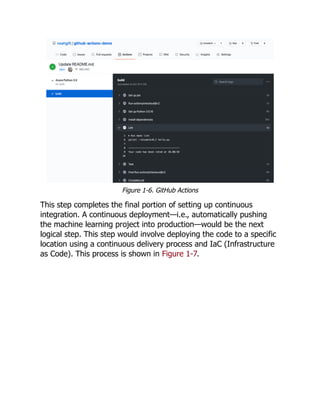
An overview of what GitHub Actions looks like when run on “push”
events from a GitHub repository is shown in Figure 1-6.
42.
Figure 1-6. GitHubActions
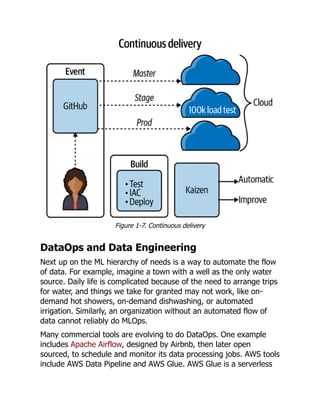
This step completes the final portion of setting up continuous
integration. A continuous deployment—i.e., automatically pushing
the machine learning project into production—would be the next
logical step. This step would involve deploying the code to a specific
location using a continuous delivery process and IaC (Infrastructure
as Code). This process is shown in Figure 1-7.
43.
Figure 1-7. Continuousdelivery
DataOps and Data Engineering
Next up on the ML hierarchy of needs is a way to automate the flow
of data. For example, imagine a town with a well as the only water
source. Daily life is complicated because of the need to arrange trips
for water, and things we take for granted may not work, like on-
demand hot showers, on-demand dishwashing, or automated
irrigation. Similarly, an organization without an automated flow of
data cannot reliably do MLOps.
Many commercial tools are evolving to do DataOps. One example
includes Apache Airflow, designed by Airbnb, then later open
sourced, to schedule and monitor its data processing jobs. AWS tools
include AWS Data Pipeline and AWS Glue. AWS Glue is a serverless
44.
ETL (Extract, Load,Transform) tool that detects a data source’s
schema and then stores the data source’s metadata. Other tools like
AWS Athena and AWS QuickSight can query and visualize the data.
Some items to consider here are the data’s size, the frequency at
which the information is changed, and how clean the data is. Many
organizations use a centralized data lake as the hub of all activity
around data engineering. The reason a data lake is helpful to build
automation around, including machine learning, is the “near infinite”
scale it provides in terms of I/O coupled with its high durability and
availability.
NOTE
A data lake is often synonymous with a cloud-based object storage
system such as Amazon S3. A data lake allows data processing “in
place” without needing to move it around. A data lake accomplishes this
through near-infinite capacity and computing characteristics.
When I worked in the film industry on movies like Avatar, the data was
immense; it did need to be moved by an excessively complicated
system. Now with the cloud, this problem goes away.
Figure 1-8 shows a cloud data lake–based workflow. Note the ability
to do many tasks, all in the exact location, without moving the data.
Dedicated job titles, like data engineer, can spend all of their time
building systems that handle these diverse use cases:
Periodic collection of data and running of jobs
Processing streaming data
Serverless and event-driven data
Big data jobs
Data and model versioning for ML engineering tasks
partner quietly slippedbehind the counter and to the safe and took
the cash and missing papers unobserved. It was also apparent to me
that this must have been done almost immediately before the store
was closed for the night, as the cash box and some of the missing
bonds had been out of the safe on the manager's desk until a short
time before they were placed in the safe by Mr. Fair himself at about
ten o'clock. Upon further investigation I learned that two young men
had visited the store about ten o'clock Saturday evening. One of
them purchased a package of smoking tobacco, while the other
consumed considerable time in trying to select a pair of shoes,
which, by the way, he did not purchase. One of these young men
was known as "Butch" DeWitt, then about nineteen years of age, the
other was William Heilman, twenty-one years of age. The parents of
these young men were respectable, hard-working people and both
resided in Oil City. The boys both bore bad reputations, but up to
that time were not considered thieves. Upon learning that they were
at the store at a late hour Saturday night, I concluded that I would
locate and interview them, but upon further inquiry I learned that
they had not been seen since the Saturday night in question, and
evidently had left town. I also learned that "Butch" DeWitt had a
sweetheart, whose name was Hattie Bates, who was a professional
dancer and was supposed to be at the time an employe of Ben
Hogan, proprietor of a large dance hall at Petrolia, Butler County, Pa.
For the information of the reader, I will say that Ben Hogan was a
prize fighter of note and a sporting character generally. He at one
time fought the celebrated Tom Allen for the heavyweight
championship of the world, near St. Louis. The fight was a draw and
created a lot of bad blood between the two factions interested.
Some time after Hogan's fight with Tom Allen he retired from the
prize ring and became an evangelist, making his headquarters at
Chicago, and up to a few years ago, the last heard of him, the writer
has been informed had been very successful in his missionary work.
Prior to the time Hogan established himself at Petrolia he had been
engaged in the dance hall business at Tidicute, Warren County, Pa.,
which is also an oil town on the banks of the Allegheny River. While
47.
engaged in thatbusiness a party of roughs, who were looking for
trouble, visited his place and started a disturbance in the dance hall,
which resulted in one of the parties being killed and two or three of
his companions being severely injured. Hogan was arrested charged
with murder. Upon hearing of this trouble, and knowing as I did the
character of the parties who created the disturbance, and that
Hogan was entirely justified in protecting his premises against the
violence of this gang, who had gone to his place in search of trouble,
I assisted Hogan's attorneys by informing them as to the character
and standing of the parties who created the trouble. Hogan was
acquitted and ever afterwards was very grateful and friendly towards
me, and when I learned that "Butch" DeWitt's sweetheart was
employed at Hogan's dance hall, I hastened to Petrolia, thinking that
DeWitt might visit his sweetheart there. Petrolia was about sixty
miles south of Oil City and I arrived there on the afternoon of
Wednesday, after the robbery before mentioned. This was my first
visit to Petrolia, which was a big oil town or more like a mining
camp, located in a valley on a tributary of the Allegheny River, and
the town consisted of one main street with buildings on both sides of
the street running up and down the valley, all very close together
and all frame. It consisted chiefly of boarding houses, saloons,
dance halls and gambling houses. On my arrival at Petrolia I started
up this street. I had had a description of Hogan's dance hall, which
he had built a short time prior to my going there, and it was
described as one of the largest buildings in town, and when I arrived
in front of what I considered the largest building there I inquired for
Hogan's place. The man from whom I made this inquiry pointed out
the building, which I had selected as Hogan's, which was directly
across the street from where I was standing, and told me that that
was Hogan's dance hall. There were two buildings standing along
side of each other, and as they were almost identically the same in
size and appearance, and being anxious to make no mistake, I
inquired again, and the man pointed out the building to my left, so I
understood, as Hogan's, whereupon I crossed the street and entered
the front door of the building, which was standing open. This was
about four o'clock in the afternoon. I mention this fact for the reason
48.
that everything isusually very quiet about these dance halls until
later in the evening, as places of this kind do all of their business at
night. There was a screen, as there usually is, in front of bar-rooms,
to shield the gaze of the passers-by on the sidewalk. As I entered
the house supposed to be Hogan's, and went around the screen to
my left, I found a bar standing right back of the screen and behind
the bar was a large young man with blonde hair, rather fine looking,
standing about six feet, one inch, in height, and weighing in the
neighborhood of two hundred pounds, and about thirty years old.
This man was the then notorious "Bill" Casey, who was also a heavy
weight prize fighter, and the proprietor of this dance hall. I knew
Casey upon sight, and he also recognized me. When I went around
the screen I found myself face to face with him as he was leaning
over with his elbows on the bar talking to one of his employes. He
straightened up, looked at me for an instant, and exclaimed, "Why,
hello, Chief. What in the world are you doing down here?" at the
same time extending his right hand. I shook hands with him and
said, "I just happened to be passing through Petrolia on a little
matter of business, and while on the opposite side of the street met
a friend who told me that this was your place and that I would be
likely to find you here at this time, so I just stepped in to pay my
respects and shake hands with you." To which he replied, "I am
mighty glad you did. You say that you are down here on a matter of
business. You know that I am pretty well posted among the class of
people that you are generally looking for, and if there is anything I
can do for you I shall be glad to do so." I thanked him for his offer
and told him that there might be some way in which he could assist
me a little later on. He then said, "You know Kittie, don't you?"
(Kittie was his wife), I said, "Yes, I remember her." "Wait a minute
and I will call her," and he called to the rear part of the house for
Kittie. When she appeared he said to her, "Kittie, you remember Mr.
Furlong, don't you? He's Chief of Police at Oil City, and I want you to
shake hands with him." Kittie came to where we were standing (in
the meantime Bill had come behind the bar alongside of me) and
good-naturedly said, "Oh, yes, I shall never forget Mr. Furlong." She
then continued, "Mr. Furlong, Bill and I often speak of you. You did
49.
the best thingthat ever happened that time that you arrested Bill in
Oil City and he has often told me that he would always remember
you with the kindest of feelings for the reason that you did not kill
him at the time he was arrested. The manner in which he acted and
the manner in which he abused your man Fry, if you had not
appeared upon the scene as you did at that time he would have
killed Fry and would probably have been hung. You know he was
drinking at the time and was acting very badly, as he always did
when he drank. He has never touched a drop of any kind of
intoxicating liquor since that time, and it has made a man of him,
and I give you credit for what you did. Bill has often said that you
had a perfect right to kill him under the circumstances and has
always felt very grateful." As she finished I said in reply, "Well, I am
very glad that you and Bill feel as you do, and I appreciate your
good will very much, although I regretted at the time what occurred,
but knew that there was nothing else to do but what I did, and I am
more than glad of the good results."
In this connection I will say that just prior to my arrest of "Bill"
Casey at Oil City, which was more than a year prior to the time of
the foregoing interview, Casey and his wife had a quarrel and had
separated. Mrs. Casey (or Kittie), as he called her, came to Oil City
and was boarding with a woman named Mrs. Brown, who had
sixteen or eighteen other female boarders. Casey, at this time, was
living at Petroleum Center, in the oil country, and had heard that his
wife was boarding with Madam Brown. He came to Oil City in search
of her and visited Madam Brown's house one afternoon about two
o'clock. Madam Brown's house was situated in Oil City in what is
known as the "Red Light District" and was a large and well furnished
establishment, in fact the finest of its kind in the oil regions of
Pennsylvania at that time. It so happened that I was passing Madam
Brown's house, when I heard a tremendous uproar in the house;
women were screaming and shouting for help, and it was a general
tumult. Some person I met on the street said to me, "You had better
go into Madam Brown's house. Officer Fry has just gone in there and
it seems as though he is in trouble," whereupon I hastened into the
50.
place, and inone of the parlors on my right as I went in I could hear
Officer Fry calling for help. I ran into the parlor, where I found
several women, all screaming at the top of their voices, and "Bill"
Casey standing at one side of a large square, old fashioned piano,
from which he had twisted one of the legs. He held this piano leg in
his hand similar to the way in which a ball player holds his bat, and
had Officer Fry backed up into a corner alongside of the piano and
was about to bring the piano leg down upon the officer's head. Fry
had his revolver in his hand, but was unable to raise it, as Casey had
him covered with the leg of the piano. Casey was standing with his
back to the door from which I entered, and, upon taking in the
situation, I pulled my revolver from my pocket and struck Casey over
the head with it just above the right ear, which cut an ugly gash and
caused him to fall to the floor. I had dealt him a heavy blow, which
took him completely by surprise, and before he could rally and arise
from the floor he was seized by Fry and myself and subdued only
after a vigorous rough-and-tumble fight. He was locked up, but
owing to the fact that his wife had been found by him in this
disreputable place, and that he was under the influence of liquor, the
committing magistrate fined him $200.00 and costs, with the
agreement, on his part, that he was to leave town immediately, upon
the payment of the fine and costs, which he did, and further
agreeing that he would never again appear in Oil City, or any place
else under the influence of liquor. That promise he always kept until
the day of his death.
With the above explanation I feel that it is unnecessary for me to
say to the reader that I did not enter "Bill" Casey's place voluntarily.
I had not the slightest idea "Bill" Casey was there. The last time I
had seen him was at Oil City on the day of his arrest, and he had
said to me before leaving that he would get even with me if it took
him the balance of his life, so the reader can imagine my
predicament better than I can describe it, when I first found myself
in the presence of "Bill" Casey and in his own place. It would have
taken a good sized rope to have dragged me into that place had I
known that Casey was its proprietor, but on confronting him I could
51.
think of nobetter way than to act boldly and act as though I had
voluntarily come in to call and pay my respects, which worked
admirably.
After ascertaining the friendly feeling of Casey and his wife towards
me, I told them that I wanted to locate "Butch" DeWitt, who was a
friend of Hattie Bates, who, I understood, was living next door with
Ben Hogan. Mrs. Casey said to me, "I know Mrs. Hogan, and we are
warm friends. I will go over and see her about this and see whether
she knows anything about the whereabouts of DeWitt or not." She
did so, and in a few minutes returned with Mrs. Hogan, who said to
me, "'Butch' DeWitt and a young thief by the name of Heilman were
here the night before last. DeWitt, you know, is a sweetheart of the
Bates girl, who lives with me. DeWitt and Heilman had some money
and left here yesterday morning at two o'clock for New Brighton, Pa.,
where they have a job of some kind that they expect to do, and
intend to return here in a couple of days from New Brighton."
I took the first train from Petrolia to Pittsburg, and then from
Pittsburg to New Brighton, Pa., where I arrived the following
morning early. At New Brighton I learned that the night before my
arrival the safe in a factory had been blown open by burglars and a
quantity of money stolen. At New Brighton I received a good
description of Heilman and DeWitt, and traced them down the
railroad to Rochester, Pa., to a hotel. Upon entering this hotel I
found that they had registered under fictitious names and were still
in their rooms at the hotel. I went to their room, forced an entrance,
and found DeWitt and Heilman there. I arrested them and took them
to Oil City, and in the meantime Heilman made a clean breast of the
robbery. He told me that while he was examining the shoes before
mentioned, DeWitt sneaked around behind the counter and took
from the safe, which was unlocked, the money and bonds that were
missing. They took the currency with them and secreted the bonds
and other things stolen by them from the safe in a tin lard can,
which they had buried on a farm south of South Oil City, known as
the Faren Farm. They accompanied me to the place and we
52.
recovered the canand its contents. These boys were convicted and
sent to prison.
The prize fighter "Bill Casey" continued as proprietor of the dance
hall and saloon at Petrolia, where he did a profitable business, and
where he had many friends among the drillers and tool dressers who
were employed at the oil wells in the district which surrounded
Petrolia. He was noted for being big-hearted, sociable and clever
while sober, and it will be remembered he had quit drinking after his
arrest at Oil City. He had accumulated a small fortune, and upon the
Christmas Eve following my interview with him, as before related, he
and his wife left Petrolia for the purpose of visiting his parents, who
were living at the time at Lockport, N. Y. They boarded what is
known as a mixed train, northbound, on the Allegheny Valley
Railroad, bound for Buffalo. This train consisted of a number of
freight cars, some of which were loaded with crude oil, a baggage
car and two passenger coaches, which were at the rear of the train.
The passenger coaches were crowded to their utmost capacity with
passengers, as there were many people leaving the oil country to
spend the holidays in other regions. As the train was rounding a very
sharp curve near Scrubgrass a front axletree broke on one of the
freight cars, which precipitated the entire train, behind the
breakdown, over a high bank into the Allegheny River, which was at
the time at high water mark. The crude oil ignited, by reason of the
wreck, and set fire to everything. The oil spread out over the water,
and, as crude oil burns just as fiercely upon water as it does upon
land, the whole river was afire in a very short time from bank to
bank, and the fire was carried down stream by the current at the
rate of four or five miles an hour. Many of the passengers were
drowned, or injured and burned to death by the flames, as it should
be remembered that the oil cars were ahead of the passenger
coaches, and as the train was running upstream the flames
immediately enveloped small portions of the passenger coaches
which remained above the surface of the water. Casey managed to
escape from the wreck, and, being a very powerful man, took his
wife with him and reached the bank in safety with the exception of a
53.
few burns. Therewas a crippled newsboy employed upon the train,
and in the wreck he had managed to get a portion of his body
through one of the windows which was upturned and out of the
water, while his lower limbs were fastened in the wreck, and he was
about to be engulfed in a body of floating burning oil, which was
rapidly approaching him, when Casey spied him. Casey immediately
left his wife standing on the bank and rushed to the assistance of
the newsboy, and while tugging away trying to extricate the boy
from the wreck Casey was engulfed by the burning oil and lost his
life, and thus died in the act of performing a humane and heroic
deed.
54.
SUBDUING A NOTORIOUSBULLY.
ONE OF MY EARLY EXPERIENCES WHILE CHIEF OF POLICE OF
OIL CITY—HOW A BAD MAN, WITH A LONG RECORD,
WAS TAKEN TO JAIL.
The notorious Tom Daly of Buffalo, New York, was arrested at Oil
City, Pa., early in the summer of 1872. Daly had been regarded in
and around the city of Buffalo for years, prior to his arrest at Oil City,
as a desperate and bad character. He had a police record almost as
long as the state statutes. He was a fighter and associated and lived
with the most vile and vicious characters to be found in the city. He
was never known to work at any legitimate trade or business. He did
pretend to gamble. He drank at times to excess, and was known to
the police as a strong-arm, or hold-up, man, and was considered by
the police a hard and bad man to arrest—a task which they were
frequently called upon to perform. But as bad as his general
reputation was, he had what was called a political pull in the slums
district, in which he resided. He had a following of his own class
because he was more aggressive and more physically powerful than
his associates and followers, and not for the reason of any superior
intellect on his part.
A couple of days before his arrest at Oil City, complaint was lodged
against Daly and some of his associates by a man in Buffalo, who
charged them with having held him up and robbed him, by force, of
a sum of money. The man also stated that Daly and his confederates
had brutally beaten him, the marks of which he bore plainly. Two
police officers were instructed to arrest Daly and bring him to
headquarters. As all the officers who were located in and about the
precinct in which Daly made his home knew him personally, the two
officers who were detailed to make his arrest easily located him.
When they approached him and told him that they had been
55.
instructed to arresthim he smilingly inquired on what charge, at the
same time, as the officers were standing within his reach, he
promptly struck first one and then the other terrific blows with his
clenched fist, knocking both of them down. He then ran into a
brothel, or dive, in front of which he had encountered the police
officers. He, of course, disappeared and escaped being arrested.
The part of the city was known, at that time, as Rock Street, or the
Five Points, and was the worst and lowest district of not only the city
of Buffalo, but probably as bad, if not worse, than any other in the
country. It consisted principally of low dance halls and drinking
places which were patronized almost entirely by the lower grade of
sailors and canal boat men. As this district was bounded on the east
by the Erie Canal and on the west by the Buffalo Creek, which is the
lake harbor of Buffalo, it was consequently a peninsula, narrow, and
frequented by the class before mentioned.
After his escapade with the police, Daly, on the same night, made
his escape from Buffalo and went direct to Oil City, Pa., where he
had some friends and acquaintances. He arrived at Oil City the next
day about noon, where he met parties whom he knew and from
whom he heard about the prowess of a valuable bulldog, owned by
a respectable citizen named Ziegenheim, and who was connected
with a meat market on Center Street. This man Daly was about
thirty-five years of age, was over six feet in height and weighed at
least two hundred pounds. He had an athletic build, was dark
complexioned and somewhat marked by the after effects of small-
pox. He had rather small dark eyes and the most villainous
expression I think that I have ever seen. He was considered an
expert boxer and was known to be a powerful man—at least by the
two police officers whom he had knocked down and escaped from in
Buffalo. I had heard of Daly and knew of his record, but I had never
seen him until I was called upon to arrest him in Oil City, and I did
not know who he was at that time.
When Daly had learned from the friends he had met in Oil City of the
valuable fighting bulldog before mentioned, he at once went to the
56.
meat market, wherehe found Mr. Ziegenheim, and tried to purchase
the dog from him for the purpose of using him as a fighting dog.
Ziegenheim informed Daly, in a polite but firm manner, that his dog
was not for sale, as it was a pet of his wife and children, and that he
would not part with the dog under any consideration, and especially
not for the purpose Daly proposed to use him. Daly became angry
and assaulted Ziegenheim, who was fully as large a man as Daly, but
was a gentleman, and not a fighter. Ziegenheim immediately sought
refuge behind a large, round table, known as a meat block, which is
used in all meat markets to cut meat on. It was probably about four
feet in diameter, and by keeping on the opposite side Ziegenheim
was out of Daly's reach. Daly picked up a large cleaver, which he
was holding in a threatening manner. At this juncture I entered the
shop, having been summoned by Mr. Steele, Ziegenheim's employer,
who had run from the meat market to my office, which was just
around the corner in the same block, and told me, in a very excited
manner, that there was a big man trying to kill Ziegenheim in the
shop.
At the time that Steele came into my office I was talking with the
Mayor, William M. Williams, and when Steele apprised me of Mr.
Ziegenheim's danger I sprang to my feet and was about to leave for
the meat market when the Mayor said to me, "Tom, you had better
take a club or a gun with you. Steele has said Ziegenheim's assailant
is a big, strong fellow." I hastily grabbed up a mace, or club, which
was hanging on a rack near where I was standing, and hastened to
the shop, where I found Daly standing in front of the meat block
before described, with his back to the door. He was holding a
cleaver, as I said before, and facing Ziegenheim, who was at the
opposite side of the block. I approached him from the rear without
being noticed by him, and placed my left hand upon the right collar
of his coat as though I meant it, at the same time commanding him
to drop the cleaver. Whereupon he immediately turned his head and
looked down upon me with a very disdainful and defiant expression.
I saw in his eyes the most vile expression that I have ever seen. I
instantly realized that I was in for trouble. He was wearing a stiff
57.
derby hat setback fairly well on his head, and it seemed to be tight
fitting. Upon noticing the expression on his countenance I instantly
struck him as hard a blow as I could with the mace, which I held in
my right hand, at the same time tightening my grip on his coat collar
and vest. However, before I struck him he made a desperate
backward lunge, evidently intending to get clear of me so that he
might get far enough away from me to strike me with his fists. But,
by reason of the strong hold I had on him I had drawn myself up
close to him, and in his lunge he was so much heavier and larger
than I that he carried me back with him, probably a distance of four
or five feet. It was while he, or rather we, were making this lunge,
that I struck him. My mace caught him, or more truthfully speaking,
his hat, just above his forehead. It forced his hat, which was a stiff
one, as stated, and drove it down over his forehead to his eyebrows.
The hat was tight and the lining was leather, and with the force of
the blow the lining cut the skin clear across the top of his forehead,
and as the hat was forced down the skin peeled down over his
forehead, and of course, the blood spurted over both of us. He fell
to his knees with the force of the blow, but immediately tried to rise,
when I hit him a second time, which felled him to the ground. I was
still holding on to his collar, and when he fell I started for my office,
dragging him behind me. He was upon his back and therefore
helpless so long as I kept him moving. He regained consciousness
when he had gone about a hundred feet and began pleading with
me to let him up, which I did, with the understanding that he was to
accompany me peaceably. This he agreed to and did.
It being at the time of the day when the streets were crowded with
people, an immense crowd was attracted by the excitement, and a
great many comments were heard, many of them condemning my
action as brutal and uncalled for. There was both a morning and an
evening paper published in Oil City at that time. The evening paper
got out an extra, which censured me severely, and was entirely in
accord with the previous comments made by many of the crowd.
They were, by the way, entirely ignorant of the facts which led me to
act as I had found it necessary.
58.
The crowd filledthe Mayor's office to overflowing, and among those
present were a few friends and former associates of Daly's, who
succeeded in getting one of the citizens, a saloon proprietor and
considered a good citizen and fairly well off, to come forward and
intercede with the Mayor, who at that time, in accordance with the
laws of Pennsylvania, was a committing magistrate. Daly's friends
told the Mayor that they would pay his fine and the costs and would
see that he left town within the hour, if he (the mayor) would let
Daly go upon the payment of the fine and costs for his having
assaulted Zeigenheim.
The Mayor assented and fined him one hundred dollars and costs,
three dollars and fifty cents, making a total of one hundred and
three dollars and fifty cents. The citizens before mentioned paid this
fine and Daly left town immediately thereafter. He gave an alias to
the Mayor, and his friends did not betray him, and for this reason the
Mayor or myself did not know who he was until after he had
departed.
Mr. St. John, who was the editor of the evening paper, and who had
so unmercifully roasted me, had always, prior to this occurrence,
acted in a friendly manner towards me. The write-up that he had
given me that evening, therefore, hurt my feelings beyond
description.
A Mr. Bishop, who was the editor and proprietor of the morning
paper, had come from Buffalo, where he was born and raised, to Oil
City, and he at once took it upon himself to investigate, through
correspondents in Buffalo, by wire, what and who this man Daly
was. The result of which was that he devoted the entire first page of
his paper, on the following morning, to Daly's complete history,
setting forth his police record, his vocation and his desperate
character, as well as the full particulars and details of his most recent
encounter with the two Buffalo police officers, his escape from
Buffalo and his subsequent arrest by me at Oil City. The article
wound up with the most complimentary comments that I have ever
received, considerable space being devoted to the fact of my having
59.
succeeded in subduingand arresting Daly unassisted by any one.
This article caused a majority of those who had so loudly denounced
my actions of the previous evening to apologize for their hasty
conclusions. Mr. St. John, of the evening paper, was among the first
to approach me with an apology for his publication of the evening
before.
If I had known that it was the notorious Tom Daly I had been called
upon to arrest I don't believe that I could have been pulled into that
meat market with a large rope attached to my neck; but I was fully
convinced that prompt and decisive action was required on my part
the instant that I saw that vicious, and I might say, hideous
expression on Daly's face.
The result of this arrest had more to do with securing me the
confidence and respect of the law-abiding citizens of Oil City than
any other one arrest that I had ever made, and I had made many of
them.
60.
A RUSE THATWORKED.
HOW EVIDENCE TO CONVICT AN ANONYMOUS LETTER WRITER
WAS OBTAINED.—TRAGIC DEATH OF TWO BROTHERS
AFTER THEIR ARREST AND AFTER BREAKING JAIL.
Early in the 1870s, Sam Ackert called at my office one cold winter
morning in the month of February. I was then Chief of Police of Oil
City, Pa. Mr. Ackert was known to me as the owner of a large oil
lease, on what was known as the Towles Farm, on the Plummer
Road, about eight miles north, and a little east of Oil City, and in
Venango County. Mr. Ackert was considered at that time, one of the
largest oil operators in that district. He was operating twelve or
fifteen oil wells, all of which were producing large quantities of oil.
Some were being pumped, while others were flowing wells. My
recollection is that one of these flowing wells was producing four
hundred barrels per day. Crude oil was selling at that time for about
eight dollars per barrel at the well. Ackert employed quite a large
number of men to attend to the wells and look after his interests in
general. Some of these men were employed as engineers, which
were commonly known in the oil country as pumpers. Two of these
engineers, or pumpers, were required to operate each well, each
man usually working from 12:00 noon until 12:00 midnight. These
watches were morning and noon watches, and men so employed
usually lived adjacent to the well upon which they were employed.
Mr. Ackert had a superintendent who had charge of the employes
and who lived on the lease. His name was Joseph Sullivan. He also
had two engineers whose names were George and Henry Book.
George Book was a young man, married and lived in a cottage on
the lease. His brother Henry was single and lived with George.
George was the eldest. They were both employed on the same well
as pumpers. George was on the noon watch each day and was
61.
considered a verygood engineer. He was sober, competent and
attentive to his business; while his brother Henry had also been
considered competent and energetic, but not as reliable as George.
He had been found asleep while on duty by Supt. Sullivan, on
various occasions, for which he was reprimanded and finally
discharged from the service.
Some months after Henry's dismissal, Mr. Ackert received an
anonymous letter through the mail. This letter threatened dire
destruction to his property by fire, or other methods unless he
(Ackert) would discharge Sullivan, his superintendent. This letter was
followed by three other threatening letters, also anonymous, which
were received at intervals of four or five days by Ackert. Sullivan
being a very competent and reliable man of good character, Mr.
Ackert at first did not pay any attention to the threatening letters,
but laid them away in his desk.
A short time after the receipt of the last anonymous letter, one of his
oil tanks, which at the time contained about four or five hundred
barrels of crude oil, was emptied one night, between dark and
daylight, by some person who had gone to the tank and opened
what was known as the lower faucet. This faucet, two inches in
diameter, entered the tank about one-half foot above the bottom of
the tank, and was placed there so that by opening it the salt water
could be drawn out of the tank. All oil wells in that particular locality,
which had to be pumped, produced a percentage of salt water, this
water coming up with the oil. Salt water being heavier than the oil,
immediately settled to the bottom of the tank, and for that reason,
as the tank would become nearly filled to its top, it was the duty of
the pumpers to open this salt water faucet and let the salt water
escape from the bottom of the tank, in order to make room for more
oil above.
On the night that this tank was emptied in the manner above
described, there was about three feet of snow on the ground. The
weather was cold, and the snow had drifted around the tank so that
it was about four feet deep above the faucet in question. I will state
62.
here that theconstant drawing off of the salt water had thoroughly
saturated the ground for a space of two or three feet square under
the faucet, and for this reason, the ground was soft and a little
muddy. The saturated earth would not freeze in cold weather on
account of the large quantities of salt which had become
impregnated with the dirt. At the time this tank was emptied by
means of the opening of the faucet, the oil, which was very
inflammable, ran down into a ravine, which was thickly dotted with
oil wells and tanks for a mile or more. But, fortunately, the flowing
oil did not happen to reach any of the fires that were under the
boilers of the pumping stations. If it had, it would have instantly
burned everything within reach along the side of the ravine, thereby
destroying hundreds of thousands of dollars' worth of property and
in all probability many lives.
Mr. Ackert called upon me the morning after the occurrence above
related and told me of what had occurred, stating at the same time,
that he had no idea who was dastardly enough to perpetrate this
malicious act. He knew of no enemy on earth and was more than
anxious that I investigate the matter and locate the party, or parties
guilty of the crime. He also told me of having received and retained
the anonymous letters before mentioned. I instructed him to bring
the letters to me at once, which he did. I noticed that the letters
were written on the same brand of paper and in a legible and
penmanlike manner and evidently by the same hand and pen. By the
end of the third day of my investigation I had learned of the
dismissal of Henry Book, and the difficulties he had had with Supt.
Sullivan. I had also learned that his brother, George Book, was a
good scholar, had been a country school teacher some years before
in his native county, which was Crawford County, Pa. I had also
found out that he was considered an extra good penman, and during
my investigation was informed that there had been other loots of oil
well tools and other valuable property on the Ackert and adjacent
leases.
63.
I decided tolocate the writer of the anonymous letters. Being
familiar with the manner of operating oil wells, I donned the suit of
an oil driller, which usually consists of overalls. These overalls
become spattered over with sand pumpings, giving the wearer the
general appearance of a bill-poster. The weather was very cold, the
thermometer standing below zero the night that I left Oil City to visit
the Ackert Lease and the pumping houses where I knew George
Book would be on duty until midnight.
That evening, preparatory to my departure, I visited a meat market
kept by a Mr. Steele, on Center Street, where I purchased five cents'
worth of liver, telling Mr. Steele that I wanted it for a pet cat that
stayed around my office. I dressed myself in heavy, warm clothing,
which I wore under the overalls before described. Taking a small
slice of the liver, I placed it in the hollow of my right hand. I then
placed another piece of the liver on top of the same hand and tightly
bandaged the hand with a piece of white muslin. The liver placed on
my hand as described, soiled the tightly drawn bandage, which gave
the hand the appearance of being very swollen and inflamed. I then
improvised a sling around my neck by tying two handkerchiefs
together so that I could place my right hand in the sling at the
proper time. I started from Oil City, unidentified by reason of my
costume, at about 7:00 o'clock in the evening, arriving at the Ackert
Lease a few minutes after nine. I went direct to the engine house in
which George Book was employed, found him sitting alone there in a
large easy chair, in front of the boiler, which was being fired with
natural gas and well lighted by the same, was warm and neatly kept.
Book was reading a novel when I entered, and as the engine house
was located but a few feet off the main road from Oil City to the
town of Plummer, it was not an unusual thing for oil well men to
stop at the engine house, while passing that way for the purpose of
getting warm or getting a drink. So Book was not at all surprised
when I appeared at that hour of the evening. I asked his permission
to stand by the boiler to get warm. He replied that it was cold, and
that he would be glad of my company. He eyed me closely for a
while and finally said, "Where do you work?" I replied that I had
64.
been working onthe Foster Farm, which was about fifteen miles
southwest of Oil City and on the Allegheny River. He then remarked,
"How did you get hurt?" as he noticed that I was carrying my right
hand in a sling. I replied, "You have been kind in allowing me to get
warm in your engine house, and you look to me like you would not
get a fellow into trouble by giving him away, and I will tell you all
about it." I began by saying, "You see, I am a driller and I was
working under a superintendent. We had trouble over a girl and he
had a gun. He shot me through the hand." I pulled my hand out of
the sling and he exclaimed, "Gracious! You have an awful hand there
and you should have medical attention at once." To which I replied,
"I am going to have it attended to when I reach Petroleum Center.
You should see the other fellow. I shot him, but I don't know
whether he is dead or not, as I left immediately and have walked the
entire distance, only stopping long enough to get a cup of coffee at
the eating-house in the depot at Oil City." He said, "You must be
hungry." His sympathy was now fully aroused and he was really a
good-hearted fellow. I then said to him, "I have some friends at
Petroleum Center who will keep me under cover and get me a
doctor, but what is worrying me most now is that I cannot write with
my left hand, and my folks live at Ft. Erie, Canada, which is just
across the Niagara River opposite Buffalo, N. Y. I have been saving
my money and sending it to my people at Fort Erie, and they have it
deposited in a bank at Buffalo to my credit. I have a few hundred
dollars there and if I could only write a letter to-night, and mail it on
the early train to-morrow morning it would reach Fort Erie to-
morrow night. My friends could then send me all the money that I
need, which I would receive the day after to-morrow at Petroleum."
To this he replied, "I am a pretty good penman, and would be glad
to write the letter for you." On saying this, he excused himself and
went to his house, which was close by, and returned in a few
minutes with letter paper, envelopes, and a nice big lunch for two
and a pot of hot coffee. We ate the lunch, and I had some cigars in
my pocket. Then he started to write the letter at my dictation. In
dictating the letter I used as many of the words as I could
intelligently get in which had been used in the anonymous letters,
65.
the contents ofwhich I had familiarized myself with. This letter of
mine was not necessarily very long, as I discovered that he was
using the same quality of paper upon which the anonymous letters
were written. I also noticed before he had written three lines, that it
was the same handwriting, and that he was using the same ink, and
no doubt, the same pen, that he had used in writing the anonymous
letters. He addressed the envelope, sealed and stamped it. I thanked
him and departed for Petroleum Center, apparently, but in reality for
Oil City, where I arrived about six o'clock in the morning.
During the forenoon I submitted my dictated letter, together with the
anonymous letters, to an expert who was connected with the First
National Bank of Oil City. He unhesitatingly stated that the letters
were all written by the same person. I then went back in the
afternoon to the Lease, knowing as I did that George, whom I had
met the night before, would be off duty and probably in bed. I
carefully shoveled the snow from around the faucet of the tank, and
when I got down to the ground, I found two very distinct tracks of a
No. 8 boot. The boots had been recently half-soled, the shoemaker
who had made the repairs having placed three nails in a row across
the center of the half-soles. This was his trade-mark. I soon located
the shoemaker who had done this work. He remembered having
repaired the boots for Henry Book a couple of days before the
emptying of the tank.
I then returned to Oil City, procured a warrant for the arrest of the
Book brothers, and that night about eleven o'clock I arrived at the
Ackert Lease, where I found George on duty, as he had been the
night before, and I found Henry in bed at George's house. On this
occasion I was accompanied by two of my officers. We drove out in
a sleigh. After making the arrest, we searched the house which was
a one-story building with an attic. In the attic we found wagon loads
of loot, from the Ackert Lease and adjacent leases, that was
afterwards identified by the owners, as having been stolen from time
to time, as before mentioned.
66.
The Book brothersin due time, had a preliminary hearing and were
committed to the County Jail in default of bail.
In the meantime Henry Book had confessed to having emptied the
oil tank and George admitted the writing of the anonymous letters.
About a week before their trial was to take place, there was a
general jail delivery at Franklin, Pa., effected one very stormy night.
There were fifteen or more prisoners who escaped. The Book
brothers were among them. They boarded a north bound freight on
the A. & G. W. R. R. which is now known as the "Erie." When at a
point about twenty miles north of Franklin this freight train collided
with another train. In the wreck Henry Book was killed instantly and
George was so badly hurt that he died the following day. Thus ended
the Ackert case.
I consumed in all not to exceed six days in connection with this case,
unassisted except upon the night of the arrests, when I was
accompanied by two of my officers, whose names were George W.
Frye and Max Fulton.
67.
CHARLIE DALTON, OUTLAW.
SPECTACULARARREST OF THIS MUCH-WANTED MAN ON A
CROWDED ST. LOUIS STREET CAR
The arrest, in St. Louis, on the evening of March 12, 1888, of the
notorious Charlie Dalton, was accomplished in a rather unique, yet
sensational manner. Dalton had been "scouting" for a couple of
years, with a large reward offered by the state of Texas and the
Missouri Pacific Railway hanging over his head. Almost every sheriff,
police officer and detective in the country had his description and
were looking for him. The charge was murder, and the crime was
committed during the 1886 strike on the Gould properties. On the
afternoon of April 3, 1886, a freight train pulled out of Fort Worth,
Texas, for New Orleans, Louisiana. Besides the regular crew, the
train carried a number of guards in charge of Jim Courtwright, a
noted western officer, who had formerly been Chief of Police, Sheriff
and Deputy United States Marshal at Fort Worth.
As the train neared the Fort Worth and New Orleans crossing, it was
fired on by a gang of outlaws and cut-throats, headed by Dalton,
who were in ambush behind a pile of ties on the Missouri Pacific
right-of-way. Two of the guards were killed outright and several
wounded. The crime created a great sensation throughout the entire
country, because of its dastardliness.
The St. Louis Globe-Democrat of April 13, 1886, editorially referred
to it as the "Fort Worth Massacre."
Dalton and some of his gang were indicted by the Grand Jury, but
when the officers began a hunt for them they had disappeared.
Circulars announcing the amount of the reward and giving a
description of the men wanted, were scattered almost broadcast
over the United States, Canada and Mexico.
68.
I received oneof them, studied it carefully and got into
communication with the officers at Fort Worth. I had never seen
Dalton, but I had seen his brother, Geary, who was connected with
the track department of the Missouri Pacific Railroad, in St. Louis,
where he lived. I noticed a resemblance in the photo I had of Charlie
to that of his brother, and had instructed my operatives to keep a
sharp lookout for Charlie, as I had learned that his mother was then
residing in Carondelet. In the latter part of February, 1888, one of
my operatives reported that he had learned from a reliable source
that the much-wanted man had been seen at his mother's home in
Carondelet. Whereupon, I took measures to have the premises
watched. I later learned that he had been making a practice of
visiting the Standard Theatre nightly.
On learning this, I arranged with the Chief of Police of St. Louis to
detail a couple of his men to visit the Standard Theatre nightly,
where I should have one of my men, who knew Dalton, on hand, so
that he might point him out to the officers, and they were to arrest
him. These arrangements were all completed on the afternoon of
March 12, 1888.
At about six o'clock that evening I left my office for home. I then
lived at 2723 Walnut Street, and I walked to the corner of Eighth
and Market Streets, where I boarded a horse-car for home. The car
proceeded west and when we got to the corner of 10th and Market
Streets, two good sized, rough-looking young men ran to the rear
end of the car and swung themselves onto the platform, one of
them lighting heavily on my right foot and hurting me very much.
His partner followed him and stood on the lower step. This man,
who had tramped on my foot, offered no apology for his rudeness,
and, in fact, paid no attention to me or the injury he had done, but
instead remarked to his partner that people ought to get out of the
way when they saw a person wanting to catch a car. His partner
said, "Charlie, we can't stay out at Geary's but a few minutes, as you
know I have got tickets for the Standard tonight and we must get
there early to get good seats."
69.
"We won't stayout there only long enough to say goodbye, as we
leave town in the morning," replied Charlie.
While they were talking I took a good look at the man addressed as
Charlie, and from the conversation, and from the resemblance he
had to his brother, I concluded that the man thus addressed was
Charlie Dalton. I knew who Geary was, and I saw the resemblance
that "Charlie" bore to him. I also knew that the car would necessarily
have to pass what was then known as the Mounted Police Station,
located between 27th and 28th Streets, on Market Street, and
before reaching Geary's house, and I decided that when we got in
front of the station I would arrest Mr. Dalton and lock him up there.
He was standing directly in front of me on the platform and had me
crowded up against the rear dashboard. He was a burly fellow,
considerably taller than I was, and would weigh one hundred and
seventy-five pounds. Having become satisfied that I had made no
mistake in his identity, I waited until we had arrived in front of the
police station, when I seized him by the coat collar with my left
hand, pulled the bell-cord, and after the car had slowed up I sprang
to the ground, taking Dalton with me, but as he struck the street, he
facing the car, he fell on his back, and I, still holding onto his coat
collar, reached for his pistol, which I was sure I would find, and I
was not disappointed, for there it was in the waist band of his
trousers, and proved to be a 41 Colts. Dalton then made an attempt
to rise, but I took all of the fight out of him by giving him a blow
over the head with his own weapon.
"What is this for?" he asked.
"Your name is Charlie Dalton and you are under arrest for murder," I
replied.
"My name is Charlie Dalton, all right, by G-d, partner," he exclaimed.
I then took him by the collar and assisted him to his feet. I took the
prisoner over to the police station and had him locked up, and later
wired the Fort Worth authorities that I had arrested Charlie Dalton,
70.
and he wasbeing held by the police of St. Louis, subject to their
orders. In due time I received a reply from the Chief of Police of Fort
Worth, requesting me to bring Dalton to that city, providing he would
go without waiting for requisition papers. Dalton, having already
informed me that he would go to Texas without requisition papers, I
left with him for Ft. Worth the following evening. On our arrival there
the prisoner was lodged in jail, and remained there a number of
months without bond.
Between the date of the crime and the arrest of the cutthroat a
number of witnesses against him had died. Others had left the state,
and the result was that when his trial was called the state was
unable to produce its evidence and the defendant was finally
released from custody.
While it is true that I was anxious to apprehend this outlaw for the
Texas authorities, and had just finished making preparations to do so
should he visit the Standard Theatre that night, because of his
known desperate character, and the further fact that he was
accompanied by a big, husky pal, I doubt that I would have
attempted his arrest single-handed, had it not been for the incidents
enumerated. I know I would not have recognized him on this
crowded car had not his rudeness attracted my attention especially
to him. The remarks of his pal settled the question of his identity in
my mind, and the pain in my foot and his insolence aroused my ire.
The arrest followed, and it has a moral—"People should be careful as
to whose toes they trample on."
71.
CONSPIRATORS HANDED ALEMON.
SENSATIONAL ENDING OF AN ATTEMPT TO BRIBE ONE OF FUR-
LONG'S OPERATIVES IN THE NOTED MILES WILL CASE.
HOW THE CONSPIRACY WAS EXPOSED.
In the latter part of the '90s, Stephen B. Miles, a wealthy resident of
Nebraska, died, leaving an estate consisting of lands in Nebraska
and Kansas, bank stocks and bonds, and other property valued at
several millions of dollars. He was survived by a wife, from whom he
had been divorced, two sons, Joseph H. and Samuel, and a
daughter, a number of nieces and nephews and several grand-
children. One of the sons, Joseph H., was a prominent banker and
business man of Falls City, Nebraska, and also had large interests in
other towns in that state. He had been a telegraph operator in his
younger days, and was highly esteemed by all who knew him, not
only as a good citizen, but a wide-awake, clean business man.
The other son, Samuel, was about forty years of age, and resided
with his family on one of his father's ranches over the Nebraska line
in Kansas. He had been rather wild in his younger days and had
caused his father much trouble because of his dissolute habits.
Shortly after the death of the elder Miles, a will was found in an old
suit case, the provisions of which made Joseph H. Miles executor
and trustee of the estate, and the chief beneficiary, Samuel being
left, besides some money, a life interest in the ranch on which he
and his family were living. At the death of him and his wife the ranch
was to be deeded to Samuel's children. The will also plainly provided
that Samuel could not either entail or dispose of the land.
The provisions of the will were very unsatisfactory, of course, to
Samuel Miles, and, at the suggestion of his counsel, he began court
72.
proceedings to preventthe probating of it, and, not succeeding in
this, later brought suit to have the will set aside.
In 1900 I had in my employ an operative by the name of D. F.
Harbaugh. This man had become well known and had obtained
considerable newspaper notoriety in and about Kansas City through
cases he had worked on under my instructions. One day Harbaugh
was approached in Kansas City by one of the lawyers employed to
break the will, and asked if he (Harbaugh) could find a man whose
former reputation had been good, who would go on the witness
stand and testify to having drawn up and witnessed a will made by
the elder Miles, while on one of his numerous trips to St. Louis
during his life time. During the talk the lawyer told Harbaugh all
about the conspiracy that had been formed to break the will—by
"finding" a later will, and gave the names of all connected with the
scheme. One of these men was a prominent lawyer in Falls City,
Nebraska, another a man of great prominence at Omaha, and who
had a big political pull throughout the state, while another was in
good standing at the bar in St. Louis at that time. Harbaugh was
further told that he would be paid a fee of $10,000 for his part when
the will was broken, and as a further compensation the lawyer would
send him to the Paris Exposition and back, paying all expenses up to
the sum of $5,000. Harbaugh agreed to give the lawyer an answer
in a few days, and left that evening for St. Louis.
The next morning Harbaugh told me all about the proposition that
had been made to him, and asked for my opinion as to the best
thing to do. I at once said, "There seems to be but two things to do
in this case. One is, for you to completely ignore the proposition, as
there can be no doubt as to the rascality of all the parties who are in
any way connected with the scheme. The other, and in my opinion,
the right thing to do, is for us to try and locate this man Joseph H.
Miles, and appraise him of the conspiracy that is being worked up by
these lawyers and his own brother against him. For, if we keep quiet
and ignore the matter, they will, in all probability secure a man who
73.
will accept theproposition and we would be parties to this
conspiracy for not having exposed it."
"Well," replied Harbaugh, "you are the boss, and it is up to you. I
have told you all I know about the matter. I told this lawyer that his
proposition was very important, and coming to me suddenly I would
need a few days to think the matter over, and it would require at
least a few days to select the right kind of a man—one that could be
trusted. He approved of this and expects an answer from me in a
week or ten days."
I at once undertook to locate Joseph H. Miles, and succeeded in
twelve hours. I found that he lived at Falls City, Nebraska, that he
was president of the First National Bank of that place, had a bank in
another Nebraska city, and had a large interest in a bank in York,
Pa., that he was a respectable citizen and prominent business man,
and very well known. After locating him I wrote him a letter, which
read about as follows:
Mr. Joseph H. Miles,
Falls City, Nebraska.
Dear Sir:
If you are the son of the late Stephen B. Miles, and have a
brother by the name of Samuel Miles, and a number of nephews
and nieces who reside in Kansas and Nebraska, I have
important information for you, and will impart it personally if
you will come to St. Louis.
I would suggest that you bring your lawyer, as I believe my
information important enough to justify you in so doing.
On receipt of this I wish that you would telegraph me, stating
when you will leave Falls City, and at what time you will arrive at
St. Louis. On arriving at St. Louis, go to the Planters Hotel, look
at the register where you will find my name, and you can then
74.
come direct tomy room, where I will be waiting for you and
your attorney.
I am using a fictitious name, for reasons that I will explain to
you when I see you.
Yours very truly
On receipt of the above letter Mr. Miles wired me promptly that he
would leave Falls City the same evening and would arrive at St. Louis
the following morning, via the Burlington Route, and would carry out
instructions as per my letter.
I went to the Planters Hotel that evening, registered under the name
I had given Mr. Miles, and was assigned to a room on the fourth
floor.
The next morning about eight o'clock, Mr. Joseph H. Miles,
accompanied by his lawyers, Ex-Judge Gillespie of Falls City, and Ex-
Judge Martin, of the same place, and the latter's son who was a
stenographer. I admitted them, and Mr. Miles stated his name, and
asked if I was Mr. Foster, to which I replied in the affirmative. He
introduced the other gentlemen and after they were seated I began
my story by saying:
"Gentlemen, my name is Thomas Furlong, and I used the name of
Foster in writing to Mr. Miles, because my name and business are
known to a great many people in Nebraska, and a party connected
with what I know to be a conspiracy against Mr. Miles, resides, and
is an old citizen of Falls City, and would probably know my name if
he heard it, and I did not know but what he might be connected
with or know people connected with the telegraph office, and would
thus learn that I had communicated with Mr. Miles, so I deemed it
advisable not to use my own name. Now, gentlemen, before I give
you the information that I have promised I wish that you would call
on any of the general managers of any of the railroads that enter St.
Louis, or the president of any bank in the city whom you may know,
and ask him as to my character and standing."
75.
Mr. Miles asked,"Does Mr. William Nickolson know you?"
I replied that Mr. Nickolson knew me very well. Mr. Miles said, "Mr.
Nickolson is my correspondent here and has charge of more than a
million dollars of our estate."
We walked over to Mr. Nickolson's bank and Mr. Miles entered the
private office, leaving me standing in the corridor outside. As he
entered the office he left the door open. Mr. Nickolson arose and
greeted him, and at the same time spoke to me. After the greeting,
Mr. Miles said to Mr. Nickolson, "I see that you know Mr. Furlong."
"Yes," replied Mr. Nickolson, "I have known Tom for years, and he is
welcome to anything I have."
Mr. Miles said, "Mr. Furlong told me that you knew him and insisted
on me coming down here and asking you about his standing in St.
Louis."
After a little further conversation Mr. Miles shook hands with Mr.
Nickolson and we returned to my room at the Planters, where
Judges Martin and Gillespie and the stenographer were awaiting us.
I then related in detail the story that I had recently heard from
Harbaugh. After I had completed the narrative, all of which was
taken in shorthand by the stenographer, the younger Mr. Martin,
Harbaugh was sent for and he verified the statements I had made to
the gentlemen. The conference then adjourned, the luncheon hour
having arrived. All parties again assembled in my room at the
Planters at two o'clock, when Judge Martin said, "We have been
considering this statement of yours, Mr. Furlong. We have known for
some time that these lawyers you have named have been trying to
make trouble, but did not know until you told us today just what
they intended to do, and now I want to say that Mr. Miles and myself
appreciate what you have done in this matter so far, and we are
anxious for your opinion as to what you think is the best way to
proceed."
76.
To which Ireplied, "I believe the best way to proceed would be for
Harbaugh to go to the lawyer in Kansas City and tell him that he
would accept his proposition, and that he would secure a man who
could be relied on, and who would assume that he had written the
will for the elder Mr. Miles. I would then select a man that I could
trust and turn him over to Harbaugh. Harbaugh would take him to
Kansas City and put him under the guidance of the lawyer. After
these conspirators had thoroughly posted and instructed this man,
whom they will expect to deliberately commit perjury, they will
probably have his deposition taken in St. Louis. He will take the
stand and be able to answer all questions put to him until asked if
he wrote the will. When he is asked this question, being under oath,
of course, he will tell the truth. In this way we will be able to prove
the enormity of the crime and the cool audacity of the parties
connected with it."
I turned to Mr. Miles and said, "That is my opinion, but if you do not
approve of it and prefer to employ some one else to handle this case
for you, you, of course, are at liberty to do so. I felt that it was my
duty to advise you of this conspiracy and the manner in which I had
received my information."
Judge Martin said, "Mr. Furlong, we want you to handle this case for
us," and Mr. Miles nodded his head and said, "Yes, I want you to
handle this case for me, and to handle it in your own way, and I will
pay you your regular charge, allow you the expenses incurred, and
pay you extra for your service." I told Mr. Miles that I did not expect
anything of that sort, as I did not believe in rewards and never
worked for them. He insisted, however, on paying me extra for my
services, which he did, and I divided it equally with Harbaugh.
I instructed Harbaugh to go to Kansas City and get in touch with the
crooked lawyer, which he did. I selected a man whom I knew well
and believed to be honest. I instructed him as to what I wanted him
to do, and in due time he was introduced to the Kansas City lawyer,
by Harbaugh. The lawyer began instructing him and gave him a
minute description of the deceased Stephen B. Miles, whom, of
77.
course, this manhad never seen. He posted him as to a room in the
old St. James Hotel that had been occupied by Stephen B. Miles in
one of his trips to St. Louis. This was the place where the fake will
was supposed to have been written. The lawyer was pleased with
the man I had sent and feasted and dined him on several occasions
when he was in Kansas City rehearsing the part he was to play in
the conspiracy.
In the meantime Harbaugh had grown to be the apple of the
crooked lawyer's eye, and from the good treatment he received from
this creature Harbaugh had begun to admire him for his liberality.
At last a day was set for the taking of the deposition of the man who
was supposed to have written the will. Due notice was served on the
respective parties interested, and at the appointed time our man
appeared at the office of the St. Louis attorney, and the taking of his
deposition began. After being duly sworn, the St. Louis
representative of the conspirators began to examine the witness in
the usual way, asking a few preliminary questions, and at last
reached the question, "Did you know Stephen B. Miles, deceased,
and did you not write this will for him?" indicating a paper he had in
his hand.
The witness said, "I have known a number of men by the name of
Miles. Allow me to describe one of them and if his description suits I
will be able to answer your question."
I had previously requested Mr. Miles' attorneys to let the St. Louis
lawyer do all the questioning and examining, and not to object to
any question that he might put to the witness, unless it was entirely
out of reason. Therefore, they merely sat still, carefully noting
everything and objecting to nothing.
Of course, the conspirators were anxious to get a strong deposition
from the witness, and, therefore, he was permitted to describe the
man Miles, for whom he was supposed to have written the will. The
St. Louis attorney kept nodding approval to his fine description of
78.
the dead man.When he had fully described Mr. Stephen B. Miles to
the satisfaction of the conspirators, he took the purported will and
examined it carefully, saying, "The handwriting on that document
looks like my handwriting, but (in a loud, clear voice) I did not write
this or any other will for Mr. Stephen B. Miles, or any other person. I
have never met the man Stephen B. Miles, nor the man that I have
just described. I was instructed to give the description that I have
given here by these lawyers (pointing to the St. Louis and Kansas
City lawyers, who were both present) and I was expected by them
to testify that I had written this will, and I was promised five
thousand dollars if I would."
The reader can easily imagine the consternation that reigned among
the conspirators at this testimony from the one they trusted would
be their star witness. Our man left the stand and the further taking
of testimony was discontinued, it is needless to add.
Mr. Miles and his attorneys believed that these conspirators had
ceased their efforts for a time, but later on they produced another
man whom they claimed had written the second will for Stephen B.
Miles. He was a young man, also a lawyer, and had at one time lived
in St. Louis for a short time, married there, and had gone to Old
Mexico. He was discovered in Mexico by the Kansas City outfit and
induced to come back to Chicago, Illinois, where his deposition was
taken. He claimed to have written the will for an old man in St.
Louis, but he was either afraid to describe him or could not do so,
therefore his testimony was worthless.
The conspirators continued to try to break the original will until it
was finally pronounced legal and valid by the Supreme Court of
Nebraska, and Joseph H. Miles' rights were thoroughly and legally
established.
During this litigation, however, two of the parties in the conspiracy
died, and the others were not prosecuted for complicity, although
their actions had put Joseph H. Miles to considerable trouble and
79.
expense. They hadmade several indirect propositions to Mr. Miles
looking to a compromise, but he promptly repelled all of them.
Harbaugh's connection with my service has long since been severed,
and he is now in the employ of Mr. Joseph H. Miles as manager of
his large stock range in Nebraska, not far from Falls City, where the
writer is informed he is doing well.





![Revision History for the First Edition
2021-09-14: First Release
See http://oreilly.com/catalog/errata.csp?isbn=9781098103019 for
release details.
The O’Reilly logo is a registered trademark of O’Reilly Media, Inc.
Practical MLOps, the cover image, and related trade dress are
trademarks of O’Reilly Media, Inc.
The views expressed in this work are those of the authors, and do
not represent the publisher’s views. While the publisher and the
authors have used good faith efforts to ensure that the information
and instructions contained in this work are accurate, the publisher
and the authors disclaim all responsibility for errors or omissions,
including without limitation responsibility for damages resulting from
the use of or reliance on this work. Use of the information and
instructions contained in this work is at your own risk. If any code
samples or other technology this work contains or describes is
subject to open source licenses or the intellectual property rights of
others, it is your responsibility to ensure that your use thereof
complies with such licenses and/or rights.
978-1-098-10301-9
[LSI]](https://image.slidesharecdn.com/16283-250311210050-7a07dcb2/85/Practical-MLOps-Operationalizing-Machine-Learning-Models-1st-Edition-Noah-Gift-8-320.jpg)








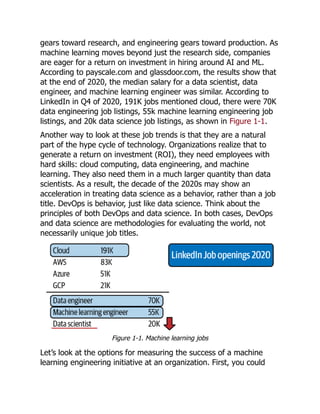




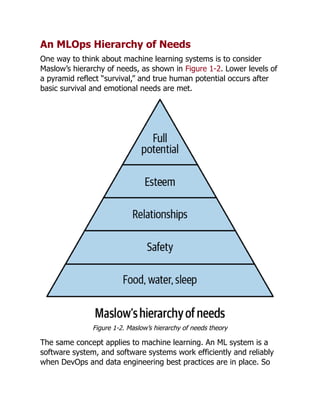
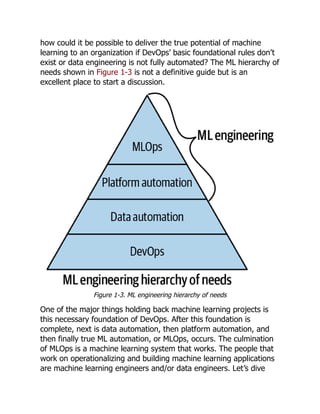
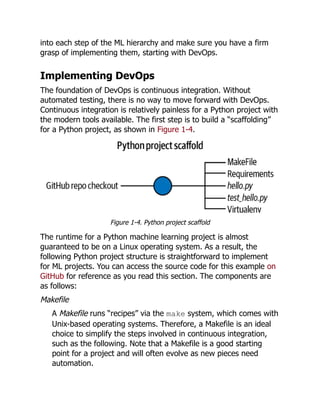
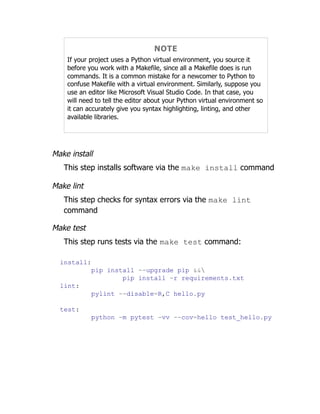

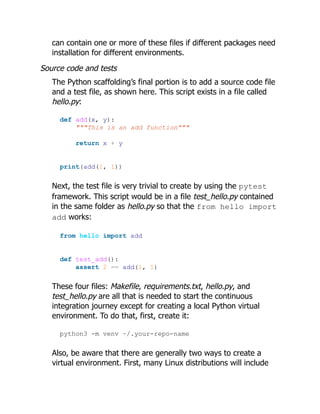
![the command-line tool virtualenv, which does the same thing
as python3 -m venv.
Next, you source it to “activate” it:
source ~/.your-repo-name/bin/activate
NOTE
Why create and use a Python virtual environment? This question is
ubiquitous for newcomers to Python, and there is a straightforward
answer. Because Python is an interpreted language, it can “grab”
libraries from anywhere on the operating system. A Python virtual
environment isolates third-party packages to a specific directory.
There are other solutions to this problem and many developing
tools. They effectively solve the same problem: the Python library
and interpreter are isolated to a particular project.
Once you have this scaffolding set up, you can do the following local
continuous integration steps:
1. Use make install to install the libraries for your project.
The output will look similar to Figure 1-5 (this example
shows a run in GitHub Codespaces):
$ make install
pip install --upgrade pip &&
pip install -r requirements.txt
Collecting pip
Using cached pip-20.2.4-py2.py3-none-any.whl (1.5
MB)
[.....more output suppressed here......]](https://image.slidesharecdn.com/16283-250311210050-7a07dcb2/85/Practical-MLOps-Operationalizing-Machine-Learning-Models-1st-Edition-Noah-Gift-38-320.jpg)

![platform linux -- Python 3.8.3, pytest-6.1.2,
/home/codespace/.venv/bin/python
cachedir: .pytest_cache
rootdir: /home/codespace/workspace/github-actions-
demo
plugins: cov-2.10.1
collected 1 item
test_hello.py::test_add PASSED
[100%]
----------- coverage: platform linux, python 3.8.3-
final-0 -----------
Name Stmts Miss Cover
------------------------------
hello.py 3 0 100%
Once this is working locally, it is straightforward to integrate this
same process with a remote SaaS build server. Options include
GitHub Actions, a Cloud native build server like AWS Code Build, GCP
CloudBuild, Azure DevOps Pipelines, or an open source, self-hosted
build server like Jenkins.
Configuring Continuous Integration with
GitHub Actions
One of the most straightforward ways to implement continuous
integration for this Python scaffolding project is with GitHub Actions.
To do this, you can either select “Actions” in the GitHub UI and
create a new one or create a file inside of these directories you
make as shown here:
.github/workflows/<yourfilename>.yml](https://image.slidesharecdn.com/16283-250311210050-7a07dcb2/85/Practical-MLOps-Operationalizing-Machine-Learning-Models-1st-Edition-Noah-Gift-40-320.jpg)
![The GitHub Actions file itself is straightforward to create, and the
following is an example of one. Note that the exact version of
Python sets to whatever interpretation the project requires. In this
example, I want to check a specific version of Python that runs on
Azure. The continuous integration steps are trivial to implement due
to the hard work earlier in creating a Makefile:
name: Azure Python 3.5
on: [push]
jobs:
build:
runs-on: ubuntu-latest
steps:
- uses: actions/checkout@v2
- name: Set up Python 3.5.10
uses: actions/setup-python@v1
with:
python-version: 3.5.10
- name: Install dependencies
run: |
make install
- name: Lint
run: |
make lint
- name: Test
run: |
make test
An overview of what GitHub Actions looks like when run on “push”
events from a GitHub repository is shown in Figure 1-6.](https://image.slidesharecdn.com/16283-250311210050-7a07dcb2/85/Practical-MLOps-Operationalizing-Machine-Learning-Models-1st-Edition-Noah-Gift-41-320.jpg)