


















Basic Functioning
of an Accountant
Accounting is a critical function in the business world, responsible for
recording, analyzing, and reporting a company's financial transactions. As
the backbone of any successful enterprise, accountants play a vital role in
ensuring the financial health and compliance of an organization. This
presentation will provide an overview of the essential accounting tools,
processes, and best practices that every aspiring accountant and small
business owner should understand.
KARTHIK O
Introduction to Accounting
Definition of Accounting
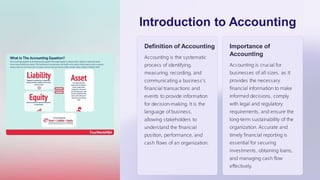
Accounting is the systematic
process of identifying,
measuring, recording, and
communicating a business's
financial transactions and
events to provide information
for decision-making. It is the
language of business,
allowing stakeholders to
understand the financial
position, performance, and
cash flows of an organization.
Importance of
Accounting
Accounting is crucial for
businesses of all sizes, as it
provides the necessary
financial information to make
informed decisions, comply
with legal and regulatory
requirements, and ensure the
long-term sustainability of the
organization. Accurate and
timely financial reporting is
essential for securing
investments, obtaining loans,
and managing cash flow
effectively.
Important Tools for Accountants
Accounting Software
Accountants rely on various software
solutions to streamline their work and
improve efficiency. Popular options
include QuickBooks, Tally, and Zoho
Books, which provide features such
as invoicing, payroll management,
and financial reporting.
Spreadsheets
Spreadsheet programs, such as
Microsoft Excel and Google Sheets,
are essential tools for accountants.
They allow for complex financial
calculations, data analysis, and the
creation of custom reports to support
decision-making.
Financial Calculators
Accountants often use specialized
financial calculators to perform
complex computations, such as
depreciation, loan amortization, and
investment analysis. These tools help
ensure accurate and consistent
financial calculations.
Chart of Accounts & Filing
of Records
1 Chart of Accounts
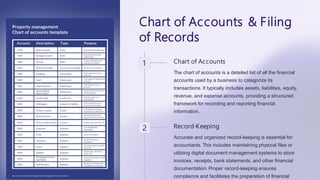
The chart of accounts is a detailed list of all the financial
accounts used by a business to categorize its
transactions. It typically includes assets, liabilities, equity,
revenue, and expense accounts, providing a structured
framework for recording and reporting financial
information.
2 Record-Keeping
Accurate and organized record-keeping is essential for
accountants. This includes maintaining physical files or
utilizing digital document management systems to store
invoices, receipts, bank statements, and other financial
documentation. Proper record-keeping ensures
compliance and facilitates the preparation of financial
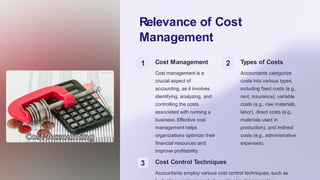
Relevance of Cost
Management
1 Cost Management
Cost management is a
crucial aspect of
accounting, as it involves
identifying, analyzing, and
controlling the costs
associated with running a
business. Effective cost
management helps
organizations optimize their
financial resources and
improve profitability.
2 Types of Costs
Accountants categorize
costs into various types,
including fixed costs (e.g.,
rent, insurance), variable
costs (e.g., raw materials,
labor), direct costs (e.g.,
materials used in
production), and indirect
costs (e.g., administrative
expenses).
3 Cost Control Techniques
Accountants employ various cost control techniques, such as
Cash & B ank Management
Cash Management
Effective cash management is vital for the financial health of
a business. Accountants play a key role in monitoring cash
inflows and outflows, forecasting cash needs, and
implementing strategies to optimize cash flow, such as
accelerating receivables, delaying payables, and maintaining
appropriate cash reserves.
Bank Management
Accountants are responsible for maintaining strong
relationships with banks, overseeing bank accounts, and
ensuring the accuracy of bank transactions. This includes
reconciling bank statements, managing overdrafts, and
negotiating favorable terms for banking services to support
the organization's financial operations.
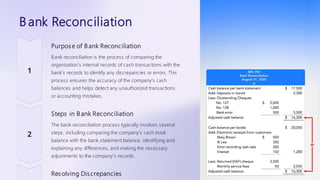
B ank Reconciliation
Purpose of Bank Reconciliation
Bank reconciliation is the process of comparing the
organization's internal records of cash transactions with the
bank's records to identify any discrepancies or errors. This
process ensures the accuracy of the company's cash
balances and helps detect any unauthorized transactions
or accounting mistakes.
Steps in Bank Reconciliation
The bank reconciliation process typically involves several
steps, including comparing the company's cash book
balance with the bank statement balance, identifying and
explaining any differences, and making the necessary
adjustments to the company's records.
Resolving Discrepancies
Sale & Purchase Management
Sales Management
Accountants play a critical role in managing the sales
process, including invoicing customers, recording revenue,
and ensuring timely payment collection. This involves
establishing efficient invoicing procedures, maintaining
accurate records of sales transactions, and recognizing
revenue in accordance with applicable accounting standards.
Purchase Management
On the purchasing side, accountants are responsible for
processing purchase orders, tracking expenses, and
managing inventory. They ensure that purchases are
properly authorized, supported by documentation, and
accurately recorded in the company's financial statements.
Effective purchase management helps control costs and
maintain optimal inventory levels.
Payroll Management
Salary Calculation
Accountants are responsible
for accurately calculating
employee salaries, including
base pay, overtime, bonuses,
and other compensation. This
process requires a thorough
understanding of labor laws,
tax regulations, and the
company's payroll policies to
ensure compliance and fair
treatment of employees.
Statutory Deductions
As part of payroll
management, accountants
must calculate and withhold
statutory deductions, such as
Provident Fund (EPF) and
Employees' State Insurance
(ESI), from employee salaries.
They are also responsible for
making timely payments of
these deductions to the
relevant authorities.
Payslip Generation
Accountants generate detailed payslips for each employee, providing
a breakdown of their gross salary, deductions, and net pay. This
Accounts Receivables and Accounts Payables
Reconciliation
Accounts Receivables (AR)
Maintaining accurate AR records is
essential for tracking customer
payments and identifying any
outstanding invoices. This includes
generating aging reports to monitor
the status of receivables and following
up with customers to ensure timely
payments.
Accounts Payables (AP)
Efficiently managing AP involves
keeping track of vendor invoices,
scheduling payments, and reconciling
accounts to ensure accuracy and
timely remittance. This process helps
maintain strong relationships with
suppliers and avoid late fees or
interest charges.
Reconciliation Process
Regularly reconciling AR and AP
accounts is a crucial step in financial
management. This involves
comparing internal records with
external statements, identifying
discrepancies, and resolving any
issues to ensure that your books
accurately reflect the company's
financial position.
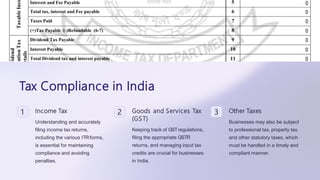
Tax Compliance in India
1 Income Tax
Understanding and accurately
filing income tax returns,
including the various ITRforms,
is essential for maintaining
compliance and avoiding
penalties.
2 Goods and Services Tax
(GST)
Keeping track of GSTregulations,
filing the appropriate GSTR
returns, and managing input tax
credits are crucial for businesses
in India.
3 Other Taxes
Businesses may also be subject
to professional tax, property tax,
and other statutory taxes, which
must be handled in a timely and
compliant manner.
Financial Reporting and
Auditing
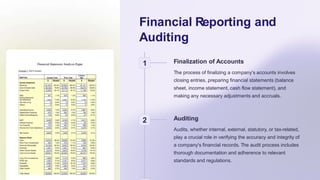
1 Finalization of Accounts
The process of finalizing a company's accounts involves
closing entries, preparing financial statements (balance
sheet, income statement, cash flow statement), and
making any necessary adjustments and accruals.
2 Auditing
Audits, whether internal, external, statutory, or tax-related,
play a crucial role in verifying the accuracy and integrity of
a company's financial records. The audit process includes
thorough documentation and adherence to relevant
standards and regulations.
Tax Returns Filing in India
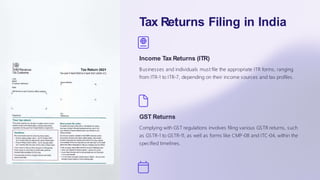
Income Tax Returns (ITR)
Businesses and individuals must file the appropriate ITR forms, ranging
from ITR-1 to ITR-7, depending on their income sources and tax profiles.
GST Returns
Complying with GST regulations involves filing various GSTR returns, such
as GSTR-1 to GSTR-11, as well as forms like CMP-08 and ITC-04, within the
specified timelines.
Detailed Guide on ITR
and TDS Returns
This presentation provides a comprehensive overview of Income Tax
Returns (ITR) and Tax Deducted at Source (TDS) Returns in the United
States. We will cover the different ITRforms, their eligibility criteria, and key
sections, as well as introduce the TDS return filing requirements. By the
end of this guide, you will have a thorough understanding of the tax return
landscape and be equipped to navigate the filing process with confidence.
Introduction to Tax Returns
1 Tax Returns Defined
Tax returns are official
documents filed with the
Internal Revenue Service
(IRS) that report an
individual's or business's
income, expenses, and tax
liabilities for a given tax
year. They are a crucial part
of the tax compliance
process and help ensure
that taxpayers pay the
correct amount of taxes
owed.
2 Importance of Tax
Returns
Filing tax returns is a legal
requirement for most
taxpayers. It allows the
government to accurately
assess and collect taxes,
while also providing
taxpayers the opportunity
to claim deductions,
credits, and other tax
benefits to which they are
entitled. Proper filing of tax
returns helps avoid
penalties and interest
charges.
Overview of ITR and TDS
ITR1 (Sahaj)
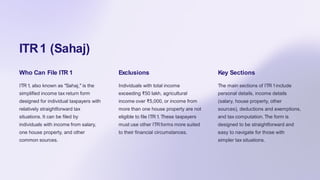
Who Can File ITR 1
ITR1, also known as "Sahaj," is the
simplified income tax return form
designed for individual taxpayers with
relatively straightforward tax
situations. It can be filed by
individuals with income from salary,
one house property, and other
common sources.
Exclusions
Individuals with total income
exceeding ₹50 lakh, agricultural
income over ₹5,000, or income from
more than one house property are not
eligible to file ITR1. These taxpayers
must use other ITRforms more suited
to their financial circumstances.
Key Sections
The main sections of ITR1include
personal details, income details
(salary, house property, other
sources), deductions and exemptions,
and tax computation. The form is
designed to be straightforward and
easy to navigate for those with
simpler tax situations.
ITR 2
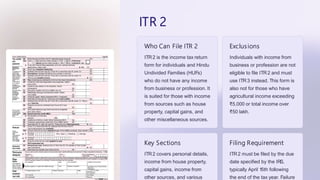
Who Can File ITR 2
ITR2 is the income tax return
form for individuals and Hindu
Undivided Families (HUFs)
who do not have any income
from business or profession. It
is suited for those with income
from sources such as house
property, capital gains, and
other miscellaneous sources.
Exclusions
Individuals with income from
business or profession are not
eligible to file ITR2 and must
use ITR3 instead. This form is
also not for those who have
agricultural income exceeding
₹5,000 or total income over
₹50 lakh.
Key Sections
ITR2 covers personal details,
income from house property,
capital gains, income from
other sources, and various
Filing Requirement
ITR2 must be filed by the due
date specified by the IRS,
typically April 15th following
the end of the tax year. Failure
ITR3
1
Who Can File ITR 3
ITR3 is the income tax return form for individuals
and Hindu Undivided Families (HUFs) who have
income from business or profession. This could
include self-employed individuals, partners in a
firm, or those with income from a proprietorship.
2 Key Sections
ITR3 covers a wider range of income sources
compared to ITR1and ITR2. It includes sections for
reporting business income, income from house
property, capital gains, and other miscellaneous
sources. Taxpayers must also provide details on
3
Filing Deadline
ITR 4 (Sugam)
Individuals
ITR 4, also known as
"Sugam," is designed for
individual taxpayers, Hindu
Undivided Families (HUFs),
and Firms (other than LLPs)
who have income from
presumptive or estimated
Income Limit
Taxpayers with total income
not exceeding ₹50 lakh,
income from a single house
property, and no capital
gains are eligible to file ITR
4. Those with higher
incomes or more complex
Key Sections
ITR 4 focuses on reporting
presumptive business
income, deductions, and tax
computation. It is simpler
and more streamlined
compared to other ITR
forms, making it suitable for
Filing Deadline
As with other ITR forms, ITR
4 must be filed by the
annual due date set by the
IRS. Taxpayers should be
aware of any extensions or
special filing requirements
that may apply to their
ITR 5
Who Can File ITR 5
ITR5 is the income tax return form for a variety of entities,
including Firms, Limited Liability Partnerships (LLPs),
Association of Persons (AOPs), Bodies of Individuals
(BOIs), Artificial Juridical Persons (AJPs), and others.
Exclusions
ITR5 is not for individual taxpayers or Hindu Undivided
Families (HUFs). These entities must use other ITRforms
more suited to their specific tax situations.
Key Sections
ITR5 covers a wide range of income sources and
deductions, including business income, capital gains,
income from other sources, and various exemptions and
deductions. The form is more complex than the individual
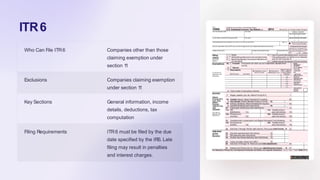
ITR6
Who Can File ITR6 Companies other than those
claiming exemption under
section 1
1
Exclusions Companies claiming exemption
under section 1
1
Key Sections General information, income
details, deductions, tax
computation
Filing Requirements ITR6 must be filed by the due
date specified by the IRS. Late
filing may result in penalties
and interest charges.
ITR7
Who Can File ITR 7
ITR 7 is the income tax return form for
persons, including companies, who
are required to furnish a return under
sections 139(4A), 139(4B), 139(4C), or
139(4D) of the Internal Revenue Code.
This includes charitable organizations,
political parties, and other entities with
specific reporting obligations.
Key Sections
ITR 7 covers general information,
income details, deductions, and tax
computation. The form is designed to
capture the unique reporting
requirements of the entities that are
required to file it.
Filing Deadline
As with other ITR forms, ITR 7 must be
filed by the annual due date set by the
IRS. Taxpayers should be aware of
any special filing rules or extensions
that may apply to their specific
situation.
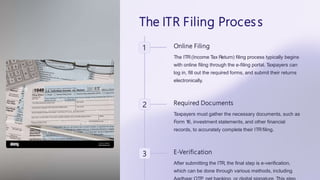
The ITR Filing Process
1 Online Filing
The ITR(Income Tax Return) filing process typically begins
with online filing through the e-filing portal. Taxpayers can
log in, fill out the required forms, and submit their returns
electronically.
2 Required Documents
Taxpayers must gather the necessary documents, such as
Form 16, investment statements, and other financial
records, to accurately complete their ITRfiling.
3 E-Verification
After submitting the ITR, the final step is e-verification,
which can be done through various methods, including
Navigating the Tax Compliance
Landscape: TDS Return Forms
Demystified
As an accounting professional or tax preparer, navigating the complex
world of tax compliance can be a daunting task. In this comprehensive
presentation, we will delve into the intricacies of TDS (Tax Deducted at
Source) return forms, providing you with a detailed overview of the key
forms, their applicability, filing requirements, and essential sections to
ensure accurate and timely tax reporting for your clients.
TDS & TCS Deduction and Returns Filing
TDS (Tax Deducted at Source)
TDS is a mechanism where a certain percentage of the
payment made to a vendor or contractor is deducted at the
time of payment and remitted to the tax authorities.
Accountants are responsible for calculating the correct TDS
rates, deducting the appropriate amounts, and filing the
necessary TDS returns within the prescribed deadlines.
TCS (Tax Collected at Source)
TCS is a similar concept, where a certain percentage of the
payment received from a customer is collected and remitted
to the tax authorities. Accountants must ensure the correct
TCS rates are applied, the amounts are collected, and the
TCS returns are filed in a timely manner to comply with tax
regulations.
Introduction to TDS Returns
1 TDS Returns Defined
Tax Deducted at Source (TDS)
returns are filed by payers to
report the tax they have withheld
from payments made to others.
TDS is a mechanism where the
payer deducts a certain
percentage of the payment as
tax and remits it to the
2 Importance of TDS
Returns
TDS returns are important for
both the payer and the payee.
They help ensure that the correct
amount of tax is paid to the
government, and they also
provide a record of the tax
deducted for the payee to claim
3 Quarterly Filing
Requirements
TDS returns must be filed on a
quarterly basis, with due dates of
July 31, October 31, January 31,
and April 30 following the end of
each quarter. Failure to file TDS
returns or late filing can result in
penalties and interest charges.
Form 24Q: TDS on Salary
Overview
Form 24Q is the TDS return form used
for reporting tax deducted on salary
payments. It is applicable to
employers who are required to deduct
tax at source from the salaries of their
employees.
Key Sections
The form includes sections for
deductor details, employee details,
salary details, and the actual tax
deduction. Accurate reporting in these
sections is crucial for compliance and
to ensure employees receive their
accurate Form 16 certificates.
Filing Frequency
Form 24Q must be filed on a quarterly
basis, with deadlines of July 31,
October 31, January 31, and May 31
for the respective quarters.
Form 26Q: TDS on Payments Other Than Salary
Overview
Form 26Q is the TDS return form used
for reporting tax deducted on
payments made to contractors,
professionals, and other payees
(excluding salary). It is applicable to
any business or entity required to
deduct tax at source from such
payments.
Key Sections
The form includes sections for
deductor details, deductee details,
payment details, and the actual tax
deduction. Accurate reporting is
crucial to ensure deductees receive
their accurate Form 16A certificates.
Filing Frequency
Like Form 24Q, Form 26Q must also
be filed on a quarterly basis with the
same deadlines.
Form 27Q: TDS on Non-Resident Payments
Overview
Form 27Q is the TDS return form used
for reporting tax deducted on
payments made to non-resident
individuals and companies, excluding
salary payments. It is applicable to
any business or entity required to
deduct tax at source from such
payments to non-residents.
Key Sections
The form includes sections for
deductor details, deductee details,
payment details, and the actual tax
deduction. Accurate reporting is
crucial to ensure non-resident
deductees receive their accurate
Form 16A certificates.
Filing Frequency
Like the other TDS return forms, Form
27Q must also be filed on a quarterly
basis with the same deadlines.
Form 27EQ: Tax Collected at Source (TCS)
Overview
Form 27EQ is the return form used for
reporting Tax Collected at Source
(TCS). TCSapplies to certain
transactions where the collector is
required to collect tax at the time of
sale or receipt of payment. This form
is applicable to any individual or entity
acting as a collector of TCS.
Key Sections
The form includes sections for
collector details, collectee details, the
amount collected, and the actual tax
collection. Accurate reporting in these
sections is crucial for compliance and
to ensure collectees receive their
accurate TCScertificates.
Filing Frequency
Like the TDS return forms, Form 27EQ
must also be filed on a quarterly basis
with the same deadlines.
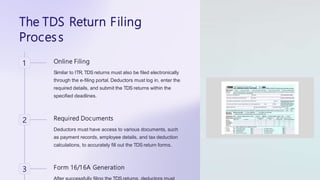
The TDS Return Filing
Process
1 Online Filing
Similar to ITR, TDS returns must also be filed electronically
through the e-filing portal. Deductors must log in, enter the
required details, and submit the TDS returns within the
specified deadlines.
2 Required Documents
Deductors must have access to various documents, such
as payment records, employee details, and tax deduction
calculations, to accurately fill out the TDS return forms.
3 Form 16/1 6A Generation
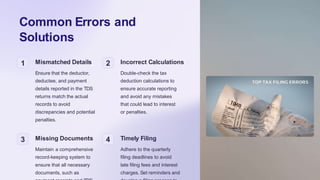
Common Errors and
Solutions
1 Mismatched Details
Ensure that the deductor,
deductee, and payment
details reported in the TDS
returns match the actual
records to avoid
discrepancies and potential
penalties.
2 Incorrect Calculations
Double-check the tax
deduction calculations to
ensure accurate reporting
and avoid any mistakes
that could lead to interest
or penalties.
3 Missing Documents
Maintain a comprehensive
record-keeping system to
ensure that all necessary
documents, such as
4 Timely Filing
Adhere to the quarterly
filing deadlines to avoid
late filing fees and interest
charges. Set reminders and
Detailed Guide on
GST Returns
Understanding Various GST Forms
and Filing Processes
In this comprehensive guide, we will delve into the intricacies of Goods and
Services Tax (GST) returns in India. GST is a unified indirect tax that has
revolutionized the country's tax landscape, and understanding the various GST
return forms and filing processes is crucial for businesses and professionals. This
presentation will provide you with a detailed overview of the key GST return
forms, their applicability, filing frequencies, and the critical information they
encompass, empowering you to navigate the GST compliance landscape with
confidence.
Introduction to GST Returns
1 Overview of GST
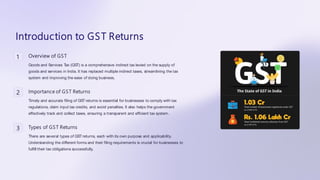
Goods and Services T
ax (GST) is a comprehensive indirect tax levied on the supply of
goods and services in India. It has replaced multiple indirect taxes, streamlining the tax
system and improving the ease of doing business.
2 Importance of GST Returns
Timely and accurate filing of GST returns is essential for businesses to comply with tax
regulations, claim input tax credits, and avoid penalties. It also helps the government
effectively track and collect taxes, ensuring a transparent and efficient tax system.
3 Types of GST Returns
There are several types of GST returns, each with its own purpose and applicability.
Understanding the different forms and their filing requirements is crucial for businesses to
fulfill their tax obligations successfully.
GSTR-1: Outward Supplies
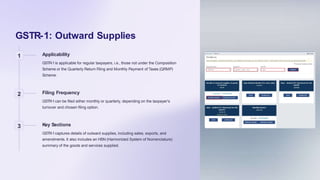
1 Applicability
GSTR-1is applicable for regular taxpayers, i.e., those not under the Composition
Scheme or the Quarterly Return Filing and Monthly Payment of Taxes (QRMP)
Scheme.
2 Filing Frequency
GSTR-1can be filed either monthly or quarterly, depending on the taxpayer's
turnover and chosen filing option.
3 Key Sections
GSTR-1captures details of outward supplies, including sales, exports, and
amendments. It also includes an HSN (Harmonized System of Nomenclature)
summary of the goods and services supplied.
GSTR-2A & 2B : Inward Supplies
GSTR-2A
GSTR-2A is an auto-drafted form that provides details
of a taxpayer's inward supplies, including the supplies
made by their vendors. It is a view-only format and
cannot be edited.
GSTR-2B
GSTR-2B is another auto-drafted form that provides a
static ITC (Input Tax Credit) statement. It is a crucial
tool for monthly reconciliation of input tax credits and
helps businesses ensure the accuracy of their claims.
GSTR-3B: Summary Return
Applicability
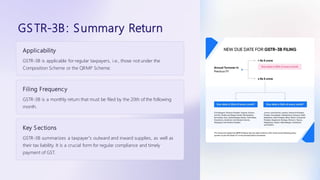
GSTR-3B is applicable for regular taxpayers, i.e., those not under the
Composition Scheme or the QRMP Scheme.
Filing Frequency
GSTR-3B is a monthly return that must be filed by the 20th of the following
month.
Key Sections
GSTR-3B summarizes a taxpayer's outward and inward supplies, as well as
their tax liability. It is a crucial form for regular compliance and timely
payment of GST.
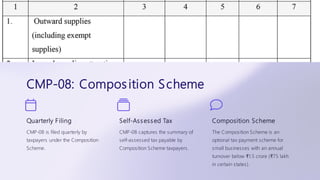
CMP-08: Composition Scheme
Quarterly Filing
CMP-08 is filed quarterly by
taxpayers under the Composition
Scheme.
Self-Assessed Tax
CMP-08 captures the summary of
self-assessed tax payable by
Composition Scheme taxpayers.
Composition Scheme
The Composition Scheme is an
optional tax payment scheme for
small businesses with an annual
turnover below ₹1.5 crore (₹75 lakh
in certain states).
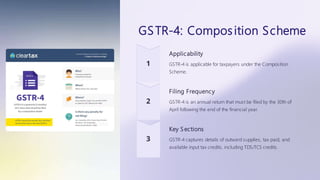
GSTR-4: Composition Scheme
Applicability
GSTR-4 is applicable for taxpayers under the Composition
Scheme.
Filing Frequency
GSTR-4 is an annual return that must be filed by the 30th of
April following the end of the financial year.
Key Sections
GSTR-4 captures details of outward supplies, tax paid, and
available input tax credits, including TDS/TCS credits.
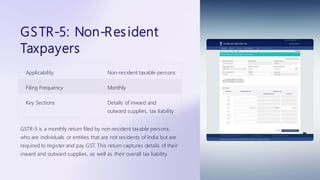
GSTR-5: Non-Resident
Taxpayers
Applicability Non-resident taxable persons
Filing Frequency Monthly
Key Sections Details of inward and
outward supplies, tax liability
GSTR-5 is a monthly return filed by non-resident taxable persons,
who are individuals or entities that are not residents of India but are
required to register and pay GST. This return captures details of their
inward and outward supplies, as well as their overall tax liability.
GSTR-5A: OIDAR Services
Applicability
GSTR-5A is applicable for non-
resident OIDAR (Online
Information and Database Access
or Retrieval) service providers.
Filing Frequency
GSTR-5A is a monthly return that
must be filed by the 20th of the
following month.
Key Sections
GSTR-5A captures details of the
OIDAR services provided by non-
resident service providers, as well
as the corresponding tax liability.
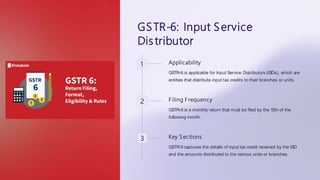
GSTR-6: Input Service
Distributor
1 Applicability
GSTR-6 is applicable for Input Service Distributors (ISDs), which are
entities that distribute input tax credits to their branches or units.
2 Filing Frequency
GSTR-6 is a monthly return that must be filed by the 13th of the
following month.
3 Key Sections
GSTR-6 captures the details of input tax credit received by the ISD
and the amounts distributed to the various units or branches.
GSTR-7: Tax Deductor's
Return
1 Applicability
GSTR-7 is applicable to tax
deductors, such as
government departments,
local authorities, and
businesses that deduct tax
at source (TDS) from
payments made to their
suppliers.
2 Filing Frequency
GSTR-7 must be filed on a
monthly basis by the 10th of
the following month.
3 Key Sections
This return includes details of the TDS deducted, the amount
deposited, and any amendments made to the previously filed
returns.
GSTR-8: E-commerce Operators' Return
Applicability
GSTR-8 is applicable to e-commerce
operators who are required to collect
Tax Collected at Source (TCS) from
their suppliers.
Filing Frequency
GSTR-8 must be filed on a monthly
basis by the 10th of the following
month.
Key Sections
This return includes details of the
supplies made through the e-
commerce platform and the amount of
TCS collected.
GSTR-9: Annual Return
Applicability
GSTR-9 is applicable to regular taxpayers, including
manufacturers, who are required to file an annual return.
Filing Frequency
GSTR-9 must be filed on an annual basis by the 31st of
December following the end of the financial year.
Key Sections
This return includes a consolidated summary of the
taxpayer's outward and inward supplies, input tax credit,
and the total tax paid during the financial year.
Importance
GSTR-9 serves as a comprehensive reconciliation of the
taxpayer's GSTcompliance and is a crucial document for
the annual assessment of GSTliabilities.
GSTR-9C: Audit Report
Applicability
GSTR-9C is applicable to taxpayers
whose annual turnover exceeds ₹2
crores. These taxpayers are required
to get their accounts audited and
submit the reconciliation statement
along with the audit report.
Filing Frequency
GSTR-9C must be filed on an annual
basis by the 31st of December
following the end of the financial year.
Key Sections
This return includes a reconciliation
statement between the books of
accounts and the GST returns, as well
as the auditor's report on the
taxpayer's GST compliance.
GSTR-10: Final Return
Applicability
GSTR-10 is applicable to
taxpayers whose registration
has been cancelled or
surrendered. It is a one-time
filing requirement to close the
GST registration.
Filing Frequency
GSTR-10 must be filed within
three months of the date of
cancellation or surrender of
registration.
Key Sections
This return includes details of the inputs, capital goods, and stock
held on the last day of the registration period, as well as the final tax
liability.
GSTR-11 : UIN Holders'
Return
Applicability
GSTR-1
1is applicable to Unique Identification Number (UIN) holders, such
as diplomatic missions, embassies, and international organizations.
Filing Frequency
GSTR-1
1must be filed on a monthly basis by the 13th of the following
month.
ITC-04: J ob Work Return
Applicability
ITC-04 is applicable to manufacturers who send goods for
job work to other manufacturers or job workers.
Filing Frequency
ITC-04 must be filed on a quarterly basis by the 25th of the
month following the quarter.
Key Sections
This return includes details of the goods sent to and
received from job workers, including the description,
quantity, and value of the goods.
Filing Process and
Compliance
1 Filing Process
The GSTreturns can be filed online through the GSTportal.
The process involves logging in, preparing the returns,
uploading the necessary documents, and submitting the
returns.
2 Required Documents
Manufacturers should ensure they have all the relevant
documents, such as invoices, purchase records, and bank
statements, ready before initiating the filing process.
3 Compliance and Penalties
THANK YOU

Practical Accounting for Upcoming AccountingProfessionals.pdf

  • 1.
    Basic Functioning of anAccountant Accounting is a critical function in the business world, responsible for recording, analyzing, and reporting a company's financial transactions. As the backbone of any successful enterprise, accountants play a vital role in ensuring the financial health and compliance of an organization. This presentation will provide an overview of the essential accounting tools, processes, and best practices that every aspiring accountant and small business owner should understand. KARTHIK O
  • 2.
    Introduction to Accounting Definitionof Accounting Accounting is the systematic process of identifying, measuring, recording, and communicating a business's financial transactions and events to provide information for decision-making. It is the language of business, allowing stakeholders to understand the financial position, performance, and cash flows of an organization. Importance of Accounting Accounting is crucial for businesses of all sizes, as it provides the necessary financial information to make informed decisions, comply with legal and regulatory requirements, and ensure the long-term sustainability of the organization. Accurate and timely financial reporting is essential for securing investments, obtaining loans, and managing cash flow effectively.
  • 3.
    Important Tools forAccountants Accounting Software Accountants rely on various software solutions to streamline their work and improve efficiency. Popular options include QuickBooks, Tally, and Zoho Books, which provide features such as invoicing, payroll management, and financial reporting. Spreadsheets Spreadsheet programs, such as Microsoft Excel and Google Sheets, are essential tools for accountants. They allow for complex financial calculations, data analysis, and the creation of custom reports to support decision-making. Financial Calculators Accountants often use specialized financial calculators to perform complex computations, such as depreciation, loan amortization, and investment analysis. These tools help ensure accurate and consistent financial calculations.
  • 4.
    Chart of Accounts& Filing of Records 1 Chart of Accounts The chart of accounts is a detailed list of all the financial accounts used by a business to categorize its transactions. It typically includes assets, liabilities, equity, revenue, and expense accounts, providing a structured framework for recording and reporting financial information. 2 Record-Keeping Accurate and organized record-keeping is essential for accountants. This includes maintaining physical files or utilizing digital document management systems to store invoices, receipts, bank statements, and other financial documentation. Proper record-keeping ensures compliance and facilitates the preparation of financial
  • 5.
    Relevance of Cost Management 1Cost Management Cost management is a crucial aspect of accounting, as it involves identifying, analyzing, and controlling the costs associated with running a business. Effective cost management helps organizations optimize their financial resources and improve profitability. 2 Types of Costs Accountants categorize costs into various types, including fixed costs (e.g., rent, insurance), variable costs (e.g., raw materials, labor), direct costs (e.g., materials used in production), and indirect costs (e.g., administrative expenses). 3 Cost Control Techniques Accountants employ various cost control techniques, such as
  • 6.
    Cash & Bank Management Cash Management Effective cash management is vital for the financial health of a business. Accountants play a key role in monitoring cash inflows and outflows, forecasting cash needs, and implementing strategies to optimize cash flow, such as accelerating receivables, delaying payables, and maintaining appropriate cash reserves. Bank Management Accountants are responsible for maintaining strong relationships with banks, overseeing bank accounts, and ensuring the accuracy of bank transactions. This includes reconciling bank statements, managing overdrafts, and negotiating favorable terms for banking services to support the organization's financial operations.
  • 7.
    B ank Reconciliation Purposeof Bank Reconciliation Bank reconciliation is the process of comparing the organization's internal records of cash transactions with the bank's records to identify any discrepancies or errors. This process ensures the accuracy of the company's cash balances and helps detect any unauthorized transactions or accounting mistakes. Steps in Bank Reconciliation The bank reconciliation process typically involves several steps, including comparing the company's cash book balance with the bank statement balance, identifying and explaining any differences, and making the necessary adjustments to the company's records. Resolving Discrepancies
  • 8.
    Sale & PurchaseManagement Sales Management Accountants play a critical role in managing the sales process, including invoicing customers, recording revenue, and ensuring timely payment collection. This involves establishing efficient invoicing procedures, maintaining accurate records of sales transactions, and recognizing revenue in accordance with applicable accounting standards. Purchase Management On the purchasing side, accountants are responsible for processing purchase orders, tracking expenses, and managing inventory. They ensure that purchases are properly authorized, supported by documentation, and accurately recorded in the company's financial statements. Effective purchase management helps control costs and maintain optimal inventory levels.
  • 9.
    Payroll Management Salary Calculation Accountantsare responsible for accurately calculating employee salaries, including base pay, overtime, bonuses, and other compensation. This process requires a thorough understanding of labor laws, tax regulations, and the company's payroll policies to ensure compliance and fair treatment of employees. Statutory Deductions As part of payroll management, accountants must calculate and withhold statutory deductions, such as Provident Fund (EPF) and Employees' State Insurance (ESI), from employee salaries. They are also responsible for making timely payments of these deductions to the relevant authorities. Payslip Generation Accountants generate detailed payslips for each employee, providing a breakdown of their gross salary, deductions, and net pay. This
  • 10.
    Accounts Receivables andAccounts Payables Reconciliation Accounts Receivables (AR) Maintaining accurate AR records is essential for tracking customer payments and identifying any outstanding invoices. This includes generating aging reports to monitor the status of receivables and following up with customers to ensure timely payments. Accounts Payables (AP) Efficiently managing AP involves keeping track of vendor invoices, scheduling payments, and reconciling accounts to ensure accuracy and timely remittance. This process helps maintain strong relationships with suppliers and avoid late fees or interest charges. Reconciliation Process Regularly reconciling AR and AP accounts is a crucial step in financial management. This involves comparing internal records with external statements, identifying discrepancies, and resolving any issues to ensure that your books accurately reflect the company's financial position.
  • 11.
    Tax Compliance inIndia 1 Income Tax Understanding and accurately filing income tax returns, including the various ITRforms, is essential for maintaining compliance and avoiding penalties. 2 Goods and Services Tax (GST) Keeping track of GSTregulations, filing the appropriate GSTR returns, and managing input tax credits are crucial for businesses in India. 3 Other Taxes Businesses may also be subject to professional tax, property tax, and other statutory taxes, which must be handled in a timely and compliant manner.
  • 12.
    Financial Reporting and Auditing 1Finalization of Accounts The process of finalizing a company's accounts involves closing entries, preparing financial statements (balance sheet, income statement, cash flow statement), and making any necessary adjustments and accruals. 2 Auditing Audits, whether internal, external, statutory, or tax-related, play a crucial role in verifying the accuracy and integrity of a company's financial records. The audit process includes thorough documentation and adherence to relevant standards and regulations.
  • 13.
    Tax Returns Filingin India Income Tax Returns (ITR) Businesses and individuals must file the appropriate ITR forms, ranging from ITR-1 to ITR-7, depending on their income sources and tax profiles. GST Returns Complying with GST regulations involves filing various GSTR returns, such as GSTR-1 to GSTR-11, as well as forms like CMP-08 and ITC-04, within the specified timelines.
  • 14.
    Detailed Guide onITR and TDS Returns This presentation provides a comprehensive overview of Income Tax Returns (ITR) and Tax Deducted at Source (TDS) Returns in the United States. We will cover the different ITRforms, their eligibility criteria, and key sections, as well as introduce the TDS return filing requirements. By the end of this guide, you will have a thorough understanding of the tax return landscape and be equipped to navigate the filing process with confidence.
  • 15.
    Introduction to TaxReturns 1 Tax Returns Defined Tax returns are official documents filed with the Internal Revenue Service (IRS) that report an individual's or business's income, expenses, and tax liabilities for a given tax year. They are a crucial part of the tax compliance process and help ensure that taxpayers pay the correct amount of taxes owed. 2 Importance of Tax Returns Filing tax returns is a legal requirement for most taxpayers. It allows the government to accurately assess and collect taxes, while also providing taxpayers the opportunity to claim deductions, credits, and other tax benefits to which they are entitled. Proper filing of tax returns helps avoid penalties and interest charges. Overview of ITR and TDS
  • 16.
    ITR1 (Sahaj) Who CanFile ITR 1 ITR1, also known as "Sahaj," is the simplified income tax return form designed for individual taxpayers with relatively straightforward tax situations. It can be filed by individuals with income from salary, one house property, and other common sources. Exclusions Individuals with total income exceeding ₹50 lakh, agricultural income over ₹5,000, or income from more than one house property are not eligible to file ITR1. These taxpayers must use other ITRforms more suited to their financial circumstances. Key Sections The main sections of ITR1include personal details, income details (salary, house property, other sources), deductions and exemptions, and tax computation. The form is designed to be straightforward and easy to navigate for those with simpler tax situations.
  • 17.
    ITR 2 Who CanFile ITR 2 ITR2 is the income tax return form for individuals and Hindu Undivided Families (HUFs) who do not have any income from business or profession. It is suited for those with income from sources such as house property, capital gains, and other miscellaneous sources. Exclusions Individuals with income from business or profession are not eligible to file ITR2 and must use ITR3 instead. This form is also not for those who have agricultural income exceeding ₹5,000 or total income over ₹50 lakh. Key Sections ITR2 covers personal details, income from house property, capital gains, income from other sources, and various Filing Requirement ITR2 must be filed by the due date specified by the IRS, typically April 15th following the end of the tax year. Failure
  • 18.
    ITR3 1 Who Can FileITR 3 ITR3 is the income tax return form for individuals and Hindu Undivided Families (HUFs) who have income from business or profession. This could include self-employed individuals, partners in a firm, or those with income from a proprietorship. 2 Key Sections ITR3 covers a wider range of income sources compared to ITR1and ITR2. It includes sections for reporting business income, income from house property, capital gains, and other miscellaneous sources. Taxpayers must also provide details on 3 Filing Deadline
  • 19.
    ITR 4 (Sugam) Individuals ITR4, also known as "Sugam," is designed for individual taxpayers, Hindu Undivided Families (HUFs), and Firms (other than LLPs) who have income from presumptive or estimated Income Limit Taxpayers with total income not exceeding ₹50 lakh, income from a single house property, and no capital gains are eligible to file ITR 4. Those with higher incomes or more complex Key Sections ITR 4 focuses on reporting presumptive business income, deductions, and tax computation. It is simpler and more streamlined compared to other ITR forms, making it suitable for Filing Deadline As with other ITR forms, ITR 4 must be filed by the annual due date set by the IRS. Taxpayers should be aware of any extensions or special filing requirements that may apply to their
  • 20.
    ITR 5 Who CanFile ITR 5 ITR5 is the income tax return form for a variety of entities, including Firms, Limited Liability Partnerships (LLPs), Association of Persons (AOPs), Bodies of Individuals (BOIs), Artificial Juridical Persons (AJPs), and others. Exclusions ITR5 is not for individual taxpayers or Hindu Undivided Families (HUFs). These entities must use other ITRforms more suited to their specific tax situations. Key Sections ITR5 covers a wide range of income sources and deductions, including business income, capital gains, income from other sources, and various exemptions and deductions. The form is more complex than the individual
  • 21.
    ITR6 Who Can FileITR6 Companies other than those claiming exemption under section 1 1 Exclusions Companies claiming exemption under section 1 1 Key Sections General information, income details, deductions, tax computation Filing Requirements ITR6 must be filed by the due date specified by the IRS. Late filing may result in penalties and interest charges.
  • 22.
    ITR7 Who Can FileITR 7 ITR 7 is the income tax return form for persons, including companies, who are required to furnish a return under sections 139(4A), 139(4B), 139(4C), or 139(4D) of the Internal Revenue Code. This includes charitable organizations, political parties, and other entities with specific reporting obligations. Key Sections ITR 7 covers general information, income details, deductions, and tax computation. The form is designed to capture the unique reporting requirements of the entities that are required to file it. Filing Deadline As with other ITR forms, ITR 7 must be filed by the annual due date set by the IRS. Taxpayers should be aware of any special filing rules or extensions that may apply to their specific situation.
  • 23.
    The ITR FilingProcess 1 Online Filing The ITR(Income Tax Return) filing process typically begins with online filing through the e-filing portal. Taxpayers can log in, fill out the required forms, and submit their returns electronically. 2 Required Documents Taxpayers must gather the necessary documents, such as Form 16, investment statements, and other financial records, to accurately complete their ITRfiling. 3 E-Verification After submitting the ITR, the final step is e-verification, which can be done through various methods, including
  • 24.
    Navigating the TaxCompliance Landscape: TDS Return Forms Demystified As an accounting professional or tax preparer, navigating the complex world of tax compliance can be a daunting task. In this comprehensive presentation, we will delve into the intricacies of TDS (Tax Deducted at Source) return forms, providing you with a detailed overview of the key forms, their applicability, filing requirements, and essential sections to ensure accurate and timely tax reporting for your clients.
  • 25.
    TDS & TCSDeduction and Returns Filing TDS (Tax Deducted at Source) TDS is a mechanism where a certain percentage of the payment made to a vendor or contractor is deducted at the time of payment and remitted to the tax authorities. Accountants are responsible for calculating the correct TDS rates, deducting the appropriate amounts, and filing the necessary TDS returns within the prescribed deadlines. TCS (Tax Collected at Source) TCS is a similar concept, where a certain percentage of the payment received from a customer is collected and remitted to the tax authorities. Accountants must ensure the correct TCS rates are applied, the amounts are collected, and the TCS returns are filed in a timely manner to comply with tax regulations.
  • 26.
    Introduction to TDSReturns 1 TDS Returns Defined Tax Deducted at Source (TDS) returns are filed by payers to report the tax they have withheld from payments made to others. TDS is a mechanism where the payer deducts a certain percentage of the payment as tax and remits it to the 2 Importance of TDS Returns TDS returns are important for both the payer and the payee. They help ensure that the correct amount of tax is paid to the government, and they also provide a record of the tax deducted for the payee to claim 3 Quarterly Filing Requirements TDS returns must be filed on a quarterly basis, with due dates of July 31, October 31, January 31, and April 30 following the end of each quarter. Failure to file TDS returns or late filing can result in penalties and interest charges.
  • 27.
    Form 24Q: TDSon Salary Overview Form 24Q is the TDS return form used for reporting tax deducted on salary payments. It is applicable to employers who are required to deduct tax at source from the salaries of their employees. Key Sections The form includes sections for deductor details, employee details, salary details, and the actual tax deduction. Accurate reporting in these sections is crucial for compliance and to ensure employees receive their accurate Form 16 certificates. Filing Frequency Form 24Q must be filed on a quarterly basis, with deadlines of July 31, October 31, January 31, and May 31 for the respective quarters.
  • 28.
    Form 26Q: TDSon Payments Other Than Salary Overview Form 26Q is the TDS return form used for reporting tax deducted on payments made to contractors, professionals, and other payees (excluding salary). It is applicable to any business or entity required to deduct tax at source from such payments. Key Sections The form includes sections for deductor details, deductee details, payment details, and the actual tax deduction. Accurate reporting is crucial to ensure deductees receive their accurate Form 16A certificates. Filing Frequency Like Form 24Q, Form 26Q must also be filed on a quarterly basis with the same deadlines.
  • 29.
    Form 27Q: TDSon Non-Resident Payments Overview Form 27Q is the TDS return form used for reporting tax deducted on payments made to non-resident individuals and companies, excluding salary payments. It is applicable to any business or entity required to deduct tax at source from such payments to non-residents. Key Sections The form includes sections for deductor details, deductee details, payment details, and the actual tax deduction. Accurate reporting is crucial to ensure non-resident deductees receive their accurate Form 16A certificates. Filing Frequency Like the other TDS return forms, Form 27Q must also be filed on a quarterly basis with the same deadlines.
  • 30.
    Form 27EQ: TaxCollected at Source (TCS) Overview Form 27EQ is the return form used for reporting Tax Collected at Source (TCS). TCSapplies to certain transactions where the collector is required to collect tax at the time of sale or receipt of payment. This form is applicable to any individual or entity acting as a collector of TCS. Key Sections The form includes sections for collector details, collectee details, the amount collected, and the actual tax collection. Accurate reporting in these sections is crucial for compliance and to ensure collectees receive their accurate TCScertificates. Filing Frequency Like the TDS return forms, Form 27EQ must also be filed on a quarterly basis with the same deadlines.
  • 31.
    The TDS ReturnFiling Process 1 Online Filing Similar to ITR, TDS returns must also be filed electronically through the e-filing portal. Deductors must log in, enter the required details, and submit the TDS returns within the specified deadlines. 2 Required Documents Deductors must have access to various documents, such as payment records, employee details, and tax deduction calculations, to accurately fill out the TDS return forms. 3 Form 16/1 6A Generation
  • 32.
    Common Errors and Solutions 1Mismatched Details Ensure that the deductor, deductee, and payment details reported in the TDS returns match the actual records to avoid discrepancies and potential penalties. 2 Incorrect Calculations Double-check the tax deduction calculations to ensure accurate reporting and avoid any mistakes that could lead to interest or penalties. 3 Missing Documents Maintain a comprehensive record-keeping system to ensure that all necessary documents, such as 4 Timely Filing Adhere to the quarterly filing deadlines to avoid late filing fees and interest charges. Set reminders and
  • 33.
    Detailed Guide on GSTReturns Understanding Various GST Forms and Filing Processes In this comprehensive guide, we will delve into the intricacies of Goods and Services Tax (GST) returns in India. GST is a unified indirect tax that has revolutionized the country's tax landscape, and understanding the various GST return forms and filing processes is crucial for businesses and professionals. This presentation will provide you with a detailed overview of the key GST return forms, their applicability, filing frequencies, and the critical information they encompass, empowering you to navigate the GST compliance landscape with confidence.
  • 34.
    Introduction to GSTReturns 1 Overview of GST Goods and Services T ax (GST) is a comprehensive indirect tax levied on the supply of goods and services in India. It has replaced multiple indirect taxes, streamlining the tax system and improving the ease of doing business. 2 Importance of GST Returns Timely and accurate filing of GST returns is essential for businesses to comply with tax regulations, claim input tax credits, and avoid penalties. It also helps the government effectively track and collect taxes, ensuring a transparent and efficient tax system. 3 Types of GST Returns There are several types of GST returns, each with its own purpose and applicability. Understanding the different forms and their filing requirements is crucial for businesses to fulfill their tax obligations successfully.
  • 35.
    GSTR-1: Outward Supplies 1Applicability GSTR-1is applicable for regular taxpayers, i.e., those not under the Composition Scheme or the Quarterly Return Filing and Monthly Payment of Taxes (QRMP) Scheme. 2 Filing Frequency GSTR-1can be filed either monthly or quarterly, depending on the taxpayer's turnover and chosen filing option. 3 Key Sections GSTR-1captures details of outward supplies, including sales, exports, and amendments. It also includes an HSN (Harmonized System of Nomenclature) summary of the goods and services supplied.
  • 36.
    GSTR-2A & 2B: Inward Supplies GSTR-2A GSTR-2A is an auto-drafted form that provides details of a taxpayer's inward supplies, including the supplies made by their vendors. It is a view-only format and cannot be edited. GSTR-2B GSTR-2B is another auto-drafted form that provides a static ITC (Input Tax Credit) statement. It is a crucial tool for monthly reconciliation of input tax credits and helps businesses ensure the accuracy of their claims.
  • 37.
    GSTR-3B: Summary Return Applicability GSTR-3Bis applicable for regular taxpayers, i.e., those not under the Composition Scheme or the QRMP Scheme. Filing Frequency GSTR-3B is a monthly return that must be filed by the 20th of the following month. Key Sections GSTR-3B summarizes a taxpayer's outward and inward supplies, as well as their tax liability. It is a crucial form for regular compliance and timely payment of GST.
  • 38.
    CMP-08: Composition Scheme QuarterlyFiling CMP-08 is filed quarterly by taxpayers under the Composition Scheme. Self-Assessed Tax CMP-08 captures the summary of self-assessed tax payable by Composition Scheme taxpayers. Composition Scheme The Composition Scheme is an optional tax payment scheme for small businesses with an annual turnover below ₹1.5 crore (₹75 lakh in certain states).
  • 39.
    GSTR-4: Composition Scheme Applicability GSTR-4is applicable for taxpayers under the Composition Scheme. Filing Frequency GSTR-4 is an annual return that must be filed by the 30th of April following the end of the financial year. Key Sections GSTR-4 captures details of outward supplies, tax paid, and available input tax credits, including TDS/TCS credits.
  • 40.
    GSTR-5: Non-Resident Taxpayers Applicability Non-residenttaxable persons Filing Frequency Monthly Key Sections Details of inward and outward supplies, tax liability GSTR-5 is a monthly return filed by non-resident taxable persons, who are individuals or entities that are not residents of India but are required to register and pay GST. This return captures details of their inward and outward supplies, as well as their overall tax liability.
  • 41.
    GSTR-5A: OIDAR Services Applicability GSTR-5Ais applicable for non- resident OIDAR (Online Information and Database Access or Retrieval) service providers. Filing Frequency GSTR-5A is a monthly return that must be filed by the 20th of the following month. Key Sections GSTR-5A captures details of the OIDAR services provided by non- resident service providers, as well as the corresponding tax liability.
  • 42.
    GSTR-6: Input Service Distributor 1Applicability GSTR-6 is applicable for Input Service Distributors (ISDs), which are entities that distribute input tax credits to their branches or units. 2 Filing Frequency GSTR-6 is a monthly return that must be filed by the 13th of the following month. 3 Key Sections GSTR-6 captures the details of input tax credit received by the ISD and the amounts distributed to the various units or branches.
  • 43.
    GSTR-7: Tax Deductor's Return 1Applicability GSTR-7 is applicable to tax deductors, such as government departments, local authorities, and businesses that deduct tax at source (TDS) from payments made to their suppliers. 2 Filing Frequency GSTR-7 must be filed on a monthly basis by the 10th of the following month. 3 Key Sections This return includes details of the TDS deducted, the amount deposited, and any amendments made to the previously filed returns.
  • 44.
    GSTR-8: E-commerce Operators'Return Applicability GSTR-8 is applicable to e-commerce operators who are required to collect Tax Collected at Source (TCS) from their suppliers. Filing Frequency GSTR-8 must be filed on a monthly basis by the 10th of the following month. Key Sections This return includes details of the supplies made through the e- commerce platform and the amount of TCS collected.
  • 45.
    GSTR-9: Annual Return Applicability GSTR-9is applicable to regular taxpayers, including manufacturers, who are required to file an annual return. Filing Frequency GSTR-9 must be filed on an annual basis by the 31st of December following the end of the financial year. Key Sections This return includes a consolidated summary of the taxpayer's outward and inward supplies, input tax credit, and the total tax paid during the financial year. Importance GSTR-9 serves as a comprehensive reconciliation of the taxpayer's GSTcompliance and is a crucial document for the annual assessment of GSTliabilities.
  • 46.
    GSTR-9C: Audit Report Applicability GSTR-9Cis applicable to taxpayers whose annual turnover exceeds ₹2 crores. These taxpayers are required to get their accounts audited and submit the reconciliation statement along with the audit report. Filing Frequency GSTR-9C must be filed on an annual basis by the 31st of December following the end of the financial year. Key Sections This return includes a reconciliation statement between the books of accounts and the GST returns, as well as the auditor's report on the taxpayer's GST compliance.
  • 47.
    GSTR-10: Final Return Applicability GSTR-10is applicable to taxpayers whose registration has been cancelled or surrendered. It is a one-time filing requirement to close the GST registration. Filing Frequency GSTR-10 must be filed within three months of the date of cancellation or surrender of registration. Key Sections This return includes details of the inputs, capital goods, and stock held on the last day of the registration period, as well as the final tax liability.
  • 48.
    GSTR-11 : UINHolders' Return Applicability GSTR-1 1is applicable to Unique Identification Number (UIN) holders, such as diplomatic missions, embassies, and international organizations. Filing Frequency GSTR-1 1must be filed on a monthly basis by the 13th of the following month.
  • 49.
    ITC-04: J obWork Return Applicability ITC-04 is applicable to manufacturers who send goods for job work to other manufacturers or job workers. Filing Frequency ITC-04 must be filed on a quarterly basis by the 25th of the month following the quarter. Key Sections This return includes details of the goods sent to and received from job workers, including the description, quantity, and value of the goods.
  • 50.
    Filing Process and Compliance 1Filing Process The GSTreturns can be filed online through the GSTportal. The process involves logging in, preparing the returns, uploading the necessary documents, and submitting the returns. 2 Required Documents Manufacturers should ensure they have all the relevant documents, such as invoices, purchase records, and bank statements, ready before initiating the filing process. 3 Compliance and Penalties
  • 51.