The Vertebral Column
⚫The vertebral column is made up of approximately
33 bones called vertebrae which are separated by
intervertebral discs.
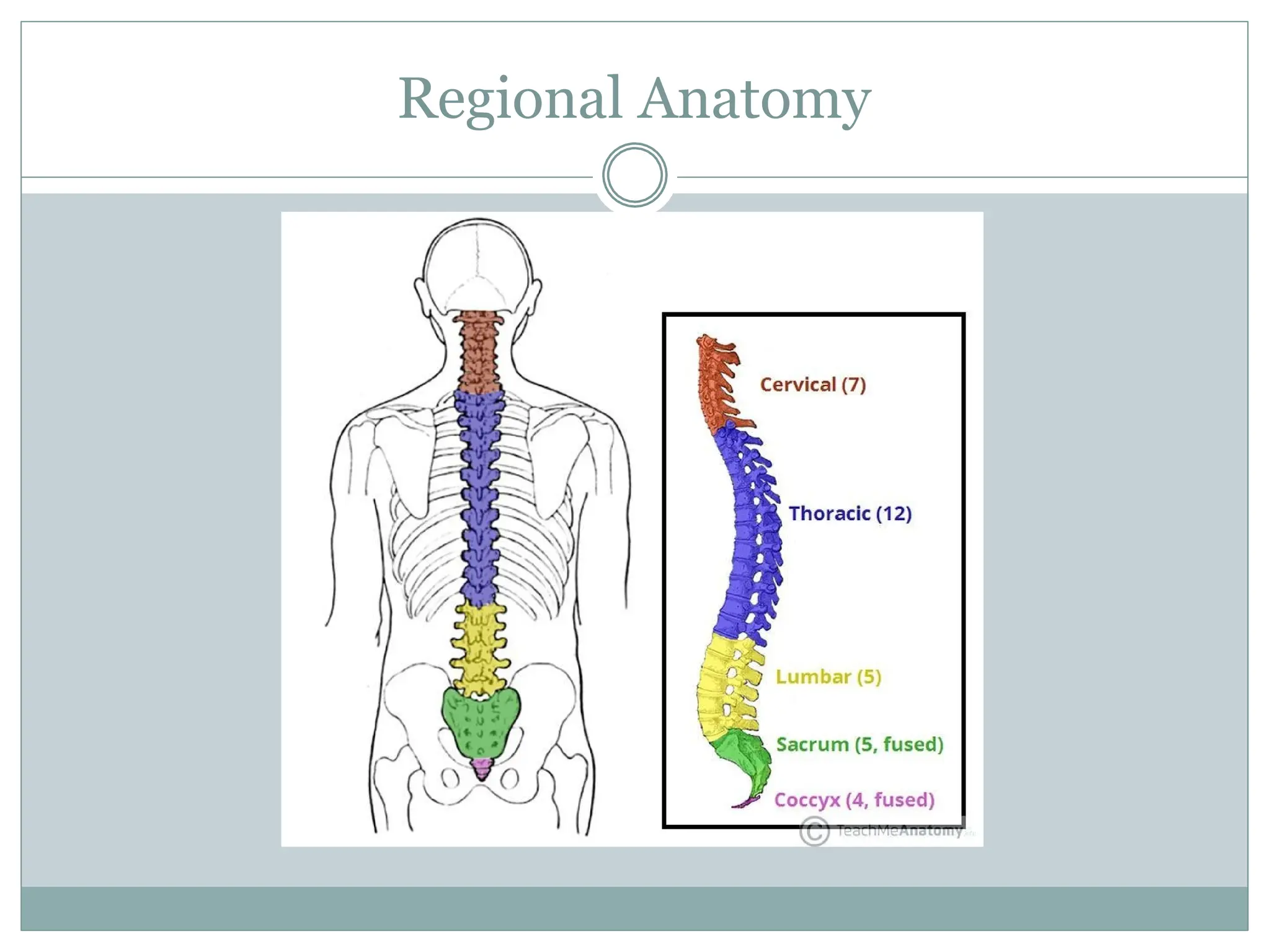
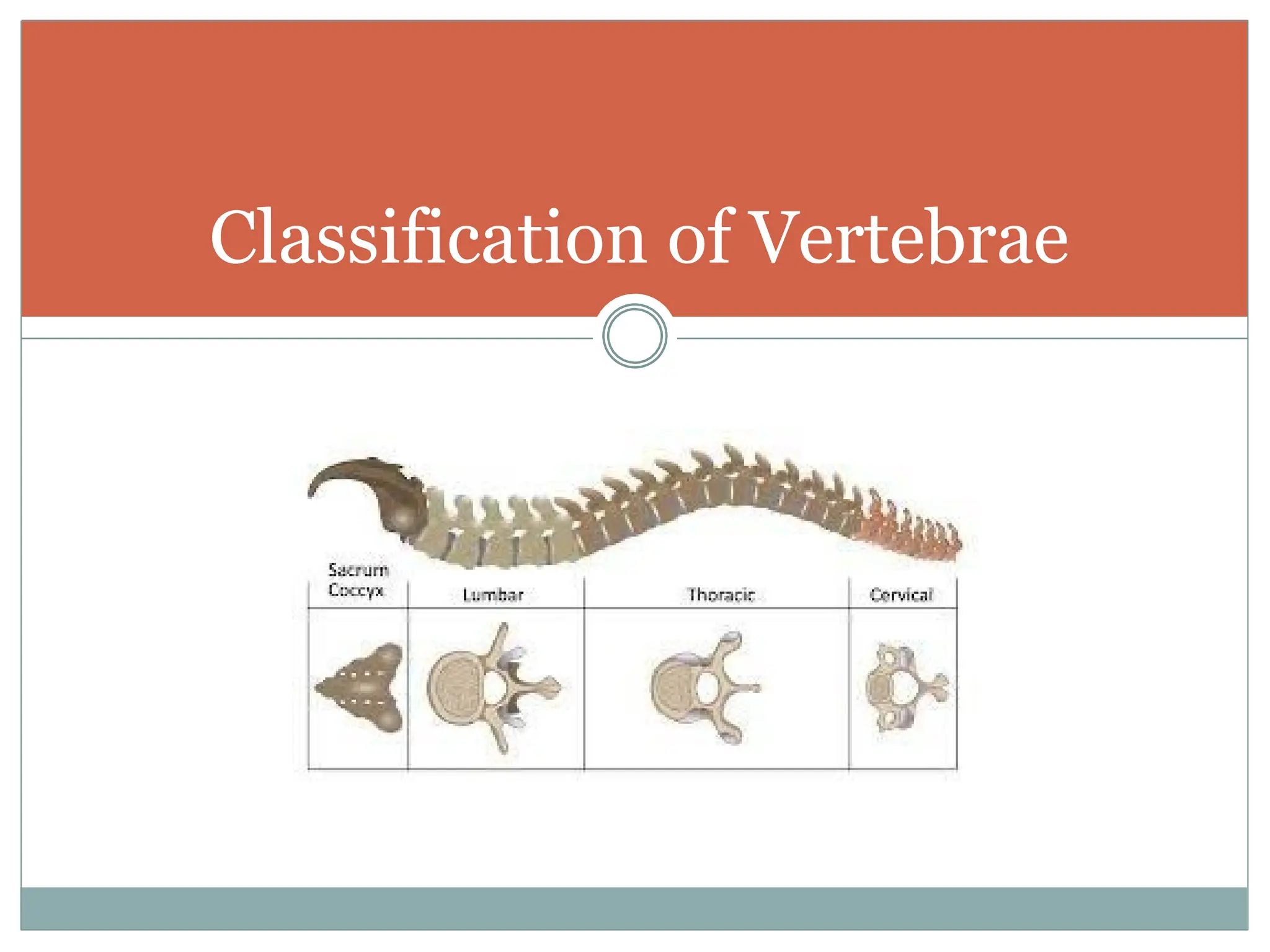
⚫ The column can be divided into five different
regions, each region is characterised by a different a
vertebral structure
⚪ Cervical (7), Thoracic (12), Lumbar (5), Sacrum (5, fused),
Coccyx (4, fused)
Functions of theVertebral Column
⚫ Protection
⚪ encloses and protects the spinal cord within the spinal
canal.
⚫ Support
⚪ carries the weight of the body above the pelvis.
⚫ Axis
⚪ forms the central axis of the body.
⚫ Movement
⚪ has roles in both posture and movement.
5.
Structure of aVertebrae
⚫ All vertebrae share a basic common structure
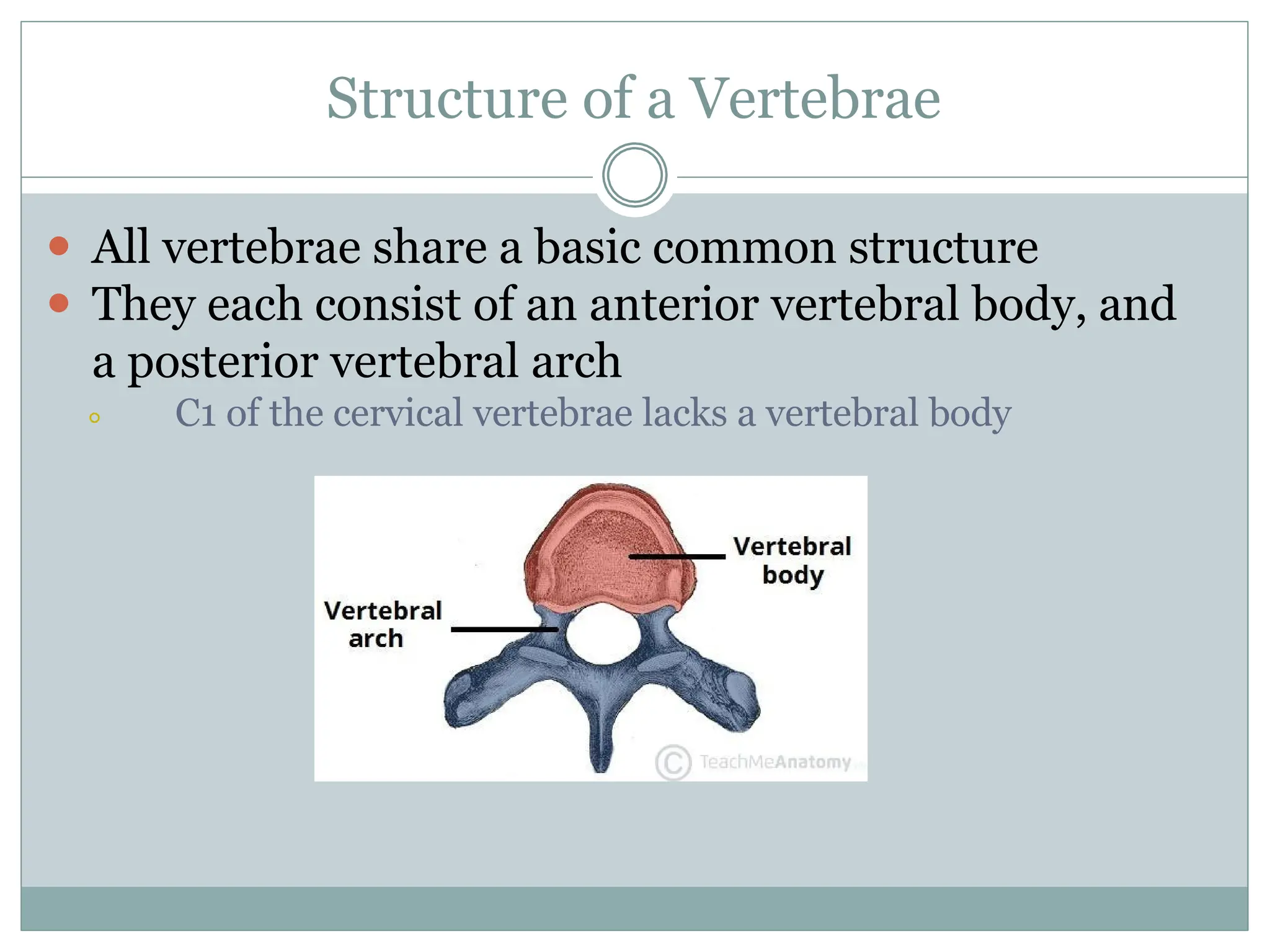
⚫ They each consist of an anterior vertebral body, and
a posterior vertebral arch
⚪ C1 of the cervical vertebrae lacks a vertebral body
6.
Vertebral Arch
⚫ Thevertebral arch forms the lateral and posterior
aspect of each vertebrae
⚫ Together, the vertebral body & the vertebral arch
creates an enclosed hole called the vertebral foramen
⚫ The vertebral foramen of all vertebrae line up to
form the vertebral canal which encloses the spinal
cord
7.
Vertebral Arch ct’d
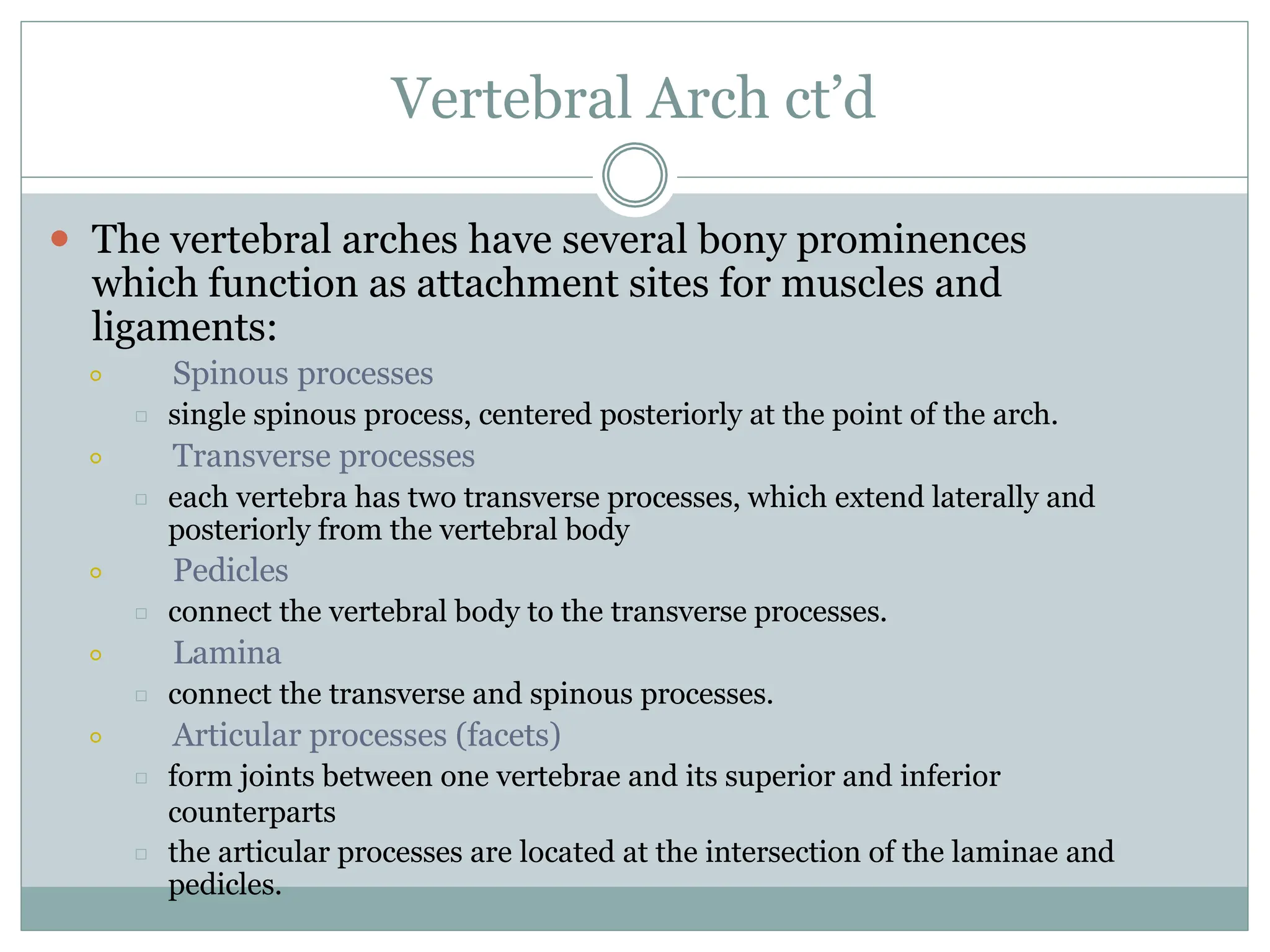
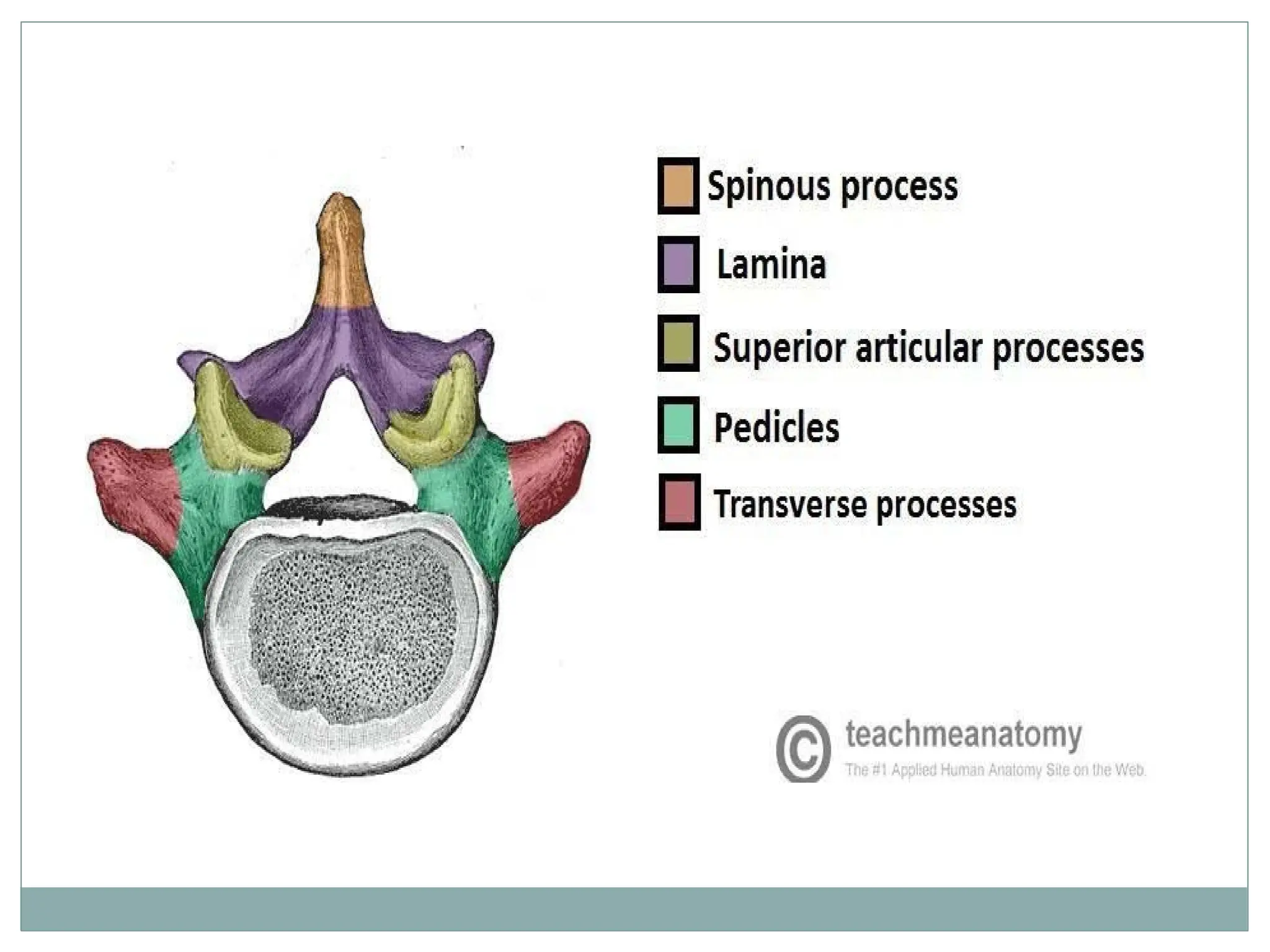
⚫The vertebral arches have several bony prominences
which function as attachment sites for muscles and
ligaments:
⚪ Spinous processes
□ single spinous process, centered posteriorly at the point of the arch.
⚪ Transverse processes
□ each vertebra has two transverse processes, which extend laterally and
posteriorly from the vertebral body
⚪ Pedicles
□ connect the vertebral body to the transverse processes.
⚪ Lamina
□ connect the transverse and spinous processes.
⚪ Articular processes (facets)
□ form joints between one vertebrae and its superior and inferior
counterparts
□ the articular processes are located at the intersection of the laminae and
pedicles.
Cervical Vertebrae
⚫ Thereare 7 cervical vertebrae in the human body
⚫ Distinguishing features:
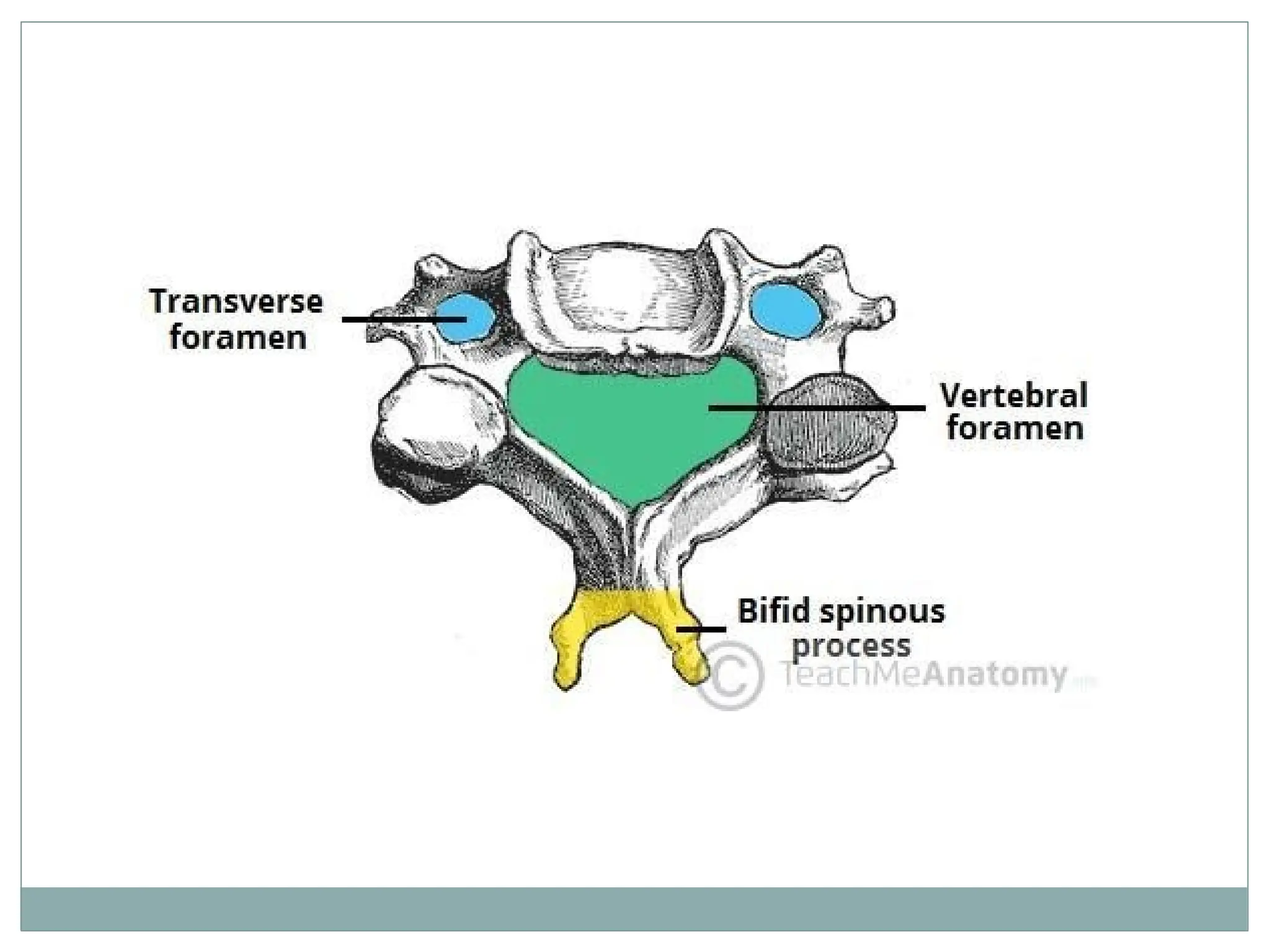
⚪ bifid spinous process – the spinous process bifurcates at its
distal end
□ exceptions to this are C1 (no spinous process) and C7
⚪ triangular vertebral foramen
⚪ transverse foramina – an opening in each transverse
process
□ the vertebral arteries travel to the brain (C1 – C6)
⚫ C1 & C2 (called the atlas and axis respectively) are
specialised to allow for the movement of the head.
12.
Thoracic Vertebrae
⚫ Thereare 12 thoracic vertebrae in the human body
⚫ Their specialized function of the thoracic vertebrae is to articulate with the
ribs
⚫ Distinguishing features:
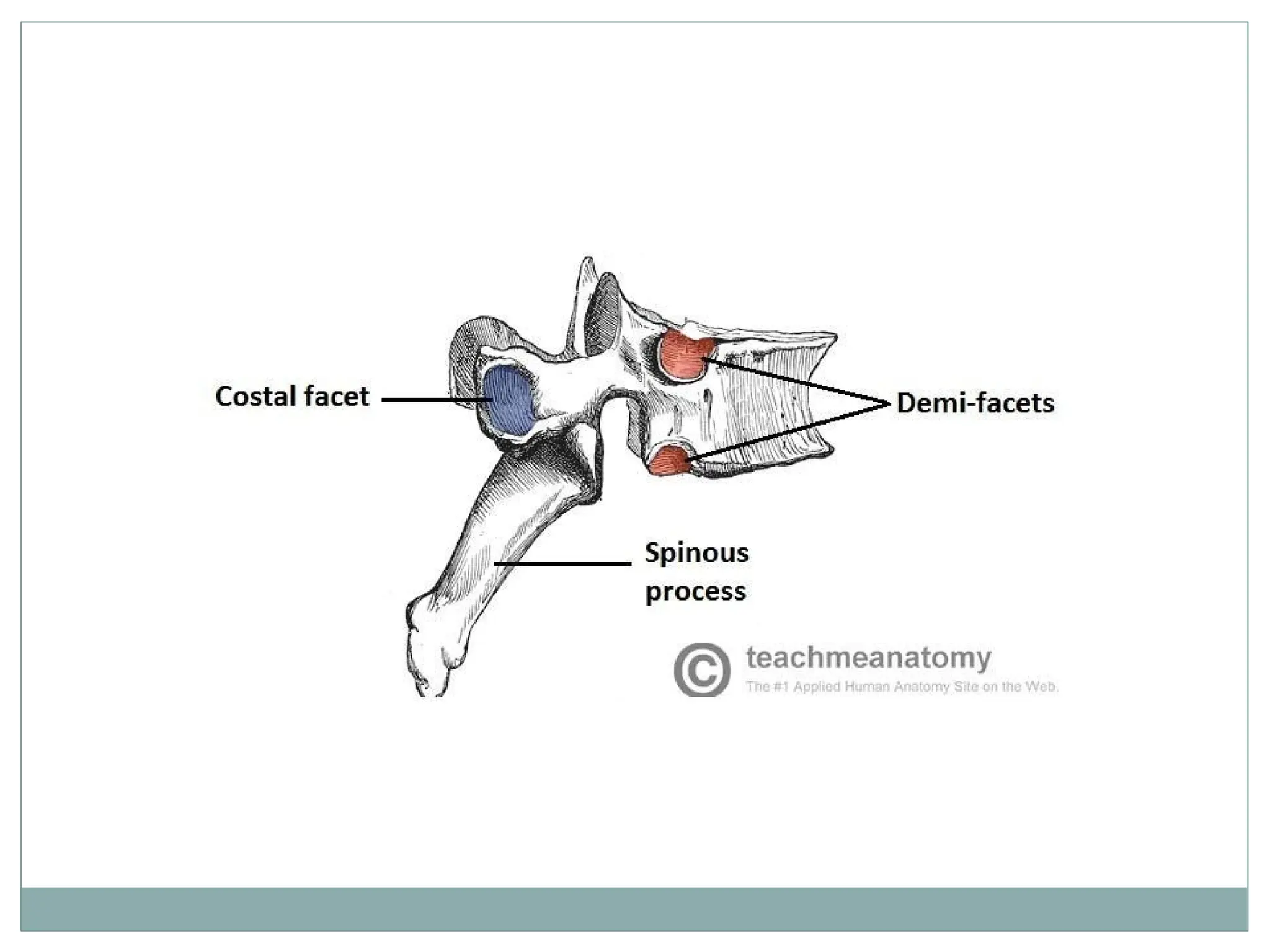
⚪ demi facets - 2 sets located superiorly and inferiorly on either side of the vertebral
body
□ articulate with the heads of two different ribs
⚪ costal facet - located on the transverse processes of the vertebrae
□ articulate with the shaft of a single rib
Example:
⚪ the head of rib 2 articulates with the inferior demi facet of thoracic vertebra 1 (T1) and the
superior demi facet of T2
⚪ the shaft of rib 2 articulates with the costal facets of T2
⚪ the spinous processes of thoracic vertebrae are oriented obliquely, inferiorly and
posteriorly
⚪ the vertebral foramen of thoracic vertebrae is circular
14.
Lumbar Vertebrae
⚫ Thereare 5 lumbar vertebrae in the human body
⚪ the largest in the vertebral column
⚫ Their specialized function is to support the weight of the
torso
⚫ Distinguishing features:
⚪ lumbar vertebrae have very large vertebral bodies which are
kidney-shaped
⚪ no transverse foramina, costal facets, or bifid spinous
processes
⚪ triangular-shaped vertebral foramen
⚪ spinous processes are shorter than those of thoracic vertebrae and do not
extend inferiorly below the level of the vertebral body
⚪ their size and orientation allows for clinical access to the spinal canal
15.
Sacrum & Coccyx
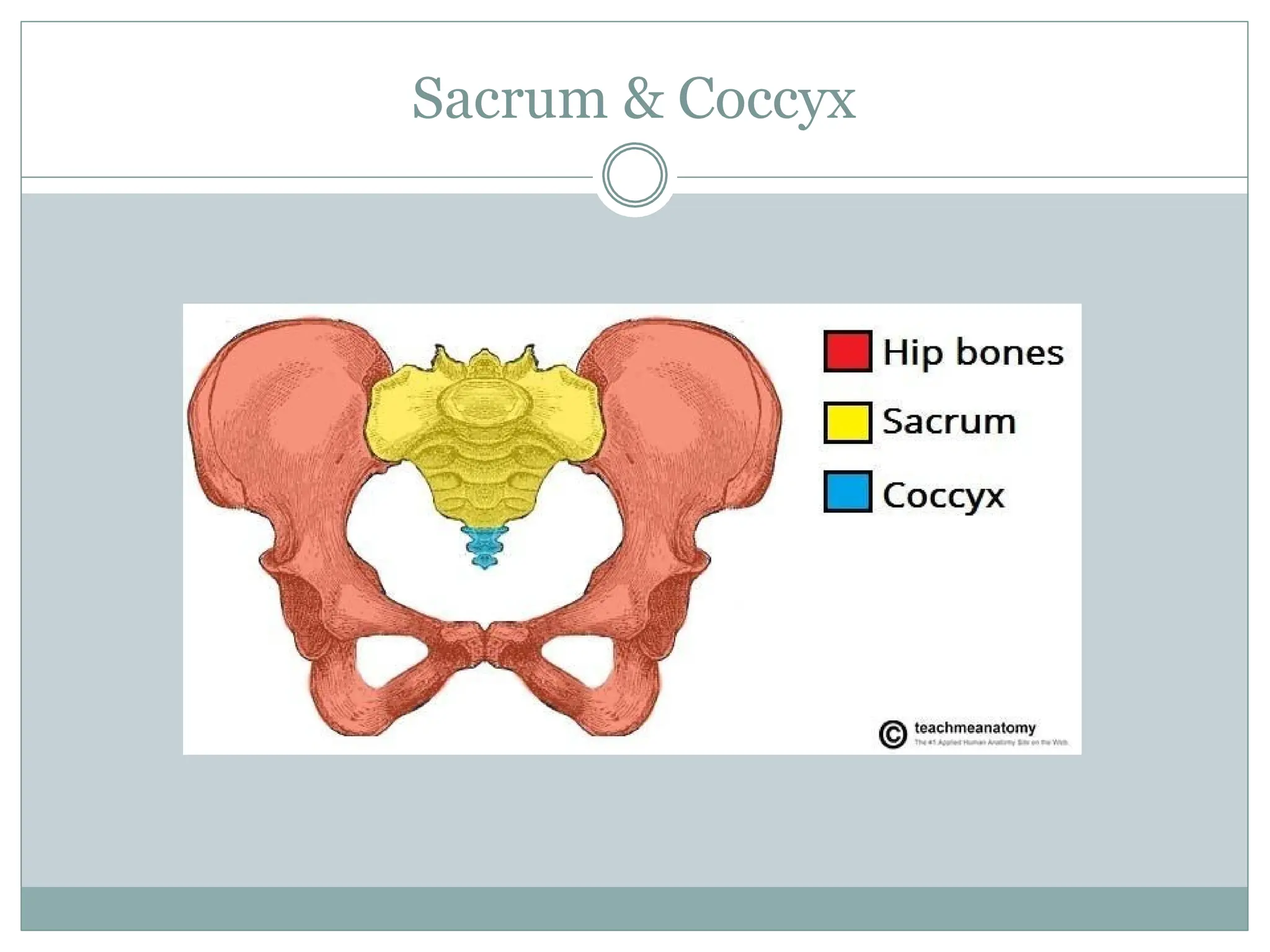
⚫The sacrum
⚪ a collection of five fused vertebrae
⚪ described as an inverted triangle, with the apex pointing
inferiorly
⚪ On the lateral walls of the sacrum are facets for articulation
with the pelvis at the sacro-iliac joints.
⚫ The coccyx
⚪ is a small bone which articulates with the apex of the
sacrum
⚪ it is recognised by its lack of vertebral arches and vertebral
canal
Joints
⚫ vertebrae aremobile and articulate with each other
via joints between their bodies and articular facets:
⚪ left and right superior articular facets articulate with the
vertebra above
⚪ left and right inferior articular facets articulate with the
vertebra below
⚪ vertebral bodies indirectly articulate with each other via the
intervertebral discs
⚫ The joints between the vertebral bodies are called
cartilaginous joints
⚪ function: designed for weight-bearing
⚪ structure: the articular surfaces of the vertebral bodies are
covered by hyaline cartilage and connect indirectly by the
intervertebral disc
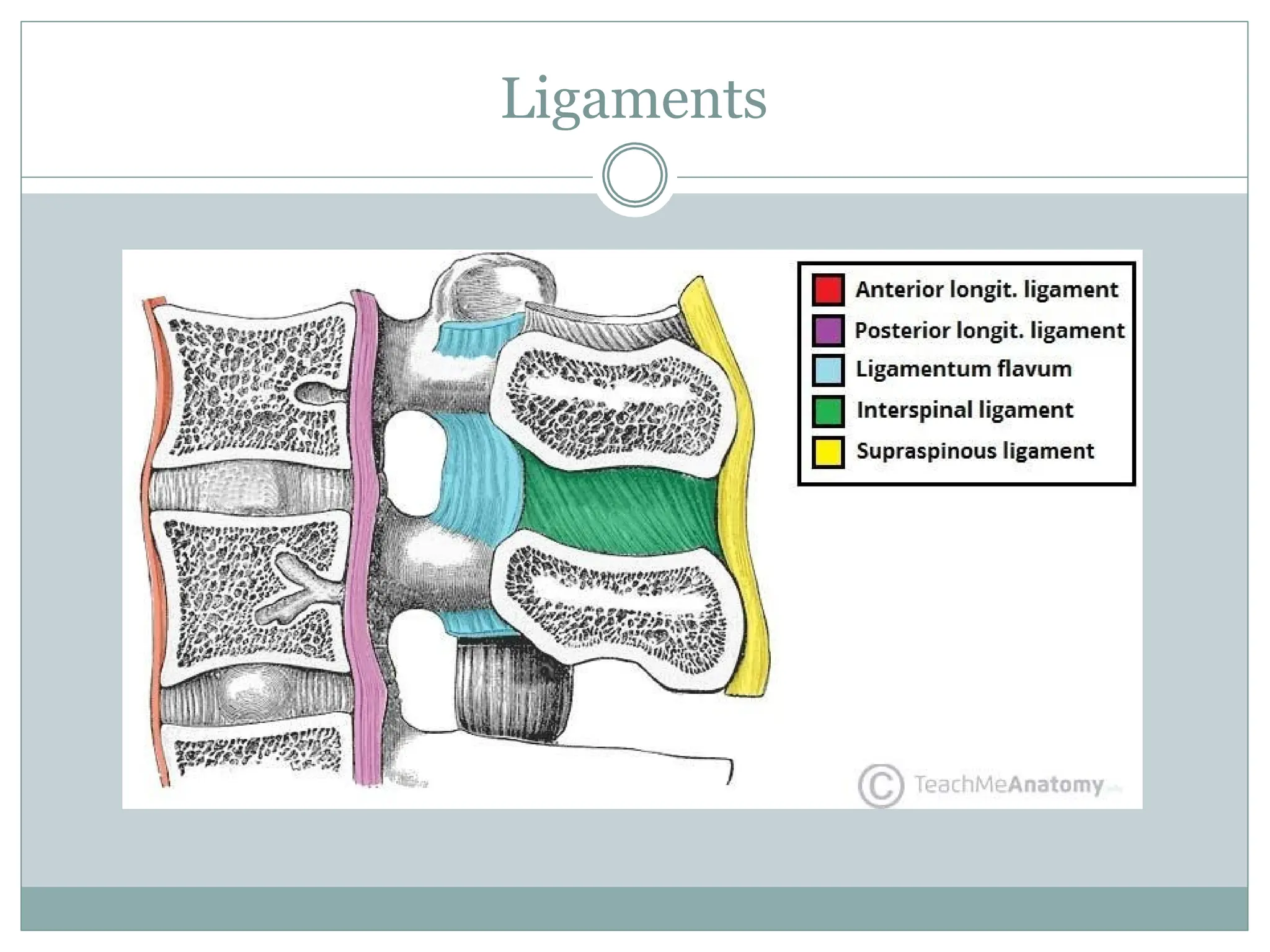
Ligaments
the vertebral column
⚫There are 2 ligaments that strengthen the vertebral body joints:
⚪ the anterior and posterior longitudinal ligaments
□ run the full length of the vertebral column.
□ the anterior longitudinal ligament is thick and prevents hyperextension of
□ the posterior longitudinal ligament is weaker, and prevents hyperflexion
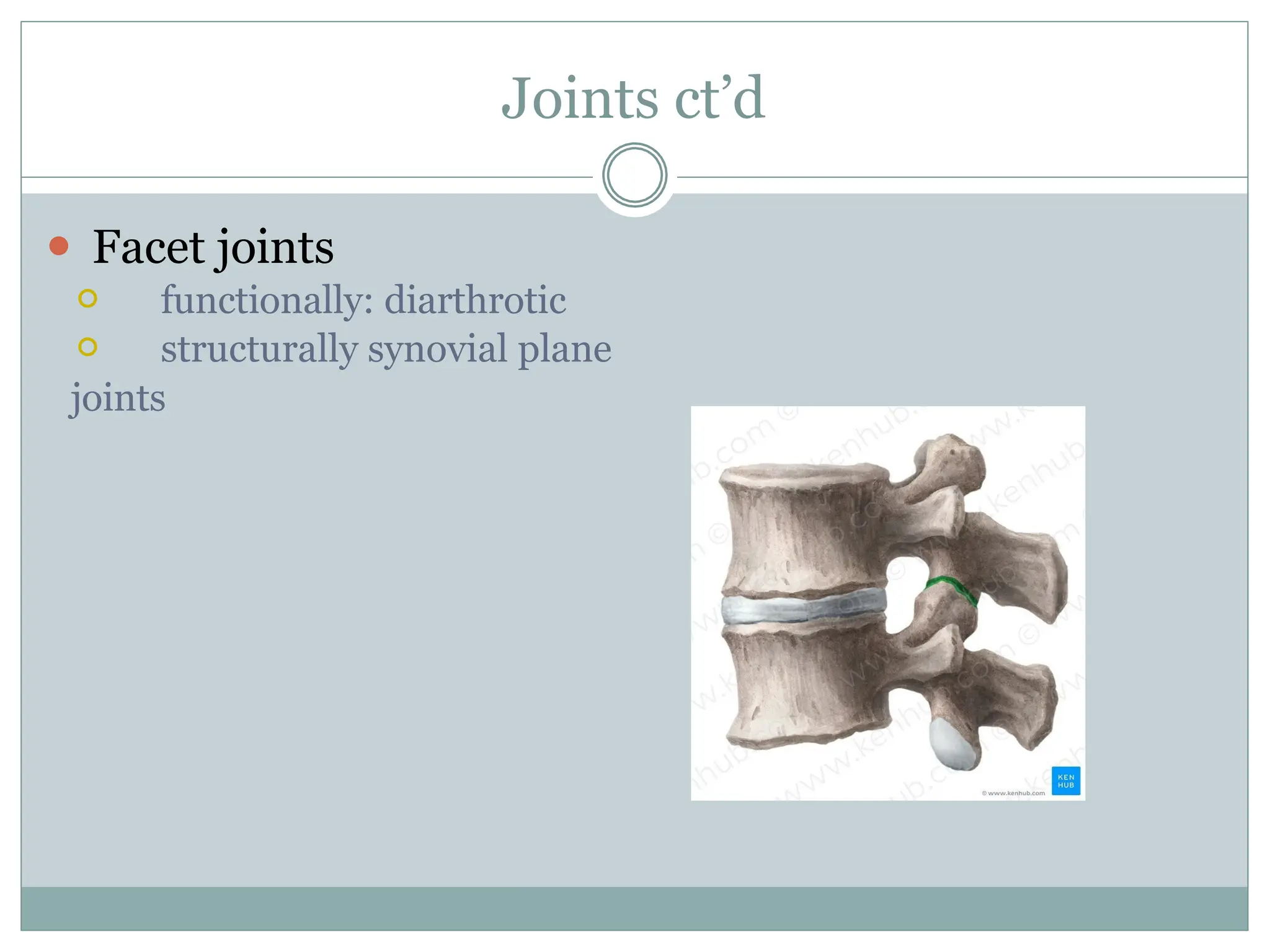
⚫ facet joints
⚪ allow for some gliding motion between the vertebrae
⚪ strengthened by several ligaments:
□ ligamentum flavum
□ extends between lamina of adjacent vertebrae
□ interspinous and supraspinous
□ join the spinous processes of adjacent vertebrae
□ the interspinous ligaments attach between the spinous processes
□ the supraspinous ligaments attach to the tips of the spinous processes
□ intertransverse ligaments
□ extends between transverse processes