PROFESSIONAL & PERSONAL
EXCELLENCE
By Dr. Sanjna Vij
Amity University Haryana
Define Excellence?
• Excellence means greatness — the very best
Achieving excellence is never easy to do.
• Excellence is a quality that people really
appreciate, because it's so hard to find.
• Excellence is the quality of excelling, of being
truly the best at something.
Difference in Personnel & Professional
Excellence
• Personal Success: This is what you aspire to
achieve for yourself: emotionally, physically
and in your personal relationships. Such as
having a loving family or hitting
a personal best in the gym.
• Professional Success: This is what you're
aiming for in your professional life, or your
place of work.
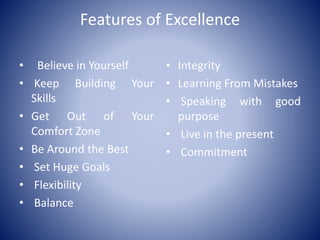
Features of Excellence
• Believe in Yourself
• Keep Building Your
Skills
• Get Out of Your
Comfort Zone
• Be Around the Best
• Set Huge Goals
• Flexibility
• Balance
• Integrity
• Learning From Mistakes
• Speaking with good
purpose
• Live in the present
• Commitment
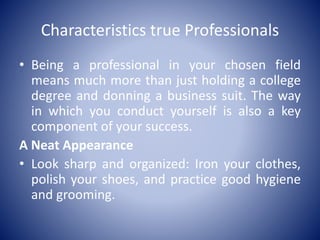
Characteristics true Professionals
• Being a professional in your chosen field
means much more than just holding a college
degree and donning a business suit. The way
in which you conduct yourself is also a key
component of your success.
A Neat Appearance
• Look sharp and organized: Iron your clothes,
polish your shoes, and practice good hygiene
and grooming.
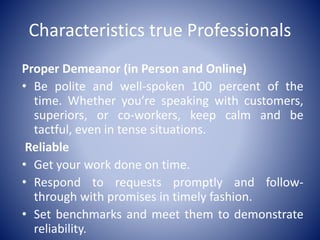
Characteristics true Professionals
Proper Demeanor (in Person and Online)
• Be polite and well-spoken 100 percent of the
time. Whether you’re speaking with customers,
superiors, or co-workers, keep calm and be
tactful, even in tense situations.
Reliable
• Get your work done on time.
• Respond to requests promptly and follow-
through with promises in timely fashion.
• Set benchmarks and meet them to demonstrate
reliability.
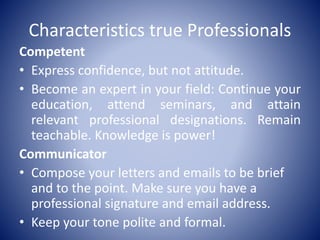
Characteristics true Professionals
Competent
• Express confidence, but not attitude.
• Become an expert in your field: Continue your
education, attend seminars, and attain
relevant professional designations. Remain
teachable. Knowledge is power!
Communicator
• Compose your letters and emails to be brief
and to the point. Make sure you have a
professional signature and email address.
• Keep your tone polite and formal.
Characteristics true Professionals
Good Phone Etiquette
• Identify yourself with your full name, company, and
title when placing and/or answering a call.
• Do not dominate the conversation; listen intently and
process what the other person is saying.
• Do not use slang terms and mind your tone of voice.
• Smile while you talk: The caller may not see it, but they
can hear it in your voice.
Ethical
• It is imperative to display ethical behavior at all times,
on or off the clock.
Characteristics true Professionals
Organized
• Keep your area neat and organized for easy execution
of tasks.
• Keep an updated appointment book so you don’t
forget meetings.
• Carry only the necessary contents for the day in your
briefcase.
Accountable
• Take responsibility for your actions. Own your mistake,
work to resolve it, and fix it as soon as possible. Even
better: Learn from your mistakes. Lead by this example
to create trust.
Individual Differences
• Individual differences stand for the variation
or deviations among individuals in regard to a
single characteristic or number of
characteristics.
• It is stand for those differences which in their
totality distinguish one individual from
another
Causes of Individual Differences
• Heredity
• Environment
• Influence of caste, race and nation
• Sex differences
• Age and intelligence
• Temperament and emotional stability
• Economic condition and education
• Other Causes:
– Interests, aptitudes, achievements, sentiments,
character, educational and home background lead to
individual differences
Definition of Socialization
• Acc. To Bogardus:- Socialization is the process
of working together, of developing group
responsibility
• Acc. To Colley:- Socialization is a social process
through which an individual develops his own
self by learning the norms and by knowing
about his own self from others
Sense of Pride and Patriotism
• Pride is the state of holding one's self or another in
high esteem. An example of pride is the feeling a
parent has when his child graduates from college
• Patriotism is most broadly defined as love of one's
country
• Patriotism should be inculcated during childhood
because when children love their home and country,
they would grow up appreciating their heritage,
diversity and history, and strive to improve in all
aspects.
National Unity and Diversity
• National unity and integration can be made
stronger and more vibrant through the
inculcation of the value of patriotism.
• Our diversity is our strength and it is the
recipe of success in achieving development
and socio-economic progress, as well as our
ability to conquer various adversities.
What are Goals?
• Goals are something that you want to achieve
in the future
• Goals are like road maps; they get you from
one point to another.
Why Goals ?
• Goals provide the direction you need to
reach your destination
• The motivation to sustain you on your
trip
• A way to measure your progress.
•
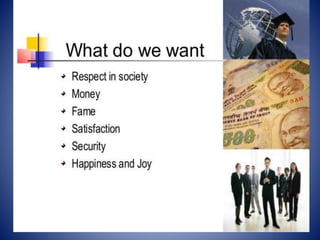
“Wants” Activity
Activity
• C
• O
• C
• O
• N
• U
• T
Difference in Goal and Dream
Goals
• Goals are something
you are acting on.
• Goals have deadlines
• Goals have a cost.
• Goals require hard
work.
Dreams
• Dreams are something
you are just thinking
about.
• Dreams are just, well,
dreams.
• Dreams are free.
• Dreams just require
your imagination
Types of Goals
 Long Term Goals:
10-year, 5-year and 1-year goals
 Short Term Goals:
goals for the next 9 months, 6 months and 3
months
 Immediate Goals:
1-30 days
Short and Long Term Goals
• To achieve each long-term goal, you must first
accomplish a series of both short-term goals and
additional long-term goals.
• For example, let's say you aspire to become a
doctor. That may be your ultimate long-term goal,
but before you can tackle it, you must achieve a
few others, for example, complete college (four
years), medical school (another four years), and a
medical residency (three to eight years).
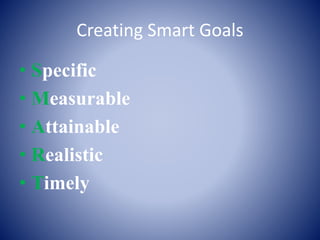
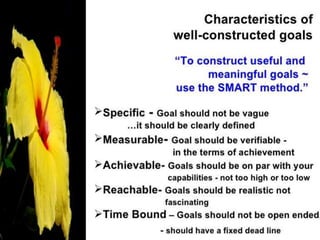
Creating Smart Goals
• Specific
• Measurable
• Attainable
• Realistic
• Timely
Activity
Fit your “Wants” Activity
goal in Smart Goal
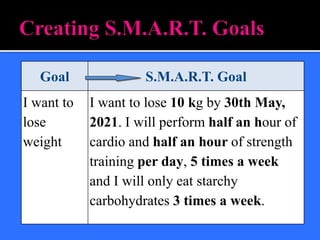
Goal S.M.A.R.T. Goal
I want to
lose
weight
I want to lose 10 kg by 30th May,
2021. I will perform half an hour of
cardio and half an hour of strength
training per day, 5 times a week
and I will only eat starchy
carbohydrates 3 times a week.
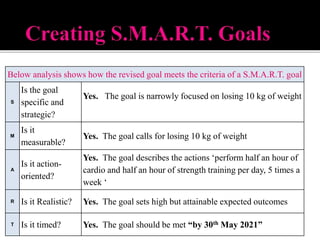
Below analysis shows how the revised goal meets the criteria of a S.M.A.R.T. goal
S
Is the goal
specific and
strategic?
Yes. The goal is narrowly focused on losing 10 kg of weight
M
Is it
measurable?
Yes. The goal calls for losing 10 kg of weight
A
Is it action-
oriented?
Yes. The goal describes the actions ‘perform half an hour of
cardio and half an hour of strength training per day, 5 times a
week ‘
R Is it Realistic? Yes. The goal sets high but attainable expected outcomes
T Is it timed? Yes. The goal should be met “by 30th May 2021”
Fail to Plan…….
Plan to Fail……
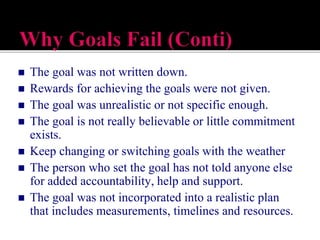
 The goal was not written down.
 Rewards for achieving the goals were not given.
 The goal was unrealistic or not specific enough.
 The goal is not really believable or little commitment
exists.
 Keep changing or switching goals with the weather
 The person who set the goal has not told anyone else
for added accountability, help and support.
 The goal was not incorporated into a realistic plan
that includes measurements, timelines and resources.
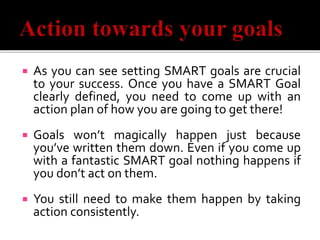
 As you can see setting SMART goals are crucial
to your success. Once you have a SMART Goal
clearly defined, you need to come up with an
action plan of how you are going to get there!
 Goals won’t magically happen just because
you’ve written them down. Even if you come up
with a fantastic SMART goal nothing happens if
you don’t act on them.
 You still need to make them happen by taking
action consistently.
Time Management
• Why Time Management is important for
professional excellence?
Discovering your own talent
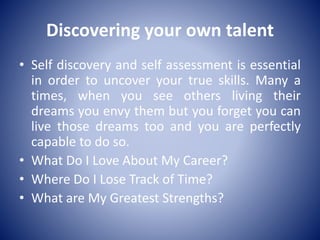
• Self discovery and self assessment is essential
in order to uncover your true skills. Many a
times, when you see others living their
dreams you envy them but you forget you can
live those dreams too and you are perfectly
capable to do so.
• What Do I Love About My Career?
• Where Do I Lose Track of Time?
• What are My Greatest Strengths?
Discovering your own style
• Don’t compare yourself with others
• Don’t concentrate on weaknesses, do
concentration strengths: First, find out what
your strengths are. Self-understanding and
self-support is key.
• Working on one’s weaknesses only brings
misery and self-doubt. Concentrating on your
strengths brings a better sense of fulfillment
and forward progress.
Discovering your own style
• Use failure as motivation: Things aren’t always going
to go your way, no matter how well you and your
teams properly align with your goals. Sometimes we
need a good kick to get us going. Sometimes we need
the pain of failure to reset, revise, and reassess. Are
you taking risks? Are you failing? If so, good going.
• Now is a time of pop-up engagement, leadership, and
success: Innovation demands the work of flexible
teams who cooperate,co-lead, and co-create. We also
believe you can do that too–on your own terms, with
your own teams, and in your own way.
Aptitudes
• Aptitudes are natural abilities
• Aptitudes are natural talents, special abilities
for doing, or learning to do, certain kinds of
things easily and quickly.
• They have little to do with knowledge or
culture, or education, or even interests.
• They have to do with heredity. Musical talent
and artistic talent are examples of such
aptitudes.
Aptitudes
• Some people can paint beautifully but cannot
carry a tune. Others are good at talking to people
but slow at paperwork. Still others can easily
repair a car, but find writing difficult.
• These basic differences among people are
important factors in making one person satisfied
as a banker, another satisfied as an engineer, and
still another satisfied working as an editor. Our
aptitude testing will identify your natural abilities.
Patterns of Aptitudes
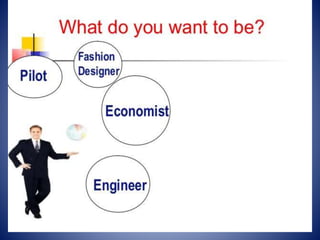
• Every occupation, whether it is engineering, medicine,
law, or management, uses certain aptitudes.
• The work you are most likely to enjoy and be successful
in is work that uses your aptitudes.
• For example, if you are an engineer but possess
aptitudes not used in engineering, your work might
seem unrewarding. If you lack the engineer's aptitudes,
your work may be difficult or unpleasant
Testing will help in choosing work that
fits you
• The primary purpose of taking aptitude tests
is to find areas in which you have ability.
• Our aptitude testing program assists you in
discovering the course of study and the type
of work that will fit your aptitude pattern; it
will help you to understand why certain
courses of study and occupations are likely to
be more satisfying or rewarding than others.
BUILDING POSITIVE PERSONALITY
• Accept Responsibility
• Show consideration e.g courtesy, politeness and
caring
• Choose your words carefully
• Never Criticize, Complain and Condemn
• Smile and Be Kind
• Be a Good Listener
• Give honest and Sincere Appreciation
• When you make a mistake, accept it and make
it easy to amend
Stress
• Stress is defined in terms of how it impacts
physical and psychological health; it includes
mental, physical, and emotional strain.
• Stress occurs when a demand exceeds an
individual’s coping ability and disrupts his or
her psychological equilibrium.
• Stress occurs in the workplace when an
employee perceives a situation to be too
strenuous to handle, and therefore
threatening to his or her well-being.
Preventing Job Stress
Clear and Open Communication
• Teach employees about stress awareness and promote
an open dialogue.
• Avoid ambiguity at all costs—clearly define workers’ roles
and responsibilities.
• Reduce uncertainty about career development and
future employment prospects.
Positive Workplace Culture
• Provide opportunities for social interaction among
workers.
• Watch for signs of dissatisfaction or bullying and work to
combat workplace discrimination (based on race, gender,
national origin, religion, or language).
Preventing Job Stress
Employee Accountability
• Give workers opportunities to participate in
decisions and actions that affect their jobs.
• Introduce a participative leadership style and
involve as many subordinates as possible in
resolving stress-producing problems.
Continued reflection
• (Placements, events, seminars, conferences,
projects extracurricular Activities etc.)

Ppt professional & personal excellence (1)

  • 1.
    PROFESSIONAL & PERSONAL EXCELLENCE ByDr. Sanjna Vij Amity University Haryana
  • 2.
    Define Excellence? • Excellencemeans greatness — the very best Achieving excellence is never easy to do. • Excellence is a quality that people really appreciate, because it's so hard to find. • Excellence is the quality of excelling, of being truly the best at something.
  • 3.
    Difference in Personnel& Professional Excellence • Personal Success: This is what you aspire to achieve for yourself: emotionally, physically and in your personal relationships. Such as having a loving family or hitting a personal best in the gym. • Professional Success: This is what you're aiming for in your professional life, or your place of work.
  • 4.
    Features of Excellence •Believe in Yourself • Keep Building Your Skills • Get Out of Your Comfort Zone • Be Around the Best • Set Huge Goals • Flexibility • Balance • Integrity • Learning From Mistakes • Speaking with good purpose • Live in the present • Commitment
  • 5.
    Characteristics true Professionals •Being a professional in your chosen field means much more than just holding a college degree and donning a business suit. The way in which you conduct yourself is also a key component of your success. A Neat Appearance • Look sharp and organized: Iron your clothes, polish your shoes, and practice good hygiene and grooming.
  • 6.
    Characteristics true Professionals ProperDemeanor (in Person and Online) • Be polite and well-spoken 100 percent of the time. Whether you’re speaking with customers, superiors, or co-workers, keep calm and be tactful, even in tense situations. Reliable • Get your work done on time. • Respond to requests promptly and follow- through with promises in timely fashion. • Set benchmarks and meet them to demonstrate reliability.
  • 7.
    Characteristics true Professionals Competent •Express confidence, but not attitude. • Become an expert in your field: Continue your education, attend seminars, and attain relevant professional designations. Remain teachable. Knowledge is power! Communicator • Compose your letters and emails to be brief and to the point. Make sure you have a professional signature and email address. • Keep your tone polite and formal.
  • 8.
    Characteristics true Professionals GoodPhone Etiquette • Identify yourself with your full name, company, and title when placing and/or answering a call. • Do not dominate the conversation; listen intently and process what the other person is saying. • Do not use slang terms and mind your tone of voice. • Smile while you talk: The caller may not see it, but they can hear it in your voice. Ethical • It is imperative to display ethical behavior at all times, on or off the clock.
  • 9.
    Characteristics true Professionals Organized •Keep your area neat and organized for easy execution of tasks. • Keep an updated appointment book so you don’t forget meetings. • Carry only the necessary contents for the day in your briefcase. Accountable • Take responsibility for your actions. Own your mistake, work to resolve it, and fix it as soon as possible. Even better: Learn from your mistakes. Lead by this example to create trust.
  • 10.
    Individual Differences • Individualdifferences stand for the variation or deviations among individuals in regard to a single characteristic or number of characteristics. • It is stand for those differences which in their totality distinguish one individual from another
  • 11.
    Causes of IndividualDifferences • Heredity • Environment • Influence of caste, race and nation • Sex differences • Age and intelligence • Temperament and emotional stability • Economic condition and education • Other Causes: – Interests, aptitudes, achievements, sentiments, character, educational and home background lead to individual differences
  • 12.
    Definition of Socialization •Acc. To Bogardus:- Socialization is the process of working together, of developing group responsibility • Acc. To Colley:- Socialization is a social process through which an individual develops his own self by learning the norms and by knowing about his own self from others
  • 14.
    Sense of Prideand Patriotism • Pride is the state of holding one's self or another in high esteem. An example of pride is the feeling a parent has when his child graduates from college • Patriotism is most broadly defined as love of one's country • Patriotism should be inculcated during childhood because when children love their home and country, they would grow up appreciating their heritage, diversity and history, and strive to improve in all aspects.
  • 15.
    National Unity andDiversity • National unity and integration can be made stronger and more vibrant through the inculcation of the value of patriotism. • Our diversity is our strength and it is the recipe of success in achieving development and socio-economic progress, as well as our ability to conquer various adversities.
  • 16.
    What are Goals? •Goals are something that you want to achieve in the future • Goals are like road maps; they get you from one point to another.
  • 17.
    Why Goals ? •Goals provide the direction you need to reach your destination • The motivation to sustain you on your trip • A way to measure your progress.
  • 18.
  • 19.
    Activity • C • O •C • O • N • U • T
  • 20.
    Difference in Goaland Dream Goals • Goals are something you are acting on. • Goals have deadlines • Goals have a cost. • Goals require hard work. Dreams • Dreams are something you are just thinking about. • Dreams are just, well, dreams. • Dreams are free. • Dreams just require your imagination
  • 21.
    Types of Goals Long Term Goals: 10-year, 5-year and 1-year goals  Short Term Goals: goals for the next 9 months, 6 months and 3 months  Immediate Goals: 1-30 days
  • 22.
    Short and LongTerm Goals • To achieve each long-term goal, you must first accomplish a series of both short-term goals and additional long-term goals. • For example, let's say you aspire to become a doctor. That may be your ultimate long-term goal, but before you can tackle it, you must achieve a few others, for example, complete college (four years), medical school (another four years), and a medical residency (three to eight years).
  • 23.
    Creating Smart Goals •Specific • Measurable • Attainable • Realistic • Timely
  • 25.
    Activity Fit your “Wants”Activity goal in Smart Goal
  • 26.
    Goal S.M.A.R.T. Goal Iwant to lose weight I want to lose 10 kg by 30th May, 2021. I will perform half an hour of cardio and half an hour of strength training per day, 5 times a week and I will only eat starchy carbohydrates 3 times a week.
  • 27.
    Below analysis showshow the revised goal meets the criteria of a S.M.A.R.T. goal S Is the goal specific and strategic? Yes. The goal is narrowly focused on losing 10 kg of weight M Is it measurable? Yes. The goal calls for losing 10 kg of weight A Is it action- oriented? Yes. The goal describes the actions ‘perform half an hour of cardio and half an hour of strength training per day, 5 times a week ‘ R Is it Realistic? Yes. The goal sets high but attainable expected outcomes T Is it timed? Yes. The goal should be met “by 30th May 2021”
  • 28.
  • 29.
     The goalwas not written down.  Rewards for achieving the goals were not given.  The goal was unrealistic or not specific enough.  The goal is not really believable or little commitment exists.  Keep changing or switching goals with the weather  The person who set the goal has not told anyone else for added accountability, help and support.  The goal was not incorporated into a realistic plan that includes measurements, timelines and resources.
  • 30.
     As youcan see setting SMART goals are crucial to your success. Once you have a SMART Goal clearly defined, you need to come up with an action plan of how you are going to get there!  Goals won’t magically happen just because you’ve written them down. Even if you come up with a fantastic SMART goal nothing happens if you don’t act on them.  You still need to make them happen by taking action consistently.
  • 31.
    Time Management • WhyTime Management is important for professional excellence?
  • 36.
    Discovering your owntalent • Self discovery and self assessment is essential in order to uncover your true skills. Many a times, when you see others living their dreams you envy them but you forget you can live those dreams too and you are perfectly capable to do so. • What Do I Love About My Career? • Where Do I Lose Track of Time? • What are My Greatest Strengths?
  • 37.
    Discovering your ownstyle • Don’t compare yourself with others • Don’t concentrate on weaknesses, do concentration strengths: First, find out what your strengths are. Self-understanding and self-support is key. • Working on one’s weaknesses only brings misery and self-doubt. Concentrating on your strengths brings a better sense of fulfillment and forward progress.
  • 38.
    Discovering your ownstyle • Use failure as motivation: Things aren’t always going to go your way, no matter how well you and your teams properly align with your goals. Sometimes we need a good kick to get us going. Sometimes we need the pain of failure to reset, revise, and reassess. Are you taking risks? Are you failing? If so, good going. • Now is a time of pop-up engagement, leadership, and success: Innovation demands the work of flexible teams who cooperate,co-lead, and co-create. We also believe you can do that too–on your own terms, with your own teams, and in your own way.
  • 39.
    Aptitudes • Aptitudes arenatural abilities • Aptitudes are natural talents, special abilities for doing, or learning to do, certain kinds of things easily and quickly. • They have little to do with knowledge or culture, or education, or even interests. • They have to do with heredity. Musical talent and artistic talent are examples of such aptitudes.
  • 40.
    Aptitudes • Some peoplecan paint beautifully but cannot carry a tune. Others are good at talking to people but slow at paperwork. Still others can easily repair a car, but find writing difficult. • These basic differences among people are important factors in making one person satisfied as a banker, another satisfied as an engineer, and still another satisfied working as an editor. Our aptitude testing will identify your natural abilities.
  • 41.
    Patterns of Aptitudes •Every occupation, whether it is engineering, medicine, law, or management, uses certain aptitudes. • The work you are most likely to enjoy and be successful in is work that uses your aptitudes. • For example, if you are an engineer but possess aptitudes not used in engineering, your work might seem unrewarding. If you lack the engineer's aptitudes, your work may be difficult or unpleasant
  • 42.
    Testing will helpin choosing work that fits you • The primary purpose of taking aptitude tests is to find areas in which you have ability. • Our aptitude testing program assists you in discovering the course of study and the type of work that will fit your aptitude pattern; it will help you to understand why certain courses of study and occupations are likely to be more satisfying or rewarding than others.
  • 48.
    BUILDING POSITIVE PERSONALITY •Accept Responsibility • Show consideration e.g courtesy, politeness and caring • Choose your words carefully • Never Criticize, Complain and Condemn • Smile and Be Kind • Be a Good Listener • Give honest and Sincere Appreciation • When you make a mistake, accept it and make it easy to amend
  • 49.
    Stress • Stress isdefined in terms of how it impacts physical and psychological health; it includes mental, physical, and emotional strain. • Stress occurs when a demand exceeds an individual’s coping ability and disrupts his or her psychological equilibrium. • Stress occurs in the workplace when an employee perceives a situation to be too strenuous to handle, and therefore threatening to his or her well-being.
  • 50.
    Preventing Job Stress Clearand Open Communication • Teach employees about stress awareness and promote an open dialogue. • Avoid ambiguity at all costs—clearly define workers’ roles and responsibilities. • Reduce uncertainty about career development and future employment prospects. Positive Workplace Culture • Provide opportunities for social interaction among workers. • Watch for signs of dissatisfaction or bullying and work to combat workplace discrimination (based on race, gender, national origin, religion, or language).
  • 51.
    Preventing Job Stress EmployeeAccountability • Give workers opportunities to participate in decisions and actions that affect their jobs. • Introduce a participative leadership style and involve as many subordinates as possible in resolving stress-producing problems.
  • 52.
    Continued reflection • (Placements,events, seminars, conferences, projects extracurricular Activities etc.)