Prepared by Nagabhushan  nagabhushan
An effective and fully developed depository system is essential for maintaining and enhancing the effeciency of a mature capital market nagabhushan
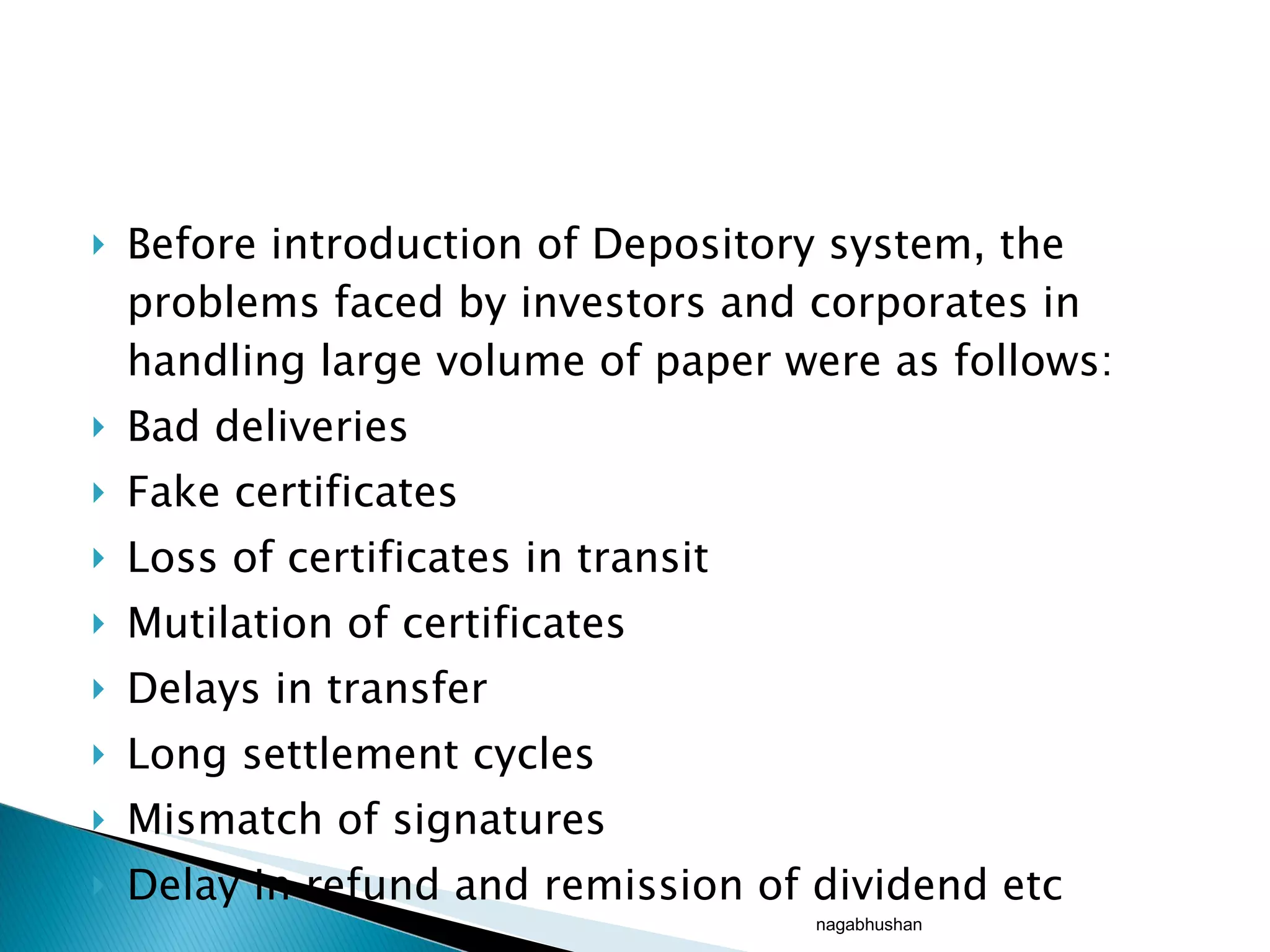
Before introduction of Depository system, the problems faced by investors and corporates in handling large volume of paper were as follows: Bad deliveries Fake certificates  Loss of certificates in transit Mutilation of certificates Delays in transfer Long settlement cycles Mismatch of signatures Delay in refund and remission of dividend etc nagabhushan
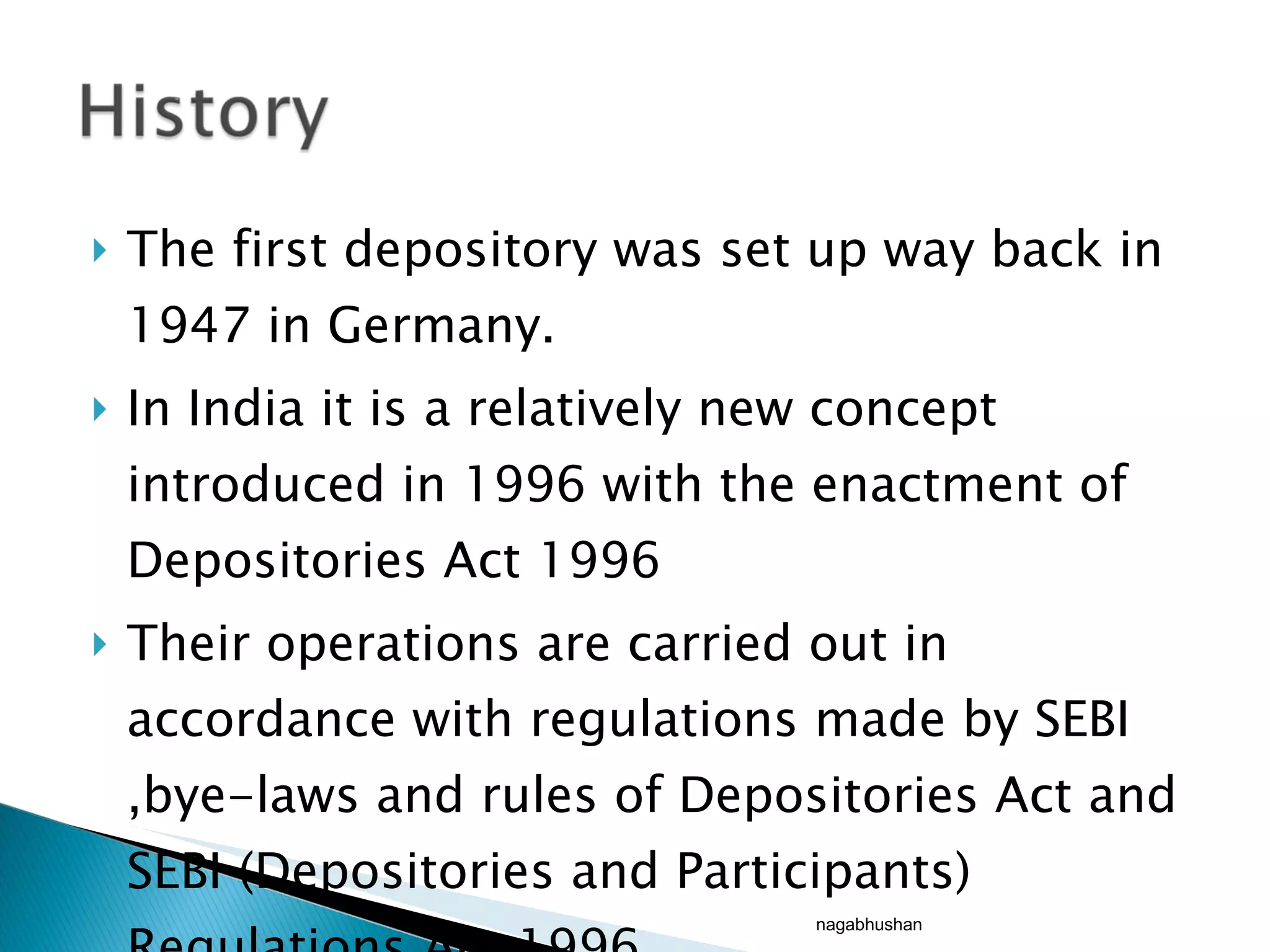
The first depository was set up way back in 1947 in Germany. In India it is a relatively new concept introduced in 1996 with the enactment of Depositories Act 1996 Their operations are carried out in accordance with regulations made by SEBI ,bye-laws and rules of Depositories Act and SEBI (Depositories and Participants) Regulations Act 1996  nagabhushan
The term Depository means a place where a deposit of money, securities, property etc is deposited for safekeeping under the terms of depository agreement A depository is an organisation, which assists in the allotment and transfer of securities and securities lending. The shares here are held in the form of electronic accounts i.e dematerialised form and the depository system revolves around the concept of paper-less or scrip-less trading. nagabhushan
It holds the securities of the investors in the form of electronic book entries avoiding risks associated with paper It is not mandatory and is left to the investor to decide Depositories carry out its operations through various functionaries called business partners  nagabhushan
nagabhushan
A depository system is governed by the following acts Securities & Exchange Board of India Act 1992 The SEBI(Depositories and Participants) Regulations, 1996 Bye –laws of depository  Business rules of depository The Companies Act 1956 nagabhushan
Presently there are two Depositories working in India: National Securities Depository Limited (NSDL)  It was registered by the SEBI on june 7 1996 as India’s first Depository to facilitate trading and settlement of securities in the demat form. It is promoted by IDBI, UTI, NSE nagabhushan
Central Depository Services (India) Limited (CSDL)  It commenced its operations during feb 1999 and was promoted by Stock Exchange Mumbai in association with Bank of Baroda, Bank of India, SBI and HDFC Bank  nagabhushan
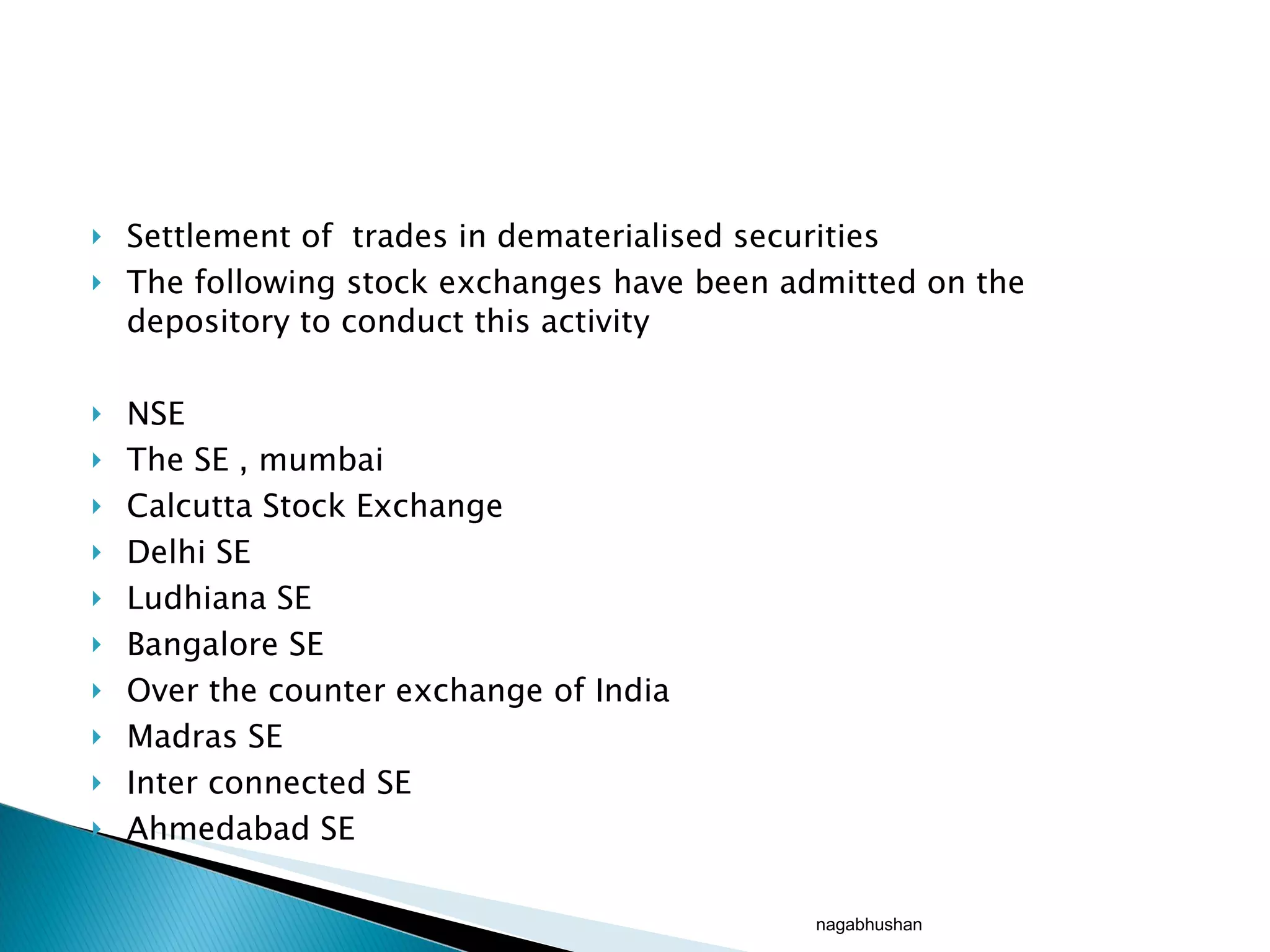
At present 10 Stock Exchanges are connected to the Depositories NSE The SE , mumbai Calcutta Stock Exchange Delhi SE Ludhiana SE Bangalore SE Over the counter exchange of India Madras SE Inter connected SE Ahmedabad SE nagabhushan
Market trade: trade done settled through a SE and clearing corporation. Off market trades: trades done privately without involvement of stock brokers and SE Again investor may either choose to invest privately, through SB or DP nagabhushan
Depository Depository Participant (DP) Securities, Issuers and Registrars and Share Transfer Agents Stock Exchanges and Stock Brokers Clearing Corporation/ Clearing House and Clearing Members Banking system Investors  nagabhushan
Depository : it is an organisation where the securities are held in electronic form and carries out the securities transaction by book entry DP : DP is an agent of the depository and functions as the interacting medium between the depository and the investor He should be registered with the SEBI nagabhushan
Must possess requisite qualifications prescribed by the concerned depository of which he is a participant He is responsible for maintaining the investors’ securities a/c with the depository and handles them as per the investors written instructions He is linked to a broker who trades on behalf of investors nagabhushan
To avail their services an account similar to a bank a/c has to be opened with the DP As per SEBI Regulations , financial institutions, banks, custodians, stock brokers etc can become DP’s However investors may choose DP’s of their choice and also deal with 1 or more DP;s at a time nagabhushan
Securities, Issuers and Registrars and Share Transfer Agents: eg: an agreement between the depository , issuer of security and the designated registrar/ share transfer agents for the underlying security in the cases of issues like transfer of securities by their beneficial owners nagabhushan
Stock Exchanges and Stock Brokers SE is an organised market for dealings in securities commonly referred as secondary market.one of its main functions is price discovery i.e to cause prices to reflect currently avalable information about a security SB are members of SE primarily engaged in 2 main activities i.e buy and sell securities for their clients charging a comm and as dealers or traders and dealers they buy and sell on their own a/c for trading gains nagabhushan
Clearing Corporation/ Clearing House and Clearing Members A clearing corporation is a central organisation created to facilitate efficient , fast and economical settlement of transactions at a SE . it being an internal department of a SE is an independent entity The members of Clearing Corporation brokerage firms, banks or other financial institutions who are called as clearing members. Eg:all trades done at NSE & OTCEI are settled through National Securities Clearing Corporation Limited (NSCCL) nagabhushan
It acts as a central mechanism for consolidating and settling transactions instead of the member firms settling each trade individually amongst themselves nagabhushan
Banking system Depository essentially plays a dual role i.e of a depository and a limited bank It maintains current a/c’s for participants and executes fund transactions relating to securities transactions for participants nagabhushan
Investors :may be individuals or corporates who have acquired shares either in primary market or in secondary market  nagabhushan
Opening of depository system Dematerialisation Rematerialisation Settlement of  trades in dematerialised securities Account transfer Transfer ,transmission and transposition nagabhushan
Pledge and hypothecation Redemption or repurchase Stock lending and borrowing Corporate action Account freezing Nomination Demat of debt instruments Dealing in govt securities nagabhushan
Opening of depository system: SEBI has made compulsory trading of shares of all the companies listed in stock exchanges in demat form w.e.f 2 nd  jan 2002 Hence if the investor wants to trade in respect of the companies which have established connectivity with NSDL & CSDL, he may have to open a beneficiary a/c nagabhushan
Beneficiary a/c is an a/c opened by the investor or a broker with a DP of his choice to hold shares in demat form and undertake scripless trading For opening demat a/c, the following documents are required: Demat opening form duly filled Address proof photograph nagabhushan
Once a demat a/c is opened investor must sign an agreement with the DP and the investor will be allotted an account no. called as client identity No minimum balance is required  The investor is provided with a transaction statement by his DP at regular intervals based on which the investor will know his security balances nagabhushan
Dematerialisation  It means conversion of the physical certificates into dematerialised holdings at the request of the investor Only shares registered in the name of the a/c holder are accepted for dematerialisation at the depository nagabhushan
Procedure: First open a demat a/c or security a/c with any DP of investor’s choice Obtain a/c no. from his DP A dematerialisation request form (DRF) to be submitted to the DP who intimates depository of the request DP then submits the certificate along with the DRF to the registrar who confirms the demat request Registrar validates the request, updates records ,destroys the certificates and informs depository who in turn credits the DP a/c  Depository participant updates the investor a/c and informs the investor  nagabhushan
Once the company is admitted into depository system, an ISIN (international securities identifiction number) is allotted by the depository. This no. is unique for each security of the company that is admitted in the depository The entire process takes about 15 days time. However when large no. of certificates are submitted from institutions, it takes upto 30 days for demat nagabhushan
An investor may demat a part of his holdings and hold the balance in physical mode for the same security Demat shares are fungible because they do not have any distinctive or certificate numbers nagabhushan
Rematerialisation It means conversion of demat holdings back into certificates If the investors wish to get the securities in physical form ,all he has to do is to request DP for remat nagabhushan
Procedure : Investor must fill up a remat request form (RRF) The DP will forward the request to depository after verifying that the shareholder has the necessary balances Depository will in turn intimate the registrar RTA (registrar & transfer agent) will print the certificates and dispatch the same to the investor  nagabhushan
Settlement of  trades in dematerialised securities The following stock exchanges have been admitted on the depository to conduct this activity NSE The SE , mumbai Calcutta Stock Exchange Delhi SE Ludhiana SE Bangalore SE Over the counter exchange of India Madras SE Inter connected SE Ahmedabad SE nagabhushan
Account transfer Depository gives effect to all transfers resulting from the settlement of trades and other transactions that take place between various beneficial owners.  Buying of securities: It is similar to buying of physical securities nagabhushan
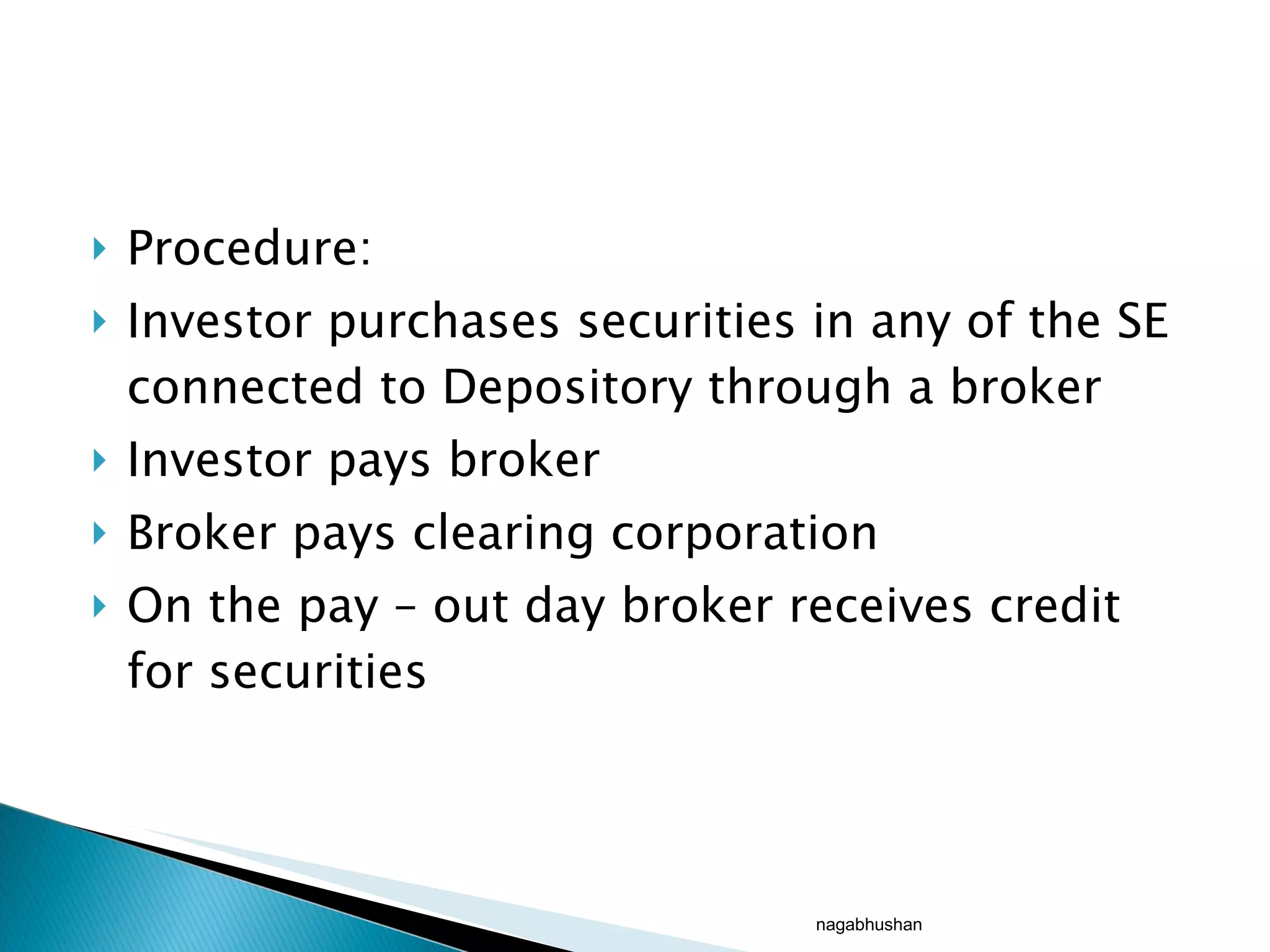
Procedure:  Investor purchases securities in any of the SE connected to Depository through a broker Investor pays broker Broker pays clearing corporation On the pay – out day broker receives credit for securities nagabhushan
He gives instructions to DP to debit clearing a/c and credit clients a/c Investor receives shares into his a/c Investor has to make sure that the broker transfers the securities into his a/c before the book closure Or else the company may hive corporate benefits to the broker nagabhushan
Selling of securities: procedure  Investor sells securities in any SE linked to depository through a broker Investor gives instruction to DP to debit his a/c and credit broker’ a/c Before the pay-in day, investor’s broker transfers the securities to clearing corporation nagabhushan
Broker receives payment from SE Investor receives payment from broker Sale in demat form is similar to sale under physical mode nagabhushan
Transfer: Depository being electronically linked to DP’s, issuer company or registrar & transfer agent and the clearing corporation of the SE, serves as an integrated set up for maintenance of investor a/c’s Hence , here transfer of securities occur merely by passing book entries in the records of the depository as and when instructed by the beneficial owners nagabhushan
Transmission: the claimant will have to fill a TRF i.e a transmission request form supported by documents like death certificate, succession certificate etc The DP after verifying that the application is genuine, will transfer securities to demat a/c of claimant Demat transmission all the formalities can be completed in one go nagabhushan
Transposition Security certificates for this purpose must be submitted along with TRF and DRF to the DP nagabhushan
Pledge and hypothecation Depositories allow the securities placed with them to be used as collateral to secure loans and other credits Pledging demat securities is easier and advantageous than pledging physical securities nagabhushan
Procedure: Both borrower (pledger) and lender (pledgee) must have depository a/c’s Details of securities to be pledged should be submitted by the pledger to his DP in a standard format Pledgee should confirm the request through his DP Once this is done, securities are pledged.then the financial transactions between pledger and pledgee are handled outside the depository system nagabhushan
After the loan is repaid, the borrower can request for a closure of pledge by instructing his DP If the pledgee agrees , the investor may change the securities offered in a pledge. nagabhushan
Redemption or repurchase This occurs when the securities are surrendered to the issuer either on maturity or in pursuance of an option given by the issuer , in lieu of agreed consideration. The consideration may be in cash or new securities in lieu of existing securities nagabhushan
Procedure: RRF (repurchase request form) is used instead of remat RF Client may be paid in cash or new securities in lieu of existing securities nagabhushan
Stock lending and borrowing It involves lending and borrowing of securities under an approved scheme It is executed through approved intermediaries duly registered with SEBI under the securities lending act 1997 Intermediaries may deal in a depository system only through a special a/c known as intermediary a/c opened with a participant nagabhushan
Corporate action nagabhushan
Nomination  Like shares in physical form, shares in electronic form also can be nominated  Nomination can be made only by individuals holding beneficiary a/c Minor can nominate only through guardian It can be made demat a/c wise and not security wise nagabhushan
nagabhushan
Demat of debt instruments Debt instruments can also be held in demat form Instruments like bonds, debentures, CP’s, CD’s From oct 31 st  2001, RBI has mentioned that banks and financial institutions shall make investment in deb and bonds only in demat form nagabhushan
Investor need not open separate demat a/c for demat of debt or instruments Procedure for demat of debt instruments is same as that of equity shares The investor has to ensure that before the certificates are handed over to the DP for demat, he marks ‘surrendered for dematerialisation’ on the face of the certificates nagabhushan
Dealing in govt securities  A subscriber to govt securities who opts for SGL securities may open an SGL a/c with RBI or any other approved entity on its own a/c are held in SGL 1 a/c and investments held on a/c of other clients are held in SGL 2 a/c nagabhushan
To ensure safety to the investors the following measures are existing: DP cannot effect any debit or credit in the demat a/c of the investor the valid authorisation of the investor Regular reconciliation between DP and depositories Periodic inspection by depositories of the office of DP and registrar ( RTA)  nagabhushan
All investors have a right to receive their statement of a/c’s periodically from the DP If the depository goes bankrupt, the creditors of the DP will have no access to the holdings in the name of the clients of the DP. Such investors may however transfer their holdings to another DP Compulsory internal audit of operations of DP by practicing Chartered Accountant every quarter  Steps to be taken for safe keeping and back up of data at all levels nagabhushan
To the nation: Growing and more liquid markets Increase in competitiveness in the international market place attracting many investors Improved prospects for privatisation of public sector units by creating a conducive environment Considerable reduction in delay Minimises settlement risk and fraud restoring investors’ faith in the capital markets nagabhushan
To the investing public Reduction of risks associated with loss, mutilation, theft and forgery of physical scrip Elimination of financial loss from loss of physical scrip Greater liquidity from speedier settlements Reduction in delays in registration Faster receipt of corporate benefits Reduced transaction costs through greater efficiency nagabhushan
To issuers: Up-to-date knowledge of shareholders’ names and addresses Reduction in printing and distribution costs of new issues Easy transfer of corporate benefits Improved ability to attract international investors without having to incur expenditure of issuance in overseas markets nagabhushan
nagabhushan

Ppt on depository system in india

  • 1.
  • 2.
    An effective andfully developed depository system is essential for maintaining and enhancing the effeciency of a mature capital market nagabhushan
  • 3.
    Before introduction ofDepository system, the problems faced by investors and corporates in handling large volume of paper were as follows: Bad deliveries Fake certificates Loss of certificates in transit Mutilation of certificates Delays in transfer Long settlement cycles Mismatch of signatures Delay in refund and remission of dividend etc nagabhushan
  • 4.
    The first depositorywas set up way back in 1947 in Germany. In India it is a relatively new concept introduced in 1996 with the enactment of Depositories Act 1996 Their operations are carried out in accordance with regulations made by SEBI ,bye-laws and rules of Depositories Act and SEBI (Depositories and Participants) Regulations Act 1996 nagabhushan
  • 5.
    The term Depositorymeans a place where a deposit of money, securities, property etc is deposited for safekeeping under the terms of depository agreement A depository is an organisation, which assists in the allotment and transfer of securities and securities lending. The shares here are held in the form of electronic accounts i.e dematerialised form and the depository system revolves around the concept of paper-less or scrip-less trading. nagabhushan
  • 6.
    It holds thesecurities of the investors in the form of electronic book entries avoiding risks associated with paper It is not mandatory and is left to the investor to decide Depositories carry out its operations through various functionaries called business partners nagabhushan
  • 7.
  • 8.
    A depository systemis governed by the following acts Securities & Exchange Board of India Act 1992 The SEBI(Depositories and Participants) Regulations, 1996 Bye –laws of depository Business rules of depository The Companies Act 1956 nagabhushan
  • 9.
    Presently there aretwo Depositories working in India: National Securities Depository Limited (NSDL) It was registered by the SEBI on june 7 1996 as India’s first Depository to facilitate trading and settlement of securities in the demat form. It is promoted by IDBI, UTI, NSE nagabhushan
  • 10.
    Central Depository Services(India) Limited (CSDL) It commenced its operations during feb 1999 and was promoted by Stock Exchange Mumbai in association with Bank of Baroda, Bank of India, SBI and HDFC Bank nagabhushan
  • 11.
    At present 10Stock Exchanges are connected to the Depositories NSE The SE , mumbai Calcutta Stock Exchange Delhi SE Ludhiana SE Bangalore SE Over the counter exchange of India Madras SE Inter connected SE Ahmedabad SE nagabhushan
  • 12.
    Market trade: tradedone settled through a SE and clearing corporation. Off market trades: trades done privately without involvement of stock brokers and SE Again investor may either choose to invest privately, through SB or DP nagabhushan
  • 13.
    Depository Depository Participant(DP) Securities, Issuers and Registrars and Share Transfer Agents Stock Exchanges and Stock Brokers Clearing Corporation/ Clearing House and Clearing Members Banking system Investors nagabhushan
  • 14.
    Depository : itis an organisation where the securities are held in electronic form and carries out the securities transaction by book entry DP : DP is an agent of the depository and functions as the interacting medium between the depository and the investor He should be registered with the SEBI nagabhushan
  • 15.
    Must possess requisitequalifications prescribed by the concerned depository of which he is a participant He is responsible for maintaining the investors’ securities a/c with the depository and handles them as per the investors written instructions He is linked to a broker who trades on behalf of investors nagabhushan
  • 16.
    To avail theirservices an account similar to a bank a/c has to be opened with the DP As per SEBI Regulations , financial institutions, banks, custodians, stock brokers etc can become DP’s However investors may choose DP’s of their choice and also deal with 1 or more DP;s at a time nagabhushan
  • 17.
    Securities, Issuers andRegistrars and Share Transfer Agents: eg: an agreement between the depository , issuer of security and the designated registrar/ share transfer agents for the underlying security in the cases of issues like transfer of securities by their beneficial owners nagabhushan
  • 18.
    Stock Exchanges andStock Brokers SE is an organised market for dealings in securities commonly referred as secondary market.one of its main functions is price discovery i.e to cause prices to reflect currently avalable information about a security SB are members of SE primarily engaged in 2 main activities i.e buy and sell securities for their clients charging a comm and as dealers or traders and dealers they buy and sell on their own a/c for trading gains nagabhushan
  • 19.
    Clearing Corporation/ ClearingHouse and Clearing Members A clearing corporation is a central organisation created to facilitate efficient , fast and economical settlement of transactions at a SE . it being an internal department of a SE is an independent entity The members of Clearing Corporation brokerage firms, banks or other financial institutions who are called as clearing members. Eg:all trades done at NSE & OTCEI are settled through National Securities Clearing Corporation Limited (NSCCL) nagabhushan
  • 20.
    It acts asa central mechanism for consolidating and settling transactions instead of the member firms settling each trade individually amongst themselves nagabhushan
  • 21.
    Banking system Depositoryessentially plays a dual role i.e of a depository and a limited bank It maintains current a/c’s for participants and executes fund transactions relating to securities transactions for participants nagabhushan
  • 22.
    Investors :may beindividuals or corporates who have acquired shares either in primary market or in secondary market nagabhushan
  • 23.
    Opening of depositorysystem Dematerialisation Rematerialisation Settlement of trades in dematerialised securities Account transfer Transfer ,transmission and transposition nagabhushan
  • 24.
    Pledge and hypothecationRedemption or repurchase Stock lending and borrowing Corporate action Account freezing Nomination Demat of debt instruments Dealing in govt securities nagabhushan
  • 25.
    Opening of depositorysystem: SEBI has made compulsory trading of shares of all the companies listed in stock exchanges in demat form w.e.f 2 nd jan 2002 Hence if the investor wants to trade in respect of the companies which have established connectivity with NSDL & CSDL, he may have to open a beneficiary a/c nagabhushan
  • 26.
    Beneficiary a/c isan a/c opened by the investor or a broker with a DP of his choice to hold shares in demat form and undertake scripless trading For opening demat a/c, the following documents are required: Demat opening form duly filled Address proof photograph nagabhushan
  • 27.
    Once a demata/c is opened investor must sign an agreement with the DP and the investor will be allotted an account no. called as client identity No minimum balance is required The investor is provided with a transaction statement by his DP at regular intervals based on which the investor will know his security balances nagabhushan
  • 28.
    Dematerialisation Itmeans conversion of the physical certificates into dematerialised holdings at the request of the investor Only shares registered in the name of the a/c holder are accepted for dematerialisation at the depository nagabhushan
  • 29.
    Procedure: First opena demat a/c or security a/c with any DP of investor’s choice Obtain a/c no. from his DP A dematerialisation request form (DRF) to be submitted to the DP who intimates depository of the request DP then submits the certificate along with the DRF to the registrar who confirms the demat request Registrar validates the request, updates records ,destroys the certificates and informs depository who in turn credits the DP a/c Depository participant updates the investor a/c and informs the investor nagabhushan
  • 30.
    Once the companyis admitted into depository system, an ISIN (international securities identifiction number) is allotted by the depository. This no. is unique for each security of the company that is admitted in the depository The entire process takes about 15 days time. However when large no. of certificates are submitted from institutions, it takes upto 30 days for demat nagabhushan
  • 31.
    An investor maydemat a part of his holdings and hold the balance in physical mode for the same security Demat shares are fungible because they do not have any distinctive or certificate numbers nagabhushan
  • 32.
    Rematerialisation It meansconversion of demat holdings back into certificates If the investors wish to get the securities in physical form ,all he has to do is to request DP for remat nagabhushan
  • 33.
    Procedure : Investormust fill up a remat request form (RRF) The DP will forward the request to depository after verifying that the shareholder has the necessary balances Depository will in turn intimate the registrar RTA (registrar & transfer agent) will print the certificates and dispatch the same to the investor nagabhushan
  • 34.
    Settlement of trades in dematerialised securities The following stock exchanges have been admitted on the depository to conduct this activity NSE The SE , mumbai Calcutta Stock Exchange Delhi SE Ludhiana SE Bangalore SE Over the counter exchange of India Madras SE Inter connected SE Ahmedabad SE nagabhushan
  • 35.
    Account transfer Depositorygives effect to all transfers resulting from the settlement of trades and other transactions that take place between various beneficial owners. Buying of securities: It is similar to buying of physical securities nagabhushan
  • 36.
    Procedure: Investorpurchases securities in any of the SE connected to Depository through a broker Investor pays broker Broker pays clearing corporation On the pay – out day broker receives credit for securities nagabhushan
  • 37.
    He gives instructionsto DP to debit clearing a/c and credit clients a/c Investor receives shares into his a/c Investor has to make sure that the broker transfers the securities into his a/c before the book closure Or else the company may hive corporate benefits to the broker nagabhushan
  • 38.
    Selling of securities:procedure Investor sells securities in any SE linked to depository through a broker Investor gives instruction to DP to debit his a/c and credit broker’ a/c Before the pay-in day, investor’s broker transfers the securities to clearing corporation nagabhushan
  • 39.
    Broker receives paymentfrom SE Investor receives payment from broker Sale in demat form is similar to sale under physical mode nagabhushan
  • 40.
    Transfer: Depository beingelectronically linked to DP’s, issuer company or registrar & transfer agent and the clearing corporation of the SE, serves as an integrated set up for maintenance of investor a/c’s Hence , here transfer of securities occur merely by passing book entries in the records of the depository as and when instructed by the beneficial owners nagabhushan
  • 41.
    Transmission: the claimantwill have to fill a TRF i.e a transmission request form supported by documents like death certificate, succession certificate etc The DP after verifying that the application is genuine, will transfer securities to demat a/c of claimant Demat transmission all the formalities can be completed in one go nagabhushan
  • 42.
    Transposition Security certificatesfor this purpose must be submitted along with TRF and DRF to the DP nagabhushan
  • 43.
    Pledge and hypothecationDepositories allow the securities placed with them to be used as collateral to secure loans and other credits Pledging demat securities is easier and advantageous than pledging physical securities nagabhushan
  • 44.
    Procedure: Both borrower(pledger) and lender (pledgee) must have depository a/c’s Details of securities to be pledged should be submitted by the pledger to his DP in a standard format Pledgee should confirm the request through his DP Once this is done, securities are pledged.then the financial transactions between pledger and pledgee are handled outside the depository system nagabhushan
  • 45.
    After the loanis repaid, the borrower can request for a closure of pledge by instructing his DP If the pledgee agrees , the investor may change the securities offered in a pledge. nagabhushan
  • 46.
    Redemption or repurchaseThis occurs when the securities are surrendered to the issuer either on maturity or in pursuance of an option given by the issuer , in lieu of agreed consideration. The consideration may be in cash or new securities in lieu of existing securities nagabhushan
  • 47.
    Procedure: RRF (repurchaserequest form) is used instead of remat RF Client may be paid in cash or new securities in lieu of existing securities nagabhushan
  • 48.
    Stock lending andborrowing It involves lending and borrowing of securities under an approved scheme It is executed through approved intermediaries duly registered with SEBI under the securities lending act 1997 Intermediaries may deal in a depository system only through a special a/c known as intermediary a/c opened with a participant nagabhushan
  • 49.
  • 50.
    Nomination Likeshares in physical form, shares in electronic form also can be nominated Nomination can be made only by individuals holding beneficiary a/c Minor can nominate only through guardian It can be made demat a/c wise and not security wise nagabhushan
  • 51.
  • 52.
    Demat of debtinstruments Debt instruments can also be held in demat form Instruments like bonds, debentures, CP’s, CD’s From oct 31 st 2001, RBI has mentioned that banks and financial institutions shall make investment in deb and bonds only in demat form nagabhushan
  • 53.
    Investor need notopen separate demat a/c for demat of debt or instruments Procedure for demat of debt instruments is same as that of equity shares The investor has to ensure that before the certificates are handed over to the DP for demat, he marks ‘surrendered for dematerialisation’ on the face of the certificates nagabhushan
  • 54.
    Dealing in govtsecurities A subscriber to govt securities who opts for SGL securities may open an SGL a/c with RBI or any other approved entity on its own a/c are held in SGL 1 a/c and investments held on a/c of other clients are held in SGL 2 a/c nagabhushan
  • 55.
    To ensure safetyto the investors the following measures are existing: DP cannot effect any debit or credit in the demat a/c of the investor the valid authorisation of the investor Regular reconciliation between DP and depositories Periodic inspection by depositories of the office of DP and registrar ( RTA) nagabhushan
  • 56.
    All investors havea right to receive their statement of a/c’s periodically from the DP If the depository goes bankrupt, the creditors of the DP will have no access to the holdings in the name of the clients of the DP. Such investors may however transfer their holdings to another DP Compulsory internal audit of operations of DP by practicing Chartered Accountant every quarter Steps to be taken for safe keeping and back up of data at all levels nagabhushan
  • 57.
    To the nation:Growing and more liquid markets Increase in competitiveness in the international market place attracting many investors Improved prospects for privatisation of public sector units by creating a conducive environment Considerable reduction in delay Minimises settlement risk and fraud restoring investors’ faith in the capital markets nagabhushan
  • 58.
    To the investingpublic Reduction of risks associated with loss, mutilation, theft and forgery of physical scrip Elimination of financial loss from loss of physical scrip Greater liquidity from speedier settlements Reduction in delays in registration Faster receipt of corporate benefits Reduced transaction costs through greater efficiency nagabhushan
  • 59.
    To issuers: Up-to-dateknowledge of shareholders’ names and addresses Reduction in printing and distribution costs of new issues Easy transfer of corporate benefits Improved ability to attract international investors without having to incur expenditure of issuance in overseas markets nagabhushan
  • 60.