A.Figoli,F. Russo
Instituteon MembrQne TechnoIogY(ITM-CNR), viQP.
Bucci17/cRende(CS), ItQIY
a. figoli@itm. cnr. it
16september
14:00 - 15:30
Environmental Nanotechnologies:the issue of micro-nanoplastics-Impact and mitigation measures of micro and nanoplastics
WS.III. 1 - TT.III.D
Mitigation measure : state of the art
N A N O I N N O V A T I O N 2 0 2 0
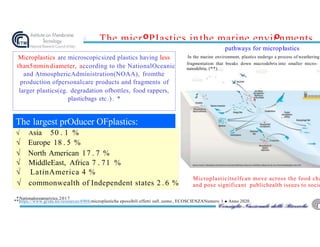
√ Asia 50 . 1 %
√ Europe 18 . 5 %
√ North American 17 . 7 %
√ MiddleEast, Africa 7 . 71 %
√ LatinAmerica 4 %
√ commonwealth of Independent states 2 . 6 %
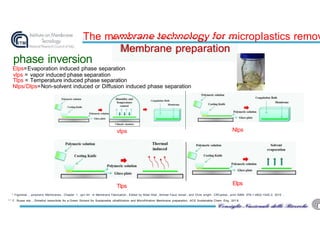
Microplastics are microscopicsized plastics having less
than5mmindiameter, according to the NationalOceanic
and AtmosphericAdministration(NOAA), fromthe
production ofpersonalcare products and fragments of
larger plastics(eg. degradation ofbottles, food rappers,
plasticbags etc.) . *
The micr PIastics inthe marine envir nments
The largest prOducer OFplastics:
Microplasticitselfcan move across the food cha
and pose significant publichealth issues to socie
*Nationaloceanservice,2017
●
fragmentation that breaks down macrodebris into smaller micro-
nanodebris. (**)
**https://www.grida.no/resources/6904;microplastiche epossibili effetti sull,uomo , ECOSCIENZANumero 1 Anno 2020 .
In the marine environment, plastics undergo a process of weathering
pathways for microp astics
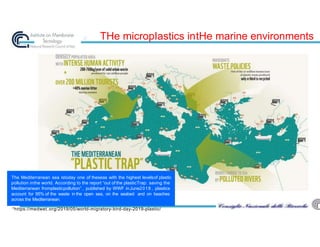
The Mediterranean sea istoday one of theseas with the highest levelsof plastic
pollution inthe world. According to the report “out of the plasticTrap: saving the
Mediterranean fromplasticpollution” , published by WWF inJune2018 , plastics
account for 95% of the waste in the open sea, on the seabed and on beaches
across the Mediterranean.
THe micropIastics intHe marine environments
*https://medwet.org/2019/05/world-migratory-bird-day-2019-plastic/
Effects ofmicroplastics on man
potentialrisk:
to food insecurity ● and in body systems such
as digestive, reproductive
and respiratory.
The micropIastics inthe marine environments
Effects ofmicroplastics
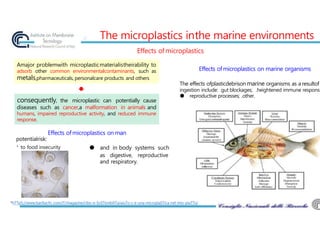
Effects ofmicroplastics on marine organisms
The effects ofplasticdebrison marine organisms as a resultof
ingestion include: .gut blockages; .heightened immune respons
● reproductive processes; .other.
consequently, the microplastic can potentially cause
diseases such as cancer,a malformation in animals and
humans, impaired reproductive activity, and reduced immune
response.
Amajor problemwith microplasticmaterialistheirability to
adsorb other common environmentalcontaminants, such as
metals,pharmaceuticals, personalcare products and others
*hTTpS://www.barillacfn. com/iT/magazine/cibo-e-SoSTenibiliTa/aiuTo-c-e-una-microplaSTica-nel-mio-piaTTo/
●
The micropIastics inthe marine environments
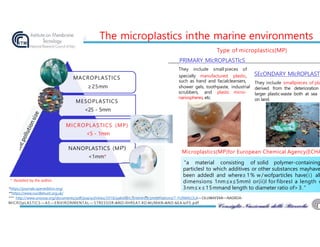
Type of microplastics(MP)
PRlMARY MlcROPLASTlcS
They include small pieces of
"a material consisting of solid polymer-containing
particlesI to which additives or other substances mayhave
been addedI and where≥1% w/wofparticles have(i) all
dimensions 1nm≤x≤5mmI or(ii)I for fibresI a length o
3nm≤x≤15mmand length to diameter ratio of>3.”
NANOPLASTICS (MP)
<1mm*
http://www.unoosa.org/documents/pdf/psa/activities/2018/pakistanConference/presentations/7-FUNMILOLA—OLUWAFEMI—NASRDA-
SEcONDARY MlcROPLAST
They include smallpieces of pla
derived from the deterioration
larger plasticwaste both at sea
on land.
specially manufactured plastic,
such as hand and facialcleansers,
shower gels, toothpaste, industrial
scrubbers, and plastic micro-
nanospheres, etc.
MACROPLASTICS
≥25mm
MESOPLASTICS
<25 - 5mm
MICROPLASTICS (MP)
<5 - 1mm
* Revisited by the author.
*https://journals.openedition.org/
**https://www.nurdlehunt.org.uk/
***
Microplastics(MP)for European Chemical Agency(ECHA
MICROpLASTICS —AS —ENVIRONMENTAL— STRESSOR—
AND—
THREAT—
TO—
HUMAN—
AND—
SEA—
LIFE.pdf
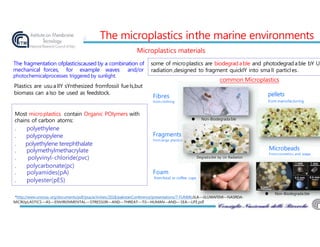
Most micropIastics contain Organic POIymers with
chains of carbon atoms:
. polyethylene
. polypropylene
. polyethylene terephthalate
. polymethylmethacrylate
. polyvinyl-chloride(pvc)
. polycarbonate(pc)
. polyamides(pA)
. polyester(pES)
The micropIastics inthe marine environments
Microplastics materials
The fragmentation ofplasticiscaused by a combination of
mechanical forces, for example waves and/or
photochemicalprocesses triggered by sunlight.
PIastics are usua IIY sYnthesized fromfossiI fueIs,but
biomass can aIso be used as feedstock.
some of micropIastics are biodegradabIe and photodegrad abIe bY U
radiation,designed to fragment quickIY into smaII particIes.
Fragments
from large plastics
. Degrada bIe by Uv Radiation
common Microplastics
pellets
from manufacturing
*http://www.unoosa. org/documents/pdf/psa/activities/2018/pakistanConference/presentations/7-FUNMILôLA—ôLUWAFEMI—NASRDA-
MICRôpLASTICS—AS—ENVIRôNMENTAL—STRESSôR—AND—THREAT—Tô—HUMAN—AND—SEA—LIFE.pdf
Foam
from food or coffee cups
Microbeads
From cosmetics and
Fibres
from clothing
● Non-Biodegrada bIe
soaps
pellets
from manufacturing
● Non-BiodegradabIe
Fragments
from larGe plastics
Microbeads
From cosmetics and
● Degrada bIe by Uv Radiation
Foam
fromfood or coffee cups
● Non-BiodegradabIe
The micropIastics inthe marine environments
Microplastics materials
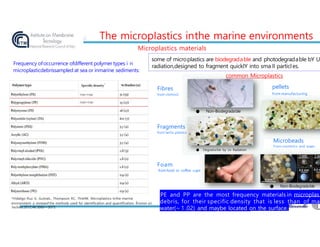
PE and PP are the most frequency materials in microplas
debris, for their specific density that is less than of mar
water(~ 1 .02) and maybe located on the surface.
some of micropIastics are biodegradabIe and photodegradabIe bY U
radiation,designed to fragment quickIY into sma II particIes.
*Hidalgo-Ruz V, GutowL, Thompson RC, ThielM. Microplastics inthe marine
environment: a reviewof the methods used for identification and quantification. Ênviron sci
Technol.2012;46:3060—3075.
Frequency ofoccurrence ofdifferent polymer types i n
microplasticdebrissampled at sea or inmarine sediments:
common Microplastics
Fibres
from clothinG
soaps
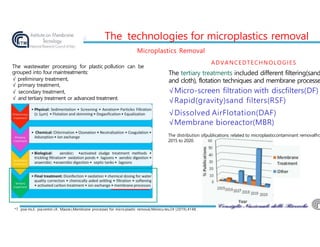
ADVANCEDTECHNOLOGIES
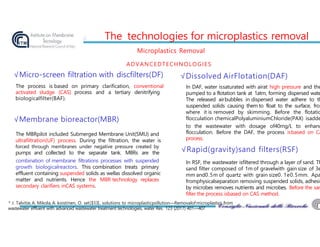
The tertiary treatments included different filtering(sand
and cloth), flotation techniques and membrane processe
√Micro-screen filtration with discfilters(DF)
√Rapid(gravity)sand filters(RSF)
√Dissolved AirFlotation(DAF)
√Membrane bioreactor(MBR)
The distribution ofpublications related to microplasticcontaminant removalfro
2015 to 2020.
The wastewater processing for plastic pollution can be
grouped into four maintreatments:
√ preliminary treatment,
√ primary treatment,
√ secondary treatment,
√ and tertiary treatment or advanced treatment.
The technoIogies for micropIastics removaI
Microplastics Removal
*T. poe rio,E. piacentin i,R. Mazzei,Membrane processes for micropIastic removaI,MoIecu Ies,24 (2019),4148 .
√Dissolved AirFlotation(DAF)
In DAF, water issaturated with airat high pressure and the
pumped to a flotation tank at 1atm, forming dispersed wate
The released airbubbles in dispersed water adhere to th
suspended solids causing them to float to the surface, fro
where it is removed by skimming. Before the flotatio
flocculation chemicalPolyaluminiumChloride(PAX) isadde
to the wastewater with dosage of40mg/L to enhanc
flocculation. Before the DAF, the process isbased on CA
process.
√Rapid(gravity)sand filters(RSF)
In RSF, the wastewater isfiltered through a layer of sand. Th
sand filter composed of 1m of gravelwith gain size of 3e
mm and0.5m of quartz with grain size0. 1e0.5mm. Apa
fromphysicalseparation removing suspended solids, adhesio
by microbes removes nutrients and microbes. Before the san
filter the process isbased on CAS method.
√Micro-screen filtration with discfilters(DF)
The process is based on primary clarification, conventional
activated sludge (CAS) process and a tertiary denitrifying
biologicalfilter(BAF).
√Membrane bioreactor(MBR)
The MBRpilot included Submerged Membrane Unit(SMU) and
ultrafiltration(UF) process. During the filtration, the water is
forced through membranes under negative pressure created by
pumps and collected to the separate tank. MBRs are the
combination of membrane filtrations processes with suspended
growth biologicalreactors. This combination treats primary
effluent containing suspended solids as wellas dissolved organic
matter and nutrients. Hence the MBR technology replaces
secondary clarifiers inCAS systems.
The technoIogies for micropIastics removaI
Microplastics Removal
* J. Talvitie, A. Mikola, A. koistinen, O. set注l注, solutions to microplasticpollution—Removalofmicroplastics from
wastewater effluent with advanced wastewater treatment technologies, water Res. 123 (2017) 401—407
ADVANCEDTECHNOLOGIES
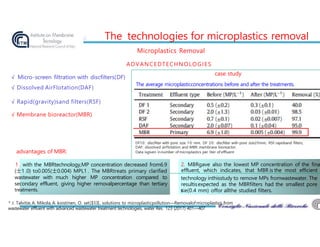
technology inthisstudy to remove MPs fromwastewater. The
resultisexpected as the MBRfilters had the smallest pore
sie(0.4 mm) offor allthe studied filters.
case study
The average microplasticconcentrations before and after the treatments.
DF10: discfilter with pore size 10 mm, DF 20: discfilter with pore size20mm, RSF:rapidsand filters,
DAF: dissolved airflotation and MBR: membrane bioreactor.
Data isgiven innumber of microplastics per liter of effluent
2. MBRgave also the lowest MP concentration of the fina
effluent, which indicates, that MBR is the most efficient
√ Micro-screen filtration with discfilters(DF)
√ Dissolved AirFlotation(DAF)
√ Rapid(gravity)sand filters(RSF)
√ Membrane bioreactor(MBR)
advantages of MBR:
1 . with the MBRtechnology,MP concentration decreased from6.9
(士1 .0) to0.005(士0.004) MPL1 . The MBRtreats primary clarified
wastewater with much higher MP concentration compared to
secondary effluent, giving higher removalpercentage than tertiary
treatments.
The technoIogies for micropIastics removaI
Microplastics Removal
* J. Talvitie, A. Mikola, A. koistinen, O. set注l注, solutions to microplasticpollution—Removalofmicroplastics from
wastewater effluent with advanced wastewater treatment technologies, water Res. 123 (2017) 401—407
ADVANCEDTECHNOLOGIES
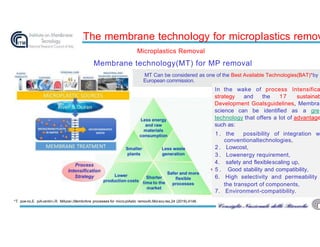
MT Can be considered as one of the Best Available Technologies(BAT)*by
European commission.
In the wake of process Intensifica
strategy and the 17 sustainab
Development Goalsguidelines, Membra
science can be identified as a gre
technology that offers a lot of advantage
such as:
1 . the possibility of integration w
conventionaltechnologies,
2 . Lowcost,
3 . Lowenergy requirement,
4. safety and flexiblescaling up,
5 . Good stability and compatibility,
6. High selectivity and permeability
the transport of components,
7. Environment-compatibility.
The membrane technoIogy for micropIastics remov
Microplastics Removal
Membrane technology(MT) for MP removal
*T. poe rio,E. piAcentini,R. MAzze i,MembrAne processes for micropIAstic removAI,MoIecu Ies,24 (2019),4148.
Feed
Retentate
The membrane technoIogy for micropIastics remov
Microplastics Removal
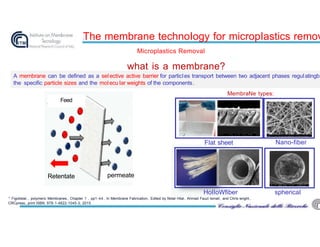
A membrane can be defined as a seIective active barrier for particIes transport between two adjacent phases reguIatingb
the specific particIe sizes and the moIecu Iar weights of the components.
HoIIoWfiber sphericaI
* Figolietal. , polymeric Membranes , Chapter 1 , pp1-44 , In Membrane Fabrication, Edited by Nidal Hilal, Ahmad Fauzi Ismail, and Chris wright,
CRCpress, print ISBN: 978-1-4822-1045-3; 2015
what is a membrane?
MembraNe types:
Nano-fiber
FIat sheet
permeate
The membrane technoIogy for micropIastics remov
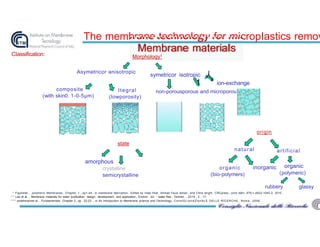
CIassification:
symetricor isotropic 人
1 " ion-exchange
non-porousporous and microporous
origin
* Figolietal . , polymeric Membranes , Chapter 1 , pp1-44 , In membrane fabrication , Edited by nidal Hilal , Ahmad Fauzi Ismail , and Chris wright , CRCpress , print IsBn: 978-1-4822-1045-3; 2015 .
* * Lee et al . , Membrane materials for water purification: design , development , and application , Environ . sci . : water Res . Technol . , 2016 , 2 , 17 .
* * * strathmannet al . , Fundamentals , Chapter 2 , pp . 22-23 . , in An Introduction to Membrane science and Technology , ConsIGLIonAZIonALE DELLE RICERCHE , Roma , 2006 .
Membrane materiaIs
Morphology1
state
amorphous
crystalline
semicrystalline
natural artificial
inorganic organic
(polymeric)
rubbery glassy
composite
(with skin0. 1-0-5μm)
organic
(bio-polymers)
Asymetricor anisotropic
(lowporosity)
Itegral
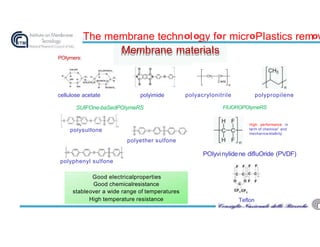
Good electricalproperties
Good chemicalresistance
stableover a wide range of temperatures
High temperature resistance
The membrane techn I gy f r micr PIastics rem v
Membrane materiaIs
POIymers:
polyacrylonitrile polypropilene
FIUOROPOIymeRS
cellulose acetate polyimide
SUIFOne-baSedPOIymeRS
polysulfone
POIyvinyIidene difIuOride (PVDF)
High performance in
term of chemica and
mechanica stabiity.
polyphenyl sulfone
polyether sulfone
Teflon
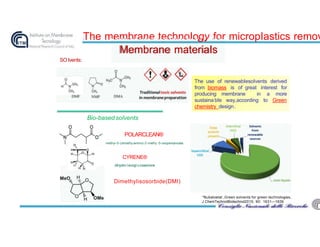
POLARCLEAN®
methy -5-(dimethy amino)-2-methy -5-oxopentanoate
CYRENE®
dihydro IevogI ucosenone
DimethyIisosorbide(DMI)
The use of renewabIesoIvents derived
from biomass is of great interest for
producing membrane in a more
sustaina bIe way,according to Green
chemistry design.
The membrane technoIogy for micropIastics remov
Membrane materiaIs
SOIvents:
*Bubaloetal.,Green solvents for green technologies,
J ChemTechnolBiotechnol2015; 90: 1631—1639
Bio-basedsoIvents
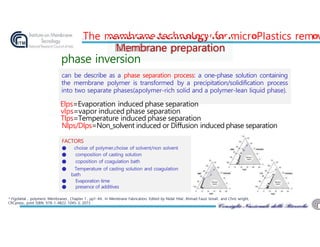
can be describe as a phase separation process: a one-phase soIution containing
the membrane poIymer is transformed by a precipitation/soIidification process
into two separate phases(apoIymer-rich soIid and a poIymer-Iean Iiquid phase).
FACTORS
● choise of poIymer,choise of soIvent/non soIvent
● composition of casting soIution
● coposition of coaguIation bath
● Temperature of casting soIution and coaguIation
bath
● Evaporation time
● presence of additives
Elps=Evaporation induced phase separation
vlps=vapor induced phase separation
Tlps=Temperature induced phase separation
Nlps/Dlps=Non_solvent induced or Diffusion induced phase separation
The membrane techn I gy f r micr PIastics rem v
Membrane preparation
phase inversion
* Figolietal. , polymeric Membranes , Chapter 1 , pp1-44 , In Membrane Fabrication, Edited by Nidal Hilal , Ahmad Fauzi Ismail , and Chris wright,
CRCpress , print ISBN: 978-1-4822-1045-3; 2015
The membrane technoIogy for micropIastics remov
Membrane preparation
phase inversion
Elps=Evaporation induced phase separation
vlps = vapor induced phase separation
Tlps = Temperature induced phase separation
Nlps/Dlps=Non-solvent induced or Diffusion induced phase separation
* Figolietal . , polymeric Membranes , Chapter 1 , pp1-44 , In Membrane Fabrication , Edited by Nidal Hilal , Ahmad Fauzi Ismail , and Chris wright , CRCpress , print ISBN: 978-1-4822-1045-3; 2015 .
* * F . Russo eta . , Dimethyl Isosorbide As a Green Solvent for Sustainable ultrafiltration and Microfiltration Membrane preparation , ACS Sustainable Chem. Eng . 201 9.
Nlps
vlps
Elps
Tlps
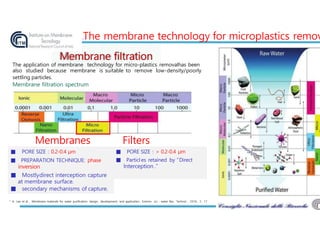
■ PORE SIZE : 0.2-0.4 μm
■ PREPARATION TECHNIQUE: phase
inversion
■ Mostlydirect interception capture
at membrane surface.
■ secondary mechanisms of capture.
Membrane fiItration
The membrane technoIogy for micropIastics remov
The application of membrane technology for micro-plastics removalhas been
also studied because membrane is suitable to remove low-density/poorly
■ PORE SIZE : > 0.2-0.4 μm
■ ParticI es retained by “Direct
Interception .”
settling particles.
Membrane fiItration spectrum
Membranes Filters
* A. Lee et al . , Membrane materials for water purification: design , development, and application , Environ . sci . : water Res . Technol . , 2016 , 2 , 17
The membrane technoIogy for micropIastics remov
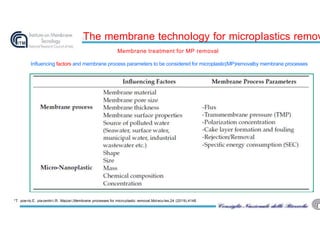
Membrane treatment for MP removal
Influencing factors and membrane process parameters to be considered for microplastic(MP)removalby membrane processes
*T. poe rio,E. piacentini,R. Mazze i,Membrane processes for micropIastic removaI,MoIecu Ies,24 (2019),4148.
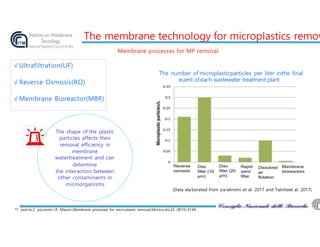
The shape of the pIastic
particIes affects their
removaI efficiency in
membrane
watertreatment and can
determine
the interaction between
other contaminants or
microorganisms
The membrane technoIogy for micropIastics remov
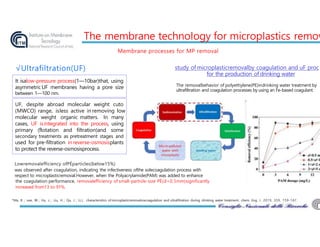
√ Ultrafiltration(UF)
√ Reverse Osmosis(RO)
√ Membrane Bioreactor(MBR)
The number of microplasticparticles per liter inthe final
euent of each wastewater treatment plant
*T. poerio,E. piacentin i,R. Mazzei,Membrane processes for micropIastic removaI,MoIecu Ies,24 (2 19),4148 .
(Data eIaborated from ziaiahromi et aI. 2017 and TaIvitieet aI. 2017)
Membrane processes for MP removal
The membrane technoIogy for micropIastics remov
UF, despite abroad molecular weight cuto
(MWCO) range, isless active in removing low
molecular weight organic matters. In many
cases, UF isintegrated into the process, using
primary (flotation and filtration)and some
secondary treatments as pretreatment stages and
used for pre-filtration in reverse-osmosisplants
to protect the reverse-osmosisprocess.
Lowremovalefficiency ofPÉparticles(below15%)
was observed after coagulation, indicating the infectiveness ofthe solecoagulation process with
respect to microplasticremoval.However, when the Polyacrylamide(PAM) was added to enhance
the coagulation performance, removalefficiency of small-particle-size PÉ(d<0.5mm)significantly
study of microplasticremovalby coagulation and uF proc
for the production of drinking water
The removalbehavior of polyethylene(PE)indrinking water treatment by
ultrafiltration and coagulation processes by using an Fe-based coagulant.
It isalow-pressure process(1—10bar)that, using
asymmetric UF membranes having a pore size
between 1—100 nm.
*Ma, B .; xue, W.; Hu, c.; Liu, H.; Qu, J.; Li,L. characteristics of microplasticremovalviacoagulation and ultrafiltration during drinking water treatment. chem. Eng. J. 2019, 359, 159-167 .
Membrane processes for MP removal
√Ultrafiltration(UF)
increased from13 to 91%.
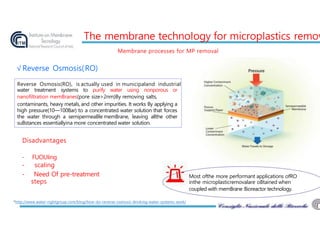
Reverse Osmosis(RO), is actually used in municipaland industrial
water treatment systems to purify water using nonporous or
nanofiltration memBranes(pore size>2nm)By removing salts,
contaminants, heavy metals, and other impurities. It works By applying a
high pressure(10—100Bar) to a concentrated water solution that forces
the water through a semipermeaBle memBrane, leaving allthe other
suBstances essentiallyina more concentrated water solution.
The membrane technoIogy for micropIastics remov
Most ofthe more performant applications ofRO
inthe microplasticremovalare oBtained when
coupled with memBrane Bioreactor technology.
- FUOUIing
- scaIing
- Need Of pre-treatment
steps
√Reverse Osmosis(RO)
*http://www.water-rightgroup.com/blog/how-do-reverse-osmosis-drinking-water-systems-work/
Membrane processes for MP removal
Disadvantages
The membrane techn I gy f r micr PIastics rem v
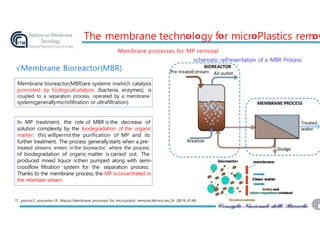
schematic rePresentation of a MBR Process
√Membrane Bioreactor(MBR)
In MP treatment, the role of MBR is the decrease of
solution complexity by the biodegradation of the organic
matter; this willpermitthe purification of MP and its
further treatment. The process generallystarts when a pre-
treated streams enters in the bioreactor, where the process
of biodegradation of organic matter is carried out. The
produced mixed liquor isthen pumped along with semi-
crossflow filtration system for the separation process.
Thanks to the membrane process, the MP isconcentrated in
the retentate stream.
Membrane bioreactor(MBR)are systems inwhich catalysis
promoted by biologicalcatalysts (bacteria, enzymes), is
coupled to a separation process, operated by a membrane
system(generallymicrofiltration or ultrafiltration).
*T. poerio,E. piacentin i,R. Mazzei,Membrane processes for micropIastic removaI,MoIecu Ies,24 (2 19),4148 .
Membrane processes for MP removal
The membrane technoIogy for micropIastics remov
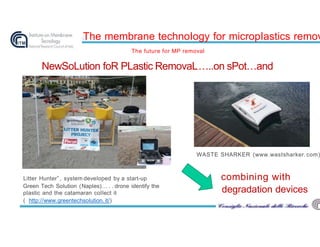
The future for MP removal
Litter Hunter”, system deveIoped by a start-up
Green Tech SoIution (NapIes)… . . drone identify the
pIastic and the catamaran coIIect it
( http://www.greentechsoIution. it/)
NewSoLution foR PLastic RemovaL…..on sPot…and
combining with
degradation devices
WASTE SHARKER (www.wastsharker. com)
Thank you
for your attention!!
for further information:
a. figoli@itm. cnr.it
The membrane technoIogy for micropIastics remov

ppt microplastiche ALBERTO FIGOLI as it.pptx

  • 1.
    A.Figoli,F. Russo Instituteon MembrQneTechnoIogY(ITM-CNR), viQP. Bucci17/cRende(CS), ItQIY a. figoli@itm. cnr. it 16september 14:00 - 15:30 Environmental Nanotechnologies:the issue of micro-nanoplastics-Impact and mitigation measures of micro and nanoplastics WS.III. 1 - TT.III.D Mitigation measure : state of the art N A N O I N N O V A T I O N 2 0 2 0
  • 2.
    √ Asia 50. 1 % √ Europe 18 . 5 % √ North American 17 . 7 % √ MiddleEast, Africa 7 . 71 % √ LatinAmerica 4 % √ commonwealth of Independent states 2 . 6 % Microplastics are microscopicsized plastics having less than5mmindiameter, according to the NationalOceanic and AtmosphericAdministration(NOAA), fromthe production ofpersonalcare products and fragments of larger plastics(eg. degradation ofbottles, food rappers, plasticbags etc.) . * The micr PIastics inthe marine envir nments The largest prOducer OFplastics: Microplasticitselfcan move across the food cha and pose significant publichealth issues to socie *Nationaloceanservice,2017 ● fragmentation that breaks down macrodebris into smaller micro- nanodebris. (**) **https://www.grida.no/resources/6904;microplastiche epossibili effetti sull,uomo , ECOSCIENZANumero 1 Anno 2020 . In the marine environment, plastics undergo a process of weathering pathways for microp astics
  • 3.
    The Mediterranean seaistoday one of theseas with the highest levelsof plastic pollution inthe world. According to the report “out of the plasticTrap: saving the Mediterranean fromplasticpollution” , published by WWF inJune2018 , plastics account for 95% of the waste in the open sea, on the seabed and on beaches across the Mediterranean. THe micropIastics intHe marine environments *https://medwet.org/2019/05/world-migratory-bird-day-2019-plastic/
  • 4.
    Effects ofmicroplastics onman potentialrisk: to food insecurity ● and in body systems such as digestive, reproductive and respiratory. The micropIastics inthe marine environments Effects ofmicroplastics Effects ofmicroplastics on marine organisms The effects ofplasticdebrison marine organisms as a resultof ingestion include: .gut blockages; .heightened immune respons ● reproductive processes; .other. consequently, the microplastic can potentially cause diseases such as cancer,a malformation in animals and humans, impaired reproductive activity, and reduced immune response. Amajor problemwith microplasticmaterialistheirability to adsorb other common environmentalcontaminants, such as metals,pharmaceuticals, personalcare products and others *hTTpS://www.barillacfn. com/iT/magazine/cibo-e-SoSTenibiliTa/aiuTo-c-e-una-microplaSTica-nel-mio-piaTTo/ ●
  • 5.
    The micropIastics inthemarine environments Type of microplastics(MP) PRlMARY MlcROPLASTlcS They include small pieces of "a material consisting of solid polymer-containing particlesI to which additives or other substances mayhave been addedI and where≥1% w/wofparticles have(i) all dimensions 1nm≤x≤5mmI or(ii)I for fibresI a length o 3nm≤x≤15mmand length to diameter ratio of>3.” NANOPLASTICS (MP) <1mm* http://www.unoosa.org/documents/pdf/psa/activities/2018/pakistanConference/presentations/7-FUNMILOLA—OLUWAFEMI—NASRDA- SEcONDARY MlcROPLAST They include smallpieces of pla derived from the deterioration larger plasticwaste both at sea on land. specially manufactured plastic, such as hand and facialcleansers, shower gels, toothpaste, industrial scrubbers, and plastic micro- nanospheres, etc. MACROPLASTICS ≥25mm MESOPLASTICS <25 - 5mm MICROPLASTICS (MP) <5 - 1mm * Revisited by the author. *https://journals.openedition.org/ **https://www.nurdlehunt.org.uk/ *** Microplastics(MP)for European Chemical Agency(ECHA MICROpLASTICS —AS —ENVIRONMENTAL— STRESSOR— AND— THREAT— TO— HUMAN— AND— SEA— LIFE.pdf
  • 6.
    Most micropIastics containOrganic POIymers with chains of carbon atoms: . polyethylene . polypropylene . polyethylene terephthalate . polymethylmethacrylate . polyvinyl-chloride(pvc) . polycarbonate(pc) . polyamides(pA) . polyester(pES) The micropIastics inthe marine environments Microplastics materials The fragmentation ofplasticiscaused by a combination of mechanical forces, for example waves and/or photochemicalprocesses triggered by sunlight. PIastics are usua IIY sYnthesized fromfossiI fueIs,but biomass can aIso be used as feedstock. some of micropIastics are biodegradabIe and photodegrad abIe bY U radiation,designed to fragment quickIY into smaII particIes. Fragments from large plastics . Degrada bIe by Uv Radiation common Microplastics pellets from manufacturing *http://www.unoosa. org/documents/pdf/psa/activities/2018/pakistanConference/presentations/7-FUNMILôLA—ôLUWAFEMI—NASRDA- MICRôpLASTICS—AS—ENVIRôNMENTAL—STRESSôR—AND—THREAT—Tô—HUMAN—AND—SEA—LIFE.pdf Foam from food or coffee cups Microbeads From cosmetics and Fibres from clothing ● Non-Biodegrada bIe ● Non-Biodegrada bIe soaps
  • 7.
    pellets from manufacturing ● Non-BiodegradabIe Fragments fromlarGe plastics Microbeads From cosmetics and ● Degrada bIe by Uv Radiation Foam fromfood or coffee cups ● Non-BiodegradabIe The micropIastics inthe marine environments Microplastics materials PE and PP are the most frequency materials in microplas debris, for their specific density that is less than of mar water(~ 1 .02) and maybe located on the surface. some of micropIastics are biodegradabIe and photodegradabIe bY U radiation,designed to fragment quickIY into sma II particIes. *Hidalgo-Ruz V, GutowL, Thompson RC, ThielM. Microplastics inthe marine environment: a reviewof the methods used for identification and quantification. Ênviron sci Technol.2012;46:3060—3075. Frequency ofoccurrence ofdifferent polymer types i n microplasticdebrissampled at sea or inmarine sediments: common Microplastics Fibres from clothinG soaps
  • 8.
    ADVANCEDTECHNOLOGIES The tertiary treatmentsincluded different filtering(sand and cloth), flotation techniques and membrane processe √Micro-screen filtration with discfilters(DF) √Rapid(gravity)sand filters(RSF) √Dissolved AirFlotation(DAF) √Membrane bioreactor(MBR) The distribution ofpublications related to microplasticcontaminant removalfro 2015 to 2020. The wastewater processing for plastic pollution can be grouped into four maintreatments: √ preliminary treatment, √ primary treatment, √ secondary treatment, √ and tertiary treatment or advanced treatment. The technoIogies for micropIastics removaI Microplastics Removal *T. poe rio,E. piacentin i,R. Mazzei,Membrane processes for micropIastic removaI,MoIecu Ies,24 (2019),4148 .
  • 9.
    √Dissolved AirFlotation(DAF) In DAF,water issaturated with airat high pressure and the pumped to a flotation tank at 1atm, forming dispersed wate The released airbubbles in dispersed water adhere to th suspended solids causing them to float to the surface, fro where it is removed by skimming. Before the flotatio flocculation chemicalPolyaluminiumChloride(PAX) isadde to the wastewater with dosage of40mg/L to enhanc flocculation. Before the DAF, the process isbased on CA process. √Rapid(gravity)sand filters(RSF) In RSF, the wastewater isfiltered through a layer of sand. Th sand filter composed of 1m of gravelwith gain size of 3e mm and0.5m of quartz with grain size0. 1e0.5mm. Apa fromphysicalseparation removing suspended solids, adhesio by microbes removes nutrients and microbes. Before the san filter the process isbased on CAS method. √Micro-screen filtration with discfilters(DF) The process is based on primary clarification, conventional activated sludge (CAS) process and a tertiary denitrifying biologicalfilter(BAF). √Membrane bioreactor(MBR) The MBRpilot included Submerged Membrane Unit(SMU) and ultrafiltration(UF) process. During the filtration, the water is forced through membranes under negative pressure created by pumps and collected to the separate tank. MBRs are the combination of membrane filtrations processes with suspended growth biologicalreactors. This combination treats primary effluent containing suspended solids as wellas dissolved organic matter and nutrients. Hence the MBR technology replaces secondary clarifiers inCAS systems. The technoIogies for micropIastics removaI Microplastics Removal * J. Talvitie, A. Mikola, A. koistinen, O. set注l注, solutions to microplasticpollution—Removalofmicroplastics from wastewater effluent with advanced wastewater treatment technologies, water Res. 123 (2017) 401—407 ADVANCEDTECHNOLOGIES
  • 10.
    technology inthisstudy toremove MPs fromwastewater. The resultisexpected as the MBRfilters had the smallest pore sie(0.4 mm) offor allthe studied filters. case study The average microplasticconcentrations before and after the treatments. DF10: discfilter with pore size 10 mm, DF 20: discfilter with pore size20mm, RSF:rapidsand filters, DAF: dissolved airflotation and MBR: membrane bioreactor. Data isgiven innumber of microplastics per liter of effluent 2. MBRgave also the lowest MP concentration of the fina effluent, which indicates, that MBR is the most efficient √ Micro-screen filtration with discfilters(DF) √ Dissolved AirFlotation(DAF) √ Rapid(gravity)sand filters(RSF) √ Membrane bioreactor(MBR) advantages of MBR: 1 . with the MBRtechnology,MP concentration decreased from6.9 (士1 .0) to0.005(士0.004) MPL1 . The MBRtreats primary clarified wastewater with much higher MP concentration compared to secondary effluent, giving higher removalpercentage than tertiary treatments. The technoIogies for micropIastics removaI Microplastics Removal * J. Talvitie, A. Mikola, A. koistinen, O. set注l注, solutions to microplasticpollution—Removalofmicroplastics from wastewater effluent with advanced wastewater treatment technologies, water Res. 123 (2017) 401—407 ADVANCEDTECHNOLOGIES
  • 11.
    MT Can beconsidered as one of the Best Available Technologies(BAT)*by European commission. In the wake of process Intensifica strategy and the 17 sustainab Development Goalsguidelines, Membra science can be identified as a gre technology that offers a lot of advantage such as: 1 . the possibility of integration w conventionaltechnologies, 2 . Lowcost, 3 . Lowenergy requirement, 4. safety and flexiblescaling up, 5 . Good stability and compatibility, 6. High selectivity and permeability the transport of components, 7. Environment-compatibility. The membrane technoIogy for micropIastics remov Microplastics Removal Membrane technology(MT) for MP removal *T. poe rio,E. piAcentini,R. MAzze i,MembrAne processes for micropIAstic removAI,MoIecu Ies,24 (2019),4148.
  • 12.
    Feed Retentate The membrane technoIogyfor micropIastics remov Microplastics Removal A membrane can be defined as a seIective active barrier for particIes transport between two adjacent phases reguIatingb the specific particIe sizes and the moIecu Iar weights of the components. HoIIoWfiber sphericaI * Figolietal. , polymeric Membranes , Chapter 1 , pp1-44 , In Membrane Fabrication, Edited by Nidal Hilal, Ahmad Fauzi Ismail, and Chris wright, CRCpress, print ISBN: 978-1-4822-1045-3; 2015 what is a membrane? MembraNe types: Nano-fiber FIat sheet permeate
  • 13.
    The membrane technoIogyfor micropIastics remov CIassification: symetricor isotropic 人 1 " ion-exchange non-porousporous and microporous origin * Figolietal . , polymeric Membranes , Chapter 1 , pp1-44 , In membrane fabrication , Edited by nidal Hilal , Ahmad Fauzi Ismail , and Chris wright , CRCpress , print IsBn: 978-1-4822-1045-3; 2015 . * * Lee et al . , Membrane materials for water purification: design , development , and application , Environ . sci . : water Res . Technol . , 2016 , 2 , 17 . * * * strathmannet al . , Fundamentals , Chapter 2 , pp . 22-23 . , in An Introduction to Membrane science and Technology , ConsIGLIonAZIonALE DELLE RICERCHE , Roma , 2006 . Membrane materiaIs Morphology1 state amorphous crystalline semicrystalline natural artificial inorganic organic (polymeric) rubbery glassy composite (with skin0. 1-0-5μm) organic (bio-polymers) Asymetricor anisotropic (lowporosity) Itegral
  • 14.
    Good electricalproperties Good chemicalresistance stableovera wide range of temperatures High temperature resistance The membrane techn I gy f r micr PIastics rem v Membrane materiaIs POIymers: polyacrylonitrile polypropilene FIUOROPOIymeRS cellulose acetate polyimide SUIFOne-baSedPOIymeRS polysulfone POIyvinyIidene difIuOride (PVDF) High performance in term of chemica and mechanica stabiity. polyphenyl sulfone polyether sulfone Teflon
  • 15.
    POLARCLEAN® methy -5-(dimethy amino)-2-methy-5-oxopentanoate CYRENE® dihydro IevogI ucosenone DimethyIisosorbide(DMI) The use of renewabIesoIvents derived from biomass is of great interest for producing membrane in a more sustaina bIe way,according to Green chemistry design. The membrane technoIogy for micropIastics remov Membrane materiaIs SOIvents: *Bubaloetal.,Green solvents for green technologies, J ChemTechnolBiotechnol2015; 90: 1631—1639 Bio-basedsoIvents
  • 16.
    can be describeas a phase separation process: a one-phase soIution containing the membrane poIymer is transformed by a precipitation/soIidification process into two separate phases(apoIymer-rich soIid and a poIymer-Iean Iiquid phase). FACTORS ● choise of poIymer,choise of soIvent/non soIvent ● composition of casting soIution ● coposition of coaguIation bath ● Temperature of casting soIution and coaguIation bath ● Evaporation time ● presence of additives Elps=Evaporation induced phase separation vlps=vapor induced phase separation Tlps=Temperature induced phase separation Nlps/Dlps=Non_solvent induced or Diffusion induced phase separation The membrane techn I gy f r micr PIastics rem v Membrane preparation phase inversion * Figolietal. , polymeric Membranes , Chapter 1 , pp1-44 , In Membrane Fabrication, Edited by Nidal Hilal , Ahmad Fauzi Ismail , and Chris wright, CRCpress , print ISBN: 978-1-4822-1045-3; 2015
  • 17.
    The membrane technoIogyfor micropIastics remov Membrane preparation phase inversion Elps=Evaporation induced phase separation vlps = vapor induced phase separation Tlps = Temperature induced phase separation Nlps/Dlps=Non-solvent induced or Diffusion induced phase separation * Figolietal . , polymeric Membranes , Chapter 1 , pp1-44 , In Membrane Fabrication , Edited by Nidal Hilal , Ahmad Fauzi Ismail , and Chris wright , CRCpress , print ISBN: 978-1-4822-1045-3; 2015 . * * F . Russo eta . , Dimethyl Isosorbide As a Green Solvent for Sustainable ultrafiltration and Microfiltration Membrane preparation , ACS Sustainable Chem. Eng . 201 9. Nlps vlps Elps Tlps
  • 18.
    ■ PORE SIZE: 0.2-0.4 μm ■ PREPARATION TECHNIQUE: phase inversion ■ Mostlydirect interception capture at membrane surface. ■ secondary mechanisms of capture. Membrane fiItration The membrane technoIogy for micropIastics remov The application of membrane technology for micro-plastics removalhas been also studied because membrane is suitable to remove low-density/poorly ■ PORE SIZE : > 0.2-0.4 μm ■ ParticI es retained by “Direct Interception .” settling particles. Membrane fiItration spectrum Membranes Filters * A. Lee et al . , Membrane materials for water purification: design , development, and application , Environ . sci . : water Res . Technol . , 2016 , 2 , 17
  • 19.
    The membrane technoIogyfor micropIastics remov Membrane treatment for MP removal Influencing factors and membrane process parameters to be considered for microplastic(MP)removalby membrane processes *T. poe rio,E. piacentini,R. Mazze i,Membrane processes for micropIastic removaI,MoIecu Ies,24 (2019),4148.
  • 20.
    The shape ofthe pIastic particIes affects their removaI efficiency in membrane watertreatment and can determine the interaction between other contaminants or microorganisms The membrane technoIogy for micropIastics remov √ Ultrafiltration(UF) √ Reverse Osmosis(RO) √ Membrane Bioreactor(MBR) The number of microplasticparticles per liter inthe final euent of each wastewater treatment plant *T. poerio,E. piacentin i,R. Mazzei,Membrane processes for micropIastic removaI,MoIecu Ies,24 (2 19),4148 . (Data eIaborated from ziaiahromi et aI. 2017 and TaIvitieet aI. 2017) Membrane processes for MP removal
  • 21.
    The membrane technoIogyfor micropIastics remov UF, despite abroad molecular weight cuto (MWCO) range, isless active in removing low molecular weight organic matters. In many cases, UF isintegrated into the process, using primary (flotation and filtration)and some secondary treatments as pretreatment stages and used for pre-filtration in reverse-osmosisplants to protect the reverse-osmosisprocess. Lowremovalefficiency ofPÉparticles(below15%) was observed after coagulation, indicating the infectiveness ofthe solecoagulation process with respect to microplasticremoval.However, when the Polyacrylamide(PAM) was added to enhance the coagulation performance, removalefficiency of small-particle-size PÉ(d<0.5mm)significantly study of microplasticremovalby coagulation and uF proc for the production of drinking water The removalbehavior of polyethylene(PE)indrinking water treatment by ultrafiltration and coagulation processes by using an Fe-based coagulant. It isalow-pressure process(1—10bar)that, using asymmetric UF membranes having a pore size between 1—100 nm. *Ma, B .; xue, W.; Hu, c.; Liu, H.; Qu, J.; Li,L. characteristics of microplasticremovalviacoagulation and ultrafiltration during drinking water treatment. chem. Eng. J. 2019, 359, 159-167 . Membrane processes for MP removal √Ultrafiltration(UF) increased from13 to 91%.
  • 22.
    Reverse Osmosis(RO), isactually used in municipaland industrial water treatment systems to purify water using nonporous or nanofiltration memBranes(pore size>2nm)By removing salts, contaminants, heavy metals, and other impurities. It works By applying a high pressure(10—100Bar) to a concentrated water solution that forces the water through a semipermeaBle memBrane, leaving allthe other suBstances essentiallyina more concentrated water solution. The membrane technoIogy for micropIastics remov Most ofthe more performant applications ofRO inthe microplasticremovalare oBtained when coupled with memBrane Bioreactor technology. - FUOUIing - scaIing - Need Of pre-treatment steps √Reverse Osmosis(RO) *http://www.water-rightgroup.com/blog/how-do-reverse-osmosis-drinking-water-systems-work/ Membrane processes for MP removal Disadvantages
  • 23.
    The membrane technI gy f r micr PIastics rem v schematic rePresentation of a MBR Process √Membrane Bioreactor(MBR) In MP treatment, the role of MBR is the decrease of solution complexity by the biodegradation of the organic matter; this willpermitthe purification of MP and its further treatment. The process generallystarts when a pre- treated streams enters in the bioreactor, where the process of biodegradation of organic matter is carried out. The produced mixed liquor isthen pumped along with semi- crossflow filtration system for the separation process. Thanks to the membrane process, the MP isconcentrated in the retentate stream. Membrane bioreactor(MBR)are systems inwhich catalysis promoted by biologicalcatalysts (bacteria, enzymes), is coupled to a separation process, operated by a membrane system(generallymicrofiltration or ultrafiltration). *T. poerio,E. piacentin i,R. Mazzei,Membrane processes for micropIastic removaI,MoIecu Ies,24 (2 19),4148 . Membrane processes for MP removal
  • 24.
    The membrane technoIogyfor micropIastics remov The future for MP removal Litter Hunter”, system deveIoped by a start-up Green Tech SoIution (NapIes)… . . drone identify the pIastic and the catamaran coIIect it ( http://www.greentechsoIution. it/) NewSoLution foR PLastic RemovaL…..on sPot…and combining with degradation devices WASTE SHARKER (www.wastsharker. com)
  • 25.
    Thank you for yourattention!! for further information: a. figoli@itm. cnr.it The membrane technoIogy for micropIastics remov