the0rie
s
Humans as cognitive
creatures
¢sgnitisns “asssciative
neaworks”
associative networks include
beliefs, attitudes, and other
cognitions
the associations are often
unconscious, implicit
changes in one belief or attitude
mayproduce a “ripple ePect”
elsewhere in one's cognitive
system
ThreeBasi
¢assumBtisnsot
csnsistencythe0rie
s
• People expect, prefer
consistency
•t• Individuals strive to maintain
psychological harmony among
their beliefs, attitudes, behaviors
Inconsistency causes
psychological discomfoL, tension
• “Dissonance” is
uncomfortable, may even
be accompanied by
physiological symptoms
• Individuals are
motivated torestore
cognitive consistency
•t• “Drive-reduction” model
•t• a form of face-saving,
identity
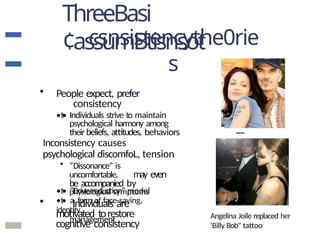
management Angelina Joile replaced her
‘Billy Bob" tattoo
• Sherman & Gorkin (1980) females who
scored high on a feminism scale tried to
solve a “sex-role” problem (which they were
set up to fail).
• A control group with similar scores on the
feminism scale completed a different task.
The failure of the treatment group to solve
theproblem induced a state of
psychological
inconsistency in the feminists.
• Both groups then read a transcript about a
sex discrimination case. Their task was
to decide who was wrong in the
case and make an award.
• What do you think happened?
ResultsstShermanxsorkin's
stuay:
• The feminists who experienced dissonance were
more Iiky
eI to find that sex discrimination had
occurred and gave much Ianer awards compared to
the control group.
• Why? Their decision helped to restore their self-
concept as feminists.
• Threats to one's self image lead to alempts to
bolster, reinforce, or reestablish the threatened
alitudes.
ReVision
s
00nsislen0ythe0riss
° More recently, consistency has also been viewed as
socially motivated
° the appearance of consistency matters to us
° Individuals can tolerate a ce8ain amount of
inconsistency ' especially if core beliefs, attitudes
aren't involved
' examples: Log Cabin Republicans, driving an SUV
but being pro-environment, being a vegetarian, but
wearing leather shoes
• In some cases, individuals may even strive to create
inconsistency
° example dysfunctional relationships
frinHeiaer’s“BaIancetheo
n”
The “granddaddy” of all consistency
theories The most basic, simple model
Involves three cognitive elements, P,O,X:
P: Person (perceiver, selt
0: Other person
X: AVitude object (thing,
event, action)
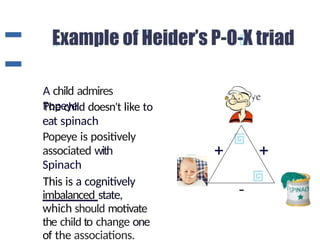
A child admires
Popeye
The child doesn't like to
eat spinach
Popeye is positively
associated with
Spinach
This is a cognitively
imbalanced state,
which should motivate
the child to change one
of the associations.
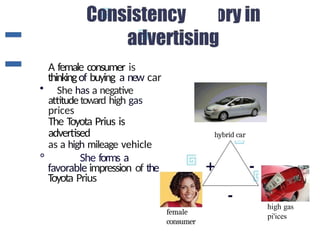
A female consumer is
thinkingof buying a new car
• She has a negative
attitudetoward high gas
prices
The Toyota Prius is
advertised
as a high mileage vehicle
° She forms a
favorable impression of the
Toyota Prius
female
consumer
hybrid car
high gas
pi'ices
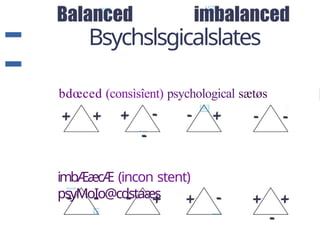
Bsychslsgicalslates
bdœced (consìsîent) psychological sætøs
imbÆæcÆ (incon stent)
psyMoIo@cdstaæs
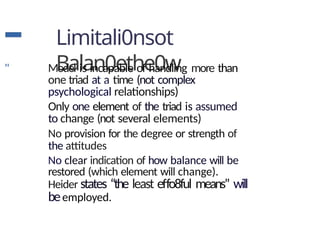
Limitali0nsot
Balan0ethe0w
" Model is incapable of handling more than
one triad at a time (not complex
psychological relationships)
Only one element of the triad is assumed
to change (not several elements)
No provision for the degree or strength of
the attitudes
No clear indication of how balance will be
restored (which element will change).
Heider states “the least effo8ful means” will
beemployed.
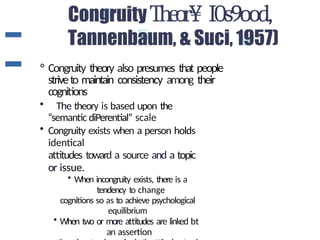
Theor¥ I0s9ood,
° Congruity theory also presumes that people
striveto maintain consistency among their
cognitions
• The theory is based upon the
“semantic diPerential” scale
• Congruity exists when a person holds
identical
attitudes toward a source and a topic
or issue.
• When incongruity exists, there is a
tendency to change
cognitions so as to achieve psychological
equilibrium
• When two or more attitudes are linked bt
an assertion
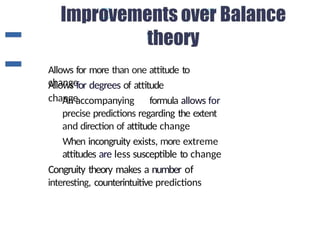
Allows for more than one attitude to
change
Allows for degrees of attitude
change
An accompanying formula allows for
precise predictions regarding the extent
and direction of attitude change
When incongruity exists, more extreme
attitudes are less susceptible to change
Congruity theory makes a number of
interesting, counterintuitive predictions
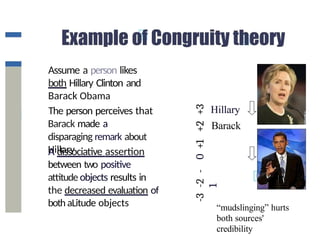
-3
-2
-
1
0
+1
+2
+3
Assume a person likes
both Hillary Clinton and
Barack Obama
The person perceives that
Barack made a
disparaging remark about
Hillary
A dissociative assertion
between two positive
attitude objects results in
the decreased evaluation of
both aLitude objects
Hillary
Barack
“mudslinging” hurts
both sources'
credibility
LimitatisnssfcsngruiWthe0w
" Model and formula only accounts
forone triad at a time.
Counterintuitive predictions
aren't always fulfilled in practice
The impo8ance and relevance of
the attitude(s) to the person is
ignored
There are other ways to achieve
congruity besides changing
evaluations of the sources or
objects
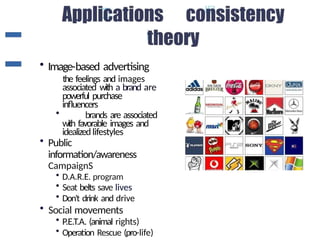
• Image-based advertising
the feelings and images
associated with a brand are
powerful purchase
influencers
• brands are associated
with favorable images and
idealizedlifestyles
• Public
information/awareness
CampaignS
• D.A.R.E. program
• Seat belts save lives
• Don't drink and drive
• Social movements
• P.E.T.A. (animal rights)
• Operation Rescue (pro-life)
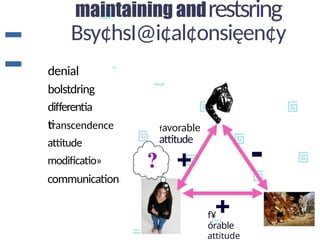
restsring
Bsy¢hsI@i¢al¢onsięen¢y
denial
bolstdring
differentia
ti
“
favorable
attitude
transcendence
attitude
modificatio»
communication
f¥
órable
attitude
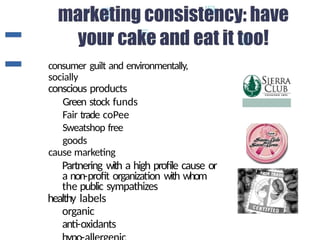
consumer guilt and environmentally,
socially
conscious products
Green stock funds
Fair trade coPee
Sweatshop free
goods
cause marketing
Partnering with a high profile cause or
a non-profit organization with whom
the public sympathizes
healthy labels
organic
anti-oxidants
inconsistencx
:
tsstering Brana-
switching
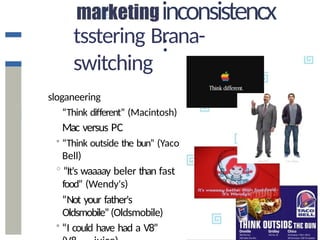
sloganeering
“Think different” (Macintosh)
Mac versus PC
• “Think outside the bun” (Yaco
Bell)
° “It's waaaay beler than fast
food” (Wendy's)
“Not your father's
Oldsmobile”(Oldsmobile)
• “I could have had a V8”
Bsy0h@0gi0aI
indansist
ency
Smoking prevetîòn pograms
tiy tr{ğrdo “glamorow
associations with smoking
Bsychêlogical
inconsislency
Cognitive Dissonance Theory
explains what happens when
an individual's beliefs,
attitudes, and/or behaviors
are incompatible
• The amount of
dissonance created
depends upon:
• How volitional the
decision is
• The importance or
consequences of the
decision
• The time, effort, or
sacrifice
involved in making the
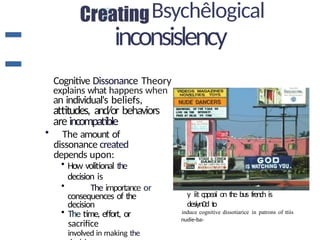
y iit cppeaî on the bus french is
desiyn0d to
induce cognitive dissotiarice in patrons of ttiis
nudie-ba›
counter-attitudinal advocacy (CAA)
advocating a position that is contras to one
s own beliefs tends to shift one's attitudes
towardthe contrary position
commitment and cognitive
dissonance
public commitments
fraternity
initiations
marriage rituals
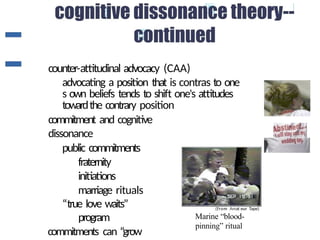
“true love waits”
program
commitments can “grow
(from Amat eur Tape)
Marine “blood-
pinning” ritual
• Free choice paradigm:
volitional behavior i
s m
o
r
e
likely t
o producedissonance
• the more free choice
one has in making a decision,
the moredissonance one will
experience.
• Belief disconfirmation:
dissonance is aroused when a
person encounters information
contrary tohis or her beliefs.
• people engage in
selective exposure to
avoid dissonantinformation
• induced comp/iance
paradigm:external
inducements, rewards reduce
dissonance
• When a person is
compelled todo something,
little dissonance is aroused
because the person can
rationalize the action by
Saying “I had no choice.”
• Effort justification.we
appreciate
things more when we work for
them
• The greater the
effort or sacrifice, the
greater thedissonance
Psych0l0gi0al
• Once people become
psychologically committed to an
idea their commitment may “grow
legs.”
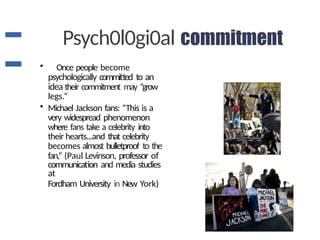
• Michael Jackson fans: “This is a
very widespread phenomenon
where fans take a celebrity into
their hearts...and that celebrity
becomes almost bulletproof to the
fan,” (Paul Levinson, professor of
communication and media studies
at
Fordham University in New York)
Psych0lêgical
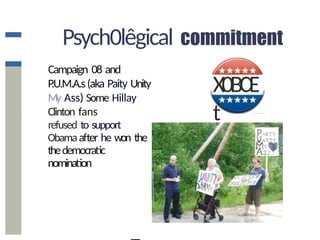
Campaign 08 and
P
.U.M.A.s(aka Paity Unity
My Ass) Some Hillay
Clinton fans
refused to support
Obamaafter he won the
thedemocratic
nomination
X0BŒ
t
Psych0l0gi0al
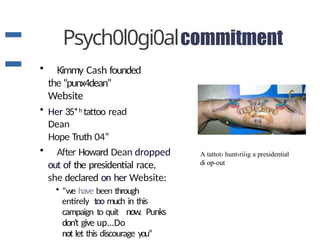
• Kimmy Cash founded
the “punx4dean”
Website
• Her 35*h tattoo read
Dean
Hope Truth 04”
• After Howard Dean dropped
out of the presidential race,
she declared on her Website:
• “we have been through
entirely too much in this
campaign to quit now. Punks
don't give up...Do
not let this discourage you”
A tattot› hunt›riiig a presidential
di op-out

PPT COgnitive Consistence.nnnnnnnnnnnpptx

  • 1.
  • 2.
    ¢sgnitisns “asssciative neaworks” associative networksinclude beliefs, attitudes, and other cognitions the associations are often unconscious, implicit changes in one belief or attitude mayproduce a “ripple ePect” elsewhere in one's cognitive system
  • 3.
    ThreeBasi ¢assumBtisnsot csnsistencythe0rie s • People expect,prefer consistency •t• Individuals strive to maintain psychological harmony among their beliefs, attitudes, behaviors Inconsistency causes psychological discomfoL, tension • “Dissonance” is uncomfortable, may even be accompanied by physiological symptoms • Individuals are motivated torestore cognitive consistency •t• “Drive-reduction” model •t• a form of face-saving, identity management Angelina Joile replaced her ‘Billy Bob" tattoo
  • 4.
    • Sherman &Gorkin (1980) females who scored high on a feminism scale tried to solve a “sex-role” problem (which they were set up to fail). • A control group with similar scores on the feminism scale completed a different task. The failure of the treatment group to solve theproblem induced a state of psychological inconsistency in the feminists. • Both groups then read a transcript about a sex discrimination case. Their task was to decide who was wrong in the case and make an award. • What do you think happened?
  • 5.
    ResultsstShermanxsorkin's stuay: • The feministswho experienced dissonance were more Iiky eI to find that sex discrimination had occurred and gave much Ianer awards compared to the control group. • Why? Their decision helped to restore their self- concept as feminists. • Threats to one's self image lead to alempts to bolster, reinforce, or reestablish the threatened alitudes.
  • 6.
    ReVision s 00nsislen0ythe0riss ° More recently,consistency has also been viewed as socially motivated ° the appearance of consistency matters to us ° Individuals can tolerate a ce8ain amount of inconsistency ' especially if core beliefs, attitudes aren't involved ' examples: Log Cabin Republicans, driving an SUV but being pro-environment, being a vegetarian, but wearing leather shoes • In some cases, individuals may even strive to create inconsistency ° example dysfunctional relationships
  • 7.
    frinHeiaer’s“BaIancetheo n” The “granddaddy” ofall consistency theories The most basic, simple model Involves three cognitive elements, P,O,X: P: Person (perceiver, selt 0: Other person X: AVitude object (thing, event, action)
  • 8.
    A child admires Popeye Thechild doesn't like to eat spinach Popeye is positively associated with Spinach This is a cognitively imbalanced state, which should motivate the child to change one of the associations.
  • 9.
    A female consumeris thinkingof buying a new car • She has a negative attitudetoward high gas prices The Toyota Prius is advertised as a high mileage vehicle ° She forms a favorable impression of the Toyota Prius female consumer hybrid car high gas pi'ices
  • 10.
    Bsychslsgicalslates bdœced (consìsîent) psychologicalsætøs imbÆæcÆ (incon stent) psyMoIo@cdstaæs
  • 11.
    Limitali0nsot Balan0ethe0w " Model isincapable of handling more than one triad at a time (not complex psychological relationships) Only one element of the triad is assumed to change (not several elements) No provision for the degree or strength of the attitudes No clear indication of how balance will be restored (which element will change). Heider states “the least effo8ful means” will beemployed.
  • 12.
    Theor¥ I0s9ood, ° Congruitytheory also presumes that people striveto maintain consistency among their cognitions • The theory is based upon the “semantic diPerential” scale • Congruity exists when a person holds identical attitudes toward a source and a topic or issue. • When incongruity exists, there is a tendency to change cognitions so as to achieve psychological equilibrium • When two or more attitudes are linked bt an assertion
  • 13.
    Allows for morethan one attitude to change Allows for degrees of attitude change An accompanying formula allows for precise predictions regarding the extent and direction of attitude change When incongruity exists, more extreme attitudes are less susceptible to change Congruity theory makes a number of interesting, counterintuitive predictions
  • 14.
    -3 -2 - 1 0 +1 +2 +3 Assume a personlikes both Hillary Clinton and Barack Obama The person perceives that Barack made a disparaging remark about Hillary A dissociative assertion between two positive attitude objects results in the decreased evaluation of both aLitude objects Hillary Barack “mudslinging” hurts both sources' credibility
  • 15.
    LimitatisnssfcsngruiWthe0w " Model andformula only accounts forone triad at a time. Counterintuitive predictions aren't always fulfilled in practice The impo8ance and relevance of the attitude(s) to the person is ignored There are other ways to achieve congruity besides changing evaluations of the sources or objects
  • 16.
    • Image-based advertising thefeelings and images associated with a brand are powerful purchase influencers • brands are associated with favorable images and idealizedlifestyles • Public information/awareness CampaignS • D.A.R.E. program • Seat belts save lives • Don't drink and drive • Social movements • P.E.T.A. (animal rights) • Operation Rescue (pro-life)
  • 17.
  • 18.
    consumer guilt andenvironmentally, socially conscious products Green stock funds Fair trade coPee Sweatshop free goods cause marketing Partnering with a high profile cause or a non-profit organization with whom the public sympathizes healthy labels organic anti-oxidants
  • 19.
    inconsistencx : tsstering Brana- switching sloganeering “Think different”(Macintosh) Mac versus PC • “Think outside the bun” (Yaco Bell) ° “It's waaaay beler than fast food” (Wendy's) “Not your father's Oldsmobile”(Oldsmobile) • “I could have had a V8”
  • 20.
    Bsy0h@0gi0aI indansist ency Smoking prevetîòn pograms tiytr{ğrdo “glamorow associations with smoking
  • 21.
    Bsychêlogical inconsislency Cognitive Dissonance Theory explainswhat happens when an individual's beliefs, attitudes, and/or behaviors are incompatible • The amount of dissonance created depends upon: • How volitional the decision is • The importance or consequences of the decision • The time, effort, or sacrifice involved in making the y iit cppeaî on the bus french is desiyn0d to induce cognitive dissotiarice in patrons of ttiis nudie-ba›
  • 22.
    counter-attitudinal advocacy (CAA) advocatinga position that is contras to one s own beliefs tends to shift one's attitudes towardthe contrary position commitment and cognitive dissonance public commitments fraternity initiations marriage rituals “true love waits” program commitments can “grow (from Amat eur Tape) Marine “blood- pinning” ritual
  • 23.
    • Free choiceparadigm: volitional behavior i s m o r e likely t o producedissonance • the more free choice one has in making a decision, the moredissonance one will experience. • Belief disconfirmation: dissonance is aroused when a person encounters information contrary tohis or her beliefs. • people engage in selective exposure to avoid dissonantinformation • induced comp/iance paradigm:external inducements, rewards reduce dissonance • When a person is compelled todo something, little dissonance is aroused because the person can rationalize the action by Saying “I had no choice.” • Effort justification.we appreciate things more when we work for them • The greater the effort or sacrifice, the greater thedissonance
  • 24.
    Psych0l0gi0al • Once peoplebecome psychologically committed to an idea their commitment may “grow legs.” • Michael Jackson fans: “This is a very widespread phenomenon where fans take a celebrity into their hearts...and that celebrity becomes almost bulletproof to the fan,” (Paul Levinson, professor of communication and media studies at Fordham University in New York)
  • 25.
    Psych0lêgical Campaign 08 and P .U.M.A.s(akaPaity Unity My Ass) Some Hillay Clinton fans refused to support Obamaafter he won the thedemocratic nomination X0BŒ t
  • 26.
    Psych0l0gi0al • Kimmy Cashfounded the “punx4dean” Website • Her 35*h tattoo read Dean Hope Truth 04” • After Howard Dean dropped out of the presidential race, she declared on her Website: • “we have been through entirely too much in this campaign to quit now. Punks don't give up...Do not let this discourage you” A tattot› hunt›riiig a presidential di op-out