Analytical
Exposition Text
Bahasa Inggris Kelas X Semester Ganjil
Mery Rahayu Ningtriyas,S.Pd
Learning
Objectives
1. Identify the social function of
Analytical Exposition Text
2. Identify the generic structure of
Analytical Exposition Text
3. Identify the language features of
Analytical Exposition Text
4. Rearrange some paragraphs into
a good analytical exposition text
5. Find detailed information in an
analytical exposition text
6. Imply the moral value of an
analytical exposition text
You will also have to develop your
critical thinking and problem solving,
creativity,collaborative and
communication skill by doing some
activities with your group
2
Hello!
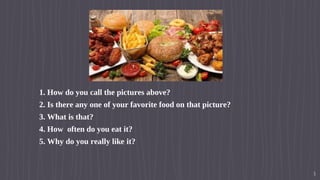
1.1. How do you call the pictures above?
2.2. Is there any one of your favorite food on that picture?
3.3. What is that?
4.4. How often do you eat it?
5.5. Why do you really like it?
3
Transition headline
Let’s start with the first set of slides
4
“
.
5
1. What do you think of the video?
2. What information did you get
from the video?
3. What diseases may you get if
you don’t stop eating junk food?
What will we
do today?
1. Work the
student’s
Worksheet
with your
group
2. Upload
it in Class
Dojo
Platform
3. Get
feedback
from the
teacher
6
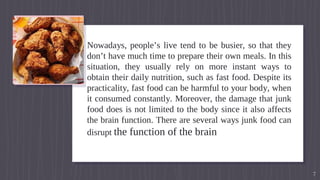
Nowadays, people’s live tend to be busier, so that they
don’t have much time to prepare their own meals. In this
situation, they usually rely on more instant ways to
obtain their daily nutrition, such as fast food. Despite its
practicality, fast food can be harmful to your body, when
it consumed constantly. Moreover, the damage that junk
food does is not limited to the body since it also affects
the brain function. There are several ways junk food can
disrupt the function of the brain
7
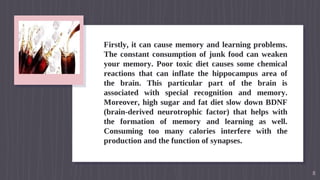
Firstly, it can cause memory and learning problems.
The constant consumption of junk food can weaken
your memory. Poor toxic diet causes some chemical
reactions that can inflate the hippocampus area of
the brain. This particular part of the brain is
associated with special recognition and memory.
Moreover, high sugar and fat diet slow down BDNF
(brain-derived neurotrophic factor) that helps with
the formation of memory and learning as well.
Consuming too many calories interfere with the
production and the function of synapses.
8
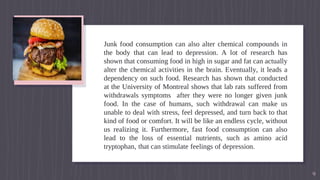
Junk food consumption can also alter chemical compounds in
the body that can lead to depression. A lot of research has
shown that consuming food in high in sugar and fat can actually
alter the chemical activities in the brain. Eventually, it leads a
dependency on such food. Research has shown that conducted
at the University of Montreal shows that lab rats suffered from
withdrawals symptoms after they were no longer given junk
food. In the case of humans, such withdrawal can make us
unable to deal with stress, feel depressed, and turn back to that
kind of food or comfort. It will be like an endless cycle, without
us realizing it. Furthermore, fast food consumption can also
lead to the loss of essential nutrients, such as amino acid
tryptophan, that can stimulate feelings of depression.
9
In conclusion, the consumption of junk
food can affect the body’s health,
including the brain. Eating junk food can
cause memory and learning problems, and
it can also lead to depression
10
Activity 1
1. According to the text, what causes
people to choose junk food over self
prepared meals?
2. How can junk food lead to memory
loss?
3. What does BDNF do?
11
Answer the question based on the text above
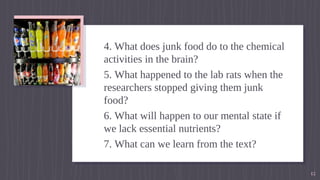
4. What does junk food do to the chemical
activities in the brain?
5. What happened to the lab rats when the
researchers stopped giving them junk
food?
6. What will happen to our mental state if
we lack essential nutrients?
7. What can we learn from the text?
12
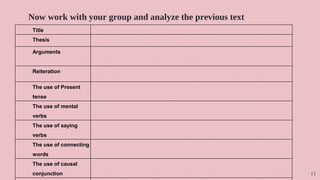
Now work with your group and analyze the previous text
13
Title
Thesis
Arguments
Reiteration
The use of Present
tense
The use of mental
verbs
The use of saying
verbs
The use of connecting
words
The use of causal
conjunction
Review’s Time
Analytical
Exposition
Text Purpose
To persuade the audience/readers that
there is something that certainly needs to
get attention. It’s written from the writer’s
perspective.
The arguments and point of view have to
be supported by facts and relevant
information.
15
Generic
Structure
▹ Thesis
The starting point of
an exposition text
essay. Here you state
the topic and
establish the point of
view
▹ Arguments
Supporting the
thesis. Each
paragraph starts with
a new argument.
Each paragraph has
the main point and
its elaboration (a
reason for the main
point and evidence to
support it)
▹ Reiteration
Reiterating or
restarting the topic of
the thesis. You may
also
summarize/conclude
what has been stated.
16
Language
Features
▹ Present tenses, such as ‘Online shopping is
easy’, refunds are your friends…
▹ Use mental verbs such as I believe, I doubt….
▹ Verbal/saying words to support the arguments,
such as People say that…, it is said that…
▹ Use modality , such as might, may, can, will
and should
17
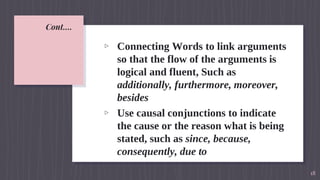
Cont….
▹ Connecting Words to link arguments
so that the flow of the arguments is
logical and fluent, Such as
additionally, furthermore, moreover,
besides
▹ Use causal conjunctions to indicate
the cause or the reason what is being
stated, such as since, because,
consequently, due to
18
Thank you

PPT ANALITYCAL EXPOSITION MATERI KURIKULUM MERDEKA

  • 1.
    Analytical Exposition Text Bahasa InggrisKelas X Semester Ganjil Mery Rahayu Ningtriyas,S.Pd
  • 2.
    Learning Objectives 1. Identify thesocial function of Analytical Exposition Text 2. Identify the generic structure of Analytical Exposition Text 3. Identify the language features of Analytical Exposition Text 4. Rearrange some paragraphs into a good analytical exposition text 5. Find detailed information in an analytical exposition text 6. Imply the moral value of an analytical exposition text You will also have to develop your critical thinking and problem solving, creativity,collaborative and communication skill by doing some activities with your group 2
  • 3.
    Hello! 1.1. How doyou call the pictures above? 2.2. Is there any one of your favorite food on that picture? 3.3. What is that? 4.4. How often do you eat it? 5.5. Why do you really like it? 3
  • 4.
    Transition headline Let’s startwith the first set of slides 4
  • 5.
    “ . 5 1. What doyou think of the video? 2. What information did you get from the video? 3. What diseases may you get if you don’t stop eating junk food?
  • 6.
    What will we dotoday? 1. Work the student’s Worksheet with your group 2. Upload it in Class Dojo Platform 3. Get feedback from the teacher 6
  • 7.
    Nowadays, people’s livetend to be busier, so that they don’t have much time to prepare their own meals. In this situation, they usually rely on more instant ways to obtain their daily nutrition, such as fast food. Despite its practicality, fast food can be harmful to your body, when it consumed constantly. Moreover, the damage that junk food does is not limited to the body since it also affects the brain function. There are several ways junk food can disrupt the function of the brain 7
  • 8.
    Firstly, it cancause memory and learning problems. The constant consumption of junk food can weaken your memory. Poor toxic diet causes some chemical reactions that can inflate the hippocampus area of the brain. This particular part of the brain is associated with special recognition and memory. Moreover, high sugar and fat diet slow down BDNF (brain-derived neurotrophic factor) that helps with the formation of memory and learning as well. Consuming too many calories interfere with the production and the function of synapses. 8
  • 9.
    Junk food consumptioncan also alter chemical compounds in the body that can lead to depression. A lot of research has shown that consuming food in high in sugar and fat can actually alter the chemical activities in the brain. Eventually, it leads a dependency on such food. Research has shown that conducted at the University of Montreal shows that lab rats suffered from withdrawals symptoms after they were no longer given junk food. In the case of humans, such withdrawal can make us unable to deal with stress, feel depressed, and turn back to that kind of food or comfort. It will be like an endless cycle, without us realizing it. Furthermore, fast food consumption can also lead to the loss of essential nutrients, such as amino acid tryptophan, that can stimulate feelings of depression. 9
  • 10.
    In conclusion, theconsumption of junk food can affect the body’s health, including the brain. Eating junk food can cause memory and learning problems, and it can also lead to depression 10
  • 11.
    Activity 1 1. Accordingto the text, what causes people to choose junk food over self prepared meals? 2. How can junk food lead to memory loss? 3. What does BDNF do? 11 Answer the question based on the text above
  • 12.
    4. What doesjunk food do to the chemical activities in the brain? 5. What happened to the lab rats when the researchers stopped giving them junk food? 6. What will happen to our mental state if we lack essential nutrients? 7. What can we learn from the text? 12
  • 13.
    Now work withyour group and analyze the previous text 13 Title Thesis Arguments Reiteration The use of Present tense The use of mental verbs The use of saying verbs The use of connecting words The use of causal conjunction
  • 14.
  • 15.
    Analytical Exposition Text Purpose To persuadethe audience/readers that there is something that certainly needs to get attention. It’s written from the writer’s perspective. The arguments and point of view have to be supported by facts and relevant information. 15
  • 16.
    Generic Structure ▹ Thesis The startingpoint of an exposition text essay. Here you state the topic and establish the point of view ▹ Arguments Supporting the thesis. Each paragraph starts with a new argument. Each paragraph has the main point and its elaboration (a reason for the main point and evidence to support it) ▹ Reiteration Reiterating or restarting the topic of the thesis. You may also summarize/conclude what has been stated. 16
  • 17.
    Language Features ▹ Present tenses,such as ‘Online shopping is easy’, refunds are your friends… ▹ Use mental verbs such as I believe, I doubt…. ▹ Verbal/saying words to support the arguments, such as People say that…, it is said that… ▹ Use modality , such as might, may, can, will and should 17
  • 18.
    Cont…. ▹ Connecting Wordsto link arguments so that the flow of the arguments is logical and fluent, Such as additionally, furthermore, moreover, besides ▹ Use causal conjunctions to indicate the cause or the reason what is being stated, such as since, because, consequently, due to 18
  • 19.