PERFORMANCE APPRAISAL &
MANAGEMENT
Course Facilitator: Sir Ranjeet Kumar
Presented By: Maria Shaheen
Nonfinancial Performance Measurement
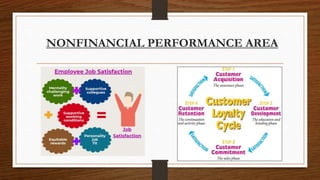
NONFINANCIAL PERFORMANCE AREA
MISTAKES
1)Not Linking Measures to Strategy
companies that create causal models
rarely go on to prove that actual
improvements in nonfinancial
performance measures affect future
financial results
2) Not Validating the Links
the goal of a performance measurement
system is to help direct the allocation of
resources, to assess and communicate
progress toward strategic objectives, or to
evaluate managerial performance, a major
challenge for companies is determining
which of the hundreds, if not thousands, of
nonfinancial measures to track
MISTAKES
4)Measuring Incorrectly
companies that build a valid causal
model and track the right elements
can fall down when determining
how to measure them. At least 70%
of companies, we found, employ
metrics that lack statistical validity.
4) Not Setting the Right
Performance Targets
Target setting is inherently difficult
because it always takes awhile for
improvements in a driver of
corporate performance to produce
improvements in the performance
it’s meant to affect.
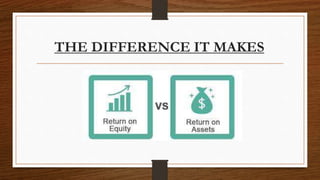
THE DIFFERENCE IT MAKES
DOING IT RIGHT
• Develop a causal model.
The first step is to develop a causal model based on the hypotheses in the strategic
plan. Unfortunately, however, many companies’ strategic plans are more like
mission or vision statements than road maps.
DOING IT RIGHT
• Pull together the data.
Most companies already track large numbers of nonfinancial measures in their
day-to-day operations. So to avoid going to the trouble of collecting data that
already exist, companies should take careful inventory of all their databases.
This inventory should not limit itself to performance measurement systems but
should extend to any information systems (such as purchasing, manufacturing
control, and customer service) that may contain useful data
DOING IT RIGHT
• There are many statistical methods for testing the causal model. Most
companies have experience using correlation analyses and multiple
regressions in their market research and quality improvement efforts.

PPT 2 Nonfinancial Performance Measurement.pptx

  • 1.
    PERFORMANCE APPRAISAL & MANAGEMENT CourseFacilitator: Sir Ranjeet Kumar Presented By: Maria Shaheen Nonfinancial Performance Measurement
  • 2.
  • 3.
    MISTAKES 1)Not Linking Measuresto Strategy companies that create causal models rarely go on to prove that actual improvements in nonfinancial performance measures affect future financial results 2) Not Validating the Links the goal of a performance measurement system is to help direct the allocation of resources, to assess and communicate progress toward strategic objectives, or to evaluate managerial performance, a major challenge for companies is determining which of the hundreds, if not thousands, of nonfinancial measures to track
  • 4.
    MISTAKES 4)Measuring Incorrectly companies thatbuild a valid causal model and track the right elements can fall down when determining how to measure them. At least 70% of companies, we found, employ metrics that lack statistical validity. 4) Not Setting the Right Performance Targets Target setting is inherently difficult because it always takes awhile for improvements in a driver of corporate performance to produce improvements in the performance it’s meant to affect.
  • 6.
  • 7.
    DOING IT RIGHT •Develop a causal model. The first step is to develop a causal model based on the hypotheses in the strategic plan. Unfortunately, however, many companies’ strategic plans are more like mission or vision statements than road maps.
  • 8.
    DOING IT RIGHT •Pull together the data. Most companies already track large numbers of nonfinancial measures in their day-to-day operations. So to avoid going to the trouble of collecting data that already exist, companies should take careful inventory of all their databases. This inventory should not limit itself to performance measurement systems but should extend to any information systems (such as purchasing, manufacturing control, and customer service) that may contain useful data
  • 9.
    DOING IT RIGHT •There are many statistical methods for testing the causal model. Most companies have experience using correlation analyses and multiple regressions in their market research and quality improvement efforts.