Course Handout
Date: 21/10/2022
Course No. : A53026
Course Title : Python Programming
Course Coordinator : Ms. V.Jyothi
1.Syllabus:
B. Tech III Year II Semester Dept. of Computer Science and
Engineering
Code Category
Hours /
Week
Credits Marks
A53026 PCC
L T P C CIE SEE Total
3 0 0 2 40 60 100
Prerequisites:
None
Course objectives
1. Understand the basics and function of Python Programming Language.
2. Understand the string operation and sequences used in Python Programming Languages.
3.Understand the data structures used in Python Programming Languages.
4. Know the classes and objects in Python Programming Language.
5.Use the reusability concepts in Python Programming Language.
Course Outcomes:
1.Apply control structures, functions and packages in Problem Solving. (L3)
2.Analyze various String handling functions and data structures(L4)
3.Model the object-oriented problems with classes and objects (L4)
4.Solve the problems by using Inheritance and polymorphism (L3)
5.Illustrate programs on Exception Handling and various packages(L3)
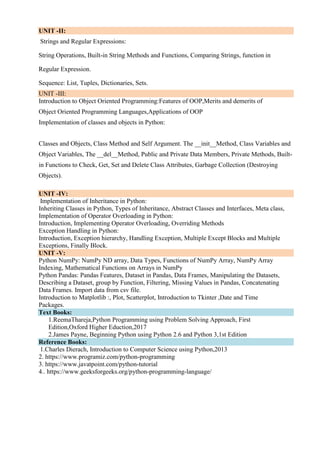
UNIT -I:
Introduction to Python:
Features of Python Language, Data Types, Operators, Expressions, Control Statement, Standard
I/O Operations.
Functions and Modules:
Declaration and Definition Function Calling, More on Defining Functions, Recursive Functions,
Modules, Packages in Python, Doc Strings.
UNIT -II:
Strings and Regular Expressions:
String Operations, Built-in String Methods and Functions, Comparing Strings, function in
Regular Expression.
Sequence: List, Tuples, Dictionaries, Sets.
UNIT -III:
Introduction to Object Oriented Programming:Features of OOP,Merits and demerits of
Object Oriented Programming Languages,Applications of OOP
Implementation of classes and objects in Python:
Classes and Objects, Class Method and Self Argument. The __init__Method, Class Variables and
Object Variables, The __del__Method, Public and Private Data Members, Private Methods, Built-
in Functions to Check, Get, Set and Delete Class Attributes, Garbage Collection (Destroying
Objects).
UNIT -IV:
Implementation of Inheritance in Python:
Inheriting Classes in Python, Types of Inheritance, Abstract Classes and Interfaces, Meta class,
Implementation of Operator Overloading in Python:
Introduction, Implementing Operator Overloading, Overriding Methods
Exception Handling in Python:
Introduction, Exception hierarchy, Handling Exception, Multiple Except Blocks and Multiple
Exceptions, Finally Block.
UNIT -V:
Python NumPy: NumPy ND array, Data Types, Functions of NumPy Array, NumPy Array
Indexing, Mathematical Functions on Arrays in NumPy
Python Pandas: Pandas Features, Dataset in Pandas, Data Frames, Manipulating the Datasets,
Describing a Dataset, group by Function, Filtering, Missing Values in Pandas, Concatenating
Data Frames. Import data from csv file.
Introduction to Matplotlib :, Plot, Scatterplot, Introduction to Tkinter ,Date and Time
Packages.
Text Books:
1.ReemaThareja,Python Programming using Problem Solving Approach, First
Edition,Oxford Higher Eduction,2017
2.James Payne, Beginning Python using Python 2.6 and Python 3,1st Edition
Reference Books:
1.Charles Dierach, Introduction to Computer Science using Python,2013
2. https://www.programiz.com/python-programming
3. https://www.javatpoint.com/python-tutorial
4.. https://www.geeksforgeeks.org/python-programming-language/
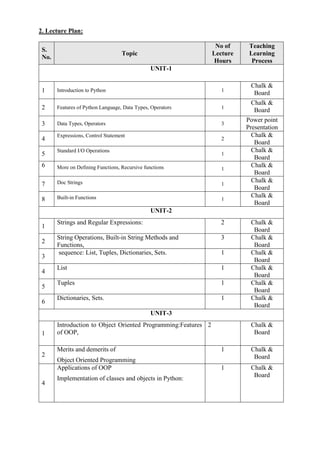
2. Lecture Plan:
S.
No.
Topic
No of
Lecture
Hours
Teaching
Learning
Process
UNIT-1
1 Introduction to Python 1
Chalk &
Board
2 Features of Python Language, Data Types, Operators 1
Chalk &
Board
3 Data Types, Operators 3
Power point
Presentation
4
Expressions, Control Statement
2
Chalk &
Board
5
Standard I/O Operations
1
Chalk &
Board
6 More on Defining Functions, Recursive functions 1
Chalk &
Board
7 Doc Strings 1
Chalk &
Board
8 Built-in Functions 1
Chalk &
Board
UNIT-2
1
Strings and Regular Expressions: 2 Chalk &
Board
2
String Operations, Built-in String Methods and
Functions,
3 Chalk &
Board
3
sequence: List, Tuples, Dictionaries, Sets. 1 Chalk &
Board
4
List 1 Chalk &
Board
5
Tuples 1 Chalk &
Board
6
Dictionaries, Sets. 1 Chalk &
Board
UNIT-3
1
Introduction to Object Oriented Programming:Features
of OOP,
2 Chalk &
Board
2
Merits and demerits of
Object Oriented Programming
1 Chalk &
Board
4
Applications of OOP
Implementation of classes and objects in Python:
1 Chalk &
Board
5
Class Method and Self Argument. __init__Method,
del__Method
1 Chalk &
Board
Public and Private Data Members, Private Methods, 1 Chalk &
Board
6
Built- in Functions to Check, Get, Set and Delete Class
Attributes, Garbage Collection (Destroying
Objects).
2 Chalk &
Board
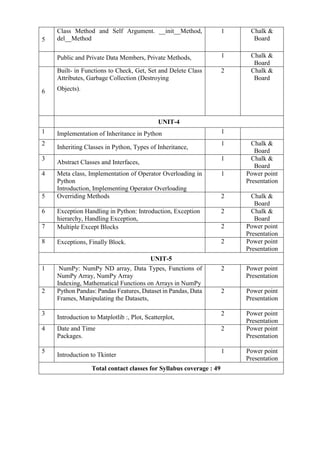
UNIT-4
1 Implementation of Inheritance in Python 1
2
Inheriting Classes in Python, Types of Inheritance,
1 Chalk &
Board
3
Abstract Classes and Interfaces,
1 Chalk &
Board
4 Meta class, Implementation of Operator Overloading in
Python
Introduction, Implementing Operator Overloading
1 Power point
Presentation
5 Overriding Methods 2 Chalk &
Board
6 Exception Handling in Python: Introduction, Exception
hierarchy, Handling Exception,
2 Chalk &
Board
7 Multiple Except Blocks 2 Power point
Presentation
8 Exceptions, Finally Block. 2 Power point
Presentation
UNIT-5
1 NumPy: NumPy ND array, Data Types, Functions of
NumPy Array, NumPy Array
Indexing, Mathematical Functions on Arrays in NumPy
2 Power point
Presentation
2 Python Pandas: Pandas Features, Dataset in Pandas, Data
Frames, Manipulating the Datasets,
2 Power point
Presentation
3
Introduction to Matplotlib :, Plot, Scatterplot,
2 Power point
Presentation
4 Date and Time
Packages.
2 Power point
Presentation
5
Introduction to Tkinter
1 Power point
Presentation
Total contact classes for Syllabus coverage : 49
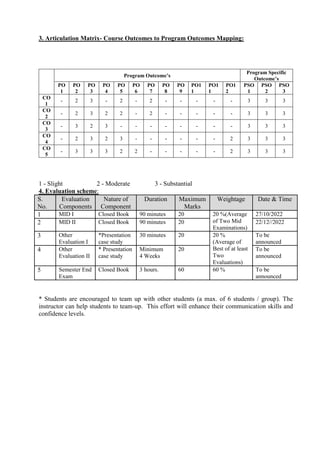
3. Articulation Matrix- Course Outcomes to Program Outcomes Mapping:
Program Outcome’s
Program Specific
Outcome’s
PO
1
PO
2
PO
3
PO
4
PO
5
PO
6
PO
7
PO
8
PO
9
PO1
1
PO1
1
PO1
2
PSO
1
PSO
2
PSO
3
CO
1
- 2 3 - 2 - 2 - - - - - 3 3 3
CO
2
- 2 3 2 2 - 2 - - - - - 3 3 3
CO
3
- 3 2 3 - - - - - - - - 3 3 3
CO
4
- 2 3 2 3 - - - - - - 2 3 3 3
CO
5
- 3 3 3 2 2 - - - - - 2 3 3 3
1 - Slight 2 - Moderate 3 - Substantial
4. Evaluation scheme:
S.
No.
Evaluation
Components
Nature of
Component
Duration Maximum
Marks
Weightage Date & Time
1 MID I Closed Book 90 minutes 20 20 %(Average
of Two Mid
Examinations)
27/10/2022
2 MID II Closed Book 90 minutes 20 22/12//2022
3 Other
Evaluation I
*Presentation
case study
30 minutes 20 20 %
(Average of
Best of at least
Two
Evaluations)
To be
announced
4 Other
Evaluation II
* Presentation
case study
Minimum
4 Weeks
20 To be
announced
5 Semester End
Exam
Closed Book 3 hours. 60 60 % To be
announced
* Students are encouraged to team up with other students (a max. of 6 students / group). The
instructor can help students to team-up. This effort will enhance their communication skills and
confidence levels.

pp hand out (1).doc

  • 1.
    Course Handout Date: 21/10/2022 CourseNo. : A53026 Course Title : Python Programming Course Coordinator : Ms. V.Jyothi 1.Syllabus: B. Tech III Year II Semester Dept. of Computer Science and Engineering Code Category Hours / Week Credits Marks A53026 PCC L T P C CIE SEE Total 3 0 0 2 40 60 100 Prerequisites: None Course objectives 1. Understand the basics and function of Python Programming Language. 2. Understand the string operation and sequences used in Python Programming Languages. 3.Understand the data structures used in Python Programming Languages. 4. Know the classes and objects in Python Programming Language. 5.Use the reusability concepts in Python Programming Language. Course Outcomes: 1.Apply control structures, functions and packages in Problem Solving. (L3) 2.Analyze various String handling functions and data structures(L4) 3.Model the object-oriented problems with classes and objects (L4) 4.Solve the problems by using Inheritance and polymorphism (L3) 5.Illustrate programs on Exception Handling and various packages(L3) UNIT -I: Introduction to Python: Features of Python Language, Data Types, Operators, Expressions, Control Statement, Standard I/O Operations. Functions and Modules: Declaration and Definition Function Calling, More on Defining Functions, Recursive Functions, Modules, Packages in Python, Doc Strings.
  • 2.
    UNIT -II: Strings andRegular Expressions: String Operations, Built-in String Methods and Functions, Comparing Strings, function in Regular Expression. Sequence: List, Tuples, Dictionaries, Sets. UNIT -III: Introduction to Object Oriented Programming:Features of OOP,Merits and demerits of Object Oriented Programming Languages,Applications of OOP Implementation of classes and objects in Python: Classes and Objects, Class Method and Self Argument. The __init__Method, Class Variables and Object Variables, The __del__Method, Public and Private Data Members, Private Methods, Built- in Functions to Check, Get, Set and Delete Class Attributes, Garbage Collection (Destroying Objects). UNIT -IV: Implementation of Inheritance in Python: Inheriting Classes in Python, Types of Inheritance, Abstract Classes and Interfaces, Meta class, Implementation of Operator Overloading in Python: Introduction, Implementing Operator Overloading, Overriding Methods Exception Handling in Python: Introduction, Exception hierarchy, Handling Exception, Multiple Except Blocks and Multiple Exceptions, Finally Block. UNIT -V: Python NumPy: NumPy ND array, Data Types, Functions of NumPy Array, NumPy Array Indexing, Mathematical Functions on Arrays in NumPy Python Pandas: Pandas Features, Dataset in Pandas, Data Frames, Manipulating the Datasets, Describing a Dataset, group by Function, Filtering, Missing Values in Pandas, Concatenating Data Frames. Import data from csv file. Introduction to Matplotlib :, Plot, Scatterplot, Introduction to Tkinter ,Date and Time Packages. Text Books: 1.ReemaThareja,Python Programming using Problem Solving Approach, First Edition,Oxford Higher Eduction,2017 2.James Payne, Beginning Python using Python 2.6 and Python 3,1st Edition Reference Books: 1.Charles Dierach, Introduction to Computer Science using Python,2013 2. https://www.programiz.com/python-programming 3. https://www.javatpoint.com/python-tutorial 4.. https://www.geeksforgeeks.org/python-programming-language/
  • 3.
    2. Lecture Plan: S. No. Topic Noof Lecture Hours Teaching Learning Process UNIT-1 1 Introduction to Python 1 Chalk & Board 2 Features of Python Language, Data Types, Operators 1 Chalk & Board 3 Data Types, Operators 3 Power point Presentation 4 Expressions, Control Statement 2 Chalk & Board 5 Standard I/O Operations 1 Chalk & Board 6 More on Defining Functions, Recursive functions 1 Chalk & Board 7 Doc Strings 1 Chalk & Board 8 Built-in Functions 1 Chalk & Board UNIT-2 1 Strings and Regular Expressions: 2 Chalk & Board 2 String Operations, Built-in String Methods and Functions, 3 Chalk & Board 3 sequence: List, Tuples, Dictionaries, Sets. 1 Chalk & Board 4 List 1 Chalk & Board 5 Tuples 1 Chalk & Board 6 Dictionaries, Sets. 1 Chalk & Board UNIT-3 1 Introduction to Object Oriented Programming:Features of OOP, 2 Chalk & Board 2 Merits and demerits of Object Oriented Programming 1 Chalk & Board 4 Applications of OOP Implementation of classes and objects in Python: 1 Chalk & Board
  • 4.
    5 Class Method andSelf Argument. __init__Method, del__Method 1 Chalk & Board Public and Private Data Members, Private Methods, 1 Chalk & Board 6 Built- in Functions to Check, Get, Set and Delete Class Attributes, Garbage Collection (Destroying Objects). 2 Chalk & Board UNIT-4 1 Implementation of Inheritance in Python 1 2 Inheriting Classes in Python, Types of Inheritance, 1 Chalk & Board 3 Abstract Classes and Interfaces, 1 Chalk & Board 4 Meta class, Implementation of Operator Overloading in Python Introduction, Implementing Operator Overloading 1 Power point Presentation 5 Overriding Methods 2 Chalk & Board 6 Exception Handling in Python: Introduction, Exception hierarchy, Handling Exception, 2 Chalk & Board 7 Multiple Except Blocks 2 Power point Presentation 8 Exceptions, Finally Block. 2 Power point Presentation UNIT-5 1 NumPy: NumPy ND array, Data Types, Functions of NumPy Array, NumPy Array Indexing, Mathematical Functions on Arrays in NumPy 2 Power point Presentation 2 Python Pandas: Pandas Features, Dataset in Pandas, Data Frames, Manipulating the Datasets, 2 Power point Presentation 3 Introduction to Matplotlib :, Plot, Scatterplot, 2 Power point Presentation 4 Date and Time Packages. 2 Power point Presentation 5 Introduction to Tkinter 1 Power point Presentation Total contact classes for Syllabus coverage : 49
  • 5.
    3. Articulation Matrix-Course Outcomes to Program Outcomes Mapping: Program Outcome’s Program Specific Outcome’s PO 1 PO 2 PO 3 PO 4 PO 5 PO 6 PO 7 PO 8 PO 9 PO1 1 PO1 1 PO1 2 PSO 1 PSO 2 PSO 3 CO 1 - 2 3 - 2 - 2 - - - - - 3 3 3 CO 2 - 2 3 2 2 - 2 - - - - - 3 3 3 CO 3 - 3 2 3 - - - - - - - - 3 3 3 CO 4 - 2 3 2 3 - - - - - - 2 3 3 3 CO 5 - 3 3 3 2 2 - - - - - 2 3 3 3 1 - Slight 2 - Moderate 3 - Substantial 4. Evaluation scheme: S. No. Evaluation Components Nature of Component Duration Maximum Marks Weightage Date & Time 1 MID I Closed Book 90 minutes 20 20 %(Average of Two Mid Examinations) 27/10/2022 2 MID II Closed Book 90 minutes 20 22/12//2022 3 Other Evaluation I *Presentation case study 30 minutes 20 20 % (Average of Best of at least Two Evaluations) To be announced 4 Other Evaluation II * Presentation case study Minimum 4 Weeks 20 To be announced 5 Semester End Exam Closed Book 3 hours. 60 60 % To be announced * Students are encouraged to team up with other students (a max. of 6 students / group). The instructor can help students to team-up. This effort will enhance their communication skills and confidence levels.